Market Minds Advisory
Western Europe Electric Sub-Meter Market

Western Europe Electric Sub-Meter Market: Legal Metrology, Charge Point Billing, And Points That Never Existed

A sub-meter is the only instrument in a building whose reading somebody may eventually dispute in court. That single fact, not the electronics, decides who is allowed to sell one here.

Lead Analyst

David Horsley

Published

September 2026

Make Smarter Decisions with Customized Research Insights

Request a free sample report and evaluate market opportunities, growth trends, and competitive dynamics relevant to your business needs.

2025 MARKET VALUE$0.9BMarket Size 2025
2036 FORECAST VALUE$2.2BBase Case , 2026 to 2036
CAGR 2026 TO 20368.4 %Bull 9.7% / Bear 7.1%
INCREMENTAL OPPORTUNITY$1.2BNet 10- year value creation
EXPANSION MULTIPLE2.24x2036 value over 2026 base
Strategic Levers
M&A Pipeline
Regional Outlook
Country Rankings
Competitive Intelligence
Segmental Deep-dive
Call-Us : 91 93563 13602

Executive Snapshot and Market Trajectory

The moment a meter reading becomes the basis of a bill between two private parties, it needs legal metrology conformity, and that requirement rather than the electronics decides who may supply. The market reaches USD 0.9 billion in 2025 and grows at 8.4%. Certification is the whole commercial structure here.
EV charge point meters grow fastest at 16.8%, exactly twice the market rate, because a kilowatt hour sold at a charge point must be measured by a conformity-assessed device and Europe is installing those points at pace. Western Europe holds 79% of value, far outside the band this framework applies, because the market is scoped to the region. Eastern Europe takes 8%.
Concentration runs at 41%, held there by conformity assessment portfolios rather than by manufacturing capability, since a DIN rail meter is not difficult to build. Competition turns on which certifications a product carries and which protocols it speaks. Certified units already represent 58% of volume, and that share rises with every new billing obligation. Every new billing obligation converts monitoring points into billing ones. Certified and monitoring products are not substitutes in law.
Market Definition
The Western Europe electric sub-meter market covers electricity meters installed downstream of the utility revenue meter to measure consumption by tenant, circuit, equipment, or charge point, together with the communication modules supplied with them. It spans conformity-assessed billing meters and monitoring-only devices across direct connected, transformer operated, socket, and charge point formats. Utility revenue meters, gas, water and heat metering, power quality analysers, protection relays, and building management software are excluded.
Base Year Value
$0.9B in 2025 (MMA Primary Research Dataset, August 2026)
Forecast Period
2026 to 2036, eleven discrete annual values
CAGR
8.4% base case. Bull 9.7%. Bear 7.1%.
Fastest Growth Segment
EV Charge Point Meters: 16.8% CAGR
Fastest Growth Country
Germany: 9.6% CAGR
Fastest Growth Region
South Asia and Pacific: 10.4% CAGR
Largest Region
Western Europe: 79% of 2025 global value
Market Leaders
Schneider Electric, Siemens, ABB, Socomec, Janitza electronics. Source: MMA Primary Research Dataset, July 2026.
Primary Survey
n=3,800 procurement and R&D decision-makers, Q4 2025, six countries
Methodology
Demand-side build-up, cross-validated against public data, 47 expert interviews

Western Europe Electric Sub-Meter Market Forecast Scenarios

electric-sub-meter-market-in-western-europe-size-forecast-scenario-1787334257644
Between 2020 and 2025 the number of metering points in European buildings rose faster than the buildings did. Energy efficiency rules pushed individual metering into multi-apartment residential stock, non-residential automation requirements added circuit level measurement, and charge point installation created billing points that had no equivalent before. Energy prices made the case for everybody. A 7.2% historical CAGR reflects points multiplying rather than any change in what a meter costs.
Three mechanisms carry the 8.4% base case. Charge point billing is the largest, since every point selling electricity needs a conformity-assessed meter and installation continues at pace across the region. Building automation requirements in non-residential property are the second, because measuring at circuit level is how any control system knows what is happening. And individual metering obligations in multi-apartment buildings keep converting shared supplies into separately measured ones on national timetables.
The 9.7% bull case turns on charge point rollout accelerating toward the targets set rather than the pace historically delivered. The 7.1% bear case is construction weakness reaching new installation demand while retrofit obligations continue regardless. Neither scenario concerns the meter itself, and both are decided by policy timetables published years ahead of the demand they create.

An Instrument Whose Reading Can Be Contested

Everything in this market follows from one distinction. A meter used to inform somebody about their consumption can be any device that measures accurately. A meter used to bill one private party on behalf of another is a legal metrology instrument, and in Europe that means conformity assessment, national approval, and a chain of accountability behind every reading. The electronics are identical. The legal standing is not.
TOP FIVE CONCENTRATION41%Certification portfolios narrow the field more than manufacturing does
AVERAGE METER PRICEUSD 96Blended across billing certified and monitoring only meter classes
CERTIFIED UNIT SHARE58%Portion requiring legal metrology conformity for billing between parties
METER SERVICE LIFE12 to 16 yearsOperating years before recalibration or replacement becomes legally necessary
POINTS PER BUILDINGOver 34Average metering points in a modern non-residential building
LEADING PRODUCER SHARE44%Manufacturing concentrates where legal metrology approval expertise developed
That distinction is worth roughly double in price and considerably more in defensibility. Certified units are 58% of volume and rising, because each new billing obligation converts monitoring points into billing points. A manufacturer without the certification portfolio is not competing on price against one that has it, since the two products are not substitutes in law.
Point count is what actually drives the market. A modern non-residential building now carries over 34 metering points where it once had one, spread across tenants, circuits, charge points, and plant. The meter has become cheap and numerous rather than expensive and singular, which changes how it is sold, installed, and communicated with entirely. Selling one meter at a time misses what is actually being bought.
"People describe this as a commodity because the device costs under a hundred euros. It is not a commodity. It is a legal instrument that happens to be inexpensive, and the difference between those two things is worth an entire business model."
Director, Energy Measurement Practice · MMA Energy Practice ·

Market Trends

Charge Point Billing Creates An Entirely New Meter Population

Selling electricity at a charge point is a commercial transaction measured by an instrument, which in Germany under national calibration law and increasingly elsewhere means a conformity-assessed measuring capsule with tamper protection and a verifiable data chain. Every public and semi-public point installed adds a billing meter that did not exist five years ago, and Europe is installing them at pace under infrastructure regulation. The requirement also reaches workplace and destination charging wherever the electricity is resold rather than provided. The segment grows at 16.8%, exactly twice the market, and the certification barrier is unusually high.
Market Impact: Obligations reach 40 million dwelli
Building Automation Requirements Push Metering To Circuit Level

Non-residential buildings above a threshold must now carry automation and control capability that monitors, logs, and analyses energy use, and no control system can do any of that without measurement at circuit level rather than at the incoming supply. That converts a building with one meter into a building with dozens, and the meters are specified by a controls integrator rather than by an electrical contractor. Communication protocol support matters more than accuracy class in these applications. Installed point counts now run above 34 in a modern non-residential building and keep climbing.
Market Impact: Allocation errors reach 30 percent

Market Opportunities and Growth Drivers

Individual Metering Obligations Reach Existing Residential Stock

European energy efficiency rules require individual consumption metering and informative billing in multi-apartment buildings where technically feasible and cost effective, and national implementations have progressively narrowed the exemptions. That reaches an installed residential population built long before anybody metered by apartment. Retrofit installation in occupied buildings favours compact devices, wireless communication, and installers who can work without rewiring. The obligation arrives on national timetables published years ahead, which makes the demand unusually predictable for anybody who reads the implementing legislation rather than the market forecasts. Predictable demand is rare and this is some.
Market Impact: Assessment costs over 300 thousand

Energy Cost Makes Allocation Worth Arguing About

When electricity was cheap, a landlord allocating cost by floor area caused no argument worth the metering investment. At current prices the difference between allocated and actual consumption is large enough that tenants question it and landlords want defensible numbers. That converts sub-metering from an administrative nicety into a commercial necessity in exactly the buildings that avoided it longest. Certified meters are required because the resulting figure appears on an invoice between two parties. The argument is financial rather than environmental, which is why it moves faster. Financial arguments move faster than environmental ones.
Market Impact: 4 protocol families compete per pro

Market Restraints and Challenges

Conformity Assessment Costs Exclude Smaller Manufacturers

A billing meter requires conformity assessment under European measuring instruments rules, national approvals where they apply, and periodic recertification, which together represent a fixed cost falling hardest on manufacturers without scale. The root cause is that legal metrology is a public trust regime rather than a product standard, so the burden is deliberate. Commercially this concentrates the certified half of the market while the monitoring half stays fragmented. Manufacturers are mitigating by certifying platform designs across many variants rather than certifying models individually, which spreads the cost considerably. The burden is deliberate rather than accidental.
Market Impact: Charge point meters grow at 16.8%

Communication Protocol Fragmentation Slows Every Installation

Sub-meters must talk to building systems, billing platforms, and increasingly to charge point operators, across M-Bus, Modbus, wireless M-Bus, and several long-range radio protocols that nobody has harmonised. The root cause is that metering evolved separately from building controls and each installed base defends its own convention. Commercially this adds integration cost to every project and creates a reason for a specifier to reuse whatever is already installed. Manufacturers are mitigating with multi-protocol devices, gateway products, and open data model support that reduces the integration burden. Integration cost lands on the project every time.
Market Impact: Buildings now carry over 34 points
3 additional market trends, 4 additional growth drivers, and 2 additional restraints and challenges are covered in the full report. Contact sales@marketmindsadvisory.com to access the complete intelligence.

Segment CAGR and Growth Architecture

Segmentation follows measurement point, meaning where in an installation the meter sits and whose consumption it records, because that determines whether legal metrology conformity applies, who specifies the device, and what communication it must support. Meter format, accuracy class, and communication protocol are handled in the framework and commentary instead. That distinction decides more than anything technical does.
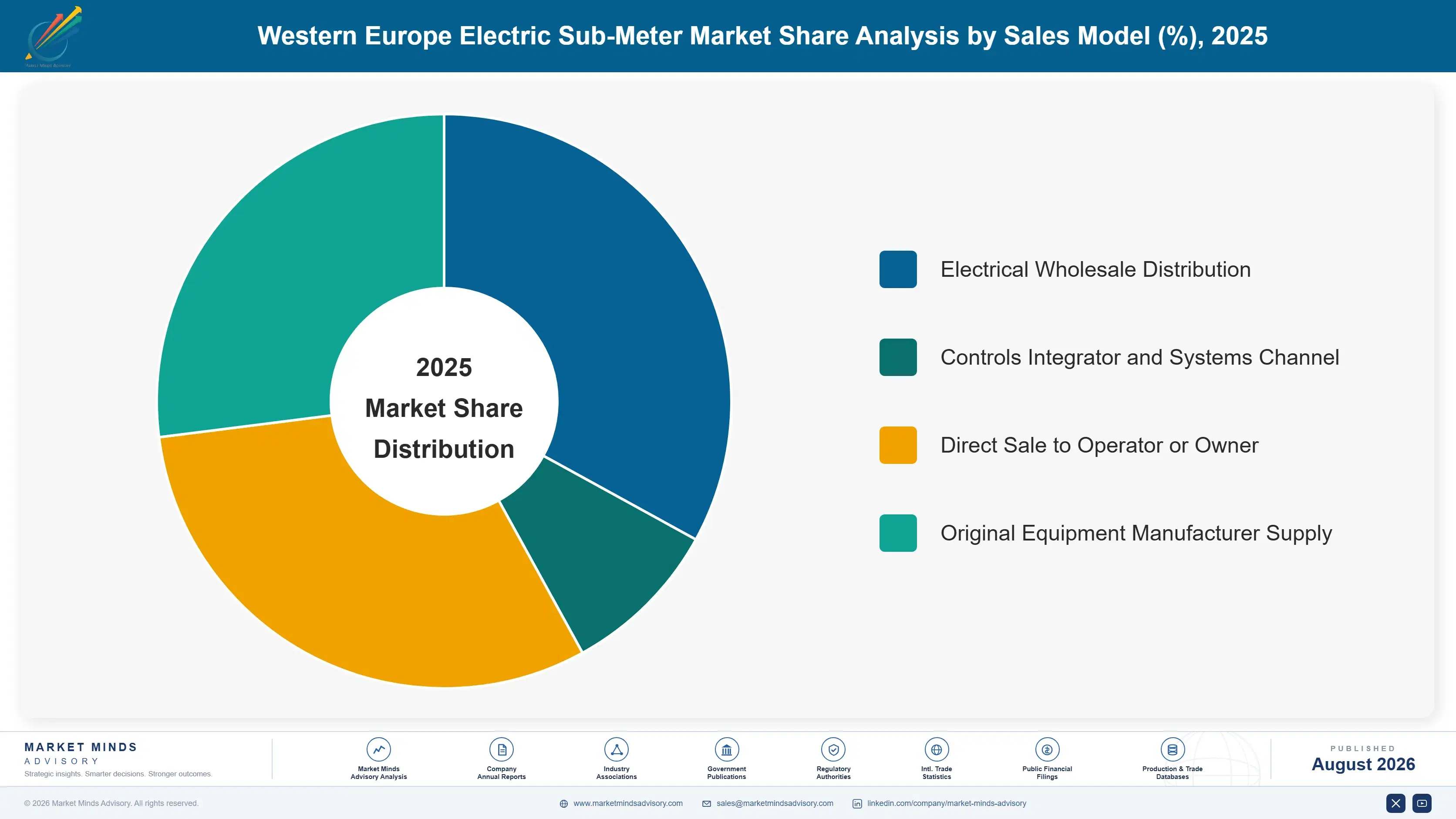
electric-sub-meter-market-in-western-europe-market-share-analysis-1787334258178

EV Charge Point Meters

Charge point metering grows fastest at 16.8%, exactly twice the market rate, and legal metrology rather than electrification explains the price and the barrier. Electricity sold at a point is a commercial transaction, so the measuring device requires conformity assessment, tamper protection, and a verifiable chain from measurement to invoice, which German calibration law enforces more strictly than anywhere and other markets are following. Alternating and direct current points carry different requirements, and direct current measurement at high power is genuinely difficult to certify. Every point installed under European infrastructure regulation adds a meter that had no predecessor. Certification rather than manufacturing decides who supplies this segment at all. Nothing else in this market has that barrier.
CAGR 16.8%

Circuit and Panel Level Meters

Circuit and panel metering grows at 9.6% on building automation requirements rather than on billing. Non-residential buildings above a size threshold must now monitor, log, and analyse energy use, and no control system does any of that without measurement below the incoming supply. These meters are usually specified by a controls integrator rather than an electrical contractor, which changes both the buying process and what matters in the product. Communication protocol breadth and data model support outweigh accuracy class here, since the reading informs a control decision rather than an invoice. Point counts per building keep rising as thresholds tighten and automation scope widens across the region. A different buyer entirely from the billing side.
CAGR 9.6%
Full segment breakdown across 7 segments available in the complete report.

Regional Architecture and Country Demand Map

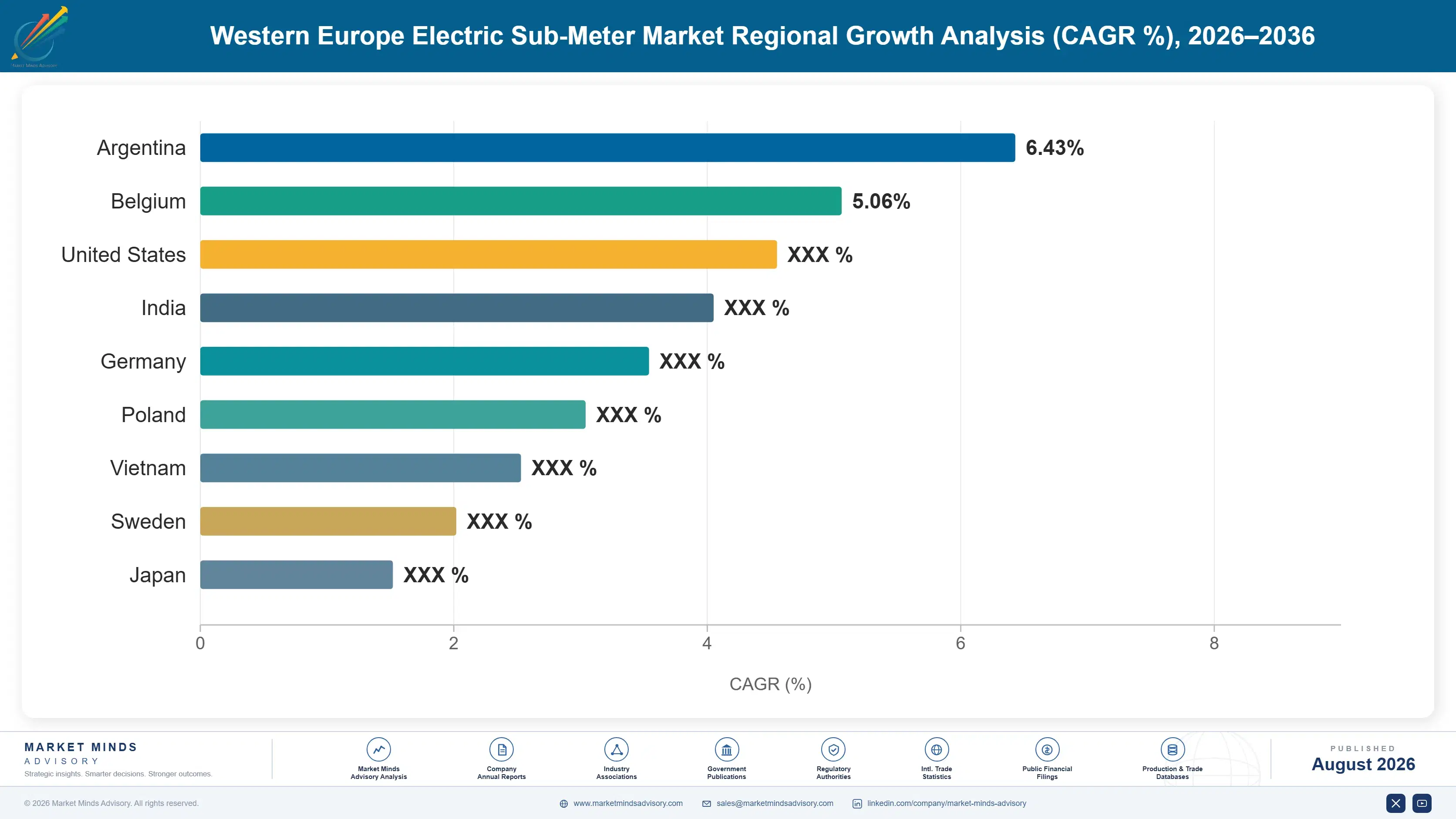
This market is scoped to Western Europe, so the seven-region table concentrates almost entirely in one place and nearly every figure sits outside the bands this framework applies. Residual shares represent export supply from European manufacturing into adjacent markets. Each out-of-band figure is explained in its own paragraph below.

Western Europe

Western Europe holds 79% of value, far above the 26% ceiling this framework normally applies, which follows directly from a market scoped to the region. Germany dominates through national calibration law that enforces legal metrology on charge point billing more strictly than anywhere else, and through an apartment stock where individual metering obligations reach a very large installed population. French, Dutch, and Nordic demand is weighted toward building automation and circuit level measurement. Italian and Spanish markets lag on non-residential automation while moving quickly on charge points. Growth at 7.4% sits below the headline rate because the headline is lifted by faster-growing adjacent regions, though this region contains almost all the actual demand and sets every specification that matters.
Share: 79% | CAGR: 7.4% (2026 to 2036)

Eastern Europe

At 8% of value, Eastern Europe stands well above the 5% ceiling this framework applies, and the figure reflects export supply from Western European manufacturing into markets applying the same European rules. Polish, Czech, and Romanian non-residential construction has expanded substantially and carries the same automation requirements as the west on the same timetable. Charge point installation is accelerating from a lower base under the same infrastructure regulation. Price sensitivity routes a share of monitoring-only volume toward cheaper suppliers while certified billing meters stay with established manufacturers. Growth at 7.9% runs above the regional rate on construction activity and on charge point rollout arriving later but faster. The same rules on the same timetable, with less money.
Share: 8% | CAGR: 7.9% (2026 to 2036)
Regional intelligence for 5 additional markets available in the complete report: North America, Middle East and Africa, East Asia, South Asia and Pacific, Latin America. Contact sales@marketmindsadvisory.com.
electric-sub-meter-market-in-western-europe-country-cagr-analysis-1787334258693

Where Sub-Meter Value Actually Sits

Four levers matter here, and the meter itself is not one of them, because measuring current and voltage accurately has been a solved problem for a century. Certification breadth, protocol coverage, installer preference, and point count positioning decide outcomes instead. A manufacturer competing on accuracy class against another certified product is arguing about something no buyer evaluates.

Certify The Platform, Not Each Individual Model

Conformity assessment for a billing meter costs over three hundred thousand euros before national approvals and periodic recertification are counted, and it behaves as a fixed cost rather than a per-unit one. A manufacturer certifying one platform design across many variants spreads that burden across far more units than certifying models individually ever does. Most manufacturers certify reactively as customers ask, which fragments the spend and leaves coverage gaps that lose projects nobody knew about. Certified units are already 58% of volume and the share keeps rising. Reactive certification costs several times what one programme does.
Market Impact: Certification costs over 300 thousa

Speak Every Protocol The Building Already Uses

Sub-meters must communicate with building systems, billing platforms, and charge point operators across four competing protocol families nobody has harmonised, and integration cost falls on the project rather than the manufacturer. A device supporting them all removes the single biggest reason a specifier reuses whatever is already installed. Multi-protocol capability costs firmware development and certification effort against no visible product benefit, which is why many manufacturers skip it. It is also the most common reason a technically superior meter loses a retrofit. Supporting all 4 families is what stops that substitution happening. Retrofits are lost here more often than anywhere.
Market Impact: All 4 protocol families now have to

Win The Installer Before The Specifier

A sub-meter is fitted by an electrical contractor or controls integrator working to a schedule, and a device that mounts, wires, and commissions quickly gets substituted in where a specification is loose. Terminal access, DIN rail behaviour, and commissioning tools decide that far more than any published specification does. Installers also recommend replacements directly to building owners for years afterwards. Manufacturers designing for a datasheet rather than for a person on a ladder lose volume they never see quoted anywhere. Installers also influence roughly 60% of replacement decisions directly. Designing for a datasheet loses volume nobody ever quotes.
Market Impact: Installers influence roughly 60% of

Sell Point Count, Not Meter Count

A modern non-residential building carries over 34 metering points where it once had one, and the manufacturer who helps a designer work out how many points a compliance obligation actually requires is shaping a much larger order than the one being quoted. That conversation happens with a controls integrator or energy consultant at design stage. Selling a meter at a time into a project somebody else scoped means competing on unit price for whatever count another party decided. Scoping the building rather than quoting the meter changes the order size entirely. Somebody decides that count, and it should be you.
Market Impact: Buildings now carry over 34 separat

Who Controls the Margin Pool

Concentration sits at 41% for the top five, and it rises sharply in the certified half of the market because conformity assessment portfolios rather than manufacturing capability decide who may supply a billing meter. The gap between leaders and challengers is certification breadth and protocol coverage rather than measurement performance. All participants here are assessed on one basis, revenue from electrical sub-metering devices and their communication modules. Approval documentation, not dev
Competition runs on four lines. Certification breadth decides which applications a product may legally serve. Protocol coverage decides whether it integrates without extra cost. Installer preference decides substitution where a specification is loose. Price decides monitoring-only devices, where the certification barrier does not apply and Asian suppliers compete freely.

Two pressures will move positions. Charge point metering is creating a certified segment with requirements most incumbents were not built for, particularly in direct current measurement. Meanwhile controls integrators rather than electrical contractors increasingly specify circuit level meters, which is a different buyer with different priorities. Positions favour whoever holds broad certification alongside genuine protocol breadth. Very few suppliers currently hold both of those together.
electric-sub-meter-market-in-western-europe-company-positioning-matrix-1787334259215

Competitive Moat and Risk Dimensions

SCHNEIDER ELECTRIC

Moat: Certification breadth and panel position

Schneider holds certification coverage across billing and monitoring applications alongside a position inside the electrical panel that competitors reach only as an add-on. A specifier already choosing switchgear from one supplier takes the metering with it more often than not. Building management integration reaches the controls integrator who increasingly writes the metering scope.
SCHNEIDER ELECTRIC

Risk: Charge point requirements sit outside

Charge point metering demands direct current measurement and calibration law compliance that a panel metering heritage does not naturally provide, which leaves the fastest-growing segment open to specialists. Breadth also spreads engineering attention across many product lines. Monitoring-only devices face price competition the certification barrier does not protect against at all.
SIEMENS

Moat: Building systems and integrator reach

Siemens reaches the controls integrator specifying circuit level metering through a building automation relationship rather than through electrical distribution, which matters as automation requirements push measurement below the incoming supply. Certification coverage is broad and German legal metrology expertise is genuinely deep. Data model and protocol support is stronger than most competitors provide.
SIEMENS

Risk: Premium position against commodity pressure

A premium cost base is difficult to defend in monitoring applications where certification provides no protection and adequate devices cost a fraction as much. Retrofit residential metering is a volume business the company is not organised to serve. Charge point metering brings competitors with no building systems heritage and considerable specialist focus.

Players Tracked

Prominent Players

Schneider Electric
Siemens
ABB
Socomec
Janitza electronics

Other Key Players

Phoenix Contact
Eaton
Legrand
Hager
Carlo Gavazzi
Iskraemeco
Landis and Gyr
Kamstrup
EMH metering
Gossen Metrawatt
Finder
Lovato Electric
Wago
Chauvin Arnoux
Saia Burgess Controls

Recent Developments

FEBRUARY 2025

Charge point calibration enforcement widens beyond Germany

Additional European markets moved toward enforcing legal metrology conformity on electricity billed at public charge points, following the German calibration law model that has applied for several years. These were regulatory developments rather than commercial events, and they extend a certification requirement most metering suppliers cannot currently meet.
Signal: A calibration requirement applied to charg
SEPTEMBER 2024

Building automation thresholds tighten across national implementations

National implementations of European building performance requirements lowered the size thresholds at which non-residential buildings must carry automation and control capability, bringing smaller properties into scope. These were regulatory changes rather than transactions, and control capability requires measurement at circuit level rather than at the supply.
Signal: Lowering a threshold converts a whole clas
MAY 2024

Individual apartment metering exemptions narrow further

Several national authorities narrowed the technical feasibility and cost effectiveness exemptions that had allowed multi-apartment buildings to avoid individual electricity metering entirely, reaching a considerably older residential population. These were national implementation decisions rather than commercial events, and retrofit in occupied buildings favours compact wireless devices.
Signal: Removing an exemption creates demand in bu

Electronics, Enclosures, Certification, Firmware

Cost structure looks unlike most electrical products because compliance is a genuine line item. Metering integrated circuits, microcontrollers, and passive components carry 34% to 46% of unit cost, from suppliers serving far larger industries. Moulded enclosures, terminals, and current transformers add 18% to 26%. Certification, approval maintenance, and periodic recertification account for 8% to 16% spread across production volume rather than per unit.
Semiconductor availability through 2021 and 2022 hit metering harder than the shortage headlines suggested, because metering integrated circuits use mature-node capacity that was reallocated to higher-volume customers. Lead times on some parts ran past 50 weeks. Schneider Electric and ABB both disclosed component supply and cost pressure across that period. Redesigning around available parts required repeating conformity assessment, which several manufacturers judged slower than simply waiting for supply.

Each range above exceeds three points because a certified billing meter and a monitoring device share components but not compliance burden. Exposure separates by certified share. A billing-weighted manufacturer carries certification cost as fixed overhead and semiconductor risk it cannot resolve by substitution. A monitoring-weighted supplier carries neither and competes on component cost alone. Asian manufacturers reach monitoring devices and the certified segment barely at all.
electric-sub-meter-market-in-western-europe-cost-volatility-analysis-1787334259411

Design around second-source metering integrated circuits

Metering chips use mature-node capacity that gets reallocated whenever higher-volume customers need it, and substituting one in a certified product means repeating conformity assessment. Qualifying an alternative at design stage costs testing time once, while discovering the dependency during a shortage costs a product line months of unavailability. Very few manufacturers here design for dual sourcing from the outset.

Certify one platform across the whole variant range

Conformity assessment and approval maintenance behave as fixed costs, so approving a single platform design across many variants spreads them far wider than certifying models individually does. Most manufacturers certify reactively as customers request, which fragments the spend and leaves coverage gaps. One coordinated programme costs less and closes more applications than several reactive ones ever manage.

Standardise enclosures and terminals across the range

Enclosures, terminals, and transformers carry up to 26% of unit cost and are largely common across meter types if a manufacturer designs them that way. Most ranges grew by accretion instead, with each product tooled separately and nobody owning the question. Consolidating costs one redesign cycle and improves tooling amortisation, inventory, and installer familiarity at the same time.

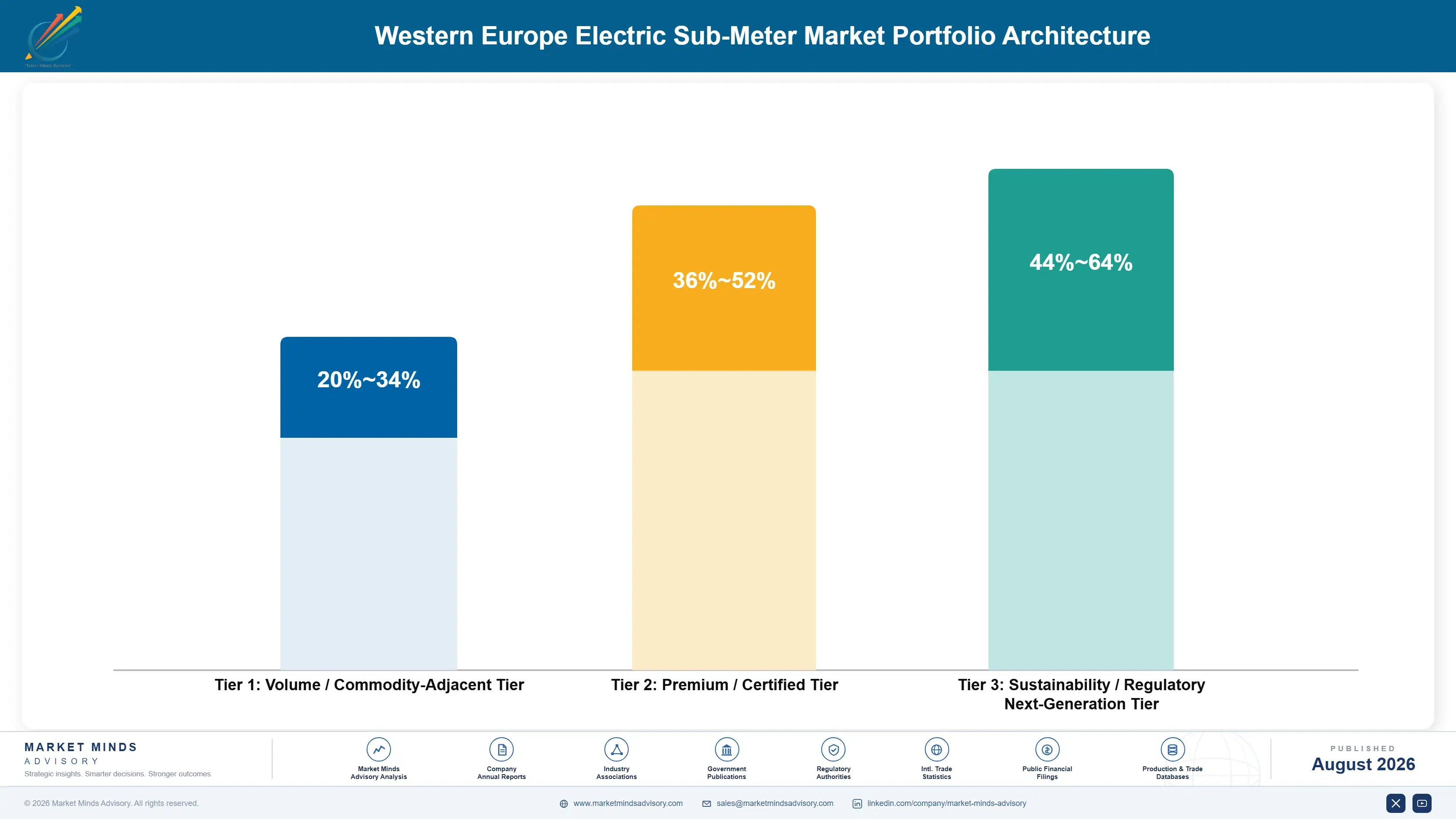
Portfolio Architecture for Margin Defence

Three tiers sit inside this category and legal metrology draws every line. Monitoring-only devices form the volume tier, where no certification applies and anybody with a metering chip can compete on price. Conformity-assessed billing meters earn considerably more, because the approval rather than the product is what a competitor must replicate. Charge point metering and direct current measurement price highest, since very few suppliers can certify at all.
The tension is between monitoring volume that fills the line and certified work that earns the return. Monitoring devices ship in quantity, need no approval maintenance, and compete against Asian suppliers on component cost alone. Certified meters need a compliance organisation that costs money in every year, including the ones where nothing is launched. Manufacturers who fund only the first find the certified half closed to them permanently.

High-value pools concentrate where approval limits competition: charge point metering under calibration law, direct current measurement at high power, billing meters for tenant allocation, and multi-protocol devices that integrate without extra project cost. The commodity end is monitoring-only DIN rail meters, where certification provides no protection and price is the only variable anybody discusses.

Volume / Commodity-Adjacent Tier

Monitoring-only sub-meters sold for energy management where no legal metrology conformity applies. The range is wide because Asian component sourcing and European manufacturing produce entirely different economics on functionally similar devices.
Gross Margin: 20-34%

Premium / Certified Tier

Conformity-assessed billing meters carrying European approval and national certification for tenant and cost allocation use. The range is wide because approval breadth decides how many applications a product reaches and gaps only appear when a project is lost.
Gross Margin: 36-52%

Sustainability / Regulatory / Next-Generation Tier

Charge point metering under calibration law, direct current measurement, and multi-protocol connected devices. The range is wide because certification scarcity supports pricing while component cost varies little across the tier.
Gross Margin: 44-64%
electric-sub-meter-market-in-western-europe-portfolio-architecture-1787334259914

High-value Sub-segments and Strategic Watch-out

EV Charge Point Meters

High value and high growth at 16.8%, exactly twice the market rate, because every point selling electricity needs a conformity-assessed device with a verifiable chain to the invoice. Direct current measurement at high power is genuinely difficult to certify, which restricts credible supply to very few manufacturers indeed.
Gross Margin: 44-64%

Circuit and Panel Level Meters

High value with strong growth at 9.6%, driven by building automation requirements that need measurement below the incoming supply to function. Controls integrators rather than electrical contractors specify these, which makes protocol coverage matter far more than accuracy class ever does. Protocol breadth decides these awards.
Gross Margin: 36-52%

Tenant and Apartment Billing Meters

The volume core by certified units at 7.4%, carrying individual metering obligations in multi-apartment residential stock across the region. Retrofit into occupied buildings favours compact wireless devices, and national exemption narrowing keeps converting shared supplies into metered ones. Exemption narrowing keeps adding to the addressable population steadily.
Gross Margin: 36-52%

Landlord Common Services Meters

The strategic watch-out at 4.2%, measuring lifts, lighting, and shared plant where allocation is straightforward and nobody disputes the figure enough to require certification. Price is essentially the only variable and monitoring-grade devices serve the application entirely adequately. Monitoring-grade devices serve it perfectly well and always will.
Gross Margin: 20-34%

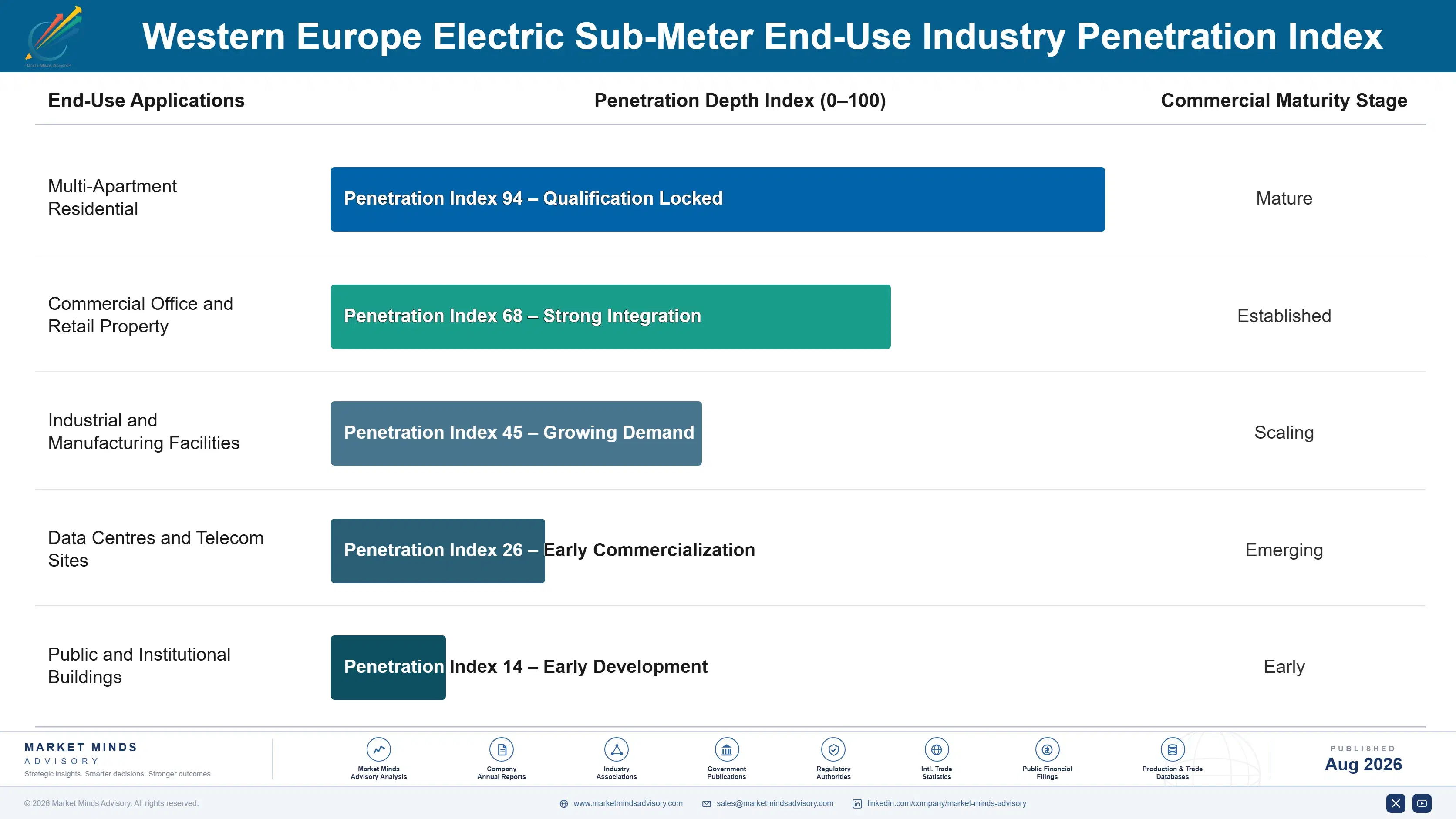
How Metering Demand Gets Committed

Demand commits at building design or compliance deadline and then repeats on recalibration and replacement every twelve to sixteen years. A billing meter carries a certification record tied to a specific device, so replacement usually means the same manufacturer. That gives real incumbency to a product costing under a hundred euros. The competitive moments are a new building, a compliance threshold change, and a protocol migration the incumbent cannot support.
Stickiness varies with what the reading is used for. Charge point metering sticks hardest, since the calibration record and the billing platform both tie to approved devices. Tenant billing sticks nearly as hard through certification documentation the landlord must retain. Circuit monitoring sticks through protocol integration already commissioned. Landlord common services sticks least, because nobody disputes the reading and the buyer compares prices.

The buyer has moved from an electrical contractor to a controls integrator and, on charge points, to an operator with a billing platform. Twenty years ago an installer chose a meter from a wholesaler. Now an integrator selects for protocol compatibility and an operator for calibration compliance, and neither buys at a counter. Manufacturers selling through electrical distribution alone reach the smallest part of the decision.
electric-sub-meter-market-in-western-europe-end-use-penetration-index-1787334260406

Our Call On Electric Sub-Meters

These are among the four positions where our research anticipates prominent divergence between winners and laggards over the coming forecast period. Each is grounded in the demand model, the regulatory perimeter, and the announced capacity pipeline.
01 / CERTIFICATION PORTFOLIO PRIORITY

Approval is the product, the meter is packaging

Conformity assessment for a billing meter costs over three hundred thousand euros before national approvals and periodic recertification, and it behaves as a fixed overhead a manufacturer carries every year rather than a cost per unit sold. That burden is exactly why certified units are 58% of volume while the certified supplier field is a fraction of the participant count. Certifying one platform design across many variants spreads the cost far wider than reactive model-by-model approval, which most manufacturers still default to and pay for repeatedly.
02 / CHARGE POINT CAPABILITY

Calibration law is the barrier worth clearing

Electricity sold at a charge point is a commercial transaction requiring a conformity-assessed measuring device with tamper protection and a verifiable chain from measurement to invoice, which German calibration law enforces and other markets are adopting. Direct current measurement at high power is genuinely difficult to certify and very few manufacturers have done it. The segment grows at 16.8%, exactly twice the market, and the barrier keeping most competitors out is precisely what makes the position worth holding once cleared.
03 / PROTOCOL COVERAGE DISCIPLINE

Integration cost decides more sales than accuracy

Sub-meters must communicate across four competing protocol families that nobody has harmonised, and the integration cost of a mismatch falls on the project rather than on the manufacturer who caused it. A device speaking all of them removes the single most common reason a specifier reuses whatever is already installed rather than choosing the better product. Multi-protocol capability costs firmware work and certification effort against no visible product benefit, which is exactly why so many manufacturers skip it and then lose retrofits they should win.
04 / POINT COUNT POSITIONING

Scope the building, do not quote the meter

A modern non-residential building now carries over 34 metering points where it once had a single supply meter, and the number is decided by a controls integrator or energy consultant working out what a compliance obligation actually requires. A manufacturer helping with that calculation is shaping an order many times larger than the one being quoted to it. Selling a meter at a time into a scope somebody else defined means competing on unit price for a point count another party already fixed.

Engagement Snapshot From the Field

A live engagement with an industry participant carrying material or product regulatory and market exposure ahead of a defining policy shift, showing how our research translates into a defensible multi-year portfolio strategy.
MARKET MINDS ADVISORY · CLIENT ENGAGEMENT SUMMARY
Western Europe Electric Sub-Meter Producer Strategic Portfolio Review and Transition Roadmap 2026·Investment Scenario on Western Europe Electric Sub-Meter Exposure Evaluation 2025-26
CLIENT PROFILE
A Western European metering manufacturer with roughly USD 71 million in annual revenue engaged MMA after growth stalled while the market around it accelerated (client-reported, unverified by MMA). The company held excellent monitoring products, a modest certified range, and no charge point capability at all, and management believed the problem was distribution rather than product scope.
STRATEGIC CHALLENGE
Sales wanted wholesaler listings in two additional countries. Engineering wanted a next generation monitoring platform. Nobody had compared the company's certification coverage against where market growth was actually occurring, or asked who specifies meters in the applications growing fastest. The board needed a position before committing the next development budget.
MMA APPROACH
MMA mapped the client's certification coverage against the applications driving growth across its markets, which the company had never set out in one place. We interviewed 40 controls integrators and charge point operators on how meters get selected and what disqualifies a supplier. We then modelled three routes: wholesaler expansion, a monitoring platform refresh, and a certification programme covering charge point metering.
KEY FINDINGS
  1. The client's certified range covered tenant billing and almost nothing else, excluding it from the two fastest-growing applications entirely (client-reported, unverified by MMA).
  2. Controls integrators eliminated suppliers on protocol coverage before considering any other attribute, and the client supported two of four common protocol families.
  3. Charge point operators required calibration law conformity as an absolute condition and they did not buy through electrical wholesale distribution at all.
  4. Wholesaler expansion modelled worst of the three routes, because the growth applications are not bought through that channel in the first place.
CLIENT PROFILE
A Western European metering manufacturer with roughly USD 71 million in annual revenue engaged MMA after growth stalled while the market around it accelerated (client-reported, unverified by MMA). The company held excellent monitoring products, a modest certified range, and no charge point capability at all, and management believed the problem was distribution rather than product scope.
STRATEGIC CHALLENGE
Sales wanted wholesaler listings in two additional countries. Engineering wanted a next generation monitoring platform. Nobody had compared the company's certification coverage against where market growth was actually occurring, or asked who specifies meters in the applications growing fastest. The board needed a position before committing the next development budget.
MMA APPROACH
MMA mapped the client's certification coverage against the applications driving growth across its markets, which the company had never set out in one place. We interviewed 40 controls integrators and charge point operators on how meters get selected and what disqualifies a supplier. We then modelled three routes: wholesaler expansion, a monitoring platform refresh, and a certification programme covering charge point metering.
KEY FINDINGS
  1. The client's certified range covered tenant billing and almost nothing else, excluding it from the two fastest-growing applications entirely (client-reported, unverified by MMA).
  2. Controls integrators eliminated suppliers on protocol coverage before considering any other attribute, and the client supported two of four common protocol families.
  3. Charge point operators required calibration law conformity as an absolute condition and they did not buy through electrical wholesale distribution at all.
  4. Wholesaler expansion modelled worst of the three routes, because the growth applications are not bought through that channel in the first place.
RECOMMENDED STRATEGY
Phase 1: Phase 1 (0 to 10 months): Halt wholesaler expansion and add the two missing protocol families across the existing certified platform. Phase 2: Phase 2 (10 to 26 months): Begin charge point metering certification and build direct relationships with operators rather than distributors. Phase 3: Phase 3 (26 to 44 months): Refresh the monitoring platform only once certified coverage matches where growth actually is. Not before.
OUTCOME
The board cancelled the wholesaler programme and funded protocol work first, which the sales director opposed and later described as obviously correct. Integrator specifications rose materially once all four protocol families were supported, and charge point certification is underway (client-reported, unverified by MMA). The monitoring platform refresh remains deferred behind the certification work.

Frequently Asked Questions

Foundational context covering the market sizes, CAGR, scope, country, region and competition that inform every finding below. This section is provided to cover basics and most often pre-purchase conversations, answered from the MMA Primary Research Dataset.

What is the current size of the Western Europe Electric Sub-Meter Market?

The regional market is valued at USD 0.9 billion in 2025, covering billing certified and monitoring sub-meters installed downstream of the utility revenue meter. Utility revenue meters and heat metering are excluded.

How large will the Western Europe Electric Sub-Meter Market be by 2036?

The market is forecast to reach USD 2.20 billion by 2036 in the base case, about 2.24 times the 2026 level. That represents incremental value of roughly USD 1.22 billion.

What is the CAGR for the Western Europe Electric Sub-Meter Market 2026 to 2036?

The market grows at an 8.4% CAGR in the base case, with bull and bear scenarios at 9.7% and 7.1%. The spread turns on charge point rollout pace and on construction activity.

Which segment is growing fastest?

EV charge point meters grow fastest at 16.8%, exactly twice the overall rate, because electricity sold at a point needs a conformity-assessed measuring device. Circuit and panel level meters follow at 9.6%.

Who are the major companies in the Western Europe Electric Sub-Meter Market?

Leading participants include Schneider Electric, Siemens, ABB, Socomec, and Janitza electronics. Concentration sits at roughly 41% and rises sharply in the certified half, where approval portfolios rather than manufacturing decide supply.

Which country is growing fastest?

Germany grows fastest at a 9.6% CAGR, driven by national calibration law on charge point billing and by individual apartment metering obligations. The Netherlands follows on building automation requirements.

Report Segmentation Architecture

The full report scope spans multiple orthogonal segmentation dimensions, with cross-tabulated demand data provided for each dimension pair. Coverage extends further to regional breakdowns, trend trajectories, and the competitive detail needed to support segment-level decision-making.

By Measurement Point

  • EV Charge Point Meters
  • Circuit and Panel Level Meters
  • Tenant and Apartment Billing Meters
  • Equipment and Sub-Circuit Meters
  • Landlord Common Services Meters

By End-Use Industry

  • Multi-Apartment Residential
  • Commercial Office and Retail Property
  • Industrial and Manufacturing Facilities
  • Data Centres and Telecom Sites
  • Public and Institutional Buildings

By Sales Model

  • Electrical Wholesale Distribution
  • Controls Integrator and Systems Channel
  • Direct Sale to Operator or Owner
  • Original Equipment Manufacturer Supply

By Region

  • Western Europe
  • Eastern Europe
  • North America
  • Middle East and Africa
  • East Asia
  • South Asia and Pacific
  • Latin America

Scope, Methodology, and Coverage

Every figure in this report is reproducible from documented input assumptions. The scope below maps the historical period, the forecast horizon, the segmentation dimensions, and the countries covered, alongside the underlying primary and qualitative methodology.
Historical Period
2020 to 2025
Forecast Period
2026 to 2036
Base Year
2025 (USD billions; MMA Primary Research Dataset, August 2026)
Market Definition
The Western Europe electric sub-meter market comprises the manufacture and sale of electricity meters installed downstream of the utility revenue meter to measure consumption attributable to a tenant, circuit, item of equipment, or charge point, valued at manufacturer selling prices to electrical wholesalers, controls integrators, charge point operators, building owners, and equipment manufacturers. It spans conformity-assessed billing meters approved under European measuring instruments requirements and national calibration law, monitoring-only devices without legal metrology approval, direct connected and current transformer operated meters, DIN rail and panel mounted formats, socket and plug level devices, and alternating and direct current charge point measuring capsules, together with the communication modules, current transformers, and gateway devices supplied with them. Utility revenue meters and national smart meter rollout equipment, gas, water, and heat meters and heat cost allocators, power quality analysers and revenue-grade laboratory instruments, protection relays and switchgear, and building management and billing software sold independently of hardware are excluded. Meter calibration, verification, and billing bureau services sold separately sit outside scope.
Quantitative Units
USD billions (current prices); volume in millions of meters shipped
Segmentation Dimensions
By Measurement Point; By End-Use Industry; By Sales Model; By Region
Regions Covered
Western Europe, Eastern Europe, North America, Middle East and Africa, East Asia, South Asia and Pacific, Latin America
Countries Covered
Germany, France, Netherlands, Belgium, Austria, Switzerland, Italy, Spain, Portugal, United Kingdom, Ireland, Sweden, Norway, Denmark, Finland, Poland, Czechia, Romania, Hungary, Slovakia, USA, Canada, Saudi Arabia, United Arab Emirates, Qatar, Turkey, Israel, China, Japan, South Korea, Australia, New Zealand, India, Singapore, Brazil, Chile, Mexico, and additional markets relevant to this sector
Key Companies Profiled
Schneider Electric, Siemens, ABB, Socomec, Janitza electronics, Phoenix Contact, Eaton, Legrand, Hager, Carlo Gavazzi, Iskraemeco, Landis and Gyr, Kamstrup, EMH metering, Gossen Metrawatt, Finder, Lovato Electric, Wago, Chauvin Arnoux, Saia Burgess Controls
Quantitative Methodology
Primary survey, n=3,800 respondents, Q4 2025, six countries; demand-side model with trade association cross-validation
Qualitative Methodology
47 expert interviews, Q4 2025; applied to validate demand model assumptions, identify emerging dynamics, and assess competitive positioning
Report Format
PDF and XLSX data workbook (Word format preview document)
Publisher
Market Minds Advisory
Report Code
MMA-2026-ENE-526
Published
August 2026
Contact
sales@marketmindsadvisory.com | www.marketmindsadvisory.com

Purchase the full Western Europe Electric Sub-Meter Market Report (2026 to 2036).

The full MMA Western Europe Electric Sub-Meter report sizes the market across five measurement points, five end-use segments, four sales models, and seven regions through 2036. It profiles 20 participants on a consistent basis of sub-metering device and communication module revenue, scoring each on certification coverage, protocol breadth, charge point capability, and integrator channel position. Scenario models quantify how charge point rollout, building automation thresholds, and individual metering obligations move both volume and achievable margin. The report also includes certification coverage mapping by manufacturer and application, protocol support benchmarking, metering point count modelling by building type, and national implementation timetables for every relevant obligation.
Five-point and four-channel market sizing to 2036
Twenty-participant benchmark on sub-metering device revenue
Certification coverage mapping by manufacturer and application
Protocol support benchmarking across major metering families
Metering point count modelling by building type and threshold
National implementation timetables for metering and automation obligations

Built For The People Who Decide

From boardroom strategy to bench-side execution, this report is read cover-to-cover by leaders shaping the next decade of their industry, turning demand scenarios, market dynamics and valuation benchmarks into decisions.
CXOs/ Presidents/ VPs/ Managers
M&A and Corporate Development
Strategy Teams and R&D Heads
Procurement and Product Directors
Regulatory and Compliance Leaders
Investor Relations and Equity Analysts