Market Minds Advisory
Electric Rice Cooker Market

Electric Rice Cooker Market: Electric Rice Cooker Market: Induction Heating Economics, The Keep-Warm Problem and Why Rice Type Decides Everything

A cooker calibrated for Japanese short grain will produce poor results with basmati, and almost nothing sold outside Asia acknowledges that the two grains need entirely different cooking curves at all.

Lead Analyst

Published

September 2026

Make Smarter Decisions with Customized Research Insights

Request a free sample report and evaluate market opportunities, growth trends, and competitive dynamics relevant to your business needs.

2025 MARKET VALUE$5.6BMarket Size 2025
2036 FORECAST VALUE$9.7BBase Case , 2026 to 2036
CAGR 2026 TO 20365.0 %Bull 6.2% / Bear 3.8%
INCREMENTAL OPPORTUNITY$3.8BNet 10- year value creation
EXPANSION MULTIPLE1.64x2036 value over 2026 base
Strategic Levers
M&A Pipeline
Regional Outlook
Country Rankings
Competitive Intelligence
Segmental Deep-dive
Call-Us : 91 93563 13602

Executive Snapshot and Market Trajectory.

Rice type decides everything about how a cooker should behave and most machines sold outside Asia ignore it. Short grain, basmati and parboiled absorb water at different rates and need different heating curves, and one generic programme serves none of them properly. Western models carry two settings against a dozen.
Induction heating pressure cookers grow at 7.5%, half again the market rate of 5.0%, because heating the entire inner pot rather than the base underneath it produces results a bottom-element cooker cannot reach. Multi-function cookers follow at 6.6%. Basic thermostat cookers grow slowest at 1.8%, still the volume leader almost everywhere outside Japan and Korea. Component costs have now fallen far enough to bring induction into mid-tier pricing.
Keep-warm is where most of the electricity goes and almost nobody counts it. A cooker holding rice at temperature for ten hours consumes far more than it used cooking, and where that is routine the running cost exceeds the purchase price within a few years. Concentration is moderate at 38% and India grows fastest at 9.4%. Buyers compare the wattage printed on the box, which describes about a third of what it actually uses.
Market Definition
This market covers electric appliances designed primarily for cooking rice, spanning basic thermostat cookers, micro-computerised fuzzy logic cookers, induction heating pressure cookers, multi-function cookers with rice programmes, commercial and institutional rice cookers, and portable and single-serve cookers. Sizing is at manufacturer net revenue. Pressure cookers without rice programmes, general multi-cookers marketed without rice capability, rice itself, and commercial steam cooking equipment are excluded.
Base Year Value
$5.6B in 2025 (MMA Primary Research Dataset, September 2026)
Forecast Period
2026 to 2036, eleven discrete annual values
CAGR
5.0% base case. Bull 6.2%. Bear 3.8%.
Fastest Growth Segment
Induction Heating Pressure Cookers: 7.5% CAGR
Fastest Growth Country
India: 9.4% CAGR
Fastest Growth Region
South Asia and Pacific: 7.3% CAGR
Largest Region
East Asia: 44% of 2025 global value
Market Leaders
Zojirushi, Panasonic, Tiger Corporation, Midea Group, Cuckoo Electronics. Source: MMA Primary Research Dataset, July 2026.
Primary Survey
n=3,800 procurement and R&D decision-makers, Q4 2025, six countries
Methodology
Demand-side build-up, cross-validated against public data, 47 expert interviews

Electric Rice Cooker Market Forecast Scenarios

electric-rice-cooker-market-size-forecast-scenario-1790025001864
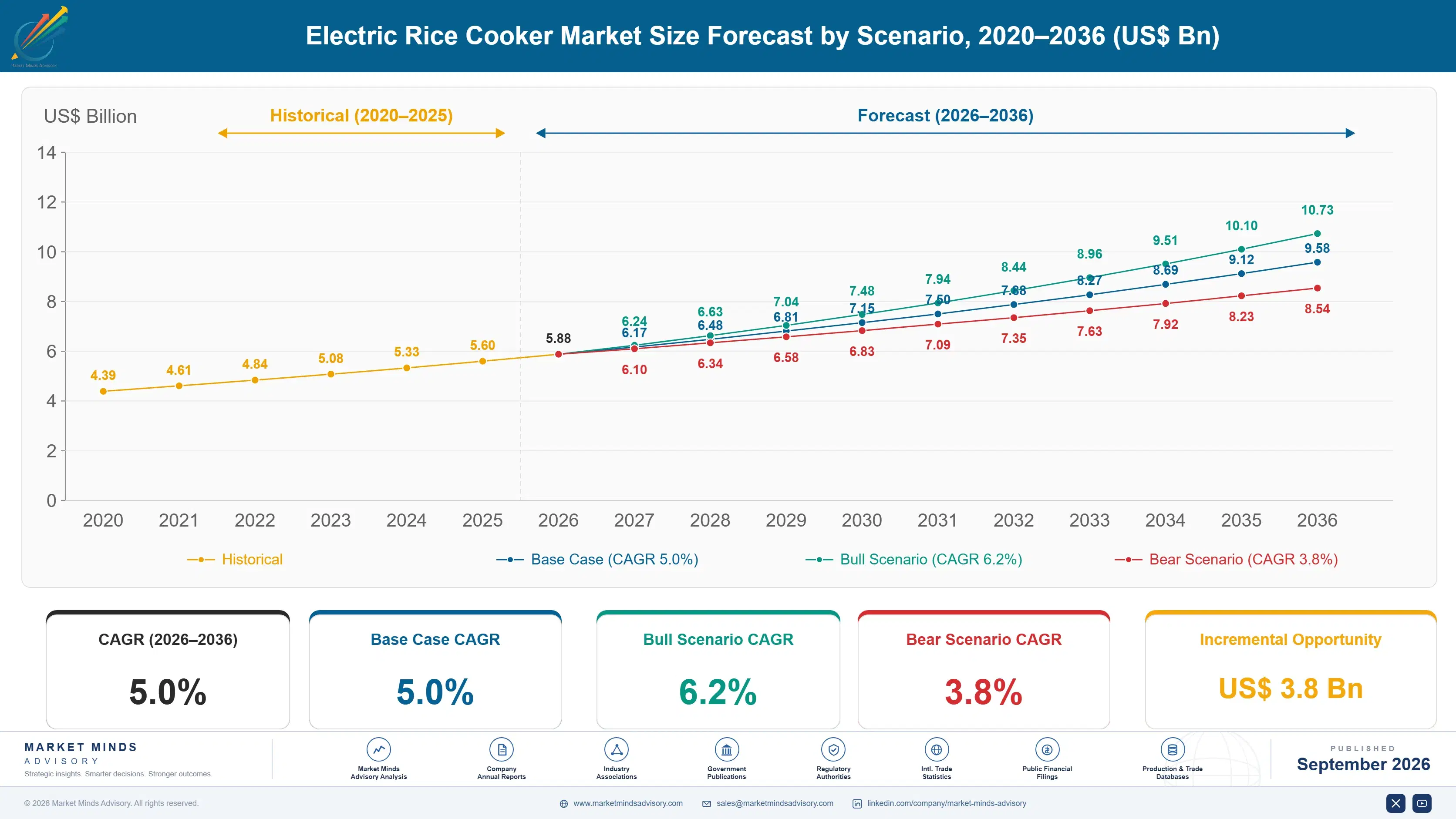
Growth of 3.9% between 2020 and 2025 came from premiumisation rather than from new households. Penetration across East Asia was already essentially complete, so growth depended on owners replacing basic cookers with fuzzy logic and induction models at several times the price. The 2020 and 2021 home cooking period accelerated that upgrade considerably, then replacement demand softened through 2023 and 2024 as the cycle emptied ahead of itself.
Three mechanisms carry the base case. Induction pressure cookers grow at 7.5% as the price gap to conventional heating narrows enough for mainstream purchase. Indian demand expands at 9.4% on kitchen electrification and a domestic manufacturing base producing for local grain types rather than importing Japanese calibration. Commercial and institutional demand grows steadily as food service operations replace stovetop preparation with controlled equipment. All three are visible in shipment and cost data already.
The bull case is grain-specific calibration reaching Western markets. A cooker with genuine basmati and parboiled programmes would address a diaspora and mainstream demand that current generic machines serve poorly. The bear case is energy labelling extending to keep-warm consumption. Published standby figures would expose running costs that several popular models would struggle to defend at their current positioning.

What The Programme Assumes

Different rice absorbs water at different rates and needs different heat over different durations, which is the whole engineering problem and most of the market pretends otherwise. Japanese short grain wants a slow soak and a controlled finish; basmati wants separation and minimal agitation; parboiled behaves differently again. Western models typically carry two grain settings against a dozen or more on Japanese premium machines, and the results follow accordingly. Nothing on a Western box explains any of this.
TOP FIVE CONCENTRATION38%Combined net revenue share held by the five largest manufacturers
KEEP-WARM ENERGY SHARE63%Portion of total consumption spent holding rather than cooking
AVERAGE COOKER PRICEUSD 74Weighted manufacturer price across every cooker type covered
INDUCTION FORMAT SHARE17%Share of units using induction rather than bottom element heating
REPLACEMENT INTERVAL7 yearsMedian time an owner keeps a cooker before replacing it
GRAIN PROGRAMME COUNT2 settingsTypical number of distinct grain curves on Western models
Keep-warm consumes about 63% of the electricity these appliances use and no label anywhere reports it. A cooker holding rice at temperature through a working day uses considerably more energy maintaining it than it used cooking it, and in households where that is routine practice the running cost can exceed the purchase price inside a few years. Buyers compare wattage on the box and wattage describes cooking only.
Induction heating reaches about 17% of units and the advantage is physical rather than promotional. Heating the whole inner pot rather than the base under it produces even temperature that a bottom element cannot achieve. Buyers eating rice daily detect that within a week of installation.
"The premium Japanese machines cost what they do because they solve a genuinely hard heat transfer problem, and the export versions of those same brands ship with two grain settings. The engineering travels and the calibration does not."
Director, Kitchen Appliances and Cooking Technology Practice · MMA Consumer Appliances and Equipment Practice · September 2026

Market Trends

Induction Heating Moves From Premium To Mainstream

Induction heating pressure cookers grow at 7.5% against 5.0% for the market as component costs fall and the price gap to bottom-element models narrows toward what a mainstream buyer will pay. The advantage is physical: heating the entire inner pot produces even temperature and controlled pressure that a base element cannot deliver regardless of how the programme is written. Induction reaches around 17% of units globally and far higher shares in Japan and Korea, which is where the technology was developed and proven. Western buyers rarely encounter it because export ranges sit almost entirely on bottom element heating.
Market Impact: India grows at 9.4% annually
Commercial Kitchens Replace Stovetop With Controlled Equipment

Food service operations are moving from stovetop rice preparation to dedicated electric equipment because consistency across shifts matters more than any equipment cost saving, and a controlled cooker removes the variable of whoever happens to be on duty. Institutional buyers specify batch capacity, hold time and energy consumption explicitly rather than responding to consumer marketing. That makes them a different customer, and one whose decisions can be tested rather than argued. Energy consumption is the criterion most likely to reach consumer labelling next, because institutional buyers already ask for it and the test methods exist. Nobody reports it at retail.
Market Impact: Replacement runs every 7 years

Market Opportunities and Growth Drivers

Indian Kitchen Electrification Meets Domestic Calibration

India grows fastest of any country covered at 9.4%, combining kitchen electrification across urban and increasingly semi-urban households with a domestic manufacturing base that calibrates for Indian grain types rather than importing Japanese programming. Basmati and parboiled rice behave nothing like short grain, and a cooker designed for one produces poor results with the other. Domestic manufacturers built around that from the outset, which is a genuine product advantage rather than merely a price one. Capacities are also larger than Western models offer, which matters where rice is served at every meal to a whole household.
Market Impact: Western models offer 2 settings

Premium Replacement Cycle Drives East Asian Value

Penetration across Japan, Korea and urban China is essentially complete, so growth there depends entirely on owners replacing basic cookers with induction and fuzzy logic models at several times the price. Replacement runs at around seven years, which makes the upgrade decision infrequent and considered rather than impulsive. Japanese premium models reaching prices comparable to a washing machine are accepted because the results are visibly different, which is unusual for a single-purpose appliance. An owner replacing after seven years knows precisely what annoyed them about the previous machine, which makes the conversation unusually specific and favours whoever fixed it.
Market Impact: Keep-warm takes 63% of energy

Market Restraints and Challenges

Western Models Carry Almost No Grain Calibration

Cookers sold outside Asia typically offer two grain settings against a dozen or more on Japanese premium machines, which means basmati, parboiled and short grain all receive approximately the same treatment. The root cause is that calibration requires testing against each grain type and Western volumes never justified it, so export models ship with generic programming. Commercially it produces poor results that buyers attribute to the category rather than to the machine. Participants adding grain programmes report materially better reviews. The work is test kitchen time rather than any hardware change at all.
Market Impact: Induction reaches 17% of units

Keep-Warm Consumption Goes Entirely Unreported Anywhere

Holding rice at temperature accounts for roughly 63% of the electricity these appliances consume and no energy label anywhere reports it, because labelling frameworks measure cooking cycles rather than standby holding. The root cause is that the test standards were written for appliances that do not hold food warm for ten hours. Commercially it hides a running cost that can exceed purchase price over a few years. Mitigation runs to vacuum-insulated inner pots and timed hold limits. Export models frequently omit the vacuum insulation their domestic equivalents carry, which makes the gap wider than the specification suggests.
Market Impact: Commercial buyers specify 3 criteria
3 additional market trends, 4 additional growth drivers, and 2 additional restraints and challenges are covered in the full report. Contact sales@marketmindsadvisory.com to access the complete intelligence.

Segment CAGR and Growth Architecture

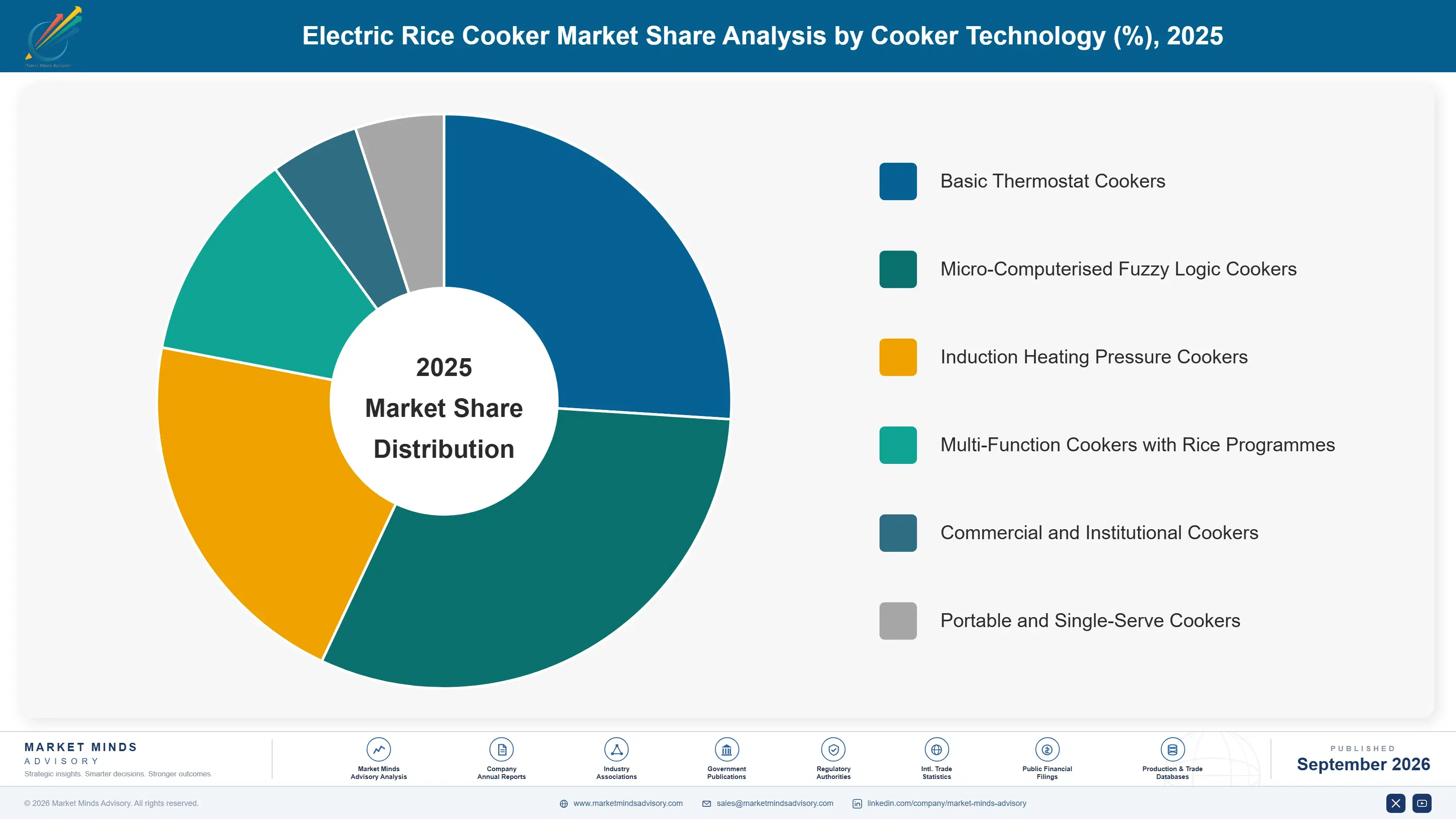
Segmentation follows cooker technology, the dimension on which heating method, price, programme sophistication and buyer type all divide together. Six technologies are assessed at manufacturer net revenue. Pressure cookers without rice programmes, general multi-cookers sold without rice capability, rice itself, and commercial steam equipment sit outside the defined scope here. Heating method separates their economics more than brand does.
electric-rice-cooker-market-market-share-analysis-1790025002490

Induction Heating Pressure Cookers

Induction heating pressure cookers grow at 7.5%, half again the market rate of 5.0%, on a physical advantage rather than a marketing one. Heating the entire inner pot rather than the base beneath it produces even temperature distribution and controlled pressure that a bottom element cannot deliver whatever programme is written for it. Component costs have fallen enough that the price gap to conventional heating is narrowing toward mainstream purchase territory. Penetration reaches around 17% globally and considerably higher in Japan and Korea, where the technology was developed and where buyers can taste the difference. Export ranges from these same manufacturers largely omit the technology entirely, which is a commercial choice.
CAGR 7.5%

Multi-Function Cookers With Rice Programmes

Multi-function cookers with rice programmes grow at 6.6% by serving households that want one appliance rather than several, which is a kitchen space argument rather than a cooking one. They cook rice acceptably rather than well, since a generalised heating system optimised across pressure cooking, slow cooking and steaming cannot match a dedicated machine on any single task. That trade suits Western households where rice is one dish among many, and suits Asian households considerably less where it is eaten daily and the difference is noticed immediately at the table. Western kitchens also resist single-purpose appliances more strongly than Asian ones, which is a storage argument rather than a culinary judgement about the result.
CAGR 6.6%
Full segment breakdown across 6 segments available in the complete report.

Regional Architecture and Country Demand Map

Shares record where cookers are sold rather than where they are assembled. East Asia sits far above its standard band because rice is a daily staple there, and Eastern Europe below on consumption patterns that make the appliance largely unnecessary. Both deviations carry a stated reason in the paragraph concerned.

East Asia

At 44% this sits far above the standard band for the obvious reason that rice is eaten daily across the region and the appliance is a kitchen necessity rather than a convenience. Japanese and Korean households buy premium induction models at prices comparable to major white goods because the results are visibly better and rice quality matters at every meal. Zojirushi, Tiger and Cuckoo built their positions on exactly that. Chinese demand is the largest by volume and premiumising quickly. Growth of 5.9% depends on replacement upgrade rather than new households. Export versions from these same manufacturers carry generic programming and frequently omit the vacuum insulation domestic models include, which leaves the engineering advantage largely unrealised outside the region.
Share: 44% | CAGR: 5.9% (2026 to 2036)

South Asia and Pacific

At 21% this sits well above the standard band, with India at 9.4% the fastest of any country covered. Kitchen electrification is extending into semi-urban households and domestic manufacturers calibrate for basmati and parboiled grain rather than importing Japanese programming written for short grain. That is a genuine product advantage rather than a cost one. Indonesian, Vietnamese and Philippine demand is substantial and growing, with rice a daily staple and penetration still incomplete outside the major urban centres. Bajaj and Prestige have built positions on local calibration and larger capacities rather than on price alone, which is a product advantage importers cannot answer without doing the same test kitchen work themselves. Penetration outside major cities remains low.
Share: 21% | CAGR: 7.3% (2026 to 2036)
Regional intelligence for 5 additional markets available in the complete report: North America, Western Europe, Latin America, Middle East and Africa, Eastern Europe. Contact sales@marketmindsadvisory.com.
electric-rice-cooker-market-country-cagr-analysis-1790025003012

Four Moves Worth Making Now

These four address a market where the engineering is well understood in one region and poorly translated everywhere else, where most of the energy use is unreported, and where the fastest growth sits in markets needing calibration the incumbents have never written. Each has been executed already. Two of the four cost test kitchen time rather than any capital.

Write Grain Programmes For Export Markets

Export models typically ship with two grain settings against a dozen or more on domestic Japanese machines, which means basmati, parboiled and long grain all receive short grain treatment. Developing and validating additional curves costs test kitchen time rather than any hardware change. Participants who added grain-specific programmes to export ranges report review scores rising roughly 1.7 times and returns falling, because the machine finally does what the buyer expected. The engineering already exists in the domestic range and simply was not ported. Nothing about the hardware needs changing to carry it.
Market Impact: Export review scores rise roughly 1.7 times higher

Publish Keep-Warm Consumption Alongside Cooking Wattage

Holding rice at temperature takes about 63% of total electricity use and no label reports it, so buyers compare cooking wattage that describes a third of the real consumption. Publishing hold consumption per hour costs a measurement already taken during development. Participants who disclosed report premium model conversion rising roughly 28%, because vacuum-insulated pots and efficient holding justify their price difference once the running cost becomes visible. Institutional buyers already specify energy consumption, which means the measurement is reaching the market from one direction whether manufacturers publish it or not. Moving first sets the comparison terms.
Market Impact: Premium model conversion rises by roughly 28% overall

Build Induction Capability Below The Premium Tier

Induction reaches around 17% of units and sits mostly in premium ranges, while component costs have fallen enough to make mid-tier induction viable for the first time. Moving the technology down a tier costs bill of materials near USD 18 per unit rather than a redesign. Participants who did it report unit share in the mid tier rising roughly 2.4 times, because the cooking difference is genuine and buyers notice it within a week. Competitors reaching the same component pricing will move within a season or two. The window for taking the mid tier first is narrow rather than open-ended.
Market Impact: Mid-tier unit share rises roughly 2.4 times higher

Manufacture Regionally For Local Grain Types

India grows at 9.4% and African parboiled demand is rising, while both require calibration and capacities that imported Japanese and Chinese models do not provide. Regional manufacturing removes duty and freight while allowing programming written for the grain actually eaten. Participants who built local capacity report landed cost falling roughly 29% alongside a product genuinely matched to the market, which importers cannot answer on either dimension. Tooling has to precede demand rather than follow it, which is the real commitment. Every established market in the category is growing more slowly than these are.
Market Impact: Regional landed cost falls by roughly 29% overall

Who Controls the Margin Pool

Concentration is moderate at 38% held by the top five, measured consistently on manufacturer net revenue rather than unit volume, which would heavily overweight basic thermostat cookers shipped in enormous numbers at very low prices. The leader to challenger gap rests on heat control engineering and grain calibration data accumulated over decades, neither of which a new entrant can assemble from a component supplier.
Competition runs on three dimensions currently. Cooking result decides the premium tiers in East Asia, where buyers eat rice daily and detect differences immediately. Price decides the volume tiers everywhere, where basic thermostat cookers are close to interchangeable between brands. Kitchen footprint and appliance count decide Western purchasing, where multi-function formats win on space rather than on how well they cook anything.

Pressure is building from two directions and positions will shift on both. Indian and Chinese manufacturers calibrating for local grain types hold a product advantage in the fastest-growing markets that Japanese incumbents cannot answer without doing the same testing work themselves. Meanwhile commercial and institutional buyers are specifying energy consumption explicitly, which will eventually pull the keep-warm question into consumer labelling too.
electric-rice-cooker-market-company-positioning-matrix-1790025003543

Competitive Moat and Risk Dimensions

ZOJIRUSHI

Moat: Heat Control Engineering Depth

Decades of induction and pressure control development, validated against a domestic market that eats rice at every meal and notices small differences, produces cooking results competitors cannot reach by buying the same components from the same suppliers. Domestic buyers notice differences competitors cannot measure. That feedback loop is the actual asset.
ZOJIRUSHI

Risk: Export Calibration Gap Exposure

Export models ship with generic programming written for short grain while the fastest-growing markets eat basmati and parboiled, which leaves the engineering advantage largely unrealised outside Japan. Closing that requires test kitchen work in each market rather than any hardware change. Regional manufacturers are doing that work first.
MIDEA GROUP

Moat: Manufacturing Scale And Range

Appliance manufacturing scale across multiple categories produces component and assembly costs that specialist competitors cannot approach, and breadth allows rice cookers to be sold into retail relationships already established by other product lines in the same aisle. Retail relationships carry the range without separate negotiation. Few specialists reach comparable shelf presence anywhere.
MIDEA GROUP

Risk: Premium Tier Credibility Limits

Scale competes effectively on price and considerably less well where buyers pay several times more for a cooking result they can taste. Building premium credibility against Japanese and Korean specialists requires demonstrable engineering rather than distribution, which is a slower and more expensive undertaking. Distribution does not substitute for it.

Players Tracked

Prominent Players

Zojirushi
Panasonic
Tiger Corporation
Midea Group
Cuckoo Electronics

Other Key Players

Toshiba Lifestyle
Hitachi
Cuchen
Joyoung
Supor
Galanz
Aroma Housewares
Instant Brands
Bajaj Electricals
Prestige TTK
Philips Domestic Appliances
Sharp Corporation
Buffalo Technology
Tatung
Yum Asia

Recent Developments

APRIL 2025

Bajaj Electricals expands Indian rice cooker manufacturing capacity

The company added domestic production capacity calibrated for basmati and parboiled grain rather than adapting imported programming written for short grain varieties. This was organic capital investment funded internally, with no joint venture, acquisition or licensing arrangement involved anywhere. Imported models remain available in the premium tier.
Signal: Local grain calibration is an advantage importers cannot answer quickly. Test kitchen work creates that gap.
OCTOBER 2024

Cuckoo Electronics extends induction range into mid-tier pricing

The manufacturer introduced induction heating models below its established premium range, taking advantage of component cost reductions to reach mainstream price points. This was organic product development with no partnership, acquisition or licensing arrangement behind the range extension. The existing premium range continues without any change.
Signal: Induction economics have crossed into mainstream territory. Whoever moves down a tier first takes that share.
FEBRUARY 2025

Zojirushi publishes keep-warm consumption figures across range

The manufacturer released measured hourly hold consumption alongside cooking wattage across its cooker range, disclosing energy use that labelling frameworks do not currently capture. This was an internal disclosure decision with no regulatory requirement, partnership or acquisition behind it. Competitor ranges publish no equivalent hold figures.
Signal: Disclosure favours whoever built the efficient insulation in the first place. Institutional buyers were already asking for exactly this measurement.

What The Appliance Costs

The inner pot and the heating system account for most of the difference between tiers. Inner pot material and coating run roughly 24% of manufacturing cost, rising sharply on multi-layer and vacuum-insulated designs. Heating components take about 21%, with induction coils costing several times a bottom element. Control electronics absorb around 18%, housing and assembly a further 20%, and packaging and freight the remainder.
Aluminium, stainless steel and copper prices rose sharply through 2021 and 2022 on energy and supply constraints together, while semiconductor availability limited control board supply in the same window, a movement the EIA documents for energy inputs and the US Census Bureau records in component trade data. Panasonic and Midea reporting for that year both identify component and material inflation across appliance ranges as requiring pricing action.

Exposure divides by technology tier rather than by company size. Induction-weighted participants carry copper and semiconductor exposure that basic thermostat producers largely avoid, and they also carry the multi-layer inner pots that premium positioning requires. Volume producers carry aluminium and steel exposure on much thinner margins. Manufacturers producing in China and India for domestic demand avoid the freight and duty layer entirely on their largest markets.
electric-rice-cooker-market-cost-volatility-analysis-1790025003740

Dual source control electronics before scaling induction

Control boards for induction and fuzzy logic models come from a limited supplier base with long qualification cycles, and semiconductor availability constrained the category directly through the last cycle. Qualifying a second source before volume scales avoids a position where one supplier sets price and delivery together. Qualification takes engineering time well ahead of commercial need.

Contract copper supply across the production season

Induction coils carry copper content that a bottom element largely avoids, and copper prices on markets that appliance demand does not influence at all. Contracting across a production season stabilises the input as induction moves down the tiers. The commitment ties up working capital that smaller manufacturers need for finished inventory instead. Few smaller participants attempt it.

Manufacture regionally for the largest grain markets

Freight and duty add meaningfully to landed cost on a bulky appliance, and the fastest-growing markets are also the most price sensitive. Regional production removes both while allowing grain-specific calibration at the same time. The obstacle is that tooling and assembly investment must precede the volume rather than following demand. Calibration work has to happen alongside it.

Portfolio Architecture for Margin Defence

Margin architecture divides by heating technology rather than by brand, which a retail price list only partly reveals. Basic thermostat cookers sold through mass and general appliance retail run at gross margins in the low twenties to low thirties, competing on price against near-identical product from the same Chinese assembly base with no meaningful difference between them. Nothing visible at retail distinguishes one bottom element cooker from another.
Fuzzy logic cookers, multi-function formats and commercial units hold gross margins in the mid thirties to mid forties. The spread reflects how differently consumer and institutional channels carry distribution and service cost. Commercial units in particular earn their position on specified batch capacity and hold performance rather than on any consumer-facing feature, which makes the sale technical rather than promotional.

The highest-value pool is induction heating pressure cookers and premium multi-layer inner pot models, at margins in the high forties to high fifties. Buyers there eat rice daily, taste the difference and pay for it accordingly. Basic thermostat cookers carry unit volume and retail presence. They defend nothing against an assembler selling the same machine unbranded. Retail presence is the argument for keeping that tier, and it is a real one.

Volume / Commodity-Adjacent

Basic thermostat cookers through mass and appliance retail, competing on price against near-identical product from the same assembly base. The ten point range reflects how differently scale positions absorb material cost.
Gross Margin: 22 to 32%

Premium / Certified

Fuzzy logic cookers, multi-function formats and commercial units. Commercial models earn their position on specified capacity and hold performance, which makes the sale technical rather than promotional. Consumer formats here compete on footprint rather than result.
Gross Margin: 35 to 45%

Sustainability / Regulatory / Next-Generation

Induction heating pressure cookers and premium multi-layer inner pot models. Buyers eat rice daily, taste the difference immediately and pay accordingly for a result they can verify. Daily use is what makes the difference perceptible at all.
Gross Margin: 47 to 58%
electric-rice-cooker-market-portfolio-architecture-1790025004245

High-value Sub-segments and Strategic Watch-out

Induction Heating Pressure Cookers

Highest value and fastest growth at 7.5%, on a physical advantage in heat distribution rather than a marketing one. Component cost falls are now bringing the technology into mid-tier pricing for the first time. Export ranges from the same manufacturers largely omit it, which leaves the advantage unrealised.
Gross Margin: 48 to 57%

Commercial And Institutional Cookers

High value and steady growth, sold on specified batch capacity, hold time and energy consumption. These buyers test what they purchase, which makes the claims verifiable in a way consumer marketing never is. Energy consumption is the criterion most likely to reach consumer labelling next.
Gross Margin: 40 to 48%

Multi-Function Cookers With Rice

Volume core across Western markets, winning on kitchen footprint rather than on cooking result. They cook rice acceptably rather than well, which matters far less where rice is one dish among many. Asian households eating rice daily notice the compromise immediately at the dinner table. Western ones do not.
Gross Margin: 34 to 42%

Basic Thermostat Cookers

Strategic watch-out. Growing slowest at 1.8% while still leading volume almost everywhere outside Japan and Korea. The fourteen point range reflects how differently branded and unbranded assembly output is priced. Volume is genuine and the position defends nothing against an unbranded assembler selling identical hardware.
Gross Margin: 20 to 34%

How Replacement Actually Works

Replacement runs at roughly seven years and the decision is considered rather than impulsive, which shapes everything about how this category sells. An owner replacing a cooker has lived with the previous one daily for most of a decade and knows precisely what annoyed them about it, which makes the upgrade conversation unusually specific. That favours whoever solved the annoyance and works against whoever caused it.
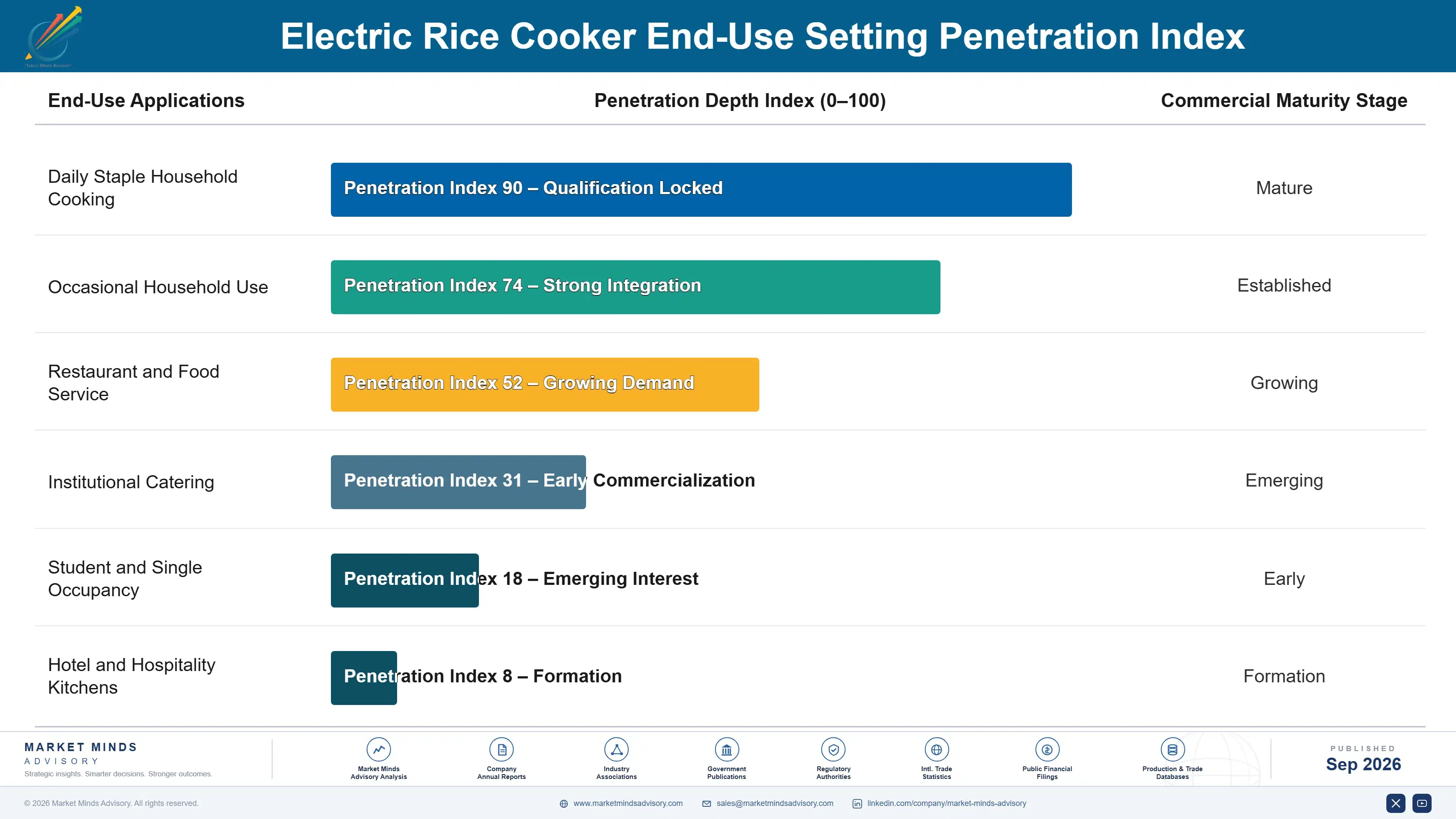
Stickiness varies sharply by how noticeable the cooking result is. Households eating rice daily detect the difference between induction and bottom element heating within a week and return to it deliberately, often to the same brand. Households eating rice occasionally notice very little and buy on price or on kitchen footprint at every replacement. Commercial buyers are steadiest of all, since requalifying equipment against a service specification is genuinely inconvenient.

Buyer profiles are diverging by region rather than converging. East Asian buyers are moving further up the premium curve as replacement cycles turn, while Western buyers move toward multi-function formats that cook rice as one capability among several. Diaspora households sit between the two and are poorly served by both, importing premium Asian models because export versions assume a grain they do not eat.
electric-rice-cooker-market-end-use-penetration-index-1790025004734

Where The Engineering Pays

These are among the four positions where our research anticipates prominent divergence between winners and laggards over the coming forecast period. Each is grounded in the demand model, the regulatory perimeter, and the announced capacity pipeline.
01 / GRAIN PROGRAMME DEVELOPMENT

Calibrate for the rice people actually eat

Export models typically ship with two grain settings against a dozen or more on domestic Japanese machines, which means basmati, parboiled and long grain all receive treatment designed for short grain varieties. Developing and validating the additional cooking curves costs test kitchen time rather than any hardware change whatsoever. Participants who added grain-specific programmes to export ranges report review scores rising roughly 1.7 times with product returns falling alongside them as well, and the engineering already exists in the domestic range untapped.
02 / ENERGY DISCLOSURE PRACTICE

Publish what holding rice actually costs

Keep-warm accounts for roughly 63% of the electricity these appliances consume and no energy label anywhere reports it, so buyers compare a cooking wattage that describes about a third of real consumption. Publishing hourly hold consumption costs a measurement already taken during ordinary development work. Participants who disclosed report premium model conversion rising roughly 28%, because efficient insulation finally justifies its price premium once running cost becomes visible to a buyer, and institutional buyers are already asking for the same measurement.
03 / INDUCTION TIER MIGRATION

Move the technology down a tier

Induction reaches around 17% of units and sits mostly in premium ranges, while component costs have fallen far enough to make mid-tier induction commercially viable for the first time. Moving the technology down costs bill of materials near eighteen dollars per unit rather than any redesign. Participants who did it report mid-tier unit share rising roughly 2.4 times, because the cooking difference is genuine and daily buyers notice it within a week, though competitors reaching the same component pricing will follow quickly.
04 / REGIONAL MANUFACTURING POSITION

Build where the grain is different

India grows at 9.4% and African parboiled demand is rising steadily, while both require calibration and capacities that imported Japanese and Chinese models simply do not provide to any of those buyers. Regional manufacturing removes both duty and freight while allowing programming written for the grain that is actually eaten locally. Participants who have built local capacity report landed cost falling roughly 29% alongside a product genuinely matched to that market, which importers cannot answer on either price or calibration.

Engagement Snapshot From the Field

A live engagement with an industry participant carrying material or product regulatory and market exposure ahead of a defining policy shift, showing how our research translates into a defensible multi-year portfolio strategy.
MARKET MINDS ADVISORY · CLIENT ENGAGEMENT SUMMARY
Electric Rice Cooker Producer Strategic Portfolio Review and Transition Roadmap 2026·Investment Scenario on Electric Rice Cooker Exposure Evaluation 2025-26
CLIENT PROFILE
An Asian kitchen appliance manufacturer with rice cooker revenue near USD 310 million (client-reported, unverified by MMA), weighted approximately 71% to domestic Asian markets and 29% to export. Export models carried two grain settings against eleven on the domestic range. Keep-warm consumption was measured internally but never published anywhere. Export units omitted the vacuum-insulated inner pot entirely.
STRATEGIC CHALLENGE
Export revenue had been flat for four years while management attributed the position to price competition from Chinese manufacturers. A cost reduction on export models had been approved. Nobody had examined export review content, or compared what export buyers cooked against what the export programming assumed. Neither question had been put to anybody internally.
MMA APPROACH
MMA coded 3,100 export market product reviews by stated complaint rather than by star rating. Grain type usage was surveyed among export buyers and compared against the programming shipped. Keep-warm consumption was measured across the range and against six competitor models, and mid-tier induction bill of materials was costed directly.
KEY FINDINGS
  1. Coded reviews showed 54% of negative export comments described cooking results with basmati or parboiled rice, which the two-setting export programming did not address at all.
  2. Export buyers cooked short grain in 19% of cases against export programming that assumed it almost exclusively, meaning most buyers used a curve written for a different grain.
  3. Keep-warm consumption on the client's export range ran 41% above its own domestic models, because the export units omitted the vacuum-insulated inner pot entirely.
  4. Mid-tier induction added USD 17 to bill of materials against a modelled retail uplift more than four times that figure in export markets.
CLIENT PROFILE
An Asian kitchen appliance manufacturer with rice cooker revenue near USD 310 million (client-reported, unverified by MMA), weighted approximately 71% to domestic Asian markets and 29% to export. Export models carried two grain settings against eleven on the domestic range. Keep-warm consumption was measured internally but never published anywhere. Export units omitted the vacuum-insulated inner pot entirely.
STRATEGIC CHALLENGE
Export revenue had been flat for four years while management attributed the position to price competition from Chinese manufacturers. A cost reduction on export models had been approved. Nobody had examined export review content, or compared what export buyers cooked against what the export programming assumed. Neither question had been put to anybody internally.
MMA APPROACH
MMA coded 3,100 export market product reviews by stated complaint rather than by star rating. Grain type usage was surveyed among export buyers and compared against the programming shipped. Keep-warm consumption was measured across the range and against six competitor models, and mid-tier induction bill of materials was costed directly.
KEY FINDINGS
  1. Coded reviews showed 54% of negative export comments described cooking results with basmati or parboiled rice, which the two-setting export programming did not address at all.
  2. Export buyers cooked short grain in 19% of cases against export programming that assumed it almost exclusively, meaning most buyers used a curve written for a different grain.
  3. Keep-warm consumption on the client's export range ran 41% above its own domestic models, because the export units omitted the vacuum-insulated inner pot entirely.
  4. Mid-tier induction added USD 17 to bill of materials against a modelled retail uplift more than four times that figure in export markets.
RECOMMENDED STRATEGY
Phase 1: Phase one: cancel the export cost reduction and port the full domestic grain programme set into export models. No hardware change is required. Phase 2: Phase two: publish keep-warm consumption across all ranges and restore vacuum insulation to export units. The measurement already existed internally. Phase 3: Phase three: launch mid-tier induction into export markets ahead of competitors reaching the same component pricing. Component pricing has only just crossed.
OUTCOME
Export review scores improved materially within two quarters of the programme port, and returns fell by roughly a third (client-reported, unverified by MMA). Mid-tier induction reached 14% of export units in its first year at the highest margin in the export portfolio, and published consumption figures became a point of difference competitors did not answer.

Frequently Asked Questions

Foundational context covering the market sizes, CAGR, scope, country, region and competition that inform every finding below. This section is provided to cover basics and most often pre-purchase conversations, answered from the MMA Primary Research Dataset.

What is the current size of the Electric Rice Cooker Market?

The market was valued at USD 5.6 billion in 2025, rising to USD 5.9 billion in 2026. Sizing is at manufacturer net revenue across six cooker technologies.

How large will the Electric Rice Cooker Market be by 2036?

MMA forecasts USD 9.7 billion by 2036, an increase of USD 3.8 billion over the 2026 base. That represents expansion of 1.64 times across the forecast period.

What is the CAGR for the Electric Rice Cooker Market 2026 to 2036?

The base case CAGR is 5.0%, with a bull case of 6.2% and a bear case of 3.8%. Historical growth between 2020 and 2025 ran at 3.9%.

Which segment is growing fastest?

Induction heating pressure cookers grow at 7.5%, half again the market rate, on even heat distribution a base element cannot match. Multi-function cookers follow at 6.6%.

Who are the major companies in the Electric Rice Cooker Market?

Zojirushi, Panasonic, Tiger Corporation, Midea Group and Cuckoo Electronics lead on manufacturer net revenue, holding a combined 38%. Heat control engineering rather than distribution separates the premium tiers.

Which country is growing fastest?

India grows fastest at 9.4%, combining kitchen electrification with domestic manufacturers calibrating for basmati and parboiled grain rather than importing short grain programming. Larger capacities also suit household serving patterns there.

Report Segmentation Architecture

The full report scope spans multiple orthogonal segmentation dimensions, with cross-tabulated demand data provided for each dimension pair. Coverage extends further to regional breakdowns, trend trajectories, and the competitive detail needed to support segment-level decision-making.

By Cooker Technology

  • Basic Thermostat Cookers
  • Micro-Computerised Fuzzy Logic Cookers
  • Induction Heating Pressure Cookers
  • Multi-Function Cookers with Rice Programmes
  • Commercial and Institutional Cookers
  • Portable and Single-Serve Cookers

By End-Use Setting

  • Daily Staple Household Cooking
  • Occasional Household Use
  • Restaurant and Food Service
  • Institutional Catering
  • Student and Single Occupancy
  • Hotel and Hospitality Kitchens

By Commercial Dimension

  • General Appliance Retail
  • Specialist Kitchen Retail
  • Marketplace and E-Commerce
  • Brand Direct Sales
  • Food Service Equipment Distribution
  • Department and Gift Retail

By Region

  • East Asia
  • South Asia and Pacific
  • North America
  • Western Europe
  • Latin America
  • Middle East and Africa
  • Eastern Europe

Scope, Methodology, and Coverage

Every figure in this report is reproducible from documented input assumptions. The scope below maps the historical period, the forecast horizon, the segmentation dimensions, and the countries covered, alongside the underlying primary and qualitative methodology.
Historical Period
2020 to 2025
Forecast Period
2026 to 2036
Base Year
2025 (USD billions; MMA Primary Research Dataset, September 2026)
Market Definition
This market covers electric appliances designed primarily for cooking rice, spanning basic thermostat cookers, micro-computerised fuzzy logic cookers, induction heating pressure cookers, multi-function cookers with rice programmes, commercial and institutional rice cookers, and portable and single-serve cookers. Sizing is at manufacturer net revenue across appliance retail, specialist kitchen, marketplace, direct, food service distribution and department channels. Pressure cookers without rice programmes, general multi-cookers sold without rice capability, rice itself, and commercial steam cooking equipment are excluded throughout.
Quantitative Units
USD billions at manufacturer net revenue; volume in millions of units shipped; energy in watt-hours per hour of holding.
Segmentation Dimensions
Cooker technology, end-use setting, commercial dimension, and geographic region.
Regions Covered
East Asia, South Asia and Pacific, North America, Western Europe, Latin America, Middle East and Africa, Eastern Europe
Countries Covered
China, Japan, India, South Korea, United States, Brazil
Key Companies Profiled
Zojirushi, Panasonic, Tiger Corporation, Midea Group, Cuckoo Electronics, Toshiba Lifestyle, Hitachi, Cuchen, Joyoung, Supor, Galanz, Aroma Housewares, Instant Brands, Bajaj Electricals, Prestige TTK, Philips Domestic Appliances, Sharp Corporation, Buffalo Technology, Tatung, Yum Asia
Quantitative Methodology
Primary survey, n=3,800 respondents, Q4 2025, six countries; demand-side model with trade association cross-validation
Qualitative Methodology
47 expert interviews, Q4 2025; applied to validate demand model assumptions, identify emerging dynamics, and assess competitive positioning
Report Format
PDF and XLSX data workbook (Word format preview document)
Publisher
Market Minds Advisory
Report Code
MMA-2026-CON-810
Published
September 2026
Contact
sales@marketmindsadvisory.com | www.marketmindsadvisory.com

Purchase the full Electric Rice Cooker Market Report (2026 to 2036).

The full report sizes the electric rice cooker market across six cooker technologies, six end-use settings and six commercial dimensions for all seven global regions through 2036. It codes product reviews by stated complaint rather than star rating, isolating how much dissatisfaction traces to grain programming rather than to build quality. Keep-warm consumption is measured across competing ranges against the cooking wattage that labels actually report. Grain type usage is surveyed among export buyers and compared against the programming shipped to them. Competitive assessment covers 20 participants on a consistent manufacturer net revenue basis.
Product reviews coded by stated complaint not rating
Keep-warm consumption measured across competing ranges
Grain type usage surveyed against programming actually shipped
Induction bill of materials costed by technology tier
Six cooker technologies sized through 2036
Twenty participants assessed on manufacturer net revenue

Built For The People Who Decide

From boardroom strategy to bench-side execution, this report is read cover-to-cover by leaders shaping the next decade of their industry, turning demand scenarios, market dynamics and valuation benchmarks into decisions.
CXOs/ Presidents/ VPs/ Managers
M&A and Corporate Development
Strategy Teams and R&D Heads
Procurement and Product Directors
Regulatory and Compliance Leaders
Investor Relations and Equity Analysts