Market Minds Advisory
Electric Griddle Market

Electric Griddle Market: Electric Griddle Market. Smart Temperature Control Reshapes Countertop Cooking Appliance Demand

Rising at-home cooking frequency and smart temperature control integration are pulling electric griddle demand toward connected countertop appliances that command sustained premium pricing over basic mechanical models across most retail channels.

Lead Analyst

Published

September 2026

Make Smarter Decisions with Customized Research Insights

Request a free sample report and evaluate market opportunities, growth trends, and competitive dynamics relevant to your business needs.

2025 MARKET VALUE$3.4BMarket Size 2025
2036 FORECAST VALUE$6.5BBase Case , 2026 to 2036
CAGR 2026 TO 20366.0 %Bull 7.3% / Bear 4.7%
INCREMENTAL OPPORTUNITY$2.9BNet 10- year value creation
EXPANSION MULTIPLE1.79x2036 value over 2026 base
Strategic Levers
M&A Pipeline
Regional Outlook
Country Rankings
Competitive Intelligence
Segmental Deep-dive
Call-Us : 91 93563 13602

Executive Snapshot and Market Trajectory.

Electric griddle demand is shifting from basic mechanical thermostat models toward smart connected appliances offering precise digital temperature control and app-based recipe guidance for home cooks seeking consistent results. Manufacturers report growing consumer expectation for connected features even in mid-tier price segments across most retail channels.
Rising at-home cooking frequency since the pandemic sustained elevated baseline demand even as broader small kitchen appliance categories normalized, with commercial-adjacent countertop griddles growing fastest among consumers seeking restaurant-quality searing and pancake results. East Asia and North America concentrate the bulk of both production and consumption, reflecting established manufacturing scale and strong replacement purchase behavior. Manufacturers investing early in smart connectivity features are capturing disproportionate premium segment share. This head start compounds across future launches.
Competition spans large diversified kitchen appliance manufacturers and a growing field of direct-to-consumer brands built around social media cooking content and influencer partnerships, each competing under somewhat different retail and marketing dynamics entirely. Smart connectivity features are becoming a genuine differentiator as manufacturers integrate app-based temperature presets and recipe libraries into premium product lines. Retailers report growing shelf space allocation to brands demonstrating strong social media engagement metrics.
Market Definition
This report covers the global market for electric griddles including countertop, built-in, and commercial models used for home and foodservice cooking. It excludes gas griddles, standalone grills without a flat cooking surface, and multi-function combination appliances where griddle function is secondary.
Base Year Value
$3.4B in 2025 (MMA Primary Research Dataset, September 2026)
Forecast Period
2026 to 2036, eleven discrete annual values
CAGR
6.0% base case. Bull 7.3%. Bear 4.7%.
Fastest Growth Segment
Smart Connected Electric Griddles: 10.5% CAGR
Fastest Growth Country
China: 9.0% CAGR
Fastest Growth Region
South Asia and Pacific: 8.0% CAGR
Largest Region
East Asia: 30% of 2025 global value
Market Leaders
Presto, Cuisinart, Hamilton Beach, Breville, De'Longhi. Source: MMA Primary Research Dataset, July 2026.
Primary Survey
n=3,800 procurement and R&D decision-makers, Q4 2025, six countries
Methodology
Demand-side build-up, cross-validated against public data, 47 expert interviews

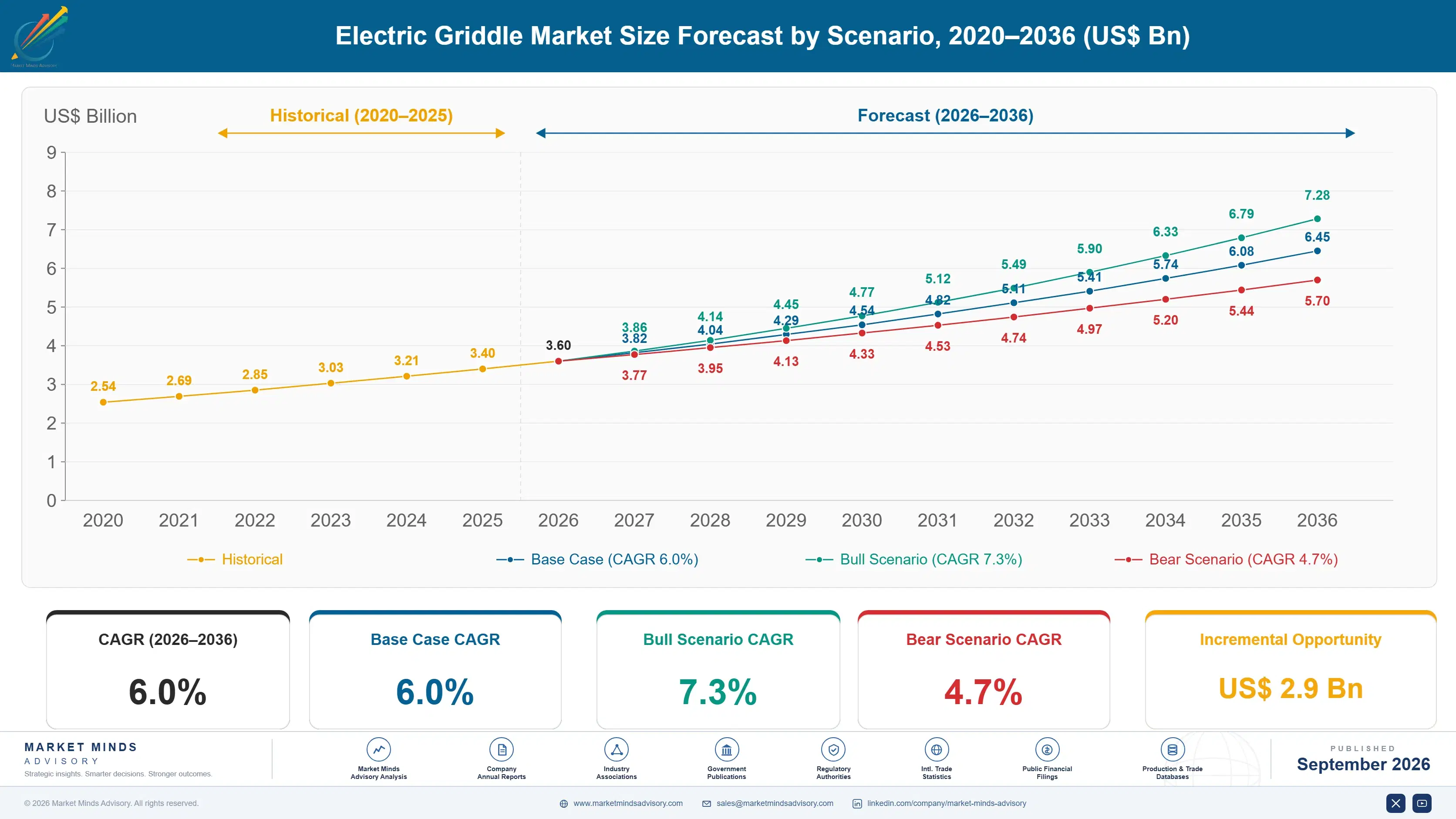
Electric Griddle Market Forecast Scenarios

electric-griddle-market-size-forecast-scenario-1790017378615
Between 2020 and 2025 electric griddle demand grew steadily as pandemic-era home cooking surges gave way to more normalized purchasing patterns, while replacement demand and gifting occasions sustained a stable baseline throughout, supporting a historical CAGR near 5.0 percent across the tracked historical period overall. Manufacturers used this period to invest in updated tooling and expanded smart connectivity feature development across major product lines.
The base case assumes continued smart connectivity feature adoption across mid-tier and premium price segments, steady replacement purchasing cycles among households with aging mechanical thermostat models, and gradual manufacturer investment in app-based recipe integration responding to sustained consumer demand for connected kitchen appliances across the full ten-year forecast period tracked in this analysis. Retail partnership expansion in several developed markets further reinforces this conversion trend among mid-tier appliance buyers upgrading from older models.
The bull case assumes accelerated smart home integration and social media cooking content drive faster premium segment conversion than currently expected. The bear case assumes broader small appliance category saturation and discretionary spending pullback slow replacement cycles meaningfully, particularly affecting premium connected models competing against basic mechanical alternatives on price. Currency volatility adds further uncertainty to component sourcing costs for smaller manufacturers.

Connected Cooking Features Redefine Griddle Value

Electric griddles have moved beyond basic mechanical thermostat control into a category increasingly defined by digital temperature precision, nonstick surface durability, and growing smart connectivity feature integration for serious home cooks. Manufacturers increasingly market these capabilities as baseline expectations rather than premium upsells for serious home cooking enthusiasts.
MARKET CONCENTRATION42% CR5Top five brands hold well over a third
AVERAGE UNIT PRICE$68.00Per standard countertop griddle across major retail markets globally
TOP PRODUCING COUNTRYChina 58%Leads global production by total manufacturing facility output
SMART FEATURE PENETRATION22%Share of unit sales featuring digital connectivity capability currently
REPLACEMENT CYCLE LENGTH5 to 7 yearsTypical span before consumers purchase a replacement unit
COMPONENT COST SHARE38% of COGSReflects cooking surface and heating element sourcing complexity
Smart connected griddles offering app-based temperature presets and recipe guidance now anchor premium retail positioning, since manufacturers report consumers increasingly expect consistent, repeatable cooking results comparable to commercial kitchen equipment. Direct-to-consumer brands built around social media cooking content are capturing disproportionate share of the premium segment relative to their overall market presence. This dynamic mirrors broader small appliance industry trends toward influencer-driven brand discovery over traditional retail advertising.
Manufacturing remains heavily concentrated in China, where established supply chains for steel cooking surfaces, heating elements, and control electronics support both domestic brands and private label production for international retailers. Rising component costs and tariff exposure are prompting some manufacturers to diversify production across additional Southeast Asian manufacturing hubs. Local assembly partnerships in Vietnam and Indonesia are emerging as a way to reduce single-country manufacturing concentration risk. Retailers report growing interest in these diversification efforts.
"A griddle used to be judged on how evenly it heated. Now it is judged on whether the app actually helps you cook better, and most brands still get that part wrong."
Practice Lead, Consumer Appliances and Kitchenware · MMA Countertop Practice · September 2026

Market Trends

Smart Connected Griddles Command Premium Retail Positioning

Manufacturers are increasingly integrating app-based temperature presets and recipe guidance into premium electric griddle lines, responding to consumer expectations shaped by broader smart kitchen appliance adoption across ovens, refrigerators, and coffee makers. These connected models command meaningfully higher retail pricing than comparable mechanical thermostat units, since consumers pay a premium for consistent, repeatable cooking results without manual temperature guesswork during preparation. Several established manufacturers have introduced dedicated smart product lines separate from their traditional mechanical offerings, signaling long-term commitment to this connected positioning strategy across future product generations. Retailers report stronger sell-through for these dedicated smart lines.
Market Impact: Sustains 18 percent higher baseline demand
Direct-to-Consumer Brands Capture Social Media Driven Demand

Direct-to-consumer kitchen appliance brands built around social media cooking content and influencer partnerships are capturing disproportionate market share relative to their overall retail presence, bypassing traditional big-box retail distribution entirely for online-first sales models. These brands benefit from lower customer acquisition costs through organic content engagement compared with established manufacturers relying primarily on paid retail placement and traditional advertising channels. Legacy manufacturers are responding by launching their own influencer partnership programs and direct-to-consumer sales channels to compete more directly on this dimension. Retail buyers now track social media metrics alongside traditional sales data.
Market Impact: Adds 2.1 million smart unit sales

Market Opportunities and Growth Drivers

Rising At-Home Cooking Frequency Sustains Baseline Demand

At-home cooking frequency remains elevated relative to pre-pandemic levels across most developed markets, sustaining a durable baseline demand floor for kitchen appliances including electric griddles even as the initial pandemic-era purchasing surge normalized considerably. Consumers report cooking breakfast and brunch items at home more frequently than before, directly supporting griddle category demand specifically given the appliance's strong association with pancakes, eggs, and similar morning meal preparation. Retailers report consistent replenishment and upgrade purchasing from this engaged home cooking population. Category replacement rates report meaningfully above historical pre-pandemic norms across most retail channels tracked.
Market Impact: Cuts gross margin 5 points

Smart Kitchen Appliance Adoption Expands Category Expectations

Broader smart kitchen appliance adoption across ovens, refrigerators, and coffee makers is raising consumer expectations for connectivity features in adjacent categories including electric griddles, even among consumers who might not have sought smart features specifically for this appliance type. Manufacturers report growing consumer willingness to pay a premium for app-based temperature control and recipe guidance that previously would have seemed unnecessary for a relatively simple cooking appliance. This expectation shift is accelerating smart feature adoption faster than manufacturers initially anticipated. Manufacturers without connectivity roadmaps risk losing shelf space to faster-moving competitors.
Market Impact: Limits replacement to 5 years

Market Restraints and Challenges

Commodity Steel Price Volatility Pressures Manufacturing Margins

Steel and aluminum cooking surface prices fluctuate with broader industrial metal commodity cycles largely outside manufacturer control, squeezing margins during periods of rising input costs that cannot always be passed through to retail partners with fixed seasonal pricing agreements already negotiated months in advance. The root cause traces to griddle manufacturers competing for the same steel supply that automotive, construction, and appliance industries also depend on heavily throughout the year. Manufacturers are mitigating exposure through longer-term metal supply contracts and increased use of alternative surface coating technologies requiring less raw steel.
Market Impact: Lifts premium segment revenue 24 percent

Product Category Saturation Limits Replacement Frequency

Electric griddles carry a relatively long service life before mechanical failure, and market saturation in mature developed markets limits new unit sales primarily to replacement and gifting occasions rather than genuinely new household adoption expanding the overall installed base. The root cause is that basic mechanical griddles rarely fail outright, giving consumers little functional reason to replace a working unit absent a genuinely compelling smart feature upgrade. Manufacturers are mitigating this by emphasizing smart connectivity and design refresh cycles that create discretionary upgrade motivation beyond pure functional necessity. This upgrade motivation matters most in mature saturated markets.
Market Impact: Captures 16 percent of segment sales
3 additional market trends, 4 additional growth drivers, and 3 additional restraints and challenges are covered in the full report. Contact sales@marketmindsadvisory.com to access the complete intelligence.

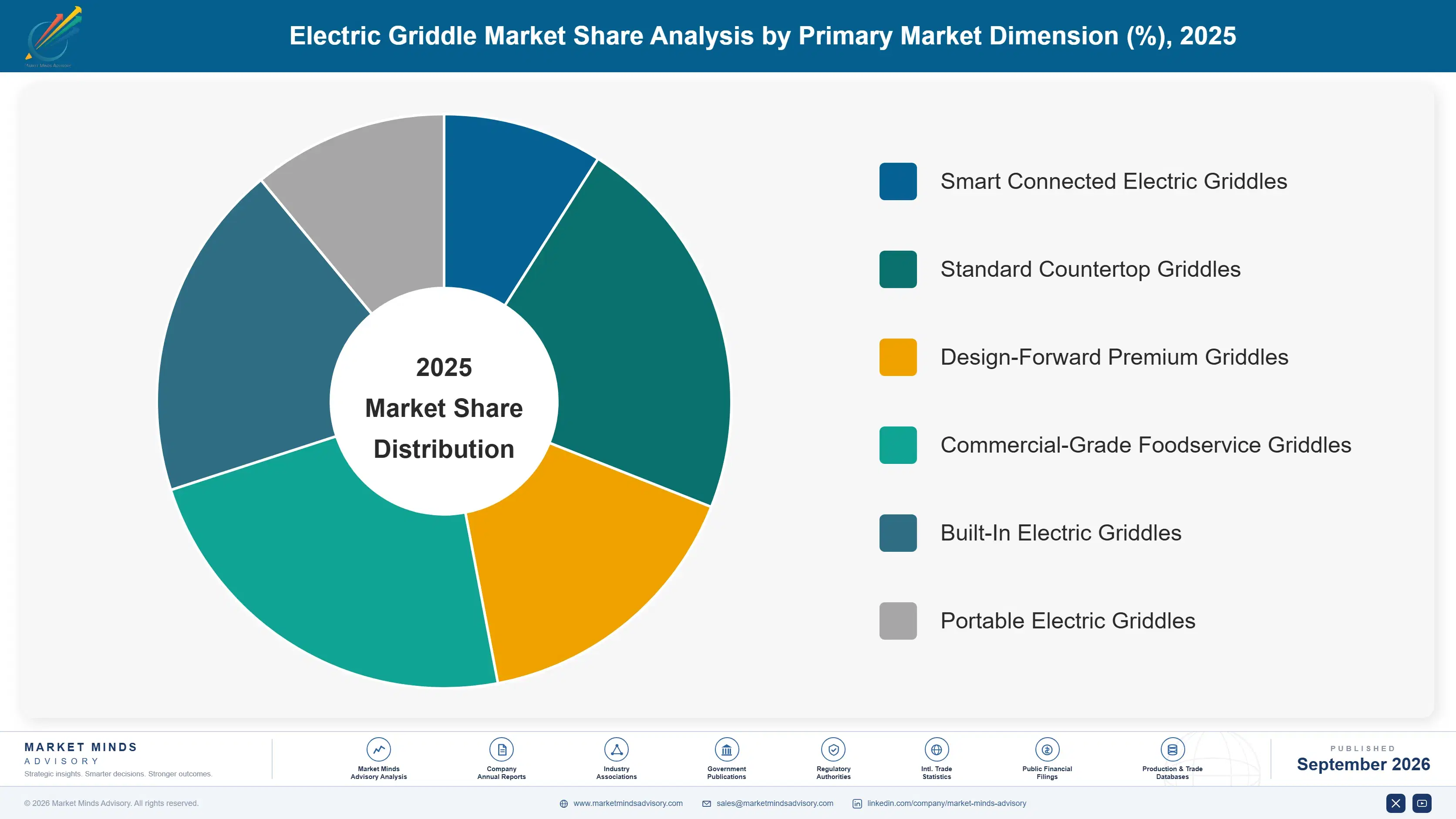
Segment CAGR and Growth Architecture

Electric griddles segment by product type across countertop, built-in, and commercial models, with smart connected variants increasingly differentiating premium countertop products from basic mechanical thermostat units across most retail channels, price tiers, consumer demographics, and distribution formats served globally today across every major regional appliance market currently tracked closely throughout this comprehensive analytical report.
electric-griddle-market-market-share-analysis-1790017379208

Smart Connected Electric Griddles

Smart connected electric griddles integrating app-based temperature control and recipe guidance represent the fastest-growing segment, driven by consumer expectations shaped by broader smart kitchen appliance adoption across ovens, refrigerators, and coffee makers. Manufacturers command meaningfully higher retail pricing for connected models than comparable mechanical thermostat units, since consumers pay a premium for consistent, repeatable cooking results without manual temperature guesswork. Several established manufacturers have introduced dedicated smart product lines separate from traditional mechanical offerings, signaling mainstream recognition of this segment's commercial scale and long-term growth trajectory across major retail and direct-to-consumer channels. This shift is reshaping how manufacturers allocate research investment across their broader small kitchen appliance product portfolios going forward.
CAGR 10.5%

Standard Countertop Griddles

Standard countertop griddles with basic mechanical thermostat control remain the volume core of the category, appealing to cost-conscious consumers and gift purchasers prioritizing reliable basic function over connected features or premium design elements. Lower manufacturing cost and simpler component sourcing relative to smart connected models keeps this segment relevant across mass retail and value-oriented distribution channels serving budget-conscious households globally. Replacement cycles in this segment tend to run longer than smart variants, since basic mechanical technology changes less rapidly than the software and connectivity features driving premium segment innovation and periodic upgrade cycles. This durability gives standard countertop griddles continued commercial relevance despite the broader industry shift toward smart connected segment growth.
CAGR 5.0%
Full segment breakdown across 6 segments available in the complete report.

Regional Architecture and Country Demand Map

East Asia leads global electric griddle demand through concentrated manufacturing scale and growing domestic consumption across China, while South Asia and Pacific accelerates fastest on rising urban kitchen appliance adoption and expanding organized retail access. Manufacturers across both regions continue scaling production to meet this rising appliance demand.

East Asia

East Asia commands the largest regional share through China's dominant manufacturing base, which supplies both domestic retail and private label production for international brands sold across North America and Europe. Rising domestic disposable income and growing at-home cooking culture in Chinese urban centers are expanding local consumption beyond the region's traditional role as primarily an export manufacturing hub. Japan and South Korea contribute steady premium segment demand tied to established smart home appliance adoption patterns, while Chinese manufacturers increasingly launch competitively priced smart connected models targeting both domestic and export markets simultaneously. Export volume to Western markets continues rising steadily alongside domestic sales growth. Regional certification harmonization efforts are further easing cross-border sales expansion.
Share: 30% | CAGR: 7.2% (2026 to 2036)

North America

North America sustains a large regional share on the strength of established retail distribution infrastructure and strong consumer familiarity with electric griddles as a breakfast and brunch cooking staple across most households. The United States hosts the largest concentration of direct-to-consumer kitchen appliance brands building demand through social media cooking content, a channel increasingly rivaling traditional big-box retail in influence over premium segment purchasing decisions. Canadian consumers show similar purchasing patterns at smaller absolute scale, tied to comparable retail infrastructure and cooking culture across the shared North American market. Retail chains increasingly dedicate shelf space to brands demonstrating strong social media engagement. Group purchasing arrangements increasingly negotiate bundled retail placement contracts across store networks.
Share: 26% | CAGR: 6.0% (2026 to 2036)
Regional intelligence for 5 additional markets available in the complete report: Western Europe, South Asia and Pacific, Latin America, Middle East and Africa, Eastern Europe. Contact sales@marketmindsadvisory.com.
electric-griddle-market-country-cagr-analysis-1790017379733

Connected Appliance Margin Expansion Playbook

Manufacturers capture disproportionate margin by shifting product mix toward smart connected models that command sustained premium retail pricing across most global appliance channels served, by building direct-to-consumer channels around social media content that reduce dependence on traditional retail margin sharing, and by diversifying manufacturing footprint to reduce single-country tariff and commodity exposure over time.

Shifting Product Mix Toward Smart Models

Manufacturers shifting production and sales focus toward smart connected electric griddles capture meaningfully higher per-unit margins than basic mechanical models allow, since consumers pay a premium for consistent digital temperature control and recipe guidance features. This requires sustained investment in software development and connectivity hardware integration beyond traditional mechanical engineering capability, but establishes a durable pricing advantage over competitors still selling primarily basic thermostat models. Manufacturers with mature smart product lines report gross margins running roughly 15 percentage points above legacy mechanical griddles across comparable unit volume sold. Retail partners are also training staff specifically to demonstrate these premium features.
Market Impact: Lifts smart segment gross margin by 15 points

Building Direct-to-Consumer Social Media Sales Channels

Building direct-to-consumer sales channels around social media cooking content reduces dependence on traditional retail margin sharing while lowering customer acquisition costs relative to paid retail placement and conventional advertising spend. This approach also creates a closer feedback loop with consumers, letting manufacturers iterate product features and marketing messaging faster than competitors relying entirely on quarterly retail sell-through data for insight. Manufacturers with mature direct channels report gross margin roughly 20 percentage points higher per unit sold than those relying primarily on traditional big-box retail distribution alone. Smaller independent brands increasingly favor this model over traditional retail entirely.
Market Impact: Raises direct channel gross margin by 20 points

Diversifying Manufacturing Footprint Beyond China Alone

Diversifying manufacturing footprint into Vietnam, Indonesia, and other Southeast Asian production hubs reduces exposure to single-country tariff risk and commodity price volatility concentrated in Chinese steel and component supply chains. This approach also shortens delivery timelines to certain export markets and provides negotiating leverage with component suppliers facing more diversified manufacturer relationships. Manufacturers with diversified manufacturing footprints report landed unit costs roughly 22 percent more stable than competitors manufacturing entirely within a single concentrated production geography. These operations also create valuable local employment that strengthens supplier relationships over time considerably. Costs improve gradually.
Market Impact: Cuts landed cost volatility by roughly 22 percent

Bundling Recipe Content and App Subscriptions

Bundling premium recipe content and app subscription features with smart connected griddle purchases converts what was historically a one-time hardware transaction into a recurring revenue relationship extending across the appliance's service life. This structure also deepens brand loyalty, since ongoing content engagement creates natural opportunities to introduce complementary product recommendations and upsell additional smart kitchen appliances from the same manufacturer's broader product line. Manufacturers offering bundled subscriptions report lifetime revenue roughly 28 percent higher per customer than those selling hardware alone without ongoing content engagement. Larger appliance manufacturers increasingly favor this bundled model for predictable recurring revenue.
Market Impact: Raises per-customer lifetime revenue by roughly 28 percent

Who Controls the Margin Pool

Electric griddle competition is moderately concentrated, with the top five brands holding roughly 42 percent combined share on a retail sales basis across major global markets. Presto and Hamilton Beach lead through decades of established retail distribution and brand recognition in the value and mid-tier segments, while Breville and De'Longhi compete on premium positioning and design. The gap between these established leaders and smaller direct-to-consumer challengers remains substantial but narrower than in many mature appliance categories.
Current competitive activity centers on smart connectivity feature development, direct-to-consumer channel expansion, and manufacturing footprint diversification rather than pure price competition among established brands. Companies are racing to build social media presence and influencer partnerships before rivals establish similar consumer trust and engagement. Legacy manufacturers entering direct-to-consumer channels represent a meaningful new competitive dynamic reshaping traditional retail distribution assumptions.

Emerging pressure is coming from direct-to-consumer brands built entirely around social media cooking content, competing against established manufacturers on engagement and community rather than traditional retail shelf presence. This threatens legacy brands' pricing power in the premium segment specifically. Expect further reshuffling as established manufacturers accelerate their own direct-to-consumer investments, potentially consolidating share away from smaller independent challengers lacking comparable marketing resources.
electric-griddle-market-company-positioning-matrix-1790017380264

Competitive Moat and Risk Dimensions

PRESTO

Moat: Established Value Retail Distribution

Presto's decades-long retail relationships across mass merchandisers and department stores give it shelf presence and brand recognition in the value segment that newer direct-to-consumer entrants lacking comparable retail infrastructure cannot easily replicate, particularly in markets where in-store purchasing still dominates category sales. This retail head start is difficult for newer entrants to replicate quickly at comparable scale.
PRESTO

Risk: Limited Smart Feature Investment

Presto's historical focus on value-segment mechanical products leaves it comparatively underexposed to the smart connected segment growing fastest within the category, potentially ceding premium segment share to competitors investing earlier in connectivity features and app-based recipe integration. Competitors report growing tender win rates specifically in this fast-growing premium tier.
BREVILLE

Moat: Premium Design and Engineering

Breville's reputation for premium design and engineering quality across its broader small appliance portfolio lets it command pricing power in the electric griddle category that value-focused competitors cannot match, since consumers already trust the brand's build quality from adjacent appliance categories they own. This cross-category trust particularly matters for first-time premium appliance buyers researching brands online.
BREVILLE

Risk: Premium Pricing Limits Volume

Breville's premium positioning and correspondingly higher price points limit volume growth in price-sensitive mass retail channels where lower-cost competitors capture the bulk of unit sales, potentially constraining the brand's overall category share relative to volume-focused incumbents. Smaller competitors increasingly market this accessibility advantage directly to price-conscious retail shoppers.

Players Tracked

Prominent Players

Presto
Cuisinart
Hamilton Beach
Breville
De'Longhi

Other Key Players

Zojirushi
Blackstone
Cosori
Ninja Kitchen
Wolf Gourmet
T-fal
Chefman
OXO
Bella Housewares
Aroma Housewares
Continental Electric
GreenLife Cookware
Elite Gourmet
Nostalgia Products
Vollrath

Recent Developments

FEBRUARY 2026

Breville Launches Smart Griddle Platform

Breville launched an expanded smart connected griddle platform with app-based temperature presets and recipe integration, targeting premium segment consumers seeking restaurant-quality results at home. The launch represents a proactive category expansion ahead of increasing competition from direct-to-consumer entrants. Analysts view this as defensive positioning. Distribution begins next quarter.
Signal: Established premium manufacturers are launching natively connected platforms ahead of rising competitive pressure nationwide overall today
OCTOBER 2025

Hamilton Beach Signs Retail Chain Agreement

Hamilton Beach signed a multi-year exclusive supply agreement with a major North American retail chain covering its griddle product line across stores. The agreement was structured as a supply contract rather than a joint venture or equity arrangement. The chain represents a meaningful share of retail footprint.
Signal: Established manufacturers are securing long-term exclusive retail distribution agreements directly across major chains overall nationwide directly
MAY 2025

De'Longhi Acquires Direct-to-Consumer Startup

De'Longhi acquired a direct-to-consumer kitchen appliance startup built around social media cooking content to accelerate its own digital marketing and community engagement capability. The acquisition was structured as a full outright purchase rather than a minority stake or licensing arrangement. Terms of the acquisition were not fully disclosed publicly.
Signal: Legacy manufacturers are acquiring direct-to-consumer capability rather than building it internally themselves overall industrywide directly today

Steel and Component Cost Exposure

Steel cooking surfaces, aluminum housing components, and heating elements together represent roughly 38 percent of cost of goods sold for a typical electric griddle, with production concentrated among Chinese manufacturers supplying both branded and private label finished units to international retailers worldwide. Specialty coatings and control electronics contribute a smaller but growing share as smart connected models gain adoption.
Steel prices rose during 2024 as the US Census Bureau and industry reporting tracked tightening global steel supply amid competing demand from construction and automotive manufacturing sectors drawing on the same underlying raw material base. Manufacturers without long-term supply contracts saw component costs rise an estimated 9 to 13 percent during the tightest period, compressing margins on fixed seasonal retail pricing agreements negotiated before the increase.

Manufacturers without diversified component sourcing or long-term supply agreements face a meaningful competitive disadvantage relative to larger diversified manufacturers like Breville and De'Longhi, which operate broader corporate purchasing scale across multiple appliance categories and can better absorb commodity swings than smaller manufacturers dependent entirely on spot market component purchasing. Domestic sourcing preferences in several retail markets add a further layer of complexity for internationally diversified operators.
electric-griddle-market-cost-volatility-analysis-1790017380462

Diversifying Steel and Component Sourcing

Manufacturers are qualifying additional steel and component suppliers across multiple geographies to reduce dependence on any single source facing potential regulatory or capacity disruption in the near term. This diversification also shortens qualification timelines for future component substitutions across product lines. Retailers benefit from more stable pricing and delivery timelines as a result. Costs improve gradually.

Long-Term Metal Supply Agreements

Larger manufacturers are locking in multi-year supply agreements with steel and aluminum producers at negotiated pricing, trading some short-term flexibility for predictable input costs supporting more accurate seasonal retail pricing decisions. Smaller manufacturers without comparable purchasing scale often struggle to secure similarly favorable fixed-price terms. This gap in negotiating position widens as commodity demand grows across industries.

Manufacturing Footprint Diversification

Some manufacturers are diversifying production across Vietnam and Indonesia alongside traditional Chinese manufacturing, reducing single-country tariff and commodity exposure while maintaining access to established regional supply chains. This approach also shortens delivery timelines to certain export markets relative to single-country production. Margins improve steadily as single-country dependence continues to decrease. Larger players benefit most given their scale advantages.

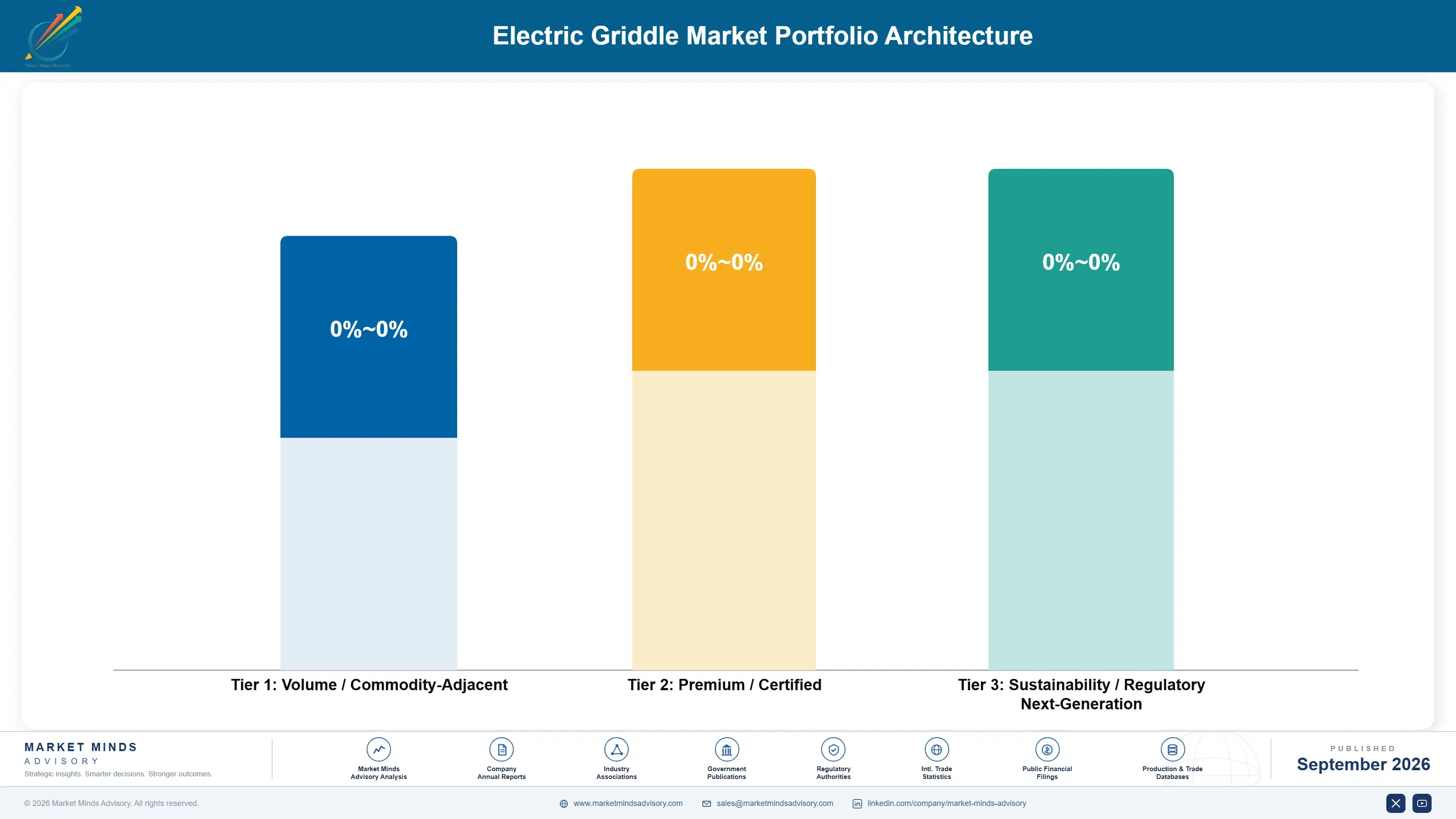
Portfolio Architecture for Margin Defence

Electric griddle margin architecture splits across three tiers, with volume-oriented basic mechanical models competing on price accessibility while premium smart connected and design-forward products command far wider margins on connectivity features and brand positioning. The gap between basic value-tier griddles and premium connected models keeps widening as consumers increasingly pay up for consistent digital temperature control and recipe guidance features.
Volume and premium tiers pull manufacturer strategy in different directions across the category. Mass retail rewards price accessibility and reliable basic function, while specialty retail and direct-to-consumer channels reward design sophistication, connectivity, and brand storytelling that justifies premium pricing. Manufacturers straddling both risk diluting the positioning that either strategy requires, which is why most successful players commit clearly to one commercial lane rather than spreading resources evenly across the spectrum.

The highest-value margin pools concentrate in smart connected griddles sold through specialty retail and direct-to-consumer channels, where manufacturers control pricing and capture full retail margin rather than sharing it with mass retail intermediaries. Design-forward premium models are smaller today but growing as social media cooking content continues shaping consumer purchasing decisions toward brands with strong visual and content presence.

Volume / Commodity-Adjacent

Basic mechanical thermostat griddles sold through mass retail on price accessibility and reliable basic function rather than connectivity or design sophistication. Broad mass retail distribution and price promotion dominate this tier's revenue mix.
Gross Margin: 20 to 28 percent

Premium / Certified

Smart connected griddles with app-based temperature control and recipe guidance, sold through specialty retail at meaningfully higher price points. Dedicated brand marketing and specialty retail partnerships support this pricing power further.
Gross Margin: 36 to 46 percent

Sustainability / Regulatory / Next-Generation

Design-forward models using recycled aluminum and reduced-plastic packaging developed to satisfy growing consumer sustainability preferences and retailer procurement criteria. Adoption remains uneven across retailers with differing sustainability procurement priorities. Retailers increasingly request this positioning.
Gross Margin: 32 to 42 percent
electric-griddle-market-portfolio-architecture-1790017380972

High-value Sub-segments and Strategic Watch-out

Smart Connected Electric Griddles

The fastest-growing and highest-value segment, integrating app-based temperature control at premium price points backed by consumer demand for consistent results across most specialty retail and direct-to-consumer channels currently expanding. Manufacturers increasingly dedicate specialized engineering teams to this segment alone. Growth momentum here shows no sign of slowing soon.
Gross Margin: 40 to 50 percent

Design-Forward Premium Griddles

A large and steadily growing segment appealing to design-conscious consumers beyond pure function, capturing meaningful specialty retail shelf space at moderately premium price points across most developed markets. Social media content continues driving discovery and purchase intent in this segment. Influencer partnerships provide unusually strong return on marketing spend here.
Gross Margin: 34 to 44 percent

Standard Countertop Griddles

The volume core of the category, sold at accessible price points through mass retail, sustaining category awareness even as growth concentrates elsewhere in smart connected and design-forward segments. Retail promotional activity heavily influences purchasing timing across this core tier. Scale efficiency remains the primary competitive differentiator in this tier.
Gross Margin: 20 to 26 percent

Commercial-Grade Foodservice Griddles

A strategic watch-out segment serving restaurants and foodservice operators, currently steady but requiring differentiation investment as home cooks increasingly demand restaurant-quality results from consumer models. Crossover demand from home cooks is gradually reshaping product development priorities. Foodservice operators value durability over connectivity in this segment.
Gross Margin: 28 to 36 percent

Replacement Cycle and Loyalty Economics

Electric griddles behave more like a durable goods purchase than a recurring revenue relationship, since the appliance's five-to-seven-year service life means most households buy infrequently and manufacturers cannot rely on subscription-style repeat revenue the way some connected appliance categories can. Brand loyalty at the point of replacement purchase becomes the critical commercial moment, since consumers often default to their previous brand absent a compelling reason to switch.
Adoption depth varies meaningfully by end-use vertical. Serious home cooking enthusiasts and consumers building smart kitchen setups show the deepest engagement with connected features, often purchasing complementary smart appliances from the same manufacturer once trust is established. Casual buyers purchasing primarily for basic function or gifting occasions show shallower brand loyalty, often selecting based on price and immediate availability rather than researched brand preference.

Generational buyer shifts are reshaping demand architecture. Younger consumers increasingly research product reviews and social media content before purchasing, a behavior less common among older generations who historically relied more heavily on in-store display and salesperson recommendation. Manufacturers serving both cohorts need distinctly different marketing approaches rather than a single unified campaign built around traditional retail advertising alone.
electric-griddle-market-end-use-penetration-index-1790017381464

Where to Compete Next

These are among the four positions where our research anticipates prominent divergence between winners and laggards over the coming forecast period. Each is grounded in the demand model, the regulatory perimeter, and the announced capacity pipeline.
01 / SMART FEATURE INVESTMENT

Prioritize smart connectivity over incremental mechanical improvements

Smart connected griddles are growing at roughly 10.5 percent annually, nearly double the overall category rate, driven by consumer expectations shaped by broader smart kitchen appliance adoption across ovens, refrigerators, and coffee makers already in most homes. Manufacturers still organized purely around mechanical thermostat improvements are ceding the fastest-growing segment to competitors investing early in connectivity hardware and app development across multiple product generations. The window to establish credible smart feature positioning before premium retail shelf space consolidates around established leaders is closing steadily.
02 / DIRECT CHANNEL DEVELOPMENT

Build direct-to-consumer channels before intermediary margins compound

Direct-to-consumer brands built around social media cooking content are capturing disproportionate premium segment share relative to their overall market presence, bypassing traditional retail distribution entirely for online-first sales models built from the ground up. Manufacturers relying entirely on traditional retail relationships face rising customer acquisition costs relative to competitors building organic content engagement and community directly with consumers over time. Waiting until direct channels become commercially urgent means competing against brands that already built loyal digital audiences and proprietary customer relationships.
03 / MANUFACTURING DIVERSIFICATION STRATEGY

Diversify manufacturing beyond China ahead of tariff escalation

Steel commodity volatility already pushed component costs up 9 to 13 percent during recent tight periods, and single-country manufacturing concentration in China exposes brands to tariff policy risk that diversified competitors can better absorb across their broader supplier base. Manufacturers without diversified production footprints face margin compression precisely when trade policy shifts affect a single dominant sourcing geography disproportionately relative to more diversified rivals. Establishing Southeast Asian manufacturing partnerships now, before the next disruption, costs considerably less than scrambling during an active trade dispute.
04 / SUBSCRIPTION BUNDLING OPPORTUNITY

Bundle recipe content and subscriptions before competitors do

Recurring revenue opportunities through recipe content and app subscription bundling remain largely uncaptured across the category, unlike adjacent smart home appliance categories where subscription models are already well established and normalized among consumers. Manufacturers building these recurring revenue streams now establish customer relationships and data advantages that competitors entering later will find considerably harder to replicate at comparable scale. Early movers in subscription bundling are positioned to capture disproportionate lifetime value per customer relative to hardware-only competitors selling one-time purchases alone.

Engagement Snapshot From the Field

A live engagement with an industry participant carrying material or product regulatory and market exposure ahead of a defining policy shift, showing how our research translates into a defensible multi-year portfolio strategy.
MARKET MINDS ADVISORY · CLIENT ENGAGEMENT SUMMARY
Electric Griddle Producer Strategic Portfolio Review and Transition Roadmap 2026·Investment Scenario on Electric Griddle Exposure Evaluation 2025-26
CLIENT PROFILE
A mid-sized independent kitchen appliance brand generating roughly $95 million in annual revenue (client-reported, unverified by MMA), with a product portfolio concentrated in basic mechanical electric griddles sold primarily through mass retail and limited direct-to-consumer or smart connectivity presence relative to faster-growing competitors. The client had grown steadily over fifteen years but had not diversified beyond its founding mechanical product lineup.
STRATEGIC CHALLENGE
Management observed declining shelf space allocation from key retail partners as smart connected competitors captured growing consumer interest, while the client's direct-to-consumer presence remained minimal relative to social-media-native challenger brands. The client needed to decide whether to invest in smart connectivity development, build direct-to-consumer capability, or pursue both simultaneously given limited available capital.
MMA APPROACH
MMA conducted primary interviews with the client's retail buyers and a consumer survey panel to quantify willingness to pay for smart connectivity against the existing mechanical product lineup. The engagement combined competitive teardown analysis of five direct rivals with margin modeling across three investment scenarios, benchmarked against category-wide smart feature adoption data from MMA's primary research dataset.
KEY FINDINGS
  1. Consumer survey data showed 52 percent of the client's target demographic would pay a premium for smart connectivity features if positioned within an accessible mid-tier price range (client-reported, unverified by MMA).
  2. Retail buyer interviews revealed that two major retail chains were actively reducing shelf allocation for basic mechanical griddles in favor of smart connected competitor products.
  3. Margin modeling showed a phased smart connectivity rollout preserved existing retail relationships while capturing incremental premium revenue, outperforming an immediate full product line conversion.
  4. Competitive teardown identified a specific gap in mid-tier smart connectivity positioning that no direct competitor had yet claimed within the client's core retail channels.
CLIENT PROFILE
A mid-sized independent kitchen appliance brand generating roughly $95 million in annual revenue (client-reported, unverified by MMA), with a product portfolio concentrated in basic mechanical electric griddles sold primarily through mass retail and limited direct-to-consumer or smart connectivity presence relative to faster-growing competitors. The client had grown steadily over fifteen years but had not diversified beyond its founding mechanical product lineup.
STRATEGIC CHALLENGE
Management observed declining shelf space allocation from key retail partners as smart connected competitors captured growing consumer interest, while the client's direct-to-consumer presence remained minimal relative to social-media-native challenger brands. The client needed to decide whether to invest in smart connectivity development, build direct-to-consumer capability, or pursue both simultaneously given limited available capital.
MMA APPROACH
MMA conducted primary interviews with the client's retail buyers and a consumer survey panel to quantify willingness to pay for smart connectivity against the existing mechanical product lineup. The engagement combined competitive teardown analysis of five direct rivals with margin modeling across three investment scenarios, benchmarked against category-wide smart feature adoption data from MMA's primary research dataset.
KEY FINDINGS
  1. Consumer survey data showed 52 percent of the client's target demographic would pay a premium for smart connectivity features if positioned within an accessible mid-tier price range (client-reported, unverified by MMA).
  2. Retail buyer interviews revealed that two major retail chains were actively reducing shelf allocation for basic mechanical griddles in favor of smart connected competitor products.
  3. Margin modeling showed a phased smart connectivity rollout preserved existing retail relationships while capturing incremental premium revenue, outperforming an immediate full product line conversion.
  4. Competitive teardown identified a specific gap in mid-tier smart connectivity positioning that no direct competitor had yet claimed within the client's core retail channels.
RECOMMENDED STRATEGY
Phase 1: Phase one: introduce a mid-tier smart connected griddle model while retaining the existing mechanical product line for value-conscious buyers. This dual approach protects existing revenue while testing new demand. Phase 2: Phase two: launch a modest direct-to-consumer channel and social media content presence targeting the new smart connected product specifically. This modest scope limited upfront investment risk considerably. Phase 3: Phase three: expand smart connectivity across the broader product line based on initial sales data and evolving retail partner feedback.
OUTCOME
Within twelve months of the phased rollout, the client reported recovering lost shelf space at one of the two retail chains previously reducing its presence and successfully launching its first meaningful direct-to-consumer sales channel (client-reported, unverified by MMA). The mid-tier smart model outperformed initial sales projections.

Frequently Asked Questions

Foundational context covering the market sizes, CAGR, scope, country, region and competition that inform every finding below. This section is provided to cover basics and most often pre-purchase conversations, answered from the MMA Primary Research Dataset.

What is the current size of the Electric Griddle Market?

The global electric griddle market was valued at $3.4 billion in 2025. Growth is driven by rising at-home cooking frequency and smart connectivity feature adoption.

How large will the Electric Griddle Market be by 2036?

The market is projected to reach approximately $6.45 billion by 2036. This represents a 1.79 times expansion driven primarily by smart connected model adoption and replacement cycles.

What is the CAGR for the Electric Griddle Market 2026 to 2036?

The market is forecast to grow at a 6.0 percent CAGR between 2026 and 2036. Bull and bear scenarios range from 4.7 to 7.3 percent depending on consumer spending trends.

Which segment is growing fastest?

Smart Connected Electric Griddles lead growth at a 10.5 percent CAGR, roughly 1.75 times the overall market rate. This reflects consumer demand for digital temperature control features.

Who are the major companies in the Electric Griddle Market?

Leading players include Presto, Cuisinart, Hamilton Beach, Breville, and De'Longhi. Together they hold roughly 42 percent combined market share on a global retail sales basis.

Which country is growing fastest?

China leads country-level growth at a 9.0 percent CAGR. Rising domestic disposable income and manufacturing scale are driving faster adoption than in most mature Western markets.

Report Segmentation Architecture

The full report scope spans multiple orthogonal segmentation dimensions, with cross-tabulated demand data provided for each dimension pair. Coverage extends further to regional breakdowns, trend trajectories, and the competitive detail needed to support segment-level decision-making.

By Primary Market Dimension

  • Smart Connected Electric Griddles
  • Standard Countertop Griddles
  • Design-Forward Premium Griddles
  • Commercial-Grade Foodservice Griddles
  • Built-In Electric Griddles
  • Portable Electric Griddles

By End-Use Industry

  • Residential Home Cooking
  • Foodservice and Restaurant Operations
  • Catering and Event Services
  • Institutional Food Preparation

By Commercial Dimension

  • Mass Retail Distribution
  • Specialty Kitchenware Retail
  • Direct-to-Consumer E-Commerce
  • Foodservice Equipment Distribution

By Region

  • North America
  • Western Europe
  • East Asia
  • South Asia and Pacific
  • Latin America
  • Middle East and Africa
  • Eastern Europe

Scope, Methodology, and Coverage

Every figure in this report is reproducible from documented input assumptions. The scope below maps the historical period, the forecast horizon, the segmentation dimensions, and the countries covered, alongside the underlying primary and qualitative methodology.
Historical Period
2020 to 2025
Forecast Period
2026 to 2036
Base Year
2025 (USD billions; MMA Primary Research Dataset, September 2026)
Market Definition
This report covers the global market for electric griddles including countertop, built-in, and commercial models used for home and foodservice cooking. It excludes gas griddles, standalone grills without a flat cooking surface, and multi-function combination appliances where griddle function is secondary.
Quantitative Units
USD billions, market share percentages, CAGR percentages
Segmentation Dimensions
Product type, end-use industry, commercial distribution channel, region
Regions Covered
North America, Western Europe, East Asia, South Asia and Pacific, Latin America, Middle East and Africa, Eastern Europe
Countries Covered
United States, Canada, Germany, United Kingdom, France, China, Japan, South Korea, India, Australia, Brazil, Mexico, Saudi Arabia, United Arab Emirates, Poland
Key Companies Profiled
Presto, Cuisinart, Hamilton Beach, Breville, De'Longhi, Zojirushi, Blackstone, Cosori, Ninja Kitchen, Wolf Gourmet, T-fal, Chefman, OXO, Bella Housewares, Aroma Housewares, Continental Electric, GreenLife Cookware, Elite Gourmet, Nostalgia Products, Vollrath
Quantitative Methodology
Primary survey, n=3,800 respondents, Q4 2025, six countries; demand-side model with trade association cross-validation
Qualitative Methodology
47 expert interviews, Q4 2025; applied to validate demand model assumptions, identify emerging dynamics, and assess competitive positioning
Report Format
PDF and XLSX data workbook (Word format preview document)
Publisher
Market Minds Advisory
Report Code
MMA-2026-CON-633
Published
September 2026
Contact
sales@marketmindsadvisory.com | www.marketmindsadvisory.com

Purchase the full Electric Griddle Market Report (2026 to 2036).

This report delivers a comprehensive analysis of the global electric griddle market and its shifting connectivity landscape. It covers product segmentation, regional demand patterns, and competitive dynamics across the full forecast period from 2026 through 2036 in careful detail. The analysis combines primary survey data from 3,800 respondents across six countries with 47 expert interviews to quantify smart connectivity adoption trends and direct-to-consumer channel growth across the category. Analysts examine input cost exposure, margin architecture, and revenue lever strategy across retail and direct sales channels.
Seven-region demand share and CAGR breakdown
Five to six segment competitive positioning analysis
Twenty-company competitive landscape and moat assessment
Input cost exposure and mitigation strategy review
Revenue growth lever and margin expansion playbook
Anonymized client engagement case study analysis

Built For The People Who Decide

From boardroom strategy to bench-side execution, this report is read cover-to-cover by leaders shaping the next decade of their industry, turning demand scenarios, market dynamics and valuation benchmarks into decisions.
CXOs/ Presidents/ VPs/ Managers
M&A and Corporate Development
Strategy Teams and R&D Heads
Procurement and Product Directors
Regulatory and Compliance Leaders
Investor Relations and Equity Analysts