Market Minds Advisory
Electric Countertop Griddles Market

Electric Countertop Griddles Market: Electric Countertop Griddles Market: Idle Energy Nobody Counts, Thermal Recovery Versus Wattage and What Chrome Actually Buys

A commercial griddle is switched on for fourteen hours and cooks for about three, which means most of the electricity it consumes goes into holding an empty plate at temperature.

Lead Analyst

Published

September 2026

Make Smarter Decisions with Customized Research Insights

Request a free sample report and evaluate market opportunities, growth trends, and competitive dynamics relevant to your business needs.

2025 MARKET VALUE$1.1BMarket Size 2025
2036 FORECAST VALUE$2.0BBase Case , 2026 to 2036
CAGR 2026 TO 20365.4 %Bull 6.6% / Bear 4.2%
INCREMENTAL OPPORTUNITY$0.8BNet 10- year value creation
EXPANSION MULTIPLE1.67x2036 value over 2026 base
Strategic Levers
M&A Pipeline
Regional Outlook
Country Rankings
Competitive Intelligence
Segmental Deep-dive
Call-Us : 91 93563 13602

Executive Snapshot and Market Trajectory.

Idle consumption rather than cooking consumption decides what a griddle costs to run over a year. Roughly 71% of daily electricity goes into holding an empty plate at temperature through service gaps, and around 14% of purchase decisions reference a published idle figure. Buyers compare wattage instead.
Induction griddles grow at 8.1%, half again the market rate of 5.4%, because removing radiant loss addresses idle energy directly rather than around it. Multi-zone thermostatic griddles follow at 7.0%. Manual control steel griddles grow slowest at 2.7%, still bought on price by operators comparing wattage figures that describe almost nothing useful. Chrome plate sits above both on cleaning labour and radiant heat rejection.
Thermal recovery is what a breakfast rush actually needs and nobody publishes it. A thin plate reaches temperature quickly and loses it the moment cold food lands, while a heavy plate recovers within seconds and holds a surface that cooks evenly. Concentration is moderate at 39% held by the top five participants, and India grows fastest of any country covered at 8.4%. Chrome plating costs more and buys reduced cooling load alongside faster cleaning.
Market Definition
This market covers electric griddles designed to sit on a commercial counter or equipment stand rather than being floor-mounted or range-integrated, spanning thermostatic steel plate griddles, chrome plate griddles, multi-zone thermostatic griddles, induction griddles, manual control steel griddles, and grooved and combination plate griddles. Sizing is at manufacturer net revenue. Gas griddles, floor-standing and range-integrated griddles, domestic griddles, and clamshell or panini presses are excluded.
Base Year Value
$1.1B in 2025 (MMA Primary Research Dataset, September 2026)
Forecast Period
2026 to 2036, eleven discrete annual values
CAGR
5.4% base case. Bull 6.6%. Bear 4.2%.
Fastest Growth Segment
Induction Griddles: 8.1% CAGR
Fastest Growth Country
India: 8.4% CAGR
Fastest Growth Region
South Asia and Pacific: 7.5% CAGR
Largest Region
North America: 31% of 2025 global value
Market Leaders
Welbilt, Middleby, Ali Group, Electrolux Professional, Vollrath. Source: MMA Primary Research Dataset, July 2026.
Primary Survey
n=3,800 procurement and R&D decision-makers, Q4 2025, six countries
Methodology
Demand-side build-up, cross-validated against public data, 47 expert interviews

Electric Countertop Griddles Market Forecast Scenarios

electric-countertop-griddles-market-size-forecast-scenario-1790025484931
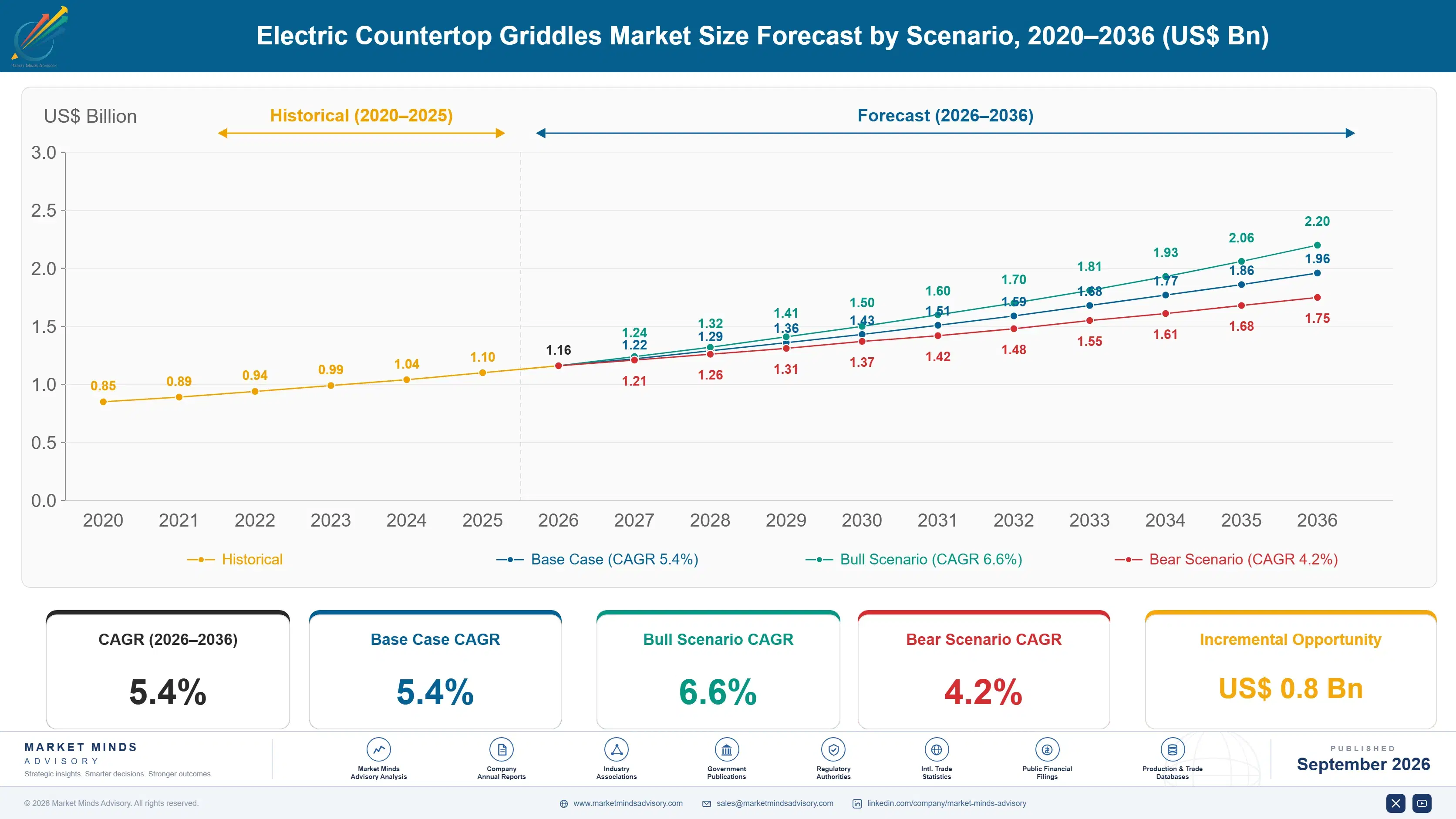
Growth of 4.3% between 2020 and 2025 records a collapse in equipment purchasing followed by a rebuild around different service patterns. Foodservice capital spending stopped almost entirely through 2020 and returned from 2022 into kitchens configured for higher throughput across considerably longer trading hours, which extended the daily period a griddle spends holding temperature rather than cooking.
Three mechanisms carry the base case. Induction griddles grow at 8.1% as energy cost makes radiant loss a line operators can quantify. Indian demand expands at 8.4% on organised food service and hotel construction served by domestic manufacturing. Extended trading hours across quick service and convenience foodservice lengthen idle periods, which strengthens the commercial case for anything that reduces holding consumption rather than cooking consumption. All three are visible in shipment data already.
The bull case is idle energy entering purchasing decisions. Published idle rates exist under commercial energy rating schemes and appear in roughly 14% of purchases, and making them routine would reprice the category around the number that governs running cost. The bear case is foodservice capital spending contracting. Countertop griddles are replaced during refits rather than on failure, which ties demand to construction cycles more tightly than most equipment.

Where The Electricity Goes

A commercial griddle spends most of its working day doing nothing and consuming electricity while it does. Around 71% of daily consumption goes into holding an empty or lightly loaded plate at temperature across service gaps, which is the figure that determines running cost and appears in roughly 14% of purchase decisions. Buyers compare wattage instead, and wattage describes the peak draw rather than anything the operator will actually pay for. Nothing on a specification sheet describes those eleven hours.
TOP FIVE CONCENTRATION39%Combined net revenue share held by five largest manufacturers
IDLE ENERGY SHARE71%Portion of daily consumption used while holding rather than cooking
AVERAGE UNIT PRICEUSD 1,850Weighted manufacturer price across every griddle type covered
PLATE THICKNESS STANDARD19 millimetresTypical cooking plate thickness on mid-tier commercial units
THERMAL RECOVERY TIME47 secondsTime to regain set temperature after a full load
ENERGY RATED PURCHASE SHARE14%Share of purchases referencing a published idle energy figure
Thermal recovery is the performance measure that matters on a busy line and almost nobody publishes it. Dropping a full load of cold product onto a plate pulls surface temperature down immediately, and what happens next decides whether the next batch cooks properly. A 19 millimetre plate recovers in around 47 seconds while a thinner one takes considerably longer, and no specification sheet states either figure.
Chrome plating costs more and buys two things operators rarely price. It radiates far less heat into the kitchen, which reduces air conditioning load, and it cleans in a fraction of the time. Neither benefit appears anywhere in a capital price comparison.
"The industry sells wattage, which is the number that matters for about three hours a day, and stays quiet about the idle rate that governs the other eleven. An operator buying on peak draw is optimising the wrong eleven hours."
Director, Foodservice Equipment and Commercial Kitchens Practice · MMA Foodservice Equipment Practice · September 2026

Market Trends

Induction Attacks Idle Loss Rather Than Cooking Cost

Induction griddles grow at 8.1% against 5.4% for the market because they remove the radiant and convective loss that drives idle consumption rather than improving cooking efficiency that was never the problem. Around 71% of a griddle's daily electricity goes into holding temperature, so a technology that heats the plate directly and stops instantly addresses the right eleven hours. Ferrous plate requirement and a price several times conventional units are the barriers, and both are narrowing steadily. Operators who have calculated an annual figure move toward it quickly. Those who have not still compare peak wattage on a specification sheet.
Market Impact: India grows at 8.4% annually
Multi-Zone Control Replaces Single Sensor Plates

Multi-zone thermostatic griddles grow at 7.0% because a single sensor under the centre of a plate cannot describe what is happening at the edges, and cold corners are the complaint operators raise most consistently. Independent zones with their own sensors hold surface temperature evenly and let a line run different products at different settings on one plate. The cost is additional controls and wiring rather than any change to the heating principle, which is why adoption has moved quickly. Zone count and sensor placement rather than wattage differentiate products here, and neither appears prominently.
Market Impact: Trading now runs 18 hours

Market Opportunities and Growth Drivers

Indian Organised Foodservice Meets Domestic Manufacturing

India grows fastest of any country covered at 8.4%, driven by organised food service chains, hotel construction and cloud kitchen operators building cooking lines at a pace no developed market matches. Domestic manufacturers serve them at costs imported equipment cannot approach on a heavy product that ships badly. Specification capability is rising as operators accumulate running cost data, which favours manufacturers able to answer technical questions rather than quote a price and a wattage. Hotel breakfast service in particular runs griddles across extended morning periods where idle consumption dominates the daily total.
Market Impact: Only 14% check idle rates

Extended Trading Hours Lengthen Daily Idle Periods

Quick service and convenience foodservice operators have extended trading hours considerably over five years, which lengthens the period a griddle spends holding temperature between cooking peaks rather than the period it spends cooking. That shifts the running cost balance further toward idle consumption and strengthens the commercial case for any technology reducing it. Energy pricing across Europe and parts of Asia has made that arithmetic visible to operators who previously never examined it at all. A griddle held at temperature through an eighteen hour day cooks for a fraction of it, and the rest is holding cost.
Market Impact: Recovery runs 47 seconds typically

Market Restraints and Challenges

Buyers Compare Wattage Rather Than Running Cost

Around 14% of purchases reference a published idle energy rate while nearly all compare wattage, which describes peak draw during the three hours a griddle actually cooks. The root cause is that wattage appears on every specification sheet and idle rate appears on very few, so a buyer comparing two units has only the misleading number available. Commercially it means efficient designs compete on criteria that ignore their advantage. Participants publishing idle rates address it directly. Energy pricing since 2022 has moved a growing group of operators to ask for the figure directly.
Market Impact: Idle takes 71% of consumption

Thermal Recovery Is Measured By Nobody At All

Recovery time after a full cold load determines whether a line keeps up during a rush, and no manufacturer publishes it despite every engineering department measuring it internally during development. The root cause is that a heavy plate costs more to make and recovers better, so publishing the figure would favour expensive product over the volume tier. Commercially it leaves operators discovering plate thickness consequences after purchase. Mitigation runs to published recovery curves at stated load. Chain buyers evaluating throughput would use the number immediately if anybody published it at a stated load.
Market Impact: Zones hold 3 settings simultaneously
3 additional market trends, 4 additional growth drivers, and 2 additional restraints and challenges are covered in the full report. Contact sales@marketmindsadvisory.com to access the complete intelligence.

Segment CAGR and Growth Architecture

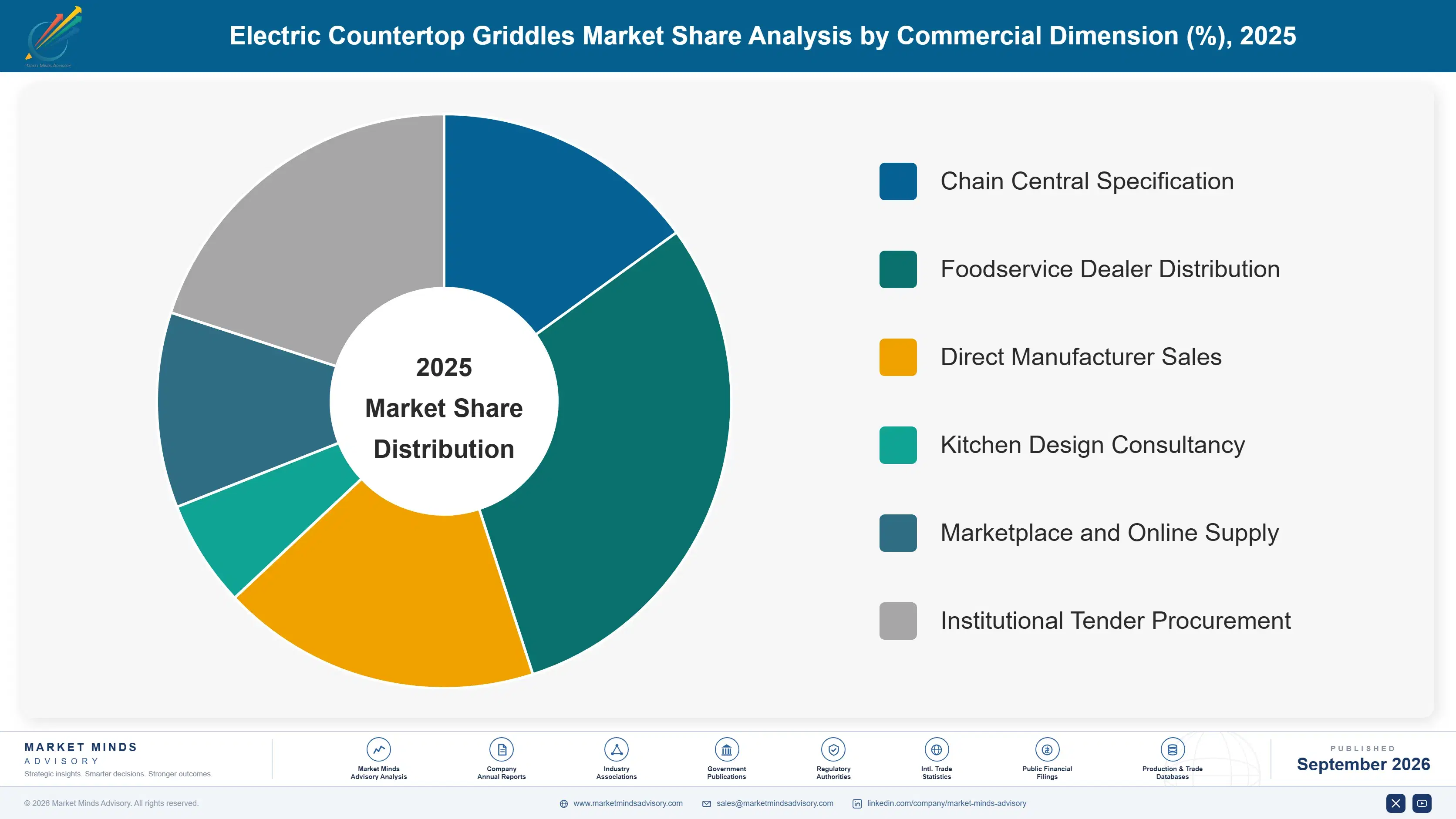
Segmentation follows heating technology and plate configuration, the dimension on which energy consumption, control precision, price and cleaning burden all divide together. Six configurations are assessed at manufacturer net revenue. Gas griddles, floor-standing units, domestic griddles and clamshell presses sit outside the defined scope throughout this report. Plate thickness cuts across all six and is documented on none of them.
electric-countertop-griddles-market-market-share-analysis-1790025485499

Induction Griddles

Induction griddles grow at 8.1%, half again the market rate of 5.4%, by addressing the consumption that actually matters rather than the one everybody measures. Heating the plate directly removes the radiant and convective loss that drives roughly 71% of a griddle's daily electricity use, and control response is effectively instant rather than lagging behind a thermostat. The plate must be ferrous, which constrains material choice, and unit prices run several times conventional thermostatic equivalents. Both constraints are narrowing as component costs fall and as energy pricing makes the running cost comparison harder for operators to ignore. Extended trading hours make the payback arrive considerably sooner than elsewhere in this category.
CAGR 8.1%

Multi-Zone Thermostatic Griddles

Multi-zone thermostatic griddles grow at 7.0% by solving the complaint operators raise most consistently, which is cold corners on a plate controlled by a single central sensor. Independent zones with their own thermostats hold surface temperature evenly and allow a line to run bacon at one setting and eggs at another on the same plate simultaneously. The additional cost is controls and wiring rather than any change to the heating principle, which has kept the price premium modest and adoption correspondingly quick. Zone count and sensor placement rather than total wattage are what differentiate products here. The benefit shows on the first shift rather than in an annual calculation, which is why adoption moves faster.
CAGR 7.0%
Full segment breakdown across 6 segments available in the complete report.

Regional Architecture and Country Demand Map

Shares record where griddles are installed rather than where plates are cast. Every region sits inside its standard band except Eastern Europe, which falls below on limited organised foodservice equipment investment across the region. That single deviation carries a stated reason in its own paragraph.

North America

At 31% this sits inside the standard band and remains the deepest market for the format, because flat-top cooking is central to American short-order and quick service preparation in a way it is nowhere else. Diner, breakfast and burger service all run on griddle plates, and chain operators specify centrally across hundreds of sites. Commercial energy rating schemes covering idle rate originated here and remain more developed than anywhere. Growth of 4.6% reflects a large installed base entering replacement rather than any expansion in outlet numbers. Chain specification means a single central decision rolls across hundreds of sites and holds for the equipment's whole life, which makes the specification relationship worth far more than any individual order.
Share: 31% | CAGR: 4.6% (2026 to 2036)

East Asia

The 26% position sits inside the standard band, carried by Chinese organised food service expansion and by a manufacturing base supplying commercial cooking equipment globally. Japanese teppanyaki and Korean grill formats use griddle plates extensively, though frequently in built-in rather than countertop configurations. Convenience store foodservice across Japan, Korea and Taiwan runs countertop griddles at enormous unit volume with extended trading hours that make idle consumption particularly significant. Growth of 6.3% reflects expansion and replacement together. Chinese manufacturers supplying cooking equipment globally are also moving into their own specified ranges, which changes the competitive position of Western participants across every single market that the two of them now contest directly with each other.
Share: 26% | CAGR: 6.3% (2026 to 2036)
Regional intelligence for 5 additional markets available in the complete report: Western Europe, South Asia and Pacific, Latin America, Middle East and Africa, Eastern Europe. Contact sales@marketmindsadvisory.com.
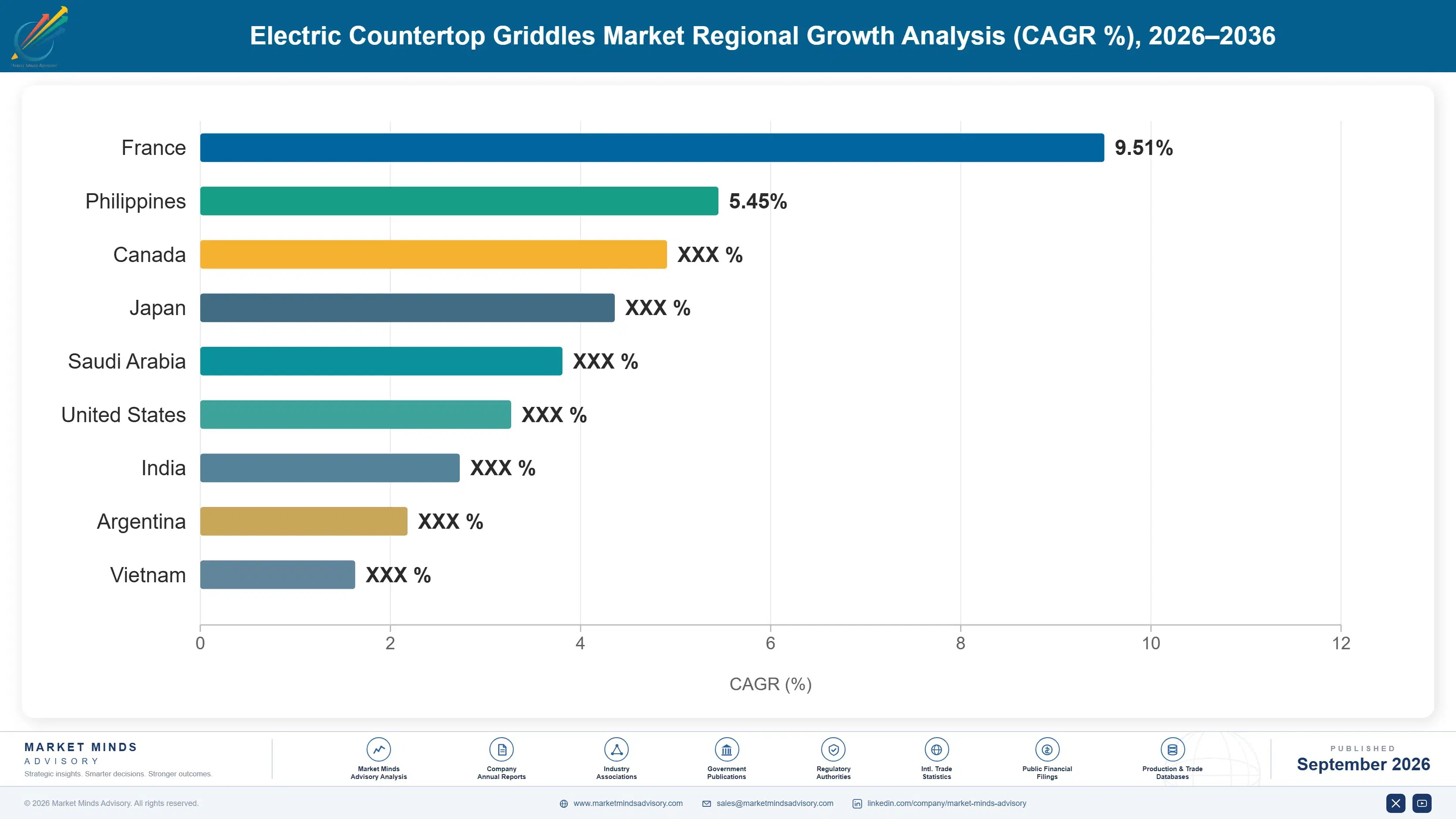
electric-countertop-griddles-market-country-cagr-analysis-1790025486041

Four Moves Worth Making Now

These four address a category where the published number describes the wrong hours, the performance measure that matters is unpublished, and the plating decision buys benefits that never appear in a purchase comparison. Each has been executed by at least one manufacturer already. Three of the four cost a documentation change or a calculation rather than any capital.

Publish Idle Energy Rate On Every Specification

Around 71% of a griddle's daily electricity goes into holding temperature and roughly 14% of purchases reference a published idle rate, because wattage appears on every specification sheet and idle rate on very few. Publishing the figure costs a test already performed for energy rating submission. Participants who did report specification inclusion rising roughly 2.1 times among operators facing high electricity pricing, who can convert the number into an annual cost immediately. Wattage describes peak draw during the hours the equipment cooks, which is about a fifth of the time it is switched on and drawing power.
Market Impact: Idle rate specification inclusion rises roughly 2.1 times

Publish Thermal Recovery Curves At Stated Load

Recovery time after a full cold load decides whether a line keeps up during a rush, and every engineering department measures it during development while no manufacturer publishes it. Releasing recovery curves at a stated load costs a documentation change. Participants who published report win rates rising roughly 1.8 times on chain tenders where throughput matters, because a buyer can finally compare the property that determines whether the equipment copes. A heavy plate costs more to make and recovers better, which is precisely why publishing the figure has never appealed to anybody selling the volume tier.
Market Impact: Chain tender win rates rise roughly 1.8 times

Price Chrome Plate Against Kitchen Cooling Load

Chrome plating costs more per unit and radiates far less heat into the kitchen, which reduces air conditioning load in a way no purchase comparison captures and which matters enormously in warm climates. Presenting the cooling saving alongside cleaning labour costs a calculation rather than any product change. Participants who framed it that way report chrome conversion rising roughly 2.6 times in Gulf and Southeast Asian markets, where the arithmetic is most compelling. In warm climates the cooling load a griddle imposes is a monthly cost rather than a comfort question, and the arithmetic favours chrome once anybody runs it.
Market Impact: Chrome plate conversion rises roughly 2.6 times higher

Move Multi-Zone Control Down Into Mid-Tier Pricing

Multi-zone control solves the cold corner complaint operators raise most consistently, costs additional thermostats and wiring rather than any change to the heating principle, and currently sits mostly in premium ranges. Moving it down a tier adds bill of materials near USD 90 per unit. Participants who did report mid-tier unit share rising roughly 2.3 times, because the benefit is visible on the first shift rather than in a running cost calculation. Unlike the energy argument, the benefit appears on the first shift rather than in an annual calculation, which makes it far easier to sell to an operator.
Market Impact: Mid-tier unit share rises roughly 2.3 times higher

Who Controls the Margin Pool

Concentration is moderate at 39% held by the top five, measured consistently on manufacturer net revenue rather than unit volume, which would overweight basic manual control units shipped at a fraction of premium prices. The leader to challenger gap rests on chain specification relationships and dealer coverage rather than on manufacturing, since casting a plate and fitting heating elements is widely available capability across several regions.
Competition runs on three dimensions currently. Chain specification decides the largest volumes, because a central decision rolls across hundreds of sites and holds for the equipment's whole life. Dealer stock position decides independent operator purchasing, where a buyer takes what the distributor carries and specification barely enters the conversation. Price decides the value tier, where manual control units are close to interchangeable between participants.

Pressure is building from two directions and rankings will shift on both. Induction specialists competing on running cost rather than capital price are reaching operators who have started calculating annual consumption, which is a comparison the volume tier cannot win. Meanwhile Indian and Chinese manufacturers serving their own fast-growing foodservice markets hold cost positions on a heavy product that Western participants cannot approach through export.
electric-countertop-griddles-market-company-positioning-matrix-1790025486568

Competitive Moat and Risk Dimensions

WELBILT

Moat: Chain Specification And Breadth

Specification relationships with large chain operators combined with breadth across cooking equipment categories make the company a single supplier for a whole kitchen rather than a vendor of one product line, and those relationships hold across multi-year rollout programmes across hundreds of sites. Recipes and timings are built around the equipment.
WELBILT

Risk: Conventional Heating Weighting

A portfolio weighted toward thermostatic radiant designs sits in the technology that idle energy scrutiny works against, while induction grows at half again the category rate. Repositioning requires engineering investment and a running cost argument the company has not historically needed to make. Induction is a different engineering base.
MIDDLEBY

Moat: Acquired Brand Portfolio Depth

A portfolio assembled through acquisition across cooking equipment categories gives chain customers a broad supplier relationship and gives the group flexibility to serve value and premium tiers under separate brands without either undermining the other in a dealer catalogue. Dealers can stock several tiers without brand conflict, which is difficult to replicate with a single-brand portfolio.
MIDDLEBY

Risk: Technology Integration Across Brands

Advances such as multi-zone control and induction need porting across many acquired brands with different engineering bases and component suppliers, which slows deployment against a focused competitor. Coordination cost rises with portfolio breadth rather than falling with it. A focused single-brand competitor deploys considerably faster than this.

Players Tracked

Prominent Players

Welbilt
Middleby
Ali Group
Electrolux Professional
Vollrath

Other Key Players

Star Manufacturing
Globe Food Equipment
Waring Commercial
Hatco
Wells Manufacturing
Anets
Lincat
Roller Grill
Cadco
Winco
APW Wyott
Adcraft
Panasonic Commercial
Tarrison
Blue Seal

Recent Developments

MARCH 2025

Electrolux Professional publishes idle energy rates across range

The company added measured idle consumption figures to specification sheets across its countertop cooking range, disclosing the rate that governs running cost rather than peak wattage alone. This was an internal documentation decision with no regulatory requirement, partnership or acquisition behind it. Wattage figures continue alongside the new rates.
Signal: European energy pricing made the number impossible to keep quiet. Operators began asking for it directly rather than accepting wattage.
OCTOBER 2024

Vollrath extends multi-zone control into mid-tier griddle range

The manufacturer introduced independent zone thermostats below its premium range, addressing cold corner complaints at a modest bill of materials increase. This was organic product development funded internally, with no partnership, licensing arrangement or acquisition behind the range extension work. Premium multi-zone models continue unchanged above the new range.
Signal: The benefit shows on the first shift rather than annually. Cold corners are the most consistent complaint.
JUNE 2025

Panasonic Commercial expands induction griddle manufacturing capacity

The company added induction cooking equipment capacity serving convenience foodservice operators across East Asia where extended trading hours make idle consumption particularly significant. This was organic capital investment with no joint venture, acquisition or licensing arrangement involved anywhere. Conventional thermostatic production continued alongside the new induction lines.
Signal: Long trading hours make induction economics work sooner than elsewhere. Eighteen hour trading makes the running cost case far sooner.

What The Griddle Costs

The cooking plate dominates and the controls decide the tier. Plate material and machining run roughly 33% of manufacturing cost, rising sharply with thickness since a heavy plate is simply more steel. Stainless housing takes about 18%, heating elements around 16%, and controls and thermostats a further 14% depending on zone count. Chrome plating adds around 9% where specified, and freight absorbs most of the remainder.
Steel and stainless prices rose sharply through 2021 and 2022 on energy and nickel costs, while semiconductor availability constrained electronic control supply in the same window, a movement the EIA documents for energy inputs and the US Census Bureau records in component trade data. Several manufacturers reported margin compression across cooking equipment ranges in 2022 and repriced through dealers. Both movements landed inside a single financial year.

Exposure divides by plate specification and manufacturing location rather than by size. Heavy plate participants carry proportionally more steel exposure while thin plate producers carry less and deliver worse thermal recovery, which is the trade the category never discusses openly. Manufacturers producing in India and China for their own markets avoid freight on a heavy product, which is much of why those positions resist export competition.
electric-countertop-griddles-market-cost-volatility-analysis-1790025486766

Contract steel and stainless across the production year

Plate material is the largest input and its cost scales directly with the thickness that determines thermal recovery, which makes steel pricing a product performance question rather than only a margin one. Contracting across a production year stabilises it. The commitment ties up working capital during periods when foodservice equipment demand softens unexpectedly. Thinner plate saves money and costs performance.

Dual source electronic controls before scaling multi-zone

Multi-zone designs multiply the control components in each unit, and semiconductor availability constrained cooking equipment production directly through the last cycle. Qualifying second sources before volume scales avoids a position where one supplier sets price and delivery together. Qualification takes engineering time well ahead of commercial need. Zone count multiplies that exposure directly across every unit.

Manufacture regionally for heavy poor-shipping equipment

A countertop griddle is dense, heavy and awkward to handle, which makes freight a meaningful share of landed cost on any long route into a fast-growing market. Producing closer to demand removes it along with duty. The constraint is that plate machining and assembly capacity must be built before regional volumes justify it. India and China clear that threshold already.

Portfolio Architecture for Margin Defence

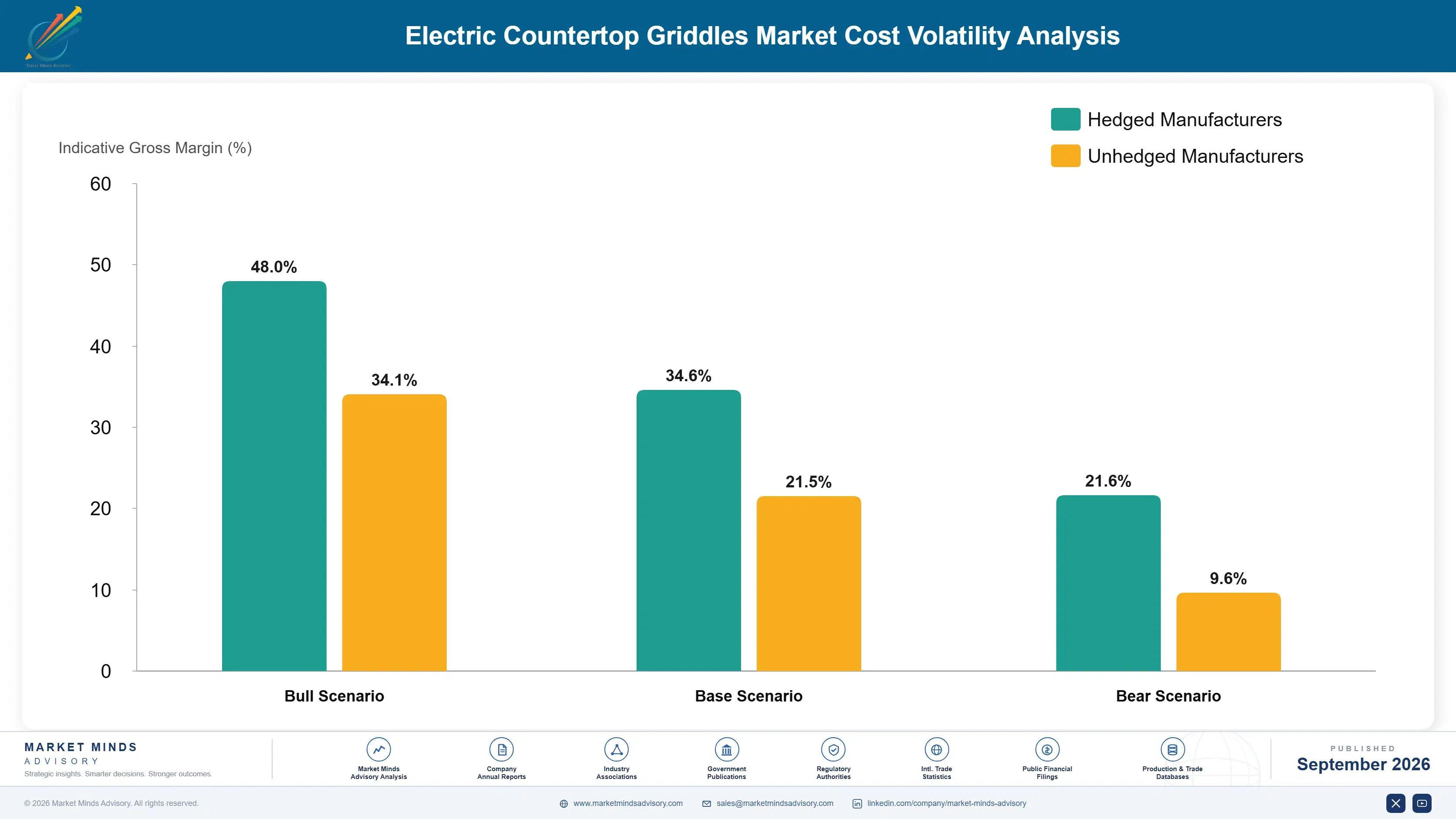
Margin architecture divides by control sophistication rather than by plate size, which a price list only partly reveals. Manual control steel griddles sold through foodservice dealers run at gross margins in the low twenties to low thirties, competing on price against near-identical units where plate casting and element fitting are available to any competent manufacturer anywhere. Nothing visible on a dealer shelf separates one from another.
Thermostatic steel and grooved combination plate griddles hold gross margins in the mid thirties to mid forties. The spread reflects how differently chain-specified and dealer-stocked units carry technical support cost. Grooved and combination plates in particular earn a premium by serving two preparation methods on one footprint, which matters on a counter where space is the binding constraint.

The highest-value pool is induction griddles and multi-zone chrome plate units, at margins in the high forties to high fifties. Those buyers calculate running cost, cleaning labour and cooling load rather than comparing capital prices, and pay for engineering that answers all three. Manual units carry volume and dealer shelf presence. They defend nothing against another manufacturer. Dealer shelf presence is the argument for keeping that tier, and it is a genuinely real one.

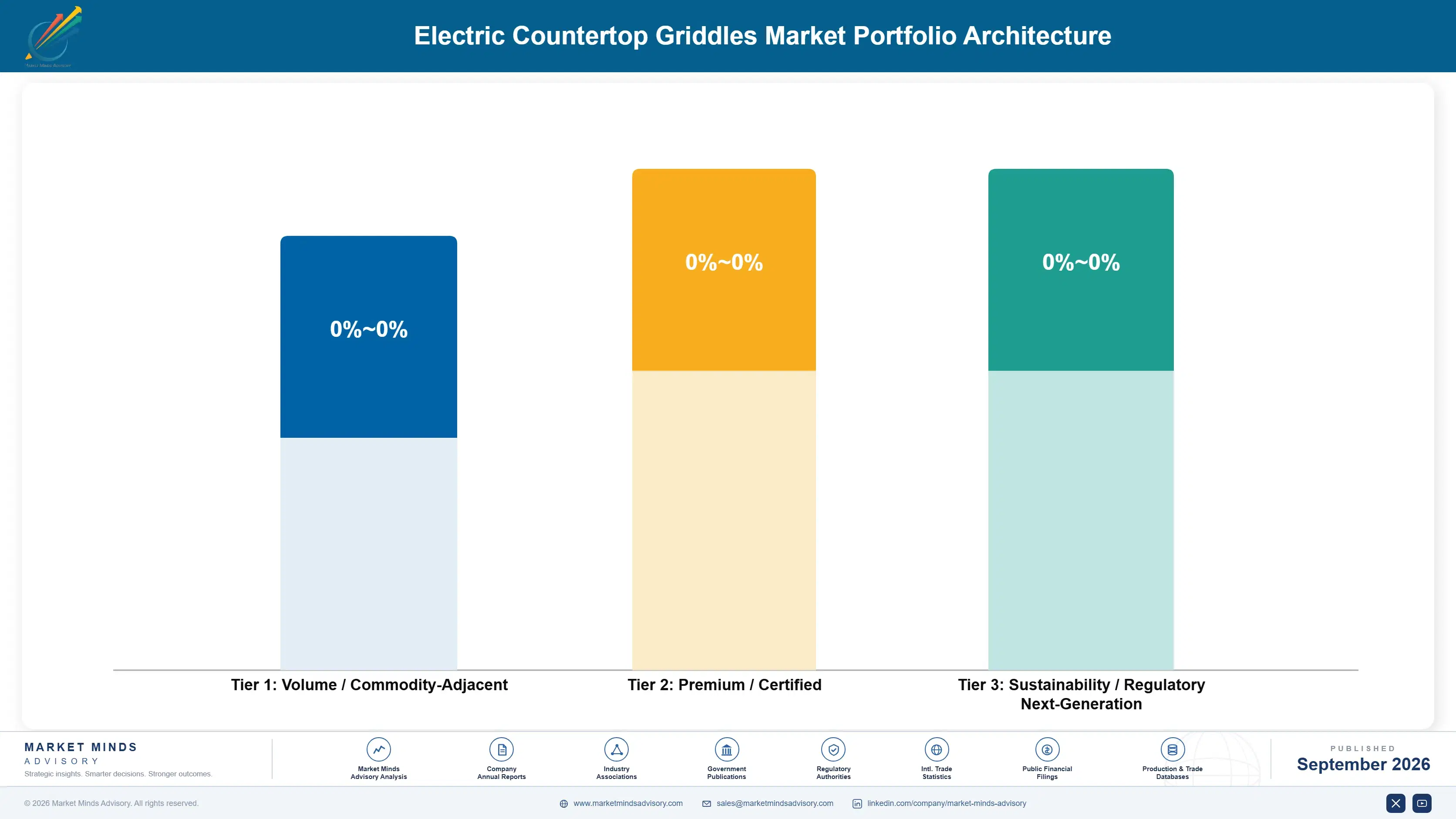
Volume / Commodity-Adjacent

Manual control steel griddles through foodservice dealers, competing on price against near-identical units from any competent manufacturer. The ten point range reflects how differently dealers negotiate volume and freight terms.
Gross Margin: 22 to 32%

Premium / Certified

Thermostatic steel and grooved combination plate griddles. Combination plates earn a premium by serving two preparation methods on one footprint, which matters where counter space is the binding constraint. Plate thickness decides how either performs under load.
Gross Margin: 35 to 45%

Sustainability / Regulatory / Next-Generation

Induction griddles and multi-zone chrome plate units. These buyers calculate running cost, cleaning labour and cooling load rather than comparing capital price, and pay for engineering answering all three. Capital price is not what these buyers are comparing.
Gross Margin: 47 to 58%
electric-countertop-griddles-market-portfolio-architecture-1790025487265

High-value Sub-segments and Strategic Watch-out

Induction Griddles

Highest value and fastest growth at 8.1%, addressing the idle loss that drives roughly 71% of daily consumption. Ferrous plate requirement and a several-fold price premium are the constraints, and both are narrowing steadily. Extended trading hours make the payback arrive sooner than in shorter service markets.
Gross Margin: 48 to 57%

Multi-Zone Thermostatic Griddles

High value and strong growth at 7.0%, solving the cold corner complaint that operators raise more consistently than any other. Additional cost is controls and wiring rather than any change in the heating principle. The benefit is visible on the first shift rather than in an annual calculation.
Gross Margin: 42 to 51%

Thermostatic Steel Plate Griddles

Volume core across most foodservice kitchens and the default dealer stock item. Plate thickness rather than wattage decides how it performs under load, and nobody publishes the figure that would show it. Dealers stock it because operators ask for it by category rather than by specification.
Gross Margin: 34 to 42%

Manual Control Steel Griddles

Strategic watch-out. Growing slowest at 2.7% and bought purely on price by operators comparing wattage figures. The fourteen point range reflects how differently branded and unbranded units are priced for the same function. Manual control also means a cook watching a dial rather than a thermostat holding temperature.
Gross Margin: 20 to 34%

How Replacement Actually Happens

Replacement here follows refits rather than failures, which distinguishes the category from most countertop equipment. A griddle that still heats is kept regardless of what it costs to run, because replacing it means a capital request that a working appliance rarely justifies. That ties demand to kitchen refurbishment cycles far more tightly than to equipment condition, and it means running cost arguments land during a refit and nowhere else.
Stickiness varies sharply by who specified and what the operator measured afterwards. Chain accounts that standardised a griddle across a network are extremely durable, since requalifying cooking equipment against established recipes and timings is genuinely disruptive to a kitchen. Independent operators buying from a dealer have no attachment at all. Operators who calculated running cost once return to whoever supplied the number.

Buyer profiles have shifted toward running cost since 2022. Energy pricing across Europe and parts of Asia moved consumption from an abstraction into a line on a monthly bill, and operators who examined it discovered that idle rate rather than wattage governs the figure. That group is growing and is served poorly by specification sheets that publish the wrong number, which is the clearest commercial opening in the category.
electric-countertop-griddles-market-end-use-penetration-index-1790025487760

Where Running Cost Decides

These are among the four positions where our research anticipates prominent divergence between winners and laggards over the coming forecast period. Each is grounded in the demand model, the regulatory perimeter, and the announced capacity pipeline.
01 / IDLE RATE DISCLOSURE

Publish the number that governs the bill

Roughly 71% of a griddle's daily electricity goes into holding temperature rather than cooking, and around 14% of purchase decisions reference a published idle rate because wattage appears everywhere and idle rate almost nowhere. Publishing the figure costs a test already performed for energy rating submission anyway. Participants who did it report specification inclusion rising roughly 2.1 times among operators facing high electricity pricing, who convert the number into annual cost immediately, and wattage describes the peak draw during roughly a fifth of operating hours.
02 / RECOVERY CURVE PUBLICATION

State what happens when food lands

Recovery time after a full cold load decides whether a cooking line keeps up during a rush, and every engineering department measures it during development while no manufacturer publishes anything at all. Releasing recovery curves at a stated load costs a documentation change rather than any product work. Participants who published report win rates rising roughly 1.8 times on chain tenders where throughput matters, because buyers can finally compare the property that governs performance, though a heavy plate costs more and recovers better, which explains the silence.
03 / CHROME COOLING ECONOMICS

Price the plating against the air conditioning

Chrome plating costs more per unit and radiates far less heat into the kitchen, which reduces air conditioning load in a way that no purchase price comparison captures anywhere. Presenting the cooling saving alongside reduced cleaning labour costs a calculation rather than any product change at all. Participants who framed it that way report chrome conversion rising roughly 2.6 times across Gulf and Southeast Asian markets, where the ambient arithmetic is most compelling, where cooling load is a monthly cost rather than a comfort question.
04 / ZONE CONTROL MIGRATION

Move the zones down a tier

Multi-zone control solves the cold corner complaint that operators raise more consistently than any other, costs additional thermostats and wiring rather than any change to the heating principle, and sits mostly in premium ranges today. Moving it down adds bill of materials near ninety dollars per unit. Participants who did it report mid-tier unit share rising roughly 2.3 times, because the benefit is visible on the first shift rather than in a calculation, unlike the energy argument, which requires an operator to run a calculation.

Engagement Snapshot From the Field

A live engagement with an industry participant carrying material or product regulatory and market exposure ahead of a defining policy shift, showing how our research translates into a defensible multi-year portfolio strategy.
MARKET MINDS ADVISORY · CLIENT ENGAGEMENT SUMMARY
Electric Countertop Griddles Producer Strategic Portfolio Review and Transition Roadmap 2026·Investment Scenario on Electric Countertop Griddles Exposure Evaluation 2025-26
CLIENT PROFILE
A commercial cooking equipment manufacturer with countertop griddle revenue near USD 72 million (client-reported, unverified by MMA), weighted approximately 68% to thermostatic steel and 32% to chrome and multi-zone. No specification sheet published idle energy rate or thermal recovery. Induction was absent from the range and plate thickness varied between models without documentation. Plate thickness was never documented.
STRATEGIC CHALLENGE
Chain specification revenue had declined for two consecutive years while management attributed the fall to imported price competition, and a cost reduction targeting plate thickness had been approved. Nobody had reviewed why chain tenders were lost, or measured what the existing range actually consumed while idling across a full trading day.
MMA APPROACH
MMA reviewed 96 lost chain tenders against stated evaluation criteria rather than against price alone. Idle consumption and thermal recovery were measured across the client's range and eight competitor units at matched settings. Chrome and steel plate radiant heat rejection was measured against kitchen cooling load in three Gulf installations.
KEY FINDINGS
  1. Lost tenders divided as 38% on running cost criteria the client could not answer and 24% on capital price, against management's assumption that price explained nearly all of them.
  2. Measured idle consumption on the client's thermostatic range ran 27% above the best competitor unit at identical plate area, and the figure appeared on no specification sheet anywhere.
  3. The approved plate thickness reduction would have extended thermal recovery from 44 to 71 seconds, which three chain customers had already identified as a throughput constraint.
  4. Chrome plate installations in Gulf kitchens reduced measured cooling load by an amount worth USD 1,400 annually per unit, which no sales material had ever mentioned.
CLIENT PROFILE
A commercial cooking equipment manufacturer with countertop griddle revenue near USD 72 million (client-reported, unverified by MMA), weighted approximately 68% to thermostatic steel and 32% to chrome and multi-zone. No specification sheet published idle energy rate or thermal recovery. Induction was absent from the range and plate thickness varied between models without documentation. Plate thickness was never documented.
STRATEGIC CHALLENGE
Chain specification revenue had declined for two consecutive years while management attributed the fall to imported price competition, and a cost reduction targeting plate thickness had been approved. Nobody had reviewed why chain tenders were lost, or measured what the existing range actually consumed while idling across a full trading day.
MMA APPROACH
MMA reviewed 96 lost chain tenders against stated evaluation criteria rather than against price alone. Idle consumption and thermal recovery were measured across the client's range and eight competitor units at matched settings. Chrome and steel plate radiant heat rejection was measured against kitchen cooling load in three Gulf installations.
KEY FINDINGS
  1. Lost tenders divided as 38% on running cost criteria the client could not answer and 24% on capital price, against management's assumption that price explained nearly all of them.
  2. Measured idle consumption on the client's thermostatic range ran 27% above the best competitor unit at identical plate area, and the figure appeared on no specification sheet anywhere.
  3. The approved plate thickness reduction would have extended thermal recovery from 44 to 71 seconds, which three chain customers had already identified as a throughput constraint.
  4. Chrome plate installations in Gulf kitchens reduced measured cooling load by an amount worth USD 1,400 annually per unit, which no sales material had ever mentioned.
RECOMMENDED STRATEGY
Phase 1: Phase one: cancel the plate reduction, measure and publish idle energy rates and recovery curves across the range. The measurements already exist internally. Phase 2: Phase two: move multi-zone control into the mid-tier and present chrome against measured cooling load in warm markets. Cooling load is a monthly cost there. Phase 3: Phase three: develop an induction range targeting operators who have begun calculating annual running cost. That group is growing quickly across Europe and Asia.
OUTCOME
Chain tender win rates improved materially within three quarters of publishing idle and recovery figures (client-reported, unverified by MMA). Chrome conversion in Gulf markets more than doubled once cooling load appeared in the sales argument, and mid-tier multi-zone reached 18% of unit volume in its first year.

Frequently Asked Questions

Foundational context covering the market sizes, CAGR, scope, country, region and competition that inform every finding below. This section is provided to cover basics and most often pre-purchase conversations, answered from the MMA Primary Research Dataset.

What is the current size of the Electric Countertop Griddles Market?

The market was valued at USD 1.1 billion in 2025, rising to USD 1.2 billion in 2026. Sizing is at manufacturer net revenue across six griddle configurations.

How large will the Electric Countertop Griddles Market be by 2036?

MMA forecasts USD 2.0 billion by 2036, an increase of USD 0.8 billion over the 2026 base. That represents expansion of 1.67 times across the forecast period.

What is the CAGR for the Electric Countertop Griddles Market 2026 to 2036?

The base case CAGR is 5.4%, with a bull case of 6.6% and a bear case of 4.2%. Historical growth between 2020 and 2025 ran at 4.3%.

Which segment is growing fastest?

Induction griddles grow at 8.1%, half again the market rate, by removing the radiant loss that drives idle consumption. Multi-zone thermostatic griddles follow at 7.0%.

Who are the major companies in the Electric Countertop Griddles Market?

Welbilt, Middleby, Ali Group, Electrolux Professional and Vollrath lead on manufacturer net revenue, holding a combined 39%. Chain specification relationships rather than manufacturing separate them.

Which country is growing fastest?

India grows fastest at 8.4%, on organised food service, hotel construction and cloud kitchen expansion served by domestic manufacturing at costs imports cannot approach. Shipping economics favour domestic production heavily.

Report Segmentation Architecture

The full report scope spans multiple orthogonal segmentation dimensions, with cross-tabulated demand data provided for each dimension pair. Coverage extends further to regional breakdowns, trend trajectories, and the competitive detail needed to support segment-level decision-making.

By Heating Technology and Plate

  • Thermostatic Steel Plate Griddles
  • Chrome Plate Griddles
  • Multi-Zone Thermostatic Griddles
  • Induction Griddles
  • Manual Control Steel Griddles
  • Grooved and Combination Plate Griddles

By End-Use Industry

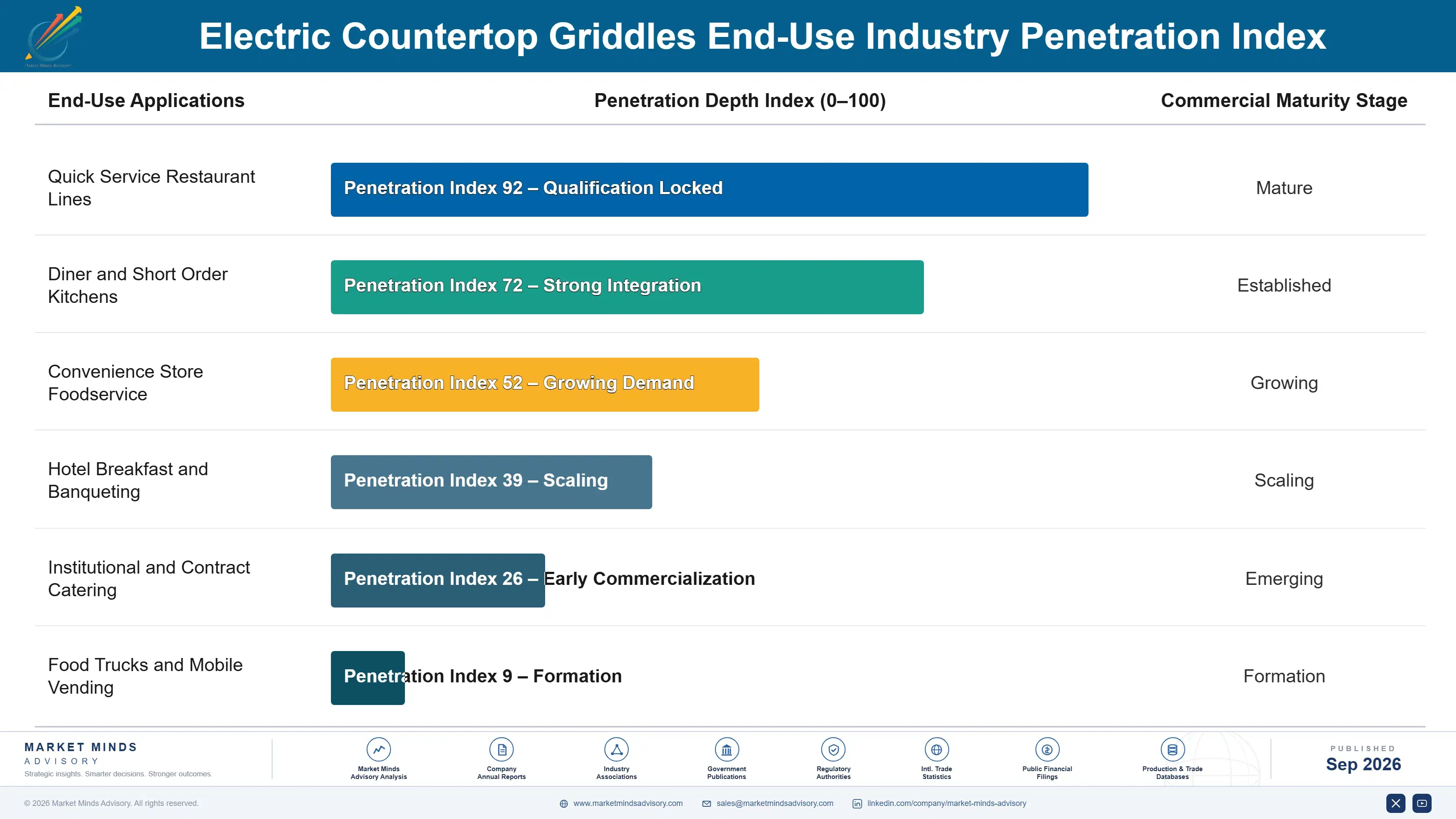
  • Quick Service Restaurant Lines
  • Diner and Short Order Kitchens
  • Convenience Store Foodservice
  • Hotel Breakfast and Banqueting
  • Institutional and Contract Catering
  • Food Trucks and Mobile Vending

By Commercial Dimension

  • Chain Central Specification
  • Foodservice Dealer Distribution
  • Direct Manufacturer Sales
  • Kitchen Design Consultancy
  • Marketplace and Online Supply
  • Institutional Tender Procurement

By Region

  • North America
  • East Asia
  • Western Europe
  • South Asia and Pacific
  • Latin America
  • Middle East and Africa
  • Eastern Europe

Scope, Methodology, and Coverage

Every figure in this report is reproducible from documented input assumptions. The scope below maps the historical period, the forecast horizon, the segmentation dimensions, and the countries covered, alongside the underlying primary and qualitative methodology.
Historical Period
2020 to 2025
Forecast Period
2026 to 2036
Base Year
2025 (USD billions; MMA Primary Research Dataset, September 2026)
Market Definition
This market covers electric griddles designed to sit on a commercial counter or equipment stand rather than being floor-mounted or range-integrated, spanning thermostatic steel plate griddles, chrome plate griddles, multi-zone thermostatic griddles, induction griddles, manual control steel griddles, and grooved and combination plate griddles. Sizing is at manufacturer net revenue across chain specification, dealer distribution, direct, design consultancy, online and institutional tender channels. Gas griddles, floor-standing and range-integrated griddles, domestic griddles, and clamshell or panini presses are excluded throughout.
Quantitative Units
USD billions at manufacturer net revenue; volume in thousands of units shipped; consumption in kilowatt hours per idle hour.
Segmentation Dimensions
Heating technology and plate configuration, end-use industry, commercial dimension, and geographic region.
Regions Covered
North America, East Asia, Western Europe, South Asia and Pacific, Latin America, Middle East and Africa, Eastern Europe
Countries Covered
United States, China, India, Japan, Germany, Brazil
Key Companies Profiled
Welbilt, Middleby, Ali Group, Electrolux Professional, Vollrath, Star Manufacturing, Globe Food Equipment, Waring Commercial, Hatco, Wells Manufacturing, Anets, Lincat, Roller Grill, Cadco, Winco, APW Wyott, Adcraft, Panasonic Commercial, Tarrison, Blue Seal
Quantitative Methodology
Primary survey, n=3,800 respondents, Q4 2025, six countries; demand-side model with trade association cross-validation
Qualitative Methodology
47 expert interviews, Q4 2025; applied to validate demand model assumptions, identify emerging dynamics, and assess competitive positioning
Report Format
PDF and XLSX data workbook (Word format preview document)
Publisher
Market Minds Advisory
Report Code
MMA-2026-CON-817
Published
September 2026
Contact
sales@marketmindsadvisory.com | www.marketmindsadvisory.com

Purchase the full Electric Countertop Griddles Market Report (2026 to 2036).

The full report sizes the electric countertop griddles market across six heating and plate configurations, six end-use industries and six commercial dimensions for all seven global regions through 2036. It measures idle consumption and thermal recovery across competing units at matched settings rather than relying on published wattage. Lost chain tenders are reviewed against stated evaluation criteria to separate running cost losses from capital price ones. Radiant heat rejection from chrome and steel plates is measured against kitchen cooling load in warm climate installations. Competitive assessment covers 20 participants on a consistent manufacturer net revenue basis.
Idle consumption measured across competing units at matched settings
Thermal recovery timed under full cold load conditions
Lost chain tenders reviewed against stated evaluation criteria
Radiant heat rejection measured against kitchen cooling load
Six griddle configurations sized through 2036
Twenty participants assessed on manufacturer net revenue

Built For The People Who Decide

From boardroom strategy to bench-side execution, this report is read cover-to-cover by leaders shaping the next decade of their industry, turning demand scenarios, market dynamics and valuation benchmarks into decisions.
CXOs/ Presidents/ VPs/ Managers
M&A and Corporate Development
Strategy Teams and R&D Heads
Procurement and Product Directors
Regulatory and Compliance Leaders
Investor Relations and Equity Analysts