

Market Minds Advisory
Elastic Laminates Market

Elastic Laminates Market: Adult Incontinence Growth Rewrites a Category Built on Diapers

Aging populations are pulling elastic laminate demand toward adult incontinence products faster than baby diaper volume can grow, forcing manufacturers built around infant hygiene specifications to requalify materials for a customer base with comfort requirements.

Lead Analyst

Bilal Shaikh

Published

September 2026

Make Smarter Decisions with Customized Research Insights

Request a free sample report and evaluate market opportunities, growth trends, and competitive dynamics relevant to your business needs.

2025 MARKET VALUE$3.4BMarket Size 2025
2036 FORECAST VALUE$6.8BBase Case , 2026 to 2036
CAGR 2026 TO 20366.5 %Bull 7.8% / Bear 5.2%
INCREMENTAL OPPORTUNITY$3.2BNet 10- year value creation
EXPANSION MULTIPLE1.88x2036 value over 2026 base
Strategic Levers
M&A Pipeline
Regional Outlook
Country Rankings
Competitive Intelligence
Segmental Deep-dive
Call-Us : 91 93563 13602

Executive Snapshot and Market Trajectory

Adult incontinence products have become the category's genuine growth engine, and elastic laminate manufacturers built around decades of infant diaper specification are having to requalify materials for a customer base that prioritizes discretion, silence, and skin comfort quite differently than parents shopping for babies. That gap is real.
Demand concentrates around three applications: baby diaper waistbands and side panels, adult incontinence products growing fastest on premiumization, and feminine hygiene applications. Elastic nonwoven composite laminates are growing fastest as adult incontinence manufacturers demand softer, quieter materials than standard film-based laminates. East Asia holds the largest share on concentrated global hygiene product manufacturing capacity. Feminine hygiene volume remains stable but smaller relative to the other two categories.
Competitive intensity concentrates among large vertically integrated nonwoven and film manufacturers serving the small number of global hygiene product companies that dominate purchasing, while regional specialists compete for smaller private-label and emerging-market accounts. Customer concentration runs deep in this category, since a handful of global hygiene brands account for a large share of total laminate purchasing worldwide. Smaller manufacturers without comparable technical breadth increasingly compete only for regional or private-label accounts.
Market Definition
The elastic laminates market covers stretchable multilayer composite materials combining nonwoven fabric and elastomeric film or strand components, used primarily in disposable hygiene products including baby diapers, adult incontinence products, and feminine hygiene items. It excludes non-elastic nonwoven materials used elsewhere in hygiene product construction, elastic materials used in apparel or medical compression applications, and finished hygiene products themselves sold as consumer goods.
Base Year Value
$3.4B in 2025 (MMA Primary Research Dataset, August 2026)
Forecast Period
2026 to 2036, eleven discrete annual values
CAGR
6.5% base case. Bull 7.8%. Bear 5.2%.
Fastest Growth Segment
Elastic Nonwoven Composite Laminates: 10.5% CAGR
Fastest Growth Country
China: 12.8% CAGR
Fastest Growth Region
South Asia and Pacific: 8.6% CAGR
Largest Region
East Asia: 28% of 2025 global value
Market Leaders
Berry Global Inc., Fitesa S.A., Avgol Ltd., RKW Group, Pantex International. Source: MMA Analysis based on company annual reports.
Primary Survey
n=3,800 procurement and R&D decision-makers, Q4 2025, six countries
Methodology
Demand-side build-up, cross-validated against public data, 47 expert interviews

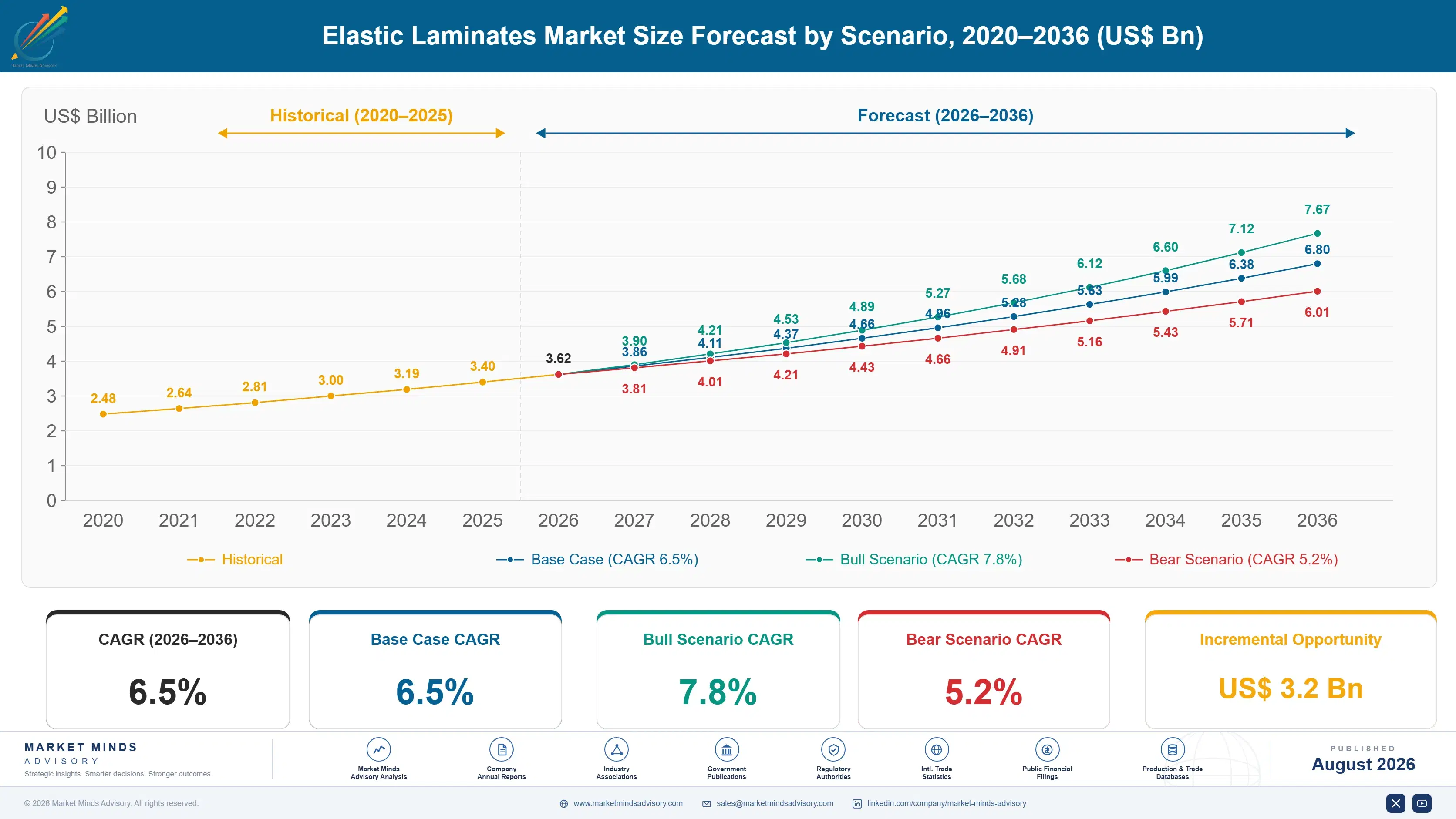
Elastic Laminates Market Forecast Scenarios

elastic-laminates-market-size-forecast-scenario-1787306354702
Between 2020 and 2025 the market grew at roughly 5.9% a year, steady rather than volatile, as baby diaper volume growth moderated in several mature markets while adult incontinence demand began accelerating meaningfully as aging population trends became more commercially visible to manufacturers. That moderation masked how quickly adult incontinence demand was already becoming commercially significant.
The base case carries the market to a 6.5% CAGR on three mechanisms. First, adult incontinence product volume keeps expanding as aging populations grow across most major markets, a demographic trend with unusually predictable long-term visibility. Second, premiumization keeps pushing hygiene product manufacturers toward softer, more discreet elastic materials commanding higher per-unit laminate value. Third, emerging market baby diaper penetration keeps rising as disposable income growth expands the addressable consumer base beyond markets where diaper adoption is already near-saturated.
The bull case reaches 7.8% if adult incontinence premiumization accelerates faster than modeled as more manufacturers launch differentiated, higher-value product lines. The bear case falls to 5.2% if raw material cost pressure forces hygiene product manufacturers to defer premium material upgrades in favor of cost-focused standard laminate specifications across major markets simultaneously. That divergence rests on premium line retail reach.

Adult Incontinence Is Rewriting Material Specifications

Three forces converge on this market at once. Adult incontinence volume keeps growing as global populations age, hygiene product manufacturers keep pushing toward premium, softer material specifications to differentiate branded products, and emerging market diaper penetration keeps expanding the baseline consumer volume beyond already-saturated developed markets. Manufacturers unable to satisfy all three risk losing accounts to more technically capable competitors. Manufacturers unable to satisf
MARKET CONCENTRATION (CR5)42%Top five manufacturers hold well under half share
AVERAGE LAMINATE PRICE$2.40/kgPremium nonwoven composites command notably higher unit pricing
TOP PRODUCING COUNTRY SHARE24%China leads installed elastic laminate manufacturing capacity globally
CAPACITY UTILISATION77%Laminate production lines run near full continuous operating schedules
TRADE INTENSITY29%Nearly a third of laminate volume crosses national borders
RESIN COST SHARE52% of COGSPolyolefin and elastomer resin inputs dominate production cost
Commercially, the market splits between standard film-based laminates, priced competitively and sold largely on cost and reliable supply to volume diaper manufacturers, and premium nonwoven composite laminates, priced substantially higher and sold on softness, quietness, and skin comfort performance increasingly demanded by adult incontinence and premium diaper product lines. That premium category commands disproportionate margin relative to its unit volume share of the overall market. That margin gap is widening as adult incontinence brands increasingly demand documented performance.
Over the next decade the defining question is whether adult incontinence volume growth fully offsets the underlying maturity in developed-market baby diaper demand, or whether the category's overall growth rate settles at a level closer to developed-market demographic trends than the emerging-market expansion story currently suggests.
"Every laminate maker in this industry built its technical playbook around babies, and adult incontinence customers want something genuinely different: quieter materials, better skin compatibility for more sensitive adult skin, and a level of discretion that a rustling diaper waistband was never designed to deliver. That is a harder material science problem than most manufacturers expected."
Director, Nonwoven Materials and Hygiene Products Practice · MMA Chemicals and M

Market Trends

Adult Incontinence Premiumization Demands Quieter, Softer Materials

Adult incontinence product manufacturers, competing increasingly on discretion and comfort rather than pure absorbency alone, have pushed elastic laminate specifications toward softer nonwoven composite structures that produce less rustling noise and feel closer to fabric than the crinkly film-based laminates historically dominant in baby diaper applications. Fitesa and Avgol have both expanded dedicated adult incontinence-focused laminate production lines since 2023, reflecting the category's growing recognition that adult consumers, unlike infants, actively evaluate and reject products based on sensory experience and social discretion concerns that never factored meaningfully into baby diaper material specification.
Market Impact: Adds 40+ million new users

Emerging Market Diaper Penetration Continues Expanding Baseline Volume

Disposable diaper penetration in several large emerging markets, including India and parts of Southeast Asia, remains meaningfully below developed-market levels, and rising disposable income combined with active hygiene brand marketing investment continues expanding the addressable consumer base in these markets steadily. Each incremental percentage point of penetration growth in a market with a large annual birth cohort represents substantial new elastic laminate volume, giving manufacturers serving these markets a demographic tailwind largely independent of the premiumization dynamics driving developed-market value growth specifically. Manufacturers with established regional distribution increasingly capture this growth first.
Market Impact: Rose 8 to 12 points

Market Opportunities and Growth Drivers

Aging Populations Drive Sustained Adult Incontinence Volume Growth

Global population aging, tracked through national demographic statistics across most major markets, continues expanding the population segment most likely to require incontinence products, a demographic trend with unusually predictable long-term visibility compared to most other consumer product demand drivers. Each aging cohort entering the incontinence product user base represents recurring, multi-year laminate demand tied directly to that population's continued product usage, giving manufacturers serving this application a growth driver that compounds steadily as life expectancy continues rising across most developed and increasingly developing markets alike. That predictability gives manufacturers unusually reliable long-term capacity planning visibility across successive product generations.
Market Impact: Adds 5 to 10 points volatility

Brand Premiumization Pushes Manufacturers Toward Higher-Value Laminates

Major hygiene product brands increasingly compete on premium product tiers commanding higher retail pricing, and elastic laminate performance, including stretch recovery, softness, and fit, has become a genuine differentiator brands actively market to consumers rather than a purely functional, invisible component. This shift rewards laminate manufacturers who can demonstrate measurable performance advantages through comparative testing data, converting what was historically a commodity purchasing decision into one where technical performance increasingly justifies premium pricing that brand owners are willing to pay for genuine consumer-facing differentiation. Manufacturers slow to invest in performance testing risk losing this pricing conversation.
Market Impact: Top 5 buyers hold 45%

Market Restraints and Challenges

Resin Price Volatility Compresses Manufacturer Margins

Polyolefin and elastomer resin pricing, tied to volatile global crude oil and naphtha markets, creates persistent margin pressure for laminate manufacturers operating under long-term supply contracts with hygiene product customers who resist frequent price renegotiation, and the root cause is that resin represents such a large share of total production cost that even modest price swings meaningfully affect manufacturer profitability. This volatility particularly pressures manufacturers serving cost-focused standard laminate segments, where customers have less tolerance for price pass-through than premium segment buyers. Manufacturers are mitigating the pressure through resin price indexing clauses increasingly built directly into multi-year supply agreements.
Market Impact: Adds 3 to 5 lines yearly

Customer Concentration Limits Manufacturer Pricing Power

A small number of global hygiene product companies account for a large share of total elastic laminate purchasing worldwide, and the root cause is that hygiene product manufacturing itself is concentrated among a handful of major global brands operating at massive scale. This concentration gives major customers substantial negotiating leverage over laminate pricing and specification terms, limiting how much of any cost increase manufacturers can pass through even when resin costs rise sharply. Manufacturers are mitigating the exposure by diversifying into private-label and regional brand accounts less concentrated than the global branded hygiene product customer base.
Market Impact: Trails by 20 to 30 points
3 additional market trends, 4 additional growth drivers, and 3 additional restraints and challenges are covered in the full report. Contact sales@marketmindsadvisory.com to access the complete intelligence.

Segment CAGR and Growth Architecture

Segmentation follows laminate construction technology, a single manufacturing-based logic distinguishing how each material achieves elasticity and bonding. End-use application and brand tier are treated as separate commercial dimensions, not parallel segments here. Each technology carries its own bonding mechanism, achievable stretch recovery, and cost structure, so commercial position tracks manufacturing process rather than end application alone.
elastic-laminates-market-market-share-analysis-1787306355270

Elastic Nonwoven Composite Laminates

Elastic nonwoven composite laminates grow fastest at 10.5%, about 1.62 times the overall rate, as adult incontinence manufacturers push toward softer, quieter materials that traditional film-based laminates struggle to match on sensory performance. These composites combine elastic nonwoven layers rather than film components, producing a fabric-like feel and reduced rustling noise that adult consumers actively prefer over the crinkly texture common in standard baby diaper laminates. Fitesa and Avgol both lead commercial development, having invested in dedicated production capacity specifically targeting this application since 2023. Adoption is fastest in premium adult incontinence product lines, where manufacturers can justify the material's cost premium through demonstrable consumer preference and willingness to pay for genuine comfort improvement.
CAGR 10.5%

Breathable Elastic Film Laminates

Breathable elastic film laminates, engineered with microporous structures that allow moisture vapor transmission while maintaining elastic performance, grow at 8.5%, the second-fastest category, as premium baby diaper and adult incontinence products both increasingly market breathability as a skin health benefit consumers actively seek. The technology requires more sophisticated film engineering than standard non-breathable elastic film, commanding meaningful price premium that reflects genuine manufacturing complexity few smaller regional producers can replicate reliably. Berry Global and RKW Group both maintain substantial breathable film technology investment, serving premium product tiers across baby and adult hygiene categories where skin health claims support brand differentiation and premium retail pricing. Adoption is broadening beyond premium lines into mainstream tiers as cost declines.
CAGR 8.5%
Full segment breakdown across 6 segments available in the complete report.

Regional Architecture and Country Demand Map

East Asia leads on concentrated global hygiene product manufacturing capacity, North America follows on premium adult incontinence demand, and South Asia and Pacific grows fastest among major regions on expanding diaper penetration. Latin America and the Middle East grow steadily off smaller current manufacturing bases.

North America

United States adult incontinence product demand, among the most developed globally given the country's aging population and strong retail infrastructure for these products, drives substantial premium laminate demand tied to branded product lines from major hygiene companies. Berry Global runs extensive domestic manufacturing capacity, serving both baby diaper and adult incontinence customers from integrated production facilities across the country. Canada's smaller but stable hygiene product market follows similar demand patterns to its southern neighbor, with premiumization trends tracking closely alongside American brand positioning strategies. Growth trails East Asia and South Asia and Pacific because the region's diaper penetration is already near-saturated, leaving adult incontinence and premiumization as the primary growth drivers rather than first-time market expansion.
Share: 25% | CAGR: 5.8% (2026 to 2036)

Western Europe

Germany and France both maintain well-developed hygiene product manufacturing and consumption, with adult incontinence demand growing steadily alongside the region's aging population and comprehensive healthcare systems that increasingly support incontinence product access for elderly patients. RKW Group, headquartered in Germany, anchors substantial regional elastic film manufacturing capacity serving both domestic and export markets across the continent. The United Kingdom's National Health Service coverage for certain incontinence products has supported steady institutional demand alongside the region's broader retail consumer market. Growth trails East Asia and South Asia and Pacific as the region's hygiene product penetration and adult incontinence infrastructure are both already comparatively mature relative to faster-growing markets. That combination keeps the region a genuine center of technical credibility.
Share: 22% | CAGR: 5.0% (2026 to 2036)
Regional intelligence for 5 additional markets available in the complete report: East Asia, South Asia and Pacific, Latin America, Middle East and Africa, Eastern Europe. Contact sales@marketmindsadvisory.com.
elastic-laminates-market-country-cagr-analysis-1787306355787

Where Laminate Manufacturers Can Defend Margin

Four commercial moves separate manufacturers capturing durable premium value from those competing purely on commodity pricing: adult incontinence chemistry investment, resin cost pass-through structuring, private-label diversification, and comparative performance data development. Each move converts a technical or contracting advantage into a defensible commercial position competitors without matching chemistry depth or account diversification cannot easily replicate quickly.

Invest in Adult-Specific Elastic Nonwoven Chemistry

Adult incontinence customers value softness, quietness, and skin comfort in ways meaningfully different from baby diaper specifications, and manufacturers investing directly in adult-specific nonwoven composite chemistry rather than adapting existing infant-focused formulations capture premium pricing that reflects genuine, purpose-built performance differentiation. Fitesa's dedicated adult incontinence product lines illustrate the model, and manufacturers with proven adult-specific chemistry increasingly win accounts that generic, repurposed baby diaper laminates cannot match on comparative sensory testing. Suppliers with proven adult-specific formulations report commanding 20% to 30% pricing premiums even against aggressive commodity competitors across every major regional market.
Market Impact: Commands 20% to 30% premium for adu

Structure Resin Price Indexing Into Long-Term Supply Contracts

Manufacturers absorbing full resin price volatility under fixed-price long-term contracts face genuine margin risk during commodity price spikes, and those who successfully negotiate resin price indexing clauses into multi-year agreements protect margin without needing to renegotiate pricing terms during every market fluctuation. This structuring approach has become increasingly standard among larger manufacturers with the negotiating position to secure it, while smaller regional producers without comparable leverage remain more exposed to full-cycle resin volatility. This indexing approach typically protects 5 to 10 points of margin that would otherwise erode during sharp commodity price cycles.
Market Impact: Protects 5 to 10 points of margin v

Diversify Into Private-Label and Regional Brand Accounts

Customer concentration among global branded hygiene companies limits pricing power for manufacturers dependent primarily on that customer base, and manufacturers building meaningful private-label and regional brand relationships diversify revenue away from the negotiating leverage large global buyers wield over pricing and specification terms. This diversification also provides more stable demand during periods when major global brands consolidate their own supplier base, a periodic risk manufacturers overly dependent on a small number of global accounts face directly. Manufacturers pursuing this diversification typically reduce top-buyer revenue concentration by 15% to 25% within three years of active pursuit.
Market Impact: Reduces top-buyer revenue concentra

Build Comparative Performance Data to Justify Premium Pricing

Brand owners increasingly demand quantified performance data before approving premium laminate pricing, and manufacturers investing in rigorous comparative testing against competitor materials and prior-generation products build the evidence base that converts a subjective quality claim into a defensible commercial argument brand owners can use internally to justify their own pricing decisions. This investment pays off across multiple customer conversations, since credible published performance data becomes a reusable commercial asset rather than a one-time sales pitch. Manufacturers with strong published performance data typically cut premium pricing negotiation time by 20% to 30% relative to competitors relying on claims alone.
Market Impact: Cuts premium pricing negotiation ti

Who Controls the Margin Pool

Concentration sits at a moderate CR5 of 42%, with a real gap separating large vertically integrated manufacturers from smaller regional specialists. Berry Global and Fitesa compete on manufacturing scale and technical breadth spanning film and nonwoven chemistry, while Avgol and RKW Group anchor strong positions in nonwoven composite and film technology respectively. Numerous smaller regional manufacturers compete on price for standard commodity laminates.
Current competitive activity runs along three lines: adult incontinence chemistry development, where Fitesa and Avgol race to prove superior sensory performance; resin cost management, increasingly central to margin protection amid volatile commodity pricing; and private-label diversification, as manufacturers seek accounts less concentrated than global branded hygiene customers. All participants are assessed on one consistent basis, annual revenue from elastic laminate products.

Pressure is building from two directions. Adult incontinence-focused specialists are capturing disproportionate margin as premiumization accelerates, a dynamic commodity-focused competitors cannot easily counter through pricing alone. Meanwhile Chinese manufacturers are scaling both price-competitive and increasingly technically capable standard laminate production, pressuring Western incumbents in cost-sensitive segments. Rankings over the next five years will likely shift toward manufacturers combining adult-specific chemistry depth with genuine manufacturing scale.
elastic-laminates-market-company-positioning-matrix-1787306356310

Competitive Moat and Risk Dimensions

BERRY GLOBAL INC.

Moat: Vertically integrated converting scale

Berry Global's vertical integration spanning resin compounding through finished laminate converting gives it cost and quality control advantages narrower competitors dependent on purchased film or nonwoven inputs cannot easily replicate, particularly valuable when resin markets grow volatile and integrated cost visibility matters most to customer pricing negotiations.
BERRY GLOBAL INC.

Risk: Petrochemical resin cost exposure

Berry Global's cost base remains heavily tied to polyolefin and elastomer resin pricing, which tracks volatile crude oil and naphtha markets largely outside its control. Sustained resin price spikes could compress margins meaningfully faster than long-term customer contracts, even with indexing clauses, can fully offset within any single fiscal period.
FITESA S.A.

Moat: Global nonwoven manufacturing footprint

Fitesa's global nonwoven manufacturing footprint, spanning multiple continents with dedicated production serving both baby diaper and adult incontinence customers, lets it serve multinational hygiene brands from local facilities everywhere they operate, a logistics and service advantage regional specialists cannot match without years of comparable capital investment.
FITESA S.A.

Risk: Customer concentration among hygiene majors

Fitesa's revenue depends heavily on a small number of global hygiene brand relationships, and losing or significantly reducing volume with any single major account could meaningfully affect overall company performance given how concentrated the customer base remains across the broader elastic laminate industry. That dependency risk grows more acute with each additional customer consolidation move across the broader hygiene industry.

Players Tracked

Prominent Players

Berry Global Inc.
Fitesa S.A.
Avgol Ltd.
RKW Group
Pantex International

Other Key Players

Mondi Group
Fibertex Personal Care
Toray Industries
Kimberly-Clark Corporation
Essity AB
First Quality Enterprises
Domtar Corporation
TWE Group
Union Industries
Cetus Corporation
Constantia Flexibles Group
Jofo Group
Winner Medical Group
Suominen Corporation
Glatfelter Corporation

Recent Developments

MARCH 2025

Fitesa expands elastic laminate manufacturing capacity in Brazil

Fitesa commissioned expanded elastic nonwoven composite production capacity at its Brazilian manufacturing site, adding capability to serve growing Latin American adult incontinence and baby diaper demand. This was an organic capacity expansion funded from existing capital, not an acquisition or partnership, reflecting sustained regional demand growth.
Signal: Regional capacity investment ahead of conf
SEPTEMBER 2024

Berry Global signs multi-year supply agreement with global hygiene brand

Berry Global signed a multi-year elastic film supply agreement with a major global hygiene product manufacturer covering multiple production regions. This was a commercial supply agreement, not a joint venture or acquisition, securing recurring volume across the customer's international manufacturing facilities. Both parties expect a stronger relationship.
Signal: A multi-region supply deal shows large man
JANUARY 2025

RKW Group launches next-generation breathable elastic film platform

RKW Group introduced an updated breathable elastic film technology platform featuring improved moisture vapor transmission performance for premium diaper and adult incontinence applications. This was an organic product launch, not an acquisition or partnership, developed through internal research and development investment over several years. Early reception has reportedly been positive.
Signal: Continued breathable film innovation inves

Polyolefin and Elastomer Resins Drive Production Cost

Polyolefin and elastomer resins together account for roughly fifty-two percent of production COGS, sourced from global petrochemical producers concentrated in the United States Gulf Coast, the Middle East, and increasingly China, where new cracker capacity has come online steadily since 2021. Nonwoven fiber inputs and specialty additives add a further meaningful cost layer sensitive to broader specialty chemical pricing.
The clearest recent volatility event traces to 2022, when the EIA recorded sharp naphtha and ethylene price spikes following Russian energy supply disruption, feeding directly into polyolefin and elastomer resin pricing across Europe and Asia. Several European laminate manufacturers reported multi-month lag in passing resin cost increases through to hygiene product customers under existing supply contracts, compressing margins meaningfully during the worst of the spike before pricing mechanisms caught up with underlying input costs.

Exposure varies by manufacturer scale and contract structure. Large integrated manufacturers with resin purchasing agreements and geographic sourcing flexibility absorb volatility more smoothly than regional producers dependent on spot market resin purchases. Manufacturers serving premium adult incontinence accounts under long-term contracts often carry more pricing flexibility than standard commodity laminate suppliers, since premium accounts more readily accept indexed pricing structures that pass through legitimate cost increases.
elastic-laminates-market-cost-volatility-analysis-1787306356507

Diversify Resin Sourcing Across Regions and Suppliers

Manufacturers are qualifying multiple resin suppliers across different geographic regions rather than relying on single-source contracts, reducing exposure to any one facility disruption, regional feedstock shortage, or trade policy change affecting a concentrated petrochemical supply base. This mirrors sourcing discipline already standard across other petrochemical-dependent manufacturing categories facing comparable seasonal demand and price concentration risk.

Index Long-Term Customer Contracts to Resin Benchmarks

More manufacturers now write resin price pass-through clauses directly into multi-year supply agreements, tying laminate pricing to published polyolefin or elastomer benchmark indices rather than negotiating each adjustment separately, which cuts the margin-compressing lag that hurt manufacturers during the 2022 spike. Customers generally accept these clauses now, having watched competitors absorb painful losses without comparable protection.

Shift Formulation Toward Lower-Resin-Intensity Structures

Some manufacturers are directing development investment toward thinner, more efficient laminate structures that use less bulk resin per unit of elastic performance, reducing raw material exposure per kilogram of laminate sold even as formulation development requires meaningful upfront engineering investment. That tradeoff increasingly favors manufacturers with strong formulation expertise over those relying purely on bulk resin volume alone.

Portfolio Architecture for Margin Defence

The portfolio splits into three tiers with real margin separation. Volume standard film-based laminates compete largely on price against cost-focused baby diaper manufacturers, earning modest margins defended through production scale. Certified premium nonwoven composite laminates earn substantially more because adult incontinence and premium diaper brands pay for demonstrated sensory performance over price. That gap widens further as adult incontinence brands increasingly demand documented sens
The tension between volume and premium shapes capital allocation directly: standard laminate lines still generate the cash that funds new premium chemistry investment, but manufacturers that let standard volume crowd out premium capacity investment risk losing the fastest-growing, highest-margin adult incontinence accounts to competitors moving faster on adult-specific chemistry. Manufacturers that manage this balance well retain both revenue streams through the multi-year premiumization transition underway.

High-value pools concentrate in adult incontinence-specific nonwoven composites and breathable film laminates serving premium brand tiers, where sensory performance and skin health claims justify premium pricing few competitors can match. The emerging next-generation biodegradable elastic laminate tier currently earns unevenly as manufacturers absorb development cost against still-developing commercial volume. That unevenness should ease as biodegradable structures accumulate more mature commercial and regulatory validation.

Volume / Commodity-Adjacent Tier

Standard film-based laminates sold on price to baby diaper manufacturers facing cost-focused purchasing decisions., where production scale and reliable supply determine which manufacturers can sustain acceptable margin under cost-focused buyer pressure.
Gross Margin: 14-26%

Premium / Certified Tier

Adult-specific nonwoven composite and breathable film laminates with demonstrated sensory performance for premium brand accounts., who pay durable premiums for demonstrated sensory performance rather than risk consumer rejection on comfort grounds.
Gross Margin: 32-48%

Sustainability / Regulatory / Next-Generation Tier

Biodegradable and next-generation elastic laminate structures still absorbing development investment against developing commercial volume., where manufacturers are betting development capital on structures they expect brand owners to demand as standard within several years.
Gross Margin: 20-45%
elastic-laminates-market-portfolio-architecture-1787306357011

High-value Sub-segments and Strategic Watch-out

Adult Incontinence Nonwoven Composites

High value and high growth as premiumization accelerates, commanding durable premium pricing once comparative sensory performance data supports brand owner purchasing decisions fully. Manufacturers with the strongest adult-specific formulations increasingly win accounts competitors offering repurposed baby diaper chemistry cannot secure regardless of price at all.
Gross Margin: 36-48%

Breathable Elastic Film Laminates

High value with strong current growth as skin health positioning expands across both baby and adult categories, priced above standard film while remaining accessible to mainstream premium budgets. Adoption is broadening steadily beyond premium diaper lines into mainstream adult incontinence products seeking comparable skin health credibility.
Gross Margin: 32-46%

Standard Baby Diaper Film Laminates

The volume core, sold on price to cost-focused diaper manufacturers, defended mainly through production scale and thin per-kilogram margin discipline across facilities. Competitive pressure here concentrates on production efficiency and reliable supply rather than the sensory differentiation reshaping premium and adult-specific tiers specifically overall today.
Gross Margin: 14-26%

Legacy Non-Breathable Film Structures

The strategic watch-out, facing mounting pressure as breathable and softer alternatives increasingly become standard rather than premium expectations across brand tiers. Manufacturers still dependent on this declining tier should be actively funding breathable alternatives rather than defending structures brand owners increasingly consider outdated for premium positioning.
Gross Margin: 10-24%

How Elastic Laminate Demand Actually Recurs

Demand here runs on continuous production-line consumption tied directly to hygiene product manufacturing volume rather than discrete purchase events. A hygiene product manufacturer running a validated formulation consumes matched laminate with every production run, making a single specification qualification worth years of recurring volume rather than a standalone transaction. That recurring consumption pattern gives manufacturers unusually predictable, multi-year revenue visibility once qualif
Adoption depth varies sharply by customer type. Global branded hygiene manufacturers integrate qualified laminates deeply into standardized product specifications across multiple manufacturing regions, making supplier switching costly and rare once a laminate is written into an approved product formulation. Private-label and regional manufacturers, by contrast, evaluate laminate suppliers more flexibly based on price and reliable supply, creating more frequent switching opportunities between competing regional producers. That difference forces manufacturers to split commercial strategy between institutional depth and flexible responsiveness.

Buyer profiles are shifting generationally as product development teams increasingly trained on adult incontinence-specific sensory testing protocols bring that evaluation rigor to baby diaper specification decisions as well, raising performance expectations across the entire category rather than treating adult and infant applications as entirely separate specification disciplines. That generational shift keeps accelerating steadily each year.
elastic-laminates-market-end-use-penetration-index-1787306357501

Where Elastic Laminate Value Concentrates Next

These are among the four positions where our research anticipates prominent divergence between winners and laggards over the coming forecast period. Each is grounded in the demand model, the regulatory perimeter, and the announced capacity pipeline.
01 / ADULT CHEMISTRY INVESTMENT PRIORITY

Build adult-specific chemistry rather than adapt infant formulations

Adult incontinence customers are demonstrably rejecting repurposed baby diaper materials in favor of purpose-built softness and discretion performance, and manufacturers still treating adult incontinence as an adjacent application for existing chemistry are losing accounts to competitors who invested in dedicated formulation work. This category will only grow more demanding as premiumization accelerates further. Manufacturers building genuine adult-specific technical depth now will own the credibility advantage before competitors catch up to where buyer expectations have already moved., a lead that compounds every additional formulation cycle.
02 / RESIN COST MANAGEMENT

Secure indexed pricing before the next commodity cycle turns

Resin price volatility is not a temporary condition, it is a persistent feature of a category built on petrochemical-derived materials, and manufacturers still operating under fixed-price contracts without indexing protection remain exposed to margin compression every time crude and naphtha markets move sharply. Securing indexed pricing terms during contract renewal negotiations protects margin durably rather than requiring reactive renegotiation during each individual price spike. This is a defensive priority every manufacturer should treat as non-negotiable going forward, a discipline that pays off most precisely when commodity cycles turn sharply.
03 / CUSTOMER DIVERSIFICATION STRATEGY

Reduce dependence on the largest global hygiene accounts

Customer concentration among a small number of global hygiene brands gives those buyers substantial negotiating leverage that manufacturers dependent primarily on that customer base cannot easily counter. Building meaningful private-label and regional brand relationships diversifies revenue and reduces exposure to any single account's purchasing decisions or supplier consolidation moves. Manufacturers who diversify proactively will weather future customer concentration risk far better than those who discover the exposure only after losing a major account unexpectedly., a risk that grows sharper every year brand consolidation continues.
04 / BREATHABILITY AND SKIN HEALTH

Treat breathable film technology as the next default expectation

Skin health positioning is moving from premium differentiator toward baseline consumer expectation across both baby and adult hygiene categories, following a pattern common in other consumer product categories where yesterday's premium feature becomes tomorrow's minimum requirement. Manufacturers who treat breathable film technology as a temporary premium upsell rather than the eventual category standard risk being caught flat-footed once mainstream brand tiers begin demanding it as a baseline specification requirement. Manufacturers who build that capability now will meet rising baseline expectations before competitors even recognize the shift is underway.

Engagement Snapshot From the Field

A live engagement with an industry participant carrying material or product regulatory and market exposure ahead of a defining policy shift, showing how our research translates into a defensible multi-year portfolio strategy.
MARKET MINDS ADVISORY · CLIENT ENGAGEMENT SUMMARY
Elastic Laminates Producer Strategic Portfolio Review and Transition Roadmap 2026·Investment Scenario on Elastic Laminates Exposure Evaluation 2025-26
CLIENT PROFILE
A regional hygiene product manufacturer serving private-label baby diaper and adult incontinence accounts across three countries approached MMA while evaluating a shift toward premium elastic laminate specifications ahead of a planned adult incontinence product line launch. The client reported roughly USD 28 million in annual elastic laminate spending across its network, with no prior adult-specific product experience across its manufacturing operations (client-reported, unverified by MMA).
STRATEGIC CHALLENGE
Management wanted to launch a competitive adult incontinence product line but lacked internal expertise evaluating which laminate suppliers could deliver genuine adult-specific sensory performance versus those simply rebranding standard baby diaper materials for the new application. The board wanted a defensible supplier decision before the product launch date, not another quarter of internal technical uncertainty.
MMA APPROACH
MMA benchmarked comparative sensory performance data and total cost across five laminate suppliers against the client's specific adult incontinence product design targets, modeled pricing under multi-year volume commitment scenarios, and assessed each supplier's dedicated adult-focused research and development investment history. We also interviewed product development staff directly to confirm real-world formulation constraints the quantitative model alone could not capture.
KEY FINDINGS
  1. Only two of five benchmarked suppliers could provide independently verified comparative sensory testing data specific to adult incontinence applications rather than baby diaper testing protocols repurposed without adaptation.
  2. The supplier with the strongest adult-specific chemistry commanded a meaningful price premium over standard laminate pricing, but comparative consumer testing suggested the premium was justified by measurably higher product acceptance scores.
  3. Sourcing from a supplier without genuine adult-specific development investment risked launching a product indistinguishable from repurposed baby diaper materials already available from lower-cost competitors in the market.
  4. Multi-year volume commitment negotiations reduced the effective premium pricing gap meaningfully compared to the supplier's standard list pricing for smaller-volume accounts (client-reported, unverified by MMA).
CLIENT PROFILE
A regional hygiene product manufacturer serving private-label baby diaper and adult incontinence accounts across three countries approached MMA while evaluating a shift toward premium elastic laminate specifications ahead of a planned adult incontinence product line launch. The client reported roughly USD 28 million in annual elastic laminate spending across its network, with no prior adult-specific product experience across its manufacturing operations (client-reported, unverified by MMA).
STRATEGIC CHALLENGE
Management wanted to launch a competitive adult incontinence product line but lacked internal expertise evaluating which laminate suppliers could deliver genuine adult-specific sensory performance versus those simply rebranding standard baby diaper materials for the new application. The board wanted a defensible supplier decision before the product launch date, not another quarter of internal technical uncertainty.
MMA APPROACH
MMA benchmarked comparative sensory performance data and total cost across five laminate suppliers against the client's specific adult incontinence product design targets, modeled pricing under multi-year volume commitment scenarios, and assessed each supplier's dedicated adult-focused research and development investment history. We also interviewed product development staff directly to confirm real-world formulation constraints the quantitative model alone could not capture.
KEY FINDINGS
  1. Only two of five benchmarked suppliers could provide independently verified comparative sensory testing data specific to adult incontinence applications rather than baby diaper testing protocols repurposed without adaptation.
  2. The supplier with the strongest adult-specific chemistry commanded a meaningful price premium over standard laminate pricing, but comparative consumer testing suggested the premium was justified by measurably higher product acceptance scores.
  3. Sourcing from a supplier without genuine adult-specific development investment risked launching a product indistinguishable from repurposed baby diaper materials already available from lower-cost competitors in the market.
  4. Multi-year volume commitment negotiations reduced the effective premium pricing gap meaningfully compared to the supplier's standard list pricing for smaller-volume accounts (client-reported, unverified by MMA).
RECOMMENDED STRATEGY
Phase 1: Phase 1 (0 to 4 months): Select the laminate supplier with verified adult-specific sensory performance data and negotiate multi-year volume pricing. Phase 2: Phase 2 (4 to 10 months): Complete product development and consumer testing for the new adult incontinence line using the selected laminate specification. Phase 3: Phase 3 (10 to 24 months): Launch the product line and track consumer acceptance data to inform potential expansion into additional adult incontinence product tiers.
OUTCOME
The client selected the supplier with verified adult-specific chemistry and began Phase 1 negotiations on schedule, securing multi-year pricing that reduced the effective premium to a level the client's product economics could support. Early consumer testing for the new product line showed acceptance scores meaningfully above the client's prior repurposed-material benchmark (client-reported, unverified by MMA).

Frequently Asked Questions

Foundational context covering the market sizes, CAGR, scope, country, region and competition that inform every finding below. This section is provided to cover basics and most often pre-purchase conversations, answered from the MMA Primary Research Dataset.

What is the current size of the Elastic Laminates Market?

The elastic laminates market was valued at USD 3.4 billion in 2025. Growth is driven by adult incontinence premiumization, emerging market diaper penetration, and rising demand for breathable materials.

How large will the Elastic Laminates Market be by 2036?

The market is projected to reach USD 6.80 billion by 2036 under the base case scenario. That reflects an expansion multiple of roughly 1.88 times the 2026 value.

What is the CAGR for the Elastic Laminates Market 2026 to 2036?

The base case CAGR is 6.5%, with a bull case of 7.8% and a bear case of 5.2%. Adult incontinence premiumization speed is the main swing factor between scenarios.

Which segment is growing fastest?

Elastic nonwoven composite laminates grow fastest at 10.5% CAGR, roughly 1.62 times the overall market rate. Breathable elastic film laminates follow as the second-fastest segment at 8.5%.

Who are the major companies in the Elastic Laminates Market?

Leading manufacturers include Berry Global Inc., Fitesa S.A., Avgol Ltd., RKW Group, and Pantex International. The top five hold a combined 42% of the market.

Which country is growing fastest?

China is the fastest-growing country at 12.8% CAGR, driven by massive hygiene product manufacturing scale and rising domestic premiumization. Domestic manufacturers anchor much of that growth.

Report Segmentation Architecture

The full report scope spans multiple orthogonal segmentation dimensions, with cross-tabulated demand data provided for each dimension pair. Coverage extends further to regional breakdowns, trend trajectories, and the competitive detail needed to support segment-level decision-making.

By Laminate Construction Technology

  • Stretch-Bonded Laminates
  • Necked-Bonded Laminates
  • Stretch-Thermal Laminates
  • Film-Based Elastic Laminates
  • Elastic Nonwoven Composite Laminates
  • Breathable Elastic Film Laminates

By End-Use Application

  • Baby Diaper Waistbands and Side Panels
  • Adult Incontinence Products
  • Feminine Hygiene Products
  • Other Personal Care Applications

By Commercial Dimension

  • Global Branded Manufacturer Supply
  • Private-Label and Regional Brand Supply
  • Distributor and Trading Channel
  • Contract Manufacturing Partnerships

By Region

  • North America
  • Western Europe
  • East Asia
  • South Asia and Pacific
  • Latin America
  • Middle East and Africa
  • Eastern Europe

Scope, Methodology, and Coverage

Every figure in this report is reproducible from documented input assumptions. The scope below maps the historical period, the forecast horizon, the segmentation dimensions, and the countries covered, alongside the underlying primary and qualitative methodology.
Historical Period
2020 to 2025
Forecast Period
2026 to 2036
Base Year
2025 (USD billions; MMA Primary Research Dataset, August 2026)
Market Definition
The elastic laminates market comprises stretchable multilayer composite materials combining nonwoven fabric and elastomeric film or strand components, used primarily in disposable hygiene products including baby diapers, adult incontinence products, and feminine hygiene items. Non-elastic nonwoven materials used elsewhere in hygiene product construction, elastic materials used in apparel or medical compression applications, and finished hygiene products sold as consumer goods are excluded.
Quantitative Units
USD billions (current prices); metric tonnes of laminate produced where applicable
Segmentation Dimensions
By Laminate Construction Technology; By End-Use Application; By Commercial Dimension; By Region
Regions Covered
North America, Western Europe, East Asia, South Asia and Pacific, Latin America, Middle East and Africa, Eastern Europe
Countries Covered
USA, China, Germany, France, UK, Japan, South Korea, India, Australia, Canada, Brazil, Mexico, Indonesia, Vietnam, Thailand, Malaysia, UAE, Saudi Arabia, South Africa, Nigeria, Turkey, Poland, Netherlands, Italy, Spain, Sweden, Switzerland, Argentina, Colombia, Singapore, and additional markets relevant to this sector
Key Companies Profiled
Berry Global Inc., Fitesa S.A., Avgol Ltd., RKW Group, Pantex International, Mondi Group, Fibertex Personal Care, Toray Industries, Kimberly-Clark Corporation, Essity AB, First Quality Enterprises, Domtar Corporation, TWE Group, Union Industries, Cetus Corporation, Constantia Flexibles Group, Jofo Group, Winner Medical Group, Suominen Corporation, Glatfelter Corporation
Quantitative Methodology
Primary survey, n=3,800 respondents, Q4 2025, six countries; demand-side model with trade association cross-validation
Qualitative Methodology
47 expert interviews, Q4 2025; applied to validate demand model assumptions, identify emerging dynamics, and assess competitive positioning
Report Format
PDF and XLSX data workbook (Word format preview document)
Publisher
Market Minds Advisory
Report Code
MMA-2026-CHM-501
Published
August 2026
Contact
sales@marketmindsadvisory.com | www.marketmindsadvisory.com

Purchase the full Elastic Laminates Market Report (2026 to 2036).

The full MMA Elastic Laminates Market report sizes demand across six laminate technologies, four end-use applications, four commercial dimensions, and seven regions through 2036. It profiles twenty companies on a consistent revenue basis, scoring each on adult-specific chemistry depth, resin cost management, and customer diversification. Scenario models quantify how adult incontinence premiumization and emerging market penetration move both demand and realizable pricing. The report includes delivered-cost modeling by laminate technology and a manufacturer premium-readiness screen built for procurement and product development strategy teams. Regional manufacturing capacity tracking rounds out the coverage for procurement and product strategy teams.
Laminate technology cost-curve modeling across all major structures
Adult incontinence chemistry benchmarking by manufacturer
Emerging market diaper penetration forecasts by country
Customer concentration and diversification tracking by manufacturer
Resin cost exposure modeling by manufacturer scale
Premiumization adoption scenarios under bull and bear cases

Built For The People Who Decide

From boardroom strategy to bench-side execution, this report is read cover-to-cover by leaders shaping the next decade of their industry, turning demand scenarios, market dynamics and valuation benchmarks into decisions.
CXOs/ Presidents/ VPs/ Managers
M&A and Corporate Development
Strategy Teams and R&D Heads
Procurement and Product Directors
Regulatory and Compliance Leaders
Investor Relations and Equity Analysts