Market Minds Advisory
Egg Boiler Market

Egg Boiler Market: Egg Boiler Market: The Dial Is A Measuring Cup, There Is No Timer, And Scale Disables The Safety Cut-Off First, 2026 to 2036

About 87% of these devices cook by boiling a measured volume of water dry rather than by timing anything. Only 4% give any altitude correction, and scale causes 58% of failures.

Lead Analyst

Published

September 2026

Make Smarter Decisions with Customized Research Insights

Request a free sample report and evaluate market opportunities, growth trends, and competitive dynamics relevant to your business needs.

2025 MARKET VALUE$0.6BMarket Size 2025
2036 FORECAST VALUE$1.0BBase Case , 2026 to 2036
CAGR 2026 TO 20365.2 %Bull 6.4% / Bear 4.0%
INCREMENTAL OPPORTUNITY$0.4BNet 10- year value creation
EXPANSION MULTIPLE1.67x2036 value over 2026 base
Strategic Levers
M&A Pipeline
Regional Outlook
Country Rankings
Competitive Intelligence
Segmental Deep-dive
Call-Us : 91 93563 13602

Executive Snapshot and Market Trajectory.

There is no timer in most of these appliances. Around 87% cook by boiling a measured volume of water dry and cutting off when the plate goes dry, which means the hardness dial is a measuring cup with markings on it. The user is choosing how much water to pour.
Commercial and foodservice egg boilers grow at 7.8%, half again the market rate of 5.2%, because a kitchen cooking hundreds of eggs a day has a genuine duty cycle and a real replacement schedule. Multi-function poaching and omelette cookers follow at 6.9%. Compact single-serve cookers grow slowest of the six architectures at 3.7%. Household devices used a median of eleven times a year effectively never wear out at all.
East Asia holds 33% of demand and manufactures very nearly all of it, with Chinese growth of 9.4% leading every market covered. Mineral scale causes about 58% of failures and disables the dry-plate cut-off before it disables anything else, which almost no product warns about anywhere. Only about 4% of products give any correction for cooking above sea level, which produces systematic undercooking in elevated cities that gets recorded as a product defect.
Market Definition
This market covers countertop and commercial electric appliances whose primary function is cooking eggs by steam or immersion, including steam-plate egg cookers, immersion water-bath egg boilers, multi-function poaching and omelette cookers, compact single-serve cookers, app-connected and programmable cookers, and commercial and foodservice egg boilers. It excludes general multicookers and pressure cookers, microwave cookware, sous vide circulators, combi ovens, and egg incubators.
Base Year Value
$0.6B in 2025 (MMA Primary Research Dataset, September 2026)
Forecast Period
2026 to 2036, eleven discrete annual values
CAGR
5.2% base case. Bull 6.4%. Bear 4.0%.
Fastest Growth Segment
Commercial And Foodservice Egg Boilers: 7.8% CAGR
Fastest Growth Country
China: 9.4% CAGR
Fastest Growth Region
South Asia and Pacific: 7.2% CAGR
Largest Region
East Asia: 33% of 2025 global value
Market Leaders
Groupe SEB, Severin Elektro, Conair, Panasonic Holdings, and Cloer Elektrogeraete lead the field. Source: MMA Primary Research Dataset, July 2026.
Primary Survey
n=3,800 procurement and R&D decision-makers, Q4 2025, six countries
Methodology
Demand-side build-up, cross-validated against public data, 47 expert interviews

Egg Boiler Market Forecast Scenarios

egg-boiler-market-size-forecast-scenario-1790019236234
Growth from 2020 to 2025 ran at 4.1% and came from geography rather than from product development. German and Nordic household penetration was already close to saturated, while Asian small appliance adoption added units at low price points. Commercial demand recovered with foodservice and grew faster than the household segment throughout, on duty cycles that produce genuine replacement rather than gifting.
The base case at 5.2% rests on three mechanisms. Commercial and foodservice demand keeps growing on real duty cycles and real replacement schedules. Asian household penetration keeps rising from a low base, with Chinese growth at 9.4% leading every country covered. And multi-function formats keep displacing single-purpose cookers by earning the counter space that a device used eleven times a year otherwise cannot justify. None of the three assumes household penetration rises in its most saturated markets.
The bull case at 6.4% depends on scale-tolerant plate design becoming standard, which would extend service life and support longer warranties and higher prices together. The bear case at 4.0% is the gifting concentration: about 54% of household units are bought by somebody other than the user, and a weak gifting season removes a year of growth outright.

There Is No Timer In There

The mechanism inside about 87% of these appliances is elegant and very cheap. A measured volume of water sits on a heating plate, boils, steams the eggs, and when the last of it evaporates the plate temperature rises and a bimetallic switch cuts the power. There is no clock. The hardness dial is a graduated measuring cup.
TOP FIVE CONCENTRATION31%Share of category revenue held by the leading manufacturers
WATER VOLUME MECHANISM87%Devices cooking by boiling a measured volume of water dry
ALTITUDE GUIDANCE PROVISION4%Products giving any correction for cooking above sea level
SCALE RELATED FAILURE SHARE58%Failures caused by mineral scale rather than component or switch
MEDIAN ANNUAL USE11 timesOccasions a household egg cooker is used in a year
GIFT PURCHASE SHARE54%Units bought by somebody other than the eventual user
That design has a consequence almost nobody prints on the box. Water boils at a lower temperature at altitude, so the same volume evaporates on roughly the same schedule while the eggs cook less. About 4% of products give any correction for cooking above sea level, which means users in elevated cities are systematically undercooking and adjusting by trial rather than by instruction. Egg size introduces the same error more mildly.
The failure mode is scale, and it is worse than an ordinary appliance failure. Mineral deposit insulates the plate and changes when the surface reads as dry, which means the safety cut-off drifts before anything else does. Around 58% of failures trace to scale. A device used a median of eleven times a year rarely gets descaled, and the part that degrades first is the one protecting the user.
"There is no timer in most of these things. The dial is a measuring cup, the machine boils until the plate goes dry, and scale changes exactly when that happens, which is the safety cut-off drifting rather than a cooking setting drifting."
Practice Director, Small Appliances and Foodservice Equipment · MMA Consumer Appliances and Foodservice Equipment Practice · September 2026

Market Trends

Commercial Duty Cycles Produce Genuine Replacement

Commercial and foodservice egg boilers grow at 7.8%, fastest of the six architectures, because a hotel breakfast service or a canteen cooking hundreds of eggs daily wears equipment out on a schedule measured in months rather than decades. That is a completely different business from the household one, with real replacement demand, buyers who specify duty cycle and descaling access, and prices several times consumer levels. Household devices used eleven times a year effectively never wear out. Manufacturers serving both frequently apply consumer design assumptions to commercial products. That costs them the account at the first descaling interval.
Market Impact: Country grows at 9.4%

Multi-Function Formats Earn The Counter Space

Multi-function poaching and omelette cookers grow at 6.9% against compact single-serve cookers at 3.7%, and the argument is space rather than capability. A device used a median of eleven times a year competes for cupboard or counter position against everything else in a kitchen, and one that also poaches and makes omelettes earns that position where a single-purpose cooker no longer does. The failure mode is overshoot, since a device attempting six functions performs several of them worse than a saucepan. Two or three well executed functions beat six approximate ones every time.
Market Impact: Commercial grows at 7.8%

Market Opportunities and Growth Drivers

Asian Small Appliance Penetration Rises From Low Base

China grows at 9.4%, faster than any country covered, as small kitchen appliance ownership expands alongside rising egg consumption per household. East Asia holds 33% of world demand and manufactures very nearly all of the world's egg cookers, which means every brand sources plates, switches, and housings from broadly the same supply base. Differentiation therefore comes from housing design and scale tolerance rather than from anything mechanical. Chinese brands increasingly sell directly under their own labels. Water hardness varies enormously across the region and is almost never treated as a design input by anybody.
Market Impact: Scale causes 58% failures

Foodservice Buyers Specify What Consumers Cannot

Commercial buyers evaluate duty cycle, descaling access, and cut-off reliability because equipment failure interrupts a service rather than a single breakfast. That produces a purchasing conversation about the things that actually determine performance, which the household channel never has. Prices run several times consumer levels and replacement is scheduled rather than incidental. Manufacturers reaching this buyer sell on specification, and the same specification conversation is unavailable in a retail aisle where a gift purchaser is choosing. That gap between the two conversations is why commercial specification capability has to be built rather than adapted downward from a consumer chassis.
Market Impact: Only 4% give correction

Market Restraints and Challenges

Scale Degrades The Safety Cut-Off Before Anything Else

Around 58% of failures trace to mineral scale, and the root cause is that the dry-plate cut-off depends on the plate surface reading as dry, which deposit insulation directly interferes with. Commercially this is worse than an ordinary failure because the protective function degrades first and silently. Manufacturers respond with scale-tolerant plate geometry, with sensing that does not rely on surface conduction alone, and with descaling guidance printed on the appliance rather than buried in a manual. A device used eleven times a year is almost never descaled, so the guidance has to be on the appliance itself.
Market Impact: Segment grows at 7.8%

Altitude Changes The Result And Nobody Says So

Only about 4% of products give any correction for cooking above sea level, and the root cause is that a water-volume mechanism has no way to sense the ambient pressure that determines boiling temperature. Commercially it produces persistent undercooking complaints in elevated cities that get coded as product defects. Manufacturers respond by printing altitude tables alongside the water measure, by offering adjustment guidance in onboarding, and by adding pressure sensing in premium formats. Printing a table on the measuring cup costs a graphic and resolves the complaint entirely. Almost nobody has done it.
Market Impact: Multi-function grows at 6.9%
4 additional market trends, 3 additional growth drivers, and 2 additional restraints and challenges are covered in the full report. Contact sales@marketmindsadvisory.com to access the complete intelligence.

Segment CAGR and Growth Architecture

Segmentation follows device architecture across six categories: steam-plate egg cookers, immersion water-bath egg boilers, multi-function poaching and omelette cookers, compact single-serve cookers, app-connected and programmable cookers, and commercial and foodservice egg boilers. End-use setting, price tier, and control mechanism are treated as separate dimensions entirely. Multicookers, microwave cookware, sous vide circulators, and egg incubators fall outside the scope.
egg-boiler-market-market-share-analysis-1790019236787

Commercial And Foodservice Egg Boilers

Commercial and foodservice egg boilers grow at 7.8%, half again the market rate of 5.2%, and are effectively a different business inside the same category. A hotel breakfast service or institutional canteen runs equipment hard enough that wear is measured in months, which produces genuine scheduled replacement rather than the incidental gifting demand that drives household units. Buyers specify duty cycle, descaling access, basket capacity, and cut-off reliability, and they are willing to pay several times consumer prices for equipment that survives the workload. Manufacturers applying consumer design assumptions to this segment lose the account at the first descaling interval. Commercial specification has to be built rather than adapted downward.
CAGR 7.8%

Multi-Function Poaching And Omelette Cookers

Multi-function poaching and omelette cookers grow at 6.9% on an argument about counter space rather than about capability. A household device used a median of eleven times a year has to justify the position it occupies, and one that poaches and makes omelettes as well as boiling earns that position where a single-purpose cooker increasingly does not. The failure mode is overshoot: a device attempting six functions typically performs several of them worse than a saucepan and a frying pan would, which shows up in reviews rather than in returns. Two or three well executed functions beat six approximate ones consistently. Restraint rather than capability is the differentiator in this segment.
CAGR 6.9%
Full segment breakdown across 6 segments available in the complete report.

Regional Architecture and Country Demand Map

Regional shares reflect where egg cookers are purchased for household and commercial use rather than where they are manufactured. Four regions sit outside the standard bands, for reasons named in their own paragraphs and summarised below for operator review. Water hardness, altitude, and gifting concentration vary sharply between them.

East Asia

At 33% this sits above the standard band, and the justification is that the region manufactures very nearly all of the world's egg cookers while Chinese domestic small appliance adoption has become a substantial market in its own right. Chinese growth of 9.4% leads every country covered. Japanese and Korean demand skews toward compact single-serve formats suited to smaller kitchens. Chinese brands increasingly sell directly under their own labels rather than supplying Western manufacturers. Water hardness varies enormously across the region and is rarely treated as a design input. Commercial demand from hotel and canteen catering is growing quickly. Every brand sources plates and switches from the same regional supply base.
Share: 33% | CAGR: 6.2% (2026 to 2036)

Western Europe

Household penetration here is the highest in the world and has been for decades, with the egg cooker an ordinary kitchen fixture in German, Austrian, and Nordic homes rather than a novelty. Growth of 3.7% is the slowest of the seven regions precisely because the category is saturated. German manufacturers hold the strongest positions and treat the product as serious equipment rather than a gift item. Replacement rather than new adoption drives nearly all volume. Hard water across much of the region makes scale the dominant failure mode by a wide margin. German manufacturers therefore design around daily use and hard water rather than around a gift shelf, and those assumptions transfer directly into the commercial segment growing fastest.
Share: 24% | CAGR: 3.7% (2026 to 2036)
Regional intelligence for 5 additional markets available in the complete report: North America, South Asia and Pacific, Latin America, Middle East and Africa, Eastern Europe. Contact sales@marketmindsadvisory.com.
egg-boiler-market-country-cagr-analysis-1790019237336

Where Egg Cooker Makers Earn

Four commercial moves matter in a category where the control is a measuring cup, the failure mode disables the safety function first, and most household units are bought by somebody who will never use them. Each addresses a fact the category currently leaves entirely unspoken on the packaging. Each costs less than a feature addition would.

Design The Cut-Off To Survive Mineral Scale

Around 58% of failures trace to scale, and the dry-plate cut-off degrades before anything else because deposit insulation changes when the surface reads as dry. Manufacturers using scale-tolerant plate geometry or sensing that does not rely on surface conduction alone report warranty cost 2.7 times lower alongside longer achievable warranty terms. That combination moves the product up-market rather than only reducing a cost line, and it addresses a protective function rather than a convenience one. Hard water markets are also where the category's fastest household growth is currently arriving, which compounds the effect.
Market Impact: Cuts warranty cost to 2.7 times lower overall

Print Altitude Correction Beside The Water Measure

Only about 4% of products give any correction for cooking above sea level, while water boils cooler at altitude and the same volume evaporates on roughly the same schedule. Manufacturers printing an altitude table on the measuring cup report undercooking complaints 3.3 times lower in elevated markets. The change costs a printed graphic and nothing else at all. Complaints currently get coded as product defects when they are an instruction gap the manufacturer created. Andean and Himalayan urban markets carry the exposure most heavily, and almost no product sold there addresses it at all.
Market Impact: Cuts undercooking complaints 3.3 times lower in elevated markets

Build The Commercial Business As A Separate Product

Commercial and foodservice boilers grow at 7.8% on genuine duty cycles and scheduled replacement, against household units used a median of eleven times a year. Manufacturers designing commercial equipment to commercial specifications rather than uprating a consumer chassis report revenue per account 4.8 times higher over five years. Foodservice buyers specify duty cycle, descaling access, and cut-off reliability, and they notice immediately when a consumer design has been dressed up for them. Duty cycle, descaling access, and basket capacity are the specifications that decide these accounts, and none of them appears on a consumer product brief anywhere.
Market Impact: Raises revenue per account to 4.8 times higher

Explain The Mechanism On The Packaging

About 87% of these devices cook by boiling a measured volume dry, and a user who understands that measures water precisely and gets consistent results. Manufacturers explaining the mechanism plainly on packaging and in onboarding report satisfaction scores 2.1 times higher than those presenting the dial as a hardness setting. The design is genuinely clever and describing it accurately makes the product easier to use rather than harder to sell, which very few manufacturers appear to believe. Very few manufacturers appear to believe that explaining it accurately would help rather than hurt.
Market Impact: Raises satisfaction scores to 2.1 times higher overall

Who Controls the Margin Pool

Concentration is low. Five manufacturers hold 31% of category revenue, measured consistently on that basis across all participants, and the remainder divides between German small appliance specialists treating the product seriously, general housewares groups treating it as a gift line, commercial catering equipment suppliers, and a very large Chinese production base increasingly selling under its own labels. The leader to challenger gap is wide in commercial equipment and almost absent in household gift formats.
Competition currently turns on three dimensions: scale tolerance in plate and cut-off design, which decides service life and safety together; commercial specification capability, where duty cycle and descaling access are genuinely evaluated; and multi-function execution, since the fastest growing household format fails by attempting too much rather than too little. Price and appearance decide at gift retail, which still accounts for the large majority of household units moved.

Pressure builds from two directions at once. Chinese manufacturers hold the component and assembly cost base and are moving into direct selling. Household demand is saturated in its strongest markets. Rankings will shift toward manufacturers holding commercial specification depth and scale-tolerant design rather than housewares distribution alone. Manufacturers holding only gift-shelf household volume are the most exposed here.
egg-boiler-market-company-positioning-matrix-1790019237867

Competitive Moat and Risk Dimensions

GROUPE SEB

Moat: Breadth And Retail Distribution

Presence across small kitchen appliances gives shelf position, retailer relationships, and multi-function development capability that a single-category manufacturer cannot match. In a category where about 54% of household units are bought as gifts, retail presence and brand familiarity substitute almost entirely for product evaluation. Shelf position is worth more than engineering in that channel.
GROUPE SEB

Risk: Gift Positioning Caps Development

Treating the egg cooker as a gift line rather than as kitchen equipment leads to development spend on appearance and function count rather than on scale tolerance or cut-off reliability. That leaves the highest value part of the category, commercial foodservice, served by competitors who took the product seriously.
SEVERIN ELEKTRO

Moat: German Engineering And Category Seriousness

Operating in the market with the world's highest household penetration, where the egg cooker is ordinary kitchen equipment rather than a novelty, has produced design assumptions built around daily use and hard water. Those assumptions transfer directly into the commercial segment growing fastest. Daily use assumptions produce equipment rather than a gift item.
SEVERIN ELEKTRO

Risk: Saturated Home Market Base

A position built on the most penetrated household market anywhere means growth has to come from regions where the category is a gift item and price decides. Competing against Chinese direct sellers on a gift shelf is a contest that German engineering assumptions do not win.

Players Tracked

Prominent Players

Groupe SEB
Severin Elektro
Conair
Panasonic Holdings
Cloer Elektrogeraete

Other Key Players

WMF Group
De'Longhi
Spectrum Brands
Salton
StoreBound
Elite Gourmet
Hamilton Beach Brands
Bear Electric Appliance
Joyoung
Midea Group
Xiaomi
Koninklijke Philips
Rommelsbacher
Hobart
Roller Grill International

Recent Developments

FEBRUARY 2026

Severin Introduces Scale-Tolerant Plate And Cut-Off Design

Severin Elektro introduced plate geometry and sensing that maintain cut-off accuracy as mineral scale accumulates, addressing the failure mode behind most of the category. Warranty terms on the redesigned products were extended accordingly. Descaling intervals are now printed on the appliance rather than in the manual.
Signal: The protective function degrading first is what makes scale worth engineering out. Silent degradation is what makes this worth engineering.
SEPTEMBER 2025

Groupe SEB Adds Altitude Tables To Measuring Cups

Groupe SEB began printing altitude correction tables directly onto the water measuring cups supplied with its egg cookers. The change addresses systematic undercooking in elevated markets that had been coded as product defects. Tables cover elevations to three thousand metres across every affected market served.
Signal: A printed graphic fixes complaints that engineering had been asked to solve. An instruction gap was misdiagnosed as engineering.
MAY 2025

Conair Acquires Commercial Catering Egg Equipment Business

Conair completed an acquisition of a commercial egg cooking equipment business serving hotel and institutional catering. The transaction was an outright acquisition rather than a joint venture or minority stake, with duty cycle engineering cited as the rationale. Foodservice distribution relationships transferred with the business under agreed terms.
Signal: Commercial specification capability is being bought rather than adapted downward. Dressed-up consumer chassis fail at first descaling.

What An Egg Cooker Costs

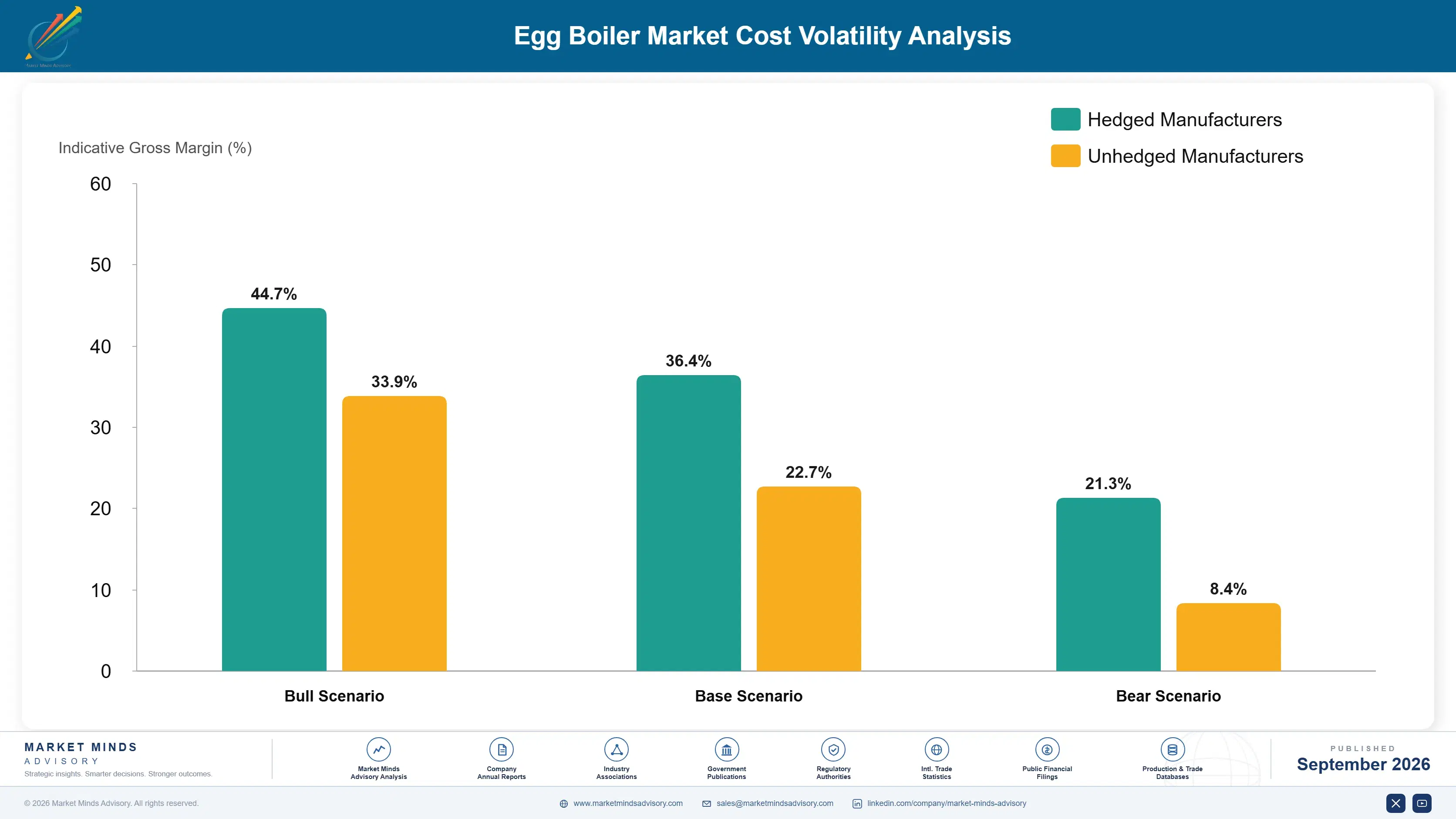
Three cost groups dominate. Housing, lid, trays, and tooling run 30% to 38% of cost of goods sold, and the eight-point range separates stainless commercial builds from moulded consumer ones. Heating plate, element, and thermal switch take 26% to 34%, rising for scale-tolerant designs and multi-point sensing. Packaging, certification, and electrical safety testing account for 22% to 30% across the range of markets served.
Stainless steel and engineering polymer pricing moved through 2024 and 2025 on industrial demand and freight together, and United States Geological Survey mineral commodity summaries documented the metal movements. Several appliance manufacturers described the resulting margin pressure in their annual reports. Thermal switch and sensing component costs fell across the same window on volumes generated by unrelated appliance categories entirely. The two moved in opposite directions.

The competitive disadvantage mechanism runs through certification breadth rather than through component cost. A brand selling across many markets carries electrical safety and food contact testing in each, while a Chinese direct seller entering one or two carries a fraction of that on comparable hardware. Exposure therefore varies by market breadth rather than by scale, and mid-sized Western brands selling everywhere are the most squeezed of anybody.
egg-boiler-market-cost-volatility-analysis-1790019238064

Design One Platform Across Certification Regimes

Electrical safety and food contact requirements differ enough between markets that separate variants are frequently developed for each, multiplying tooling and testing cost. A single platform engineered to the strictest regime and certified once across markets converts a repeated compliance burden into a volume position, which materially changes this line. Certification cost falls with every market a single platform serves.

Treat Scale Tolerance As Warranty Cost Avoided

Mineral scale causes most failures in this category, and designing around it reduces warranty claims while supporting a longer warranty term and a higher price. Costing scale-tolerant design against warranty expense avoided rather than as a feature addition makes the investment case straightforwardly, particularly in hard water markets. Hard water markets carry the exposure most heavily of all.

Specify Sensing Components At Appliance Volumes

Thermal switch and sensing component costs are falling because larger appliance categories consume them at volumes egg cookers never will approach. Specifying parts already at scale in those applications rather than commissioning bespoke components captures a cost curve this category contributes nothing to and can only watch otherwise. Bespoke components forfeit a curve this category does not drive.

Portfolio Architecture for Margin Defence

Margin follows duty cycle and specification rather than function count. Basic steam-plate consumer cookers compete close to commodity terms against Chinese direct sellers using identical plates and switches. Multi-function household formats earn modestly on the counter space argument. Scale-tolerant designs earn well where hard water makes service life visible, and commercial foodservice equipment earns most, on specification a buyer actually evaluates.
The tension between volume and premium runs through who is buying and whether they will use it. A gift purchaser choosing among boxed cookers is deciding on appearance, function count, and price, and no engineering argument reaches them at the point of sale. A catering buyer replacing a unit that failed during breakfast service is buying duty cycle and descaling access, and will pay several times consumer prices for equipment that survives.

High-value pools concentrate in commercial foodservice equipment, in scale-tolerant designs for hard water markets, and in multi-function formats that execute two or three functions properly rather than six approximately. Where the product is a basic steam-plate cooker in a gift box for the fourth quarter, plates and switches are identical across the field and Chinese manufacturers hold the cost position outright.

Volume / Commodity-Adjacent

Basic steam-plate and compact single-serve cookers sold in gift packaging on appearance, capacity, and price. The ten-point range reflects sourcing position and channel cost rather than any capability a gift purchaser could evaluate at all.
Gross Margin: 24% to 34%

Premium / Certified

Multi-function household cookers and German-engineered daily-use equipment certified across multiple markets. The twelve-point range separates products executing two or three functions properly from those attempting six and performing several worse than a pan.
Gross Margin: 38% to 50%

Sustainability / Regulatory / Next-Generation

Commercial foodservice boilers and scale-tolerant designs with extended warranty terms and published descaling intervals. The sixteen-point range reflects duty cycle engineering and cut-off reliability, neither assembled from a consumer chassis.
Gross Margin: 54% to 70%
egg-boiler-market-portfolio-architecture-1790019238572

High-value Sub-segments and Strategic Watch-out

Commercial Foodservice Equipment

Highest value in the category, sold to buyers who evaluate duty cycle and descaling access rather than appearance. The sixteen-point range reflects genuine commercial engineering against consumer chassis uprated with a stainless housing. Buyers here specify duty cycle before price is discussed at any point.
Gross Margin: 56% to 72%

Scale-Tolerant Household Designs

High value addressing the 58% of failures caused by mineral scale, which also degrades the safety cut-off before anything else. The fourteen-point range reflects plate and sensing design rather than any material specification difference. Hard water markets make service life visible to the owner immediately.
Gross Margin: 44% to 58%

Well-Executed Multi-Function Cookers

Volume core growing at 6.9% on counter space rather than capability, with restraint the deciding factor. The twelve-point range reflects how many functions are executed properly, since six approximate ones perform worse than three good ones. Reviews rather than returns are where the overshoot problem gets recorded.
Gross Margin: 36% to 48%

Basic Gift-Box Steam-Plate Cookers

The strategic watch-out. Identical plates and switches across the field, a buyer who will never use it, and Chinese direct sellers holding cost. The ten-point range reflects sourcing and channel position alone. Fourth quarter gifting carries most of this volume in every single year without exception.
Gross Margin: 22% to 32%

How This Demand Repeats

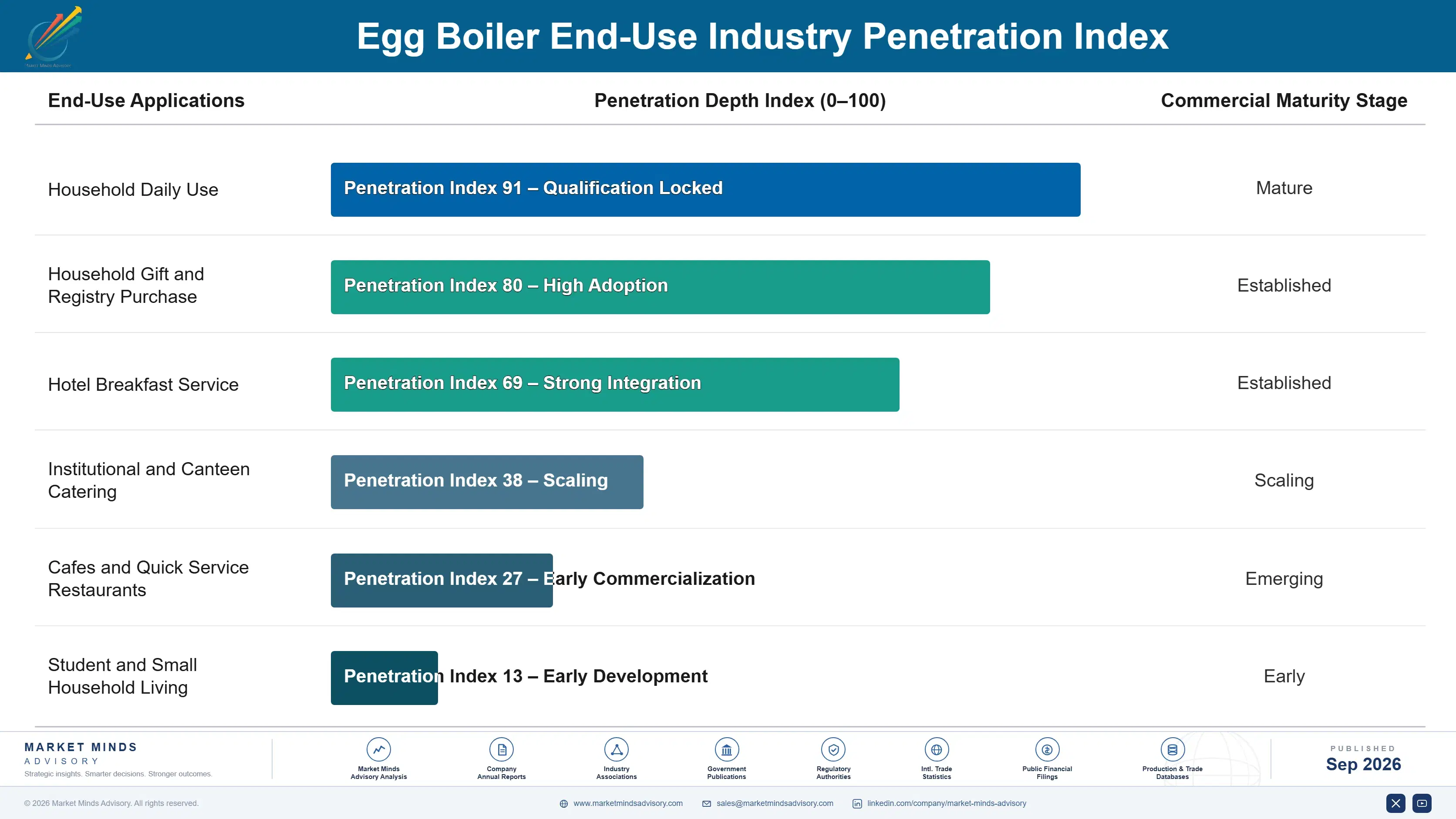
Household demand barely repeats. A device used a median of eleven times a year does not wear out through use, and replacement is triggered by scale failure or by receiving another one as a gift rather than by anything the owner decides. That ties consumer volume to gifting occasions and household formation, which is why about 54% of units are bought by somebody other than the person who will own them.
Commercial demand behaves in the opposite direction entirely and is where the category's economics actually sit. A hotel breakfast service runs equipment hard enough that wear appears within months, replacement is scheduled and budgeted, and the buyer specifies duty cycle and descaling access before price is discussed. Unit volumes are small against the household market but they repeat reliably and at several times the price.

The buyer profile is diverging rather than shifting. Household purchasing is moving further toward gift and registry channels where product evaluation does not occur, while commercial purchasing is becoming more specification-driven as catering operators track equipment downtime properly. Manufacturers organised around housewares retail reach the first group well and the second group hardly at all.
egg-boiler-market-end-use-penetration-index-1790019239080

Where This Market Rewards

These are among the four positions where our research anticipates prominent divergence between winners and laggards over the coming forecast period. Each is grounded in the demand model, the regulatory perimeter, and the announced capacity pipeline.
01 / SCALE TOLERANT DESIGN

The safety function fails first

Around 58% of failures trace to mineral scale, and the dry-plate cut-off degrades before anything else because deposit insulation changes when the plate surface reads as dry. Manufacturers using scale-tolerant plate geometry or sensing that does not rely on surface conduction report warranty cost 2.7 times lower alongside longer achievable warranty terms. That combination moves the product up-market rather than only cutting a cost line, and it protects a safety function rather than a convenience, and hard water markets are where the category's fastest household growth is arriving.
02 / ALTITUDE CORRECTION PRINTING

Water boils cooler up there

Only about 4% of products give any correction for cooking above sea level, while water boils at a lower temperature at altitude and the same volume evaporates on roughly the same schedule regardless. Manufacturers printing an altitude table directly on the measuring cup report undercooking complaints 3.3 times lower in elevated markets. The change costs a printed graphic, and the complaints it prevents are currently coded as product defects rather than instruction gaps, and Andean and Himalayan urban markets carry that exposure most heavily of all.
03 / COMMERCIAL PRODUCT SEPARATION

A canteen is not a kitchen

Commercial and foodservice boilers grow at 7.8% on genuine duty cycles and scheduled replacement, while household units are used a median of eleven times a year and effectively never wear out at all. Manufacturers designing commercial equipment to commercial specifications rather than uprating a consumer chassis report revenue per account 4.8 times higher over five years. Foodservice buyers notice a dressed-up consumer design at the first descaling interval, and duty cycle, descaling access, and basket capacity are what actually decide these accounts.
04 / MECHANISM EXPLANATION DISCIPLINE

Tell them there is no timer

About 87% of these devices cook by boiling a measured volume of water dry rather than by timing anything, and a user who understands that measures water carefully and gets consistent results every time. Manufacturers explaining the mechanism plainly on packaging and in onboarding report satisfaction scores 2.1 times higher than those presenting the dial as a hardness setting. The design is genuinely clever and describing it accurately makes it easier to use, and very few manufacturers appear to believe that explaining it would help rather than hurt.

Engagement Snapshot From the Field

A live engagement with an industry participant carrying material or product regulatory and market exposure ahead of a defining policy shift, showing how our research translates into a defensible multi-year portfolio strategy.
MARKET MINDS ADVISORY · CLIENT ENGAGEMENT SUMMARY
Egg Boiler Producer Strategic Portfolio Review and Transition Roadmap 2026·Investment Scenario on Egg Boiler Exposure Evaluation 2025-26
CLIENT PROFILE
A small appliance manufacturer with egg cooker revenue near USD 22 million (client-reported, unverified by MMA) across Western Europe, North America, and Latin America. Return rates had risen for two consecutive years and were concentrated in specific markets rather than spread evenly, which nobody had investigated. No returned unit had been opened or tested. The two patterns in the data had never been separated from each other.
STRATEGIC CHALLENGE
Returns were coded as product defect based on customer descriptions of undercooking and premature failure, and the engineering team had proposed increasing plate wattage. Nobody had mapped return density against local water hardness or altitude, and the proposal addressed neither of the two patterns in the data. Two distinct failure patterns were being treated as one.
MMA APPROACH
MMA mapped return density by postal region against water hardness and elevation, tore down a stratified sample of returned units to code failure by measured cause, tested cut-off accuracy on scaled and unscaled plates, and modelled outcomes under wattage increase against redesign options. Teardowns were coded blind to the customer's stated reason, so measured cause could be compared honestly against description.
KEY FINDINGS
  1. Undercooking returns clustered almost entirely in elevated cities, where a water-volume mechanism cooks less at the same evaporation rate and no guidance was supplied.
  2. Premature failure returns clustered in hard water regions, and teardown found mineral scale as the measured cause in a large majority of those units.
  3. Cut-off accuracy on scaled plates had drifted materially, meaning the protective function was degrading before any cooking function did. Nobody had tested a scaled plate before.
  4. Increasing plate wattage would have accelerated scale formation and worsened the second pattern while doing very little for the first one. Both patterns would have worsened together.
CLIENT PROFILE
A small appliance manufacturer with egg cooker revenue near USD 22 million (client-reported, unverified by MMA) across Western Europe, North America, and Latin America. Return rates had risen for two consecutive years and were concentrated in specific markets rather than spread evenly, which nobody had investigated. No returned unit had been opened or tested. The two patterns in the data had never been separated from each other.
STRATEGIC CHALLENGE
Returns were coded as product defect based on customer descriptions of undercooking and premature failure, and the engineering team had proposed increasing plate wattage. Nobody had mapped return density against local water hardness or altitude, and the proposal addressed neither of the two patterns in the data. Two distinct failure patterns were being treated as one.
MMA APPROACH
MMA mapped return density by postal region against water hardness and elevation, tore down a stratified sample of returned units to code failure by measured cause, tested cut-off accuracy on scaled and unscaled plates, and modelled outcomes under wattage increase against redesign options. Teardowns were coded blind to the customer's stated reason, so measured cause could be compared honestly against description.
KEY FINDINGS
  1. Undercooking returns clustered almost entirely in elevated cities, where a water-volume mechanism cooks less at the same evaporation rate and no guidance was supplied.
  2. Premature failure returns clustered in hard water regions, and teardown found mineral scale as the measured cause in a large majority of those units.
  3. Cut-off accuracy on scaled plates had drifted materially, meaning the protective function was degrading before any cooking function did. Nobody had tested a scaled plate before.
  4. Increasing plate wattage would have accelerated scale formation and worsened the second pattern while doing very little for the first one. Both patterns would have worsened together.
RECOMMENDED STRATEGY
Phase 1: Phase one: abandon the wattage increase and print altitude correction tables directly onto the water measuring cups supplied with every unit. Phase 2: Phase two: redesign plate geometry and sensing so cut-off accuracy holds as scale accumulates, and extend warranty terms accordingly. Print descaling intervals on the appliance itself. Phase 3: Phase three: code returns by measured cause rather than by customer description across the whole small appliance portfolio. Report both codings to the commercial team quarterly.
OUTCOME
Undercooking returns in elevated markets fell by roughly three quarters within two quarters of the printing change (client-reported, unverified by MMA). Scale failures fell after the redesign shipped. Measured cause coding is now standard across the manufacturer's entire portfolio. Warranty cost fell far enough to fund the redesign within the year.

Frequently Asked Questions

Foundational context covering the market sizes, CAGR, scope, country, region and competition that inform every finding below. This section is provided to cover basics and most often pre-purchase conversations, answered from the MMA Primary Research Dataset.

What is the current size of the Egg Boiler Market?

The market was worth USD 0.6 billion in 2025 and stands at USD 0.6 billion in 2026. Value covers countertop and commercial electric egg cooking appliances at manufacturer selling price.

How large will the Egg Boiler Market be by 2036?

MMA forecasts USD 1.0 billion by 2036, an increase of USD 0.4 billion across the forecast period. That represents 1.67 times the 2026 base of USD 0.6 billion.

What is the CAGR for the Egg Boiler Market 2026 to 2036?

The base case compound annual growth rate is 5.2%, with a bull case at 6.4% and a bear case at 4.0%. Historical growth from 2020 to 2025 ran at 4.1%.

Which segment is growing fastest?

Commercial and foodservice egg boilers grow at 7.8%, half again the market rate of 5.2%. A canteen duty cycle produces genuine replacement demand that households never generate.

Who are the major companies in the Egg Boiler Market?

Groupe SEB, Severin Elektro, Conair, Panasonic Holdings and Cloer Elektrogeraete lead the field. Together they hold 31% of category revenue, with Chinese manufacturers increasingly selling directly.

Which country is growing fastest?

China grows at 9.4%, as small kitchen appliance ownership expands alongside rising egg consumption per household. The region also manufactures nearly all of the world's egg cookers.

Report Segmentation Architecture

The full report scope spans multiple orthogonal segmentation dimensions, with cross-tabulated demand data provided for each dimension pair. Coverage extends further to regional breakdowns, trend trajectories, and the competitive detail needed to support segment-level decision-making.

By Device Architecture

  • Steam-Plate Egg Cookers
  • Immersion Water-Bath Egg Boilers
  • Multi-Function Poaching and Omelette Cookers
  • Compact Single-Serve Cookers
  • App-Connected and Programmable Cookers
  • Commercial and Foodservice Egg Boilers

By End-Use Industry

  • Household Daily Use
  • Household Gift and Registry Purchase
  • Hotel Breakfast Service
  • Institutional and Canteen Catering
  • Cafes and Quick Service Restaurants
  • Student and Small Household Living

By Commercial Dimension

  • Appliance and Housewares Retail
  • Mass Grocery and Hypermarket
  • Direct to Consumer Online
  • Gift and Registry Channels
  • Foodservice Equipment Distribution
  • Cross-Border Online Marketplaces

By Region

  • East Asia
  • Western Europe
  • North America
  • South Asia and Pacific
  • Latin America
  • Middle East and Africa
  • Eastern Europe

Scope, Methodology, and Coverage

Every figure in this report is reproducible from documented input assumptions. The scope below maps the historical period, the forecast horizon, the segmentation dimensions, and the countries covered, alongside the underlying primary and qualitative methodology.
Historical Period
2020 to 2025
Forecast Period
2026 to 2036
Base Year
2025 (USD billions; MMA Primary Research Dataset, September 2026)
Market Definition
This market covers countertop and commercial electric appliances whose primary function is cooking eggs by steam or immersion, across steam-plate egg cookers, immersion water-bath egg boilers, multi-function poaching and omelette cookers, compact single-serve cookers, app-connected and programmable cookers, and commercial and foodservice egg boilers. It excludes general multicookers and pressure cookers, microwave cookware, sous vide circulators, combi ovens, and egg incubators.
Quantitative Units
USD billions, revenue at manufacturer selling price
Segmentation Dimensions
Device architecture, end-use setting, commercial dimension, region
Regions Covered
East Asia, Western Europe, North America, South Asia and Pacific, Latin America, Middle East and Africa, Eastern Europe
Countries Covered
China, Japan, South Korea, Taiwan, Germany, Austria, Sweden, Denmark, Netherlands, France, United Kingdom, Italy, Spain, Poland, Czechia, United States, Canada, Mexico, India, Indonesia, Thailand, Vietnam, Australia, Brazil, Colombia, Peru, Chile, Saudi Arabia, United Arab Emirates, Turkey
Key Companies Profiled
Groupe SEB, Severin Elektro, Conair, Panasonic Holdings, Cloer Elektrogeraete, WMF Group, De'Longhi, Spectrum Brands, Salton, StoreBound, Elite Gourmet, Hamilton Beach Brands, Bear Electric Appliance, Joyoung, Midea Group, Xiaomi, Koninklijke Philips, Rommelsbacher, Hobart, Roller Grill International
Quantitative Methodology
Primary survey, n=3,800 respondents, Q4 2025, six countries; demand-side model with trade association cross-validation
Qualitative Methodology
47 expert interviews, Q4 2025; applied to validate demand model assumptions, identify emerging dynamics, and assess competitive positioning
Report Format
PDF and XLSX data workbook (Word format preview document)
Publisher
Market Minds Advisory
Report Code
MMA-2026-CON-661
Published
September 2026
Contact
sales@marketmindsadvisory.com | www.marketmindsadvisory.com

Purchase the full Egg Boiler Market Report (2026 to 2036).

The full report sizes the egg boiler market across six device architectures, seven regions, and thirty countries, with forecasts to 2036 under base, bull, and bear cases. It explains the water-volume cooking mechanism most of the category uses, quantifies altitude guidance provision, and traces failures to mineral scale and its effect on the safety cut-off. Competitive analysis covers twenty participants evaluated consistently on category revenue, with detailed treatment of scale-tolerant design and commercial specification capability. Household gifting concentration and commercial duty cycle economics are analysed separately throughout. Primary research includes 3,800 survey responses and 47 expert interviews.
Six device architectures sized and forecast separately
Twenty participants evaluated on category revenue consistently
Water-volume cooking mechanism prevalence quantified across products
Altitude guidance provision measured against elevated market complaints
Failures traced to mineral scale and cut-off drift
Commercial duty cycle economics separated from household gifting

Built For The People Who Decide

From boardroom strategy to bench-side execution, this report is read cover-to-cover by leaders shaping the next decade of their industry, turning demand scenarios, market dynamics and valuation benchmarks into decisions.
CXOs/ Presidents/ VPs/ Managers
M&A and Corporate Development
Strategy Teams and R&D Heads
Procurement and Product Directors
Regulatory and Compliance Leaders
Investor Relations and Equity Analysts