Market Minds Advisory
Edible Cups Market

Edible Cups Market: Wafer, Seaweed, and the Plastic Ban Opportunity

Stadiums and festivals banning single-use plastic are turning to wafer and seaweed cups faster than manufacturers can scale bakery-style production, even as taste and moisture resistance still limit which beverages edible cups can hold.

Lead Analyst

Bilal Shaikh

Published

September 2026

Make Smarter Decisions with Customized Research Insights

Request a free sample report and evaluate market opportunities, growth trends, and competitive dynamics relevant to your business needs.

2025 MARKET VALUE$0.2BMarket Size 2025
2036 FORECAST VALUE$1.0BBase Case , 2026 to 2036
CAGR 2026 TO 203615.5 %Bull 16.8% / Bear 14.2%
INCREMENTAL OPPORTUNITY$0.7BNet 10- year value creation
EXPANSION MULTIPLE4.22x2036 value over 2026 base
Strategic Levers
M&A Pipeline
Regional Outlook
Country Rankings
Competitive Intelligence
Segmental Deep-dive
Call-Us : 91 93563 13602

Executive Snapshot and Market Trajectory

Edible cups are moving from novelty pilot to repeat stadium and festival procurement faster than any adjacent sustainable packaging category, as venue-level plastic bans force organisers to specify a genuinely disposable-free serving alternative across multiple consecutive seasons rather than treating it as a single one-off trial event this year.
Wafer-based cups still carry the most volume through bakery-scale manufacturing, but seaweed and algae cups pull growth fastest as cold beverage compatibility and longer moisture resistance widen their usable occasion range considerably. Western Europe hosts the bulk of commercial deployment today, while East Asia compounds fastest as Japanese and Korean beverage chains and festival organisers pilot edible serving formats that imported production alone cannot yet scale fast enough to meet.
Five suppliers hold under a fifth of a still-fragmented global market, and Notpla's seaweed biopolymer platform and Earthshot Prize profile have proven durable even against manufacturers with longer operating histories in bakery-based cups specifically. Venue plastic bans, beverage moisture-resistance breakthroughs, and bakery-ingredient supplier entry now decide who wins large event contracts faster than any single flavour or format innovation moving through this still-forming category this decade.
Market Definition
The market covers cups made from edible substrates, including wafer, seaweed and algae biopolymer, rice and grain, gelatin, agar, and chocolate-coated formats, sold to stadiums, festivals, foodservice, and retail buyers as single-use beverage serving containers. Non-edible compostable or biodegradable cups, and standalone edible straws or cutlery, are excluded.
Base Year Value
$0.2B in 2025 (MMA Primary Research Dataset, August 2026)
Forecast Period
2026 to 2036, eleven discrete annual values
CAGR
15.5% base case. Bull 16.8%. Bear 14.2%.
Fastest Growth Segment
Seaweed and Algae-Based Cups: 24.0% CAGR
Fastest Growth Country
Germany: 26.0% CAGR
Fastest Growth Region
South Asia and Pacific: 17.6% CAGR
Largest Region
Western Europe: 26% of 2025 global value
Market Leaders
Cupffee GmbH, Notpla Ltd., Loliware Inc., Do Eat, WikiFoods Inc. Source: MMA Analysis based on company annual reports.
Primary Survey
n=3,800 procurement and R&D decision-makers, Q4 2025, six countries
Methodology
Demand-side build-up, cross-validated against public data, 47 expert interviews

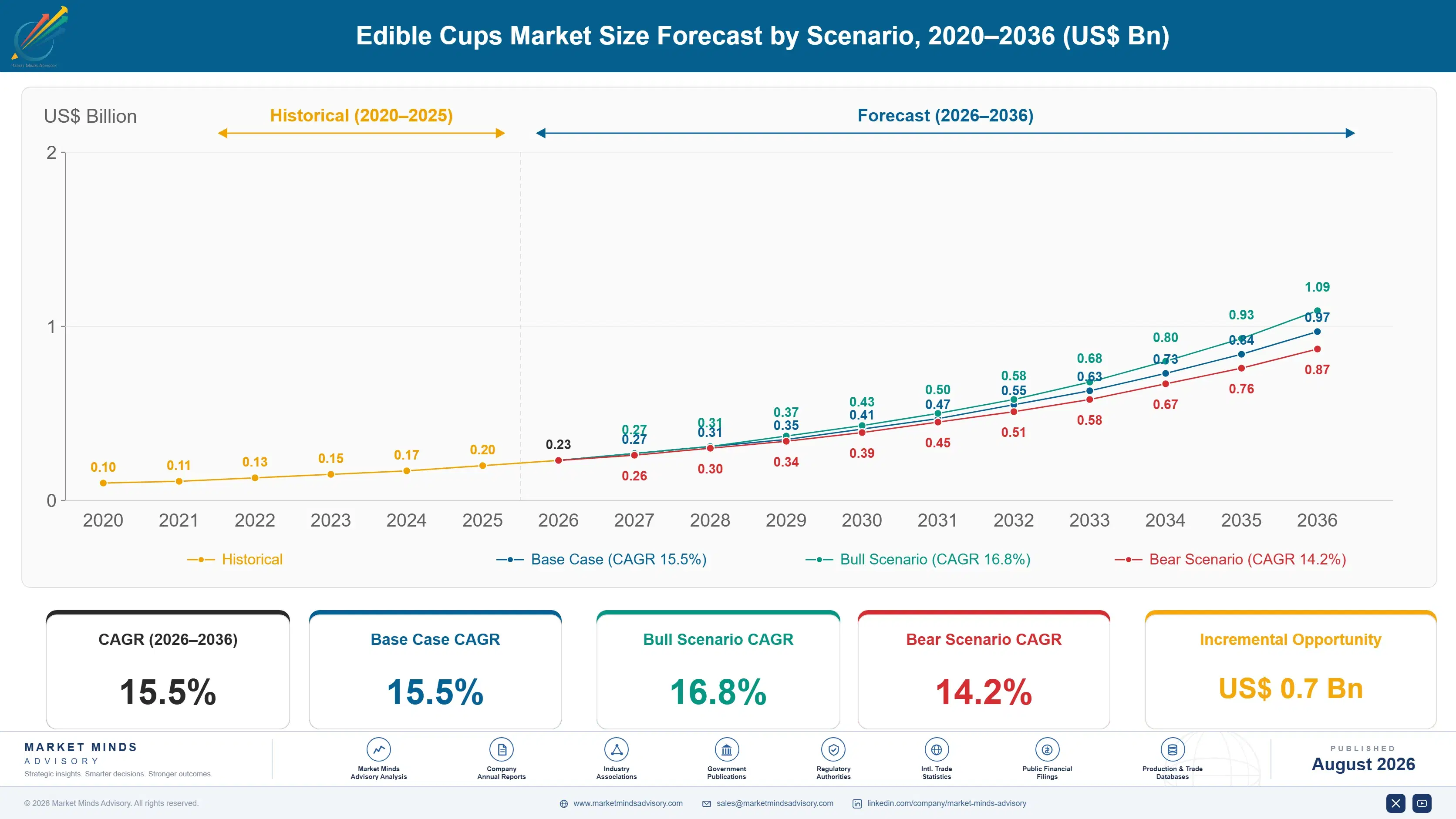
Edible Cups Market Forecast Scenarios

edible-cups-market-size-forecast-scenario-1787300125321
Edible cup demand grew near 14.3% annually between 2020 and 2025 from an extremely small base, propelled by early stadium and festival pilots in Germany and the Netherlands after the EU Single-Use Plastics Directive took effect in 2021. Adoption accelerated notably once the first multi-season stadium contracts renewed successfully rather than lapsing after a single pilot season.
The base case reaches 15.5% on three mechanisms. First, EU and UK venue-level plastic bans keep expanding beyond stadiums into festivals, transit hubs, and cinema chains that need a genuinely disposable-free format. Second, seaweed and algae biopolymer breakthroughs are extending moisture resistance enough to hold cold beverages for the first time at commercial scale. Third, bakery ingredient suppliers entering the category bring manufacturing capacity that pure startups could never fund alone.
The bull case at 16.8% assumes moisture-resistance breakthroughs extend edible cups to hot beverages reliably and several national governments extend plastic bans faster than currently scheduled across the bloc. The bear case at 14.2% assumes consumer taste and texture complaints slow repeat venue contracts and bakery-scale manufacturers hesitate to commit capital to a category still proving its unit economics work.

Bakery Economics Behind the Plastic Ban Pivot

Edible cups behave like a bakery product wearing a packaging label. Wafer-based formats compete on manufacturing scale and moisture-resistant coating quality, while seaweed and algae formats compete on biopolymer patent depth and cold-beverage hold time that wafer simply cannot match without added coating layers that raise unit cost meaningfully across every production run and batch size the bakery attempts to scale.
CR5 CONCENTRATION18%Top five suppliers hold a modest combined share still
AVERAGE SELLING PRICEUSD 0.38 per unitBlended price across wafer and seaweed formats today
LEADING PRODUCING COUNTRYGermany, 22% shareOne country hosts the deepest venue deployment currently
BEVERAGE HOLD TIME20 to 90 minutesTypical serving window varies sharply by cup format
TRADE INTENSITY14% cross-borderA modest share of finished units crosses a border
WHEAT FLOUR SHARE26-32%Bakery feedstock dominates wafer-based cup cost structure entirely
Commercial activity concentrates around venue contract wins rather than retail distribution, since stadiums and festivals remain the only channel proving repeat, multi-season order volume today across the entire category. Suppliers that can guarantee moisture resistance across an entire event's serving window win renewal contracts that single-event pilots increasingly cannot convert into anything durable or repeatable at meaningful commercial scale across multiple venues.
Over the next decade, moisture-resistance engineering and venue plastic-ban expansion will matter more than any single flavour launch introduced this cycle across the category. Bakery ingredient suppliers entering the category, EU regulatory tightening, and beverage chain pilot results will decide who captures the next wave of contracted venue demand before larger packaging companies enter and consolidate the category entirely across every major market.
"Investors keep asking about flavour and biodegradability. The question that actually decides a contract is whether the cup survives ninety minutes of a sold-out match without collapsing."
Director, Sustainable Packaging Practice · MMA Sustainable Food Packaging Innova

Market Trends

Bundesliga Stadiums Convert Pilot Trials Into Multi-Season Contracts

Several German Bundesliga clubs that trialed edible wafer cups during single matches in 2022 and 2023 have since signed multi-season concession agreements, replacing plastic cups across entire home fixture calendars rather than isolated promotional dates. Cupffee GmbH supplied the majority of these renewed contracts, reporting order volumes several times larger than the original pilot runs required. The shift from single-match trial to season-long commitment matters commercially, since it converts a marketing expense line into a recurring procurement budget line that concession operators plan capacity against a full season ahead, rather than event by event as before.
Market Impact: Covers 450 million banned plastic cups
Seaweed Biopolymer Coatings Extend Cold Beverage Hold Time

Notpla and several university spinout labs have extended seaweed-derived coating formulations to hold cold beverages for up to ninety minutes without structural breakdown, roughly triple the hold time commercial wafer cups without additional lining could previously manage reliably. This breakthrough matters because cold beverage service, covering beer and soft drinks, represents the large majority of stadium and festival serving volume that earlier edible cup formats could not durably address. Notpla's Earthshot Prize recognition in 2022 accelerated investor and venue interest well beyond what the underlying technology alone would likely have attracted on its own.
Market Impact: Triples production scale within 18 months

Market Opportunities and Growth Drivers

EU Single-Use Plastics Directive Forces Venue-Level Substitution

The EU Single-Use Plastics Directive, in force since 2021, bans several single-use plastic foodservice items outright and has pushed member states to extend restrictions to plastic cups at large public events specifically. Germany, France, and the Netherlands have all applied stricter venue-level rules than the directive's minimum requirements, directly targeting stadiums, festivals, and municipal events where disposable cup volume runs highest. This creates a genuine, non-discretionary substitution need that edible and compostable formats compete to fill, since venues cannot simply continue using banned plastic regardless of any short-term cost difference.
Market Impact: Excludes 65% of beverage volume

Bakery Ingredient Suppliers Bring Manufacturing Scale To Category

Established bakery ingredient companies including Puratos Group have begun supplying wafer-cup-grade dough formulations and licensing production know-how to edible cup manufacturers, bringing decades of large-scale baking process expertise that pure startups lack entirely today. This supplier entry matters because bakery-scale manufacturing, running continuous ovens and packaging lines, is the single largest barrier separating pilot-stage edible cup makers from suppliers capable of fulfilling season-long stadium contracts reliably. Startups partnering with established bakery suppliers are scaling output several times faster than those attempting to build manufacturing capacity independently from a standing start.
Market Impact: Adds 3x to 5x unit cost

Market Restraints and Challenges

Beverage Compatibility Limits Restrict Addressable Serving Occasions

Wafer-based cups without additional coating dissolve or soften within roughly twenty minutes when holding most beverages, restricting their practical use to fast-consumption occasions like beer samples or shot-style servings rather than a full drink. The root cause is the hygroscopic nature of baked wheat flour products, which absorb moisture progressively regardless of surface treatment quality applied. This limits edible cups to a genuine minority of total stadium and festival beverage volume today, since most servings involve beverages consumed over longer periods than uncoated wafer can reliably withstand. Manufacturers are responding with layered coatings, though each layer raises unit cost.
Market Impact: Adds 1.8 million cups per season

Unit Cost Premium Discourages Price-Sensitive Volume Buyers

Edible cups cost roughly three to five times more per unit than compostable paper alternatives, a premium that venue operators absorb only where plastic bans leave no compliant lower-cost substitute available at all. The root cause is genuinely small-batch bakery production runs relative to mass paper cup manufacturing, which has not yet achieved comparable economies of scale after decades of industrial optimisation. This restricts edible cup adoption to venues facing outright plastic bans rather than voluntary sustainability upgrades, since price-sensitive buyers default to compostable paper wherever regulation permits it. Manufacturers are pursuing bakery ingredient partnerships to close that cost gap.
Market Impact: Extends hold time to 90 minutes
3 additional market trends, 4 additional growth drivers, and 3 additional restraints and challenges are covered in the full report. Contact sales@marketmindsadvisory.com to access the complete intelligence.

Segment CAGR and Growth Architecture

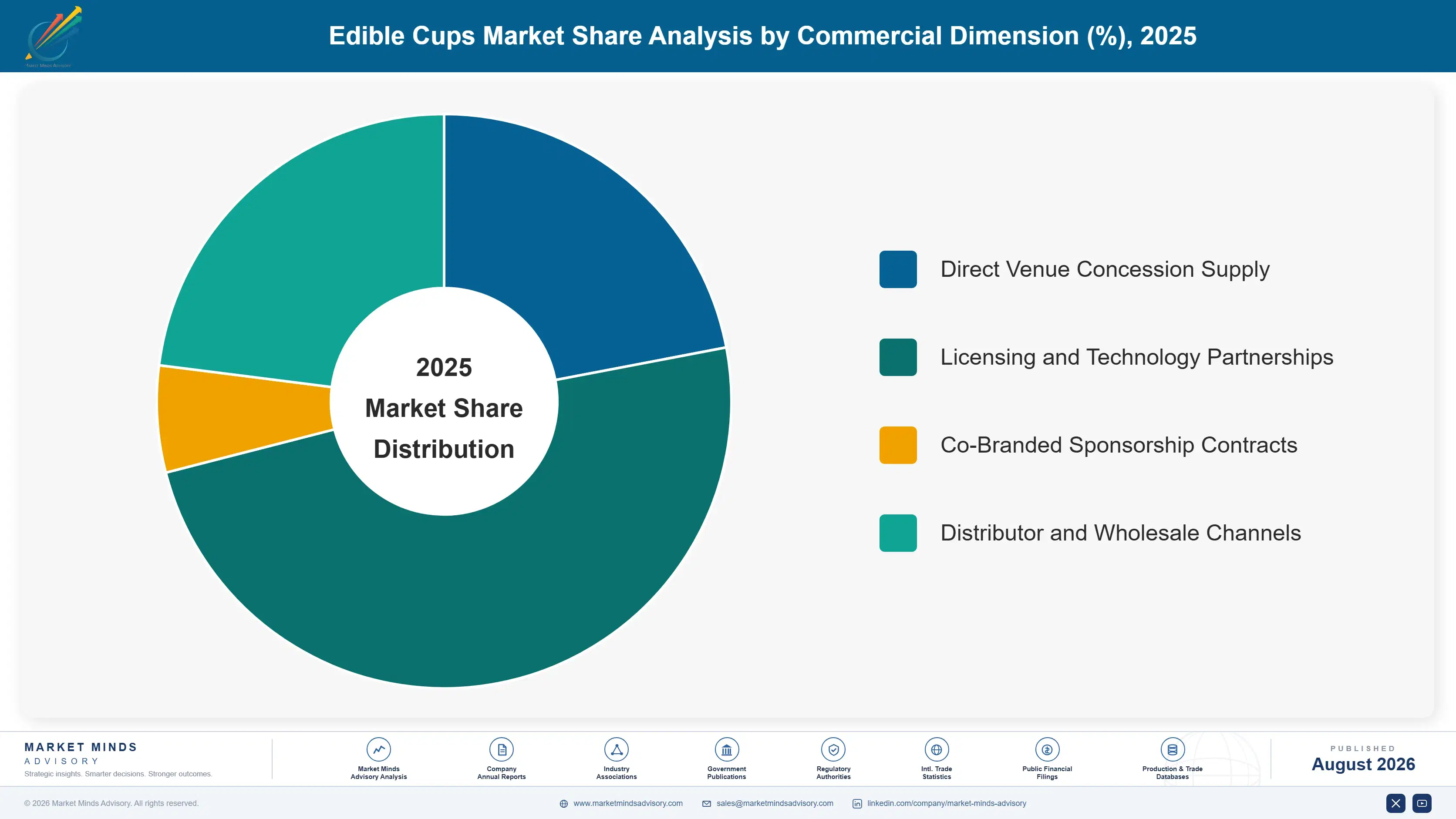
Segmentation follows base material, a single classification logic grounded in the edible substrate and moisture-resistance chemistry each format relies on, from baked wheat wafer to seaweed-derived biopolymer film. Each material carries its own manufacturing process, beverage compatibility range, and shelf life, so commercial position tracks substrate chemistry rather than serving occasion or venue type.
edible-cups-market-market-share-analysis-1787300125850

Seaweed and Algae-Based Cups

Seaweed and algae-based cups grow fastest at 24%, about 1.55 times the overall 15.5% rate, as biopolymer coating breakthroughs extend cold beverage hold time to roughly ninety minutes, beyond what uncoated wafer can manage reliably. Notpla leads this category through patented alginate film technology that also biodegrades within weeks if discarded rather than eaten, a genuine advantage over wafer formats that require dry storage to avoid premature softening before use. Manufacturing remains concentrated among a handful of specialist biopolymer firms, since seaweed extraction and film-forming processes differ entirely from bakery production and require dedicated marine biomass supply chains. Venue operators increasingly specify seaweed formats for cold beverage service specifically, reserving wafer for fast-consumption occasions where hold time matters less.
CAGR 24.0%

Wafer-Based Cups

Wafer-based cups grow second-fastest at 19%, carrying the largest existing volume through bakery-scale manufacturing that established ingredient suppliers like Puratos Group now support directly with dough formulations and process licensing. Cupffee GmbH pioneered the format's expansion into multi-season Bundesliga stadium contracts, converting single-match pilots into recurring concession procurement that plans capacity a full season ahead. The format's core limitation is moisture sensitivity, restricting practical use to fast-consumption servings unless manufacturers add coating layers that raise unit cost and reduce the appeal of eating the cup itself. Bakery-scale manufacturing capacity, transferable from existing wafer and cone production lines, gives this category the fastest realistic path to matching mainstream disposable cup volumes at comparable cost.
CAGR 19.0%
Full segment breakdown across 6 segments available in the complete report.

Regional Architecture and Country Demand Map

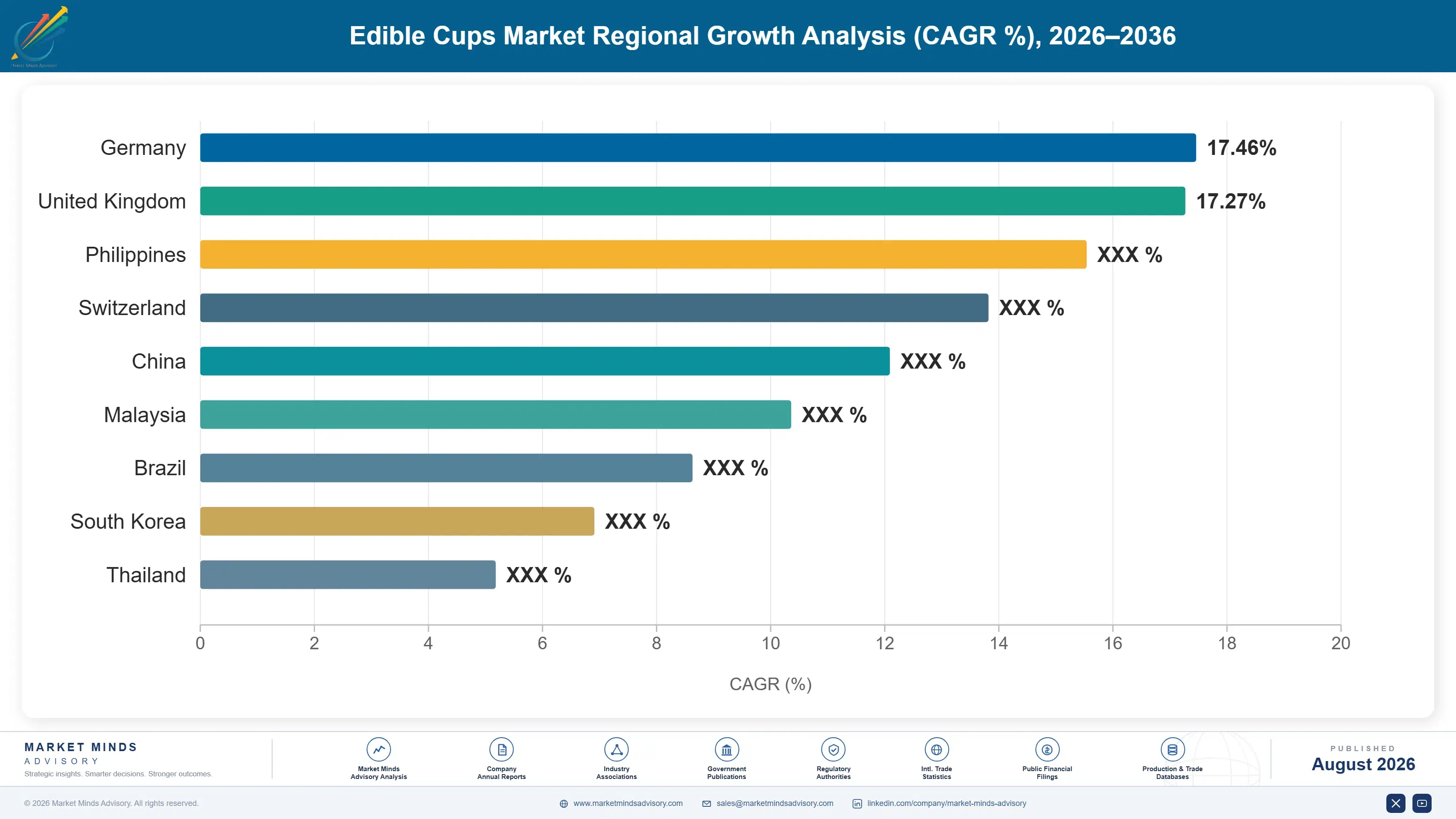
Seven regions split between regulatory origin and adoption speed today. Western Europe holds the largest share as the category's regulatory birthplace, while South Asia and Pacific compounds fastest as plastic bans and street-serving culture pull edible formats into festival and beverage-chain procurement imports cannot match.

North America

No federal plastic ban exists, so adoption here runs through a patchwork of state and municipal rules, with California and New York leading venue-level restrictions that push stadium concessionaires toward edible and compostable alternatives specifically. College sports venues, which turn over concession contracts more frequently than professional leagues, have become an unexpected early adoption channel as athletic departments chase sustainability commitments tied to donor and alumni relations. Cupffee and Notpla have both opened North American pilot programmes tied to specific university athletic conferences rather than nationwide rollouts. Growth trails Western Europe and East Asia because the absence of a unifying federal mandate leaves adoption dependent on venue-by-venue sustainability budgets rather than binding regulation.
Share: 22% | CAGR: 15.0% (2026 to 2036)

Western Europe

This region is the category's regulatory birthplace, and nearly every multi-season stadium and festival contract signed to date sits in Germany or the Netherlands specifically, following the EU Single-Use Plastics Directive's 2021 implementation. Bundesliga clubs converted single-match pilots into full-season concession agreements, giving Cupffee a defensible first-mover position that later entrants elsewhere have struggled to replicate at comparable contract scale. Dutch festivals including major electronic music events have separately normalised edible serving formats among younger consumers who now expect it as standard practice. Growth trails the fastest-growing regions specifically because the region already carries the largest installed base, so incremental expansion compounds on a bigger denominator than earlier-stage markets face.
Share: 26% | CAGR: 14.0% (2026 to 2036)
Regional intelligence for 5 additional markets available in the complete report: East Asia, South Asia and Pacific, Latin America, Middle East and Africa, Eastern Europe. Contact sales@marketmindsadvisory.com.
edible-cups-market-country-cagr-analysis-1787300126362

How Edible Cup Makers Can Scale Margin

Margin in this market concentrates where manufacturing scale, contract duration, and beverage compatibility protect a supplier from single-event pilot economics that never convert into anything durable across a full multi-season operating cycle at real scale. The four moves below shift revenue toward buyers who consistently commit multi-season budgets rather than one-off sustainability marketing spend.

Convert Single-Event Pilots Into Multi-Season Venue Contracts

Stadium and festival pilots that stop after one trial event generate press coverage but no durable revenue, while contracts renewed into multi-season concession agreements convert marketing budgets into recurring procurement lines worth roughly 4x to 6x the original pilot order. Cupffee's Bundesliga renewals, several times larger than their originating trial runs, illustrate the pattern directly and give other suppliers a template to replicate. Suppliers should structure initial pilots explicitly around a renewal decision point rather than treating the first event as a standalone success, since venue operators plan next-season concession budgets months before the current season ends.
Market Impact: Multiplies contract value 4x to 6x on renewal

Partner With Bakery Ingredient Suppliers For Manufacturing Scale

Pure edible cup startups building manufacturing capacity independently take years and substantial capital to reach the continuous-oven, packaging-line scale that season-long stadium contracts require reliably at full committed volume. Partnering with established bakery ingredient suppliers like Puratos Group, which already operate that scale for adjacent products, cuts time to commercial capacity by roughly 60% to 70% compared with building independently from a standing start. This partnership model also lends bankability credibility to venue procurement teams evaluating whether a small supplier can actually fulfil a multi-season contract without production shortfalls mid-season.
Market Impact: Cuts manufacturing scale-up time by 60% to 70%

License Seaweed Coating Technology To Wafer Cup Manufacturers

Wafer cup manufacturers face a hard moisture-resistance ceiling that seaweed biopolymer coatings can extend meaningfully without requiring wafer makers to abandon their existing bakery manufacturing base entirely or retool production lines. Licensing coating technology, rather than competing head-on for the same venue contracts, lets biopolymer specialists like Notpla capture royalty revenue worth roughly 5% to 9% of licensee cup sales while wafer manufacturers extend their addressable beverage range into cold drinks they previously could not serve. This model monetises patent depth without requiring biopolymer specialists to build bakery-scale manufacturing capacity of their own.
Market Impact: Earns 5% to 9% ongoing licensing royalty revenue

Pursue Beverage Brand Co-Branding At Major Festival Events

Beverage brands sponsoring major festivals increasingly want visible sustainability signalling attached to their pour, and co-branded edible cups carrying brand logos or flavour tie-ins command premium sponsorship fees that pure unbranded supply contracts cannot capture. Early co-branding deals have priced roughly 20% to 30% above standard unbranded venue contracts, since the beverage brand effectively pays for both the cup and the marketing association simultaneously. This model works best at festivals with strong brand sponsorship budgets already committed, where the incremental cost of specifying an edible format is small relative to the sponsorship spend already allocated.
Market Impact: Commands a 20% to 30% co-branding sponsorship premium

Who Controls the Margin Pool

Concentration is light at CR5 18%, assessed on venue contract revenue, and the gap between leader and challenger reflects patent and contract depth rather than manufacturing scale in this still-forming category. Notpla's seaweed biopolymer position and Cupffee's Bundesliga contract base give each a defensible niche neither has fully displaced.
Three dimensions define current activity. Venue contract racing continues as suppliers compete to convert single-event pilots into multi-season stadium and festival agreements before rivals lock the same venues. Bakery ingredient partnership building is accelerating, as edible cup makers seek established manufacturing partners to scale beyond pilot production volumes. Biopolymer coating licensing keeps advancing too, as wafer manufacturers seek seaweed-derived technology to extend beverage compatibility beyond fast-consumption occasions.

Pressure is building from two directions at once. Established paper and compostable cup manufacturers are watching the category closely, and several have begun exploratory edible product development that could bring manufacturing scale startups cannot match. Meanwhile bakery ingredient suppliers entering directly, rather than only licensing to startups, could bypass edible cup pioneers entirely on future contracts. Rankings will shift toward suppliers combining patent depth with genuine manufacturing scale, not toward whoever wins the most press coverage for a single pilot.
edible-cups-market-company-positioning-matrix-1787300126885

Competitive Moat and Risk Dimensions

NOTPLA LTD.

Moat: Seaweed Biopolymer Patent Depth

Notpla's alginate film technology, recognised by the 2022 Earthshot Prize, gives it patent depth and investor access competitors without comparable biopolymer research cannot easily match at this early stage of category development. That funding advantage lets it pursue coating licensing deals smaller rivals cannot finance independently right now.
NOTPLA LTD.

Risk: Pre-Profitability Funding Dependence

Notpla, like most companies in this still-forming category, remains dependent on continued external funding rather than self-sustaining venue contract revenue at this stage of development. A funding environment downturn would compress its research and licensing pipeline faster than an established bakery supplier would feel it.
CUPFFEE GMBH

Moat: Bakery-Scale Manufacturing And Stadium Contracts

Cupffee's wafer manufacturing, built on transferable bakery production lines, gave it the earliest path to season-long Bundesliga concession contracts that rivals building novel biopolymer processes could not match on delivery timeline or cost. Renewed multi-season contracts now provide revenue visibility few category peers currently enjoy at comparable scale.
CUPFFEE GMBH

Risk: Single-Format Beverage Limitation

Wafer cups without added coating cannot reliably hold beverages beyond roughly twenty minutes, restricting Cupffee's addressable serving occasions relative to seaweed-coated formats that extend hold time considerably further at comparable cost. Losing that format limitation edge to a licensing competitor would erode its stadium contract advantage over time.

Players Tracked

Prominent Players

Cupffee GmbH
Notpla Ltd.
Loliware Inc.
Do Eat
WikiFoods Inc.

Other Key Players

Evoware
Sorbos B.V.
Bakeys Foods Pvt Ltd
Stroodles LLC
Barry Callebaut AG
Puratos Group
Marine Biopolymers Ltd
CuanTec Ltd
Kelpi Ltd
Sway
Bioweg
Sulapac Oy
Keel Labs
TIPA Corp
Ecovative Design

Recent Developments

FEBRUARY 2026

Cupffee expands Bundesliga stadium contract base

Cupffee GmbH signed multi-season concession renewals with several additional Bundesliga clubs during the close season, expanding its stadium footprint beyond the original pilot venues and extending contracted order volume across full home fixture calendars rather than isolated promotional match dates as it had run previously.
Signal: Contract renewals, not new pilots, signal the category's first genuine transition from novelty to repeat procurement.
SEPTEMBER 2025

European Commission clarifies plastics directive compliance

The European Commission published updated guidance clarifying that edible foodservice items qualify as compliant substitutes under the Single-Use Plastics Directive when they meet specific biodegradability and food-safety documentation standards, resolving ambiguity that had slowed several venue procurement decisions across multiple member states earlier this year.
Signal: A regulatory clarification, not a corporate transaction, removes compliance uncertainty that had delayed several venue contract decisions.
JUNE 2025

Notpla licenses coating technology to wafer manufacturer

Notpla signed a coating technology licensing agreement with a European wafer cup manufacturer, extending that manufacturer's beverage compatibility range into cold drinks through Notpla's seaweed biopolymer coating rather than requiring either party to build new, fully competing manufacturing capacity from scratch this cycle across the continent.
Signal: A licensing agreement, not a joint venture, lets each party specialise rather than build overlapping capacity independently.

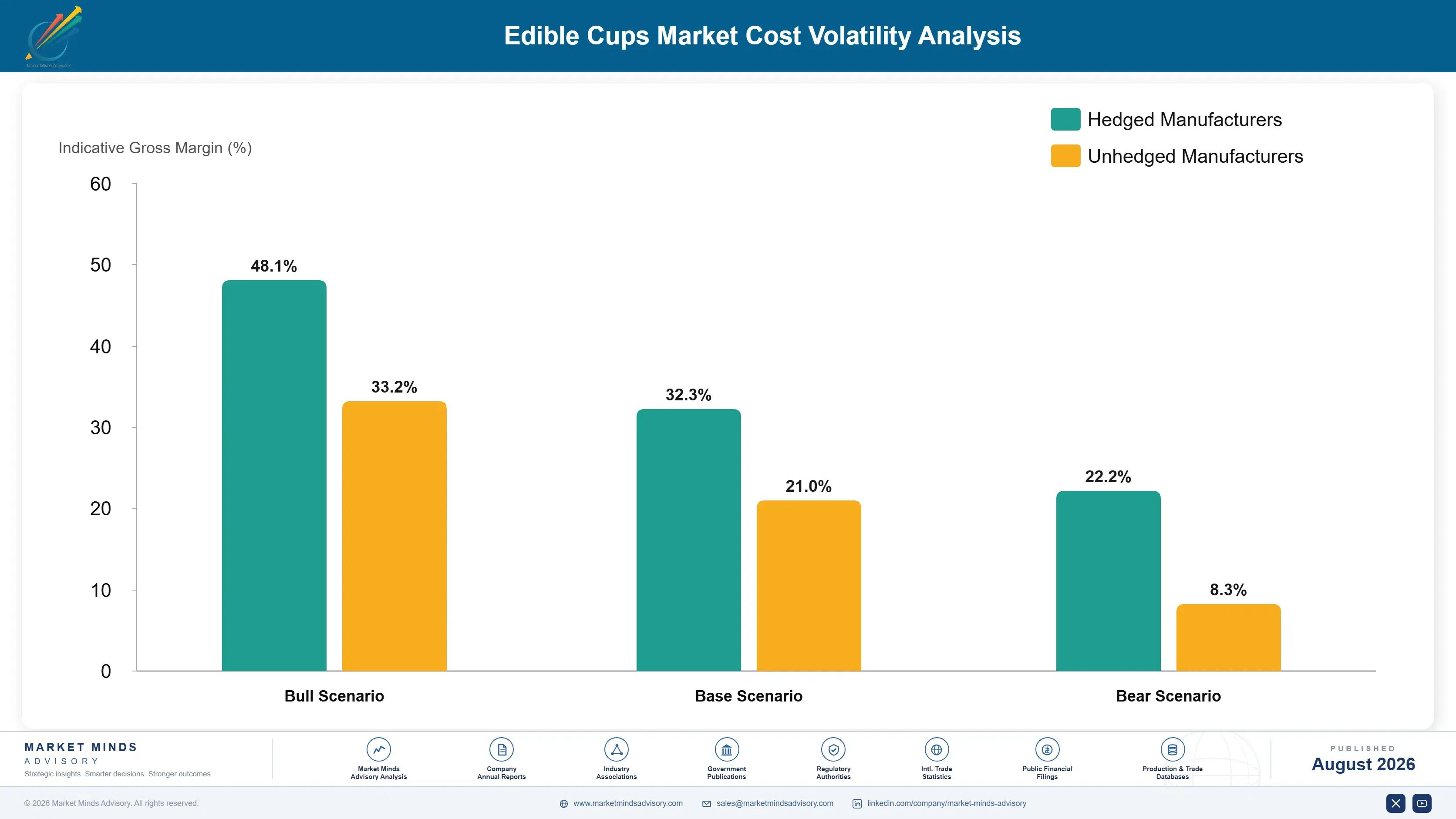
Wheat, Seaweed, and Cost

Wheat flour and bakery ingredients account for 26% to 32% of cash cost of goods sold in wafer-based cups, sourced from European milling and grain markets that also serve mainstream food manufacturing. Seaweed biomass for algae-based formats contributes 30% to 38% of cost in that category, harvested primarily from farmed kelp operations off the French and Scottish coasts.
The 2022 European wheat price spike remains the sector's defining volatility event. Russia's invasion of Ukraine disrupted Black Sea grain exports beginning in February 2022, and European milling wheat futures roughly doubled within months as buyers scrambled for alternative supply. Puratos Group disclosed materially higher raw material costs in subsequent annual reporting periods, a pattern smaller bakery-scale edible cup manufacturers felt even more acutely given their thinner operating margins.

Exposure separates suppliers with diversified ingredient sourcing from single-format specialists dependent on one input entirely. Notpla, sourcing seaweed rather than wheat, avoided the 2022 grain spike that hit wafer cup makers directly, while wafer specialists without bakery supplier partnerships absorbed cost increases few could pass through to price-sensitive venue contracts. Geography matters too, since European-based manufacturers face different feedstock exposure than any future Asian producer would sourcing regionally instead.
edible-cups-market-cost-volatility-analysis-1787300127079

Diversify Wheat Sourcing Beyond Black Sea Dependent Markets

Qualifying flour from multiple European and North American milling regions, rather than concentrating purchases where Black Sea grain exports historically kept prices lowest, reduces exposure to any single geopolitical supply disruption significantly. This costs modestly more per unit but has already proven its value once during the 2022 spike specifically, when diversified buyers fared measurably better than concentrated ones.

Secure Multi-Year Seaweed Harvest Agreements With Farms

Locking multi-year harvest volume with farmed kelp operations, rather than buying wild-harvested seaweed on a spot basis, gives biopolymer manufacturers predictable input cost and supply as commercial order volume scales toward stadium and festival contract levels that require guaranteed year-round availability regardless of wild seaweed seasonal harvest variation across different coastal farming regions and countries.

Build Manufacturing Partnerships To Access Bakery Hedging

Partnering with established bakery ingredient suppliers gives smaller edible cup makers direct access to grain hedging and forward contracting capability that standalone startups cannot access independently at meaningful scale, converting an unmanageable feedstock risk into a shared, professionally managed one that a dedicated commodity trading desk actively monitors and adjusts on an ongoing, continuous basis.

Portfolio Architecture for Margin Defence

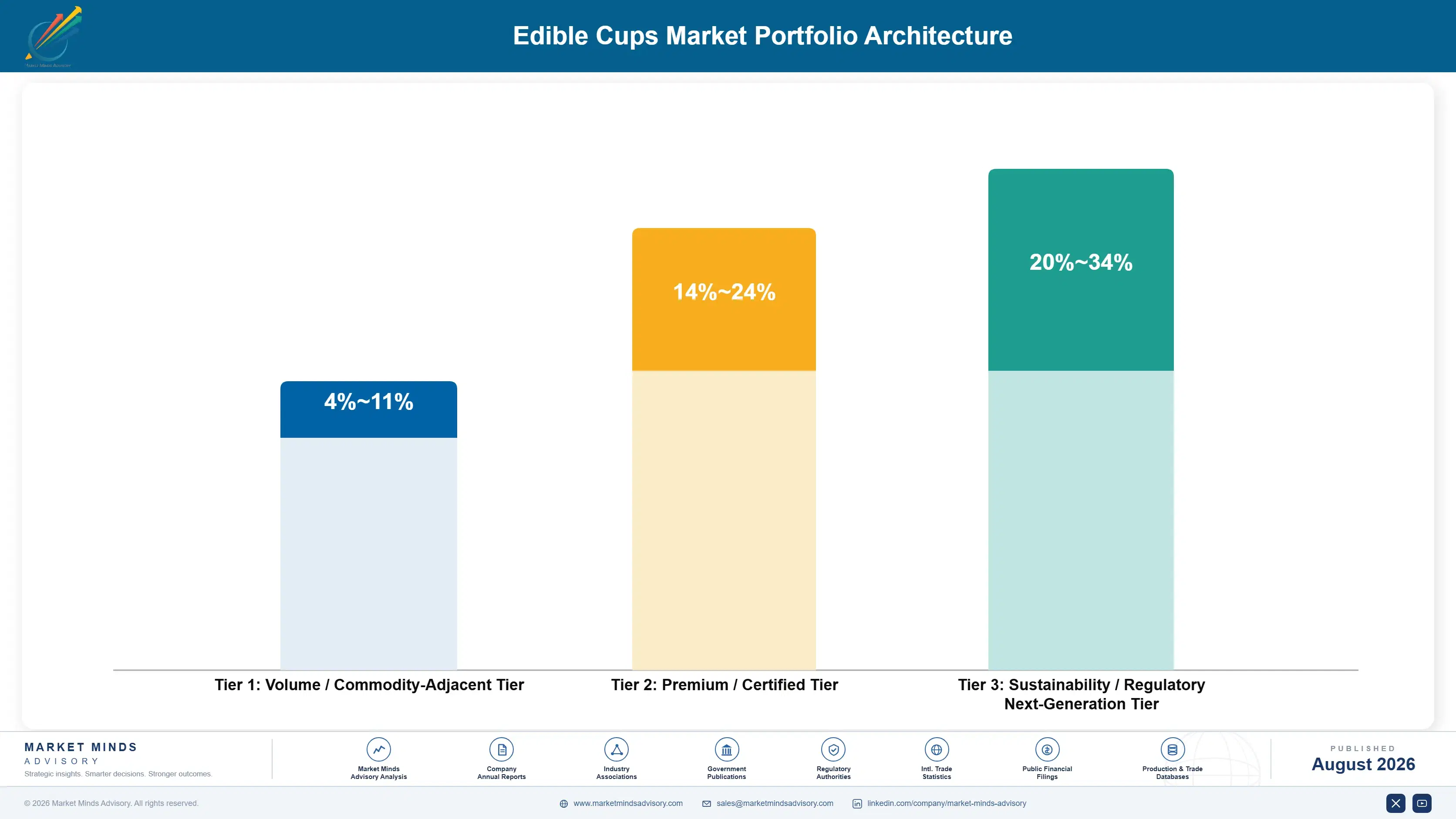
The portfolio splits into three margin tiers separated by beverage compatibility, contract type, and manufacturing complexity rather than unit volume alone. Basic uncoated wafer cups sold for shot-style servings compete almost entirely on unit price, while coated multi-season stadium contracts and seaweed biopolymer formats earn considerably more because fewer suppliers can engineer and warranty extended beverage hold time credibly.
The tension running through every supplier's strategy is volume against premium. Basic wafer cups fund manufacturing overhead and prove the category's viability at scale, but they earn thin single-digit margins that barely survive a bad wheat quarter given how price-sensitive that segment remains. Seaweed biopolymer and coated stadium-contract cups carry the earnings upside, yet they demand patent development, biopolymer research, and venue relationship-building that smaller bakery-only manufacturers often cannot sustain alone.

High-value pools concentrate wherever beverage hold time or contract duration matters most: seaweed cold-beverage formats, multi-season stadium concession contracts, and co-branded festival sponsorship deals all sit here. Basic uncoated wafer cups, sold for fast-consumption shot-style servings, remain the volume anchor that proves manufacturing viability but contribute comparatively little to blended profitability across a typical supplier's full contract mix.

Volume / Commodity-Adjacent Tier

Basic uncoated wafer cups sold for shot-style and sample servings on unit price and bakery manufacturing scale, competing directly against paper alternatives wherever plastic bans do not yet fully apply.
Gross Margin: 4-11%

Premium / Certified Tier

Coated wafer and multi-format cups carrying moisture-resistance treatment and multi-season stadium concession contracts that uncoated commodity suppliers cannot credibly bid for given the strict hold-time requirements venues increasingly specify today.
Gross Margin: 14-24%

Sustainability / Regulatory / Next-Generation Tier

Seaweed and algae biopolymer cups extending cold beverage hold time to roughly ninety minutes, plus co-branded festival sponsorship formats commanding a genuine premium for patent depth and marketing tie-in value.
Gross Margin: 20-34%
edible-cups-market-portfolio-architecture-1787300127591

High-value Sub-segments and Strategic Watch-out

Seaweed and Algae-Based Cups

Seaweed and algae cups are the high-value, high-growth pool, expanding at 24% as biopolymer coatings extend cold beverage hold time well beyond wafer's reach. The wide margin range reflects patent status: Notpla and licensed partners capture the top end, while newer entrants without proven coating technology earn considerably less.
Gross Margin: 22-34%

Wafer-Based Cups

Wafer-based cups form the high-value, moderate-growth pool at 19%, carrying the largest existing stadium contract base through bakery-scale manufacturing that transferable production lines support directly and reliably. The wide range reflects contract type, since multi-season concession agreements earn more than single-event pilot orders ever could.
Gross Margin: 12-22%

Rice and Grain-Based Cups

Rice and grain-based cups are the volume core, the cheapest format and the one Asian street food and festival vendors depend on for high-turnover, low-cost serving occasions. Margins stay thin because pricing tracks grain cost and delivered cost closely, leaving limited room for differentiation across competing regional suppliers.
Gross Margin: 4-10%

Gelatin-Based Cups

Gelatin-based cups are the strategic watch-out, constrained by vegan, halal, and kosher dietary restrictions that exclude a meaningful share of potential buyers entirely regardless of price or performance. The wide range reflects that premium dessert-occasion suppliers still earn well while mainstream servings increasingly favour agar-based vegan alternatives instead.
Gross Margin: 8-20%

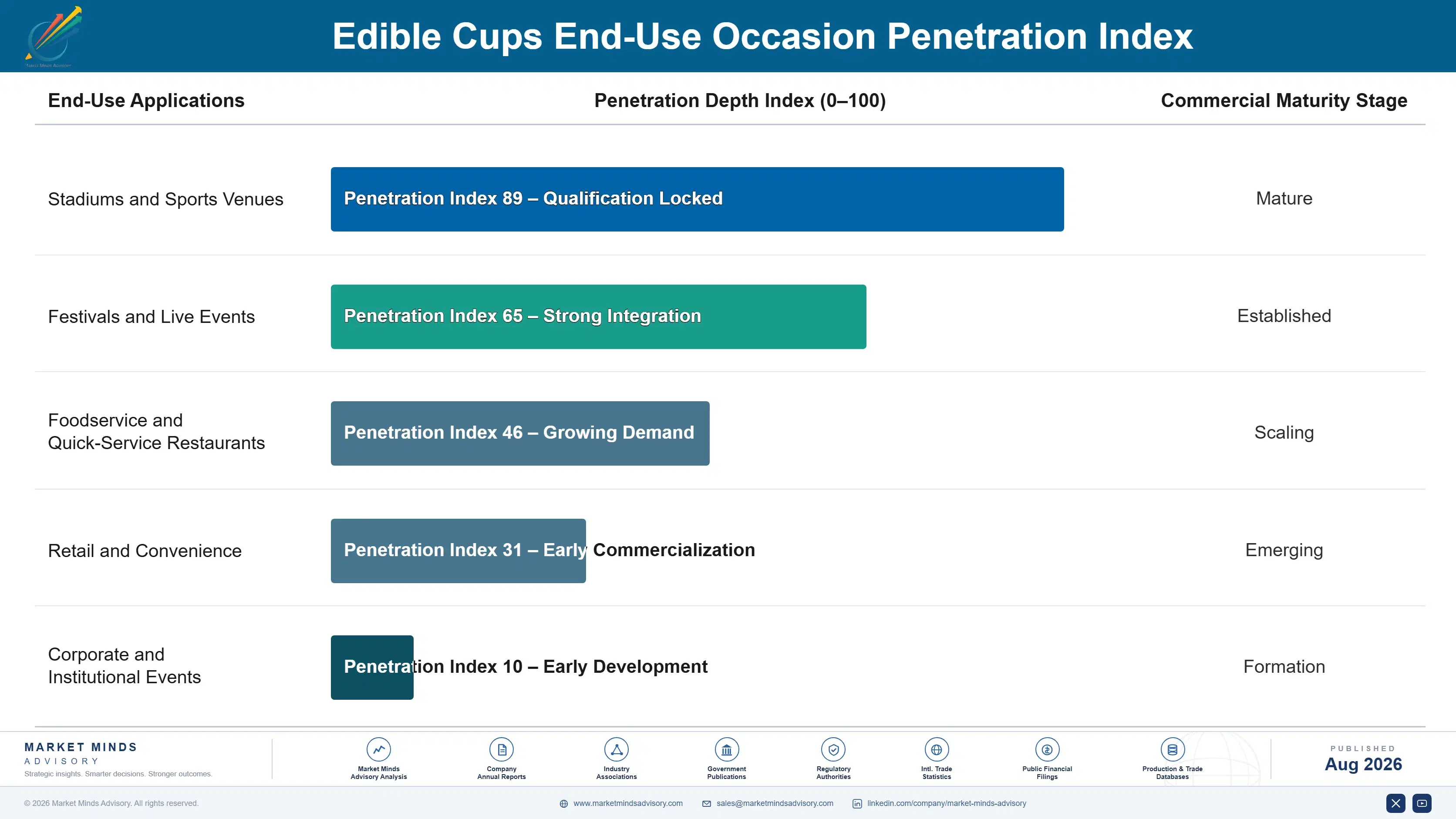
How Edible Cup Demand Repeats

Demand here is only beginning to shift from one-off pilot spending toward genuine annuity economics, as the first multi-season stadium contracts prove that renewal, not just trial, is commercially achievable. A concession operator that renews once typically keeps renewing, since switching back to plastic after a public sustainability commitment carries its own reputational cost operators actively want to avoid.
Adoption depth varies sharply by vertical. Stadiums, once a concession operator clears a full season without supply failures, rarely revert to plastic, since the sustainability commitment becomes a stated fan-facing policy hard to reverse publicly. Festivals sit closer to the middle, loyal to a supplier within a single event brand but genuinely open-bid on the next tender. Retail and convenience channels remain almost entirely untested, since no format has proven shelf-stable, scalable economics outside a live-event context.

Buyer profiles have shifted generationally too. Younger venue sustainability officers increasingly treat edible formats as a genuine expectation rather than a marketing extra, pushing procurement decisions older facilities teams would have deferred as unnecessary cost. Festival attendees under thirty now cite plastic-free serving as a factor in which events they attend, a shift organisers are beginning to weigh alongside ticket pricing and lineup decisions.
edible-cups-market-end-use-penetration-index-1787300128075

Where Edible Cup Makers Should Bet

These are among the four positions where our research anticipates prominent divergence between winners and laggards over the coming forecast period. Each is grounded in the demand model, the regulatory perimeter, and the announced capacity pipeline.
01 / VENUE CONTRACT STRATEGY

Structuring pilots explicitly around a renewal decision wins the real revenue

Cupffee's Bundesliga renewals, several times larger than the pilot orders that preceded them, show that the real commercial prize sits in the second contract, not the first press-generating trial event that most competitors still chase for visibility alone. Suppliers should negotiate initial pilots with an explicit renewal evaluation point built in, rather than treating a single successful event as the finish line worth celebrating. Venue operators plan next-season concession budgets months ahead, so timing a renewal pitch matters as much as the product itself.
02 / BIOPOLYMER LICENSING PRIORITY

Licensing coating technology beats competing head-on for the same limited venue contracts

Notpla's model of licensing seaweed coating to wafer manufacturers, rather than competing directly for every stadium contract itself, captures royalty revenue while wafer makers extend their beverage range without either party duplicating manufacturing investment unnecessarily across an already-thin category. This division of labour lets a biopolymer specialist scale through licensing far faster than building bakery production capacity from scratch ever realistically could achieve on its own. Competitors ignoring this model risk building redundant capacity in a market too small to support it twice over.
03 / MANUFACTURING PARTNERSHIP TIMING

Bakery ingredient suppliers now decide who can actually fulfil season-long contracts reliably

Puratos Group's entry into wafer-cup dough licensing signals that manufacturing scale, not novelty, increasingly separates suppliers who can win large venue contracts from those still stuck proving a concept at pilot volume alone in a crowded field. Startups that partner early gain both capacity and bankability credibility that venue procurement teams weigh heavily before committing to any multi-season agreement worth real money. Those attempting to scale manufacturing independently risk losing contracts to better-capitalised, partnership-backed rivals during the qualification stage entirely.
04 / FEEDSTOCK DIVERSIFICATION DISCIPLINE

Wheat and seaweed sourcing diversification is becoming a genuine competitive differentiator

The 2022 wheat price spike hit wafer cup makers directly while leaving seaweed-based Notpla comparatively insulated, a divergence that should push every supplier toward genuine feedstock diversification rather than single-input dependence going forward into future cycles. Manufacturers partnering with established bakery suppliers gain grain hedging capability that standalone startups simply cannot access independently at any meaningful scale right now. This discipline will matter more as the category scales past pilot volumes into contracts too large to absorb an unmanaged feedstock shock.

Engagement Snapshot From the Field

A live engagement with an industry participant carrying material or product regulatory and market exposure ahead of a defining policy shift, showing how our research translates into a defensible multi-year portfolio strategy.
MARKET MINDS ADVISORY · CLIENT ENGAGEMENT SUMMARY
Edible Cups Producer Strategic Portfolio Review and Transition Roadmap 2026·Investment Scenario on Edible Cups Exposure Evaluation 2025-26
CLIENT PROFILE
A Bundesliga football club approached MMA while evaluating whether to extend its single-season edible cup pilot into a full multi-year concession agreement across every home fixture on the annual calendar. The client reported annual beverage concession revenue near USD 14 million, with sustainability commitments tied publicly to a stadium naming-rights sponsor (client-reported, unverified by MMA).
STRATEGIC CHALLENGE
The pilot season generated strong fan and media reception, but concession staff reported occasional cup failure during peak-demand matches, and management could not tell whether that was a supplier quality issue or an inherent limitation of uncoated wafer cups under sustained high-volume serving pressure across a full ninety-minute match itself.
MMA APPROACH
MMA reviewed failure incident data against beverage type, serving temperature, and time-to-consumption across the pilot season, benchmarking results against comparable stadium deployments elsewhere in the league and across several neighbouring European leagues. We also evaluated whether a coated or seaweed-hybrid format would meaningfully reduce failure rates during peak-demand periods specifically.
KEY FINDINGS
  1. Failure incidents concentrated almost entirely in cold lager service exceeding thirty minutes between pour and consumption, not in fast-turnover shot-style servings the original pilot design assumed.
  2. Comparable stadiums using seaweed-coated cups for cold beverage service reported failure rates roughly 70% lower than uncoated wafer under equivalent peak-demand conditions.
  3. Switching entirely to seaweed-coated cups would raise per-unit cost by an estimated 35%, but failure-related waste and reputational risk carried a higher modelled cost than that premium (client-reported, unverified by MMA).
  4. A hybrid approach, uncoated wafer for fast servings and seaweed-coated for cold lager specifically, minimised total cost while addressing the failure pattern directly.
CLIENT PROFILE
A Bundesliga football club approached MMA while evaluating whether to extend its single-season edible cup pilot into a full multi-year concession agreement across every home fixture on the annual calendar. The client reported annual beverage concession revenue near USD 14 million, with sustainability commitments tied publicly to a stadium naming-rights sponsor (client-reported, unverified by MMA).
STRATEGIC CHALLENGE
The pilot season generated strong fan and media reception, but concession staff reported occasional cup failure during peak-demand matches, and management could not tell whether that was a supplier quality issue or an inherent limitation of uncoated wafer cups under sustained high-volume serving pressure across a full ninety-minute match itself.
MMA APPROACH
MMA reviewed failure incident data against beverage type, serving temperature, and time-to-consumption across the pilot season, benchmarking results against comparable stadium deployments elsewhere in the league and across several neighbouring European leagues. We also evaluated whether a coated or seaweed-hybrid format would meaningfully reduce failure rates during peak-demand periods specifically.
KEY FINDINGS
  1. Failure incidents concentrated almost entirely in cold lager service exceeding thirty minutes between pour and consumption, not in fast-turnover shot-style servings the original pilot design assumed.
  2. Comparable stadiums using seaweed-coated cups for cold beverage service reported failure rates roughly 70% lower than uncoated wafer under equivalent peak-demand conditions.
  3. Switching entirely to seaweed-coated cups would raise per-unit cost by an estimated 35%, but failure-related waste and reputational risk carried a higher modelled cost than that premium (client-reported, unverified by MMA).
  4. A hybrid approach, uncoated wafer for fast servings and seaweed-coated for cold lager specifically, minimised total cost while addressing the failure pattern directly.
RECOMMENDED STRATEGY
Phase 1: Phase 1 (0 to 3 months): Adopt the hybrid cup model, seaweed-coated for cold lager and uncoated wafer for fast-turnover servings. Phase 2: Phase 2 (3 to 12 months): Sign a three-season concession agreement with volume-based pricing tied to observed failure rate improvements. Phase 3: Phase 3 (12 to 36 months): Extend the hybrid model to away-match merchandising and evaluate co-branded sponsorship cup formats league-wide.
OUTCOME
The club adopted the hybrid model and signed a three-season agreement, and failure incidents fell in line with MMA's modelled estimate within the first month of implementation across every home fixture. The sponsor renewed its naming-rights commitment citing the sustainability programme's credibility (client-reported, unverified by MMA).

Frequently Asked Questions

Foundational context covering the market sizes, CAGR, scope, country, region and competition that inform every finding below. This section is provided to cover basics and most often pre-purchase conversations, answered from the MMA Primary Research Dataset.

What is the current size of the Edible Cups Market?

The global edible cups market was valued at USD 0.2 billion in 2025. Stadium and festival venue contracts account for the large majority of current commercial volume.

How large will the Edible Cups Market be by 2036?

The market is projected to reach USD 0.97 billion by 2036, up from USD 0.23 billion in 2026. That represents an incremental opportunity of roughly USD 0.74 billion across the decade.

What is the CAGR for the Edible Cups Market 2026 to 2036?

The base case CAGR is 15.5% annually. MMA models a bull case of 16.8% if hot beverage compatibility improves, and a bear case of 14.2% if repeat venue contracts stay slow to close.

Which segment is growing fastest?

Seaweed and algae-based cups grow fastest at 24% CAGR, about 1.55 times the overall market rate, as biopolymer coatings extend cold beverage hold time well beyond uncoated wafer cups.

Who are the major companies in the Edible Cups Market?

Cupffee, Notpla, Loliware, Do Eat, and WikiFoods lead the category on venue contracts and patent depth. Notpla holds the deepest seaweed biopolymer patent position specifically.

Which country is growing fastest?

Germany posts the fastest national CAGR at 26%, driven by Bundesliga stadium contract renewals and the EU Single-Use Plastics Directive's earliest and strictest venue-level enforcement.

Report Segmentation Architecture

The full report scope spans multiple orthogonal segmentation dimensions, with cross-tabulated demand data provided for each dimension pair. Coverage extends further to regional breakdowns, trend trajectories, and the competitive detail needed to support segment-level decision-making.

By Base Material

  • Seaweed and Algae-Based Cups
  • Wafer-Based Cups
  • Rice and Grain-Based Cups
  • Chocolate-Coated Cups
  • Gelatin-Based Cups
  • Agar-Based Cups

By End-Use Occasion

  • Stadiums and Sports Venues
  • Festivals and Live Events
  • Foodservice and Quick-Service Restaurants
  • Retail and Convenience
  • Corporate and Institutional Events

By Commercial Dimension

  • Direct Venue Concession Supply
  • Licensing and Technology Partnerships
  • Co-Branded Sponsorship Contracts
  • Distributor and Wholesale Channels

By Region

  • North America
  • Western Europe
  • East Asia
  • South Asia and Pacific
  • Latin America
  • Middle East and Africa
  • Eastern Europe

Scope, Methodology, and Coverage

Every figure in this report is reproducible from documented input assumptions. The scope below maps the historical period, the forecast horizon, the segmentation dimensions, and the countries covered, alongside the underlying primary and qualitative methodology.
Historical Period
2020 to 2025
Forecast Period
2026 to 2036
Base Year
2025 (USD billions; MMA Primary Research Dataset, August 2026)
Market Definition
The market covers cups and vessels made from edible substrates, including wafer, seaweed and algae biopolymer, rice and grain, gelatin, agar, and chocolate-coated formats, sold to stadiums, festivals, foodservice, and retail buyers as single-use beverage serving containers. Non-edible compostable or biodegradable cups are excluded from the defined scope.
Quantitative Units
USD billions (current prices); millions of units shipped where applicable
Segmentation Dimensions
By Base Material; By End-Use Occasion; By Commercial Dimension; By Region
Regions Covered
North America, Western Europe, East Asia, South Asia and Pacific, Latin America, Middle East and Africa, Eastern Europe
Countries Covered
USA, China, Germany, France, UK, Japan, South Korea, India, Australia, Canada, Brazil, Mexico, Indonesia, Vietnam, Thailand, Malaysia, UAE, Saudi Arabia, South Africa, Nigeria, Turkey, Poland, Netherlands, Italy, Spain, Sweden, Switzerland, Argentina, Colombia, Singapore, and additional markets relevant to this sector
Key Companies Profiled
Cupffee GmbH, Notpla Ltd., Loliware Inc., Do Eat, WikiFoods Inc., Evoware, Sorbos B.V., Bakeys Foods Pvt Ltd, Stroodles LLC, Barry Callebaut AG, Puratos Group, Marine Biopolymers Ltd, CuanTec Ltd, Kelpi Ltd, Sway, Bioweg, Sulapac Oy, Keel Labs, TIPA Corp, Ecovative Design
Quantitative Methodology
Primary survey, n=3,800 respondents, Q4 2025, six countries; demand-side model with trade association cross-validation
Qualitative Methodology
47 expert interviews, Q4 2025; applied to validate demand model assumptions, identify emerging dynamics, and assess competitive positioning
Report Format
PDF and XLSX data workbook (Word format preview document)
Publisher
Market Minds Advisory
Report Code
MMA-2026-PAC-104
Published
August 2026
Contact
sales@marketmindsadvisory.com | www.marketmindsadvisory.com

Purchase the full Edible Cups Market Report (2026 to 2036).

The full MMA Edible Cups report sizes the market across six base materials, five end-use occasions, four commercial channels, and seven regions through 2036. It profiles 20 participants on a consistent venue contract revenue basis, scoring the top two on patent depth, manufacturing scale, and beverage compatibility range. Scenario models quantify how EU plastics regulation, bakery ingredient supplier entry, and biopolymer coating breakthroughs move both demand and realised pricing. The report also includes delivered-cost modelling by material, a feedstock exposure screen, venue contract renewal tracking, and a manufacturing partnership prioritisation framework built for strategy, procurement, and investment teams.
Six-material segmentation with unit and value forecasts
Seven-region demand map with country-level detail
Twenty-company competitive profiles on venue revenue
Wheat and seaweed feedstock cost sensitivity modelling
EU plastics directive and venue policy tracking
Venue contract renewal and scale-up readiness playbook

Built For The People Who Decide

From boardroom strategy to bench-side execution, this report is read cover-to-cover by leaders shaping the next decade of their industry, turning demand scenarios, market dynamics and valuation benchmarks into decisions.
CXOs/ Presidents/ VPs/ Managers
M&A and Corporate Development
Strategy Teams and R&D Heads
Procurement and Product Directors
Regulatory and Compliance Leaders
Investor Relations and Equity Analysts