Market Minds Advisory
Edge Bending Machine Market

Edge Bending Machine Market: Automating The Last Visible Seam In Furniture Manufacturing

A cabinet door's edge is the first thing a customer touches, and makers are replacing manual and semi-automatic banders with CNC-integrated lines faster than glue chemistry and labour shortages let older equipment keep pace.

Lead Analyst

David Horsley

Published

September 2026

Make Smarter Decisions with Customized Research Insights

Request a free sample report and evaluate market opportunities, growth trends, and competitive dynamics relevant to your business needs.

2025 MARKET VALUE$1.6BMarket Size 2025
2036 FORECAST VALUE$3.2BBase Case , 2026 to 2036
CAGR 2026 TO 20366.5 %Bull 7.7% / Bear 5.4%
INCREMENTAL OPPORTUNITY$1.5BNet 10- year value creation
EXPANSION MULTIPLE1.88x2036 value over 2026 base
Strategic Levers
M&A Pipeline
Regional Outlook
Country Rankings
Competitive Intelligence
Segmental Deep-dive
Call-Us : 91 93563 13602

Executive Snapshot and Market Trajectory

Edge banding has moved from a manual finishing step to a specified automation line item, because furniture manufacturers increasingly treat edge quality as a brand differentiator that a hand-fed bander cannot deliver consistently at volume. Panel processors now budget for CNC-integrated lines before a new production shift is even scheduled.
Commercial demand concentrates around kitchen cabinetry, office furniture, and flat-pack retail furniture production, where edge consistency and glue-line invisibility directly affect returns and warranty claims. CNC-integrated lines are pulling ahead of standalone double-sided banders as manufacturers link cutting, drilling, and edging into one continuous cell. East Asia leads deployment volume on China's furniture export base, with South Asia and Pacific close behind on Vietnam's manufacturing relocation specifically.
Competitive character splits between diversified woodworking machinery majors bundling edge banders into wider panel processing lines and specialist bander makers selling standalone equipment to smaller shops. Regulatory pressure is lighter here than in most industrial equipment categories, but labour cost pressure is not: rising wage costs in furniture-manufacturing hubs are pushing shops toward automation even where the payback period exceeds their historical capital threshold. That pressure is reshaping capital budgets faster than planned.
Market Definition
The edge bending machine market covers manual and automatic machinery that applies edge banding material to the edges of panel products, including manual and semi-automatic edge banders, single-sided and double-sided automatic machines, CNC-integrated edge banding lines, portable compact units, and curved or post-forming machines. It excludes the edge banding material itself sold separately and general panel saws or CNC routers not built for edge banding.
Base Year Value
$1.6B in 2025 (MMA Primary Research Dataset, August 2026)
Forecast Period
2026 to 2036, eleven discrete annual values
CAGR
6.5% base case. Bull 7.7%. Bear 5.4%.
Fastest Growth Segment
CNC-Integrated Edge Banding Lines: 9.5% CAGR
Fastest Growth Country
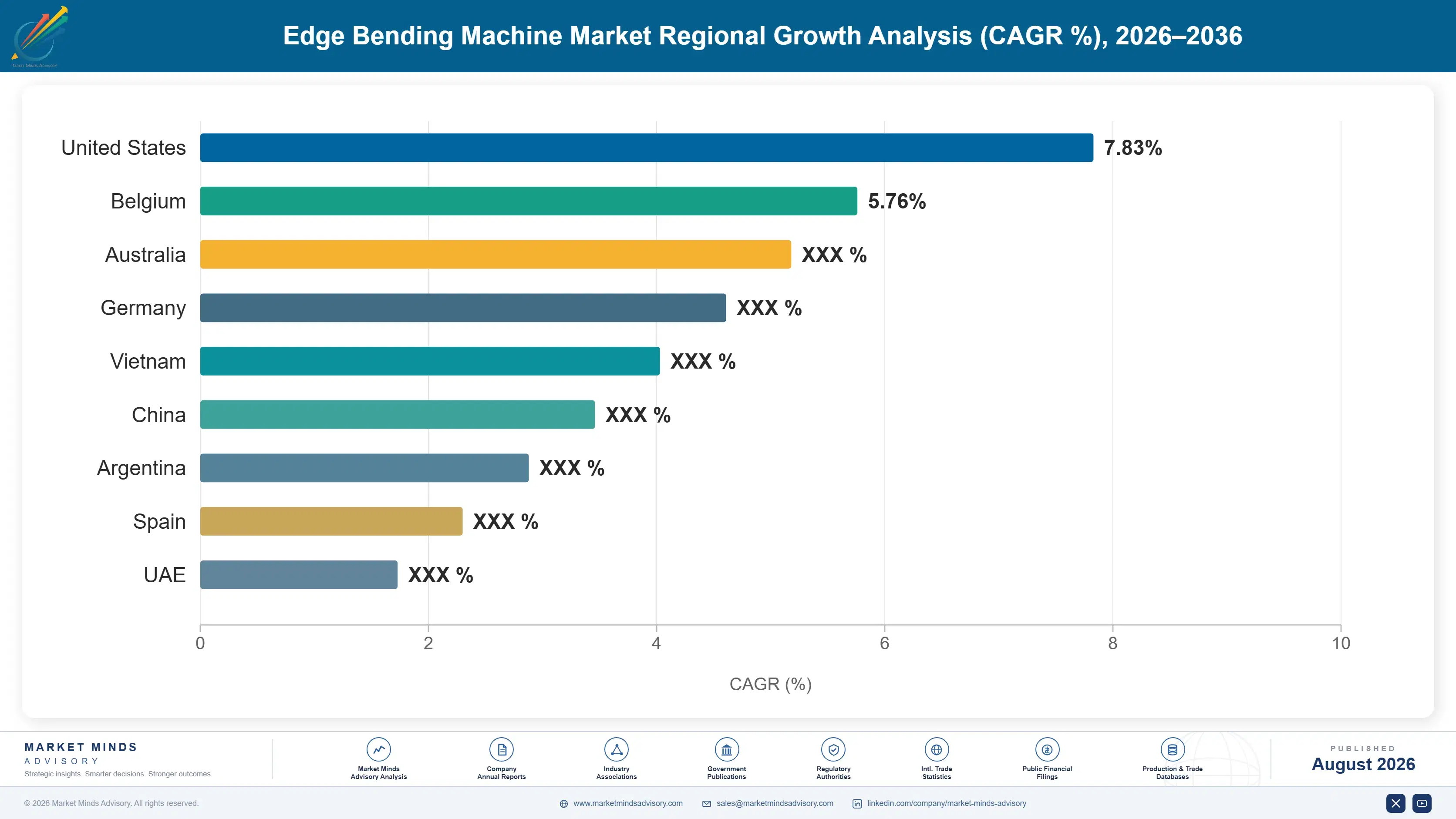
Vietnam: 9.1% CAGR
Fastest Growth Region
South Asia and Pacific: 8.5% CAGR
Largest Region
East Asia: 29% of 2025 global value
Market Leaders
Biesse Group, SCM Group, Homag Group, IMA Schelling Group, Felder Group. Source: MMA Analysis based on company annual reports.
Primary Survey
n=3,800 procurement and R&D decision-makers, Q4 2025, six countries
Methodology
Demand-side build-up, cross-validated against public data, 47 expert interviews

Edge Bending Machine Market Forecast Scenarios

edge-bending-machine-market-size-forecast-scenario-1787302946392
Between 2020 and 2025 the market grew at a 5.8% historical CAGR, anchored by steady replacement demand from established furniture manufacturing regions. Growth tracked general furniture output closely. CNC-integrated line adoption only gained real momentum from 2023 onward. Manufacturers largely treated automated edging as optional rather than a design-stage default. That habit is changing quickly.
The base case carries the market to a 6.5% CAGR through 2036 on three mechanisms. First, furniture manufacturing capacity relocating toward Southeast Asia and India multiplies the number of new production lines specifying automated edging from the outset. Second, rising labour cost in established manufacturing hubs pushes shops toward CNC-integrated lines that cut per-unit labour requirements considerably. Third, e-commerce-driven flat-pack furniture demand requires consistent edge quality at volumes that manual banding cannot reliably sustain.
The bull case reaches 7.7% if furniture manufacturing relocation to South Asia and Pacific accelerates faster than currently modelled, pulling automated line orders forward across a compressed capacity build schedule. The bear case falls to 5.4% if furniture demand growth slows broadly, keeping equipment purchases tied mostly to replacement cycles rather than new capacity specification. That divergence is already visible in early-stage order books across several regions.

Why Edge Quality Became A Line-Level Specification

Three forces converge on edge banding automation at once. Furniture manufacturing capacity relocating toward Southeast Asia and India multiplies the number of new lines specifying automated edging from the outset. Rising labour cost in established hubs pushes shops toward CNC-integrated lines that cut per-unit labour requirements considerably. And e-commerce-driven flat-pack demand requires edge consistency that manual banding cannot sustain at volume.
MARKET CONCENTRATIONCR5: 42%Diversified machinery majors and specialists split roughly two-fifths
AVERAGE SELLING PRICEUSD 15,000 to 480,000 per linePricing spans compact manual units to full CNC-integrated cells
TOP PRODUCING COUNTRY SHAREChina: 29% of units shippedDomestic machinery assembly concentrates around a few clusters
CAPACITY UTILISATION67 to 74%Certified production lines run consistently near committed capacity
INPUT COST SHARE25 to 32% of COGSSteel framing and servo drive components dominate cost spending
REPLACEMENT CYCLE LENGTH10 to 15 yearsWell-maintained machine frames outlast electronic control systems considerably
Commercially, the market behaves like specialised production infrastructure rather than generic factory equipment. Buyers specify by throughput speed, glue application system, and edge material compatibility rather than by price alone, because an undersized line creates a bottleneck that costs far more in lost output than the equipment itself. That specification discipline protects margin for makers with genuine motion-control engineering depth and keeps generic equipment assemblers from moving into technically demanding CNC-integrated contracts.
Over the next decade, integration becomes the real differentiator. CNC-integrated lines are closing the throughput gap with standalone double-sided banders as manufacturers link cutting, drilling, and edging into one continuous cell. Makers that combine reliable mechanical engineering with software-driven line coordination, rather than standalone machines alone, will capture the multi-line contracts increasingly dominating new capacity investment.
"Nobody notices a perfect edge, but everyone notices a bad one, and that asymmetry is exactly why furniture makers keep upgrading equipment they could technically run for another decade."
Director, Woodworking and Panel Processing Equipment Practice · MMA Woodworking

Market Trends

Furniture Manufacturing Relocates Toward Southeast Asia And India

Furniture manufacturers are shifting new production capacity toward Vietnam, Indonesia, and India as tariff exposure and labour cost push output away from China's established manufacturing base, and every new greenfield facility specifies edge banding equipment as part of its initial line design rather than adding it later. That relocation is converting what was once steady replacement demand in mature markets into genuine new-capacity specification in fast-growing regions, a distinction that changes both order size and buyer sophistication considerably. Biesse and SCM Group have both expanded regional sales presence to capture this capacity.
Market Impact: Cuts labour headcount 30-45% per li
CNC Integration Links Cutting, Drilling, And Edging Into One Cell

Furniture manufacturers increasingly specify integrated cells that combine panel cutting, drilling, and edge banding into one continuous production sequence rather than operating separate standalone machines that require manual handling between stations. That integration cuts work-in-process inventory and floor space considerably while reducing the handling damage that occurs when panels move manually between disconnected machines. Homag and IMA Schelling have both expanded integrated cell product lines specifically to capture manufacturers upgrading from standalone equipment to fully coordinated production sequences. Manufacturers upgrading to integrated cells report meaningful reductions in handling damage across the full production sequence.
Market Impact: Cuts customer-visible defect rates

Market Opportunities and Growth Drivers

Rising Labour Cost Pushes Shops Toward CNC-Integrated Lines

Wage inflation across established furniture manufacturing hubs has made manual and semi-automatic edge banding meaningfully more expensive per unit produced, particularly where skilled operators capable of running complex banding sequences are increasingly difficult to recruit at any wage level. A CNC-integrated line reduces the operator headcount needed per shift considerably while cutting training time, since much of the sequencing that once depended on operator judgment is now programmed directly into the line's control system. That labour arithmetic increasingly favours automation even for smaller shops that historically could not justify the capital outlay.
Market Impact: Raises entry cost 3-5x standalone e

E-Commerce Flat-Pack Demand Requires Consistent Edge Quality At Volume

Online furniture retailers ship flat-pack products directly to consumers who assemble them without professional installation, which means any edge banding defect is immediately visible to the end customer rather than being caught and corrected during professional installation as it might have been historically. That direct-to-consumer visibility has raised the acceptable defect rate bar considerably for flat-pack manufacturers, pushing them toward CNC-integrated lines with automated quality inspection that manual banding simply cannot match consistently across the volumes e-commerce retailers now require. Manufacturers serving major online furniture retailers increasingly treat automated edge inspection as a condition of the retailer relationship itself.
Market Impact: Adds 20-30% changeover time

Market Restraints and Challenges

High Capital Cost Deters Smaller Furniture Shops

A fully CNC-integrated edge banding line can cost several times what a standalone double-sided bander requires, the root cause being that integrating cutting, drilling, and edging into one coordinated sequence demands considerably more sophisticated motion control and software engineering than any single standalone machine. That cost gap keeps full integration concentrated among larger manufacturers who can spread the capital cost across high production volume, leaving smaller shops running standalone equipment despite genuine labour and quality pressure. Makers are responding by offering modular upgrade paths that let smaller shops add integration incrementally rather than committing upfront.
Market Impact: Adds 6-12 lines per facility

Edge Material Compatibility Complicates Multi-Line Standardisation

Different edge banding materials, PVC, ABS, melamine, and wood veneer, each require different glue chemistry and application temperature settings, the root cause being that these materials bond differently to panel substrates and degrade under different heat and pressure conditions during application. That variation forces manufacturers running multiple product lines with different edge material specifications to either maintain separate dedicated equipment or accept longer changeover times between production runs. Makers are responding by developing multi-glue-system machines that switch between application chemistries automatically, cutting the changeover penalty that previously discouraged mixed-material production scheduling.
Market Impact: Cuts work-in-process inventory 25-3
3 additional market trends, 3 additional growth drivers, and 2 additional restraints and challenges are covered in the full report. Contact sales@marketmindsadvisory.com to access the complete intelligence.

Segment CAGR and Growth Architecture

Segmentation follows machine configuration, the single engineering logic that determines throughput, automation level, and integration capability. Manual, single-sided, double-sided, CNC-integrated, portable, and curved edge banding machines each serve a genuinely distinct production need and are evaluated consistently throughout this report. Underlying edge banding material and general CNC routers sit outside this hierarchy, evaluated separately.
edge-bending-machine-market-market-share-analysis-1787302946925

CNC-Integrated Edge Banding Lines

CNC-integrated edge banding lines grow fastest at 9.5%, about 1.46 times the market's 6.5% overall rate, as manufacturers increasingly link cutting, drilling, and edging into one continuous production cell rather than operating disconnected standalone machines requiring manual handling between stations. These lines cut work-in-process inventory and handling damage considerably while reducing the operator headcount needed per shift, a combination that increasingly justifies the higher capital cost even for mid-sized manufacturers previously priced out of full integration. Homag and IMA Schelling have both expanded integrated cell product lines specifically to capture manufacturers upgrading from standalone equipment. Adoption concentrates first among large exporters with standardised runs, spreading into mid-sized shops as modular upgrade paths lower entry cost.
CAGR 9.5%

Double-Sided Automatic Edge Banding Machines

Double-sided automatic edge banding machines grow second-fastest at 8.0%, driven by manufacturers seeking a meaningful throughput increase over single-sided equipment without committing to the full capital cost of complete CNC integration. Rather than processing one edge at a time, these machines apply banding to both opposing edges of a panel in a single pass, cutting cycle time considerably for standard rectangular panel production that represents the bulk of cabinetry and flat-pack output. Biesse and SCM Group have both expanded double-sided product lines specifically to serve manufacturers positioned between entry-level single-sided equipment and full CNC integration. Adoption is fastest among mid-sized manufacturers producing standardised panel formats at meaningful but not yet fully automated volume.
CAGR 8.0%
Full segment breakdown across 6 segments available in the complete report.

Regional Architecture and Country Demand Map

Global demand concentrates where furniture manufacturing capacity and export volume run deepest. East Asia leads on China's furniture export base, South Asia and Pacific follows on manufacturing relocation, and Western Europe trails both on a mature, replacement-driven base. North America adds meaningful incremental demand behind both leaders.

North America

The United States drives regional demand through kitchen cabinetry and office furniture manufacturing concentrated across North Carolina and the broader southeastern corridor, where labour cost pressure has pushed several large manufacturers toward CNC-integrated lines over the past several years. Flat-pack furniture assembly serving major e-commerce retailers adds a further demand layer, with automated edge inspection increasingly specified as a condition of retailer supply agreements. Biesse and Homag both hold deep incumbency in North American furniture manufacturer contracts, bundling edge banding into wider panel processing platform relationships. Canada contributes a smaller layer through cabinetry manufacturing serving both domestic and export markets. Growth of 7.0% tracks labour cost pressure and e-commerce furniture demand more than any single facility announcement.
Share: 22% | CAGR: 7.0% (2026 to 2036)

Western Europe

Germany, Italy, and Poland anchor demand through established furniture manufacturing bases that adopted early automation and are now upgrading toward CNC-integrated lines from older standalone equipment. Homag and IMA Schelling both hold genuine home-market advantage across German manufacturing accounts, competing on integration depth against Italian machinery specialists Biesse and SCM Group. Furniture manufacturing capacity has shifted somewhat toward Eastern Europe over the past decade, capping the region's underlying growth even as remaining manufacturers invest in genuinely advanced equipment. Growth of 5.2% reflects that capacity shift directly, sitting below the global rate despite the region's deep machinery engineering base. Italian and German machinery makers continue investing in local service depth to defend their remaining home-market base.
Share: 22% | CAGR: 5.2% (2026 to 2036)
Regional intelligence for 5 additional markets available in the complete report: East Asia, South Asia and Pacific, Latin America, Middle East and Africa, Eastern Europe. Contact sales@marketmindsadvisory.com.
edge-bending-machine-market-country-cagr-analysis-1787302947438

Where Edge Banding Machine Makers Can Defend Margin

Capital budgets are shifting toward greenfield facility design and toward CNC-integrated lines that command genuine automation premiums. The four levers below capture revenue before a new facility commits to a layout rather than after, and each rewards makers who can prove throughput reliability across a customer's full production portfolio. That shift rewards makers proving throughput reliability early.

Bundle Edging Into Greenfield Facility Design Contracts

Edge banding equipment increasingly gets specified during new facility design rather than added after construction, when floor layout and material handling flow are already fixed and costly to change. Makers that place engineers inside facility design teams from the outset capture the full line specification rather than competing for a smaller retrofit order later, and early involvement lets them influence layout decisions that reduce future integration cost. Biesse reports that projects bundling equipment into initial facility design carry order values roughly 32% higher than post-construction retrofit contracts on comparable facilities.
Market Impact: Lifts contract value roughly 32% ve

Sell Predictive Maintenance Subscriptions For Integrated Lines

Unplanned downtime on a fully integrated CNC line halts an entire production sequence rather than a single station, making predictive maintenance considerably more valuable than it is for standalone equipment where other stations can continue operating during a single machine's repair. Makers bundling condition monitoring hardware with subscription analytics software are capturing service revenue worth 9 to 15% of the original line price annually, extending customer relationships well past the initial installation and improving retention across renewal cycles considerably. Homag has expanded its subscription monitoring offering specifically to capture this recurring layer.
Market Impact: Adds a durable 9-15% annual recurri

Target Relocating Manufacturers With Regional Framework Deals

Furniture manufacturers relocating capacity across multiple new facilities in Vietnam, India, or Mexico need consistent equipment specification and service support across every new site rather than negotiating separately for each individual facility, which shifts the purchasing decision upstream to a small number of corporate manufacturing engineering teams. Securing a framework agreement covering a manufacturer's full relocation programme delivers volume that no number of individual facility orders can match, and it locks in the relationship before competitors ever see an individual site's tender. SCM Group has pursued exactly this structure with several relocating manufacturers since 2023.
Market Impact: Locks in supply across a full 10+ s

Offer Modular Retrofit Packages For Smaller Furniture Shops

Smaller furniture shops cannot justify the capital cost of a fully integrated CNC line, yet they represent a large, historically underserved segment of the market that larger makers previously found uneconomical to pursue directly at scale. Makers offering modular retrofit packages that add integration incrementally to existing standalone equipment capture this segment at a fraction of the full-line replacement cost, and modular customers often return for additional upgrade modules as their production volume grows. Felder Group has scaled exactly this modular approach across smaller shops since 2024. That efficiency advantage now covers a meaningful share of Felder Group's smaller-shop accounts.
Market Impact: Cuts entry cost by roughly 45% for

Who Controls the Margin Pool

Concentration sits at CR5 42%, moderate for a category split between diversified machinery majors and regional specialists. Biesse and Homag lead on breadth, bundling edge banding into wider panel processing platform contracts, while the gap to specialists like Felder Group and IMA Schelling is more about integration depth than channel reach. All participants are assessed on one consistent basis, edge banding machine revenue.
Current competitive activity runs across three dimensions. Product development concentrates on CNC integration to close the throughput gap with standalone equipment. Software investment focuses on predictive maintenance and quality inspection rather than mechanical reliability alone. And account structure centres on relocating-manufacturer framework agreements rather than one-off facility orders, a shift that rewards makers with genuine multi-region delivery capability.

Emerging pressure comes from Chinese machinery makers scaling behind the country's furniture export buildout, winning price-sensitive standard double-sided machine business that global incumbents once assumed was theirs by default. Rankings will shift toward makers who combine CNC integration with proven multi-region service delivery, since that combination is what large relocating manufacturers are now specifying by default. Standalone-equipment-only makers without a credible integration roadmap face the sharpest erosion over the coming decade.
edge-bending-machine-market-company-positioning-matrix-1787302947963

Competitive Moat and Risk Dimensions

BIESSE GROUP

Moat: Bundled panel processing platform

Biesse sells edge banding as part of a wider panel processing platform that furniture manufacturers already purchase from for cutting and drilling equipment, making it the default choice for customers who prefer a single consolidated vendor relationship across their full production line. That relationship depth is difficult for standalone specialists to displace quickly.
BIESSE GROUP

Risk: Exposed to Chinese pricing pressure

Biesse's premium positioning sometimes trades off against the price competitiveness that fast-growing Chinese and regional manufacturers increasingly demand, leaving room for domestic machinery makers to win standard equipment business on cost alone. That undercutting pressure is most acute in East Asian and Southeast Asian relocation markets specifically.
HOMAG GROUP

Moat: Deep CNC integration engineering

Homag has invested heavily in CNC line integration software ahead of most competitors, giving it a meaningful lead in the category's fastest-growing segment and a reference base of large installations that newer integration entrants struggle to match on demonstrated field reliability. That accumulated software expertise is difficult for newer integration entrants to replicate quickly.
HOMAG GROUP

Risk: Concentrated European revenue base

A large share of Homag's revenue still ties to European furniture manufacturer accounts, leaving it more exposed than global rivals to the region's slower capacity growth and less positioned to capture Southeast Asia's faster-growing relocation-driven volume. That geographic concentration leaves less room to absorb a European capacity slowdown than global rivals face.

Players Tracked

Prominent Players

Biesse Group
SCM Group
Homag Group
IMA Schelling Group
Felder Group

Other Key Players

Casadei Busellato S.p.A.
Cehisa Maquinaria S.L.
Brandt Kantentechnik GmbH
Holz-Her GmbH
Altendorf GmbH
Paolino Bacci S.r.l.
Masterwood S.p.A.
Robland NV
Griggio S.r.l.
Yalig Makine
Nanxing Machinery Co. Ltd
Suzhou Beaver Machinery Co. Ltd
Jinan Muwang CNC Equipment Co. Ltd
Weinig Group
Stemas Makina

Recent Developments

APRIL 2025

Homag launches CNC-integrated line with AI-driven quality inspection

Homag introduced a new CNC-integrated edge banding line with automated optical quality inspection built directly into the production sequence. This was an organic product launch rather than an acquisition, extending Homag's integration capability into automated defect detection specifically. across large and mid-sized manufacturing facilities alike.
Signal: Incumbents are building quality inspection
OCTOBER 2025

Biesse acquires specialty curved edge banding technology company

Biesse completed the acquisition of a specialty curved and post-forming edge banding technology company serving high-end furniture manufacturers. The deal brought proprietary curved-edge processing capability in-house, expanding Biesse's premium segment coverage considerably beyond its prior standard product range. across its premium furniture segment offerings broadly.
Signal: Curved-edge technology is becoming a genui
JULY 2025

SCM Group signs supply agreement with major furniture manufacturer

SCM Group entered a multi-year supply agreement to provide edge banding lines across a major furniture manufacturer's multiple relocating production facilities. The agreement was a commercial supply contract, not a joint venture or equity transaction, covering equipment across the manufacturer's full relocation programme. across the manufacturer's relocating facility portfolio.
Signal: Multi-year, multi-facility supply agreemen

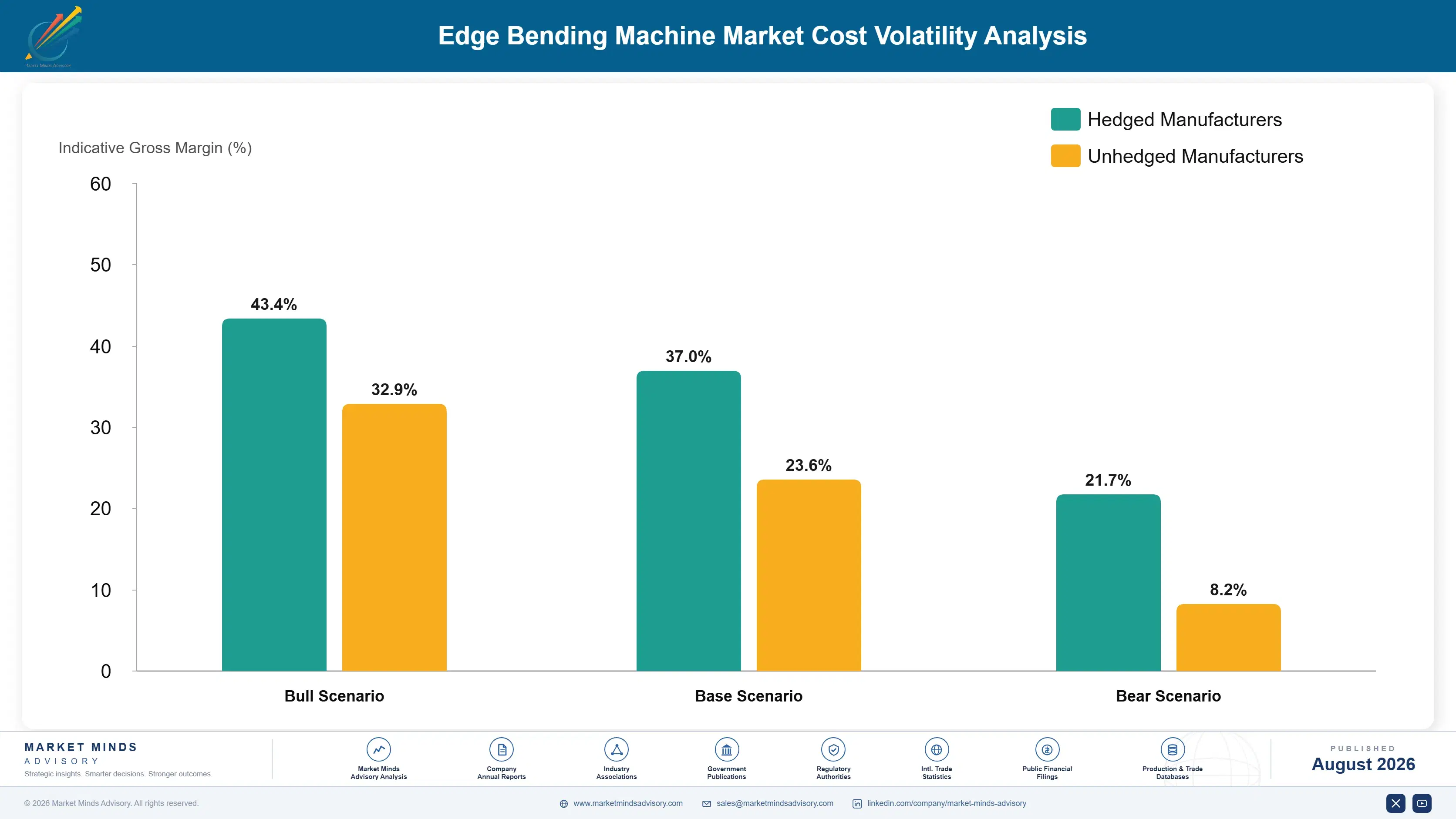
Steel Framing And Servo Drive Cost Exposure

Steel framing and structural components used in machine construction run 25 to 32% of COGS, sourced from a mix of domestic steel producers and specialised machine component manufacturers that also supply the wider industrial machinery industry. Servo motors and drive systems add a further 22 to 28%, with glue application and heating systems accounting for most of the remainder on CNC-integrated lines specifically.
The steel price spike running through 2021 and 2022 hit machine production cost directly, since machine frames depend on structural steel pricing that moved sharply during that period alongside broader construction material inflation. Homag Group's 2022 Annual Report disclosed elevated production costs across its machinery segment, attributing part of the margin pressure to steel and component price inflation that persisted through much of the year across its global operations.

Exposure varies sharply by player type. Vertically integrated majors like Biesse and Homag carry enough purchasing scale to negotiate favourable steel and servo component contracts, while smaller regional makers depend on distributors and absorb price spikes directly into thinner margins. Geography matters too, since makers manufacturing in China sit closer to component supply chains than Western competitors sourcing through longer, more exposed international routes.
edge-bending-machine-market-cost-volatility-analysis-1787302948158

Lock Steel Supply Through Multi-Year Contracts

Fixed-volume, multi-year procurement contracts with steel suppliers smooth machine frame acquisition costs across price cycles. Several makers moved a majority of their steel purchasing onto contract pricing rather than spot markets after the 2021 spike exposed their exposure directly. That approach has meaningfully reduced spot-market exposure across the largest makers' product lines. Several negotiated favourable multi-year terms.

Dual-Source Servo Drive Components Across Suppliers

Qualifying machine designs against two servo drive families from separate suppliers, rather than one, keeps a shortage at either supplier from halting production entirely. Several makers adopted dual-sourcing as standard practice after component shortages exposed how concentrated their supply chains genuinely were. That shift has reduced single-source exposure across the industry's largest hardware programmes.

Shift Product Mix Toward Software To Reduce Hardware Exposure

Subscription monitoring software carries little steel or servo component exposure, giving makers a durable way to cut input cost volatility over time simply by shifting revenue mix as customers adopt predictive maintenance alongside their hardware purchase. That mix shift has meaningfully improved blended margin across product portfolios over time. Several makers have already shifted meaningfully.

Portfolio Architecture for Margin Defence

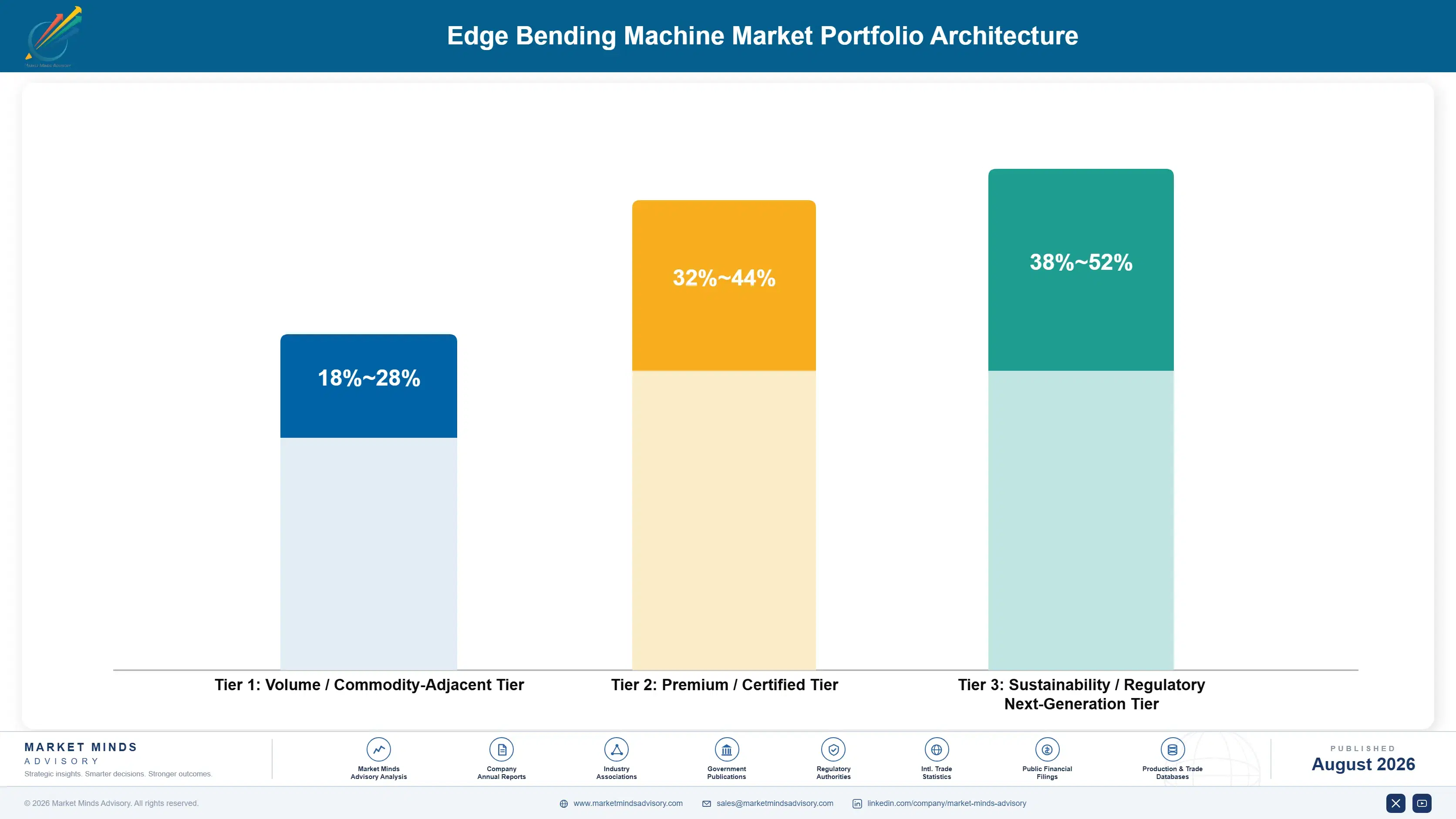
The portfolio splits into three tiers with real margin separation, and the gap between tiers has widened as CNC integration becomes a genuine differentiator rather than an add-on feature. Volume-tier manual and single-sided machines compete on price against generic equipment and earn modestly. Premium double-sided and framework-contracted equipment earns considerably more because it solves a genuine throughput and reliability problem that customers cannot engineer around cheaply.
The tension is between fleet-wide unit volume and per-line engineering margin. Distributors buying standard machines in bulk push hard on unit price, while large manufacturers standardising on CNC-integrated framework agreements pay for throughput and delivery consistency rather than negotiating down to the last dollar on every unit. Makers serving both buyer types run genuinely different sales motions under one brand.

High-value pools concentrate in CNC-integrated lines sold with predictive maintenance subscriptions and relocation framework agreements, where switching cost is highest and price sensitivity lowest. Legacy standalone equipment business remains large in volume but persistently thin in margin, as customers treat it as a commodity purchase rather than a differentiated one, and few makers manage to change that perception. Makers without a credible integration roadmap risk being confined to the volume tier permanently.

Volume / Commodity-Adjacent Tier

Manual and single-sided machines sold into standard replacement programmes, priced against generic equipment alternatives. Margin stays thin because buyers negotiate primarily on unit price. Buyers rarely differentiate between makers on anything beyond delivery speed and price.
Gross Margin: 18-28%

Premium / Certified Tier

Double-sided machines and framework agreements sold into manufacturers standardising across relocating production facilities. Buyers pay for throughput and delivery consistency rather than for hardware alone. Delivery timelines and throughput consistency matter as much as the hardware specification.
Gross Margin: 32-44%

Sustainability / Regulatory / Next-Generation Tier

CNC-integrated lines bundled with predictive maintenance subscriptions sold to large manufacturers and export-oriented facilities. Margin reflects both integration scarcity and recurring revenue. Few makers currently combine both elements convincingly at meaningful commercial scale.
Gross Margin: 38-52%
edge-bending-machine-market-portfolio-architecture-1787302948657

Facility-Anchored Recurring Equipment Demand

Demand behaves like an annuity once a manufacturer standardises on a CNC-integrated platform, because machine frames outlast electronic control systems across a 10 to 15 year replacement cycle and require predictive maintenance subscriptions throughout that span. That renewal cycle, plus the underlying capacity expansion demand it eventually triggers, gives makers a predictable revenue tail well beyond the original installation, converting a one-time equipment sale into an ongoing account relati
Adoption depth varies sharply by end-use vertical. Export-oriented furniture manufacturers adopt fastest and deepest, since international retail buyers increasingly specify edge consistency standards that manual banding cannot reliably meet. Flat-pack manufacturers serving e-commerce retailers follow closely on automated quality inspection requirements. Smaller domestic furniture shops adopt more slowly, often waiting for a labour shortage or a lost contract to force the automation decision.

Buyer profiles are shifting generationally. Procurement once sat with shop floor supervisors evaluating individual machine models; it now increasingly involves manufacturing engineering and facility planning leaders who specify integration requirements before a single machine is selected. That shift moves the real purchasing decision earlier into the capital planning cycle and rewards makers who can prove throughput reliability credibly.
edge-bending-machine-market-end-use-penetration-index-1787302949150

Where Edge Banding Value Concentrates

These are among the four positions where our research anticipates prominent divergence between winners and laggards over the coming forecast period. Each is grounded in the demand model, the regulatory perimeter, and the announced capacity pipeline.
01 / CNC INTEGRATION POSITIONING

Line Integration Now Decides Long-Run Category Position

CNC-integrated edge banding lines are growing at 9.5%, about 1.46 times the market's 6.5% overall rate, and that gap is widening as manufacturers link cutting, drilling, and edging into one continuous production cell. Makers still anchored on standalone equipment alone risk losing the fastest-growing, highest-margin relocation-era contracts to rivals offering proven integration already installed at scale on comparable facilities. The window to build credible integration capability is closing within this forecast period, not the next one, and latecomers will find the largest reference installations already claimed by faster-moving rivals.
02 / PREDICTIVE MAINTENANCE STRATEGY

Condition Monitoring Is Becoming Table Stakes For Large Lines

Large manufacturers increasingly refuse to specify CNC-integrated lines without predictive maintenance, since unplanned downtime on a fully integrated line halts the entire production sequence rather than a single station as it would on standalone equipment. Makers who build this monitoring capability capture recurring subscription revenue and preferred-vendor status that hardware-only competitors cannot easily replicate at comparable scale. Those without a credible monitoring platform will find themselves excluded from the largest framework agreements entirely, regardless of how competitive their base hardware pricing happens to be.
03 / RELOCATION FRAMEWORK CHANNEL

Multi-Facility Frameworks Will Outgrow Single-Site Orders

Furniture manufacturers relocating capacity across multiple new facilities are increasingly folding equipment specification into corporate manufacturing engineering standards rather than leaving it to individual site managers, concentrating real purchasing power in a small number of framework decisions that smaller makers cannot easily access at scale. Makers who secure framework status with major relocating manufacturers capture volume across an entire relocation programme that no number of individual facility orders can replicate. Those still selling purely site by site risk being locked out of this fastest-growing channel entirely.
04 / REGIONAL MANUFACTURING PRICING

Chinese Machinery Scale Will Keep Pressuring Global Pricing

China's furniture export buildout has scaled domestic machinery makers fast enough to win price-sensitive standard equipment tenders that global incumbents once assumed were theirs by default, and that pricing pressure is starting to spread into Southeast Asian procurement decisions as relocation accelerates. Makers competing purely on price against fast-scaling Chinese entrants will struggle to hold margin over any meaningful time horizon. The more durable response is competing on CNC integration depth and monitoring software, categories where Chinese entrants still visibly lag behind global incumbents.

Engagement Snapshot From the Field

A live engagement with an industry participant carrying material or product regulatory and market exposure ahead of a defining policy shift, showing how our research translates into a defensible multi-year portfolio strategy.
MARKET MINDS ADVISORY · CLIENT ENGAGEMENT SUMMARY
Edge Bending Machine Producer Strategic Portfolio Review and Transition Roadmap 2026·Investment Scenario on Edge Bending Machine Exposure Evaluation 2025-26
CLIENT PROFILE
A mid-sized kitchen cabinetry manufacturer operating two facilities approached MMA after losing a major retail contract due to inconsistent edge quality flagged during the retailer's incoming inspection process. The client reported annual revenue near USD 165 million, with the lost contract representing a meaningful share of projected growth for the following fiscal year (client-reported, unverified by MMA). Leadership needed a credible automation plan before the next retailer review cycle.
STRATEGIC CHALLENGE
The client had operated the same standalone single-sided banders for over a decade without upgrading, assuming the equipment remained adequate so long as no prior complaint had been raised formally. The lost contract exposed how far behind current retailer expectations its edge quality had fallen, and management had limited internal expertise to evaluate CNC integration options confidently.
MMA APPROACH
MMA benchmarked the client's edge defect rates against comparable manufacturers that had already upgraded to CNC-integrated lines, quantifying the quality improvement needed to satisfy the retailer's reinstatement criteria. We evaluated both a full line replacement and a modular retrofit path against the client's existing floor layout, and assessed three qualified equipment makers on integration timeline and financing terms.
KEY FINDINGS
  1. The client's defect rate on visible edge seams ran well above the retailer's documented tolerance threshold, confirming the flagged quality gap was substantive rather than a one-time inspection anomaly.
  2. A modular retrofit adding CNC-coordinated edging to the client's existing cutting and drilling equipment could resolve the defect rate within the retailer's reinstatement review window, at meaningfully lower cost than a full line replacement.
  3. Two of three equipment makers evaluated could deliver and commission the modular retrofit within the client's compressed timeline; the third required a longer engineering lead time regardless of price.
  4. Documenting the retrofit plan formally ahead of the retailer's review shortened the reinstatement decision timeline compared with the client's initial informal estimate (client-reported, unverified by MMA).
CLIENT PROFILE
A mid-sized kitchen cabinetry manufacturer operating two facilities approached MMA after losing a major retail contract due to inconsistent edge quality flagged during the retailer's incoming inspection process. The client reported annual revenue near USD 165 million, with the lost contract representing a meaningful share of projected growth for the following fiscal year (client-reported, unverified by MMA). Leadership needed a credible automation plan before the next retailer review cycle.
STRATEGIC CHALLENGE
The client had operated the same standalone single-sided banders for over a decade without upgrading, assuming the equipment remained adequate so long as no prior complaint had been raised formally. The lost contract exposed how far behind current retailer expectations its edge quality had fallen, and management had limited internal expertise to evaluate CNC integration options confidently.
MMA APPROACH
MMA benchmarked the client's edge defect rates against comparable manufacturers that had already upgraded to CNC-integrated lines, quantifying the quality improvement needed to satisfy the retailer's reinstatement criteria. We evaluated both a full line replacement and a modular retrofit path against the client's existing floor layout, and assessed three qualified equipment makers on integration timeline and financing terms.
KEY FINDINGS
  1. The client's defect rate on visible edge seams ran well above the retailer's documented tolerance threshold, confirming the flagged quality gap was substantive rather than a one-time inspection anomaly.
  2. A modular retrofit adding CNC-coordinated edging to the client's existing cutting and drilling equipment could resolve the defect rate within the retailer's reinstatement review window, at meaningfully lower cost than a full line replacement.
  3. Two of three equipment makers evaluated could deliver and commission the modular retrofit within the client's compressed timeline; the third required a longer engineering lead time regardless of price.
  4. Documenting the retrofit plan formally ahead of the retailer's review shortened the reinstatement decision timeline compared with the client's initial informal estimate (client-reported, unverified by MMA).
RECOMMENDED STRATEGY
Phase 1: Phase 1 (0 to 3 months): Install a modular CNC-coordinated retrofit at the facility responsible for the retailer's flagged production run. Phase 2: Phase 2 (3 to 6 months): Validate defect rate improvement against the retailer's documented tolerance threshold ahead of the review deadline. Phase 3: Phase 3 (6 to 18 months): Extend the retrofit to the client's second facility and formalise automated inspection as a standing quality control process.
OUTCOME
The client's defect rate fell within the retailer's tolerance threshold ahead of the review deadline, and the retail contract was reinstated at a volume matching the client's original projection. The retrofit approach has since been extended to the client's second facility using the same modular equipment specification (client-reported, unverified by MMA).

Frequently Asked Questions

Foundational context covering the market sizes, CAGR, scope, country, region and competition that inform every finding below. This section is provided to cover basics and most often pre-purchase conversations, answered from the MMA Primary Research Dataset.

What is the current size of the Edge Bending Machine Market?

The market was valued at USD 1.6 billion in 2025, with demand concentrated in kitchen cabinetry, office furniture, and flat-pack retail manufacturing. Growth is closely tied to relocation and labour cost pressure.

How large will the Edge Bending Machine Market be by 2036?

The market is projected to reach USD 3.19 billion by 2036, an expansion multiple of 1.88 times its 2026 value. CNC-integrated lines drive most of that growth.

What is the CAGR for the Edge Bending Machine Market 2026 to 2036?

The base case CAGR is 6.5%, with a bull case of 7.7% and a bear case of 5.4%. The range reflects uncertainty around furniture manufacturing relocation pace.

Which segment is growing fastest?

CNC-integrated edge banding lines grow fastest at 9.5%, about 1.46 times the overall market rate, as manufacturers link cutting, drilling, and edging into one cell.

Who are the major companies in the Edge Bending Machine Market?

Biesse, SCM Group, Homag, IMA Schelling, and Felder Group lead the market. Concentration sits at CR5 42%, moderate for a category split between generalists and specialists.

Which country is growing fastest?

Vietnam grows fastest at 9.1%, driven by furniture manufacturing relocation away from China that continues accelerating faster than most other regions. China remains the largest market by production volume.

Report Segmentation Architecture

The full report scope spans multiple orthogonal segmentation dimensions, with cross-tabulated demand data provided for each dimension pair. Coverage extends further to regional breakdowns, trend trajectories, and the competitive detail needed to support segment-level decision-making.

By Machine Configuration

  • Manual and Semi-Automatic Banders
  • Single-Sided Automatic Machines
  • Double-Sided Automatic Machines
  • CNC-Integrated Edge Banding Lines
  • Portable and Compact Edge Banders
  • Curved and Post-Forming Machines

By End-Use Industry

  • Kitchen and Bathroom Cabinetry
  • Office and Commercial Furniture
  • Residential and Flat-Pack Furniture
  • Shopfitting and Retail Fixtures
  • Doors and Architectural Millwork

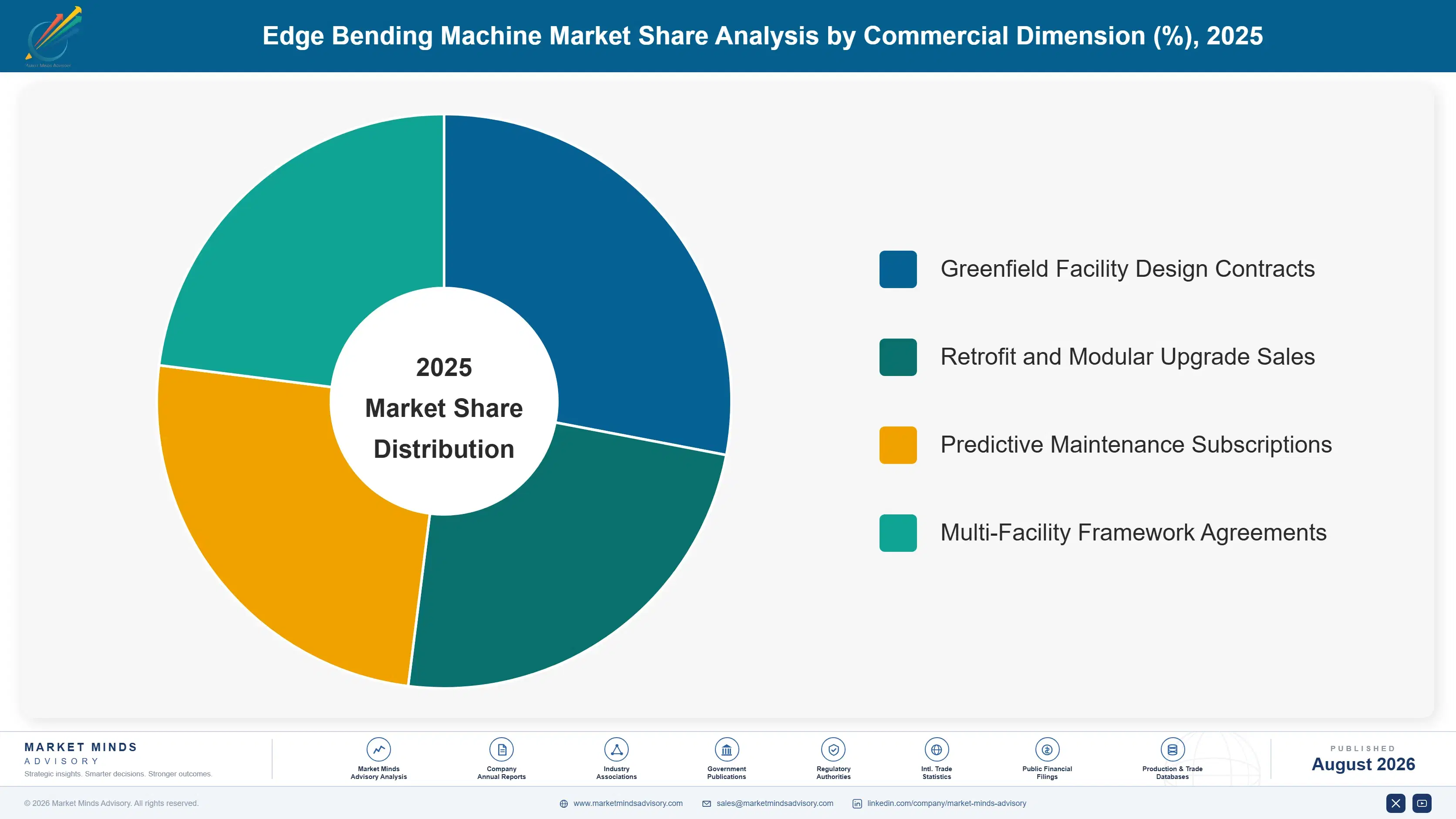
By Commercial Dimension

  • Greenfield Facility Design Contracts
  • Retrofit and Modular Upgrade Sales
  • Predictive Maintenance Subscriptions
  • Multi-Facility Framework Agreements

By Region

  • North America
  • Western Europe
  • East Asia
  • South Asia and Pacific
  • Latin America
  • Middle East and Africa
  • Eastern Europe

Scope, Methodology, and Coverage

Every figure in this report is reproducible from documented input assumptions. The scope below maps the historical period, the forecast horizon, the segmentation dimensions, and the countries covered, alongside the underlying primary and qualitative methodology.
Historical Period
2020 to 2025
Forecast Period
2026 to 2036
Base Year
2025 (USD billions; MMA Primary Research Dataset, August 2026)
Market Definition
The edge bending machine market comprises manual and automatic machinery that applies edge banding material to the edges of panel products, spanning manual and semi-automatic edge banders, single-sided and double-sided automatic machines, CNC-integrated edge banding lines, portable compact units, and curved or post-forming machines. The edge banding material itself sold separately is excluded, as are general panel saws or CNC routers not built for edge banding.
Quantitative Units
USD billions (current prices); installed machines and production line units where applicable
Segmentation Dimensions
By Machine Configuration; By End-Use Industry; By Commercial Dimension; By Region
Regions Covered
North America, Western Europe, East Asia, South Asia and Pacific, Latin America, Middle East and Africa, Eastern Europe
Countries Covered
USA, China, Germany, France, UK, Japan, South Korea, India, Australia, Canada, Brazil, Mexico, Indonesia, Vietnam, Thailand, Malaysia, UAE, Saudi Arabia, South Africa, Nigeria, Turkey, Poland, Netherlands, Italy, Spain, Sweden, Switzerland, Argentina, Colombia, Singapore, and additional markets relevant to this sector
Key Companies Profiled
Biesse Group, SCM Group, Homag Group, IMA Schelling Group, Felder Group, Casadei Busellato S.p.A., Cehisa Maquinaria S.L., Brandt Kantentechnik GmbH, Holz-Her GmbH, Altendorf GmbH, Paolino Bacci S.r.l., Masterwood S.p.A., Robland NV, Griggio S.r.l., Yalig Makine, Nanxing Machinery Co. Ltd, Suzhou Beaver Machinery Co. Ltd, Jinan Muwang CNC Equipment Co. Ltd, Weinig Group, Stemas Makina
Quantitative Methodology
Primary survey, n=3,800 respondents, Q4 2025, six countries; demand-side model with trade association cross-validation
Qualitative Methodology
47 expert interviews, Q4 2025; applied to validate demand model assumptions, identify emerging dynamics, and assess competitive positioning
Report Format
PDF and XLSX data workbook (Word format preview document)
Publisher
Market Minds Advisory
Report Code
MMA-2026-CON-101
Published
August 2026
Contact
sales@marketmindsadvisory.com | www.marketmindsadvisory.com

Purchase the full Edge Bending Machine Market Report (2026 to 2036).

The full MMA Edge Bending Machine report sizes the market across six machine configurations, five end-use industries, four commercial dimensions, and seven regions through 2036. It profiles twenty participants on a consistent edge banding machine revenue basis, scoring each on integration depth, monitoring software, and multi-region delivery capability. Scenario models quantify how furniture manufacturing relocation, labour cost trends, and e-commerce flat-pack demand move both demand and realised pricing. The report also includes delivered-cost modelling by machine configuration and a framework-agreement benchmarking tool built for manufacturing engineering, procurement, and facility planning teams.
Machine configuration cost and throughput benchmarking
Furniture manufacturing relocation demand and site tracker
CNC integration upgrade path comparison model
Labour cost and automation payback calculator
Component and materials supply chain risk screen
Predictive maintenance subscription revenue forecasting model

Built For The People Who Decide

From boardroom strategy to bench-side execution, this report is read cover-to-cover by leaders shaping the next decade of their industry, turning demand scenarios, market dynamics and valuation benchmarks into decisions.
CXOs/ Presidents/ VPs/ Managers
M&A and Corporate Development
Strategy Teams and R&D Heads
Procurement and Product Directors
Regulatory and Compliance Leaders
Investor Relations and Equity Analysts