Market Minds Advisory
Edge AI High-Bandwidth Memory Chips Market

Edge AI High-Bandwidth Memory Chips Market: Edge AI High-Bandwidth Memory: Wrong Economics for Most of the Edge, Right for the Part That Can Pay

Stacked memory was designed for data centre accelerators and costs about 7.2 times low power alternatives, which confines edge adoption to systems with a power budget and a reason to pay.

Lead Analyst

Published

September 2026

Make Smarter Decisions with Customized Research Insights

Request a free sample report and evaluate market opportunities, growth trends, and competitive dynamics relevant to your business needs.

2025 MARKET VALUE$1.8BMarket Size 2025
2036 FORECAST VALUE$9.6BBase Case , 2026 to 2036
CAGR 2026 TO 203616.4 %Bull 17.6% / Bear 15.2%
INCREMENTAL OPPORTUNITY$7.5BNet 10- year value creation
EXPANSION MULTIPLE4.57x2036 value over 2026 base
Strategic Levers
M&A Pipeline
Regional Outlook
Country Rankings
Competitive Intelligence
Segmental Deep-dive
Call-Us : 91 93563 13602

Executive Snapshot and Market Trajectory.

High-bandwidth memory was engineered for data centre accelerators with fans, power and cost headroom, none of which the edge has. A stack draws about 6.4 watts and costs roughly 7.2 times a low power alternative, which settles where it can and cannot go. That settles the addressable market.
Automotive central compute grows at 24.6%, half again the market rate of 16.4%, because a vehicle carries a power budget, a cooling system and a bill of materials that absorbs the premium. Edge servers and micro data centres follow at 19.2%. East Asia takes 56% of value, since stacked memory manufacture and advanced packaging both sit there almost entirely. Industrial vision and robotics follow at 17.0% on frame rate targets nothing else meets.
Concentration sits near 94% across the top five on measured stacked memory and integration revenue, which is close to the tightest supply position in semiconductors. The binding constraint is packaging rather than memory: advanced assembly queues run about 38 weeks and edge buyers, at roughly 4% of output, sit behind data centre customers in every allocation discussion. Allocation has become an architectural decision rather than a procurement one.
Market Definition
This market covers high-bandwidth stacked memory devices and their attributable advanced packaging integration supplied into edge inference systems, spanning automotive central compute memory, edge server and micro data centre memory, industrial vision and robotics memory, telecom and network edge memory, defence and aerospace edge memory, and medical imaging edge memory. Revenue is measured as stacked memory device and attributable integration value at supplier level. Data centre accelerator memory, low power double data rate memory, on-chip static memory, standalone logic processors, and memory controller intellectual property are excluded.
Base Year Value
$1.8B in 2025 (MMA Primary Research Dataset, September 2026)
Forecast Period
2026 to 2036, eleven discrete annual values
CAGR
16.4% base case. Bull 17.6%. Bear 15.2%.
Fastest Growth Segment
Automotive Central Compute Memory: 24.6% CAGR
Fastest Growth Country
India: 19.4% CAGR
Fastest Growth Region
South Asia and Pacific: 18.6% CAGR
Largest Region
East Asia: 56% of 2025 global value
Market Leaders
SK hynix, Samsung Electronics, Micron Technology, TSMC and ASE Technology lead on measured stacked memory and integration revenue. Source: MMA Primary Research Dataset, July 2026.
Primary Survey
n=3,800 procurement and R&D decision-makers, Q4 2025, six countries
Methodology
Demand-side build-up, cross-validated against public data, 47 expert interviews

Edge AI High-Bandwidth Memory Chips Market Forecast Scenarios

edge-ai-high-bandwidth-memory-chips-market-size-forecast-scenario-1788427274304
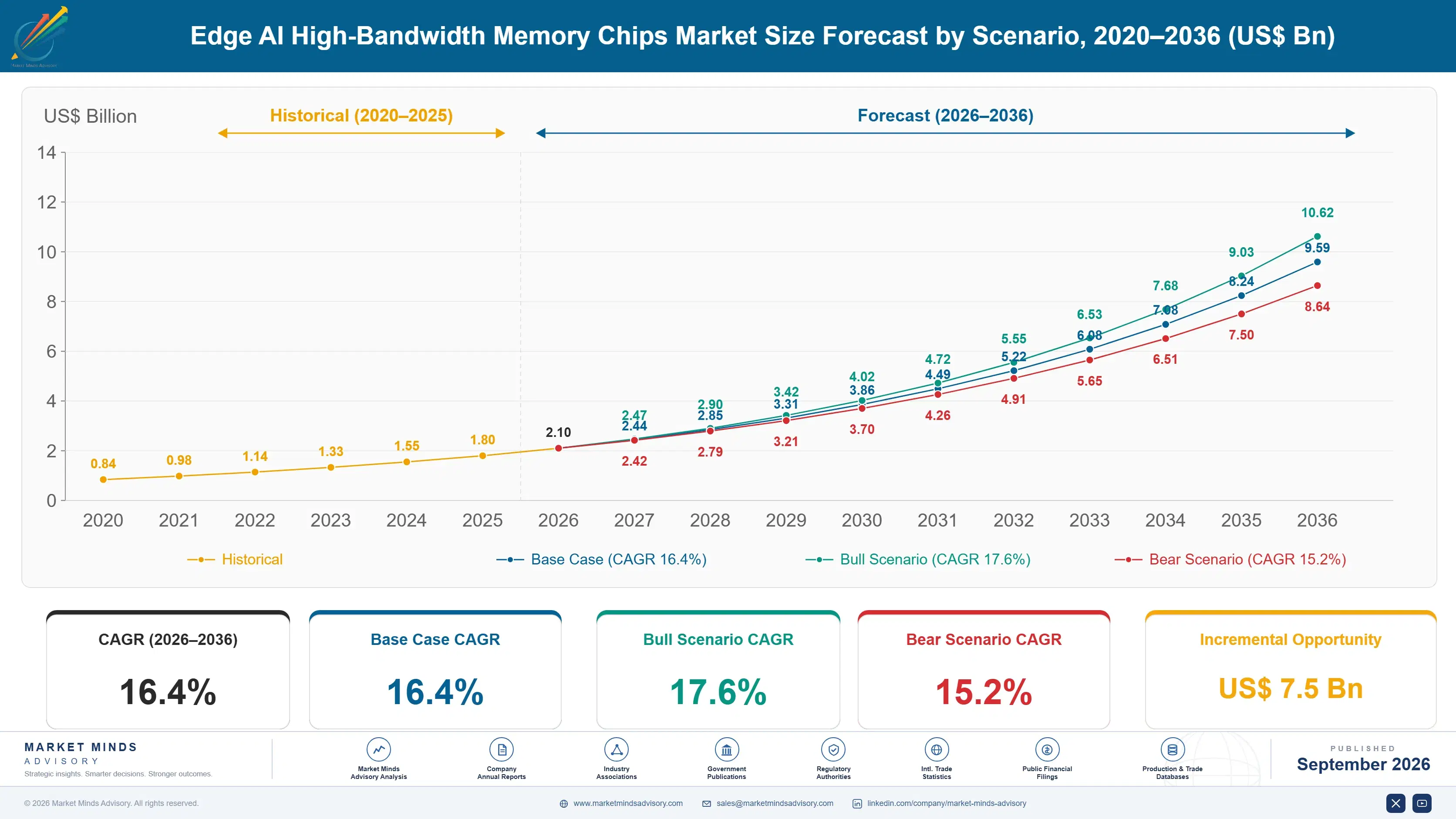
Growth ran at 15.0% from 2020 to 2025 from a base small enough that the percentage flatters it. Early edge adoption was confined to telecom base stations and a handful of defence and industrial vision systems where cost mattered less than bandwidth. Automotive interest arrived later and moved slowly, because qualifying a stacked device for vehicle temperature grades takes around 31 months.
The base case at 16.4% rests on three mechanisms. Automotive central compute consolidates functions onto single high-bandwidth platforms, the only edge application with the power budget and bill of materials to absorb a 7.2 times premium. Edge servers and micro data centres are effectively small data centres and inherit the same economics that justified stacked memory originally. Third, industrial vision and robotics need sustained bandwidth that low power alternatives cannot deliver at required frame rates.
The bull case at 17.6% assumes automotive platforms adopt on announced timelines and that packaging capacity expands enough to serve buyers outside the data centre queue. The bear case at 15.2% is that low power alternatives and on-package memory close the bandwidth gap sufficiently for most edge systems, leaving stacked memory confined to applications that were always going to pay for it.

Data Centre Memory at the Edge

Almost every claim about high-bandwidth memory at the edge collapses on two numbers. A stack draws around 6.4 watts and costs roughly 7.2 times equivalent low power memory. Phones, cameras, wearables and most industrial sensors have neither the power budget nor the cost headroom, and no bandwidth argument changes that. The edge that can use this is a specific and comparatively small part of it.
TOP FIVE CONCENTRATION94%Extremely concentrated among stacked memory and integration suppliers
STACK POWER DRAW6.4 wattsConsumption per stack under a sustained inference workload
EDGE SHARE OF OUTPUT4%Stacked memory production allocated outside data centre customers
PACKAGING CAPACITY WAIT38 weeksQueue for advanced two and a half dimensional assembly
COST PREMIUM OVER ALTERNATIVE7.2 timesPrice against low power double data rate memory
AUTOMOTIVE QUALIFICATION TIME31 monthsPeriod to qualify a stack for vehicle temperature grades
Where it does work, it works decisively. A vehicle central compute platform has cooling, hundreds of watts of electrical budget and a bill of materials that absorbs the premium. An edge server is a data centre in a cabinet and inherits those economics wholesale. Industrial vision systems on continuous high-resolution streams cannot meet frame rate targets on low power memory. These applications pay because the alternative does not function.
Supply is the awkward part, and it is not about memory. Stacked devices need advanced assembly whose queues run around 38 weeks, and edge customers at roughly 4% of output sit behind data centre buyers ordering far larger quantities. During an accelerator boom an edge programme can find itself unable to obtain parts at any price. Design teams now secure allocation before committing an architecture.
"The question a design team should ask is not whether high-bandwidth memory would help. It almost always would. The question is whether the system has 6.4 watts to spare, seven times the memory budget, and enough purchasing weight to matter to a supplier whose main customers order by the wafer lot."
Director, Memory Systems and Edge Computing Practice · MMA Technology Practice · September 2026

Market Trends

Vehicle Compute Consolidation Creates a Real Edge Buyer

Vehicle manufacturers are collapsing dozens of separate controllers onto a small number of central compute platforms, and those platforms run perception, planning and cabin workloads simultaneously against bandwidth that low power memory cannot supply. A vehicle offers what almost no other edge system does: hundreds of watts of electrical budget, an existing cooling architecture and a bill of materials where a memory premium disappears against the vehicle price. Automotive central compute grows at 24.6%, faster than anything else here. Qualification at around 31 months is the gate rather than the economics.
Market Impact: Delivers 7.2 times the cost
Packaging Allocation Decides Who Can Actually Build

The constraint on stacked memory has been advanced assembly capacity rather than memory die supply for several years, and edge programmes representing roughly 4% of output queue behind accelerator customers ordering in vastly larger volumes. Queues near 38 weeks mean an edge design team committing to a stacked architecture without secured allocation may find itself unable to build at all. Several programmes have redesigned around low power memory after discovering this late. Allocation has become an architectural input rather than a procurement detail. Capacity access rather than technical merit now decides which programmes proceed.
Market Impact: Grows at 19.2% each year

Market Opportunities and Growth Drivers

Sustained Bandwidth Cannot Be Reached Any Other Way

Continuous inference on high-resolution streams needs memory bandwidth that low power double data rate parts cannot supply at any practical configuration, because widening a conventional interface costs pins, board area and power faster than it delivers throughput. Stacked memory solves that through vertical connection rather than through wider boards. Industrial vision, robotics and automotive perception all hit the same wall at similar points. These buyers adopt because the alternative fails to meet a frame rate requirement rather than because it merely performs worse. The wall arrives at a similar point regardless of the application.
Market Impact: Draws 6.4 watts per stack

Edge Servers Inherit Data Centre Economics Directly

Micro data centres and edge server cabinets deployed at cell sites, factories and retail distribution points are simply small data centres, with cooling, mains power and the same workload profile that justified stacked memory in the first place. Their operators evaluate on inference throughput per rack unit rather than on component cost, which is precisely the calculation that favours this technology. The segment grows at 19.2%, second fastest here. It is the least surprising part of this market and frequently the most overlooked in edge discussions. Nothing about it is technically novel or commercially surprising.
Market Impact: Qualification consumes 31 months

Market Restraints and Challenges

Power and Cost Rule Out Most Edge Devices Entirely

A stack drawing about 6.4 watts and costing roughly 7.2 times a low power alternative is simply unavailable to phones, cameras, wearables and the large majority of industrial sensing, where total device power budgets are frequently smaller than a single stack consumes. The root cause is the technology's origin in systems with fans, mains power and cost tolerance. Commercially this caps the addressable edge at a fraction of what edge inference forecasts imply. Suppliers mitigate with lower-stack-count variants, which help modestly and do not change the fundamental arithmetic. The addressable edge is much smaller than forecasts imply.
Market Impact: Fastest segment at 24.6% growth

Thermal Extraction Through the Base Die Is Difficult

A stacked device dissipates most of its heat through the bottom die into the package, which is manageable with a heatsink and airflow and considerably harder in a sealed automotive enclosure at high ambient temperature. The root cause is the geometry that makes stacking valuable in the first place. Commercially this is why automotive qualification takes around 31 months and why several programmes derated performance to pass it. Suppliers mitigate through thermal interface improvements, reduced stack heights and lower clock operation in hot environments. Airflow-cooled data centre systems never encounter this problem at all.
Market Impact: Queues run about 38 weeks
4 additional market trends, 3 additional growth drivers, and 2 additional restraints and challenges are covered in the full report. Contact sales@marketmindsadvisory.com to access the complete intelligence.

Segment CAGR and Growth Architecture

Segmentation follows the deployment class, because that determines the power budget, the thermal envelope and whether a bill of materials can absorb the premium. These three things decide adoption entirely, and they vary far more between a vehicle and a factory camera than any difference in the inference workload those two systems are actually running.
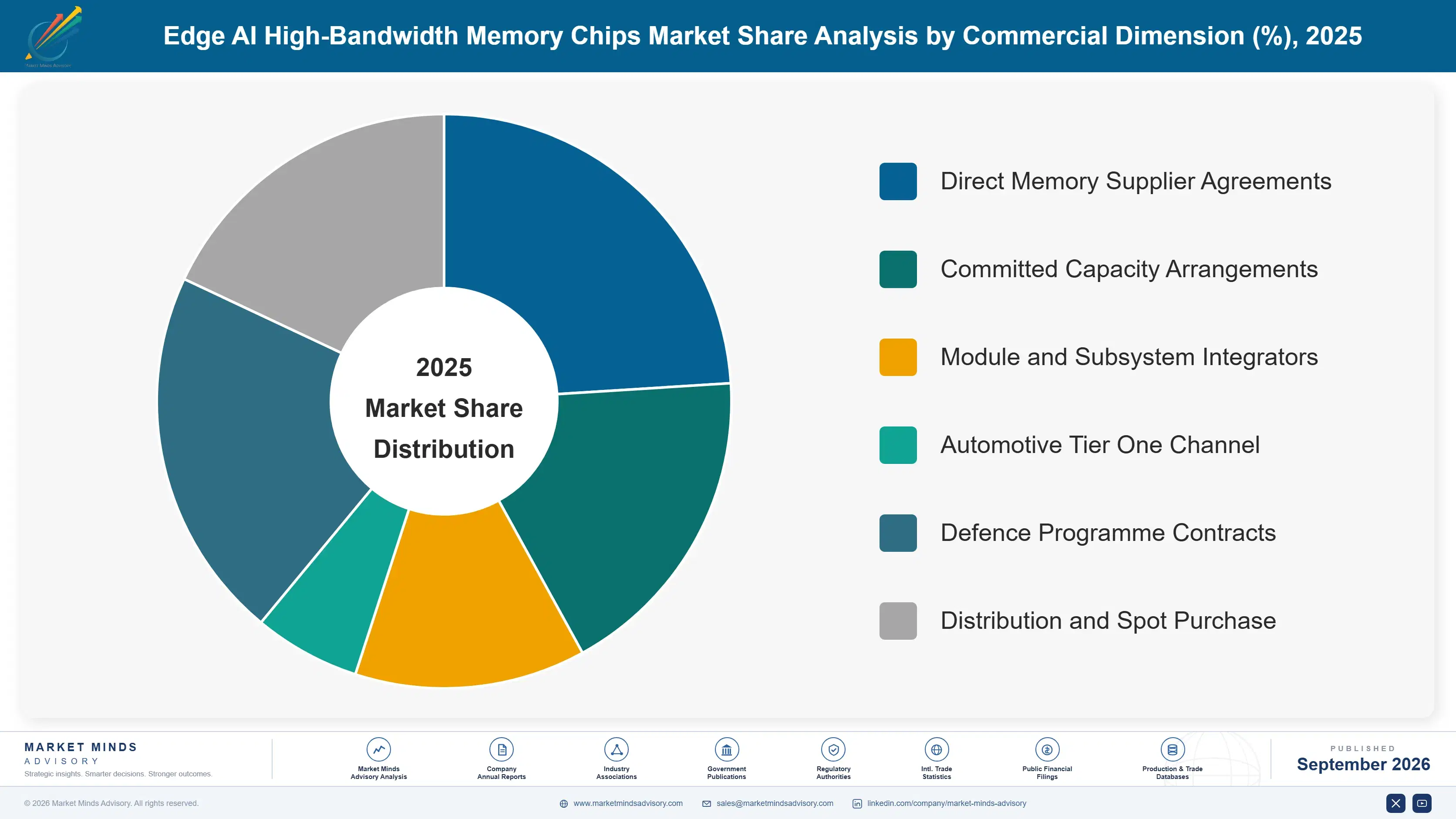
edge-ai-high-bandwidth-memory-chips-market-market-share-analysis-1788427274862

Automotive Central Compute Memory

Automotive central compute grows at 24.6%, half again the market rate of 16.4%, and it is the only high-volume edge application where the economics genuinely work. Vehicles consolidating dozens of controllers onto single platforms need bandwidth low power memory cannot supply, and they offer hundreds of watts of electrical budget, existing cooling and a bill of materials where a 7.2 times memory premium disappears against the vehicle price. The gate is qualification rather than cost, at around 31 months for vehicle temperature grades. Suppliers who began that work early hold positions competitors cannot reach within a current platform generation. Volumes only look unattractive until a platform actually reaches production, which is where the return sits.
CAGR 24.6%

Edge Server and Micro Data Centre Memory

Edge servers grow at 19.2% for the least surprising reason in this market, which is that they are small data centres with cooling, mains power and the workload profile that justified stacked memory originally. Operators deploying at cell sites, factories and distribution centres evaluate inference throughput per rack unit rather than component cost, and that calculation favours this technology at every capacity point. Volumes are modest against data centre buying, which means these customers still queue behind accelerator orders for advanced packaging. The segment gets less attention than it deserves because it does not fit anybody's definition of edge. Allocation rather than any performance question limits how much of this demand can actually be served.
CAGR 19.2%
Full segment breakdown across 6 segments available in the complete report.

Regional Architecture and Country Demand Map

Value follows where stacked memory is manufactured and packaged rather than where edge systems are deployed, since supply concentration is extreme and integration happens close to the memory. Deployment geography is far more evenly spread than revenue. The mismatch between the two is unusually large in this market.

East Asia

East Asia holds 56%, far above the regional band, because stacked memory manufacture and the advanced packaging that integrates it both sit almost entirely within the region and value is recognised where the device is produced. Korean memory makers hold the majority of stacked output, and Taiwanese advanced assembly capacity is the gate through which every device passes regardless of who designed the system. Chinese domestic memory development is progressing under export restrictions and serves regional edge programmes that international suppliers cannot address. Japanese materials and equipment supply underpins the whole arrangement without appearing as device revenue. Allocation decisions for the whole market are effectively made within this region, whatever the customer's headquarters.
Share: 56% | CAGR: 17.4% (2026 to 2036)

North America

American value reflects system design, allocation negotiation and one of the three global memory manufacturers rather than any concentration of assembly capacity. Automotive and robotics programmes specified here consume devices manufactured and packaged elsewhere, with the specification decision carrying commercial weight the revenue recognition does not show. Defence and aerospace edge programmes buy at specifications and prices no commercial application supports, which sustains capability that commercial buyers later use. Growth at 17.2% runs ahead of the market on vehicle compute platforms and on edge server deployment across large operators. Edge programmes here learned the allocation lesson early, since proximity to accelerator buyers made the queue visible sooner. Vehicle qualification work is concentrated with a small number of suppliers.
Share: 22% | CAGR: 17.2% (2026 to 2036)
Regional intelligence for 5 additional markets available in the complete report: Western Europe, South Asia and Pacific, Eastern Europe, Latin America, Middle East and Africa. Contact sales@marketmindsadvisory.com.
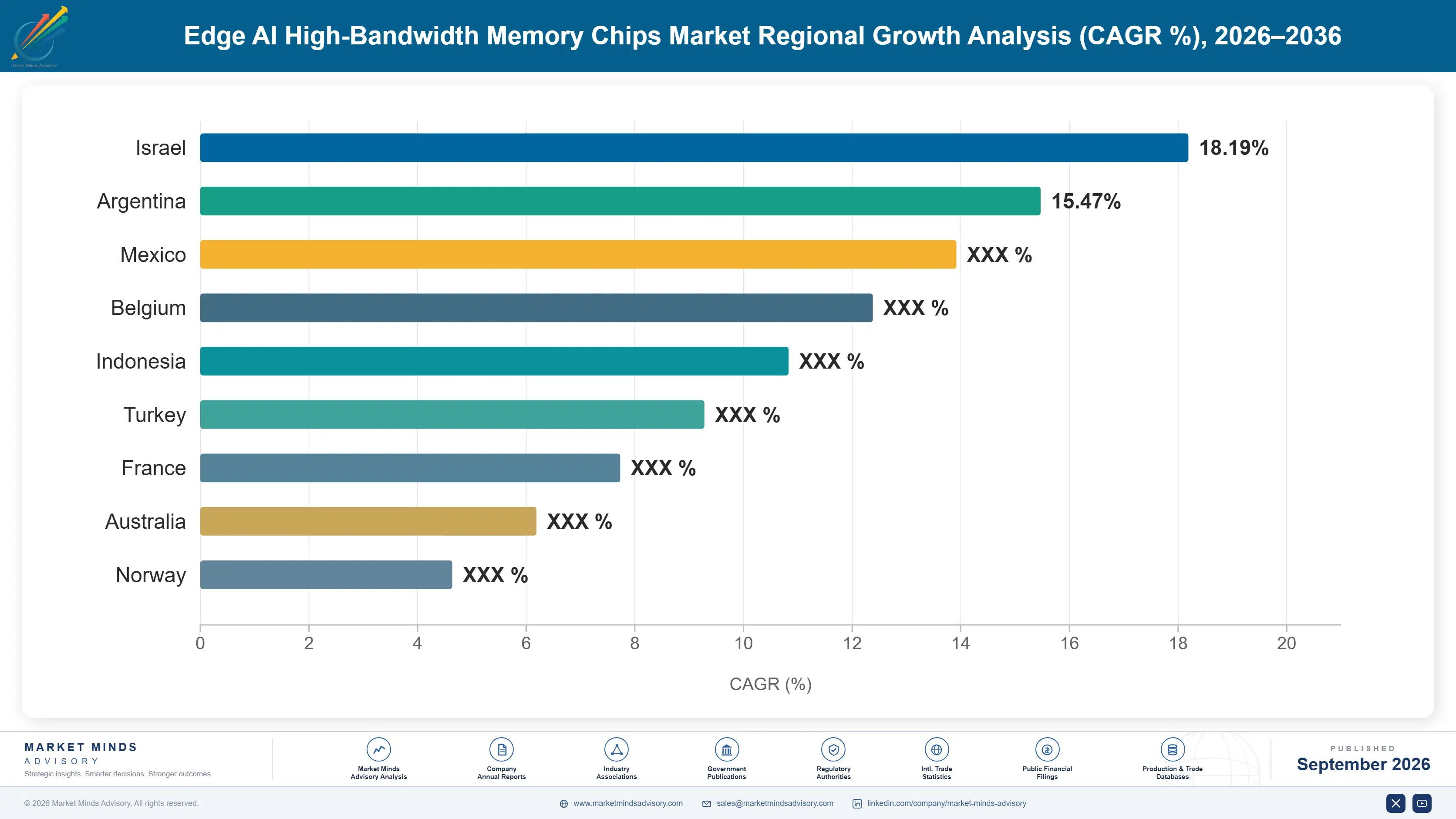
edge-ai-high-bandwidth-memory-chips-market-country-cagr-analysis-1788427275388

Where This Memory Genuinely Belongs

Most edge inference forecasts assume a memory technology the devices in question cannot power, cool or afford. The levers worth pursuing all concentrate effort on the applications that can, secure the packaging capacity that actually limits supply, and treat automotive qualification as the multi-year position it genuinely is. Nothing else moves the needle here.

Qualify for Vehicle Grades Ahead of Competitors

Qualifying a stacked device for vehicle temperature grades takes around 31 months and cannot be compressed by spending, which means a supplier starting now reaches the market after the current platform generation has already chosen. Automotive central compute grows at 24.6% and represents the only high-volume edge application whose economics work at a 7.2 times premium. Suppliers holding qualification hold platform positions for the vehicle's production life, typically 6 years or more. Those without it are competing for programmes that will be decided before they can bid. Volumes look small until the platform reaches production.
Market Impact: Holds platform positions for 6 year production runs

Secure Packaging Allocation Before Committing Architecture

Advanced assembly queues run about 38 weeks and edge programmes at roughly 4% of output sit behind accelerator customers in every allocation conversation, so an architecture committed without secured capacity may simply be unbuildable. Design teams treating allocation as an early architectural input rather than a later procurement task avoid redesigns that cost entire programme cycles. Several edge programmes have reverted to low power memory after discovering the queue too late. The conversation costs nothing and happens far too rarely. Allocation is an architectural input in this market, whatever the organisation chart says about it.
Market Impact: Avoids a supply queue running 38 weeks long

Sell Throughput Per Watt, Not Bandwidth

Bandwidth comparisons flatter stacked memory and lose the argument anyway, because an edge designer is working to a power budget rather than to a performance target. Framing the comparison as inference throughput per watt at system level shows stacked memory winning in applications with power to spend and losing honestly elsewhere, which builds credibility that bandwidth claims destroy. Suppliers using system-level framing convert roughly 2 times better in genuine opportunities. It also stops them wasting effort on applications that were never available. Honest losses build exactly the credibility that wins the next genuine opportunity.
Market Impact: Converts roughly 2 times better in real opportunities

Engineer Thermal Extraction for Sealed Enclosures

Heat leaves a stacked device through the base die, which works with airflow and is considerably harder inside a sealed automotive or industrial enclosure at high ambient temperature. Suppliers investing in thermal interface design, reduced stack heights and derating behaviour reach qualification where competitors stall, and thermal work rather than electrical performance is what fails most automotive attempts. Improved extraction lets a device hold rated clocks about 15% longer under sustained load. It is unglamorous engineering that decides which programmes proceed. Most automotive qualification attempts fail here rather than on any electrical measurement.
Market Impact: Holds rated clocks about 15% longer under load

Who Controls the Margin Pool

Concentration sits near 94% across the top five on measured stacked memory and attributable integration revenue, which is close to the tightest supply position anywhere in semiconductors. All participants are assessed on that same basis, which mixes memory manufacturers with the advanced assembly suppliers who integrate their devices, because both capture value and neither can deliver a working part alone. Three memory makers and a very small number of packaging houses effectively constitute this market.
Competition runs on three dimensions. Packaging allocation is first, since capacity rather than memory die availability limits what can be built and edge buyers hold little leverage against accelerator customers. Second is automotive qualification, where around 31 months of work confers positions lasting a vehicle platform generation. Third is thermal engineering, which is what actually fails automotive attempts rather than any electrical shortfall.

Two pressures will move positions. Automotive qualification is redistributing advantage toward suppliers who started early, irrespective of their data centre standing. Meanwhile Chinese domestic memory development is progressing under export restrictions and will serve regional edge programmes that established suppliers cannot address, creating a protected market segment none of them can enter.
edge-ai-high-bandwidth-memory-chips-market-company-positioning-matrix-1788427275913

Competitive Moat and Risk Dimensions

SK HYNIX

Moat: Stacked memory process leadership

SK hynix holds the largest share of stacked memory output and process maturity built across several generations, which translates into yield and thermal behaviour that competitors have taken years to approach. Its integration relationships with advanced packaging suppliers secure capacity when queues extend. Data centre relationships give it early visibility into edge requirements as customers extend downward.
SK HYNIX

Risk: Data centre allocation gravity

Accelerator customers order in volumes edge buyers cannot approach, and when capacity tightens the commercial logic of serving them first is difficult to resist internally. Edge programmes consequently experience the company as an unreliable supplier through exactly the periods when they are committing architectures. Automotive qualification also demands sustained engagement with buyers whose volumes look small until production.
TSMC

Moat: Advanced integration capacity control

TSMC operates the advanced two and a half dimensional assembly capacity through which stacked memory reaches a working system, which makes it the gate on supply regardless of which memory maker produced the dies. Capacity expansion is capital-intensive and slow, which sustains the position. Relationships with system designers reveal edge architecture decisions before memory suppliers see them.
TSMC

Risk: Edge volume economics

Edge programmes at roughly 4% of output consume capacity that accelerator customers would fill at better terms, which makes serving them commercially unattractive during any period of tight supply. Building capacity specifically for smaller buyers is difficult to justify against the demand profile. Packaging competitors also target the lower-volume work where scale advantage matters least.

Players Tracked

Prominent Players

SK hynix
Samsung Electronics
Micron Technology
TSMC
ASE Technology

Other Key Players

Amkor Technology
CXMT
Kioxia
Winbond Electronics
Nanya Technology
JCET Group
Powertech Technology
Siliconware Precision Industries
Rambus
Marvell Technology
NVIDIA
Ambarella
Renesas
NXP Semiconductors
Texas Instruments

Recent Developments

FEBRUARY 2025

Vehicle manufacturers complete first automotive grade stacked memory qualifications

Central compute programmes finished temperature grade qualification for stacked memory after multi-year testing, with thermal extraction rather than electrical performance proving the difficult part. Several programmes accepted derated clock behaviour at high ambient temperature to complete the process within schedule. Electrical performance had never been in doubt.
Signal: Thermal engineering rather than raw bandwidth capability determines which suppliers can reach automotive platforms at all.
JULY 2025

Edge programmes revert to low power memory after packaging allocation refusals

Several industrial and robotics design teams abandoned stacked memory architectures after failing to secure advanced packaging capacity against accelerator demand, redesigning around low power alternatives at meaningful performance cost. The allocation position had not been checked before architecture commitment. Performance targets were missed and the programmes shipped anyway.
Signal: Packaging allocation is an architectural constraint, and design teams treating it as procurement discover that expensively.
OCTOBER 2025

Domestic Chinese stacked memory development targets regional edge programmes

Chinese memory developers advanced stacked device capability aimed at domestic edge inference and automotive programmes that established international suppliers cannot serve under export restrictions. Specifications lag leading products while remaining adequate for many edge workloads. Established international suppliers cannot serve those programmes regardless of their technical position.
Signal: A protected regional segment is forming that established suppliers cannot enter regardless of their technical position.

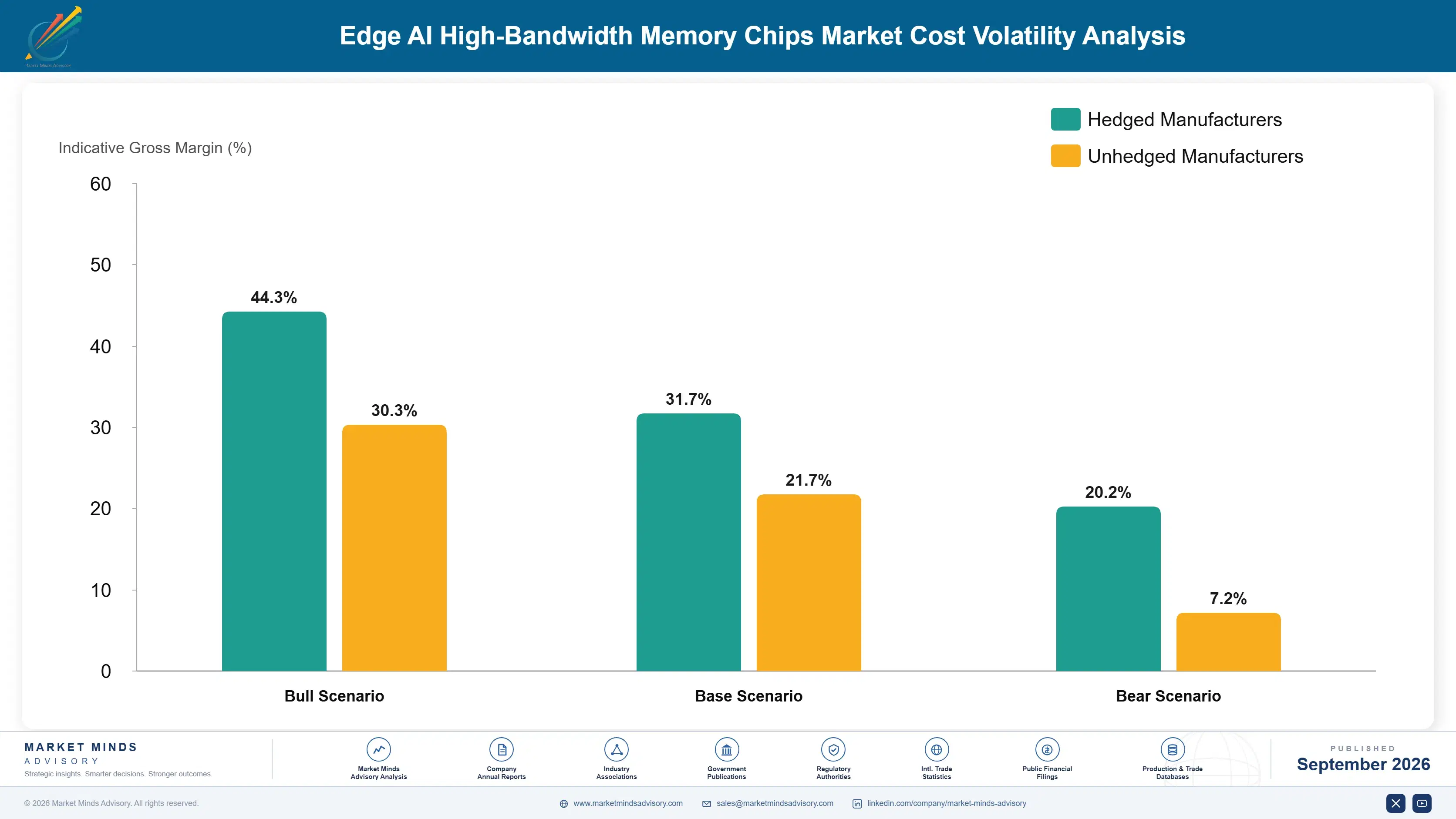
What a Stack Actually Costs

Cost structure is dominated by assembly rather than by memory. Stacked die, through-silicon connection, interposer and advanced assembly together account for roughly 68% of device cost, with assembly and interposer content alone exceeding the memory dies in most configurations. Test is unusually expensive because a failed stack discards every die within it. Yield at the assembly step therefore governs cost far more than wafer economics ever do.
Advanced packaging capacity has been the sharpest cost influence. Assembly capacity remained tight through 2024 and 2025 as accelerator demand absorbed expansion faster than it was commissioned, which held pricing firm and pushed queues toward 38 weeks. SK hynix and TSMC both referenced advanced packaging capacity and demand conditions in recent annual reporting. Edge buyers absorbed it entirely, having neither volume leverage nor an alternative supplier.

Exposure varies by allocation position rather than by purchase volume. Buyers with committed capacity agreements carry price exposure and can at least build. Those buying against spot availability carry both price and schedule exposure, and the schedule exposure is the one that ends programmes. Suppliers integrating memory and assembly within one relationship control more of the cost stack, which is why several designers now negotiate both together.
edge-ai-high-bandwidth-memory-chips-market-cost-volatility-analysis-1788427276108

Negotiate memory and assembly capacity as one agreement

Memory die supply and advanced assembly capacity are separately contracted by most buyers, which leaves a programme holding dies it cannot integrate or capacity it cannot fill. Negotiating both within a single commitment removes the mismatch that has stalled several edge programmes outright. Suppliers resist because it exposes their allocation constraints, which is precisely why it is worth having early.

Design an alternative memory path into every architecture

Edge programmes at roughly 4% of output can be refused allocation without warning during an accelerator boom, and a design with no fallback becomes unbuildable rather than merely delayed. Carrying a low power variant through architecture costs effort and preserves the programme. Several teams that skipped this step redesigned late at a cost many times the fallback engineering budget.

Invest in thermal extraction before electrical optimisation

Heat leaves a stacked device through the base die and sealed edge enclosures at high ambient temperature make that genuinely difficult, which is what fails most automotive qualification rather than any electrical shortfall. Thermal interface work, reduced stack heights and derating behaviour address the actual failure mode. Programmes optimising electrical margin first discover this after the first temperature cycling results.

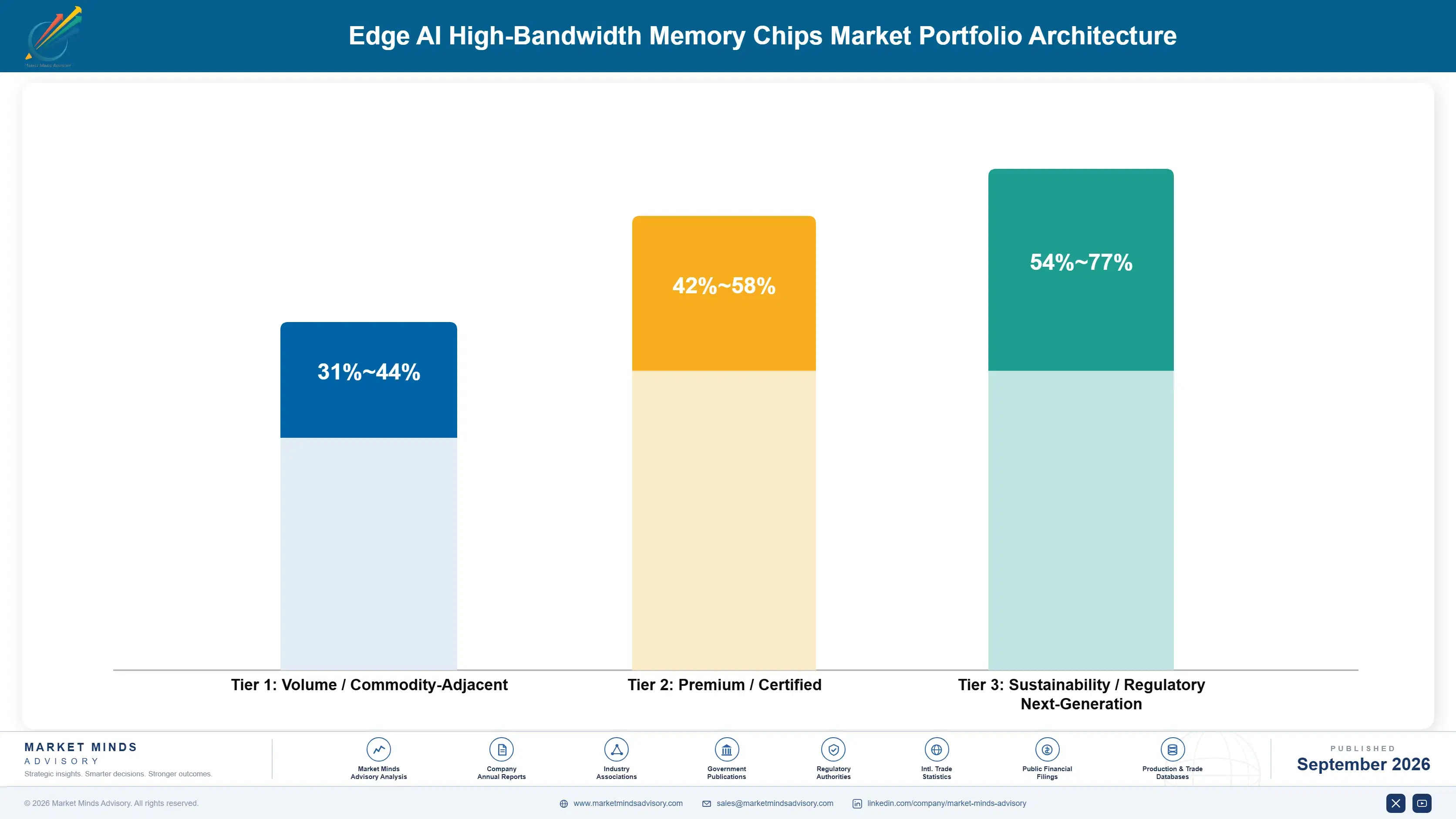
Portfolio Architecture for Margin Defence

Margin architecture separates on whether the buyer has an alternative. Edge server and telecom customers can specify conventional memory at some performance cost, so pricing has a ceiling set by what they would otherwise accept. Automotive and defence customers who have qualified a specific device have no practical alternative within a platform generation, and pricing reflects that plainly. Qualification rather than technology creates the position.
The tension runs between volume and access. Data centre supply provides the volume that funds process development and secures assembly capacity, and it consumes the capacity that edge buyers need. Edge supply earns better per unit and cannot be scaled, since these customers order in quantities that barely register against accelerator demand. Suppliers serving both must decide deliberately how much capacity to reserve, and most decide by default in favour of the larger order.

High-value revenue concentrates in automotive qualified devices and in defence and aerospace supply. Both are protected by qualification cycles measured in years rather than by anything technical, and both renew across platform lives that outlast several product generations. Edge server supply provides the volume base and behaves commercially much like a smaller version of the data centre business it descends from.

Volume / Commodity-Adjacent

Edge server and telecom network memory sold to buyers who could specify conventional alternatives at some performance cost. The range reflects assembly yield and allocation terms. Pricing has a ceiling set by what these customers would otherwise accept instead.
Gross Margin: 31-44%

Premium / Certified

Industrial vision, robotics and medical imaging devices where sustained bandwidth requirements leave no practical alternative at target frame rates. Margin depends on qualification depth and thermal specification. Volumes are modest and switching is genuinely difficult once designed in.
Gross Margin: 42-58%

Sustainability / Regulatory / Next-Generation

Automotive grade qualified devices and defence and aerospace supply, protected by qualification cycles running around 31 months. The widest range in the portfolio, reflecting temperature grade and programme specificity. Highest margin and least contested within a platform generation.
Gross Margin: 54-77%
edge-ai-high-bandwidth-memory-chips-market-portfolio-architecture-1788427276615

High-value Sub-segments and Strategic Watch-out

Automotive Qualified Devices

High value with the fastest growth at 24.6%, protected by qualification cycles near 31 months that confer positions for a vehicle platform life. The range reflects temperature grade and derating specification. Suppliers who began qualification early hold positions competitors cannot reach this generation. Timing was everything.
Gross Margin: 56-77%

Defence and Aerospace Supply

High value with steady growth, buying at specifications and prices no commercial application supports and renewing across programme lives measured in decades. The range reflects screening and traceability requirements. It sustains capability that commercial edge buyers subsequently benefit from without paying for. Nobody acknowledges that.
Gross Margin: 58-75%

Edge Server Memory Supply

The volume core, behaving commercially like a smaller version of the data centre business it descends from and priced against alternatives these buyers could genuinely accept. The range reflects assembly yield and allocation terms. It provides the volume base that funds everything else here in the portfolio.
Gross Margin: 30-43%

Unallocated Edge Programmes

The strategic watch-out, covering designs committed to stacked architectures without secured advanced packaging capacity. At roughly 4% of output these buyers can be refused without warning during an accelerator boom. Several programmes have been abandoned outright rather than merely delayed by that discovery. Late is fatal here.
Gross Margin: 0-12%

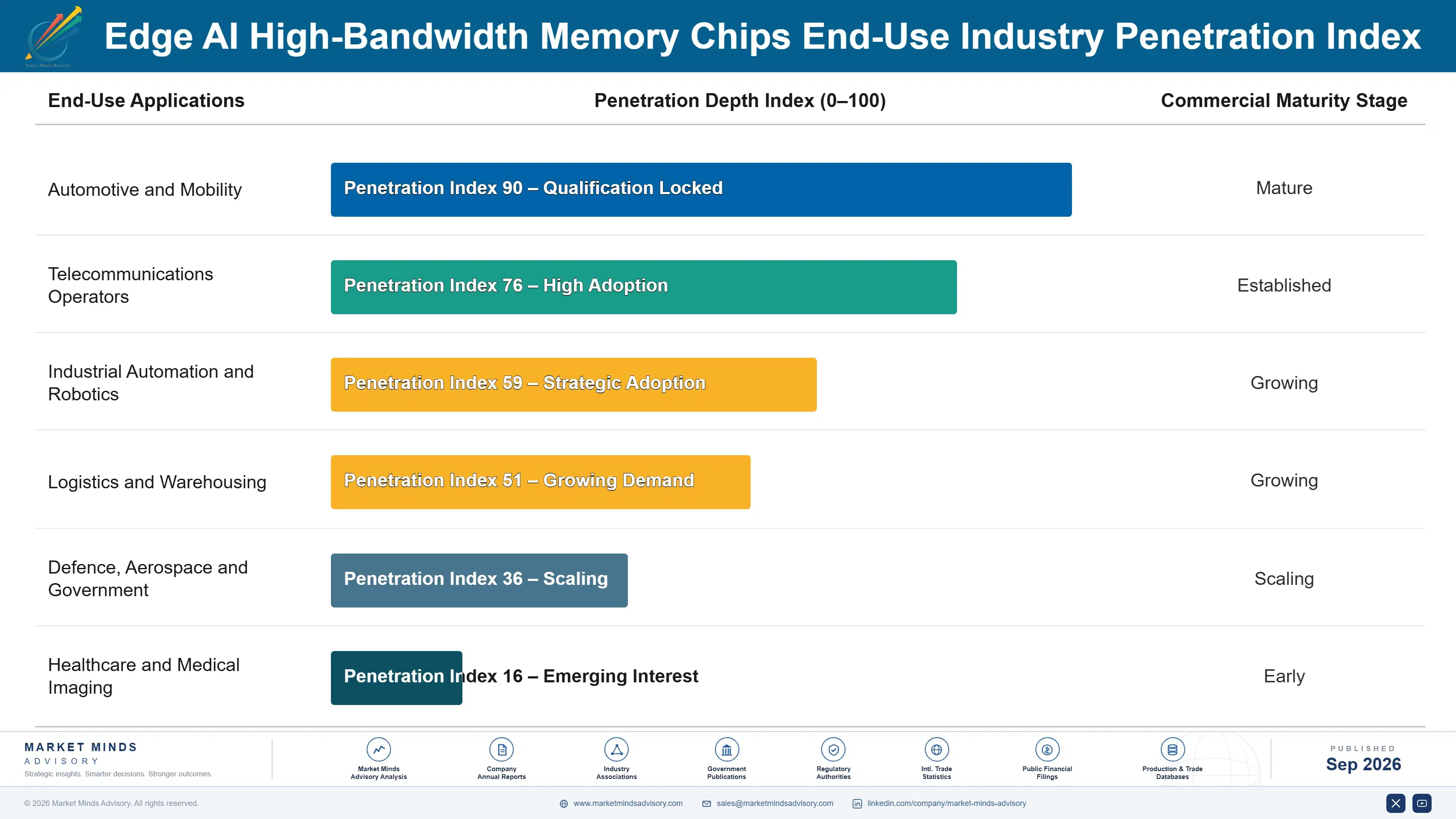
How This Demand Locks In

Recurrence works through design commitment rather than through repeat purchasing decisions. A device qualified into a vehicle platform ships for that platform's production life, commonly 6 years or more, and cannot be substituted without repeating qualification nobody will fund mid-programme. Edge server memory refreshes with server generations every few years. Industrial vision systems sit between the two, replaced when the equipment is, which can be a decade.
Adoption depth varies with how much qualification sits behind the part. An automotive device carries temperature grade evidence, derating characterisation and functional safety documentation that took around 31 months to assemble, and none of it transfers to an alternative supplier. An edge server module can be changed at the next refresh. That gap explains why suppliers pursue automotive programmes whose volumes look unattractive until the platform reaches production.

The specifying buyer sits further from procurement than in most component markets. Stacked memory is chosen by system architects deciding a compute architecture, frequently years before any purchase order exists, and the decision is effectively irreversible once silicon and software are committed around it. Suppliers engaging at procurement are arriving after the choice was made, which is why allocation conversations now happen with engineering.
edge-ai-high-bandwidth-memory-chips-market-end-use-penetration-index-1788427277105

Where the Economics Work

These are among the four positions where our research anticipates prominent divergence between winners and laggards over the coming forecast period. Each is grounded in the demand model, the regulatory perimeter, and the announced capacity pipeline.
01 / AUTOMOTIVE QUALIFICATION TIMING

Start vehicle qualification now or miss the generation

Qualifying a stacked device for vehicle temperature grades takes around 31 months and cannot be compressed by spending, priority or engineering intensity of any kind whatsoever, at any budget. Automotive central compute grows at 24.6% and is the only high-volume edge application whose economics survive a 7.2 times memory premium, and qualification confers positions lasting a vehicle production life of 6 years or more in production. Suppliers beginning qualification now will arrive after the current platform generation has already chosen its memory architecture.
02 / PACKAGING ALLOCATION SECURITY

Secure assembly capacity before committing the architecture

Advanced assembly queues run about 38 weeks and edge programmes at roughly 4% of output sit behind accelerator customers in every allocation conversation that takes place with a supplier. A design committed to a stacked architecture without secured capacity can prove unbuildable rather than merely late, and several industrial programmes have redesigned around low power memory after discovering exactly that too late. Treating allocation as an early architectural input rather than a procurement task costs nothing and happens far too rarely today.
03 / SYSTEM LEVEL FRAMING

Compare throughput per watt, never raw bandwidth

Bandwidth comparisons flatter stacked memory and lose the argument regardless, because an edge system designer is working against a power budget rather than toward a performance target on a datasheet somewhere. Framing the comparison as inference throughput per watt at system level shows this technology winning where power exists and losing honestly elsewhere, which builds credibility that raw bandwidth claims actively destroy instead. Suppliers using that framing convert roughly 2 times better in the opportunities genuinely available to them at all.
04 / THERMAL ENGINEERING PRIORITY

Fix heat extraction before optimising anything electrical

Heat leaves a stacked device through the base die, and sealed edge enclosures at high ambient temperature make that genuinely difficult in a way airflow-cooled data centre systems never encounter at all. Thermal extraction rather than raw electrical performance is what actually fails most automotive qualification attempts, and improved thermal interface design lets a device hold rated clocks about 15% longer under sustained thermal load. Programmes optimising electrical margin first discover this only after their first temperature cycling results finally arrive.

Engagement Snapshot From the Field

A live engagement with an industry participant carrying material or product regulatory and market exposure ahead of a defining policy shift, showing how our research translates into a defensible multi-year portfolio strategy.
MARKET MINDS ADVISORY · CLIENT ENGAGEMENT SUMMARY
Edge AI High-Bandwidth Memory Chips Producer Strategic Portfolio Review and Transition Roadmap 2026·Investment Scenario on Edge AI High-Bandwidth Memory Chips Exposure Evaluation 2025-26
CLIENT PROFILE
An industrial robotics manufacturer developing a perception platform for warehouse automation, targeting roughly 26,000 units annually within four years (client-reported, unverified by MMA). The engineering team had specified stacked memory to meet frame rate targets across twelve camera streams, and the architecture had been approved on performance grounds alone, without any other review. Nobody had asked more.
STRATEGIC CHALLENGE
The platform carried a total power budget of 45 watts and a target bill of materials near USD 340 (client-reported, unverified by MMA). Two stacked memory devices would consume roughly 13 watts and a substantial share of that budget. Nobody had checked whether advanced packaging allocation was obtainable at the client's volume in the first place.
MMA APPROACH
MMA evaluated the architecture against power, cost and supply access together rather than against frame rate alone, which the engineering team had already established. We modelled throughput per watt for three memory configurations, interviewed 11 engineering staff, two memory suppliers and one assembly provider, and tested allocation availability directly at the client's stated volume.
KEY FINDINGS
  1. Two stacked devices would consume roughly 29% of the platform's entire 45 watt power budget before any processing silicon was accounted for.
  2. Memory cost at the client's volume represented approximately 41% of the target bill of materials, against 6% for a low power alternative.
  3. Neither memory supplier would commit advanced packaging allocation at 26,000 units annually, and both indicated queues near 38 weeks against accelerator demand.
  4. A partitioned architecture using low power memory with additional on-chip buffering met frame rate targets on ten of the twelve camera streams tested.
CLIENT PROFILE
An industrial robotics manufacturer developing a perception platform for warehouse automation, targeting roughly 26,000 units annually within four years (client-reported, unverified by MMA). The engineering team had specified stacked memory to meet frame rate targets across twelve camera streams, and the architecture had been approved on performance grounds alone, without any other review. Nobody had asked more.
STRATEGIC CHALLENGE
The platform carried a total power budget of 45 watts and a target bill of materials near USD 340 (client-reported, unverified by MMA). Two stacked memory devices would consume roughly 13 watts and a substantial share of that budget. Nobody had checked whether advanced packaging allocation was obtainable at the client's volume in the first place.
MMA APPROACH
MMA evaluated the architecture against power, cost and supply access together rather than against frame rate alone, which the engineering team had already established. We modelled throughput per watt for three memory configurations, interviewed 11 engineering staff, two memory suppliers and one assembly provider, and tested allocation availability directly at the client's stated volume.
KEY FINDINGS
  1. Two stacked devices would consume roughly 29% of the platform's entire 45 watt power budget before any processing silicon was accounted for.
  2. Memory cost at the client's volume represented approximately 41% of the target bill of materials, against 6% for a low power alternative.
  3. Neither memory supplier would commit advanced packaging allocation at 26,000 units annually, and both indicated queues near 38 weeks against accelerator demand.
  4. A partitioned architecture using low power memory with additional on-chip buffering met frame rate targets on ten of the twelve camera streams tested.
RECOMMENDED STRATEGY
Phase 1: Redesign around low power memory with additional on-chip buffering, which met frame rate targets on most streams at a fraction of the power. Phase 2: Reduce the camera count from twelve to ten or stagger stream processing, since the two failing streams did not carry safety-critical function. Phase 3: Reserve stacked memory for a future premium variant sold at volumes and prices where allocation and cost both become defensible.
OUTCOME
The redesigned platform met its 45 watt budget with roughly 9 watts of margin and a bill of materials near USD 310 (client-reported, unverified by MMA). Frame rate targets were met on ten streams, the programme shipped on schedule, and the stacked memory architecture was retained for a premium variant scheduled two years later.

Frequently Asked Questions

Foundational context covering the market sizes, CAGR, scope, country, region and competition that inform every finding below. This section is provided to cover basics and most often pre-purchase conversations, answered from the MMA Primary Research Dataset.

What is the current size of the Edge AI High-Bandwidth Memory Chips Market?

The market was worth USD 1.8 billion in 2025 and reaches USD 2.10 billion in 2026. Edge applications take roughly 4% of total stacked memory output.

How large will the Edge AI High-Bandwidth Memory Chips Market be by 2036?

MMA forecasts USD 9.59 billion by 2036, an expansion of 4.57 times over the forecast period. That represents USD 7.49 billion of incremental annual revenue against 2026.

What is the CAGR for the Edge AI High-Bandwidth Memory Chips Market 2026 to 2036?

The base case is 16.4% compound annual growth, with a bull case at 17.6% and a bear case at 15.2%. Whether low power alternatives close the bandwidth gap separates the scenarios.

Which segment is growing fastest?

Automotive central compute memory grows at 24.6%, half again the market rate of 16.4%. A vehicle offers the power budget and bill of materials that absorb the premium.

Who are the major companies in the Edge AI High-Bandwidth Memory Chips Market?

SK hynix, Samsung Electronics, Micron Technology, TSMC and ASE Technology lead on measured stacked memory and integration revenue. Together they hold roughly 94%, the tightest supply position in semiconductors.

Which country is growing fastest?

India grows fastest at 19.4%, on edge server and telecom network deployment expanding faster than in any comparable market, though device value is captured elsewhere.

Report Segmentation Architecture

The full report scope spans multiple orthogonal segmentation dimensions, with cross-tabulated demand data provided for each dimension pair. Coverage extends further to regional breakdowns, trend trajectories, and the competitive detail needed to support segment-level decision-making.

By Primary Market Dimension

  • Automotive Central Compute Memory
  • Edge Server and Micro Data Centre Memory
  • Industrial Vision and Robotics Memory
  • Telecom and Network Edge Memory
  • Defence and Aerospace Edge Memory
  • Medical Imaging Edge Memory

By End-Use Industry

  • Automotive and Mobility
  • Telecommunications Operators
  • Industrial Automation and Robotics
  • Logistics and Warehousing
  • Defence, Aerospace and Government
  • Healthcare and Medical Imaging

By Commercial Dimension

  • Direct Memory Supplier Agreements
  • Committed Capacity Arrangements
  • Module and Subsystem Integrators
  • Automotive Tier One Channel
  • Defence Programme Contracts
  • Distribution and Spot Purchase

By Region

  • East Asia
  • North America
  • Western Europe
  • South Asia and Pacific
  • Eastern Europe
  • Latin America
  • Middle East and Africa

Scope, Methodology, and Coverage

Every figure in this report is reproducible from documented input assumptions. The scope below maps the historical period, the forecast horizon, the segmentation dimensions, and the countries covered, alongside the underlying primary and qualitative methodology.
Historical Period
2020 to 2025
Forecast Period
2026 to 2036
Base Year
2025 (USD billions; MMA Primary Research Dataset, September 2026)
Market Definition
This market covers high-bandwidth stacked memory devices and their attributable advanced packaging integration supplied into edge inference systems, spanning automotive central compute memory, edge server and micro data centre memory, industrial vision and robotics memory, telecom and network edge memory, defence and aerospace edge memory, and medical imaging edge memory. Revenue is measured as stacked memory device and attributable advanced assembly integration value at supplier level. Data centre accelerator memory, low power double data rate and conventional graphics memory, on-chip static memory, standalone logic processors and accelerators, memory controller and interface intellectual property, and complete edge systems are excluded from scope.
Quantitative Units
USD billions, stacked memory device and attributable integration revenue at supplier level
Segmentation Dimensions
Edge deployment class, end-use industry, commercial channel, region
Regions Covered
East Asia, North America, Western Europe, South Asia and Pacific, Eastern Europe, Latin America, Middle East and Africa
Countries Covered
South Korea, Taiwan, China, Japan, Singapore, Malaysia, India, Vietnam, Australia, United States, Canada, Mexico, Brazil, Chile, Germany, Sweden, Switzerland, Italy, France, Netherlands, United Kingdom, Poland, Czechia, Hungary, Romania, United Arab Emirates, Saudi Arabia, Israel, South Africa
Key Companies Profiled
SK hynix, Samsung Electronics, Micron Technology, TSMC, ASE Technology, Amkor Technology, CXMT, Kioxia, Winbond Electronics, Nanya Technology, JCET Group, Powertech Technology, Siliconware Precision Industries, Rambus, Marvell Technology, NVIDIA, Ambarella, Renesas, NXP Semiconductors, Texas Instruments
Quantitative Methodology
Primary survey, n=3,800 respondents, Q4 2025, six countries; demand-side model with trade association cross-validation
Qualitative Methodology
47 expert interviews, Q4 2025; applied to validate demand model assumptions, identify emerging dynamics, and assess competitive positioning
Report Format
PDF and XLSX data workbook (Word format preview document)
Publisher
Market Minds Advisory
Report Code
MMA-2026-TEC-121
Published
September 2026
Contact
sales@marketmindsadvisory.com | www.marketmindsadvisory.com

Purchase the full Edge AI High-Bandwidth Memory Chips Market Report (2026 to 2036).

The full MMA report separates the part of the edge that can genuinely power, cool and afford stacked memory from the far larger part that cannot, and works through the allocation problem deciding which programmes get built. It sizes the market to 2036 across six deployment classes, seven regions and 29 countries, with segment growth rates and regional demand mechanisms set out throughout. Competitive analysis covers 20 suppliers assessed on measured stacked memory and integration revenue, with moat and risk assessment for the two leaders. The report quantifies assembly cost structure, qualification economics and margin architecture across three portfolio tiers. It closes with four verdicts and an anonymised robotics engagement.
Six deployment classes sized through 2036
Seven regions with demand mechanism analysis
Twenty suppliers on consistent revenue basis
Power, cost premium and allocation queue benchmarks
Margin architecture across three portfolio tiers
Anonymised robotics compute architecture review engagement

Built For The People Who Decide

From boardroom strategy to bench-side execution, this report is read cover-to-cover by leaders shaping the next decade of their industry, turning demand scenarios, market dynamics and valuation benchmarks into decisions.
CXOs/ Presidents/ VPs/ Managers
M&A and Corporate Development
Strategy Teams and R&D Heads
Procurement and Product Directors
Regulatory and Compliance Leaders
Investor Relations and Equity Analysts