Market Minds Advisory
Eco Friendly Straws Market

Eco Friendly Straws Market: Regulatory Bans and the Compostable Material Transition

Foodservice chains are locking in multi-year paper and bioplastic straw contracts as single-use plastics bans take permanent effect, even as compostable costs and wet-paper performance complaints pressure suppliers to close the gap with plastic.

Lead Analyst

Bilal Shaikh

Published

September 2026

Make Smarter Decisions with Customized Research Insights

Request a free sample report and evaluate market opportunities, growth trends, and competitive dynamics relevant to your business needs.

2025 MARKET VALUE$1.6BMarket Size 2025
2036 FORECAST VALUE$4.3BBase Case , 2026 to 2036
CAGR 2026 TO 20369.4 %Bull 10.6% / Bear 8.1%
INCREMENTAL OPPORTUNITY$2.5BNet 10- year value creation
EXPANSION MULTIPLE2.46x2036 value over 2026 base
Strategic Levers
M&A Pipeline
Regional Outlook
Country Rankings
Competitive Intelligence
Segmental Deep-dive
Call-Us : 91 93563 13602

Executive Snapshot and Market Trajectory

Foodservice operators are converting temporary plastic-ban compliance into permanent procurement policy, locking suppliers into multi-year paper and bioplastic straw contracts rather than treating the switch as a transitional cost. That contractual permanence, more than any single ban announcement, is what is now driving capacity investment across the industry.
PLA and bioplastic straws are capturing the fastest growth as quick-service chains chase compostability certification that paper alone cannot always meet in cold-beverage applications, particularly for iced coffee and soft drinks served over long consumption periods at busy urban and suburban locations alike. East Asia holds the deepest manufacturing and export base, while European foodservice operators drive the highest per-unit specification standards under the EU's single-use plastics directive, well ahead of most other regulated markets.
Competitive intensity remains fragmented relative to the addressable market size, since paper straw production scales relatively easily and low entry barriers have pulled in hundreds of regional converters worldwide. Aardvark and Huhtamaki's brand recognition and foodservice distribution relationships set the pace that challengers chase, while falling bioplastic resin costs are pulling smaller converters into premium compostable categories each year, narrowing the gap that once separated commodity and premium tiers.
Market Definition
The eco friendly straws market covers single-use and reusable drinking straws manufactured from paper, bioplastic (PLA and other compostable polymers), bamboo, agricultural fiber, and durable materials including stainless steel and silicone, sold into foodservice, retail, and institutional channels as an alternative to conventional petroleum-based plastic straws. It excludes conventional polypropylene and polystyrene straws, straw dispensing equipment sold separately from the straws themselves, and broader compostable foodservice packaging categories such as cutlery and cups.
Base Year Value
$1.6B in 2025 (MMA Primary Research Dataset, August 2026)
Forecast Period
2026 to 2036, eleven discrete annual values
CAGR
9.4% base case. Bull 10.6%. Bear 8.1%.
Fastest Growth Segment
PLA / Bioplastic Straws: 12.8% CAGR
Fastest Growth Country
India: 12.6% CAGR
Fastest Growth Region
South Asia and Pacific: 11.6% CAGR
Largest Region
East Asia: 28% of 2025 global value
Market Leaders
Aardvark Straws (Hoffmaster Group), Huhtamaki Oyj, Transcend Packaging Ltd, Footprint International, BioPak Pty Ltd. Source: MMA Analysis based on company annual reports and investor filings.
Primary Survey
n=3,800 procurement and R&D decision-makers, Q4 2025, six countries
Methodology
Demand-side build-up, cross-validated against public data, 47 expert interviews

Eco Friendly Straws Market Forecast Scenarios

eco-friendly-straws-market-size-forecast-scenario-1787300521058
Eco friendly straw demand accelerated sharply between 2020 and 2025, as the EU's single-use plastics directive took effect in 2021 and a wave of US state and municipal bans followed through 2023, pulling forward capacity investment that then had to catch up with demand. The category closed 2025 at an estimated 8.4% historical CAGR, well ahead of conventional plastic straw decline.
The base case rests on three reinforcing mechanisms. First, remaining jurisdictions without plastic straw bans, particularly across Latin America and Southeast Asia, keep adopting similar regulation on a multi-year lag behind the EU and North America. Second, bioplastic resin costs keep falling as production scales, narrowing the price gap with paper that has constrained premium compostable adoption. Third, large foodservice chains are extending straw sustainability commitments into supplier scorecards, locking in multi-year volume regardless of near-term material cost swings.
The bull case turns on India finalizing nationwide enforcement of its single-use plastics notification, pulling forward volumes across the world's second-largest foodservice market faster than the base forecast assumes. The bear risk is continued consumer backlash against wet-paper straw performance pushing chains back toward reusable or exempted alternatives, slowing unit volume growth in the largest single-use segment.

Compliance Economics and the Wet-Paper Performance Gap

Eco friendly straws sit at the intersection of two converging pressures: single-use plastics regulation that keeps expanding geographically, and consumer sustainability expectations that increasingly hold foodservice brands accountable regardless of local legal requirements. Both forces reward material innovation that closes the performance gap with plastic without sacrificing the compostability or renewability that regulation and consumers both demand. Neither pressure shows signs of easing ove
MARKET CONCENTRATION32% CR5Fragmented supply base with low manufacturing entry barriers
AVERAGE SELLING PRICE$0.008-0.035 per unitPrice varies steeply by material and compostability certification
TOP PRODUCING COUNTRYChina, 38% shareChinese converters supply the largest single national output share
CAPACITY UTILISATION69%Utilisation trails mature packaging categories amid rapid capacity additions
TRADE INTENSITY54% cross-borderMore than half cross a border before foodservice use
FEEDSTOCK COST SHARE38% of COGSPulp and bioplastic resin costs dominate input spending lines
Commercially, the market splits between commodity paper straws sold largely on price to quick-service chains, and a smaller but growing premium tier of bioplastic and agricultural-fiber straws sold on certified compostability and improved wet-strength performance. Large foodservice brands increasingly specify by material and certification standard rather than accepting whatever a distributor happens to stock on a given delivery cycle.
Over the next decade, material science will matter more than manufacturing scale alone. Improved wet-strength paper coatings and next-generation bioplastic formulations that compost faster in industrial facilities will keep narrowing the performance gap with plastic, and the suppliers that solve the cold-beverage durability problem most convincingly stand to capture outsized share of large chain contracts across every major foodservice region.
"The plastic straw ban won the political argument years ago. The argument happening now is entirely about whether paper can survive a forty-minute iced coffee without going soggy, and that argument is still not settled."
Director, Sustainable Packaging Practice · MMA Packaging Practice ·

Market Trends

Bioplastic Resin Costs Keep Falling as Scale Builds

PLA and other compostable bioplastic resin costs have fallen meaningfully as production scale increases, narrowing the price gap that has kept bioplastic straws confined to premium foodservice accounts willing to pay a multiple over paper. Suppliers including Footprint International and BioPak have both expanded dedicated bioplastic extrusion capacity since 2024, and industry-reported resin pricing has fallen roughly 22% since 2022 as more manufacturers enter bioplastic feedstock production. That cost trajectory is pulling bioplastic straws into mid-tier accounts that previously defaulted to paper on cost grounds alone, particularly for cold-beverage applications where paper's wet-strength limitations matter most to satisfaction scores.
Market Impact: Drives 90%+ EU foodservice compliance
Wet-Strength Paper Coatings Close the Durability Gap

New multi-layer paper coating technologies are extending the time paper straws hold structural integrity in cold beverages, addressing the single most common complaint driving backlash against the category since bans took effect. Several converters have released reformulated coatings since 2024 that extend usable straw life in iced beverages from roughly fifteen minutes to past forty minutes in controlled testing, closing much of the performance gap with plastic for typical consumption occasions. Large quick-service chains have begun re-specifying paper straw contracts around these coatings rather than defaulting to bioplastic, since the upgrade costs less than switching category.
Market Impact: Covers 400+ US municipalities directly

Market Opportunities and Growth Drivers

EU Single-Use Plastics Directive Anchors Structural Demand Shift

The European Union's Single-Use Plastics Directive, in force since July 2021, banned conventional plastic straws across all member states and has since been followed by expanding enforcement and labeling requirements that keep pushing foodservice operators toward compliant alternatives. The European Commission's 2024 implementation review found compliance rates exceeding 90% across major foodservice chains, with paper and bioplastic straws now the default replacement in the large majority of documented cases. MMA's primary survey found European foodservice operators citing regulatory compliance, not sustainability marketing alone, as the primary driver behind their straw sourcing decisions in more than 70% of surveyed accounts.
Market Impact: Cited by roughly 35% of consumers

US State and Municipal Bans Expand Beyond Coastal Markets

More than a dozen US states and well over four hundred municipalities have enacted plastic straw restrictions since California's 2019 pioneering law, with adoption accelerating beyond the coastal markets that moved first into the Midwest and South over the past three years. National quick-service chains operating across multiple ban jurisdictions increasingly standardize on eco-friendly straws system-wide rather than maintaining separate plastic and compliant straw inventories by location, a logistics simplification that pulls total system volume toward compliant materials faster than ban geography alone would suggest, even in states without any formal restriction currently in force.
Market Impact: Affects labeling in 12+ jurisdictions

Market Restraints and Challenges

Consumer Complaints About Wet-Paper Performance Persist

Paper straws remain the single most common source of customer complaints tied to sustainable packaging switches, a friction point rooted in cellulose fiber's tendency to soften under sustained liquid exposure rather than any manufacturing defect. Social media backlash against soggy paper straws has become a recurring reputational issue for major chains, and MMA's primary survey found roughly 35% of consumers reporting they would prefer plastic straws if compostable alternatives remained available, even where local regulation restricts that choice. Suppliers are addressing this with improved coatings and thicker-wall formulations, though a gap with plastic persists for beverages consumed over extended periods.
Market Impact: Cuts bioplastic resin cost roughly 22%

Bioplastic Compostability Claims Face Growing Scrutiny

Regulators and environmental groups are increasingly scrutinizing whether PLA and other bioplastic straws actually compost within the timeframes suppliers claim, since most PLA requires industrial composting facilities operating at sustained high temperatures that many municipalities lack, meaning straws marketed as compostable frequently end up in landfill or incineration streams instead. That scrutiny, rooted in a genuine gap between laboratory certification conditions and real-world waste infrastructure, is pushing several jurisdictions toward stricter labeling requirements that could slow bioplastic adoption until infrastructure catches up. Suppliers are responding by partnering with municipal composting programs and disclosing facility-specific compostability limitations more transparently.
Market Impact: Extends usable life past 40 minutes
3 additional market trends, 4 additional growth drivers, and 3 additional restraints and challenges are covered in the full report. Contact sales@marketmindsadvisory.com to access the complete intelligence.

Segment CAGR and Growth Architecture

Segmentation follows material composition rather than end-use channel, since fiber source and polymer chemistry determine compostability certification, cost structure, and performance characteristics more than whether a straw ends up in a restaurant or a retail multi-pack. Paper remains the volume base, but bioplastic and agricultural-fiber materials now address performance requirements paper cannot always meet.
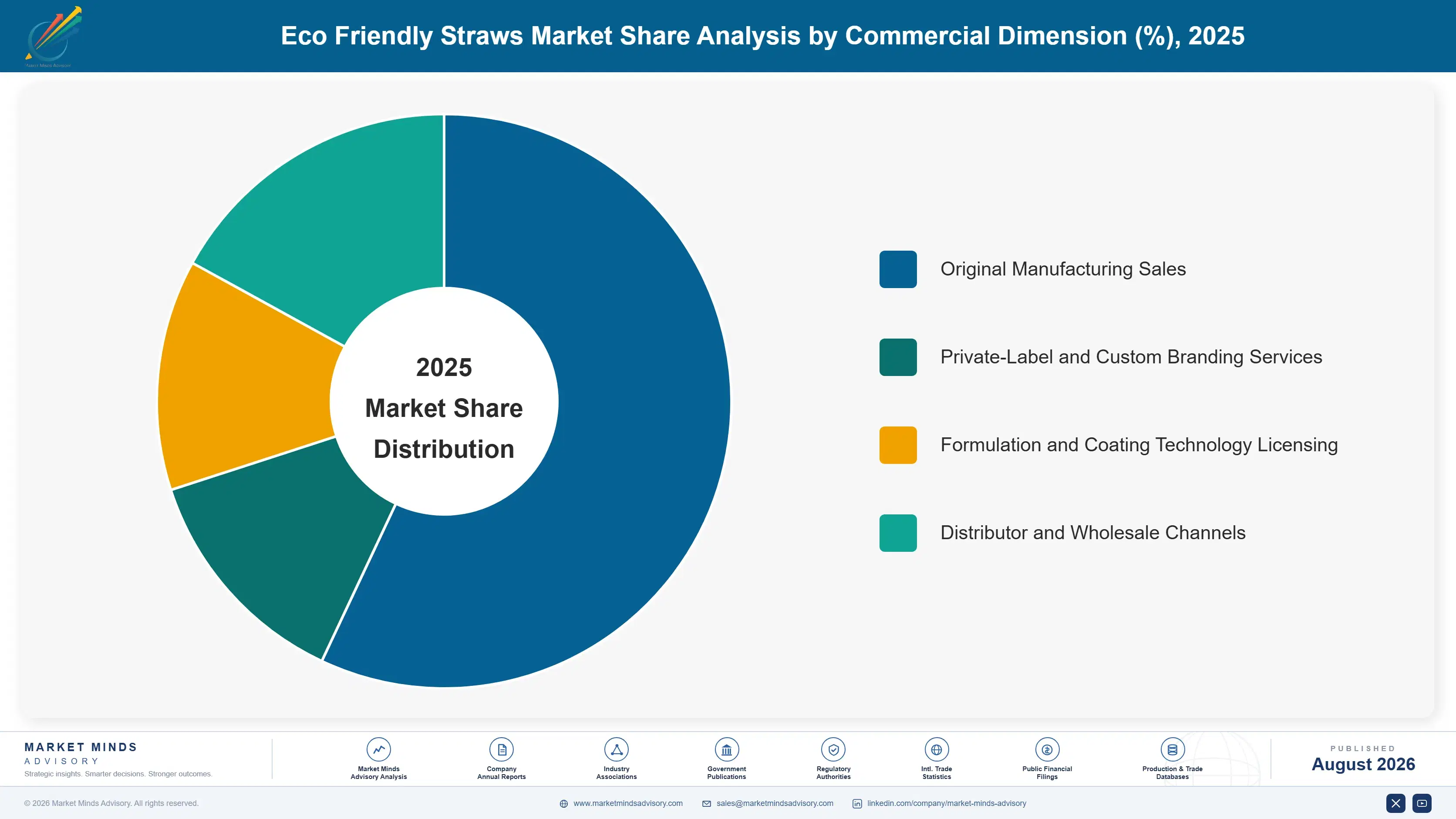
eco-friendly-straws-market-market-share-analysis-1787300521706

PLA / Bioplastic Straws

PLA and other bioplastic straws are the fastest-growing material segment, expanding at an estimated 12.8% CAGR against a market average of 9.4%, roughly 1.36 times the overall pace. Growth tracks directly with falling resin costs and premium foodservice accounts seeking compostability certification that paper's wet-strength limitations cannot always satisfy in cold-beverage applications. Footprint International and BioPak currently lead on shipped bioplastic volume, though the segment faces genuine scrutiny over real-world compostability given limited industrial composting infrastructure in many markets where these straws are sold today. Continued adoption depends on resin costs continuing to fall and on composting infrastructure expanding enough to support the compostability claims driving premium positioning across major foodservice accounts.
CAGR 12.8%

Agricultural Fiber (Wheat / Pasta) Straws

Agricultural fiber straws made from wheat stem, pasta, or other food-crop byproducts rank second-fastest, growing at an estimated 11.5% CAGR as novel-format straws gain traction in premium retail and hospitality channels seeking a differentiated sustainability story beyond standard paper. The segment benefits from marketing appeal, since agricultural fiber straws use byproduct material that would otherwise go to waste and often carry an edible or fully biodegradable positioning that resonates with environmentally conscious consumers. Adoption still trails paper by a wide margin given meaningfully higher unit costs and less consistent supply chains than established paper converters offer. Growth is concentrated among specialty suppliers serving premium hospitality and direct-to-consumer retail channels rather than mass-market quick-service accounts.
CAGR 11.5%
Full segment breakdown across 5 segments available in the complete report.

Regional Architecture and Country Demand Map

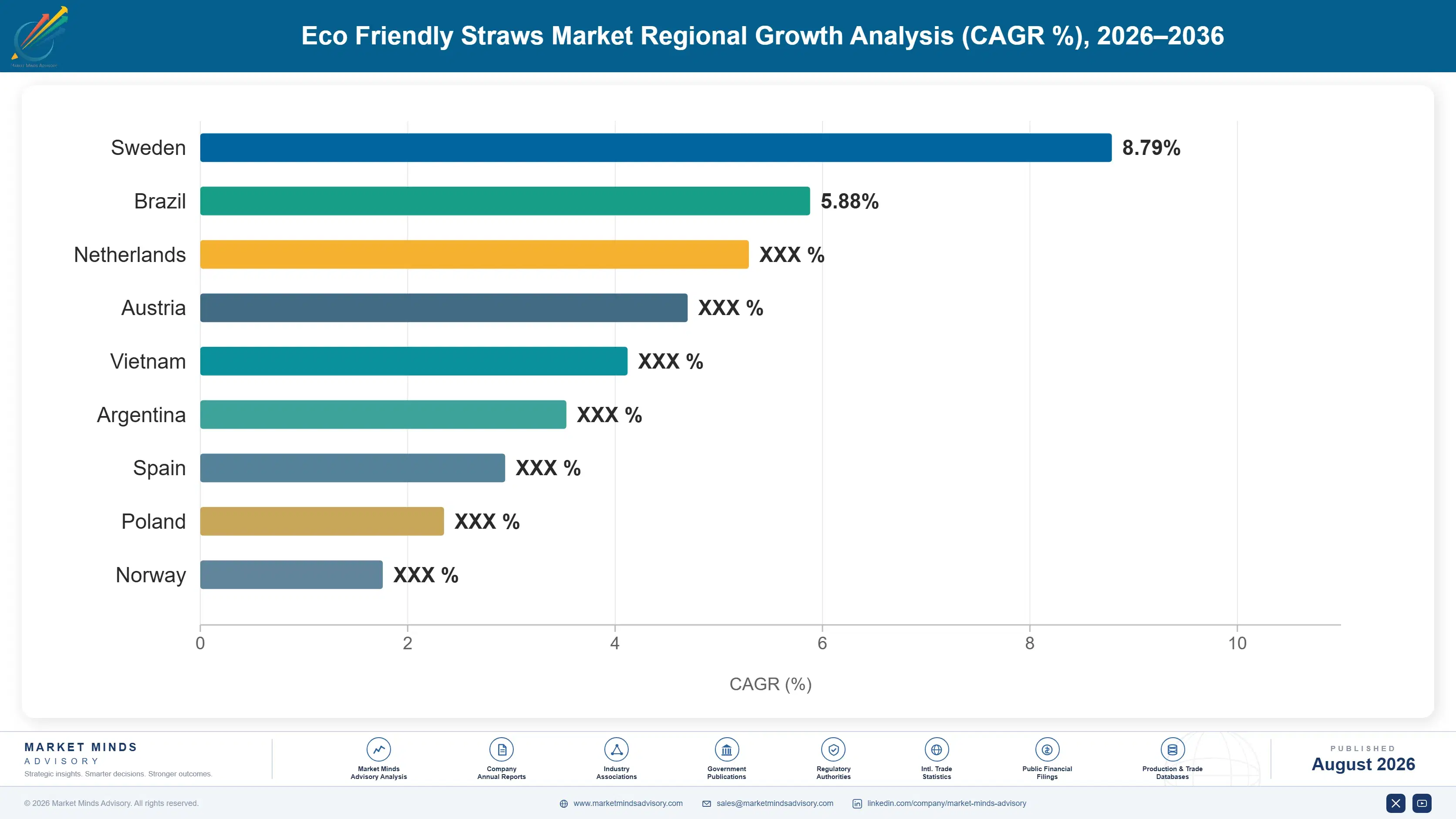
Eco friendly straw demand concentrates where regulatory bans and manufacturing scale overlap. East Asia leads on both converting capacity and export volume, North America follows on foodservice chain standardization, and South Asia and Pacific grows fastest as enforcement expands across the region's large foodservice markets.

North America

Multi-state and municipal plastic straw restrictions anchor North America's demand, as national quick-service chains standardize on eco-friendly straws system-wide rather than maintaining separate inventories for ban and non-ban jurisdictions. California, New York, and Washington led early adoption, and enforcement has since expanded across Midwest and Southern metro areas that moved later into restriction. Coffee and quick-service chains represent the largest single demand channel, since cold-beverage volume drives the highest per-unit straw consumption of any foodservice category. Canada contributes a smaller, steadier share tied to its own provincial restrictions, while Mexico's contribution is growing fastest of the three as its largest cities adopt restrictions following the North American pattern with a multi-year lag.
Share: 23% | CAGR: 9.9% (2026 to 2036)

Western Europe

The EU's Single-Use Plastics Directive, in force since July 2021, makes Western Europe the most heavily regulated market for conventional plastic straw alternatives, with Germany, France, and the Netherlands showing the highest documented compliance rates among major member states. Foodservice operators across the region increasingly specify compostability certification standards that exceed the directive's minimum requirements, reflecting consumer expectations that run ahead of legal minimums in several markets. The UK's parallel plastic straw restriction, enacted separately from EU membership, keeps British demand closely aligned with continental patterns despite the regulatory divergence. Growth here trails the global average, reflecting a market that reached high compliance saturation earlier than markets still expanding enforcement.
Share: 21% | CAGR: 8.1% (2026 to 2036)
Regional intelligence for 5 additional markets available in the complete report: East Asia, South Asia and Pacific, Latin America, Middle East and Africa, Eastern Europe. Contact sales@marketmindsadvisory.com.
eco-friendly-straws-market-country-cagr-analysis-1787300522349

Where Eco Straw Margin Concentrates Next

Four commercial moves separate suppliers capturing outsized margin from those competing purely on unit price. Each depends on shifting revenue toward certification, material innovation, supply chain reliability, or private-label service that current shipment volume does not yet fully reflect, particularly as commodity paper pricing keeps compressing hard at the low end of the category.

Third-Party Compostability Certification Pricing Premium Program

Suppliers that secure recognized third-party compostability certifications, including BPI and TUV Austria OK Compost marks, are commanding a durable price premium over uncertified alternatives, since large foodservice chains increasingly require documented certification to satisfy their own sustainability disclosure obligations. Certified straws typically command a price premium of 15 to 25% over functionally similar uncertified alternatives, a margin reflecting both certification cost and the reduced compliance risk buyers value. Suppliers without recognized certification increasingly lose large chain contracts to certified rivals regardless of underlying material cost, making certification less an optional marketing claim than a baseline requirement for enterprise accounts.
Market Impact: Commands a durable 15 to 25% price premium

Wet-Strength Coating Technology Licensing Revenue Program

Suppliers with proprietary wet-strength coating formulations are licensing that technology to smaller converters rather than keeping it exclusive, capturing royalty revenue on volume they could never manufacture themselves while extending their formulation's market reach. A coating technology license typically carries royalty fees of $0.0008 to $0.002 per unit manufactured under license, a small figure per straw but a meaningful aggregate given foodservice volumes running into the billions of units annually. This licensing model lets formulation innovators monetize research investment across a far larger production base than their own converting capacity could ever reach alone.
Market Impact: Adds $0.0008 to $0.002 in royalty per unit

Multi-Year Supply Continuity Contract Pricing Program

Suppliers offering contractual supply continuity guarantees, including backup capacity commitments and price stability clauses, are winning large chain accounts that experienced painful straw shortages during the initial post-ban transition period when demand outpaced converting capacity industry-wide. Multi-year continuity contracts typically carry a price premium of 8 to 14% over spot-market purchasing, reflecting the value large chains place on avoiding another supply disruption that forces embarrassing plastic straw reversion or menu disruption. Suppliers able to demonstrate genuine multi-site backup capacity increasingly win these contracts over single-facility competitors regardless of headline unit price.
Market Impact: Commands 8 to 14% premium over spot pricing

Private-Label Formulation and Packaging Service Offerings

Suppliers offering full private-label services, including custom branding, packaging design, and formulation matched to a specific chain's beverage program, are capturing higher-margin business than commodity converters selling generic straws through distributors. A private-label program typically carries setup and tooling fees of $15,000 to $60,000 depending on customization scope, in addition to the recurring per-unit manufacturing revenue that follows. This service model matters most for large regional and national chains that want straw branding and performance characteristics matched precisely to their specific beverage menu rather than accepting generic distributor stock off the shelf.
Market Impact: Private-label setup fees typically run $15,000 to $60,000

Who Controls the Margin Pool

The top five suppliers hold an estimated 32% of global eco-friendly straw shipment volume, a fragmented concentration reflecting low entry barriers that have pulled hundreds of regional paper converters into the category since bans took effect. Aardvark and Huhtamaki lead on brand recognition and distribution relationships, while a long tail of regional converters competes mainly on price for basic uncertified straws.
Current competitive activity centers on three fronts. Wet-strength coating launches are redrawing the performance tier, with several major converters racing to close the gap with plastic on cold-beverage durability. Bioplastic capacity expansion is opening a second growth avenue as resin costs fall. And several Chinese manufacturers are pursuing Western certification and distributor partnerships to move beyond export pricing into branded competition.

Emerging pressure comes from Chinese converters moving up the value chain into certified compostable and wet-strength coated products once dominated by Western and Japanese suppliers, aided by domestic pulp and bioplastic resin supply that keeps their input costs consistently lower. If Chinese suppliers close the certification and brand trust gap further, expect share to shift meaningfully over the next several years, particularly among mid-tier foodservice accounts where price sensitivity runs higher than at flagship national chains.
eco-friendly-straws-market-company-positioning-matrix-1787300522910

Competitive Moat and Risk Dimensions

AARDVARK STRAWS (HOFFMASTER GROUP)

Moat: Foodservice Brand Recognition

Aardvark built its brand into the default reference point for paper straws among North American foodservice buyers, a recognition advantage that smaller converters cannot replicate quickly regardless of their underlying product quality, giving it pricing power in negotiations with distributors and chains that trust the name.
AARDVARK STRAWS (HOFFMASTER GROUP)

Risk: Premium Pricing Under Cost Pressure

Aardvark's brand-driven premium pricing depends on buyers valuing recognition enough to pay more than commodity Chinese alternatives, and that willingness to pay could erode if lower-cost converters close the quality and reliability gap faster than Aardvark can defend its position through continued formulation innovation and marketing investment.
HUHTAMAKI OYJ

Moat: Global Foodservice Packaging Scale

Huhtamaki's straws sell alongside its much broader foodservice packaging portfolio, letting it bundle straws into larger contracts with quick-service chains that pure-play straw converters cannot match, giving it procurement relationships built across cups, containers, and cutlery categories simultaneously, reinforced by decades of chain distribution history.
HUHTAMAKI OYJ

Risk: Modest Portfolio Share

Straws represent a small piece of Huhtamaki's much larger packaging business, so capital allocation and product development attention compete against higher-volume categories, leaving room for straw-focused specialists to out-innovate Huhtamaki on coating technology and material formulation despite its scale advantage across the broader portfolio and global distribution reach.

Key Players

Aardvark Straws (Hoffmaster Group)
Huhtamaki Oyj
Transcend Packaging Ltd
Footprint International
BioPak Pty Ltd

Others

World Centric
Vegware Ltd
Sulapac Oy
Klean Kanteen
Simply Straws
Weikang Environmental Technology Co.
Shandong Lujing Biotechnology Co.
Sharpak Aylesham
TIPA Corp
EcoStraw Malaysia
Green Wave International
Bio-Pappel
Pacific Bag Inc.
Novolex
WinCup Inc.

Recent Developments

MARCH 2025

Aardvark Launches Reformulated Wet-Strength Coating for Cold Beverages

Aardvark Straws released a reformulated multi-layer wet-strength coating extending usable straw integrity in iced beverages to past forty minutes in controlled testing, addressing the category's most persistent complaint since bans took effect. The launch followed eighteen months of formulation testing with several major quick-service partners.
Signal: Signals wet-strength performance becoming the primary competitive battleground among established paper straw suppliers industry-wide this cycle.
SEPTEMBER 2024

Footprint International Expands Bioplastic Straw Extrusion Capacity

Footprint International commissioned additional bioplastic straw extrusion capacity at its US facility, roughly doubling dedicated output for certified compostable straws serving premium foodservice accounts nationwide. The expansion followed sustained order backlog growth as bioplastic resin costs continued falling through 2024, outpacing prior capacity planning assumptions.
Signal: Signals bioplastic straw demand outpacing existing certified converting capacity across the industry this current planning cycle.
JANUARY 2025

Huhtamaki Acquires Regional Agricultural-Fiber Straw Converter

Huhtamaki Oyj acquired a regional agricultural-fiber straw converter to add wheat-stem and pasta-straw manufacturing capability to its foodservice packaging portfolio, targeting premium hospitality accounts seeking differentiated sustainability positioning beyond standard paper. The acquired converter continues operating under its existing brand within Huhtamaki's broader corporate structure.
Signal: Signals large diversified packaging suppliers entering novel material categories through acquisition rather than organic internal development.

Pulp and Bioplastic Resin Cost Exposure

Wood pulp and bioplastic resin together account for roughly 38% of cost of goods sold in eco-friendly straw manufacturing, with pulp supply concentrated among North American and Scandinavian producers and bioplastic resin increasingly sourced from a growing base of Asian and North American PLA manufacturers. Coating chemicals and specialty additives add a further meaningful share, sourced predominantly from specialty chemical suppliers regardless of final converter location.
Pulp prices spiked sharply during 2021 and 2022 as global paper industry demand recovered unevenly from pandemic disruption, with several converters reporting cost increases exceeding 25% in their 2022 annual reports just as post-ban straw demand was accelerating fastest. The USDA's periodic forest products market review has flagged pulp supply as sensitive to both weather-related harvest disruption and competing demand from packaging categories outside foodservice entirely.

Smaller regional converters without long-term pulp supply contracts absorbed the 2021 to 2022 price spike hardest, losing contract bids to larger suppliers including Huhtamaki that had negotiated priority pricing with established pulp mills. Converters with in-house or closely integrated bioplastic resin production weathered input volatility somewhat better than those dependent on the open resin market, a durable cost advantage that persists as resin demand keeps climbing industry-wide.
eco-friendly-straws-market-cost-volatility-analysis-1787300523125

Multi-Year Pulp Supply Agreements

Larger converters are locking multi-year pulp supply agreements directly with mills, trading some pricing flexibility for guaranteed volume and price stability that protects margin during future paper market volatility, an increasingly standard practice among the top five suppliers following the 2021 to 2022 price spike experience. Smaller converters increasingly pool orders through distributors to access comparable priority terms.

Backward Integration Into Bioplastic Resin Production

Several larger suppliers are investing directly in bioplastic resin production capacity rather than purchasing on the open market, reducing exposure to resin price swings and improving supply reliability, though this requires meaningfully higher fixed capital investment than pure converting operations alone can absorb without external financing support spread across multiple fiscal years and production sites.

Alternative Fiber Source Qualification

Suppliers are qualifying alternative pulp sources, including recycled fiber and non-wood agricultural fiber blends, as partial substitutes to reduce dependence on the concentrated North American and Scandinavian pulp supply base that has shown price volatility during recent shortage cycles, though qualification for foodservice-grade material can take several months to complete fully across multiple candidate suppliers.

Portfolio Architecture for Margin Defence

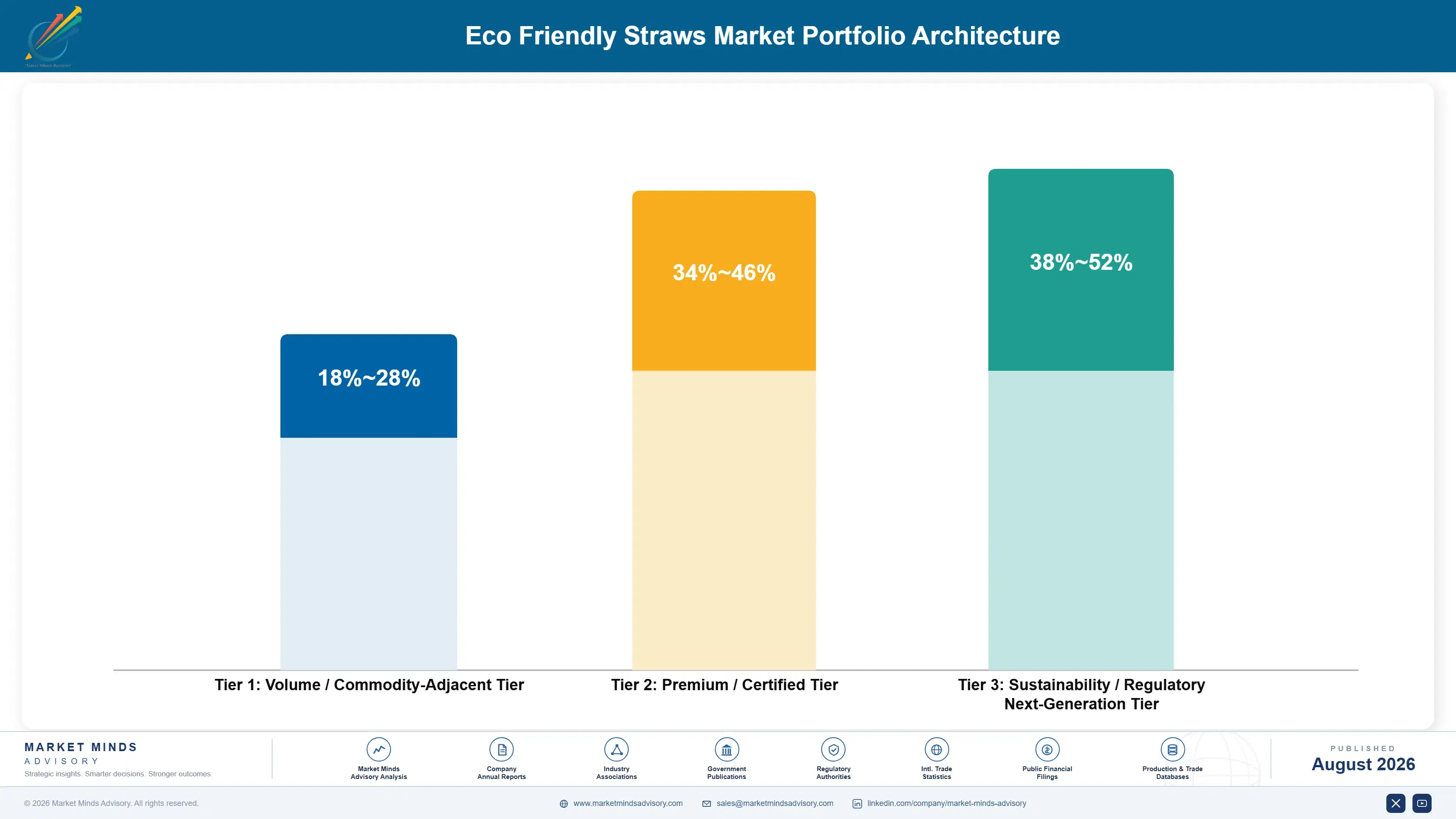
Eco friendly straw portfolios split across three tiers with meaningfully different margin economics. The volume tier, standard uncertified paper straws sold largely on price, competes hardest against Chinese imports and delivers gross margins in the 18 to 28% range. Premium certified straws bundling recognized compostability marks and improved wet-strength performance command materially higher margins, reflecting certification cost and formulation investment layered on top of base material.
The tension between volume and premium tiers shapes capacity allocation decisions across the industry. Volume paper capacity is easiest to scale and fastest to fund, but Chinese price competition keeps margin pressure constant in that tier. Premium bioplastic and certified capacity requires deeper formulation investment and slower certification cycles, but rewards patient capital with margins that hold up even as volume-tier pricing keeps eroding.

High-value margin pools concentrate in certified bioplastic straws, wet-strength coated paper, and the private-label and licensing layer that increasingly separates established suppliers from commodity converters. These pools remain a modest share of total shipment volume today, but they are growing faster than the base paper category and are where most supplier research and development spending is now directed.

Volume / Commodity-Adjacent Tier

Standard uncertified paper straws sold primarily on unit price, facing the heaviest direct competition from Chinese imports. These units carry the thinnest margins in the portfolio and depend on manufacturing scale rather than certification to stay profitable.
Gross Margin: 18-28%

Premium / Certified Tier

Certified compostable straws bundling recognized third-party marks, improved wet-strength coatings, and multi-year supply continuity guarantees that large chains pay a premium to access. This tier generates steady repeat business, since certified accounts rarely switch without cause.
Gross Margin: 34-46%

Sustainability / Regulatory / Next-Generation Tier

Agricultural-fiber and next-generation bioplastic formulations tied to expanding compostability regulation and premium hospitality positioning. This tier draws the heaviest research spending, since formulation and certification both require sustained investment to defend against fast-moving entrants.
Gross Margin: 38-52%
eco-friendly-straws-market-portfolio-architecture-1787300523639

High-value Sub-segments and Strategic Watch-out

PLA / Bioplastic Straws

The fastest-growing, highest-margin pool in the market, driven by falling resin costs and premium accounts seeking compostability certification paper cannot always satisfy in cold-beverage applications. Suppliers without certified formulation risk losing the fastest-growing accounts to specialists that moved earlier in the adoption cycle across the category.
Gross Margin: 40-52%

Wet-Strength Coated Paper Straws

A smaller but rapidly scaling high-value pool as coating technology narrows the durability gap with plastic, gated by formulation licensing and qualification cycles with large foodservice chains. Suppliers that secure early chain adoption tend to hold that relationship for years, since switching straw suppliers mid-contract is costly.
Gross Margin: 34-44%

Standard Uncertified Paper Straws

The volume core of the market, serving cost-sensitive foodservice accounts where Chinese price competition keeps margins under the most sustained pressure of any product tier. This segment still generates the largest absolute shipment volume, and defending share funds the research spending premium tiers require to grow.
Gross Margin: 18-26%

Unbranded Chinese Commodity Imports

A strategic watch-out segment where rapidly expanding low-cost, uncertified units could pull volume-tier pricing down faster than certification and brand trust can defend established margins. Suppliers without a genuine quality or certification advantage against these imports should expect continued price erosion across the entire volume tier.
Gross Margin: 12-22%

The Certification Relationship as the Moat

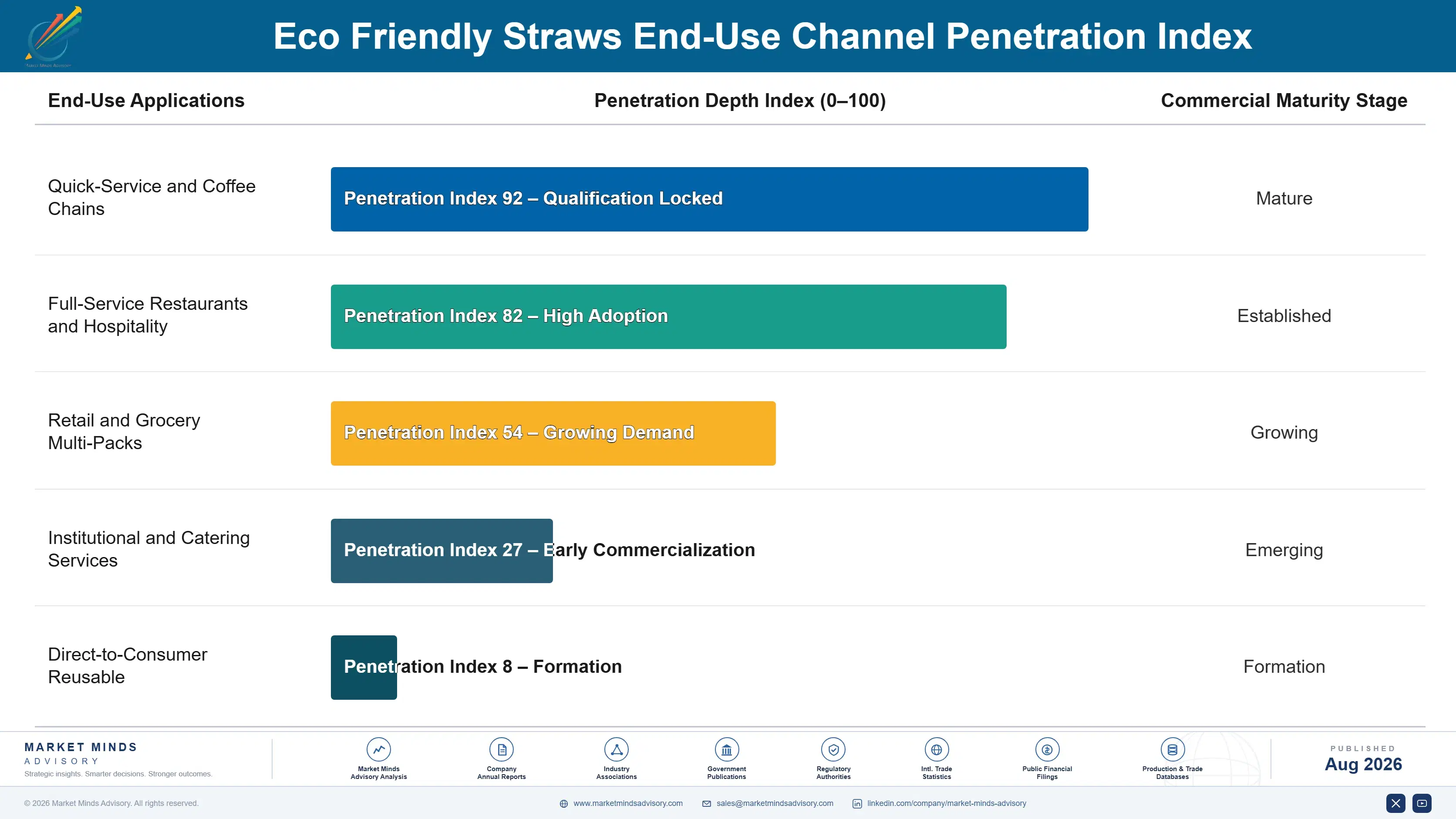
Eco friendly straw economics increasingly resemble a certified-supplier relationship business rather than a simple commodity sale. Compostability certification renewal, wet-strength formulation licensing, and multi-year supply continuity contracts generate recurring engagement with large foodservice chains that persists well beyond the initial contract signing, and suppliers that own that relationship can forecast renewal demand with more confidence than pure commodity competitors.
Adoption depth varies by end-use channel. Large national quick-service chains, once qualified on a supplier's certification and formulation, rarely switch given the cost and brand risk of requalifying an entire system-wide straw program. Independent restaurants and smaller regional chains show shallower stickiness so far, since they often buy through distributors rather than direct supplier relationships and switch more readily on price.

A generational shift in buyer profiles is underway as sustainability and procurement officers, rather than pure purchasing managers, increasingly co-sign straw sourcing decisions given brand reputation exposure. These buyers weight certification credibility and supply continuity alongside unit cost, a shift that favors suppliers with proven compliance records over those competing purely on price. The trend is uneven across chain sizes but consistently favors certification-capable suppliers over time.
eco-friendly-straws-market-end-use-penetration-index-1787300524132

Where MMA Sees the Opportunity

These are among the four positions where our research anticipates prominent divergence between winners and laggards over the coming forecast period. Each is grounded in the demand model, the regulatory perimeter, and the announced capacity pipeline.
01 / BIOPLASTIC SEGMENT INVESTMENT

Prioritize certified bioplastic capacity over commodity paper expansion

PLA and bioplastic straws are growing roughly 1.36 times faster than the overall market, driven by falling resin costs and premium accounts that value compostability certification paper cannot always satisfy in cold-beverage use. Suppliers still weighted toward commodity paper capacity risk ceding the fastest-growing, highest-margin accounts to specialists that built certified bioplastic formulation earlier in the adoption cycle. Capital directed toward bioplastic capacity and certification now should pay back faster than incremental paper expansion into an increasingly crowded, price-competitive commodity tier offering little room for margin growth.
02 / CERTIFICATION AND COMPLIANCE BUILD-OUT

Treat third-party certification as a core competitive moat investment

Suppliers that still compete purely on unit price without recognized certification are leaving significant value on the table that certification, wet-strength technology, and supply continuity guarantees are already capturing for established brands. These certified relationships carry materially higher switching costs than the underlying commodity sale, locking large chains into renewal patterns that price-only competitors struggle to break. Building this capability now, before Chinese entrants close the certification gap further, is worth more than matching a rival's price cut for cut.
03 / PULP SUPPLY HEDGING

Lock multi-year pulp supply agreements ahead of the next cycle

Pulp and resin input costs already run close to 38% of cost of goods sold, and the 2021 to 2022 spike showed mill allocation constraints can push converter costs up more than 25% within a single year. Suppliers without multi-year supply agreements risk losing contract bids to better-hedged rivals during the next volatile cycle, damaging chain relationships built over years in a single sharp price spike. Locking supply now, even at a premium to spot pricing, protects margin stability and the credibility needed to win long-duration foodservice contracts.
04 / REGIONAL CAPACITY POSITIONING

Weigh Chinese cost scale against Western certification trust carefully

East Asia now holds the largest manufacturing base for eco-friendly straw production and continues adding capacity faster than most other regions, making cost leadership there increasingly difficult for Western converters to contest directly on unit price. Western and Japanese suppliers still hold a genuine advantage in certification credibility, formulation technology, and chain relationship trust that Chinese entrants have not yet fully closed. The sounder strategy is not chasing Chinese manufacturing scale directly, but doubling down on the certification and formulation capability Chinese competitors still cannot replicate at comparable trust levels.

Engagement Snapshot From the Field

A live engagement with an industry participant carrying material or product regulatory and market exposure ahead of a defining policy shift, showing how our research translates into a defensible multi-year portfolio strategy.
MARKET MINDS ADVISORY · CLIENT ENGAGEMENT SUMMARY
Eco Friendly Straws Producer Strategic Portfolio Review and Transition Roadmap 2026·Investment Scenario on Eco Friendly Straws Exposure Evaluation 2025-26
CLIENT PROFILE
The client is a national quick-service coffee and beverage chain operating more than 900 US locations, serving an estimated 4 million cold and hot beverages weekly across its system. The chain had switched to paper straws system-wide in 2021 but faced persistent customer complaints and needed an independent assessment of whether a material or formulation change could improve customer satisfaction without reverting to plastic (client-reported, unverified by MMA).
STRATEGIC CHALLENGE
The chain needed to decide whether to invest in reformulated wet-strength paper straws, switch to bioplastic straws system-wide, or pursue a hybrid approach by beverage type, against the operational complexity and cost of managing more than one straw material across a large multi-location system with decentralized ordering and inconsistent regional distributor relationships.
MMA APPROACH
MMA conducted a vendor-neutral material and formulation assessment benchmarking wet-strength paper, bioplastic, and hybrid approaches against customer satisfaction data, per-unit cost, and operational complexity, drawing on structured interviews with the chain's operations staff across three regions and MMA's primary survey data on consumer straw material preferences collected nationally across comparable quick-service accounts.
KEY FINDINGS
  1. Customer complaint rates for cold beverages specifically ran nearly three times higher than for hot beverages, suggesting a hybrid material approach could address the bulk of the complaint volume without a full system-wide material switch.
  2. Reformulated wet-strength paper straws showed complaint rates dropping by an estimated 60% in limited-market testing compared to the chain's existing standard paper straws used since 2021.
  3. A full bioplastic system-wide switch would increase per-unit straw cost by roughly 35% compared to standard paper, a cost increase leadership judged difficult to justify given the wet-strength paper alternative's strong test results.
  4. Operational complexity of managing two straw materials by beverage type was judged manageable given the chain's existing point-of-sale system could already differentiate hot and cold beverage orders automatically.
CLIENT PROFILE
The client is a national quick-service coffee and beverage chain operating more than 900 US locations, serving an estimated 4 million cold and hot beverages weekly across its system. The chain had switched to paper straws system-wide in 2021 but faced persistent customer complaints and needed an independent assessment of whether a material or formulation change could improve customer satisfaction without reverting to plastic (client-reported, unverified by MMA).
STRATEGIC CHALLENGE
The chain needed to decide whether to invest in reformulated wet-strength paper straws, switch to bioplastic straws system-wide, or pursue a hybrid approach by beverage type, against the operational complexity and cost of managing more than one straw material across a large multi-location system with decentralized ordering and inconsistent regional distributor relationships.
MMA APPROACH
MMA conducted a vendor-neutral material and formulation assessment benchmarking wet-strength paper, bioplastic, and hybrid approaches against customer satisfaction data, per-unit cost, and operational complexity, drawing on structured interviews with the chain's operations staff across three regions and MMA's primary survey data on consumer straw material preferences collected nationally across comparable quick-service accounts.
KEY FINDINGS
  1. Customer complaint rates for cold beverages specifically ran nearly three times higher than for hot beverages, suggesting a hybrid material approach could address the bulk of the complaint volume without a full system-wide material switch.
  2. Reformulated wet-strength paper straws showed complaint rates dropping by an estimated 60% in limited-market testing compared to the chain's existing standard paper straws used since 2021.
  3. A full bioplastic system-wide switch would increase per-unit straw cost by roughly 35% compared to standard paper, a cost increase leadership judged difficult to justify given the wet-strength paper alternative's strong test results.
  4. Operational complexity of managing two straw materials by beverage type was judged manageable given the chain's existing point-of-sale system could already differentiate hot and cold beverage orders automatically.
RECOMMENDED STRATEGY
Phase 1: Phase 1 (Months 1 to 4): Pilot reformulated wet-strength paper straws for cold beverages at 100 test locations across three regions. Phase 2: Phase 2 (Months 5 to 10): Expand wet-strength paper straws to all cold-beverage orders system-wide based on strong pilot results. Phase 3: Phase 3 (Months 11 to 15): Evaluate customer satisfaction data system-wide and consider bioplastic piloting for any remaining complaint-prone locations.
OUTCOME
The chain began system-wide rollout of reformulated wet-strength paper straws for cold beverages in early 2026, following successful pilot results. Early data through mid-2026 showed complaint rates tracking close to the pilot's 60% reduction estimate, though full system confirmation awaits complete rollout (client-reported, unverified by MMA).

Frequently Asked Questions

Foundational context covering the market sizes, CAGR, scope, country, region and competition that inform every finding below. This section is provided to cover basics and most often pre-purchase conversations, answered from the MMA Primary Research Dataset.

What is the current size of the Eco Friendly Straws Market?

The global eco friendly straws market reached an estimated $1.6 billion in 2025. Growth concentrates in foodservice channels where plastic straw bans have become permanent procurement policy rather than temporary compliance measures.

How large will the Eco Friendly Straws Market be by 2036?

MMA forecasts the market reaching approximately $4.30 billion by 2036, well over double its 2026 value. PLA and bioplastic straws are expected to drive the largest share of that incremental growth.

What is the CAGR for the Eco Friendly Straws Market 2026 to 2036?

The base case CAGR is 9.4% across the forecast period, with a bull case near 10.6% and a bear case near 8.1% depending on bioplastic cost trends and enforcement expansion pace.

Which segment is growing fastest?

PLA and bioplastic straws are the fastest-growing segment, expanding at roughly 12.8% CAGR, about 1.36 times the overall market pace, driven by falling resin costs and certification demand.

Who are the major companies in the Eco Friendly Straws Market?

Leading suppliers include Aardvark Straws, Huhtamaki, Transcend Packaging, Footprint International, and BioPak. The top five hold an estimated 32% of global shipment volume in a fragmented market.

Which country is growing fastest?

China leads growth in absolute manufacturing volume, but India is expanding fastest in percentage terms, driven by staged single-use plastics enforcement across its massive foodservice sector.

Report Segmentation Architecture

The full report scope spans multiple orthogonal segmentation dimensions, with cross-tabulated demand data provided for each dimension pair. Coverage extends further to regional breakdowns, trend trajectories, and the competitive detail needed to support segment-level decision-making.

By Material Type

  • Paper Straws
  • PLA / Bioplastic Straws
  • Bamboo Straws
  • Agricultural Fiber (Wheat / Pasta) Straws
  • Stainless Steel / Reusable Straws

By End-Use Channel

  • Quick-Service and Coffee Chains
  • Full-Service Restaurants and Hospitality
  • Retail and Grocery Multi-Packs
  • Institutional and Catering Services
  • Direct-to-Consumer Reusable

By Commercial Dimension

  • Original Manufacturing Sales
  • Private-Label and Custom Branding Services
  • Formulation and Coating Technology Licensing
  • Distributor and Wholesale Channels

By Region

  • North America
  • Western Europe
  • East Asia
  • South Asia and Pacific
  • Latin America
  • Middle East and Africa
  • Eastern Europe

Scope, Methodology, and Coverage

Every figure in this report is reproducible from documented input assumptions. The scope below maps the historical period, the forecast horizon, the segmentation dimensions, and the countries covered, alongside the underlying primary and qualitative methodology.
Historical Period
2020 to 2025
Forecast Period
2026 to 2036
Base Year
2025 (USD billions; MMA Primary Research Dataset, August 2026)
Market Definition
The eco friendly straws market covers single-use and reusable drinking straws manufactured from paper, bioplastic (PLA and other compostable polymers), bamboo, agricultural fiber, and durable materials including stainless steel and silicone, sold into foodservice, retail, and institutional channels as an alternative to conventional petroleum-based plastic straws. It excludes conventional polypropylene and polystyrene straws, straw dispensing equipment sold separately from the straws themselves, and broader compostable foodservice packaging categories such as cutlery and cups.
Quantitative Units
USD billions (current prices); unit shipment volume in billions of straws where disclosed
Segmentation Dimensions
By Material Type; By End-Use Channel; By Commercial Dimension; By Region
Regions Covered
North America, Western Europe, East Asia, South Asia and Pacific, Latin America, Middle East and Africa, Eastern Europe
Countries Covered
USA, China, Germany, France, UK, Japan, South Korea, India, Australia, Canada, Brazil, Mexico, Indonesia, Vietnam, Thailand, Malaysia, UAE, Saudi Arabia, South Africa, Nigeria, Turkey, Poland, Netherlands, Italy, Spain, Sweden, Switzerland, Argentina, Colombia, Singapore, and additional markets relevant to this sector
Key Companies Profiled
Aardvark Straws (Hoffmaster Group), Huhtamaki Oyj, Transcend Packaging Ltd, Footprint International, BioPak Pty Ltd, World Centric, Vegware Ltd, Sulapac Oy, Klean Kanteen, Simply Straws, Weikang Environmental Technology Co., Shandong Lujing Biotechnology Co., Sharpak Aylesham, TIPA Corp, EcoStraw Malaysia, Green Wave International, Bio-Pappel, Pacific Bag Inc., Novolex, WinCup Inc.
Quantitative Methodology
Primary survey, n=3,800 respondents, Q4 2025, six countries; demand-side model with trade association cross-validation
Qualitative Methodology
47 expert interviews, Q4 2025; applied to validate demand model assumptions, identify emerging dynamics, and assess competitive positioning
Report Format
PDF and XLSX data workbook (Word format preview document)
Publisher
Market Minds Advisory
Report Code
MMA-2026-PAC-092
Published
August 2026
Contact
sales@marketmindsadvisory.com | www.marketmindsadvisory.com

Purchase the full Eco Friendly Straws Market Report (2026 to 2036).

The full Eco Friendly Straws Market report delivers a comprehensive assessment of material technology, competitive positioning, and regional demand through 2036. It includes detailed segmentation by material type, end-use channel, and commercial dimension, alongside profiles of all twenty companies covered in this summary. The report quantifies regional market size and growth across all seven world regions, with country-level detail for the thirty-plus markets MMA tracks. Buyers receive access to MMA's underlying primary survey dataset and expert interview transcripts, enabling further custom analysis. A dedicated chapter benchmarks pulp and resin cost exposure and mitigation strategies across supplier types.
Material-level segmentation across five product technology categories
Profiles of twenty leading eco-friendly straw suppliers worldwide
Regional sizing and forecasts across all seven world regions
Pulp and resin cost exposure and mitigation strategy chapter
Primary survey dataset access covering 3,800 respondent interviews
Competitive development tracking with dated corporate event log

Built For The People Who Decide

From boardroom strategy to bench-side execution, this report is read cover-to-cover by leaders shaping the next decade of their industry, turning demand scenarios, market dynamics and valuation benchmarks into decisions.
CXOs/ Presidents/ VPs/ Managers
M&A and Corporate Development
Strategy Teams and R&D Heads
Procurement and Product Directors
Regulatory and Compliance Leaders
Investor Relations and Equity Analysts