Market Minds Advisory
Eco Friendly Paper Plates Market

Eco Friendly Paper Plates Market: Bans, Certification, and the Compostability Gap

Single-use plastic bans are pulling foodservice buyers toward paper and molded fiber plates faster than compostable coatings can match plastic's grease resistance, leaving certification credibility and composting infrastructure as the real bottlenecks holding back substitution.

Lead Analyst

Bilal Shaikh

Published

September 2026

Make Smarter Decisions with Customized Research Insights

Request a free sample report and evaluate market opportunities, growth trends, and competitive dynamics relevant to your business needs.

2025 MARKET VALUE$3.4BMarket Size 2025
2036 FORECAST VALUE$7.0BBase Case , 2026 to 2036
CAGR 2026 TO 20366.8 %Bull 8.0% / Bear 5.6%
INCREMENTAL OPPORTUNITY$3.4BNet 10- year value creation
EXPANSION MULTIPLE1.93x2036 value over 2026 base
Strategic Levers
M&A Pipeline
Regional Outlook
Country Rankings
Competitive Intelligence
Segmental Deep-dive
Call-Us : 91 93563 13602

Executive Snapshot and Market Trajectory

Regulatory bans on single-use plastic tableware are the single biggest force in this market right now, converting mandated substitution into guaranteed volume growth for paper and molded fiber plates well before most buyers have compared true performance or cost against the plastic alternatives being phased out.
Bagasse and molded fiber plates dominate volume today, but PLA and bio-based coated plates grow fastest at 11.2%, roughly 1.65 times the overall rate, as foodservice chains chase certified compostability rather than simple biodegradability claims regulators increasingly reject. East Asia holds the largest regional share at 28%, anchored by China's molded fiber export manufacturing base, while India's domestic ban-driven demand makes it the fastest-growing single country worldwide.
Competitive intensity is genuinely low for a packaging category this size, with the top five holding roughly one third of shipment volume, leaving room for hundreds of small regional and national manufacturers to compete on relationships and price. Regulatory divergence complicates this further, since certification standards for compostability differ meaningfully between the European Union, the United States, and India, forcing manufacturers to qualify products separately for each jurisdiction rather than selling one specification globally.
Market Definition
The eco-friendly paper plates market covers disposable foodservice plates manufactured from paper, molded fiber, bagasse, bamboo, and natural leaf materials intended for compostable or biodegradable end-of-life disposal. It excludes conventional plastic and polystyrene tableware, reusable ceramic and melamine plates, and laminated plastic-coated paper plates not certified compostable.
Base Year Value
$3.4B in 2025 (MMA Primary Research Dataset, August 2026)
Forecast Period
2026 to 2036, eleven discrete annual values
CAGR
6.8% base case. Bull 8.0%. Bear 5.6%.
Fastest Growth Segment
PLA and Bio-Based Coated Plates: 11.2% CAGR
Fastest Growth Country
India: 14.5% CAGR
Fastest Growth Region
South Asia and Pacific: 9.0% CAGR
Largest Region
East Asia: 28% of 2025 global value
Market Leaders
Huhtamaki, Duni Group, Pactiv Evergreen, BioPak, Vegware. Source: MMA Analysis based on company annual reports.
Primary Survey
n=3,800 procurement and R&D decision-makers, Q4 2025, six countries
Methodology
Demand-side build-up, cross-validated against public data, 47 expert interviews

Eco Friendly Paper Plates Market Forecast Scenarios

eco-friendly-paper-plates-market-size-forecast-scenario-1787300695312
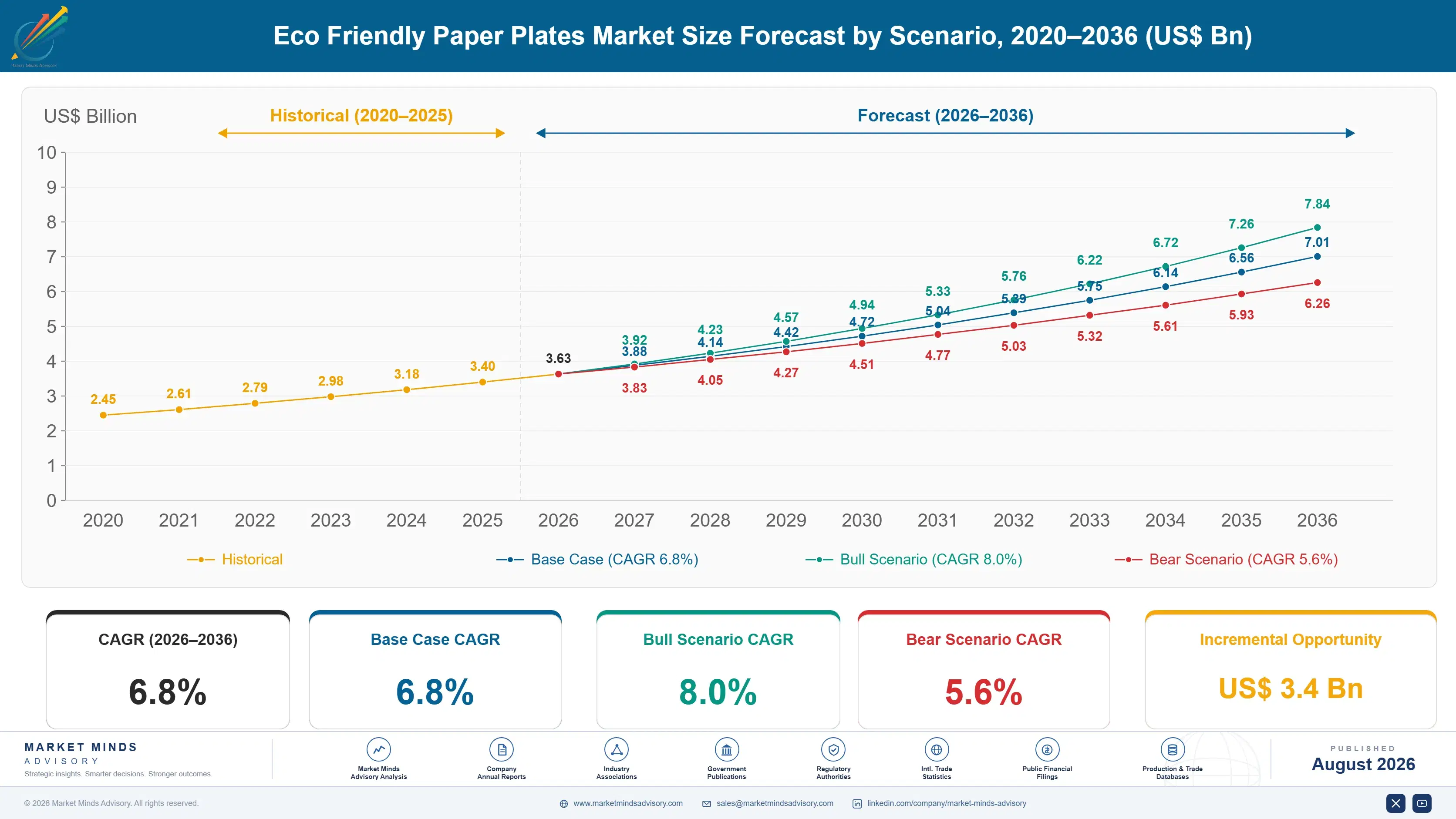
Between 2020 and 2025 the market grew at roughly 5.8% annually, starting from a pandemic-era dip in foodservice volume before accelerating sharply as the European Union's Single-Use Plastics Directive and a wave of American state and municipal bans took effect. India's own 2022 national ban on select single-use plastic items added a second major demand shock, pulling growth well above what population and foodservice spending trends alone would explain.
The base case carries the market to 6.8% annual growth through three mechanisms. First, additional plastic bans keep taking effect across American states, Canadian provinces, and Southeast Asian countries, converting mandated substitution into guaranteed volume. Second, foodservice chains increasingly specify certified compostable tableware in supplier contracts ahead of regulatory requirements, driven by corporate sustainability commitments. Third, molded fiber and bagasse manufacturing capacity keeps expanding across India and China, narrowing the price gap against plastic alternatives.
The bull case, 8.0%, assumes additional major markets, including several populous Southeast Asian and Latin American countries, adopt comprehensive single-use plastic bans within the forecast window. The bear case, 5.6%, assumes compostable coating cost inflation and inconsistent municipal composting infrastructure slow buyer conversion, keeping some operators on cheaper plastic-coated alternatives longer than regulation alone would predict.

Bans, Certification, and the Compostability Gap

Three forces converge on this market simultaneously. Plastic bans keep expanding across new jurisdictions, converting regulatory mandate directly into guaranteed shipment volume regardless of underlying cost competitiveness. Certification standards are tightening as regulators crack down on vague biodegradability claims that cannot be substantiated under recognized industrial or home composting protocols. And raw material costs, pulp, bagasse, and bamboo fiber, keep rising as demand growth outpa
MARKET CONCENTRATIONCR5: 34%Hundreds of small regional manufacturers still compete actively
AVERAGE UNIT PRICEUSD 0.03 to 0.12 per platePrices vary widely by material and certification level
TOP PRODUCING COUNTRYChina: 31% of outputMolded fiber export manufacturing remains heavily concentrated there
CAPACITY UTILIZATION68%Many smaller regional plants run below full nameplate capacity
FIBER COST SHARE42% of COGSRaw pulp and bagasse fiber dominate total production cost
COMPOSTING INFRASTRUCTURE23% of US populationMunicipal composting access still lags well behind product adoption
Commercially, this market behaves like a fragmented commodity business layered onto a genuine sustainability compliance requirement. Hundreds of manufacturers compete on regional relationships, certification breadth, and price, since the physical product itself is difficult to differentiate meaningfully once it meets a given compostability standard. Buyers increasingly treat certification credentials, not brand recognition, as the primary purchasing signal driving supplier selection.
Over the next decade expect continued consolidation among smaller manufacturers unable to afford multi-jurisdiction certification costs across major regulated markets. Bagasse and molded fiber will keep taking share from clay-coated paperboard as compostability standards tighten further worldwide. And composting infrastructure investment, more than manufacturing technology, will increasingly determine which markets convert fastest over the coming decade.
"Everyone in this category claims their plate is compostable. The real question is whether the municipality receiving it actually has anywhere to compost it."
Director, Sustainable Packaging Practice · MMA Packaging Practice ·

Market Trends

Regulators Sharply Tighten Compostability Certification Standards

The US Federal Trade Commission's revised Green Guides and the European Union's proposed Green Claims Directive both raise the bar for what manufacturers can legally market as compostable or biodegradable, requiring substantiation under recognized standards such as ASTM D6400 or EN 13432 rather than generic marketing language. Several manufacturers have faced enforcement action or reformulation requirements after claims could not be substantiated. Certification bodies report application volume climbing sharply as manufacturers race to formalize claims before enforcement intensifies further, adding compliance cost but also creating a genuine competitive moat for manufacturers who complete certification early.
Market Impact: Covers 120-plus countries with active bans
Foodservice Chains Specify Compostable Tableware Contractually

Major quick-service and fast-casual restaurant chains increasingly write certified compostable tableware requirements directly into supplier procurement contracts, ahead of any regulatory mandate in the jurisdictions where they operate. This corporate-driven demand channel is proving more durable than regulation alone, since contractual specifications do not depend on any single government maintaining a ban through changing political administrations. Starbucks, Chipotle, and several major hotel chains have all published public commitments moving toward fully compostable or reusable foodservice packaging by set target dates, setting de facto industry specification standards well ahead of regulation.
Market Impact: Adds demand from 500-plus hotel brands

Market Opportunities and Growth Drivers

Single-Use Plastic Bans Keep Expanding Globally

More than 120 countries and dozens of US states and municipalities now restrict or ban single-use plastic foodservice items in some form, according to United Nations Environment Programme tracking, and the pace of new bans has accelerated rather than slowed over the past three years. Each new ban converts existing plastic tableware volume directly into paper, molded fiber, or bio-based alternative demand, since foodservice operators cannot simply stop offering disposable tableware. India's 2022 national ban alone shifted an enormous volume of foodservice and retail demand toward paper and leaf-based alternatives within a single calendar year.
Market Impact: Adds 15% to 30% unit cost

Corporate Sustainability Commitments Add Demand Channel

Large foodservice and hospitality brands increasingly treat compostable tableware adoption as a visible, easily communicated component of broader corporate sustainability commitments, generating demand independent of local regulatory requirements. This is particularly valuable for manufacturers since corporate procurement decisions typically involve multi-year supply agreements rather than the spot purchasing common in price-sensitive segments of the market. Hotel groups, airlines, and stadium operators have all made public commitments to phase out single-use plastic tableware entirely on timelines that in some cases run well ahead of any applicable regulation currently in force today.
Market Impact: Reaches only 23% of US households

Market Restraints and Challenges

Compostable Coatings Still Cost More Than Plastic

Certified compostable barrier coatings, PLA or bio-based alternatives to conventional plastic lamination, cost meaningfully more per unit than the petroleum-based coatings they replace, and that cost gap has narrowed only slowly despite years of manufacturing scale-up. The root cause is that bio-based feedstock production, corn or sugarcane-derived PLA specifically, remains a smaller, less mature industry than petrochemical plastic production. The commercial impact falls hardest on price-sensitive segments, quick-service restaurants and institutional catering especially, where thin margins make even small cost increases painful. Some manufacturers are responding with uncoated designs that sacrifice grease resistance for lower cost.
Market Impact: Adds certification compliance cost 8%

Municipal Composting Infrastructure Lags Product Adoption

Certified compostable tableware only delivers its intended environmental benefit when it actually reaches an industrial composting facility, yet municipal composting access remains limited to a minority of the population even across markets with aggressive single-use plastic bans. The root cause is infrastructure investment lag: composting facilities require capital investment and siting approval that moves far slower than legislative bans on plastic tableware. The commercial impact is reputational as much as practical, since compostable products routed to conventional landfill generate the same outcome as plastic while carrying a higher price tag. Some manufacturers now partner with municipalities to expand composting access.
Market Impact: Adds demand from 3 major sectors
3 additional market trends, 2 additional growth drivers, and 4 additional restraints and challenges are covered in the full report. Contact sales@marketmindsadvisory.com to access the complete intelligence.

Segment CAGR and Growth Architecture

Segmentation follows material and construction type, the single classification logic that determines compostability certification pathway and cost structure. Kraft paper, clay-coated paperboard, bagasse and molded fiber, PLA-coated, bamboo, and natural leaf plates each carry distinct raw material sourcing and processing requirements, so commercial position tracks material chemistry rather than plate size or foodservice application.
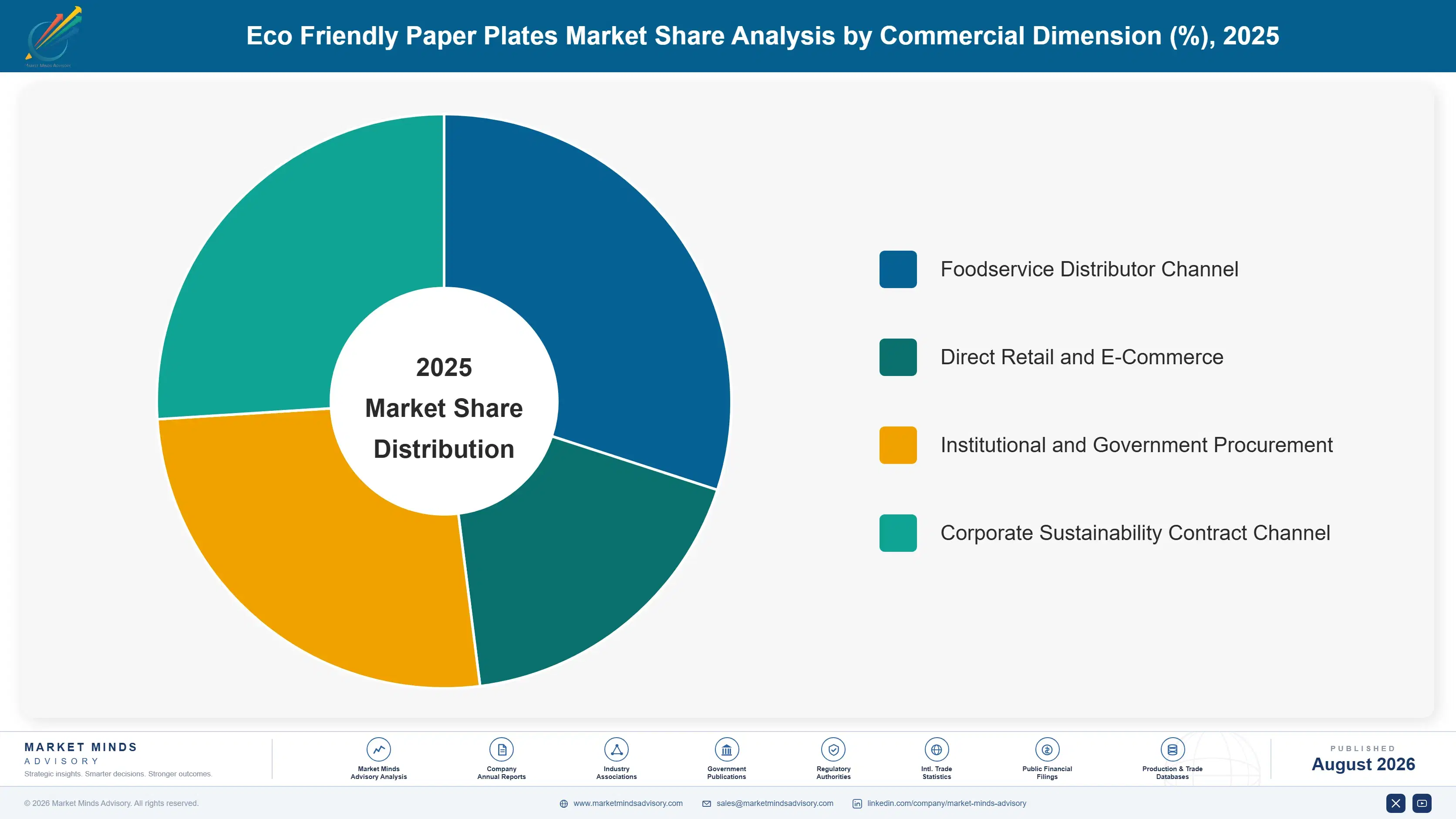
eco-friendly-paper-plates-market-market-share-analysis-1787300695845

PLA and Bio-Based Coated Plates

PLA and bio-based coated plates grow fastest at 11.2%, roughly 1.65 times the overall market rate, as foodservice chains increasingly specify certified compostability rather than simple biodegradability, a distinction regulators enforce more strictly each year. These plates use plant-derived polylactic acid or comparable bio-based films to provide grease and moisture resistance without the petroleum-based lamination found in conventional coated paper plates. World Centric, BioPak, and Vegware lead this segment's branded certified offerings, while several Chinese and Indian manufacturers are scaling PLA coating capacity to serve export demand into stricter European and North American markets. Feedstock cost and coating line capacity remain the main constraints, and manufacturers who lock long-term PLA supply agreements early secure more stable pricing than spot-market buyers.
CAGR 11.2%

Areca Leaf and Palm Leaf Plates

Areca leaf and palm leaf plates grow second-fastest at 10.3%, about 1.51 times the overall rate, appealing to buyers seeking genuinely unprocessed, zero-chemical alternatives rather than manufactured compostable materials that still require industrial composting infrastructure. These plates are pressed from naturally fallen areca palm sheaths or leaves using heat and pressure alone, without adhesive, coating, or chemical treatment, letting them decompose in ordinary home compost within weeks. India dominates global production, where small and mid-sized manufacturers export to premium retail and zero-waste event channels across North America, Europe, and Australia. The segment's constraint is raw material seasonality and limited automation, since leaf collection remains more labor-intensive than pulp-based manufacturing, capping how fast capacity can scale.
CAGR 10.3%
Full segment breakdown across 6 segments available in the complete report.

Regional Architecture and Country Demand Map

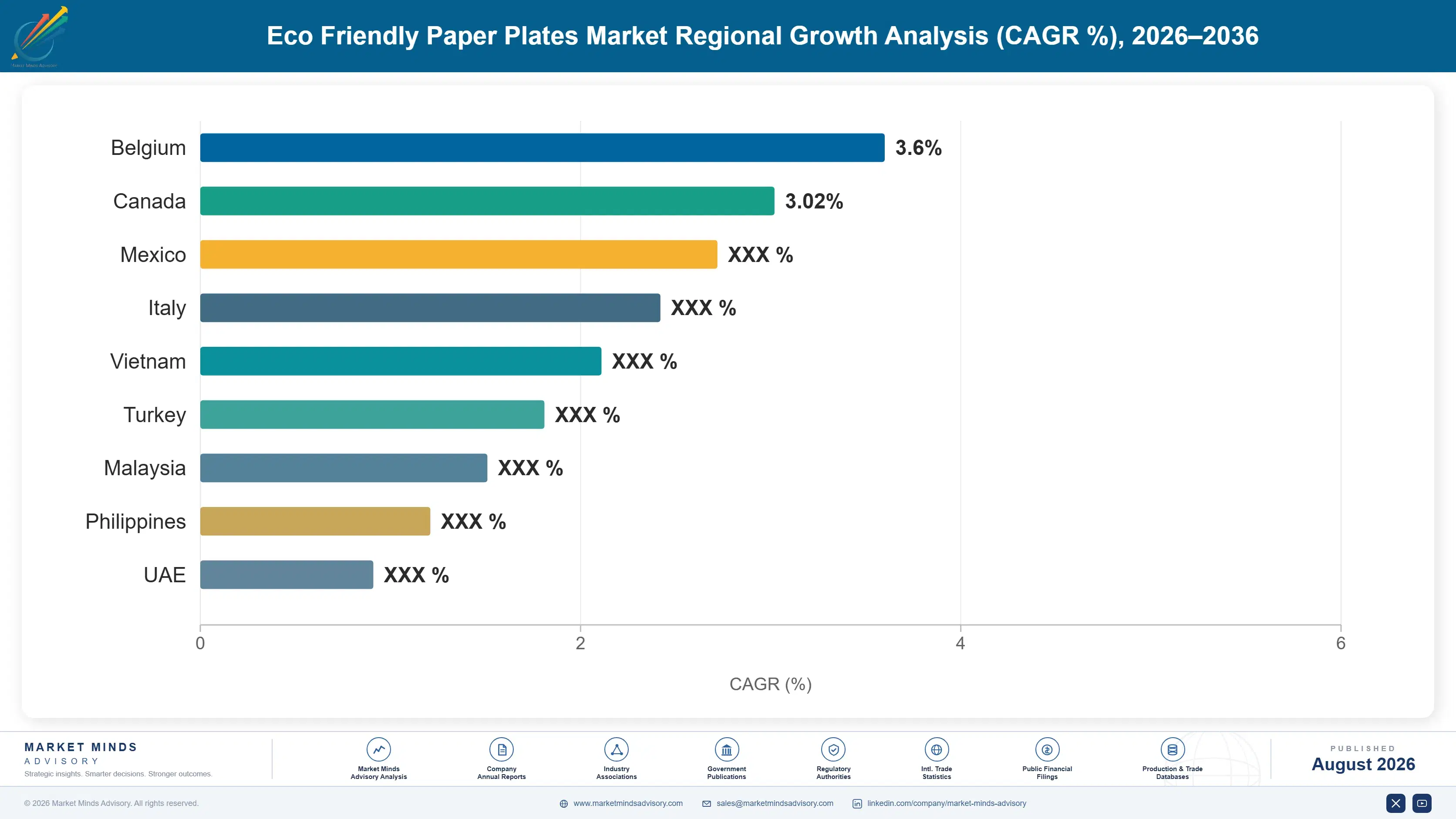
East Asia leads on value at 28% of the global total, anchored by China's molded fiber export manufacturing base. North America and Western Europe follow closely on ban-driven demand. South Asia and Pacific, Latin America, the Middle East, and Eastern Europe complete a global distribution across seven regions tracked.

North America

State-level plastic bans, not federal policy, drive most of North America's demand, with California, New York, and a growing list of municipalities restricting single-use plastic foodservice items ahead of any national mandate. The United States hosts the region's largest buyer base, spanning quick-service chains, institutional catering, and retail grocery private-label programs that increasingly specify certified compostable tableware. Canada's federal single-use plastics regulations, phased in progressively since 2022, add a second national-level demand driver independent of American state policy. Domestic manufacturing remains limited relative to consumption, leaving the region reliant on imports from Chinese and Indian producers for a meaningful share of volume. Growth of 6.2% tracks steady state-level ban expansion more than any single national policy shift.
Share: 24% | CAGR: 6.2% (2026 to 2036)

Western Europe

The European Union's Single-Use Plastics Directive anchors virtually all demand across this region, having banned a defined list of plastic foodservice items outright since 2021 and pushed buyers toward paper, fiber, and certified compostable alternatives specifically. Germany, France, and the United Kingdom represent the region's largest national markets, each layering additional national packaging waste regulation on top of the EU-wide directive. The region's 20% share, near the lower half of its typical band, reflects genuine market maturity: the ban has already worked through most of the addressable conversion opportunity. Growth of 5.3%, the softest pace among the seven regions tracked, reflects this saturation rather than weakening underlying demand for compostable tableware.
Share: 20% | CAGR: 5.3% (2026 to 2036)
Regional intelligence for 5 additional markets available in the complete report: East Asia, South Asia and Pacific, Latin America, Middle East and Africa, Eastern Europe. Contact sales@marketmindsadvisory.com.
eco-friendly-paper-plates-market-country-cagr-analysis-1787300696351

How Eco Plate Makers Can Build Margin

Margin increasingly depends on certification breadth and buyer relationship depth rather than raw material cost alone, as commoditized bagasse and kraft plates face constant price pressure. The four levers below target certification, branding, and channel revenue that eco-friendly plate manufacturers have historically left underexploited, converting a low-margin commodity sale into a more defensible, differentiated position.

Complete Compostability Certification Across Multiple Jurisdictions Early

Manufacturers who complete ASTM D6400, EN 13432, and other major compostability certifications ahead of regulatory enforcement deadlines gain access to procurement contracts that increasingly require documented certification rather than marketing claims alone. World Centric and BioPak both report that certification breadth directly determines which corporate procurement tenders they can even bid for, independent of price. Certification costs meaningfully upfront, often running into six figures across several standards bodies, but manufacturers who complete it early lock in multi-year supply agreements before certification becomes a baseline requirement rather than a genuine differentiator industry-wide.
Market Impact: Wins multi-year procurement contracts worth over $100,000 annually

Build Direct Retail And E-Commerce Brand Presence

Manufacturers selling primarily through foodservice distributors capture a fraction of the margin available through direct-to-consumer retail and e-commerce channels, where environmentally conscious households pay meaningfully more per unit for branded, clearly certified compostable tableware than institutional buyers typically pay. World Centric and Vegware both built recognizable consumer brands that command retail pricing 3 to 5 times higher than unbranded bulk foodservice equivalents, capturing margin that pure business-to-business manufacturers leave entirely on the table. Building this channel requires marketing investment most commodity-focused manufacturers have historically avoided, but the margin differential increasingly justifies it for manufacturers with distinctive certified positioning.
Market Impact: Commands retail prices 3 to 5 times higher

Offer Corporate Sustainability Reporting Support Bundled

Manufacturers increasingly bundle carbon footprint documentation and disposal impact reporting alongside the physical product sale, helping corporate buyers substantiate sustainability claims in their own annual reporting without conducting that analysis independently. Technology and hospitality companies seeking verifiable environmental claims for stakeholder disclosure pay 8% to 12% more for tableware bundled with this documentation than for equivalent unbundled product elsewhere. This premium reflects genuine value: corporate sustainability teams need audit-ready data, not just compostable plates, to satisfy increasingly stringent disclosure requirements from regulators and investors alike. Manufacturers building this capability in-house capture more of the premium.
Market Impact: Commands 8% to 12% premium on bundled contracts

Expand Regional Manufacturing To Cut Import Cost

Import tariffs and shipping cost on Asian-manufactured bagasse and molded fiber plates have risen enough that regional manufacturing, closer to the largest ban-driven consumption markets, increasingly beats import economics even at somewhat higher raw labor cost. Manufacturers building North American and European production capacity, rather than relying entirely on Asian imports, cut landed cost by 12% to 18% while also shortening lead times that matter increasingly to foodservice buyers managing thin inventory margins. This shift requires meaningful upfront capital investment, but manufacturers who move early capture share from competitors still dependent entirely on longer, costlier import supply chains.
Market Impact: Cuts landed import costs by 12% to 18%

Who Controls the Margin Pool

Five manufacturers control roughly one third of global shipment volume, a fragmented picture for a packaging category serving worldwide foodservice demand. Huhtamaki and Duni Group both lead on scale and certification breadth, though hundreds of smaller regional manufacturers compete effectively on relationships and price in less consolidated markets. Shipment volume, the basis used throughout this assessment, favors manufacturers with the broadest certified range.
Competitive activity currently runs across three dimensions. Manufacturers race to complete multi-jurisdiction compostability certification before rivals lock in corporate procurement contracts requiring documented standards compliance. Regional manufacturing investment has become a differentiator, as tariff and shipping cost pressure pushes buyers toward suppliers with production closer to major consumption markets. Branded direct-to-consumer positioning, once rare in this category, increasingly shapes premium retail pricing.

Pressure is building from two directions that could reshuffle rankings within the decade. Indian manufacturers, absent from the key player list despite dominating areca leaf and bagasse supply, are scaling export capacity to capture more value currently captured by branded Western distributors. Certification leaders like World Centric are proving documentation depth can command premium pricing that pure commodity manufacturers struggle to match, forcing larger players to decide whether to build comparable capability or acquire it.
eco-friendly-paper-plates-market-company-positioning-matrix-1787300696872

Competitive Moat and Risk Dimensions

HUHTAMAKI OYJ

Moat: Broadest Global Certification Portfolio

Huhtamaki holds compostability and food-safety certifications across more jurisdictions than any single competitor, built over years of regulatory engagement spanning Europe, North America, and Asia simultaneously. That breadth lets it bid on multinational corporate procurement tenders that require consistent certified specification across every market a buyer operates in.
HUHTAMAKI OYJ

Risk: Exposure To Commodity Pulp Pricing

Huhtamaki's scale means a large share of production cost tracks global pulp and fiber commodity pricing, which has proven volatile in recent years and compresses margin whenever input costs spike faster than contracted customer pricing can adjust. Smaller manufacturers with more flexible sourcing sometimes absorb volatility more nimbly.
DUNI GROUP AB

Moat: Strong European Hospitality Relationships

Duni Group holds deep, long-standing relationships across European hotel, restaurant, and catering channels, built over decades as a table-setting and hospitality packaging specialist rather than a generalist manufacturer. That channel depth gives it recurring order volume competitors without comparable hospitality-sector relationships struggle to replicate quickly.
DUNI GROUP AB

Risk: Concentrated European Revenue Base

Duni Group's revenue concentrates heavily in European markets already at advanced ban-driven market maturity, leaving less runway for organic growth than competitors with meaningful exposure to earlier-stage regulatory markets across Asia, Latin America, and Africa, where category conversion has barely begun and volume growth potential remains substantially larger.

Key Players

Huhtamaki Oyj
Duni Group AB
Pactiv Evergreen Inc.
BioPak Pty Ltd
Vegware Ltd

Others

Genpak LLC
Eco-Products Inc.
Fabri-Kal Corporation
World Centric
Detmold Group
Solia SAS
Stalk Market LLC
Green Wave Enviro Tech Industries Ltd.
Yash Papers Ltd.
Ecoware India Pvt. Ltd.
Hotpack Global
Biopac India Corporation Ltd.
Sabert Corporation
Novolex Holdings LLC
Georgia-Pacific LLC

Recent Developments

MARCH 2025

World Centric Completes EN 13432 Certification For Full Product Line

World Centric completed European EN 13432 industrial compostability certification across its full plate and tableware product line, extending previously US-focused ASTM D6400 certification into the European market. The certification allows the company to bid directly on European corporate and municipal procurement tenders requiring documented compostability standards.
Signal: Signals that certification breadth is becoming a genuine prerequisite for competing in multiple major regulated markets simultaneously.
JULY 2025

Huhtamaki Acquires Indian Molded Fiber Manufacturer

Huhtamaki completed the acquisition of a mid-sized Indian molded fiber tableware manufacturer, adding domestic production capacity and areca leaf sourcing relationships to its existing global portfolio. The transaction was a full acquisition, not a joint venture or minority equity investment, and closed within the same quarter.
Signal: Signals established multinational manufacturers are acquiring Indian production capacity rather than relying solely on longer-distance imports.
NOVEMBER 2025

Duni Group Launches PLA-Coated Compostable Plate Line

Duni Group launched a new PLA-coated plate line targeting hospitality customers seeking grease-resistant compostable alternatives to conventional plastic-laminated paper plates. The launch represents an organic product development initiative rather than an acquisition or licensing arrangement with any external technology provider whatsoever, according to the company.
Signal: Signals established European manufacturers are investing organically in bio-based coating technology rather than acquiring it externally.

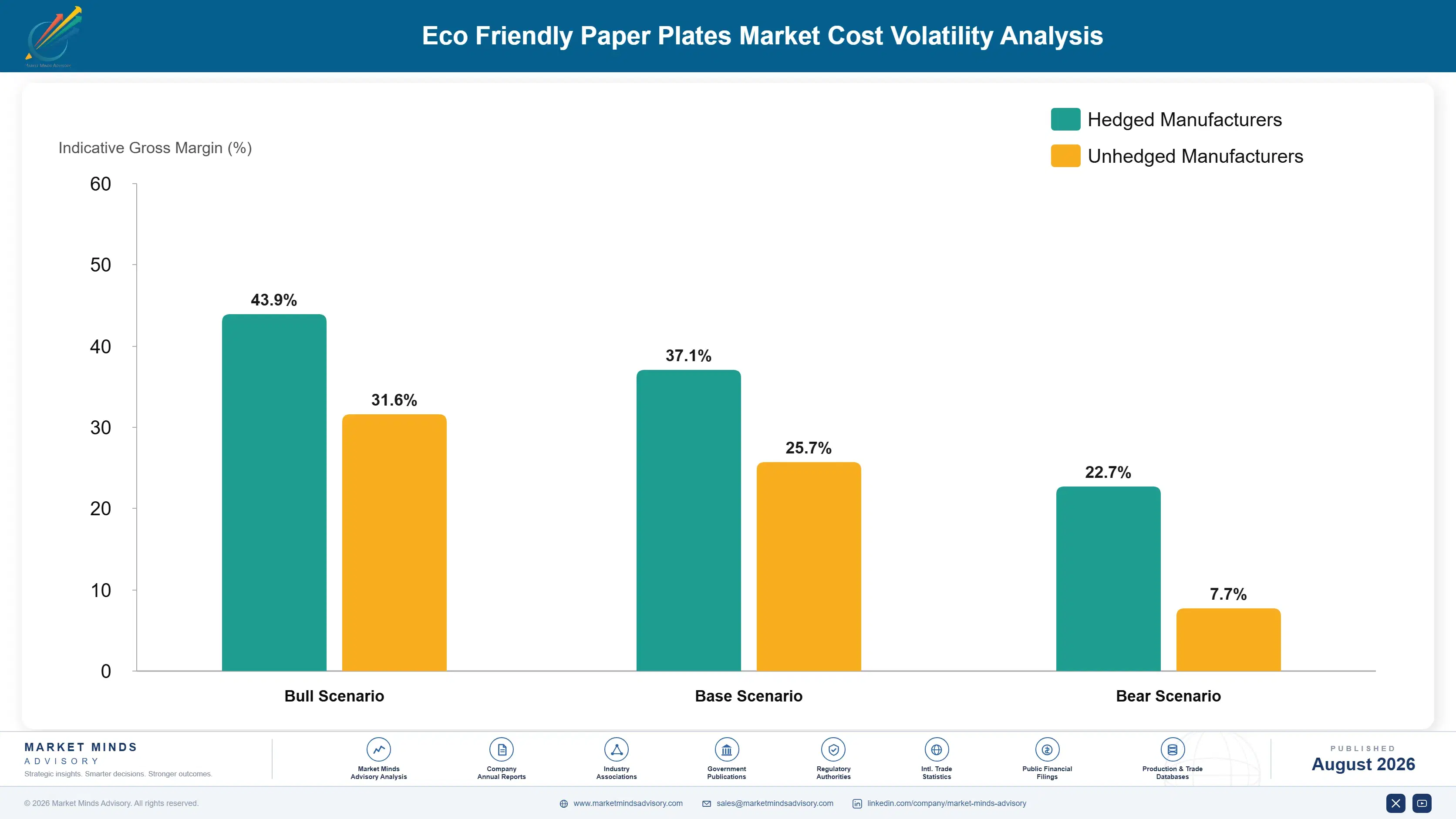
What Actually Drives Plate Production Cost

Raw pulp, bagasse, and bamboo fiber account for roughly 42% of production cost, sourced from a mix of dedicated pulp mills, sugarcane processing byproduct streams, and bamboo plantations concentrated in India, China, and Brazil. Compostable coating materials, PLA or bio-based films, add another 18% for coated products specifically, while energy and labor make up most of the remainder across most manufacturing facilities.
Pulp and fiber prices spiked sharply in 2021 and 2022 as global paper and packaging demand recovered from pandemic-era lows and competed directly with molded fiber tableware manufacturers for the same pulp processing capacity. Huhtamaki's 2022 annual report cited elevated fiber costs as a direct pressure on margins that year, and several tableware manufacturers reported similar pressure, pushing some smaller manufacturers toward temporary production cutbacks until pricing eased into 2023.

Smaller regional manufacturers carry the sharpest exposure, since they lack the purchase volume to negotiate long-term fiber supply contracts that Huhtamaki and Duni Group secure directly with pulp producers. Geographic exposure varies too: manufacturers sourcing bagasse from sugarcane byproduct face lower input cost than those buying dedicated virgin pulp, a cost gap that widens whenever sugar harvest volumes shift regional bagasse availability unpredictably.
eco-friendly-paper-plates-market-cost-volatility-analysis-1787300697068

Lock Multi-Year Fiber Supply Contracts With Producers

Manufacturers with sufficient purchase volume are negotiating multi-year fiber supply agreements directly with pulp mills and sugarcane processors, trading pricing flexibility for guaranteed allocation during industry-wide shortages. This approach favors the largest manufacturers disproportionately, since minimum volume commitments required for favorable terms sit well beyond what smaller regional producers can commit to reliably given typical purchase volumes.

Diversify Fiber Sourcing Across Multiple Feedstocks

Some manufacturers now qualify bagasse, bamboo, and virgin pulp as interchangeable feedstock options rather than depending on a single fiber source, trading some product consistency for meaningfully improved supply resilience during regional harvest disruptions or pulp market shortages across any single input category, keeping production lines running smoothly through most seasonal and cyclical fluctuations in raw material availability.

Build Fiber Processing Capacity Near Feedstock Sources

Opening processing facilities closer to sugarcane and bamboo growing regions, as several Indian and Chinese manufacturers have done, cuts raw material transport cost and spoilage risk even when finished products still ship globally, shortening the exposed portion of the supply chain meaningfully for every participating manufacturer and their contracted logistics and distribution partners worldwide.

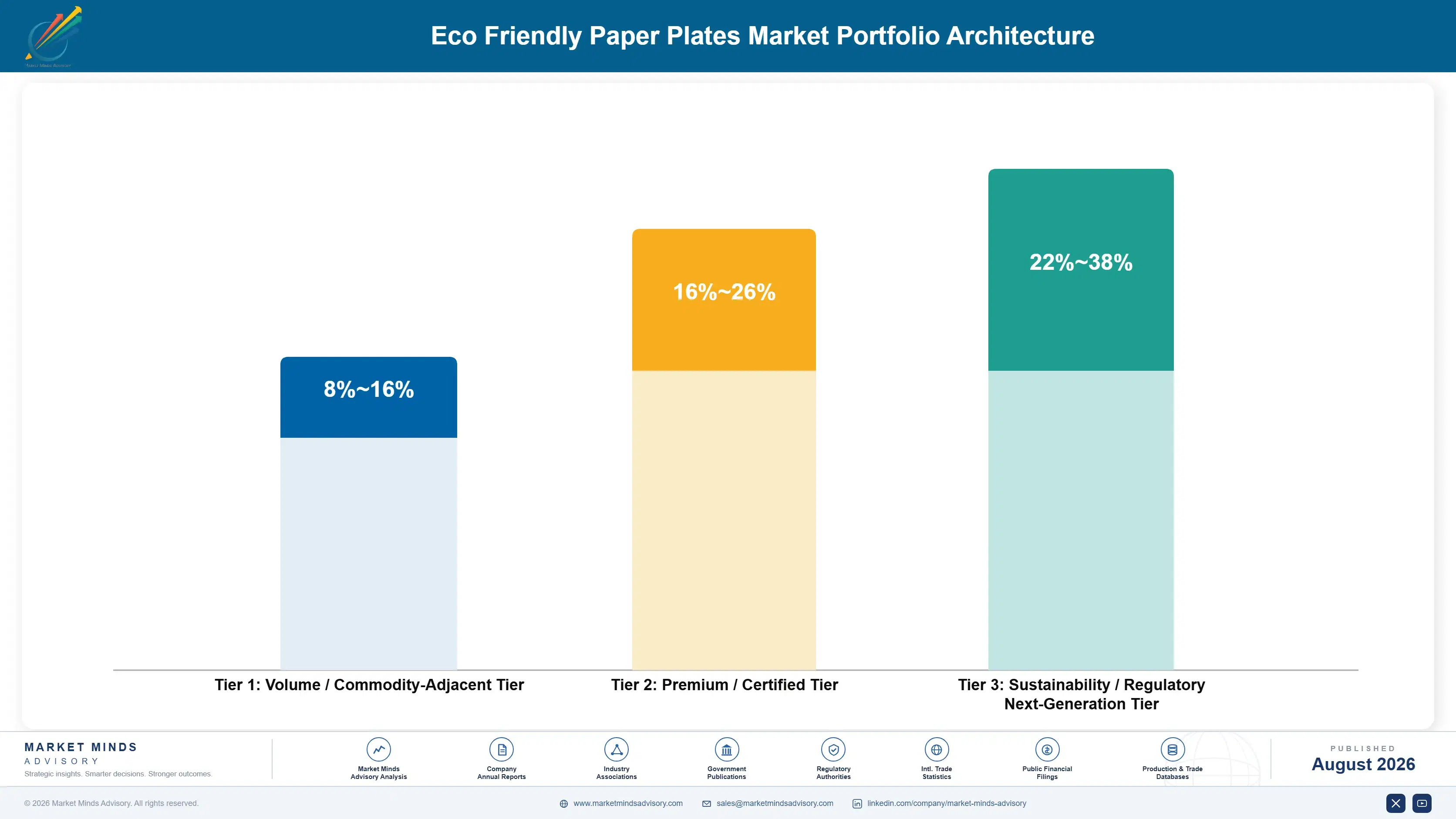
Portfolio Architecture for Margin Defence

The portfolio splits into three tiers with margin separation. Volume-tier products, uncoated kraft and clay-coated paperboard plates sold largely on price into commoditized institutional channels, compete hard and earn modestly. Premium certified products, covering bagasse, molded fiber, and bamboo plates carrying full compostability certification, earn more because certification and brand trust support pricing. Next-generation PLA-coated and natural leaf plates occupy the top tier, commanding t
The tension here is familiar to any commodity-adjacent sustainability category: volume kraft and paperboard products fund the manufacturing scale and distribution relationships premium certified products depend on, yet volume growth alone cannot fund the certification and branding investment next-generation products require. Manufacturers leaning too heavily into premium positioning risk losing the manufacturing scale that makes market entry viable in price-sensitive channels, while pure volume players cede the fastest-growing segment to rivals.

High-value pools concentrate where certification depth, brand recognition, and retail access intersect: environmentally conscious consumers and corporate buyers willing to pay for verified, documented compostability. That intersection is still a minority of shipment volume globally but expanding quickly, which is why the next-generation tier grows fastest even while representing a modest share of volume today.

Volume / Commodity-Adjacent Tier

Uncoated kraft and clay-coated paperboard plates sold largely on price into commoditized institutional catering and quick-service channels, competing directly against conventional plastic tableware on cost alone across most price-sensitive global markets.
Gross Margin: 8%-16%

Premium / Certified Tier

Bagasse, molded fiber, and bamboo plates carrying full ASTM D6400 or EN 13432 compostability certification, sold to foodservice and retail buyers willing to pay for documented, verified environmental performance across major markets.
Gross Margin: 16%-26%

Sustainability / Regulatory / Next-Generation Tier

PLA-coated and natural leaf plates representing the technology and positioning frontier, priced at a premium justified by grease resistance, zero-chemical processing, or direct-to-consumer brand recognition across premium retail channels worldwide.
Gross Margin: 22%-38%
eco-friendly-paper-plates-market-portfolio-architecture-1787300697563

High-value Sub-segments and Strategic Watch-out

PLA and Bio-Based Coated Plates

The fastest-growing and highest-margin segment, expanding at 11.2% as foodservice chains specify certified compostability over simple biodegradability claims regulators increasingly reject. Manufacturers with early certification and locked feedstock supply capture the majority of this segment's premium pricing globally, well ahead of slower-moving competitors still relying on generic biodegradability claims alone.
Gross Margin: 22%-38%

Areca Leaf and Palm Leaf Plates

High value with strong growth as zero-chemical, unprocessed positioning appeals to premium retail buyers, though overall expansion trails PLA-coated products since leaf-based manufacturing remains inherently more labor-intensive and harder to scale quickly at volume across most producing regions worldwide, especially during peak seasonal harvest windows.
Gross Margin: 20%-34%

Bagasse and Molded Fiber Plates

The volume core by shipment, covering the bulk of institutional and quick-service demand worldwide, generating steady but moderate margins as certification becomes table stakes rather than a genuine differentiator across nearly every mature market tracked here in this year's full segmentation review and competitive analysis.
Gross Margin: 16%-26%

Clay-Coated Paperboard Plates

The strategic watch-out, as buyers increasingly favor bagasse and molded fiber over clay-coated paperboard for genuine compostability credentials, leaving this legacy category shrinking steadily even as total paper plate volume keeps expanding across most markets tracked in this year's full report and ongoing competitive review process.
Gross Margin: 8%-14%

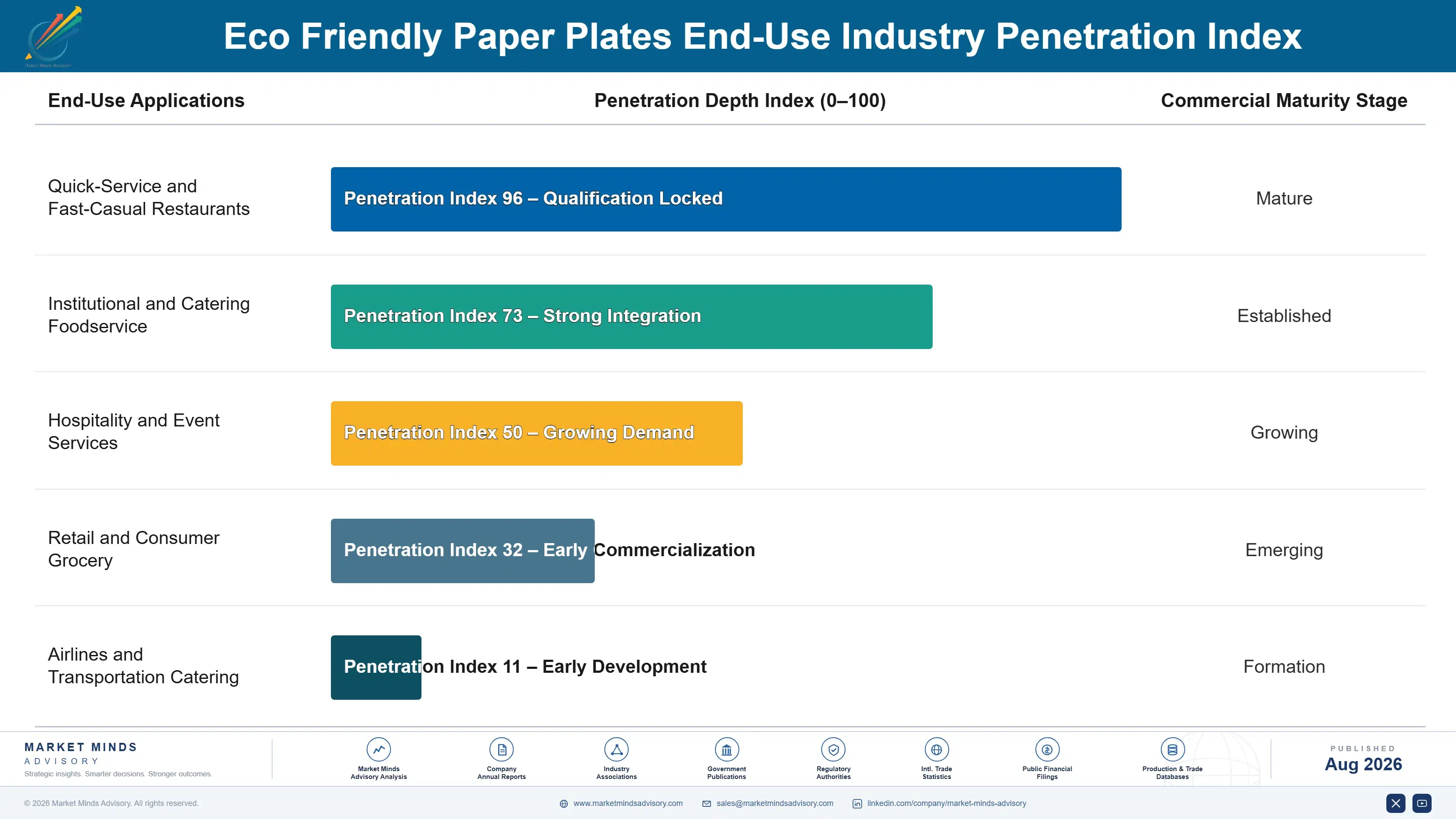
How Compostable Tableware Demand Commits

Demand here commits through recurring institutional purchasing rather than one-time capital decisions. A foodservice operator that switches to certified compostable tableware typically signs a multi-year supplier agreement covering repeat consumable purchasing, since disposable tableware is consumed continuously rather than installed once. That recurring-purchase structure, more than any single regulatory event, makes this market behave like a consumables annuity once a buyer converts away from
Adoption depth varies sharply by buyer type. Quick-service and fast-casual restaurant chains adopt fastest once regulation or corporate policy mandates the switch, since standardized menus and centralized procurement make conversion straightforward across many locations simultaneously. Institutional catering, hospitals, schools, and corporate cafeterias adopt more gradually, often constrained by budget cycles and existing supplier contracts that renew on multi-year schedules. Individual consumer and event purchasing occupies a smaller but fast-growing position, particularly for premium branded and natural leaf products sold through retail channels.

Younger foodservice operators and procurement managers increasingly research certification standards and supplier sustainability credentials directly rather than relying entirely on distributor recommendations that previous purchasing generations accepted without independent verification. That shift is pushing manufacturers toward more transparent certification documentation, even though distributors remain the actual purchasing channel for most institutional transactions today.
eco-friendly-paper-plates-market-end-use-penetration-index-1787300698053

Where This Market Rewards Certification

These are among the four positions where our research anticipates prominent divergence between winners and laggards over the coming forecast period. Each is grounded in the demand model, the regulatory perimeter, and the announced capacity pipeline.
01 / CERTIFICATION AND COMPLIANCE STRATEGY

Winners will complete certification before enforcement forces it

Product differentiation on material alone is becoming difficult to sustain, since most manufacturers can eventually match a given fiber blend or coating formulation within a few product cycles. What actually separates winners is the speed of completing documented compostability certification across major jurisdictions, because a genuinely compostable product without certification cannot be sold into procurement channels increasingly requiring documented proof. Manufacturers building dedicated certification and regulatory affairs capability, rather than treating it as an afterthought, will out-earn technically comparable rivals over the coming decade.
02 / REGIONAL MANUFACTURING STRATEGY

Local production footprint will decide import cost competitiveness

Trade and shipping cost, not raw manufacturing cost alone, increasingly determines which manufacturers can compete profitably in the largest ban-driven consumption markets across North America and Western Europe specifically. Manufacturers who build regional production capacity early will capture cost advantages that purely import-dependent competitors cannot match, regardless of how competitive their underlying unit economics might otherwise appear on paper today under current trade conditions. Those relying entirely on long-distance Asian imports will find themselves increasingly undercut on landed cost within this decade.
03 / BRAND AND CHANNEL DEVELOPMENT

Direct retail branding will matter more than bulk shipment volume

Manufacturers still competing purely on bulk institutional price per unit are leaving durable margin on the table that branded direct-to-consumer retail and e-commerce channels already capture successfully for positioning-forward competitors. These premium retail channels persist independent of the institutional procurement cycles that otherwise define this market's thin, competitive commodity pricing pattern across most regions. Companies that build genuine brand and retail channel capability early will earn materially more per unit sold over a decade than those still selling only bulk institutional volume.
04 / COMPOSTING INFRASTRUCTURE ACCESS

Municipal infrastructure gaps will constrain growth more than demand

Even where regulatory mandate and buyer willingness align favorably for a given manufacturer, realized environmental and reputational benefit is capped by municipal composting infrastructure access, a constraint that manufacturers alone cannot directly control or expand meaningfully today. Manufacturers who invest in municipal partnership programs and consumer education alongside product sales will differentiate on realized outcomes rather than theoretical compostability claims that critics increasingly scrutinize. This constraint will matter more to genuine category credibility over the next decade than any single certification standard alone.

Engagement Snapshot From the Field

A live engagement with an industry participant carrying material or product regulatory and market exposure ahead of a defining policy shift, showing how our research translates into a defensible multi-year portfolio strategy.
MARKET MINDS ADVISORY · CLIENT ENGAGEMENT SUMMARY
Eco Friendly Paper Plates Producer Strategic Portfolio Review and Transition Roadmap 2026·Investment Scenario on Eco Friendly Paper Plates Exposure Evaluation 2025-26
CLIENT PROFILE
A regional quick-service restaurant chain operating across several US states approached MMA while evaluating a full transition from plastic-coated paper tableware to certified compostable alternatives ahead of a state-level plastic ban taking effect. The client reported annual tableware procurement spend near USD 12 million, with roughly 40% of locations already operating in jurisdictions with active or pending single-use plastic restrictions (client-reported, unverified by MMA).
STRATEGIC CHALLENGE
Leadership needed to select a certified compostable supplier before the ban deadline but faced meaningfully higher per-unit cost than the chain's existing plastic-coated supplier, with no clear internal model for how much of that cost increase could reasonably be passed through to customers without measurably affecting overall order volume across locations.
MMA APPROACH
MMA benchmarked pricing across four certified compostable suppliers, modeled price pass-through scenarios against comparable chains that had already completed similar transitions, and interviewed operations leads at three peer restaurant chains on real-world customer response to modest menu price adjustments following recent supplier transitions of comparable scope, scale, and regional timing.
KEY FINDINGS
  1. Comparable chains that completed similar transitions passed through roughly 60% of the added tableware cost via modest menu price increases without measurable order volume impact (client-reported, unverified by MMA).
  2. Certification breadth varied meaningfully across the four suppliers evaluated, with only two holding both ASTM D6400 and EN 13432 certification needed for the client's eventual multi-state expansion plans.
  3. Locking a two-year supply agreement immediately, rather than negotiating annually, secured pricing roughly 6% below the best available annual-contract alternative from the same supplier.
  4. Customer survey data from comparable chains showed sustainability messaging around the transition itself modestly improved brand perception among younger customer segments specifically.
CLIENT PROFILE
A regional quick-service restaurant chain operating across several US states approached MMA while evaluating a full transition from plastic-coated paper tableware to certified compostable alternatives ahead of a state-level plastic ban taking effect. The client reported annual tableware procurement spend near USD 12 million, with roughly 40% of locations already operating in jurisdictions with active or pending single-use plastic restrictions (client-reported, unverified by MMA).
STRATEGIC CHALLENGE
Leadership needed to select a certified compostable supplier before the ban deadline but faced meaningfully higher per-unit cost than the chain's existing plastic-coated supplier, with no clear internal model for how much of that cost increase could reasonably be passed through to customers without measurably affecting overall order volume across locations.
MMA APPROACH
MMA benchmarked pricing across four certified compostable suppliers, modeled price pass-through scenarios against comparable chains that had already completed similar transitions, and interviewed operations leads at three peer restaurant chains on real-world customer response to modest menu price adjustments following recent supplier transitions of comparable scope, scale, and regional timing.
KEY FINDINGS
  1. Comparable chains that completed similar transitions passed through roughly 60% of the added tableware cost via modest menu price increases without measurable order volume impact (client-reported, unverified by MMA).
  2. Certification breadth varied meaningfully across the four suppliers evaluated, with only two holding both ASTM D6400 and EN 13432 certification needed for the client's eventual multi-state expansion plans.
  3. Locking a two-year supply agreement immediately, rather than negotiating annually, secured pricing roughly 6% below the best available annual-contract alternative from the same supplier.
  4. Customer survey data from comparable chains showed sustainability messaging around the transition itself modestly improved brand perception among younger customer segments specifically.
RECOMMENDED STRATEGY
Phase 1: Phase 1 (0 to 3 months): Select the certified supplier with the broadest multi-jurisdiction certification and lock a two-year supply agreement immediately. Phase 2: Phase 2 (3 to 9 months): Roll out the transition across ban-affected locations first, pairing it with modest, clearly communicated menu price adjustments. Phase 3: Phase 3 (9 to 24 months): Expand the transition chain-wide ahead of anticipated additional state bans, capturing early-mover sustainability positioning.
OUTCOME
The client selected the recommended supplier and completed the transition across ban-affected locations on schedule, passing through approximately 55% of added cost via a modest menu price adjustment with no measurable order volume decline. The client reported the sustainability transition modestly improved customer satisfaction scores in post-transition surveys (client-reported, unverified by MMA).

Frequently Asked Questions

Foundational context covering the market sizes, CAGR, scope, country, region and competition that inform every finding below. This section is provided to cover basics and most often pre-purchase conversations, answered from the MMA Primary Research Dataset.

What is the current size of the Eco Friendly Paper Plates Market?

The market stood at USD 3.4 billion in 2025, based on MMA Primary Research Dataset findings. Plastic bans and corporate sustainability commitments continue driving conversion away from conventional plastic tableware.

How large will the Eco Friendly Paper Plates Market be by 2036?

MMA projects the market will reach USD 7.01 billion by 2036 under the base case scenario, representing roughly 1.93 times the 2026 opening value across the eleven-year forecast period.

What is the CAGR for the Eco Friendly Paper Plates Market 2026 to 2036?

The base case CAGR is 6.8% annually. MMA's bull scenario reaches 8.0% while the bear scenario, reflecting slower certification and infrastructure buildout, runs closer to 5.6%.

Which segment is growing fastest?

PLA and bio-based coated plates lead at 11.2% CAGR, roughly 1.65 times the overall market rate, as foodservice chains increasingly specify certified compostability over simple biodegradability.

Who are the major companies in the Eco Friendly Paper Plates Market?

Huhtamaki, Duni Group, Pactiv Evergreen, BioPak, and Vegware lead the market, together controlling an estimated 34% of shipment volume on a consistent basis across the full profiled participant set.

Which country is growing fastest?

India posts the fastest national growth at 14.5% CAGR, driven by its 2022 national plastic ban and dominant position in areca leaf and bagasse raw material supply.

Report Segmentation Architecture

The full report scope spans multiple orthogonal segmentation dimensions, with cross-tabulated demand data provided for each dimension pair. Coverage extends further to regional breakdowns, trend trajectories, and the competitive detail needed to support segment-level decision-making.

By Material and Construction Type

  • Uncoated Kraft Paper Plates
  • Clay-Coated Paperboard Plates
  • Bagasse and Molded Fiber Plates
  • PLA and Bio-Based Coated Plates
  • Bamboo Fiber Plates
  • Areca Leaf and Palm Leaf Plates

By End-Use Industry

  • Quick-Service and Fast-Casual Restaurants
  • Institutional and Catering Foodservice
  • Hospitality and Event Services
  • Retail and Consumer Grocery
  • Airlines and Transportation Catering

By Commercial Dimension

  • Foodservice Distributor Channel
  • Direct Retail and E-Commerce
  • Institutional and Government Procurement
  • Corporate Sustainability Contract Channel

By Region

  • North America
  • Western Europe
  • East Asia
  • South Asia and Pacific
  • Latin America
  • Middle East and Africa
  • Eastern Europe

Scope, Methodology, and Coverage

Every figure in this report is reproducible from documented input assumptions. The scope below maps the historical period, the forecast horizon, the segmentation dimensions, and the countries covered, alongside the underlying primary and qualitative methodology.
Historical Period
2020 to 2025
Forecast Period
2026 to 2036
Base Year
2025 (USD billions; MMA Primary Research Dataset, August 2026)
Market Definition
The eco-friendly paper plates market covers disposable foodservice plates manufactured from paper, molded fiber, bagasse, bamboo, and natural leaf materials intended for compostable or biodegradable end-of-life disposal. It excludes conventional plastic and polystyrene tableware, reusable ceramic and melamine plates, and laminated plastic-coated paper plates not certified compostable.
Quantitative Units
USD billions (current prices); unit shipment volume in billions of plates where applicable
Segmentation Dimensions
By Material and Construction Type; By End-Use Industry; By Commercial Dimension; By Region
Regions Covered
North America, Western Europe, East Asia, South Asia and Pacific, Latin America, Middle East and Africa, Eastern Europe
Countries Covered
USA, China, Germany, France, UK, Japan, South Korea, India, Australia, Canada, Brazil, Mexico, Indonesia, Vietnam, Thailand, Malaysia, UAE, Saudi Arabia, South Africa, Nigeria, Turkey, Poland, Netherlands, Italy, Spain, Sweden, Switzerland, Argentina, Colombia, Singapore, and additional markets relevant to this sector
Key Companies Profiled
Huhtamaki Oyj, Duni Group AB, Pactiv Evergreen Inc., BioPak Pty Ltd, Vegware Ltd, Genpak LLC, Eco-Products Inc., Fabri-Kal Corporation, World Centric, Detmold Group, Solia SAS, Stalk Market LLC, Green Wave Enviro Tech Industries Ltd., Yash Papers Ltd., Ecoware India Pvt. Ltd., Hotpack Global, Biopac India Corporation Ltd., Sabert Corporation, Novolex Holdings LLC, Georgia-Pacific LLC
Quantitative Methodology
Primary survey, n=3,800 respondents, Q4 2025, six countries; demand-side model with trade association cross-validation
Qualitative Methodology
47 expert interviews, Q4 2025; applied to validate demand model assumptions, identify emerging dynamics, and assess competitive positioning
Report Format
PDF and XLSX data workbook (Word format preview document)
Publisher
Market Minds Advisory
Report Code
MMA-2026-PAC-118
Published
August 2026
Contact
sales@marketmindsadvisory.com | www.marketmindsadvisory.com

Purchase the full Eco Friendly Paper Plates Market Report (2026 to 2036).

The full MMA Eco Friendly Paper Plates report sizes the market across six material and construction categories, five end-use verticals, four commercial channels, and seven regions through 2036. It profiles 20 participants on a consistent shipment volume basis, scoring the top five on certification breadth, manufacturing footprint, and brand positioning. Scenario models quantify how plastic ban expansion, certification enforcement, and composting infrastructure investment move both demand and realizable pricing. The report also includes delivered-cost modelling by material category, a regional ban and certification policy tracker, and a competitive benchmarking tool built for manufacturer strategy, foodservice procurement, and investor due diligence teams.
Six-category material segmentation with regional cross-tabulation
Ban and certification policy tracker across twelve major markets
Competitive benchmarking on consistent shipment volume basis
Delivered-cost modelling by material category and region
Scenario models for ban expansion and certification enforcement
Composting infrastructure access analysis by region

Built For The People Who Decide

From boardroom strategy to bench-side execution, this report is read cover-to-cover by leaders shaping the next decade of their industry, turning demand scenarios, market dynamics and valuation benchmarks into decisions.
CXOs/ Presidents/ VPs/ Managers
M&A and Corporate Development
Strategy Teams and R&D Heads
Procurement and Product Directors
Regulatory and Compliance Leaders
Investor Relations and Equity Analysts