Market Minds Advisory
Echo Sounders Market

Echo Sounders Market: Mapping A Seabed That Is Mostly Still Unmapped

Roughly three quarters of the ocean floor has never been surveyed to modern resolution, and crewed vessels will not close that gap. The instrument has to change before the map does.

Lead Analyst

David Horsley

Published

September 2026

Make Smarter Decisions with Customized Research Insights

Request a free sample report and evaluate market opportunities, growth trends, and competitive dynamics relevant to your business needs.

2025 MARKET VALUE$1.3BMarket Size 2025
2036 FORECAST VALUE$2.5BBase Case , 2026 to 2036
CAGR 2026 TO 20366.1 %Bull 7.4% / Bear 4.9%
INCREMENTAL OPPORTUNITY$1.1BNet 10- year value creation
EXPANSION MULTIPLE1.81x2036 value over 2026 base
Strategic Levers
M&A Pipeline
Regional Outlook
Country Rankings
Competitive Intelligence
Segmental Deep-dive
Call-Us : 91 93563 13602

Executive Snapshot and Market Trajectory

About 27% of the ocean floor has been surveyed to modern resolution, and the rest is guesswork interpolated from satellite gravity data. Closing that gap with crewed survey vessels is simply not affordable at any scale. The market is worth USD 1.3 billion in 2025 and grows at 6.1%.
Multibeam echo sounders grow fastest at 8.8%, roughly 1.44 times the market rate, on offshore wind site survey, cable route work, and uncrewed platforms needing a sounder able to run without an operator adjusting it. East Asia holds 34% of value, above the band this framework applies, because the world's largest fishing fleet and most of its shipbuilding both sit there. South Asia and Pacific takes 12%.
Concentration reaches 58% across the top five, with survey-grade acoustics held by a very small group while the recreational and fishing end of the market stays considerably more crowded. Competition turns on data quality at speed, on integration with positioning and motion reference sensors, and increasingly on sheer power draw. An autonomous vessel simply cannot carry the electrical load that a crewed survey ship never had to think about at all.
Market Definition
The echo sounders market covers acoustic instruments that measure water depth and image the seabed or sub-seabed from surface and subsurface platforms, spanning multibeam, single-beam survey, sub-bottom profiling, fisheries, and navigation echo sounders together with their transducers, processing units, and acquisition software. Side-scan sonar, forward-looking navigation sonar, acoustic positioning systems, current profilers, sub-sea communications, and survey services sold as a deliverable are excluded.
Base Year Value
$1.3B in 2025 (MMA Primary Research Dataset, August 2026)
Forecast Period
2026 to 2036, eleven discrete annual values
CAGR
6.1% base case. Bull 7.4%. Bear 4.9%.
Fastest Growth Segment
Multibeam Echo Sounders: 8.8% CAGR
Fastest Growth Country
India: 9.4% CAGR
Fastest Growth Region
South Asia and Pacific: 8.2% CAGR
Largest Region
East Asia: 34% of 2025 global value
Market Leaders
Kongsberg Maritime, Teledyne Marine, Furuno, Navico Group, Wartsila ELAC Nautik. Source: MMA Primary Research Dataset, July 2026.
Primary Survey
n=3,800 procurement and R&D decision-makers, Q4 2025, six countries
Methodology
Demand-side build-up, cross-validated against public data, 47 expert interviews

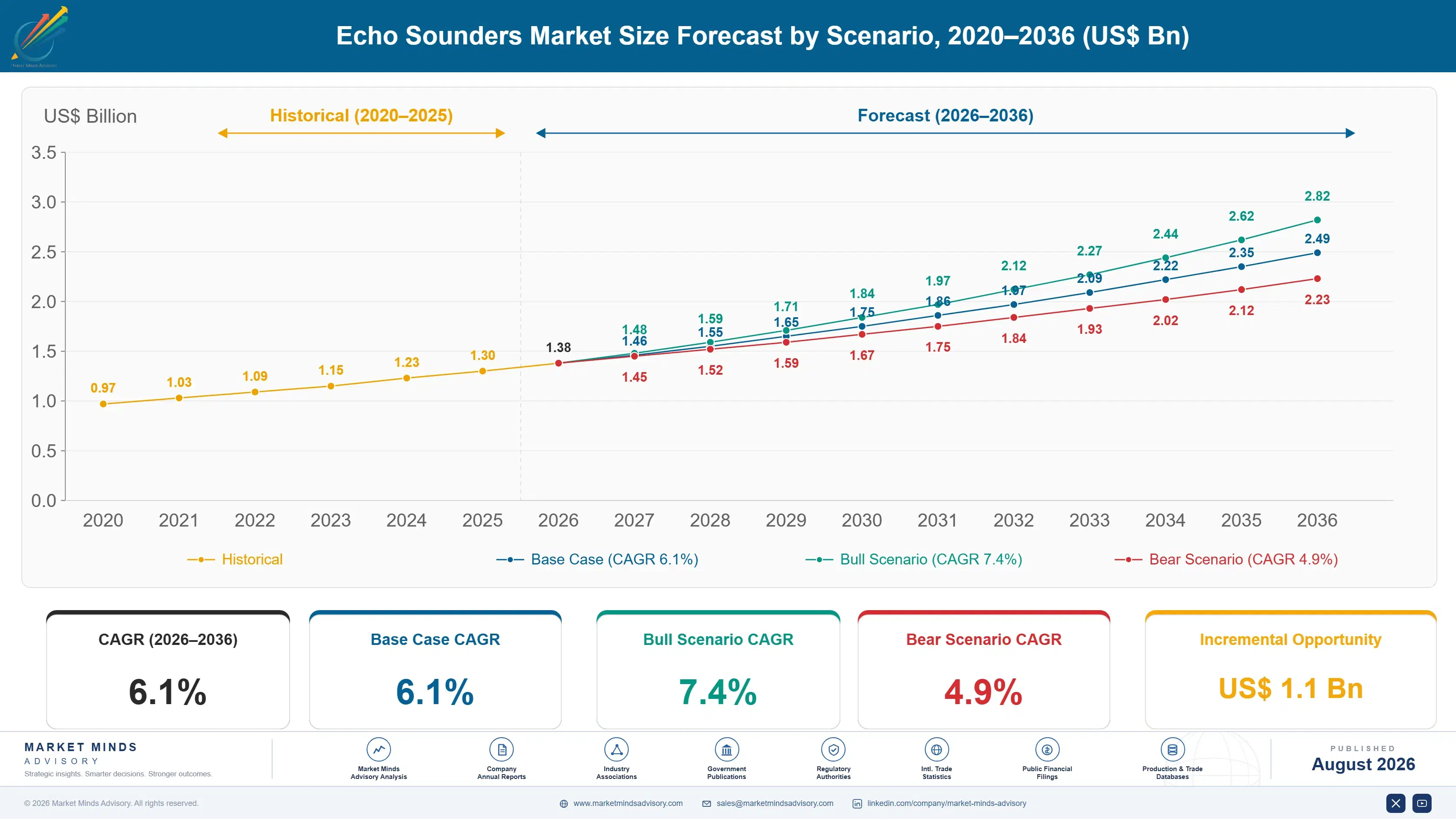
Echo Sounders Market Forecast Scenarios

echo-sounders-market-size-forecast-scenario-1787333769824
Between 2020 and 2025 the market split into two halves moving at different speeds. Navigation and fisheries equipment tracked shipbuilding and fleet renewal, which was flat to weak for most of the period. Survey equipment ran hard on offshore wind site investigation, subsea cable routing, and the first serious wave of uncrewed platform procurement. A 5.0% historical CAGR averages a static base with a genuinely fast-growing minority of it.
Three mechanisms carry the 6.1% base case. Offshore wind site and cable route survey is the largest, since every array requires bathymetry, sub-bottom profiling, and repeat monitoring across the whole asset life. Uncrewed surface vessel adoption is the second, opening survey work at cost points crewed vessels cannot reach. And Seabed 2030 keeps hydrographic offices funding acquisition that domestic priorities alone would never justify. Nothing else here is committed that far ahead.
The 7.4% bull case turns on uncrewed platform economics improving enough to make continuous seabed mapping routine rather than project-driven, which would multiply instrument demand rather than shift it. The 4.9% bear case is offshore wind deferral, since much of recent survey growth traces to a pipeline that has slipped repeatedly on cost and permitting grounds.

Most Of The Seabed Is Still A Guess

The ocean floor is less well mapped than the surface of Mars. Roughly 27% has been surveyed at a resolution anybody would call modern, and the remainder is interpolated from satellite gravity measurements that resolve features a few kilometres across at best. Every cable route, wind farm foundation, and deep-draught approach channel depends on filling that gap locally, one project at a time.
TOP FIVE CONCENTRATION58%Survey grade acoustics stay concentrated among a few established builders
NEWBUILD FITMENT RATE96%Merchant vessels leaving yards with mandated depth sounding equipment
AVERAGE SYSTEM PRICEUSD 240,000Configured survey multibeam before vessel integration and calibration work
SEABED MAPPED SHARE27%Portion of the ocean floor surveyed to modern resolution
UNCREWED PLATFORM SHARE14%Survey work now delivered from autonomous or remotely operated vessels
CALIBRATION INTERVAL12 monthsPeriod between required patch test and calibration verification
Crewed survey vessels cannot close it. Day rates, crew, and fuel put the cost of systematic mapping far beyond what any hydrographic office would fund, which is why uncrewed surface vessels have moved from demonstration to procurement so quickly. That shift changes what the instrument has to be: lower power, smaller, tolerant of a platform that pitches badly, and able to hold data quality with nobody aboard to adjust the gain.
Meanwhile the other half of this market barely moves at all. Navigation echo sounders are fitted because regulation requires them, fisheries units sell on fleet renewal cycles, and neither responds much to anything except shipbuilding volume. Suppliers serving both halves are running two businesses with almost nothing in common besides the underlying physics.
"The interesting engineering problem stopped being acoustic resolution years ago. It is now power budget and autonomy, because the platform carrying the sounder has no generator, no operator, and no patience for a system that needs babysitting."
Director, Marine Technology Practice · MMA Technology Practice ·

Market Trends

Uncrewed Platforms Rewrite The Instrument Specification

A survey vessel supplies unlimited power and an operator watching the data in real time. An uncrewed surface vessel supplies neither, and echo sounders designed around the first assumption struggle badly on the second. Manufacturers are redesigning for lower power draw, smaller transducer arrays, and processing that maintains data quality autonomously through motion and noise the operator would previously have compensated for. Roughly 14% of survey work now runs from uncrewed platforms and the share climbs every year, which is reshaping product roadmaps faster than resolution improvements ever did. Resolution improvements no longer decide anything.
Market Impact: Coverage rose from 6% to 27%
Offshore Wind Drives Repeat Survey Rather Than One-Off

A wind array is surveyed before construction, during installation, and repeatedly across its operating life to monitor scour around foundations and burial depth on export cables. That converts what used to be a single site investigation into a recurring monitoring programme running twenty-five years. Developers and cable owners now buy or charter equipment rather than commissioning surveys occasionally, and the specification emphasises repeatability between campaigns over absolute resolution. It is a considerably better revenue profile than project-driven survey work ever offered suppliers. Charter arrangements are giving way to owned equipment on these programmes.
Market Impact: Cable installations exceed 100 annu

Market Opportunities and Growth Drivers

Seabed 2030 Sustains Hydrographic Office Procurement

The Nippon Foundation and GEBCO Seabed 2030 project has set a target of mapping the entire ocean floor, and it has given national hydrographic offices a framework for funding acquisition that domestic priorities alone would not justify. Coverage has risen substantially since the programme began, largely through pooling existing data and through targeted new survey in poorly covered regions. The programme also standardises data formats, which raises the value of equipment producing compliant output. It is the closest thing this market has to committed public demand. No other source of demand here is committed in the same way.
Market Impact: Survey fleet averages 22 years

Subsea Cable Construction Requires Route Survey Everywhere

Transoceanic data cables and interconnectors are being laid at a pace driven by data centre buildout and by grid connections between countries, and every route needs bathymetry and sub-bottom profiling before a single kilometre is installed. Burial depth assessment requires sediment characterisation that only sub-bottom profiling delivers. Repair and reroute work adds further demand on cables already in service. This is survey demand that follows digital infrastructure investment rather than the marine cycle, which makes it usefully uncorrelated with everything else here. Data centre buildout now sets the pace of it.
Market Impact: Processing takes 3 times acquisitio

Market Restraints and Challenges

Survey Vessel Availability Caps Deliverable Capacity

Instrument demand is limited by the platforms available to carry it, and the crewed survey fleet is old, fully booked in season, and expensive to expand. The root cause is that a survey vessel is a specialist asset with poor utilisation outside campaign windows, so owners have not ordered replacements at replacement rate. Commercially this caps how much equipment the market can absorb regardless of the mapping backlog. Participants are mitigating by supplying uncrewed platforms directly, by supporting portable systems fitted to vessels of opportunity, and by hiring equipment rather than selling it.
Market Impact: Uncrewed platforms carry 14% of wor

Data Processing Bottleneck Delays Project Delivery

Modern multibeam systems generate data faster than anybody can clean, validate, and turn it into a chart, and the processing backlog often exceeds the acquisition time by several multiples. The root cause is that noise rejection and quality control still require experienced judgement that automation handles inconsistently. Commercially it slows project delivery, frustrates clients, and caps how much survey a given team can complete in a season. Mitigation is running toward automated cleaning algorithms, cloud processing, and edge processing that rejects bad soundings before they ever reach storage. Very little of that judgement has been successfully automated.
Market Impact: Arrays require 25 years monitoring
3 additional market trends, 2 additional growth drivers, and 4 additional restraints and challenges are covered in the full report. Contact sales@marketmindsadvisory.com to access the complete intelligence.

Segment CAGR and Growth Architecture

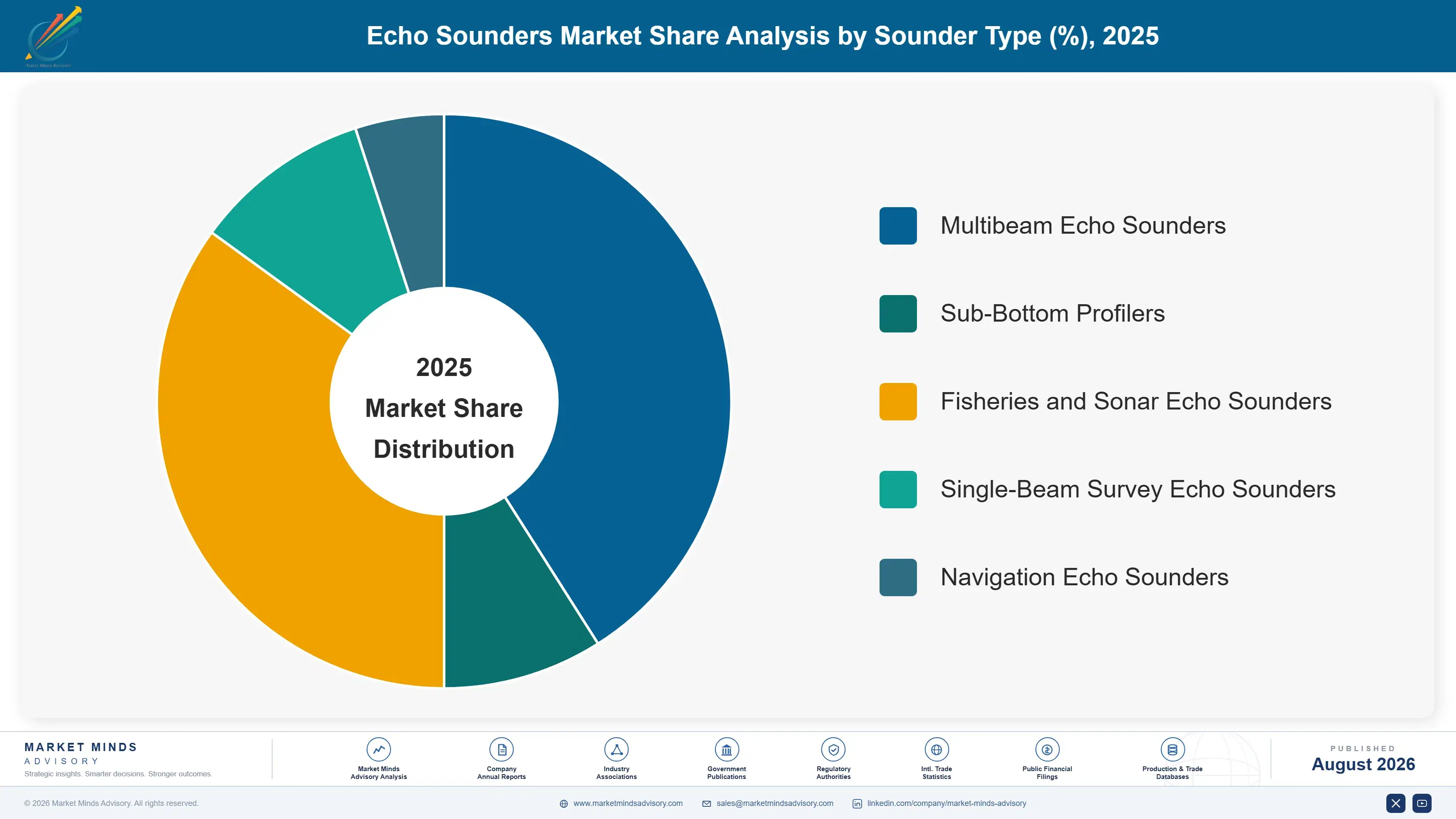
Segmentation follows sounder type, meaning the acoustic architecture of the instrument itself, because that determines the coverage achieved on each pass, the resolution it delivers, the platform it can be fitted to, and the price band it occupies. Platform, end-use, and sales channel are handled in the framework rather than treated as segments here.
echo-sounders-market-market-share-analysis-1787333770356

Multibeam Echo Sounders

Multibeam grows fastest at 8.8%, roughly 1.44 times the market rate, because a fan of beams maps a swathe rather than a line and that is the only way the mapping backlog gets addressed at all. Offshore wind site investigation, cable route survey, and port approach maintenance all specify it as standard now. The interesting change is platform rather than acoustics: uncrewed surface vessels need systems that draw a fraction of the power a survey ship supplies and hold data quality without an operator watching. Manufacturers who redesigned for that constraint early are taking share from those still selling ship-scale hardware. Ship-scale hardware is becoming a shrinking part of the addressable market.
CAGR 8.8%

Sub-Bottom Profilers

Sub-bottom profilers grow at 7.2%, imaging sediment layers beneath the seabed rather than the surface itself, which is what cable burial assessment and foundation design actually require. A multibeam survey tells a developer the depth; it says nothing about whether the seabed will accept a monopile or hold a buried cable. Offshore wind and subsea cable work have therefore pulled this segment along with multibeam rather than competing against it. Parametric systems have improved resolution considerably in shallow water, which is where most renewable and cable work happens, and that has widened the addressable base. Very few projects now specify one without the other alongside it. Foundation design depends on it entirely.
CAGR 7.2%
Full segment breakdown across 7 segments available in the complete report.

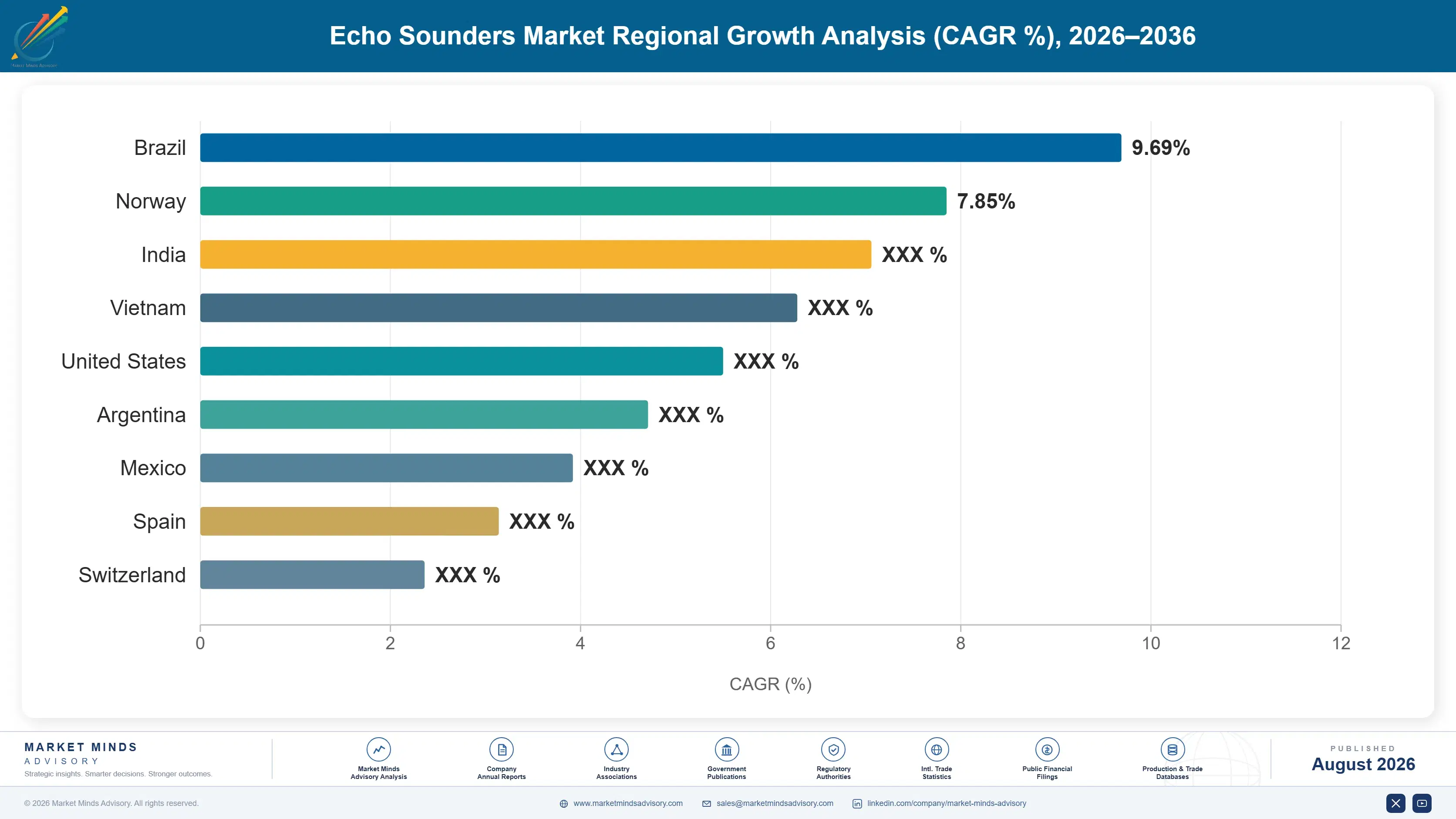
Regional Architecture and Country Demand Map

Regional shares here follow vessels rather than coastline length. Fishing fleet size, merchant tonnage under construction, and offshore project activity are the three things that decide where echo sounders actually get bought, and all of them concentrate very differently from where the unmapped survey backlog sits.

East Asia

East Asia takes 34% of value against a 30% ceiling in this framework, and vessel numbers explain the breach entirely. China operates the largest fishing fleet in the world by a wide margin, and Chinese, Korean, and Japanese yards build most of the merchant tonnage delivered each year, every hull of which leaves with mandated depth sounding equipment fitted. Japanese manufacturers hold strong positions in fisheries and navigation equipment globally. Chinese survey activity has expanded quickly on port development and on offshore wind buildout in Jiangsu and Guangdong. Growth at 6.8% exceeds the global rate on that combination of fleet renewal and survey demand together. Domestic manufacturers supply a rising share of it.
Share: 34% | CAGR: 6.8% (2026 to 2036)

South Asia and Pacific

Fastest growth sits in South Asia and Pacific at 8.2%, on 12% of global value. Indian hydrographic survey activity has expanded substantially under port modernisation and coastal mapping programmes, and naval procurement adds a further demanding stream. Australian survey work covers an enormous exclusive economic zone with very poor existing coverage, which makes it a natural early adopter of uncrewed platforms. Southeast Asian fishing fleets are large and renewing steadily. Very little of this demand is replacement of modern equipment, which is why the regional rate runs well above the global figure across the forecast. Uncrewed adoption is running ahead of most other regions here. Coverage gaps are enormous. Budgets are rising with them.
Share: 12% | CAGR: 8.2% (2026 to 2036)
Regional intelligence for 5 additional markets available in the complete report: Western Europe, North America, Latin America, Middle East and Africa, Eastern Europe. Contact sales@marketmindsadvisory.com.
echo-sounders-market-country-cagr-analysis-1787333770875

Where Echo Sounder Margin Actually Sits

Hardware pricing on echo sounders has been under pressure for a decade and nothing is going to reverse that. The money is moving toward processing software that clears the bottleneck after acquisition, toward hire fleets serving a survey market short of platforms, and toward designing for autonomy before competitors finish arguing about whether it matters.

Sell Processing Software As Recurring Licence

Data cleaning and validation takes roughly three times as long as acquisition, and that bottleneck costs survey companies far more than the instrument ever did. Selling automated processing as an annual licence rather than bundling it into hardware creates recurring revenue worth 12% to 18% of system value each year, at software margins. It also locks the workflow, because a survey team trained on one processing chain will not switch it casually. Manufacturers still giving the software away with the box are funding their competitors' recurring revenue. Very few of them see it that way yet.
Market Impact: Licences yield 12 to 18 percent of

Hire Equipment Into A Platform-Constrained Market

Survey companies are limited by vessel availability and by seasonal campaign windows, which makes owning instruments for year-round use genuinely uneconomic for many of them. Hire fleets convert that into rental income yielding 30% to 45% of system value annually across a good season, and the equipment returns for redeployment. It also puts systems in front of operators who would never have specified them, which converts into purchases later. Fleet utilisation and calibration discipline decide whether this works or quietly loses money. Trials convert into purchases at a rate that surprises most operators.
Market Impact: Hire yields 30 to 45 percent of val

Design For Autonomous Platforms Before Competitors Do

An uncrewed surface vessel offers a fraction of the power a survey ship supplies and nobody aboard to tune anything, and instruments designed for the old assumption perform badly on the new one. Redesigning for low power draw, compact arrays, and autonomous quality control costs real development money and reaches roughly 14% of survey work today, rising every year. Suppliers who moved early are being specified into uncrewed platform builds at the design stage, which is a position competitors cannot buy back later. Retrofitting a ship-scale design toward autonomy rarely produces a competitive result.
Market Impact: Autonomous platforms already carry

Who Controls the Margin Pool

Concentration reaches 58% across the top five measured on echo sounder revenue, though that figure conceals two very different competitive situations. Survey-grade multibeam and sub-bottom profiling is held by a small group led by Kongsberg Maritime and Teledyne Marine, where acoustic engineering and calibration credibility take decades to build. Fisheries and recreational equipment is far more crowded, with Furuno and Navico strong and many smaller entrants competing on price.
Competition currently turns on data quality achieved at survey speed, on integration with positioning and motion reference units, and on power draw. That last one barely mattered five years ago and now decides uncrewed platform selection outright. Service and calibration network reach matters more than most suppliers acknowledge, because a system out of calibration cannot be used for chartable work.

Pressure is building from two directions. Uncrewed vehicle builders are integrating their own acoustics rather than buying complete systems, and processing software specialists are capturing value that instrument makers assumed came bundled with the hardware. Rankings will shift toward suppliers who own the whole acquisition and processing chain, which is a different capability set from the acoustic engineering that established the current order.
echo-sounders-market-company-positioning-matrix-1787333771395

Competitive Moat and Risk Dimensions

KONGSBERG MARITIME

Moat: Survey grade acoustic engineering depth

Kongsberg has developed multibeam and sub-bottom acoustics for decades and holds reference installations across national hydrographic offices and the major survey contractors. Chart-grade data has to be defensible to an authority, and a supplier whose systems already appear throughout accepted survey practice carries an evidentiary advantage that no specification comparison on paper can offset.
KONGSBERG MARITIME

Risk: Ship-scale design assumptions persist

The product heritage assumes a vessel supplying generous power and an operator monitoring acquisition, which is precisely the assumption uncrewed platforms break. Competitors designing from a low-power autonomous starting point can meet requirements Kongsberg has to engineer backwards toward, and uncrewed platform builders increasingly specify at design stage rather than selecting equipment afterwards.
TELEDYNE MARINE

Moat: Breadth across the acquisition chain

Teledyne supplies echo sounders, positioning, motion reference, and processing software across a portfolio assembled through years of acquisition, which lets a survey contractor source an entire integrated chain from one supplier with one support relationship. Integration risk between subsystems is a genuine operational problem in survey work, and removing it carries commercial value beyond any component comparison.
TELEDYNE MARINE

Risk: Integration across acquired product lines

A portfolio built by acquisition carries inconsistent interfaces, overlapping products, and support organisations that never fully merged, which surfaces exactly when a customer tries to use the breadth being sold. Competitors offering a narrower but genuinely coherent chain can win on operational simplicity, and survey contractors under schedule pressure value that more highly than catalogue depth.

Players Tracked

Prominent Players

Kongsberg Maritime
Teledyne Marine
Furuno
Navico Group
Wartsila ELAC Nautik

Other Key Players

Garmin
Raymarine
Airmar Technology
Japan Radio Company
Skipper Electronics
Exail
R2Sonic
Norbit
EdgeTech
Innomar Technik
Valeport
Syqwest
WASSP
Imagenex Technology
Klein Marine Systems

Recent Developments

FEBRUARY 2025

Manufacturer released low-power multibeam for uncrewed vessels

An echo sounder manufacturer released a multibeam system designed around the power budget of an uncrewed surface vessel, with a compact array and autonomous quality control replacing operator supervision. The design target was survey-grade data from a platform carrying no generator and nobody aboard to adjust anything.
Signal: Power budget rather than acoustic resoluti
AUGUST 2024

Hydrographic office contracted uncrewed fleet for coastal mapping

A national hydrographic office contracted a fleet of uncrewed surface vessels for systematic coastal mapping work, replacing an approach that had previously relied on chartering crewed survey vessels seasonally. The economics of continuous low-cost operation rather than any technical advantage drove the whole procurement decision.
Signal: Systematic mapping only becomes affordable
NOVEMBER 2024

Processing software specialist took share from instrument bundles

An independent processing software developer expanded its licensed base among survey contractors who had previously used only the software bundled in with their own acquisition hardware. Automated cleaning performance rather than licence price drove the switching, since processing time exceeds acquisition time by several multiples.
Signal: Value is migrating away from the instrumen

Transducers, Electronics, And Calibration

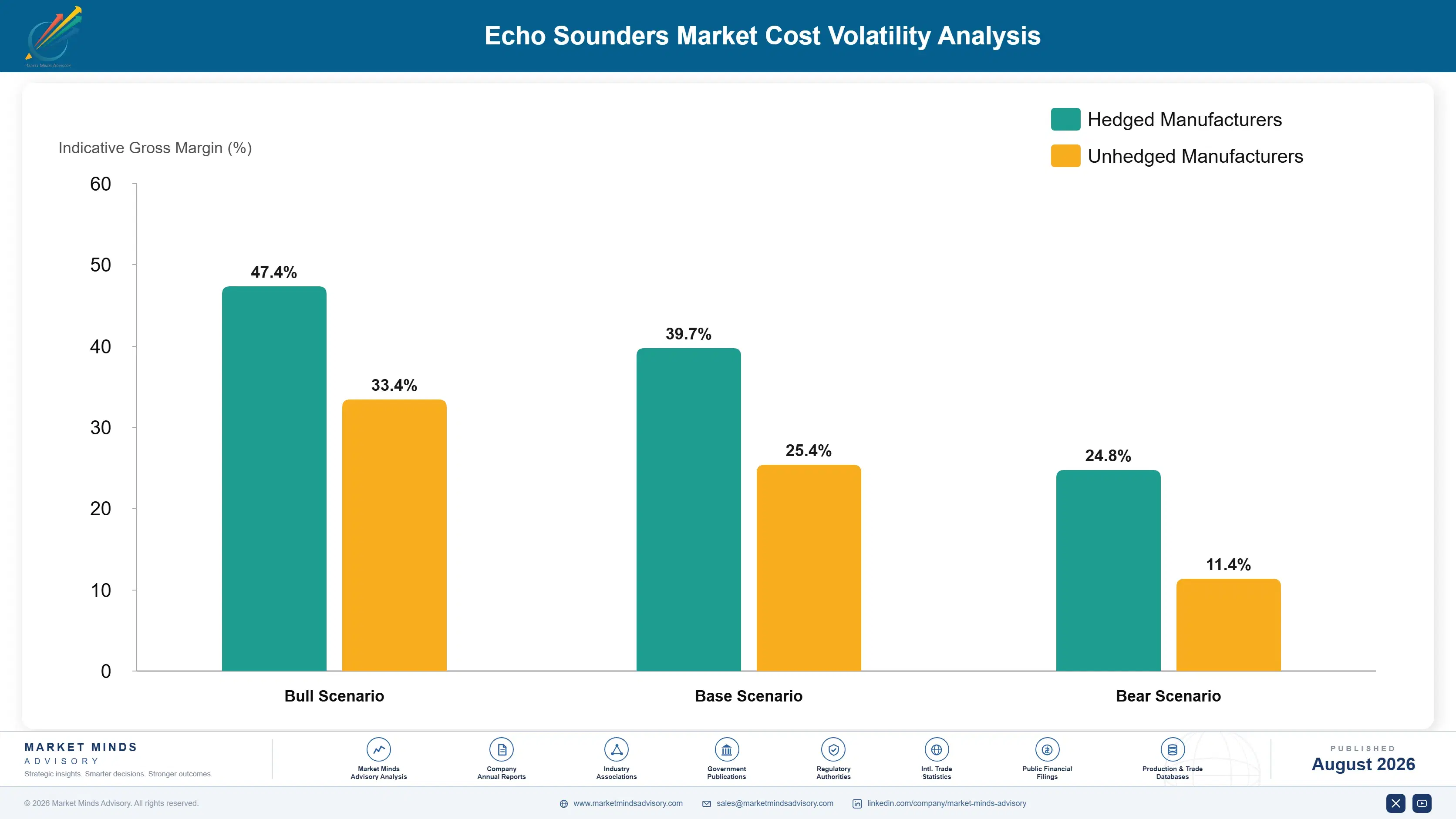
Piezoelectric ceramic elements and transducer array assembly carry roughly 28% to 36% of cost of goods, drawn from a narrow group of specialist producers in the United States, Europe, Japan, and China. Signal processing electronics, converters, and field programmable arrays add 22% to 28% from the general semiconductor chain. Titanium and composite housings, cabling, and calibration labour make up most of the remainder.
Semiconductor allocation through 2021 and 2022 hit this industry harder than its size warranted, because marine electronics volumes are far too small to command priority at foundries serving automotive and consumer customers. Lead times on converters and programmable logic ran past a year at the peak. Teledyne disclosed supply chain constraint and elevated component cost across that period, and manufacturers redesigned boards around whatever parts could actually be obtained.

Exposure divides by volume rather than by geography. Fisheries and recreational manufacturers ship enough units to hold allocation agreements and negotiate on component pricing. Survey instrument makers building tens or hundreds of units annually have almost no purchasing power and pay whatever the broker market asks. Piezoelectric ceramic supply is the more persistent worry, since qualified sources are few and material properties are not interchangeable.
echo-sounders-market-cost-volatility-analysis-1787333771590

Design boards around multi-sourced component families

Specifying converters and programmable logic from families with genuine second sources costs some board efficiency and removes the single-part exposure that stopped production lines through 2021. The engineering discipline is unglamorous and it has to be applied at design stage, because redesigning a qualified board under shortage pressure takes longer than the shortage usually lasts.

Qualify secondary piezoelectric ceramic suppliers early

Ceramic properties vary between producers enough to change array performance, so a second source has to be qualified through full acoustic characterisation rather than found during a disruption. The work costs test time and engineering attention upfront, and it removes an exposure that a single plant outage would otherwise turn into a complete production stop.

Pool component purchasing across product families

Survey instrument volumes are too small for meaningful purchasing power on their own, but a manufacturer covering fisheries, navigation, and survey lines can consolidate common electronics across all of them. That aggregation reaches allocation thresholds no single line would meet. The constraint is engineering standardisation, which product teams resist until a shortage makes the argument for them.

Portfolio Architecture for Margin Defence

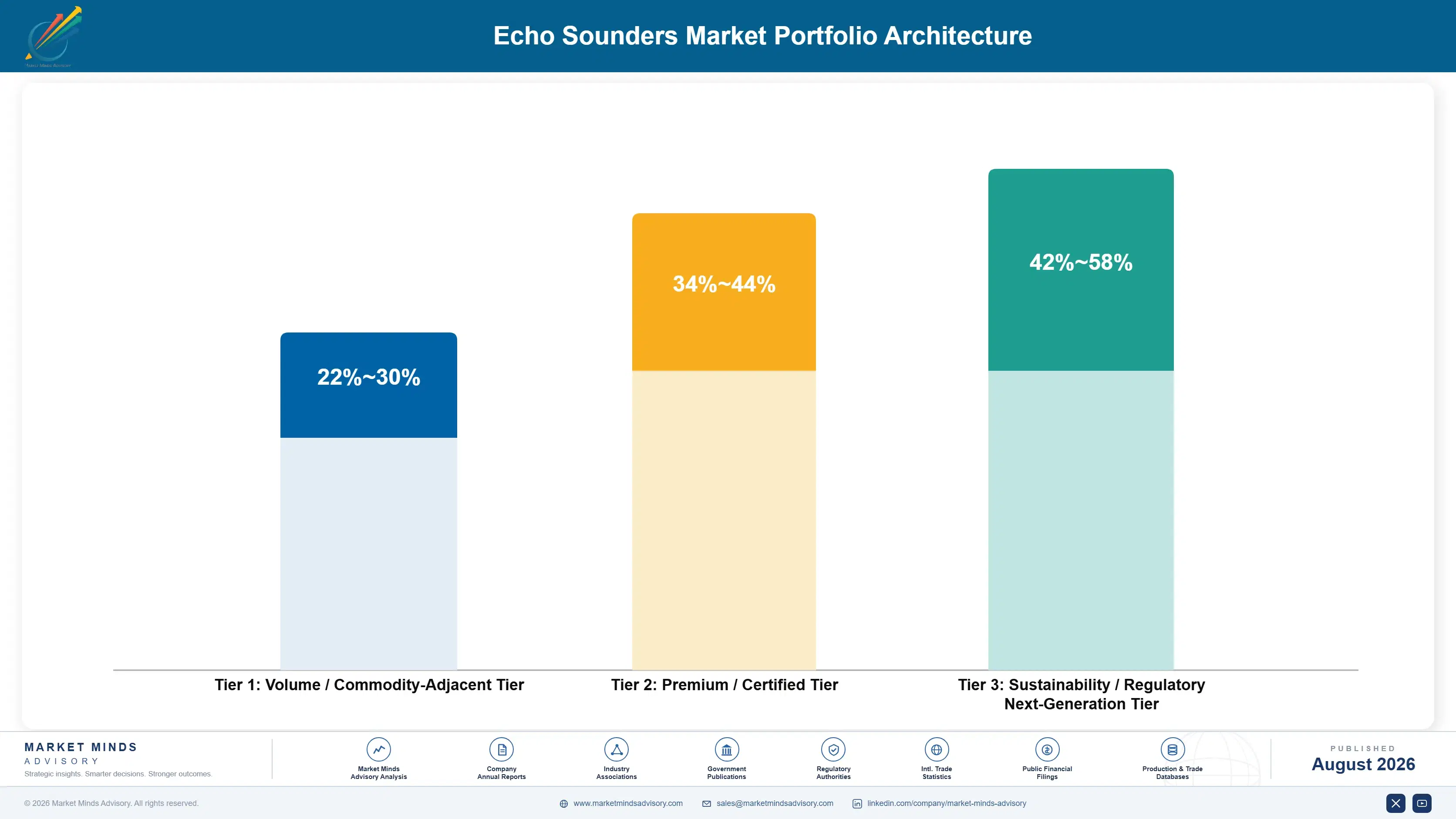
Margin here tracks how defensible the data has to be. Recreational and small fisheries units compete on price and on features against a very crowded field, and pricing shows it plainly. Survey-grade systems producing data that must satisfy a hydrographic authority face a narrow competitor set, long qualification histories, and buyers who care considerably more about calibration credibility than they do about purchase price.
The volume tension is between two businesses that share only physics. Fisheries and navigation equipment ships in quantity, funds the electronics purchasing scale that survey volumes could never reach alone, and grows with shipbuilding. Survey equipment ships in tens and hundreds, carries the margin, and grows with offshore projects. Suppliers holding only one of the two are permanently disadvantaged, on cost or on margin respectively.

High-value pools sit in three places. Processing software licensed annually rather than bundled with the hardware, hire fleets serving a survey market short of platforms, and instruments designed specifically for uncrewed operation. None of those three is a conventional hardware sale, which is where this market has been heading for several years now without every participant noticing it.

Volume / Commodity-Adjacent Tier

Recreational, small fisheries, and basic navigation echo sounders sold through dealers and chandlery channels. Competition is broad and feature-driven, and the range reflects how much channel margin sits between manufacturer and end user.
Gross Margin: 22-30%

Premium / Certified Tier

Survey-grade single-beam and multibeam systems producing chart-quality data for hydrographic and engineering use. Calibration credibility and acceptance by charting authorities rather than manufacturing cost are what sustain the margin here.
Gross Margin: 34-44%

Sustainability / Regulatory / Next-Generation Tier

Processing software licences, uncrewed platform instruments, and equipment hire arrangements. The very wide range reflects genuinely different economics between annual software licensing, specialist hardware, and rental yield on owned fleet assets.
Gross Margin: 42-58%
echo-sounders-market-portfolio-architecture-1787333772092

High-value Sub-segments and Strategic Watch-out

Acquisition And Processing Software

Growing fast because processing takes roughly three times as long as acquisition and that bottleneck costs survey companies more than the instruments do. Licensed annually it produces software margins, and trained survey teams switch processing chains very reluctantly once they are established. Switching costs here are almost entirely human.
Gross Margin: 58-74%

Uncrewed Platform Instruments

Growing at the pace of autonomous survey adoption, currently around 14% of work and rising each year without pause. Suppliers who redesigned for low power draw early are being specified at platform design stage, which competitors find almost impossible to reverse afterwards. Design-stage specification is very hard to reverse.
Gross Margin: 40-54%

Fisheries And Navigation Equipment

The volume base of the market, tracking shipbuilding and fleet renewal rather than anything technological. It funds the component purchasing scale that survey volumes alone could never reach, which makes it worth holding even at these thinner margins. Exiting it costs more than the margin suggests.
Gross Margin: 22-30%

Survey Equipment Hire Fleets

Growing because survey contractors are constrained by platforms and seasonality rather than by instrument availability. The watch-out is that hire cannibalises outright sales, and fleet utilisation across the off-season decides whether the arithmetic works at all. Utilisation discipline decides the whole outcome. Few operators track it closely enough.
Gross Margin: 38-52%

What Follows The Instrument Sale

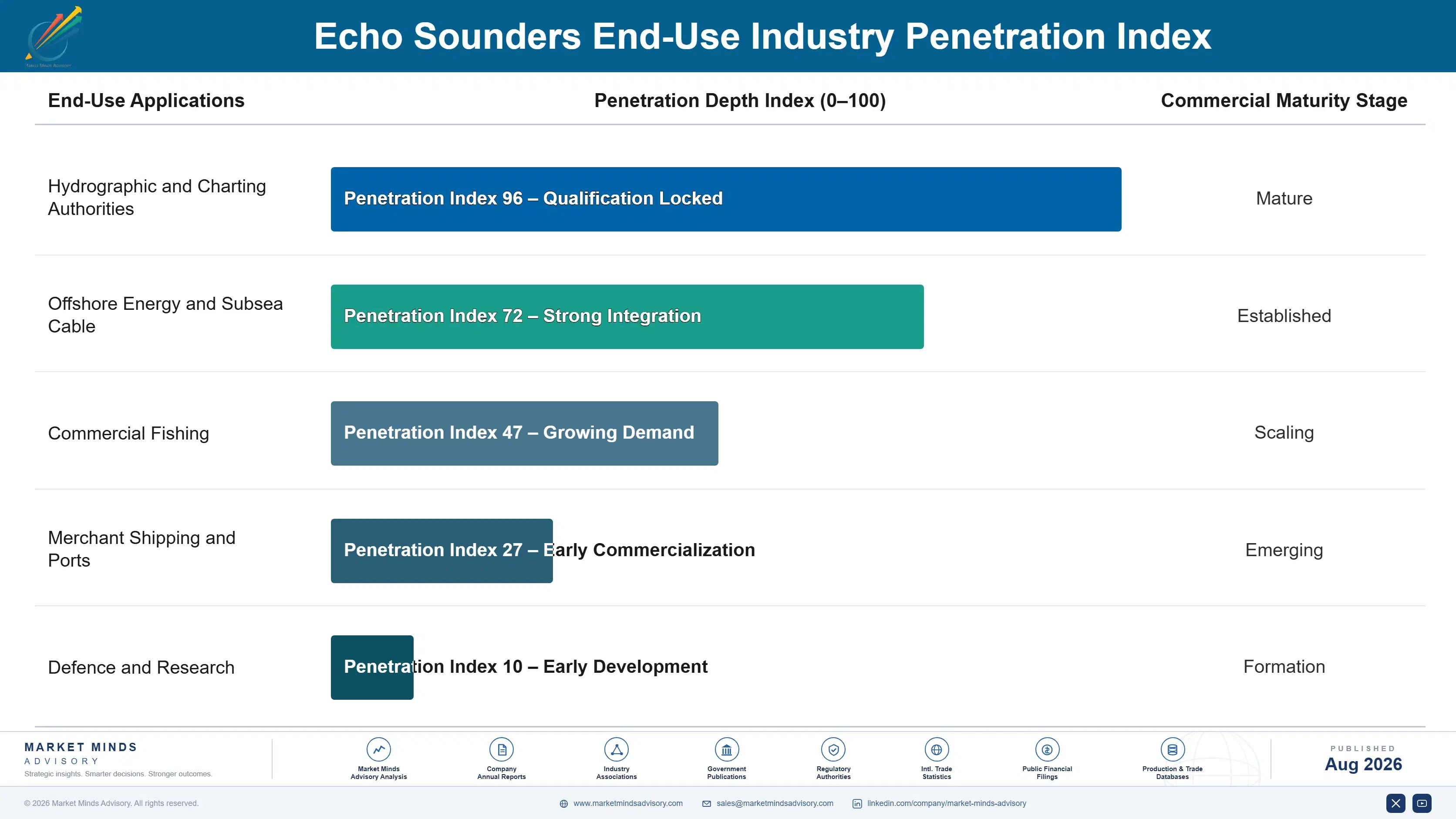
Echo sounders generate more recurring income than most instrument businesses collect, and the gap is mostly software and calibration. A survey system needs annual patch testing and calibration verification to remain usable for chartable work, and processing software renewed each year is now a larger line than parts for many suppliers. Transducers wear and get damaged, particularly on hull-mounted installations, which produces steady replacement demand nobody plans for.
Stickiness varies enormously across the two halves of this market. Survey contractors are locked in hard by processing workflow, trained operators, and calibration records that establish data defensibility over years, and switching means revalidating all of it. Fisheries and recreational buyers switch freely on price at every replacement. Uncrewed platform builders sit somewhere new, specifying at design stage and staying with that choice across the build.

Buyer profiles have shifted with the platform. Survey equipment used to be chosen by a hydrographic surveyor who would operate it personally and cared about acquisition behaviour in difficult conditions. It is increasingly chosen by a systems integrator building an autonomous vessel who cares about power draw, interface, and unattended operation. Those are different questions, and suppliers answering the old one are losing the new work.
echo-sounders-market-end-use-penetration-index-1787333772587

Where To Compete Here

These are among the four positions where our research anticipates prominent divergence between winners and laggards over the coming forecast period. Each is grounded in the demand model, the regulatory perimeter, and the announced capacity pipeline.
01 / PROCESSING SOFTWARE MONETISATION

Stop giving away the expensive part

Data cleaning and validation takes roughly three times as long as acquisition does, which means the processing chain costs a survey contractor considerably more across a working season than the instrument itself ever did. Licensing that software annually rather than bundling it invisibly with the hardware creates recurring revenue at software margins and locks in a trained workflow that nobody switches casually. Manufacturers who still include it free with the box are quietly funding somebody else's recurring revenue line instead.
02 / AUTONOMY-FIRST INSTRUMENT DESIGN

Design for no power and no operator

An uncrewed surface vessel supplies only a fraction of the power a survey ship does and has nobody aboard to adjust anything when conditions change partway through a survey line. Instruments engineered around the older assumptions perform badly on it, and the suppliers who redesigned early are now being written into platform specifications at design stage rather than being selected afterwards. That position compounds across an entire build programme, and it is extremely difficult for any competitor to reverse afterwards.
03 / HIRE FLEET DEVELOPMENT

Rent into a platform-constrained survey market

Survey contractors are limited by vessel availability and by seasonal campaign windows, which makes owning instruments outright for year-round use genuinely uneconomic for a good many of the smaller ones. Hire fleets convert that constraint into recurring rental income yielding a third to nearly half of full system value across a single strong season. It also puts equipment in front of operators who would never have specified it themselves, and a meaningful share of those trials convert into outright purchases later.
04 / DUAL MARKET COST STRUCTURE

Hold the volume business to fund the margin one

Fisheries and navigation equipment ships in quantities that reach component allocation thresholds survey volumes could never approach on their own, and that purchasing scale directly subsidises the cost of every single survey instrument built. Suppliers who exited the volume business in order to concentrate on margin discovered they were then paying broker prices for converters during every subsequent shortage. The two halves of this market share almost nothing at all except physics, and that is precisely why both of them are needed.

Engagement Snapshot From the Field

A live engagement with an industry participant carrying material or product regulatory and market exposure ahead of a defining policy shift, showing how our research translates into a defensible multi-year portfolio strategy.
MARKET MINDS ADVISORY · CLIENT ENGAGEMENT SUMMARY
Echo Sounders Producer Strategic Portfolio Review and Transition Roadmap 2026·Investment Scenario on Echo Sounders Exposure Evaluation 2025-26
CLIENT PROFILE
A national hydrographic office responsible for charting an exclusive economic zone of well over three million square kilometres, operating on an annual survey budget near USD 62 million (client-reported, unverified by MMA). Modern-resolution coverage stood below a fifth of the charting area, and the office relied on two ageing crewed survey vessels supplemented by seasonal charter.
STRATEGIC CHALLENGE
At the prevailing survey rate, completing modern coverage would take considerably longer than a century, which no funding cycle could sustain and no commitment under Seabed 2030 could accommodate. Vessel replacement had been costed and was unaffordable. The office needed a different delivery model rather than a larger version of the existing one.
MMA APPROACH
MMA modelled achievable survey area per year under crewed, uncrewed, and mixed fleet configurations, using measured line productivity rather than manufacturer claims. Instrument options were assessed against uncrewed platform power budgets and sea state tolerance in the relevant waters. Processing throughput was examined separately, since acquisition capacity is worthless if the data cannot be turned into charts.
KEY FINDINGS
  1. Uncrewed surface vessels delivered survey area per dollar roughly four times better than crewed operation in water depths under two hundred metres, where most of the gap sat.
  2. Sea state tolerance rather than acoustic capability determined uncrewed productivity, and the difference between candidate platforms exceeded 40% of achievable survey days annually.
  3. Processing capacity would become the binding constraint within two years of any fleet expansion, since acquisition would roughly triple against a team that was not growing.
  4. Two of the three candidate multibeam systems drew more power than the preferred uncrewed platform could supply continuously without reducing endurance substantially.
CLIENT PROFILE
A national hydrographic office responsible for charting an exclusive economic zone of well over three million square kilometres, operating on an annual survey budget near USD 62 million (client-reported, unverified by MMA). Modern-resolution coverage stood below a fifth of the charting area, and the office relied on two ageing crewed survey vessels supplemented by seasonal charter.
STRATEGIC CHALLENGE
At the prevailing survey rate, completing modern coverage would take considerably longer than a century, which no funding cycle could sustain and no commitment under Seabed 2030 could accommodate. Vessel replacement had been costed and was unaffordable. The office needed a different delivery model rather than a larger version of the existing one.
MMA APPROACH
MMA modelled achievable survey area per year under crewed, uncrewed, and mixed fleet configurations, using measured line productivity rather than manufacturer claims. Instrument options were assessed against uncrewed platform power budgets and sea state tolerance in the relevant waters. Processing throughput was examined separately, since acquisition capacity is worthless if the data cannot be turned into charts.
KEY FINDINGS
  1. Uncrewed surface vessels delivered survey area per dollar roughly four times better than crewed operation in water depths under two hundred metres, where most of the gap sat.
  2. Sea state tolerance rather than acoustic capability determined uncrewed productivity, and the difference between candidate platforms exceeded 40% of achievable survey days annually.
  3. Processing capacity would become the binding constraint within two years of any fleet expansion, since acquisition would roughly triple against a team that was not growing.
  4. Two of the three candidate multibeam systems drew more power than the preferred uncrewed platform could supply continuously without reducing endurance substantially.
RECOMMENDED STRATEGY
Phase 1: Phase one: procure a small uncrewed fleet for shallow water coverage, selecting platforms on sea state tolerance rather than on acquisition specification alone. Phase 2: Phase two: invest in automated processing capacity ahead of acquisition growth, because the bottleneck arrives before anybody plans for it. Phase 3: Phase three: retain crewed capability for deep water and complex nearshore work, retiring one vessel rather than replacing both as originally costed.
OUTCOME
The office procured an initial uncrewed fleet and reported survey area completed rising roughly 2.6 times in the first full season against the previous crewed baseline (client-reported, unverified by MMA). Automated processing was commissioned alongside acquisition, and one crewed vessel was retired rather than replaced, releasing capital toward further platform additions.

Frequently Asked Questions

Foundational context covering the market sizes, CAGR, scope, country, region and competition that inform every finding below. This section is provided to cover basics and most often pre-purchase conversations, answered from the MMA Primary Research Dataset.

What is the current size of the Echo Sounders Market?

The market reached USD 1.3 billion in 2025 and is forecast at USD 1.38 billion for 2026. Demand splits between a mature navigation and fisheries base and a considerably faster-growing survey segment.

How large will the Echo Sounders Market be by 2036?

MMA forecasts USD 2.49 billion by 2036, an increase of USD 1.11 billion over 2026. That represents an expansion multiple of 1.81 times across the forecast period.

What is the CAGR for the Echo Sounders Market 2026 to 2036?

The base case CAGR is 6.1%, with a bull case at 7.4% and a bear case at 4.9%. The bear case reflects offshore wind project deferral, which has already happened repeatedly.

Which segment is growing fastest?

Multibeam echo sounders grow fastest at 8.8%, roughly 1.44 times the market rate. Offshore wind survey, cable routing, and uncrewed platform adoption all specify multibeam as standard.

Who are the major companies in the Echo Sounders Market?

Kongsberg Maritime, Teledyne Marine, Furuno, Navico Group, and Wartsila ELAC Nautik lead the market. The top five hold roughly 58% of echo sounder revenue, though survey and recreational segments look very different competitively.

Which country is growing fastest?

India grows fastest at 9.4%, driven by port modernisation, coastal mapping programmes, and naval survey procurement. Very little of that demand is replacement of modern equipment already in service.

Report Segmentation Architecture

The full report scope spans multiple orthogonal segmentation dimensions, with cross-tabulated demand data provided for each dimension pair. Coverage extends further to regional breakdowns, trend trajectories, and the competitive detail needed to support segment-level decision-making.

By Sounder Type

  • Multibeam Echo Sounders
  • Sub-Bottom Profilers
  • Fisheries and Sonar Echo Sounders
  • Single-Beam Survey Echo Sounders
  • Navigation Echo Sounders

By End-Use Industry

  • Hydrographic and Charting Authorities
  • Offshore Energy and Subsea Cable
  • Commercial Fishing
  • Merchant Shipping and Ports
  • Defence and Research

By Commercial Dimension

  • Direct Project Sales
  • Shipyard and Integrator Supply
  • Dealer and Chandlery Channel
  • Equipment Hire and Charter
  • Software Licensing and Support

By Region

  • East Asia
  • South Asia and Pacific
  • Western Europe
  • North America
  • Latin America
  • Middle East and Africa
  • Eastern Europe

Scope, Methodology, and Coverage

Every figure in this report is reproducible from documented input assumptions. The scope below maps the historical period, the forecast horizon, the segmentation dimensions, and the countries covered, alongside the underlying primary and qualitative methodology.
Historical Period
2020 to 2025
Forecast Period
2026 to 2036
Base Year
2025 (USD billions; MMA Primary Research Dataset, August 2026)
Market Definition
The echo sounders market comprises acoustic instruments measuring water depth and imaging the seabed or sub-seabed from surface, subsurface, and uncrewed platforms, valued at manufacturer selling prices to hydrographic authorities, survey contractors, offshore developers, fishing operators, shipyards, integrators, and dealers. It spans multibeam echo sounders, sub-bottom profilers, single-beam survey and navigation echo sounders, and fisheries sounders, together with their transducers and arrays, processing units, acquisition and processing software licences, calibration services, and equipment hire arrangements. Side-scan sonar, forward-looking navigation and obstacle avoidance sonar, acoustic positioning and underwater navigation systems, current profilers, sub-sea acoustic communications, sonar for defence detection, and survey services sold as a finished data deliverable are excluded.
Quantitative Units
USD billions (current prices); volume in systems shipped
Segmentation Dimensions
By Sounder Type; By End-Use Industry; By Commercial Dimension; By Region
Regions Covered
East Asia, South Asia and Pacific, Western Europe, North America, Latin America, Middle East and Africa, Eastern Europe
Countries Covered
China, Japan, South Korea, Taiwan, India, Australia, Indonesia, Vietnam, Thailand, Malaysia, Norway, UK, Germany, Netherlands, Denmark, France, Italy, Spain, Sweden, Finland, USA, Canada, Mexico, Brazil, Chile, Peru, Argentina, Panama, Saudi Arabia, United Arab Emirates, Qatar, Nigeria, South Africa, Egypt, Poland, Romania, Bulgaria, and additional markets relevant to this sector
Key Companies Profiled
Kongsberg Maritime, Teledyne Marine, Furuno, Navico Group, Wartsila ELAC Nautik, Garmin, Raymarine, Airmar Technology, Japan Radio Company, Skipper Electronics, Exail, R2Sonic, Norbit, EdgeTech, Innomar Technik, Valeport, Syqwest, WASSP, Imagenex Technology, Klein Marine Systems
Quantitative Methodology
Primary survey, n=3,800 respondents, Q4 2025, six countries; demand-side model with trade association cross-validation
Qualitative Methodology
47 expert interviews, Q4 2025; applied to validate demand model assumptions, identify emerging dynamics, and assess competitive positioning
Report Format
PDF and XLSX data workbook (Word format preview document)
Publisher
Market Minds Advisory
Report Code
MMA-2026-TEC-610
Published
August 2026
Contact
sales@marketmindsadvisory.com | www.marketmindsadvisory.com

Purchase the full Echo Sounders Market Report (2026 to 2036).

The full report examines echo sounder demand across seven regions and five instrument types, with particular attention to how uncrewed platform adoption is rewriting the specification around power budget and unattended operation. It quantifies the survey backlog against realistic delivery capacity and traces where processing throughput becomes the binding constraint. Competitive analysis covers twenty participants assessed on echo sounder revenue, including where software specialists and vehicle builders are taking value from instrument makers. Regional chapters map fleet size, shipbuilding, and offshore project activity against instrument demand.
Seven-region fleet and offshore activity demand analysis
Five instrument type segmentation with growth rates
Twenty participant competitive assessment and platform positioning
Uncrewed survey economics against crewed vessel baselines
Processing software licensing and recurring revenue benchmarking
Equipment hire fleet yield and utilisation comparison

Built For The People Who Decide

From boardroom strategy to bench-side execution, this report is read cover-to-cover by leaders shaping the next decade of their industry, turning demand scenarios, market dynamics and valuation benchmarks into decisions.
CXOs/ Presidents/ VPs/ Managers
M&A and Corporate Development
Strategy Teams and R&D Heads
Procurement and Product Directors
Regulatory and Compliance Leaders
Investor Relations and Equity Analysts