Market Minds Advisory
Earplugs Market

Earplugs Market: Earplugs Market: The Gap Between The Number On The Box And The Protection On The Worker, And A Sleep Category Nobody Planned For, 2026 to 2036

Real world attenuation runs about 12 decibels below the labelled rating, only 9% of employers verify fit on individual workers, and a consumer sleep category now supplies 31% of revenue.

Lead Analyst

Published

September 2026

Make Smarter Decisions with Customized Research Insights

Request a free sample report and evaluate market opportunities, growth trends, and competitive dynamics relevant to your business needs.

2025 MARKET VALUE$1.5BMarket Size 2025
2036 FORECAST VALUE$3.1BBase Case , 2026 to 2036
CAGR 2026 TO 20366.8 %Bull 8.0% / Bear 5.6%
INCREMENTAL OPPORTUNITY$1.5BNet 10- year value creation
EXPANSION MULTIPLE1.94x2036 value over 2026 base
Strategic Levers
M&A Pipeline
Regional Outlook
Country Rankings
Competitive Intelligence
Segmental Deep-dive
Call-Us : 91 93563 13602

Executive Snapshot and Market Trajectory.

The number printed on the box is a laboratory result achieved by trained fitters under supervision. Real world attenuation runs roughly 12 decibels below it, and only about 9% of employers verify what any individual worker actually achieves. Compliance is counted by boxes issued, not by protection delivered.
Electronic level-dependent earplugs grow at 10.2%, half again the market rate of 6.8%, because they address the reason people take protection out rather than the protection itself. Around 44% of wearers remove plugs to hear speech or alarms. Custom moulded earplugs follow at 8.9%. Banded and semi-aural products grow slowest of anything covered here. Disposable foam still carries most of the volume and competes on cents.
Consumer sleep now supplies about 31% of category revenue, which is a different business with different buying criteria, and it has grown faster than occupational demand for six consecutive years. East Asia holds 29% of demand on manufacturing workforce scale and production base together. Observed wear compliance under unannounced observation sits near 58%. Design-led entrants took that segment because established safety manufacturers treated it as an extension of an existing business.
Market Definition
This market covers earplugs and in-ear hearing protection for occupational, consumer sleep, water, pressure, and music applications, including disposable foam earplugs, reusable pre-moulded earplugs, custom moulded earplugs, banded and semi-aural earplugs, electronic level-dependent earplugs, and specialty water and pressure earplugs. It excludes earmuffs and over-ear hearing protection, hearing aids and amplification devices, earphones, in-ear monitors, and surgical ear tubes.
Base Year Value
$1.5B in 2025 (MMA Primary Research Dataset, September 2026)
Forecast Period
2026 to 2036, eleven discrete annual values
CAGR
6.8% base case. Bull 8.0%. Bear 5.6%.
Fastest Growth Segment
Electronic Level-Dependent Earplugs: 10.2% CAGR
Fastest Growth Country
China: 10.9% CAGR
Fastest Growth Region
South Asia and Pacific: 8.8% CAGR
Largest Region
East Asia: 29% of 2025 global value
Market Leaders
3M, Honeywell International, Moldex-Metric, Ansell, and Uvex Safety Group lead the field. Source: MMA Primary Research Dataset, July 2026.
Primary Survey
n=3,800 procurement and R&D decision-makers, Q4 2025, six countries
Methodology
Demand-side build-up, cross-validated against public data, 47 expert interviews

Earplugs Market Forecast Scenarios

earplugs-market-size-forecast-scenario-1790016782123
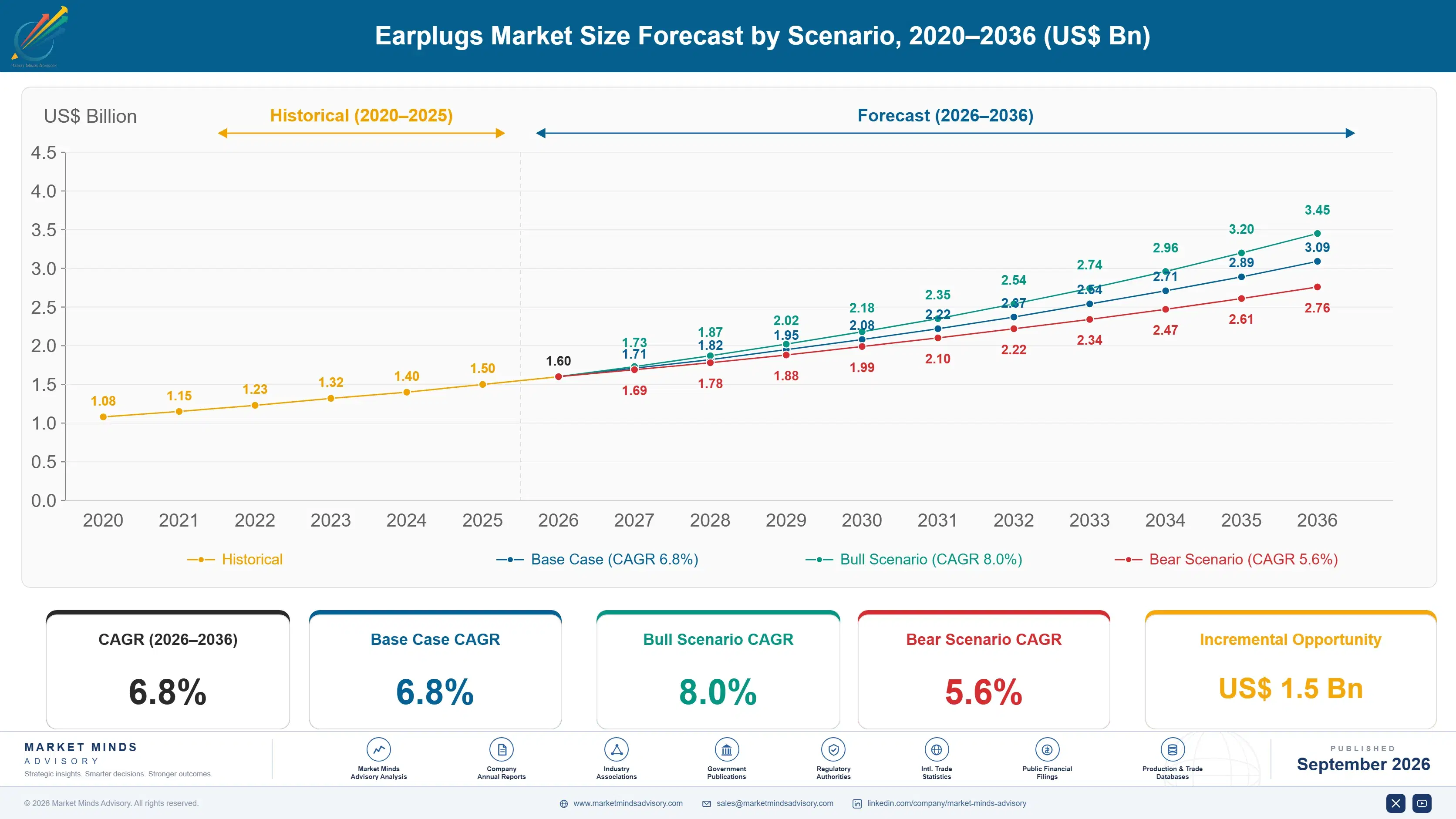
Growth from 2020 to 2025 ran at 5.7% and came from an unexpected direction. Occupational demand grew slowly with industrial employment and safety enforcement, while consumer sleep earplugs went from a marginal pharmacy line to roughly a third of category revenue, pulled by social channels and by a generation of buyers treating sleep quality as something worth spending on. Nobody in the safety industry planned for that.
The base case at 6.8% rests on three mechanisms. Consumer sleep keeps compounding faster than occupational demand, with design and comfort deciding purchases rather than attenuation figures. Occupational noise enforcement tightens across Asian manufacturing, with Chinese growth at 10.9% leading every country covered. And electronic level-dependent products keep taking share by addressing why workers remove protection instead of how much it blocks. None of the three depends on labelled ratings improving at all.
The bull case at 8.0% depends on fit verification becoming an expected practice rather than a rarity at 9% adoption, which would move purchasing toward verifiable systems. The bear case at 5.6% is consumer attention: the sleep segment grew through social channels that move on, and 31% of revenue now rests on a category never tested by a downturn.

The Number On The Box

A disposable foam plug is rated in a laboratory, on subjects fitted by trained technicians who roll, insert, and hold the plug while it expands. Almost nobody does that on a factory floor. Insertion depth is the whole variable, and real world attenuation comes in about 12 decibels under the label. Occupational health agencies have derated labelled ratings for decades because of it.
TOP FIVE CONCENTRATION47%Share of category revenue held by the leading manufacturers
REAL WORLD ATTENUATION GAP12 dBTypical shortfall between labelled and achieved noise reduction
FIT VERIFICATION ADOPTION9%Employers verifying achieved attenuation on individual workers annually
OBSERVED WEAR COMPLIANCE58%Workers wearing protection during unannounced high noise observation
SLEEP SEGMENT SHARE31%Category revenue from consumer sleep rather than occupational use
REMOVAL FOR COMMUNICATION44%Wearers removing protection to hear speech or alarms
The fix exists, costs very little, and almost nobody uses it. Field attenuation testing measures what a specific worker achieves with a specific plug in a few minutes, and adoption sits near 9% of employers. Compliance is measured by issuance instead, because counting boxes is easy. Observed wear during unannounced checks in high noise areas runs around 58%, which is the other half of the same problem.
Then there is the reason people take them out. Roughly 44% of wearers remove protection to hear speech or an alarm, which is a rational response to being unable to work safely with it in. Electronic level-dependent plugs attenuate impulse noise while passing speech, and they grow at 10.2%, fastest of the six types. They cost more and solve the actual barrier.
"The industry has spent forty years improving a number that laboratory conditions produce and field conditions do not. A five minute fit test tells you more about whether a worker is protected than the entire rating system does, and fewer than one employer in ten runs one."
Practice Director, Personal Protective Equipment and Occupational Safety · MMA Medical Devices and Personal Protection Practice · September 2026

Market Trends

Consumer Sleep Became A Third Of Revenue

Consumer sleep earplugs now account for around 31% of category revenue, having grown from a marginal pharmacy line over roughly six years. The buying criteria bear almost no relation to occupational purchasing: side-sleeping comfort, appearance, and reusability decide the sale, and attenuation figures appear on packs mainly as reassurance. Social channels drove the growth rather than any product development. Safety manufacturers built for industrial distribution have found the channel, pricing, and design expectations of this segment genuinely difficult to serve well. Design-led entrants without any safety credential have taken meaningful share as a result.
Market Impact: Country grows at 10.9%
Electronic Plugs Address Why People Remove Them

Electronic level-dependent earplugs grow at 10.2%, fastest of the six types, by attenuating impulse noise while passing speech at conversational levels. That matters because roughly 44% of wearers remove protection to hear a colleague or an alarm, which is the single largest cause of unprotected exposure in noisy workplaces. Unit prices run many multiples of a foam plug, which has kept adoption concentrated in military, aviation, and high value industrial settings. Cost curves are moving in the right direction. Falling component costs widen the addressable range with each passing year.
Market Impact: Drives 31% revenue share

Market Opportunities and Growth Drivers

Asian Noise Enforcement Reaches Manufacturing Scale

China grows at 10.9%, faster than any country covered, as occupational noise exposure limits move from written regulation into inspected practice across manufacturing provinces. The exposed workforce is larger than in North America and Western Europe combined, so even modest compliance improvement adds substantial volume. East Asia holds 29% of world demand. Domestic manufacturers supply most of that volume at prices international brands cannot match, and the growth accrues disproportionately to local producers rather than to the established field. International brands hold the higher specification end and very little of the volume beneath it.
Market Impact: Gap runs 12 decibels

Sleep Quality Spending Creates A Parallel Market

Consumers now treat sleep as a category worth spending on, and earplugs sit alongside masks, sound machines, and bedding in that budget rather than alongside safety equipment. Growth has come through social recommendation rather than pharmacy distribution or clinical advice. Design-led entrants have taken meaningful share from established safety brands by treating the product as an object people wear rather than a consumable people are issued. Repeat purchase behaves like accessories rather than like industrial supply. Safety manufacturers organised around industrial distribution have consistently struggled to reach these buyers at all.
Market Impact: Wear compliance near 58%

Market Restraints and Challenges

Labelled Ratings Do Not Survive Field Conditions

Real world attenuation runs roughly 12 decibels below the labelled rating, and the root cause is insertion depth: laboratory ratings come from trained fitters and workplace insertion is done in seconds without supervision. Commercially this leaves employers buying to a number that does not describe what they receive. Only about 9% verify individual fit despite the test taking minutes. Manufacturers respond by offering fit verification systems, by simplifying insertion geometry, and by publishing derated field figures alongside the labelled ones. None of that helps while purchasing continues to specify by the labelled figure alone.
Market Impact: Supplies 31% of revenue

Compliance Is Counted By Issuance Not By Wearing

Observed wear in high noise areas runs near 58% under unannounced checks, and the root cause is that safety programmes measure boxes distributed because that number is easy to collect. Commercially this hides the failure from the people buying, so nothing in the purchase decision responds to it. Manufacturers respond with comfort-led designs that raise voluntary wear, with electronic products removing the communication reason for removal, and with observation-based programme audits. Nothing in the purchase decision responds to a failure that the compliance metric does not record. Observation-based auditing is the only route to changing that, and it is rare.
Market Impact: Segment grows at 10.2%
4 additional market trends, 3 additional growth drivers, and 2 additional restraints and challenges are covered in the full report. Contact sales@marketmindsadvisory.com to access the complete intelligence.

Segment CAGR and Growth Architecture

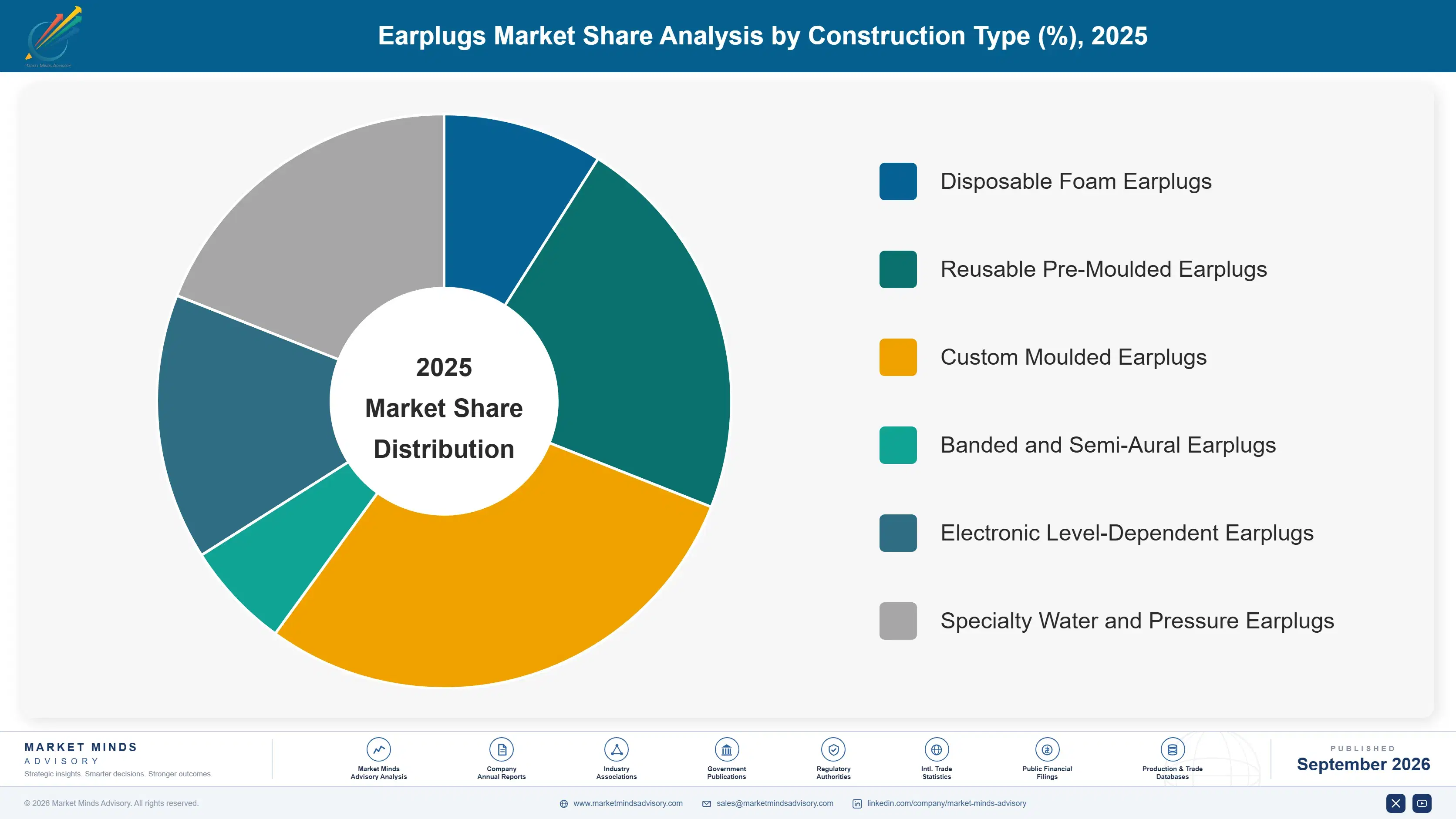
Segmentation follows earplug construction type across six categories: disposable foam earplugs, reusable pre-moulded earplugs, custom moulded earplugs, banded and semi-aural earplugs, electronic level-dependent earplugs, and specialty water and pressure earplugs. End-use application, distribution channel, and attenuation class sit as separate dimensions rather than folded into this one. Earmuffs and over-ear protection fall outside the defined scope entirely.
earplugs-market-market-share-analysis-1790016782697

Electronic Level-Dependent Earplugs

Electronic level-dependent earplugs grow at 10.2%, half again the market rate of 6.8%, by solving the reason protection gets removed rather than by blocking more sound. Digital attenuation cuts impulse and steady high level noise while passing speech at conversational volume, which addresses the 44% of wearers who take plugs out to hear a colleague or an alarm. Adoption concentrates in military, aviation, law enforcement, and high value industrial settings, because unit prices run many multiples of a foam plug. Component costs are falling and rechargeable formats have improved considerably, which is widening the addressable range each year. Selling more attenuation into a communication problem has never worked, and this is the segment that stopped trying.
CAGR 10.2%

Custom Moulded Earplugs

Custom moulded earplugs grow at 8.9% because a plug shaped to an individual ear removes the insertion variable that costs disposable foam roughly 12 decibels in the field. Achieved attenuation sits far closer to labelled performance, and comfort raises voluntary wear time materially over a shift. The barriers are cost and process: each unit requires an impression or a scan, a fitting appointment, and a lead time that industrial procurement finds awkward. Digital ear scanning has cut that process considerably. Musician and shooting sports applications carry the segment's highest margins by a wide margin. Industrial adoption depends on whether the scanning and fitting process can be run at site scale without a clinic.
CAGR 8.9%
Full segment breakdown across 6 segments available in the complete report.

Regional Architecture and Country Demand Map

Regional shares reflect where earplugs are purchased for occupational and consumer use rather than where they are manufactured. One region sits outside the standard bands, for the reason named in its own paragraph and summarised below for operator review. Occupational and consumer mix varies sharply by region.

East Asia

The exposed manufacturing workforce here is larger than North America and Western Europe combined, which gives the region its lead on volume even at unit prices well below Western levels. Chinese growth of 10.9% leads every country covered as noise exposure limits move from written regulation into inspected practice. Domestic manufacturers supply most of that volume and international brands hold the higher specification end only. Japanese and Korean consumer sleep demand is substantial and design-led. Most of the world's earplug manufacturing capacity also sits in this region and in Southeast Asia. Growth accrues disproportionately to local producers. Electronic and custom products remain a small share of regional volume outside multinational operations.
Share: 29% | CAGR: 7.8% (2026 to 2036)

North America

Occupational hearing conservation programmes are more formalised here than anywhere, with written requirements covering exposure monitoring, provision, and training across regulated industries. Growth of 6.2% runs close to the world rate. Unit prices are the highest of any region, which lifts value share well above the region's share of exposed workers. Fit verification adoption is higher than the world average and still sits well below where the evidence would justify. Consumer sleep has grown quickly through direct to consumer channels. Electronic level-dependent adoption leads all regions on military and industrial demand together. Insurers and regulators both look at recorded hearing loss cases, which gives verification data a commercial value here that it does not carry in most other markets.
Share: 26% | CAGR: 6.2% (2026 to 2036)
Regional intelligence for 5 additional markets available in the complete report: Western Europe, South Asia and Pacific, Latin America, Middle East and Africa, Eastern Europe. Contact sales@marketmindsadvisory.com.
earplugs-market-country-cagr-analysis-1790016783252

Where Manufacturers Build Real Position

Four commercial moves matter in a category where the headline specification does not describe what users receive and where a third of revenue now comes from a business the industry did not plan for. Each addresses a specific gap: the fit, the wearing, the removal reason, or the consumer channel. None of the four involves improving a laboratory rating.

Sell Fit Verification As Part Of Supply

Real world attenuation runs about 12 decibels below label and only around 9% of employers verify individual fit, despite the test taking minutes per worker. Manufacturers bundling fit verification systems with product supply report account retention 2.9 times higher than product-only supply, because the verification data becomes part of the customer's own compliance record. Once a programme runs on measured attenuation rather than issuance counts, changing supplier means rebuilding the evidence base. Insurers and regulators both look at recorded hearing loss, which gives that evidence base a commercial weight beyond the safety function itself.
Market Impact: Raises account retention rates to 2.9 times higher

Design For Voluntary Wear Not Peak Attenuation

Observed wear in high noise areas runs near 58%, so a plug rated three decibels higher that spends half the shift in a pocket protects nobody. Manufacturers competing on comfort and all-shift wearability rather than headline rating report measured programme exposure reductions 2.3 times greater than rating-led alternatives. This requires selling against the specification the buyer thinks they want, which is difficult, and it is the only argument that survives contact with the actual data. Removal rates rise sharply through the final hours of longer shifts, which is where comfort becomes the determinant.
Market Impact: Cuts measured exposure 2.3 times more than alternatives

Solve Communication Before Adding More Attenuation

Roughly 44% of wearers remove protection to hear speech or an alarm, making communication the largest single cause of unprotected exposure. Manufacturers offering level-dependent electronic products report unit revenue 6.4 times higher than disposable foam alongside materially better wear compliance. Component costs are falling and rechargeable formats have improved, which widens the addressable range each year. Selling attenuation into a communication problem has never worked and will not start working now. The applications where removal concentrates are identifiable in advance through observation, so deployment can be targeted rather than universal, which makes the unit cost considerably easier to justify.
Market Impact: Raises unit revenue to 6.4 times foam levels

Build Consumer Channel Capability On Purpose

Consumer sleep supplies around 31% of category revenue and behaves nothing like industrial supply, with comfort, appearance, and social recommendation deciding purchases. Manufacturers building dedicated consumer design and direct channel capability report gross margin 2.1 times better than those routing sleep products through safety distribution. Design-led entrants have taken meaningful share precisely because established manufacturers treated the segment as an extension of an existing business rather than a separate one. Repeat purchase in that segment behaves like accessories rather than consumables, which changes the economics of acquisition and makes design investment recoverable in a way industrial supply never allows.
Market Impact: Raises gross margin to 2.1 times better overall

Who Controls the Margin Pool

Concentration is moderate. Five manufacturers hold 47% of category revenue, measured consistently on that basis across all participants, and the remainder divides between regional safety suppliers, Asian volume producers, custom moulding specialists, and design-led consumer entrants that did not exist a decade ago. The leader to challenger gap is wide in occupational supply and almost absent in consumer sleep. That split matters because the two halves are competed on entirely different terms.
Competition currently turns on three dimensions: fit verification capability, which converts a product sale into a compliance programme; electronic level-dependent development, where the communication barrier is actually addressed; and consumer channel competence, which established safety manufacturers have largely lacked. Price still decides wherever a tender names a noise reduction rating and a unit cost, which describes most disposable foam volume across every region covered here.

Pressure builds from two directions at once. Asian producers hold cost positions on disposable foam that Western manufacturers cannot approach. Design-led consumer entrants have taken the fastest growing part of the market without competing on any safety credential. Rankings will shift toward manufacturers holding electronic capability and genuine consumer channel depth. Manufacturers holding only disposable foam are most exposed.
earplugs-market-company-positioning-matrix-1790016783775

Competitive Moat and Risk Dimensions

3M

Moat: Fit Verification System Installed Base

An installed base of field attenuation testing equipment inside customer safety programmes converts product supply into a compliance system the customer depends on. Once a programme records measured attenuation per worker rather than boxes issued, switching supplier means rebuilding an evidence base that regulators and insurers have already seen.
3M

Risk: Weak Consumer Sleep Position

Around 31% of category revenue now comes from consumer sleep, where design-led entrants compete on appearance, comfort, and social recommendation rather than on any safety credential. Industrial brand equity carries almost no weight in that channel and can actively work against a product positioned as something people choose to wear.
HONEYWELL INTERNATIONAL

Moat: Electronic And Industrial Breadth

Depth across electronic level-dependent products and conventional hearing protection lets a single supplier serve both the high specification communication problem and the volume requirement in one programme. That breadth matters as electronic component costs fall and the addressable range for level-dependent products widens each year.
HONEYWELL INTERNATIONAL

Risk: Asian Cost Position Exposure

The disposable foam volume that funds distribution and technical service competes against Asian producers whose cost base cannot be matched from Western assets. Defending that volume on brand and service works until regional producers add technical capability, which several have begun doing in the higher specification range.

Players Tracked

Prominent Players

3M
Honeywell International
Moldex-Metric
Ansell
Uvex Safety Group

Other Key Players

MSA Safety
Radians
Delta Plus Group
JSP Safety
Cotral Lab
Etymotic Research
Alpine Hearing Protection
Loop Earplugs
McKeon Products
Apothecary Products
Ohropax
Pyramex Safety
Elvex Corporation
Custom Protect Ear
Sonova Consumer Hearing

Recent Developments

JANUARY 2026

3M Publishes Field Attenuation Data Across Its Hearing Protection Range

3M released measured field attenuation figures alongside labelled ratings across its earplug range, drawn from verification testing in customer programmes. The published gap is consistent with the roughly twelve decibel shortfall occupational health agencies have documented for years. Derated figures now appear alongside the labelled ones in product documentation.
Signal: Publishing the gap is a stronger position than continuing to defend the label. Documentation now carries what agencies already assumed.
AUGUST 2025

Honeywell Expands Electronic Level-Dependent Earplug Production

Honeywell International completed an organic expansion of electronic hearing protection manufacturing, funded internally with no partner involved. Management cited falling component costs widening the range of industrial applications the products can economically serve. Rechargeable formats and improved battery life were introduced across the expanded range at the same time.
Signal: Falling component costs are moving electronic products out of specialist applications. Specialist applications no longer bound the range.
MARCH 2025

Ansell Acquires Design-Led Consumer Sleep Earplug Brand

Ansell completed an acquisition of a design-led consumer sleep earplug business with direct channel capability. The transaction was an outright acquisition rather than a joint venture or minority stake, with consumer channel competence cited as the rationale. Design and direct channel staff transferred with the business under the agreed terms.
Signal: Safety manufacturers are buying consumer capability rather than attempting to build it. Consumer competence is bought, not built.

What Hearing Protection Costs

Three cost groups dominate. Polyurethane foam and elastomer resins run 28% to 36% of cost of goods sold across disposable and reusable products, and the eight-point range separates integrated producers from open market buyers. Moulding, tooling, and assembly take 24% to 32%, rising sharply for custom products requiring individual impressions. Electronic components account for 22% to 30% in level-dependent products and nothing at all elsewhere.
Polyurethane and elastomer resin pricing moved through 2024 and 2025 on petrochemical feedstock and freight together, and Energy Information Administration price series documented the underlying movements across the period. Several manufacturers described the resulting margin pressure in their annual reports. Electronic component costs fell across the same window as audio processing volumes rose in unrelated consumer categories entirely. The two cost groups therefore moved in opposite directions across the same period.

The competitive disadvantage mechanism runs through manufacturing location rather than through material cost. A Western manufacturer of disposable foam competes against Asian production with lower labour and proximity to resin supply, and cannot recover the gap on a product selling for cents. Exposure therefore varies by product mix rather than by scale, and manufacturers weighted toward electronic and custom products are considerably better insulated.
earplugs-market-cost-volatility-analysis-1790016783971

Shift Mix Toward Electronic And Custom Products

Disposable foam competes on manufacturing location and material cost, neither of which a Western producer can win on a product selling for cents. Electronic and custom moulded products carry unit revenues many multiples higher and compete on capability rather than cost, which is the only mix change that materially changes the exposure. Mix is the only lever here.

Contract Resin Against Petrochemical Rather Than Safety Cycles

Polyurethane and elastomer feedstock follows petrochemical and freight cycles that have no relationship to occupational safety demand or to safety equipment purchasing calendars. Contracting against the upstream cycle rather than the customer's budget year removes most of the exposure and secures allocation through the tighter periods. Safety budget calendars and petrochemical cycles have never aligned usefully.

Buy Electronic Components On Consumer Audio Volumes

Audio processing component costs are falling because unrelated consumer categories consume them at volumes hearing protection never will. Specifying components already at scale in those categories, rather than bespoke parts, captures a cost curve the safety industry contributes nothing to and can otherwise only watch from outside. Bespoke parts forfeit a curve the industry does not drive.

Portfolio Architecture for Margin Defence

Margin follows capability rather than attenuation. Disposable foam competes on manufacturing cost and freight against Asian producers. Reusable pre-moulded products earn modestly better on repeat wear economics. Custom moulded products earn well because the fitting process cannot be replicated by a volume manufacturer, and electronic level-dependent products earn most, carrying unit revenues many multiples above anything else in the category. The spread from bottom to top tier is wider than in most protective equipment categories.
The tension between volume and premium runs through what the buyer is actually purchasing. A tender naming a noise reduction rating and a unit price is a purchasing exercise decided on cents and freight. A programme specifying measured attenuation per worker, verification records, and wear compliance targets is a service relationship, and the supplier holding the verification data holds the account for as long as the programme runs.

High-value pools concentrate in electronic level-dependent products, in custom moulding for musicians and shooting sports, and in verification-backed industrial programmes. Where the purchase is disposable foam against a rating and a price, the product is a commodity and Asian producers hold manufacturing cost and resin proximity together, which leaves very little for anybody else.

Volume / Commodity-Adjacent

Disposable foam and basic banded products supplied against a noise reduction rating and a unit price. The ten-point range reflects manufacturing location and resin position rather than any capability a safety manager would pay a premium to obtain.
Gross Margin: 22% to 32%

Premium / Certified

Reusable pre-moulded products, specialty water and pressure earplugs, and comfort-led designs supported by wear compliance data. The twelve-point range separates genuine wear performance evidence from products differentiated only by materials and colour.
Gross Margin: 38% to 50%

Sustainability / Regulatory / Next-Generation

Electronic level-dependent products, custom moulded systems, and verification-backed programmes selling measured attenuation rather than a rating. The sixteen-point range reflects electronic capability and service depth, which vary enormously between manufacturers.
Gross Margin: 54% to 70%
earplugs-market-portfolio-architecture-1790016784479

High-value Sub-segments and Strategic Watch-out

Electronic Level-Dependent Systems

Highest value in the category and fastest growing at 10.2%, addressing the 44% removal rate that attenuation improvements never touch. The sixteen-point range reflects electronic development depth, which separates genuine level-dependent processing from simple passive filtering. Component costs are falling on volumes from unrelated categories.
Gross Margin: 56% to 72%

Custom Moulded Programmes

High value because individual fitting removes the insertion variable costing disposable foam roughly twelve decibels in the field. The fourteen-point range reflects scanning and fitting process efficiency, which decides whether the economics work at industrial scale. Digital scanning has cut the process cost considerably already.
Gross Margin: 46% to 60%

Design-Led Consumer Sleep Products

Volume core supplying around 31% of revenue through channels that safety manufacturers have historically served badly. The fourteen-point range reflects direct channel capability, since routing these products through safety distribution destroys most of the available margin. Repeat purchase behaves like accessories rather than consumables here.
Gross Margin: 42% to 56%

Commodity Disposable Foam

The strategic watch-out. Competing on cents against Asian producers holding labour cost and resin proximity, on a product whose rating does not describe field performance. The ten-point range reflects manufacturing location alone, with nothing else defending it. The rating it competes on does not describe field performance.
Gross Margin: 20% to 30%

How This Demand Repeats

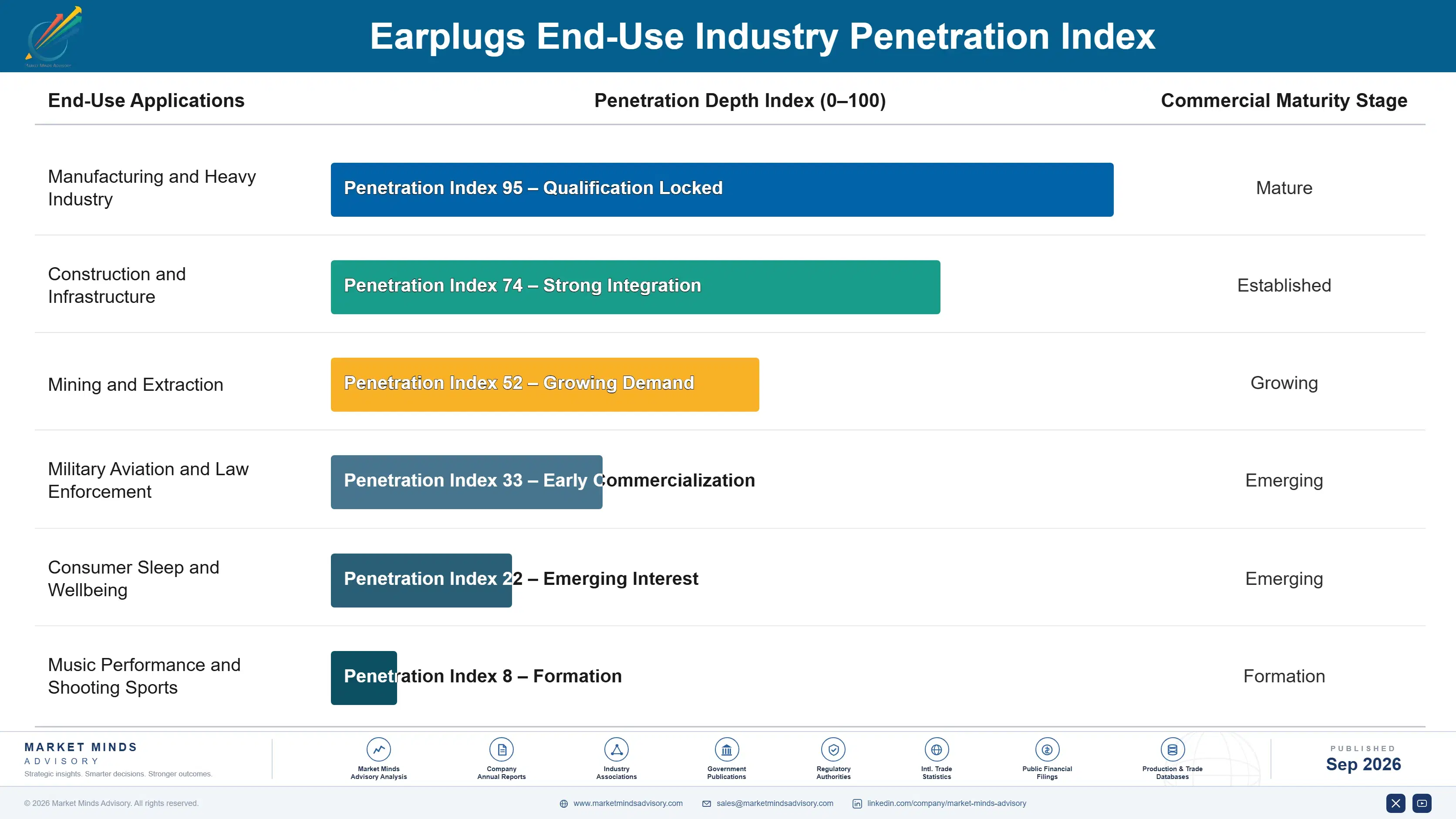
Occupational demand is genuinely consumable and repeats on issuance rather than on any purchase decision, which makes it predictable and low margin at once. A plant issuing disposable foam reorders on headcount and shift patterns without anybody revisiting the specification for years. Verification-backed programmes behave differently: the switching cost is the evidence base rather than the product, and that holds an account far longer than a price advantage ever does.
Attachment depth varies enormously by segment. A custom moulded programme with individual fitting records is effectively locked for as long as the workforce is stable, because refitting an entire site is a project rather than a purchase. Disposable foam against a rating and a price moves on cents at every tender. Electronic products sit between, held by training investment and by the communication systems they integrate with.

The consumer sleep buyer behaves like nobody in the occupational chain. Purchases are individual, discretionary, driven by social recommendation, and repeat like accessories rather than consumables. A generation that treats sleep quality as worth spending on has created roughly a third of this market's revenue in about six years, and safety manufacturers organised around industrial distribution have consistently struggled to reach them.
earplugs-market-end-use-penetration-index-1790016784968

Where This Market Rewards

These are among the four positions where our research anticipates prominent divergence between winners and laggards over the coming forecast period. Each is grounded in the demand model, the regulatory perimeter, and the announced capacity pipeline.
01 / FIT VERIFICATION PROGRAMMES

The label is not the protection

Real world attenuation runs roughly 12 decibels below the labelled rating because insertion depth is the whole variable and workplace insertion happens in seconds without supervision. Manufacturers bundling fit verification with product supply report account retention 2.9 times higher, since the verification data becomes part of the customer's own compliance record. Once a programme runs on measured attenuation rather than issuance counts, changing supplier means rebuilding an evidence base regulators have already reviewed, and insurers and regulators both look at recorded hearing loss cases.
02 / VOLUNTARY WEAR DESIGN

A pocketed plug protects nobody

Observed wear in high noise areas runs near 58% under unannounced checks, so a plug rated three decibels higher that spends half a shift in a pocket delivers less protection than a lower rated one worn throughout. Manufacturers competing on comfort and all-shift wearability report measured exposure reductions 2.3 times greater than rating-led alternatives achieve. The argument requires selling against the specification the buyer believes they want, which is why almost nobody makes it, and removal rates rise sharply through the final hours of longer shifts.
03 / COMMUNICATION BARRIER ENGINEERING

People remove them for a reason

Roughly 44% of wearers remove protection to hear speech or an alarm, which makes communication the single largest cause of unprotected exposure rather than any shortfall in available attenuation. Manufacturers offering level-dependent electronic products report unit revenue 6.4 times higher than disposable foam alongside materially better wear compliance in the same environments. Selling more attenuation into a communication problem has never worked and there is no reason to expect it to start, and the areas where removal concentrates can be identified in advance through observation.
04 / CONSUMER CHANNEL BUILDING

A third of revenue nobody planned

Consumer sleep supplies around 31% of category revenue and behaves nothing like industrial supply, with comfort, appearance, and social recommendation deciding purchases that safety credentials do not influence at all. Manufacturers building dedicated consumer design and direct channel capability report gross margin 2.1 times better than those routing sleep products through safety distribution networks. Design-led entrants took this segment precisely because incumbents treated it as an extension of an existing business, and repeat purchase there behaves like accessories rather than like industrial consumables.

Engagement Snapshot From the Field

A live engagement with an industry participant carrying material or product regulatory and market exposure ahead of a defining policy shift, showing how our research translates into a defensible multi-year portfolio strategy.
MARKET MINDS ADVISORY · CLIENT ENGAGEMENT SUMMARY
Earplugs Producer Strategic Portfolio Review and Transition Roadmap 2026·Investment Scenario on Earplugs Exposure Evaluation 2025-26
CLIENT PROFILE
A multi-site industrial manufacturer with around 14,000 employees across eleven plants and annual hearing protection spend near USD 2.4 million (client-reported, unverified by MMA). Recorded noise-induced hearing loss cases had risen for four consecutive years despite full compliance with issuance requirements and a recent upgrade to higher rated disposable plugs. The programme had never been audited by observation.
STRATEGIC CHALLENGE
The safety function had responded to rising cases by specifying plugs with higher noise reduction ratings at each of the last two tenders. Nobody had measured what individual workers were achieving, and the programme's compliance metric counted boxes distributed rather than protection delivered to anybody. Higher ratings had been the only lever considered at either tender.
MMA APPROACH
MMA ran field attenuation testing across a stratified sample of 400 workers, conducted unannounced wear observation in designated high noise areas across all eleven plants, coded the reasons workers gave for removal, and modelled outcomes under higher rating, comfort-led, and electronic level-dependent alternatives. Observation was carried out without notice to plant management so the recorded wear rates reflected ordinary practice.
KEY FINDINGS
  1. Measured attenuation averaged roughly thirteen decibels below the labelled rating, and the higher rated plugs specified at the last tender performed no better in the field than their predecessors.
  2. Unannounced observation found protection actually worn by around fifty-five per cent of workers in designated high noise areas, against issuance records showing full programme compliance.
  3. Communication was the reason given for removal in a clear majority of cases, concentrated in areas where operators needed to coordinate verbally or respond to audible alarms.
  4. Comfort was the second reason and correlated closely with shift length, with removal rates rising sharply through the final three hours of longer shifts.
CLIENT PROFILE
A multi-site industrial manufacturer with around 14,000 employees across eleven plants and annual hearing protection spend near USD 2.4 million (client-reported, unverified by MMA). Recorded noise-induced hearing loss cases had risen for four consecutive years despite full compliance with issuance requirements and a recent upgrade to higher rated disposable plugs. The programme had never been audited by observation.
STRATEGIC CHALLENGE
The safety function had responded to rising cases by specifying plugs with higher noise reduction ratings at each of the last two tenders. Nobody had measured what individual workers were achieving, and the programme's compliance metric counted boxes distributed rather than protection delivered to anybody. Higher ratings had been the only lever considered at either tender.
MMA APPROACH
MMA ran field attenuation testing across a stratified sample of 400 workers, conducted unannounced wear observation in designated high noise areas across all eleven plants, coded the reasons workers gave for removal, and modelled outcomes under higher rating, comfort-led, and electronic level-dependent alternatives. Observation was carried out without notice to plant management so the recorded wear rates reflected ordinary practice.
KEY FINDINGS
  1. Measured attenuation averaged roughly thirteen decibels below the labelled rating, and the higher rated plugs specified at the last tender performed no better in the field than their predecessors.
  2. Unannounced observation found protection actually worn by around fifty-five per cent of workers in designated high noise areas, against issuance records showing full programme compliance.
  3. Communication was the reason given for removal in a clear majority of cases, concentrated in areas where operators needed to coordinate verbally or respond to audible alarms.
  4. Comfort was the second reason and correlated closely with shift length, with removal rates rising sharply through the final three hours of longer shifts.
RECOMMENDED STRATEGY
Phase 1: Phase one: introduce annual field attenuation testing and replace issuance counting with measured attenuation as the programme's compliance metric. Report both figures to site leadership quarterly. Phase 2: Phase two: deploy electronic level-dependent protection in the communication-critical areas where removal rates were concentrated during observation. Target deployment by observed removal rate rather than plant-wide. Phase 3: Phase three: stop specifying by noise reduction rating at tender and specify by measured field attenuation and observed wear instead.
OUTCOME
Measured programme exposure fell substantially within three quarters and observed wear in high noise areas rose above eighty per cent (client-reported, unverified by MMA). Total protection spend rose by around a fifth. The rating-led specification approach was withdrawn across all eleven plants. Recorded hearing loss cases stopped rising for the first time in five years.

Frequently Asked Questions

Foundational context covering the market sizes, CAGR, scope, country, region and competition that inform every finding below. This section is provided to cover basics and most often pre-purchase conversations, answered from the MMA Primary Research Dataset.

What is the current size of the Earplugs Market?

The market was worth USD 1.5 billion in 2025 and stands at USD 1.6 billion in 2026. Value covers occupational, consumer sleep, water, pressure, and music earplugs at manufacturer selling price.

How large will the Earplugs Market be by 2036?

MMA forecasts USD 3.1 billion by 2036, an increase of USD 1.5 billion across the forecast period. That represents 1.94 times the 2026 base of USD 1.6 billion.

What is the CAGR for the Earplugs Market 2026 to 2036?

The base case compound annual growth rate is 6.8%, with a bull case at 8.0% and a bear case at 5.6%. Historical growth from 2020 to 2025 ran at 5.7%.

Which segment is growing fastest?

Electronic level-dependent earplugs grow at 10.2%, half again the market rate of 6.8%. They address why people remove protection rather than how much sound it blocks.

Who are the major companies in the Earplugs Market?

3M, Honeywell International, Moldex-Metric, Ansell and Uvex Safety Group lead the field. Together they hold 47% of category revenue, with design-led entrants strong in consumer sleep.

Which country is growing fastest?

China grows at 10.9%, as occupational noise exposure limits move from written regulation into inspected practice across manufacturing provinces. The exposed workforce there is exceptionally large.

Report Segmentation Architecture

The full report scope spans multiple orthogonal segmentation dimensions, with cross-tabulated demand data provided for each dimension pair. Coverage extends further to regional breakdowns, trend trajectories, and the competitive detail needed to support segment-level decision-making.

By Construction Type

  • Disposable Foam Earplugs
  • Reusable Pre-Moulded Earplugs
  • Custom Moulded Earplugs
  • Banded and Semi-Aural Earplugs
  • Electronic Level-Dependent Earplugs
  • Specialty Water and Pressure Earplugs

By End-Use Industry

  • Manufacturing and Heavy Industry
  • Construction and Infrastructure
  • Mining and Extraction
  • Military Aviation and Law Enforcement
  • Consumer Sleep and Wellbeing
  • Music Performance and Shooting Sports

By Commercial Dimension

  • Industrial Safety Distribution
  • Direct Programme Supply Contracts
  • Pharmacy and Grocery Retail
  • Direct to Consumer Online
  • Audiology and Custom Fitting Channels
  • Fit Verification and Programme Services

By Region

  • East Asia
  • North America
  • Western Europe
  • South Asia and Pacific
  • Latin America
  • Middle East and Africa
  • Eastern Europe

Scope, Methodology, and Coverage

Every figure in this report is reproducible from documented input assumptions. The scope below maps the historical period, the forecast horizon, the segmentation dimensions, and the countries covered, alongside the underlying primary and qualitative methodology.
Historical Period
2020 to 2025
Forecast Period
2026 to 2036
Base Year
2025 (USD billions; MMA Primary Research Dataset, September 2026)
Market Definition
This market covers earplugs and in-ear hearing protection for occupational, consumer sleep, water, pressure, and music applications, across disposable foam earplugs, reusable pre-moulded earplugs, custom moulded earplugs, banded and semi-aural earplugs, electronic level-dependent earplugs, and specialty water and pressure earplugs. It excludes earmuffs and over-ear hearing protection, hearing aids and amplification devices, earphones, in-ear monitors, and surgical ear tubes.
Quantitative Units
USD billions, revenue at manufacturer selling price
Segmentation Dimensions
Construction type, end-use application, commercial dimension, region
Regions Covered
East Asia, North America, Western Europe, South Asia and Pacific, Latin America, Middle East and Africa, Eastern Europe
Countries Covered
China, Japan, South Korea, Taiwan, India, Indonesia, Vietnam, Thailand, Australia, United States, Canada, Mexico, Germany, France, United Kingdom, Italy, Spain, Netherlands, Sweden, Poland, Czechia, Romania, Brazil, Argentina, Chile, Saudi Arabia, United Arab Emirates, Qatar, Egypt, South Africa
Key Companies Profiled
3M, Honeywell International, Moldex-Metric, Ansell, Uvex Safety Group, MSA Safety, Radians, Delta Plus Group, JSP Safety, Cotral Lab, Etymotic Research, Alpine Hearing Protection, Loop Earplugs, McKeon Products, Apothecary Products, Ohropax, Pyramex Safety, Elvex Corporation, Custom Protect Ear, Sonova Consumer Hearing
Quantitative Methodology
Primary survey, n=3,800 respondents, Q4 2025, six countries; demand-side model with trade association cross-validation
Qualitative Methodology
47 expert interviews, Q4 2025; applied to validate demand model assumptions, identify emerging dynamics, and assess competitive positioning
Report Format
PDF and XLSX data workbook (Word format preview document)
Publisher
Market Minds Advisory
Report Code
MMA-2026-MED-511
Published
September 2026
Contact
sales@marketmindsadvisory.com | www.marketmindsadvisory.com

Purchase the full Earplugs Market Report (2026 to 2036).

The full report sizes the earplugs market across six construction types, seven regions, and thirty countries, with forecasts to 2036 under base, bull, and bear cases. It quantifies the gap between labelled and field attenuation, measures fit verification adoption and observed wear compliance separately from issuance records, and sizes the consumer sleep segment that now supplies roughly a third of revenue. Competitive analysis covers twenty participants evaluated consistently on category revenue, with detailed treatment of electronic level-dependent capability and consumer channel depth. Cost structure by product mix and manufacturing location is analysed throughout. Primary research includes 3,800 survey responses and 47 expert interviews.
Six construction types sized and forecast separately
Twenty participants evaluated on category revenue consistently
Field attenuation compared against labelled ratings by type
Observed wear compliance measured separately from issuance records
Removal reasons coded and quantified across occupational settings
Consumer sleep segment sized and channel dynamics assessed

Built For The People Who Decide

From boardroom strategy to bench-side execution, this report is read cover-to-cover by leaders shaping the next decade of their industry, turning demand scenarios, market dynamics and valuation benchmarks into decisions.
CXOs/ Presidents/ VPs/ Managers
M&A and Corporate Development
Strategy Teams and R&D Heads
Procurement and Product Directors
Regulatory and Compliance Leaders
Investor Relations and Equity Analysts