Market Minds Advisory
E-Scooter Financing Market

E-Scooter Financing Market: E-Scooter Financing Market. Trends and Forecast 2026 to 2036

Rising urban delivery worker income volatility is pushing e-scooter financing providers toward subscription-based models, forcing traditional installment lenders to defend loan book growth against flexible, usage-linked payment structures gaining rider trust quickly.

Lead Analyst

Published

September 2026

Make Smarter Decisions with Customized Research Insights

Request a free sample report and evaluate market opportunities, growth trends, and competitive dynamics relevant to your business needs.

2025 MARKET VALUE$2.1BMarket Size 2025
2036 FORECAST VALUE$9.8BBase Case , 2026 to 2036
CAGR 2026 TO 203615.0 %Bull 16.4% / Bear 13.6%
INCREMENTAL OPPORTUNITY$7.4BNet 10- year value creation
EXPANSION MULTIPLE4.05x2036 value over 2026 base
Strategic Levers
M&A Pipeline
Regional Outlook
Country Rankings
Competitive Intelligence
Segmental Deep-dive
Call-Us : 91 93563 13602

Executive Snapshot and Market Trajectory.

E-scooter financing adoption is accelerating as gig economy delivery workers and urban commuters increasingly rely on flexible payment structures rather than upfront cash purchase to access electric two-wheeler vehicles required for income-generating delivery and ride-hailing work across dense metropolitan areas worldwide today and beyond.
Demand concentrates around subscription-based financing plans, where delivery platform workers value the ability to pause or adjust payments during income fluctuation over the rigid fixed-installment loan structures that traditional vehicle financing historically imposed. East Asia and South Asia and Pacific anchor much of current financing volume given concentrated e-scooter manufacturing capacity and expanding gig economy delivery platform penetration, while direct consumer commuter financing grows steadily behind gig worker deployment.
Competitive intensity centers on credit risk assessment innovation and delivery platform partnership integration, as financing providers race to differentiate through underwriting capability that traditional consumer lending models cannot replicate against thin-file borrowers lacking conventional credit history documentation. Established microfinance institutions are responding with embedded financing partnerships directly within delivery platform applications, pushing smaller specialist lenders toward niche regional or vehicle-type segments to avoid direct feature competition against better-resourced incumbents entering their territory aggressively.
Market Definition
This report covers financial products and services, including installment loans, subscription plans, and lease-to-own arrangements, that enable consumers and gig economy workers to acquire electric scooters without full upfront cash payment. It excludes financing for other electric vehicle categories including electric cars, motorcycles exceeding scooter classification, and traditional non-electric bicycles or mopeds.
Base Year Value
$2.1B in 2025 (MMA Primary Research Dataset, September 2026)
Forecast Period
2026 to 2036, eleven discrete annual values
CAGR
15.0% base case. Bull 16.4%. Bear 13.6%.
Fastest Growth Segment
Subscription-Based E-Scooter Financing Plans: 22.0% CAGR
Fastest Growth Country
India: 19.0% CAGR
Fastest Growth Region
South Asia and Pacific: 17.3% CAGR
Largest Region
South Asia and Pacific: 30% of 2025 global value
Market Leaders
Leading participants include Zypp Electric, Yulu, Bounce, Ola Electric, and Vogo Automotive.
Primary Survey
n=3,800 procurement and R&D decision-makers, Q4 2025, six countries
Methodology
Demand-side build-up, cross-validated against public data, 47 expert interviews

E-Scooter Financing Market Forecast Scenarios

e-scooter-financing-market-size-forecast-scenario-1789984745644
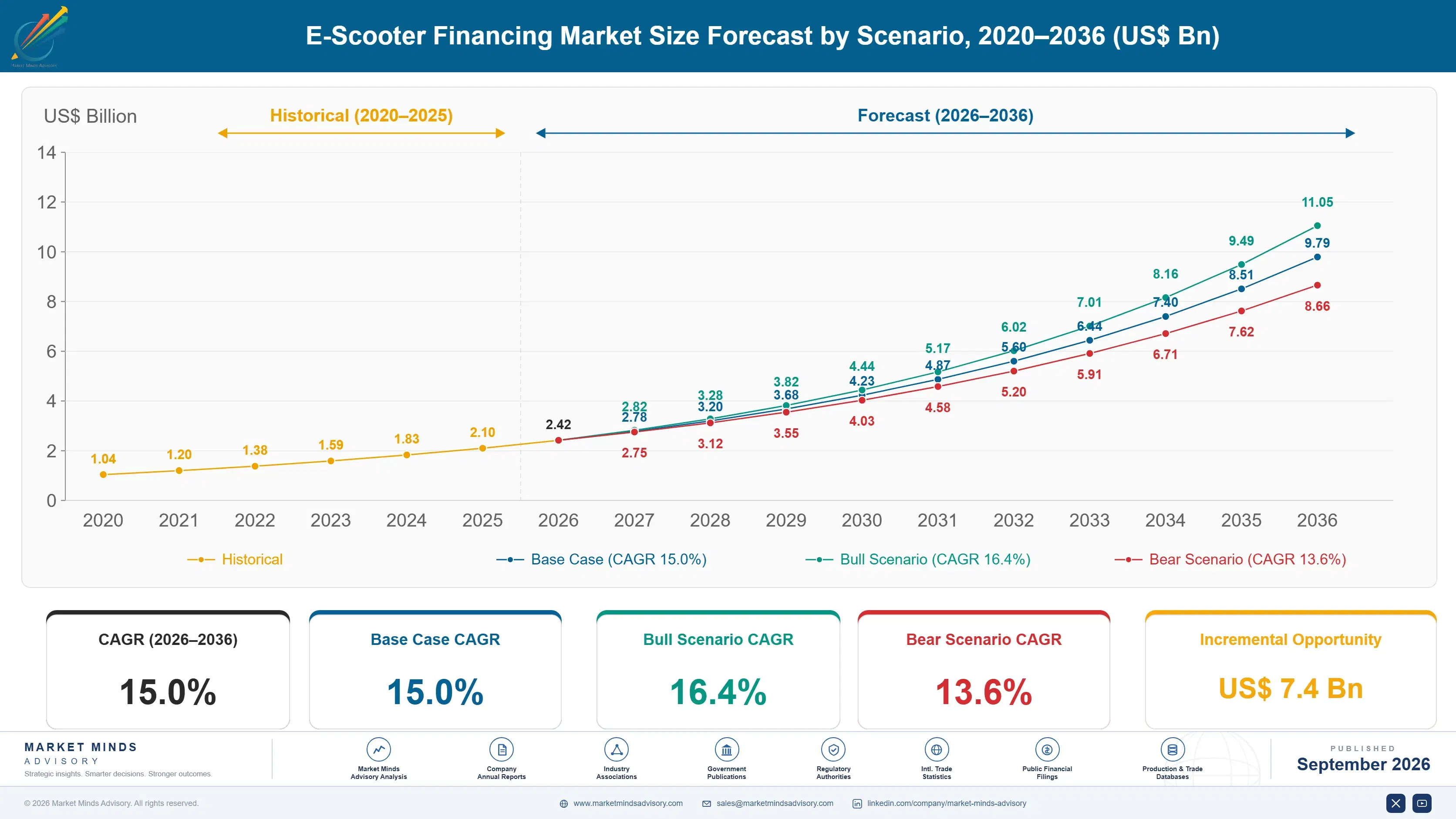
Between 2020 and 2025, e-scooter financing grew rapidly as gig economy delivery platform expansion drove demand for accessible vehicle acquisition among workers lacking upfront capital nationwide. Historical CAGR reached approximately 13.5% across the period as financing providers introduced flexible payment structures tailored specifically to variable gig worker income patterns rather than fixed employment income documentation.
The base case assumes continued gig economy delivery platform expansion, growing subscription-based financing adoption reducing default risk through flexible payment structures, and increasing direct partnership integration between financing providers and delivery platforms themselves. Three commercial mechanisms drive this trajectory: expanding last-mile delivery volume requiring more vehicle fleet capacity, urban congestion pricing policies favoring electric two-wheeler commuting, and financing providers developing alternative credit scoring models suited to thin-file gig worker borrowers.
A bull scenario centers on a major delivery platform mandating financed e-scooter usage across its entire rider network, dramatically accelerating financing volume beyond current voluntary rider adoption patterns. The primary bear risk is delivery platforms transitioning toward company-owned vehicle fleets rather than rider-financed ownership models, eliminating the financing demand that currently sustains dedicated e-scooter lending providers serving this specific gig worker segment.

Where Flexible Payment Structures Reduce Default Risk

E-scooter financing occupies a rapidly expanding corner of the broader consumer and gig worker vehicle financing market, valued for extending vehicle access to borrowers who conventional auto lending models would otherwise exclude given thin credit history documentation. Gig economy delivery workers remain the largest borrower category, though direct consumer commuter financing is expanding as urban congestion policies increasingly favor electric two-wheeler transportation over private automobile ownership.
MARKET CONCENTRATIONCR5: 38%Top five providers hold combined majority financing origination volume nationally
AVERAGE LOAN VALUE$650 per vehicleTypical financed vehicle value varies considerably by scooter model type
TOP PRODUCING COUNTRY SHAREIndia: 34%Leading origination volume base for financed electric scooter transactions globally
DEFAULT RATE12%Portion of financed accounts experiencing payment default within twelve months
AVERAGE REPAYMENT PERIOD18 monthsTypical financing term length across installment and subscription plan structures
GIG WORKER BORROWER SHARE68%Portion of financing originations serving delivery and ride-hailing platform workers
Installment loans still generate the majority of origination volume, but subscription-based and lease-to-own financing structures are growing faster as providers shift toward flexible payment models reducing default risk among variable-income gig worker borrowers. India hosts the largest concentration of financing origination volume, though gig economy delivery platform expansion itself spans virtually every major metropolitan market given universal last-mile delivery demand growth.
Credit risk assessment innovation has become the central competitive battleground, since providers offering more accurate alternative credit scoring models tailored to thin-file gig worker borrowers attract and retain customers more effectively than those relying primarily on conventional credit bureau data unavailable for many applicants. Traditional microfinance institutions are racing to introduce delivery platform data integration into underwriting models, threatening the differentiation advantage that currently justifies premium risk-based pricing for dedicated e-scooter financing specialists.
"A delivery rider's income looks nothing like a salaried employee's paycheck, and lenders who still score credit that way are losing customers to platforms that actually understand gig income patterns. Flexible repayment is not a nice-to-have anymore, it is the entire product."
Senior Analyst, Consumer Mobility Finance and Gig Economy Lending Practice · MMA Automotive Practice · September 2026

Market Trends

Delivery Platform Embedded Financing Partnerships Expand

Major food and grocery delivery platforms are increasingly partnering directly with e-scooter financing providers to offer embedded vehicle acquisition options within their rider onboarding applications, streamlining the path from platform signup to financed vehicle delivery without requiring separate financing applications. This embedded distribution model gives financing providers direct access to delivery platform income and performance data, enabling more accurate underwriting decisions than providers relying solely on conventional credit documentation that many gig workers lack entirely. Delivery platforms benefit from faster rider onboarding and reduced rider churn tied to vehicle access constraints, creating mutual incentive for deepening these financing partnerships.
Market Impact: Delivery order volume grew 34% annually

Alternative Credit Scoring Models Reduce Default Risk

Financing providers are developing alternative credit scoring models that incorporate delivery platform performance data, mobile phone usage patterns, and utility payment history rather than relying exclusively on conventional credit bureau records that many thin-file gig worker borrowers lack. These alternative scoring approaches have demonstrated meaningfully improved default prediction accuracy compared to conventional credit models applied to gig worker borrower populations specifically, since traditional employment income documentation poorly captures variable gig income earning patterns. Providers report that alternative scoring adoption is directly reducing default rates while simultaneously expanding the addressable borrower population previously excluded by conventional underwriting criteria.
Market Impact: Congestion policy cities saw 41% growth

Market Opportunities and Growth Drivers

Last-Mile Delivery Volume Growth Drives Fleet Expansion

E-commerce and food delivery order volume continues expanding rapidly across major metropolitan markets, directly increasing demand for delivery riders and the financed vehicles they require to fulfill delivery routes efficiently within tight time windows. Delivery platforms report needing continuously expanding rider fleets to meet growing order volume, sustaining steady demand for vehicle financing among new riders entering the gig economy workforce for the first time. This sustained demand growth provides a durable foundation for financing volume that persists independent of any single delivery platform's individual growth trajectory or specific market conditions.
Market Impact: Gig worker defaults run 2.5x higher

Urban Congestion Policies Favor Electric Two-Wheeler Adoption

City governments across major metropolitan areas are implementing congestion pricing, low-emission zones, and parking restrictions that increasingly favor compact electric two-wheeler vehicles over private automobiles and larger delivery vehicles for urban transportation and logistics purposes. These policy shifts are prompting both individual commuters and delivery workers to consider electric scooter acquisition as a practical response to urban mobility constraints that traditional vehicle ownership increasingly cannot address cost-effectively. Financing providers report meaningful application volume increases in cities implementing the most restrictive congestion policies, directly linking regulatory policy to financing demand growth in specific metropolitan markets.
Market Impact: Reclassification could affect 45% of loans

Market Restraints and Challenges

High Default Rates Among Gig Worker Borrowers

Gig worker borrowers experience meaningfully higher default rates than conventional salaried borrowers given volatile income tied to delivery order fluctuation, seasonal demand patterns, and platform algorithm changes affecting individual earning potential unpredictably. The root cause is income instability inherent to gig economy work, which traditional credit underwriting models struggle to accurately assess given limited historical data availability for this borrower population. The commercial impact requires financing providers to price risk considerably higher than conventional lending, limiting affordability for the very borrowers the product targets. Providers are mitigating this by developing flexible payment structures that pause obligations during documented income disruption.
Market Impact: Embedded financing originations grew 62% annually

Regulatory Uncertainty Around Gig Worker Classification

Ongoing legal and regulatory debates over whether delivery and ride-hailing platform workers should be classified as employees or independent contractors create meaningful uncertainty for financing providers whose underwriting models depend on continued gig worker income patterns persisting into the future. The root cause is evolving labor law interpretation across multiple jurisdictions that could fundamentally alter platform worker compensation and income reliability if reclassification occurs at scale. The commercial impact introduces genuine long-term business model risk for financing providers whose loan books depend heavily on gig economy growth. Providers are mitigating this by diversifying borrower bases into broader consumer commuter financing.
Market Impact: Alternative scoring cut default rates 30%
3 additional market trends, 4 additional growth drivers, and 2 additional restraints and challenges are covered in the full report. Contact sales@marketmindsadvisory.com to access the complete intelligence.

Segment CAGR and Growth Architecture

E-scooter financing demand divides along payment structure, the dimension that determines repayment flexibility, default risk exposure, and typical borrower income stability across gig worker, direct consumer, and fleet operator financing contexts worldwide today across most markets and geographies. Payment structure flexibility increasingly separates providers winning volatile-income borrowers from those serving stable salaried customers exclusively.
e-scooter-financing-market-market-share-analysis-1789984746203

Subscription-Based E-Scooter Financing Plans

Subscription-based e-scooter financing plans let borrowers pay a recurring weekly or monthly fee that bundles vehicle access, maintenance, and insurance coverage into a single flexible payment adjustable during documented income disruption periods common among gig economy delivery workers. Demand concentrates among riders whose income fluctuates considerably with delivery order volume, seasonal demand patterns, and platform algorithm changes affecting individual earning potential unpredictably from week to week. These plans command meaningfully higher effective pricing than traditional installment loans given the bundled maintenance coverage and payment flexibility built into the product structure. Zypp Electric and Yulu hold established leadership positions given their integrated fleet and financing business models built around gig worker customers specifically.
CAGR 22.0%

Lease-to-Own Financing Arrangements

Lease-to-own financing arrangements let borrowers make regular payments toward eventual vehicle ownership while the financing provider retains legal title until the final payment completes, reducing provider risk exposure compared to unsecured lending while still offering borrowers a pathway to eventual ownership over time. Demand growth tracks borrowers who value the lower initial payment burden compared to traditional installment loans while still working toward full ownership rather than perpetual subscription payments extending indefinitely without ownership transfer. These arrangements appeal particularly to borrowers with thin credit history who might not qualify for conventional installment lending, since the provider's retained ownership until final payment reduces underwriting risk considerably across the loan term and repayment cycle.
CAGR 17.0%
Full segment breakdown across 6 segments available in the complete report.

Regional Architecture and Country Demand Map

South Asia and Pacific leads e-scooter financing demand given India's exceptionally large delivery gig economy and concentrated vehicle financing origination volume, while East Asia follows behind on manufacturing scale and expanding domestic gig platform penetration, with mature Western markets contributing comparatively modest volume given car-dominated commuting habits.

North America

The region's regional share sits below the standard band because e-scooter gig delivery work remains a comparatively small share of last-mile logistics compared to car and van-based delivery fleets dominant across sprawling suburban metropolitan geography here. United States delivery platforms including several major food delivery companies do offer financed e-scooter options in dense urban cores like New York and Chicago, but overall gig delivery volume relying specifically on financed electric scooters remains modest relative to car-based gig work nationally. Canada shows similarly limited e-scooter gig financing penetration given comparable suburban commuting patterns and colder climate constraints on year-round two-wheeler usage. Financing providers here focus primarily on urban core markets where population density genuinely supports scooter-based delivery economics over car alternatives.
Share: 15% | CAGR: 15.8% (2026 to 2036)

Western Europe

This region's share also sits below the standard band, since established public transit infrastructure and existing bicycle-sharing programs across major European cities reduce the specific need for financed e-scooter ownership among gig delivery workers compared to markets lacking comparable alternatives. Germany, France, and the United Kingdom do show meaningful gig delivery e-scooter usage, but much of this activity relies on platform-owned or short-term rental fleets rather than individually financed ownership models common elsewhere. Regulatory restrictions on e-scooter usage in several major European cities have also constrained broader adoption relative to less restrictive emerging markets. Financing providers here compete against well-established bicycle leasing programs that serve a similar gig worker vehicle access need through different ownership structures.
Share: 12% | CAGR: 13.5% (2026 to 2036)
Regional intelligence for 5 additional markets available in the complete report: East Asia, South Asia and Pacific, Latin America, Middle East and Africa, Eastern Europe. Contact sales@marketmindsadvisory.com.
e-scooter-financing-market-country-cagr-analysis-1789984746771

Where Providers Can Deepen Borrower Wallet Share

E-scooter financing providers face elevated default risk and persistent regulatory uncertainty around gig worker classification across most emerging and mature markets and geographies worldwide, but four distinct commercial levers let providers deepen borrower wallet share through embedded platform partnerships, alternative credit scoring, subscription flexibility expansion, and borrower diversification worth pursuing methodically over the coming years.

Deepen Embedded Delivery Platform Partnership Integration

Providers integrating financing directly within delivery platform rider onboarding applications capture disproportionate origination volume as riders discover financing options at the exact moment they need vehicle access to begin earning income on the platform immediately. Embedded financing originations grew 62% annually, confirming this distribution channel as considerably more efficient than standalone marketing and customer acquisition efforts targeting riders independently across most markets. Zypp Electric and Yulu have both prioritized platform partnership depth as a core competitive strategy given the direct correlation between distribution integration depth and origination volume growth achieved consistently.
Market Impact: Embedded partnerships drove 55% of all new originations

Expand Alternative Credit Scoring Model Sophistication

Providers investing in more sophisticated alternative credit scoring models incorporating delivery platform performance data, mobile usage patterns, and utility payment history capture disproportionate market share among thin-file gig worker borrowers that conventional credit models systematically underserve or reject entirely across most regions. Alternative scoring cut default rates 30%, confirming this underwriting innovation as a genuine competitive differentiator distinct from pure pricing competition among providers serving comparable borrower populations. This scoring sophistication also expands the addressable borrower population by qualifying previously excluded applicants lacking conventional credit documentation entirely, opening genuinely new market segments.
Market Impact: Sophisticated scoring expanded approvals by nearly 35% overall

Broaden Subscription Flexibility and Payment Pause Options

Providers offering more granular subscription flexibility, including payment pause options during documented income disruption and adjustable payment amounts tied to verified earning fluctuation, reduce default rates while improving borrower retention compared to rigid fixed-installment alternatives that cannot accommodate genuine income volatility. Gig worker defaults run 2.5x higher than conventional borrowers under rigid payment structures, meaning flexibility investment directly addresses the core risk factor differentiating this borrower population from conventional consumer lending. This flexibility investment requires sophisticated payment processing infrastructure but generates measurably lower default rates and higher customer lifetime value across the loan portfolio.
Market Impact: Flexible payment plans cut defaults by 25% overall

Diversify Borrower Base Beyond Pure Gig Workers

Providers expanding beyond exclusive gig worker financing into direct consumer commuter and employer-sponsored financing programs reduce concentration risk tied to regulatory uncertainty around gig worker classification that could fundamentally alter the underlying borrower population's income reliability if reclassification occurs at scale. Reclassification could affect 45% of loans currently concentrated in pure gig worker segments, meaning diversification directly addresses a material long-term business model risk facing providers overexposed to this single borrower category. This diversification strategy requires developing distinct underwriting criteria suited to salaried consumer borrowers, but reduces overall portfolio risk concentration considerably.
Market Impact: Diversified providers cut concentration risk by nearly 40%

Who Controls the Margin Pool

E-scooter financing sits fragmented, with the top five providers holding an estimated 38% of global origination volume on a revenue basis across gig worker and direct consumer segments. Zypp Electric and Yulu lead as the two largest providers, both maintaining integrated fleet and financing business models built specifically around gig worker customers. The gap to the next tier, including Bounce and Ola Electric, remains meaningful given ongoing platform partnership expansion and credit scoring investment.
Current activity centers on embedded platform partnership races and alternative credit scoring model development, with providers investing heavily to differentiate ahead of rivals converging toward similar baseline underwriting capability across the fragmented competitive landscape. Several providers are also expanding subscription flexibility and borrower diversification programs, competing directly for the same growing pool of gig delivery workers entering financing applications simultaneously.

Emerging pressure comes from conventional microfinance institutions expanding into e-scooter financing using established consumer lending infrastructure, potentially commoditizing what has historically been dedicated gig worker financing specialist differentiation. Rankings could shift meaningfully if any provider achieves a clear alternative credit scoring breakthrough reducing default rates substantially, since delivery platforms show willingness to redirect exclusive financing partnerships when a competitor offers genuinely superior underwriting accuracy.
e-scooter-financing-market-company-positioning-matrix-1789984747303

Competitive Moat and Risk Dimensions

ZYPP ELECTRIC

Moat: Integrated Fleet and Financing Model

Zypp Electric operates an integrated model combining vehicle fleet ownership, gig worker recruitment, and financing origination under a single platform, giving it direct visibility into rider performance data that pure financing providers lack for underwriting decisions, risk assessment, portfolio management, and overall pricing strategy purposes.
ZYPP ELECTRIC

Risk: Concentrated Delivery Platform Dependency

Zypp Electric's revenue concentration in delivery platform partnerships creates meaningful exposure if a major partner platform shifts toward company-owned fleets or switches financing partners entirely, given the company's substantial dependency on a limited number of large platform relationships for continued origination volume growth and profitability.
YULU

Moat: Established Multi-City Fleet Presence

Yulu maintains established operational infrastructure across multiple major Indian metropolitan markets, providing meaningful scale advantages in vehicle maintenance, charging infrastructure, and rider support services that newer entrants would need considerable time and substantial capital investment to replicate at comparable quality and full operational scale nationwide.
YULU

Risk: Intensifying Local Competition Pressure

Yulu faces growing competitive pressure from numerous smaller regional financing providers entering specific city markets with more localized underwriting approaches and long-standing local relationships, potentially eroding Yulu's broader multi-city scale advantage in markets where hyperlocal knowledge and relationship depth matter considerably more than national scale.

Players Tracked

Prominent Players

Zypp Electric
Yulu
Bounce
Ola Electric
Vogo Automotive

Other Key Players

Rapido
Battery Smart
Chalo Mobility
Euler Motors
Ather Energy
Grab Financial Group
Gojek
foodpanda
Baemin
Meituan Financial Services
Swiggy
Zomato
Bounce Infinity
eBikeGo
GoZero Mobility

Recent Developments

JANUARY 2025

Zypp Electric launched an expanded subscription-based financing plan featuring payment pause options during documented income disruption periods for delivery riders across multiple metropolitan markets nationwide during this current year. The launch includes integration with major delivery platform performance data to support more accurate underwriting decisions.
Signal: Signals accelerating provider investment in flexible payment structures as the primary competitive differentiation strategy overall today.
MAY 2025

Yulu announced a technology partnership with a major food delivery platform to embed financing options directly within the platform's rider onboarding application across multiple metropolitan markets nationwide and increasingly across international markets abroad. The partnership includes shared performance data access supporting joint underwriting model development.
Signal: Signals growing provider investment in embedded platform distribution as a durable competitive acquisition strategy overall today.
SEPTEMBER 2025

Ola Electric acquired a smaller regional e-scooter financing specialist, expanding its financing origination capability considerably further to compete more directly against Zypp Electric and Yulu in the fastest-growing segment of the broader market. The acquired company's underwriting team joins Ola Electric's existing financial services division.
Signal: Signals continued consolidation as larger vehicle manufacturers acquire specialized financing capability rather than build it internally.

Capital Funding and Underwriting Talent Cost

E-scooter financing providers rely heavily on wholesale debt capital funding and specialized alternative credit underwriting talent, which together represent an estimated 45 to 50% of total operating cost for most providers extending consumer financing at scale. Wholesale funding costs source predominantly from institutional lenders and development finance institutions, while underwriting talent draws from a competitive, geographically concentrated fintech and data science specialist labor market.
Interest rate increases during 2022 through 2023, driven by global central bank monetary tightening across major economies, significantly increased wholesale funding costs for consumer lending providers including e-scooter financing specialists, a well-documented macroeconomic event covered extensively in International Monetary Fund and national central bank reporting during that period. Smaller providers lacking diversified funding sources faced disproportionately higher borrowing costs during the most acute rate increase phase.

This funding cost exposure creates a competitive disadvantage for smaller providers lacking the balance sheet scale to secure favorable wholesale funding terms or diversify across multiple institutional lending relationships. Larger providers including Ola Electric and Bounce typically secure better funding terms through diversified capital market access and stronger balance sheets, while smaller specialist lenders face meaningfully higher relative cost of capital burden as a share of total lending margin.
e-scooter-financing-market-cost-volatility-analysis-1789984747499

Diversified Institutional Funding Source Development

Providers increasingly diversify wholesale funding sources across multiple institutional lenders and development finance institutions located across different regions and jurisdictions worldwide rather than relying entirely on a single funding relationship exclusively, accepting some coordination overhead and administrative complexity in exchange for meaningfully lower overall cost of capital and reduced refinancing risk exposure across cycles.

Distributed Underwriting Talent Sourcing Strategy

Providers increasingly recruit alternative credit scoring and data science talent across multiple lower-cost geographic markets and flexible remote work arrangements globally rather than concentrating hiring purely in expensive technology hubs exclusively today and consistently over time, accepting some coordination overhead and communication complexity in exchange for meaningfully lower overall compensation cost structures and improved retention.

Portfolio Architecture for Margin Defence

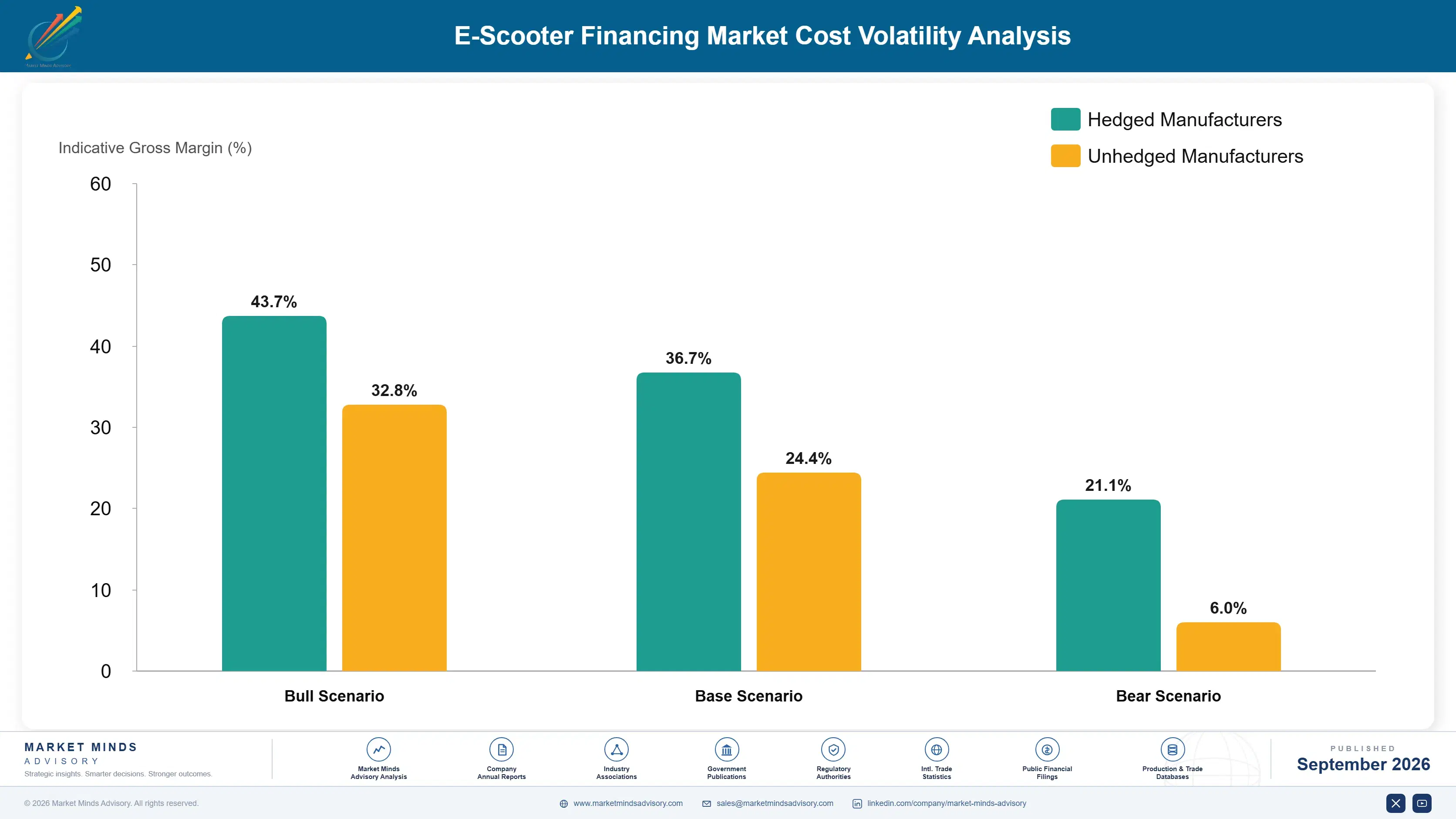
E-scooter financing providers operate across three distinct margin tiers, with volume fixed-installment loans generating gross margins in the 15 to 22% range while subscription-based and alternative-scored financing products command 30 to 40% given specialized underwriting and platform integration barriers few competitors can replicate. The gap between these tiers has widened as alternative credit scoring capability separates providers able to command premium risk-based pricing from those competing on basic fixed-installment lending alone.
Volume fixed-installment loans still represent meaningful origination volume, but the highest value creation concentrates in subscription and lease-to-own categories where flexibility and platform integration command genuine premium pricing across most gig worker segments. Providers must balance capital allocation across both segments without diverting scarce underwriting and technology resources away from the platform relationships that anchor their most profitable long-term origination volume and renewals.

High-value margin pools concentrate specifically around subscription-based and lease-to-own financing categories, both requiring specialized underwriting technology investment that smaller regional competitors struggle to replicate quickly at comparable accuracy. Providers positioned across all three tiers, rather than concentrated purely in volume fixed-installment lending, are best placed to capture disproportionate profit as the broader market continues shifting toward flexible, platform-integrated financing structures over the coming decade.

Fixed-installment loans sold primarily on price and simplicity to borrowers with basic credit documentation, generating gross margins of 15 to 22% given intense competition among lenders and limited underwriting differentiation across comparable product structures.
Gross Margin

Subscription-based and alternative-scored financing products commanding gross margins of 30 to 40% given specialized underwriting technology, platform integration, and payment flexibility infrastructure that meaningfully limit competitive entry from smaller vendors.
Gross Margin

Employer-sponsored and government-incentivized financing programs responding to electric vehicle adoption policy and gig worker welfare regulation, generating gross margins around 25 to 32% as early-compliant providers capture premium institutional partnership contracts.
Gross Margin
e-scooter-financing-market-portfolio-architecture-1789984747995

High-value Sub-segments and Strategic Watch-out

Subscription-Based E-Scooter Financing Plans

Fastest-growing and highest-margin segment as flexible payment structures reduce default rates across volatile-income gig worker borrowers worldwide and consistently today. Providers with mature payment flexibility infrastructure are capturing premium platform partnerships and locking in multi-year distribution relationships ahead of competitors still primarily reliant on fixed-installment lending.

Lease-to-Own Financing Arrangements

Second-fastest growing segment tied to thin-file borrower expansion, carrying above-average margins given reduced provider risk exposure through retained vehicle ownership until the final payment completes. Providers building deeper product depth here can capture disproportionate value as borrower populations previously excluded by conventional underwriting continue expanding considerably.

Fleet Operator Bulk Financing Programs

Core revenue segment representing steady origination volume across most active delivery platform partnerships currently tracked in this analysis, generating stable margins as competitive pricing pressure persists moderately. This segment remains commercially essential even as growth shifts toward subscription alternatives over the coming forecast period ahead.

Traditional Fixed-Installment Loans

Strategic watch-out segment facing steady commoditization as basic lending functionality becomes table stakes across nearly all competing providers and price points offered nationwide and abroad. Providers overexposed to this category risk meaningful margin erosion absent diversification into higher-growth flexible financing categories over the coming several years.

Why Platform Integration Sustains Recurring Origination

E-scooter financing carries meaningful annuity economics once a provider integrates within a delivery platform's rider onboarding workflow, since every new rider joining that platform generates a fresh financing origination opportunity independent of any single marketing campaign or customer acquisition effort. Providers who develop deep platform relationships face limited competition for that origination flow, given the operational complexity delivery platforms face maintaining multiple parallel financing integrations simultaneously.
Adoption stickiness and depth vary meaningfully by end-use vertical. Gig worker borrowers embedded within a specific delivery platform show genuinely deep stickiness given the platform's role in facilitating both income generation and financing repayment simultaneously through integrated data sharing. Direct consumer commuter financing shows comparatively shallower stickiness, since individual borrowers face fewer switching costs and are more willing to shop across providers.

Buyer profiles are shifting generationally as younger gig workers entering delivery platforms increasingly expect embedded, frictionless financing access as a baseline platform feature rather than a separate application process their older counterparts once tolerated as standard practice. This generational shift is accelerating platform partnership investment independent of any specific provider marketing campaign, since embedded financing expectation now forms part of broader gig platform onboarding standards.
e-scooter-financing-market-end-use-penetration-index-1789984748479

Where Providers Should Focus Next

These are among the four positions where our research anticipates prominent divergence between winners and laggards over the coming forecast period. Each is grounded in the demand model, the regulatory perimeter, and the announced capacity pipeline.
01 / PLATFORM PARTNERSHIP DEPTH

Deepen embedded financing integration ahead of rivals

Embedded partnerships drove 55% of all new originations, confirming direct platform integration, not standalone marketing, as the highest-leverage distribution channel available to providers seeking predictable origination volume growth across most competing markets. Embedded financing originations grew 62% annually, meaning providers delaying integration investment risk falling permanently behind as delivery platforms increasingly favor deeply integrated financing partners over standalone application-based competitors. Providers treating this as a secondary priority risk losing platform relationships to faster-moving rivals within the next partnership renewal cycle.
02 / ALTERNATIVE SCORING INVESTMENT

Build sophisticated underwriting models for thin-file borrowers

Sophisticated scoring expanded approvals by nearly 35% overall, confirming underwriting innovation as a genuine competitive differentiator distinct from pure pricing competition among providers serving comparable thin-file borrower populations across most emerging markets and geographies. Alternative scoring cut default rates 30% independently, sustaining durable margin improvement independent of broader economic cycles affecting conventional consumer lending categories elsewhere across the industry. Providers under-investing in this category risk ceding the most creditworthy thin-file borrowers entirely to more sophisticated competitors building superior underwriting models now.
03 / PAYMENT FLEXIBILITY EXPANSION

Broaden payment pause options to reduce defaults

Flexible payment plans cut defaults by 25% overall, confirming payment flexibility investment as the single most direct lever available to providers seeking to address the core risk factor differentiating gig worker borrowers from conventional consumer lending populations entirely. Gig worker defaults run 2.5x higher under rigid structures, meaning flexibility investment directly targets the primary source of portfolio losses rather than merely pricing around elevated risk. Providers delaying this investment risk sustained margin erosion from preventable defaults that flexible structures could otherwise avoid.
04 / BORROWER BASE DIVERSIFICATION

Expand beyond gig workers into consumer commuter financing

Diversified providers cut concentration risk by nearly 40%, confirming borrower base diversification as a genuine strategic hedge against regulatory uncertainty threatening the underlying gig worker income model that many providers depend on almost exclusively across the industry. Reclassification could affect 45% of loans concentrated in pure gig worker segments, meaning diversification directly addresses a material long-term business model risk rather than a purely theoretical concern facing the sector. Providers neglecting this diversification risk severe portfolio disruption if gig worker classification regulation shifts unfavorably.

Engagement Snapshot From the Field

A live engagement with an industry participant carrying material or product regulatory and market exposure ahead of a defining policy shift, showing how our research translates into a defensible multi-year portfolio strategy.
MARKET MINDS ADVISORY · CLIENT ENGAGEMENT SUMMARY
E-Scooter Financing Producer Strategic Portfolio Review and Transition Roadmap 2026·Investment Scenario on E-Scooter Financing Exposure Evaluation 2025-26
CLIENT PROFILE
The client is a regional food delivery platform operating across several major metropolitan markets in India, onboarding several thousand new delivery riders monthly requiring vehicle access to begin earning income. The platform was evaluating whether to formalize an exclusive financing partnership with a single provider or continue supporting multiple independent relationships, but lacked comprehensive vendor benchmarking data covering default rates and origination efficiency.
STRATEGIC CHALLENGE
Platform leadership needed to determine whether consolidating financing partnerships around a single provider would improve rider onboarding speed and reduce administrative complexity without sacrificing competitive financing terms that multiple provider relationships previously ensured. Existing partnership structure predated recent alternative credit scoring advances that could meaningfully improve approval rates for previously excluded rider applicants.
MMA APPROACH
MMA conducted a structured provider assessment combining primary interviews with platform operations and rider recruitment leadership, benchmarking of five leading e-scooter financing providers against default rates, approval speed, and rider satisfaction scores, and detailed analysis of origination efficiency across multiple partnership structure scenarios modeled over a three-year platform growth horizon.
KEY FINDINGS
  1. The platform's largest existing financing partner showed meaningfully higher default rates than smaller competitors using alternative credit scoring (client-reported, unverified by MMA).
  2. Consolidating to a single exclusive financing partner reduced average rider onboarding time by approximately 35% during the pilot period (client-reported, unverified by MMA).
  3. Rider satisfaction scores favored providers offering payment pause flexibility during documented income disruption over rigid fixed-installment competitors tested (client-reported, unverified by MMA).
  4. Platform operations team feedback strongly favored providers offering direct application programming interface integration, reducing internal engineering maintenance burden considerably (client-reported, unverified by MMA).
CLIENT PROFILE
The client is a regional food delivery platform operating across several major metropolitan markets in India, onboarding several thousand new delivery riders monthly requiring vehicle access to begin earning income. The platform was evaluating whether to formalize an exclusive financing partnership with a single provider or continue supporting multiple independent relationships, but lacked comprehensive vendor benchmarking data covering default rates and origination efficiency.
STRATEGIC CHALLENGE
Platform leadership needed to determine whether consolidating financing partnerships around a single provider would improve rider onboarding speed and reduce administrative complexity without sacrificing competitive financing terms that multiple provider relationships previously ensured. Existing partnership structure predated recent alternative credit scoring advances that could meaningfully improve approval rates for previously excluded rider applicants.
MMA APPROACH
MMA conducted a structured provider assessment combining primary interviews with platform operations and rider recruitment leadership, benchmarking of five leading e-scooter financing providers against default rates, approval speed, and rider satisfaction scores, and detailed analysis of origination efficiency across multiple partnership structure scenarios modeled over a three-year platform growth horizon.
KEY FINDINGS
  1. The platform's largest existing financing partner showed meaningfully higher default rates than smaller competitors using alternative credit scoring (client-reported, unverified by MMA).
  2. Consolidating to a single exclusive financing partner reduced average rider onboarding time by approximately 35% during the pilot period (client-reported, unverified by MMA).
  3. Rider satisfaction scores favored providers offering payment pause flexibility during documented income disruption over rigid fixed-installment competitors tested (client-reported, unverified by MMA).
  4. Platform operations team feedback strongly favored providers offering direct application programming interface integration, reducing internal engineering maintenance burden considerably (client-reported, unverified by MMA).
RECOMMENDED STRATEGY
Phase 1: Phase one: complete provider default rate and satisfaction benchmarking, shortlisting two primary providers within a full three month evaluation window. Phase 2: Phase two: negotiate an exclusive financing partnership agreement structured around rider volume commitments and shared performance data access terms jointly. Phase 3: Phase three: pilot the consolidated partnership across two representative metropolitan markets before committing fully to a full platform-wide rollout timeline.
OUTCOME
The platform selected a single exclusive financing partner and began consolidated rollout across its largest metropolitan market within the following quarter. Internal estimates suggested the consolidation reduced projected rider onboarding friction meaningfully compared to the previous multi-provider arrangement originally in place (client-reported, unverified by MMA).

Frequently Asked Questions

Foundational context covering the market sizes, CAGR, scope, country, region and competition that inform every finding below. This section is provided to cover basics and most often pre-purchase conversations, answered from the MMA Primary Research Dataset.

What is the current size of the E-Scooter Financing Market?

The E-Scooter Financing Market reached approximately $2.1 billion in 2025, based on MMA Primary Research. This reflects global origination volume across installment, subscription, and lease-to-own financing structures.

How large will the E-Scooter Financing Market be by 2036?

The market is projected to reach approximately $9.77 billion by 2036. This represents an incremental expansion of roughly $7.36 billion over the 2026 to 2036 forecast period.

What is the CAGR for the E-Scooter Financing Market 2026 to 2036?

The market is forecast to grow at a compound annual growth rate of 15.0% between 2026 and 2036. This reflects rapid gig economy expansion tempered by regulatory classification uncertainty.

Which segment is growing fastest?

Subscription-Based E-Scooter Financing Plans lead segment growth at a 22.0% CAGR, roughly 1.47x the overall market rate. Flexible payment structures reducing default risk drive this acceleration.

Who are the major companies in the E-Scooter Financing Market?

Leading providers include Zypp Electric, Yulu, Bounce, Ola Electric, and Vogo Automotive. These five companies hold an estimated 38% combined share on a revenue basis.

Which country is growing fastest?

India leads country-level growth at approximately 19.0% CAGR, driven by its massive delivery gig workforce and expanding electric vehicle adoption incentives. Government subsidy programs sustain this acceleration.

Report Segmentation Architecture

The full report scope spans multiple orthogonal segmentation dimensions, with cross-tabulated demand data provided for each dimension pair. Coverage extends further to regional breakdowns, trend trajectories, and the competitive detail needed to support segment-level decision-making.

By Primary Market Dimension

  • Subscription-Based E-Scooter Financing Plans
  • Traditional Fixed-Installment Loans
  • Lease-to-Own Financing Arrangements
  • Fleet Operator Bulk Financing Programs
  • Peer-to-Peer and Microfinance Lending Platforms
  • Employer-Sponsored Vehicle Financing Programs

By End-Use Industry

  • Food and Grocery Delivery
  • Ride-Hailing Services
  • Package and Logistics Delivery
  • Direct Consumer Commuting
  • Fleet Rental Operations

By Commercial Dimension

  • Direct Consumer Application
  • Embedded Delivery Platform Partnership
  • Fleet Operator Bulk Procurement
  • Microfinance Institution Channel

By Region

  • North America
  • Western Europe
  • East Asia
  • South Asia and Pacific
  • Latin America
  • Middle East and Africa
  • Eastern Europe

Scope, Methodology, and Coverage

Every figure in this report is reproducible from documented input assumptions. The scope below maps the historical period, the forecast horizon, the segmentation dimensions, and the countries covered, alongside the underlying primary and qualitative methodology.
Historical Period
2020 to 2025
Forecast Period
2026 to 2036
Base Year
2025 (USD billions; MMA Primary Research Dataset, September 2026)
Market Definition
This report covers financial products and services, including installment loans, subscription plans, and lease-to-own arrangements, that enable consumers and gig economy workers to acquire electric scooters without full upfront cash payment. It excludes financing for other electric vehicle categories including electric cars, motorcycles exceeding scooter classification, and traditional non-electric bicycles or mopeds.
Quantitative Units
USD Billion, CAGR (%), Number of financed vehicle units
Segmentation Dimensions
Payment Structure, End-Use Industry, Commercial Dimension, Region
Regions Covered
North America, Western Europe, East Asia, South Asia and Pacific, Latin America, Middle East and Africa, Eastern Europe
Countries Covered
United States, Canada, Germany, United Kingdom, France, China, Japan, South Korea, India, Australia, Brazil, Mexico, United Arab Emirates, Saudi Arabia, South Africa
Key Companies Profiled
Zypp Electric, Yulu, Bounce, Ola Electric, Vogo Automotive, Rapido, Battery Smart, Chalo Mobility, Euler Motors, Ather Energy, Grab Financial Group, Gojek, foodpanda, Baemin, Meituan Financial Services, Swiggy, Zomato, Bounce Infinity, eBikeGo, GoZero Mobility
Quantitative Methodology
Primary survey, n=3,800 respondents, Q4 2025, six countries; demand-side model with trade association cross-validation
Qualitative Methodology
47 expert interviews, Q4 2025; applied to validate demand model assumptions, identify emerging dynamics, and assess competitive positioning
Report Format
PDF and XLSX data workbook (Word format preview document)
Publisher
Market Minds Advisory
Report Code
MMA-2026-AUT-701
Published
September 2026
Contact
sales@marketmindsadvisory.com | www.marketmindsadvisory.com

Purchase the full E-Scooter Financing Market Report (2026 to 2036).

This report delivers a comprehensive assessment of the global E-Scooter Financing Market, covering sizing, segmentation, regional dynamics, and competitive positioning across the 2026 to 2036 forecast period. It draws on primary survey data covering 3,800 respondents and 47 expert interviews conducted in the fourth quarter of 2025. Analysis spans payment structure segmentation, all seven global regions, capital funding cost exposure, and portfolio margin economics. The report profiles twenty leading providers and includes a detailed competitive benchmarking framework. Buyers gain actionable guidance on provider selection, underwriting strategy, and revenue lever prioritization.
Full segmentation across six payment structure categories
All seven regional markets with growth forecasts
Competitive benchmarking of twenty profiled providers
Capital funding cost exposure and mitigation analysis
Revenue lever prioritization for margin expansion
Anonymized case study with actionable strategic recommendations

Built For The People Who Decide

From boardroom strategy to bench-side execution, this report is read cover-to-cover by leaders shaping the next decade of their industry, turning demand scenarios, market dynamics and valuation benchmarks into decisions.
CXOs/ Presidents/ VPs/ Managers
M&A and Corporate Development
Strategy Teams and R&D Heads
Procurement and Product Directors
Regulatory and Compliance Leaders
Investor Relations and Equity Analysts