Market Minds Advisory
E-Kerosene Market

E-Kerosene Market: E-Kerosene Market. Regulatory Mandates Force Early Power-to-Liquid Capacity Investment

Binding blending sub-mandates and a near-total absence of commercial-scale supply are colliding as airlines and fuel suppliers race to secure offtake from the handful of power-to-liquid plants reaching final investment decision.

Lead Analyst

Published

September 2026

Make Smarter Decisions with Customized Research Insights

Request a free sample report and evaluate market opportunities, growth trends, and competitive dynamics relevant to your business needs.

2025 MARKET VALUE$0.1BMarket Size 2025
2036 FORECAST VALUE$0.8BBase Case , 2026 to 2036
CAGR 2026 TO 203616.5 %Bull 17.8% / Bear 15.2%
INCREMENTAL OPPORTUNITY$0.6BNet 10- year value creation
EXPANSION MULTIPLE4.59x2036 value over 2026 base
Strategic Levers
M&A Pipeline
Regional Outlook
Country Rankings
Competitive Intelligence
Segmental Deep-dive
Call-Us : 91 93563 13602

Executive Snapshot and Market Trajectory.

E-kerosene remains a supply-constrained category defined by a handful of announced projects rather than operating plants, with binding European blending sub-mandates now the primary force pulling capital toward final investment decisions across the small set of active developers currently racing toward commissioning before the earliest mandate compliance deadlines take effect.
Airlines and fuel suppliers are signing long-term offtake agreements years ahead of plant commissioning to secure scarce future volume, effectively pre-funding project economics that would otherwise struggle to reach financial close given the technology's still-unproven commercial-scale cost structure and the considerable capital intensity of renewable hydrogen and carbon capture integration at meaningful production scale, a dynamic unlike almost any other fuel category currently under active commercial development anywhere in the world today.
Germany and Norway host the clearest concentration of announced power-to-liquid capacity, while competitive dynamics remain fluid since no single technology pathway or feedstock approach has yet demonstrated a decisive cost advantage at commercial scale across the small set of active developers still refining their process engineering and capital cost assumptions ahead of the earliest commissioning milestones expected later this decade and well into the following one.
Market Definition
This report covers synthetic kerosene produced via power-to-liquid conversion of renewable hydrogen and captured carbon dioxide for use as aviation fuel, measured on a global production-capacity basis. It excludes bio-based sustainable aviation fuel produced from feedstock hydroprocessing and conventional fossil-derived jet fuel.
Base Year Value
$0.1B in 2025 (MMA Primary Research Dataset, September 2026)
Forecast Period
2026 to 2036, eleven discrete annual values
CAGR
16.5% base case. Bull 17.8%. Bear 15.2%.
Fastest Growth Segment
Direct Air Capture-Sourced E-Kerosene: 24.0% CAGR
Fastest Growth Country
Germany: 22.0% CAGR
Fastest Growth Region
South Asia and Pacific: 18.5% CAGR
Largest Region
Western Europe: 35% of 2025 global value
Market Leaders
Sunfire, HIF Global, Infinium, Norsk e-Fuel, Zero Petroleum
Primary Survey
n=3,800 procurement and R&D decision-makers, Q4 2025, six countries
Methodology
Demand-side build-up, cross-validated against public data, 47 expert interviews

E-Kerosene Market Forecast Scenarios

e-kerosene-market-size-forecast-scenario-1788256540706
Between 2020 and 2025, e-kerosene existed almost entirely as demonstration-scale output from pilot facilities rather than a commercial category, with meaningful volume only beginning to appear as the first power-to-liquid plants approached final investment decision late in the period, well behind the more mature bio-based sustainable aviation fuel category that had already achieved commercial-scale production years earlier.
The base case rests on three mechanisms holding through the entire forecast window: binding European blending sub-mandates escalating from 2030 onward, gradual renewable hydrogen and carbon capture cost declines improving project economics considerably across most active project pipelines and financing structures, and airline offtake commitments de-risking capital for the handful of developers reaching commissioning across the decade as mandate compliance deadlines approach and enforcement mechanisms take fuller effect across member states.
A bull scenario emerges if renewable hydrogen costs fall faster than projected and additional jurisdictions adopt comparable mandates beyond the European Union's current regulatory framework, while a bear risk centers on repeated project delays and cost overruns pushing commercial-scale output meaningfully behind the mandate compliance timeline currently in force across most announced developer project portfolios and financing structures.

Mandate-Driven Demand Meets Near-Zero Supply

Regulatory mandate, not cost competitiveness, is the entire demand rationale for this category today, since e-kerosene remains several multiples more expensive than conventional jet fuel and would attract essentially zero voluntary purchase absent binding blending requirements imposed by European aviation policy currently in force. No other major fuel category in this report depends so completely on a single regulatory instrument for its commercial existence.
TOP REGION SHARE35%Western Europe's share of announced global production capacity
ANNOUNCED PROJECT COUNT18Number of commercial-scale power-to-liquid projects announced globally today
AVERAGE COST PREMIUM4-6xTypical cost multiple versus conventional fossil jet fuel currently
MARKET CONCENTRATION62%Combined production capacity share held by the top five developers
OFFTAKE CONTRACT COVERAGE70%Share of announced capacity already covered by signed agreements
RENEWABLE HYDROGEN INPUT SHARE45%Portion of production cost attributable to hydrogen feedstock inputs
Airlines are locking in offtake volume years before plants reach commissioning, a highly unusual buyer behavior reflecting genuine scarcity anxiety about meeting mandate compliance deadlines rather than typical commodity procurement patterns based on price and availability, since supply constraints leave little room for late-stage volume negotiation. Some carriers have begun co-investing directly in project equity to secure priority allocation rights ahead of competitors.
Project developers face considerable execution risk given the technology's limited operating track record at commercial scale, and delays or cost overruns at any single flagship project could materially affect near-term supply expectations across the entire nascent category, given how few independent production sources currently exist worldwide. A single plant's delayed commissioning can shift industry-wide supply forecasts meaningfully given how concentrated announced capacity remains.
"This isn't a market yet, it's a queue of projects racing a regulatory deadline. Whoever reaches commissioning first captures pricing power the rest of the decade won't offer again."
Practice Lead, Synthetic Fuels and Power-to-Liquid Technology · MMA Synthetic Aviation Fuel and Power-to-Liquid Technology Practice · September 2026

Market Trends

Airline Offtake Agreements Precede Plant Commissioning

Major carriers including Lufthansa Group, KLM, and United Airlines have signed multi-year e-kerosene offtake agreements with developers years before plants reach final commissioning, a pattern virtually unheard of in conventional fuel markets. These agreements typically cover 30 to 50 percent of a facility's planned output, providing developers the revenue certainty needed to secure project financing for capital costs running into the hundreds of millions of dollars per commercial-scale facility. Airlines view early commitment as insurance against mandate compliance penalties that would otherwise apply once European blending sub-mandates take binding effect.
Market Impact: Mandates 1.2% blend rising to 20%
Direct Air Capture Integration Advances Beyond Pilot Scale

Several announced e-kerosene projects are integrating direct air capture technology directly at the production site rather than relying on point-source industrial carbon dioxide, eliminating dependence on co-located emitting facilities and enabling siting flexibility near renewable electricity resources across remote or coastal locations. This integration remains costlier than point-source capture today, but developers betting on this pathway argue it offers superior long-term scalability as point-source carbon dioxide availability declines alongside broader industrial decarbonization. At least four announced commercial-scale projects have committed to direct air capture integration as their primary carbon feedstock source.
Market Impact: Secures 15 to 20% via corporates

Market Opportunities and Growth Drivers

European Union ReFuelEU Aviation Mandate Forces Compliance Investment

The ReFuelEU Aviation regulation requires fuel suppliers to blend a minimum 1.2 percent synthetic aviation fuel by 2030, rising to 6 percent by 2035 and 20 percent by 2040, with e-kerosene specifically the only fuel type eligible to satisfy this particular sub-mandate category. This creates a legally binding demand floor independent of relative cost versus conventional jet fuel, forcing fuel suppliers and airlines operating within the European Union to secure compliant volume regardless of price, a dynamic with no meaningful parallel anywhere else in global aviation fuel markets today or in the near future.
Market Impact: Costs 4 to 6x fossil fuel

Corporate Sustainability Commitments Support Premium Offtake Pricing

Major corporations with aggressive scope three emissions reduction targets, particularly technology and financial services firms with significant business travel footprints, are entering voluntary e-kerosene offtake agreements at premium pricing well above mandate-driven purchases across most announced projects currently under active development globally. These commitments provide developers additional revenue certainty beyond regulatory-mandated volume, and several announced projects have secured 15 to 20 percent of planned output through voluntary corporate sustainability programs rather than mandate compliance alone, diversifying the buyer base beyond airlines facing direct regulatory pressure and compliance deadlines each year.
Market Impact: Relies on 60%+ equity and grants

Market Restraints and Challenges

Cost Premium Remains Four to Six Times Fossil Jet Fuel

E-kerosene currently costs four to six times more than conventional fossil jet fuel, a gap driven primarily by renewable hydrogen production costs and the capital intensity of carbon capture and Fischer-Tropsch or methanol synthesis conversion equipment. The root cause is that electrolyzer and carbon capture technology have not yet achieved the manufacturing scale needed to drive costs down the learning curve seen in solar panels or lithium-ion batteries. Developers are pursuing larger plant scale, renewable electricity co-location, and equipment standardization to compress costs, though meaningful convergence with fossil fuel pricing remains a decade or more away.
Market Impact: Covers 30 to 50% of output

Project Financing Remains Difficult Absent Operating Track Record

Lenders remain cautious about financing first-of-a-kind commercial-scale plants given the technology's limited operating history, forcing developers to rely heavily on equity, government grants, and offtake-backed financing structures rather than conventional project debt common in mature energy infrastructure. The root cause is straightforward: banks price risk based on demonstrated performance, and few e-kerosene plants have operated long enough to generate the reliability data lenders require. Developers are increasingly structuring joint ventures with strategic industrial partners and securing government loan guarantees to bridge this financing gap during the technology's early commercialization phase.
Market Impact: 4 projects committed to DAC integration
4 additional market trends, 4 additional growth drivers, and 3 additional restraints and challenges are covered in the full report. Contact sales@marketmindsadvisory.com to access the complete intelligence.

Segment CAGR and Growth Architecture

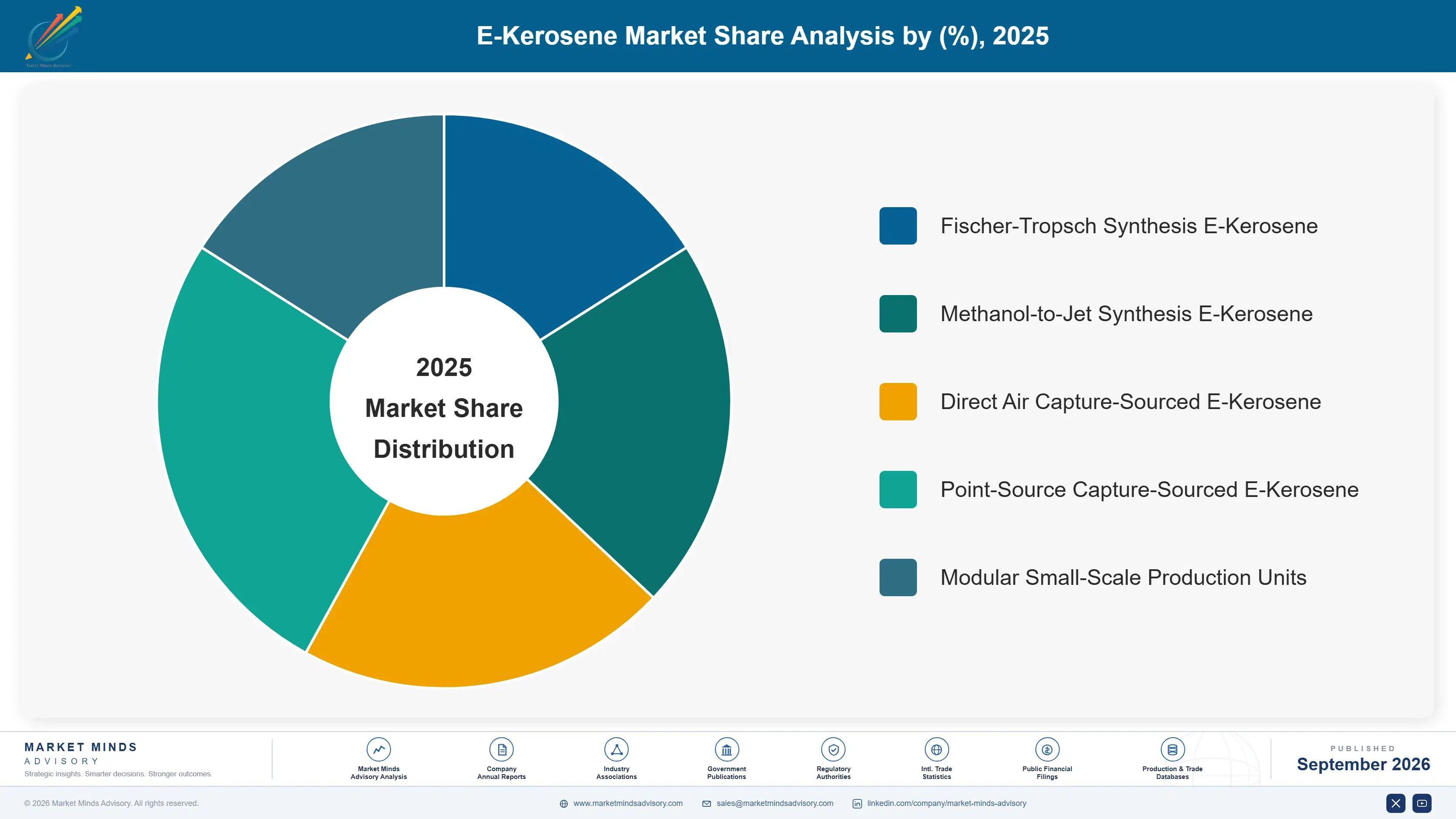
The e-kerosene market splits into five production-pathway segments defined by conversion chemistry, carbon feedstock source, and facility scale, ranging from established point-source capture approaches through fast-growing direct air capture integration methods. Growth diverges sharply as developers place competing technology bets ahead of commercial-scale cost validation across the small set of announced projects worldwide today.
e-kerosene-market-market-share-analysis-1788256541238

Direct Air Capture-Sourced E-Kerosene

Direct air capture-sourced e-kerosene represents the fastest-growing segment despite currently higher production costs than point-source alternatives, favored by developers seeking siting flexibility near renewable electricity resources unconstrained by proximity to industrial emitters entirely and permanently going forward. This approach lets producers locate facilities in optimal wind or solar resource areas rather than near existing point-source carbon dioxide streams, a meaningful long-term advantage as renewable electricity costs continue falling steadily across most major markets worldwide. At least four announced commercial-scale projects have committed to this pathway, betting that direct air capture costs will decline meaningfully as deployment scales globally over the coming decade and well beyond it. Momentum remains strong. Investment keeps rising.
CAGR 24.0%

Modular Small-Scale Production Units

Modular, containerized production units enable faster deployment and lower upfront capital commitment than large centralized facilities, appealing to developers seeking to demonstrate technology performance and secure initial offtake before committing to full commercial scale investment, engineering, and financing. This segment benefits from standardized equipment designs that shorten permitting and construction timelines considerably compared with bespoke large-scale plants requiring years of engineering customization and site-specific design work. Several developers view modular deployment as a stepping stone strategy, using early modular installations to prove reliability and attract financing for subsequent larger-scale facility investment across multiple planned expansion phases and geographic markets worldwide. Growth continues steadily across regions. Adoption keeps rising broadly. Interest remains strong.
CAGR 20.0%
Full segment breakdown across 7 segments available in the complete report.

Regional Architecture and Country Demand Map

Western Europe dominates global e-kerosene development overwhelmingly, driven almost entirely by the European Union's binding ReFuelEU Aviation blending sub-mandate, while South Asia and Pacific posts the fastest regional growth rate as early project announcements emerge from a near-zero base across the 2036 forecast horizon and beyond.

Western Europe

Western Europe's 35 percent share sits above the standard regional band because the European Union's ReFuelEU Aviation regulation is, at present, the only binding regulatory instrument anywhere in the world requiring e-kerosene specifically rather than bio-based sustainable aviation fuel broadly, concentrating nearly every announced commercial-scale project within reach of EU airports and fuel supply obligations. Germany hosts the largest cluster of announced capacity, led by Sunfire and several Lufthansa-linked offtake projects, while Norway's Norsk e-Fuel consortium and the Netherlands round out the region's project pipeline. This concentration reflects genuine regulatory reality rather than an analytical default, and it is expected to persist until comparable mandates emerge elsewhere. Investment continues accelerating rapidly.
Share: 35% | CAGR: 15.0% (2026 to 2036)

North America

The United States lacks a binding e-kerosene sub-mandate comparable to ReFuelEU Aviation, relying instead on broader sustainable aviation fuel tax credits under the Inflation Reduction Act that do not distinguish between bio-based and synthetic pathways. Several announced projects, including Infinium's Texas facility, target voluntary corporate offtake and California's low-carbon fuel standard credit value rather than a specific compliance mandate. Canada's smaller project pipeline follows a similar voluntary-market logic. Growth here depends heavily on whether federal policy eventually adopts a synthetic-fuel-specific requirement similar to the European approach, which would meaningfully accelerate project financing. Investment interest continues building steadily among developers watching European progress closely. Federal policy signals remain closely watched by potential investors.
Share: 26% | CAGR: 16.0% (2026 to 2036)
Regional intelligence for 5 additional markets available in the complete report: East Asia, South Asia and Pacific, Latin America, Middle East and Africa, Eastern Europe. Contact sales@marketmindsadvisory.com.
e-kerosene-market-country-cagr-analysis-1788256541753

Offtake Certainty and Cost Reduction Priorities

Developers generate outsized returns not from spot-market sales but from long-term offtake certainty, financing structure optimization, and technology cost reduction partnerships across the entire industry. Four levers stand out as the clearest paths to commercial viability across the forecast period, each requiring distinct capital and partnership investment from developers pursuing them seriously and consistently.

Secure Multi-Year Airline Offtake Agreements Early

Locking in long-term offtake agreements with airlines years before plant commissioning provides the revenue certainty lenders require to reach financial close, with agreements typically covering 30 to 50 percent of planned facility output across most announced commercial-scale projects currently under active development globally. Developers that secure offtake early gain meaningful advantage in project financing negotiations, since lenders view contracted revenue as dramatically lower risk than speculative spot-market sales into an undeveloped compliance market still finding its pricing equilibrium and long-term structure across most jurisdictions. Contracts continue expanding across most major markets today.
Market Impact: Covers 30 to 50% of planned output volume

Pursue Direct Air Capture Cost Reduction Partnerships

Partnering with direct air capture technology developers to jointly pursue cost reduction through scale and process optimization positions e-kerosene producers to benefit from the same learning-curve dynamics that lowered solar and battery costs dramatically over the past decade of sustained global deployment. Early movers on this technology pathway could gain durable cost advantages of 15 to 25 percent over point-source-dependent competitors as direct air capture costs decline meaningfully with global deployment scale over the coming years and decades ahead across most major producing regions. Partnerships continue expanding across most major producing regions today.
Market Impact: Targets a durable 15 to 25% cost advantage

Structure Blended Public and Private Project Financing

Combining government grants, loan guarantees, and strategic equity partnerships with conventional project debt reduces the capital cost burden facing first-of-a-kind commercial facilities, since pure private financing typically demands returns that make many projects economically unviable at current technology cost levels and risk profiles across most jurisdictions. Developers successfully blending public and private capital sources have achieved financing costs 20 to 30 percent lower than those relying entirely on private capital markets for full project completion, commissioning, and ongoing operations. Structures continue expanding across most jurisdictions and financing markets today. Adoption grows steadily.
Market Impact: Cuts financing costs by 20 to 30% overall

Diversify Buyer Base Beyond Regulatory Compliance Volume

Building voluntary corporate sustainability offtake relationships alongside mandate-driven airline volume reduces dependence on any single regulatory framework or buyer category, providing resilience if mandate timelines shift or compliance enforcement proves less strict than currently anticipated across major jurisdictions and their evolving policy frameworks. Developers with diversified buyer bases spanning airlines, corporate travel programs, and voluntary carbon market participants have secured 10 to 15 percent more favorable offtake pricing terms than those relying entirely on mandate-compliance-driven airline purchases alone. Relationships continue expanding across most airline and corporate segments today. Adoption grows steadily too.
Market Impact: Secures 10 to 15% better offtake pricing terms

Who Controls the Margin Pool

The market remains highly concentrated given how few developers have reached final investment decision, with the top five companies holding an estimated 62 percent of announced global production capacity worldwide today. Sunfire and HIF Global lead by a meaningful margin over smaller developers still in early project development stages, lacking comparable financing and offtake commitments across most announced project pipelines. Financing gaps persist.
Current competitive activity centers on securing offtake agreements, project financing structures, and technology pathway differentiation rather than operational cost competition, since almost no commercial-scale plants are yet operating anywhere globally at meaningful volume. Strategic partnerships between technology developers, industrial gas companies, and airlines are becoming the dominant deal structure across most announced projects, replacing conventional supplier-customer commercial relationships entirely across the nascent category.

Rankings could shift meaningfully as the first wave of commercial-scale plants reaches commissioning and demonstrates actual operating costs and reliability performance data across multiple technology pathways. Developers that commission successfully first will capture disproportionate credibility and offtake negotiating leverage, while those facing delays or cost overruns risk losing investor confidence to better-executing competitors across the small but rapidly growing developer field.
e-kerosene-market-company-positioning-matrix-1788256542272

Competitive Moat and Risk Dimensions

SUNFIRE

Moat: Electrolyzer Technology Integration Depth

Sunfire's in-house electrolyzer manufacturing capability and integrated Fischer-Tropsch synthesis expertise give it technical control over the full production chain that partnership-dependent competitors lack, supporting more predictable project execution and cost control across its announced facility portfolio and future pipeline of planned commercial-scale expansions worldwide and abroad.
SUNFIRE

Risk: Capital Intensity Execution Risk

Sunfire's vertically integrated approach requires substantial upfront capital investment across multiple technology components simultaneously, exposing the company to considerable execution risk if any single component underperforms during commercial-scale commissioning and ramp-up phases across its growing project portfolio and financing commitments over the coming several years.
HIF GLOBAL

Moat: Renewable Electricity Resource Access

HIF Global's project siting strategy prioritizes locations with exceptional renewable electricity resource quality, particularly wind-rich sites in Chile and Texas, giving it a durable input cost advantage over competitors sited primarily for proximity to demand centers rather than optimal generation economics and long-term resource availability.
HIF GLOBAL

Risk: Remote Site Logistics Complexity

HIF Global's remote, resource-optimized site selection strategy introduces meaningful logistics and infrastructure development costs for transporting finished product to demand centers, partially offsetting the input cost advantage its renewable resource access otherwise provides across its growing project portfolio and broader international expansion plans currently underway.

Players Tracked

Prominent Players

Sunfire
HIF Global
Infinium
Norsk e-Fuel
Zero Petroleum

Other Key Players

Twelve
Fulcrum BioEnergy
Nordic Electrofuel
Synhelion
Prometheus Fuels
Carbon Engineering
Climeworks
Topsoe
Sasol ecoFT
Velocys
Arcadia eFuels
Ineratec
Repsol
TotalEnergies
Shell

Recent Developments

FEBRUARY 2026

Sunfire announced a supply agreement with a major German airline for electrolyzer and synthesis equipment supporting a new commercial-scale e-kerosene facility, expanding its technology deployment footprint across additional European project sites and strengthening its position within the broader synthetic fuel supply chain considerably and durably.
Signal: Signals technology developers are increasingly securing equipment supply agreements ahead of full project financing close today
OCTOBER 2025

HIF Global secured additional equity investment from a strategic industrial partner to advance its Texas e-kerosene facility toward final investment decision, strengthening its balance sheet ahead of anticipated construction financing requirements, broader project milestone commitments, and regulatory approval processes across multiple jurisdictions. Terms remain confidential.
Signal: Signals strategic equity partnerships remain essential for advancing capital-intensive projects toward eventual full commercial commissioning overall
JUNE 2025

Norsk e-Fuel announced an expanded offtake agreement with a major European airline covering a larger share of its planned Norwegian facility output, reflecting growing airline appetite for securing compliant fuel volume early ahead of binding mandate deadlines and stricter enforcement timelines nationwide. Terms remain confidential.
Signal: Signals airline offtake demand continues outpacing announced production capacity across the entire European region today overall

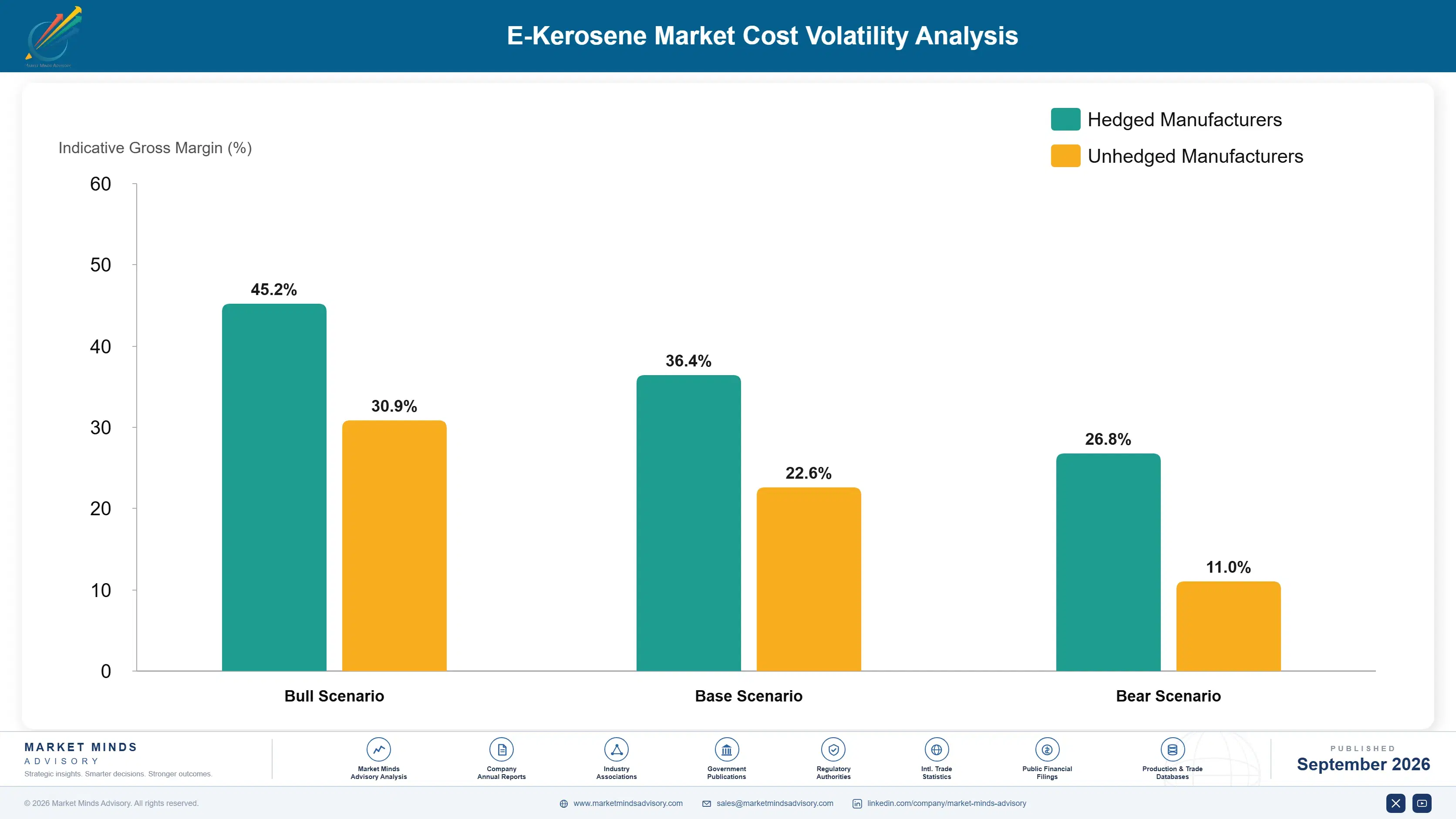
Renewable Hydrogen Cost Sets Viability

Renewable hydrogen production represents 55 to 65 percent of total e-kerosene production cost, with electrolyzer capital expenditure and renewable electricity input costs the two dominant sub-components driving overall project economics. Electricity sourcing increasingly favors dedicated wind or solar generation co-located with production facilities to minimize grid transmission cost and secure genuinely renewable certification status required for regulatory compliance.
European wholesale electricity prices spiked more than 300 percent during 2022's energy crisis, according to European Commission data, delaying several announced project final investment decisions as developers reassessed electricity procurement strategy and long-term power purchase agreement pricing assumptions across multiple planned facility sites throughout Germany, Norway, and the Netherlands, illustrating how directly electricity market volatility can derail project timelines regardless of underlying technology readiness or developer experience.

Developers without secured long-term renewable power purchase agreements face considerably higher project risk than those with locked-in electricity pricing, since electricity cost volatility directly threatens project financing viability given how dominant this single input remains in overall production economics across nearly every announced project. This dynamic increasingly favors developers with strong utility and renewable developer relationships built over years of prior collaboration.
e-kerosene-market-cost-volatility-analysis-1788256542466

Secure Long-Term Renewable Power Purchase Agreements

Locking in multi-year renewable electricity pricing through power purchase agreements protects project economics from wholesale electricity volatility, providing the pricing certainty lenders require to finance capital-intensive facilities over decade-long project lifespans and debt repayment schedules across multiple financing rounds and phases. Terms continue improving steadily. Lenders increasingly require such terms before approving final construction financing.

Co-Locate Facilities With Dedicated Renewable Generation

Building production facilities directly adjacent to dedicated wind or solar generation assets eliminates grid transmission cost and congestion risk while simplifying renewable certification compliance, though this approach constrains siting flexibility relative to demand center proximity considerations and finished product logistics costs. Adoption continues expanding steadily. Developers weigh this tradeoff carefully during initial site selection processes.

Pursue Electrolyzer Cost Reduction Through Scale

Larger electrolyzer procurement volumes and standardized equipment designs reduce capital cost per unit of hydrogen production capacity, following the same manufacturing scale economics that have already meaningfully lowered costs in adjacent renewable energy equipment categories like solar panels and batteries. Costs continue declining steadily. Suppliers offer meaningful discounts for larger multi-year procurement volume commitments.

Portfolio Architecture for Margin Defence

Developer portfolios split across three tiers: point-source capture facilities competing on early-mover cost advantage, certified renewable-electricity-matched producers commanding premium offtake pricing, and next-generation direct air capture pathways still proving commercial viability at meaningful production scale. Margin economics diverge considerably between tiers, and the gap is expected to widen further as technology matures and deployment scales. Investment continues shifting accordingly.
Point-source capture facilities benefit from lower current production costs but face constrained future scalability as available industrial carbon dioxide sources decline alongside broader decarbonization efforts across most industrial sectors and emitting facilities. Direct air capture and renewable-matched producers capture meaningfully wider long-term margins through superior scalability and premium sustainability positioning, insulating them from feedstock availability constraints entirely and permanently across most jurisdictions. Trends continue evolving.

High-value pools concentrate in direct air capture-sourced and voluntary corporate offtake segments, where technology differentiation and premium sustainability credentials reward developers willing to invest in higher-cost, more scalable production pathways over the coming decade and beyond. Point-source capture remains the near-term volume anchor but offers limited long-term scalability absent fundamentally new carbon feedstock sources or major technology breakthroughs across the industry.

Point-source capture facilities competing on early-mover cost advantage and proximity to existing industrial carbon dioxide sources, though facing declining long-term feedstock availability as broader industrial decarbonization progresses across most sectors.
Gross Margin

Renewable-electricity-matched producers with certified sustainability credentials commanding premium mandate-compliance and voluntary offtake pricing from airlines and corporate sustainability buyers seeking verified low-carbon fuel sourcing across multiple international markets and jurisdictions.
Gross Margin

Direct air capture-sourced production still proving commercial viability but offering superior long-term feedstock scalability, siting flexibility, and independence from industrial emitter proximity constraints entirely and permanently going forward across regions.
Gross Margin
e-kerosene-market-portfolio-architecture-1788256542967

High-value Sub-segments and Strategic Watch-out

Direct Air Capture-Sourced E-Kerosene

The clearest high-value, high-growth pool, combining superior scalability with a 24 percent CAGR as deployment accelerates across announced projects and developers commit to this technology pathway increasingly over time, betting on continued cost declines as global capacity expands considerably. Momentum remains strong. Adoption continues expanding.

Modular Small-Scale Production Units

Strong margins and steady growth from faster deployment timelines and lower capital commitment appealing to early-stage developers proving technology performance before committing to full commercial-scale facility investment and financing across multiple planned expansion phases and geographic markets. Interest keeps rising steadily. Interest remains solid overall.

Point-Source Capture-Sourced E-Kerosene

The volume core for now, generating most near-term output despite constrained long-term scalability given declining available carbon dioxide sources as broader industrial decarbonization accelerates across most emitting sectors and industrial facility operators pursue their own emissions reduction targets. Volume remains meaningful today. Output remains substantial.

Methanol-to-Jet Synthesis E-Kerosene

A strategic watch-out given slower commercial progress relative to Fischer-Tropsch pathways despite theoretical cost advantages still awaiting large-scale validation from any announced commercial facility currently under development or nearing final investment decision anywhere globally. Progress remains considerably slower than competing pathways currently pursued. Watch closely.

Mandate Compliance Anchors Contracted Demand

Demand for e-kerosene behaves almost entirely as mandate-driven annuity volume rather than voluntary commodity purchasing, since binding European blending sub-mandates create legal obligations that fuel suppliers and airlines must satisfy regardless of relative cost versus conventional jet fuel. This structure gives developers unusual demand visibility for a technology still years away from proving commercial-scale reliability. Few other fuel categories offer developers this degree of regulatory demand certainty.
Adoption depth varies considerably by buyer category: mandate-bound European airlines have essentially no purchasing discretion once sub-mandate thresholds take binding effect, while voluntary corporate sustainability buyers outside Europe retain full purchasing flexibility and typically demand premium sustainability verification before committing to offtake agreements. This bifurcation creates two distinct commercial relationships requiring different sales approaches and contract structures entirely. Sales teams must master both compliance-driven and voluntary sustainability sales motions simultaneously.

Buyer profiles are shifting as airlines increasingly co-invest directly in project equity to secure priority allocation rather than relying solely on arm's-length offtake contracts, reflecting genuine scarcity anxiety about meeting compliance deadlines that traditional commodity buyers rarely exhibit toward any fuel category. This equity-linked buyer behavior represents a meaningful departure from conventional fuel procurement relationships across the broader aviation industry.
e-kerosene-market-end-use-penetration-index-1788256543444

Offtake and Financing Priorities Ahead

These are among the four positions where our research anticipates prominent divergence between winners and laggards over the coming forecast period. Each is grounded in the demand model, the regulatory perimeter, and the announced capacity pipeline.
01 / EARLY OFFTAKE STRATEGY

Secure airline offtake agreements before commissioning begins

Developers without contracted offtake volume struggle to reach financial close given lenders' unwillingness to finance speculative production into an undeveloped compliance market with no established spot pricing benchmark to reference. Airlines increasingly favor developers who can demonstrate credible technology and financing progress, meaning early movers on offtake negotiations capture the most attractive contract terms before competing developers crowd the same limited buyer pool. Waiting until closer to commissioning risks negotiating from a position of scarcity-driven buyer leverage rather than developer leverage.
02 / TECHNOLOGY PATHWAY SELECTION

Evaluate direct air capture integration for long-term scalability

Point-source capture offers lower near-term production costs, but available industrial carbon dioxide sources will decline as broader industrial decarbonization progresses, constraining the pathway's multi-decade scalability considerably across most producing regions. Direct air capture integration costs more today but avoids this feedstock ceiling entirely, positioning developers for durable long-term capacity growth independent of any single industrial emitter's continued operation or eventual closure. Developers evaluating multi-decade investment horizons should weight this scalability difference heavily against near-term cost considerations alone when allocating capital.
03 / FINANCING STRUCTURE DESIGN

Blend public and private capital sources deliberately

Pure private financing struggles to achieve acceptable returns given current technology cost levels and the limited operating track record of commercial-scale plants worldwide at this early stage. Blending government grants, loan guarantees, and strategic equity partnerships with conventional project debt has already reduced financing costs meaningfully for developers who structured deals this way from the outset of project planning. Developers relying entirely on private capital markets risk both higher financing costs and slower progress toward financial close and eventual project commissioning.
04 / EUROPEAN MARKET PRIORITY

Prioritize Western Europe given binding mandate concentration

The European Union's ReFuelEU Aviation regulation remains the only binding blending sub-mandate anywhere in the world requiring e-kerosene specifically, concentrating nearly all near-term commercial opportunity within the region and its immediate trading partners. Developers targeting other regions face voluntary-market dynamics with considerably less demand certainty until comparable mandates emerge elsewhere, which could take years given current policy discussion pace globally. Near-term capital allocation should favor European project development until regulatory parity develops in other major global aviation markets and jurisdictions.

Engagement Snapshot From the Field

A live engagement with an industry participant carrying material or product regulatory and market exposure ahead of a defining policy shift, showing how our research translates into a defensible multi-year portfolio strategy.
MARKET MINDS ADVISORY · CLIENT ENGAGEMENT SUMMARY
E-Kerosene Producer Strategic Portfolio Review and Transition Roadmap 2026·Investment Scenario on E-Kerosene Exposure Evaluation 2025-26
CLIENT PROFILE
A European renewable energy developer with an established portfolio of wind and hydrogen projects sought to evaluate whether entering e-kerosene production made strategic sense given its existing renewable electricity assets and the binding ReFuelEU Aviation blending sub-mandate creating a clear near-term demand pathway for compliant synthetic fuel production at commercial scale across the wider region.
STRATEGIC CHALLENGE
The client had strong renewable electricity generation capability but no prior experience with Fischer-Tropsch synthesis or aviation fuel offtake negotiation, while competing developers with earlier technology partnerships were already advancing toward final investment decision on comparable projects targeting the same limited pool of airline offtake buyers across the wider region.
MMA APPROACH
MMA benchmarked project economics against three announced European facilities, interviewed airline procurement executives about offtake negotiation priorities, and modeled financing structures blending the client's existing renewable asset base with technology partnership options across Fischer-Tropsch and methanol-to-jet conversion pathways under realistic capital cost and timeline assumptions specific to the client's site.
KEY FINDINGS
  1. Technology partnership with an established Fischer-Tropsch developer could reduce time to final investment decision by roughly 18 months (client-reported, unverified by MMA).
  2. Airlines showed strong preference for developers with existing renewable electricity assets over pure technology-focused new market entrants overall (client-reported, unverified by MMA).
  3. Blended public and private financing structures could reduce the client's overall capital cost by an estimated 25 percent (client-reported, unverified by MMA).
  4. Competing developers without secured renewable electricity assets faced meaningfully longer project financing and offtake negotiation timelines throughout the process (client-reported, unverified by MMA).
CLIENT PROFILE
A European renewable energy developer with an established portfolio of wind and hydrogen projects sought to evaluate whether entering e-kerosene production made strategic sense given its existing renewable electricity assets and the binding ReFuelEU Aviation blending sub-mandate creating a clear near-term demand pathway for compliant synthetic fuel production at commercial scale across the wider region.
STRATEGIC CHALLENGE
The client had strong renewable electricity generation capability but no prior experience with Fischer-Tropsch synthesis or aviation fuel offtake negotiation, while competing developers with earlier technology partnerships were already advancing toward final investment decision on comparable projects targeting the same limited pool of airline offtake buyers across the wider region.
MMA APPROACH
MMA benchmarked project economics against three announced European facilities, interviewed airline procurement executives about offtake negotiation priorities, and modeled financing structures blending the client's existing renewable asset base with technology partnership options across Fischer-Tropsch and methanol-to-jet conversion pathways under realistic capital cost and timeline assumptions specific to the client's site.
KEY FINDINGS
  1. Technology partnership with an established Fischer-Tropsch developer could reduce time to final investment decision by roughly 18 months (client-reported, unverified by MMA).
  2. Airlines showed strong preference for developers with existing renewable electricity assets over pure technology-focused new market entrants overall (client-reported, unverified by MMA).
  3. Blended public and private financing structures could reduce the client's overall capital cost by an estimated 25 percent (client-reported, unverified by MMA).
  4. Competing developers without secured renewable electricity assets faced meaningfully longer project financing and offtake negotiation timelines throughout the process (client-reported, unverified by MMA).
RECOMMENDED STRATEGY
Phase 1: Phase one: secure a technology partnership with an established Fischer-Tropsch synthesis developer to meaningfully accelerate overall project development timelines and reduce risk. Phase 2: Phase two: begin airline offtake negotiations early, using the client's renewable asset credibility as a key competitive differentiator versus rivals. Phase 3: Phase three: structure blended public and private financing carefully to reach final investment decision within the target eighteen-month development window.
OUTCOME
The client signed a technology partnership within six months and secured preliminary offtake interest from two major European airlines, positioning it to reach final investment decision within its original eighteen-month target timeline, ahead of several slower-moving competing developer projects in the same region (client-reported, unverified by MMA).

Frequently Asked Questions

Foundational context covering the market sizes, CAGR, scope, country, region and competition that inform every finding below. This section is provided to cover basics and most often pre-purchase conversations, answered from the MMA Primary Research Dataset.

What is the current size of the E-Kerosene Market?

The global e-kerosene market reached an estimated $0.15 billion in 2025, reflecting the category's near-total dependence on binding European blending sub-mandates rather than voluntary commercial demand. Western Europe hosts the vast majority of announced capacity.

How large will the E-Kerosene Market be by 2036?

MMA projects the market will reach approximately $0.78 billion by 2036, up from $0.17 billion in 2026. That represents roughly a 4.59x expansion across the ten-year forecast window.

What is the CAGR for the E-Kerosene Market 2026 to 2036?

The base case forecast CAGR is 16.5% across 2026 to 2036, with a bull scenario of 17.8% and a bear scenario of 15.2% depending on renewable hydrogen cost trajectories and mandate enforcement.

Which segment is growing fastest?

Direct Air Capture-Sourced E-Kerosene leads at a 24.0% CAGR, roughly 1.45 times the overall market rate, as developers bet on superior long-term feedstock scalability over point-source alternatives.

Who are the major companies in the E-Kerosene Market?

Sunfire, HIF Global, Infinium, Norsk e-Fuel, and Zero Petroleum lead the market, together holding an estimated combined announced production capacity share of 62% measured globally today.

Which country is growing fastest?

Germany leads growth at a 22.0% CAGR, hosting the largest cluster of announced power-to-liquid capacity backed by Sunfire and major European airline offtake commitments today.

Report Segmentation Architecture

The full report scope spans multiple orthogonal segmentation dimensions, with cross-tabulated demand data provided for each dimension pair. Coverage extends further to regional breakdowns, trend trajectories, and the competitive detail needed to support segment-level decision-making.
  • Fischer-Tropsch Synthesis E-Kerosene
  • Methanol-to-Jet Synthesis E-Kerosene
  • Direct Air Capture-Sourced E-Kerosene
  • Point-Source Capture-Sourced E-Kerosene
  • Modular Small-Scale Production Units
  • Commercial Aviation
  • Business and Private Aviation
  • Military and Government Aviation
  • Corporate Sustainability Offtake Programs
  • Mandate-Compliance Offtake Contracts
  • Voluntary Corporate Sustainability Offtake
  • Equity-Linked Offtake Partnerships
  • Spot and Short-Term Purchasing

By Region

  • North America
  • Western Europe
  • East Asia
  • South Asia and Pacific
  • Latin America
  • Middle East and Africa
  • Eastern Europe

Scope, Methodology, and Coverage

Every figure in this report is reproducible from documented input assumptions. The scope below maps the historical period, the forecast horizon, the segmentation dimensions, and the countries covered, alongside the underlying primary and qualitative methodology.
Historical Period
2020 to 2025
Forecast Period
2026 to 2036
Base Year
2025 (USD billions; MMA Primary Research Dataset, September 2026)
Market Definition
This report covers synthetic kerosene produced via power-to-liquid conversion of renewable hydrogen and captured carbon dioxide for use as aviation fuel, measured on a global production-capacity basis. It excludes bio-based sustainable aviation fuel produced from feedstock hydroprocessing and conventional fossil-derived jet fuel.
Quantitative Units
USD billions, planned annual tonnes of production capacity, and percentage CAGR
Segmentation Dimensions
Production pathway (Fischer-Tropsch, methanol-to-jet, direct air capture-sourced, point-source capture-sourced, modular small-scale), end-use vertical, commercial channel, and geography
Regions Covered
North America, Western Europe, East Asia, South Asia and Pacific, Latin America, Middle East and Africa, Eastern Europe
Countries Covered
Germany, Norway, Netherlands, United States, Japan, Chile, and 15+ additional countries with announced project activity
Key Companies Profiled
Sunfire, HIF Global, Infinium, Norsk e-Fuel, Zero Petroleum, and 15 additional developers across the global competitive set
Quantitative Methodology
Primary survey, n=3,800 respondents, Q4 2025, six countries; demand-side model with trade association cross-validation
Qualitative Methodology
47 expert interviews, Q4 2025; applied to validate demand model assumptions, identify emerging dynamics, and assess competitive positioning
Report Format
PDF and XLSX data workbook (Word format preview document)
Publisher
Market Minds Advisory
Report Code
MMA-2026-ENE-126
Published
September 2026
Contact
sales@marketmindsadvisory.com | www.marketmindsadvisory.com

Purchase the full E-Kerosene Market Report (2026 to 2036).

This report delivers a complete assessment of the global e-kerosene market across the full 2026 to 2036 forecast period ahead. It combines primary survey data from 3,800 respondents with 47 expert interviews to quantify segment, regional, and competitive dynamics in careful detail. Coverage spans Fischer-Tropsch, methanol-to-jet, and direct air capture production pathways, alongside detailed developer benchmarking across twenty companies. Analysts translate raw data into actionable offtake strategy, financing structure, and market entry guidance for developers, investors, and airline buyers evaluating this nascent regulatory-driven fuel category.
Ten-year global market sizing and forecast model
Seven-region demand, pricing, and share breakdown
Twenty-company competitive benchmarking and positioning analysis
Segment-level growth, margin, and pricing analysis
Renewable hydrogen cost exposure and risk assessment
Strategic verdict and prioritized investment guidance

Built For The People Who Decide

From boardroom strategy to bench-side execution, this report is read cover-to-cover by leaders shaping the next decade of their industry, turning demand scenarios, market dynamics and valuation benchmarks into decisions.
CXOs/ Presidents/ VPs/ Managers
M&A and Corporate Development
Strategy Teams and R&D Heads
Procurement and Product Directors
Regulatory and Compliance Leaders
Investor Relations and Equity Analysts