

Market Minds Advisory
E-Axle Input and Output Couplings Market

E-Axle Input and Output Couplings Market: E-Axle Input and Output Couplings Market. Motor-to-Gearbox Input and Gearbox-to-Differential Output Applications

An e-axle motor spins several times faster than any combustion engine ever did, and the spline coupling carrying that speed into the gearbox has almost no margin for error. Automakers increasingly specify documented high-speed fatigue.

Lead Analyst

Published

September 2026

Make Smarter Decisions with Customized Research Insights

Request a free sample report and evaluate market opportunities, growth trends, and competitive dynamics relevant to your business needs.

2025 MARKET VALUE$0.5BMarket Size 2025
2036 FORECAST VALUE$2.4BBase Case , 2026 to 2036
CAGR 2026 TO 203615.0 %Bull 16.3% / Bear 13.7%
INCREMENTAL OPPORTUNITY$1.8BNet 10- year value creation
EXPANSION MULTIPLE4.05x2036 value over 2026 base
Strategic Levers
M&A Pipeline
Regional Outlook
Country Rankings
Competitive Intelligence
Segmental Deep-dive
Call-Us : 91 93563 13602

Executive Snapshot and Market Trajectory.

An e-axle motor spins several times faster than any combustion engine ever did, and the spline coupling carrying that speed into the gearbox has almost no margin for error at all. Automakers increasingly specify documented high-speed fatigue data before approving new e-axle designs today.
High-speed spline coupling assemblies grow fastest as e-axle motor speeds continue climbing to reduce motor size and weight, since a coupling engineered for combustion-speed input shafts cannot reliably survive the rotational speeds modern e-axle motors generate. Torsional damper coupling units follow closely, reflecting the need to manage torque ripple and NVH that electric motors introduce at these elevated rotational speeds. Certification depth increasingly separates leaders from smaller regional challengers.
Five suppliers hold roughly 62% of category value, led by ZF Friedrichshafen and BorgWarner, both drawing on decades of high-speed rotating equipment engineering and fatigue testing relationships that smaller manufacturers cannot easily replicate across diverse motor speed requirements. Regulatory high-speed certification requirements add a further long-term consideration for suppliers to track closely. Fleet durability audits add further complexity for suppliers to manage across e-axle platforms. Rankings shift where testing depth proves out first.
Market Definition
The market covers torque transfer coupling hardware internal to integrated e-axle housings, including motor-to-gearbox input couplings, gearbox-to-differential output couplings, high-speed spline coupling assemblies, torsional damper coupling units, and commercial vehicle e-axle couplings sold through OEM channels. It excludes the electric motor and hybrid starter-generator unit itself, downstream CV joint half-shaft couplings connecting the e-axle output to the wheel hub, and standalone gearbox hardware, which are covered as separate distinct product categories.
Base Year Value
$0.5B in 2025 (MMA Primary Research Dataset, September 2026)
Forecast Period
2026 to 2036, eleven discrete annual values
CAGR
15.0% base case. Bull 16.3%. Bear 13.7%.
Fastest Growth Segment
High-Speed Spline Coupling Assemblies: 21.0% CAGR
Fastest Growth Country
China: 16.2% CAGR
Fastest Growth Region
South Asia and Pacific: 17.2% CAGR
Largest Region
East Asia: 34% of 2025 global value
Market Leaders
ZF Friedrichshafen, BorgWarner, Bosch, JATCO, Nidec Corporation. Source: MMA Analysis, company annual reports.
Primary Survey
n=3,800 procurement and R&D decision-makers, Q4 2025, six countries
Methodology
Demand-side build-up, cross-validated against public data, 47 expert interviews

E-Axle Input and Output Couplings Market Forecast Scenarios

e-axle-input-and-output-couplings-market-size-forecast-scenario-1790515110303
From 2020 to 2025 demand grew at about 11.5% a year as integrated e-axle architecture gained specification share across electric vehicle platforms and motor speeds began climbing steadily, establishing the high-speed fatigue testing foundation that current coupling designs now build upon. China's expanding e-axle manufacturing base drove much of the recent volume increase through this period.
The base case of 15.0% rests on three mechanisms working together. E-axle motor speeds keep climbing to reduce motor size and weight, requiring coupling hardware engineered beyond combustion-speed ratings. Torque ripple and NVH management keeps demanding more sophisticated torsional damper coupling engineering as motor speeds rise further. Electric vehicle platform adoption keeps scaling globally, sustaining baseline demand for integrated e-axle coupling hardware across all vehicle classes. Each mechanism shows clearly in supplier shipment data and.
The bull case reaches 16.3% if electric vehicle adoption accelerates faster than expected across additional platform categories. The bear case falls to 13.7% if electric vehicle production growth slows and e-axle motor speed increases proceed more slowly across major markets. Suppliers track both scenarios closely against electric adoption pace and motor speed trends. Suppliers track both scenarios closely against electric adoption pace and motor speed trends broadly.

Rotational Speed Rating Decides Coupling Specification

Suppliers design precision-machined spline couplings and torsional dampers, then validate performance through extensive high-speed fatigue cycling and balance testing before certifying a coupling for a specific motor speed and torque specification. Rotational speed rating increasingly decides coupling specification, since a coupling that fails at elevated speeds compromises both e-axle reliability and warranty standing. This gap widens further as automakers adopt more sophisticated rotordynamic simulation and testing practices.
MARKET CONCENTRATION62% CR5Top five suppliers hold roughly three fifths of category value.
HIGH-SPEED SEGMENT SHARE23%Portion of category revenue from high-speed spline coupling assembly sales
OEM DIRECT SHARE97%Portion of category volume sold directly to e-axle assembly plants.
PRECISION STEEL COST SHARE51% of COGSPrecision-machined steel and spline component cost within total manufacturing cost
AVERAGE COUPLING PRICEUSD 90-380Typical price range for a single complete e-axle input or.
TYPICAL MOTOR SPEED RATING14,000-20,000 rpmTypical maximum rotational speed rating for a modern e-axle input.
Value concentrates around high-speed spline couplings and torsional damper units, the two fastest-growing categories in the segmentation. Standard input couplings, output couplings, commercial vehicle applications, and aftermarket service kits round out the remaining segments through steady, if comparatively slower, demand volume. Certification depth increasingly separates suppliers able to win multi-year OEM contracts from smaller regional rivals.
Supply combines diversified driveline majors and specialized high-speed rotating equipment manufacturers competing on precision balance and fatigue testing depth. ZF Friedrichshafen and BorgWarner lead through decades of proprietary high-speed coupling technology that smaller manufacturers cannot easily replicate. Smaller manufacturers compete mainly on niche application expertise instead. Smaller manufacturers compete mainly on niche application expertise and regional responsiveness instead. Regional players still fill important gaps in niche and application-specific segments.
"A combustion engine never asked much of its input coupling. An e-axle motor spinning at eighteen thousand RPM asks everything, and most suppliers are still catching up."
Senior Analyst, E-Axle Integration Systems Practice · MMA Integrated E-Axle Internal Torque Transfer Coupling Hardware Practice · September 2026

Market Trends

E-Axle Motor Speeds Keep Climbing to Cut Size and Weight

Automakers continue pushing e-axle motor speeds higher to reduce motor size and weight, since a smaller, lighter, faster-spinning motor delivering the same power output frees valuable vehicle packaging space and cuts overall vehicle mass, with suppliers such as ZF Friedrichshafen expanding high-speed testing capacity to meet rising specification volume across their expanding electric platform lineups worldwide. High-speed demand grows about 21.0% a year, and gross margins run 32% to 44% across the category. This trend is expected to continue accelerating through the next several years. This pattern shows clearly across supplier shipment data reported in recent quarters.
Market Impact: platform adoption adds 6-9% yearly demand

Torque Ripple Management Demands Sophisticated Damper Engineering

Suppliers continue advancing torsional damper coupling engineering to manage torque ripple and NVH that electric motors introduce at elevated rotational speeds, since unmanaged torque ripple transmits directly into cabin noise and vibration without the masking effect combustion engines historically provided. Industry e-axle NVH engineering data show sustained investment growth across major suppliers each year. This trend is expected to continue accelerating through the next several years. Suppliers with strong damper engineering pipelines are best positioned to capture this expanding demand pool broadly. This trend is expected to continue accelerating through the next several years.
Market Impact: integrated architecture adds 4-7% yearly growth

Market Opportunities and Growth Drivers

Electric Vehicle Platform Adoption Scales Across Markets

Electric vehicle platform adoption continues scaling globally, sustaining baseline demand for integrated e-axle coupling hardware installed on every new electric platform built regardless of eventual motor speed reinforcement timing. Industry electric vehicle production data show sustained output growth across major markets each year. The driver rewards suppliers with proven e-axle integration capability, and it supports continued demand growth, though the pace still varies by regional electrification policy and platform mix across different markets. Volume remains strong. Suppliers with proven e-axle integration capability capture disproportionate share of this incremental demand. Growth remains strong.
Market Impact: validation complexity delays approval 18-26 months

Integrated E-Axle Architecture Gains Specification Share

Automakers continue specifying fully integrated e-axle architecture over separately packaged motor and gearbox components, requiring more sophisticated internal coupling engineering than distributed powertrain layouts previously needed. Industry e-axle architecture specification data show sustained adoption growth across major platforms each year. The driver rewards suppliers with proven integrated system engineering capability, and it supports steady demand growth, though the pace still varies by regional platform strategy across different markets. Capacity remains tight. Suppliers with proven integrated systems engineering capability capture disproportionate share of this incremental demand. Capacity remains tight. Growth stays.
Market Impact: steel volatility compresses margin 21%

Market Restraints and Challenges

High-Speed Validation Complexity Slows New Design Approval

Automakers continue requiring extensive high-speed fatigue cycling and balance testing before approving a new coupling design, and this validation complexity slows how quickly suppliers can bring proven high-speed technology to market across additional motor generations, according to industry regulatory filing data. The root cause is the safety-critical nature of rotating equipment failure at elevated speeds, which leaves automakers unwilling to shortcut validation regardless of a coupling's apparent readiness. Suppliers respond with parallel validation programmes and early OEM engineering engagement well ahead of platform launch. Parallel validation remains the clearest mitigation path suppliers pursue to shorten this bottleneck.
Market Impact: high-speed segment grows 21.0% yearly

Precision Steel Cost Volatility Pressures Coupling Margins

Precision-machined steel and spline component cost makes up about 51% of manufacturing cost, and steel price volatility continues pressuring coupling margins across suppliers without diversified sourcing or long-term supply contracts, according to industry commodity pricing data. The root cause is the genuine cost structure dependence high-speed coupling manufacturing holds on precision steel pricing, which leaves smaller suppliers exposed when prices spike suddenly across a production cycle. Suppliers respond with diversified sourcing and forward purchasing agreements to manage exposure. Diversified sourcing remains the most common mitigation path suppliers pursue actively to manage this exposure.
Market Impact: damper coupling demand adds 6-9% growth
4 additional market trends, 3 additional growth drivers, and 4 additional restraints and challenges are covered in the full report. Contact sales@marketmindsadvisory.com to access the complete intelligence.

Segment CAGR and Growth Architecture

The market is segmented by product type, which shows where high-speed engineering depth, margins and validation requirements differ most across categories. High-speed and damper couplings grow fastest. Standard input and output couplings round out the segment lineup with steady, if comparatively modest, demand. Commercial vehicle and aftermarket couplings round out the lineup with modest but stable demand overall.
e-axle-input-and-output-couplings-market-market-share-analysis-1790515110593

High-Speed Spline Coupling Assemblies

High-Speed Spline Coupling Assemblies is the fastest-growing segment at 21.0% a year, about 1.40 times the overall market rate. Automakers increasingly push e-axle motor speeds higher to reduce motor size and weight, since a smaller, faster-spinning motor delivering equivalent power output frees valuable packaging space, and prices run 55% to 95% above standard couplings given added precision balance and fatigue engineering requirements. Gross margins of 32% to 44% reward suppliers with proven high-speed fatigue and certification capability. Growth depends on motor speed trends, OEM adoption and testing capacity, while fatigue testing capacity still limits how fast supply can scale. Suppliers increasingly rely on multi-platform speed rating libraries to speed new coupling certification considerably.
CAGR 21.0%

Torsional Damper Coupling Units

Torsional Damper Coupling Units grows at 18.0% a year, about 1.20 times the overall market rate, because suppliers continue advancing damper engineering to manage torque ripple and NVH that electric motors introduce at elevated rotational speeds. Suppliers use vibration damping precision and fatigue cycling testing to differentiate offerings across platform generations. Gross margins of 28% to 40% support suppliers with reliable testing infrastructure and documented performance data. Growth depends on NVH standards, platform breadth and OEM trust, and suppliers with consistent testing data hold the strongest positions across the category today. Distributors increasingly stock pre-tested damper couplings matched to specific motor speed configurations. Automakers increasingly favor suppliers who can demonstrate consistent damping performance across an entire platform lineup.
CAGR 18.0%
Full segment breakdown across 6 segments available in the complete report.

Regional Architecture and Country Demand Map

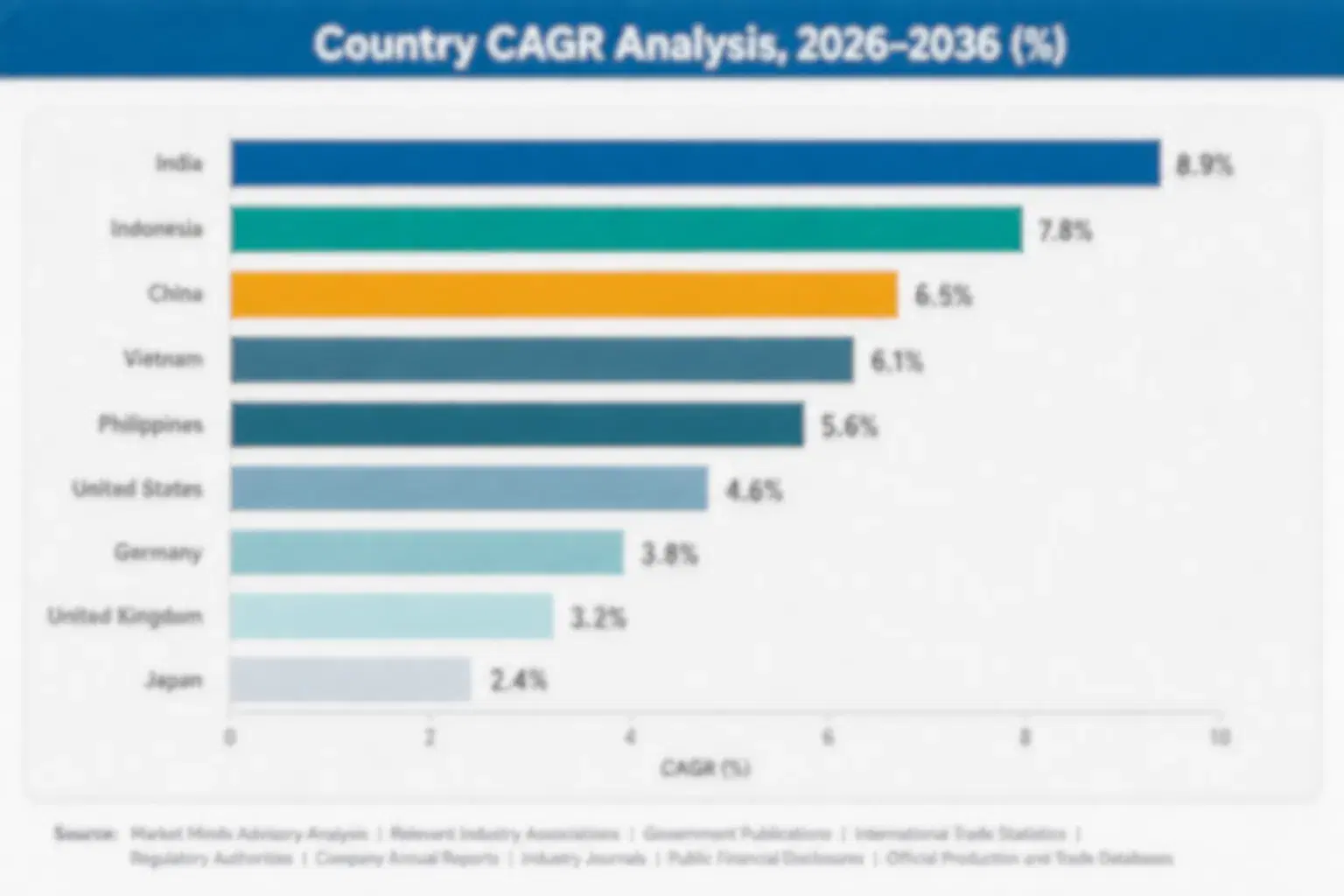
East Asia leads given China's dominant e-axle and battery electric vehicle production base. North America and Western Europe follow closely behind. South Asia and Pacific grows fastest as regional electric vehicle production accelerates rapidly across new platforms. Eastern Europe and Middle East and Africa trail given smaller electric vehicle manufacturing.

East Asia

East Asia leads at 34% share, well above its standard band, and growth of 16.2%, above the global rate. The deviation reflects China's dominant e-axle and battery electric vehicle production base, home to the largest concentration of integrated e-axle manufacturing capacity globally through suppliers serving both domestic and export electric platform programmes. Japanese and South Korean suppliers add further regional manufacturing depth. South Korean and Japanese suppliers add further regional manufacturing depth through established motor integration programmes across the region. Regional capacity investment continues scaling to meet both domestic demand and export platform requirements across neighboring markets. Chinese domestic suppliers continue narrowing the technology gap through aggressive research spending each year.
Share: 34% | CAGR: 16.2% (2026 to 2036)

North America

North America holds 21% share, just below its standard band, and growth of 15.9%, above the global rate. The modest deviation reflects the region's electric vehicle platform base still trailing China's e-axle manufacturing scale, even as premium platforms across the United States continue driving rising regional demand for high-speed coupling hardware. BorgWarner maintains significant regional engineering presence supporting emerging e-axle platform programmes. Canada and Mexico contribute assembly capacity supporting cross-border platform production, particularly for suppliers serving both US and export electric vehicle programmes. Regulatory high-speed certification requirements across the region further reinforce demand for suppliers with proven certification track records. Domestic testing infrastructure investment continues expanding to meet rising certification demand overall.
Share: 21% | CAGR: 15.9% (2026 to 2036)
Regional intelligence for 5 additional markets available in the complete report: Western Europe, South Asia and Pacific, Latin America, Middle East and Africa, Eastern Europe. Contact sales@marketmindsadvisory.com.
e-axle-input-and-output-couplings-market-country-cagr-analysis-1790515110861

Four Margin Routes for E-Axle Coupling Suppliers

Margin in e-axle input and output couplings comes from high-speed engineering depth, damper certification breadth, OEM qualification relationships and precision balance testing rather than volume alone. The routes below apply broadly. Each route can start inside a single motor generation cycle without major restructuring investment. Diversified majors and specialized manufacturers alike can pursue these routes within a single motor cycle.

Investing in High-Speed Fatigue and Balance Testing

OEMs want documented high-speed reliability, so suppliers that invest in high-speed fatigue cycling and balance testing capacity win contracts worth 13% to 19% of revenue at gross margins of 32% to 44%. Programmes cost $4 million to $15 million. Suppliers should invest in testing infrastructure, validate high-speed fatigue data and secure certification alignment early, since undocumented suppliers lose contracts to suppliers offering proven certification-backed reliability. Early movers secure the strongest OEM relationships and repeat platform volume. Suppliers that delay testing investment risk losing platform allocation to better-documented competitors within a single cycle.
Market Impact: high-speed testing wins contracts worth 13-19% of revenue

Building Torsional Damper Engineering Testing Capability

OEMs want proven damper reliability, so suppliers that build torsional damper engineering capability spanning multiple motor speed combinations win contracts worth 10% to 16% of revenue at gross margins of 28% to 40%. Programmes cost $3 million to $12 million. Suppliers should document motor-specific vibration performance, publish validation success rates and secure OEM engineering testimonials, since unproven suppliers lose contracts to suppliers with documented damper engineering history. Suppliers lacking this documentation increasingly lose platform allocation to competitors with deeper damper histories across programmes. This trend has accelerated noticeably across the last two platform cycles.
Market Impact: damper testing wins contracts worth 10-16% of revenue

Expanding Integrated E-Axle Systems Engineering Capacity

Automakers want reliable integrated e-axle capability, so suppliers that expand systems engineering capacity across platform generations win contracts worth 8% to 13% of revenue at gross margins of 24% to 34%. Programmes cost $2 million to $10 million. Suppliers should validate cross-platform integration compatibility, test reliability extensively and secure engineering collaboration agreements, since less-advanced suppliers lose volume to more-advanced competitors across the OEM channel. Suppliers lacking systems capability increasingly cede platform allocation to competitors with broader engineering depth. This trend has accelerated noticeably across the last two platform cycles. Growth remains strong.
Market Impact: systems engineering wins contracts worth 8-13% of revenue

Diversifying Precision Steel Component Sourcing Further

Precision steel cost makes up about 51% of cost, so suppliers that diversify precision steel and spline component sourcing across multiple suppliers cut cost and supply swings by 8% to 16% and protect margins worth 4% to 9% of profit. Programmes cost $2 million to $9 million. Suppliers should qualify multiple component suppliers, test alternative sourcing configurations and monitor commodity markets closely, since single-source dependence raises production risk substantially. Suppliers without diversified sourcing face materially higher exposure to precision steel price swings across cycles. This trend has accelerated noticeably across the last two commodity cycles.
Market Impact: diversified sourcing cuts total cost by 8-16% yearly

Who Controls the Margin Pool

The e-axle coupling market is highly concentrated, with a CR5 of 62%, because high-speed rotating equipment engineering demands rare precision balance and fatigue testing capability that only a small group of majors currently possess. This assessment measures participants on estimated coupling manufacturing revenue. ZF Friedrichshafen and BorgWarner lead through high-speed engineering scale and certification technology, and the gap to the sixth player is substantial across the category.
Competition runs on four dimensions today: high-speed fatigue and balance testing depth, torsional damper engineering capability, integrated e-axle systems engineering breadth, and precision steel cost competitiveness. Diversified majors win on high-speed engineering depth and OEM relationships, specialized manufacturers win on niche rotating equipment expertise, and regional players win on platform-specific application knowledge. Pricing power still concentrates among suppliers holding the deepest testing and certification track records overall.

Emerging pressure comes from e-axle motor speeds continuing to climb further, from torque ripple management demanding more sophisticated engineering, and from precision steel cost that pressures well-capitalised, certification-scaled producers to keep investing in high-speed technology. Rankings shift where a supplier proves novel high-speed engineering progress, wins faster OEM adoption or builds deeper regulatory credibility, and consolidation continues as small manufacturers face rising validation costs.
e-axle-input-and-output-couplings-market-company-positioning-matrix-1790515111178

Competitive Moat and Risk Dimensions

ZF FRIEDRICHSHAFEN

Moat: Global High-Speed Engineering Testing Scale

ZF Friedrichshafen operates extensive global high-speed fatigue cycling and balance testing infrastructure spanning e-axle coupling categories, giving it cost and reliability advantages that narrower manufacturers cannot match independently. Its high-speed engineering depth and OEM relationships give it strong access to buyers seeking reliable certification-backed support across diverse motor speed requirements.
ZF FRIEDRICHSHAFEN

Risk: Testing Investment and Cost Risk

ZF Friedrichshafen depends on continued testing investment to sustain its high-speed engineering lead, which creates execution risk if a competitor's motor speed breakthrough obsoletes existing approaches faster than research can respond. Steel costs squeeze margins. Regional competitors keep narrowing this gap through targeted testing investment.
BORGWARNER

Moat: E-Axle Systems Integration Reach

BorgWarner operates established e-axle systems integration technology backed by broad OEM relationships across multiple premium electric vehicle platform categories, giving it market access that narrower specialists lack entirely. Its integration depth and distribution relationships give it strong access to buyers across multiple e-axle coupling categories worldwide.
BORGWARNER

Risk: Concentration and Competitive Pressure

BorgWarner's e-axle coupling revenue still carries meaningful concentration relative to more diversified driveline competitors, creating pricing pressure as regional manufacturers expand their own high-speed engineering capability. Steel costs squeeze margins. Regional competitors keep narrowing this gap through targeted investment. Specialized manufacturers keep narrowing this gap through targeted engineering investment.

Players Tracked

Prominent Players

ZF Friedrichshafen
BorgWarner
Bosch
JATCO
Nidec Corporation

Other Key Players

Magna International
GKN Automotive
Hyundai Mobis
Schaeffler AG
Valeo
Dana Incorporated
American Axle & Manufacturing
Denso Corporation
Aisin Corporation
Hitachi Astemo
Mitsubishi Electric
Wanxiang Group
Continental AG
Vitesco Technologies
JTEKT Corporation

Recent Developments

JANUARY 2026

Coupling Supplier Expands High-Speed Testing Research Facility

An e-axle coupling manufacturer expanded its high-speed fatigue cycling and balance testing research facility to support new motor generation certification, according to company communications. It is an organic capacity expansion, not an acquisition. Terms of the arrangement were not fully disclosed in public communications. Terms remain undisclosed.
Signal: Confirms suppliers are scaling high-speed testing capacity because demand keeps outpacing existing validation supply. This reflects a broader industry pattern.
FEBRUARY 2026

Premium Automaker Signs Multi-Year E-Axle Coupling Supply Agreement

A premium automaker signed a multi-year e-axle coupling supply agreement with a systems manufacturer covering multiple platform programs, according to company communications. It is a supply agreement, not an acquisition, and it tests commitment. Terms of the arrangement were not fully disclosed in public communications.
Signal: Shows automakers are locking in coupling supply because high-speed reliability increasingly sustains sourcing decisions. This reflects a broader industry pattern.
MARCH 2026

Regional Manufacturer Announces New Torsional Damper Testing Centre

A regional coupling manufacturer announced a new torsional damper testing centre located near a major premium OEM engineering hub, according to public filings. It is a facility announcement, not a commercial deal, and it tests strategy. Terms of the arrangement were not fully disclosed in public communications.
Signal: Indicates manufacturers are prioritizing engineering proximity because testing responsiveness increasingly determines sourcing decisions. This reflects a broader industry pattern suppliers.

Precision Steel and Spline Component Cost Exposure

Precision-machined steel and spline component cost accounts for roughly 51% of manufacturing cost, damper and elastomer materials about 22%, high-speed testing and certification about 16%, packaging and logistics about 6%, and quality assurance about 5%, with the remainder split across administrative overhead. Precision machining capacity concentrates in Germany, Japan and China. Precision manufacturing capacity concentrates further in Taiwan and South Korea across major established markets.
The clearest recent shock came in 2021 and 2022. Global steel and precision component industry data show automotive-grade forged steel prices rising sharply amid broader supply chain disruption, which delayed coupling production and lifted component costs across the category. Suppliers absorbed part of the increase, raised unit prices in stages and diversified steel sourcing, which compressed margins through the period. Costs have since stabilised somewhat as supply normalized through 2024 and 2025.

The disadvantage falls on smaller manufacturers without steel sourcing scale, testing capital or diversified supply, because they pay more per unit and cannot spread fixed high-speed testing cost. Exposure varies by player type: diversified driveline majors hold sourcing scale and testing breadth, mid-tier manufacturers depend on regional supplier relationships, and smaller producers depend on limited production volume and narrower testing capability.
e-axle-input-and-output-couplings-market-cost-volatility-analysis-1790515111507

Multi-Year Precision Steel Supply Contracts With Diversification

Suppliers sign multi-year precision steel supply contracts and diversify sourcing across multiple specialist producers to cut cost swings of 8% to 16% per year. The main challenge is volume commitment and component consistency, so suppliers test alternatives early and track results closely each quarter throughout the year. Suppliers report measurable improvement within two to three fiscal quarters of implementation.

Shared High-Speed Testing Infrastructure Across Product Lines

Suppliers share high-speed fatigue cycling and balance testing infrastructure across multiple product categories and platform programmes to reduce fixed testing capital risk considerably. The main challenge is coordinating research schedules across diverse product timelines, so suppliers plan capital allocation carefully each cycle and report progress regularly to management. Suppliers report measurable improvement within two to three fiscal quarters of implementation.

Price Architecture and Long-Term OEM Supply Contracts

Suppliers use price architecture and long-term supply contracts with automakers to recover 33% to 53% of cost increases without sudden price shocks. The main challenge is OEM resistance and competitive price pressure, so suppliers test changes with key accounts first and gather feedback carefully each cycle. Suppliers report measurable improvement within two to three fiscal quarters of implementation.

Portfolio Architecture for Margin Defence

Margins run from moderate returns on standard input and output couplings to strong returns on high-speed spline assemblies sold with documented fatigue performance and certification depth. Three tiers separate volume products, premium certified products and next-generation solutions, and each draws on different testing capability and OEM trust in a highly concentrated market. Margin gaps between tiers run to 20 points, with certified high-speed systems sitting at the top of that range.
The tension between volume and premium is sharp. Standard input and output couplings fill production volume at moderate prices and face steel cost swings, while high-speed and damper couplings earn higher margins on smaller volumes and depend on certification proof, testing investment and OEM trust. Suppliers running only standard volume suffer when steel costs rise together across the category and cannot easily pass through increases.

High-value pools concentrate in high-speed spline coupling assemblies and in torsional damper coupling units sold through documented certification and testing programmes to automakers chasing high-speed reliability beyond baseline standard capability. They gather where buyers pay for verified testing depth and certification status, not volume alone. Commercial vehicle e-axle couplings add a further specialty pool worth watching.

Volume / Commodity-Adjacent

Standard motor-to-gearbox input couplings and aftermarket service kits sold on cost per unit through established distributor and direct OEM contracts. Buyers focus on cost and proven reliability, and differentiation is limited by shared manufacturing processes across suppliers.
Gross Margin: 22%-30%

Premium / Certified

Gearbox-to-differential output couplings and commercial vehicle applications with documented fatigue testing data sold through specialty tier-one relationships. Buyers value proof of quality consistency and reliable supply, and contracts run for multi-year terms with regular reviews.
Gross Margin: 28%-38%

Sustainability / Regulatory / Next-Generation

High-speed spline coupling assemblies and torsional damper coupling units sold to buyers demanding documented fatigue performance and certification testing depth. Sales depend on trial proof and certification depth, and suppliers must show reliable production consistency.
Gross Margin: 32%-44%
e-axle-input-and-output-couplings-market-portfolio-architecture-1790515111789

High-value Sub-segments and Strategic Watch-out

High-Speed Spline Coupling Assemblies

High-speed couplings combine the fastest growth with the strongest pricing, since buyers accept gross margins of 32% to 44% for documented fatigue performance with proven certification consistency. Testing capital depth forms the entry barrier for entrants. Suppliers who invest early in this segment secure the strongest long-term positioning relative to.

Torsional Damper Coupling Units

Damper coupling units deliver solid growth with premium pricing, since buyers support gross margins of 28% to 40% for documented reliability and vibration damping data. Testing scale and OEM access limit competition, though adoption varies by platform. Suppliers who invest early in this segment secure the strongest long-term positioning relative.

Motor-to-Gearbox Input Couplings

Standard input couplings are the volume core, with value growing at a modest pace as the category matures gradually. Steel cost, processing consistency and price competition decide profit across the mainstream segment. Suppliers who invest early in this segment secure the strongest long-term positioning relative to competitors.

Gearbox-to-Differential Output Couplings

Output couplings are the strategic watch-out, since growth trails the leaders, commodity supply competition increasingly compresses baseline pricing and generic supplier entry adds persistent margin risk over time. Suppliers who invest early in this segment secure the strongest long-term positioning relative to competitors. Consolidation risk remains meaningful.

Why Automakers Keep Certifying E-Axle Suppliers

Coupling demand behaves like an annuity attached to every platform's full production run, reinforced by the certification ceiling that high-speed testing imposes on switching suppliers mid-platform regardless of cost pressure. Once an automaker certifies a supplier's high-speed fatigue performance, purchases repeat across the entire platform production run, and switching means re-certifying a new supplier against a fixed motor speed specification.
Adoption stickiness differs by end-use vertical. Premium electric platforms running elevated motor speeds are the deepest, since the purchase is grounded in both certification depth and safety-critical positioning economics. Mainstream electric platforms are moderately sticky, driven by cost competitiveness and periodic specification review. Entry-level electric platforms without elevated speed ambitions are more fluid, adopting standard couplings only as cost curves allow.

Buyer profiles are shifting across generations of platform powertrain engineers. Older engineers relied on proven combustion-speed rated technology exclusively and simple cost comparison, while younger engineers increasingly research high-speed fatigue data, demand certification transparency and adopt simulation-driven design practices. Suppliers that publish clear fatigue testing data win these newer engineers consistently across the OEM engineering channel. Training programmes increasingly emphasize high-speed rotordynamics alongside traditional mechanical engineering fundamentals for incoming staff.
e-axle-input-and-output-couplings-market-end-use-penetration-index-1790515112103

MMA Verdict: E-Axle Coupling Supplier Strategy

These are among the four positions where our research anticipates prominent divergence between winners and laggards over the coming forecast period. Each is grounded in the demand model, the regulatory perimeter, and the announced capacity pipeline.
01 / HIGH-SPEED TESTING STRATEGY

Invest in Testing Before Rivals Capture Motor Speed Demand

OEMs want documented high-speed reliability, and suppliers that invest in high-speed fatigue cycling and balance testing capacity win contracts worth 13% to 19% of revenue at gross margins of 32% to 44%. Suppliers should invest $4 million to $15 million, validate high-speed fatigue data and secure certification alignment thoroughly across every motor generation. Those that delay will lose category momentum over the next two years, while early movers hold clearly higher prices and durably stronger margins across every renewal, audit and annual review conducted.
02 / DAMPER ENGINEERING STRATEGY

Build Damper Capability Before Rivals Own Platform Trust

OEMs want proven damper reliability, and suppliers that build torsional damper engineering capability spanning multiple motor speed combinations win contracts worth 10% to 16% of revenue at gross margins of 28% to 40%. Suppliers should invest $3 million to $12 million, document motor-specific vibration performance and publish validation success rates thoroughly across every cycle. Those that delay will lose contracts and OEM trust over the next two years, while early movers hold much stronger relationships and durably better margins across every renewal cycle and annual review conducted.
03 / SYSTEMS ENGINEERING STRATEGY

Expand Integration Capability Before Rivals Capture Sourcing

Automakers want reliable integrated e-axle capability, and suppliers that expand systems engineering capacity across platform generations win contracts worth 8% to 13% of revenue at gross margins of 24% to 34%. Suppliers should invest $2 million to $10 million, validate cross-platform integration compatibility and test reliability extensively across every supported model. Those that delay will lose contracts and OEM trust over the next two years, while early movers hold much stronger relationships and consistently better margins across every renewal, audit and annual review conducted, without exception.
04 / COMPONENT SOURCING STRATEGY

Diversify Sourcing Before Supply Swings Erode Achievable Margins

Precision steel cost makes up about 51% of cost, and suppliers that diversify precision steel and spline component sourcing across multiple suppliers cut cost and supply swings by 8% to 16% and protect margins worth 4% to 9% of profit. Suppliers should invest $2 million to $9 million, qualify multiple component suppliers and test alternative sourcing configurations across every production line used. Those that delay will pay rising input bills and lose pricing power over the next two years, while early movers hold durably lower costs.

Engagement Snapshot From the Field

A live engagement with an industry participant carrying material or product regulatory and market exposure ahead of a defining policy shift, showing how our research translates into a defensible multi-year portfolio strategy.
MARKET MINDS ADVISORY · CLIENT ENGAGEMENT SUMMARY
E-Axle Input and Output Couplings Producer Strategic Portfolio Review and Transition Roadmap 2026·Investment Scenario on E-Axle Input and Output Couplings Exposure Evaluation 2025-26
CLIENT PROFILE
The client is an East Asian electric vehicle manufacturer with annual revenue near $41 billion (client-reported, unverified by MMA), launching a new performance platform requiring high-speed e-axle coupling certification ahead of production ramp-up. Existing testing capacity threatened the platform's launch timeline significantly and required urgent evaluation. The platform represented a strategic performance priority central to the manufacturer's broader electrification roadmap.
STRATEGIC CHALLENGE
The manufacturer needed high-speed fatigue certification across three motor configurations within a 16-month window (client-reported, unverified by MMA), existing testing capacity remained limited to standard-speed validation, and management had to decide whether to accelerate parallel certification or delay the platform launch. Delaying the launch risked ceding competitive positioning to rival manufacturers pursuing similar performance platforms.
MMA APPROACH
MMA analysed certification testing economics and timeline trade-offs across three scenarios, interviewed 14 rotating equipment engineers and competing suppliers, and modelled cost and schedule trade-offs between parallel certification and phased rollout over an 18-month horizon. Findings were benchmarked against two comparable performance platform launches. The engagement also included direct facility visits to two candidate supplier testing sites.
KEY FINDINGS
  1. Parallel certification of three motor configurations would reach production readiness within the stated sixteen-month timeline (client-reported, unverified by MMA). This was confirmed through direct supplier testing capacity interviews and documentation review.
  2. Two competing coupling suppliers offered dedicated engineering support matched closely to the platform's high-speed requirements (client-reported, unverified by MMA). This finding was confirmed through direct supplier interviews and testing documentation review.
  3. Securing full certification before launch would require a phased validation approach spanning two production lines (client-reported, unverified by MMA). This finding was confirmed through direct supplier interviews and testing documentation review.
  4. The incumbent supplier expressed clear willingness to accelerate its own testing capacity once parallel certification began (client-reported, unverified by MMA). This finding was confirmed through direct supplier interviews and testing documentation review.
CLIENT PROFILE
The client is an East Asian electric vehicle manufacturer with annual revenue near $41 billion (client-reported, unverified by MMA), launching a new performance platform requiring high-speed e-axle coupling certification ahead of production ramp-up. Existing testing capacity threatened the platform's launch timeline significantly and required urgent evaluation. The platform represented a strategic performance priority central to the manufacturer's broader electrification roadmap.
STRATEGIC CHALLENGE
The manufacturer needed high-speed fatigue certification across three motor configurations within a 16-month window (client-reported, unverified by MMA), existing testing capacity remained limited to standard-speed validation, and management had to decide whether to accelerate parallel certification or delay the platform launch. Delaying the launch risked ceding competitive positioning to rival manufacturers pursuing similar performance platforms.
MMA APPROACH
MMA analysed certification testing economics and timeline trade-offs across three scenarios, interviewed 14 rotating equipment engineers and competing suppliers, and modelled cost and schedule trade-offs between parallel certification and phased rollout over an 18-month horizon. Findings were benchmarked against two comparable performance platform launches. The engagement also included direct facility visits to two candidate supplier testing sites.
KEY FINDINGS
  1. Parallel certification of three motor configurations would reach production readiness within the stated sixteen-month timeline (client-reported, unverified by MMA). This was confirmed through direct supplier testing capacity interviews and documentation review.
  2. Two competing coupling suppliers offered dedicated engineering support matched closely to the platform's high-speed requirements (client-reported, unverified by MMA). This finding was confirmed through direct supplier interviews and testing documentation review.
  3. Securing full certification before launch would require a phased validation approach spanning two production lines (client-reported, unverified by MMA). This finding was confirmed through direct supplier interviews and testing documentation review.
  4. The incumbent supplier expressed clear willingness to accelerate its own testing capacity once parallel certification began (client-reported, unverified by MMA). This finding was confirmed through direct supplier interviews and testing documentation review.
RECOMMENDED STRATEGY
Phase 1: Phase 1 (Months 1-5): Secure supplier commitment through documented certification investment plan presentation. Vendors selected competitively across motor categories. Milestones reviewed jointly with supplier engineering leads. Phase 2: Phase 2 (Months 6-15): Complete parallel high-speed fatigue certification testing programs. Progress tracked weekly against plan. Milestones reviewed jointly with supplier engineering leads. Phase 3: Phase 3 (Month 16): Ramp production volume and document full platform performance results. Results reviewed against target adoption. Milestones reviewed jointly with supplier engineering leads.
OUTCOME
Within 16 months, the manufacturer secured full certification and avoided platform launch delays entirely (client-reported, unverified by MMA). Management credited the parallel certification approach with managing capacity risk while meeting the platform's launch timeline. The engagement strengthened the manufacturer's long-term supplier certification playbook for future platform launches as well.

Frequently Asked Questions

Foundational context covering the market sizes, CAGR, scope, country, region and competition that inform every finding below. This section is provided to cover basics and most often pre-purchase conversations, answered from the MMA Primary Research Dataset.

What is the current size of the E-Axle Input and Output Couplings Market?

The e-axle input and output couplings market was valued at $0.52 billion in 2025 on a manufacturer revenue basis. Growth comes from rising motor speeds, torque ripple management and electric vehicle platform adoption.

How large will the E-Axle Input and Output Couplings Market be by 2036?

The market is projected to reach $2.42 billion by 2036, up from $0.60 billion in 2026. The increase of $1.82 billion reflects high-speed and damper coupling adoption.

What is the CAGR for the E-Axle Input and Output Couplings Market 2026 to 2036?

The market is forecast to grow at a 15.0% CAGR from 2026 to 2036. The bull case reaches 16.3% and the bear case 13.7%, depending on electric adoption pace and motor speed trends.

Which segment is growing fastest?

High-Speed Spline Coupling Assemblies is the fastest-growing segment at 21.0% CAGR, roughly 1.40 times the overall market rate. Torsional Damper Coupling Units follows at 18.0% CAGR, about 1.20 times the overall rate.

Who are the major companies in the E-Axle Input and Output Couplings Market?

Major companies include ZF Friedrichshafen, BorgWarner, Bosch, JATCO and Nidec Corporation, alongside Magna International, GKN Automotive and Hyundai Mobis. These companies compete on high-speed testing depth and validated damper engineering capability.

Which country is growing fastest?

China is growing fastest at about 16.2% CAGR, because its dominant e-axle and battery electric vehicle production base keeps driving demand higher across new platforms.

Report Segmentation Architecture

The full report scope spans multiple orthogonal segmentation dimensions, with cross-tabulated demand data provided for each dimension pair. Coverage extends further to regional breakdowns, trend trajectories, and the competitive detail needed to support segment-level decision-making.

By Primary Market Dimension

  • Motor-to-Gearbox Input Couplings
  • Gearbox-to-Differential Output Couplings
  • High-Speed Spline Coupling Assemblies
  • Torsional Damper Coupling Units
  • Commercial Vehicle E-Axle Couplings
  • Aftermarket E-Axle Coupling Service Kits

By End-Use Industry

  • Passenger Electric Vehicle OEM
  • Performance and Sports Electric Platforms
  • Commercial Electric Vehicle OEM
  • Autonomous-Capable Vehicle Platforms

By Commercial Dimension

  • Direct OEM Supply Contracts
  • Tier-One Integration Channels
  • Regulatory Certification Support Partnerships
  • Regional Engineering Support Channels

By Region

  • North America
  • Western Europe
  • East Asia
  • South Asia and Pacific
  • Latin America
  • Middle East and Africa
  • Eastern Europe

Scope, Methodology, and Coverage

Every figure in this report is reproducible from documented input assumptions. The scope below maps the historical period, the forecast horizon, the segmentation dimensions, and the countries covered, alongside the underlying primary and qualitative methodology.
Historical Period
2020 to 2025
Forecast Period
2026 to 2036
Base Year
2025 (USD billions; MMA Primary Research Dataset, September 2026)
Market Definition
The market covers torque transfer coupling hardware internal to integrated e-axle housings, including motor-to-gearbox input couplings, gearbox-to-differential output couplings, high-speed spline coupling assemblies, torsional damper coupling units, and commercial vehicle e-axle couplings sold through OEM channels. It excludes the electric motor and hybrid starter-generator unit itself, downstream CV joint half-shaft couplings connecting the e-axle output to the wheel hub, and standalone gearbox hardware, which are covered as separate distinct product categories.
Quantitative Units
USD millions (manufacturer revenue); unit shipments for volume references
Segmentation Dimensions
By Product Type; By End-Use Vehicle Category; By Commercial Dimension; By Region
Regions Covered
North America, Western Europe, East Asia, South Asia and Pacific, Latin America, Middle East and Africa, Eastern Europe
Countries Covered
China, United States, Germany, Japan, South Korea, France, United Kingdom, Sweden, Netherlands, India
Key Companies Profiled
ZF Friedrichshafen, BorgWarner, Bosch, JATCO, Nidec Corporation, Magna International, GKN Automotive, Hyundai Mobis, Schaeffler AG, Valeo, Dana Incorporated, American Axle & Manufacturing, Denso Corporation, Aisin Corporation, Hitachi Astemo, Mitsubishi Electric, Wanxiang Group, Continental AG, Vitesco Technologies, JTEKT Corporation
Quantitative Methodology
Primary survey, n=3,800 respondents, Q4 2025, six countries; demand-side model with trade association cross-validation
Qualitative Methodology
47 expert interviews, Q4 2025; applied to validate demand model assumptions, identify emerging dynamics, and assess competitive positioning
Report Format
PDF and XLSX data workbook (Word format preview document)
Publisher
Market Minds Advisory
Report Code
MMA-2026-AUT-483
Published
September 2026
Contact
sales@marketmindsadvisory.com | www.marketmindsadvisory.com

Purchase the full E-Axle Input and Output Couplings Market Report (2026 to 2036).

The full report delivers a detailed assessment of the e-axle input and output couplings market through 2036, covering product type and regional forecasts, competitive benchmarking of leading driveline majors and specialized high-speed rotating equipment manufacturers, and detailed input cost analysis. It combines MMA primary research, including a six-country survey of 3,800 respondents and 47 expert interviews, with public statistical and company data. A dedicated chapter benchmarks high-speed testing investment against realistic payback timelines for both majors and specialized manufacturers. Regional appendices detail platform-specific certification requirements for suppliers.
Ten-year product type and regional demand forecasts
Precision steel cost tracking resource today
Competitive benchmarking of leading suppliers today
High-speed certification and testing progress tracker
Country-level comparative analysis across major markets
Quarterly primary survey data update access

Built For The People Who Decide

From boardroom strategy to bench-side execution, this report is read cover-to-cover by leaders shaping the next decade of their industry, turning demand scenarios, market dynamics and valuation benchmarks into decisions.
CXOs/ Presidents/ VPs/ Managers
M&A and Corporate Development
Strategy Teams and R&D Heads
Procurement and Product Directors
Regulatory and Compliance Leaders
Investor Relations and Equity Analysts