Market Minds Advisory
Dynamic Slotting and Storage Optimization Software Market

Dynamic Slotting and Storage Optimization Software Market: Dynamic Slotting and Storage Optimization Software Market. Robotics Integration Reshapes Warehouse Slotting Economics

E-commerce fulfillment centers facing relentless SKU proliferation and rising labor costs are colliding as warehouse operators abandon static slotting rules for software that continuously re-optimizes storage location based on real-time demand signals.

Lead Analyst

Published

September 2026

Make Smarter Decisions with Customized Research Insights

Request a free sample report and evaluate market opportunities, growth trends, and competitive dynamics relevant to your business needs.

2025 MARKET VALUE$2.1BMarket Size 2025
2036 FORECAST VALUE$8.4BBase Case , 2026 to 2036
CAGR 2026 TO 203613.5 %Bull 14.8% / Bear 12.2%
INCREMENTAL OPPORTUNITY$6.1BNet 10- year value creation
EXPANSION MULTIPLE3.55x2036 value over 2026 base
Strategic Levers
M&A Pipeline
Regional Outlook
Country Rankings
Competitive Intelligence
Segmental Deep-dive
Call-Us : 91 93563 13602

Executive Snapshot and Market Trajectory.

E-commerce fulfillment operators managing thousands of constantly shifting SKUs are abandoning static, manually configured slotting rules for software that continuously re-optimizes storage location placement based on real-time demand signals and seasonal velocity shifts across every active distribution center nationwide today, reshaping warehouse operating economics and staffing models across the industry.
Robotics and automated storage and retrieval system integration modules are scaling fastest, as warehouses deploying autonomous mobile robots need slotting software that accounts for robot travel time and charging cycles rather than human walking distance alone across increasingly automated facilities. Labor and pick-path optimization is close behind, driven by persistent warehouse labor shortages pushing operators to extract maximum productivity from a shrinking available workforce across nearly every distribution center operating nationwide today.
Established warehouse management giants, specialized slotting optimization vendors, and robotics integration platforms all compete for fulfillment center budgets, with larger platforms increasingly bundling slotting optimization directly into broader warehouse management suites rather than selling it as a standalone module separately in the open market. Independent optimization specialists are responding by building deeper algorithmic differentiation that bundled offerings genuinely cannot easily match at scale.
Market Definition
This report covers software platforms that continuously optimize warehouse storage location assignment, slotting rules, and pick-path efficiency based on demand velocity and inventory characteristics, measured on a global vendor revenue basis. It excludes standalone warehouse management systems sold without a dedicated dynamic slotting optimization engine.
Base Year Value
$2.1B in 2025 (MMA Primary Research Dataset, September 2026)
Forecast Period
2026 to 2036, eleven discrete annual values
CAGR
13.5% base case. Bull 14.8%. Bear 12.2%.
Fastest Growth Segment
Robotics and AS/RS Integration Modules: 19.0% CAGR
Fastest Growth Country
India: 20.0% CAGR
Fastest Growth Region
South Asia and Pacific: 15.5% CAGR
Largest Region
North America: 32% of 2025 global value
Market Leaders
Manhattan Associates, Blue Yonder, Körber Supply Chain, SAP, Oracle
Primary Survey
n=3,800 procurement and R&D decision-makers, Q4 2025, six countries
Methodology
Demand-side build-up, cross-validated against public data, 47 expert interviews

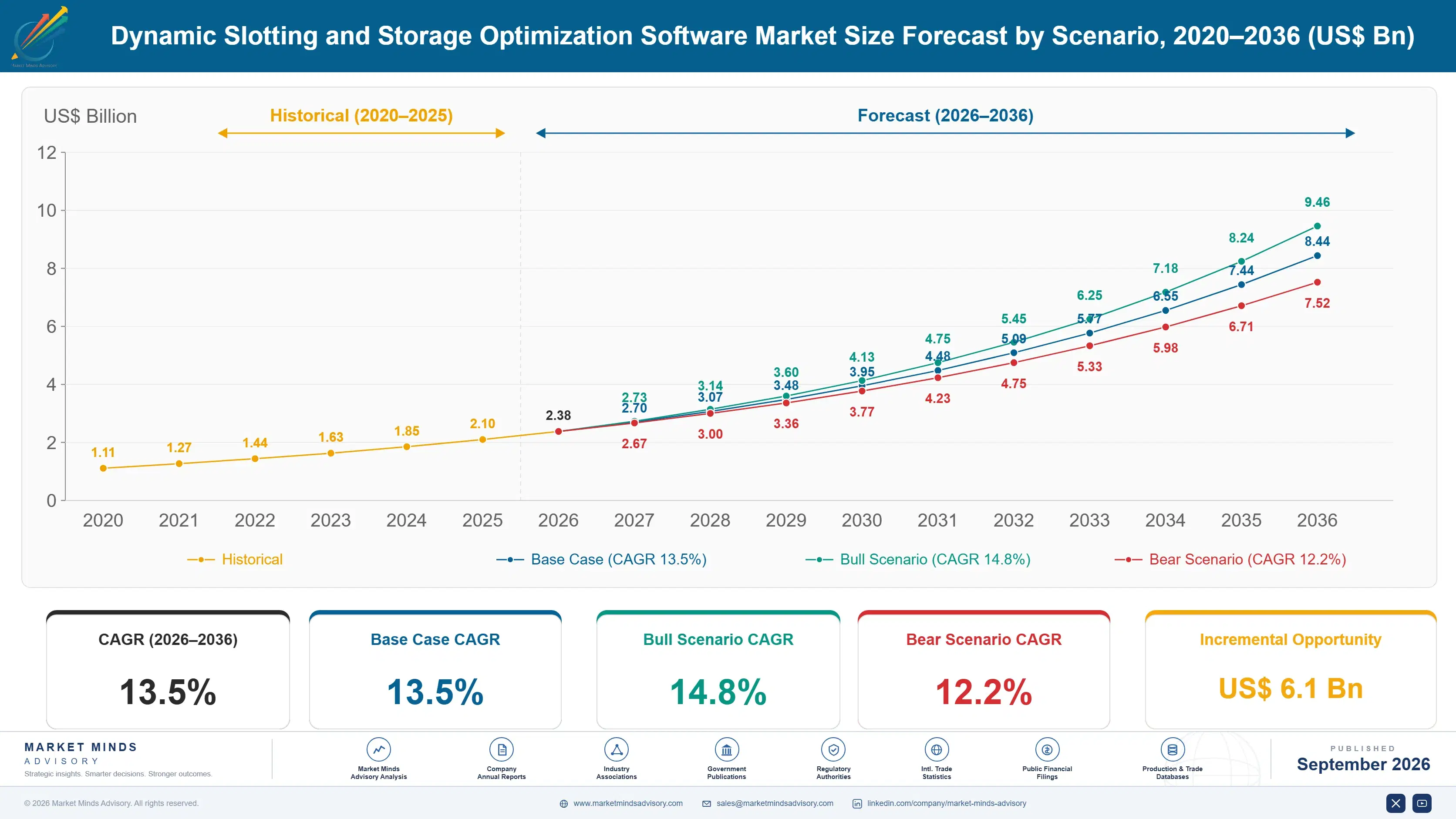
Dynamic Slotting and Storage Optimization Software Market Forecast Scenarios

dynamic-slotting-and-storage-optimization-software-size-forecast-scenario-1788422983755
Slotting optimization software adoption grew at a 12.3 percent historical rate between 2020 and 2025 as e-commerce order volume surged and fulfillment centers found static slotting rules genuinely inadequate for managing rapidly shifting SKU velocity across seasonal demand swings. Warehouse labor shortages accelerated adoption further, pushing operators toward software that could extract measurable productivity gains from an increasingly constrained workforce.
The base case assumes 13.5 percent annual growth through 2036, anchored by three mechanisms working together: continued e-commerce SKU proliferation requiring constant re-slotting to match shifting demand patterns, expanding warehouse robotics deployment requiring slotting logic that accounts for robot travel and charging constraints, and persistent labor shortages pushing operators toward software-driven productivity gains rather than additional headcount. Vendor consolidation is steadily narrowing the number of credible platform choices operators can select from confidently.
A bull case near 14.8 percent growth hinges on accelerating warehouse robotics adoption creating new integration demand that pure human-optimized slotting software cannot satisfy without genuine architectural redesign across most fulfillment operations. A bear case near 12.2 percent follows an e-commerce growth slowdown curbing fulfillment center capital spending and delaying planned software modernization projects across the industry.

Robotics Integration Redraws Slotting Software Requirements

Dynamic slotting software sits at the intersection of operations research algorithms and physical warehouse layout constraints, forcing vendors to model genuinely complex tradeoffs between pick efficiency, storage density, and labor ergonomics simultaneously. Vendors that built genuine algorithmic sophistication early defend a real competitive advantage against newer entrants offering comparable specifications without the underlying optimization depth to match. That algorithmic depth takes years to replicate credibly.
MARKET CONCENTRATIONCR5 44%Fragmented across warehouse management giants and specialized optimization vendors
AVERAGE CONTRACT VALUE$140,000 per facility annuallyReflects facility size and robotics integration complexity purchased
ROBOTICS INTEGRATION SHARERobotics-enabled 38%Portion of deployments integrated with autonomous mobile robot fleets
IMPLEMENTATION CYCLE LENGTH3 to 5 monthsTime typically required for full platform deployment completion nationwide
PRODUCTIVITY IMPROVEMENT18 to 25 percentTypical picking efficiency gain reported after full software deployment
IT BUDGET SHAREWarehouse software 8%Portion of logistics technology budgets allocated to slotting software
Robotics compatibility is now the primary purchasing criterion, as fulfillment operators increasingly select slotting platforms based on how directly they integrate with autonomous mobile robot fleets rather than pure algorithmic sophistication for human pickers alone. Vendors slow to build genuine robotics-aware slotting logic are losing renewal negotiations to competitors offering purpose-built integration with leading robotics platforms already deployed. Operators increasingly write robotics compatibility directly into procurement requirements.
Consolidation is reshaping vendor choice as larger warehouse management platforms acquire specialized slotting optimization firms to offer unified coverage across the full fulfillment workflow from receiving through shipping. Operators increasingly prefer consolidating vendor relationships to reduce integration overhead, even when that means accepting a less specialized slotting engine in exchange for unified data visibility across the entire warehouse management system.
"Slotting used to mean putting fast-movers near the dock and calling it done. Now it means modeling robot battery life and charging station queues, and the vendors who understood that shift first are winning the robotics-enabled fulfillment centers."
Practice Lead, Warehouse Automation and Logistics Software · MMA Warehouse Management and Storage Optimization Software Practice · September 2026

Market Trends

Robotics-Aware Slotting Logic Becomes Standard Requirement

Vendors are rebuilding core slotting algorithms to account for autonomous mobile robot travel time, charging cycle scheduling, and traffic congestion at popular pick locations, factors that traditional human-optimized slotting logic never needed to consider. This shift lets fulfillment centers deploying robotics fleets extract meaningfully more throughput from the same physical footprint and robot count than legacy slotting rules would allow. Roughly 38 percent of active deployments now integrate with autonomous mobile robot fleets, up sharply from a much smaller base just three years earlier, and vendors report accelerating integration requests from operators expanding robotics deployment across additional facilities nationwide.
Market Impact: Manages 15,000+ new SKUs monthly
Real-Time Demand Sensing Replaces Periodic Batch Re-Slotting

Vendors are moving from periodic, batch-based slotting recalculation cycles run overnight or weekly toward continuous, real-time demand sensing that adjusts storage recommendations throughout the operating day as order patterns shift. This shift matters most during peak shopping periods when demand for specific SKUs can spike dramatically within hours, a timescale traditional batch-based slotting systems were never designed to respond to effectively. Several major vendors have launched real-time slotting capability within the past 18 months, responding to operator demand for software that keeps pace with genuinely volatile modern demand patterns across most consumer categories.
Market Impact: Improves productivity by 18 to 25%

Market Opportunities and Growth Drivers

E-Commerce SKU Proliferation Demands Continuous Re-Slotting

Online retailers continuously expanding product catalogs, often adding thousands of new SKUs monthly, create a genuinely dynamic inventory landscape that static slotting rules configured once and rarely revisited simply cannot keep pace with over time. Each new product introduction shifts the relative velocity ranking of existing inventory, requiring continuous re-optimization rather than periodic manual review that most legacy warehouse management approaches were built around historically. Fulfillment centers running software-driven continuous slotting report meaningfully better space utilization than those still relying on quarterly or even monthly manual review cycles across comparable facility footprints.
Market Impact: Captures only 60% of recommended moves

Warehouse Labor Shortage Pushes Productivity-Focused Software

Persistent difficulty hiring and retaining warehouse labor, particularly during peak shopping seasons, is pushing fulfillment operators to treat slotting software as a genuine productivity multiplier rather than a nice-to-have operational efficiency tool reserved for the largest operations. Operators report that optimized slotting alone can improve picking productivity by 18 to 25 percent, a meaningful gain when additional headcount is genuinely difficult or expensive to source in tight regional labor markets. This productivity lever has become particularly valuable as minimum wage increases raise the fully loaded cost of each additional warehouse worker.
Market Impact: Adds 2 to 3 months delay

Market Restraints and Challenges

Physical Relocation Costs Limit Re-Slotting Frequency

Software can recommend optimal storage locations continuously, but physically moving inventory to match those recommendations requires labor time and temporarily disrupts picking operations, creating a real gap between algorithmic recommendation and practical implementation frequency. The root cause is that most warehouses rely on human labor to physically execute relocation moves, since fully automated storage and retrieval systems remain a substantial capital investment few facilities have made. The commercial impact shows up as operators implementing only a fraction of recommended moves, capturing less optimization value than the software theoretically enables. Some vendors now prioritize recommendations by expected return.
Market Impact: Adds 38% robotics-integrated deployment share

Legacy Warehouse Management System Integration Complexity

Many fulfillment centers run warehouse management systems installed a decade or more ago that lack modern application programming interfaces, forcing slotting optimization vendors to build custom integration work for each unique legacy environment encountered during implementation. The underlying cause is that legacy warehouse management vendors had limited incentive to build open integration standards when their own bundled modules represented the primary alternative available to customers. The commercial impact is that implementation projects routinely run longer than initially quoted, delaying time to value for customers. Several vendors now offer dedicated legacy integration teams to shorten that deployment gap.
Market Impact: Cuts re-slotting cycle time 70 percent
3 additional market trends, 4 additional growth drivers, and 3 additional restraints and challenges are covered in the full report. Contact sales@marketmindsadvisory.com to access the complete intelligence.

Segment CAGR and Growth Architecture

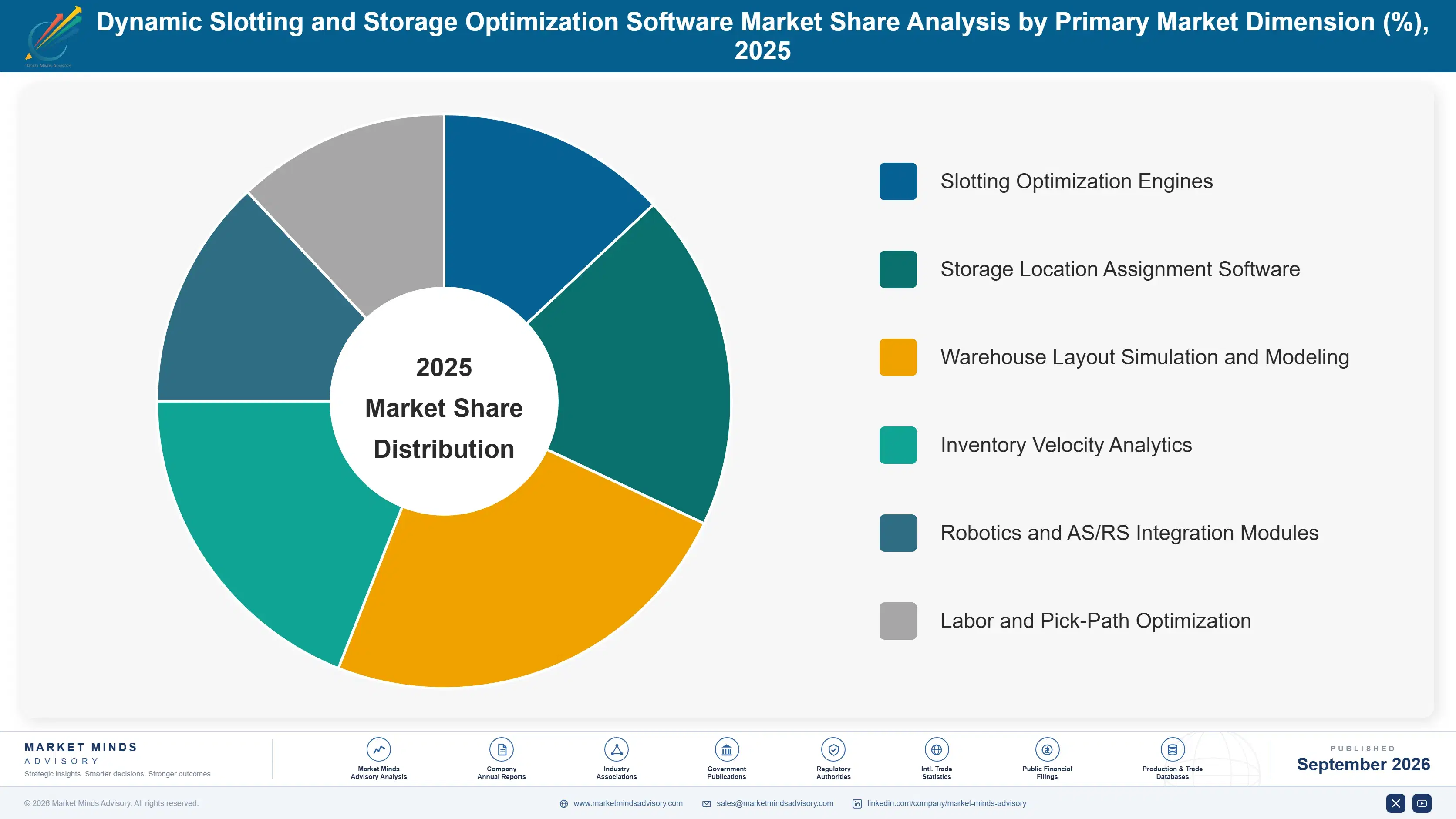
Dynamic slotting software segments by functional module across six categories spanning slotting optimization engines, storage location assignment, warehouse layout simulation, inventory velocity analytics, robotics and AS/RS integration, and labor and pick-path optimization, each serving a distinct fulfillment workflow layer within the broader warehouse management technology stack from initial receiving all the way through final outbound shipment.
dynamic-slotting-and-storage-optimization-software-market-share-analysis-1788422984315

Robotics and AS/RS Integration Modules

Robotics and automated storage and retrieval system integration modules translate slotting recommendations into instructions that autonomous mobile robots and automated storage systems can execute directly, accounting for robot travel time, charging cycles, and traffic congestion at popular pick locations that human-optimized slotting logic never needed to model. Demand is accelerating fastest here as warehouse robotics deployment expands rapidly across fulfillment operators seeking labor productivity gains that pure software optimization alone cannot deliver at the same scale. Vendors who built genuine robotics-aware slotting logic early, rather than retrofitting human-optimized algorithms for robotic execution, are winning the largest share of new enterprise contracts. Integration partnerships with leading robotics manufacturers increasingly determine which slotting vendors get evaluated during new facility planning.
CAGR 19.0%

Labor and Pick-Path Optimization

Labor and pick-path optimization software calculates the most efficient walking or travel routes for human pickers navigating a warehouse floor, a function growing quickly as persistent labor shortages push operators to extract maximum productivity from every available worker hour. Optimized pick-path routing directly reduces the physical distance workers travel per order, a metric operators increasingly track as a core productivity indicator alongside units picked per hour. Growth here trails robotics integration slightly but benefits from applicability across every fulfillment center regardless of robotics adoption stage, sustaining broad demand even among operators not yet ready for automation investment. Operators increasingly benchmark pick-path efficiency across shifts to identify training gaps among newer warehouse staff.
CAGR 16.5%
Full segment breakdown across 6 segments available in the complete report.

Regional Architecture and Country Demand Map

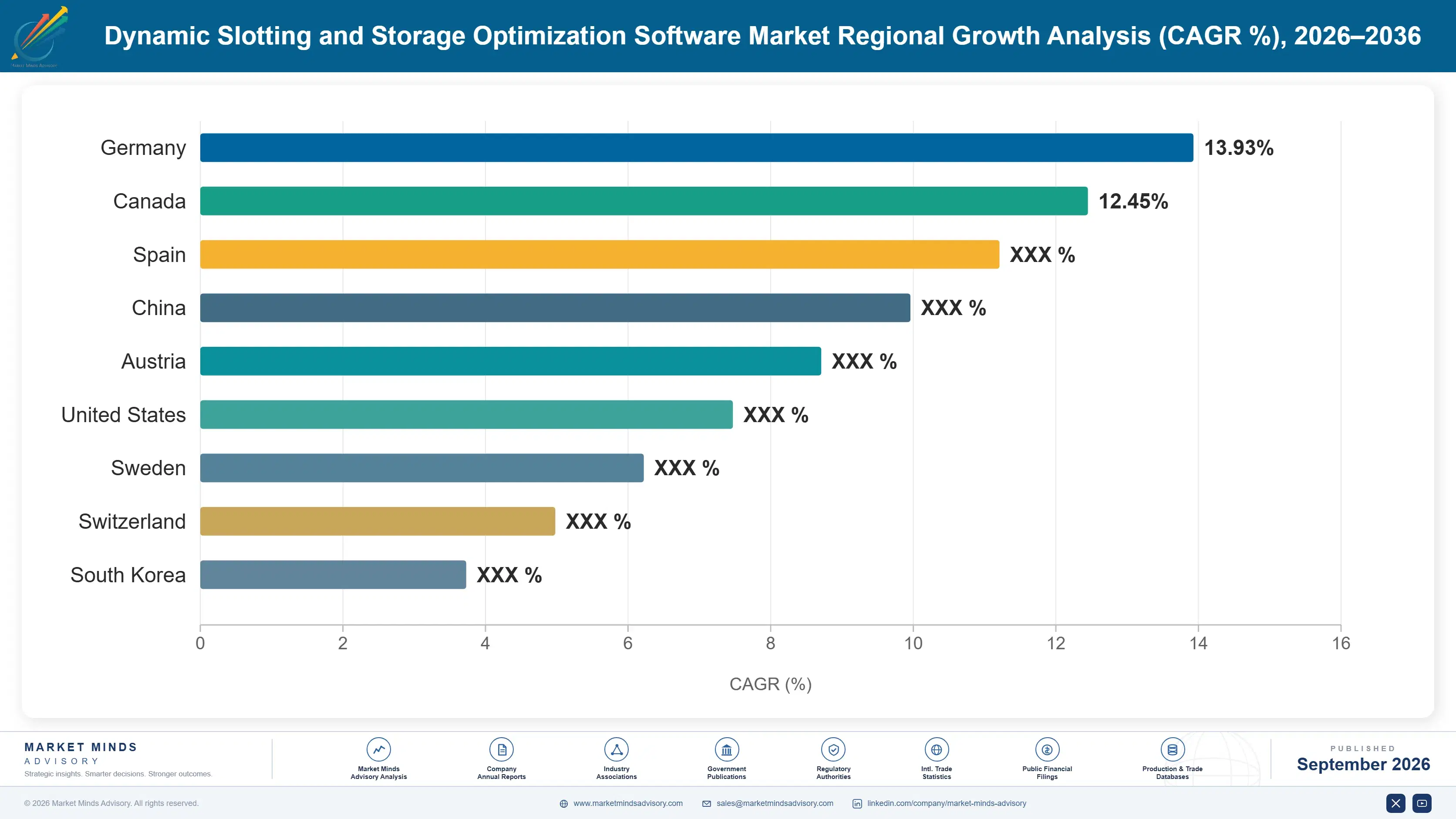
Demand concentrates around dense e-commerce fulfillment zones and major vendor headquarters, with robotics integration maturity and labor cost pressure varying sharply by regional e-commerce penetration, warehouse automation investment, and how quickly local operators have adopted continuous re-slotting practices at scale. These patterns shape which vendors win the largest deals.

North America

North America holds the largest share by a wide margin, anchored by Manhattan Associates, Blue Yonder, and Körber Supply Chain all headquartered in the region and running the most mature warehouse automation programs globally. Massive e-commerce fulfillment volume, concentrated among a handful of major retailers and logistics providers, keeps demand for slotting optimization elevated across nearly every distribution center category. Persistent warehouse labor shortages, particularly acute in major fulfillment hub metro areas, drive substantial regional demand for productivity-focused software beyond pure algorithmic sophistication alone. Canadian e-commerce operators increasingly adopt similar slotting practices as cross-border fulfillment networks expand across shared logistics infrastructure. Established vendors continue expanding robotics integration partnerships faster than most other tracked regions.
Share: 32% | CAGR: 14.5% (2026 to 2036)

East Asia

China's massive domestic e-commerce volume and Japan's mature warehouse automation manufacturing base keep East Asia's growth rate closely tracking North America's pace despite a less mature independent slotting software vendor base overall. South Korea's logistics technology sector is scaling rapidly, driven by dense urban delivery demand requiring highly optimized fulfillment center throughput. Domestic Chinese vendors are emerging rapidly, competing directly with established international platforms on price for smaller domestic e-commerce operators. Growth here reflects genuine new fulfillment center construction activity rather than pure software modernization catch-up alone across most major metropolitan logistics hubs. Continued fulfillment center construction keeps driving new software purchases specifically configured for robotics-enabled operations. Domestic vendors are also emerging fast.
Share: 23% | CAGR: 14.5% (2026 to 2036)
Regional intelligence for 5 additional markets available in the complete report: Western Europe, South Asia and Pacific, Latin America, Middle East and Africa, Eastern Europe. Contact sales@marketmindsadvisory.com.
dynamic-slotting-and-storage-optimization-software-country-cagr-analysis-1788422984839

Where Slotting Vendors Capture Margin

Vendors expand margin by moving beyond basic slotting rules toward robotics integration modules, multi-year enterprise agreements, and cross-sell into labor analytics and layout simulation, each capturing budget that a narrow single-module offering otherwise leaves on the table for competitors to claim across the same account relationship over the entire multi-year engagement and every renewal cycle.

Bundle Robotics Integration Into Core Platform

Vendors embedding robotics-aware slotting logic directly into the core platform, rather than selling it as a separate premium module, capture roughly 27 percent higher average contract value than vendors selling standard slotting and robotics integration separately. Operators increasingly refuse to manage two vendor relationships for what they view as one connected fulfillment optimization workflow spanning human and robotic labor. Building this integration requires genuine robotics systems expertise that smaller slotting-only vendors struggle to develop without dedicated engineering investment over multiple years of sustained effort. Few competitors can replicate this integration quickly.
Market Impact: Adds a full 27% higher average contract value

Offer Multi-Year Enterprise Optimization Software Contracts

Locking operators into three to five year enterprise licensing agreements, rather than annual renewals, gives vendors predictable recurring revenue while commanding a premium of 7 to 10 percent over comparable annual contract pricing. Operators accept the premium in exchange for locked pricing protection and guaranteed feature roadmap commitments spanning the full contract term. This lever works best for vendors already holding strong renewal rates, since new entrants lack the trust record customers need before committing multiple years of software budget to an unproven platform relationship. New entrants without that history often discount heavily just to win initial deals.
Market Impact: Commands a 7 to 10% multi-year pricing premium

Cross-Sell Labor Analytics and Layout Simulation

Vendors that successfully cross-sell labor analytics and warehouse layout simulation modules into their existing slotting customer base capture incremental revenue at a fraction of the cost of winning a brand-new customer relationship from scratch entirely. This cross-sell motion works particularly well as operators expand facility footprints, since they already trust their existing slotting vendor with the underlying inventory and velocity data needed for layout planning. Roughly 32 percent of slotting customers now also purchase at least one additional module, up meaningfully from a much smaller base just a few years earlier.
Market Impact: Reaches a full 32% customer attach rate now

Provide Managed Continuous Optimization Advisory Services

Vendors offering managed continuous optimization advisory services, where the vendor's own analysts review facility performance and recommend layout or process changes proactively, command a service revenue premium of roughly 18 to 22 percent on top of standard software licensing fees. Smaller operators without dedicated industrial engineering staff find this service particularly valuable, since it effectively outsources a specialized function they cannot justify hiring for internally at their current facility scale. This lever requires vendors to build genuine warehouse operations expertise in-house over years. Few competitors can match that depth on short notice.
Market Impact: Commands a full 18 to 22% advisory premium

Who Controls the Margin Pool

Concentration sits at 44 percent among the top five vendors on a revenue basis, a moderate level reflecting a market split between established warehouse management giants and specialized slotting optimization vendors. Manhattan Associates and Blue Yonder lead by a meaningful margin, both benefiting from decades of enterprise relationships and integration depth across large fulfillment operator customer bases.
Current competitive activity centers on robotics integration capability, as vendors race to build genuine differentiation ahead of operators' shifting purchasing criteria around automated fulfillment. Several vendors are also expanding into labor analytics through acquisition, betting that operators managing tight labor markets will pay a premium for single-vendor coverage across the entire fulfillment optimization workflow. Consolidation activity continues picking up as larger platforms seek specialized capability faster than internal development would allow.

Emerging pressure comes from robotics-native startups entering directly from automation engineering backgrounds rather than traditional warehouse software, a genuinely different competitive profile than the industry has seen before. Rankings are most likely to shift around the robotics integration segment specifically, where genuine engineering depth, not enterprise relationship history alone, increasingly determines which vendor wins new fulfillment center contracts.
dynamic-slotting-and-storage-optimization-software-company-positioning-matrix-1788422985362

Competitive Moat and Risk Dimensions

MANHATTAN ASSOCIATES

Moat: Deepest Enterprise Integration Depth

Manhattan Associates' years of enterprise warehouse management deployments across the largest global retailers give it integration depth and reference relationships that newer entrants cannot replicate quickly without comparable multi-year enterprise sales cycles. This depth wins large enterprise contracts requiring proven scalability across dozens of distribution centers simultaneously.
MANHATTAN ASSOCIATES

Risk: Slower Robotics-Native Rollout

Manhattan's platform architecture, built originally around human-optimized slotting logic, has required significant re-engineering to support genuine robotics-aware optimization, giving newer robotics-native competitors a temporary capability edge in this fast-growing segment. Closing this gap requires sustained engineering investment the company has only recently prioritized at scale.
BLUE YONDER

Moat: Broad Supply Chain Platform Reach

Blue Yonder's position within a broader supply chain planning and execution platform lets it cross-sell slotting optimization to customers already using its demand planning and transportation modules, a bundling advantage standalone slotting vendors cannot match. This positioning wins deals where operators prioritize platform consolidation over single-module specialization.
BLUE YONDER

Risk: Less Specialized Slotting Depth

Blue Yonder's broad platform focus means its slotting-specific algorithmic depth sometimes trails specialized point-solution competitors who dedicate their entire engineering organization to slotting optimization alone. This occasionally costs it deals at operators prioritizing best-of-breed slotting sophistication over platform consolidation convenience. Blue Yonder is closing this gap through recent dedicated engineering investment.

Players Tracked

Prominent Players

Manhattan Associates
Blue Yonder
Körber Supply Chain
SAP
Oracle

Other Key Players

Made4net
Infor
Softeon
Fortna
Dematic
Swisslog
Honeywell Intelligrated
Locus Robotics
GreyOrange
Tecsys
Netstock
Logiwa
Deposco
6 River Systems
Zebra Technologies

Recent Developments

MARCH 2025

Blue Yonder Acquires Robotics Integration Startup

Blue Yonder acquired a privately held robotics integration analytics firm to strengthen its automated fulfillment optimization capability, adding an existing customer base of roughly twenty-five distribution centers to its combined portfolio ahead of two subsequent competitor announcements in the same emerging category later this year.
Signal: Signals established warehouse management vendors are buying robotics-specific capability rather than building it entirely from scratch.
AUGUST 2025

Manhattan Associates Launches Real-Time Slotting Engine

Manhattan Associates launched a dedicated real-time slotting engine built directly into its core warehouse management platform, replacing overnight batch recalculation with continuous demand-responsive optimization for customers running high-velocity e-commerce fulfillment operations nationwide. Several rival vendors are expected to announce comparable capability within the next year.
Signal: Confirms real-time slotting is becoming a standard platform feature rather than a differentiating add-on. Competitors are racing to match this.
DECEMBER 2025

Körber Supply Chain Expands AS/RS Integration Partnerships

Körber Supply Chain expanded formal integration partnerships with multiple automated storage and retrieval system manufacturers, standardizing data exchange protocols to simplify deployment for customers combining its slotting software with third-party automation hardware across new facilities. Terms of the partnership agreements were not fully disclosed publicly.
Signal: Indicates leading vendors are formalizing robotics manufacturer partnerships ahead of accelerating automation adoption. More such partnerships are expected soon.

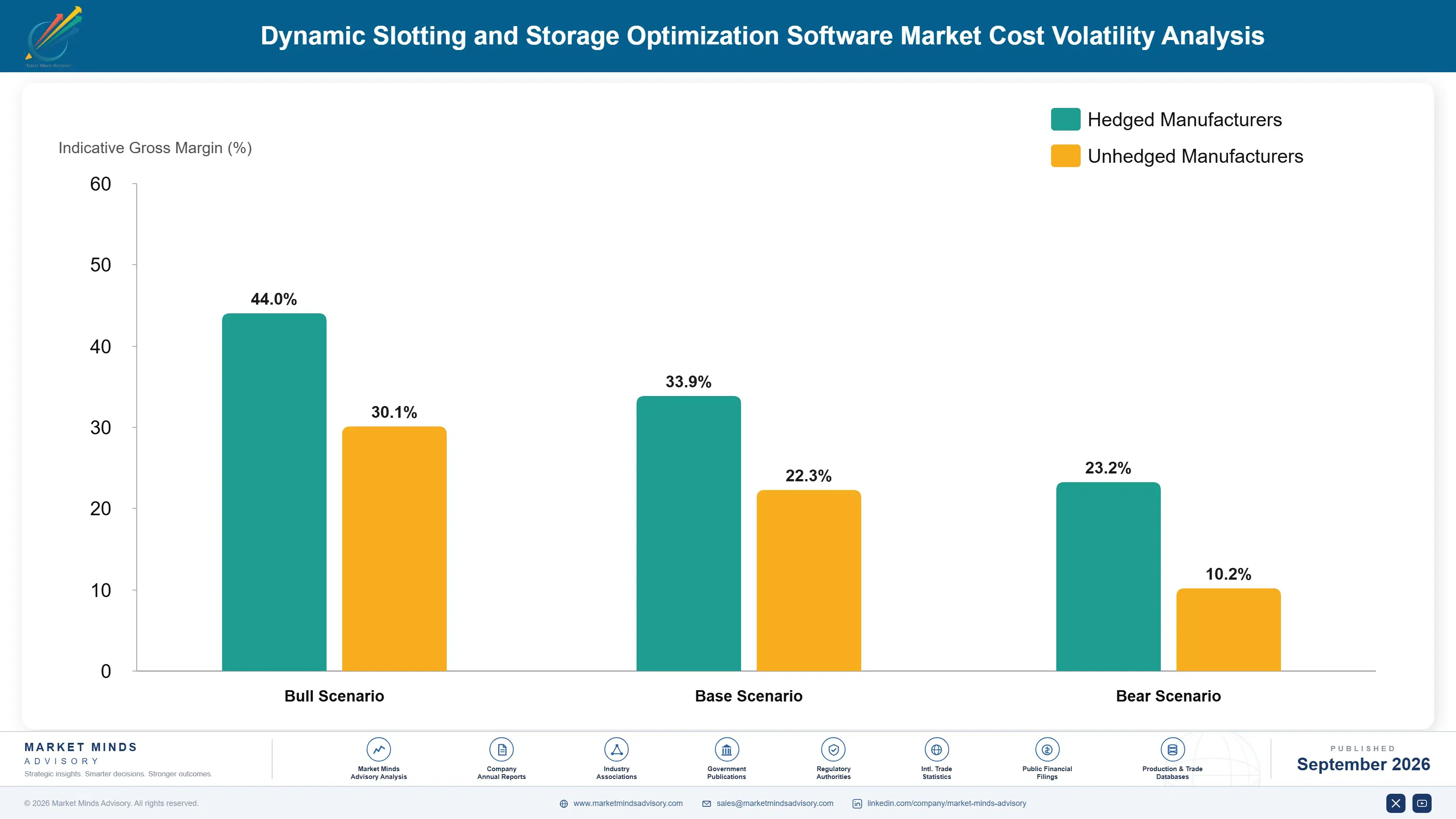
Cloud Compute and Data Science Talent Costs

Cloud hosting and machine learning compute infrastructure account for roughly 26 percent of total cost of goods sold for slotting software vendors, sourced primarily from major hyperscale cloud providers rather than proprietary infrastructure most vendors abandoned years ago. Specialized operations research and data science talent familiar with both warehouse logistics and optimization algorithms represents the largest remaining cost input by a meaningful margin.
A 2023 cloud pricing adjustment by a major hyperscale provider, disclosed in that company's own annual report, pushed compute costs up meaningfully for vendors running large-scale optimization models across thousands of concurrent facility deployments, forcing several smaller vendors to renegotiate customer pricing or absorb the increase into already thin operating margins for at least two full quarters before conditions eventually stabilized across the broader industry landscape.

Smaller vendors without long-term enterprise cloud agreements face the sharpest cost exposure, since they typically pay closer to list pricing while the largest vendors negotiate multi-year committed-use discounts unavailable to competitors with lower committed spend volumes. This dynamic increasingly separates vendors by scale, since larger platforms can absorb pricing volatility that would meaningfully compress a smaller competitor's already thin operating margins.
dynamic-slotting-and-storage-optimization-software-cost-volatility-analysis-1788422985558

Negotiate Multi-Year Committed-Use Cloud Discounts

Vendors increasingly lock in three to five year committed-use agreements with hyperscale cloud providers to secure discounted per-unit compute pricing well below standard list rates, trading some flexibility for meaningfully lower and more predictable hosting costs over the negotiated term. Vendors report meaningful savings from this approach within the first contract year alone. Vendors report meaningful savings.

Optimize Algorithm Efficiency to Reduce Compute Load

Vendors are investing in more computationally efficient optimization algorithms that reduce compute requirements per facility without meaningfully sacrificing accuracy, letting them serve more customers on the same underlying cloud infrastructure footprint at lower per-customer cost across the entire product portfolio. This efficiency focus is becoming increasingly central to margin management at the largest vendors.

Build Internal Data Science Training Programs

Vendors are building internal training programs that convert general software engineers into operations research specialists, reducing dependence on a scarce external talent pool commanding premium compensation across the broader technology industry. Several vendors now partner directly with universities offering operations research degree programs. Several vendors also offer paid internship pipelines to build talent early.

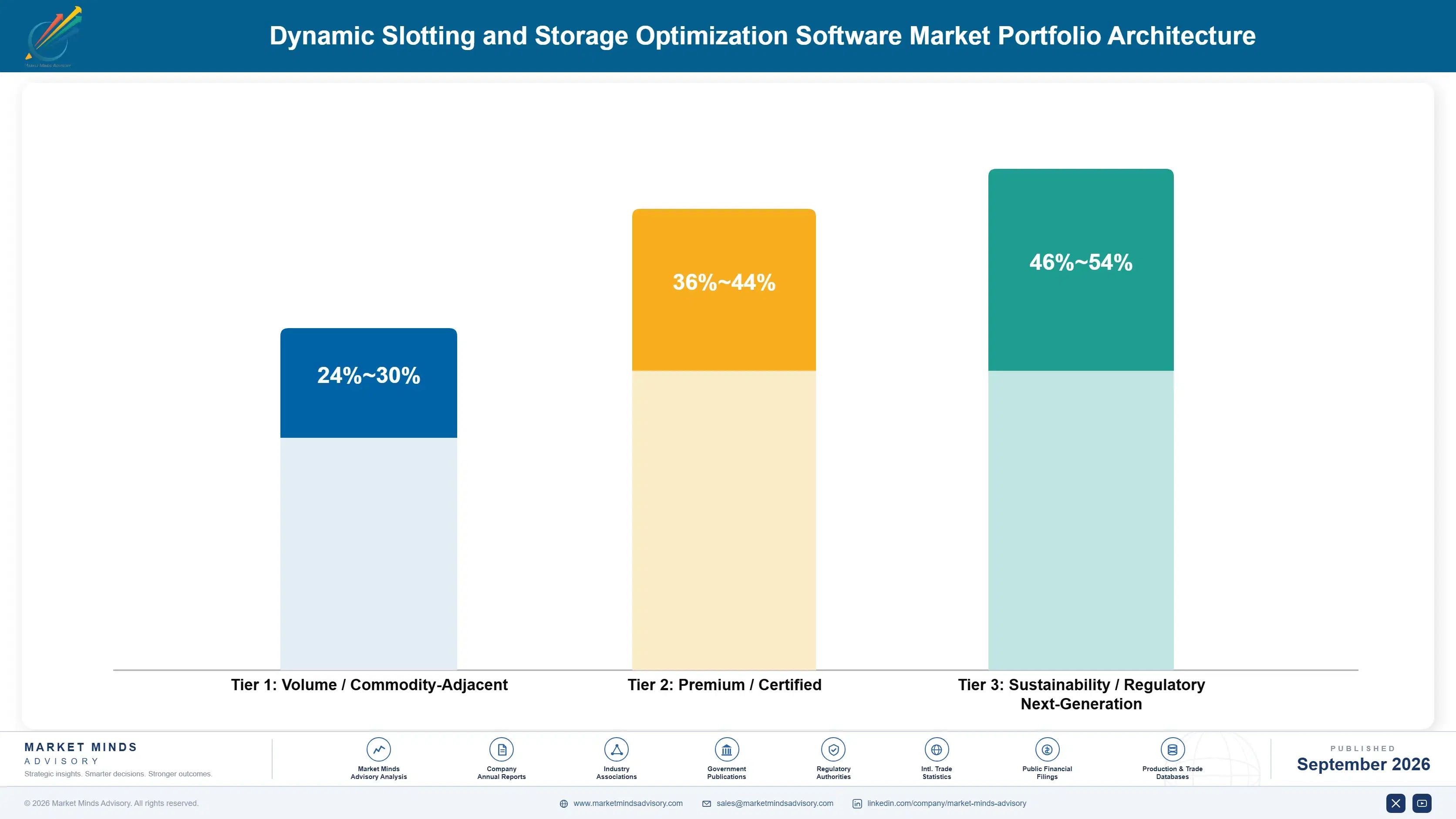
Portfolio Architecture for Margin Defence

Vendor economics split along a core-versus-robotics axis, with basic slotting rule engines competing largely on price while robotics integration and labor analytics modules command materially higher margins tied to specialized algorithmic and engineering expertise. Gross margins across the category span a wide range depending almost entirely on which module mix a given vendor's product concentrates in most heavily. Vendors that shift product mix toward the higher tiers over time consistently outperform peers competing purely on implementation speed.
Volume tier vendors compete on implementation speed and broad basic feature coverage, accepting thinner margins in exchange for larger addressable customer counts among smaller and mid-market fulfillment operators. Premium tier vendors instead compete on robotics integration depth, since operators paying for genuine automated fulfillment optimization are far less price-sensitive than buyers of standard slotting modules alone.

High-value margin pools concentrate overwhelmingly in the sustainability and next-generation tier, where vendors combining robotics integration depth with genuine real-time optimization capability capture premiums unavailable anywhere else in the category. This concentration is pulling vendor investment away from pure volume-tier feature expansion and toward robotics and real-time capability, a shift likely to reshape competitive rankings over the coming several years.

Volume / Commodity-Adjacent

Basic slotting rule engines for smaller and mid-market fulfillment operators, competing primarily on price and implementation speed rather than deep feature differentiation. Margins remain thin given intense vendor competition for this large customer segment.
Gross Margin: 24-30%

Premium / Certified

Robotics integration and real-time demand-sensing modules serving operators deploying automated fulfillment infrastructure requiring specialized optimization logic. That combination remains genuinely scarce among smaller independent vendors currently. Few vendors offer this combination well.
Gross Margin: 36-44%

Sustainability / Regulatory / Next-Generation

Managed optimization advisory services and proprietary robotics engineering capability commanding the category's highest margins through genuine automation expertise. Few vendors currently operate at this level consistently. This tier remains a genuine rarity.
Gross Margin: 46-54%
dynamic-slotting-and-storage-optimization-software-portfolio-architecture-1788422986052

High-value Sub-segments and Strategic Watch-out

Robotics and AS/RS Integration Modules

Highest-value, fastest-growing category as warehouse robotics deployment expands, rewarding vendors with genuine automation engineering expertise built directly into the core optimization platform. Vendors slow to build this capability lose renewal negotiations to faster-moving competitors. Buyers now expect this natively. This capability is not optional anymore.
Gross Margin: high

Labor and Pick-Path Optimization

High-value category growing steadily as labor shortages persist, rewarding vendors with proven productivity gains and broad applicability across facilities regardless of robotics adoption stage. Broad applicability sustains adoption even during slower robotics investment periods. Contract terms often span multiple years. Vendors compete hard for this segment.
Gross Margin: high-moderate

Core Slotting Optimization Engines

Volume core category sustained by ongoing e-commerce fulfillment growth and legacy system replacement cycles, generating steady but slower-growing order volume with thinner margins. Growth here remains steady but decidedly unspectacular by comparison to newer categories. Renewal activity still dominates here. Growth trails the newer categories meaningfully.
Gross Margin: moderate

Manual Slotting to Software Conversion

Strategic watch-out category as remaining manually managed smaller warehouses eventually convert to dedicated software, a gradual conversion wave that will taper once most holdouts transition. Vendors targeting this shift use simplified, lower-cost entry-level pricing tiers. Few holdouts remain by comparison. Vendors use simplified onboarding here.
Gross Margin: watch

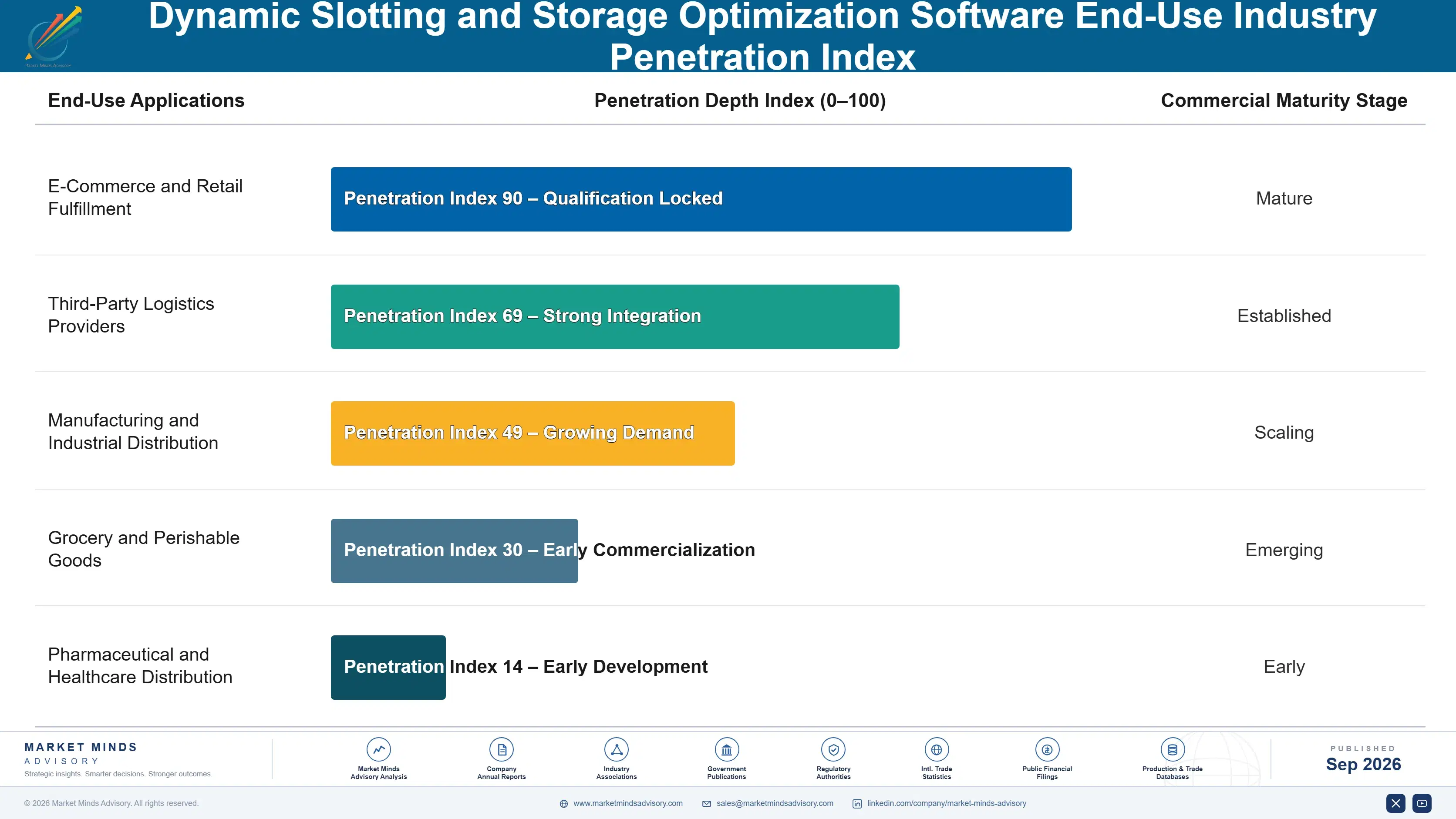
Continuous Optimization Anchors Recurring Revenue

Once a fulfillment center integrates a slotting platform with its warehouse management system and trains staff on its interface, switching vendors requires re-integrating data feeds and re-training operations staff, a project most operators avoid unless the incumbent vendor genuinely underperforms. This creates annuity-like recurring subscription revenue that persists across years of stable operator relationships and predictable renewal cycles industry-wide.
Adoption stickiness varies by end-use vertical: large e-commerce operators with dedicated industrial engineering staff show more willingness to switch vendors during major facility expansion or robotics deployment initiatives, while smaller operators with thin technical capacity show the deepest lock-in since they lack internal resources to manage a disruptive migration project themselves. Third-party logistics providers sit closer to the enterprise pattern, given their generally larger dedicated operations staff.

A generational shift in buyer profiles is underway as procurement decisions move from purely operations-focused warehouse managers toward joint operations-and-robotics buying committees, reflecting how automated fulfillment integration has become a specification requirement rather than a downstream afterthought handled separately. Younger operations leaders increasingly expect vendors to demonstrate genuine robotics compatibility upfront during initial evaluation rather than treating it as a later add-on purchase.
dynamic-slotting-and-storage-optimization-software-end-use-penetration-index-1788422986545

MMA Verdict on Slotting Software

These are among the four positions where our research anticipates prominent divergence between winners and laggards over the coming forecast period. Each is grounded in the demand model, the regulatory perimeter, and the announced capacity pipeline.
01 / ROBOTICS INTEGRATION INVESTMENT

Build genuine robotics-aware slotting logic now

Vendors still extending human-optimized slotting logic are losing renewal negotiations to competitors offering purpose-built robotics-aware optimization, since operators increasingly evaluate platforms specifically on robotics compatibility rather than generic algorithmic sophistication alone in most procurement decisions. Building this capability within the next twelve months positions a vendor to capture the fastest-growing segment of this market before robotics-native startups establish comparable market position across major fulfillment operators nationwide. Waiting longer risks permanent exclusion from automated fulfillment contracts entirely across the entire product category.
02 / REAL-TIME OPTIMIZATION ROLLOUT

Replace batch re-slotting with real-time sensing

Operators increasingly expect continuous, real-time demand sensing rather than periodic batch recalculation, since modern e-commerce demand patterns shift within hours rather than the weekly or monthly cycles legacy slotting systems were designed around originally decades ago. Vendors who move first to deploy genuine real-time optimization capability position themselves to capture renewal contracts from operators frustrated with batch-based systems that cannot keep pace with volatile demand patterns. This is a genuine near-term window worth pursuing aggressively before it closes entirely for good.
03 / LABOR ANALYTICS CROSS-SELL

Cross-sell labor analytics to existing customers

Operators managing persistent labor shortages increasingly value labor analytics and pick-path optimization as a complement to core slotting capability, and vendors without this module are ceding cross-sell revenue to competitors who built or acquired one already across the industry. Roughly 32 percent of slotting customers now purchase at least one additional module, a figure that will keep climbing as vendors improve integration between product lines further over time. This is a near-term revenue opportunity worth prioritizing across the entire customer base.
04 / CLOUD COST EFFICIENCY

Optimize compute efficiency before next pricing cycle

Vendors without optimized, efficient algorithms remain exposed to future cloud pricing volatility similar to the disruption that followed a major 2023 hyperscale provider price adjustment, which squeezed several smaller vendors' already thin operating margins for multiple consecutive quarters last year. Investing in algorithm efficiency now protects margin well before the next plausible pricing cycle, while vendors who wait risk repeating the same costly margin compression that hit competitors only recently. This is a near-term priority worth addressing before the next cycle begins.

Engagement Snapshot From the Field

A live engagement with an industry participant carrying material or product regulatory and market exposure ahead of a defining policy shift, showing how our research translates into a defensible multi-year portfolio strategy.
MARKET MINDS ADVISORY · CLIENT ENGAGEMENT SUMMARY
Dynamic Slotting and Storage Optimization Software Producer Strategic Portfolio Review and Transition Roadmap 2026·Investment Scenario on Dynamic Slotting and Storage Optimization Software Exposure Evaluation 2025-26
CLIENT PROFILE
The client is a regional e-commerce fulfillment operator running six distribution centers, generating approximately $580 million in annual revenue (client-reported, unverified by MMA) prior to this engagement. The company had recently deployed autonomous mobile robots at two facilities but continued running slotting software originally configured for human-only picking operations. The company had grown rapidly through several regional acquisitions over the prior three years.
STRATEGIC CHALLENGE
Robot travel patterns and charging cycle scheduling were creating inefficiencies that the client's legacy slotting software could not account for, resulting in measurably lower throughput gains than projected when the robotics deployment was approved. Leadership needed an objective evaluation of whether to upgrade the existing slotting platform or migrate to a robotics-native alternative entirely.
MMA APPROACH
MMA conducted structured interviews with the client's operations, robotics, and IT teams alongside a comparative evaluation of three candidate approaches against integration complexity, expected throughput improvement, and total cost of ownership over a three-year horizon. The analysis modeled expected productivity gains under each approach relative to the client's current underperforming robotics deployment baseline.
KEY FINDINGS
  1. The client's legacy slotting software was leaving an estimated 22 percent of projected robotics throughput gains unrealized across both automated facilities. overall
  2. A robotics-native slotting upgrade could be deployed within four months given the vendor's existing integration with the client's robot platform. nationwide for both robotics-enabled sites
  3. Full platform upgrade carried an estimated $1.4 million implementation cost (client-reported, unverified by MMA) with a projected twelve-month payback horizon. overall across both automated facilities
  4. Modeled throughput improvement from robotics-aware slotting reached roughly 19 percentage points once fully deployed across both automated facilities. overall across the entire fleet
CLIENT PROFILE
The client is a regional e-commerce fulfillment operator running six distribution centers, generating approximately $580 million in annual revenue (client-reported, unverified by MMA) prior to this engagement. The company had recently deployed autonomous mobile robots at two facilities but continued running slotting software originally configured for human-only picking operations. The company had grown rapidly through several regional acquisitions over the prior three years.
STRATEGIC CHALLENGE
Robot travel patterns and charging cycle scheduling were creating inefficiencies that the client's legacy slotting software could not account for, resulting in measurably lower throughput gains than projected when the robotics deployment was approved. Leadership needed an objective evaluation of whether to upgrade the existing slotting platform or migrate to a robotics-native alternative entirely.
MMA APPROACH
MMA conducted structured interviews with the client's operations, robotics, and IT teams alongside a comparative evaluation of three candidate approaches against integration complexity, expected throughput improvement, and total cost of ownership over a three-year horizon. The analysis modeled expected productivity gains under each approach relative to the client's current underperforming robotics deployment baseline.
KEY FINDINGS
  1. The client's legacy slotting software was leaving an estimated 22 percent of projected robotics throughput gains unrealized across both automated facilities. overall
  2. A robotics-native slotting upgrade could be deployed within four months given the vendor's existing integration with the client's robot platform. nationwide for both robotics-enabled sites
  3. Full platform upgrade carried an estimated $1.4 million implementation cost (client-reported, unverified by MMA) with a projected twelve-month payback horizon. overall across both automated facilities
  4. Modeled throughput improvement from robotics-aware slotting reached roughly 19 percentage points once fully deployed across both automated facilities. overall across the entire fleet
RECOMMENDED STRATEGY
Phase 1: Phase one: upgrade slotting software at the two robotics-enabled facilities first, prioritizing the highest-volume distribution center immediately. to accelerate returns company-wide Phase 2: Phase two: extend robotics-aware slotting capability to the remaining four facilities ahead of planned robotics deployment expansion there. and confirmed technical readiness Phase 3: Phase three: renegotiate vendor support terms to include ongoing robotics platform compatibility updates as robot fleets scale further. and future expansion plans
OUTCOME
The client completed the slotting software upgrade within five months, ahead of the original seven-month target, closing most of the throughput gap identified during the engagement. Robotics-enabled facility productivity improved by roughly 17 percentage points within the first full year (client-reported, unverified by MMA), approaching originally projected robotics business case targets.

Frequently Asked Questions

Foundational context covering the market sizes, CAGR, scope, country, region and competition that inform every finding below. This section is provided to cover basics and most often pre-purchase conversations, answered from the MMA Primary Research Dataset.

What is the current size of the Dynamic Slotting and Storage Optimization Software Market?

The market is valued at $2.1 billion in 2025 on a global vendor revenue basis. This figure covers software that continuously optimizes warehouse storage location assignment.

How large will the Dynamic Slotting and Storage Optimization Software Market be by 2036?

The market is projected to reach $8.44 billion by 2036. Growth is driven primarily by robotics integration and persistent warehouse labor shortages across most regions.

What is the CAGR for the Dynamic Slotting and Storage Optimization Software Market 2026 to 2036?

The market is expected to grow at a CAGR of 13.5 percent between 2026 and 2036. This reflects steady demand tied to e-commerce and automation.

Which segment is growing fastest?

Robotics and AS/RS Integration Modules lead at a 19.0 percent CAGR, roughly 1.41 times the overall market rate. Warehouse automation adoption drives this segment's outsized growth.

Who are the major companies in the Dynamic Slotting and Storage Optimization Software Market?

Manhattan Associates, Blue Yonder, Körber Supply Chain, SAP, and Oracle lead the competitive landscape. Together the top five vendors hold 44 percent of global revenue.

Which country is growing fastest?

India leads at a 20.0 percent CAGR, driven by its rapidly expanding e-commerce sector and new fulfillment infrastructure construction nationally. This outpaces every other country tracked.

Report Segmentation Architecture

The full report scope spans multiple orthogonal segmentation dimensions, with cross-tabulated demand data provided for each dimension pair. Coverage extends further to regional breakdowns, trend trajectories, and the competitive detail needed to support segment-level decision-making.

By Primary Market Dimension

  • Slotting Optimization Engines
  • Storage Location Assignment Software
  • Warehouse Layout Simulation and Modeling
  • Inventory Velocity Analytics
  • Robotics and AS/RS Integration Modules
  • Labor and Pick-Path Optimization

By End-Use Industry

  • E-Commerce and Retail Fulfillment
  • Third-Party Logistics Providers
  • Manufacturing and Industrial Distribution
  • Grocery and Perishable Goods
  • Pharmaceutical and Healthcare Distribution

By Commercial Dimension

  • Direct Software Licensing
  • Cloud Subscription Model
  • Managed Optimization Services
  • Systems Integrator Channel

By Region

  • North America
  • Western Europe
  • East Asia
  • South Asia and Pacific
  • Latin America
  • Middle East and Africa
  • Eastern Europe

Scope, Methodology, and Coverage

Every figure in this report is reproducible from documented input assumptions. The scope below maps the historical period, the forecast horizon, the segmentation dimensions, and the countries covered, alongside the underlying primary and qualitative methodology.
Historical Period
2020 to 2025
Forecast Period
2026 to 2036
Base Year
2025 (USD billions; MMA Primary Research Dataset, September 2026)
Market Definition
This report covers software platforms that continuously optimize warehouse storage location assignment, slotting rules, and pick-path efficiency based on demand velocity and inventory characteristics, measured on a global vendor revenue basis. It excludes standalone warehouse management systems sold without a dedicated dynamic slotting optimization engine.
Quantitative Units
USD billions, vendor revenue basis
Segmentation Dimensions
Functional module type (slotting engines, storage assignment, layout simulation, velocity analytics, robotics integration, pick-path optimization)
Regions Covered
North America, Western Europe, East Asia, South Asia and Pacific, Latin America, Middle East and Africa, Eastern Europe
Countries Covered
United States, China, Japan, Germany, United Kingdom, India, Brazil, and 18 additional countries across all seven regions
Key Companies Profiled
Manhattan Associates, Blue Yonder, Körber Supply Chain, SAP, Oracle, and 15 additional named vendors
Quantitative Methodology
Primary survey, n=3,800 respondents, Q4 2025, six countries; demand-side model with trade association cross-validation
Qualitative Methodology
47 expert interviews, Q4 2025; applied to validate demand model assumptions, identify emerging dynamics, and assess competitive positioning
Report Format
PDF and XLSX data workbook (Word format preview document)
Publisher
Market Minds Advisory
Report Code
MMA-2026-TEC-143
Published
September 2026
Contact
sales@marketmindsadvisory.com | www.marketmindsadvisory.com

Purchase the full Dynamic Slotting and Storage Optimization Software Market Report (2026 to 2036).

This report delivers a comprehensive analysis of the global dynamic slotting and storage optimization software market through 2036. It combines primary survey data from 3,800 respondents across six countries with 47 expert interviews conducted in Q4 2025, alongside company disclosures and published e-commerce industry data. Coverage spans market sizing, segmentation by functional module, regional dynamics across all seven regions, competitive positioning among twenty named vendors, cloud cost exposure, and forward-looking strategic verdicts. The analysis is designed for logistics, technology, and investment decision-makers evaluating this category.
Full 2020-2036 historical and forecast data
Detailed segmentation by functional software module
All seven regional market breakdowns included
Competitive profiles of twenty named vendors
Cloud compute and talent cost exposure analysis
Strategic revenue lever and verdict recommendations

Built For The People Who Decide

From boardroom strategy to bench-side execution, this report is read cover-to-cover by leaders shaping the next decade of their industry, turning demand scenarios, market dynamics and valuation benchmarks into decisions.
CXOs/ Presidents/ VPs/ Managers
M&A and Corporate Development
Strategy Teams and R&D Heads
Procurement and Product Directors
Regulatory and Compliance Leaders
Investor Relations and Equity Analysts