Market Minds Advisory
Duplex Paper and Board Market

Duplex Paper and Board Market: Grey-Back and White-Back Duplex Board for Folding Cartons and Packaging

Plastic-to-paperboard mandates keep expanding just as recovered fiber costs swing harder than virgin pulp, forcing duplex board mills to requalify caliper and coating specifications while holding the line on carton strength.

Lead Analyst

Bilal Shaikh

Published

September 2026

Make Smarter Decisions with Customized Research Insights

Request a free sample report and evaluate market opportunities, growth trends, and competitive dynamics relevant to your business needs.

2025 MARKET VALUE$18.5BMarket Size 2025
2036 FORECAST VALUE$34.4BBase Case , 2026 to 2036
CAGR 2026 TO 20365.8 %Bull 7.0% / Bear 4.6%
INCREMENTAL OPPORTUNITY$14.8BNet 10- year value creation
EXPANSION MULTIPLE1.76x2036 value over 2026 base
Strategic Levers
M&A Pipeline
Regional Outlook
Country Rankings
Competitive Intelligence
Segmental Deep-dive
Call-Us : 91 93563 13602

Executive Snapshot and Market Trajectory

Plastic-to-paperboard conversion mandates keep expanding across consumer packaging categories just as recovered fiber costs swing harder than virgin pulp, forcing duplex board mills to requalify caliper and coating specifications while holding the line on carton strength across every converting line they supply and every export market they reach.
Grey-back duplex board still carries the largest share of shipped tonnage, but recycled-fiber grades are expanding fastest as brand owners face growing regulatory pressure to raise recycled content across their carton portfolios. Demand concentrates among folding carton converters running high-speed printing and die-cutting lines, where caliper consistency and print surface quality matter as much as delivered tonnage cost across every production run scheduled across the full converting calendar.
Competition splits between large integrated paperboard groups bundling duplex board into broader packaging paper portfolios and regional mills competing on price and delivery proximity to individual converting plants. Tightening recycled-content regulation and rising brand owner sustainability commitments are pushing purchasing decisions toward mills that can prove consistent caliper and bursting strength across large production runs, and rankings are starting to shift toward mills holding both capabilities at once across their largest converter accounts.
Market Definition
The duplex paper and board market covers grey-back and white-back duplex paperboard used as the primary substrate for folding cartons, tags, and rigid packaging applications. It excludes corrugated board, solid bleached sulfate board, and specialty coated papers not classified as duplex construction.
Base Year Value
$18.5B in 2025 (MMA Primary Research Dataset, August 2026)
Forecast Period
2026 to 2036, eleven discrete annual values
CAGR
5.8% base case. Bull 7.0%. Bear 4.6%.
Fastest Growth Segment
Recycled-Fiber Duplex Board: 9.6% CAGR
Fastest Growth Country
India: 8.6% CAGR
Fastest Growth Region
South Asia and Pacific: 7.6% CAGR
Largest Region
East Asia: 28% of 2025 global value
Market Leaders
WestRock Company, Nine Dragons Paper Holdings Limited, Smurfit Kappa Group plc, Stora Enso Oyj, ITC Limited. Source: MMA Analysis based on company annual reports.
Primary Survey
n=3,800 procurement and R&D decision-makers, Q4 2025, six countries
Methodology
Demand-side build-up, cross-validated against public data, 47 expert interviews

Duplex Paper and Board Market Forecast Scenarios

duplex-paper-and-board-market-size-forecast-scenario-1787299172006
Growth from 2020 to 2025 compounded near 5.1%, restrained early by pandemic-era converting plant disruption, then accelerating as plastic-to-paperboard conversion mandates expanded considerably faster than standard carton volume across most developed regions tracked over the period, particularly across Western Europe and North America's consumer packaging channels and their expanding retail distribution networks and export commitments.
Three mechanisms carry the base case to 5.8%. First, expanding recycled-content regulation pushing brand owners toward recycled-fiber duplex board regardless of the modest cost premium involved. Second, rising small-format retail and e-commerce carton demand across Asia, which sustains duplex board volume independent of mature developed-market carton trends. Third, growing brand owner interest in premium coated finishes, which raises average board value per tonne shipped across established converting channels and expanding premium retail categories.
The bull case at 7.0% assumes plastic-to-paperboard conversion mandates accelerate faster than current national timelines suggest across major consumer packaging markets. The bear case at 4.6% assumes recovered fiber cost volatility discourages recycled grade conversion, slowing overall duplex board volume expansion across the category and forcing some mills to idle a portion of installed production capacity across their largest facilities.

Recycled Content Rules Reshape Duplex Board Demand

Three forces converge on duplex board budgets this year. Plastic-to-paperboard conversion mandates keep spreading across additional consumer packaging categories, recycled-content regulation keeps tightening, and converters keep demanding tighter caliper tolerances to match increasingly automated high-speed carton lines running across multiple shifts and production regions and export destinations.
MARKET CONCENTRATIONCR5 32%top five paperboard groups hold a considerable combined revenue share
AVERAGE BOARD PRICE PREMIUM9-16% for coated gradespremium coated duplex board commands a moderate premium currently
TOP PRODUCING COUNTRY SHAREChina 26%leading share of global duplex board manufacturing capacity today
CAPACITY UTILISATION76-84%mill facilities running below full annual production levels overall
TRADE INTENSITY31%share of finished board crossing borders before carton conversion
FIBER COST SHARE50-60%recovered and virgin pulp fiber dominate total board production cost
The market behaves less like a standard commodity paper category and more like an engineered substrate investment wrapped around converting performance. Mills compete on documented caliper consistency and bursting strength rather than price alone, since a converter qualifying a new board supplier faces genuine production trial and run-speed validation timelines that discourage frequent switching between mills mid-contract, even when a competing quote looks attractive on paper, since a single line stop costs far more than any material savings recovered.
Recycled-fiber sourcing innovation, coated finish development, and automated high-speed converting investment are reshaping mill selection criteria across the next decade, favoring producers that can prove consistent board quality at scale against documented production baselines across comparable carton applications and their varying strength requirements, from lightweight tags through heavy multi-pack cartons shipped across every regional distribution network and export corridor served.
"Converters used to buy duplex board on price and caliper spec alone. Now recycled content percentage sits on the same purchase order line as bursting strength, and mills that can't document both lose the bid before price even comes up."
Director, Paperboard Packaging Substrates Practice · MMA Paperboard Packaging Su

Market Trends

Recycled-Fiber Duplex Board Replaces Virgin-Heavy Grades

Several major paperboard mills have moved high-recycled-content duplex board formulations beyond pilot production runs into standard specification, replacing virgin-fiber-heavy grades that brand owners increasingly cannot justify under tightening recycled content regulation. Early deployment data across multiple converting plants show measurable improvements in regulatory compliance standing compared with legacy virgin-heavy board formulations, though mills still face genuine technical tradeoffs balancing bursting strength against fiber furnish composition across demanding high-speed converting applications tracked in this year's primary survey data and expert interviews conducted across major mill facilities and their newest production lines commissioned recently.
Market Impact: Adds 9% annual conversion volume

Premium Coated Finishes Become a Standard Brand Expectation

Major consumer brands are pushing duplex board mills to deliver more sophisticated coated finishes, treating the carton surface as a premiumization lever that differentiates products on crowded retail shelves regardless of category. This shift requires mills to develop entirely new coating and calendering capability separate from standard uncoated grey-back production lines, creating a genuinely distinct product specification track that brand owners increasingly treat as a strategic packaging investment rather than a simple substrate cost line item buried inside a broader procurement budget review each fiscal year and shelf reset negotiation.
Market Impact: Sustains carton demand growth 12%

Market Opportunities and Growth Drivers

Expanding Plastic-to-Paperboard Mandates Force Substrate Change

Rising plastic packaging restrictions across major consumer markets keep expanding the pool of brand owners facing direct commercial incentive to switch from plastic to duplex board packaging, since manufacturers cannot simply absorb rising plastic compliance fees indefinitely without eventually redesigning their packaging portfolio. Brand owners increasingly view duplex board conversion as essential to managing long-term regulatory cost exposure rather than discretionary packaging redesign, particularly across categories facing the strictest incoming plastic restrictions and enforcement deadlines already confirmed by regulators across several of the largest consumer packaging markets tracked this year.
Market Impact: Delays recycled adoption 14 months typically

E-Commerce and Small-Format Retail Sustain Carton Demand

Continued e-commerce packaging and small-format retail expansion across Asia keeps expanding the pool of cartons requiring consistent duplex board supply, creating sustained demand independent of mature developed-market retail carton trends that have plateaued in North America and Western Europe. Converters increasingly specify board formats with proven caliper consistency rather than standard commodity grades, rewarding mills with dedicated high-speed converting product lines over those still relying entirely on generic duplex board formulations and their narrower performance specifications documented across recent trials, rollout reviews, and vendor scorecard audits conducted annually across regions.
Market Impact: Compresses converter margin 11%

Market Restraints and Challenges

Recovered Fiber Volatility Strains Smaller Converters

Recovered paper fiber prices swing considerably more than virgin pulp given collection volume variability, and smaller regional converters operating on thin margins frequently cannot pass through cost increases quickly given multi-year fixed-price agreements already in place with brand owner customers. The root cause is fragmented municipal recovered paper collection infrastructure that has not kept pace with expanding recycled-content board demand. This constrains how quickly smaller converters can commit to recycled-fiber board formats, and several mills are now offering blended furnish formulations to bridge the cost volatility during the transition period.
Market Impact: Raises recycled-fiber board share 24%

Coating Line Capacity Concentration Limits Sourcing Flexibility

Advanced coating and calendering capacity remains concentrated among a limited number of large integrated paperboard mills globally, and converters dependent on a narrow supplier base frequently cannot secure alternative coated board sourcing quickly when disruption hits any single producer. The root cause traces to the capital-intensive coating line investment few regional mills have made in recent years relative to established integrated producers. This creates genuine supply risk for smaller converters, and several larger competitors are now expanding dedicated coating capacity to capture the resulting premium demand across their largest production facilities.
Market Impact: Expands coated board demand 18%
3 additional market trends, 4 additional growth drivers, and 2 additional restraints and challenges are covered in the full report. Contact sales@marketmindsadvisory.com to access the complete intelligence.

Segment CAGR and Growth Architecture

Segmentation follows board construction and fiber furnish because production process, regulatory exposure, and converter qualification cycles differ substantially between grey-back, white-back, coated, and recycled-fiber board categories, each carrying its own distinct mill capability requirement and brand adoption pathway across carton, tag, and rigid packaging applications tracked in this report and its underlying survey data.
duplex-paper-and-board-market-market-share-analysis-1787299172535

Recycled-Fiber Duplex Board

This segment grows fastest at 9.6% as major paperboard mills move high-recycled-content formulations from pilot production runs into standard specification across their carton and tag portfolios. Mills differentiate on documented recycled content percentage and consistent bursting strength rather than price alone, since converters still require extensive production trial validation before shifting primary board specifications away from familiar virgin-heavy formulations. Demand concentrates among global brand owners facing the strictest incoming recycled content mandates across their largest carton programmes and export markets. Smaller regional converters typically delay recycled-fiber adoption until validated strength data becomes broadly available across the wider mill base, watching larger competitors absorb the early qualification cost first before committing their own packaging budget to the transition.
CAGR 9.6%

Coated Duplex Board

Coated duplex board grows at 7.4% as brand owners invest in more distinctive shelf presentation to differentiate products amid intensifying private-label competition across major retail channels. This segment carries the strongest print quality and finish intensity in the portfolio, since coating consistency directly affects how professionally the finished carton represents a brand at the point of sale. Mills with advanced calendering and coating capability hold a genuine advantage over competitors still relying on standard uncoated grey-back production lacking comparable premium finish sophistication across large production runs. Brand owners increasingly treat coating quality as a proxy for overall product quality, pushing mills to invest in tighter gloss and color tolerance control.
CAGR 7.4%
Full segment breakdown across 6 segments available in the complete report.

Regional Architecture and Country Demand Map

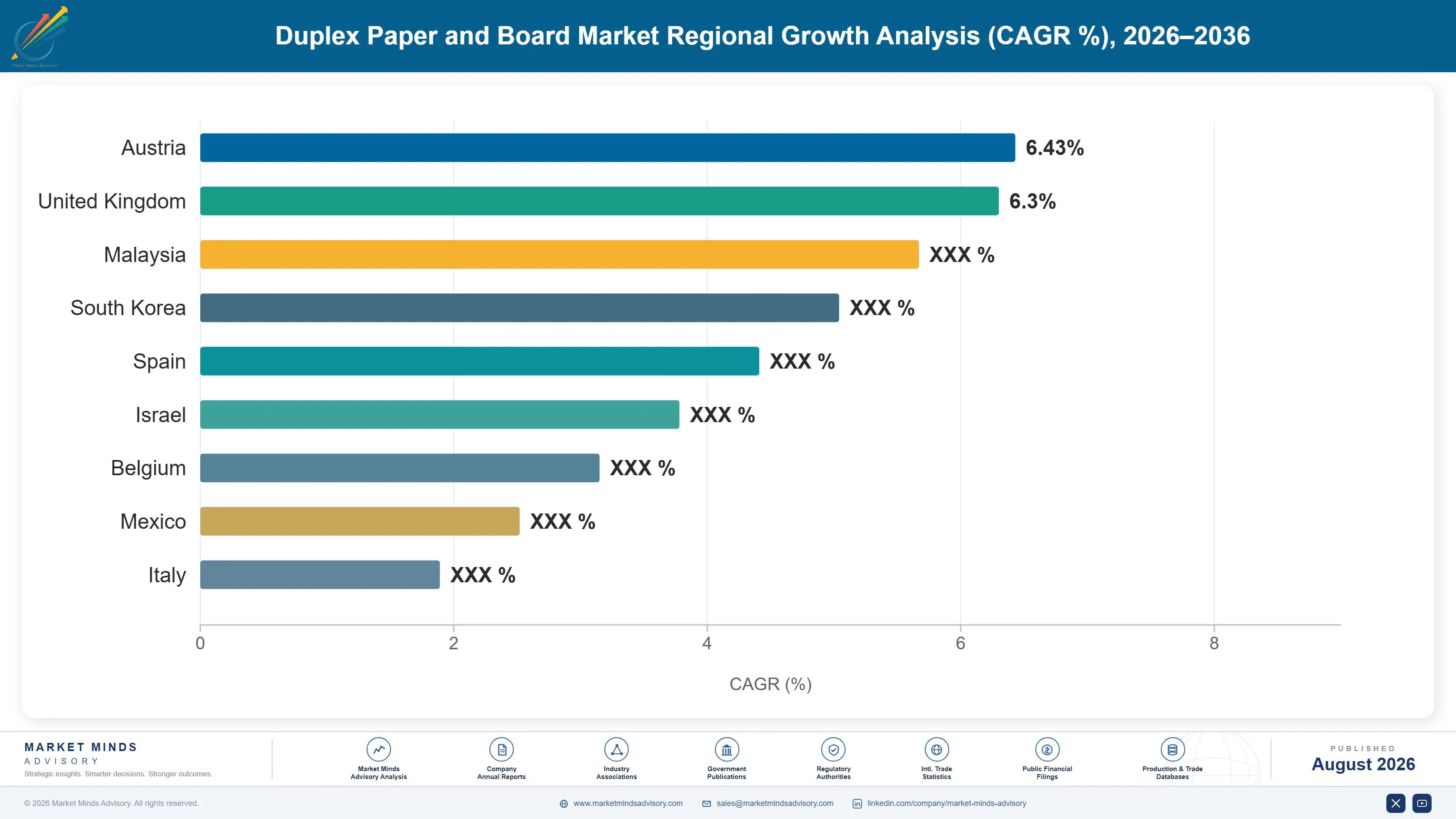
East Asia leads on China's massive folding carton converting base and integrated paperboard mill capacity, while South Asia and Pacific grows fastest as India's expanding packaged goods manufacturing base scales this year and beyond across newly built converting facilities and their surrounding supplier networks and export commitments.

North America

The United States accounts for the largest share of regional demand as major consumer packaged goods companies distribute enormous carton volume across national retail networks requiring consistent duplex board supply. Mills headquartered there, including WestRock, maintain deep domestic converter relationships and production infrastructure that smaller international competitors struggle to replicate quickly. Canada contributes a smaller share tied to its own packaged goods manufacturing base, particularly across its largest provinces. Growth trails the fastest-growing regions since the market here is already relatively mature compared with regions still building initial recycled-fiber board infrastructure, leaving most incremental volume tied to coating upgrades rather than new mill capacity across established converting corridors and their long-standing brand relationships.
Share: 22% | CAGR: 5.4% (2026 to 2036)

Western Europe

Germany and France anchor regional demand, with both countries maintaining strict national implementation of European Union packaging waste and recycled content directives that apply uniformly across member states regardless of individual country market size. The United Kingdom contributes steady demand through its own plastic packaging tax structure penalizing brand owners for non-compliant formats. The region's mill base, including Stora Enso and Smurfit Kappa, supplies a substantial share of global recycled-fiber board innovation and certification expertise, exporting proven formulation methodology to mills elsewhere. Growth runs below the fastest-growing regions as the region's plastic-to-board conversion cycle has already largely matured relative to still-transitioning markets elsewhere, leaving most incremental volume tied to coated grade premiumization.
Share: 19% | CAGR: 4.3% (2026 to 2036)
Regional intelligence for 5 additional markets available in the complete report: East Asia, South Asia and Pacific, Latin America, Middle East and Africa, Eastern Europe. Contact sales@marketmindsadvisory.com.
duplex-paper-and-board-market-country-cagr-analysis-1787299173053

Where Duplex Board Mills Can Expand Margin Now

Mills selling standard board alone are leaving margin on the table. Four levers let established producers expand revenue per converter contract without simply chasing tonnage across an increasingly commoditised base grey-back tier facing mounting price pressure from regional competitors entering with lower-cost capacity and thinner corporate overhead structures of their own each fiscal year.

Bundle Converting Trial Support Services Together

Mills selling board alone leave higher-margin converting trial and run-speed optimization work to internal converter engineering teams even when the mill's own technical staff already possess the deepest knowledge of the board's high-speed converting behavior. Bundling both into a single contract raises average revenue per converter client by an estimated 16 to 24% while reducing the converter's internal engineering burden and shortening the qualification timeline for new board grades considerably. Converters increasingly prefer single-vendor accountability for both board supply and run-speed validation, particularly across facilities running multiple carton formats simultaneously.
Market Impact: Raises revenue per contract 16-24% within two years

Publish Validated Recycled Content Performance Data

Mills with multi-year validated recycled content and bursting strength data against conventional board baselines can charge premium rates over competitors offering unproven sustainability claims, since converters weigh documented certification evidence heavily during vendor selection reviews tied to brand owner sustainability scorecards. Published performance studies covering multiple carton formats support pricing premiums of roughly 10 to 16% above standard recycled board rates across comparable applications. This lever rewards mills that invested early in recycled content validation rather than relying on generic sustainability marketing claims, and it compounds further with each additional published study.
Market Impact: Supports a pricing premium of roughly 10-16% overall

Expand Dedicated Coating Line Capacity Early

Establishing dedicated coating and calendering capacity ahead of confirmed brand demand lets mills win long-term converter contracts that competitors dependent entirely on subcontracted coating cannot credibly guarantee, since advanced coating capacity remains genuinely scarce relative to expanding premium carton demand. Early movers captured an estimated 19% larger share of new long-term supply contracts awarded over the past two years compared with mills that waited for confirmed demand signals before investing in coating capacity, a gap that widens further as available coating capacity gets contracted away by earlier movers each successive year.
Market Impact: Captures roughly 19% more new supply contracts yearly

Expand Regional Mill Capacity Near Fast-Growing Converters

Converters increasingly need mills positioned close to their production facilities to minimize board delivery lead time and support just-in-time replenishment requirements that generalist national mills frequently cannot supply without lengthy custom logistics arrangements across every additional converting region. Mills building dedicated regional production capacity near major converter clusters capture incremental contract value estimated near 12% above standard national supply scope, since converters otherwise absorb higher transport cost and lead-time risk across every affected shipment lane and production facility they operate, particularly across markets adding new capacity fastest each successive fiscal year.
Market Impact: Adds roughly 12% incremental contract value across renewals

Who Controls the Margin Pool

CR5 sits near 32%, evaluated on disclosed duplex paperboard segment revenue across public filings and industry disclosures where available. The gap between the top five integrated paperboard groups and the next tier of regional mills is moderate, since several mid-size producers hold strong regional fiber sourcing and delivery capability that larger generalist competitors cannot easily replicate across every converting region they serve across dozens of converter relationships.
Current competitive activity centers on three dimensions: recycled-fiber sourcing investment, coating capacity expansion, and high-speed converting reliability. Large integrated groups bundle duplex board into broader packaging paper contracts, while regional mills compete purely on price and delivery proximity documented across comparable converter deployments and their recurring renewal cycles, often winning business by outperforming generalists on a single dimension across a narrower regional footprint.

Emerging pressure comes from Asian mills offering lower-cost board without comparable coating or recycled content certification capability, forcing established Western producers to defend premium pricing through demonstrated technical differentiation and published performance evidence. Rankings could shift toward mills combining recycled content data with sophisticated coating capability over the next several converter contract renewal cycles across major carton categories worldwide and their evolving regulatory environments.
duplex-paper-and-board-market-company-positioning-matrix-1787299173576

Competitive Moat and Risk Dimensions

WESTROCK COMPANY

Moat: Broad North American converter relationships

WestRock's massive North American integrated paperboard manufacturing scale and direct relationships with major consumer packaged goods brands let it bundle duplex board into broader packaging supply contracts that regional mills cannot match, capturing a larger share of total converter packaging spend. Its established production infrastructure supports rapid qualification across new carton formats.
WESTROCK COMPANY

Risk: Volatile recovered fiber pricing

WestRock's substantial conventional board business carries meaningful exposure to recovered paper fiber price volatility given thin margins on commodity-adjacent grey-back lines, leaving profitability more sensitive to feedstock cost swings than competitors with more diversified specialty board portfolios able to offset softness elsewhere across their broader product mix.
NINE DRAGONS PAPER HOLDINGS LIMITED

Moat: Massive Chinese fiber sourcing scale

Nine Dragons Paper's massive Chinese production capacity and deep recycled fiber sourcing network across Asia give it genuine cost and scale advantage that smaller regional mills cannot easily replicate, supporting premium positioning across the region's largest converting customers. Its established import logistics infrastructure supports rapid fiber procurement across shifting trade policy conditions.
NINE DRAGONS PAPER HOLDINGS LIMITED

Risk: Chinese trade policy exposure

Nine Dragons Paper's revenue concentrates heavily in Chinese and Asian markets exposed to recovered paper import and export policy shifts, leaving it more exposed to regulatory or trade disruption risk than competitors with broader geographic diversification across less policy-dependent fiber sourcing regions and customer categories.

Players Tracked

Prominent Players

WestRock Company
Nine Dragons Paper Holdings Limited
Smurfit Kappa Group plc
Stora Enso Oyj
ITC Limited

Other Key Players

Mondi plc
International Paper Company
Oji Holdings Corporation
Nippon Paper Industries Co., Ltd.
Shandong Sun Paper Industry Joint Stock Co., Ltd.
Lee & Man Paper Manufacturing Limited
JK Paper Limited
Trident Limited
Andhra Paper Limited
Emami Paper Mills Limited
Metsä Board Corporation
Holmen AB
Century Pulp and Paper
Gascogne Papier
Seaman Paper Company

Recent Developments

MAY 2025

WestRock launches expanded recycled-fiber duplex board line

WestRock launched an expanded recycled-fiber duplex board production line at its North American mills, an organic capacity expansion rather than an acquisition, adding certified recycled content capability for converter customers across multiple carton formats and production speeds this year and next fiscal cycle, with additional lines already planned.
Signal: Confirms established mills keep investing in recycled-fiber technology to defend premium pricing against newer regional entrants.
OCTOBER 2024

Nine Dragons Paper acquires regional paperboard mill

Nine Dragons Paper completed an acquisition of a regional paperboard mill, adding dedicated coating and calendering capability to its existing production portfolio rather than building comparable expertise internally, extending its board offering across a broader Asian customer base and product range spanning multiple carton categories.
Signal: Signals large diversified producers increasingly prefer acquiring specialized coating expertise over pursuing slower internal development timelines.
FEBRUARY 2025

Stora Enso forms Southeast Asian paperboard joint venture

Stora Enso and a regional converter formed a joint venture establishing shared paperboard production capacity across Southeast Asian markets, splitting investment in facility buildout rather than either party expanding independently, targeting converters seeking geographically diversified duplex board supply across the broader Southeast Asian region and its expanding converting base.
Signal: Shows regional capacity expansion increasingly happens through shared-risk partnerships rather than solo investment this current cycle.

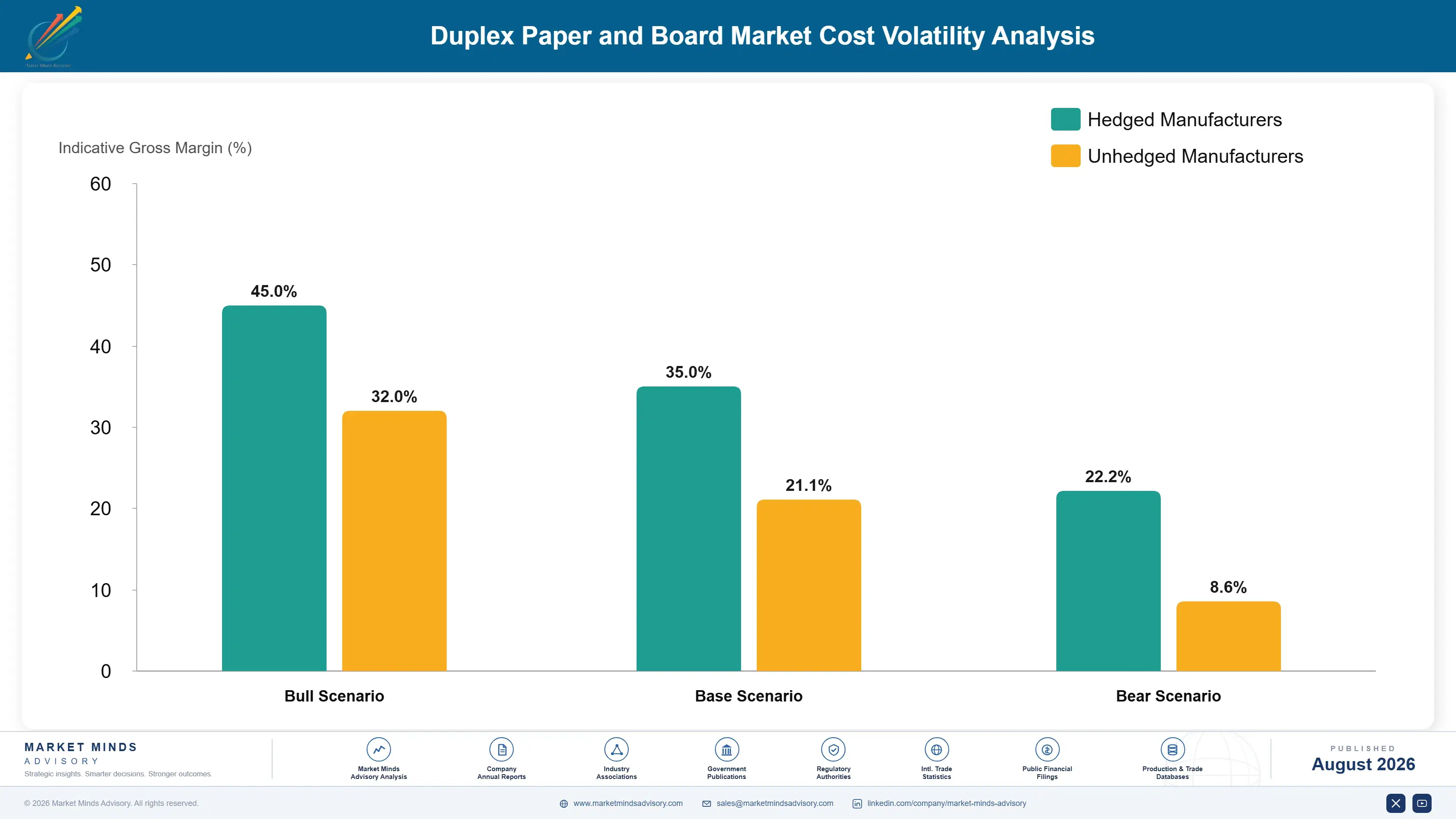
Recovered and Virgin Pulp Fiber Cost Exposure

Recovered paper and virgin pulp fiber together represent roughly 50 to 60% of duplex board production cost, sourced primarily from collection networks and pulp mills concentrated across North America, Scandinavia, and East Asia, where feedstock availability and processing capacity both influence pricing available to downstream converters and their quoted lead times for large-volume orders placed against annual production forecasts.
Global recovered paper prices spiked significantly through 2022 as collection volume tightened alongside broader supply chain disruption, compressing mill margins across the paperboard industry, according to disclosures in WestRock's annual report covering that period. Mills with multi-year fixed-price converter contracts absorbed much of the cost increase rather than immediately repricing agreements, pressuring near-term margin significantly across affected product lines and forcing several to renegotiate terms at the next contract renewal.

Mills with fiber sourcing concentrated among a small number of collection networks carry substantially more disruption exposure than those with diversified sourcing relationships across multiple producing regions. Smaller regional mills lacking sourcing diversification face a genuine competitive disadvantage against larger vertically integrated producers able to shift procurement toward whichever supplier currently offers the most favorable cost position.
duplex-paper-and-board-market-cost-volatility-analysis-1787299173773

Diversify Fiber Suppliers Across Multiple Regions

Mills are qualifying recovered paper and virgin pulp suppliers across multiple producing regions rather than concentrating sourcing with a single collection network, reducing single-supplier disruption exposure while maintaining flexibility to shift procurement toward whichever supplier currently offers the strongest capacity position and delivery reliability across each affected production region and their downstream converting facilities.

Build Internal Fiber Hedging and Contract Programmes

Larger mills are building internal fiber hedging programmes and multi-year supply agreements specifically to smooth input cost volatility, accepting modest hedging cost in exchange for pricing predictability that spot-market purchasing cannot guarantee during genuinely volatile feedstock pricing periods affecting the broader industry and its downstream converting operations across every major producing region and their converting facilities.

Index Multi-Year Contracts to Fiber Price Benchmarks

Newer converter contracts increasingly include recovered fiber price indexing clauses tied to published pulp and paper market benchmarks, passing a portion of input cost volatility through to buyers automatically rather than absorbing the full impact against fixed multi-year pricing agreed before fiber markets shifted significantly against original cost assumptions reached at the original contract signing date.

Portfolio Architecture for Margin Defence

The portfolio splits across three tiers. Volume grey-back duplex board carries thin margin driven by fiber cost competition and regional mill price pressure, premium coated and recycled-fiber grades command considerably stronger margin on certification and technical differentiation, and emerging closed-loop recycled supply commands the strongest margin of all while volume remains comparatively small relative to the mature grey-back base that still anchors most mill revenue today across the indus
Volume and premium work pull mills in different directions. Grey-back scale justifies continued production investment because it anchors converter relationships and funds coating infrastructure, but margin expansion increasingly depends on winning higher-value coated and recycled contracts layered on top of that base relationship rather than tonnage alone across a growing converter roster spanning multiple packaging categories and geographies.

High-value margin pools concentrate around coated board for premium brand owners and validated recycled-fiber formats serving converters with volumes large enough to justify premium certification investment above standard grey-back rates in most established packaging markets with mature compliance infrastructure already in place and growing brand willingness to pay for documented performance across every major product category served.

Volume / Commodity-Adjacent Tier

Standard grey-back duplex board priced on fiber-linked tonnage, competing mainly on delivery cost and regional proximity across large converter contracts and recurring replacement orders negotiated each annual cycle across major accounts.
Gross Margin: 15-25%

Premium / Certified Tier

Coated and recycled-fiber duplex board requiring dedicated coating and certification infrastructure commanding higher pricing across specialist sustainability-committed brand categories, their renewal cycles, and periodic third-party performance audits each fiscal year.
Gross Margin: 29-41%

Sustainability / Regulatory / Next-Generation Tier

Closed-loop recycled fiber supply and validated certified content, priced on documented compliance value rather than raw tonnage across long-term converter scorecard contracts, annual reporting commitments, and periodic third-party compliance audits.
Gross Margin: 31-43%
duplex-paper-and-board-market-portfolio-architecture-1787299174269

High-value Sub-segments and Strategic Watch-out

Recycled-Fiber Duplex Board

High value and high growth at 9.6%, the fastest category by a wide margin, as mills move recycled formats from pilot into standard specification this year and its underlying survey data, expert interviews, and long-range forecasts through the decade ahead and the following renewal cycle.
Gross Margin: 29-41%

Coated Duplex Board

High value with strong growth at 7.4%, driven by intensifying private-label competition pushing brands toward more distinctive shelf presentation across established retail channels and their evolving merchandising strategies each promotional cycle and periodic shelf reset negotiation with major national grocery and pharmacy retail chain accounts.
Gross Margin: 29-41%

Grey-Back Duplex Board

The volume core by shipped tonnage, growing near 4.8% as rising carton production volume sustains steady intake demand even as margin concentrates elsewhere across the broader portfolio, margin mix, and evolving customer specification structure tracked across every major converter account and its own annual renewal.
Gross Margin: 15-25%

Virgin-Fiber Duplex Board

The strategic watch-out, growing slowest at roughly 3.6% and facing commoditisation as standard virgin-fiber constructions become a bundled entry-level offer rather than a genuinely differentiated purchase decision across most accounts reviewed this year and last across the wider industry and its major global producing regions.
Gross Margin: 17-27%

Recurring Converting Cycles Anchor Mill Relationships

Duplex board revenue behaves like an annuity tied to each converter's ongoing production line schedule rather than a one-time purchase order. Every new carton redesign, recycled content regulation, and coating upgrade extends the mill relationship, and switching suppliers mid-cycle carries genuine requalification risk that keeps renewal rates high across established mill relationships built over many years of consistent performance and documented reliability.
Adoption depth varies considerably by converter category. Large global consumer packaged goods brands facing the strictest recycled content mandates maintain the deepest recycled-fiber format adoption given the direct commercial consequence of continued non-compliance, while smaller regional converters are earlier in adopting comparable certified formats and still weighing conversion cost against regulatory fee savings. Pharmaceutical and premium cosmetic converters sit differently, prioritizing coated finish quality over pure recycled content messaging in most current specifications.

A generational shift is underway in converter procurement leadership. Younger sustainability officers trained on lifecycle assessment methodology favor mills demonstrating documented recycled content performance over mills relying purely on established reputation, gradually reshaping which suppliers win new long-term board mandates across the industry and its largest converter accounts each renewal cycle.
duplex-paper-and-board-market-end-use-penetration-index-1787299174758

Where Duplex Board Mills Focus Next

These are among the four positions where our research anticipates prominent divergence between winners and laggards over the coming forecast period. Each is grounded in the demand model, the regulatory perimeter, and the announced capacity pipeline.
01 / RECYCLED CONTENT INVESTMENT PRIORITY

Fund recycled-fiber capacity before competitors close the gap

Mills without validated recycled-fiber board performance data will lose ground to competitors that invested early, since converters increasingly demand documented certification evidence before signing new supply contracts across regulation-exposed accounts. The window for differentiated positioning is narrowing as more mills reach comparable technical maturity within the next several contract renewal cycles. Waiting another budget cycle risks permanent competitive disadvantage against early movers who already hold demonstrable performance evidence in front of prospective converter clients, particularly across the largest accounts now finalizing next year's supplier shortlists.
02 / COATING CAPACITY EXPANSION

Build dedicated coating lines to capture premium demand

Brand owners increasingly demand sophisticated coated finishes that generalist grey-back mills cannot supply without dedicated investment, making coating capacity a genuine competitive advantage rather than optional service extension. Mills investing now secure premium contract positioning that competitors relying on subcontracted coating will struggle to match. Waiting for confirmed demand leaves mills bidding for whatever contracts remain after earlier movers have already secured them, a gap that widens further as brand owners standardize on proven coating partners across their largest and fastest-growing carton programmes.
03 / FIBER SUPPLY SECURITY

Secure dedicated fiber agreements to guarantee delivery reliability

Converters increasingly demand supply security that spot-market fiber sourcing alone cannot guarantee, making dedicated recovered fiber supply agreements a genuine competitive advantage rather than optional procurement spending. Mills investing now secure premium contract positioning that competitors relying purely on spot-market sourcing will struggle to match once demand outpaces available recovered fiber capacity across the industry's largest producing regions. This supply security work compounds over successive production cycles, so mills that start now widen their advantage against slower competitors with each passing year.
04 / REGIONAL CAPACITY EXPANSION

Expand capacity near fast-growing converting markets early

South Asia and East Asia's expanding packaged goods and e-commerce demand represents substantial first-time conversion demand that mills lacking regional presence cannot fully capture given established converter preference for geographically proximate suppliers. Expanding capacity now captures share before competitors establish comparable regional footholds. Mills that delay this investment risk losing first-mover advantage entirely to regional competitors already building local converter relationships and distribution networks across these expanding markets, and once those relationships harden into multi-year contracts the opening for a new entrant narrows considerably.

Engagement Snapshot From the Field

A live engagement with an industry participant carrying material or product regulatory and market exposure ahead of a defining policy shift, showing how our research translates into a defensible multi-year portfolio strategy.
MARKET MINDS ADVISORY · CLIENT ENGAGEMENT SUMMARY
Duplex Paper and Board Producer Strategic Portfolio Review and Transition Roadmap 2026·Investment Scenario on Duplex Paper and Board Exposure Evaluation 2025-26
CLIENT PROFILE
A global consumer packaged goods brand selling cereal and snack products across multiple regions engaged MMA while evaluating whether to convert its entire duplex board portfolio to certified recycled-fiber formats ahead of an approaching recycled content mandate. The client reported facing projected annual compliance penalty exposure exceeding 3.5 million dollars under its current board mix (client-reported, unverified by MMA).
STRATEGIC CHALLENGE
The client's existing virgin-heavy duplex board could not meet new recycled content thresholds taking effect across several major markets, yet full portfolio conversion risked disrupting high-speed carton production lines across dozens of stock keeping units simultaneously. Leadership needed a defensible conversion plan before the mandate took effect, with limited internal packaging engineering resources available to build one independently.
MMA APPROACH
MMA benchmarked the client's full carton portfolio against recycled content thresholds, modeled three conversion scenarios spanning full immediate conversion, phased conversion, and selective high-exposure conversion, and evaluated four mill candidates against certification capability, bursting strength performance data, and disclosed pricing benchmarks drawn from comparable recent engagements across similar carton portfolios and their documented conversion timelines.
KEY FINDINGS
  1. Only two of four evaluated mills offered validated recycled-fiber board performance meeting the client's strictest bursting strength requirements without additional independent testing.
  2. A phased conversion prioritizing the highest-regulatory-exposure carton lines first matched the approach used by three comparable brands reviewed during this engagement's benchmarking exercise.
  3. Full immediate conversion across the entire portfolio would have required simultaneous production line requalification for dozens of stock keeping units, creating unacceptable near-term supply risk.
  4. Selective conversion of the highest-volume carton lines captured 69% of projected compliance savings while requiring only 40% of the total conversion investment needed.
CLIENT PROFILE
A global consumer packaged goods brand selling cereal and snack products across multiple regions engaged MMA while evaluating whether to convert its entire duplex board portfolio to certified recycled-fiber formats ahead of an approaching recycled content mandate. The client reported facing projected annual compliance penalty exposure exceeding 3.5 million dollars under its current board mix (client-reported, unverified by MMA).
STRATEGIC CHALLENGE
The client's existing virgin-heavy duplex board could not meet new recycled content thresholds taking effect across several major markets, yet full portfolio conversion risked disrupting high-speed carton production lines across dozens of stock keeping units simultaneously. Leadership needed a defensible conversion plan before the mandate took effect, with limited internal packaging engineering resources available to build one independently.
MMA APPROACH
MMA benchmarked the client's full carton portfolio against recycled content thresholds, modeled three conversion scenarios spanning full immediate conversion, phased conversion, and selective high-exposure conversion, and evaluated four mill candidates against certification capability, bursting strength performance data, and disclosed pricing benchmarks drawn from comparable recent engagements across similar carton portfolios and their documented conversion timelines.
KEY FINDINGS
  1. Only two of four evaluated mills offered validated recycled-fiber board performance meeting the client's strictest bursting strength requirements without additional independent testing.
  2. A phased conversion prioritizing the highest-regulatory-exposure carton lines first matched the approach used by three comparable brands reviewed during this engagement's benchmarking exercise.
  3. Full immediate conversion across the entire portfolio would have required simultaneous production line requalification for dozens of stock keeping units, creating unacceptable near-term supply risk.
  4. Selective conversion of the highest-volume carton lines captured 69% of projected compliance savings while requiring only 40% of the total conversion investment needed.
RECOMMENDED STRATEGY
Phase 1: Phase 1 (Months 1-5): Convert the highest-regulatory-exposure carton lines to certified recycled-fiber board immediately and reliably across leading production runs. Phase 2: Phase 2 (Months 6-11): Extend conversion to remaining high-volume carton lines while monitoring bursting strength performance closely throughout each successive run. Phase 3: Phase 3 (Months 12-18): Evaluate compliance savings achieved and plan final portfolio conversion based on documented performance data collected across phases.
OUTCOME
The client adopted the phased conversion plan and reported a 62% reduction in projected regulatory compliance penalty exposure within the first year, while avoiding production disruption across its highest-volume carton lines and preserving existing retailer relationships throughout the full eighteen-month conversion window across every affected market (client-reported, unverified by MMA).

Frequently Asked Questions

Foundational context covering the market sizes, CAGR, scope, country, region and competition that inform every finding below. This section is provided to cover basics and most often pre-purchase conversations, answered from the MMA Primary Research Dataset.

What is the current size of the Duplex Paper and Board Market?

The global duplex paper and board market is valued at USD 18.5 billion in 2025, covering grey-back and white-back duplex paperboard used as the primary substrate for folding cartons and packaging.

How large will the Duplex Paper and Board Market be by 2036?

The market is projected to reach USD 34.4 billion by 2036, roughly 1.76 times its 2026 value of USD 19.57 billion, driven by plastic-to-paperboard conversion and recycled content regulation.

What is the CAGR for the Duplex Paper and Board Market 2026 to 2036?

The base case CAGR is 5.8%, with a bull case of 7.0% if plastic-to-paperboard conversion mandates accelerate faster than expected, and a bear case of 4.6% under slower conversion.

Which segment is growing fastest?

Recycled-Fiber Duplex Board leads at a 9.6% CAGR, roughly 1.66 times the overall market rate, as mills move recycled formats into standard specification across their carton portfolios.

Who are the major companies in the Duplex Paper and Board Market?

WestRock, Nine Dragons Paper, Smurfit Kappa, Stora Enso, and ITC lead the market, together holding roughly 32% of duplex paperboard segment revenue generated worldwide, per company filings.

Which country is growing fastest?

India leads at an 8.6% CAGR as its expanding packaged goods and pharmaceutical carton manufacturing sector scales domestic demand for duplex board across a growing consumer base.

Report Segmentation Architecture

The full report scope spans multiple orthogonal segmentation dimensions, with cross-tabulated demand data provided for each dimension pair. Coverage extends further to regional breakdowns, trend trajectories, and the competitive detail needed to support segment-level decision-making.

By Board Construction and Fiber Furnish

  • Grey-Back Duplex Board
  • White-Back Duplex Board
  • Coated Duplex Board
  • Recycled-Fiber Duplex Board
  • Virgin-Fiber Duplex Board
  • Custom Caliper and Specialty Duplex Board

By End-Use Application

  • Food and Beverage Cartons
  • Pharmaceutical and Healthcare Cartons
  • Cosmetics and Personal Care Cartons
  • Tags and Tickets
  • General Consumer Goods Cartons

By Commercial Dimension

  • Direct Converter Supply Contracts
  • Distributor and Trading Channels
  • Coating and Finishing Service Bundles
  • Regional Contract Manufacturing Partnerships

By Region

  • North America
  • Western Europe
  • East Asia
  • South Asia and Pacific
  • Latin America
  • Middle East and Africa
  • Eastern Europe

Scope, Methodology, and Coverage

Every figure in this report is reproducible from documented input assumptions. The scope below maps the historical period, the forecast horizon, the segmentation dimensions, and the countries covered, alongside the underlying primary and qualitative methodology.
Historical Period
2020 to 2025
Forecast Period
2026 to 2036
Base Year
2025 (USD billions; MMA Primary Research Dataset, August 2026)
Market Definition
The duplex paper and board market covers grey-back and white-back duplex paperboard used as the primary substrate for folding cartons, tags, and rigid packaging applications. It excludes corrugated board, solid bleached sulfate board, and specialty coated papers not classified as duplex construction.
Quantitative Units
USD billions (current prices); board volume in metric tons where applicable
Segmentation Dimensions
By Board Construction and Fiber Furnish; By End-Use Application; By Commercial Dimension; By Region
Regions Covered
North America, Western Europe, East Asia, South Asia and Pacific, Latin America, Middle East and Africa, Eastern Europe
Countries Covered
USA, China, Germany, France, UK, Japan, South Korea, India, Australia, Canada, Brazil, Mexico, Saudi Arabia, UAE, South Africa, Nigeria, Turkey, Poland, Hungary, Romania, Italy, Spain, Sweden, Finland, Netherlands, Singapore, and additional markets relevant to this sector
Key Companies Profiled
WestRock Company, Nine Dragons Paper Holdings Limited, Smurfit Kappa Group plc, Stora Enso Oyj, ITC Limited, Mondi plc, International Paper Company, Oji Holdings Corporation, Nippon Paper Industries Co., Ltd., Shandong Sun Paper Industry Joint Stock Co., Ltd., Lee & Man Paper Manufacturing Limited, JK Paper Limited, Trident Limited, Andhra Paper Limited, Emami Paper Mills Limited, Metsä Board Corporation, Holmen AB, Century Pulp and Paper, Gascogne Papier, Seaman Paper Company
Quantitative Methodology
Primary survey, n=3,800 respondents, Q4 2025, six countries; demand-side model with trade association cross-validation
Qualitative Methodology
47 expert interviews, Q4 2025; applied to validate demand model assumptions, identify emerging dynamics, and assess competitive positioning
Report Format
PDF and XLSX data workbook (Word format preview document)
Publisher
Market Minds Advisory
Report Code
MMA-2026-PAC-180
Published
August 2026
Contact
sales@marketmindsadvisory.com | www.marketmindsadvisory.com

Purchase the full Duplex Paper and Board Market Report (2026 to 2036).

The full report delivers granular sizing and forecasts across all six board construction segments and seven global regions through 2036. It profiles twenty companies across integrated paperboard groups and specialist regional mills, benchmarking recycled content coverage, coating capability, and fiber supply security in considerable detail. Analysts detail feedstock cost exposure, portfolio margin tiers, and demand architecture by converter category across major global markets and their evolving regulatory environments. Buyers receive both the standalone report and full access to underlying data tables supporting every figure and forecast presented throughout.
Six-segment board construction sizing and full forecasts
Seven-region global market share breakdown detail
Twenty-company detailed competitive profile benchmarking analysis
Feedstock cost exposure and mitigation pathway analysis
Portfolio margin tier benchmarking economics framework
Anonymised client engagement outcome case study

Built For The People Who Decide

From boardroom strategy to bench-side execution, this report is read cover-to-cover by leaders shaping the next decade of their industry, turning demand scenarios, market dynamics and valuation benchmarks into decisions.
CXOs/ Presidents/ VPs/ Managers
M&A and Corporate Development
Strategy Teams and R&D Heads
Procurement and Product Directors
Regulatory and Compliance Leaders
Investor Relations and Equity Analysts