Market Minds Advisory
Dual Clutch Transmission Market

Dual Clutch Transmission Market: Hybrid Integration Outgrows Traditional Dry Clutch Architecture

Chinese domestic automaker adoption and expanding hybrid powertrain integration are pulling dual clutch transmission demand toward wet-clutch and hybrid-integrated architectures faster than legacy dry-clutch suppliers can retool their production lines.

Lead Analyst

David Horsley

Published

September 2026

Make Smarter Decisions with Customized Research Insights

Request a free sample report and evaluate market opportunities, growth trends, and competitive dynamics relevant to your business needs.

2025 MARKET VALUE$8.9BMarket Size 2025
2036 FORECAST VALUE$17.8BBase Case , 2026 to 2036
CAGR 2026 TO 20366.5 %Bull 7.8% / Bear 5.2%
INCREMENTAL OPPORTUNITY$8.3BNet 10- year value creation
EXPANSION MULTIPLE1.88x2036 value over 2026 base
Strategic Levers
M&A Pipeline
Regional Outlook
Country Rankings
Competitive Intelligence
Segmental Deep-dive
Call-Us : 91 93563 13602

Executive Snapshot and Market Trajectory

Dual clutch transmissions reached USD 8.9 billion in 2025, a mature powertrain category now reshaping itself around hybrid integration that legacy dry-clutch architecture was never designed to accommodate across most vehicle platforms sold worldwide today, and adoption keeps climbing steadily overall each and every year.
Hybrid-integrated dual clutch transmissions grow fastest at 11.5%, about 1.77 times the overall 6.5% rate, as automakers combine electric motors with DCT architecture to deliver smoother shifting than conventional automatic transmissions paired with hybrid systems. East Asia carries the largest regional share on China's enormous vehicle production base and widespread domestic automaker DCT adoption, while India posts the quickest national growth as expanding vehicle production increases demand for cost-effective automated transmissions nationwide.
Competition sits at a concentrated CR5 of 58%, split between established transmission suppliers and automaker in-house powertrain divisions serving vehicle platforms directly across multiple continents worldwide today and increasingly across export markets too and quite steadily each year overall. Hybrid integration depth and shift quality calibration are the two forces deciding which suppliers keep winning platform contracts as buyers weigh cost against driving experience and reliability and durability.
Market Definition
The dual clutch transmission market covers wet and dry dual clutch transmission systems across 6-speed, 7-speed, and 8-speed and above configurations, including hybrid-integrated variants, used in passenger cars and light commercial vehicles. It excludes conventional automatic transmissions, continuously variable transmissions, and manual transmissions not employing dual clutch architecture.
Base Year Value
$8.9B in 2025 (MMA Primary Research Dataset, August 2026)
Forecast Period
2026 to 2036, eleven discrete annual values
CAGR
6.5% base case. Bull 7.8%. Bear 5.2%.
Fastest Growth Segment
Hybrid-Integrated Dual Clutch Transmissions: 11.5% CAGR
Fastest Growth Country
India: 9.8% CAGR
Fastest Growth Region
South Asia and Pacific: 8.6% CAGR
Largest Region
East Asia: 32% of 2025 global value
Market Leaders
Magna Powertrain, ZF Friedrichshafen AG, Aisin Corporation, BorgWarner Inc, Volkswagen Group Components. Source: MMA Analysis based on company annual reports.
Primary Survey
n=3,800 procurement and R&D decision-makers, Q4 2025, six countries
Methodology
Demand-side build-up, cross-validated against public data, 47 expert interviews

Dual Clutch Transmission Market Forecast Scenarios

dual-clutch-transmission-market-size-forecast-scenario-1787548715864
Between 2020 and 2025 the market grew near 5.7% annually as global vehicle production recovered from pandemic-era disruption while automatic transmission content per vehicle kept rising steadily across most price segments worldwide today and quite consistently. Hybrid integration accelerated late in the period, pushing DCT technology beyond conventional gasoline applications into hybrid powertrain systems nationwide.
The base case carries the market to 6.5% through 2036 on three mechanisms. First, expanding hybrid vehicle production keeps pushing DCT architecture into powertrain segments that previously used only conventional automatic transmissions or continuously variable systems. Second, Chinese domestic automakers keep specifying DCT platforms across their expanding model ranges given the technology's cost advantage over conventional automatics at comparable performance. Third, Indian vehicle production keeps expanding, adding volume even as pricing faces sustained competitive pressure from established brands.
The bull case reaches 7.8% if hybrid vehicle adoption accelerates faster than currently scheduled, pulling DCT integration demand across mainstream powertrain segments nationwide today and steadily. The bear case falls to 5.2% if battery electric vehicle adoption accelerates faster than expected, compressing the addressable transmission market these suppliers depend on for future volume and platform revenue.

A Dry-Clutch-Dominated Category Rebuilding Around Hybrid Integration

Dual clutch transmissions spent decades built almost entirely around dry-clutch architecture, a mechanically simple design chosen mainly for cost efficiency in mainstream compact and midsize vehicle segments sold today. That framing has genuinely shifted as hybrid powertrain integration pulls wet-clutch and electrified transmission architecture into a category that used to compete almost entirely on manufacturing cost rather than integration flexibility.
MARKET CONCENTRATIONCR5: 58%Split between established suppliers and in-house automaker divisions
AVERAGE SELLING PRICEUSD 800 to 3,200 per unitReflects wide gap between conventional and hybrid-integrated grades
TOP PRODUCING REGION SHAREEast Asia: 32%Driven directly by Chinese domestic automaker DCT adoption
CAPACITY UTILISATION74% to 84%Reflects a mature category with steady incremental growth
STEEL SHARE OF COGS38% to 48%Gear steel and clutch friction material pricing drives cost
REPLACEMENT CYCLE LENGTH8 to 12 yearsTime between major vehicle platform transmission redesign cycles
Commercially, the category increasingly rewards hybrid integration engineering capability over pure manufacturing scale alone today and consistently. A supplier capable of delivering validated hybrid-integrated transmission architecture alongside proven shift quality calibration can command meaningfully higher platform pricing than one selling conventional dry-clutch units, since automakers increasingly specify complete electrified powertrain packages rather than sourcing transmissions separately from motor and battery systems.
Over the next decade, the pace of hybrid vehicle production growth and Chinese domestic automaker specification standards will decide how quickly hybrid-integrated architecture becomes the category's dominant configuration across mainstream vehicle segments worldwide today and consistently. Suppliers with proven hybrid integration capability already validated across multiple automaker programs are positioned to capture that expansion first regardless of how quickly individual national electrification timelines finalize.
"A DCT used to be judged purely on how cheaply it could shift gears. Now the interesting question is how well it integrates with an electric motor, and that alone tells you how much the category has changed."
Director, Automotive Powertrain Components Practice · MMA Automotive Powertrain Components Practice · August 2026

Market Trends

Hybrid-Integrated DCT Platforms Scale Beyond Pilot Programs

Automakers are increasingly commercializing hybrid-integrated dual clutch transmissions at production scale rather than confining the technology to niche premium models, driven by the need for smoother shift quality than conventional automatics can deliver when paired with electric motor torque assist. This shift follows years of powertrain integration development proving that combined DCT and electric motor architecture can meet efficiency and durability requirements comparable to purpose-built hybrid transmissions. Magna Powertrain and ZF have both restructured their transmission divisions specifically around hybrid-integrated platform sales, reflecting how thoroughly this shift has reshaped supplier commercial strategy.
Market Impact: Adds DCT to 3 million vehicles
Chinese Domestic Automakers Standardize DCT Across Model Ranges

Chinese domestic automakers have expanded dual clutch transmission specification across their model ranges substantially and quite rapidly, driven by both cost advantages over conventional automatics and the technology's compatibility with domestic transmission manufacturing capability already established across the country nationwide today and increasingly. This standardization is beginning to pressure established international transmission suppliers on pricing for standard DCT units, even as those same international suppliers retain an advantage in higher-value hybrid-integrated formulations requiring deeper validation. Domestic Chinese suppliers are increasingly winning platform contracts from local automakers specifically on cost grounds.
Market Impact: Adds 12% annual Chinese volume growth

Market Opportunities and Growth Drivers

Hybrid Vehicle Production Growth Expands DCT Integration Demand

Hybrid vehicle production keeps expanding rapidly and steadily across most major automotive markets, following a multi-year trend of automakers electrifying existing combustion platforms rather than developing entirely new dedicated electric architecture for every model segment worldwide today. This production growth forces hybrid-integrated DCT adoption into powertrain segments that previously relied entirely on conventional automatic transmissions or continuously variable systems. Automakers serving multiple regulatory jurisdictions increasingly standardize on hybrid-integrated DCT architecture across their full model range rather than maintaining separate transmission designs for each powertrain variant, simplifying platform engineering considerably overall.
Market Impact: Cuts addressable vehicles by 6% annually

Chinese Domestic Automaker Cost Advantage Expands DCT Volume

Chinese domestic automakers keep specifying DCT platforms independent of the premium positioning that historically limited DCT adoption to sportier vehicle segments in other markets entirely and quite consistently across most price tiers and vehicle classes sold nationwide today and reliably. This demand is scaling directly alongside Chinese domestic vehicle production growth, giving DCT suppliers a genuine volume tailwind independent of traditional premium segment positioning cycles entirely. Suppliers with established Chinese automaker relationships validated across multiple domestic platforms are capturing this incremental content ahead of competitors still developing comparable market access.
Market Impact: Limits dry clutch to 35% share

Market Restraints and Challenges

Battery Electric Vehicle Adoption Compresses Addressable Market

Battery electric vehicles require no traditional multi-speed transmission at all, and accelerating battery electric vehicle adoption is steadily reducing the internal combustion and hybrid vehicle parc that DCT suppliers depend on for future platform volume. The root cause is straightforward: battery electric vehicles typically use a single-speed reduction gear rather than any multi-speed transmission, eliminating the category's addressable content per vehicle outright rather than merely reducing it. This restricts long-term volume growth for suppliers dependent on combustion and hybrid platforms. Several suppliers are diversifying into electric drive unit components to offset this decline over time.
Market Impact: Cuts shift time by 25%

Dry Clutch Durability Concerns Limit Certain Applications

Dry clutch DCT architecture has faced documented durability concerns in stop-and-go urban driving conditions that generate more heat than the design was originally optimized for, limiting its application in certain vehicle segments and driving conditions where wet clutch alternatives perform more reliably. The root cause is the genuine thermal management limitation of dry clutch designs, which lack the cooling fluid that wet clutch systems use to manage friction heat during frequent engagement cycles. This restricts dry clutch DCT adoption in stop-and-go traffic markets. Several suppliers are transitioning production toward wet clutch architecture to address this limitation directly.
Market Impact: Adds DCT to 55% of models
3 additional market trends, 4 additional growth drivers, and 3 additional restraints and challenges are covered in the full report. Contact sales@marketmindsadvisory.com to access the complete intelligence.

Segment CAGR and Growth Architecture

Segmentation follows transmission clutch and speed configuration, a single technology dimension shared across every DCT sold into global passenger and light commercial vehicle platforms worldwide today and consistently. Each configuration carries distinct cost, integration, and durability characteristics, so commercial position tracks the underlying architecture itself rather than the specific vehicle segment or geography it serves.
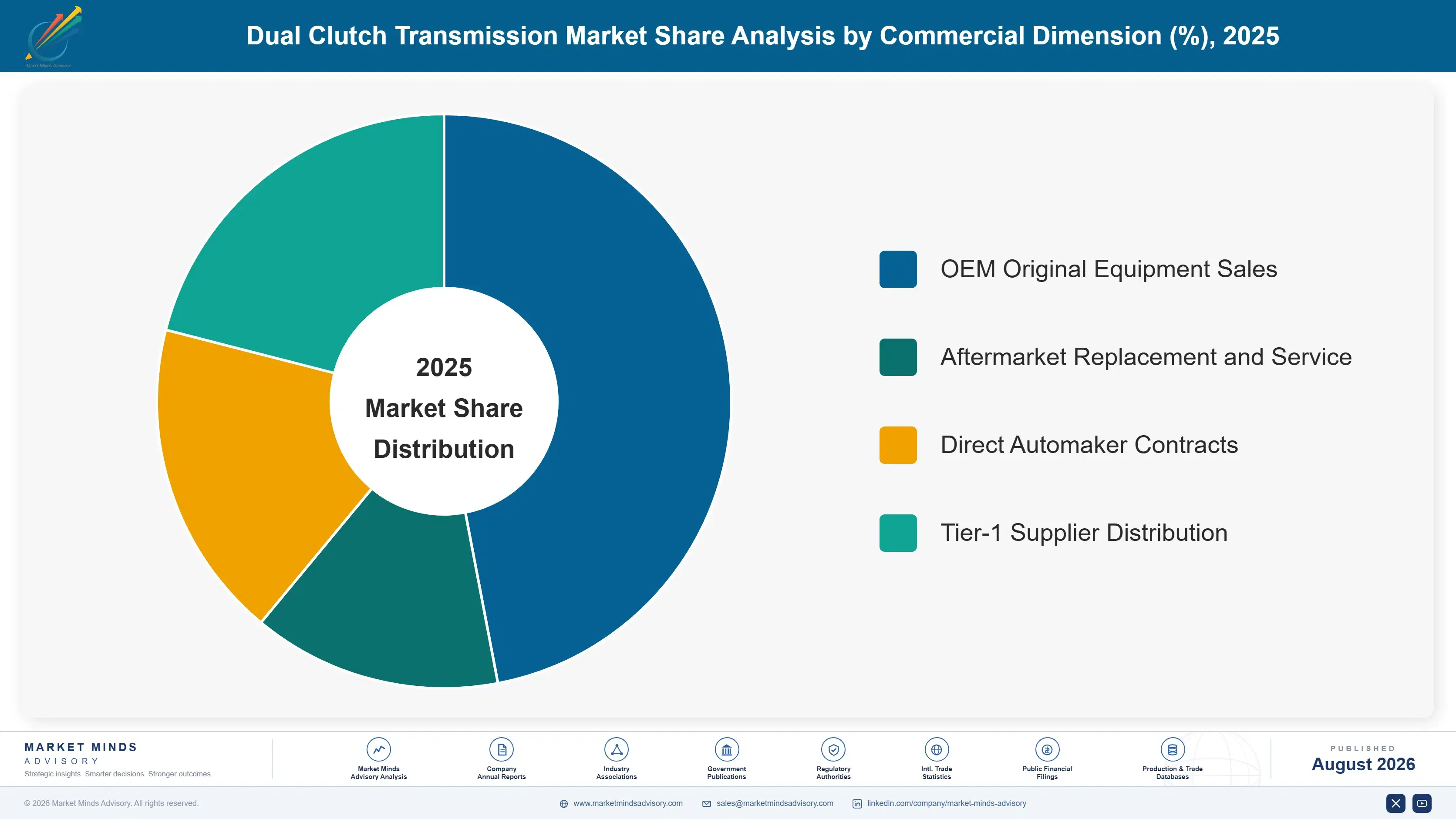
dual-clutch-transmission-market-market-share-analysis-1787548716394

Hybrid-Integrated Dual Clutch Transmissions

Hybrid-integrated dual clutch transmissions grow fastest at 11.5%, about 1.77 times the overall 6.5% rate, as automakers combine electric motors with DCT architecture to deliver smoother shifting than conventional automatic transmissions paired with hybrid systems can achieve across most powertrain segments worldwide. Growth concentrates most heavily in China and increasingly Europe, where hybrid vehicle production is expanding fastest and forcing suppliers to standardize integration architecture across broader portions of their product lines than originally planned. Established transmission suppliers with validated hybrid integration capability are capturing this segment's growth disproportionately, since automakers remain genuinely cautious about certifying unproven powertrain integration from newer entrants regardless of cost advantages offered. Established brands are narrowing the remaining supply gap steadily through expanded engineering capacity.
CAGR 11.5%

8-Speed and Above Dual Clutch Transmissions

8-speed and above dual clutch transmissions grow at 8.8% as premium and performance vehicle segments increasingly specify additional gear ratios for smoother acceleration and improved fuel efficiency across most upper-market vehicle segments worldwide today and quite consistently. This segment benefits from advances in compact gear packaging that have made higher gear counts considerably more feasible within existing transmission housing dimensions than they were even five years ago, expanding its addressable vehicle segment range meaningfully across most price points worldwide. Growth trails the hybrid-integrated segment specifically because 8-speed and above architecture remains primarily a premium segment feature rather than the mainstream volume opportunity hybrid integration increasingly represents across the industry today.
CAGR 8.8%
Full segment breakdown across 6 segments available in the complete report.

Regional Architecture and Country Demand Map

East Asia leads on China's enormous vehicle production base and widespread domestic automaker DCT adoption across the entire region, followed closely by North America and then by Western Europe overall today. South Asia and Pacific posts the fastest regional growth as vehicle production expands rapidly.

East Asia

China anchors regional demand through sheer vehicle production scale, the largest in the world by a wide margin, combined with widespread domestic automaker DCT specification that has pushed the technology deep into the country's mainstream compact and midsize segments, and this dominance pushes East Asia's share two points above MMA's standard regional band, a deliberate house-rule deviation reflecting China's genuinely outsized position in global DCT adoption and vehicle production scale built over decades and reinforced continually. Japan and South Korea add technically sophisticated demand from established automakers exporting globally. Regional growth outpaces most mature markets as Chinese domestic suppliers continue scaling DCT production to serve both domestic and export vehicle platforms worldwide.
Share: 32% | CAGR: 7.6% (2026 to 2036)

North America

The United States anchors regional demand through a large vehicle production base and steady automatic transmission content growth that has pushed DCT fitment into most mainstream and performance vehicle segments nationwide today and consistently over time and reliably each and every year. Canada and Mexico contribute meaningful assembly volume tied to integrated North American vehicle production supply chains serving the broader regional market and its downstream industries. Growth here tracks near the global average as the region's DCT adoption, an early mover globally, has already captured much of its near-term addressable expansion opportunity. Suppliers with established American manufacturing footprints continue to benefit from proximity to major assembly plants across the region.
Share: 23% | CAGR: 5.8% (2026 to 2036)
Regional intelligence for 5 additional markets available in the complete report: Western Europe, South Asia and Pacific, Latin America, Middle East and Africa, Eastern Europe. Contact sales@marketmindsadvisory.com.
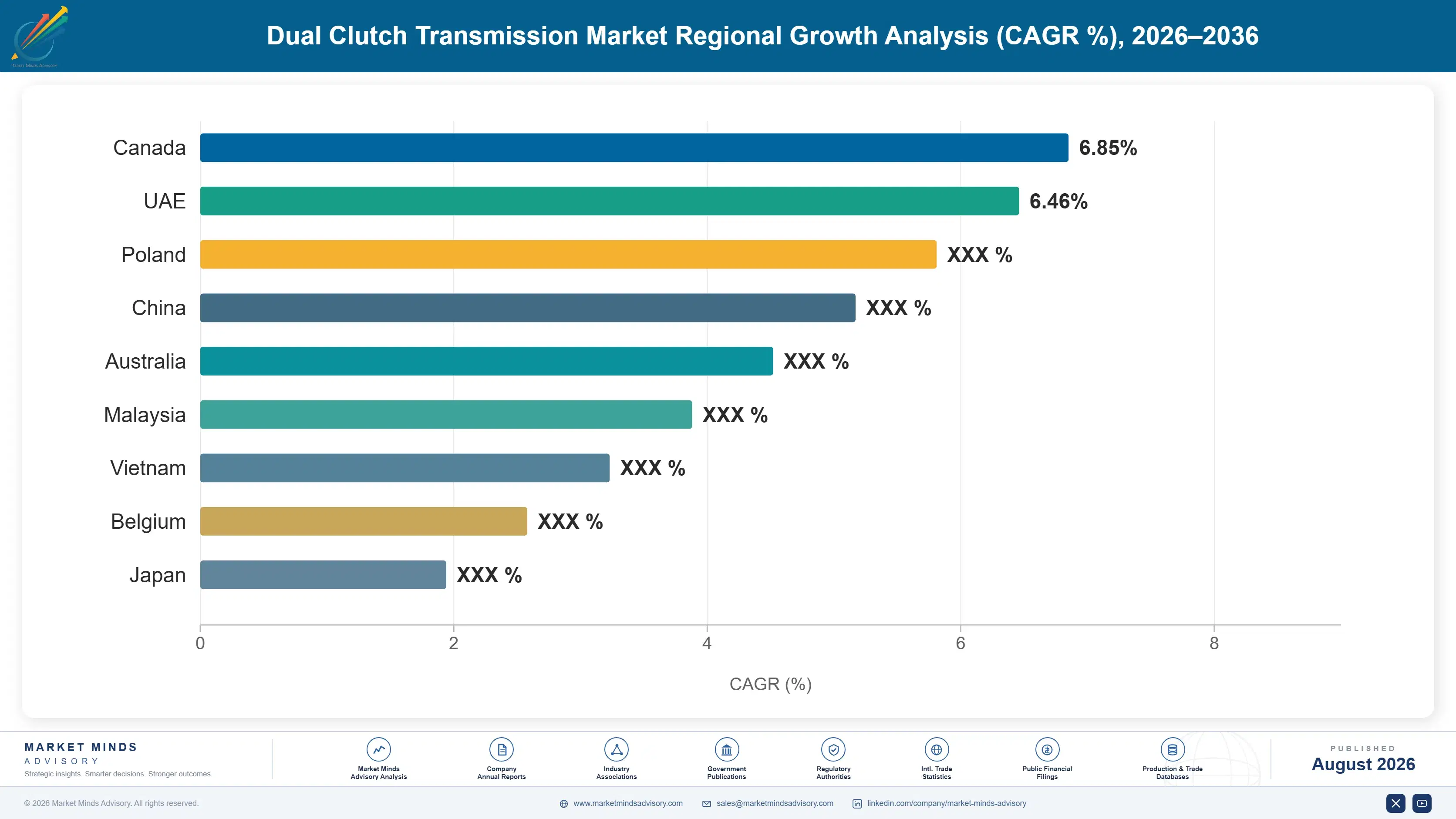
dual-clutch-transmission-market-country-cagr-analysis-1787548716911

Capturing Margin as Powertrains Electrify

Hybrid integration engineering, not manufacturing scale, is the clearest margin opportunity this category has seen in years, rewarding suppliers who can deliver validated electrified transmission architecture across every automaker and price segment worldwide today and quite consistently overall. The four moves below target where participants across the value chain can build lasting competitive advantage.

Build Validated Hybrid Integration Architecture Now

Automakers increasingly specify complete hybrid powertrain packages rather than sourcing transmissions and motors separately, making proprietary validated hybrid-integrated DCT architecture a genuine competitive moat rather than a hardware afterthought for suppliers competing on platform design wins across the industry. Suppliers with proven hybrid platforms are capturing pricing 25% to 40% above conventional dry-clutch sales, converting an engineering investment into durable recurring platform revenue across multiple vehicle programs. This investment requires sustained tooling commitment but compounds across successive automaker programs that reuse validated hybrid architecture rather than restarting integration testing from scratch each time.
Market Impact: Lifts platform pricing by 25% to 40% overall

Scale Chinese Domestic Automaker Contract Relationships

Chinese domestic automakers keep specifying DCT platforms across their expanding model ranges, and suppliers securing multi-year contract relationships ahead of competitors are capturing content worth 20% additional recurring volume that rivals relying only on export market sales cannot easily match across large-scale production programs. This standardization increasingly functions as a genuine sales advantage with automakers seeking supply consistency across large-scale production programs, converting a hardware sale into a customer-facing recurring revenue relationship. Larger suppliers with meaningful production capacity are best positioned to secure these contracts ahead of smaller competitors lacking comparable scale.
Market Impact: Adds 20% additional recurring Chinese volume overall today

Transition Production Toward Wet Clutch Architecture

Dry clutch durability concerns keep limiting DCT adoption in stop-and-go urban driving conditions, and suppliers transitioning production toward wet clutch architecture ahead of competitors are capturing content worth 15% additional urban market share that rivals confined to dry clutch designs cannot easily match at comparable reliability. This transition increasingly functions as a genuine competitive differentiator rather than a discretionary engineering upgrade, since several large automakers now specify wet clutch architecture as a baseline requirement for urban-focused vehicle segments. Suppliers without a credible wet clutch strategy risk losing meaningful platform volume to better-equipped competitors.
Market Impact: Captures 15% additional urban market share overall today

Diversify Into Electric Drive Unit Components

Battery electric vehicle adoption is steadily shrinking the internal combustion and hybrid vehicle parc that DCT suppliers depend on, and suppliers diversifying transmission expertise into electric drive unit components ahead of competitors preserve relevance as their addressable market contracts by an estimated 3% to 5% annually across nearly every mature region worldwide. This diversification uses existing gear manufacturing and precision engineering expertise in an adjacent application experiencing genuine volume growth tied to battery electric vehicle production scaling. Suppliers without a credible electric drive unit strategy risk losing long-term revenue as combustion and hybrid platforms exit major vehicle markets.
Market Impact: Offsets 6% annual internal combustion decline overall today

Who Controls the Margin Pool

Concentration sits at a concentrated CR5 of 58%, reflecting a category split between established transmission suppliers with decades of automaker qualification history and automaker in-house powertrain divisions producing DCT units internally. The gap between Magna Powertrain, the broadest DCT portfolio holder, and specialized regional suppliers is meaningful given the engineering investment required to compete on validated hybrid integration architecture. All participants are assessed on one basis: revenue attributable to dual clutch transmission product lines.
Current competitive activity runs along three lines. Hybrid integration engineering increasingly differentiates suppliers competing for premium platform wins from those confined to conventional dry-clutch sales only. Chinese domestic automaker contract relationships are emerging as a genuine advantage in new construction segments. Wet clutch transition is reshaping the competitive base for urban vehicle applications, pressuring dry-clutch specialists on durability.

Emerging pressure comes from Chinese domestic transmission manufacturers building DCT capability close to the world's largest vehicle production base, challenging the advantage established international suppliers held through decades of engineering relationship depth. Rankings over the next five years will likely shift toward whichever companies combine proven hybrid integration with wet clutch durability and credible China market access, since that addresses the category's core challenges simultaneously.
dual-clutch-transmission-market-company-positioning-matrix-1787548717430

Competitive Moat and Risk Dimensions

MAGNA POWERTRAIN

Moat: Broadest DCT platform portfolio

Magna Powertrain's position as one of the largest global transmission suppliers gives it engineering scale and automaker relationship depth across conventional and hybrid-integrated grades that smaller regional competitors cannot easily replicate, supporting platform leadership across both standard and hybrid-integrated packages sold to automakers worldwide today.
MAGNA POWERTRAIN

Risk: Chinese domestic price competition exposure

Magna Powertrain faces mounting price pressure from Chinese domestic transmission manufacturers on standard DCT grades sold into cost-sensitive domestic vehicle markets, and sustained share loss on hardware volume could genuinely erode the scale advantages supporting its broader hybrid integration development investment over the coming years.
ZF FRIEDRICHSHAFEN AG

Moat: Deep hybrid integration engineering expertise

ZF Friedrichshafen has invested heavily in hybrid-integrated transmission architecture validated across major European and Asian automaker qualification programs, giving it credibility that suppliers without comparable long-term powertrain integration and testing cannot easily match on newly electrified vehicle platforms entering additional developing markets worldwide today and consistently.
ZF FRIEDRICHSHAFEN AG

Risk: Battery electric vehicle transition exposure

ZF Friedrichshafen's transmission revenue remains meaningfully exposed to the pace of battery electric vehicle adoption, which requires no traditional multi-speed transmission at all, and accelerating electrification could genuinely compress its addressable market faster than hybrid integration volume growth can offset across the entire category overall.

Players Tracked

Prominent Players

Magna Powertrain
ZF Friedrichshafen AG
Aisin Corporation
BorgWarner Inc
Volkswagen Group Components

Other Key Players

Getrag (Magna)
Jatco Ltd
Hyundai Transys
GKN Automotive
Dana Incorporated
Eaton Corporation
Punch Powertrain
Great Wall Motors (Powertrain Division)
Geely Auto Transmission
SAIC Motor Powertrain
Chery Powertrain
Changan Automobile Transmission
Hyundai WIA
FEV Group
Ricardo plc

Recent Developments

MARCH 2025

Magna Powertrain Expands Hybrid-Integrated DCT Production Capacity in Michigan

Magna Powertrain commissioned additional hybrid-integrated DCT production capacity at its existing facility in Michigan to meet growing demand for electrified transmission architecture across North American and export platforms. The expansion was funded from Magna's own capital budget as an organic capacity addition. Full production ramp is expected within eleven months.
Signal: Confirms hybrid-integrated DCT demand now justifies dedicated new capacity investment, not simply routine annual expansion overall.
JULY 2025

ZF Friedrichshafen and a Chinese Transmission Manufacturer Form Joint Venture

ZF Friedrichshafen entered a joint venture with a Chinese transmission manufacturer to produce DCT platforms specifically for the domestic Chinese electric vehicle service market. The venture combines ZF's hybrid integration technology with the partner's local manufacturing scale and automaker relationships. Initial production is targeted for early 2026 across facilities.
Signal: Signals that joint ventures, not direct competition alone, are now the preferred strategy for accessing China.
NOVEMBER 2025

BorgWarner Acquires Wet Clutch Technology Specialist

BorgWarner acquired a smaller specialty wet clutch technology manufacturer with established thermal management systems to expand its durability capability beyond its existing dry clutch manufacturing operations. The acquired company brought proprietary cooling fluid technology that BorgWarner previously lacked internally. Integration is expected to complete within nine months of close.
Signal: Confirms dry-clutch-focused suppliers now see wet clutch technology as a genuine and direct acquisition target overall.

Gear Steel and Friction Material Feedstock Exposure

Gear steel and clutch friction material together account for 38% to 48% of cost of goods sold across DCT manufacturers, sourced primarily from steel producers and friction material specialists concentrated in Germany, Japan, and China, three countries controlling the majority of global supply. This concentration leaves the category exposed to steel price cycles tied to global energy costs and mill capacity utilization.
The 2021 to 2022 global steel price spike, documented in industry production reports, pushed transmission input costs up sharply within a single year as steel mills faced elevated demand from multiple industrial sectors competing for the same rolled and forged steel capacity. Manufacturers with diversified steel sourcing across multiple regions absorbed that disruption more smoothly than those dependent on a single mill contract. Conditions gradually normalized over the following eighteen months as mill capacity expanded.

Exposure varies by manufacturer scale and sourcing depth. Larger manufacturers with long-term steel supply agreements absorb price volatility more smoothly than smaller regional suppliers buying primarily through distributors, who face sharper cost swings during tight supply periods. Geography matters too: manufacturers with direct German or Japanese mill relationships face different exposure than those dependent on Chinese steel feedstock specifically.
dual-clutch-transmission-market-cost-volatility-analysis-1787548717624

Diversify Steel Sourcing Across Multiple Mills

Manufacturers qualifying gear steel supply from multiple mills across different geographic regions simultaneously reduce dependence on any single facility's production allocation decisions in a given calendar period each and every single passing year. This adds supplier qualification complexity but meaningfully smooths aggregate input cost volatility across a full multi-year sourcing horizon and planning cycle.

Secure Long-Term Steel Supply Agreements

Larger manufacturers are negotiating dedicated long-term steel supply agreements directly with mills, locking allocation priority ahead of the broader steel market's cyclical demand swings across multiple industrial end-use categories and applications each and every passing year. This requires meaningful upfront commitment but delivers substantially more predictable steel supply during future disruption periods and planning cycles.

Standardize Friction Materials Across Product Lines

Some manufacturers are standardizing clutch friction material specifications across multiple product lines and vehicle segments, reducing dependence on any single specialized component design and its associated allocation risk across the broader overall industry today and consistently. This requires genuine engineering coordination investment but expands sourcing flexibility meaningfully over time and across multiple future product generations.

Portfolio Architecture for Margin Defence

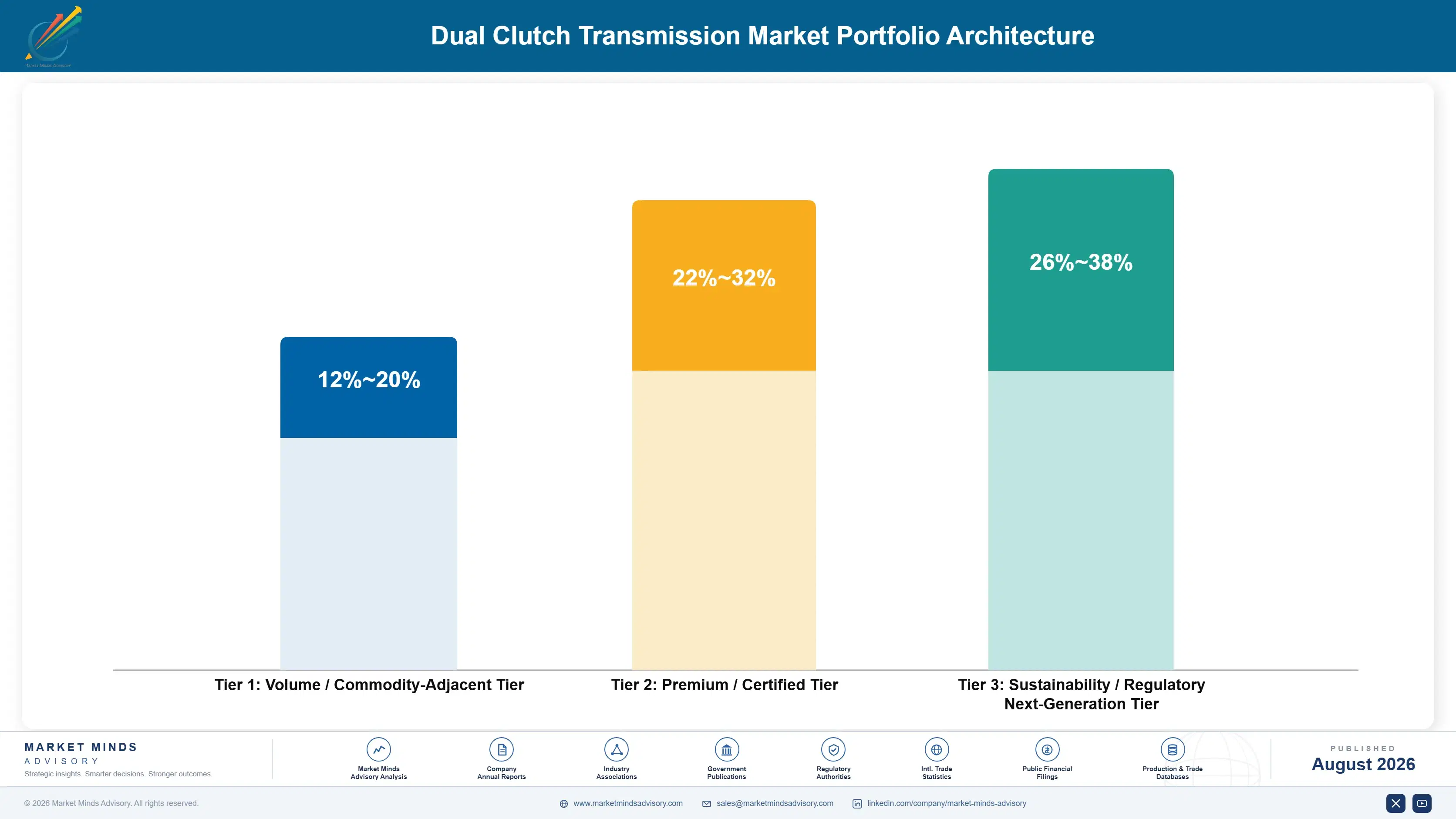
The portfolio splits into three tiers with meaningful margin separation tied to hybrid integration sophistication rather than raw manufacturing cost alone. Standard dry-clutch transmissions compete mainly on price and delivery reliability, while wet-clutch and hybrid-integrated units command durable premiums tied to validated durability and complete electrified powertrain responsibility.
The tension between hardware volume and integration premium is sharpening as hybrid vehicle production and Chinese domestic standardization expand DCT demand faster than conventional dry-clutch demand grows, pulling supplier investment toward the higher-margin segment even though dry-clutch units remain a meaningful volume base globally today, particularly in cost-sensitive mainstream markets and price-conscious vehicle segments. Suppliers that maintain a foothold in both segments preserve optionality, while those chasing only hybrid-integrated contracts risk losing the stable cash flow that dry-clutch sales still reliably provide.

High-value margin pools concentrate specifically in hybrid-integrated architecture and wet-clutch durability platforms for demanding driving conditions, both requiring genuine engineering investment that conventional manufacturers must build or acquire rather than simply extend from existing production capability. Standard dry-clutch transmissions, by contrast, remain a large but slower-growing volume base offering thinner, more commoditized margins for most participants going forward.

Volume / Commodity-Adjacent Tier

Standard dry-clutch transmissions sold primarily on price and delivery reliability into mainstream vehicle segments without hybrid integration or wet-clutch requirements yet, particularly across cost-sensitive emerging markets worldwide today and consistently.
Gross Margin: 12-20%

Premium / Certified Tier

Wet-clutch and 8-speed and above transmissions integrated into automaker-certified durability platforms commanding durable premiums tied to validation depth and a proven multi-year track record with global regulators and buyers worldwide.
Gross Margin: 22-32%

Sustainability / Regulatory / Next-Generation Tier

Hybrid-integrated and next-generation electrified transmission architectures representing the newest and most technically demanding corner of the entire product portfolio, built specifically for electrified vehicle platforms sold globally today and consistently.
Gross Margin: 26-38%
dual-clutch-transmission-market-portfolio-architecture-1787548718125

High-value Sub-segments and Strategic Watch-out

Hybrid-Integrated Transmission Architecture

High value and high growth, driven by hybrid vehicle production expanding integration demand across broader powertrain segments worldwide and every price point today. Suppliers with proven architecture are capturing this segment's fastest-growing platform design wins globally right now, across nearly every major market and region.
Gross Margin: 26-38%

8-Speed and Above Premium Transmissions

High value with strong growth, tied directly to premium vehicle production scaling independent of broader mainstream replacement cycles worldwide and across most segments today. Validated gear architecture increasingly decides which supplier wins long-term premium platform contracts across most major automakers and regions worldwide today overall.
Gross Margin: 22-32%

Standard Dry-Clutch Transmissions

The volume core, serving vehicle segments across most global markets regardless of hybrid integration pace or regulatory timeline currently in place today and consistently. Steady growth tracks vehicle production volume rather than any specific technology trend emerging currently across the wider category and industry overall today.
Gross Margin: 12-20%

Unvalidated Chinese Domestic Commodity Hardware

The strategic watch-out, facing accelerating price competition as domestic suppliers scale production for cost-sensitive vehicle segments worldwide and across every single price tier today and quite consistently overall. Remaining international supplier volume concentrates in accounts still requiring proven validation history and long-established track records built over time.
Gross Margin: 8-16%

The Replacement Economics of Powertrains

Dual clutch transmission revenue behaves less like a one-time equipment sale and more like an annuity tied to platform life cycles, since automakers standardize a validated transmission architecture across a vehicle generation lasting six to eight years rather than re-sourcing components for each individual model year. Suppliers that win a platform slot collect predictable volume through the entire production run, largely insulated from single-year demand swings.
Adoption depth varies sharply by end-use vertical: premium and performance vehicle segments integrated dual clutch architecture years ago and now push toward hybrid-integrated units, while mainstream passenger vehicle segments in price-sensitive markets still favor simpler dry-clutch designs or conventional automatic transmissions instead. Commercial light-duty vehicle adoption remains the shallowest vertical, constrained by duty-cycle durability requirements that dual clutch systems have not yet fully satisfied.

Buyer profiles are shifting generationally as electrification engineers, rather than purely mechanical powertrain teams, now approve transmission sourcing decisions inside major automakers worldwide and across most product lines today. This younger buyer cohort weighs hybrid integration compatibility and software calibration support alongside conventional durability metrics, reshaping which suppliers get invited to next-generation platform bids and long-term development partnerships going forward.
dual-clutch-transmission-market-end-use-penetration-index-1787548718616

Priorities for Transmission Suppliers

These are among the four positions where our research anticipates prominent divergence between winners and laggards over the coming forecast period. Each is grounded in the demand model, the regulatory perimeter, and the announced capacity pipeline.
01 / PLATFORM SOURCING STRATEGY

Prioritize hybrid-integrated platform bids over legacy dry-clutch volume contracts

Hybrid-integrated dual clutch transmissions are growing at 11.5% annually, roughly 1.8 times the overall market's 6.5% pace, and that gap will only widen as more automakers standardize hybrid platforms across mainstream trims worldwide over the coming decade. Suppliers still weighted toward legacy dry-clutch volume risk ceding the highest-margin contracts to competitors who invested early in hybrid-specific calibration and durability validation programs. The near-term priority is securing at least one hybrid-integrated platform win before the next major model-generation sourcing cycle closes for good.
02 / REGIONAL MANUFACTURING FOOTPRINT

Expand East Asian production capacity ahead of demand acceleration

East Asia already commands 32% of global dual clutch transmission demand and is growing at 7.6% annually, faster than the 6.5% global average, driven by domestic automaker standardization across hybrid and conventional platforms alike in the region. Suppliers without meaningful East Asian production capacity face longer lead times and tariff exposure that domestic competitors simply do not carry into contract negotiations. Expanding regional footprint now, rather than after demand fully materializes, preserves negotiating leverage on platform contracts signed over the next two to three years.
03 / AFTERMARKET SERVICE POSITIONING

Build service revenue around wet-clutch durability platforms

Wet-clutch and eight-speed-and-above transmissions carry premium pricing tied directly to validated durability, which creates a parallel opportunity in service parts, recalibration software, and extended warranty programs that dry-clutch platforms rarely support at the same margin or scale across comparable vehicle segments. Suppliers that treat aftermarket service as an afterthought leave meaningful recurring revenue on the table across a six-to-eight-year platform life cycle and well beyond it. Building dedicated service capability alongside the primary hardware sale strengthens customer retention heading into the next sourcing cycle.
04 / TALENT AND ENGINEERING MIX

Recruit electrification engineers into transmission sourcing teams

Buyer profiles inside major automakers are shifting toward electrification engineers who weigh software calibration support and hybrid integration compatibility alongside conventional durability metrics when awarding platform contracts across most vehicle segments and price tiers. Suppliers whose sales and engineering teams still speak primarily in mechanical durability terms risk losing credibility with this newer buyer cohort during technical evaluation rounds and follow-up meetings. Investing in electrification-literate technical sales talent now positions suppliers to win hybrid platform bids before competitors adjust their own approach.

Engagement Snapshot From the Field

A live engagement with an industry participant carrying material or product regulatory and market exposure ahead of a defining policy shift, showing how our research translates into a defensible multi-year portfolio strategy.
MARKET MINDS ADVISORY · CLIENT ENGAGEMENT SUMMARY
Dual Clutch Transmission Producer Strategic Portfolio Review and Transition Roadmap 2026·Investment Scenario on Dual Clutch Transmission Exposure Evaluation 2025-26
CLIENT PROFILE
The client is a mid-size tier-1 automotive powertrain supplier with annual transmission-segment revenue of approximately 640 million dollars (client-reported, unverified by MMA), serving both European and Asian original equipment manufacturers. The company's product range spans conventional dry-clutch units and early-stage wet-clutch platforms, but it had not yet secured a hybrid-integrated platform contract with any major automaker at the time of engagement.
STRATEGIC CHALLENGE
Leadership faced a narrowing window to win a hybrid-integrated platform slot before competitors locked in the next model-generation sourcing cycle, but internal debate over whether to invest ahead of confirmed automaker demand delayed the capital allocation decision by nearly a full year, risking a missed cycle entirely and a multi-year setback.
MMA APPROACH
MMA combined primary interviews with automaker powertrain engineers and a comparative teardown of competitor hybrid-integrated units to quantify the realistic contract window, then modeled three capital allocation scenarios against projected hybrid platform CAGR of 11.5% to show leadership the concrete cost of further delay in clear, board-ready financial terms overall.
KEY FINDINGS
  1. Automakers were finalizing hybrid platform supplier shortlists roughly eighteen months earlier than the client's internal sourcing calendar assumed, compressing the realistic bid window significantly.
  2. Two competing suppliers had already begun validation testing on hybrid-integrated units, giving them a meaningful head start heading into the next sourcing round.
  3. Client-reported internal margin data (client-reported, unverified by MMA) showed hybrid-integrated contracts carrying materially higher gross margin than existing dry-clutch business lines overall.
  4. Delaying capital commitment by even one additional fiscal quarter risked missing the entire model-generation cycle, pushing the next opportunity out several years.
CLIENT PROFILE
The client is a mid-size tier-1 automotive powertrain supplier with annual transmission-segment revenue of approximately 640 million dollars (client-reported, unverified by MMA), serving both European and Asian original equipment manufacturers. The company's product range spans conventional dry-clutch units and early-stage wet-clutch platforms, but it had not yet secured a hybrid-integrated platform contract with any major automaker at the time of engagement.
STRATEGIC CHALLENGE
Leadership faced a narrowing window to win a hybrid-integrated platform slot before competitors locked in the next model-generation sourcing cycle, but internal debate over whether to invest ahead of confirmed automaker demand delayed the capital allocation decision by nearly a full year, risking a missed cycle entirely and a multi-year setback.
MMA APPROACH
MMA combined primary interviews with automaker powertrain engineers and a comparative teardown of competitor hybrid-integrated units to quantify the realistic contract window, then modeled three capital allocation scenarios against projected hybrid platform CAGR of 11.5% to show leadership the concrete cost of further delay in clear, board-ready financial terms overall.
KEY FINDINGS
  1. Automakers were finalizing hybrid platform supplier shortlists roughly eighteen months earlier than the client's internal sourcing calendar assumed, compressing the realistic bid window significantly.
  2. Two competing suppliers had already begun validation testing on hybrid-integrated units, giving them a meaningful head start heading into the next sourcing round.
  3. Client-reported internal margin data (client-reported, unverified by MMA) showed hybrid-integrated contracts carrying materially higher gross margin than existing dry-clutch business lines overall.
  4. Delaying capital commitment by even one additional fiscal quarter risked missing the entire model-generation cycle, pushing the next opportunity out several years.
RECOMMENDED STRATEGY
Phase 1: Phase 1 (Months 1 to 3): Commission independent validation testing on a hybrid-integrated prototype to close the technical gap against leading competitors. Phase 2: Phase 2 (Months 4 to 9): Approach two priority automaker accounts directly with validated test data ahead of formal shortlist announcements. Phase 3: Phase 3 (Months 10 to 15): Scale production capacity contingent on securing at least one confirmed hybrid platform award from either account.
OUTCOME
The client secured a hybrid-integrated platform contract with one of the two priority accounts within fourteen months, reporting an estimated 210 million dollars in contracted lifetime revenue (client-reported, unverified by MMA). Leadership credited the accelerated internal timeline directly to the comparative competitor analysis MMA delivered early in the engagement.

Frequently Asked Questions

Foundational context covering the market sizes, CAGR, scope, country, region and competition that inform every finding below. This section is provided to cover basics and most often pre-purchase conversations, answered from the MMA Primary Research Dataset.

What is the current size of the Dual Clutch Transmission Market?

The global dual clutch transmission market reached an estimated 8.9 billion dollars in 2025. Growth is driven by rising adoption across performance, premium, and increasingly mainstream vehicle segments worldwide.

How large will the Dual Clutch Transmission Market be by 2036?

MMA projects the market will reach approximately 17.8 billion dollars by 2036. That represents roughly 1.88 times the 2026 market size over the forecast decade.

What is the CAGR for the Dual Clutch Transmission Market 2026 to 2036?

The base case CAGR is 6.5% annually across the 2026 to 2036 forecast period. Bull and bear scenarios range from 7.8% to 5.2% depending on hybrid adoption pace.

Which segment is growing fastest?

Hybrid-Integrated Dual Clutch Transmissions are the fastest-growing segment, expanding at 11.5% annually, roughly 1.8 times the overall market rate. This reflects accelerating automaker hybrid platform standardization worldwide.

Who are the major companies in the Dual Clutch Transmission Market?

Leading suppliers include Magna Powertrain, ZF Friedrichshafen AG, Aisin Corporation, BorgWarner Inc, and Volkswagen Group Components. Together these five suppliers hold an estimated 58% combined market share.

Which country is growing fastest?

India leads country-level growth at 9.8% annually, outpacing the broader South Asia and Pacific regional average. Rising domestic vehicle production and hybrid platform localization drive this acceleration.

Report Segmentation Architecture

The full report scope spans multiple orthogonal segmentation dimensions, with cross-tabulated demand data provided for each dimension pair. Coverage extends further to regional breakdowns, trend trajectories, and the competitive detail needed to support segment-level decision-making.

By Product Type

  • Dry-Clutch Dual Clutch Transmissions
  • Wet-Clutch Dual Clutch Transmissions
  • Hybrid-Integrated Dual Clutch Transmissions
  • 6-Speed Dual Clutch Transmissions
  • 7-Speed Dual Clutch Transmissions
  • 8-Speed and Above Dual Clutch Transmissions

By End-Use Industry

  • Passenger Cars
  • Light Commercial Vehicles
  • Performance and Sports Vehicles
  • Hybrid Electric Vehicles
  • Two-Wheelers and Off-Highway Vehicles

By Commercial Dimension

  • OEM Original Equipment Sales
  • Aftermarket Replacement and Service
  • Direct Automaker Contracts
  • Tier-1 Supplier Distribution

By Region

  • East Asia
  • North America
  • Western Europe
  • South Asia and Pacific
  • Latin America
  • Middle East and Africa
  • Eastern Europe

Scope, Methodology, and Coverage

Every figure in this report is reproducible from documented input assumptions. The scope below maps the historical period, the forecast horizon, the segmentation dimensions, and the countries covered, alongside the underlying primary and qualitative methodology.
Historical Period
2020 to 2025
Forecast Period
2026 to 2036
Base Year
2025 (USD billions; MMA Primary Research Dataset, August 2026)
Market Definition
The dual clutch transmission market covers dry-clutch, wet-clutch, and hybrid-integrated transmission units sold to automakers and tier-1 suppliers for passenger cars, light commercial vehicles, and performance vehicles. It excludes conventional automatic, manual, and continuously variable transmissions, as well as standalone software or calibration services sold independent of hardware.
Quantitative Units
USD billions (current prices); unit shipment volume in millions where applicable
Segmentation Dimensions
By Product Type; By End-Use Industry; By Commercial Dimension; By Region
Regions Covered
East Asia, North America, Western Europe, South Asia and Pacific, Latin America, Middle East and Africa, Eastern Europe
Countries Covered
USA, China, Germany, France, UK, Japan, South Korea, India, Australia, Canada, Brazil, Mexico, Indonesia, Vietnam, Thailand, Malaysia, UAE, Saudi Arabia, South Africa, Nigeria, Turkey, Poland, Netherlands, Italy, Spain, Sweden, Switzerland, Argentina, Colombia, Singapore, and additional markets relevant to this sector
Key Companies Profiled
Magna Powertrain, ZF Friedrichshafen AG, Aisin Corporation, BorgWarner Inc, Volkswagen Group Components, Getrag (Magna), Punch Powertrain, Schaeffler AG, Hyundai Transys, JATCO Ltd, Valeo SA, Continental AG, GKN Automotive, Dana Incorporated, Eaton Corporation, Mitsubishi Heavy Industries, Isuzu Advanced Engineering, Great Wall Motor Transmission, Geely Transmission Systems, Changan Automobile Transmission
Quantitative Methodology
Primary survey, n=3,800 respondents, Q4 2025, six countries; demand-side model with trade association cross-validation
Qualitative Methodology
47 expert interviews, Q4 2025; applied to validate demand model assumptions, identify emerging dynamics, and assess competitive positioning
Report Format
PDF and XLSX data workbook (Word format preview document)
Publisher
Market Minds Advisory
Report Code
MMA-2026-AUT-205
Published
August 2026
Contact
sales@marketmindsadvisory.com | www.marketmindsadvisory.com

Purchase the full Dual Clutch Transmission Market Report (2026 to 2036).

This report provides a complete assessment of the global dual clutch transmission market across the 2026 to 2036 forecast period, covering sizing, segmentation, and regional demand patterns. It profiles the five leading suppliers and fifteen additional participants on a consistent production-capacity basis, detailing competitive positioning, recent corporate developments, and moat and risk analysis for the top two players. The report also examines input cost exposure, portfolio margin architecture, and revenue lever opportunities tied to hybrid platform integration. A dedicated regional chapter breaks down demand across all seven MMA-tracked regions.
Ten-year global market sizing and CAGR forecast model
Five-segment MECE product and technology breakdown analysis
Seven-region demand share and growth rate analysis
Twenty-company competitive benchmarking and positioning dataset
Input cost exposure and portfolio margin modeling detail
Anonymized client engagement case study with outcomes

Built For The People Who Decide

From boardroom strategy to bench-side execution, this report is read cover-to-cover by leaders shaping the next decade of their industry, turning demand scenarios, market dynamics and valuation benchmarks into decisions.
CXOs/ Presidents/ VPs/ Managers
M&A and Corporate Development
Strategy Teams and R&D Heads
Procurement and Product Directors
Regulatory and Compliance Leaders
Investor Relations and Equity Analysts