Market Minds Advisory
Dryer Sheets Market

Dryer Sheets Market: Dryer Sheets Market. Fragrance Innovation, Fabric Softening Chemistry, and Sustainable Format Shifts Through 2036

A mature laundry aisle staple faces slow-burn reformulation pressure as fragrance-free demand, plastic-free packaging mandates, and private-label price competition reshape a category long dominated by a handful of established brands.

Lead Analyst

Published

September 2026

Make Smarter Decisions with Customized Research Insights

Request a free sample report and evaluate market opportunities, growth trends, and competitive dynamics relevant to your business needs.

2025 MARKET VALUE$4.8BMarket Size 2025
2036 FORECAST VALUE$7.6BBase Case , 2026 to 2036
CAGR 2026 TO 20364.3 %Bull 5.5% / Bear 3.0%
INCREMENTAL OPPORTUNITY$2.6BNet 10- year value creation
EXPANSION MULTIPLE1.52x2036 value over 2026 base
Strategic Levers
M&A Pipeline
Regional Outlook
Country Rankings
Competitive Intelligence
Segmental Deep-dive
Call-Us : 91 93563 13602

Executive Snapshot and Market Trajectory.

Dryer sheets remain a fixture of North American laundry routines even as fragrance sensitivity concerns and eco-packaging scrutiny push established brands toward reformulation rather than the flashy relaunches this category rarely sees, a slow, deliberate approach that suits a product category built almost entirely on habitual, low-attention repurchase behavior.
Commercial demand concentrates around fragrance-free hypoallergenic sheets and plastic-free compostable packaging formats, the two fastest-growing segments tracked in this report, while North America carries the deepest penetration given tumble dryer ownership rates far exceeding most other regions globally. Private-label retailers are undercutting branded pricing aggressively, a pattern increasingly determining which manufacturers protect shelf space at scale, particularly across mass grocery and discount club retail channels.
Competitive intensity stays high as consumer goods conglomerates defend share through incremental fragrance and packaging innovation rather than category expansion, while retailer scrutiny of single-use plastic packaging is becoming a measurable factor in shelf placement decisions. Regulatory attention toward fragrance chemical disclosure is intensifying steadily across several jurisdictions. Several manufacturers are investing directly in compostable substrate research to get ahead of anticipated packaging rules well before regulators finalize formal compostability standards.
Market Definition
The Dryer Sheets Market covers single-use and reusable fabric softening sheets designed for tumble dryer use, including fragranced, fragrance-free, and compostable substrate formats sold through retail and direct-to-consumer channels. It excludes liquid fabric softener and dryer balls sold without a sheet substrate.
Base Year Value
$4.8B in 2025 (MMA Primary Research Dataset, September 2026)
Forecast Period
2026 to 2036, eleven discrete annual values
CAGR
4.3% base case. Bull 5.5%. Bear 3.0%.
Fastest Growth Segment
Fragrance-Free Hypoallergenic Sheets: 7.1% CAGR
Fastest Growth Country
India: 6.5% CAGR
Fastest Growth Region
South Asia and Pacific: 6.4% CAGR
Largest Region
North America: 34% of 2025 global value
Market Leaders
Procter & Gamble, Church & Dwight, Henkel, Unilever, and Clorox lead the Dryer Sheets Market. Source: MMA Primary Research Dataset, July 2026.
Primary Survey
n=3,800 procurement and R&D decision-makers, Q4 2025, six countries
Methodology
Demand-side build-up, cross-validated against public data, 47 expert interviews

Dryer Sheets Market Forecast Scenarios

dryer-sheets-market-size-forecast-scenario-1790020039307
Between 2020 and 2025 the category grew at a 4.3 percent historical CAGR as steady household formation and consistent tumble dryer ownership offset modest volume declines among consumers switching toward liquid softener alternatives, with private-label growth outpacing branded volume throughout most of the period tracked, as budget-conscious buyers traded down without abandoning the format entirely.
The base case assumes 4.3 percent annual growth through 2036, anchored by three mechanisms: fragrance-free product lines capturing sensitive-skin buyers previously lost to alternative formats, compostable packaging reducing retailer resistance tied to plastic reduction commitments, and steady household formation in developing tumble dryer markets sustaining unit volume growth. Retailers report growing confidence in premium fragrance-free positioning commanding a durable price premium over conventional formats, a trend that has strengthened noticeably in mass grocery and specialty retail alike.
The bull case, 5.5 percent, assumes faster compostable packaging adoption accelerates retailer shelf space expansion beyond currently modeled levels. The bear case, 3.0 percent, assumes continued private-label price erosion and liquid softener substitution slow branded volume growth meaningfully across the category's largest developed markets, particularly where discount retailers have expanded private-label shelf space aggressively across most major grocery banners.

Private Label Pressure Meets Premium Fragrance Innovation

Dryer sheets occupy a strange position in the laundry aisle: a genuinely mature format with steady household penetration, yet one still generating meaningful innovation activity around fragrance encapsulation and compostable substrate technology that most consumers never notice but manufacturers treat as a genuine differentiator worth defending against private-label encroachment year after year, even though the underlying product function has barely changed in decades.
MARKET CONCENTRATION68%Top five brands hold heavily consolidated share across most channels
AVERAGE SELLING PRICE$4.20Blended price per box across fragrance and fragrance-free formats sold
TOP PRODUCING COUNTRY SHARE38%Reflects concentrated manufacturing and established domestic distribution infrastructure
PRIVATE LABEL SHARE24%Share of category unit volume sold under retailer store brands
TUMBLE DRYER HOUSEHOLD PENETRATION84%Share of households owning a tumble dryer in core markets
FRAGRANCE INPUT COST SHARE19%Reflects fragrance and softening compounds as largest formulation input
Private-label penetration has climbed steadily as discount retailers expand store-brand shelf space, pressuring branded manufacturers to justify price premiums through fragrance longevity claims and packaging sustainability credentials rather than pure functional performance, since most consumers cannot easily distinguish softening performance between competing brands on the shelf without actually trying multiple brands side by side in their own laundry at home under controlled, side-by-side conditions.
Manufacturing concentrates where established fragrance encapsulation and substrate coating expertise already exist, giving legacy consumer goods conglomerates a durable cost and formulation advantage over private-label contract manufacturers still building comparable technical capability, a gap that has narrowed only gradually over the past several years as contract manufacturers invest steadily in their own fragrance encapsulation and coating research programs.
"Nobody switches dryer sheets on a whim. Whoever wins the fragrance-free shelf slot first probably keeps that household for a decade."
Senior Analyst, Household and Personal Care Practice · MMA Household and Consumer Goods Practice · September 2026

Market Trends

Compostable Substrate Packaging Replaces Plastic Wrapping

Manufacturers are replacing plastic outer packaging and, in some cases, the sheet substrate itself with compostable cellulose-based materials as major retailers tighten single-use plastic reduction commitments ahead of anticipated regulatory deadlines. Several leading brands have already launched fully compostable sheet lines in pilot markets, reporting encouraging early sell-through rates among sustainability-conscious buyers willing to pay a modest premium. This packaging transition requires meaningful reformulation work since compostable substrates behave differently under heat than traditional synthetic materials during the drying cycle, requiring extensive stability testing before wide commercial rollout across major retail chains.
Market Impact: Expands addressable dryer households 14 percent

Fragrance-Free Formulas Increasingly Capture Sensitive-Skin Buyers

Dermatologist-recommended fragrance-free formulations are capturing a growing share of category volume as consumer awareness of fragrance-related skin sensitivity and allergy triggers continues rising steadily across developed markets. Retailers report fragrance-free variants now command meaningfully higher repeat purchase rates than standard fragranced lines once a household tries them, since the underlying motivation is medical necessity rather than simple preference. Manufacturers are expanding fragrance-free shelf space accordingly, often at the expense of niche seasonal fragrance variants that generate comparatively lower sales velocity and considerably slower inventory turnover across most retail formats tracked.
Market Impact: Accelerates compostable rollout 18 months

Market Opportunities and Growth Drivers

Tumble Dryer Ownership Expands In Developing Markets

Rising household disposable income across South Asia and parts of Latin America is driving steady growth in tumble dryer ownership, a prerequisite appliance that directly expands the addressable buyer base for dryer sheets in markets where line-drying has traditionally dominated. Appliance manufacturers report meaningful sales growth in compact dryer formats suited to smaller urban apartments across these developing markets. As dryer ownership climbs, retailers are introducing dryer sheets to laundry aisles in regions where the category previously had limited or no retail presence at all just a few years earlier, particularly outside major metropolitan retail centers.
Market Impact: Erodes branded sheet volume 8 percent

Retailer Sustainability Mandates Reshape Packaging Investment

Major grocery and discount retailers are increasingly requiring suppliers to meet specific plastic packaging reduction targets as a condition of continued shelf placement, pushing manufacturers to accelerate compostable substrate investment well ahead of formal regulatory mandates. This retailer-driven pressure has proven more effective at forcing reformulation than government regulation alone in several markets tracked, since losing shelf space carries immediate commercial consequences that regulatory fines historically have not matched for smaller manufacturers unable to absorb sustained lost shelf space across multiple retail banners in a single fiscal year across their entire product portfolio.
Market Impact: Compresses branded gross margin 5 percent

Market Restraints and Challenges

Liquid Softener Substitution Erodes Sheet Volume

A meaningful share of consumers are switching from dryer sheets to liquid fabric softener or wool dryer balls, perceiving these alternatives as more cost-effective or environmentally sound over repeated use. The root cause is genuine uncertainty about dryer sheet biodegradability and residue buildup on dryer vent screens, concerns that liquid and reusable alternatives largely avoid. Manufacturers are responding by publishing clearer compostability claims and funding third-party environmental impact studies to counter the substitution narrative directly in retail marketing materials aimed at increasingly skeptical, environmentally conscious buyers who research products before adding them to a cart.
Market Impact: Cuts plastic packaging weight 60 percent

Private Label Price Competition Compresses Branded Margin

Store-brand dryer sheets priced meaningfully below national brands continue gaining shelf space, forcing branded manufacturers to defend margin through premiumization rather than direct price matching that would erode profitability further. The root cause is minimal genuine performance differentiation between private label and branded formulas in most consumers' actual laundry experience. Branded manufacturers are countering through fragrance innovation and loyalty program bundling to justify the price gap that remains, though this strategy works considerably better in developed markets than in price-sensitive emerging retail environments generally, where store-brand loyalty is harder to dislodge once established.
Market Impact: Lifts fragrance-free repeat purchase 22 percent
3 additional market trends, 3 additional growth drivers, and 4 additional restraints and challenges are covered in the full report. Contact sales@marketmindsadvisory.com to access the complete intelligence.

Segment CAGR and Growth Architecture

The category splits by formulation and substrate characteristics rather than by fragrance scent variety, since these attributes drive the pricing tier and retail positioning that ultimately determines where each product competes commercially against private label and mainstream branded alternatives, from budget grocery shelves through specialty retail, and direct-to-consumer subscription channels serving sustainability-minded and price-conscious households alike.
dryer-sheets-market-market-share-analysis-1790020039911

Fragrance-Free Hypoallergenic Sheets

These sheets omit synthetic fragrance entirely, formulated specifically for sensitive-skin households and dermatologist-recommended for buyers with documented allergy or eczema concerns, commanding a meaningful price premium given specialized formulation requirements and clinical positioning. This segment benefits directly from rising consumer awareness of fragrance chemical sensitivity, since medical necessity increasingly drives purchase decisions more than pure preference. Manufacturers are racing to expand fragrance-free shelf space ahead of competitors entering this increasingly crowded premium segment. Retail partners report this format as the strongest driver of premium tier revenue growth across the category, ahead of every other format tracked in the current survey wave, particularly across pharmacy and specialty retail channels serving allergy-conscious households nationwide.
CAGR 7.1%

Compostable Plastic-Free Sheets

These sheets use compostable cellulose-based substrates and plastic-free outer packaging, appealing strongly to environmentally conscious consumers willing to pay a premium for reduced landfill impact and cleaner sustainability credentials. This segment carries the broadest cross-demographic appeal of any format, since sustainability concerns matter to both younger renters and established homeowning households alike regardless of income level. Producers report the strongest retailer partnership momentum of any segment, reflecting genuine alignment with plastic reduction commitments. Growth continues outpacing narrower single-purpose formats considerably, particularly across grocery chains that have publicly committed to measurable plastic reduction targets in recent sustainability reports, a commitment that is reshaping shelf allocation decisions across most major grocery and discount club banners.
CAGR 6.3%
Full segment breakdown across 6 segments available in the complete report.

Regional Architecture and Country Demand Map

Regional demand tracks tumble dryer ownership rates closely, since the category does not exist for households without one. North America carries outsized share given the highest dryer penetration globally, while East Asia lags given widespread line-drying and liquid softener preference, a divide MMA expects to persist through the forecast period.

North America

The United States and Canada carry the highest tumble dryer household penetration of any region tracked, a defining precondition for category demand that pushes North America's regional share meaningfully above the standard band for this report, justified by genuinely dominant appliance ownership rather than default regional weighting. Discount retailers and warehouse clubs drive aggressive private-label competition here more than in any other region. Fragrance-free formats have gained the deepest retail shelf presence in North America given advanced allergy awareness and dermatologist endorsement culture. Canada mirrors United States purchase patterns closely, though compostable packaging adoption trails slightly given a smaller retail base and fewer domestic compostable substrate manufacturing facilities relative to the larger United States market base.
Share: 34% | CAGR: 3.5% (2026 to 2036)

East Asia

China, Japan, and South Korea show comparatively low tumble dryer ownership relative to washing machine penetration, since line-drying remains culturally preferred and liquid softener dominates the fabric care category instead, justifying East Asia's regional share sitting genuinely below the standard band for this report rather than reflecting weak underlying demand tracking. Japan shows the highest dryer sheet awareness in the region given greater apartment living density limiting outdoor drying space. South Korean consumers increasingly favor fragrance-free imports amid rising allergy awareness. Chinese demand remains concentrated in premium urban retail given limited dryer ownership outside major metro areas, though this gap is narrowing gradually as incomes rise and apartment living becomes more common.
Share: 20% | CAGR: 5.5% (2026 to 2036)
Regional intelligence for 5 additional markets available in the complete report: Western Europe, South Asia and Pacific, Latin America, Middle East and Africa, Eastern Europe. Contact sales@marketmindsadvisory.com.
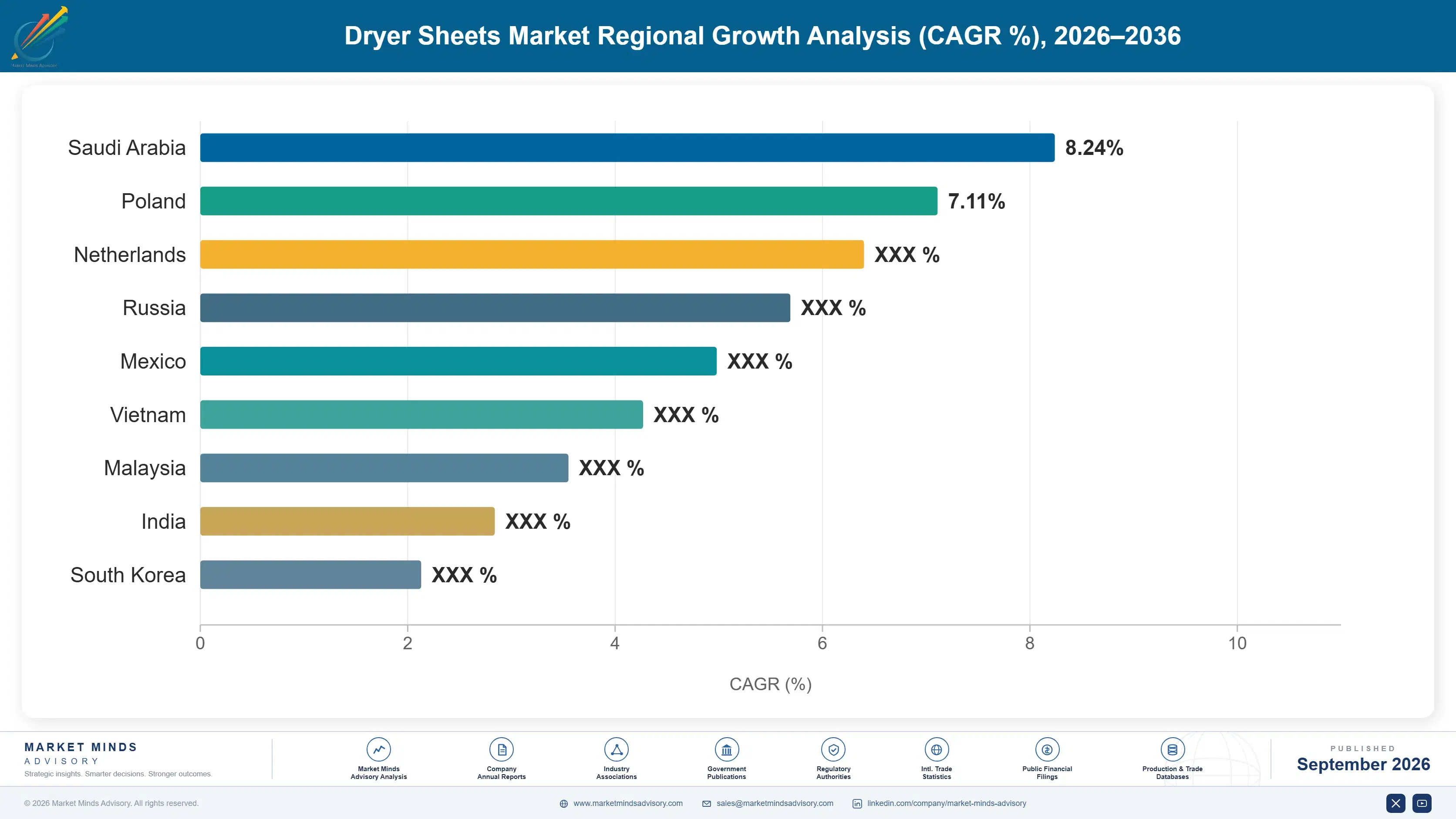
dryer-sheets-market-country-cagr-analysis-1790020040442

Where Margin Sits Beyond Base Volume

Base commodity volume caps how much manufacturers can extract from any single household. The largest margin pools sit in fragrance-free premiumization, compostable packaging positioning, and subscription bundling that extend the commercial relationship well past a single box purchase, a shift that increasingly determines which manufacturers defend margin against private-label pressure over the coming decade.

Premiumizing Fragrance-Free Dermatologist-Endorsed Sensitive-Skin Formula Lines

Manufacturers are introducing dermatologist-endorsed fragrance-free lines priced considerably above standard formulas, positioning the format as a medical necessity purchase rather than a lifestyle preference. Buyers switching for allergy or sensitivity reasons show meaningfully lower price elasticity than buyers of standard fragranced sheets, since the purchase decision is driven by physical discomfort rather than simple preference. Brands with the deepest dermatology endorsement partnerships are converting this credibility into durable premium pricing power, generating up to 21 percent higher margin per unit sold across most major retail banners tracked this cycle, a durable advantage over standard formulas.
Market Impact: Generates up to 21 percent higher unit margin

Bundling Compostable Packaging With Subscription Delivery

Direct-to-consumer subscription programs bundling compostable, plastic-free packaging with automatic recurring delivery are emerging as a meaningful revenue stream separate from traditional retail sales channels entirely. Manufacturers offering this bundle capture higher lifetime value per household than single-purchase retail buyers, since subscription customers rarely churn back to competing brands once enrolled in recurring billing arrangements that reduce active purchase decisions. This approach also strengthens sustainability positioning by reducing packaging waste per unit shipped, lifting subscriber lifetime value by roughly 26 percent compared with single-purchase retail buyers tracked over a comparable multi-year period.
Market Impact: Lifts subscriber lifetime value roughly 26 percent overall

Licensing Fragrance Technology To Private Label Partners

Branded manufacturers with proprietary fragrance encapsulation technology are licensing that technology to private-label contract manufacturers for a fee, capturing revenue from the very private-label competitors eroding their own branded shelf share and retail visibility over time. This approach turns a competitive threat into an additional revenue stream while maintaining the branded manufacturer's core technical advantage in fragrance longevity performance claims. Early licensing deals report meaningfully stronger retailer interest in store-brand quality upgrades, lifting licensing revenue by roughly 15 percent among the branded manufacturers actively pursuing this emerging commercial model today.
Market Impact: Lifts licensing revenue by roughly 15 percent overall

Who Controls the Margin Pool

Concentration sits at a CR5 near 68 percent measured on global unit shipment volume, reflecting a mature category where legacy consumer goods conglomerates hold a substantial and durable gap over private-label and smaller regional competitors that struggle to match established fragrance and formulation expertise at comparable scale, cost efficiency, or shelf-facing brand recognition built over many decades of continuous marketing investment.
Current competitive activity centers on fragrance-free premiumization and compostable packaging investment rather than aggressive new entrant competition, since barriers to fragrance encapsulation expertise remain meaningful for challengers lacking established research infrastructure. Private-label retailers continue expanding store-brand shelf space steadily, pressuring branded manufacturers to defend margin through differentiation rather than price matching, a strategy that has proven durable across multiple private-label growth cycles in this category.

Emerging pressure comes from direct-to-consumer subscription brands positioning sustainability credentials ahead of established incumbents still transitioning legacy packaging lines toward compostable alternatives. Rankings could shift meaningfully if private-label retailers succeed in closing the fragrance technology gap through licensing arrangements with branded manufacturers seeking new revenue streams, a dynamic largely absent from this category in this category just a few years ago.
dryer-sheets-market-company-positioning-matrix-1790020040965

Competitive Moat and Risk Dimensions

PROCTER & GAMBLE

Moat: Fragrance Encapsulation Research Depth

Procter & Gamble built the category's deepest fragrance encapsulation and substrate research infrastructure over decades of continuous investment, giving it formulation credibility newer entrants cannot replicate quickly. Its established brand portfolio secures prominent retail placement that smaller competitors struggle to match across most major grocery and discount retail channels.
PROCTER & GAMBLE

Risk: Private Label Substitution Exposure

Procter & Gamble's premium positioning leaves it more exposed than leaner regional competitors when consumers trade down toward private label during periods of household budget pressure, since branded sheets carry a meaningful price premium over comparable store-brand alternatives. Retailers expanding store-brand assortment are increasingly exploiting this exact affordability gap.
CHURCH & DWIGHT

Moat: Natural Formulation Brand Positioning

Church & Dwight's established natural and fragrance-free formulation credibility gives it a durable positioning advantage among sensitive-skin buyers seeking alternatives to heavily fragranced mainstream brands. Its diversified household product portfolio lets it cross-promote dryer sheets alongside other established natural care product lines efficiently across specialty and mass retail channels.
CHURCH & DWIGHT

Risk: Smaller Manufacturing Scale Disadvantage

Church & Dwight operates at meaningfully smaller manufacturing scale than the largest category leaders, limiting its ability to match aggressive private-label pricing without compressing already thinner margins. Larger competitors with greater production scale are increasingly exploiting this cost disadvantage in mass retail price competition across most developed grocery channels.

Players Tracked

Prominent Players

Procter & Gamble
Church & Dwight
Henkel
Unilever
Clorox

Other Key Players

Colgate-Palmolive
Reckitt Benckiser
S.C. Johnson & Son
Kao Corporation
Method Products
Grab Green
Seventh Generation
Ecos
Mrs. Meyer's Clean Day
Sun Products Corporation
Melaleuca
Public Goods
Dropps
Molly's Suds
Attitude Living

Recent Developments

MAY 2026

Church & Dwight Launches Compostable Sheet Line

Church & Dwight launched a fully compostable dryer sheet line across its natural care brand, extending plastic-free packaging to the format after eighteen months of substrate development work across select retail partners nationwide. The launch targets the fast-growing sustainability segment increasingly displacing conventional packaging as a category differentiator.
Signal: Signals continued mid-tier investment in compostable substrate innovation as major retailers push suppliers for sustainability differentiation ahead of rivals.
SEPTEMBER 2025

Procter & Gamble Signs Fragrance Technology Licensing Deal

Procter & Gamble signed a licensing agreement granting a regional private-label manufacturer access to proprietary fragrance encapsulation technology in exchange for ongoing royalty payments. The agreement gives Procter & Gamble a new revenue stream from private-label competitors while protecting its core branded formulation advantage in fragrance longevity.
Signal: Established brands are monetizing formulation technology directly rather than treating private label purely as a competitive threat.
FEBRUARY 2026

Clorox Acquires Fragrance-Free Specialty Brand

Clorox acquired a specialty fragrance-free dryer sheet brand focused on sensitive-skin households, adding dermatologist endorsement relationships and clinical formulation expertise to its household care portfolio. The acquisition strengthens Clorox's positioning in the fastest-growing premium segment against established fragrance-free competitors that previously held the strongest clinical credibility claims in this segment.
Signal: Larger conglomerates are increasingly acquiring specialty credibility rather than building fragrance-free formulation expertise internally from scratch.

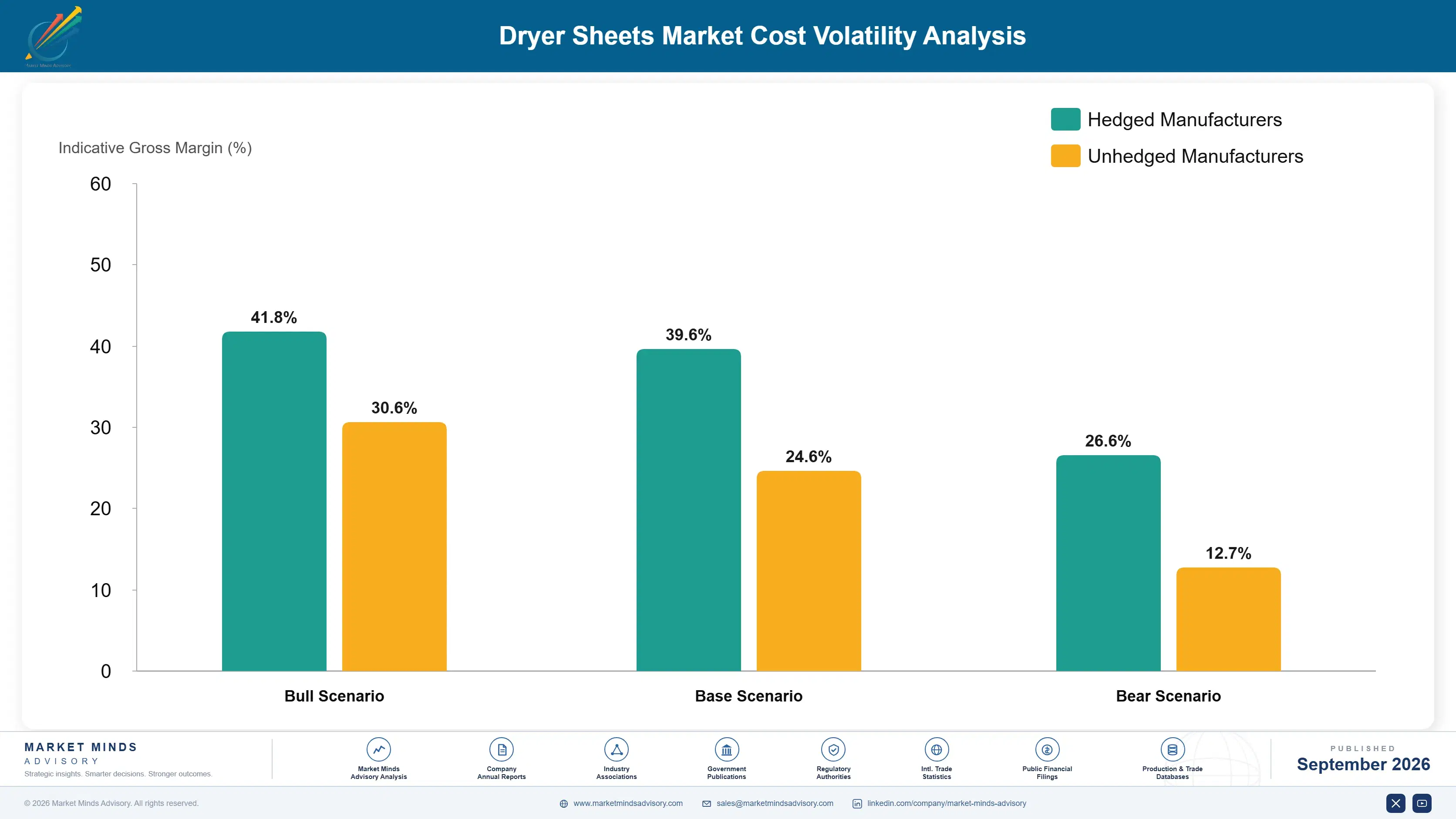
Fragrance and Substrate Cost Exposure

Fragrance compounds and nonwoven fabric softening agents represent roughly 19 percent of product cost of goods sold, sourced primarily from specialty chemical suppliers in Germany and the United States alongside nonwoven substrate manufacturers concentrated across China and Southeast Asia. This concentration leaves manufacturers exposed to petrochemical feedstock price swings that broader household chemical categories have already experienced firsthand.
Petrochemical feedstock volatility during 2022 pushed fragrance carrier and nonwoven substrate costs up considerably, forcing several household products manufacturers including dryer sheet producers to raise retail pricing multiple times within a single year. IEA industrial input price tracking data shows feedstock costs have since stabilized, though manufacturers report lingering caution around single-source fragrance supplier dependencies established during that period, prompting several brands to qualify a second fragrance carrier supplier as standard practice going forward.

Smaller specialty and private-label manufacturers without long-term petrochemical supply agreements face meaningfully worse input pricing than established conglomerates with existing supplier relationships, creating a durable cost disadvantage in branded premium positioning. This gap varies considerably by geography, with manufacturers in regions closer to petrochemical production generally securing better terms and shorter, more reliable delivery lead times from domestic suppliers.
dryer-sheets-market-cost-volatility-analysis-1790020041162

Dual-Source Fragrance Carrier Supply Agreements

Manufacturers increasingly qualify a second fragrance carrier and substrate supplier ahead of formulation lock-in, reducing exposure to single-source disruption risk. This approach adds modest upfront qualification cost but has proven worthwhile given how sharply feedstock prices moved during the last volatility cycle, when spot pricing swung sharply within just a few months for several key inputs.

Long-Term Petrochemical Feedstock Hedging Contracts

Larger manufacturers are locking in multi-year fixed-price feedstock contracts rather than relying on spot market purchasing, protecting margin during volatile pricing periods. This requires meaningful working capital commitment but reduces exposure to petrochemical price swings over the product's full multi-year development cycle, though it remains feasible mainly for manufacturers with sufficient annual purchase volume to secure favorable terms.

Portfolio Architecture for Margin Defence

The category splits into three margin tiers running from commodity-adjacent standard fragranced sheets through certified premium fragrance-free formats to next-generation compostable clinical-grade lines. Gross margin roughly doubles moving from the volume tier to the top next-generation tier, reflecting how much formulation sophistication and sustainability certification cost gets embedded in premium pricing. Manufacturers investing early in dermatology partnerships and compostable substrate research are generally best positioned to capture that widening spread over the coming decade.
Volume tier products compete almost entirely on price and shelf availability, while premium and next-generation tiers compete on dermatologist endorsement and sustainability certification credentials that justify considerably higher retail pricing. Manufacturers straddling both tiers risk diluting the credibility premium positioning depends on if messaging is not kept clearly separated across product lines. Retailers increasingly enforce category separation on shelf.

High-value margin pools concentrate heavily in fragrance-free hypoallergenic sheets and compostable plastic-free formats, the two fastest-growing segments identified earlier in this report. Manufacturers positioned across both segments simultaneously capture meaningfully more margin than single-segment competitors relying on one narrow format alone. MMA Analysis expects this concentration to deepen further as retailer sustainability mandates and clinical endorsement requirements tighten across most developed retail markets.

Volume / Commodity-Adjacent

Standard fragranced sheets and private-label formats sold through mass grocery and discount retail channels on price and shelf availability rather than formulation sophistication. Larger buyers negotiate aggressively on unit pricing given the thin margins throughout this tier.
Gross Margin: 22-30%

Premium / Certified

Fragrance-free and dermatologist-endorsed sheets sold through specialty and mainstream retail channels at a meaningful price premium over volume tier units and standard fragranced formats given specialized clinical positioning and dermatologist endorsement credentials.
Gross Margin: 38-46%

Sustainability / Regulatory / Next-Generation

Compostable substrate lines with plastic-free packaging and clinical endorsement, marketed through direct-to-consumer subscription channels and specialty retail at the top of category pricing, with certification depth reinforcing the premium these products command.
Gross Margin: 46-55%
dryer-sheets-market-portfolio-architecture-1790020041662

High-value Sub-segments and Strategic Watch-out

Fragrance-Free Hypoallergenic Sheets

The fastest-growing segment in the category, combining high unit margins with steady double-digit volume growth as dermatologist endorsement programs expand distribution. Manufacturers with the deepest clinical partnership networks capture the largest share of this pool as allergy awareness continues rising across most developed retail markets tracked.
Gross Margin: 48-56%

Compostable Plastic-Free Sheets

Strong margins paired with steady rather than explosive growth, driven by environmentally conscious consumers willing to pay a premium for reduced packaging waste. Retailer sustainability mandates continue to reinforce demand for this format among discount and mass grocery banners nationwide, particularly where sustainability commitments carry public reporting requirements.
Gross Margin: 42-50%

Standard Fragranced Sheets

The volume core of the category, generating the bulk of unit shipments at moderate margins through mass retail channels, providing the revenue base that funds premium tier product development. Growth here tracks household formation rather than any single product innovation cycle in a given calendar year.
Gross Margin: 24-31%

Unbranded Generic Sheets

A strategic watch-out segment facing the steepest margin pressure as private-label and unbranded competition intensifies, though it remains relevant in price-sensitive emerging retail markets for the next several coming years across most price-sensitive markets. MMA Analysis flags this as the segment most exposed to further private-label erosion.
Gross Margin: 12-18%

Habit Loops Anchor Repeat Purchase

Dryer sheets sell on pure repurchase habit rather than active consideration, with most households restocking the same brand and fragrance automatically at the point of exhaustion rather than comparison shopping. This annuity-like purchase pattern gives established brands meaningful pricing power, though it also means switching costs run low once a private-label alternative earns initial trial at a moment of price sensitivity or simple shelf availability.
Adoption stickiness varies considerably by end-use vertical. Households with sensitive-skin family members show the deepest brand loyalty once they find a fragrance-free formula that works, rarely switching afterward regardless of price. Budget-conscious households churn toward private label far more readily, while commercial laundromat operators show the strongest bulk purchase loyalty of any segment, prioritizing consistent bulk supply and reliable pricing over fragrance variety or brand prestige.

Buyer profiles are shifting generationally as younger renters in smaller households increasingly skip dryer sheets entirely in favor of dryer balls or fragrance-free liquid alternatives perceived as more sustainable. Older homeowning households remain the category's most reliable repeat buyers, a divide that is shaping how brands allocate marketing spend across generational cohorts, retail formats, and even individual product packaging this cycle.
dryer-sheets-market-end-use-penetration-index-1790020042152

Priorities For Category Participants

These are among the four positions where our research anticipates prominent divergence between winners and laggards over the coming forecast period. Each is grounded in the demand model, the regulatory perimeter, and the announced capacity pipeline.
01 / FRAGRANCE-FREE CREDIBILITY INVESTMENT

Build dermatologist endorsement credibility before rivals close the gap

Fragrance-free hypoallergenic sheets are growing considerably faster than the category overall, showing that clinical credibility already drives measurable purchase decisions rather than remaining a marginal shelf variant confined to niche retail sections. Manufacturers that continue relying on generic allergy claims risk losing the highest-margin segment to competitors who invest in dermatologist partnerships and published clinical validation studies. MMA Analysis expects clinical endorsement to become a baseline requirement for premium tier participation within roughly three years, not a differentiator, and laggards risk permanent share loss to better-prepared rivals.
02 / COMPOSTABLE PACKAGING TRANSITION

Accelerate compostable packaging conversion ahead of retailer mandates

Retailer plastic reduction commitments already determine shelf placement meaningfully, confirming that packaging sustainability converts directly into commercial access across most major grocery and discount retail channels tracked this cycle, a pressure that has intensified rather than eased over the past several years. Converting legacy packaging lines to compostable substrates takes years of reformulation and stability testing, meaning manufacturers who delay face a steadily widening compliance gap against faster-moving incumbents. Starting substrate conversion now protects shelf access well before retailers finalize formal compostability mandates.
03 / PRIVATE LABEL MARGIN DEFENSE

Defend branded margin through differentiation, not price matching

Private-label sheets priced meaningfully below national brands continue gaining shelf space, confirming that price matching alone erodes branded profitability faster than premiumization strategies built on genuine formulation differentiation. Building credible fragrance and clinical differentiation takes sustained marketing and research investment, meaning delayed investment compounds steadily into a widening private-label share gap over time. Manufacturers should prioritize premiumization now, ahead of rivals still competing primarily on price against increasingly capable store-brand formulas that have narrowed the perceived quality gap considerably in recent years.
04 / FEEDSTOCK COST HEDGING

Lock multi-year fragrance and feedstock supply agreements now

Petrochemical feedstock volatility already erodes margin meaningfully for manufacturers lacking fixed-price supply arrangements, particularly smaller specialty brands without the purchasing scale to negotiate favorable long-term terms with major chemical suppliers. Locking in multi-year agreements protects margin during the volatile periods that have repeatedly hit the category over the past several years of tracked feedstock pricing data. Manufacturers that delay hedging risk ceding pricing flexibility to better-capitalized rivals precisely when feedstock costs spike hardest across the global supply base, particularly during periods of sustained petrochemical price disruption.

Engagement Snapshot From the Field

A live engagement with an industry participant carrying material or product regulatory and market exposure ahead of a defining policy shift, showing how our research translates into a defensible multi-year portfolio strategy.
MARKET MINDS ADVISORY · CLIENT ENGAGEMENT SUMMARY
Dryer Sheets Producer Strategic Portfolio Review and Transition Roadmap 2026·Investment Scenario on Dryer Sheets Exposure Evaluation 2025-26
CLIENT PROFILE
The client is a mid-tier household products manufacturer headquartered in North America with an established portfolio of standard fragranced dryer sheets sold across mass grocery and discount retail channels. Annual revenue reported at approximately 165 million dollars (client-reported, unverified by MMA) across its fabric care division, with no prior investment in fragrance-free or compostable product lines ahead of this engagement.
STRATEGIC CHALLENGE
The client's standard product line faced margin compression as private-label competitors undercut its pricing across major grocery accounts. Leadership sought entry into the higher-margin fragrance-free segment but needed positioning that avoided direct competition with entrenched dermatology-endorsed incumbents on clinical credibility alone. Board pressure to demonstrate measurable progress within twelve months added further urgency.
MMA APPROACH
MMA conducted primary interviews with grocery retail buyers and allergy specialists alongside proprietary survey data across six countries to size addressable demand by segment and region. The engagement mapped competitive positioning against the client's existing brand equity and modeled dermatologist endorsement economics against comparable category benchmarks drawn from adjacent household care segments.
KEY FINDINGS
  1. Fragrance-free hypoallergenic sheets, the fastest-growing format in the category, offered the clearest entry path given the client's existing formulation expertise from its standard product line manufacturing.
  2. The client's existing grocery distribution relationships offered a credible advantage over digitally native challenger brands lacking established mass retail infrastructure across comparable regional markets.
  3. Clinical endorsement credibility proved the single largest barrier to premium segment entry, with retailers increasingly favoring brands holding formal dermatologist backing over unendorsed fragrance-free offerings.
  4. Partnering with an established dermatology research network emerged as a faster entry path than building original clinical credibility from scratch, cutting estimated time to market by roughly eleven months.
CLIENT PROFILE
The client is a mid-tier household products manufacturer headquartered in North America with an established portfolio of standard fragranced dryer sheets sold across mass grocery and discount retail channels. Annual revenue reported at approximately 165 million dollars (client-reported, unverified by MMA) across its fabric care division, with no prior investment in fragrance-free or compostable product lines ahead of this engagement.
STRATEGIC CHALLENGE
The client's standard product line faced margin compression as private-label competitors undercut its pricing across major grocery accounts. Leadership sought entry into the higher-margin fragrance-free segment but needed positioning that avoided direct competition with entrenched dermatology-endorsed incumbents on clinical credibility alone. Board pressure to demonstrate measurable progress within twelve months added further urgency.
MMA APPROACH
MMA conducted primary interviews with grocery retail buyers and allergy specialists alongside proprietary survey data across six countries to size addressable demand by segment and region. The engagement mapped competitive positioning against the client's existing brand equity and modeled dermatologist endorsement economics against comparable category benchmarks drawn from adjacent household care segments.
KEY FINDINGS
  1. Fragrance-free hypoallergenic sheets, the fastest-growing format in the category, offered the clearest entry path given the client's existing formulation expertise from its standard product line manufacturing.
  2. The client's existing grocery distribution relationships offered a credible advantage over digitally native challenger brands lacking established mass retail infrastructure across comparable regional markets.
  3. Clinical endorsement credibility proved the single largest barrier to premium segment entry, with retailers increasingly favoring brands holding formal dermatologist backing over unendorsed fragrance-free offerings.
  4. Partnering with an established dermatology research network emerged as a faster entry path than building original clinical credibility from scratch, cutting estimated time to market by roughly eleven months.
RECOMMENDED STRATEGY
Phase 1: Phase 1 (Months 1-6): Secure a dermatology research partnership and launch a limited pilot targeting existing grocery accounts in North America. Phase 2: Phase 2 (Months 7-12): Expand pilot data into a full endorsement package supporting broader retail listing negotiations across additional grocery markets. Phase 3: Phase 3 (Months 13-18): Scale endorsement partnerships nationally and evaluate a new compostable packaging line using the validated pilot results.
OUTCOME
Within the first year following the engagement, the client reported cross-sell conversion of 11 percent among existing grocery accounts and incremental revenue of approximately 13 million dollars (client-reported, unverified by MMA) attributable to the new fragrance-free line, ahead of internal targets set at project outset for the pilot phase.

Frequently Asked Questions

Foundational context covering the market sizes, CAGR, scope, country, region and competition that inform every finding below. This section is provided to cover basics and most often pre-purchase conversations, answered from the MMA Primary Research Dataset.

What is the current size of the Dryer Sheets Market?

The Dryer Sheets Market reached 4.8 billion dollars in base year 2025. Growth is driven by fragrance-free reformulation and expanding compostable packaging adoption across developed markets.

How large will the Dryer Sheets Market be by 2036?

The market is forecast to reach 7.627 billion dollars by 2036, roughly a 1.52 times expansion from 2026 levels. Growth concentrates in fragrance-free and compostable segments.

What is the CAGR for the Dryer Sheets Market 2026 to 2036?

The market is projected to grow at a 4.3 percent compound annual growth rate between 2026 and 2036. Bull and bear scenarios range from 3.0 to 5.5 percent depending on adoption pace.

Which segment is growing fastest?

Fragrance-Free Hypoallergenic Sheets lead at a 7.1 percent CAGR, roughly 1.65 times the overall market rate. Compostable Plastic-Free Sheets follow at 6.3 percent annual growth.

Who are the major companies in the Dryer Sheets Market?

Procter & Gamble, Church & Dwight, Henkel, Unilever, and Clorox lead the category. Together they hold a CR5 near 68 percent measured on global unit shipment volume across all major product formats.

Which country is growing fastest?

India leads country-level growth at a 6.5 percent CAGR, driven by expanding tumble dryer ownership and rising organized retail penetration, while the United States remains the largest single consumption market globally.

Report Segmentation Architecture

The full report scope spans multiple orthogonal segmentation dimensions, with cross-tabulated demand data provided for each dimension pair. Coverage extends further to regional breakdowns, trend trajectories, and the competitive detail needed to support segment-level decision-making.

By Formulation and Substrate Type

  • Fragrance-Free Hypoallergenic Sheets
  • Compostable Plastic-Free Sheets
  • Standard Fragranced Sheets
  • Reusable Wool Dryer Sheets
  • Unbranded Generic Sheets
  • Static-Control Specialty Sheets

By End-Use Industry

  • Household and Consumer Use
  • Commercial Laundromat Services
  • Hospitality and Hotel Laundry Services
  • Institutional and Healthcare Laundry Services
  • Rental Property Management Services

By Commercial Dimension

  • Mass Grocery Retail Distribution
  • Discount and Club Retail Channels
  • Direct-to-Consumer Subscription Sales
  • Private Label Manufacturing Agreements

By Region

  • North America
  • Western Europe
  • East Asia
  • South Asia and Pacific
  • Latin America
  • Middle East and Africa
  • Eastern Europe

Scope, Methodology, and Coverage

Every figure in this report is reproducible from documented input assumptions. The scope below maps the historical period, the forecast horizon, the segmentation dimensions, and the countries covered, alongside the underlying primary and qualitative methodology.
Historical Period
2020 to 2025
Forecast Period
2026 to 2036
Base Year
2025 (USD billions; MMA Primary Research Dataset, September 2026)
Market Definition
The Dryer Sheets Market covers single-use and reusable fabric softening sheets designed for tumble dryer use, including fragranced, fragrance-free, and compostable substrate formats sold through retail and direct-to-consumer channels. It excludes liquid fabric softener and dryer balls sold without a sheet substrate.
Quantitative Units
USD billions (current prices); unit volume in million units where applicable
Segmentation Dimensions
By Formulation and Substrate Type; By End-Use Industry; By Commercial Dimension; By Region
Regions Covered
North America, Western Europe, East Asia, South Asia and Pacific, Latin America, Middle East and Africa, Eastern Europe
Countries Covered
USA, China, Germany, France, UK, Japan, South Korea, India, Australia, Canada, Brazil, Mexico, Indonesia, Vietnam, Thailand, Malaysia, UAE, Saudi Arabia, South Africa, Nigeria, Turkey, Poland, Netherlands, Italy, Spain, Sweden, Switzerland, Argentina, Colombia, Singapore, and additional markets relevant to this sector
Key Companies Profiled
Procter & Gamble, Church & Dwight, Henkel, Unilever, Clorox, Colgate-Palmolive, Reckitt Benckiser, S.C. Johnson & Son, Kao Corporation, Method Products, Grab Green, Seventh Generation, Ecos, Mrs. Meyer's Clean Day, Sun Products Corporation, Melaleuca, Public Goods, Dropps, Molly's Suds, Attitude Living
Quantitative Methodology
Primary survey, n=3,800 respondents, Q4 2025, six countries; demand-side model with trade association cross-validation
Qualitative Methodology
47 expert interviews, Q4 2025; applied to validate demand model assumptions, identify emerging dynamics, and assess competitive positioning
Report Format
PDF and XLSX data workbook (Word format preview document)
Publisher
Market Minds Advisory
Report Code
MMA-2026-CON-514
Published
September 2026
Contact
sales@marketmindsadvisory.com | www.marketmindsadvisory.com

Purchase the full Dryer Sheets Market Report (2026 to 2036).

The full report provides granular segmentation across formulation type, end-use industry, and commercial channel, with ten-year forecasts through 2036 for all seven global regions. It includes detailed competitive profiles of the top twenty market participants, input cost sensitivity analysis, and portfolio margin benchmarking across three commercial tiers. Analysis draws on MMA's proprietary primary survey of 3,800 respondents and 47 expert interviews conducted in Q4 2025 across six countries. The report also includes an anonymized client case study illustrating practical premiumization strategy, alongside a full strategic verdict section covering priorities for category participants.
Ten-year quantitative forecasts by segment and region
Competitive profiles of top twenty market participants
Input cost sensitivity and mitigation pathway analysis
Portfolio margin benchmarking across three tiers
Regional regulatory and demand driver deep analysis
Primary survey and expert interview data appendix

Built For The People Who Decide

From boardroom strategy to bench-side execution, this report is read cover-to-cover by leaders shaping the next decade of their industry, turning demand scenarios, market dynamics and valuation benchmarks into decisions.
CXOs/ Presidents/ VPs/ Managers
M&A and Corporate Development
Strategy Teams and R&D Heads
Procurement and Product Directors
Regulatory and Compliance Leaders
Investor Relations and Equity Analysts