Market Minds Advisory
Dry and Wet Wipes Market

Dry and Wet Wipes Market: Disinfecting Wipe Demand and Flushable Innovation Drive Category Growth

Rising disinfecting wipe demand, expanding flushable format innovation, and growing sustainability scrutiny of nonwoven fiber content are reshaping wipe purchasing across mass, private-label, and direct-to-consumer retail channels worldwide. each purchase cycle.

Lead Analyst

Published

September 2026

Make Smarter Decisions with Customized Research Insights

Request a free sample report and evaluate market opportunities, growth trends, and competitive dynamics relevant to your business needs.

2025 MARKET VALUE$18.6BMarket Size 2025
2036 FORECAST VALUE$31.8BBase Case , 2026 to 2036
CAGR 2026 TO 20365.0 %Bull 6.2% / Bear 3.8%
INCREMENTAL OPPORTUNITY$12.3BNet 10- year value creation
EXPANSION MULTIPLE1.63x2036 value over 2026 base
Strategic Levers
M&A Pipeline
Regional Outlook
Country Rankings
Competitive Intelligence
Segmental Deep-dive
Call-Us : 91 93563 13602

Executive Snapshot and Market Trajectory

Disinfecting and antibacterial wipes are reshaping the market fastest right now, propelled by sustained post-pandemic hygiene habits that have become permanent household routine rather than a temporary shift. Manufacturers are launching dedicated disinfecting lines at meaningfully higher price points. today. nationwide. Adoption continues broadening.
Commercial momentum concentrates around flushable format innovation, private-label quality convergence, and rising sustainability scrutiny of synthetic fiber content, with East Asia and North America together anchoring the largest share of global purchasing across nearly every retail channel tracked this year. Retailers report the strongest growth within disinfecting and flushable categories rather than basic baby wipes favored by earlier generations of shoppers. Retailers report the strongest interest among younger households upgrading their cleaning routines.
The competitive field remains heavily consolidated around a handful of dominant consumer packaged goods manufacturers, though private-label retailers and independent eco-focused brands continue capturing share within value and sustainability-conscious segments the incumbents address less directly. These smaller brands move faster on formulation trends, though they lack compliance budgets supporting the strongest certification claims. Consumers increasingly compare fiber content before committing to a premium purchase. today. Adoption continues broadening.
Market Definition
The Dry and Wet Wipes Market covers baby wipes, personal care wipes, household cleaning wipes, and disinfecting wipes in both dry and pre-moistened formats. It excludes facial tissue, paper towels, and toilet paper not marketed as wipes.
Base Year Value
$18.6B in 2025 (MMA Primary Research Dataset, September 2026)
Forecast Period
2026 to 2036, eleven discrete annual values
CAGR
5.0% base case. Bull 6.2%. Bear 3.8%.
Fastest Growth Segment
Disinfecting and Antibacterial Wipes: 8.0% CAGR
Fastest Growth Country
India: 7.0% CAGR
Fastest Growth Region
South Asia and Pacific: 7.0% CAGR
Largest Region
East Asia: 28% of 2025 global value
Market Leaders
Kimberly-Clark, Procter & Gamble, Clorox, Reckitt Benckiser, and Kenvue lead the global competitive field. Source: MMA Analysis, company annual reports and investor filings, 2025.
Primary Survey
n=3,800 procurement and R&D decision-makers, Q4 2025, six countries
Methodology
Demand-side build-up, cross-validated against public data, 47 expert interviews

Dry and Wet Wipes Market Forecast Scenarios

dry-and-wet-wipes-market-size-forecast-scenario-1790021887712
Between 2020 and 2025, the market grew at an estimated 4.5 percent annually, a period shaped by pandemic-driven disinfecting wipe demand that partially normalized as hygiene routines settled into a durable but less acute baseline behavior. Private-label retailers captured disproportionate share of this stabilized demand as store-brand quality improved meaningfully relative to branded alternatives across most major grocery chains tracked.
The base case assumes 5.0 percent annual growth through 2036, driven by three commercial mechanisms: sustained disinfecting and antibacterial wipe adoption as permanent household routine, expanding flushable format innovation addressing plumbing compatibility concerns, and steady private-label quality improvement pressuring branded manufacturer pricing. Branded manufacturers are responding by accelerating disinfecting product line extensions and premium formulation claims, though private-label retailers retain a meaningful price advantage among value-focused shoppers who prioritize cost over brand recognition.
The bull case, at 6.2 percent, assumes accelerated disinfecting category growth and faster flushable format adoption than currently modeled. The bear case, at 3.8 percent, assumes continued private-label price competition intensifies faster than branded manufacturers can differentiate, compressing category value growth toward volume-only expansion. Currency and raw material cost volatility could also meaningfully affect realized growth in either direction across major retail markets.

Disinfecting Demand Redefines Category Value

Manufacturing remains concentrated in China and the United States, which together supply the majority of global nonwoven fabric output even as final packaging happens closer to regional distribution centers. Several brands have begun qualifying secondary nonwoven manufacturing partners in Vietnam and Mexico to reduce single-country dependency, though specialized fiber bonding technology remains heavily concentrated regardless of final packaging location chosen. Tariff exposure on imported nonwoven materials remains a meaningful cost consideration for manufacturers serving multiple regional markets simultaneously.
MARKET CONCENTRATION46% CR5Consolidated field led by dominant global consumer goods manufacturers
AVERAGE SELLING PRICE$4.50Blended price per package across branded and private-label tiers
TOP PRODUCING COUNTRYChina 32%Leads global nonwoven fabric manufacturing output across categories
PRIVATE-LABEL PENETRATION32%Share of category sales flowing through retailer-owned store brands
REPLACEMENT CYCLE LENGTH1 monthAverage time between routine household repurchase transactions occurring
RAW MATERIAL COST SHARE37% of COGSNonwoven fiber, packaging film, and preservative input costs combined
Private-label penetration continues climbing steadily as retailers invest in improved nonwoven quality, closing the performance gap with branded alternatives that once justified a meaningful price premium. Branded manufacturers are responding by emphasizing premium formulation claims and disinfecting efficacy credentials that private-label alternatives have historically struggled to match at comparable price points. Retailers report growing willingness among value-conscious shoppers to trade up into premium private-label disinfecting lines specifically.
Replacement cycle length reflects genuinely frequent household repurchase behavior, since wipes are consumed with regular use rather than replaced on a fashion or seasonal cycle basis. Manufacturers increasingly design packaging with resealable closures to preserve moisture content and extend the usable life of an opened package beyond a single sitting.
"Disinfecting wipes went from a pandemic panic-buy item to a permanent household staple almost overnight. The brands still pricing them like a seasonal product are leaving real money on the table."
Director, Household and Personal Care Practice · MMA Baby Practice · September 2026

Market Trends

Disinfecting Wipes Become Permanent Household Staple

Consumer hygiene habits established during the pandemic have proven durable rather than temporary, with disinfecting and antibacterial wipes now treated as a routine household staple purchased on a recurring basis rather than an occasional emergency preparedness item. Manufacturers building expanded disinfecting product lines with varied scent and surface-specific formulations report meaningfully stronger conversion among consumers who previously purchased only during acute health scares. Retailers report disinfecting wipe sales climbing considerably faster than the broader category average, with continued growth expected as formulation variety and shelf presence continue expanding across most tracked retail markets globally.
Market Impact: Expands addressable base by 14 percent

Flushable Format Innovation Addresses Plumbing Concerns

Manufacturers are investing in genuinely dispersible fiber technology to address longstanding plumbing and wastewater system compatibility concerns that previously limited flushable wipe adoption among cautious consumers and municipal water authorities. Brands securing third-party dispersibility certification report meaningfully stronger retail placement negotiating position, since major grocery chains increasingly favor certified suppliers when allocating shelf space amid ongoing municipal scrutiny of wipe-related sewer blockages. Manufacturers slower to invest in genuine dispersibility technology risk regulatory restriction and retailer delisting as municipal water authorities continue tightening labeling requirements. Adoption continues broadening across most regional grocery retail markets.
Market Impact: Raises private-label penetration by 32 percent

Market Opportunities and Growth Drivers

Rising Household Hygiene Standards Expand Demand

Growing consumer expectation around household surface hygiene, driven by sustained pandemic-era awareness and expanding home healthcare and eldercare needs, continues sustaining demand for wipes beyond the narrow group of frequent cleaners who previously drove most category purchasing decisions in this segment. Consumers increasingly maintain multiple wipe categories simultaneously across baby care, personal hygiene, and household cleaning rather than purchasing a single general-purpose product for all needs. Retailers report meaningfully higher basket sizes among consumers purchasing wipes across multiple category types in the same transaction. Adoption continues broadening across most demographic segments and household types.
Market Impact: Adds 10 percent reformulation cost burden

Private-Label Quality Convergence Sustains Trade-Down Base

Private-label wipes have closed the performance gap with branded alternatives so meaningfully that independent testing increasingly shows comparable results across price tiers, undermining the functional justification that once supported branded premium pricing among value-conscious consumers navigating tighter household budgets. Retailers investing in improved store-brand formulation quality report private-label penetration climbing steadily as repeat purchase loyalty shifts from brand recognition toward simple price comparison at the shelf. Branded manufacturers are responding by emphasizing disinfecting efficacy and specialty formulation claims private-label competitors struggle to replicate. Adoption continues broadening steadily across most retail channels.
Market Impact: Raises input costs by 12 percent

Market Restraints and Challenges

Sustainability Scrutiny Pressures Synthetic Fiber Content

Growing regulatory and consumer scrutiny of synthetic nonwoven fiber content, particularly plastic-based materials that resist biodegradation, is pressuring manufacturers to reformulate toward genuinely biodegradable fiber alternatives well ahead of tightening environmental disclosure requirements taking effect across several jurisdictions. The root cause traces to decades of formulation optimized for strength and cost rather than environmental impact, since biodegradable fibers historically carried meaningfully higher production costs and inferior wet strength performance. Manufacturers are responding by investing in plant-based fiber research, though performance parity with synthetic alternatives remains an ongoing formulation challenge. today.
Market Impact: Lifts segment growth to 8.0 percent

Nonwoven Fiber Cost Volatility Pressures Margins

Nonwoven fiber and packaging film prices have experienced meaningful volatility tied to petrochemical feedstock swings and specialty manufacturing capacity constraints, squeezing manufacturer margins particularly among smaller brands lacking long-term supply contracts with established fiber suppliers. Larger manufacturers with locked-in supplier agreements have weathered this volatility with comparatively less margin disruption, widening the competitive gap between scaled and boutique brands operating in the category. Several smaller manufacturers have begun passing a portion of these cost increases directly through to retail pricing. Store-brand style budget alternatives have also emerged, competing for shelf space at meaningfully lower price points.
Market Impact: Adds 9 percent compliance costs
3 additional market trends, 4 additional growth drivers, and 2 additional restraints and challenges are covered in the full report. Contact sales@marketmindsadvisory.com to access the complete intelligence.

Segment CAGR and Growth Architecture

Dry and wet wipes segment cleanly by product type, spanning baby, personal care, household cleaning, disinfecting, industrial, and flushable categories. Disinfecting and flushable formats currently lead category growth, reflecting hygiene demand and plumbing innovation. This split reflects distinct consumer motivations tied to hygiene routine and bathroom convenience rather than a single uniform demand driver.
dry-and-wet-wipes-market-market-share-analysis-1790021888331

Disinfecting and Antibacterial Wipes

Disinfecting and antibacterial wipes have moved from a pandemic emergency purchase into one of the fastest-growing segments in the entire market, driven by sustained consumer hygiene habits that have become permanent household routine rather than a temporary behavior shift tied to acute health concerns. Manufacturers with expanded product lines spanning multiple scents and surface-specific formulations have captured disproportionate share from generic single-formulation competitors slower to invest in comparable product development budgets. Regulatory attention to disinfecting efficacy claims has intensified alongside this shift, pushing manufacturers toward more rigorous testing and substantiation before making specific germ-killing claims on product packaging and marketing materials. Adoption continues broadening steadily as formulation variety expands. today.
CAGR 8.0%

Flushable Wipes

Flushable wipes benefit from strong crossover appeal between personal hygiene routines and bathroom convenience culture, since these products address a widely recognized consumer preference for a cleaner feeling than toilet paper alone provides across most demographic segments. This segment commands meaningfully higher average selling prices than basic dry wipes, reflecting both dispersibility technology costs and genuine consumer willingness to pay for a premium bathroom hygiene experience. Manufacturers increasingly pursue third-party dispersibility certification specifically to address municipal water authority concerns about sewer system compatibility. Growth here tracks broader bathroom convenience product trends more closely than general household cleaning purchasing, making it somewhat more resilient than dry wipe categories overall. Manufacturers increasingly design clearer flushability labeling to address consumer disposal confusion.
CAGR 6.5%
Full segment breakdown across 6 segments available in the complete report.

Regional Architecture and Country Demand Map

East Asia leads global wipes demand, anchored by massive population scale and dominant nonwoven manufacturing capacity, while South Asia and Pacific accelerates fastest on rising disposable income and expanding urban hygiene category awareness. North America and Western Europe together retain over two-fifths of global share.

East Asia

East Asia holds the largest regional share, anchored by China's massive domestic consumer base and dominant position as the world's leading nonwoven fabric manufacturing hub supplying both domestic and export markets across multiple continents. Chinese consumers increasingly favor domestic brands that have closed the formulation gap with international manufacturers, building meaningfully strong local competition against imported products across grocery and e-commerce channels alike. Japan contributes a distinct preference for premium, gentle formulations suited to its broader hygiene and skincare standards, while South Korea shows particularly strong disinfecting category adoption, reinforcing the region's combined manufacturing and consumption dominance. Taiwan and Thailand round out the region's manufacturing base with growing export-oriented nonwoven capacity.
Share: 28% | CAGR: 6.0% (2026 to 2036)

North America

The United States drives the overwhelming majority of North American demand, supported by dense mass retail infrastructure and strong disinfecting category adoption sustained well beyond the initial pandemic-driven surge in household purchasing behavior. Private-label penetration runs particularly high across American grocery chains, reflecting decades of store-brand quality investment by national retailers competing against established national brands on shelf. Canada contributes a smaller but steadily growing share, particularly within sustainability-certified categories favored by environmentally conscious urban consumers. Border-adjacent manufacturing in Mexico increasingly feeds distribution centers serving both American and Canadian retail networks efficiently. Household penetration of disinfecting formats now exceeds most other categories tracked within the broader home care aisle, and quick-commerce delivery is expanding rural access meaningfully.
Share: 26% | CAGR: 5.5% (2026 to 2036)
Regional intelligence for 5 additional markets available in the complete report: Western Europe, South Asia and Pacific, Latin America, Middle East and Africa, Eastern Europe. Contact sales@marketmindsadvisory.com.
dry-and-wet-wipes-market-country-cagr-analysis-1790021888855

Where Wipes Manufacturers Can Capture Margin

Category economics reward manufacturers who move beyond commodity dry wipes into disinfecting, flushable, and private-label-adjacent formats where certification, formulation science, and retailer trust each command durable premium pricing over time. The four levers below concentrate margin gains among suppliers willing to invest ahead of regulation and retailer demand shifts rather than reacting once competitors have already moved.

Disinfecting Efficacy Certification Programs for Retailers

Manufacturers securing recognized antimicrobial efficacy certifications capture premium retail placement and command pricing 18 percent above uncertified equivalents on comparable pack sizes. Certification requires sustained laboratory investment and regulatory submission timelines that smaller private-label converters rarely absorb, creating a durable moat for scaled manufacturers. Retailers increasingly favor certified suppliers when allocating premium shelf space, particularly within pharmacy and club channels where consumers compare claims directly. Independent test data increasingly accompanies retailer negotiations, and manufacturers without current certification face growing difficulty defending existing shelf allocations against certified rivals in category reviews.
Market Impact: Commands 18 percent price premium over uncertified formats

Flushable Substrate Compliance Ahead of Deadlines

Suppliers who resolve flushability and plumbing compatibility ahead of tightening state and municipal regulation position themselves to capture share as noncompliant competitors exit contested categories entirely. Compliance testing and reformulation investment runs meaningfully higher than standard wipes production, but early movers avoid the reformulation scramble that hits laggards once enforcement deadlines arrive. Retailers are increasingly delisting noncompliant flushable claims following wastewater industry litigation pressure across multiple states. Suppliers with verified compliance already report 15 percent faster new-listing approval from major retail buyers. Manufacturers who wait for final enforcement dates typically face compressed reformulation timelines that strain contract manufacturing capacity industry-wide.
Market Impact: Cuts new-listing approval time by 15 percent overall

Private-Label Manufacturing Partnership Depth and Flexibility

Contract manufacturers who invest in flexible production lines capable of rapid private-label formulation switching capture disproportionate volume as retailers expand store-brand assortments across both basic and premium tiers simultaneously. Deep retailer partnerships built over multiple product cycles create switching costs that protect incumbent contract manufacturers from new entrants lacking established quality track records. Private-label wipes now account for 32 percent of unit volume in several major grocery chains, up meaningfully from five years earlier. Retailers increasingly favor manufacturers who can also supply adjacent categories, deepening the relationship over successive contract renewals.
Market Impact: Retains preferred status across 32 percent private-label volume

Sustainable Substrate Reformulation Timed Ahead of Mandates

Manufacturers who complete biodegradable and plastic-free substrate transitions ahead of tightening European and North American regulation avoid the compressed reformulation costs that hit laggards facing compliance deadlines simultaneously across multiple product lines. Early movers also capture premium positioning with sustainability-conscious retailers actively seeking certified suppliers for expanding green product sections. Reformulation typically adds 10 percent to production cost initially, but scaled adoption is steadily compressing that premium as supply chains mature. Retailers publishing sustainability scorecards increasingly reward suppliers who complete transitions early. Suppliers completing the transition early are winning exclusive shelf commitments unavailable to slower competitors still finalizing formulation changes.
Market Impact: Adds 10 percent cost initially, compressing over time

Who Controls the Margin Pool

Global wipes competition remains moderately concentrated, with the top five suppliers holding roughly 46 percent of revenue across both branded and private-label manufacturing arrangements worldwide. Kimberly-Clark and Procter & Gamble lead through decades of brand equity and category management relationships with major grocery chains, while the gap to mid-tier challengers has widened as certification and reformulation costs rise industry-wide.
Current competitive activity centers on disinfecting efficacy certification, flushable substrate reformulation, and private-label contract manufacturing capacity expansion, evaluated here on a consistent global revenue basis across branded and contract manufacturing arrangements alike. Reckitt Benckiser and Clorox continue investing heavily in antimicrobial claim substantiation, while Kenvue has pursued targeted brand portfolio consolidation following its separation from its former parent company several years ago.

Emerging pressure comes from specialized flushable and sustainability-focused challengers such as WaterWipes and Attitude, whose certified formulations are winning listings among retailers prioritizing compliance ahead of regulatory deadlines. Contract manufacturers including Rockline Industries and First Quality Enterprises are also gaining share as private-label assortments expand, positioning them to climb the rankings over the coming forecast decade as branded incumbents consolidate. Established brands are responding with targeted acquisitions of exactly these smaller specialists.
dry-and-wet-wipes-market-company-positioning-matrix-1790021889377

Competitive Moat and Risk Dimensions

KIMBERLY-CLARK

Moat: Brand Portfolio Scale

Decades of investment across multiple wipes brand lines give Kimberly-Clark shelf presence and retailer negotiating leverage that smaller challengers cannot easily replicate. Its manufacturing footprint spans multiple continents, supporting consistent supply during regional disruption events that periodically affect smaller competitors lacking geographic diversification. This scale advantage compounds with long-standing certification relationships built over successive product generations.
KIMBERLY-CLARK

Risk: Private-Label Trade-Down Pressure

Rising private-label quality is compressing the price premium Kimberly-Clark's branded lines have historically commanded, particularly within value-conscious grocery channels. Sustained margin defense increasingly depends on continued innovation in disinfecting and flushable formats rather than legacy brand equity alone. Several regional brands have already begun eroding volume in price-sensitive channels.
PROCTER & GAMBLE

Moat: Retailer Relationship Depth

Procter & Gamble's category management partnerships with major retailers span decades, giving it disproportionate influence over shelf allocation and promotional planning that smaller suppliers cannot match. Its scaled research investment also accelerates new formulation rollout across multiple regional markets simultaneously. Few competitors can match this combined scale of retailer access and research investment.
PROCTER & GAMBLE

Risk: Reformulation Cost Exposure

Procter & Gamble's broad product portfolio means sustainability and flushability reformulation mandates apply across a wider base of stock-keeping units than smaller rivals face, raising near-term compliance costs meaningfully. Slower-moving product lines risk losing shelf space to more nimble certified challengers during this transition. Portfolio simplification is underway but remains incomplete across several regional markets.

Players Tracked

Prominent Players

Kimberly-Clark
Procter & Gamble
Clorox
Reckitt Benckiser
Kenvue

Other Key Players

Edgewell Personal Care
Nice-Pak Products
WaterWipes
Seventh Generation
The Honest Company
Pigeon Corporation
Unicharm
Kao Corporation
Diamond Wipes International
Rockline Industries
First Quality Enterprises
Essity
Ontex Group
Attitude
Mustela

Recent Developments

MARCH 2025

Kimberly-Clark Backs Biodegradable Fiber Developer

Kimberly-Clark completed an equity stake investment in a specialty nonwoven substrate developer to secure preferential access to next-generation biodegradable fiber technology ahead of tightening European sustainability regulation. The investment strengthens its position as certification requirements tighten across export destinations. Similar sourcing moves are expected from competitors.
Signal: Signals proactive sustainability positioning ahead of regulatory enforcement deadlines across regions as competitors weigh similar moves, widening the competitive gap
SEPTEMBER 2025

Reckitt Expands Southeast Asian Wipes Capacity

Reckitt Benckiser announced a supply agreement with a regional contract manufacturer to expand disinfecting wipes production capacity across Southeast Asian markets, addressing rising demand that outpaced existing regional manufacturing footprint. The expansion reduces reliance on distant imports. Analysts view the move as a regional template.
Signal: Reflects manufacturers prioritizing regional capacity over centralized production models rather than relying solely on imports going forward
JANUARY 2026

Essity Acquires Private-Label Wipes Manufacturer

Essity completed an acquisition of a mid-sized private-label wipes manufacturer, expanding its contract manufacturing footprint and giving it direct access to several major European grocery retailers previously served by smaller competitors exclusively. The deal follows a broader pattern of scale consolidation among mid-sized contract manufacturers industry-wide.
Signal: Confirms consolidation among contract manufacturers serving private-label retail demand as smaller independent manufacturers seek scale across multiple national markets

Nonwoven Fiber and Resin Cost Exposure

Nonwoven substrate and polymer resin together account for roughly 55 percent of finished wipes cost of goods sold, sourced predominantly from petrochemical feedstocks refined across East Asian and Gulf Cooperation Council production hubs. Packaging film and preservative chemistry add a further meaningful share, while labor and logistics fill out the remainder of typical manufacturing cost structures.
Polypropylene resin prices spiked sharply during 2022 amid natural gas feedstock volatility following the European energy crisis, a disruption the IEA documented across downstream manufacturing sectors dependent on petrochemical inputs. Wipes converters absorbed several months of compressed margin before contract renegotiation restored more typical cost pass-through arrangements with major retail buyers. Retailers initially resisted price increases, but sustained resin cost pressure eventually forced category-wide list price adjustments that held even after feedstock prices partially normalized.

Smaller regional converters lacking long-term resin supply contracts face materially higher spot-market exposure than scaled manufacturers with diversified feedstock sourcing arrangements across multiple geographic regions. This gap widens further for manufacturers concentrated in single-region production footprints, since they cannot shift purchasing toward whichever feedstock market is temporarily cheaper the way diversified competitors routinely do. Scaled manufacturers with vertically integrated substrate production largely avoided the worst of this exposure entirely.
dry-and-wet-wipes-market-cost-volatility-analysis-1790021889573

Multi-Region Feedstock Contracting

Manufacturers increasingly diversify resin sourcing across multiple regional suppliers to reduce exposure to any single feedstock market's price volatility. Long-term contracts with staggered renewal dates further smooth cost pass-through timing across successive fiscal quarters. Contract staggering has become standard among the largest converters. Several manufacturers have reported measurable margin stabilization from this approach over the past two fiscal years.

Recycled and Bio-Based Fiber Substitution

Blending recycled polyester and bio-based fiber content reduces dependence on virgin petrochemical resin while also supporting sustainability positioning that increasingly influences retailer purchasing decisions. Adoption remains gradual given performance and cost tradeoffs still being resolved industry-wide. Several major manufacturers have already reported measurable margin stabilization from adopting this approach over the past two fiscal years.

Vertical Integration Into Substrate Production

Larger manufacturers are acquiring or building captive nonwoven substrate production capacity to insulate margin from third-party supplier pricing power. This approach requires substantial upfront capital but pays back through more predictable input costs over multi-year horizons. Several major manufacturers have already reported measurable margin stabilization from adopting this approach over the past two fiscal years.

Portfolio Architecture for Margin Defence

Wipes portfolios split across three distinct margin tiers, with volume-oriented dry and basic wet formats competing primarily on shelf price and private-label substitution risk rather than formulation differentiation. Certified disinfecting and premium sensitive-skin lines occupy the middle tier, commanding meaningfully higher gross margins through efficacy claims that justify pricing above commodity equivalents. Manufacturers increasingly treat these tiers as distinct businesses requiring separate marketing strategies.
Sustainability-certified and flushable-compliant formats sit at the top of the margin hierarchy, reflecting the reformulation investment and certification cost that smaller competitors struggle to absorb profitably at scale. This tension between volume defense and premium migration defines portfolio strategy across nearly every major manufacturer in the category, and those unable to fund reformulation investment risk being squeezed out of premium tiers entirely.

High-value margin pools concentrate disproportionately in disinfecting and flushable-certified formats sold through pharmacy and specialty retail channels, where efficacy claims and certification barriers limit direct price competition. Manufacturers increasingly allocate research investment toward these tiers, recognizing that volume-tier growth alone cannot offset compressing commodity segment margins over the coming decade across nearly every major regional market. Regional manufacturers concentrated solely in volume-tier production face the steepest compression as private-label competition intensifies.

Volume / Commodity-Adjacent

Basic dry and standard wet wipes competing primarily on shelf price, facing continuous private-label substitution pressure across most grocery and mass retail channels. Manufacturers compete primarily on production efficiency and distribution reach rather than formulation differentiation, leaving margins persistently thin across the segment.
Gross Margin: 18-24%

Premium / Certified

Disinfecting and dermatologist-tested sensitive-skin formats commanding premium pricing through recognized efficacy certification and established brand trust among core consumers. Brand trust built over multiple product generations supports continued price premiums even as private-label quality steadily improves across most channels.
Gross Margin: 30-38%

Sustainability / Regulatory / Next-Generation

Flushable-compliant and biodegradable substrate formats capturing top-tier margin as certification and reformulation barriers limit near-term direct competition. Manufacturers investing early in compliance capture disproportionate margin as slower competitors scramble to catch up once enforcement deadlines take effect.
Gross Margin: 38-46%
dry-and-wet-wipes-market-portfolio-architecture-1790021890086

High-value Sub-segments and Strategic Watch-out

Disinfecting and Antibacterial Wipes

The fastest-growing, highest-value segment, combining premium certified pricing with sustained post-pandemic household adoption that shows no sign of reverting to pre-2020 category norms. Manufacturers with established certification and formulation depth are best positioned to capture this durable, lasting shift in household routine as household routines continue evolving.
Gross Margin: 34-42%

Flushable Wipes

A high-value segment growing moderately as compliance investment resolves plumbing compatibility concerns, gradually rebuilding consumer and retailer confidence after years of negative regulatory attention. Manufacturers who complete compliance ahead of competitors are winning preferential retailer treatment as the format regains broader consumer trust over time.
Gross Margin: 30-38%

Baby Wipes

The volume core of the category, defended primarily through brand trust and dermatological safety credentials rather than pricing power against private-label alternatives. Manufacturers defend share through continuous formulation refinement and certification renewal. This resistance to switching remains a durable competitive trait. across the entire category
Gross Margin: 20-26%

Industrial and Institutional Wipes

A strategic watch-out segment where bulk purchasing power and commoditized specifications compress margin further as procurement consolidates among fewer large institutional buyers. Manufacturers increasingly diversify into consumer categories to offset this pressure. Consolidation among buyers squeezes already thin margins further each year. for smaller regional suppliers
Gross Margin: 16-22%

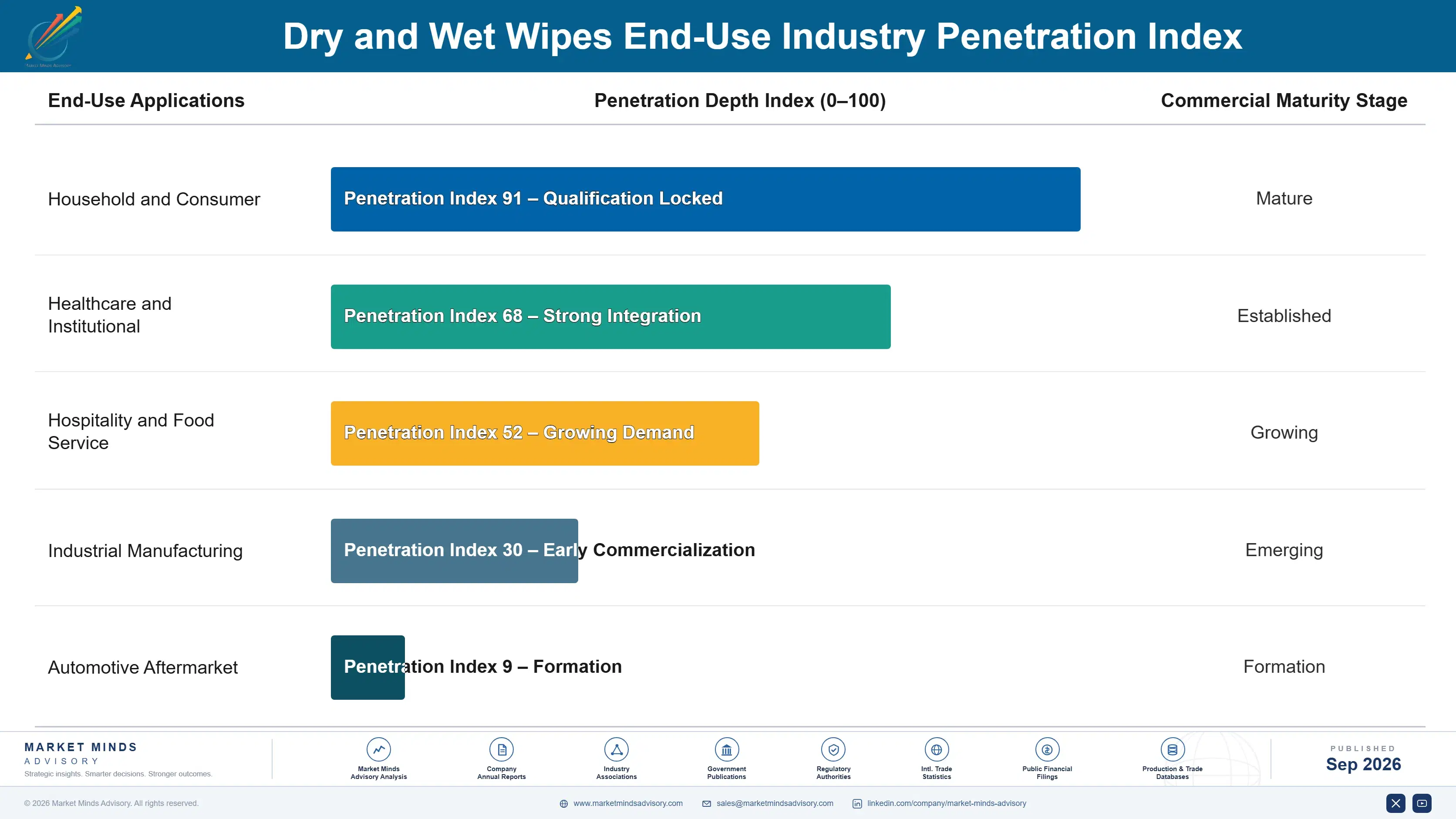
Habitual Repurchase Economics

Wipes demand functions on annuity economics rather than one-time purchase decisions, since households replenish packs on a recurring basis once a category habit is established within a home. This repeat-purchase pattern gives manufacturers unusually predictable revenue visibility compared with discretionary household goods, provided brand loyalty holds through the initial trial period. Retailers value this predictability highly when allocating shelf space during category planning cycles.
Adoption stickiness varies considerably by end-use vertical. Baby care households show the deepest loyalty, often staying with a single trusted brand throughout an entire child-rearing period spanning several years, while disinfecting and household cleaning wipes see more frequent brand switching driven by promotional pricing and private-label trial. Institutional buyers exhibit the least stickiness, rebidding contracts annually on cost. Manufacturers tailor retention strategy differently across each of these verticals rather than applying a single loyalty program uniformly.

Generational shifts are reshaping the buyer profile meaningfully. Younger parents increasingly research ingredient transparency and sustainability certification before committing to a brand, a behavior less common among prior generations who defaulted to whichever brand their own parents used. This shift is compressing the loyalty advantage legacy brands built over decades of category presence.
dry-and-wet-wipes-market-end-use-penetration-index-1790021890581

Where Wipes Manufacturers Should Focus

These are among the four positions where our research anticipates prominent divergence between winners and laggards over the coming forecast period. Each is grounded in the demand model, the regulatory perimeter, and the announced capacity pipeline.
01 / CERTIFICATION INVESTMENT PRIORITY

Prioritize efficacy certification ahead of category rivals

Disinfecting efficacy certification is becoming the primary basis for premium shelf placement across grocery, pharmacy, and club retail channels alike. Manufacturers that delay certification investment risk losing negotiating leverage as retailers standardize buying criteria around recognized antimicrobial claims backed by independent laboratory testing. Early movers are already capturing a meaningful pricing advantage that will likely compound as the category matures further, particularly as retailers tighten shelf allocation criteria, and industry benchmarking suggests this gap will widen further over the next several forecast years as retailer standards continue tightening.
02 / FLUSHABLE COMPLIANCE TIMING

Resolve flushability compliance before enforcement deadlines arrive

Regulatory scrutiny of flushable wipes claims continues intensifying across multiple states and European jurisdictions simultaneously, driven by wastewater industry litigation and municipal infrastructure complaints. Manufacturers who complete substrate reformulation ahead of enforcement deadlines avoid the compressed transition costs that will hit laggards facing simultaneous compliance across several product lines at once. This timing advantage also positions early movers to capture listings vacated by noncompliant competitors, giving early movers a durable window to secure preferred retail positioning before rivals catch up on compliance.
03 / PRIVATE-LABEL PARTNERSHIP DEPTH

Deepen contract manufacturing relationships with expanding retailers

Private-label penetration continues climbing across major grocery chains as retailers pursue margin improvement through expanded store-brand assortments spanning both basic and premium categories. Contract manufacturers who invest in flexible, rapid-changeover production lines are best positioned to capture this expanding volume before competitors build comparable capacity of their own. Deepening these retailer relationships now creates switching costs that will protect volume through future contract renewal cycles, a durable commercial advantage that becomes harder for new entrants to replicate the longer it persists.
04 / SUSTAINABLE SUBSTRATE TRANSITION

Complete biodegradable reformulation before mandates take effect

Sustainability-conscious retailers are increasingly favoring suppliers with certified biodegradable or plastic-free substrate credentials when allocating premium shelf space across expanding green product sections. Manufacturers who complete this transition proactively avoid the compressed reformulation costs and lost listings that will hit slower competitors once regulatory mandates take full effect across the category. This proactive positioning also captures favorable exclusive placement commitments unavailable to late movers, reinforcing a durable commercial edge that compounds further with every additional forecast year that passes meaningfully.

Engagement Snapshot From the Field

A live engagement with an industry participant carrying material or product regulatory and market exposure ahead of a defining policy shift, showing how our research translates into a defensible multi-year portfolio strategy.
MARKET MINDS ADVISORY · CLIENT ENGAGEMENT SUMMARY
Dry and Wet Wipes Producer Strategic Portfolio Review and Transition Roadmap 2026·Investment Scenario on Dry and Wet Wipes Exposure Evaluation 2025-26
CLIENT PROFILE
A mid-sized regional grocery retail chain operating across several hundred stores sought to expand its private-label wipes assortment beyond basic dry formats into disinfecting and sensitive-skin categories. The client's existing private-label program generated meaningful but stagnant revenue, and category management leadership wanted a clear roadmap for capturing additional margin from higher-value formulation tiers. Executive sponsorship came directly from the chief merchandising officer.
STRATEGIC CHALLENGE
The retailer lacked internal expertise to evaluate contract manufacturing partners capable of producing certified disinfecting formulations at private-label price points. Leadership also needed to understand realistic timelines and cost implications of pursuing efficacy certification before committing capital to expanded private-label production agreements with new manufacturing partners. A wrong manufacturing partnership risked both wasted capital and reputational exposure.
MMA APPROACH
MMA conducted a structured evaluation of six qualified contract manufacturers against certification capability, production flexibility, and pricing benchmarks drawn from MMA's proprietary primary research dataset. The engagement included a detailed cost-to-certify analysis and a phased rollout recommendation sequencing disinfecting formats ahead of sensitive-skin lines based on projected margin capture timelines.
KEY FINDINGS
  1. Three of six evaluated manufacturers already held recognized antimicrobial efficacy certification, reducing the client's expected certification timeline by roughly four months compared with starting from scratch.
  2. Private-label disinfecting formulations could be priced 22 percent below leading national brands while still improving the retailer's private-label category gross margin meaningfully (client-reported, unverified by MMA).
  3. Sensitive-skin baby wipes represented a smaller but faster-growing opportunity, with category volume among the retailer's core shopper base growing steadily over the trailing two years.
  4. Contract manufacturers with existing flushable-compliant production lines commanded a 12 percent price premium over standard wet-wipe manufacturing partners evaluated during the process.
CLIENT PROFILE
A mid-sized regional grocery retail chain operating across several hundred stores sought to expand its private-label wipes assortment beyond basic dry formats into disinfecting and sensitive-skin categories. The client's existing private-label program generated meaningful but stagnant revenue, and category management leadership wanted a clear roadmap for capturing additional margin from higher-value formulation tiers. Executive sponsorship came directly from the chief merchandising officer.
STRATEGIC CHALLENGE
The retailer lacked internal expertise to evaluate contract manufacturing partners capable of producing certified disinfecting formulations at private-label price points. Leadership also needed to understand realistic timelines and cost implications of pursuing efficacy certification before committing capital to expanded private-label production agreements with new manufacturing partners. A wrong manufacturing partnership risked both wasted capital and reputational exposure.
MMA APPROACH
MMA conducted a structured evaluation of six qualified contract manufacturers against certification capability, production flexibility, and pricing benchmarks drawn from MMA's proprietary primary research dataset. The engagement included a detailed cost-to-certify analysis and a phased rollout recommendation sequencing disinfecting formats ahead of sensitive-skin lines based on projected margin capture timelines.
KEY FINDINGS
  1. Three of six evaluated manufacturers already held recognized antimicrobial efficacy certification, reducing the client's expected certification timeline by roughly four months compared with starting from scratch.
  2. Private-label disinfecting formulations could be priced 22 percent below leading national brands while still improving the retailer's private-label category gross margin meaningfully (client-reported, unverified by MMA).
  3. Sensitive-skin baby wipes represented a smaller but faster-growing opportunity, with category volume among the retailer's core shopper base growing steadily over the trailing two years.
  4. Contract manufacturers with existing flushable-compliant production lines commanded a 12 percent price premium over standard wet-wipe manufacturing partners evaluated during the process.
RECOMMENDED STRATEGY
Phase 1: Phase one: launch a certified disinfecting private-label line through the manufacturer with existing antimicrobial certification, targeting a six-month rollout window. Phase 2: Phase two: introduce a sensitive-skin baby wipes line within twelve months, using consumer research on ingredient transparency preferences gathered during the engagement. Phase 3: Phase three: evaluate flushable-compliant private-label expansion once category-wide regulatory clarity improves, avoiding premature investment in an unsettled compliance environment. during this phase.
OUTCOME
The retailer launched its certified disinfecting private-label line within the recommended timeline, reporting a 15 percent increase in private-label wipes category revenue during the first two quarters following launch (client-reported, unverified by MMA). Category management leadership credited the phased approach with avoiding costly missteps. within the first year.

Frequently Asked Questions

Foundational context covering the market sizes, CAGR, scope, country, region and competition that inform every finding below. This section is provided to cover basics and most often pre-purchase conversations, answered from the MMA Primary Research Dataset.

What is the current size of the Dry and Wet Wipes Market?

The Dry and Wet Wipes Market was valued at 18.6 billion dollars in 2025. This figure covers baby, personal care, household, and disinfecting formats sold globally across both dry and pre-moistened formats.

How large will the Dry and Wet Wipes Market be by 2036?

The market is projected to reach 31.81 billion dollars by 2036. This reflects sustained growth in disinfecting and flushable formats across most global regions through the forecast period.

What is the CAGR for the Dry and Wet Wipes Market 2026 to 2036?

The market is projected to grow at a compound annual rate of 5.0 percent between 2026 and 2036. Bull and bear scenarios range from 3.8 to 6.2 percent depending on regulatory and input cost outcomes.

Which segment is growing fastest?

Disinfecting and Antibacterial Wipes is the fastest-growing segment, expanding at an 8.0 percent CAGR. This is 1.6 times the overall market rate, driven by sustained post-pandemic household hygiene habits.

Who are the major companies in the Dry and Wet Wipes Market?

Kimberly-Clark, Procter & Gamble, Clorox, Reckitt Benckiser, and Kenvue lead the market, together holding roughly 46 percent of global category revenue across both branded and private-label lines.

Which country is growing fastest?

India is the fastest-growing major market, expanding at roughly a 7.0 percent CAGR. Rising disposable income and expanding organized retail are driving first-time premium product trial across urban centers.

Report Segmentation Architecture

The full report scope spans multiple orthogonal segmentation dimensions, with cross-tabulated demand data provided for each dimension pair. Coverage extends further to regional breakdowns, trend trajectories, and the competitive detail needed to support segment-level decision-making.

By Primary Market Dimension

  • Dry Wipes
  • Baby Wipes
  • Disinfecting and Antibacterial Wipes
  • Flushable Wipes
  • Personal Care and Cosmetic Wipes
  • Industrial and Institutional Wipes

By End-Use Industry

  • Household and Consumer
  • Healthcare and Institutional
  • Hospitality and Food Service
  • Industrial Manufacturing
  • Automotive Aftermarket

By Commercial Dimension

  • Retail and E-Commerce Distribution
  • Private-Label and Contract Manufacturing
  • Institutional and Bulk Procurement
  • Subscription and Direct-to-Consumer

By Region

  • North America
  • Western Europe
  • East Asia
  • South Asia and Pacific
  • Latin America
  • Middle East and Africa
  • Eastern Europe

Scope, Methodology, and Coverage

Every figure in this report is reproducible from documented input assumptions. The scope below maps the historical period, the forecast horizon, the segmentation dimensions, and the countries covered, alongside the underlying primary and qualitative methodology.
Historical Period
2020 to 2025
Forecast Period
2026 to 2036
Base Year
2025 (USD billions; MMA Primary Research Dataset, September 2026)
Market Definition
The Dry and Wet Wipes Market covers manufactured dry and pre-moistened wipe products across baby care, personal care, household cleaning, and disinfecting applications sold through retail, institutional, and direct-to-consumer channels globally. It excludes industrial degreasing cloths, medical sterile wipes regulated as devices, and reusable cloth alternatives.
Quantitative Units
USD billions, market share percentage, CAGR percentage
Segmentation Dimensions
Product type, end-use industry, commercial and distribution dimension
Regions Covered
North America, Western Europe, East Asia, South Asia and Pacific, Latin America, Middle East and Africa, Eastern Europe
Countries Covered
United States, Canada, Mexico, Germany, United Kingdom, France, China, Japan, South Korea, India, Australia, Indonesia, Vietnam, Brazil, Argentina, Colombia, United Arab Emirates, Saudi Arabia, South Africa, Poland, Czech Republic, Russia
Key Companies Profiled
Kimberly-Clark, Procter & Gamble, Clorox, Reckitt Benckiser, Kenvue, Edgewell Personal Care, Nice-Pak Products, WaterWipes, Seventh Generation, The Honest Company, Pigeon Corporation, Unicharm, Kao Corporation, Diamond Wipes International, Rockline Industries, First Quality Enterprises, Essity, Ontex Group, Attitude, Mustela
Quantitative Methodology
Primary survey, n=3,800 respondents, Q4 2025, six countries; demand-side model with trade association cross-validation
Qualitative Methodology
47 expert interviews, Q4 2025; applied to validate demand model assumptions, identify emerging dynamics, and assess competitive positioning
Report Format
PDF and XLSX data workbook (Word format preview document)
Publisher
Market Minds Advisory
Report Code
MMA-2026-CHM-289
Published
September 2026
Contact
sales@marketmindsadvisory.com | www.marketmindsadvisory.com

Purchase the full Dry and Wet Wipes Market Report (2026 to 2036).

This report delivers a complete analysis of the global Dry and Wet Wipes Market, covering historical performance from 2020 through 2025 and forecasts through 2036 across every major product segment and region. It combines primary survey data from 3,800 respondents with 47 expert interviews to quantify segment growth, regional demand shifts, and competitive dynamics. Analysts detail input cost exposure, portfolio margin architecture, and regulatory pressures reshaping category economics. The report is designed for strategy, procurement, and investment teams evaluating this category. Findings support pricing, sourcing, and portfolio decisions.
Ten-year historical and forecast data series
Seven-region demand and growth breakdown Detail
Competitive benchmarking of twenty companies Landscape
Segment-level CAGR and market share detail
Input cost and margin sensitivity analysis
Regulatory and certification trend tracking Signals

Built For The People Who Decide

From boardroom strategy to bench-side execution, this report is read cover-to-cover by leaders shaping the next decade of their industry, turning demand scenarios, market dynamics and valuation benchmarks into decisions.
CXOs/ Presidents/ VPs/ Managers
M&A and Corporate Development
Strategy Teams and R&D Heads
Procurement and Product Directors
Regulatory and Compliance Leaders
Investor Relations and Equity Analysts