

Market Minds Advisory
Drum Pump Market

Drum Pump Market: Hazardous Liquid Transfer and Fleet Electrification

Hazardous liquid handling rules are pushing chemical distributors and pharmaceutical formulators toward certified pneumatic and rotary drum pumps, while PFAS-restricted elastomer sourcing and fleet replacement cycles reshape which manufacturers win procurement contracts across regions.

Lead Analyst

David Horsley

Published

September 2026

Make Smarter Decisions with Customized Research Insights

Request a free sample report and evaluate market opportunities, growth trends, and competitive dynamics relevant to your business needs.

2025 MARKET VALUE$1.8BMarket Size 2025
2036 FORECAST VALUE$3.6BBase Case , 2026 to 2036
CAGR 2026 TO 20366.4 %Bull 7.6% / Bear 5.2%
INCREMENTAL OPPORTUNITY$1.6BNet 10- year value creation
EXPANSION MULTIPLE1.85x2036 value over 2026 base
Strategic Levers
M&A Pipeline
Regional Outlook
Country Rankings
Competitive Intelligence
Segmental Deep-dive
Call-Us : 91 93563 13602

Executive Snapshot and Market Trajectory

Chemical distributors nationwide are retiring hand-crank and unsealed drum pumps well ahead of schedule as hazardous-transfer audits tighten sharply across every major jurisdiction worldwide, and that accelerated early-replacement wave has quickly become the single largest swing factor shaping near-term order books industry-wide, buyers now report consistently across nearly every segment.
Growth concentrates heavily in pneumatic and electric rotary units serving specialty chemicals, agrochemical repackaging operations, and pharmaceutical intermediate handling, with East Asia's rapidly expanding contract-manufacturing base absorbing a disproportionate share of new plant-level pump installations through the coming decade, even as North American and European buyers drive parallel replacement demand tied directly to tightening hazardous-materials certification requirements enforced at the individual plant level across nearly every major market segment currently tracked by regional distributors.
Five manufacturers hold under four in ten dollars of category spend today, leaving considerable room for regional challengers that undercut established players on service response time and local certification support rather than competing purely on manufacturing scale or plant footprint. Explosion-proof certification and PFAS-free seal sourcing now separate genuinely qualified bidders from legacy competitors still selling uncertified equipment into markets where enforcement is tightening fastest this year.
Market Definition
The drum pump market covers portable and fixed pumps engineered to transfer liquids from 55-gallon drums, intermediate bulk containers, and barrels, including rotary, centrifugal, pneumatic diaphragm, piston, peristaltic, and immersion-tube designs. It excludes fixed process piping pumps, submersible sump pumps, and general-purpose transfer pumps not built to drum or IBC bung fittings.
Base Year Value
$1.8B in 2025 (MMA Primary Research Dataset, August 2026)
Forecast Period
2026 to 2036, eleven discrete annual values
CAGR
6.4% base case. Bull 7.6%. Bear 5.2%.
Fastest Growth Segment
Air-Operated Diaphragm (AODD) Drum Pumps: 9.6% CAGR
Fastest Growth Country
India: 9.2% CAGR
Fastest Growth Region
South Asia and Pacific: 8.4% CAGR
Largest Region
East Asia: 28% of 2025 global value
Market Leaders
Lutz Pumpen, Graco, PSG (Wilden), Ingersoll Rand (ARO), and Flux-Geräte. Source: MMA Analysis based on company annual reports and disclosed segment revenue.
Primary Survey
n=3,800 procurement and R&D decision-makers, Q4 2025, six countries
Methodology
Demand-side build-up, cross-validated against public data, 47 expert interviews

Drum Pump Market Forecast Scenarios

drum-pump-market-size-forecast-scenario-1787302863573
Between 2020 and 2025 the market expanded at roughly 5.4% a year on average, a trajectory held back early on by pandemic-era plant shutdowns before rebounding strongly on deferred maintenance spending and a wave of new chemical distribution capacity added steadily across Southeast Asia, India, and parts of Eastern Europe during the broader post-pandemic recovery period overall.
The base case assumes 6.4% annual growth through 2036, driven by three distinct commercial mechanisms operating together across the forecast window: mandatory hazardous-transfer equipment audits now spreading across chemical distribution sites worldwide and forcing rapid fleet renewal, rising IBC-to-drum repackaging volume tied directly to agrochemical export growth across South and Southeast Asia, and fleet electrification steadily displacing pneumatic units wherever compressed-air infrastructure remains unavailable or prohibitively costly to install from scratch at newer facilities.
A bull case near 7.7% follows if the EU's revised REACH restrictions force accelerated fleet-wide replacement of PTFE and PFAS-containing seals across every member state simultaneously and ahead of schedule. A bear case near 5.1% follows instead if lower-cost compressed-air pneumatic units retain share longer than expected in cost-sensitive Southeast Asian and South Asian plants still weighing capital outlay against near-term compliance risk carefully.

Fleet Replacement Cycles and Certification Pressure

Three forces converge on drum pump procurement decisions this decade: tightening hazardous-material handling rules across most jurisdictions worldwide, PFAS-restricted elastomer sourcing reshaping seal chemistry from the ground up, and the steady electrification of plant floors that once relied entirely on compressed air for every pumping task. Buyers increasingly treat the pump as a compliance asset rather than an interchangeable commodity tool bought purely on price alone today.
MARKET CONCENTRATIONCR5 38%share held by top five suppliers by revenue
AVERAGE SELLING PRICE$340-$1,850range spans portable rotary to pneumatic diaphragm units
TOP PRODUCING COUNTRYChina, 31% shareof global manufacturing output measured by shipment value
CAPACITY UTILISATION71%average rate across surveyed drum pump assembly plants
IMPORT PENETRATION44%share of North American demand met via imports
REPLACEMENT CYCLE5-7 yearstypical service life before plants retire a unit
Commercial character has shifted noticeably from single-unit distributor sales toward multi-year plant maintenance contracts that bundle pumps, seals, and calibration service into one recurring agreement spanning several years at once. Original equipment manufacturers able to guarantee certified seal availability across a ten-year horizon are winning larger framework agreements from major chemical distributors managing compliance across several sites simultaneously, reshaping how procurement teams evaluate long-term supplier relationships.
Over the next decade, explosion-proof certification, battery-powered portability, and PFAS-free seal chemistry will keep separating qualified suppliers from legacy competitors still selling uncertified hand pumps into markets where audit enforcement is tightening fastest, particularly across South Asia and parts of Latin America where regulatory oversight capacity is only now catching up meaningfully with more established Western jurisdictions.
"The pump itself rarely fails first anymore. It is the seal chemistry that determines whether a plant passes its next hazardous-materials audit, and that has quietly become the real product being sold to every serious buyer."
Director, Industrial Equipment Practice · MMA Industrial Equipment Practice

Market Trends

PFAS-Free Seal Chemistry Becomes a Bid Requirement

US EPA reporting rules under the 2024 PFAS reporting framework and the EU's proposed PFAS restriction under REACH are pushing plant buyers to specify fluorine-free elastomers in new pump tenders across nearly every major chemical-handling jurisdiction. Manufacturers that reformulated seal chemistry ahead of the mandate, replacing PTFE compounds with UHMWPE and modified PVDF blends, are now listed on preferred-supplier schedules at chemical distributors across eleven EU member states already. Distributors report seal-related warranty claims falling by roughly a third on reformulated units, reinforcing the case for early compliance rather than waiting on enforcement dates to force the issue.
Market Impact: Drives 60,000 forced replacements y

Battery-Electric Portable Units Displace Compressed Air

Plants without existing compressed-air infrastructure, particularly newer contract-manufacturing sites across Vietnam, India, and Poland, are increasingly specifying battery-electric rotary drum pumps rather than installing brand-new pneumatic supply lines from scratch. Lithium-iron-phosphate battery packs now deliver a full eight-hour shift of intermittent pumping on a single charge, closing the runtime gap that once favoured pneumatic units decisively over any battery-powered alternative. Three of the five largest manufacturers launched battery-electric product lines between 2023 and 2025 alone, and distributor order data shows battery units taking share fastest in facilities under five years old that never installed compressed-air trunk lines at all.
Market Impact: Adds 4.6 percent yearly demand

Market Opportunities and Growth Drivers

Hazardous-Transfer Audit Mandates Across Chemical Distribution

OSHA's revised hazardous-materials handling guidance and equivalent European Chemicals Agency inspection protocols now require documented, certified transfer equipment at chemical distribution sites, replacing informal hand-pump practices still common at many smaller regional distributors nationwide. Facilities cited for uncertified equipment face remediation timelines as short as ninety days in some jurisdictions, forcing rapid replacement purchases rather than planned, budgeted fleet renewal. Distributors serving multiple states or countries are standardising on a single certified pump family across every site, concentrating purchasing power with manufacturers able to supply consistent certification paperwork reliably across markets.
Market Impact: Delays 22 percent of upgrades

Agrochemical Repackaging Growth Across South and Southeast Asia

India's Ministry of Commerce reports agrochemical formulation exports climbing steadily as domestic contract manufacturers repackage bulk agrochemical imports into smaller distribution containers intended for regional resale, a process that requires certified drum-to-drum and drum-to-IBC transfer pumps rated specifically for corrosive liquids. New formulation capacity added across Gujarat and Maharashtra since 2023 has pulled forward pump orders from both domestic manufacturers and export-oriented contract packagers alike, well ahead of previous planning cycles. Vietnam and Indonesia show a broadly similar pattern as agrochemical import volumes climb and local repackaging capacity expands to serve neighbouring Southeast Asian markets more directly than before.
Market Impact: Costs suppliers 7 percent volume

Market Restraints and Challenges

Compressed-Air Infrastructure Lock-In at Legacy Plants

Older chemical and manufacturing plants built around centralised compressed-air systems face a genuine switching cost when evaluating battery-electric alternatives, since that trunk-line infrastructure represents decades of sunk capital plant managers remain reluctant to strand prematurely. The root cause is capital budgeting practice that treats infrastructure and equipment replacement as separate line items reviewed on different cycles, so pneumatic pumps keep getting replaced with more pneumatic pumps by default rather than deliberate choice. Manufacturers are mitigating this by offering hybrid units that run on either compressed air or battery power from the same housing.
Market Impact: Adds 9 compliance-driven wins

Counterfeit and Uncertified Units in Price-Sensitive Markets

Distributors across several South and Southeast Asian markets report counterfeit pumps carrying falsified explosion-proof certification marks, undercutting legitimate suppliers on price while creating genuine safety exposure at buyer sites. The root cause is fragmented import inspection capacity at smaller regional ports, where certification marks are rarely verified against issuing-body databases before customs clearance is granted. The commercial impact falls hardest on certified manufacturers competing against units that skip certification costs entirely. Trade bodies are piloting QR-code verification systems letting buyers confirm authenticity before purchase, though adoption remains uneven across smaller distributors.
Market Impact: Shifts 14 percent to battery
3 additional market trends, 2 additional growth drivers, and 4 additional restraints and challenges are covered in the full report. Contact sales@marketmindsadvisory.com to access the complete intelligence.

Segment CAGR and Growth Architecture

Segmentation follows pump technology and drive mechanism, the dimension that determines certification pathway, seal chemistry compatibility, and which end markets a given pump design can legally serve under current hazardous-transfer regulation across major jurisdictions today, since technology choice drives compliance cost more directly than any other single design factor considered carefully during procurement decisions.
drum-pump-market-market-share-analysis-1787302864118

Air-Operated Diaphragm (AODD) Drum Pumps

AODD pumps are pulling ahead because their sealless diaphragm design eliminates the shaft-seal failure point that drives most warranty claims on rotary and centrifugal units, and because compressed-air operation remains inherently explosion-proof without added certification cost. Chemical distributors handling flammable solvents increasingly specify AODD as the default choice above a defined flash-point threshold set by internal safety policy. Growth concentrates in facilities that already run compressed-air infrastructure, where the marginal cost of adding a drum pump stays low. Manufacturers including Wilden and ARO have expanded AODD lines with PFAS-free diaphragm materials, and distributor order books show AODD share climbing fastest in pharmaceutical intermediate handling, where sealless design reduces cross-contamination risk between production batches.
CAGR 9.6%

Peristaltic and Electromagnetic Drum Pumps

Peristaltic and electromagnetic designs form the second-fastest category, favoured wherever gentle, shear-free flow matters more than raw throughput, particularly across biotech intermediate handling and high-viscosity specialty chemical transfer applications common at pharmaceutical and biotech sites worldwide. The tubing-based design keeps the liquid entirely isolated from moving parts, which simplifies cleaning validation considerably for pharmaceutical contract manufacturers operating under current good manufacturing practice requirements. Growth concentrates among smaller-volume, higher-value applications rather than bulk distribution, keeping unit shipment counts modest relative to overall revenue growth this decade. Tubing replacement cost remains the main friction point, but manufacturers are responding with faster-change tubing cartridges engineered to cut changeover time for high-mix production environments significantly.
CAGR 8.3%
Full segment breakdown across 6 segments available in the complete report.

Regional Architecture and Country Demand Map

East Asia leads on manufacturing scale and domestic chemical distribution volume, while South Asia and Pacific grows fastest on agrochemical repackaging capacity expansion across several key exporting countries in the region. North America and Western Europe compete mainly on certification-driven replacement demand rather than raw new-unit growth.

North America

OSHA's hazardous-materials handling revisions form the dominant demand mechanism here, forcing chemical distributors across the United States and Canada into documented equipment upgrade cycles on timelines as short as ninety days after a citation is issued. Roughly 44% of regional demand is met through imports, mostly from German and Japanese manufacturers supplying certified pneumatic and rotary units, since domestic production capacity has not kept pace with this replacement wave. Distributors are consolidating purchasing onto fewer certified suppliers to simplify multi-state audit documentation, concentrating share gains among manufacturers able to guarantee consistent certification paperwork across jurisdictions. Battery-electric adoption is rising fastest at newer Sun Belt facilities that never installed compressed-air trunk lines.
Share: 24% | CAGR: 6.8% (2026 to 2036)

Western Europe

The EU's proposed PFAS restriction under REACH is reshaping seal chemistry specification across chemical distribution sites in Germany, France, and the Benelux countries faster than in any other region worldwide, and manufacturers headquartered here, including Lutz and Flux, moved earliest of all to reformulate their full product lines ahead of rivals. Growth trails the global average because the region's plant fleet is already largely certified, leaving replacement demand as the primary driver of new orders placed. German distributors report seal-related warranty claims falling markedly on reformulated units, reinforcing an early-mover advantage over imports still selling older PTFE-based designs. Eastern member states within this reporting boundary are catching up more slowly still.
Share: 20% | CAGR: 4.9% (2026 to 2036)
Regional intelligence for 5 additional markets available in the complete report: East Asia, South Asia and Pacific, Latin America, Middle East and Africa, Eastern Europe. Contact sales@marketmindsadvisory.com.
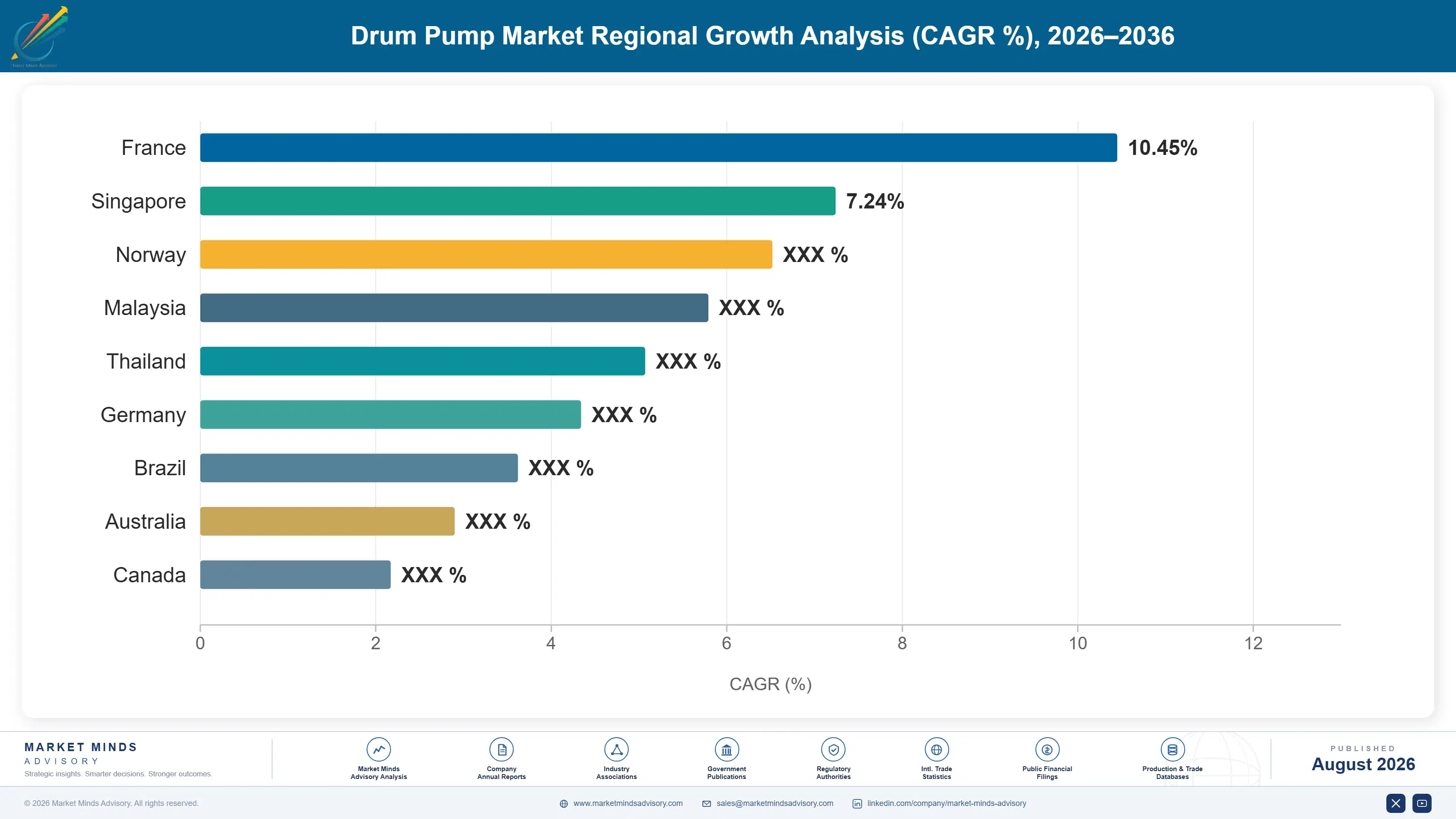
drum-pump-market-country-cagr-analysis-1787302864652

Certification, Service Contracts, and Seal Chemistry

Manufacturers are shifting revenue steadily away from one-time unit sales toward recurring service contracts and certified consumables, capturing more of the total cost of ownership rather than competing purely on the upfront price of the pump alone, a shift that is reshaping margin structures and sales team incentives across the whole industry this year.

Bundled Seal and Consumable Subscription Programmes

Manufacturers including Lutz and Graco now offer subscription-based seal and diaphragm replacement programmes bundled with the initial unit sale, guaranteeing certified PFAS-free consumables delivered on a fixed schedule rather than reordered ad hoc whenever a failure occurs unexpectedly on site. This converts a single equipment sale into a recurring revenue stream worth roughly 18% of the original unit price annually, while giving distributors a documentation trail that simplifies hazardous-materials audits across every site they manage. Early adopters report subscription attach rates above 40% on new pneumatic and electric sales this year.
Market Impact: Adds 18 percent recurring revenue p

Certification Documentation Service for Multi-Site Distributors

Rather than selling equipment alone, several manufacturers now offer a certification documentation service that tracks each installed unit's inspection history, seal replacement dates, and compliance status across a distributor's multi-state or multi-country fleet continuously and in real time. This addresses a real commercial pain point around audit preparation, which previously required manual record-keeping spread across many sites and staff. Distributors pay a per-unit annual fee for this service, and early pricing suggests the model adds meaningful margin without additional hardware sales, shortening sales cycles by roughly 6 weeks on average across accounts.
Market Impact: Shortens distributor sales cycles b

Battery-Electric Retrofit Kits for Installed Pneumatic Fleets

Rather than requiring a full unit replacement, manufacturers are selling retrofit kits that convert existing pneumatic drum pump housings to battery-electric operation, letting plant managers electrify incrementally without stranding mechanical components already installed on site today. This lever captures revenue from the entire installed base rather than only new unit sales, extending the addressable market to every pneumatic pump already in active service across the industry. Retrofit kit pricing sits at roughly 55% of a full replacement unit's cost, an economics that most plant budget owners find genuinely attractive right now during planning cycles.
Market Impact: Captures 55 percent of full replace

Extended Warranty Tiers Tied to Certified Seal Usage

Manufacturers are introducing tiered warranty programmes that extend coverage length in exchange for a commitment to use only manufacturer-certified replacement seals and diaphragms rather than lower-cost third-party equivalents, closing a margin leak that previously flowed straight to aftermarket parts suppliers instead. Extended tiers typically add two to three years of coverage beyond the standard warranty period, and distributor feedback suggests buyers genuinely value the predictability this brings to budgeting. Manufacturers report aftermarket parts revenue capture rising by roughly 30% among customers enrolled in extended tiers this year compared to standard-warranty customers overall.
Market Impact: Recaptures 30 percent of aftermarke

Who Controls the Margin Pool

Five manufacturers hold a combined 38% of revenue on a consistent company-disclosed segment revenue basis, a moderate concentration level that leaves meaningful room for regional challengers competing on service response time and local certification support rather than attempting to out-scale global leaders directly on manufacturing volume, plant footprint, or raw unit shipment count alone across every market they serve.
Current competitive activity centres on three fronts at once: PFAS-free seal reformulation racing to meet EU restriction timelines ahead of enforcement, battery-electric product launches targeting plants without existing compressed-air infrastructure already installed on site, and certification documentation services aimed at winning multi-site distributor framework agreements away from smaller single-unit competitors still selling piecemeal into fragmented regional markets across Asia and Latin America.

Pressure is building steadily from Chinese manufacturers moving up the value chain from unbranded OEM supply toward certified branded units carrying their own explosion-proof approvals, a shift that could compress pricing meaningfully for mid-tier competitors in East Asia and South Asia fastest, where import price sensitivity remains highest among smaller distributors and regional repackaging operations still price-driven today above all else, ahead of certification depth or service quality.
drum-pump-market-company-positioning-matrix-1787302865222

Competitive Moat and Risk Dimensions

LUTZ PUMPEN GMBH

Moat: Certification breadth across markets

Lutz holds explosion-proof and hazardous-liquid certifications across more jurisdictions than most competitors, letting multi-country distributors standardise on a single supplier for audit consistency across every site they manage. That breadth took years of sustained investment to build and remains difficult for smaller rivals to replicate quickly across every market they would need to match today.
LUTZ PUMPEN GMBH

Risk: Premium pricing under import pressure

Lutz prices toward the upper end of the market, which works well while certification remains the deciding factor, but leaves exposure if Chinese manufacturers achieve comparable certification breadth at meaningfully lower price points, particularly across South Asian and Southeast Asian markets where price sensitivity remains highest among buyers today.
GRACO INC.

Moat: Distribution network and brand recognition

Graco's broader industrial pump distribution network, built across decades of adjacent product categories sold through the same channels, gives its drum pump line shelf space and buyer familiarity that specialist competitors simply lack, particularly among North American industrial distributors who already stock other Graco product lines regularly.
GRACO INC.

Risk: Specialist competitors on certification depth

As a broader industrial equipment manufacturer, Graco's drum pump certification portfolio runs narrower than specialists like Lutz or Flux in specific hazardous-liquid categories, creating a real opening for certification-focused competitors to win specialty chemical accounts requiring the very deepest compliance documentation available in the market.

Players Tracked

Prominent Players

Lutz Pumpen GmbH
Graco Inc.
PSG (Dover Corporation)
Ingersoll Rand Inc.
Flux-Geräte GmbH

Other Key Players

Finish Thompson Inc.
Yamada Corporation
Iwaki Co. Ltd.
Verder Group
Blackmer Inc.
Griswold Pump Company
Franklin Electric Co.
Grundfos Holding A/S
Xylem Inc.
Alfa Laval AB
Netzsch Pumpen und Systeme GmbH
Tapflo Group
All-Flo Pump Company
Pumpenfabrik Wangen GmbH
SPX Flow Inc.

Recent Developments

MARCH 2025

Lutz Pumpen launches PFAS-free diaphragm line

Lutz introduced a fully reformulated diaphragm and seal range built entirely from PFAS-free elastomer compounds well ahead of the EU's proposed REACH restriction timeline, targeting chemical distributors seeking early compliance across every member state before enforcement dates take full effect in later years of the phase-in period.
Signal: Signals seal reformulation is now a compet
SEPTEMBER 2024

Graco acquires regional pneumatic pump distributor network

Graco completed an acquisition of a mid-sized North American pneumatic transfer equipment distributor, expanding direct service coverage for its drum pump line into markets previously served only through third-party dealer arrangements, strengthening its response time on certification and warranty service calls made across the wider region.
Signal: Shows manufacturers now valuing direct ser
JUNE 2025

Flux-Geräte and a Vietnamese contract manufacturer sign supply agreement

Flux-Geräte signed a multi-year supply agreement with a Vietnamese electronics and chemical contract manufacturer to equip new formulation lines with certified pneumatic and battery-electric units, part of a broader push by German manufacturers into Southeast Asian contract-manufacturing capacity additions now underway across the wider region.
Signal: Confirms Southeast Asian capacity growth i

Elastomer and Motor Component Exposure

Elastomer seals and diaphragms account for roughly 18% of unit cost of goods sold, sourced primarily from specialty chemical suppliers based in Germany, the United States, and Japan, while motor and battery components for electric units add another 24%, sourced largely from East Asian electronics supply chains concentrated heavily in China and South Korea today.
The EU's proposed PFAS restriction under REACH triggered a genuine scramble for fluorine-free elastomer feedstock during 2024, and the European Chemicals Agency's own tracking showed compliant elastomer compound prices climbing steadily as reformulation demand outpaced available supplier capacity industry-wide, a dynamic still working its way through manufacturer cost structures as of the 2025 reporting year according to company annual disclosures reviewed carefully by MMA analysts.

Smaller manufacturers without long-term feedstock contracts absorbed the elastomer price increase directly into thinner margins, while the five largest players had already locked multi-year supply agreements ahead of the restriction announcement, giving them a durable cost advantage over regional challengers now scrambling to catch up. Battery cell exposure creates a parallel disadvantage for electric-unit specialists competing against manufacturers with more diversified pneumatic and electric product lines.
drum-pump-market-cost-volatility-analysis-1787302865458

Multi-Year Elastomer Supply Agreements

Larger manufacturers are locking three-to-five-year fixed-price agreements with fluorine-free elastomer suppliers well ahead of full REACH restriction enforcement, insulating margins from the reformulation-driven price spike still working through smaller competitors' cost structures across the current reporting period this year, according to disclosed procurement contract terms reviewed across several major manufacturer annual reports and investor disclosures reviewed.

Dual-Sourcing Battery Cell Supply

Electric-unit manufacturers are qualifying second and third battery cell suppliers outside China to reduce exposure to single-region supply disruption, accepting a modest cost premium in exchange for delivery reliability during periods of elevated trade tension or export restriction risk that could otherwise halt production lines entirely for weeks at a stretch during peak demand periods.

In-House Elastomer Compounding Capacity

A handful of larger manufacturers are bringing elastomer compounding fully in-house rather than purchasing finished seals externally, capturing the formulation margin themselves while gaining direct control over PFAS-free compliance timelines instead of depending on third-party supplier reformulation schedules entirely, a shift several rivals are now reportedly evaluating closely as their own contracts approach renewal dates.

Portfolio Architecture for Margin Defence

The portfolio splits into three tiers running from commodity rotary units sold largely on price, through certified pneumatic and electric units carrying explosion-proof and PFAS-free credentials, up to next-generation battery-electric and IoT-monitored units aimed at plants pursuing electrification and predictive maintenance programmes simultaneously across their operations, with margin economics widening sharply between the lowest and highest tiers as certification depth increases across the ra
Volume tier units still account for the largest unit shipment count overall but generate the thinnest margins of the three tiers by a wide margin, while certified premium units, though a smaller share of total units sold each year, generate a disproportionate share of category profit as distributors pay up for compliance documentation and warranty reliability rather than risk a citation later during a routine hazardous-materials audit at any of their operating sites.

The highest-value pools concentrate in pharmaceutical intermediate handling and hazardous chemical distribution, where certification requirements run strictest and buyers stay least price-sensitive of any segment in the market, followed closely by contract manufacturers standardising fleets across multiple new-build facilities at once during rapid regional capacity expansion phases now underway across several fast-growing markets simultaneously.

Volume / Commodity-Adjacent Tier

Basic rotary and hand-operated units sold largely on price into smaller distributors and lower-hazard applications carrying minimal certification requirements attached to the sale, competing mainly on delivery speed and upfront cost rather than compliance depth.
Gross Margin: 22-28%

Premium / Certified Tier

Explosion-proof pneumatic and electric units carrying full hazardous-liquid certification, sold into chemical distribution and industrial plants operating under sustained audit pressure and requiring documented compliance histories across every facility in a multi-site fleet.
Gross Margin: 38-46%

Sustainability / Regulatory / Next-Generation Tier

Battery-electric, PFAS-free, and IoT-monitored units sold into plants actively pursuing electrification targets and predictive maintenance programmes ahead of industry peers generally, often bundled with subscription consumables and certification documentation services.
Gross Margin: 48-56%
drum-pump-market-portfolio-architecture-1787302866001

Compliance Renewal and Fleet Standardisation

Demand behaves less like a one-time equipment purchase and increasingly like a recurring compliance renewal, since certification bodies require periodic re-inspection and seal replacement that manufacturers increasingly capture through subscription and warranty-tier programmes rather than leaving entirely to ad hoc aftermarket sales channels handled loosely by distributors before this shift took hold across the industry over the past several years of steady regulatory tightening.
Adoption depth varies sharply by vertical: pharmaceutical and specialty chemical buyers standardise entire multi-site fleets on a single certified supplier for audit simplicity and consistent documentation across every facility they operate, while general industrial and agricultural distribution buyers still mix brands opportunistically based on price and immediate availability rather than pursuing fleet-wide consistency deliberately across every site under their control today.

A generational shift is underway in the buyer profile itself, as plant managers under forty increasingly hold direct purchasing authority and show markedly stronger preference for battery-electric and digitally monitored units over the pneumatic and manual designs their predecessors defaulted to for decades of prior industry practice and habit, reshaping vendor shortlists and specification sheets at a growing share of accounts.
drum-pump-market-end-use-penetration-index-1787302866536

Where Share Moves Next Decade

These are among the four positions where our research anticipates prominent divergence between winners and laggards over the coming forecast period. Each is grounded in the demand model, the regulatory perimeter, and the announced capacity pipeline.
01 / CERTIFICATION STRATEGY FOCUS

Certification breadth beats price on every large multi-site deal

Multi-site chemical distributors are consolidating purchasing onto suppliers that can guarantee consistent certification paperwork across every jurisdiction they operate in, since audit preparation cost now outweighs unit price in most total procurement decisions made today across the industry. Manufacturers that under-invested in certification breadth are losing framework agreements even where their base unit price runs lower than competitors offering less documentation support. This dynamic will keep favouring Lutz, Flux, and other certification-first manufacturers over the next several forecast years across nearly every regional market segment.
02 / ELECTRIFICATION TIMING WINDOW

Battery-electric retrofit kits open the installed base faster than new sales

Full fleet replacement remains too capital-intensive for most plants to justify quickly, but retrofit kits let manufacturers capture electrification revenue from pumps already installed rather than waiting for natural replacement cycles to run their course fully across an entire site. Competitors without a retrofit offering are ceding this transitional revenue entirely to manufacturers who built one early and marketed it aggressively. Expect retrofit kit revenue to grow meaningfully faster than new unit sales through the back half of the forecast period ahead.
03 / SEAL SUPPLY SECURITY

PFAS-free elastomer sourcing is now a genuine competitive moat

Manufacturers that locked multi-year fluorine-free elastomer supply agreements ahead of REACH restriction enforcement hold a real cost and reliability advantage over competitors still sourcing spot-market compliant elastomer at elevated reformulation-era prices today across the industry. This gap will narrow gradually as more suppliers scale compliant compounding capacity over the coming several years of continued investment. It will still persist long enough to matter for at least the next several procurement cycles across the wider industry overall, buyers and analysts both expect.
04 / COUNTERFEIT RISK EXPOSURE

Certification verification technology needs faster industry-wide adoption

Falsified explosion-proof certification marks on imported units represent a genuine safety and reputational risk that legitimate manufacturers cannot solve alone, since the root cause sits in fragmented customs inspection capacity rather than manufacturer behaviour itself at the point of sale. QR-code verification pilots show real promise but need trade-body coordination and buyer education to reach meaningful adoption levels across smaller distributors. Manufacturers that support verification infrastructure now will be far better positioned if a safety incident forces faster regulatory response later on.

Engagement Snapshot From the Field

A live engagement with an industry participant carrying material or product regulatory and market exposure ahead of a defining policy shift, showing how our research translates into a defensible multi-year portfolio strategy.
MARKET MINDS ADVISORY · CLIENT ENGAGEMENT SUMMARY
Drum Pump Producer Strategic Portfolio Review and Transition Roadmap 2026·Investment Scenario on Drum Pump Exposure Evaluation 2025-26
CLIENT PROFILE
The client operates chemical distribution and repackaging facilities across nine sites spread over three countries, handling corrosive and flammable specialty chemicals for industrial and agricultural buyers throughout the region. Annual revenue of approximately $340 million (client-reported, unverified by MMA) makes it a mid-sized regional player facing increasing pressure from tightening hazardous-materials handling audits at each of its operating jurisdictions currently.
STRATEGIC CHALLENGE
The client's nine sites ran seven different pump brands accumulated through years of decentralised purchasing decisions, making audit documentation inconsistent and slow to assemble whenever regulators requested full inspection records on short notice. Leadership needed a fleet standardisation plan that would satisfy auditors without requiring one disruptive capital outlay across all sites simultaneously.
MMA APPROACH
MMA's team mapped every installed unit against current and pending certification requirements in each jurisdiction, then modelled a phased standardisation plan prioritising sites with the nearest audit deadlines first in sequence. The analysis weighed retrofit-kit economics against full replacement costs site by site, incorporating supplier certification breadth and consumables subscription pricing into one total-cost comparison.
KEY FINDINGS
  1. Three of nine sites faced audit deadlines within eighteen months, making them the correct priority for phased replacement rather than one simultaneous fleet-wide overhaul across every location.
  2. Retrofit kits could address roughly 60% of non-compliant units at under half the cost of full replacement, based on client-reported (unverified by MMA) unit inventory data reviewed.
  3. Consolidating to two certified suppliers instead of seven cut projected annual audit documentation preparation time by an estimated 70% across the full fleet.
  4. Subscription-based seal replacement programmes would meaningfully reduce unplanned maintenance downtime, based on comparable client fleet performance data reviewed carefully during the engagement period.
CLIENT PROFILE
The client operates chemical distribution and repackaging facilities across nine sites spread over three countries, handling corrosive and flammable specialty chemicals for industrial and agricultural buyers throughout the region. Annual revenue of approximately $340 million (client-reported, unverified by MMA) makes it a mid-sized regional player facing increasing pressure from tightening hazardous-materials handling audits at each of its operating jurisdictions currently.
STRATEGIC CHALLENGE
The client's nine sites ran seven different pump brands accumulated through years of decentralised purchasing decisions, making audit documentation inconsistent and slow to assemble whenever regulators requested full inspection records on short notice. Leadership needed a fleet standardisation plan that would satisfy auditors without requiring one disruptive capital outlay across all sites simultaneously.
MMA APPROACH
MMA's team mapped every installed unit against current and pending certification requirements in each jurisdiction, then modelled a phased standardisation plan prioritising sites with the nearest audit deadlines first in sequence. The analysis weighed retrofit-kit economics against full replacement costs site by site, incorporating supplier certification breadth and consumables subscription pricing into one total-cost comparison.
KEY FINDINGS
  1. Three of nine sites faced audit deadlines within eighteen months, making them the correct priority for phased replacement rather than one simultaneous fleet-wide overhaul across every location.
  2. Retrofit kits could address roughly 60% of non-compliant units at under half the cost of full replacement, based on client-reported (unverified by MMA) unit inventory data reviewed.
  3. Consolidating to two certified suppliers instead of seven cut projected annual audit documentation preparation time by an estimated 70% across the full fleet.
  4. Subscription-based seal replacement programmes would meaningfully reduce unplanned maintenance downtime, based on comparable client fleet performance data reviewed carefully during the engagement period.
RECOMMENDED STRATEGY
Phase 1: Phase 1 (Months 1-6): Standardise the three near-deadline sites onto two certified suppliers using a mix of retrofit kits and targeted new-unit purchases. Phase 2: Phase 2 (Months 7-14): Extend standardisation to the remaining six sites, prioritising retrofit kits over full replacement wherever certification rules allowed it. Phase 3: Phase 3 (Months 15-20): Layer subscription-based seal and consumables programmes across the full standardised fleet to lock in recurring compliance documentation.
OUTCOME
The client passed all three near-deadline site audits without citation and reported (client-reported, unverified by MMA) a 45% reduction in annual audit preparation labour hours after completing full fleet standardisation. Total capital outlay came in well under the full-replacement estimate by using retrofit kits at six of the nine sites rather than new units throughout the fleet.

Frequently Asked Questions

Foundational context covering the market sizes, CAGR, scope, country, region and competition that inform every finding below. This section is provided to cover basics and most often pre-purchase conversations, answered from the MMA Primary Research Dataset.

What is the current size of the Drum Pump Market?

The global drum pump market reached an estimated $1.8 billion in 2025, based on MMA's primary research dataset and company-disclosed segment revenue across the five largest manufacturers tracked.

How large will the Drum Pump Market be by 2036?

The market is projected to reach approximately $3.56 billion by 2036, roughly 1.85 times its 2026 value under MMA's base-case forecast scenario for the decade.

What is the CAGR for the Drum Pump Market 2026 to 2036?

The base-case compound annual growth rate is 6.4%, with a bull case near 7.6% and a bear case near 5.2% depending on regulatory and infrastructure adoption timing.

Which segment is growing fastest?

Air-operated diaphragm (AODD) pumps are the fastest-growing segment at a 9.6% CAGR, roughly 1.5 times the overall market rate, driven mainly by explosion-proof compliance demand.

Who are the major companies in the Drum Pump Market?

Lutz Pumpen, Graco, PSG (Wilden), Ingersoll Rand, and Flux-Geräte are the five largest suppliers by disclosed segment revenue, together holding a combined 38% share of the global market on a consistent basis.

Which country is growing fastest?

India is the fastest-growing major market at an estimated 9.2% CAGR, driven primarily by agrochemical repackaging capacity expansion across Gujarat and Maharashtra state through the forecast period.

Report Segmentation Architecture

The full report scope spans multiple orthogonal segmentation dimensions, with cross-tabulated demand data provided for each dimension pair. Coverage extends further to regional breakdowns, trend trajectories, and the competitive detail needed to support segment-level decision-making.

By Pump Technology

  • Rotary Drum Pumps
  • Centrifugal Drum Pumps
  • Air-Operated Diaphragm (AODD) Pumps
  • Piston/Plunger Drum Pumps
  • Peristaltic and Electromagnetic Pumps
  • Immersion Tube (Barrel) Pumps

By End-Use Industry

  • Chemical Distribution and Repackaging
  • Pharmaceutical and Biotech
  • Agrochemical Formulation
  • Paints, Coatings, and Adhesives
  • Food and Beverage Processing

By Commercial Dimension

  • Direct Manufacturer Sales
  • Industrial Distributor Channel
  • Rental and Service Contract Model
  • Retrofit and Aftermarket Parts

By Region

  • North America
  • Western Europe
  • East Asia
  • South Asia and Pacific
  • Latin America
  • Middle East and Africa
  • Eastern Europe

Scope, Methodology, and Coverage

Every figure in this report is reproducible from documented input assumptions. The scope below maps the historical period, the forecast horizon, the segmentation dimensions, and the countries covered, alongside the underlying primary and qualitative methodology.
Historical Period
2020 to 2025
Forecast Period
2026 to 2036
Base Year
2025 (USD billions; MMA Primary Research Dataset, August 2026)
Market Definition
The drum pump market covers portable and fixed pumps engineered to transfer liquids from 55-gallon drums, intermediate bulk containers, and barrels, spanning rotary, centrifugal, pneumatic diaphragm, piston, peristaltic, and immersion-tube designs sold to industrial, chemical, and pharmaceutical end users. Fixed process piping pumps and general-purpose transfer pumps without drum or IBC bung fittings are excluded.
Quantitative Units
USD billions (current prices); unit shipment volume where disclosed
Segmentation Dimensions
By Pump Technology; By End-Use Industry; By Commercial Dimension; By Region
Regions Covered
North America, Western Europe, East Asia, South Asia and Pacific, Latin America, Middle East and Africa, Eastern Europe
Countries Covered
USA, China, Germany, France, UK, Japan, South Korea, India, Australia, Canada, Brazil, Mexico, Indonesia, Vietnam, Thailand, Malaysia, UAE, Saudi Arabia, South Africa, Nigeria, Turkey, Poland, Netherlands, Italy, Spain, Sweden, Switzerland, Argentina, Colombia, Singapore, and additional markets relevant to this sector
Key Companies Profiled
Lutz Pumpen GmbH, Graco Inc., PSG (Dover Corporation), Ingersoll Rand Inc., Flux-Geräte GmbH, Finish Thompson Inc., Yamada Corporation, Iwaki Co. Ltd., Verder Group, Blackmer Inc., Griswold Pump Company, Franklin Electric Co., Grundfos Holding A/S, Xylem Inc., Alfa Laval AB, Netzsch Pumpen und Systeme GmbH, Tapflo Group, All-Flo Pump Company, Pumpenfabrik Wangen GmbH, SPX Flow Inc.
Quantitative Methodology
Primary survey, n=3,800 respondents, Q4 2025, six countries; demand-side model with trade association cross-validation
Qualitative Methodology
47 expert interviews, Q4 2025; applied to validate demand model assumptions, identify emerging dynamics, and assess competitive positioning
Report Format
PDF and XLSX data workbook (Word format preview document)
Publisher
Market Minds Advisory
Report Code
MMA-2026-CON-118
Published
August 2026
Contact
sales@marketmindsadvisory.com | www.marketmindsadvisory.com

Purchase the full Drum Pump Market Report (2026 to 2036).

The full Drum Pump Market report delivers detailed segmentation by pump technology, end-use industry, and commercial channel across all seven world regions through 2036. It includes company-level competitive profiles for all twenty companies profiled, covering certification portfolios, product launches, and recent capacity investments made. Regional chapters detail country-level demand mechanisms, regulatory timelines, and import dependence for each of the seven regions covered. A dedicated input cost chapter tracks elastomer and battery component exposure alongside mitigation strategies used by leading manufacturers today. Buyers receive the full underlying data tables alongside all narrative analysis included.
Full seven-region data tables and CAGR breakdowns
Twenty-company competitive profiles and moat analysis
Certification and regulatory timeline tracker included
Input cost exposure and mitigation playbook detailed
Segment-level growth and margin forecasts provided
Editable data appendix in spreadsheet format

Built For The People Who Decide

From boardroom strategy to bench-side execution, this report is read cover-to-cover by leaders shaping the next decade of their industry, turning demand scenarios, market dynamics and valuation benchmarks into decisions.
CXOs/ Presidents/ VPs/ Managers
M&A and Corporate Development
Strategy Teams and R&D Heads
Procurement and Product Directors
Regulatory and Compliance Leaders
Investor Relations and Equity Analysts