Market Minds Advisory
Drug Discovery Services Market

Drug Discovery Services Market: AI Adoption and Outsourcing Depth in Early-Stage Pharmaceutical R&D

Biopharma sponsors are outsourcing an increasing share of early discovery work to specialized CROs, chasing AI-accelerated target identification and lead optimization timelines that in-house teams can no longer match cost-effectively at internal capacity.

Lead Analyst

Alice Ballenger

Published

September 2026

Make Smarter Decisions with Customized Research Insights

Request a free sample report and evaluate market opportunities, growth trends, and competitive dynamics relevant to your business needs.

2025 MARKET VALUE$18.5BMarket Size 2025
2036 FORECAST VALUE$50.7BBase Case , 2026 to 2036
CAGR 2026 TO 20369.6 %Bull 10.9% / Bear 8.3%
INCREMENTAL OPPORTUNITY$30.4BNet 10- year value creation
EXPANSION MULTIPLE2.50x2036 value over 2026 base
Strategic Levers
M&A Pipeline
Regional Outlook
Country Rankings
Competitive Intelligence
Segmental Deep-dive
Call-Us : 91 93563 13602

Executive Snapshot and Market Trajectory

Biopharma companies are shifting early-stage discovery work outward at an unprecedented pace, driven by tightening R&D budgets and the need to access AI-driven computational design capability that most sponsors have not built internally, turning specialized discovery CROs into a genuine capacity bottleneck across the industry.
AI-driven and computational drug design services are growing fastest as sponsors seek to compress hit-to-lead timelines and cut attrition costs earlier in the pipeline, especially in newer formats. North America anchors the largest share of global demand, reflecting its concentration of biotech funding and large pharmaceutical R&D budgets, while India and China are capturing a rising share of outsourced medicinal chemistry and synthesis work on meaningfully lower unit cost structures than domestic Western capacity.
Competitive position tracks scientific depth and integrated platform breadth more than pure price, since sponsors increasingly award multi-year discovery partnerships rather than one-off project contracts. Charles River and WuXi AppTec lead on global scale, but mid-sized specialist CROs are winning share by embedding proprietary AI platforms directly into client workflows. Rising geopolitical scrutiny of China-based capacity is simultaneously reshaping where sponsors choose to place sensitive discovery programs.
Market Definition
The drug discovery services market covers outsourced target identification, hit-to-lead, lead optimization, medicinal chemistry, ADMET screening, and computational drug design services provided by contract research organizations to biopharmaceutical sponsors. It excludes clinical trial services, commercial manufacturing, and regulatory affairs consulting performed independently of discovery-stage research.
Base Year Value
$18.5B in 2025 (MMA Primary Research Dataset, August 2026)
Forecast Period
2026 to 2036, eleven discrete annual values
CAGR
9.6% base case. Bull 10.9%. Bear 8.3%.
Fastest Growth Segment
AI-Driven and Computational Design Services: 14.5% CAGR
Fastest Growth Country
India: 13.2% CAGR
Fastest Growth Region
South Asia and Pacific: 11.6% CAGR
Largest Region
North America: 30% of 2025 global value
Market Leaders
Charles River Laboratories International, Inc., Lonza Group AG, WuXi AppTec Co., Ltd., Evotec SE, ICON plc. Source: MMA Analysis based on company annual reports.
Primary Survey
n=3,800 procurement and R&D decision-makers, Q4 2025, six countries
Methodology
Demand-side build-up, cross-validated against public data, 47 expert interviews

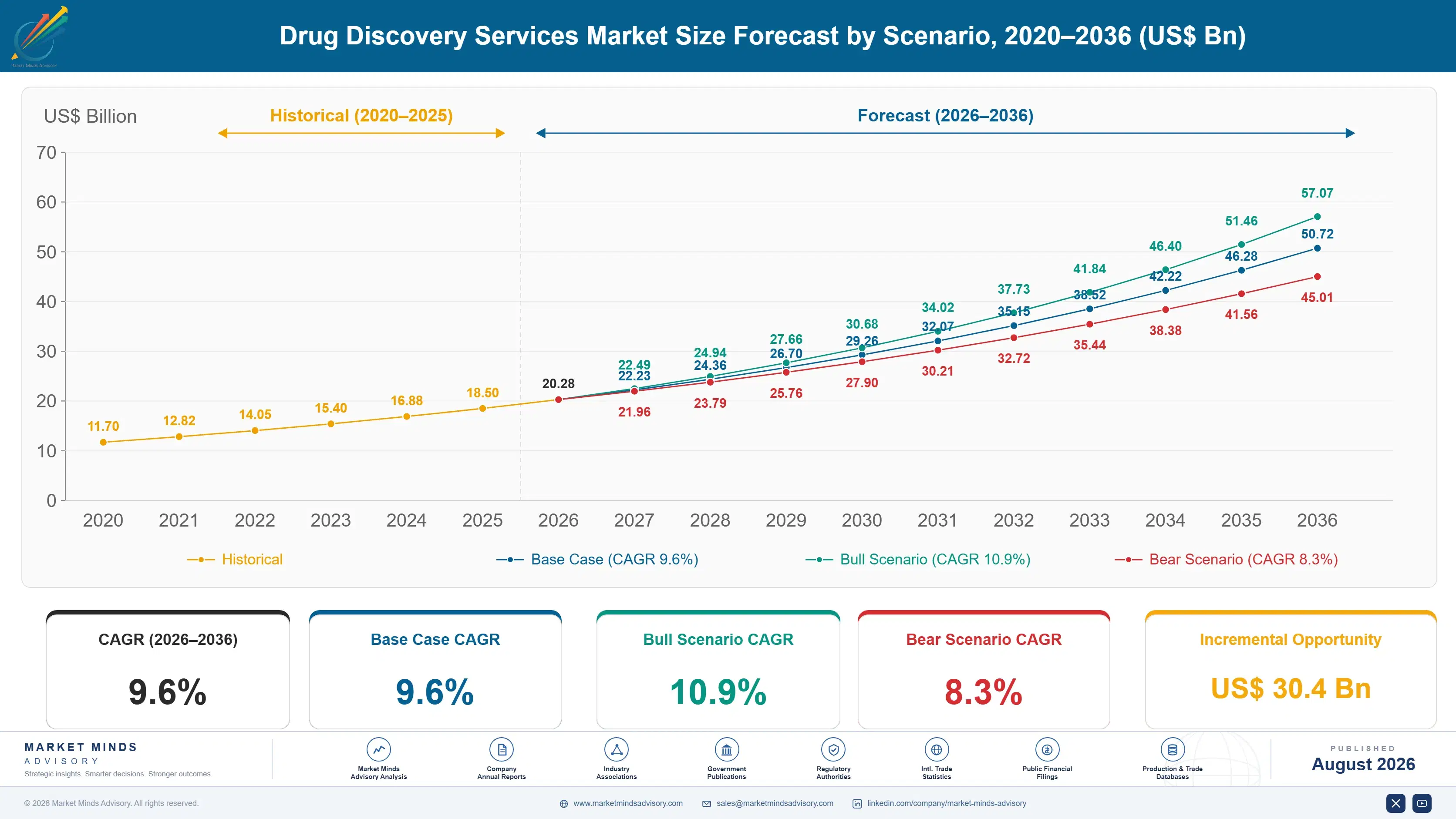
Drug Discovery Services Market Forecast Scenarios

drug-discovery-services-market-size-forecast-scenario-1787301442521
Between 2020 and 2025 the market grew at an estimated 8.6% CAGR, a period shaped by a pandemic-driven biotech funding surge that later cooled sharply, followed by sponsors accelerating outsourcing to preserve cash runway as venture capital tightened. Growth remained resilient rather than explosive, reflecting the category's status as a still-maturing but increasingly essential extension of internal pharmaceutical R&D.
The base case assumes 9.6% CAGR through 2036, driven by three mechanisms: continued biopharma outsourcing of early discovery work as sponsors prioritize capital efficiency over building internal capacity, rapid adoption of AI-driven computational design tools that shorten hit-to-lead cycles and justify premium service pricing, and expanding biotech funding and pipeline activity across India and China as domestic sponsors and multinational partners scale local discovery capacity. Together these mechanisms sustain growth meaningfully above the broader pharmaceutical services category.
The bull case, 10.9% CAGR, assumes faster AI adoption compresses discovery timelines enough that sponsors outsource an even larger share of pipeline work industry-wide. The bear case, 8.3% CAGR, reflects the risk that tightening biotech venture funding and geopolitical restrictions on China-based capacity slow sponsors' ability to place discovery work with the lowest-cost providers regardless of underlying demand.

AI Adoption and Outsourcing Depth in Early Discovery

Drug discovery services behave less like a standardized commodity purchase and more like a capacity-and-capability allocation decision, since sponsors increasingly select partners based on scientific depth and platform integration rather than headline day rates alone. Providers with strong AI-driven design capability and deep therapeutic area expertise currently command real pricing power that purely capacity-based providers cannot match. This dynamic has intensified as more sponsors extend inte
MARKET CONCENTRATION (CR5)38%Fragmented among many specialized regional and global providers
AVERAGE PROJECT VALUE$2.4M/programReflects typical scope of a discovery service engagement
TOP PROVIDING COUNTRY SHAREIndia, 19%Reflects the country's expanding contract research capacity base
CAPACITY UTILIZATION84%Specialist scientist teams run near full billable capacity
OUTSOURCING PENETRATION42% of R&D spendShare of discovery work sponsors place externally today
FTE COST SHARE61%Skilled scientific staff dominate total service delivery cost
Commercially, the category splits between mature, high-volume medicinal chemistry and synthesis services serving established small-molecule pipelines, and a smaller but faster-growing computational and AI-driven design segment sold at meaningful premium pricing into sponsors pursuing faster timelines. Providers exposed to both segments manage genuinely different client conversations, since traditional chemistry work competes primarily on cost and throughput while AI-driven services compete on demonstrated hit rate and cycle-time reduction.
The next decade favors providers who can pair deep scientific talent with proprietary AI design platforms, since sponsors increasingly cite cycle-time reduction, not just unit cost, as a primary factor in awarding multi-year discovery partnerships. This shift is already visible in how the largest sponsors structure vendor consolidation programs. Sponsors are also consolidating vendor rosters to concentrate spend with fewer partners.
"Everyone still frames this as a scientific services purchase, but it's really a capacity bet on which platforms will actually cut attrition. The providers who can prove that with real data are the ones setting price right now."
Director, Pharmaceutical Services and Outsourcing Practice · MMA Healthcare / Ph

Market Trends

AI-Driven Computational Design Cuts Discovery Timelines

Contract research organizations are rapidly deploying generative and predictive AI models across target identification, hit finding, and lead optimization, compressing timelines that traditionally spanned years into a matter of months for well-characterized target classes. Sponsors are responding by directing an increasing share of new discovery programs specifically toward providers who can demonstrate validated AI platforms rather than purely traditional wet-lab throughput. This is reshaping which providers win the largest, most complex programs, since AI-driven hit rates are becoming a genuine differentiator in competitive tenders rather than a marketing claim providers make without supporting data.
Market Impact: Adds $2.1 billion outsourced spend
Biosecure Act Pressure Redirects China-Based Sourcing

Proposed and enacted restrictions targeting China-based biotechnology service providers, including the US BIOSECURE Act framework, are prompting sponsors to reassess where they place sensitive discovery and manufacturing-adjacent work, particularly for programs with eventual US government or federally funded customers. This is accelerating diversification toward India, Eastern Europe, and domestic Western capacity even where China-based providers offer meaningfully lower cost structures. Providers positioned outside the most scrutinized jurisdictions are capturing disproportionate new program awards from sponsors seeking to de-risk their supply chain well ahead of any final regulatory determination affecting existing long-term contracts.
Market Impact: Lifts biologics discovery demand 15

Market Opportunities and Growth Drivers

Biopharma R&D Budgets Shift Toward Variable-Cost Outsourcing

Biopharmaceutical sponsors, facing sustained pressure to preserve cash runway amid tighter venture funding conditions, are converting formerly fixed internal discovery headcount into variable-cost outsourced engagements that scale up or down with pipeline activity. This creates a direct, quantifiable financial incentive to place more discovery work externally rather than maintaining large internal teams through funding cycles, since outsourced spend can be adjusted program by program without the fixed cost burden of permanent staff. Sponsors with the most volatile pipeline activity are outsourcing fastest, giving flexible, scientifically credible CROs meaningful advantage over rigid internal capacity.
Market Impact: Extends hiring timelines by 5 month

Rising Biologics Pipeline Activity Lifts Specialized Demand

Biologics and antibody-based drug candidates now represent a rapidly growing share of active pharmaceutical pipelines, and antibody discovery, expression, and characterization work requires specialized scientific capability that most sponsors, particularly smaller biotech companies, have not built internally. Domestic and multinational discovery CROs are expanding biologics-specific capacity to meet this demand, and each new biologics program typically requires a longer, more technically demanding engagement than an equivalent small-molecule chemistry project. This sustains growth in specialized service segments well beyond what traditional medicinal chemistry outsourcing alone can generate across the industry each year.
Market Impact: Adds 3 months to onboarding

Market Restraints and Challenges

Scientific Talent Shortages Constrain Capacity Expansion

Specialized discovery scientists, particularly those with computational chemistry, structural biology, or antibody engineering expertise, remain in persistently short supply relative to the pace at which CROs are trying to expand capacity to meet accelerating sponsor demand. The cause is that graduate programs producing this specific talent mix have not scaled proportionally with industry demand, and competing employers, including large pharmaceutical companies and technology firms, bid aggressively for the same limited talent pool. Providers are mitigating this through expanded training programs and offshore hiring in India and Eastern Europe, though building genuinely deep bench strength still takes years.
Market Impact: Cuts timelines by 40 percent

Sponsor Data Security Concerns Slow Vendor Onboarding

Biopharma sponsors increasingly require extensive data security audits, IP protection guarantees, and regulatory compliance certification before awarding new discovery contracts, particularly for programs involving proprietary compound libraries or sensitive genomic data. The cause is that several high-profile data breaches and IP disputes involving contract research providers have made sponsor legal and compliance teams more cautious than they were five years ago. This lengthens vendor onboarding timelines and raises the qualification bar smaller or newer providers must clear. Providers are mitigating this through third-party security certification and dedicated client data segregation infrastructure, though onboarding new sponsors still takes longer than before.
Market Impact: Redirects $600 million toward non-C
3 additional market trends, 2 additional growth drivers, and 4 additional restraints and challenges are covered in the full report. Contact sales@marketmindsadvisory.com to access the complete intelligence.

Segment CAGR and Growth Architecture

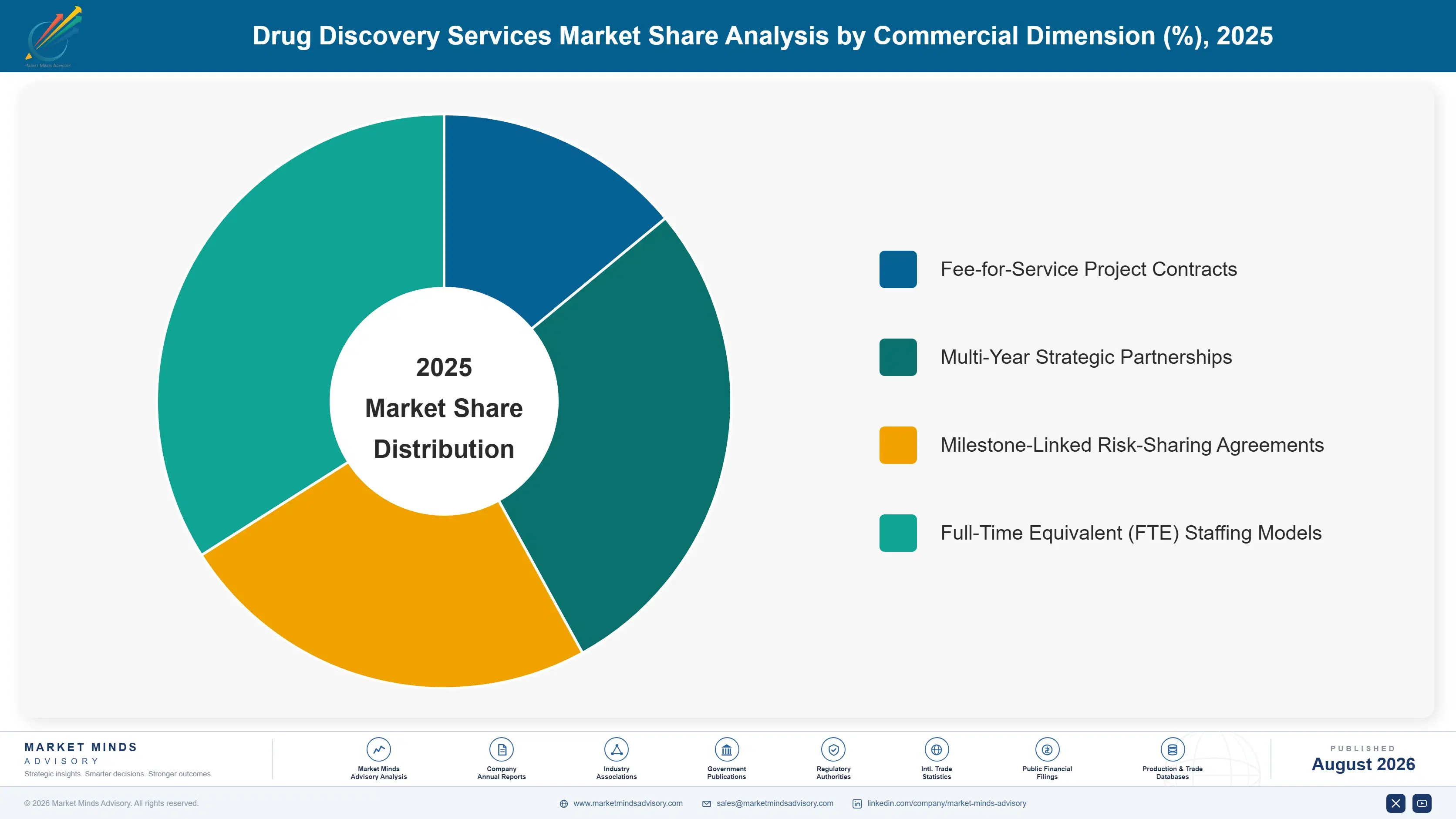
MMA segments the drug discovery services market by service type, the dimension that determines required scientific capability, pricing model, and where a service fits within a sponsor's discovery workflow. This framing separates target identification and early biology services from medicinal chemistry, ADMET screening, and increasingly computational and AI-driven design services commanding premium pricing across most active development programs.
drug-discovery-services-market-market-share-analysis-1787301443066

AI-Driven and Computational Design Services

AI-driven and computational drug design services, encompassing generative molecule design, structure-based virtual screening, and predictive ADMET modeling, are growing fastest as sponsors seek to compress discovery timelines and reduce costly late-stage attrition. This segment commands the steepest pricing premium in the category, since building and validating proprietary AI platforms requires sustained data and computational infrastructure investment not every provider has yet made. Evotec and WuXi AppTec currently hold some of the deepest AI-driven design capability, having invested years building proprietary training datasets and modeling infrastructure. Adoption remains concentrated among large biopharma sponsors with the biggest pipelines for now, though smaller biotech companies are increasingly accessing these capabilities through shared-platform service models.
CAGR 14.5%

Biologics and Antibody Discovery Services

Biologics and antibody discovery services form the second-fastest-growing segment, pulled by rising biologics pipeline activity and sponsors' need for specialized expression, characterization, and engineering capability most cannot build internally. These services command a meaningful premium over standard small-molecule chemistry work, since antibody discovery requires specialized cell line and assay infrastructure that standard medicinal chemistry providers do not maintain, and sponsors pay for that dedicated capability. Growth concentrates among sponsors developing oncology, autoimmune, and rare disease programs, where biologics increasingly dominate active pipelines. Regional adoption varies, with North American and European sponsors moving fastest while cost-sensitive programs in other regions still favor small-molecule approaches for now. MMA expects this gap to narrow as infrastructure costs decline.
CAGR 11.5%
Full segment breakdown across 6 segments available in the complete report.

Regional Architecture and Country Demand Map

Drug discovery service demand concentrates where biopharmaceutical R&D spending and biotech funding are deepest. North America leads on its concentration of large pharmaceutical sponsors and venture-backed biotech pipelines, East Asia follows on China and Japan's expanding discovery capacity, and South Asia and Pacific grows fastest on India's scientific talent base.

North America

North America's substantial discovery services demand is anchored by its concentration of large pharmaceutical companies and venture-backed biotech sponsors, who together direct the largest share of global early-stage R&D spending toward external partners. Charles River and ICON maintain their deepest scientific and commercial relationships in this market, reflecting decades of investment alongside major North American sponsors. AI-driven design adoption is advancing fastest here given both sponsor sophistication and available computational infrastructure, commanding meaningful premium pricing across the region's largest pipeline programs. Canada's smaller biotech sector contributes additional steady regional demand, tracking broadly similar outsourcing trends as the larger US market across most therapeutic areas and program types, though data privacy compliance requirements shape vendor selection.
Share: 30% | CAGR: 10.4% (2026 to 2036)

Western Europe

Western Europe's demand centers on its long-established pharmaceutical research base, with German, Swiss, and UK sponsors representing the largest concentration of regional discovery spending. European providers including Evotec and Lonza maintain deep regional scientific capability and customer relationships built over decades of pharmaceutical industry partnership. Regulatory data protection requirements are generally stricter here than in most other regions, pushing sponsors toward providers with strong compliance infrastructure and documented data governance practices. Growth trails North America and East Asia's faster-expanding biotech funding environments, but Western Europe's scientific talent depth keeps it a durable, premium-priced discovery hub for complex, high-value programs across multiple therapeutic areas. Ireland's growing biopharma manufacturing cluster also contributes incremental discovery-adjacent demand.
Share: 20% | CAGR: 8.1% (2026 to 2036)
Regional intelligence for 5 additional markets available in the complete report: East Asia, South Asia and Pacific, Latin America, Middle East and Africa, Eastern Europe. Contact sales@marketmindsadvisory.com.
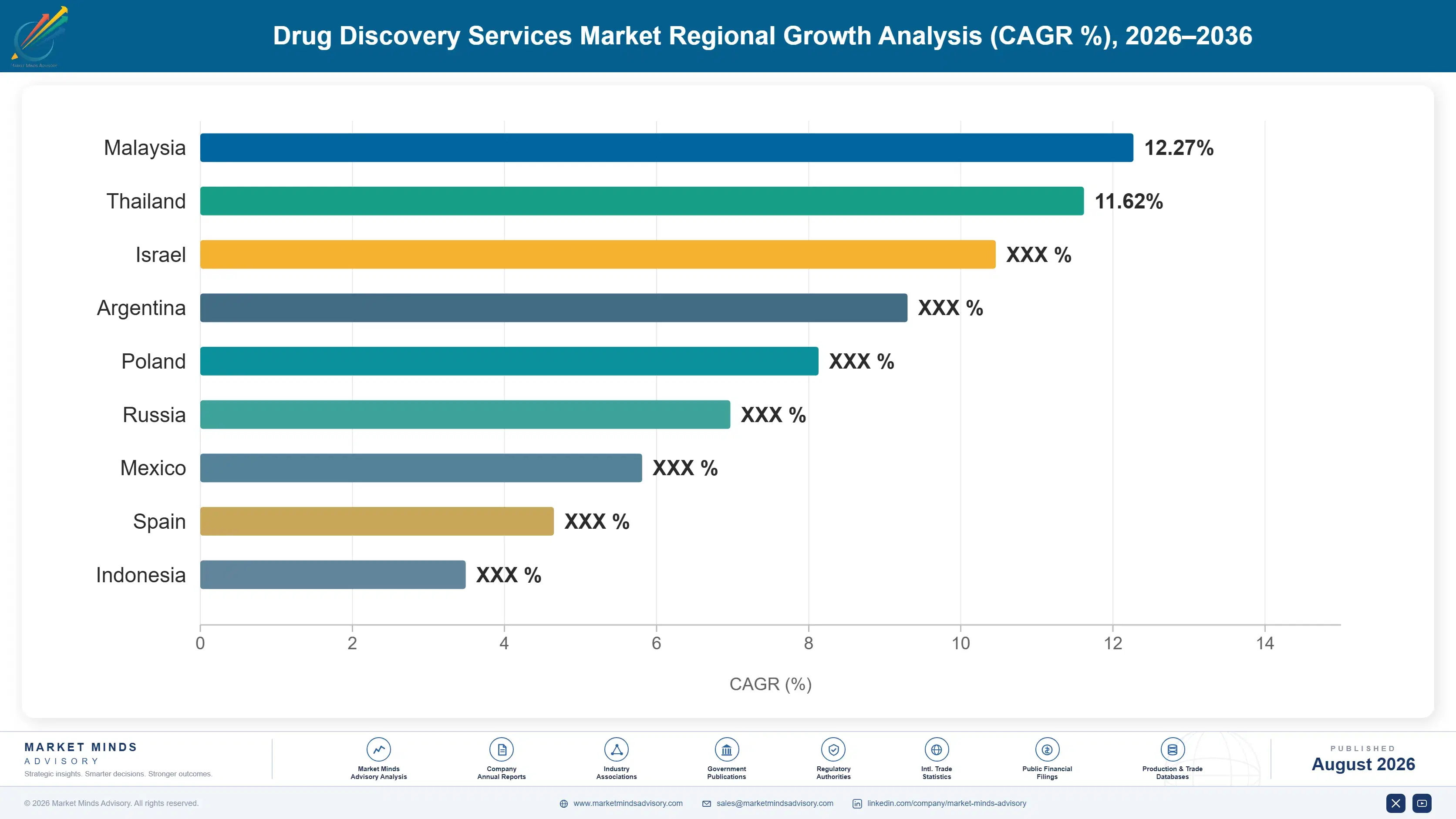
drug-discovery-services-market-country-cagr-analysis-1787301443574

Monetizing Scientific Depth and AI Platforms

Discovery CROs are shifting from headcount-based project billing toward capability-and-outcome-led commercial models: multi-year strategic discovery partnerships that lock in scarce scientific talent, premium pricing for validated AI-driven design platforms, milestone-linked risk-sharing arrangements that align incentives with sponsors, and dedicated therapeutic-area centers of excellence that deepen client relationships across a sponsor's broader pipeline year over year.

Multi-Year Strategic Discovery Partnerships Locking In Talent

Discovery CROs increasingly negotiate multi-year strategic partnerships that commit dedicated scientific teams to a single sponsor's pipeline, guaranteeing continuity of institutional knowledge across programs while securing predictable, recurring revenue for the provider in return. This model requires real talent retention discipline and favors larger, better-capitalized CROs over smaller regional players lacking comparable ability to commit senior scientists to a single account for years at a time. Charles River's strategic partnership model with major pharmaceutical sponsors illustrates this approach, typically spanning 5 years or longer, generating predictable revenue that materially aids capacity and hiring planning.
Market Impact: Locks in strategic partnerships spa

Premium Pricing for Validated AI Design Platforms

Discovery CROs increasingly price AI-driven computational design services at a meaningful premium over traditional wet-lab-only discovery work, reflecting both the real data and infrastructure investment required and sponsors' willingness to pay for demonstrably faster, more predictive hit identification. This premium is most defensible where providers can show validated hit rates and documented cycle-time reduction, since sponsors increasingly demand supporting data before accepting a price premium on marketing claims alone. AI-driven design services currently command premiums of 20 to 35 percent over traditional chemistry-only engagements across most major sponsors, a gap expected to persist.
Market Impact: Commands a 20 to 35 percent price p

Milestone-Linked Risk-Sharing Arrangements That Align Incentives

Discovery CROs increasingly offer milestone-linked risk-sharing arrangements, accepting a portion of compensation tied to program success metrics like hit rate or lead candidate advancement rather than pure fee-for-service billing. This model requires real confidence in scientific capability and balance sheet strength to absorb the risk of underperforming programs, but it generates deeper alignment with sponsors and durable, multi-year revenue that a pure billable-hours model cannot easily replicate. Providers offering milestone-linked arrangements report win rates on competitive tenders roughly 25 percent higher than those offering only traditional fee-for-service contracts during the most recent sponsor procurement cycle.
Market Impact: Improves tender win rates by roughl

Therapeutic-Area Centers of Excellence Deepening Ties

Discovery CROs increasingly build dedicated therapeutic-area centers of excellence, concentrating scientists with deep oncology, immunology, or rare disease expertise around a smaller group of sponsors working in those specific areas. This model requires real capital and talent commitment but generates deeper scientific credibility and pricing power that a generalist provider cannot easily replicate, since sponsors increasingly value partners who understand their specific disease biology and regulatory pathway. Providers with established therapeutic-area centers of excellence report client retention roughly 30 percent higher than generalist competitors serving comparable sponsor portfolios, a gap that continues widening across most therapeutic areas.
Market Impact: Improves client retention by roughl

Who Controls the Margin Pool

CR5 sits at 38 percent, a moderate concentration reflecting the category's continued fragmentation across many scientifically specialized regional providers. Charles River and WuXi AppTec lead on global scale and integrated platform breadth, and the gap to mid-tier challengers is real, though specialist AI-driven providers are closing it faster than most established generalist CROs initially expected.
Current activity centers on three fronts: expanding AI-driven and computational design capability to capture premium pricing, building dedicated biologics and antibody discovery infrastructure to meet rising pipeline demand, particularly across oncology and immunology-focused programs, and geographic capacity diversification away from China-concentrated sourcing as sponsors respond to tightening geopolitical scrutiny of cross-border biotechnology data and materials flows.

Emerging pressure comes from India-based and other specialist providers extending scientific capability and cost-competitive scale into markets historically dominated by larger Western and Chinese CROs, competing aggressively on both price and scientific depth in areas where established leaders have historically underinvested. Expect ranking shifts as these challengers capture a growing share of computational and biologics-focused contracts, gradually pushing established leaders to defend share through deeper AI platform investment and broader therapeutic-area specialization rather than scale alone, a shift already underway across multiple recent competitive tenders.
drug-discovery-services-market-company-positioning-matrix-1787301444092

Competitive Moat and Risk Dimensions

CHARLES RIVER LABORATORIES INTERNATIONAL, INC.

Moat: Integrated Discovery-to-Preclinical Platform Scale

Charles River operates one of the largest integrated networks spanning early discovery through preclinical safety assessment, giving it unmatched breadth to serve sponsors across an entire program lifecycle from a single coordinated commercial relationship. This integration lets sponsors avoid handoff friction between separate discovery and preclinical vendors, a real advantage smaller specialist providers cannot easily replicate.
CHARLES RIVER LABORATORIES INTERNATIONAL, INC.

Risk: Pricing Pressure From Specialist Entrants

Charles River's scale advantage is increasingly challenged by specialist providers who undercut on price for narrower, well-defined discovery workstreams rather than competing across the full program lifecycle. Competitors argue this creates pressure on Charles River's blended margins over time, though its integrated platform still gives it real advantage in the largest, most complex multi-year sponsor engagements.
WUXI APPTEC CO., LTD.

Moat: China-Based Cost and Scale Advantage

WuXi AppTec operates an enormous integrated discovery, biology, and chemistry platform across China, giving it cost and throughput advantages that Western-based competitors cannot match at comparable scale. This lets WuXi serve sponsors with large, complex programs requiring substantial scientific headcount at meaningfully lower blended cost than most alternative providers.
WUXI APPTEC CO., LTD.

Risk: Geopolitical Scrutiny of China-Based Sourcing

Proposed US restrictions on China-based biotechnology providers, including BIOSECURE-style legislation, threaten WuXi's access to government-adjacent and federally funded sponsor programs regardless of its underlying scientific capability. Competitors argue this creates genuine long-term contract risk that a more geographically diversified provider would not face, though WuXi's scale still gives it real negotiating position with sponsors outside the most scrutinized program categories.

Players Tracked

Prominent Players

Charles River Laboratories International, Inc.
Lonza Group AG
WuXi AppTec Co., Ltd.
Evotec SE
ICON plc

Other Key Players

Syngene International Limited
Pharmaron Beijing Co., Ltd.
Sai Life Sciences Limited
Genscript Biotech Corporation
Certara, Inc.
Curia Global, Inc.
Cerba Research
BioDuro-Sundia
Enamine Ltd.
Selvita S.A.
Reaction Biology Corporation
Domainex Ltd.
Sygnature Discovery Ltd.
Aragen Life Sciences Limited
Albany Molecular Research, Inc.

Recent Developments

MARCH 2025

Charles River Acquires AI-Driven Structural Biology Startup

Charles River Laboratories acquired a specialized AI-driven structural biology startup, adding proprietary predictive modeling capability directly into its early discovery service offering. The acquisition expands Charles River's computational design capacity ahead of rising sponsor demand for validated AI-driven hit identification across its largest ongoing multi-year discovery partnerships and programs.
Signal: Signals established CROs increasingly buyi
JULY 2025

Evotec Signs Multi-Year Strategic Discovery Partnership With Major Biopharma Sponsor

Evotec signed a multi-year strategic discovery partnership agreement with a major global biopharmaceutical sponsor, committing dedicated scientific teams across target identification and lead optimization for the sponsor's oncology pipeline. The agreement secures predictable, recurring revenue for Evotec across multiple therapeutic programs and reinforces its position in premium strategic partnership models.
Signal: Shows sponsors increasingly locking in ded
NOVEMBER 2025

Syngene Expands Biologics Discovery Capacity in India

Syngene International expanded its biologics and antibody discovery capacity at its Bangalore campus, adding dedicated cell line development and characterization infrastructure to serve rising sponsor demand for biologics-focused discovery work. The expansion reinforces India's growing role in specialized biologics services beyond traditional small-molecule medicinal chemistry outsourcing work.
Signal: Extends India's ongoing shift from cost-dr

Scientific Talent and Infrastructure Cost Exposure

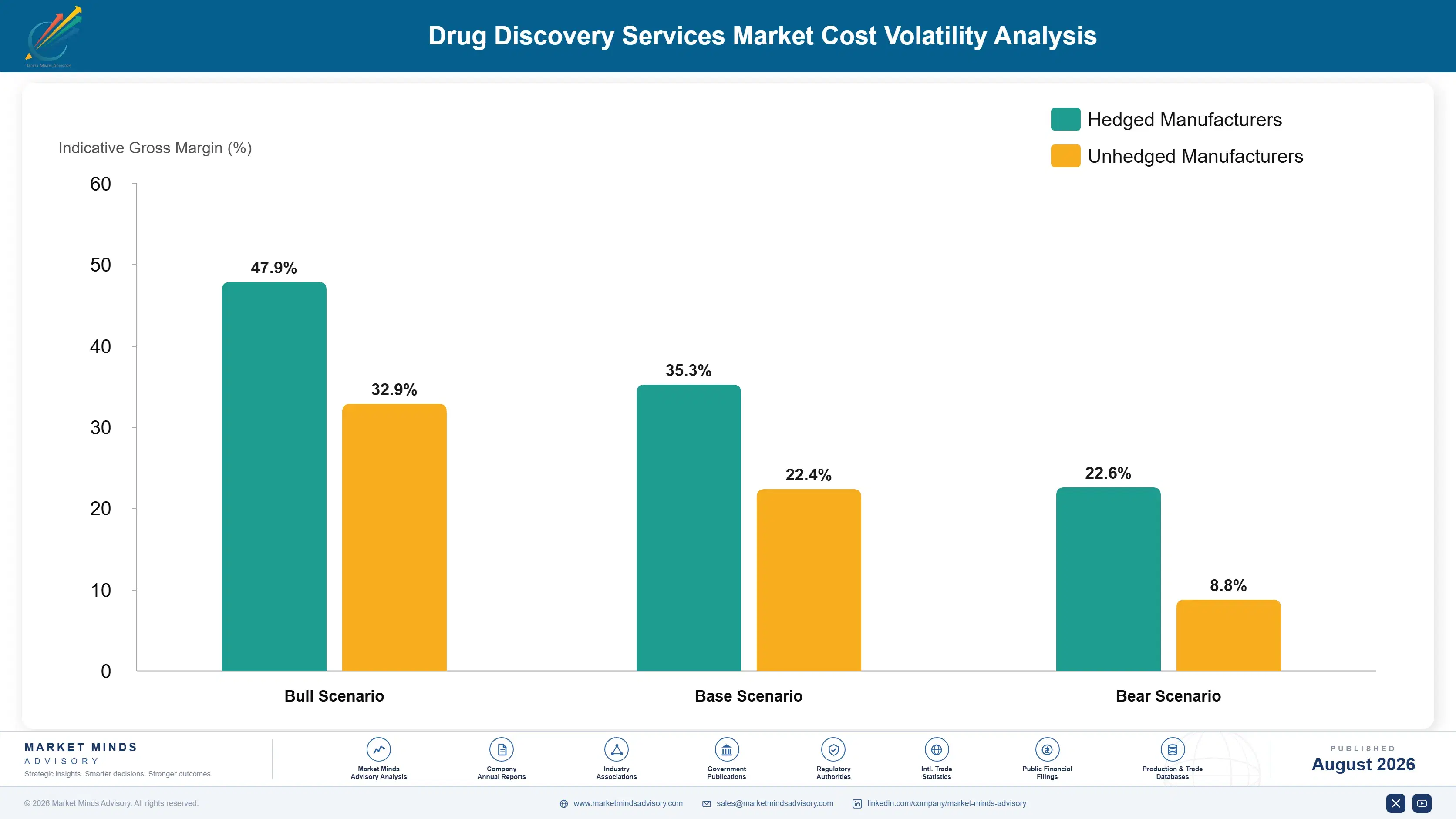
Skilled scientific labor, including PhD-level chemists, biologists, and computational scientists, accounts for an estimated 61 percent of discovery service delivery cost, with the remainder split between specialized equipment, reagents, laboratory facilities, and software licensing. This talent pool concentrates among a relatively limited number of research-intensive countries and universities, exposing providers to competitive wage pressure largely outside their direct control.
Scientific salaries rose across major research hubs through 2022 and 2023 following intense competition for computational biology and AI talent from both pharmaceutical companies and technology firms, according to Charles River Laboratories' FY2024 annual report, before moderating through 2024 and 2025 as biotech funding cooled. Providers without diversified geographic hiring absorbed the earlier wage inflation into compressed project margins, while larger providers with broader India and Eastern Europe hiring smoothed the impact across their delivery cost base.

Exposure varies by provider type: large diversified CROs with broad geographic hiring footprints absorbed wage inflation better than smaller regional specialists concentrated in a single high-cost research hub. Geographic exposure also differs, since providers with meaningful India, Eastern Europe, or China-based delivery capacity faced less cost pressure than those relying primarily on North American or Western European scientific staff during recent hiring competition.
drug-discovery-services-market-cost-volatility-analysis-1787301444290

Diversified Geographic Hiring Across Cost-Advantaged Regions

Larger CROs are expanding scientific hiring across India, Eastern Europe, and other cost-advantaged research hubs, reducing dependence on any single high-wage market and smoothing overall delivery cost even during periods of localized wage inflation. This requires established local infrastructure and training programs that smaller regional providers often cannot build without significant upfront capital investment relative to larger diversified competitors.

Long-Term Multi-Year Talent Retention Programs

Several larger CROs now offer extended retention incentives and career development pathways to reduce costly scientific staff turnover, smoothing wage cost volatility even though this requires sustained investment most smaller regional providers lack. This has become a differentiator during recent hiring competition, letting well-resourced providers maintain more stable delivery teams than competitors facing frequent staff departures.

AI-Assisted Workflows to Reduce Headcount Dependence

Several providers are deploying AI-assisted computational tools to extend the productivity of existing scientific staff, reducing reliance on continuous headcount growth to meet rising project volume across their delivery capacity. This partially decouples service capacity growth from wage cost inflation, providing a genuine offset against continued scientific talent scarcity across major research hubs, particularly in high-cost markets.

Portfolio Architecture for Margin Defence

The category splits into three tiers with distinct margin profiles. Commodity medicinal chemistry and standard screening services, sold on throughput and cost for established small-molecule programs, generate the thinnest margins despite carrying the bulk of total volume. Premium computational and AI-driven design services command better margins tied to platform investment and demonstrated hit-rate performance rather than scientist headcount alone. The next-generation and biologics tier carries
Volume and premium tiers pull providers toward different capability investments. Commodity chemistry volume rewards scientist throughput and workflow efficiency, favoring large diversified CROs who spread fixed infrastructure costs across enormous project volumes. Premium and next-generation tiers reward investment in proprietary AI platforms and specialized biologics infrastructure, favoring providers willing to commit years to building the scientific credentials and sponsor relationships these programs increasingly require.

High-value pools concentrate in AI-driven design and biologics discovery services purchased by sponsors under timeline and pipeline-quality pressure, where scientific capability, not scientist headcount, increasingly sets pricing power. Providers positioned in these segments capture disproportionate margin relative to volume share, a pattern MMA expects to persist while validated AI platforms and specialized biologics talent remain the binding constraint across the category.

Volume / Commodity-Adjacent Tier

Standard medicinal chemistry and screening services sold largely on throughput and cost for established small-molecule programs where computational differentiation does not yet command a meaningful premium over conventional wet-lab execution.
Gross Margin: 16-20%

Premium / Certified Tier

Computational and AI-driven design services sold into sponsor programs requiring validated hit-rate performance and documented cycle-time reduction across major discovery accounts and complex, multi-target therapeutic pipelines, where sponsors pay for demonstrated speed.
Gross Margin: 26-30%

Sustainability / Regulatory / Next-Generation Tier

Biologics and antibody discovery services developed for sponsors pursuing advanced modality pipelines beyond standard small-molecule chemistry, requiring the deepest scientific and infrastructure investment across the entire discovery portfolio and the longest program timelines.
Gross Margin: 32-36%
drug-discovery-services-market-portfolio-architecture-1787301444787

Recurring Discovery Partnership Economics

Once a provider wins a major sponsor's discovery relationship, especially through a dedicated multi-year strategic partnership, the relationship extends across many years of recurring project volume, since switching providers requires requalifying scientific workflows and rebuilding institutional program knowledge that sponsors rarely pursue without good reason. This gives providers who win the initial relationship durable, multi-year revenue difficult for competitors to dislodge without a capab
Adoption depth varies by end-use vertical. Large global pharmaceutical sponsors have moved fastest toward AI-driven design specification and dedicated strategic partnerships, since their pipeline scale justifies the platform and talent investment these arrangements require. Smaller and mid-sized biotech sponsors adopt more selectively, continuing standard project-based purchasing where lower pipeline volume does not justify dedicated capacity investment or premium AI-driven design sourcing.

Buyer profiles are shifting generationally as sponsor R&D and procurement teams, increasingly staffed by professionals hired for computational biology and data science expertise, gain influence over provider selection decisions that procurement teams previously controlled on cost grounds alone. This is opening doors for providers who can demonstrate strong AI-driven design credentials and documented hit-rate performance, even against incumbents with legacy cost relationships that carry less weight with these newer decision-makers.
drug-discovery-services-market-end-use-penetration-index-1787301445275

Where Scientific Depth Creates Value

These are among the four positions where our research anticipates prominent divergence between winners and laggards over the coming forecast period. Each is grounded in the demand model, the regulatory perimeter, and the announced capacity pipeline.
01 / AI PLATFORM INVESTMENT TIMING

Build validated AI capability now before differentiation disappears

Sponsors are increasingly awarding the largest, most complex discovery programs specifically to providers who can demonstrate validated AI-driven hit-rate performance rather than pure scientific headcount. Charles River and Evotec currently hold some of the deepest AI-driven design capability underway, drawing on data and infrastructure investment that smaller regional players cannot always match on comparable timelines. MMA expects providers who delay AI platform investment now to find themselves locked out of the fastest-growing, highest-margin segment this category has produced in years.
02 / BIOLOGICS TALENT BUILD-OUT

Build antibody discovery capability before biologics pipelines dominate

Biologics and antibody-based candidates increasingly dominate active pharmaceutical pipelines, and providers without credible antibody discovery and characterization capability risk losing premium sponsor contracts as this shift accelerates further. Providers with established cell line infrastructure and biologics-specific scientific talent are capturing disproportionate share of this premium segment, drawing on years of accumulated investment newer entrants cannot easily replicate. MMA expects providers who delay this investment now to find themselves excluded from one of the fastest-growing, highest-value segments of this category permanently.
03 / MULTI-YEAR PARTNERSHIP POSITIONING

Win strategic partnership commitments before rivals lock them in

Multi-year strategic discovery partnerships create switching costs a standard project-based purchase order relationship cannot match, and providers who win these commitments capture durable, multi-year revenue difficult for competitors to dislodge. Large global sponsors increasingly prefer this model because it guarantees continuity of institutional program knowledge, a priority that has grown considerably more important than pure unit cost in recent negotiations. MMA views strategic partnership commitments as one of the most durable competitive advantages available to providers willing to make the capital commitment required.
04 / CHINA SOURCING DIVERSIFICATION

Diversify sourcing now before geopolitical restrictions tighten further

Discovery volume across India and other non-China providers continues meaningfully outpacing China-based capacity growth, and domestic Indian providers are scaling scientific capacity quickly enough to challenge established Chinese providers on both price and delivery speed. Sponsors who delay diversifying discovery sourcing away from China-concentrated providers risk exposure to sudden regulatory or export control disruption affecting existing long-term programs. MMA expects the next several years to determine which established providers successfully capture this diversification wave versus ceding it to new entrants permanently.

Engagement Snapshot From the Field

A live engagement with an industry participant carrying material or product regulatory and market exposure ahead of a defining policy shift, showing how our research translates into a defensible multi-year portfolio strategy.
MARKET MINDS ADVISORY · CLIENT ENGAGEMENT SUMMARY
Drug Discovery Services Producer Strategic Portfolio Review and Transition Roadmap 2026·Investment Scenario on Drug Discovery Services Exposure Evaluation 2025-26
CLIENT PROFILE
The client is a mid-sized biopharmaceutical company with several hundred million dollars in annual revenue (client-reported, unverified by MMA), developing a pipeline of oncology and immunology candidates across both small-molecule and biologics modalities. The company had relied on a small internal discovery team supplemented by ad hoc project-based vendor relationships, but faced growing pressure to accelerate timelines without proportionally expanding headcount.
STRATEGIC CHALLENGE
Facing board pressure to accelerate pipeline timelines and mounting investor scrutiny of cash burn, the client needed to secure reliable access to both AI-driven computational design capability and specialized biologics discovery expertise without committing to the fixed cost of a much larger internal scientific organization, all within a competitive vendor market that gave established providers considerable pricing leverage.
MMA APPROACH
MMA conducted a comparative capability and cost assessment across six leading discovery providers, benchmarking AI-driven design maturity, biologics infrastructure depth, and multi-year partnership terms offered. The engagement produced a segmented vendor strategy pairing the client's AI-driven design needs with a specialist computational provider while routing biologics work to a provider with deeper antibody discovery infrastructure, avoiding a single-vendor compromise across both capability areas.
KEY FINDINGS
  1. Vendor capability varied significantly across AI-driven design maturity, with several providers showing considerably less validated hit-rate performance than their marketing materials suggested.
  2. Biologics discovery capability differed considerably between providers, directly affecting which vendors could credibly support the client's oncology and immunology pipeline timeline requirements.
  3. Splitting vendor relationships by capability area required more coordination overhead than a single-vendor approach, a meaningful shift in how the client's discovery team operated day to day.
  4. Pairing specialist providers by capability area allowed the client to access deeper expertise in each domain than any single generalist vendor could offer alone.
CLIENT PROFILE
The client is a mid-sized biopharmaceutical company with several hundred million dollars in annual revenue (client-reported, unverified by MMA), developing a pipeline of oncology and immunology candidates across both small-molecule and biologics modalities. The company had relied on a small internal discovery team supplemented by ad hoc project-based vendor relationships, but faced growing pressure to accelerate timelines without proportionally expanding headcount.
STRATEGIC CHALLENGE
Facing board pressure to accelerate pipeline timelines and mounting investor scrutiny of cash burn, the client needed to secure reliable access to both AI-driven computational design capability and specialized biologics discovery expertise without committing to the fixed cost of a much larger internal scientific organization, all within a competitive vendor market that gave established providers considerable pricing leverage.
MMA APPROACH
MMA conducted a comparative capability and cost assessment across six leading discovery providers, benchmarking AI-driven design maturity, biologics infrastructure depth, and multi-year partnership terms offered. The engagement produced a segmented vendor strategy pairing the client's AI-driven design needs with a specialist computational provider while routing biologics work to a provider with deeper antibody discovery infrastructure, avoiding a single-vendor compromise across both capability areas.
KEY FINDINGS
  1. Vendor capability varied significantly across AI-driven design maturity, with several providers showing considerably less validated hit-rate performance than their marketing materials suggested.
  2. Biologics discovery capability differed considerably between providers, directly affecting which vendors could credibly support the client's oncology and immunology pipeline timeline requirements.
  3. Splitting vendor relationships by capability area required more coordination overhead than a single-vendor approach, a meaningful shift in how the client's discovery team operated day to day.
  4. Pairing specialist providers by capability area allowed the client to access deeper expertise in each domain than any single generalist vendor could offer alone.
RECOMMENDED STRATEGY
Phase 1: Phase 1 (Months 1-2): Benchmark six leading discovery providers on AI-driven design maturity, biologics infrastructure depth, and multi-year partnership terms offered. Phase 2: Phase 2 (Months 3-6): Establish parallel vendor relationships, routing AI-driven design work and biologics discovery work to separate specialist providers based on demonstrated capability. Phase 3: Phase 3 (Months 7-10): Formalize multi-year strategic partnership terms with both selected providers, establishing shared governance and program milestone tracking.
OUTCOME
The client established parallel discovery partnerships with two specialist providers within ten months, ahead of its original internal timeline (client-reported, unverified by MMA). The new vendor structure reportedly cut computational hit-to-lead cycle time meaningfully while expanding biologics program capacity, without requiring the client to expand its internal scientific headcount substantially (client-reported, unverified by MMA).

Frequently Asked Questions

Foundational context covering the market sizes, CAGR, scope, country, region and competition that inform every finding below. This section is provided to cover basics and most often pre-purchase conversations, answered from the MMA Primary Research Dataset.

What is the current size of the Drug Discovery Services Market?

The global drug discovery services market is valued at $18.5 billion in 2025. It is forecast to reach $20.28 billion in 2026 as outsourcing accelerates.

How large will the Drug Discovery Services Market be by 2036?

MMA forecasts the market will reach $50.71 billion by 2036, roughly 2.5 times its 2026 value. AI-driven design adoption and rising biologics pipeline activity both drive that expansion.

What is the CAGR for the Drug Discovery Services Market 2026 to 2036?

The base case CAGR is 9.6 percent across the 2026 to 2036 forecast period. Bull and bear scenarios range from 8.3 to 10.9 percent depending on AI adoption pace.

Which segment is growing fastest?

AI-driven and computational design services are growing fastest at a 14.5 percent CAGR, well ahead of traditional chemistry work. That is roughly 1.51 times the overall market growth rate.

Who are the major companies in the Drug Discovery Services Market?

Leading discovery providers include Charles River, Lonza, WuXi AppTec, Evotec, and ICON. Together they hold an estimated 38 percent of a moderately concentrated global market.

Which country is growing fastest?

India is the fastest-growing major market, expanding at an estimated 13.2 percent CAGR. Growth is driven by expanding scientific talent capacity and rising cost-competitive discovery investment.

Report Segmentation Architecture

The full report scope spans multiple orthogonal segmentation dimensions, with cross-tabulated demand data provided for each dimension pair. Coverage extends further to regional breakdowns, trend trajectories, and the competitive detail needed to support segment-level decision-making.

By Service Type

  • Target Identification and Validation Services
  • Hit-to-Lead and Lead Optimization Services
  • Medicinal Chemistry and Synthesis Services
  • ADMET and Preclinical Screening Services
  • AI-Driven and Computational Design Services
  • Biologics and Antibody Discovery Services

By Therapeutic Area

  • Oncology
  • Immunology and Inflammation
  • Neuroscience
  • Infectious Disease
  • Rare and Orphan Disease

By Commercial Dimension

  • Fee-for-Service Project Contracts
  • Multi-Year Strategic Partnerships
  • Milestone-Linked Risk-Sharing Agreements
  • Full-Time Equivalent (FTE) Staffing Models

By Region

  • North America
  • Western Europe
  • East Asia
  • South Asia and Pacific
  • Latin America
  • Middle East and Africa
  • Eastern Europe

Scope, Methodology, and Coverage

Every figure in this report is reproducible from documented input assumptions. The scope below maps the historical period, the forecast horizon, the segmentation dimensions, and the countries covered, alongside the underlying primary and qualitative methodology.
Historical Period
2020 to 2025
Forecast Period
2026 to 2036
Base Year
2025 (USD billions; MMA Primary Research Dataset, August 2026)
Market Definition
This report defines the drug discovery services market as outsourced target identification, hit-to-lead, lead optimization, medicinal chemistry, ADMET screening, and computational drug design services provided by contract research organizations to biopharmaceutical sponsors. It excludes clinical trial services, commercial manufacturing, and regulatory affairs consulting performed independently of discovery-stage research.
Quantitative Units
USD billions (current prices); number of active discovery programs where applicable
Segmentation Dimensions
By Service Type; By Therapeutic Area; By Commercial Dimension; By Region
Regions Covered
North America, Western Europe, East Asia, South Asia and Pacific, Latin America, Middle East and Africa, Eastern Europe
Countries Covered
USA, China, Germany, France, UK, Japan, South Korea, India, Australia, Canada, Brazil, Mexico, Indonesia, Vietnam, Thailand, Malaysia, UAE, Saudi Arabia, South Africa, Nigeria, Turkey, Poland, Netherlands, Italy, Spain, Sweden, Switzerland, Argentina, Colombia, Singapore, and additional markets relevant to this sector
Key Companies Profiled
Charles River Laboratories International, Inc., Lonza Group AG, WuXi AppTec Co., Ltd., Evotec SE, ICON plc, Syngene International Limited, Pharmaron Beijing Co., Ltd., Sai Life Sciences Limited, Genscript Biotech Corporation, Certara, Inc., Curia Global, Inc., Cerba Research, BioDuro-Sundia, Enamine Ltd., Selvita S.A., Reaction Biology Corporation, Domainex Ltd., Sygnature Discovery Ltd., Aragen Life Sciences Limited, Albany Molecular Research, Inc.
Quantitative Methodology
Primary survey, n=3,800 respondents, Q4 2025, six countries; demand-side model with trade association cross-validation
Qualitative Methodology
47 expert interviews, Q4 2025; applied to validate demand model assumptions, identify emerging dynamics, and assess competitive positioning
Report Format
PDF and XLSX data workbook (Word format preview document)
Publisher
Market Minds Advisory
Report Code
MMA-2026-HLT-202
Published
August 2026
Contact
sales@marketmindsadvisory.com | www.marketmindsadvisory.com

Purchase the full Drug Discovery Services Market Report (2026 to 2036).

The full report provides a comprehensive assessment of the global drug discovery services market, including detailed sizing and ten-year forecasts across all seven regions and six service segments. It profiles twenty leading discovery providers, benchmarking scientific capability, AI-driven design maturity, and strategic partnership terms across the five largest players in particular. The analysis includes primary research drawn from MMA's Q4 2025 survey of 3,800 biopharmaceutical R&D and procurement respondents across six countries and 47 expert interviews with discovery and computational biology leaders. Regional sections cover talent cost exposure, geopolitical sourcing risk, and competitive dynamics specific to each market, supported by a standalone input cost and mitigation framework.
Ten-year market sizing and growth forecasts
Profiles of twenty leading discovery providers
AI-driven design maturity and capability benchmarking
Scientific talent cost exposure and mitigation framework
Primary survey data from 3,800 industry respondents
Forty-seven expert interviews with discovery science leaders

Built For The People Who Decide

From boardroom strategy to bench-side execution, this report is read cover-to-cover by leaders shaping the next decade of their industry, turning demand scenarios, market dynamics and valuation benchmarks into decisions.
CXOs/ Presidents/ VPs/ Managers
M&A and Corporate Development
Strategy Teams and R&D Heads
Procurement and Product Directors
Regulatory and Compliance Leaders
Investor Relations and Equity Analysts