

Market Minds Advisory
Dropper Squeeze Bottle Market

Dropper Squeeze Bottle Market: Dose Accuracy, Child Resistance, and the Serum Boom That Bought the Tooling

A dropper delivers a dose the user measures by eye, which is acceptable for a face serum and a regulated problem the moment the same bottle carries a paediatric medicine.

Lead Analyst

Bilal Shaikh

Published

September 2026

Make Smarter Decisions with Customized Research Insights

Request a free sample report and evaluate market opportunities, growth trends, and competitive dynamics relevant to your business needs.

2025 MARKET VALUE$1.9BMarket Size 2025
2036 FORECAST VALUE$4.1BBase Case , 2026 to 2036
CAGR 2026 TO 20367.0 %Bull 8.2% / Bear 5.8%
INCREMENTAL OPPORTUNITY$2.0BNet 10- year value creation
EXPANSION MULTIPLE1.97x2036 value over 2026 base
Strategic Levers
M&A Pipeline
Regional Outlook
Country Rankings
Competitive Intelligence
Segmental Deep-dive
Call-Us : 91 93563 13602

Executive Snapshot and Market Trajectory

The same bottle format serves two industries with opposite requirements. A cosmetic serum dropper needs to look expensive and dispense roughly a pipette's worth. A paediatric medicine dropper needs graduation marks, child-resistant closure and dose accuracy somebody can defend to a regulator. They share a format and almost nothing else.
Calibrated pharmaceutical dosing droppers compound at 10.5%, a full 1.50x the market rate, because paediatric dosing errors put measurement accuracy under regulatory attention that cosmetic applications never face. East Asia holds the largest share at 33%, on Chinese and South Korean moulding capacity plus a skincare serum culture that consumes dropper bottles at exceptional rates. An uncalibrated assembly varies by roughly 14% between drops.
Concentration is very low at 33%, since injection moulding and glass forming are widely held and the dropper assembly is where differentiation sits. The serum boom funded tooling that pharmaceutical applications now use, which is an unusual case of cosmetics subsidising medical packaging capability rather than the reverse. Skincare serums account for roughly 49% of dropper bottle volume, which funded moulding and assembly capacity across Asia at a scale pharmaceutical demand alone never would have.
Market Definition
This market covers bottles dispensing liquid through a dropper, pipette or controlled-drop mechanism, spanning glass dropper bottles with rubber or plastic bulbs, plastic squeeze dropper bottles, calibrated pharmaceutical dosing droppers, child-resistant dropper assemblies, and airless and preservative-free dropper systems. Pump and spray dispensers, standard closures without dropper function, ampoules and vials, pipettes supplied separately from bottles, and filling or assembly equipment are excluded.
Base Year Value
$1.9B in 2025 (MMA Primary Research Dataset, August 2026)
Forecast Period
2026 to 2036, eleven discrete annual values
CAGR
7.0% base case. Bull 8.2%. Bear 5.8%.
Fastest Growth Segment
Calibrated Pharmaceutical Dosing Droppers: 10.5% CAGR
Fastest Growth Country
India: 11.0% CAGR
Fastest Growth Region
South Asia and Pacific: 9.2% CAGR
Largest Region
East Asia: 33% of 2025 global value
Market Leaders
Gerresheimer, Berry Global, Aptar, Silgan Dispensing, and Stolzle Glass. Source: MMA Primary Research Dataset, July 2026.
Primary Survey
n=3,800 procurement and R&D decision-makers, Q4 2025, six countries
Methodology
Demand-side build-up, cross-validated against public data, 47 expert interviews

Dropper Squeeze Bottle Market Forecast Scenarios

dropper-squeeze-bottle-market-size-forecast-scenario-1787307220886
Growth ran near 5.9% from 2020 to 2025 and skincare drove almost all of it. Serum formats proliferated across every price tier as routines lengthened and brands added single-ingredient products, each requiring a dropper bottle that signalled precision and potency. Pharmaceutical dropper demand grew steadily underneath that on paediatric and ophthalmic formulations without any comparable surge.
Base case growth of 7.0% rests on three mechanisms. Paediatric liquid formulations continue expanding as more medicines reach children's indications, and each requires calibrated dosing that regulators scrutinise. Skincare serum formats keep spreading through mass and value tiers after establishing themselves in premium. And preservative-free ophthalmic formulations require dropper systems that exclude contamination without additives. None of the three depends on serum proliferation continuing at recent rates, which matters because that growth reflects a format fashion rather than any durable functional need.
The bull case at 8.2% assumes child-resistant dropper requirements extend into cosmetic and supplement categories carrying concentrated actives, which several regulators have discussed. The bear case at 5.8% reflects skincare format fatigue reducing serum proliferation, since a substantial share of recent growth came from routine expansion that could contract as quickly as it arrived. Consumer routines have simplified before now.

Droppers: Dose Accuracy Versus Shelf Appeal

A dropper is a deceptively demanding dispensing device. Drop volume depends on bulb compression, orifice geometry, liquid viscosity and how the user holds the bottle, and an uncalibrated cosmetic assembly varies by roughly 14% between drops. For a face serum that variation is invisible and irrelevant. For a paediatric antibiotic measured in millilitres by a tired parent at three in the morning, it is a clinical problem.
TOP FIVE CONCENTRATION33%Highly fragmented across moulders, glass formers and assembly specialists
DOSE DELIVERY VARIANCE14%Variation between drops from an uncalibrated cosmetic dropper assembly
CALIBRATED DROPPER PREMIUM2.4xPrice against a standard cosmetic dropper of comparable size
GLASS FORMAT SHARE58%Dropper bottles produced in glass rather than polymer materials
CHILD-RESISTANT REQUIREMENT37%Pharmaceutical dropper volume requiring certified child-resistant closure systems
SERUM CATEGORY SHARE49%Total dropper bottle volume consumed by skincare serum applications
That divergence splits the market cleanly. Calibrated pharmaceutical droppers carry graduation marks, controlled orifice geometry and validated dose accuracy, and they price at roughly 2.4 times a cosmetic equivalent. Child-resistant closure systems apply to around 37% of pharmaceutical dropper volume and add assembly complexity that cosmetic applications never encounter. The two halves share a format and almost nothing else.
What connects them commercially is tooling. Skincare serum demand, now around 49% of dropper bottle volume, funded moulding and assembly capacity across Asia at a scale that pharmaceutical volumes alone would never have justified. Pharmaceutical converters now access that capacity, which is an unusual case of a cosmetic boom subsidising medical packaging capability rather than the other way round.
"The serum craze built the factories. Nobody was going to tool up dropper assembly lines across Asia for paediatric syrup volumes, and then skincare arrived and paid for all of it. The pharmaceutical converters walked into capacity that cosmetics had already funded, which almost never happens in packaging."
Principal Analyst, Dispensing Systems and Primary Packaging Practice · MMA Packa

Market Trends

Paediatric dosing errors put dropper accuracy under scrutiny

Medication errors involving liquid paediatric formulations have drawn sustained regulatory attention, and dropper accuracy sits at the centre of that. An uncalibrated assembly varies by roughly 14% between drops, which is acceptable in cosmetics and indefensible when a parent is measuring an antibiotic dose at night. Calibrated droppers with graduation marks and controlled orifice geometry now price at roughly 2.4 times cosmetic equivalents, and the segment compounds at 10.5% on regulatory pressure rather than on any commercial preference. Suppliers require pharmaceutical quality systems and documentation that cosmetic moulders simply do not hold, which limits the competing field considerably.
Market Impact: Systems priced 2.4x standard droppe
Serum proliferation funded capacity pharmaceuticals now use

Skincare serum formats now account for roughly 49% of dropper bottle volume, having proliferated across every price tier as routines lengthened and brands introduced single-ingredient products. That demand funded dropper moulding and assembly capacity across Asia at a scale pharmaceutical volumes alone would never have justified. Pharmaceutical packaging converters now access that capacity for calibrated applications, which is an unusual instance of cosmetics subsidising medical packaging capability rather than the other direction. Converters accessing that capacity for calibrated and child-resistant applications obtain tooling economics that a pharmaceutical-only investment could never have supported on its own.
Market Impact: Certification covering 37% of volum

Market Opportunities and Growth Drivers

Preservative-free ophthalmic formulations require sealed dropper systems

Ophthalmic preparations without preservatives require dispensing systems that exclude microbial contamination mechanically rather than chemically, which means airless or filtered dropper assemblies rather than a simple bulb. Preservative sensitivity and dry eye disease prevalence both continue rising, and every preservative-free formulation needs a dispensing system engineered for it. These assemblies carry considerably higher unit values than conventional droppers and require validation that cosmetic suppliers cannot easily provide. Validation for ocular use excludes cosmetic suppliers from the application entirely, which makes this among the most defensible positions available anywhere in the category.
Market Impact: Serums carrying 49% of demand

Child-resistant requirements extend across concentrated formulations

Around 37% of pharmaceutical dropper volume already requires certified child-resistant closure, and regulators have discussed extending comparable requirements to cosmetic and supplement products carrying concentrated actives. Child resistance in a dropper format is genuinely difficult, since the mechanism must resist a child while remaining usable by an elderly patient with limited grip. That difficulty limits the supplier field and supports pricing well above standard assemblies across every application it touches. Certification testing is prescribed and unforgiving, and a failure means redesign rather than adjustment, which deters suppliers without the mechanical engineering capability to attempt it.
Market Impact: Glass holding 58% of formats

Market Restraints and Challenges

Serum demand could contract as fast as it appeared

Skincare serums account for roughly 49% of dropper bottle volume and much of that arrived within a few years as routines lengthened and brands multiplied single-ingredient products. The root cause is that the growth reflects a format fashion rather than any durable functional need, and consumer routines have simplified before. Commercial impact would fall on capacity built specifically for that demand. Participants respond by diversifying into pharmaceutical and ophthalmic applications where the requirement is functional rather than aesthetic. Pharmaceutical volumes could not absorb the difference. Diversification into regulated work is the response.
Market Impact: Variance reaching 14% between drops

Glass dominance limits where cost reduction is possible

Roughly 58% of dropper bottles are glass, chosen for chemical compatibility in pharmaceutical applications and for perceived quality in cosmetics, and glass carries weight, breakage and freight costs that polymer avoids. The root cause is that both halves of the market want glass for different reasons that neither will readily abandon. Commercial impact is a cost floor that polymer substitution cannot address without losing the application. Participants respond by lightweighting glass and by targeting applications where polymer is already accepted. Lightweighting within compatibility limits is the available response. Neither half will abandon glass readily.
Market Impact: Serums consuming 49% of volume
4 additional market trends, 3 additional growth drivers, and 2 additional restraints and challenges are covered in the full report. Contact sales@marketmindsadvisory.com to access the complete intelligence.

Segment CAGR and Growth Architecture

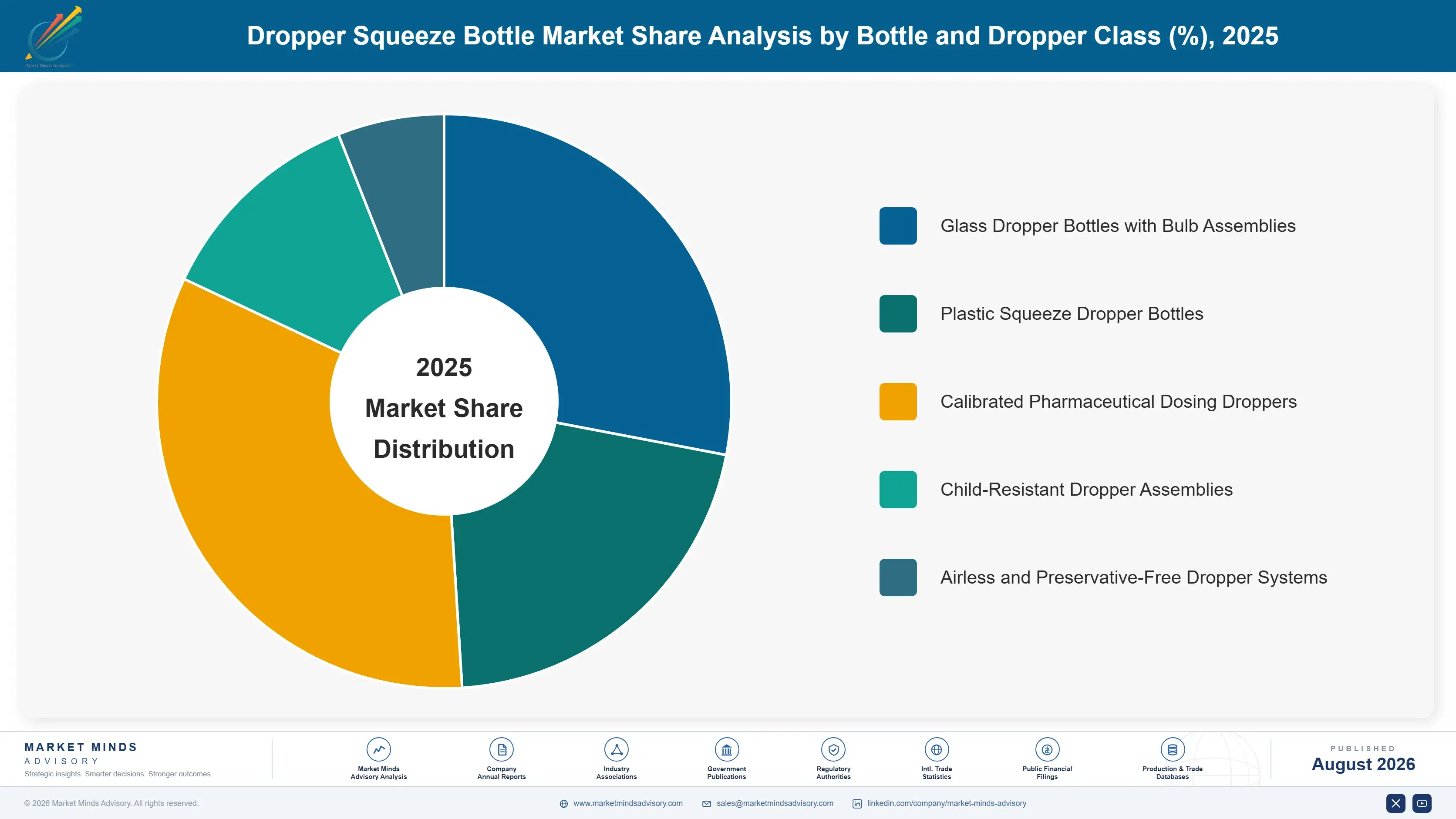
Five bottle classes divide this market by dispensing mechanism and regulatory requirement, which together determine price and which suppliers can realistically compete. The division separates cosmetic applications judged on appearance from pharmaceutical ones judged on measurable dose accuracy, and those two are barely the same business. Regulatory requirement rather than format decides who can compete.
dropper-squeeze-bottle-market-market-share-analysis-1787307221427

Calibrated Pharmaceutical Dosing Droppers

Compounding at 10.5%, a full 1.50x the market rate, calibrated droppers carry graduation marks, controlled orifice geometry and validated dose accuracy for paediatric, ophthalmic and veterinary formulations. Regulatory attention to paediatric dosing errors drives adoption rather than any commercial preference, and pricing near 2.4 times cosmetic equivalents reflects validation and tooling precision rather than material cost. Suppliers require pharmaceutical quality systems and documentation that cosmetic moulders do not hold, which limits the competing field considerably and supports the pricing that follows. Programmes qualified into a medicinal product persist for the life of that product, which makes these accounts unusually durable compared with anything on the cosmetic side. Displacement is rare absent a supply failure.
CAGR 10.5%

Child-Resistant Dropper Assemblies

Growing at 9.2% and covering around 37% of pharmaceutical dropper volume, child-resistant assemblies must defeat a determined child while remaining operable by an elderly patient with arthritic hands, which is a genuinely difficult mechanical brief in a format this small. Certification testing is prescribed and expensive, and failure means redesign rather than adjustment. The difficulty narrows the supplier field usefully and supports pricing well above standard assemblies. Regulators have discussed extending comparable requirements into concentrated cosmetic and supplement products. That would considerably widen the addressable volume for whichever suppliers already hold the certification capability. Certification testing costs are prescribed and expensive, and a failure requires redesign rather than adjustment, which deters suppliers lacking the mechanical engineering capability.
CAGR 9.2%
Full segment breakdown across 5 segments available in the complete report.

Regional Architecture and Country Demand Map

Regional distribution follows moulding and glass forming capacity alongside skincare consumption, which coincide across East Asia. Pharmaceutical dropper demand distributes more evenly, since paediatric and ophthalmic formulations are prescribed at broadly similar rates across developed markets. Skincare consumption and component manufacturing coincide geographically. Pharmaceutical demand distributes far more evenly.

East Asia

Thirty-three per cent of global value, the largest regional position, and skincare explains most of it. Note: this exceeds the 22 to 30% band because South Korean and Chinese skincare culture consumes serum dropper bottles at rates no Western market approaches, and regional moulding and glass forming capacity supplies dropper components worldwide. Korean brands popularised the serum format that subsequently spread globally, and the manufacturing capacity built to serve them now supports pharmaceutical dropper production. Japanese producers hold strong positions in precision assembly and ophthalmic dispensing systems. Serum-funded capacity across the region now supports pharmaceutical dropper production as well. Korean brands popularised the format that subsequently spread worldwide. Japanese producers hold precision assembly positions.
Share: 33% | CAGR: 8.0% (2026 to 2036)

North America

Twenty-two per cent of value, split between a substantial pharmaceutical dropper requirement and premium skincare that adopted serum formats readily. Paediatric dosing error attention has been sharpest here, which drives calibrated dropper adoption and child-resistant certification across a wide range of liquid formulations. Ophthalmic preservative-free demand is also well developed given dry eye prevalence and an ageing population. Import dependence for dropper components is high, since domestic moulding capacity for these formats is limited relative to consumption. Regulatory affairs functions rather than brand teams select pharmaceutical droppers here, evaluating documentation and change control history rather than appearance or tooling quality. Import dependence is high, since domestic moulding capacity for these formats is limited relative to consumption.
Share: 22% | CAGR: 6.4% (2026 to 2036)
Regional intelligence for 5 additional markets available in the complete report: Western Europe, South Asia and Pacific, Latin America, Middle East and Africa, Eastern Europe. Contact sales@marketmindsadvisory.com.
dropper-squeeze-bottle-market-country-cagr-analysis-1787307221951

Where Dropper Bottle Value Concentrates

A cosmetic dropper is a moulded assembly that hundreds of suppliers can make, and it competes accordingly. Value sits in the applications where a regulator cares how much liquid comes out, where a closure has to defeat a child, and where contamination cannot be controlled chemically. Documentation gates the profitable half. Regulators decide where value sits.

Build pharmaceutical quality systems, not better cosmetics

Calibrated dosing droppers price at roughly 2.4 times cosmetic equivalents and require pharmaceutical quality systems, validation documentation and change control that cosmetic moulders do not hold. That documentation rather than any moulding capability is what limits the competing field, and it is the reason the segment compounds at 10.5% while cosmetic droppers grow at half that. Suppliers investing in quality systems reach applications that better tooling alone never opens, and the barrier protects them afterward. Better tooling alone never opens those applications. The barrier protects the position once established. Quality systems are the entry cost.
Market Impact: Calibrated droppers priced at 2.4x

Take the child-resistant brief nobody wants

A child-resistant dropper must defeat a determined toddler while remaining operable by an arthritic pensioner, in a format measuring a few centimetres, and certification testing is prescribed and unforgiving. Roughly 37% of pharmaceutical dropper volume already requires it and regulators have discussed extending comparable rules into concentrated cosmetics and supplements. The difficulty is precisely what narrows the supplier field, and participants solving it hold positions that moulding capacity alone cannot threaten. Moulding capacity alone cannot threaten that position. Extension into concentrated cosmetics would widen it further. Mechanical capability decides participation.
Market Impact: Requirements now covering 37% of th

Serve preservative-free ophthalmic dispensing requirements properly

Preservative-free ophthalmic formulations must exclude contamination mechanically rather than chemically, which requires airless or filtered dropper assemblies engineered and validated for ocular use. Dry eye prevalence and preservative sensitivity are both rising, and every such formulation needs a compatible dispensing system. Unit values run well above conventional droppers and validation requirements exclude cosmetic suppliers entirely, which makes this among the most defensible positions available anywhere in the category. Unit values run well above the 2.4 times premium that calibrated dosing droppers command, and the validation requirement excludes cosmetic suppliers entirely from the application.
Market Impact: Assemblies priced above 2.4x the st

Use serum-funded capacity for pharmaceutical volumes

Skincare demand at roughly 49% of dropper volume funded moulding and assembly capacity across Asia at a scale pharmaceutical requirements alone would never have justified. Converters accessing that capacity for calibrated and child-resistant applications obtain tooling economics that a pharmaceutical-only investment could not support. India compounds at 11.0% partly on exactly this dynamic, where pharmaceutical manufacturing and skincare growth share the same regional component supply base to mutual advantage. Pharmaceutical-only investment could not have justified the automation. Regional component supply serves both halves simultaneously. Both halves share one component supply base.
Market Impact: India compounding at 11.0% in every

Who Controls the Margin Pool

The top five hold 33% of the market measured on revenue from dropper bottle and dropper assembly products, the basis used throughout this section. Fragmentation reflects widely held moulding and glass forming capability rather than any absence of scale, since the differentiation sits in dropper assembly and quality documentation. Gerresheimer holds the strongest pharmaceutical position while Aptar and Silgan lead in dispensing mechanism engineering across both halves.
Competitive activity runs along three lines. Pharmaceutical packaging suppliers are investing in calibration and child-resistant capability as regulatory attention to paediatric dosing intensifies. Cosmetic-focused moulders are attempting to qualify into pharmaceutical applications, which requires quality systems rather than better tooling. And Asian component manufacturers are moving from serum supply into regulated applications where documentation is the gate they must pass.

Pressure comes from two directions. Serum demand is a fashion-driven volume that could contract, which would leave capacity built for it seeking alternative work and pressing prices across the whole category. And regulatory requirements keep narrowing the supplier field in pharmaceutical applications. Rankings shift toward participants holding both pharmaceutical documentation and access to Asian component capacity, since neither alone is sufficient.
dropper-squeeze-bottle-market-company-positioning-matrix-1787307222466

Competitive Moat and Risk Dimensions

GERRESHEIMER

Moat: Pharmaceutical glass and documentation

Long-established pharmaceutical primary packaging quality systems, validation documentation and regulatory change control give the company access to calibrated and ophthalmic applications that cosmetic-oriented moulders cannot enter without building comparable infrastructure. Pharmaceutical customers value a supplier whose documentation regulators have accepted repeatedly far above one offering better unit economics or faster tooling.
GERRESHEIMER

Risk: Cost position against Asian capacity

European glass forming and assembly carry cost structures that Asian component manufacturers do not face, and those manufacturers are steadily obtaining the quality documentation that currently protects the position. As documentation ceases to be the differentiator, the cost gap becomes decisive in applications where regulators accept multiple qualified suppliers equally.
APTAR

Moat: Dispensing mechanism engineering depth

Specialisation in dispensing systems across many formats has produced mechanism engineering capability that determines dose accuracy, child resistance and contamination exclusion, which are the properties regulated applications are evaluated on. That expertise transfers across pharmaceutical, ophthalmic and premium cosmetic applications from one development base, which pure moulders cannot replicate at all.
APTAR

Risk: Serum volume exposure concentrated

A meaningful share of dropper volume serves skincare serums that account for roughly 49% of the category and arrived within a few years as a format fashion. Consumer routines have simplified before, and a contraction would leave both volume and the capacity built for it exposed simultaneously, with pharmaceutical applications far too small to absorb the difference.

Players Tracked

Prominent Players

Gerresheimer
Berry Global
Aptar
Silgan Dispensing
Stolzle Glass

Other Key Players

SGD Pharma
Bormioli Pharma
Piramal Glass
Schott
Nipro Corporation
Comar
Virospack
Quadpack
Baralan
Heinz Glas
Lumson
Yoshino Kogyosho
Zhejiang Rongsheng
Guangzhou Wenxi Cosmetic Packaging
Pragati Glass

Recent Developments

MAY 2021

Regulators intensify focus on paediatric liquid dosing errors

Medicines regulators across several jurisdictions increased attention to dosing errors involving liquid paediatric formulations, examining measuring device accuracy alongside labelling and instructions. These were regulatory review activities rather than commercial developments, and they raised the specification bar for droppers supplied with children's medicines. Measuring device accuracy came under direct examination.
Signal: Dose accuracy moved from a design preferen
SEPTEMBER 2022

Serum formats reach mass market price tiers

Skincare serum formats spread from premium into mass and value price tiers across major markets, multiplying dropper bottle demand well beyond what premium positioning alone had supported. These were brand and retail decisions rather than regulatory events, and they funded dropper component capacity expansion across Asian manufacturing.
Signal: A cosmetic format fashion funded the manuf
APRIL 2024

Preservative-free ophthalmic formulations expand across markets

Preservative-free ophthalmic preparations gained wider approval and adoption on preservative sensitivity concerns, requiring dispensing systems that exclude contamination mechanically. These were formulation and approval developments rather than packaging events, and they created demand for validated airless and filtered dropper assemblies. Airless and filtered assemblies became the requirement.
Signal: Removing a preservative moved the contamin

What Actually Costs Money Here

Glass and assembly labour dominate, and the dropper mechanism costs more than the bottle it sits in. Type I and Type III glass accounts for roughly 31% of cost of goods across glass formats, with furnace energy a substantial component within that. Dropper assembly including bulb, pipette, closure and their fitting absorbs around 34%, and assembly is labour-intensive in ways bottle forming is not.
Glass furnace energy costs rose sharply through 2021 and 2022 across European production, and formers holding annual contracts absorbed the increase before repricing became possible. Pharmaceutical packaging sector reporting documented that compression clearly. Elastomer bulb materials also tightened, and pharmaceutical-grade elastomers carry extractables and leachables documentation that limits substitution considerably more than cosmetic grades do. Substitution is correspondingly harder than in cosmetic grades, where extractables documentation is not required at all.

Exposure varies by material and by application. Glass formats carry furnace energy exposure that polymer avoids entirely, which has widened the cost gap against Asian glass production considerably. Pharmaceutical applications carry documentation and validation costs that cosmetic equivalents do not, and those costs are largely fixed regardless of volume, which punishes small pharmaceutical programmes and rewards suppliers running many of them across one quality system.
dropper-squeeze-bottle-market-cost-volatility-analysis-1787307222661

Assembly automation against labour intensity

Dropper assembly involves fitting a bulb, pipette and closure with tolerances that determine dose consistency, and manual assembly limits both throughput and repeatability. Automated assembly improves both at capital cost that only sustained volume justifies, which is why serum demand funding capacity mattered so much to what pharmaceutical applications can now access. Volume certainty is the precondition.

Quality system shared across pharmaceutical programmes

Validation, documentation and change control costs are largely fixed per programme regardless of volume, which punishes suppliers running few pharmaceutical products. Spreading one quality system across many programmes amortises that overhead properly, and it is why pharmaceutical packaging specialists outcompete cosmetic moulders attempting occasional regulated work. Occasional regulated work never amortises that overhead properly.

Glass lightweighting within compatibility limits

Glass carries weight, freight and furnace energy costs that polymer avoids, and lightweighting reduces all three within limits set by mechanical strength and chemical compatibility. Pharmaceutical applications constrain how far this can go, since wall thickness affects both breakage resistance and the extractables profile that regulators examine closely. Extractables profiles constrain the achievable reduction considerably.

Portfolio Architecture for Margin Defence

Margin architecture separates by whether a regulator evaluates the product. Cosmetic dropper bottles compete against hundreds of moulders and glass formers on appearance and price, clearing gross margins in the low twenties. Calibrated pharmaceutical droppers and child-resistant assemblies require quality documentation and certification testing that most of those suppliers cannot provide, and they clear roughly double from comparable equipment.
The tension is between volume and qualification. Cosmetic serum work fills assembly lines, funds automation and provides the scale that makes pharmaceutical programmes viable on the same capacity. It also earns little and depends on a format fashion that could reverse. Pharmaceutical work carries margin and arrives in smaller programmes with fixed documentation costs that punish suppliers running only a few of them.

High-value pools concentrate where accuracy or safety is measured rather than assumed. Calibrated paediatric dosing, child-resistant assemblies and preservative-free ophthalmic systems all sit there, because each is evaluated against a standard rather than against an appearance. Everything sold on how a serum bottle looks on a bathroom shelf competes against suppliers with identical moulds and cheaper labour. Identical moulds and cheaper labour decide that contest.

Volume / Commodity-Adjacent Tier

Standard cosmetic dropper bottles in glass and polymer supplied to skincare and supplement brands, where moulding capability is widely held and appearance and delivered price decide most awards. Account turnover here is rapid and continuous.
Gross Margin: 18-28%

Premium / Certified Tier

Calibrated pharmaceutical dosing droppers carrying graduation marks and validated accuracy, protected by quality documentation and change control that cosmetic moulders would need years to establish. Programmes persist for the product's regulatory life.
Gross Margin: 34-48%

Sustainability / Regulatory / Next-Generation Tier

Child-resistant assemblies and preservative-free ophthalmic dispensing systems, defended by certification testing and contamination exclusion engineering that narrow the qualified supplier field considerably. Mechanical difficulty is what protects the position, and certification failure means redesign rather than adjustment.
Gross Margin: 42-58%
dropper-squeeze-bottle-market-portfolio-architecture-1787307223158

High-value Sub-segments and Strategic Watch-out

Calibrated Pharmaceutical Dosing Droppers

The fastest growth at 10.5%, driven by regulatory attention to paediatric dosing errors rather than by commercial preference. Quality documentation rather than moulding capability decides which suppliers can compete at all here. Accounts persist for the life of the medicinal product. Regulatory notification blocks change.
Gross Margin: 34-48%

Child-Resistant Dropper Assemblies

High value at 9.2% and covering 37% of pharmaceutical volume. The mechanical brief is genuinely hard, which narrows the supplier field usefully and supports pricing well above standard dropper assemblies. Regulators have discussed extending the requirement further. Certification failure means full redesign rather than adjustment.
Gross Margin: 42-58%

Cosmetic Serum Dropper Bottles

The volume core at 5.6% and roughly half of all demand, funding the assembly automation that pharmaceutical programmes now use. It also depends on a format fashion that has reversed in other categories before. Format fashions have reversed elsewhere before. Automation it funded now serves regulated work.
Gross Margin: 18-28%

Preservative-Free Ophthalmic Systems

The strategic watch-out at 9.8%. Contamination exclusion engineering and ocular validation exclude cosmetic suppliers entirely, but the addressable formulation count remains modest against the development required. Development effort is substantial against a modest addressable formulation count, which limits how many suppliers pursue it. Few suppliers pursue it.
Gross Margin: 46-60%

Who Qualifies and What Persists

Revenue in pharmaceutical applications is durable in a way cosmetic work is not, because a dropper qualified into a medicinal product cannot be changed without regulatory notification and stability implications. That makes those programmes long-lived and displacement difficult, while cosmetic brands change dropper suppliers between product launches on price, lead time or appearance with no barrier at all. Cosmetic accounts turn over every two or three product cycles.
Stickiness therefore varies enormously by half. Ophthalmic and paediatric programmes persist for the life of the product, and suppliers are rarely displaced absent a supply failure. Child-resistant assemblies persist similarly on certification grounds. Cosmetic serum work turns over constantly as brands refresh formats, which produces volume without producing any durable account position that a supplier can rely upon. Volume without position describes the cosmetic half precisely.

The deciding function reflects that split precisely. Pharmaceutical droppers are selected by packaging development and regulatory affairs evaluating documentation, validation and change control. Cosmetic droppers are chosen by brand and design teams evaluating appearance, weight in the hand and shelf presence. A supplier addressing both with one commercial approach reaches neither convincingly, and the two audiences share almost no evaluation criteria.
dropper-squeeze-bottle-market-end-use-penetration-index-1787307223647

Where Value Actually Sits

These are among the four positions where our research anticipates prominent divergence between winners and laggards over the coming forecast period. Each is grounded in the demand model, the regulatory perimeter, and the announced capacity pipeline.
01 / QUALITY SYSTEM INVESTMENT

Documentation gates the profitable half entirely

Calibrated dosing droppers price at roughly 2.4 times their cosmetic equivalents and require pharmaceutical quality systems, validation documentation and formal change control that cosmetic moulders simply do not hold at all. Buyers audit that paperwork before they audit the tooling, and that documentation rather than any moulding or tooling capability whatsoever is what limits the competing field in every regulated application. Suppliers that invest in those systems reach applications which better tooling alone would never open at all, and the very same barrier then protects them afterward.
02 / CHILD-RESISTANT ENGINEERING POSITION

The hard brief is the defensible one

A child-resistant dropper must defeat a determined toddler while remaining fully operable by an arthritic pensioner, within a format measuring only a few centimetres across, and the certification testing is prescribed and entirely unforgiving of failure. Few moulders hold that mechanical engineering capability, and roughly 37% of all pharmaceutical dropper volume already requires it, and regulators have separately discussed extending comparable rules into concentrated cosmetics and supplements. The mechanical difficulty itself is precisely what narrows the qualified supplier field and sustains pricing well above standard dropper assemblies.
03 / OPHTHALMIC VALIDATION POSITION

Removing preservative moved the problem to hardware

Preservative-free ophthalmic formulations must exclude microbial contamination mechanically rather than chemically, which demands airless or filtered dropper assemblies engineered and separately validated for ocular use in particular. The hardware carries the sterility burden the formulation gave up, and dry eye prevalence and preservative sensitivity are both rising steadily, so every new formulation of this kind requires a dispensing system engineered and validated for it. Unit values run well above conventional droppers, and the validation requirements exclude cosmetic suppliers from the application entirely and permanently.
04 / SERUM CAPACITY EXPLOITATION

Cosmetics paid for the pharmaceutical tooling

Skincare demand at roughly 49% of all dropper bottle volume funded moulding and assembly capacity across Asia at a scale that pharmaceutical requirements alone would never once have justified building at all. Cosmetics subsidised medical packaging rather than the reverse, and converters that access that capacity for calibrated and child-resistant applications obtain tooling economics which a pharmaceutical-only investment could never have supported alone. India compounds at 11.0% partly on precisely that dynamic, where pharmaceutical manufacturing and skincare growth now share a single regional component base.

Engagement Snapshot From the Field

A live engagement with an industry participant carrying material or product regulatory and market exposure ahead of a defining policy shift, showing how our research translates into a defensible multi-year portfolio strategy.
MARKET MINDS ADVISORY · CLIENT ENGAGEMENT SUMMARY
Dropper Squeeze Bottle Producer Strategic Portfolio Review and Transition Roadmap 2026·Investment Scenario on Dropper Squeeze Bottle Exposure Evaluation 2025-26
CLIENT PROFILE
A primary packaging manufacturer with annual revenue near $260 million (client-reported, unverified by MMA), producing glass and polymer dropper bottles and assemblies at three plants serving cosmetic brands and a small pharmaceutical customer base. Serum volumes had grown strongly while overall margin stayed flat, and leadership wanted to understand whether pharmaceutical expansion justified the investment it required.
STRATEGIC CHALLENGE
The company held basic quality systems adequate for its few pharmaceutical customers but nothing supporting calibrated dosing or child-resistant certification, and its commercial organisation sold to cosmetic brand and design teams exclusively. Leadership needed to establish what pharmaceutical qualification would cost, how long it would take, and whether serum volumes were as durable as recent growth suggested.
MMA APPROACH
We assessed the client's quality systems against calibrated dosing and child-resistant requirements, identifying the specific gaps and their remediation cost. Twenty-six packaging development, regulatory affairs and brand managers were interviewed across both customer types. We modelled pharmaceutical qualification investment against continued cosmetic focus using account durability as the comparison variable.
KEY FINDINGS
  1. Cosmetic dropper accounts turned over every two to three product cycles on price and appearance, while the client's few pharmaceutical accounts had persisted unchanged for over eight years.
  2. Calibrated dosing qualification required documentation and validation infrastructure the client lacked, at a cost recoverable within four years on realistic pharmaceutical volume assumptions.
  3. Regulatory affairs managers evaluated suppliers on documentation and change control history in all fourteen pharmaceutical interviews, and none mentioned appearance or tooling quality at any point.
  4. Serum-funded assembly automation already installed met pharmaceutical throughput requirements, so the qualification gap was documentation rather than any manufacturing capability. Manufacturing capability was never the constraint.
CLIENT PROFILE
A primary packaging manufacturer with annual revenue near $260 million (client-reported, unverified by MMA), producing glass and polymer dropper bottles and assemblies at three plants serving cosmetic brands and a small pharmaceutical customer base. Serum volumes had grown strongly while overall margin stayed flat, and leadership wanted to understand whether pharmaceutical expansion justified the investment it required.
STRATEGIC CHALLENGE
The company held basic quality systems adequate for its few pharmaceutical customers but nothing supporting calibrated dosing or child-resistant certification, and its commercial organisation sold to cosmetic brand and design teams exclusively. Leadership needed to establish what pharmaceutical qualification would cost, how long it would take, and whether serum volumes were as durable as recent growth suggested.
MMA APPROACH
We assessed the client's quality systems against calibrated dosing and child-resistant requirements, identifying the specific gaps and their remediation cost. Twenty-six packaging development, regulatory affairs and brand managers were interviewed across both customer types. We modelled pharmaceutical qualification investment against continued cosmetic focus using account durability as the comparison variable.
KEY FINDINGS
  1. Cosmetic dropper accounts turned over every two to three product cycles on price and appearance, while the client's few pharmaceutical accounts had persisted unchanged for over eight years.
  2. Calibrated dosing qualification required documentation and validation infrastructure the client lacked, at a cost recoverable within four years on realistic pharmaceutical volume assumptions.
  3. Regulatory affairs managers evaluated suppliers on documentation and change control history in all fourteen pharmaceutical interviews, and none mentioned appearance or tooling quality at any point.
  4. Serum-funded assembly automation already installed met pharmaceutical throughput requirements, so the qualification gap was documentation rather than any manufacturing capability. Manufacturing capability was never the constraint.
RECOMMENDED STRATEGY
Phase 1: Phase one: invest in pharmaceutical quality systems and validation documentation, since the manufacturing capability serum demand funded already meets the requirement. Phase 2: Phase two: build a separate commercial approach for regulatory affairs and packaging development audiences, who evaluate on criteria brand teams never mention. Phase 3: Phase three: pursue child-resistant certification selectively, treating the mechanical difficulty as a barrier that protects rather than a cost to avoid.
OUTCOME
Quality system investment was approved and completed within fifteen months, and two calibrated dosing programmes were qualified in the following year (client-reported, unverified by MMA). Pharmaceutical revenue grew from a small base at margins well above the cosmetic business. Serum volumes continued growing, and leadership now treats them as capacity funding rather than as the strategy.

Frequently Asked Questions

Foundational context covering the market sizes, CAGR, scope, country, region and competition that inform every finding below. This section is provided to cover basics and most often pre-purchase conversations, answered from the MMA Primary Research Dataset.

What is the current size of the Dropper Squeeze Bottle Market?

The global market is valued at $1.94 billion in 2025, rising to $2.07 billion in 2026. East Asia holds the largest share at 33%, reflecting skincare serum consumption and regional component manufacturing capacity.

How large will the Dropper Squeeze Bottle Market be by 2036?

MMA forecasts $4.07 billion by 2036, an increase of $2.00 billion over the 2026 base and an expansion multiple of 1.97x. Calibrated pharmaceutical droppers carry most of that growth.

What is the CAGR for the Dropper Squeeze Bottle Market 2026 to 2036?

The base case compound annual growth rate is 7.0%, with a bull case at 8.2% and a bear case at 5.8%. Historical growth from 2020 to 2025 ran near 5.9%, driven almost entirely by skincare serums.

Which segment is growing fastest?

Calibrated pharmaceutical dosing droppers compound at 10.5%, a full 1.50x the market rate. Regulatory attention to paediatric dosing errors drives that adoption rather than any commercial preference.

Who are the major companies in the Dropper Squeeze Bottle Market?

Gerresheimer, Berry Global, Aptar, Silgan Dispensing and Stolzle Glass together hold 33% of dropper bottle revenue. Fragmentation reflects widely held moulding and glass forming capability across the industry.

Which country is growing fastest?

India compounds at 11.0%, faster than any other country covered, on very large paediatric liquid formulation volumes alongside a rapidly expanding skincare sector sharing the same component supply base.

Report Segmentation Architecture

The full report scope spans multiple orthogonal segmentation dimensions, with cross-tabulated demand data provided for each dimension pair. Coverage extends further to regional breakdowns, trend trajectories, and the competitive detail needed to support segment-level decision-making.

By Bottle and Dropper Class

  • Glass Dropper Bottles with Bulb Assemblies
  • Plastic Squeeze Dropper Bottles
  • Calibrated Pharmaceutical Dosing Droppers
  • Child-Resistant Dropper Assemblies
  • Airless and Preservative-Free Dropper Systems

By End-Use Industry

  • Skincare and Cosmetic Serums
  • Paediatric Liquid Medicines
  • Ophthalmic Preparations
  • Nutritional Supplements and Vitamins
  • Veterinary Liquid Formulations
  • Essential Oils and Aromatherapy

By Commercial Dimension

  • Pharmaceutical Qualified Supply
  • Brand Direct Cosmetic Supply
  • Contract Manufacturer Channels
  • Distributor and Packaging Trader Supply
  • Private Label Programmes
  • Export and Regional Distribution

By Region

  • East Asia
  • North America
  • Western Europe
  • South Asia and Pacific
  • Latin America
  • Middle East and Africa
  • Eastern Europe

Scope, Methodology, and Coverage

Every figure in this report is reproducible from documented input assumptions. The scope below maps the historical period, the forecast horizon, the segmentation dimensions, and the countries covered, alongside the underlying primary and qualitative methodology.
Historical Period
2020 to 2025
Forecast Period
2026 to 2036
Base Year
2025 (USD billions; MMA Primary Research Dataset, August 2026)
Market Definition
This market comprises bottles dispensing liquid through a dropper, pipette or controlled-drop mechanism, measured at producer revenue across pharmaceutical qualified supply, brand direct cosmetic supply, contract manufacturer channels, distributor and packaging trader supply, private label programmes, and export or regional distribution. Coverage spans glass dropper bottles with rubber or plastic bulb assemblies, plastic squeeze dropper bottles in polyethylene and related polymers, calibrated pharmaceutical dosing droppers carrying graduation marks and validated dose accuracy, child-resistant dropper assemblies meeting certification testing requirements, and airless or preservative-free dropper systems excluding contamination mechanically. Pump, spray, mist and atomiser dispensers, standard closures and caps without dropper function, ampoules, vials and prefilled syringes, pipettes, droppers and bulbs supplied separately from bottles, filling, capping and assembly equipment, secondary cartons and labels, and the liquid formulations themselves fall outside scope.
Quantitative Units
USD millions (current prices); units shipped by bottle class; dose delivery variance; price against cosmetic equivalents; glass share of formats; child-resistant share of pharmaceutical volume; serum share of total demand
Segmentation Dimensions
By Bottle and Dropper Class; By End-Use Industry; By Commercial Dimension; By Region
Regions Covered
East Asia, North America, Western Europe, South Asia and Pacific, Latin America, Middle East and Africa, Eastern Europe
Countries Covered
China, South Korea, Japan, Taiwan, United States, Canada, Mexico, France, Italy, Germany, United Kingdom, Spain, Switzerland, Netherlands, India, Australia, Indonesia, Thailand, Vietnam, Malaysia, Brazil, Mexico, Argentina, Colombia, Chile, Saudi Arabia, United Arab Emirates, Egypt, South Africa, Poland, Turkey, Czechia, Hungary, Romania, and additional markets relevant to primary packaging analysis
Key Companies Profiled
Gerresheimer, Berry Global, Aptar, Silgan Dispensing, Stolzle Glass, SGD Pharma, Bormioli Pharma, Piramal Glass, Schott, Nipro Corporation, Comar, Virospack, Quadpack, Baralan, Heinz Glas, Lumson, Yoshino Kogyosho, Zhejiang Rongsheng, Guangzhou Wenxi Cosmetic Packaging, Pragati Glass
Quantitative Methodology
Primary survey, n=3,800 respondents, Q4 2025, six countries; demand-side model with trade association cross-validation
Qualitative Methodology
47 expert interviews, Q4 2025; applied to validate demand model assumptions, identify emerging dynamics, and assess competitive positioning
Report Format
PDF and XLSX data workbook (Word format preview document)
Publisher
Market Minds Advisory
Report Code
MMA-2026-PAC-605
Published
August 2026
Contact
sales@marketmindsadvisory.com | www.marketmindsadvisory.com

Purchase the full Dropper Squeeze Bottle Market Report (2026 to 2036).

The full MMA report separates the cosmetic half of this market from the regulated half and shows why they share a format and nothing else commercially. It sizes five bottle classes and seven regions to 2036, modelling units shipped, dose delivery variance, pricing against cosmetic equivalents, glass share, child-resistant penetration and serum concentration separately. Competitive assessment covers twenty producers on one consistent revenue basis. Cost exposure is traced through glass, assembly labour and elastomers. Four commercial levers and a strategic verdict close the report, grounded in 47 expert interviews and a 3,800-respondent survey.
Five bottle and dropper classes sized separately through 2036
Dose delivery variance benchmarked across calibrated and standard assemblies
Child-resistant certification requirements mapped by market and application
Twenty producers assessed on one consistent revenue basis
Account durability compared between cosmetic and pharmaceutical programmes
Anonymised manufacturer engagement with tested qualification recommendations

Built For The People Who Decide

From boardroom strategy to bench-side execution, this report is read cover-to-cover by leaders shaping the next decade of their industry, turning demand scenarios, market dynamics and valuation benchmarks into decisions.
CXOs/ Presidents/ VPs/ Managers
M&A and Corporate Development
Strategy Teams and R&D Heads
Procurement and Product Directors
Regulatory and Compliance Leaders
Investor Relations and Equity Analysts