Market Minds Advisory
Drone Motors Market

Drone Motors Market: Smart Motor Integration and the Agricultural Payload Shift

Motor manufacturers are racing to embed electronic speed controllers directly into the motor housing, chasing agricultural and industrial drone operators who now demand heavier payload capacity than consumer-grade motor designs were ever built to deliver.

Lead Analyst

David Horsley

Published

September 2026

Make Smarter Decisions with Customized Research Insights

Request a free sample report and evaluate market opportunities, growth trends, and competitive dynamics relevant to your business needs.

2025 MARKET VALUE$2.4BMarket Size 2025
2036 FORECAST VALUE$11.7BBase Case , 2026 to 2036
CAGR 2026 TO 203615.5 %Bull 16.8% / Bear 14.2%
INCREMENTAL OPPORTUNITY$8.9BNet 10- year value creation
EXPANSION MULTIPLE4.22x2036 value over 2026 base
Strategic Levers
M&A Pipeline
Regional Outlook
Country Rankings
Competitive Intelligence
Segmental Deep-dive
Call-Us : 91 93563 13602

Executive Snapshot and Market Trajectory

Drone motors have shifted from a commoditized consumer component into a genuine capacity-constrained category, as agricultural and industrial drone operators demand heavier payload capacity and smarter integrated electronics than motor manufacturers built their original product lines to deliver at scale, reshaping how supply contracts get negotiated industry-wide.
Motors with integrated electronic speed controllers are pulling demand fastest, since drone manufacturers increasingly favor simplified wiring and reduced assembly time over sourcing separate motor and controller components. East Asia anchors the largest share of global demand, driven by China's enormous drone manufacturing base and rapidly modernizing motor production lines, while India is expanding fastest as domestic drone manufacturing policy support accelerates local component sourcing nationwide.
Competitive position tracks motor efficiency data and manufacturer trust built through years of flight-tested reliability more than brand recognition alone, since switching a drone platform's motor supplier requires significant flight testing and certification investment on both sides. DJI and T-MOTOR lead on vertical integration and premium performance reputation respectively, but Chinese mid-tier motor makers are winning share fastest in cost-sensitive consumer and prosumer segments willing to accept less established brands, a pattern buyers increasingly encourage.
Market Definition
The drone motors market covers brushless DC motors, including outrunner, inrunner, and coreless designs, along with motors with integrated electronic speed controllers used to power multirotor and fixed-wing unmanned aerial systems. It excludes complete drone airframes, flight controllers, batteries, and ground control station equipment.
Base Year Value
$2.4B in 2025 (MMA Primary Research Dataset, August 2026)
Forecast Period
2026 to 2036, eleven discrete annual values
CAGR
15.5% base case. Bull 16.8%. Bear 14.2%.
Fastest Growth Segment
Motors with Integrated Electronic Speed Controllers: 22.0% CAGR
Fastest Growth Country
India: 19.5% CAGR
Fastest Growth Region
South Asia and Pacific: 17.7% CAGR
Largest Region
East Asia: 30% of 2025 global value
Market Leaders
SZ DJI Technology Co., Ltd., Nanjing Tiger Motor Technology Co., Ltd., Hobbywing Technology Co., Ltd., Maxon Group, Shenzhen Emax Innovation Technology Co., Ltd. Source: MMA Analysis based on company annual reports.
Primary Survey
n=3,800 procurement and R&D decision-makers, Q4 2025, six countries
Methodology
Demand-side build-up, cross-validated against public data, 47 expert interviews

Drone Motors Market Forecast Scenarios

drone-motors-market-size-forecast-scenario-1787301436814
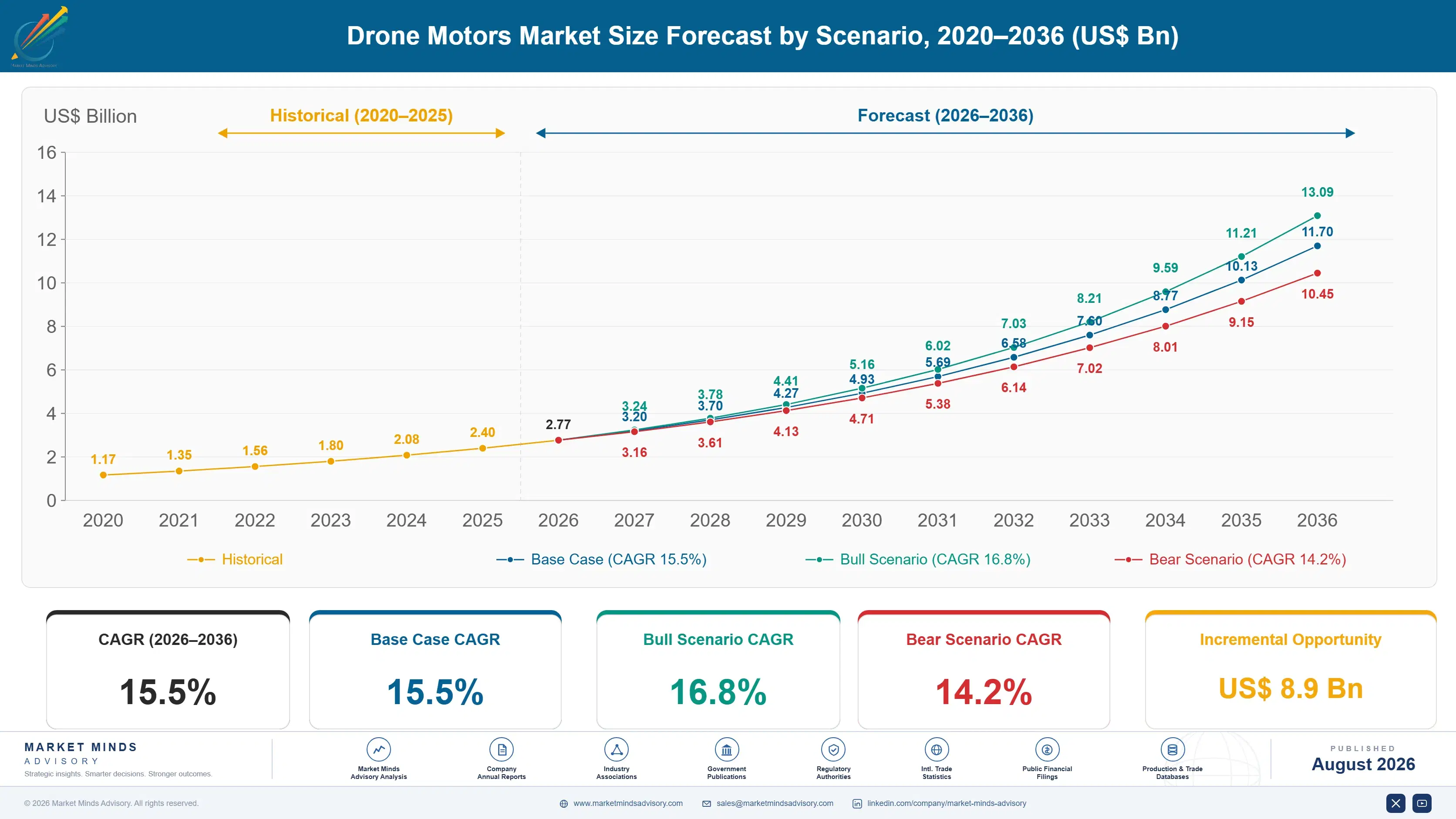
Between 2020 and 2025 the market grew at an estimated 14.3% CAGR, a period shaped by a pandemic-driven consumer drone hobbyist surge followed by rapid expansion into agricultural spraying and industrial inspection applications requiring meaningfully higher-torque motor designs. Growth accelerated through this shift, reflecting the category's transition from a hobbyist niche into a genuine industrial component supply chain.
The base case assumes 15.5% CAGR through 2036, driven by three mechanisms: continued adoption of agricultural spraying drones requiring high-torque motors capable of lifting substantially heavier payloads than consumer designs, rising demand for motors with integrated electronic speed controllers that simplify drone manufacturer assembly and reduce total component count, and expanding domestic drone manufacturing capacity across India and Southeast Asia as regional governments support local component sourcing policy. Together these mechanisms sustain growth well above what a mature electronics component category would typically generate.
The bull case, 16.8% CAGR, assumes faster agricultural drone adoption expands high-torque motor demand more quickly than currently expected across major farming regions. The bear case, 14.2% CAGR, reflects the risk that persistent motor manufacturing capacity constraints and export policy uncertainty affecting Chinese motor makers slow the pace at which drone manufacturers can actually secure sufficient motor supply.

Smart Motor Integration and the Agricultural Payload Shift

Drone motors behave less like a differentiated component category and more like a capacity-rationed industrial input, since a high-torque motor production line takes months to retool and qualify, while drone manufacturer demand for specific motor specifications can shift meaningfully within a single product design cycle. Motor makers with existing qualified capacity for high-torque agricultural applications currently hold real pricing power that consumer-grade motor supply has not commanded in y
MARKET CONCENTRATION (CR5)58%Concentrated among a handful of established Chinese motor makers
AVERAGE SELLING PRICE$34/unitIntegrated smart motors command a meaningful pricing premium
TOP PRODUCING COUNTRY SHAREChina, 46%Reflects the country's enormous drone component manufacturing base
CAPACITY UTILIZATION88%Production lines run near full capacity amid rising demand
TRADE INTENSITY52% cross-borderMost finished motors ship internationally to drone assemblers
MAGNET COST SHARE41%Neodymium magnet inputs dominate total motor production cost
Commercially, the category splits between mature, high-volume consumer and prosumer motor formats serving established hobbyist and photography drone brands, and a smaller but faster-growing agricultural and industrial motor segment sold at meaningful premium pricing into operators requiring genuine payload capacity. Motor makers exposed to both segments manage genuinely different customer conversations, since consumer motors compete primarily on price and weight while industrial motors compete on torque, reliability, and integrated electronics.
The next decade favors motor makers who can add qualified high-torque production capacity fastest in the right specification range, since drone manufacturers increasingly cite supply security and integrated electronics, not just unit price, as primary factors in awarding long-term motor supply agreements. This shift is already visible in how the largest drone manufacturers structure vendor consolidation programs and evaluation committees.
"Everyone still pictures a drone motor as a cheap hobbyist part, but agricultural operators are now buying motors the way industrial equipment buyers think about components: reliability first, price a distant second."
Director, Unmanned Systems and Aerospace Components Practice · MMA Technology /

Market Trends

Integrated Electronic Speed Controllers Simplify Assembly

Motor manufacturers are increasingly embedding electronic speed controller electronics directly into the motor housing, eliminating a separate component that drone manufacturers previously had to source, wire, and calibrate independently during assembly. This is reshaping purchasing decisions across drone manufacturers of all sizes, since reduced component count meaningfully lowers total assembly time and simplifies quality control across the finished product. Motor makers with mature integrated designs are capturing disproportionate share of new drone platform designs, while manufacturers still selling separate motor and controller components face growing pressure to develop comparable integrated offerings quickly.
Market Impact: Adds 2.1 million motor units annual
Agricultural Spraying Drones Demand Higher-Torque Motors

Agricultural spraying drone operators are adopting motors engineered for substantially higher torque and payload capacity than consumer or photography drone designs ever required, reflecting the heavier chemical payload weight these operational applications actually carry across extended flight times. This is pulling demand into an entirely new motor specification tier that most consumer-focused motor makers had not previously prioritized, expanding the addressable market beyond traditional hobbyist and prosumer volume. Motor makers with available qualified high-torque capacity are capturing this incremental demand fastest, while capacity-constrained competitors see agricultural operators face genuine supply allocation decisions.
Market Impact: Lifts Indian motor demand 24 percen

Market Opportunities and Growth Drivers

Expanding Commercial Drone Applications Lift Motor Volume

Commercial drone applications, including infrastructure inspection, precision agriculture, and last-mile delivery pilots, are expanding rapidly across major markets as regulatory frameworks mature and operators gain confidence in beyond-visual-line-of-sight flight approval processes. This creates a direct, quantifiable expansion of motor demand beyond the historical hobbyist and photography drone base, since each new commercial application typically requires motors specified differently than consumer designs. Motor makers investing most aggressively in application-specific motor development are capturing this expanding demand fastest, growing volume meaningfully ahead of prior industry projections across nearly every major regional market segment.
Market Impact: Adds 15 percent sourcing diversific

India's Domestic Drone Manufacturing Policy Support

India's production-linked incentive programs and import restrictions on foreign-manufactured drones are directly accelerating domestic drone assembly, and each domestically assembled drone increasingly requires locally sourced or domestically manufactured motor components to qualify for government incentive programs and procurement contracts. Domestic and multinational motor makers are establishing Indian manufacturing partnerships to serve this policy-driven demand, and each new domestic assembly facility typically generates a meaningful, recurring motor supply relationship once fully operational. This sustains growth well beyond what organic commercial drone adoption alone could generate across the region each year, reinforcing India's rising commercial importance.
Market Impact: Magnet swings hit margins 8 percent

Market Restraints and Challenges

Export Policy Uncertainty Affects Chinese Motor Supply

Growing geopolitical scrutiny of Chinese-manufactured drone components, including proposed restrictions in several Western markets on drones and components from specific Chinese manufacturers, is creating genuine supply chain uncertainty for drone manufacturers dependent on Chinese motor sourcing. The cause is that motor manufacturing capacity concentrated so heavily in China over the past decade that alternative qualified suppliers in other regions remain limited relative to actual global demand. Manufacturers are mitigating this through diversified sourcing and accelerated qualification of non-Chinese motor suppliers, though building comparable alternative capacity still takes considerably longer than switching a single component supplier normally would.
Market Impact: Cuts assembly time by 35 percent

Rare Earth Magnet Price Volatility Complicates Contracts

Neodymium and other rare earth magnet materials, essential inputs for high-performance brushless motor production, remain subject to meaningful price volatility tied to Chinese export policy and global rare earth mining supply dynamics largely outside motor manufacturers' direct control. The cause is that rare earth magnet supply concentrates overwhelmingly among a small number of Chinese processors, creating genuine geopolitical exposure for the entire global motor manufacturing supply chain regardless of where final motor assembly occurs. Manufacturers are mitigating this through long-term supply agreements and magnet-light motor redesigns, though timing lags between price moves and contract resets can still compress margins meaningfully.
Market Impact: Adds $310 million agricultural moto
3 additional market trends, 3 additional growth drivers, and 2 additional restraints and challenges are covered in the full report. Contact sales@marketmindsadvisory.com to access the complete intelligence.

Segment CAGR and Growth Architecture

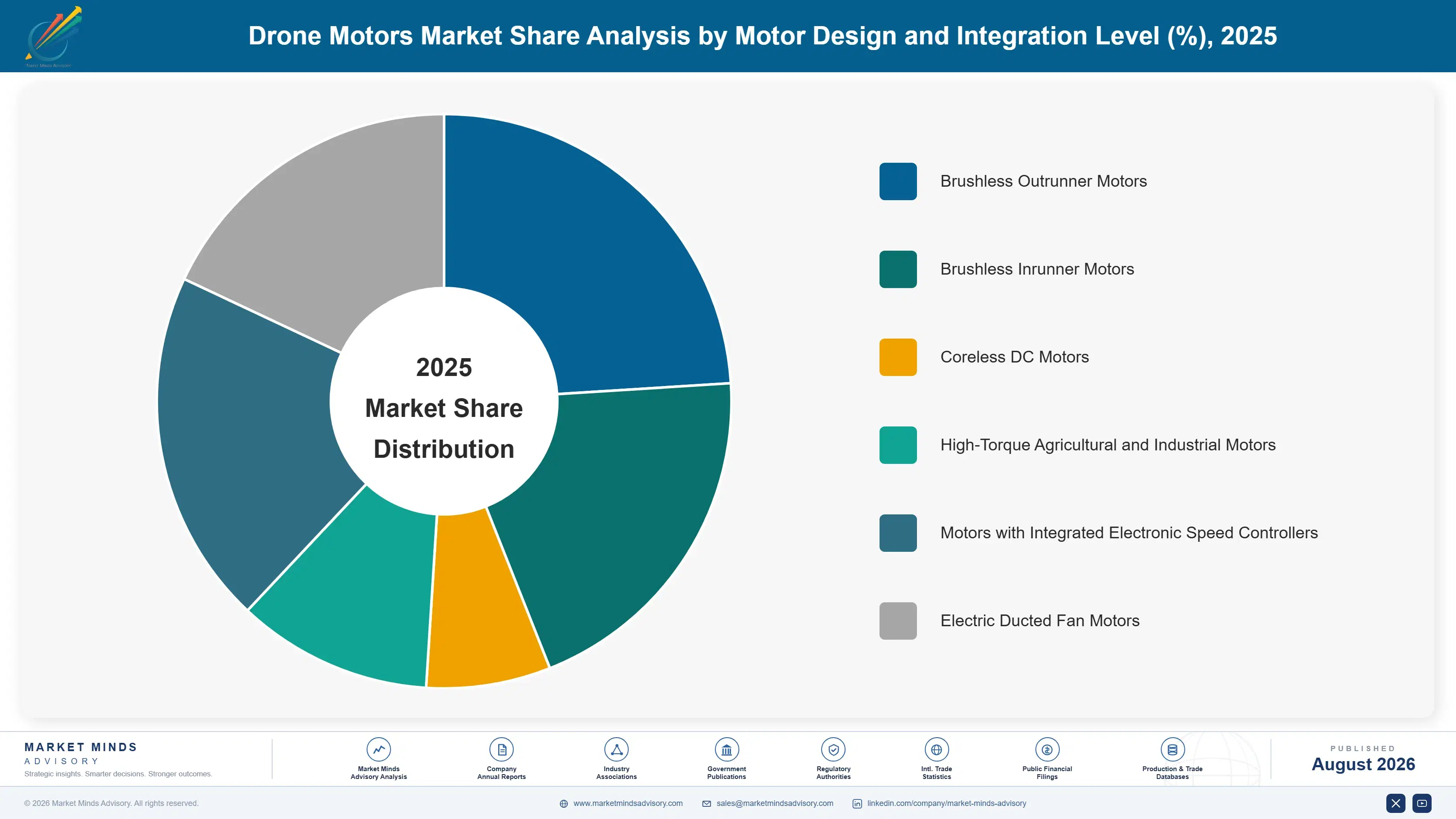
MMA segments the drone motors market by motor design and integration level, the dimension that determines manufacturing complexity, pricing tier, and where a motor fits within a drone manufacturer's assembly and sourcing strategy. This framing separates standard brushless motor formats from increasingly integrated smart motor systems commanding premium pricing across most major drone platforms today.
drone-motors-market-market-share-analysis-1787301437343

Motors with Integrated Electronic Speed Controllers

Motors with integrated electronic speed controllers, combining motor and control electronics into a single assembled unit, are growing fastest as drone manufacturers increasingly prioritize simplified assembly and reduced component count over sourcing flexibility. This segment commands the steepest pricing premium in the category, since designing reliable integrated electronics that withstand motor heat and vibration requires substantial engineering investment not every motor maker has yet completed. Hobbywing and several specialized Chinese entrants currently hold some of the most advanced integrated motor designs, having invested years building the required electronics and thermal management expertise. Adoption remains concentrated among larger drone manufacturers for now, though smaller manufacturers are increasingly accessing these designs as component pricing declines.
CAGR 22.0%

High-Torque Agricultural and Industrial Motors

High-torque agricultural and industrial motors form the second-fastest-growing segment, pulled by rising agricultural spraying drone adoption and industrial inspection applications requiring substantially heavier payload capacity than consumer or photography drone designs ever demanded. These motors command a meaningful premium over standard consumer formats, since achieving reliable high-torque output under sustained heavy load requires specialized winding and cooling design that standard production does not typically include. Growth concentrates in major agricultural regions, including China, India, and Brazil, where operators actively adopt spraying drones to reduce labor cost. Regional adoption varies, with Chinese and Indian manufacturers moving fastest while other regions build comparable agricultural drone infrastructure more gradually. MMA expects this gap to narrow as costs decline further.
CAGR 19.0%
Full segment breakdown across 6 segments available in the complete report.

Regional Architecture and Country Demand Map

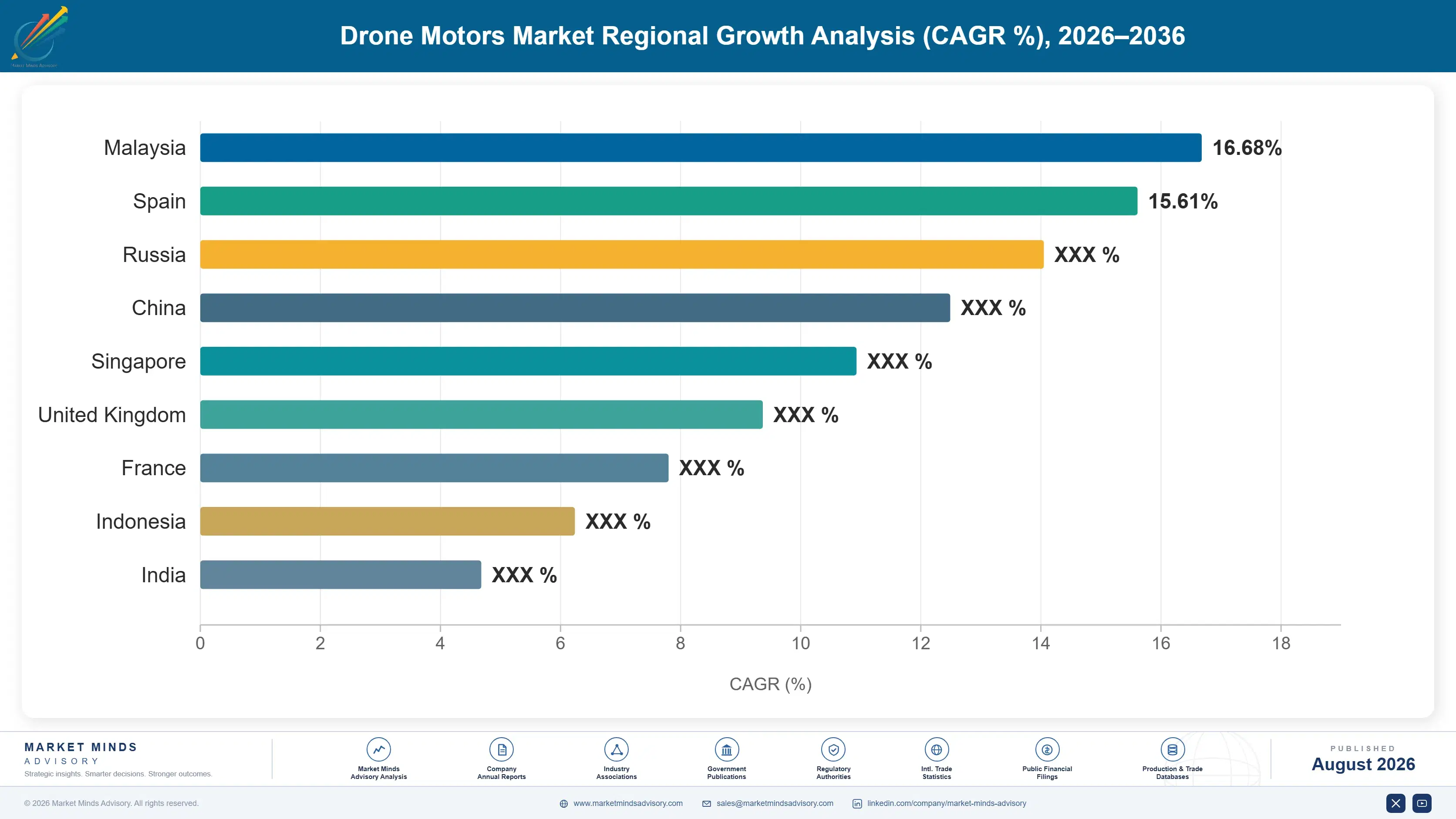
Drone motor demand concentrates where drone manufacturing volume and commercial application adoption are both highest. East Asia leads on China's enormous drone manufacturing base, North America follows on its mature commercial and industrial drone adoption, and South Asia and Pacific grows fastest as India's domestic manufacturing policy accelerates local sourcing.

North America

North America's substantial motor demand is anchored by its mature commercial drone sector, spanning infrastructure inspection, agricultural spraying, and public safety applications that increasingly require higher-torque, more reliable motor specifications than consumer designs. DJI and T-MOTOR maintain their deepest distribution relationships and brand recognition in this market, reflecting years of investment alongside major drone integrators and agricultural technology companies. Domestic motor manufacturing capacity remains limited relative to the region's drone assembly volume, creating meaningful reliance on imported Chinese and Taiwanese motor supply despite growing geopolitical scrutiny. Canada's smaller commercial drone sector contributes additional steady regional demand, tracking broadly similar adoption trends as the larger US market across most application categories.
Share: 24% | CAGR: 15.2% (2026 to 2036)

Western Europe

Western Europe's demand centers on regulatory-approved commercial drone applications, with German, French, and UK operators representing the largest concentration of regional industrial and agricultural inspection demand. European motor specification requirements increasingly emphasize certified reliability and traceable supply chains, pushing motor makers toward documented quality assurance processes to maintain access to premium commercial contracts. Domestic European motor manufacturing remains comparatively limited, meaning the region depends heavily on Asian motor imports for most commercial and industrial drone platforms. Growth trails East Asia and South Asia and Pacific's faster-expanding manufacturing bases, but Western Europe's regulatory-driven commercial adoption keeps demand growing steadily across most member states and their affiliated inspection service providers and agricultural cooperatives.
Share: 18% | CAGR: 13.7% (2026 to 2036)
Regional intelligence for 5 additional markets available in the complete report: East Asia, South Asia and Pacific, Latin America, Middle East and Africa, Eastern Europe. Contact sales@marketmindsadvisory.com.
drone-motors-market-country-cagr-analysis-1787301437857

Monetizing Integration and Payload Capacity

Motor makers are shifting from commodity unit sales toward integration-and-reliability-led commercial models: long-term supply agreements that lock in scarce high-torque capacity, premium pricing for integrated smart motor systems, application-specific motor development partnerships that deepen customer relationships, and flight-tested reliability certification that differentiates against lower-cost regional competitors across an increasingly competitive, multi-manufacturer landscape each year.

Long-Term Supply Agreements Locking In Capacity

Motor makers increasingly negotiate long-term supply agreements that lock in dedicated production capacity for major drone manufacturer customers years in advance, guaranteeing supply security during the current capacity-constrained environment while securing predictable, multi-year revenue visibility for the motor maker in return. This model requires real capacity planning discipline and favors larger, better-capitalized motor makers over smaller regional players lacking comparable balance sheet capacity to commit dedicated lines years before actual production begins. Hobbywing's long-term supply agreements with major agricultural drone brands illustrate this model, typically spanning 3 years or longer, generating predictable revenue that materially aids capacity investment planning.
Market Impact: Locks in supply agreements spanning

Premium Pricing for Integrated Smart Motor Systems

Motor makers increasingly price motors with integrated electronic speed controllers at a meaningful premium over standard separate-component designs, reflecting both the real engineering investment required and drone manufacturers' willingness to pay for simplified assembly and reduced total component count. This premium is most defensible where motor makers can demonstrate reduced drone manufacturer assembly time and documented thermal reliability data, since sophisticated drone manufacturers increasingly demand supporting engineering data beyond convenience claims alone. Integrated smart motors currently command premiums of 30 to 45 percent over comparable separate-component designs across most major drone platforms.
Market Impact: Commands a 30 to 45 percent price p

Application-Specific Motor Co-Development Partnerships With Customers

Motor makers increasingly co-develop application-specific motor designs directly with major drone manufacturer customers, creating a genuinely sticky relationship that goes well beyond a standard purchase order into something closer to an extension of the customer's own product development process. This model requires real engineering capital commitment but generates durable, multi-year revenue and pricing power that a shared, catalog-only motor design cannot easily replicate, since switching away requires the drone manufacturer to requalify an entirely new motor design elsewhere. Motor makers offering development partnerships report customer retention roughly 26 percent higher than those relying primarily on catalog products alone.
Market Impact: Improves customer retention by roug

Flight-Tested Reliability Certification Programs for Buyers

Motor makers increasingly offer documented flight-tested reliability certification, providing drone manufacturer customers with validated failure-rate data that differentiates against lower-cost regional competitors offering comparable specifications without comparable testing depth. This requires real testing infrastructure and flight-hour accumulation investment that favor larger, more established motor makers over smaller regional players lacking comparable validation capability at scale. Motor makers offering certified reliability data report customer willingness to pay roughly 18 percent more than for uncertified competitors offering only specification sheets, a gap that has held steady across recent procurement cycles and continues shaping supplier selection decisions industry-wide.
Market Impact: Commands roughly 18 percent higher

Who Controls the Margin Pool

CR5 sits at 58 percent, meaningful concentration reflecting the capital intensity and flight-testing relationship depth that favor established motor makers over new entrants. DJI and T-MOTOR lead on vertical integration and premium performance reputation respectively, and the gap to mid-tier challengers is real, though Chinese mid-tier motor makers are closing it faster than most established brands initially expected.
Current activity centers on three fronts: capacity expansion to meet accelerating agricultural and commercial drone demand, development of integrated smart motor capability to capture premium pricing, and geographic diversification of manufacturing capacity into India and Southeast Asia where policy incentives favor local sourcing. Motor makers pursuing multiple fronts simultaneously are generally best positioned to defend share as competitive dynamics continue shifting.

Emerging pressure comes from Indian and other Asian motor makers extending domestic manufacturing scale into export markets across South Asia and beyond, competing aggressively on price and policy-driven local sourcing preference in markets where established Chinese suppliers have historically dominated. Expect ranking shifts as these challengers capture a growing share of regional drone manufacturer contracts, gradually pushing established leaders to defend share through faster capacity investment and deeper integration capability rather than production scale alone.
drone-motors-market-company-positioning-matrix-1787301438375

Competitive Moat and Risk Dimensions

SZ DJI TECHNOLOGY CO., LTD.

Moat: Vertically Integrated Manufacturing Scale

DJI operates the largest vertically integrated drone and motor manufacturing network globally, giving it unmatched production scale and per-unit cost efficiency that smaller standalone motor makers cannot easily match. This integration lets DJI optimize motor design specifically for its own drone platforms while still supplying select components to third-party manufacturers.
SZ DJI TECHNOLOGY CO., LTD.

Risk: Geopolitical Export Restriction Exposure

DJI faces meaningful geopolitical scrutiny in several Western markets, including proposed restrictions on Chinese-manufactured drone components in government and commercial procurement. Competitors argue this creates genuine long-term market access risk that DJI's manufacturing scale cannot fully offset, though DJI's cost leadership still gives it real advantage in most price-sensitive commercial and consumer markets.
NANJING TIGER MOTOR TECHNOLOGY CO., LTD.

Moat: Premium Performance Brand Reputation

T-MOTOR holds the deepest brand trust among professional drone racing, agricultural, and industrial customers who prioritize documented performance data and flight-tested reliability over unit price alone. This reputation, built through years of published thrust and efficiency testing, gives T-MOTOR real pricing power in premium application segments.
NANJING TIGER MOTOR TECHNOLOGY CO., LTD.

Risk: Margin Pressure From Lower-Cost Rivals

T-MOTOR faces meaningful pricing pressure from lower-cost Chinese motor makers offering comparable specifications at substantially reduced prices, particularly in cost-sensitive consumer and prosumer segments. Competitors with lower-cost manufacturing bases argue this could limit T-MOTOR's ability to defend volume share without meaningfully compressing its premium brand margins over time.

Players Tracked

Prominent Players

SZ DJI Technology Co., Ltd.
Nanjing Tiger Motor Technology Co., Ltd.
Hobbywing Technology Co., Ltd.
Maxon Group
Shenzhen Emax Innovation Technology Co., Ltd.

Other Key Players

KDE Direct, LLC
Scorpion Power System
Ningbo Sunnysky Technology Co., Ltd.
Model Motors s.r.o.
Compress Motors s.r.o.
Plettenberg Elektromotoren GmbH
Neu Motors, Inc.
Shenzhen Arris Technology Co., Ltd.
Hacker Motor GmbH
MAD Components Co., Ltd.
Foxtech Aviation
T-Drones Technology Co., Ltd.
Innov8tive Designs, Inc.
HobbyKing Pty Ltd.
iFlight Technology Co., Ltd.

Recent Developments

MARCH 2025

Hobbywing Launches Expanded Integrated Smart Motor Line

Hobbywing launched an expanded line of motors with integrated electronic speed controllers targeting agricultural and industrial drone applications, adding qualified capacity aimed at meeting rising manufacturer demand for simplified assembly ahead of the upcoming agricultural spraying season across several major farming regions and their associated distributor networks.
Signal: Signals established motor makers investing
JULY 2025

T-MOTOR Signs Multi-Year Supply Agreement With Agricultural Drone Manufacturer

T-MOTOR signed a multi-year supply agreement with a major agricultural drone manufacturer to provide high-torque motors across multiple product lines, securing dedicated production capacity years ahead of the manufacturer's planned production expansion across its largest markets, distribution regions, and farming customer accounts nationwide and internationally.
Signal: Shows drone manufacturers locking in scarc
NOVEMBER 2025

DJI Expands Manufacturing Footprint Into Southeast Asia

DJI expanded its motor and component manufacturing footprint into a new Southeast Asian facility, diversifying production capacity beyond mainland China amid growing geopolitical scrutiny and reducing reliance on any single manufacturing geography for its global export volume, customer base, and long-term contract portfolio across multiple regions.
Signal: Extends DJI's manufacturing diversificatio

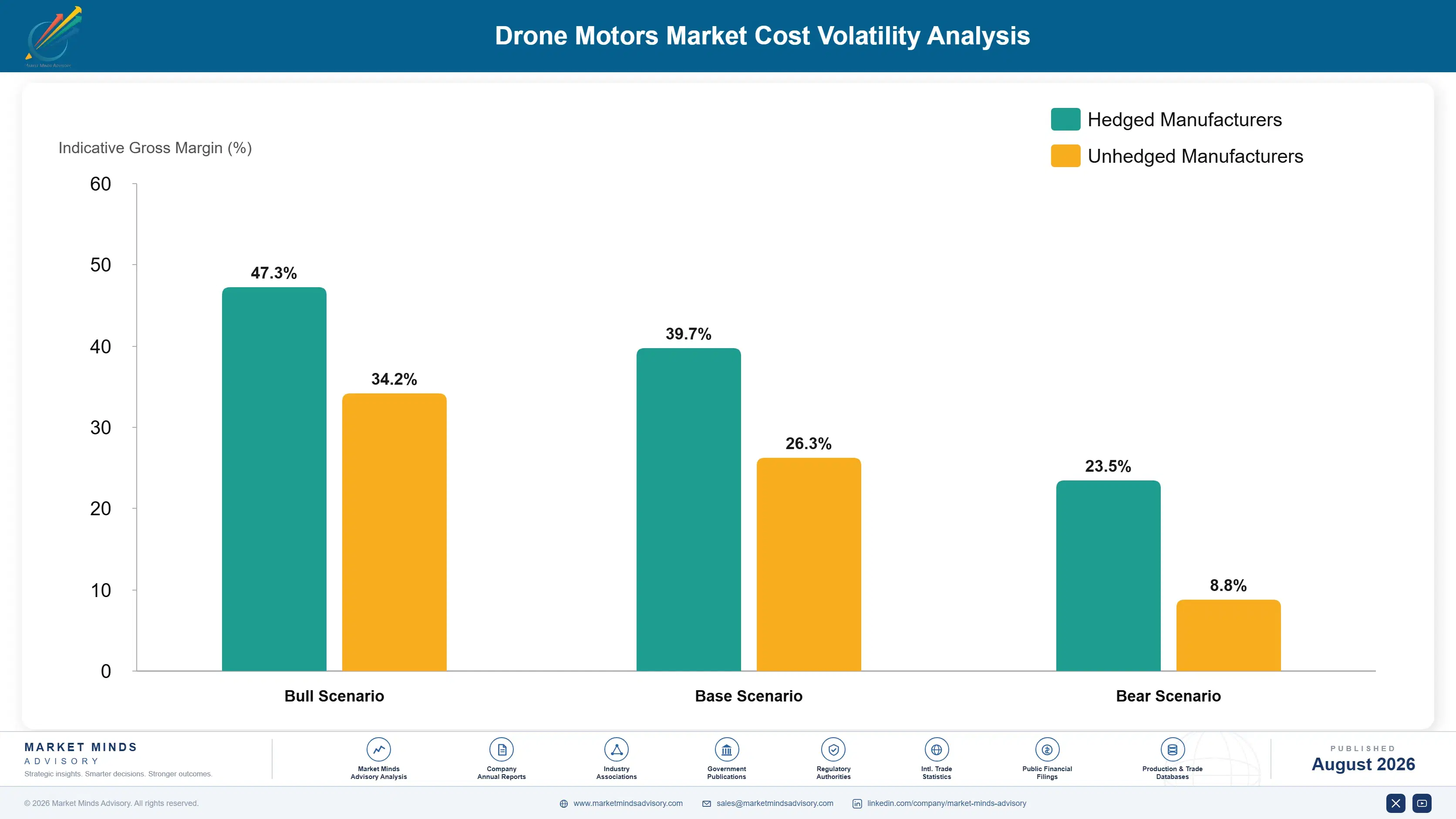
Rare Earth Magnet Sourcing Risk

Neodymium and other rare earth magnets, the primary input for brushless motor production, account for an estimated 41 percent of production cost for finished drone motors, with the remainder split between copper winding, housing, electronics, and labor. Rare earth magnet supply concentrates among a small number of qualified Chinese processors, exposing motor makers to geopolitical and export policy dynamics beyond their control.
Rare earth magnet prices rose through 2021 and 2022 following tightening Chinese export quotas and mounting demand from the broader electric vehicle and renewable energy sectors, according to China MIIT industrial policy reporting, before moderating through 2023 and 2024 as new mining capacity outside China gradually came online. Motor makers without long-term magnet supply agreements absorbed the earlier volatility into thinning margins, while larger motor makers with procurement relationships and forward-purchased inventory smoothed the impact.

Exposure varies by manufacturer type: large diversified motor makers with dedicated materials procurement and hedging capability absorbed input cost volatility better than smaller regional players buying rare earth magnets on shorter-term contracts. Geographic exposure also differs, since motor makers with direct relationships to non-Chinese rare earth processing capacity faced less disruption than those relying primarily on standard Chinese supply chains.
drone-motors-market-cost-volatility-analysis-1787301438572

Long-Term Magnet Supply Agreements With Processors

Larger motor makers are signing multi-year rare earth magnet supply agreements directly with qualified processors, securing capacity and smoothing input costs even during periods of broader export policy volatility. This requires committing to minimum purchase volumes that smaller regional motor makers often cannot absorb given their comparatively limited order visibility and working capital relative to larger diversified competitors.

Magnet-Light Motor Redesign to Reduce Exposure

Several motor makers are redesigning motor windings and magnet configurations to reduce total rare earth magnet content per unit where technically feasible, reducing exposure to magnet price volatility while simultaneously lowering total material cost per motor in a single engineering shift. This has become an increasingly common approach as magnet cost volatility persists across the broader supply chain.

Diversified Non-Chinese Magnet Sourcing

Several motor makers are qualifying rare earth magnet suppliers outside China, including newer processing capacity in Australia and the United States, reducing geographic concentration risk even though these alternative sources currently carry a modest cost premium. This diversification has become a differentiator for motor makers serving customers in markets increasingly sensitive to China-concentrated supply chains.

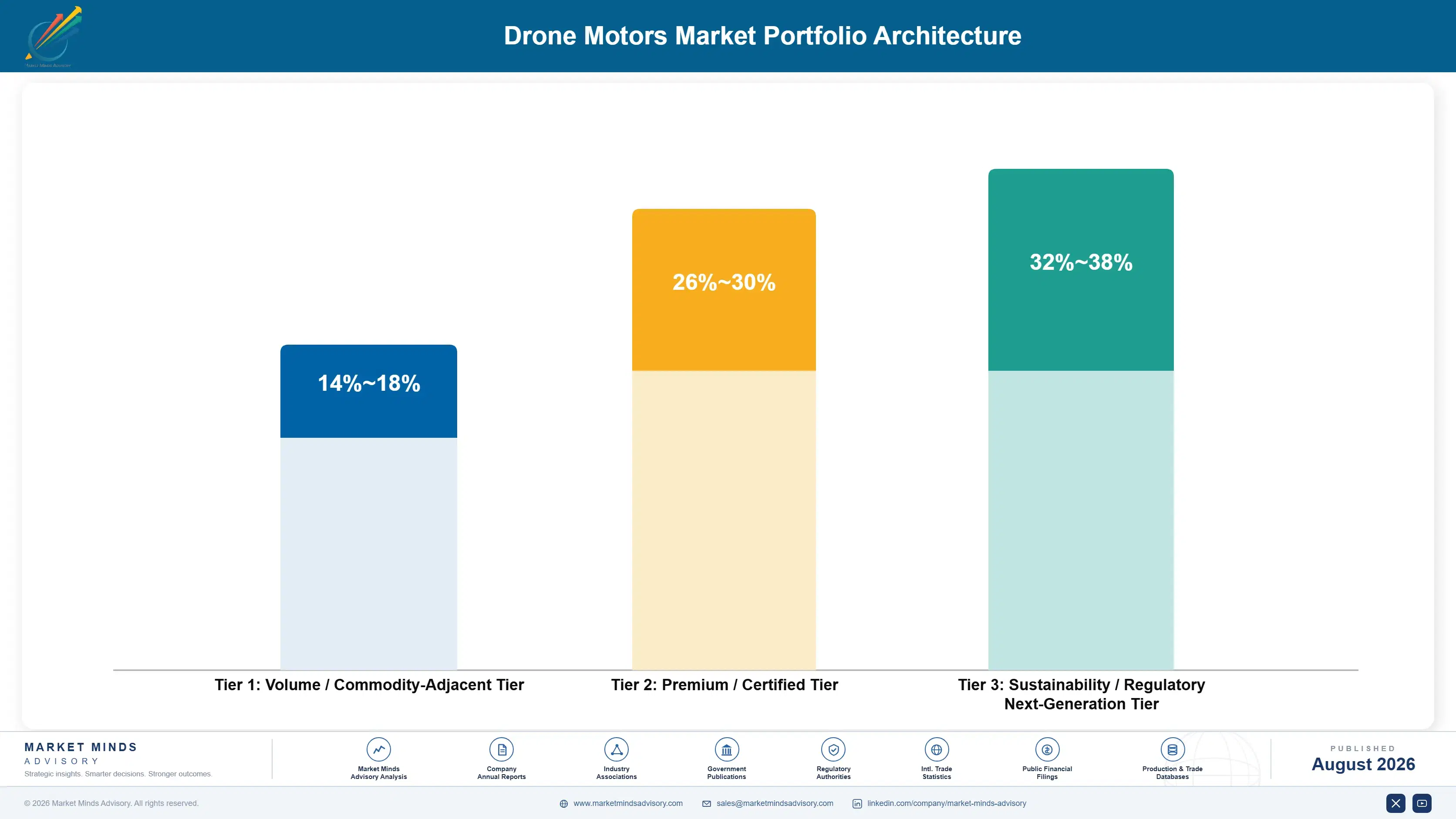
Portfolio Architecture for Margin Defence

The category splits into three tiers with margin profiles. Commodity consumer and prosumer motors, sold on price and weight for established hobbyist and photography drone brands, generate the thinnest margins despite representing the bulk of total volume. High-torque agricultural and industrial motors command better margins tied to specialized engineering investment rather than raw component content alone. The integrated smart motor tier carries the highest margins alongside the highest electron
Consumer and industrial tiers pull motor makers toward different capability investments. Consumer format volume rewards manufacturing scale and line efficiency, favoring large diversified motor makers who spread fixed costs across enormous production volumes. Industrial and integrated tiers reward investment in application-specific engineering and electronics integration capability, favoring motor makers willing to commit years to building the customer relationships these products require.

High-value pools concentrate overwhelmingly in integrated smart motors and high-torque agricultural formats purchased by drone manufacturers under direct payload and assembly efficiency pressure, where engineering capability, not raw production cost, increasingly sets pricing power. Motor makers positioned in these segments capture disproportionate margin relative to their volume share, a pattern MMA expects to persist while qualified high-torque capacity remains the binding constraint across the category.

Volume / Commodity-Adjacent Tier

Standard consumer and prosumer motors sold largely on price and weight for established hobbyist and photography drone brands where integration and torque specification do not yet command a meaningful premium.
Gross Margin: 14-18%

Premium / Certified Tier

High-torque agricultural and industrial motors sold into operators requiring documented reliability and payload capacity across major spraying and inspection accounts and applications nationwide. Margins here reflect the specialized engineering investment required.
Gross Margin: 26-30%

Sustainability / Regulatory / Next-Generation Tier

Motors with integrated electronic speed controllers developed for drone manufacturers pursuing simplified assembly and reduced component count beyond standard motor sourcing alone across their entire product line. These designs require the deepest electronics engineering investment.
Gross Margin: 32-38%
drone-motors-market-portfolio-architecture-1787301439074

Application-Specific Motor Design Economics

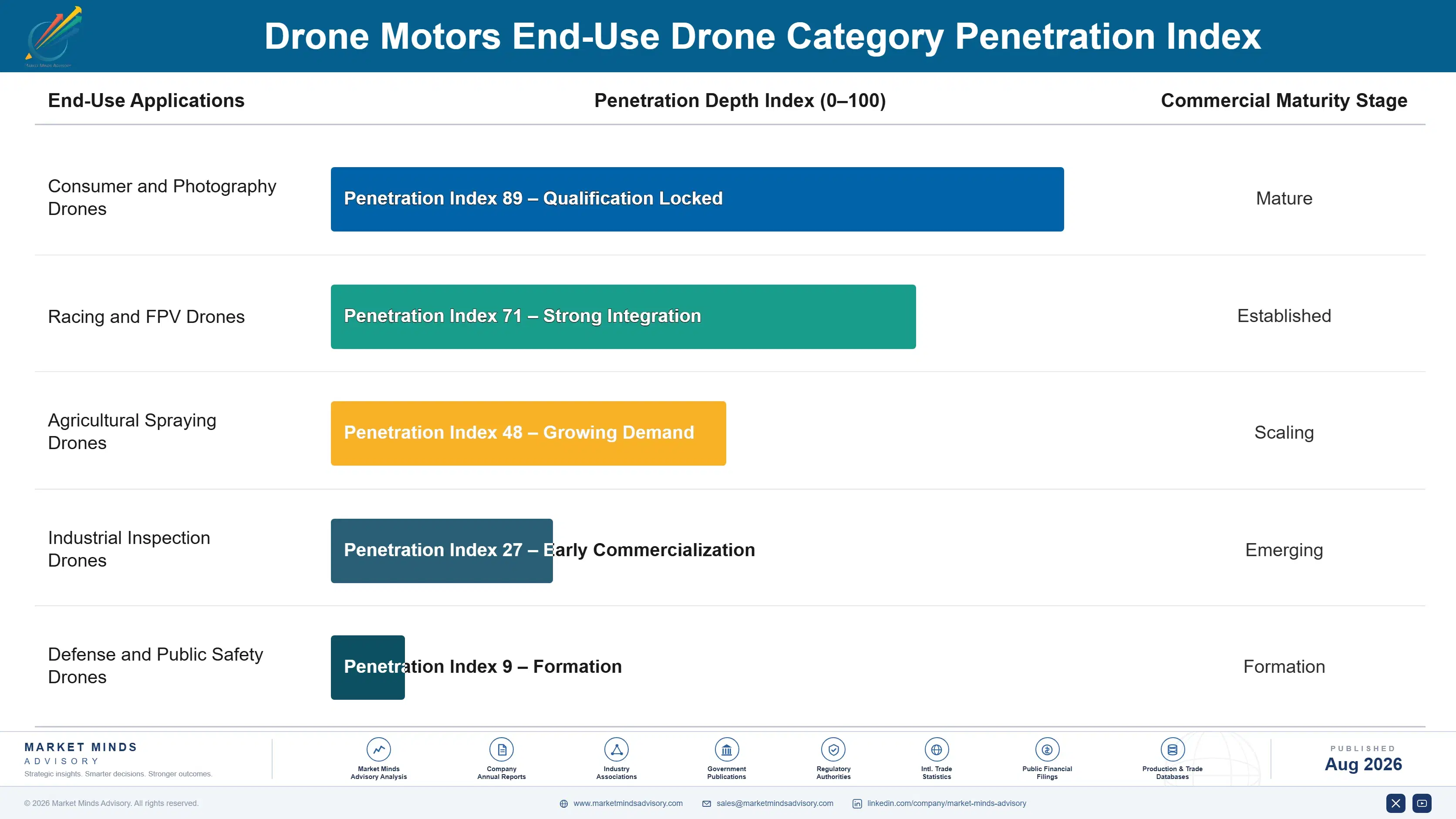
Once a motor maker wins a major drone manufacturer's supply relationship, especially through a co-development arrangement, the relationship extends across many years of recurring volume, since switching suppliers requires requalifying flight performance and rebuilding supply chain logistics that manufacturers rarely pursue without a compelling reason. This gives motor makers who win the initial relationship durable, multi-year revenue difficult for competitors to dislodge without a price, reliab
Adoption depth varies by end-use category. Agricultural and industrial drone manufacturers have moved fastest toward high-torque and integrated motor specification, since their operational reliability requirements justify the engineering and testing investment these arrangements require. Smaller consumer and hobbyist drone brands adopt more selectively, often continuing standard catalog motor purchasing where their comparatively lower volume does not justify dedicated application-specific engineering investment.

Buyer profiles are shifting generationally as drone manufacturer engineering teams, increasingly staffed by professionals hired for application-specific performance requirements, gain influence over motor specification decisions that procurement teams previously controlled on cost grounds alone. This is opening doors for motor makers who can demonstrate strong reliability data and application-specific engineering capability, even against incumbents with legacy cost relationships that carry less weight with these newer decision-makers.
drone-motors-market-end-use-penetration-index-1787301439561

Where Integration and Torque Create Value

These are among the four positions where our research anticipates prominent divergence between winners and laggards over the coming forecast period. Each is grounded in the demand model, the regulatory perimeter, and the announced capacity pipeline.
01 / SMART MOTOR INTEGRATION TIMING

Build integrated capability now before differentiation disappears

Drone manufacturers are increasingly awarding new platform designs specifically to motor makers who can demonstrate mature integrated electronics rather than pure motor specifications alone, across nearly every major application category. Hobbywing and several specialized entrants currently hold the deepest integrated motor capability underway, drawing on engineering investment that smaller regional players cannot always match on comparable timelines. MMA expects motor makers who delay integration investment now to find themselves locked out of the fastest-growing, highest-margin segment this category has produced in years.
02 / AGRICULTURAL CAPACITY INVESTMENT

Add high-torque capacity before the payload window closes

Agricultural spraying drone adoption is outpacing the industry's ability to add qualified high-torque motor capacity, and motor makers who invest in new capacity now are positioned to capture years of tight-market pricing power. T-MOTOR and Hobbywing currently hold the deepest agricultural motor capacity expansion programs underway, drawing on balance sheet strength that smaller regional players cannot match on comparable timelines. MMA expects motor makers who delay capacity investment to find themselves locked out of the most favorable pricing environment this category has experienced in years.
03 / GEOGRAPHIC SOURCING DIVERSIFICATION

Diversify manufacturing now before geopolitical restrictions tighten further

Growing geopolitical scrutiny of Chinese-manufactured drone components continues meaningfully outpacing the industry's ability to diversify supply, and motor makers who establish non-Chinese manufacturing presence fastest capture durable first-mover advantage among customers seeking to de-risk their supply chain. Motor makers who delay diversification risk losing customers to competitors who understand emerging market requirements and logistics more intimately. MMA expects the next several years to determine which established motor makers successfully defend Western market access versus ceding it to geopolitical restrictions permanently.
04 / INDIAN MANUFACTURING EXPANSION

Build Indian capacity now before local makers close the gap

Domestic drone manufacturing policy support across India continues meaningfully outpacing mature Western markets, and Indian motor makers are scaling manufacturing capacity quickly enough to challenge established Chinese suppliers on both policy compliance and delivery speed. International motor makers who delay building direct Indian manufacturing presence risk ceding the fastest-growing volume in the category to domestic competitors who understand local policy requirements more intimately. MMA expects the next several years to determine which established motor makers successfully defend Asian growth versus ceding it to regional challengers permanently.

Engagement Snapshot From the Field

A live engagement with an industry participant carrying material or product regulatory and market exposure ahead of a defining policy shift, showing how our research translates into a defensible multi-year portfolio strategy.
MARKET MINDS ADVISORY · CLIENT ENGAGEMENT SUMMARY
Drone Motors Producer Strategic Portfolio Review and Transition Roadmap 2026·Investment Scenario on Drone Motors Exposure Evaluation 2025-26
CLIENT PROFILE
The client is a mid-sized agricultural drone manufacturer with several hundred million dollars in annual revenue (client-reported, unverified by MMA), designing and assembling spraying drones for large-scale farming operations across North America and Latin America through direct sales and regional distributor channels. The company had relied on a single Chinese motor supplier but faced growing supply concentration risk and rising geopolitical scrutiny.
STRATEGIC CHALLENGE
Facing mounting customer concern about single-source supply risk and potential geopolitical restrictions affecting Chinese-manufactured components, the client needed to diversify its motor sourcing across multiple qualified suppliers while maintaining the high-torque performance specifications its agricultural customers required within a genuinely capacity-constrained supplier market that gave established manufacturers unusual negotiating leverage over price and terms.
MMA APPROACH
MMA conducted a comparative capacity and performance assessment across five leading high-torque motor manufacturers, benchmarking available qualified capacity, documented reliability data, and long-term supply agreement terms across both Chinese and non-Chinese suppliers. The engagement produced a diversified sourcing strategy sequencing supplier qualification by production line criticality, prioritizing the client's highest-volume motor specifications first to secure capacity before competing manufacturers locked in remaining supply.
KEY FINDINGS
  1. Available qualified high-torque motor capacity varied significantly by supplier, with several non-Chinese options showing meaningfully tighter near-term availability than the client's team had initially assumed.
  2. Reliability data quality differed considerably between suppliers, directly affecting which motor makers could credibly support the client's agricultural performance warranty commitments to farming customers.
  3. Securing dedicated production capacity required committing to longer-term volume agreements than the client's previous transactional purchasing approach, a meaningful shift in commercial relationship structure.
  4. Sequencing supplier qualification by production line criticality allowed the client to secure scarce capacity before competing manufacturers locked in the remaining available supply themselves.
CLIENT PROFILE
The client is a mid-sized agricultural drone manufacturer with several hundred million dollars in annual revenue (client-reported, unverified by MMA), designing and assembling spraying drones for large-scale farming operations across North America and Latin America through direct sales and regional distributor channels. The company had relied on a single Chinese motor supplier but faced growing supply concentration risk and rising geopolitical scrutiny.
STRATEGIC CHALLENGE
Facing mounting customer concern about single-source supply risk and potential geopolitical restrictions affecting Chinese-manufactured components, the client needed to diversify its motor sourcing across multiple qualified suppliers while maintaining the high-torque performance specifications its agricultural customers required within a genuinely capacity-constrained supplier market that gave established manufacturers unusual negotiating leverage over price and terms.
MMA APPROACH
MMA conducted a comparative capacity and performance assessment across five leading high-torque motor manufacturers, benchmarking available qualified capacity, documented reliability data, and long-term supply agreement terms across both Chinese and non-Chinese suppliers. The engagement produced a diversified sourcing strategy sequencing supplier qualification by production line criticality, prioritizing the client's highest-volume motor specifications first to secure capacity before competing manufacturers locked in remaining supply.
KEY FINDINGS
  1. Available qualified high-torque motor capacity varied significantly by supplier, with several non-Chinese options showing meaningfully tighter near-term availability than the client's team had initially assumed.
  2. Reliability data quality differed considerably between suppliers, directly affecting which motor makers could credibly support the client's agricultural performance warranty commitments to farming customers.
  3. Securing dedicated production capacity required committing to longer-term volume agreements than the client's previous transactional purchasing approach, a meaningful shift in commercial relationship structure.
  4. Sequencing supplier qualification by production line criticality allowed the client to secure scarce capacity before competing manufacturers locked in the remaining available supply themselves.
RECOMMENDED STRATEGY
Phase 1: Phase 1 (Months 1-2): Benchmark five leading motor manufacturers on available qualified capacity, reliability data depth, and long-term supply agreement terms offered. Phase 2: Phase 2 (Months 3-8): Secure dedicated capacity commitments with a diversified supplier mix, prioritizing the client's highest-volume motor specifications first. Phase 3: Phase 3 (Months 9-13): Extend qualification across remaining motor specifications, finalizing reliability documentation to support ongoing customer warranty commitments and reporting.
OUTCOME
The client secured diversified motor supply capacity across its highest-priority specifications within eight months, ahead of its original internal timeline (client-reported, unverified by MMA). The secured supply agreements reportedly included reliability commitments sufficient to support the client's agricultural warranty program, while insulating the client from the worst of the ongoing single-source concentration risk (client-reported, unverified by MMA).

Frequently Asked Questions

Foundational context covering the market sizes, CAGR, scope, country, region and competition that inform every finding below. This section is provided to cover basics and most often pre-purchase conversations, answered from the MMA Primary Research Dataset.

What is the current size of the Drone Motors Market?

The global drone motors market is valued at $2.4 billion in 2025. It is forecast to reach $2.77 billion in 2026 as agricultural and commercial drone adoption accelerates.

How large will the Drone Motors Market be by 2036?

MMA forecasts the market will reach $11.71 billion by 2036, roughly 4.22 times its 2026 value. Agricultural payload demand and smart motor integration both drive that expansion.

What is the CAGR for the Drone Motors Market 2026 to 2036?

The base case CAGR is 15.5 percent across the 2026 to 2036 forecast period. Bull and bear scenarios range from 14.2 to 16.8 percent depending on capacity additions.

Which segment is growing fastest?

Motors with integrated electronic speed controllers are growing fastest at a 22.0 percent CAGR, well ahead of standard motors. That is roughly 1.42 times the overall market growth rate.

Who are the major companies in the Drone Motors Market?

Leading motor makers include DJI, T-MOTOR, Hobbywing, Maxon, and Emax. Together they hold an estimated 58 percent of a meaningfully concentrated global market, despite rising regional competition.

Which country is growing fastest?

India is the fastest-growing major market, expanding at an estimated 19.5 percent CAGR. Growth is driven by domestic manufacturing policy support and expanding agricultural drone adoption.

Report Segmentation Architecture

The full report scope spans multiple orthogonal segmentation dimensions, with cross-tabulated demand data provided for each dimension pair. Coverage extends further to regional breakdowns, trend trajectories, and the competitive detail needed to support segment-level decision-making.

By Motor Design and Integration Level

  • Brushless Outrunner Motors
  • Brushless Inrunner Motors
  • Coreless DC Motors
  • High-Torque Agricultural and Industrial Motors
  • Motors with Integrated Electronic Speed Controllers
  • Electric Ducted Fan Motors

By End-Use Drone Category

  • Consumer and Photography Drones
  • Racing and FPV Drones
  • Agricultural Spraying Drones
  • Industrial Inspection Drones
  • Defense and Public Safety Drones

By Commercial Dimension

  • Direct Manufacturer Contracts
  • Application-Specific Co-Development Partnerships
  • Regional Distributor Supply
  • Aftermarket Replacement Sales

By Region

  • North America
  • Western Europe
  • East Asia
  • South Asia and Pacific
  • Latin America
  • Middle East and Africa
  • Eastern Europe

Scope, Methodology, and Coverage

Every figure in this report is reproducible from documented input assumptions. The scope below maps the historical period, the forecast horizon, the segmentation dimensions, and the countries covered, alongside the underlying primary and qualitative methodology.
Historical Period
2020 to 2025
Forecast Period
2026 to 2036
Base Year
2025 (USD billions; MMA Primary Research Dataset, August 2026)
Market Definition
This report defines the drone motors market as brushless DC motors, including outrunner, inrunner, and coreless designs, along with motors with integrated electronic speed controllers used to power multirotor and fixed-wing unmanned aerial systems. It excludes complete drone airframes, flight controllers, batteries, and ground control station equipment.
Quantitative Units
USD billions (current prices); millions of motor units where applicable
Segmentation Dimensions
By Motor Design and Integration Level; By End-Use Drone Category; By Commercial Dimension; By Region
Regions Covered
North America, Western Europe, East Asia, South Asia and Pacific, Latin America, Middle East and Africa, Eastern Europe
Countries Covered
USA, China, Germany, France, UK, Japan, South Korea, India, Australia, Canada, Brazil, Mexico, Indonesia, Vietnam, Thailand, Malaysia, UAE, Saudi Arabia, South Africa, Nigeria, Turkey, Poland, Netherlands, Italy, Spain, Sweden, Switzerland, Argentina, Colombia, Singapore, and additional markets relevant to this sector
Key Companies Profiled
SZ DJI Technology Co., Ltd., Nanjing Tiger Motor Technology Co., Ltd., Hobbywing Technology Co., Ltd., Maxon Group, Shenzhen Emax Innovation Technology Co., Ltd., KDE Direct, LLC, Scorpion Power System, Ningbo Sunnysky Technology Co., Ltd., Model Motors s.r.o., Compress Motors s.r.o., Plettenberg Elektromotoren GmbH, Neu Motors, Inc., Shenzhen Arris Technology Co., Ltd., Hacker Motor GmbH, MAD Components Co., Ltd., Foxtech Aviation, T-Drones Technology Co., Ltd., Innov8tive Designs, Inc., HobbyKing Pty Ltd., iFlight Technology Co., Ltd.
Quantitative Methodology
Primary survey, n=3,800 respondents, Q4 2025, six countries; demand-side model with trade association cross-validation
Qualitative Methodology
47 expert interviews, Q4 2025; applied to validate demand model assumptions, identify emerging dynamics, and assess competitive positioning
Report Format
PDF and XLSX data workbook (Word format preview document)
Publisher
Market Minds Advisory
Report Code
MMA-2026-TEC-206
Published
August 2026
Contact
sales@marketmindsadvisory.com | www.marketmindsadvisory.com

Purchase the full Drone Motors Market Report (2026 to 2036).

The full report provides a comprehensive assessment of the global drone motors market, including detailed sizing and ten-year forecasts across all seven regions and six motor segments. It profiles twenty leading motor makers, benchmarking production capacity, integration capability, and application-specific engineering depth across the five largest players in particular. The analysis includes primary research drawn from MMA's Q4 2025 survey of 3,800 drone manufacturer and procurement respondents across six countries and 47 expert interviews with unmanned systems and component engineering leaders. Regional sections cover manufacturing capacity, sourcing risk, and competitive dynamics specific to each market, supported by a standalone input cost and mitigation framework.
Ten-year market sizing and growth forecasts
Profiles of twenty leading drone motor makers
Regional manufacturing capacity and demand analysis
Rare earth magnet sourcing risk and mitigation framework
Primary survey data from 3,800 industry respondents
Forty-seven expert interviews with unmanned systems leaders

Built For The People Who Decide

From boardroom strategy to bench-side execution, this report is read cover-to-cover by leaders shaping the next decade of their industry, turning demand scenarios, market dynamics and valuation benchmarks into decisions.
CXOs/ Presidents/ VPs/ Managers
M&A and Corporate Development
Strategy Teams and R&D Heads
Procurement and Product Directors
Regulatory and Compliance Leaders
Investor Relations and Equity Analysts