Market Minds Advisory
Drilling Tools Market

Drilling Tools Market: Precision Systems for Complex Well Construction

Operators are pushing laterals past four kilometers and demanding tool reliability under higher temperatures, forcing drill bit and downhole tool suppliers to compress qualification cycles while shale completion intensity reshapes where drilling dollars concentrate.

Lead Analyst

David Horsley

Published

August 2026

Make Smarter Decisions with Customized Research Insights

Request a free sample report and evaluate market opportunities, growth trends, and competitive dynamics relevant to your business needs.

2025 MARKET VALUE$8.4BMarket Size 2025
2036 FORECAST VALUE$16.6BBase Case , 2026 to 2036
CAGR 2026 TO 20366.4 %Bull 7.7% / Bear 5.1%
INCREMENTAL OPPORTUNITY$7.7BNet 10- year value creation
EXPANSION MULTIPLE1.86x2036 value over 2026 base
Strategic Levers
M&A Pipeline
Regional Outlook
Country Rankings
Competitive Intelligence
Segmental Deep-dive
Call-Us : 91 93563 13602

Executive Snapshot and Market Trajectory

Lateral lengths keep extending past four kilometers across major shale basins, and operators now treat downhole tool reliability as a completion economics variable rather than a procurement afterthought, pushing premium rotary steerable and MWD packages into wells that used to run mud motors alone.
Rotary steerable systems are growing fastest at roughly 1.4 times the market average as operators chase directional precision in extended-reach laterals, while measurement and logging while drilling tools follow close behind on real-time formation evaluation demand. North America absorbs the largest share of global spending because United States shale completions run tool-intensive multi-stage laterals, and offshore campaigns in Guyana and Brazil are adding incremental rig-months that pull premium tool packages into new basins.
Five suppliers, SLB, Halliburton, Baker Hughes, NOV, and Weatherford, account for just over half of global revenue, leaving a tail of regional bit shops and rental tool specialists to compete on turnaround time rather than technology depth. Digital telemetry standards and automated directional drilling software are compressing the advantage window for legacy mechanical tool designs, and methane intensity reporting requirements are reshaping which rig contractors operators prefer to hire.
Market Definition
The drilling tools market covers drill bits, downhole motors, measurement and logging while drilling systems, rotary steerable systems, casing and tubular running tools, and fishing and well intervention tools used in the construction of oil and gas wells, onshore and offshore. It excludes mining drill rigs, water well equipment, and surface rig structures, which are tracked separately.
Base Year Value
$8.4B in 2025 (MMA Primary Research Dataset, August 2026)
Forecast Period
2026 to 2036, eleven discrete annual values
CAGR
6.4% base case. Bull 7.7%. Bear 5.1%.
Fastest Growth Segment
Rotary Steerable Systems: 9.2% CAGR
Fastest Growth Country
Guyana: 13.5% CAGR
Fastest Growth Region
South Asia and Pacific: 8.4% CAGR
Largest Region
North America: 30% of 2025 global value
Market Leaders
SLB, Halliburton, Baker Hughes, NOV, Weatherford. Source: MMA Analysis based on company annual reports.
Primary Survey
n=3,800 procurement and R&D decision-makers, Q4 2025, six countries
Methodology
Demand-side build-up, cross-validated against public data, 47 expert interviews

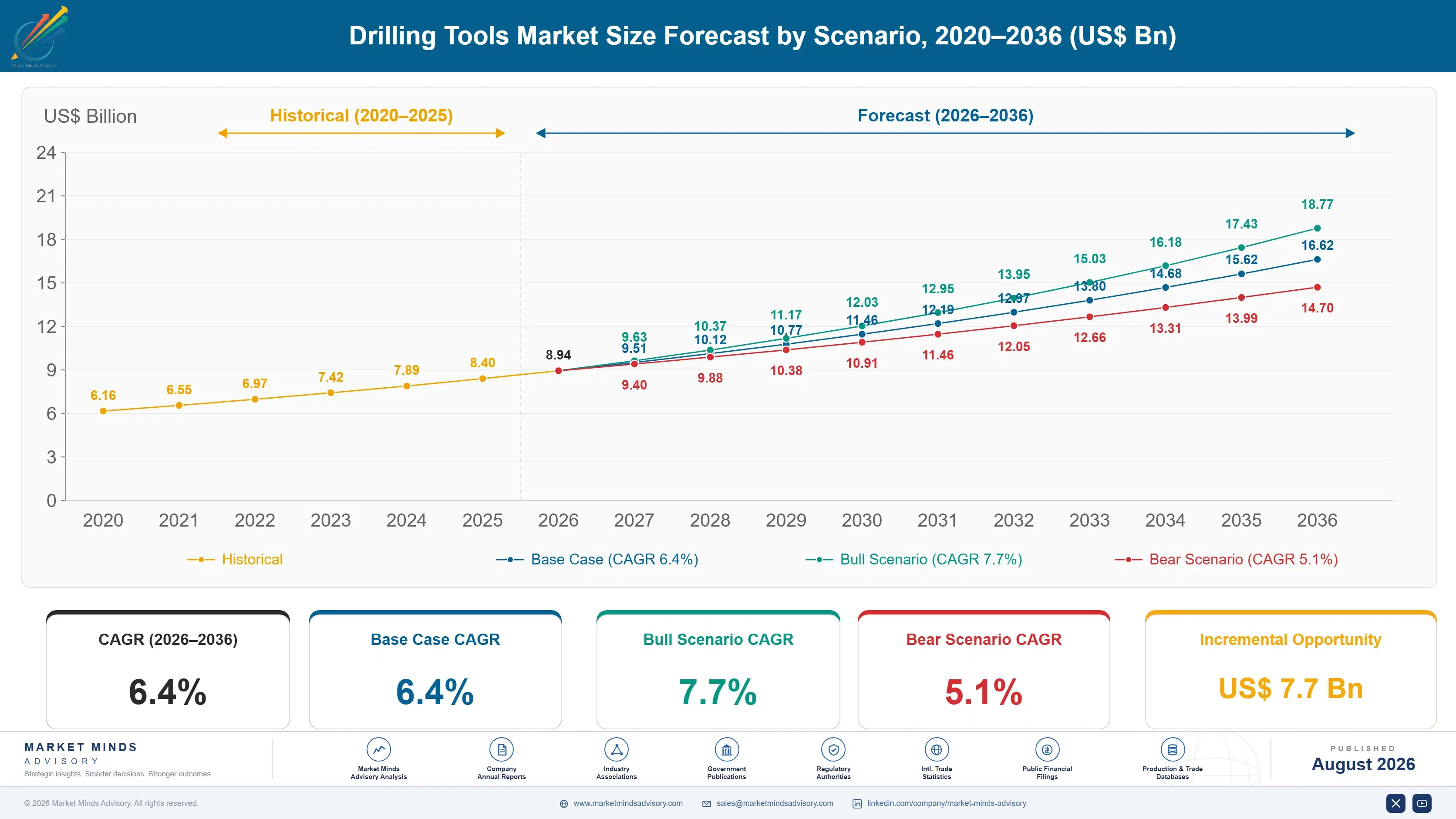
Drilling Tools Market Forecast Scenarios

drilling-tools-market-size-forecast-scenario-1787300270334
The market fell sharply in 2020 as operators slashed drilling budgets during the demand collapse, then rebuilt steadily as rig counts recovered through 2022 and 2023. Shale operators shifted toward longer laterals and pad-based drilling, lifting tool intensity per well even as well counts stayed below pre-pandemic peaks. The result was a 5.4 percent historical CAGR built on technology mix.
The base case rests on three mechanisms. First, lateral lengths keep extending past four kilometers in the Permian and Marcellus, raising directional tool runs per well. Second, offshore campaigns in Guyana, Brazil, and Namibia are adding deepwater rig-months that carry premium day rates. Third, digital telemetry and automated steering software lift average selling prices even where rig counts stay flat, because operators pay for data density rather than raw footage.
The bull case turns on a sustained deepwater cycle if Guyana's Stabroek block and Brazil's pre-salt program keep sanctioning wells through the decade, pulling premium tool mix higher. The bear case centers on a prolonged OPEC+ supply response that drives crude below sixty dollars a barrel, stalling shale completions and pushing operators toward cheaper, less tool-intensive well designs.

Tool Intensity as the New Growth Vector

Drilling tools sit at the intersection of two lasting shifts in oilfield economics: longer laterals demanding precise steering, and a smaller, more selective operator base paying for reliability over day rate. Both trends favor premium packages over legacy mechanical designs, visible in rising average selling prices even as total rig counts stay flat. Suppliers that once competed on bit durability compete on data density and steering accuracy.
CR5 CONCENTRATION52%Top five suppliers hold majority of global revenue share
AVERAGE SELLING PRICE$185,000 per RSS tool setPremium directional packages command sharp price premium over motors
TOP PRODUCING COUNTRY SHARE34%United States dominates global tool manufacturing and export volume
RIG UTILIZATION RATE68%Global fleet runs well below prior cyclical peak levels
TRADE INTENSITY41% of output exportedCross-border tool shipments rise as offshore basins expand
INPUT COST SHARE38% of COGSTungsten carbide and specialty steel dominate bit input costs
Commercially, the market behaves like a barbell. Bit sales are transactional and price-competitive, replaced every few thousand feet of hole drilled, while downhole electronics and rotary steerable systems are relationship businesses built on multi-year service contracts and data platforms. Shale operators buy on turnaround time and rental rates, while national oil companies in the Middle East negotiate long-term frame agreements years ahead of drilling campaigns.
Over the next decade, digital telemetry standards and automated directional control will keep compressing the technical gap between top-tier and mid-tier suppliers, forcing consolidation among regional bit shops that cannot fund software development. Emissions reporting requirements on methane intensity are also starting to influence which service companies operators shortlist for long-cycle offshore campaigns, in West Africa and the Eastern Mediterranean where new licensing rounds are opening fresh acreage.
"Every extra kilometer of lateral is really a bet that steering precision matters more than day rate. The suppliers still selling on bit price alone are competing for a shrinking share of a market that increasingly pays for reliability."
Director, Energy and Industrial Equipment Practice · MMA Energy | Oilfield Equip

Market Trends

Extended-Reach Laterals Push Premium Steering Tool Demand

Operators in the Permian, Marcellus, and Duvernay basins are routinely drilling laterals beyond four kilometers, with some Permian pads now exceeding five kilometers of reach. Longer laterals require tighter build-and-hold curves and consistent toolface control across extended intervals, which mud motors alone struggle to deliver reliably. Rotary steerable systems close that gap by holding a continuous steering trajectory without sliding, cutting drilling days per well even as footage rises. Operators now specify RSS packages on roughly 60 percent of new Tier 1 shale wells, up from about 35 percent five years ago.
Market Impact: Adds 160 billion dollars upstream capex
Real-Time Downhole Telemetry Becomes Standard Practice

Fiber-enabled and high-speed mud-pulse telemetry now stream formation and drilling-mechanics data to surface in near real time, replacing the memory-only logging tools operators relied on through the 2010s. Digital twin platforms ingest that stream to flag bit wear and vibration risk before a trip is needed, cutting non-productive time tied to unplanned pulls. Major operators report saving between eight and fifteen hours per well on directional drilling operations once real-time telemetry replaces batch logging. Service companies are bundling telemetry subscriptions with hardware rental, turning what used to be a one-time tool sale into a recurring data contract.
Market Impact: Guyana adds 30 new wells

Market Opportunities and Growth Drivers

Global Upstream Capital Expenditure Returns to Growth

Global upstream exploration and production capital spending is projected to reach roughly 580 billion dollars in 2026, up from a post-pandemic trough near 420 billion dollars in 2021, according to IEA investment tracking. National oil companies in Saudi Arabia and the United Arab Emirates are running some of the largest rig fleets in company history to defend production capacity, while independents in the United States are reinvesting free cash flow into longer laterals rather than new rig additions. That capital is flowing toward tool-intensive well designs, since operators now measure success in cost per barrel rather than wells drilled.
Market Impact: Carbide costs rose 30 percent

Deepwater Final Investment Decisions Accelerate Offshore Demand

Deepwater project sanctioning has picked up sharply since 2023, led by ExxonMobil and Hess in Guyana's Stabroek block, Petrobras in Brazil's Buzios and Mero fields, and a wave of new licensing rounds off Namibia and Suriname. Each new floating production system typically anchors ten to twenty development wells drilled with premium rotary steerable and high-temperature MWD packages, since deepwater rock is harder to steer through blind. Guyana alone added more than thirty new production wells between 2023 and 2025, and operators there pay day rates two to three times onshore North American levels for equivalent tool packages.
Market Impact: Rig counts fell 50 percent 2020

Market Restraints and Challenges

Tungsten Carbide Price Swings Squeeze Bit Margins

Tungsten carbide accounts for a large share of drill bit input cost, and China controls roughly 60 percent of global tungsten mining and refining capacity, concentrating supply risk in one country's export policy. When China tightened tungsten export quotas in 2024, spot carbide prices rose more than 30 percent within two quarters, compressing margins for bit makers that had not hedged forward. Mid-tier manufacturers without long-term supply contracts absorbed most of that hit, while larger suppliers leaned on diversified sourcing from Vietnam and carbide reclamation to soften the blow. Several producers are qualifying tungsten-free composite cutting structures as a hedge.
Market Impact: Lifts RSS penetration to 60 percent

Oil Price Downturns Cut Rig Activity Sharply

Drilling tool demand tracks active rig count directly, and rig count is highly sensitive to crude price because operators idle rigs within weeks of a price shock. The root cause is capital discipline: independents now prioritize shareholder returns over growth, so a sustained move below sixty dollars a barrel triggers rapid budget cuts rather than gradual pullbacks. The 2020 downturn cut North American rig counts by more than half within two months, and suppliers with fixed manufacturing capacity absorbed steep utilization losses. Leading suppliers now hold larger rental fleets and diversify into offshore markets that move on longer investment cycles.
Market Impact: Cuts non-productive time by 10 hours
3 additional market trends, 3 additional growth drivers, and 3 additional restraints and challenges are covered in the full report. Contact sales@marketmindsadvisory.com to access the complete intelligence.

Segment CAGR and Growth Architecture

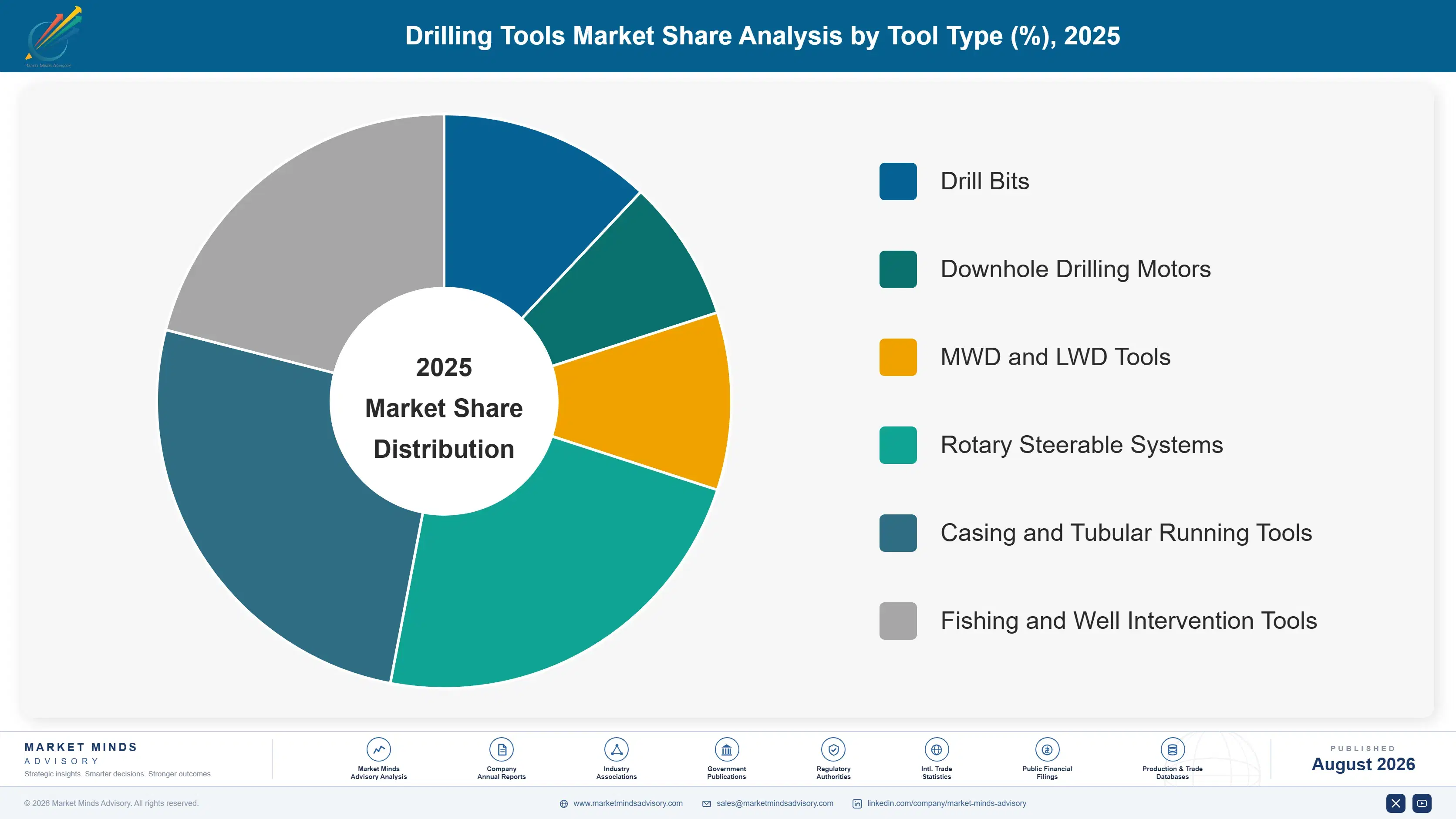
Segmentation follows tool type rather than well type or basin, since a single well typically consumes several tool categories across its construction. Six categories span the drilling tool value chain from cutting structures through steering and formation evaluation to completion-adjacent fishing and intervention tools, reflecting how operators budget for and procure each discipline separately across a program.
drilling-tools-market-market-share-analysis-1787300270860

Rotary Steerable Systems

Rotary steerable systems have become the default choice for extended-reach laterals because they hold a continuous steering trajectory without the toolface oscillation that slows sliding with mud motors. Adoption is concentrated in the Permian, Marcellus, and Guyana's offshore program, where laterals now regularly exceed four kilometers and operators pay a day rate premium for footage gained. SLB's PowerDrive and Halliburton's Geo-Pilot families lead unit placements, though Chinese suppliers are qualifying competing systems for domestic shale and offshore campaigns. Rental models now dominate over outright sales, since operators prefer to pay per footage drilled rather than carry ownership risk on electronics-heavy tools that require specialized maintenance between wells, especially in high-vibration carbonate formations.
CAGR 9.2%

MWD and LWD Tools

Measurement and logging while drilling tools stream real-time directional and formation data to surface, letting geologists steer wells within thin target zones without waiting for wireline runs after the fact. Demand is rising fastest in unconventional plays with complex, multi-bench targets, where missing a landing zone by a few feet can cost an entire well's economics. High-frequency mud-pulse and wired-pipe telemetry are displacing older single-channel tools, and service companies increasingly bundle MWD hardware with cloud-based visualization subscriptions billed per well rather than per day. Offshore campaigns in Brazil and West Africa are adopting high-temperature, high-pressure rated MWD packages engineered for deeper, hotter reservoirs than typical onshore shale tools were designed to handle.
CAGR 8.5%
Full segment breakdown across 6 segments available in the complete report.

Regional Architecture and Country Demand Map

Demand concentrates where lateral length and offshore rig activity are highest. North America leads on shale completion intensity, East Asia on onshore well count and domestic tool manufacturing, while Latin America and the Middle East and Africa gain share fastest on new deepwater and national oil company drilling campaigns.

North America

United States shale basins drive this region's lead, and the mechanism is straightforward: laterals in the Permian, Marcellus, and Eagle Ford keep extending past four kilometers, and every added kilometer of lateral requires more directional tool runs, not fewer. Independent operators such as Diamondback Energy and EQT increasingly specify rotary steerable systems as standard rather than optional equipment on Tier 1 acreage, lifting average tool spend per well well above pad-drilling levels from five years ago. Gulf of Mexico deepwater activity adds a second growth channel, with several operators sanctioning subsea tiebacks that require high-temperature MWD packages. Canada's Montney and Duvernay plays contribute a smaller but steadily growing volume of premium tool demand as well.
Share: 30% | CAGR: 7.4% (2026 to 2036)

Western Europe

North Sea maturity explains Western Europe's declining relative position more than any single policy choice. Norway and the United Kingdom continue drilling infill and tieback wells on producing fields, but new exploration activity has slowed as operators prioritize existing infrastructure over fresh acreage. Equinor's continued investment in subsea tiebacks sustains a base level of premium tool demand, and Germany's limited geothermal drilling program is opening a small adjacent market for high-temperature tools. Poland's shale gas ambitions from a decade ago never materialized at scale, leaving the region reliant on offshore maintenance drilling rather than new well construction for its tool volume. Italy's Adriatic gas fields add modest incremental volume, insufficient to reverse the region's gradual decline.
Share: 19% | CAGR: 4.9% (2026 to 2036)
Regional intelligence for 5 additional markets available in the complete report: East Asia, South Asia and Pacific, Latin America, Middle East and Africa, Eastern Europe. Contact sales@marketmindsadvisory.com.
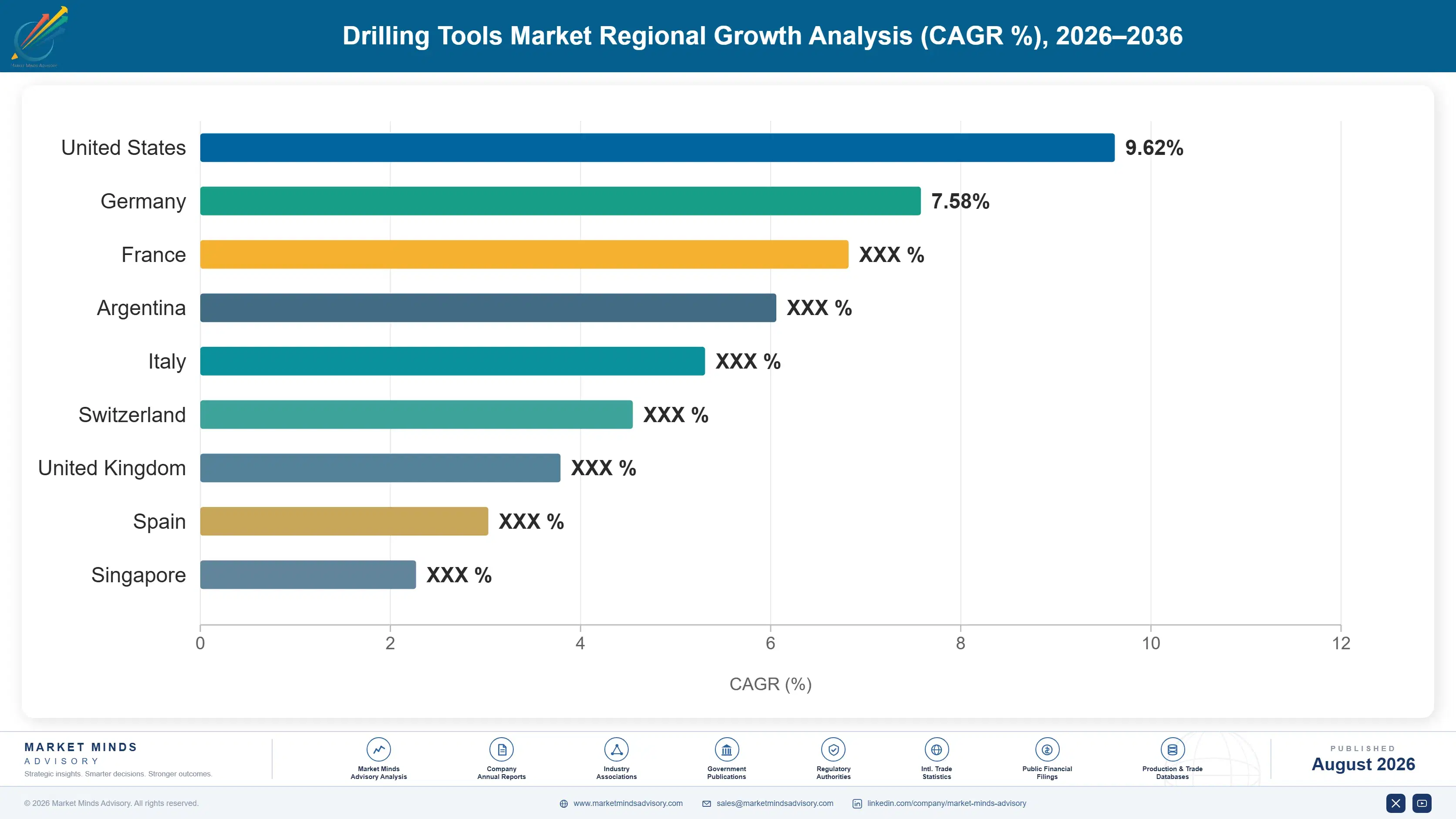
drilling-tools-market-country-cagr-analysis-1787300271371

Where Tool Suppliers Can Grow Margin

Growth in unit volume alone will not lift margins in a market where bit pricing stays competitive. The more durable path runs through recurring data services, rental conversion, and specialization in high-temperature and high-pressure tools that few competitors can qualify, each of which carries pricing power that legacy mechanical hardware sales no longer command.

Converting Tool Sales Into Data Subscriptions

Bundling MWD and RSS hardware with cloud-based visualization and analytics subscriptions turns a one-time equipment sale into a recurring revenue stream billed per well or per month. Operators increasingly prefer this model because it shifts maintenance and software update costs back onto the supplier, and early adopters among the top five suppliers report subscription attach rates above 40 percent on new rotary steerable placements. Margins on data services run considerably higher than on hardware alone, since the incremental cost of serving an additional well on an existing cloud platform is small once the underlying software investment is made.
Market Impact: Lifts services attach rate to over 40 percent of placements

Expanding High-Temperature Tool Qualification for Deepwater

Deepwater and geothermal wells routinely exceed 150 degrees Celsius downhole, a temperature that disqualifies standard electronics and elastomer seals used in onshore tool packages. Suppliers that qualify high-temperature, high-pressure rated MWD and RSS systems can charge day rates two to three times the onshore equivalent, since only a handful of competitors currently hold that qualification. Baker Hughes and SLB have both expanded high-temperature product lines over the past two years specifically to capture Guyana and Brazil deepwater campaigns, and the qualification barrier alone keeps regional bit shops and smaller rental specialists out of this segment entirely, protecting pricing.
Market Impact: Commands day rates up to 3 times higher

Building Domestic Manufacturing Inside China and India

Import substitution policy in China and local content requirements in India are pushing operators to specify domestically manufactured tools over imported Western equipment on a growing share of new contracts. Suppliers that establish local manufacturing and qualification facilities inside these markets avoid tariff exposure and qualify faster for national oil company tenders that weight domestic content heavily. Honghua and other Chinese manufacturers have captured an estimated 25 percent of domestic rotary steerable placements within five years, a share Western suppliers can only partially defend through joint ventures and licensing arrangements with local partners.
Market Impact: Domestic suppliers hold 25 percent of China RSS

Growing Rental Fleet Share Over Outright Sales

Operators increasingly prefer to rent premium directional and MWD tool packages rather than own them outright, since rental shifts obsolescence risk onto the supplier as electronics generations turn over quickly. Rental now accounts for roughly 55 percent of rotary steerable deployments globally, up from under 40 percent five years ago, and suppliers with large, well-utilized rental fleets earn steadier margins than those exposed to lumpy capital equipment sales cycles. Weatherford has rebuilt its balance sheet in part by shifting toward a rental-heavy model, trading unit sales volume for recurring utilization revenue less exposed to quarterly rig count swings.
Market Impact: Rental share reaches 55 percent of RSS deployments

Who Controls the Margin Pool

Five suppliers, SLB, Halliburton, Baker Hughes, NOV, and Weatherford, control just over half of global drilling tool revenue on a company-reported basis, and the gap between the top two and the rest of the field is wide. SLB and Halliburton run global manufacturing and qualification networks smaller rivals cannot replicate quickly, while mid-tier suppliers compete mainly on turnaround time and rental pricing rather than depth.
Current competitive activity centers on three fronts. Suppliers are racing to qualify high-temperature tool packages for deepwater campaigns in Guyana and Brazil, since that barrier commands premium day rates few competitors can match. They are bundling hardware with telemetry subscriptions to build recurring revenue, and expanding rental fleets in North America. Chinese suppliers are qualifying competing rotary steerable systems to displace Western tools inside domestic and Belt and Road-linked programs.

Emerging pressure comes from two directions. Chinese suppliers led by Honghua are exporting credible rotary steerable systems into Middle Eastern and African markets at prices Western suppliers struggle to match, and that gap could shift share within the forecast period. Independent telemetry software specialists are also entering by partnering with smaller hardware manufacturers, threatening to unbundle the hardware and data layers suppliers currently sell together.
drilling-tools-market-company-positioning-matrix-1787300271889

Competitive Moat and Risk Dimensions

SLB

Moat: Global Qualification and Scale

SLB operates the broadest global network of tool manufacturing, testing, and field qualification facilities in the industry, letting it deploy new rotary steerable and MWD technology across every major basin within months of release. That scale advantage is difficult for smaller rivals to replicate without years of qualification testing and capital investment most competitors cannot justify.
SLB

Risk: Chinese Price Competition Rising

Domestic Chinese suppliers are qualifying competing tool packages at substantially lower price points, and as their technology gap narrows, SLB's premium pricing in China and adjacent Belt and Road markets faces growing pressure from suppliers willing to compete primarily on cost rather than performance. That pressure is likely to intensify as Chinese suppliers expand export ambitions beyond their home market.
HALLIBURTON

Moat: Deep North American Shale Relationships

Halliburton's long-standing relationships with major North American independents give it preferred access to the highest-volume shale drilling programs, where its Geo-Pilot rotary steerable family holds strong incumbency built over more than a decade of iterative field deployment and operator trust. That incumbency is reinforced by deep integration with completion design workflows that competitors find difficult to displace quickly.
HALLIBURTON

Risk: Offshore Portfolio Gap Versus Rivals

Halliburton's offshore and deepwater tool portfolio is comparatively thinner than SLB's or Baker Hughes's, leaving it more exposed if North American shale activity slows and the industry's growth increasingly concentrates in deepwater basins where its market position is weaker. Closing that gap would require sustained capital investment the company has so far prioritized elsewhere.

Key Players

SLB
Halliburton
Baker Hughes
NOV Inc.
Weatherford International

Others

Ulterra Drilling Technologies
Varel International Energy Services
Scientific Drilling International
Drilling Tools International
Bico Drilling Tools
Rival Downhole Tools
American Block
Forum Energy Technologies
Superior Energy Services
Innovex Downhole Solutions
Kingdream
Honghua Group
Sinopec Oilfield Service Corporation
Drillmec
National Energy Services Reunited Corp

Recent Developments

MARCH 2025

Baker Hughes Expands High-Temperature MWD Line

Baker Hughes launched an extended-range high-temperature MWD tool rated to 200 degrees Celsius, targeting deepwater campaigns in Guyana and Brazil where standard electronics fail. The launch followed eighteen months of field trials with two undisclosed operators and expands the company's addressable share of premium offshore tool day rates.
Signal: Signals intensifying competition for deepwater high-temperature tool qualification as suppliers race to serve expanding pre-salt and Stabroek drilling programs.
JULY 2025

Halliburton Signs Multi-Year RSS Supply Agreement in Guyana

Halliburton signed a multi-year supply agreement with a major Guyana-focused offshore drilling contractor to provide rotary steerable systems and directional drilling services across an expanding well program. The agreement locks in tool availability through 2029 and reflects intensifying competition for premium deepwater service contracts in the basin.
Signal: Signals suppliers locking in long-term deepwater contracts as Guyana's drilling program continues expanding through the decade.
JANUARY 2025

Honghua Opens New Rotary Steerable Manufacturing Facility

Honghua Group opened a new manufacturing and qualification facility in Sichuan dedicated to rotary steerable system production, expanding domestic capacity to serve China's growing shale gas drilling program. The facility doubles Honghua's annual RSS output and supports import substitution goals under national industrial policy through 2030.
Signal: Signals accelerating Chinese domestic tool capacity as import substitution policy reshapes competitive dynamics in the region.

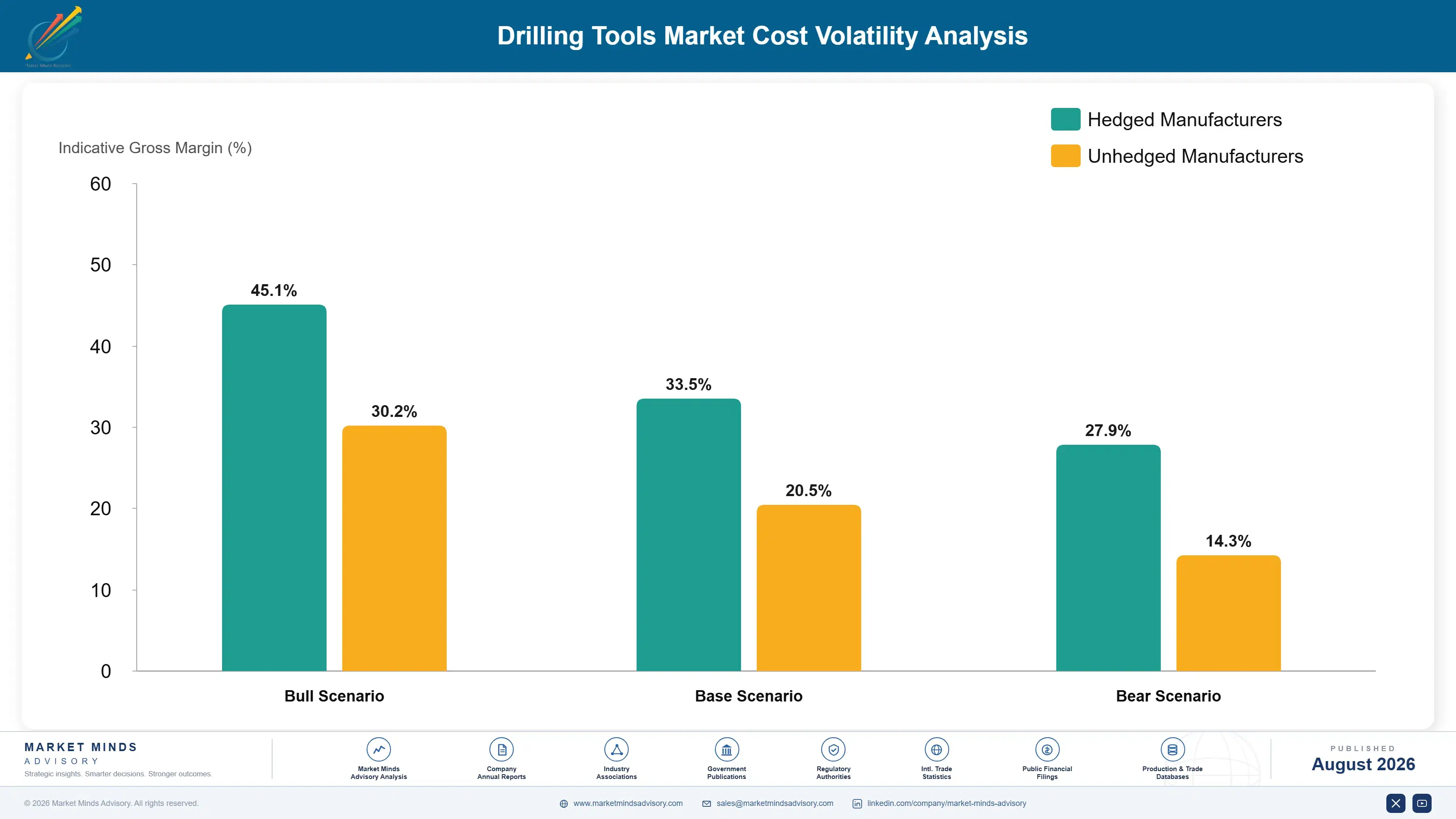
Carbide and Steel Cost Exposure

Tungsten carbide and specialty alloy steel together account for roughly 38 percent of drill bit and downhole tool cost of goods sold, with carbide concentrated overwhelmingly in Chinese mining and refining supply. Steel inputs are more geographically diverse, sourced from mills in the United States, Germany, and South Korea, but carbide's single-country concentration creates the sharper exposure for tool manufacturers across the industry.
China tightened tungsten export licensing in 2024 as part of broader critical mineral trade controls, and spot tungsten concentrate prices rose more than 30 percent within two quarters, per IEA critical minerals tracking. Baker Hughes's 2024 annual report cited elevated raw material costs as a drag on drilling products segment margins, and several mid-tier bit manufacturers passed a portion of the increase through to customers via surcharges.

The disadvantage falls hardest on manufacturers without long-term supply contracts or geographic sourcing diversity. Top-five suppliers with scale to negotiate multi-year carbide agreements and qualify alternative sources in Vietnam absorb volatility more smoothly than regional bit shops buying on the spot market. That gap widens further for manufacturers based outside China, who face both the price exposure and potential export licensing delays that domestic Chinese producers do not.
drilling-tools-market-cost-volatility-analysis-1787300272084

Diversifying Carbide Sourcing Beyond China

Leading suppliers are qualifying tungsten sources in Vietnam and expanding recycled carbide reclamation programs to reduce reliance on Chinese-origin material. Recycled carbide now supplies a growing share of replacement bit manufacturing, cutting exposure to export licensing swings while lowering input cost per unit. Several suppliers expect this diversification to accelerate over the next three years.

Hedging Steel and Alloy Purchases Forward

Several manufacturers have moved to twelve-month forward purchase agreements for specialty alloy steel, locking in pricing ahead of production runs rather than buying on the spot market. This reduces margin volatility quarter to quarter, though it also means suppliers occasionally pay above prevailing spot prices when steel costs fall unexpectedly during the contract period.

Qualifying Tungsten-Free Cutting Structure Alternatives

A handful of suppliers are testing composite and ceramic cutting structures that reduce or eliminate tungsten carbide content entirely, though field performance data remains limited outside pilot programs. If proven at scale, these alternatives would meaningfully reduce the industry's dependence on a single-country mineral supply chain, though commercial adoption is still several years away.

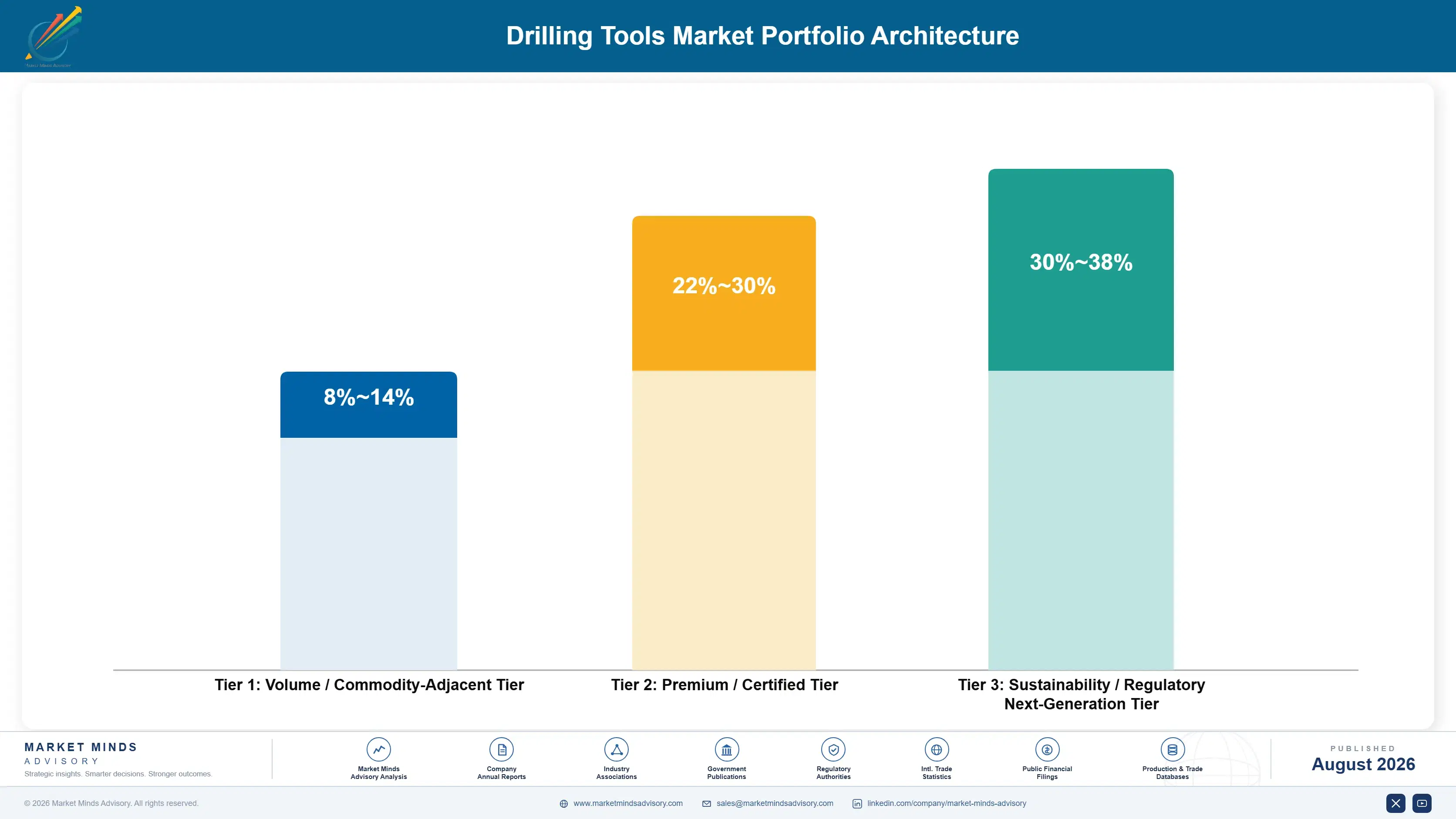
Portfolio Architecture for Margin Defence

The portfolio splits into three tiers. Commodity bits and basic downhole motors sit at the volume base with thin single-digit to low-teens gross margins, competing mainly on price and availability. Premium and certified rotary steerable and MWD systems occupy the middle tier, commanding stronger margins through qualification barriers and service relationships. High-temperature, deepwater-rated tools and data-integrated platforms sit at the top, where margins run considerably richer and competiti
The tension between volume and premium runs through how suppliers allocate capital across the business. Bit manufacturing requires steady throughput to cover fixed manufacturing costs, pulling suppliers toward volume even when margins compress, while premium tool lines demand sustained R&D and qualification investment that only pays off once adoption scales. Suppliers that lean too far toward either extreme risk losing either the cash generation the volume base provides or the margin growth premium tools deliver.

High-value margin pools concentrate in deepwater-qualified tools and data subscription services, where qualification barriers keep competition thin and operators pay premium day rates for reliability under extreme downhole conditions. That concentration is likely to deepen as more capital flows into offshore basins relative to mature onshore shale.

Volume / Commodity-Adjacent Tier

Standard drill bits, mud motors, and basic tubular handling tools sold primarily on price and delivery lead time to a broad base of onshore operators and drilling contractors across mature basins.
Gross Margin: 8%-14%

Premium / Certified Tier

Rotary steerable systems, MWD and LWD packages, and advanced fishing tools qualified for extended-reach and complex well geometries, sold with service contracts and data platform bundling. Pricing reflects qualification barriers that few mid-tier suppliers can clear.
Gross Margin: 22%-30%

Sustainability / Regulatory / Next-Generation Tier

High-temperature, high-pressure deepwater tools, tungsten-free cutting structures, and automated directional drilling systems built for emissions-sensitive and extreme-condition drilling programs. Suppliers price this tier on qualification scarcity rather than unit cost, capturing the richest margins in the portfolio.
Gross Margin: 30%-38%
drilling-tools-market-portfolio-architecture-1787300272584

High-value Sub-segments and Strategic Watch-out

Deepwater High-Temperature MWD and RSS Packages

Deepwater campaigns in Guyana and Brazil pay day rates two to three times onshore equivalents for tools rated above 150 degrees Celsius. Qualification barriers keep competition thin, and volume is expanding faster than almost any other category as new floating production systems come online through the decade.
Gross Margin: 32%-40%

Digital Telemetry and Cloud Analytics Subscriptions

Recurring software and data services attached to hardware placements grow steadily as operators standardize on real-time visualization platforms. Growth is moderate compared with deepwater hardware but margins are among the richest in the portfolio once the platform investment is made. Suppliers with proprietary platforms capture outsized share of this growth.
Gross Margin: 35%-45%

Standard Drill Bits and Mud Motors

The largest revenue base by unit volume, sold into onshore basins worldwide on price and availability. Growth tracks global rig count closely and margins stay thin, but the segment generates the cash flow that funds premium tool development. Suppliers rely on it to sustain manufacturing scale.
Gross Margin: 8%-14%

Chinese Rotary Steerable Exports

Chinese suppliers led by Honghua are exporting increasingly credible rotary steerable systems at prices well below Western equivalents, initially into the Middle East and Africa. If qualification gaps close further, this segment could pressure premium pricing across the industry within the forecast decade and into the next.
Gross Margin: 15%-25%

Recurring Revenue Inside Every Well

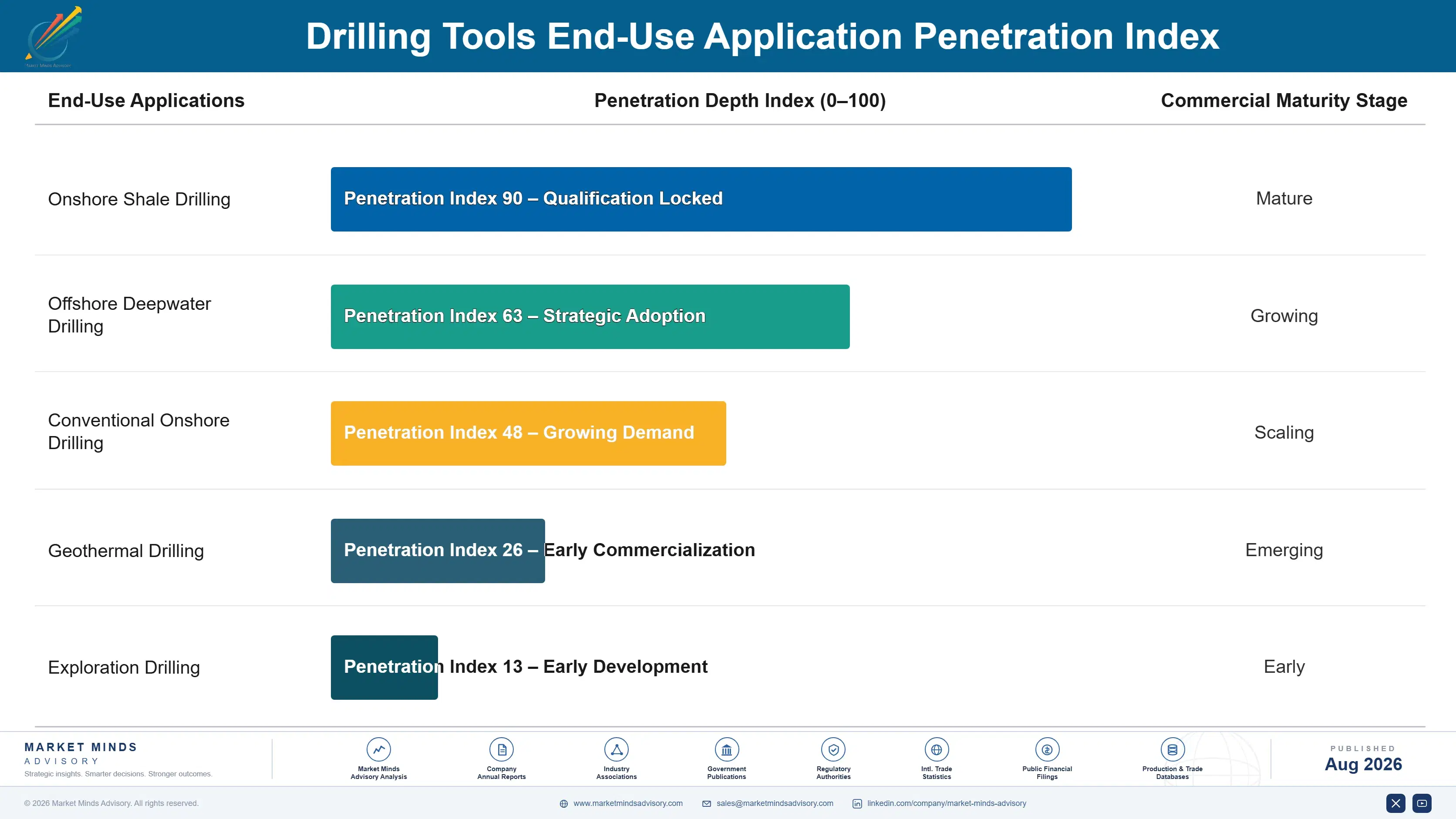
Drilling tools generate revenue closer to an annuity than a one-time sale once rental and data subscription models are included, since every new well consumes another cycle of tool rental, telemetry access, and consumables regardless of whether the operator owns hardware outright. That dynamic gives suppliers more predictable revenue than headline rig count volatility alone would suggest, provided their fleet stays utilized.
Adoption depth varies sharply by vertical. Deepwater and national oil company customers sign multi-year frame agreements that lock in tool suppliers well ahead of individual well campaigns, creating high switching costs once a supplier is qualified into a program. Independent shale operators behave differently, rebidding tool packages more frequently on a well-by-well or pad-by-pad basis, which keeps pricing competitive but limits how much recurring revenue any single supplier can count on from that customer segment.

A generational shift in buyer profiles is underway as digitally native drilling engineers who came up on real-time visualization platforms replace an older generation that trusted manual toolface adjustment and paper logs. That shift favors suppliers with strong software and data platforms over those competing purely on mechanical hardware reliability, and it is reshaping which suppliers get invited to qualify for new programs.
drilling-tools-market-end-use-penetration-index-1787300273074

Where MMA Sees the Opportunity

These are among the four positions where our research anticipates prominent divergence between winners and laggards over the coming forecast period. Each is grounded in the demand model, the regulatory perimeter, and the announced capacity pipeline.
01 / DEEPWATER QUALIFICATION PRIORITY

Prioritize high-temperature tool qualification for deepwater campaigns

Deepwater basins in Guyana and Brazil are sanctioning new wells faster than almost any other part of the market, and they pay day rates two to three times onshore equivalents for tools rated above 150 degrees Celsius. Suppliers that have not yet qualified high-temperature, high-pressure MWD and rotary steerable packages are effectively locked out of the fastest-growing and most profitable segment of the addressable market. MMA recommends prioritizing qualification investment here over incremental improvements to standard onshore tool lines that face growing pricing pressure.
02 / RENTAL FLEET EXPANSION

Shift capital toward rental fleets over outright hardware sales

Rental now accounts for roughly 55 percent of rotary steerable deployments globally, up from under 40 percent five years ago, and that share keeps climbing as operators prefer to pay per footage drilled rather than carry ownership risk on electronics-heavy tools. Suppliers with underdeveloped rental fleets are ceding recurring utilization revenue to competitors like Weatherford, which has rebuilt its business model around rental intensity. MMA recommends reallocating capital expenditure toward rental fleet growth ahead of new product development spending over the next several years.
03 / CHINA EXPORT DEFENSE

Defend Western technology lead against rising Chinese RSS exports

Chinese suppliers led by Honghua have captured an estimated 25 percent of domestic rotary steerable placements within five years and are now exporting competing systems into the Middle East and Africa at prices Western suppliers struggle to match. If that price and qualification gap continues narrowing, Western suppliers risk losing pricing power in markets outside their traditional North American and North Sea strongholds within the next decade. MMA recommends accelerating technology differentiation, particularly in data platforms, rather than competing on price alone.
04 / DATA PLATFORM INVESTMENT

Build proprietary data platforms before software specialists unbundle hardware

Independent telemetry software specialists are beginning to partner with smaller hardware manufacturers, threatening to separate the data and hardware layers that the largest suppliers currently sell together as a bundled premium. If that unbundling gains traction, tool suppliers without strong proprietary software risk being reduced to commodity hardware vendors while software specialists capture the more profitable data layer. MMA recommends investing in proprietary visualization and analytics platforms now, before smaller competitors establish independent footholds with operators across every major drilling basin worldwide.

Engagement Snapshot From the Field

A live engagement with an industry participant carrying material or product regulatory and market exposure ahead of a defining policy shift, showing how our research translates into a defensible multi-year portfolio strategy.
MARKET MINDS ADVISORY · CLIENT ENGAGEMENT SUMMARY
Drilling Tools Producer Strategic Portfolio Review and Transition Roadmap 2026·Investment Scenario on Drilling Tools Exposure Evaluation 2025-26
CLIENT PROFILE
The client is a mid-sized independent exploration and production operator running roughly 40 horizontal wells per year across the Permian basin, reporting approximately 1.2 billion dollars in annual drilling and completion capital expenditure (client-reported, unverified by MMA). The operator had historically standardized on mud motor directional drilling across its acreage and was evaluating whether premium rotary steerable systems justified their day rate premium given rising lateral lengths.
STRATEGIC CHALLENGE
Leadership needed to determine whether shifting to rotary steerable systems across its Tier 1 acreage would pay back the incremental day rate through faster drilling and reduced non-productive time, or whether the technology premium exceeded the value of footage gained. The operator lacked internal benchmarking data comparing its own well economics against basin-wide RSS adoption trends.
MMA APPROACH
MMA analyzed anonymized well-level performance data across comparable Permian operators, benchmarking drilling days, non-productive time, and tool cost per lateral foot between mud motor and rotary steerable completions. The engagement combined primary interviews with three service company account teams and secondary analysis of basin-wide completion trends to isolate the RSS value proposition specific to the client's acreage.
KEY FINDINGS
  1. Wells drilled with rotary steerable systems averaged 1.8 fewer drilling days than comparable mud motor wells across the client's Tier 1 acreage, driven mainly by reduced sliding time (client-reported, unverified by MMA).
  2. The day rate premium for RSS packages ran approximately 18 percent above mud motor rental rates, but faster drilling more than offset the incremental cost on wells longer than 3.5 kilometers (client-reported, unverified by MMA).
  3. Non-productive time tied to toolface control issues fell by roughly 35 percent on RSS-drilled wells, reducing exposure to costly stuck-pipe events on the client's longest laterals (client-reported, unverified by MMA).
  4. Basin-wide adoption data showed peer operators had already shifted more than half of new wells to rotary steerable systems, suggesting the client's mud motor reliance was becoming a competitive disadvantage.
CLIENT PROFILE
The client is a mid-sized independent exploration and production operator running roughly 40 horizontal wells per year across the Permian basin, reporting approximately 1.2 billion dollars in annual drilling and completion capital expenditure (client-reported, unverified by MMA). The operator had historically standardized on mud motor directional drilling across its acreage and was evaluating whether premium rotary steerable systems justified their day rate premium given rising lateral lengths.
STRATEGIC CHALLENGE
Leadership needed to determine whether shifting to rotary steerable systems across its Tier 1 acreage would pay back the incremental day rate through faster drilling and reduced non-productive time, or whether the technology premium exceeded the value of footage gained. The operator lacked internal benchmarking data comparing its own well economics against basin-wide RSS adoption trends.
MMA APPROACH
MMA analyzed anonymized well-level performance data across comparable Permian operators, benchmarking drilling days, non-productive time, and tool cost per lateral foot between mud motor and rotary steerable completions. The engagement combined primary interviews with three service company account teams and secondary analysis of basin-wide completion trends to isolate the RSS value proposition specific to the client's acreage.
KEY FINDINGS
  1. Wells drilled with rotary steerable systems averaged 1.8 fewer drilling days than comparable mud motor wells across the client's Tier 1 acreage, driven mainly by reduced sliding time (client-reported, unverified by MMA).
  2. The day rate premium for RSS packages ran approximately 18 percent above mud motor rental rates, but faster drilling more than offset the incremental cost on wells longer than 3.5 kilometers (client-reported, unverified by MMA).
  3. Non-productive time tied to toolface control issues fell by roughly 35 percent on RSS-drilled wells, reducing exposure to costly stuck-pipe events on the client's longest laterals (client-reported, unverified by MMA).
  4. Basin-wide adoption data showed peer operators had already shifted more than half of new wells to rotary steerable systems, suggesting the client's mud motor reliance was becoming a competitive disadvantage.
RECOMMENDED STRATEGY
Phase 1: Phase 1 (Months 1 to 3): Pilot rotary steerable systems on ten wells exceeding four kilometers of lateral length, benchmarking drilling days and cost per foot against historical performance. Phase 2: Phase 2 (Months 4 to 9): Expand RSS adoption to all Tier 1 acreage wells above 3.5 kilometers, renegotiating supplier day rates based on committed annual volume. Phase 3: Phase 3 (Months 10 to 18): Standardize RSS as default equipment across remaining acreage where lateral length justifies the premium, retaining mud motors only for shorter wells.
OUTCOME
Within eighteen months, the client reported drilling day reductions worth an estimated 22 million dollars in annual rig time savings across its expanded drilling program, alongside a meaningful drop in stuck-pipe related non-productive time (client-reported, unverified by MMA). The operator now specifies rotary steerable systems as default equipment on all wells exceeding three kilometers of lateral length.

Frequently Asked Questions

Foundational context covering the market sizes, CAGR, scope, country, region and competition that inform every finding below. This section is provided to cover basics and most often pre-purchase conversations, answered from the MMA Primary Research Dataset.

What is the current size of the Drilling Tools Market?

The global drilling tools market was valued at approximately 8.4 billion dollars in 2025. Growth is driven primarily by extended-reach lateral drilling and expanding deepwater campaigns.

How large will the Drilling Tools Market be by 2036?

MMA forecasts the market reaching approximately 16.6 billion dollars by 2036, roughly 1.86 times its 2026 value. Deepwater and premium directional tool demand account for most of that growth.

What is the CAGR for the Drilling Tools Market 2026 to 2036?

The market is projected to grow at a 6.4 percent compound annual rate over the forecast period. Bull and bear scenarios range from 5.1 to 7.7 percent depending on offshore investment cycles.

Which segment is growing fastest?

Rotary steerable systems are the fastest-growing segment, expanding at roughly 1.4 times the overall market rate. Extended-reach lateral drilling in shale basins and deepwater campaigns is the primary driver.

Who are the major companies in the Drilling Tools Market?

SLB, Halliburton, Baker Hughes, NOV, and Weatherford lead the market on a revenue basis. Together they hold just over half of global drilling tool revenue.

Which country is growing fastest?

Guyana is the fastest-growing country, driven by rapid deepwater development in the Stabroek block. Its offshore drilling program has expanded from negligible activity to a major contributor within five years.

Report Segmentation Architecture

The full report scope spans multiple orthogonal segmentation dimensions, with cross-tabulated demand data provided for each dimension pair. Coverage extends further to regional breakdowns, trend trajectories, and the competitive detail needed to support segment-level decision-making.

By Tool Type

  • Drill Bits
  • Downhole Drilling Motors
  • MWD and LWD Tools
  • Rotary Steerable Systems
  • Casing and Tubular Running Tools
  • Fishing and Well Intervention Tools

By End-Use Application

  • Onshore Shale Drilling
  • Offshore Deepwater Drilling
  • Conventional Onshore Drilling
  • Geothermal Drilling
  • Exploration Drilling

By Commercial Model

  • Outright Sale
  • Rental and Day Rate
  • Data and Telemetry Subscription
  • Integrated Service Contract

By Region

  • North America
  • Western Europe
  • East Asia
  • South Asia and Pacific
  • Latin America
  • Middle East and Africa
  • Eastern Europe

Scope, Methodology, and Coverage

Every figure in this report is reproducible from documented input assumptions. The scope below maps the historical period, the forecast horizon, the segmentation dimensions, and the countries covered, alongside the underlying primary and qualitative methodology.
Historical Period
2020 to 2025
Forecast Period
2026 to 2036
Base Year
2025 (USD billions; MMA Primary Research Dataset, August 2026)
Market Definition
The drilling tools market covers drill bits, downhole motors, measurement and logging while drilling systems, rotary steerable systems, casing and tubular running tools, and fishing and well intervention tools used in oil and gas well construction, onshore and offshore. It excludes mining drill rigs, water well equipment, and surface rig structures.
Quantitative Units
USD billions (current prices); unit shipments and rental day rates where applicable
Segmentation Dimensions
By Tool Type; By End-Use Application; By Commercial Model; By Region
Regions Covered
North America, Western Europe, East Asia, South Asia and Pacific, Latin America, Middle East and Africa, Eastern Europe
Countries Covered
USA, China, Germany, France, UK, Japan, South Korea, India, Australia, Canada, Brazil, Mexico, Indonesia, Vietnam, Thailand, Malaysia, UAE, Saudi Arabia, South Africa, Nigeria, Turkey, Poland, Netherlands, Italy, Spain, Sweden, Switzerland, Argentina, Colombia, Singapore, and additional markets relevant to this sector
Key Companies Profiled
SLB, Halliburton, Baker Hughes, NOV Inc., Weatherford International, Ulterra Drilling Technologies, Varel International Energy Services, Scientific Drilling International, Drilling Tools International, Bico Drilling Tools, Rival Downhole Tools, American Block, Forum Energy Technologies, Superior Energy Services, Innovex Downhole Solutions, Kingdream, Honghua Group, Sinopec Oilfield Service Corporation, Drillmec, National Energy Services Reunited Corp
Quantitative Methodology
Primary survey, n=3,800 respondents, Q4 2025, six countries; demand-side model with trade association cross-validation
Qualitative Methodology
47 expert interviews, Q4 2025; applied to validate demand model assumptions, identify emerging dynamics, and assess competitive positioning
Report Format
PDF and XLSX data workbook (Word format preview document)
Publisher
Market Minds Advisory
Report Code
MMA-2026-ENE-101
Published
August 2026
Contact
sales@marketmindsadvisory.com | www.marketmindsadvisory.com

Purchase the full Drilling Tools Market Report (2026 to 2036).

The full report provides detailed sizing and ten-year forecasts for each of the six drilling tool categories tracked in this analysis, alongside country-level detail across thirty markets. It includes a complete competitive benchmarking of the top twenty suppliers on a revenue basis, with moat and risk analysis for the two market leaders. The report also contains a dedicated input cost and supply chain risk assessment covering tungsten carbide and specialty steel exposure, plus scenario modeling across bull, base, and bear cases through 2036. Buyers receive access to the underlying primary survey and expert interview datasets referenced throughout the analysis.
Ten-year forecasts across all six tool categories
Competitive benchmarking of twenty profiled drilling tool suppliers
Input cost and tungsten carbide supply chain analysis
Bull, base, and bear scenario modeling through 2036
Country-level sizing across thirty tracked national markets
Access to underlying primary survey and interview data

Built For The People Who Decide

From boardroom strategy to bench-side execution, this report is read cover-to-cover by leaders shaping the next decade of their industry, turning demand scenarios, market dynamics and valuation benchmarks into decisions.
CXOs/ Presidents/ VPs/ Managers
M&A and Corporate Development
Strategy Teams and R&D Heads
Procurement and Product Directors
Regulatory and Compliance Leaders
Investor Relations and Equity Analysts