Market Minds Advisory
Draw Heat Setting Winder Market

Draw Heat Setting Winder Market: Precision Machinery for Industrial and Technical Yarn Production

Automotive airbag and tire cord manufacturers are tightening dimensional tolerance specifications just as China's technical yarn capacity expansion outpaces machine builder output, forcing winder makers to balance precision engineering against volume manufacturing economics.

Lead Analyst

David Horsley

Published

August 2026

Make Smarter Decisions with Customized Research Insights

Request a free sample report and evaluate market opportunities, growth trends, and competitive dynamics relevant to your business needs.

2025 MARKET VALUE$0.5BMarket Size 2025
2036 FORECAST VALUE$0.9BBase Case , 2026 to 2036
CAGR 2026 TO 20366.2 %Bull 7.5% / Bear 4.9%
INCREMENTAL OPPORTUNITY$0.4BNet 10- year value creation
EXPANSION MULTIPLE1.83x2036 value over 2026 base
Strategic Levers
M&A Pipeline
Regional Outlook
Country Rankings
Competitive Intelligence
Segmental Deep-dive
Call-Us : 91 93563 13602

Executive Snapshot and Market Trajectory

Automotive safety component certification is tightening dimensional and tenacity tolerances on industrial yarn, forcing winder makers to compete increasingly on precision engineering rather than raw throughput speed alone across major technical yarn producing regions worldwide, reshaping purchase criteria and vendor selection decisions industry-wide this cycle.
High-speed industrial yarn winders are the fastest-growing segment as tire cord and airbag yarn producers steadily upgrade aging machine fleets to meet tightening automotive safety certification standards worldwide. East Asia holds the largest share of installed capacity, reflecting China's dominant technical yarn production base, while South Asia is growing fastest as India rapidly expands domestic tire cord and airbag yarn manufacturing capacity year over year.
Competition splits between German and Japanese precision machine builders supplying premium equipment to certified automotive yarn producers and Chinese domestic manufacturers competing on price for standard industrial yarn lines, keeping the top five suppliers well short of dominant control over the global market. Tightening automotive certification standards and rising labor costs are pushing producers toward automated doffing and inline quality monitoring, with Chinese challengers gaining share on cost-sensitive standard yarn production lines across emerging markets.
Market Definition
The draw heat setting winder market covers integrated machinery that draws, heat-sets, and winds synthetic filament yarn, primarily nylon and polyester, into finished packages for industrial and technical yarn applications including tire cord, airbags, and safety belts. It excludes upstream spinning and extrusion equipment, and it excludes standalone texturing machinery sold without integrated heat-setting capability.
Base Year Value
$0.5B in 2025 (MMA Primary Research Dataset, August 2026)
Forecast Period
2026 to 2036, eleven discrete annual values
CAGR
6.2% base case. Bull 7.5%. Bear 4.9%.
Fastest Growth Segment
High-Speed Industrial Yarn Winders: 8.5% CAGR
Fastest Growth Country
China: 8.0% CAGR
Fastest Growth Region
South Asia and Pacific: 8.3% CAGR
Largest Region
East Asia: 30% of 2025 global value
Market Leaders
Oerlikon Barmag, Saurer Technologies GmbH & Co. KG, TMT Machinery, Inc., Murata Machinery, Ltd., and Jingwei Textile Machinery Company Limited. Source: MMA Analysis based on company annual reports.
Primary Survey
n=3,800 procurement and R&D decision-makers, Q4 2025, six countries
Methodology
Demand-side build-up, cross-validated against public data, 47 expert interviews

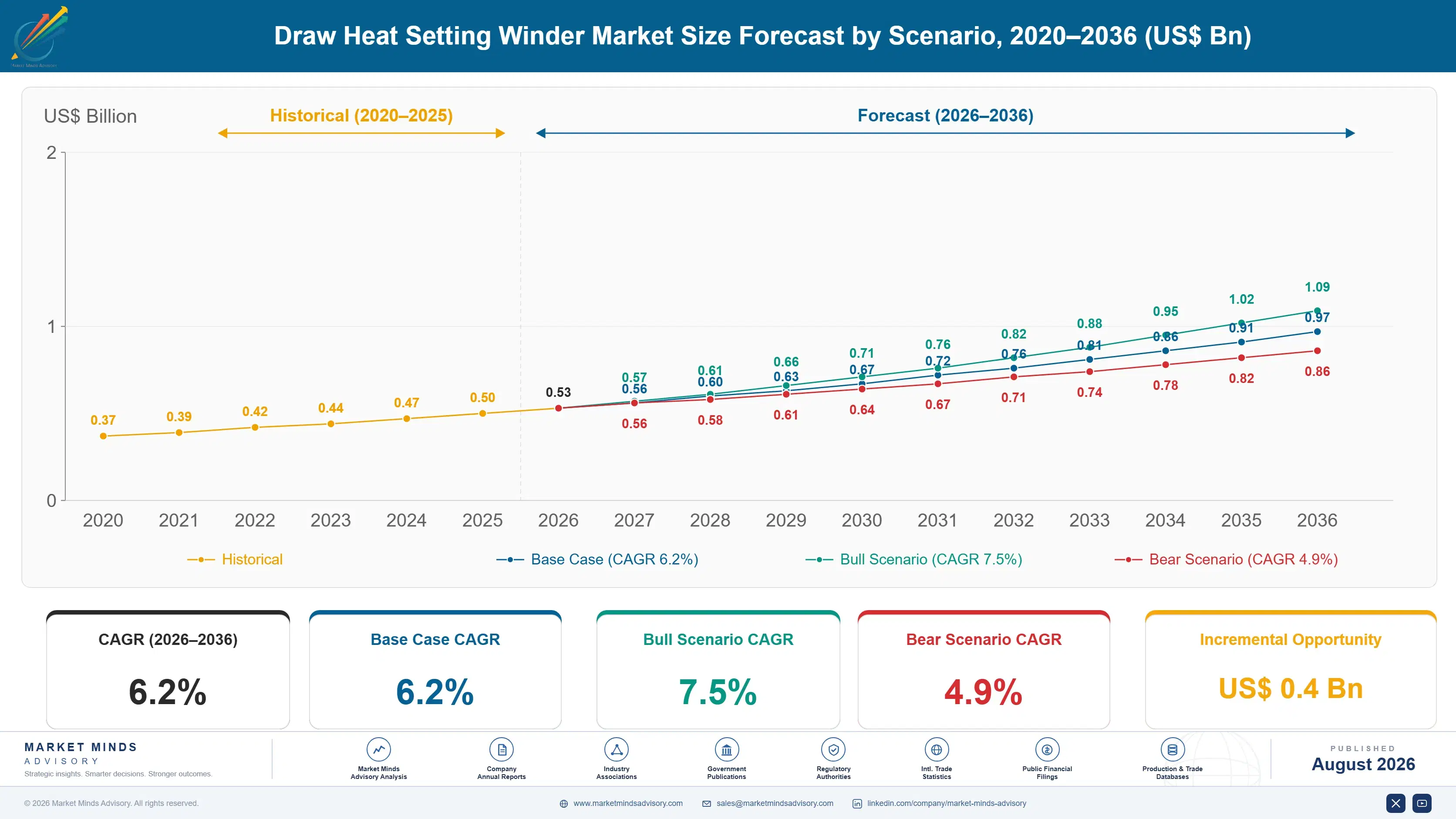
Draw Heat Setting Winder Market Forecast Scenarios

draw-heat-setting-winder-market-size-forecast-scenario-1787301712647
Draw heat setting winder demand grew unevenly between 2020 and 2025 as automotive production disruptions delayed technical yarn capacity investment while Chinese fiber manufacturers continued steadily expanding despite broader global industry uncertainty elsewhere. Capital spending recovered from 2023 onward as automotive production normalized, pushing the historical CAGR to roughly 5.4 percent across the period overall.
The base case assumes 6.2 percent annual growth through 2036, anchored in three mechanisms: tightening automotive safety certification standards requiring machine fleet upgrades at existing tire cord and airbag yarn producers worldwide, continued Chinese and Indian technical yarn capacity expansion requiring new winder installations at scale, and rising labor costs pushing producers toward automated doffing systems that command meaningfully higher machine prices than the manual equivalents they are steadily replacing.
A bull case near 7.5 percent CAGR assumes accelerated automotive safety regulation adoption across emerging markets pulls forward machine fleet replacement demand much faster than currently modeled here. A bear case near 4.9 percent reflects the risk that budget-constrained mid-sized yarn producers defer machine upgrades, extending the service life of older winders well beyond typical replacement cycles across the industry.

Certification Standards Meet Capacity Expansion

Two forces are converging on this specialized machinery market at once. Automotive safety certification bodies are tightening dimensional and tenacity tolerances for tire cord, airbag, and seatbelt yarn, forcing producers to replace older winders that cannot consistently hold the new specifications. At the same time, Chinese and Indian technical yarn capacity expansion is generating new-build machine demand at a scale mature markets cannot match, reshaping where equipment makers concentrate manu
CR5 CONCENTRATION42%Fragmented across German, Japanese, and Chinese machine builders globally
AVERAGE MACHINE PRICE$185,000Reflects winding speed rating and automation feature configuration level
TOP REGION INSTALLED SHAREEast Asia, 30%Concentrated where technical yarn production capacity is largest
AUTOMATED DOFFING PENETRATION48%Share of new machine orders specifying automated doffing systems
MACHINE SERVICE LIFE12-18 yearsTypical operating years before automotive-grade producers replace winders
PRECISION COMPONENT COST SHARE40%Portion of unit cost from precision bearings and heating elements
Commercially, the market splits between premium German and Japanese machine builders selling certified precision equipment to automotive-grade yarn producers and Chinese domestic manufacturers competing on price for standard industrial yarn lines serving less certification-intensive applications. Producers that can document consistent dimensional tolerance across long production runs win a disproportionate share of automotive supplier qualification programs, since requalification cost and delay discourage switching between machine vendors mid-contract.
Over the next decade, expect automated doffing and inline quality monitoring to matter more than raw winding speed for automotive-grade producers, even as standard industrial yarn lines remain a price-competitive commodity business dominated by regional machine builders with limited engineering overhead and thin after-sales service support beyond basic installation and maintenance guidance.
"The machine hasn't gotten faster in a meaningful way in a decade. What's changed is that a tire maker will now reject an entire lot over a tolerance drift you couldn't have even measured ten years ago."
Director, Industrial Machinery and Technical Textiles Practice · MMA Textile & T

Market Trends

Automotive Certification Tightens Dimensional Tolerance Standards

Global automotive safety component certification bodies have tightened dimensional and tenacity tolerance requirements for tire cord, airbag, and seatbelt yarn over recent certification cycles, requiring producers to demonstrate consistent yarn uniformity across long production runs rather than periodic sampling alone. Older winders, particularly those lacking inline tension and diameter monitoring, increasingly struggle to hold these tighter tolerances across an entire production shift without manual operator intervention. Machine builders are responding with integrated sensor packages that flag tolerance drift in real time, catching quality issues before an entire yarn lot fails certification testing.
Market Impact: Adds 180 new winder installations a
Automated Doffing Cuts Labor-Intensive Package Handling

Manual package doffing, removing finished yarn packages and loading empty bobbins, remains labor-intensive on older winder installations, and rising labor costs across major technical yarn producing regions are pushing producers toward automated doffing systems that handle package changeover without operator intervention. Automated systems also reduce yarn breakage and package damage associated with manual handling, improving first-pass yield on premium automotive-grade production runs where a single damaged package can trigger a costly requalification review. Machine builders report automated doffing now specified on a majority of new orders from automotive-grade producers, up sharply from a minority share five years earlier.
Market Impact: Adds 15% replacement share versus r

Market Opportunities and Growth Drivers

Technical Yarn Capacity Expansion Drives New Machine Orders

China and India continue expanding domestic technical yarn production capacity to serve growing automotive, industrial rope, and geotextile demand, requiring substantial new winder installations rather than relying solely on existing machine fleets to meet growing output targets. Chinese fiber producers alone have commissioned several new technical yarn production lines in recent years, each requiring multiple draw heat setting winders to reach designed capacity. Domestic Chinese machine builders have scaled production to serve a meaningful share of this demand, competing directly with established German and Japanese suppliers on price for standard, non-automotive-grade production lines specifically.
Market Impact: Adds 25% to entry-level equipment c

Aging Machine Fleets Require Certification-Driven Replacement

A meaningful share of the global installed winder base was commissioned more than fifteen years ago, before current automotive dimensional tolerance and inline monitoring standards existed, and these older machines increasingly cannot be retrofitted cost-effectively to meet tightened certification requirements. Automotive yarn producers facing requalification deadlines are choosing outright machine replacement over incremental retrofit in a growing share of cases, since retrofit engineering cost and requalification risk together can approach the price of new equipment. This replacement cycle is concentrated among producers serving automotive-grade markets rather than standard industrial yarn applications with looser tolerance requirements.
Market Impact: Adds 8% unplanned downtime industry

Market Restraints and Challenges

Premium Machine Pricing Deters Smaller Yarn Producers

Certified automotive-grade winders with integrated sensor packages and automated doffing carry a substantial price premium over standard industrial-grade equipment, and the root cause of smaller producers' hesitation is that the added cost only pays back through automotive supplier qualification revenue that smaller producers may not yet have secured. Producers serving only standard industrial yarn markets often cannot justify the premium investment without a confirmed automotive contract in hand, creating a chicken-and-egg dynamic that slows entry. Some machine builders now offer modular sensor upgrade paths that let producers add automotive-grade monitoring after initial purchase rather than committing fully upfront.
Market Impact: Requires upgrades on 34% of install

Skilled Technician Shortage Complicates Machine Maintenance

Draw heat setting winders require specialized maintenance knowledge covering precision heating elements, tension control systems, and increasingly integrated sensor packages, and the root cause of growing maintenance backlogs is that skilled textile machinery technicians are aging out of the workforce faster than replacements are being trained in most producing regions. Producers report longer unplanned downtime when specialized technicians are unavailable, directly reducing effective machine utilization and output during the interim. Leading machine builders are responding with remote diagnostic capability and structured technician training programs delivered in partnership with producers to rebuild the skilled maintenance workforce more systematically over time.
Market Impact: Cuts per-machine labor requirement
3 additional market trends, 3 additional growth drivers, and 3 additional restraints and challenges are covered in the full report. Contact sales@marketmindsadvisory.com to access the complete intelligence.

Segment CAGR and Growth Architecture

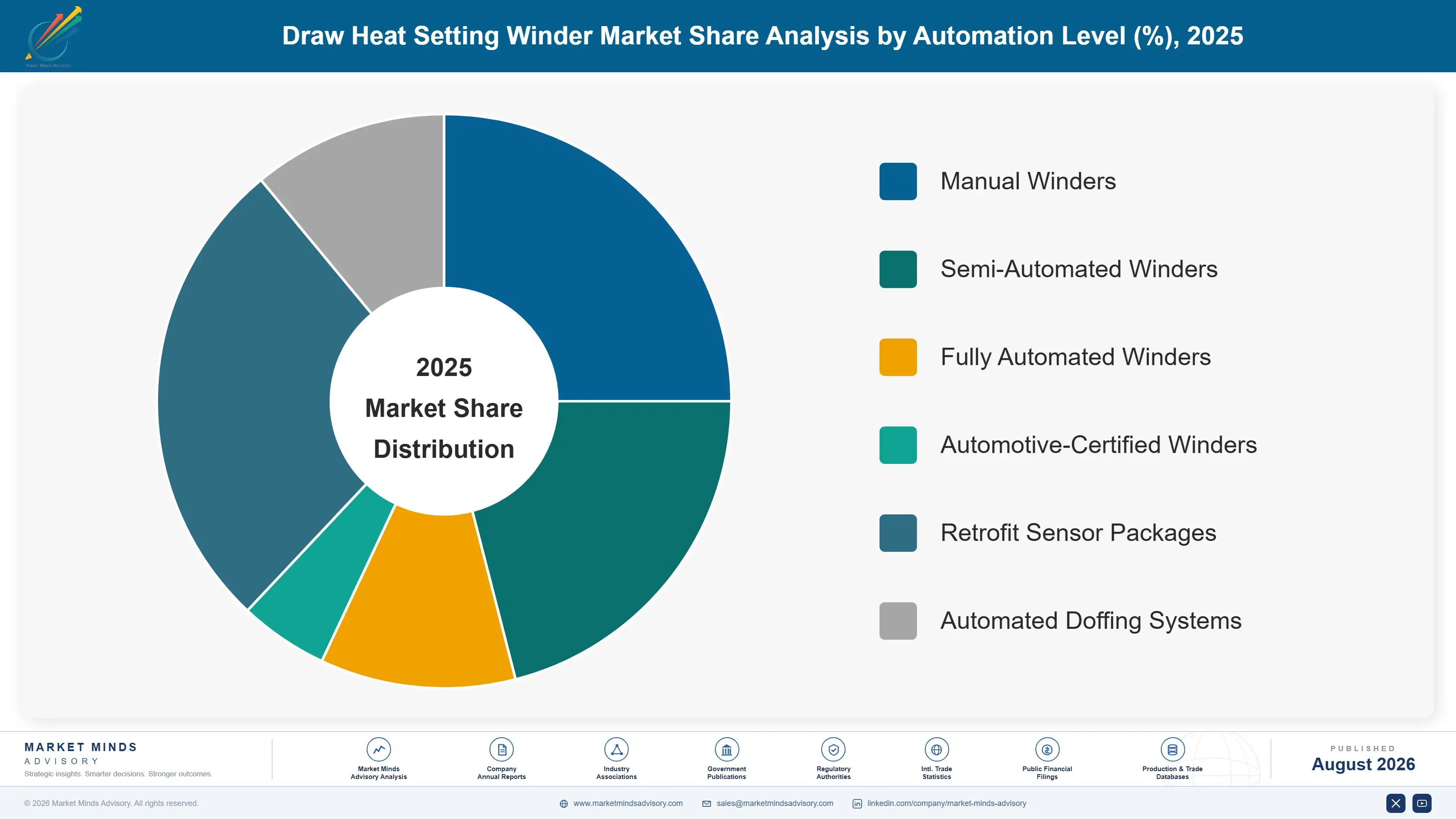
Segmentation follows machine automation level rather than yarn end-use, since the same production facility often runs multiple winder generations side by side across different production lines simultaneously, each serving distinct customer certification requirements. Manual, semi-automated, fully automated, and automotive-certified winders each carry distinct price points, buyer qualification requirements, and replacement cycles within a single facility.
draw-heat-setting-winder-market-market-share-analysis-1787301713184

High-Speed Industrial Yarn Winders

High-speed industrial yarn winders are the fastest-growing segment as automotive-grade producers upgrade aging machine fleets to meet tightening dimensional and tenacity tolerance certification standards across tire cord, airbag, and seatbelt yarn applications specifically. These machines integrate inline tension and diameter monitoring with automated doffing, letting producers document consistent quality across long production runs without manual sampling intervention at every stage. Growth concentrates among producers already qualified as automotive suppliers, where the cost of a failed certification audit far exceeds the price premium of upgraded equipment. Chinese and Indian producers expanding automotive-grade capacity are driving much of this segment's growth, increasingly specifying automated doffing as a standard feature on new orders.
CAGR 8.5%

Automated Package Doffing Systems

Automated package doffing systems form the second-fastest segment as rising labor costs across major technical yarn producing regions make manual package handling an increasingly expensive line item relative to automation investment payback periods. Automated systems reduce yarn breakage and package damage associated with manual handling while also freeing skilled operators for higher-value quality monitoring tasks rather than repetitive package changeover work across multiple daily production shifts. Adoption is strongest among the very largest production facilities running continuous multi-shift operations, where labor cost savings compound fastest and justify the automation investment within a reasonable payback window most finance teams and plant managers find acceptable for this category of capital equipment purchases.
CAGR 7.9%
Full segment breakdown across 6 segments available in the complete report.

Regional Architecture and Country Demand Map

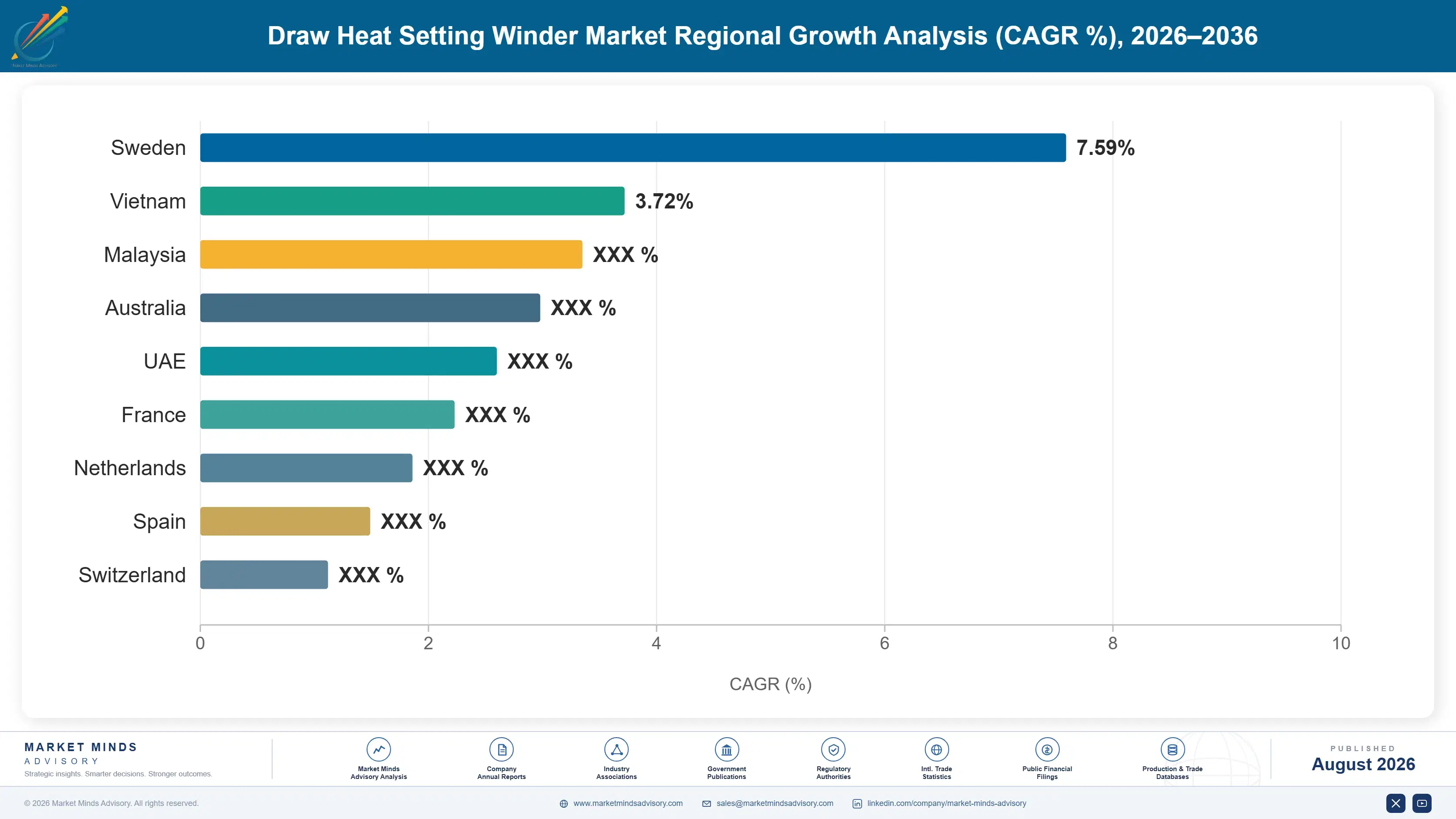
Draw heat setting winder demand concentrates where technical yarn production capacity is largest. East Asia leads on installed base and new-build volume, North America and Western Europe generate premium automotive-grade replacement demand, and South Asia is the fastest-growing region as India expands tire cord manufacturing capacity.

North America

North America's demand centers on automotive-grade machine replacement rather than new capacity expansion, since domestic technical yarn production capacity has remained relatively stable while automotive certification requirements have tightened considerably over recent certification cycles. Producers serving airbag, seatbelt, and tire cord customers for domestic and transplant automakers prioritize certified equipment capable of meeting the region's stringent automotive safety documentation requirements over lower-cost standard machinery. Limited domestic machine manufacturing capacity means most equipment is imported from German and Japanese suppliers, exposing producers to currency and shipping lead time considerations absent in regions with local machine builders. Growth here trails East Asia and South Asia considerably given the region's mature, largely stable technical yarn production base.
Share: 24% | CAGR: 5.5% (2026 to 2036)

Western Europe

Western Europe hosts several of the world's leading precision machine builders even as domestic technical yarn production capacity has declined relative to Asian competitors over recent decades. Germany and Italy anchor regional machine manufacturing expertise, exporting the majority of production to Asian and North American technical yarn producers rather than serving primarily domestic demand at scale across the continent. Domestic replacement demand remains modest, concentrated among specialty and aerospace-grade yarn producers requiring the tightest tolerance certifications currently available anywhere in the market today. Growth trails the global average since the region functions more as a machine export hub than a technical yarn production growth market in its own right currently.
Share: 18% | CAGR: 4.7% (2026 to 2036)
Regional intelligence for 5 additional markets available in the complete report: East Asia, South Asia and Pacific, Latin America, Middle East and Africa, Eastern Europe. Contact sales@marketmindsadvisory.com.
draw-heat-setting-winder-market-country-cagr-analysis-1787301713701

Where Machine Builders Find Margin Upside

Suppliers capture the most durable margin not from standard winder hardware sales but from certification support services, automated retrofit engineering, and premium sensor packages layered on top of the core machine. The levers below describe where machine builders are shifting commercial focus as standard equipment pricing compresses under intensifying Chinese domestic competition across nearly every producing region.

Automotive Certification Support Services For Producers

Machine builders increasingly offer dedicated certification support services, helping producers document dimensional and tenacity tolerance compliance for automotive supplier qualification audits rather than leaving producers to navigate requirements independently after purchase. This service relationship extends well beyond the initial machine sale, since automotive certification audits recur periodically throughout a production line's operating life and producers value a vendor who understands both equipment and certification requirements. Machine builders offering bundled certification support report service revenue margins roughly 25 percentage points above standard equipment sales, since the service draws on specialized expertise competitors cannot easily replicate quickly.
Market Impact: Lifts certification service margin

Automated Doffing Retrofit Engineering Service Packages

Rather than selling automated doffing as a standalone component, several machine builders now sell complete retrofit engineering packages that include mechanical integration, control system upgrades, and commissioning support for older manual winder installations. This addresses producers' single biggest barrier to automation adoption, the engineering complexity and downtime risk of retrofitting equipment never designed for automated package handling, and converts a component sale into a higher-value engineering services contract. Suppliers offering full retrofit packages report average deal sizes roughly 45 percent larger than component-only sales, reflecting the added engineering, project management, and commissioning labor bundled into the offer.
Market Impact: Increases average retrofit deal siz

Sensor Package Upgrades For Existing Machine Fleets

Rather than requiring producers to purchase entirely new machines for automotive-grade certification, several manufacturers now offer modular inline tension and diameter sensor packages that can be retrofitted onto existing winder platforms without full equipment replacement. This lets producers pursue automotive supplier qualification incrementally rather than committing to a full fleet replacement upfront, lowering the capital barrier to entering automotive-grade production. Suppliers offering modular sensor upgrades report winning certification-driven business from producers who would otherwise have deferred equipment investment entirely, capturing incremental revenue at roughly 30 percent of the cost of full machine replacement.
Market Impact: Captures upgrades at 30 percent of

Licensed Local Manufacturing In Growth Markets

Rather than exporting finished machines into China and India, several international machine builders are establishing local licensed manufacturing to compete more directly with domestic Chinese suppliers on price for standard, non-automotive-grade equipment orders. Licensing arrangements typically combine the international partner's precision engineering standards with the domestic partner's manufacturing scale and local market access, reducing landed cost meaningfully compared with direct export from Europe or Japan. Suppliers with established licensing arrangements report winning standard equipment orders at price points roughly 25 percent below what direct export pricing could achieve, offsetting thinner per-unit margins with substantially higher order volumes.
Market Impact: Cuts landed equipment cost by rough

Who Controls the Margin Pool

The draw heat setting winder market carries a CR5 of roughly 42 percent on a unit shipment revenue basis, reflecting concentration among German and Japanese precision machine builders alongside a fragmented base of Chinese domestic manufacturers. The gap between leading suppliers and the next tier of challengers is meaningful in automotive-grade equipment but far narrower in standard industrial yarn line machinery.
Current competitive activity centers on three fronts: certification support service launches aimed at deepening automotive supplier relationships, automated doffing retrofit engineering packages targeting the large installed base of manual winders, and licensed local manufacturing announcements in Chinese and Indian growth markets. Suppliers without established certification support capability increasingly partner with independent testing laboratories rather than building the capability internally from scratch.

Emerging pressure is coming from Chinese domestic manufacturers that combine improving precision engineering with aggressive pricing on standard equipment, gradually narrowing the technology gap with established German and Japanese suppliers. Rankings are most likely to shift in South Asian markets, where new technical yarn capacity is being commissioned faster than in mature regions and where incumbents have not yet established the local manufacturing presence that anchors customer relationships elsewhere.
draw-heat-setting-winder-market-company-positioning-matrix-1787301714220

Competitive Moat and Risk Dimensions

OERLIKON BARMAG

Moat: Automotive certification track record

Oerlikon Barmag's decades of precision engineering expertise in synthetic filament processing give the company an established position with automotive-grade producers who value proven certification track records over price, particularly for tire cord and airbag yarn applications where a single quality failure can trigger costly customer requalification reviews.
OERLIKON BARMAG

Risk: Cost disadvantage on standard orders

Oerlikon Barmag's premium engineering positioning carries meaningfully higher production cost than Chinese domestic rivals, a disadvantage on standard, non-automotive-grade equipment orders where price sensitivity dominates purchasing decisions and certification depth matters comparatively far less to the buyer evaluating multiple competing vendor bids on identical specifications.
MURATA MACHINERY, LTD.

Moat: Integrated automation product line

Murata Machinery's integration of automated doffing and inline quality monitoring across its winder product line gives the company a differentiated offering for producers seeking to reduce labor cost while simultaneously meeting tightening automotive certification requirements without purchasing separate retrofit components from multiple vendors independently across the production floor.
MURATA MACHINERY, LTD.

Risk: Limited appeal to price-sensitive buyers

Murata Machinery's automation-forward positioning adds cost that price-sensitive standard industrial yarn producers in emerging markets are often quite unwilling to pay, ceding share on entry-level equipment orders to lower-cost Chinese domestic manufacturers competing primarily on upfront purchase price rather than long-term automation payback economics specifically.

Players Tracked

Prominent Players

Oerlikon Barmag
Saurer Technologies GmbH & Co. KG
TMT Machinery, Inc.
Murata Machinery, Ltd.
Jingwei Textile Machinery Company Limited

Other Key Players

Rieter Holding AG
Savio Macchine Tessili S.p.A.
SSM Scharer Schweiter Mettler AG
Himson Engineering Pvt. Ltd.
Truetzschler Group SE
Toyota Industries Corporation
Karl Mayer Group
Lakshmi Machine Works Limited
Marzoli Machines Textile S.r.l.
China Hi-Tech Group Corporation
Qingdao Hongda Textile Machinery Co., Ltd.
ANDRITZ AG
Reifenhauser Group
Zhejiang Jinggong Science & Technology Co., Ltd.
Jiangsu Hongyuan Textile Machinery Co., Ltd.

Recent Developments

JUNE 2025

Oerlikon Barmag Launches Integrated Certification Support Service

Oerlikon Barmag launched an integrated certification support service in June 2025, pairing new automotive-grade winder sales with dedicated engineering assistance for supplier qualification documentation, reducing the typical timeline producers need to achieve automotive customer certification after installing new equipment on their production floor and ramping output.
Signal: Signals machine builders are bundling cert
DECEMBER 2024

Murata Machinery Introduces Upgraded Automated Doffing Retrofit Kit

Murata Machinery introduced an upgraded automated doffing retrofit kit for legacy winder platforms in December 2024, letting producers add automation capability to existing installations without full machine replacement, a capability increasingly requested as labor costs rise steadily across most major technical yarn producing regions worldwide.
Signal: Shows machine builders extending automatio
FEBRUARY 2025

Jingwei Textile Machinery Announces Indian Local Manufacturing Agreement

Jingwei Textile Machinery announced a licensed local manufacturing agreement with an Indian industrial group in February 2025 to produce standard industrial yarn winders domestically, avoiding import duties that had previously limited the company's price competitiveness in the fast-growing Indian technical yarn market specifically and meaningfully.
Signal: Confirms Chinese machine builders are purs

Precision Steel and Heating Element Exposure

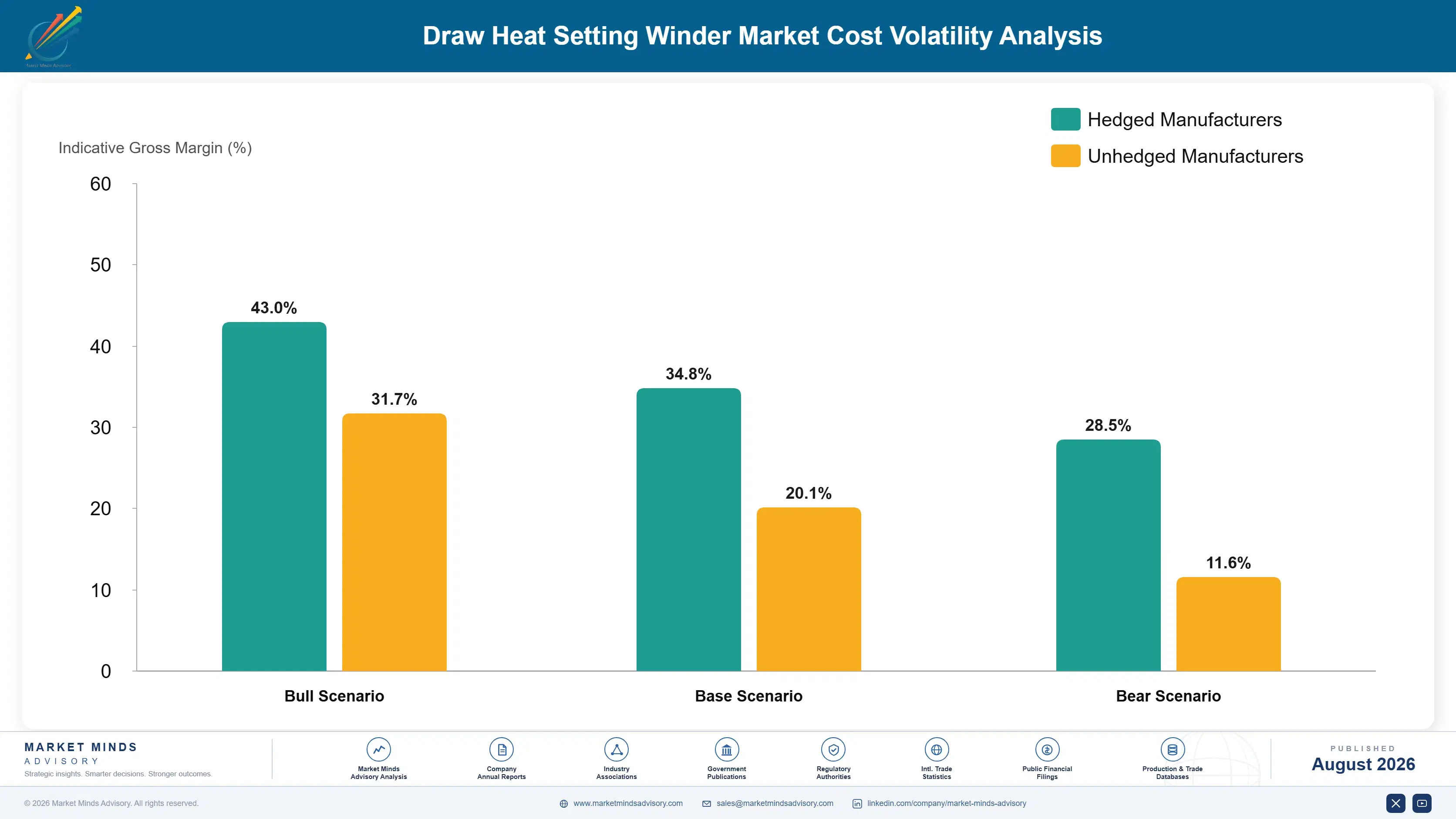
Precision-machined alloy steel components for winder frames and rollers, together with specialty heating elements for the heat-setting stage, account for roughly 40 percent of manufactured cost of goods sold in a typical certified winder. Steel is sourced predominantly from specialty mills in Germany, Japan, and China, while high-temperature heating elements draw on a narrower base of specialist electrical component suppliers.
Steel and electrical component price volatility following 2022 supply disruptions pushed manufacturing costs up meaningfully at several European machine builders, according to EIA and IEA industrial commodity reporting, forcing manufacturers to renegotiate fixed-price contracts signed before the increase and delaying delivery on several large customer orders. Semiconductor shortages affecting integrated sensor packages further compounded cost pressure for automotive-grade equipment specifically during that period of tightness.

Smaller regional machine builders without long-term component supply agreements face the sharpest exposure, since they typically purchase steel and electrical components on spot or short-term contracts vulnerable to allocation shortages during tight markets. Larger diversified manufacturers with multi-year component agreements have generally passed through less cost volatility to producer customers, widening the competitive gap between top-tier and smaller regional machine builders during periods of input tightness.
draw-heat-setting-winder-market-cost-volatility-analysis-1787301714415

Multi-year steel and component supply agreements

Several larger machine builders have locked in firm multi-year pricing agreements with specialty steel mills and electrical component suppliers rather than buying entirely on the spot market, smoothing input cost volatility even when it means paying a modest premium over prevailing spot prices during periods of soft demand elsewhere across export markets generally worldwide.

Dual-sourcing heating elements across two supplier regions

Leading manufacturers now qualify heating element components from suppliers in at least two different regions rather than relying on a single source, reducing exposure to any single region's production disruptions. This adds qualification cost upfront but has meaningfully shortened average component lead time recovery during recent tight periods industry-wide across most major producing regions worldwide.

In-house precision machining for critical steel components

A small number of vertically integrated machine builders have brought precision steel machining capability fully in-house, insulating their highest-volume product lines from external allocation shortages entirely, though this remains capital-intensive and impractical for smaller regional builders lacking the production scale needed to justify the investment currently given typical current order volumes and thin margins.

Portfolio Architecture for Margin Defence

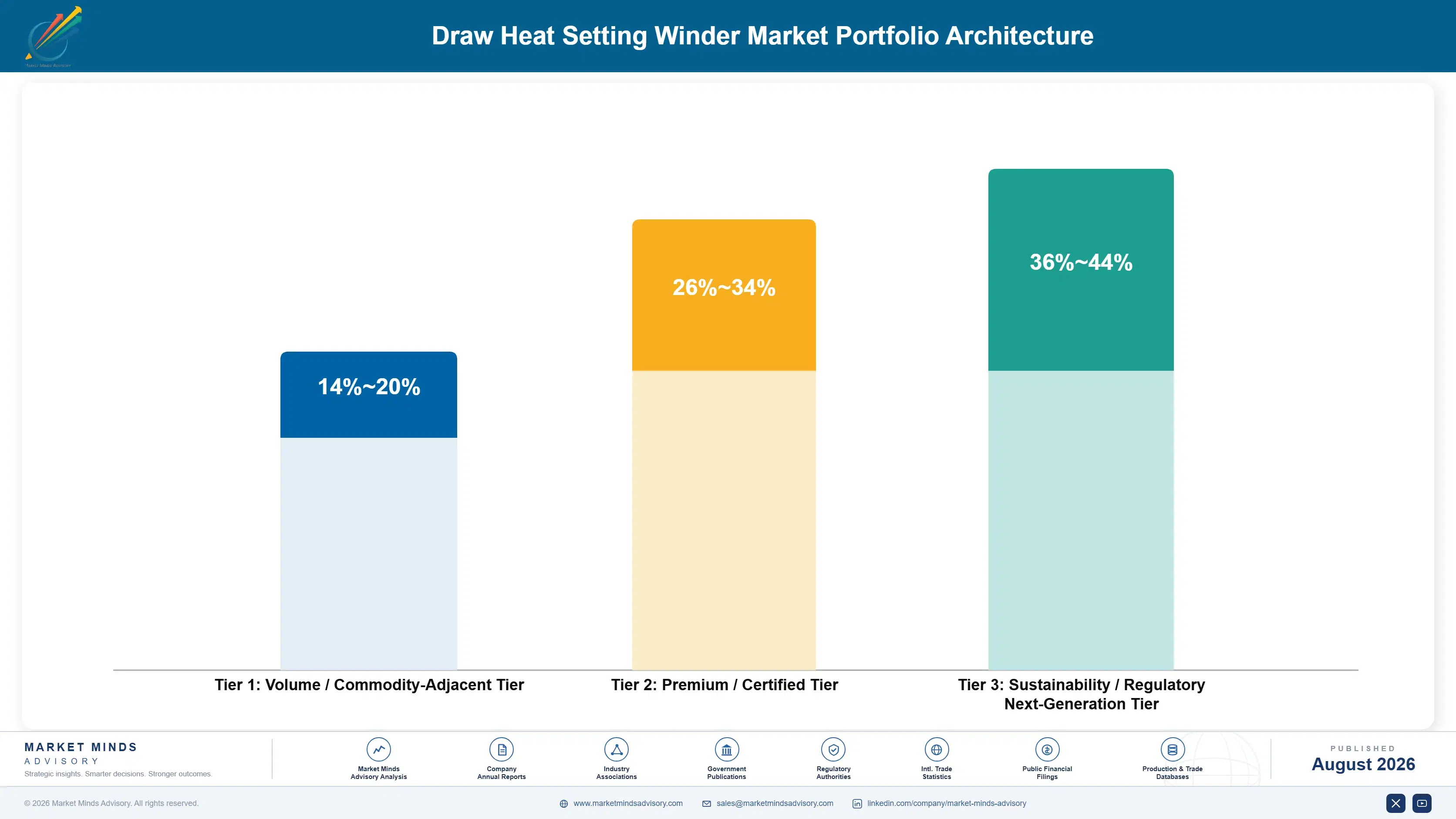
The market organizes into three commercial tiers separated by certification depth and automation level rather than simple winding speed. Volume tier products are standard manual and semi-automated winders sold largely on price for non-certified industrial yarn lines. Premium tier systems carry automated doffing and inline monitoring. The sustainability and next-generation tier layers in full automotive certification support and predictive maintenance on top of certified hardware.
Margin economics favor the premium and next-generation tiers heavily, since volume-tier standard winders compete largely on unit price against a crowded field of Chinese domestic manufacturers with limited differentiation. Suppliers that can move customers from a one-time hardware sale into certification support services and automated retrofit engineering contracts capture materially higher revenue per account, which is why most established players are actively pushing customers toward higher tiers.

High-value pools concentrate at automotive-grade certified equipment bundled with certification support services, and in the retrofit engineering relationships that follow every automation upgrade for the life of the equipment. Volume-tier standard equipment sales remain necessary for market presence but contribute comparatively little to overall supplier profitability across the wider portfolio and long-term account value.

Volume / Commodity-Adjacent Tier

Standard manual and semi-automated winders sold primarily on unit price for non-certified industrial yarn lines serving rope, netting, and other standard applications, competing against a crowded field of Chinese domestic manufacturers.
Gross Margin: 14-20%

Premium / Certified Tier

Fully automated winders with automated doffing and inline tension and diameter monitoring, sold to producers requiring documented process consistency for automotive supplier qualification or other quality-sensitive technical yarn applications requiring certification.
Gross Margin: 26-34%

Sustainability / Regulatory / Next-Generation Tier

Automotive-certified winders bundled with certification support services and predictive maintenance monitoring, sold to tire cord, airbag, and seatbelt yarn producers where a single quality failure risks losing automotive customer certification entirely.
Gross Margin: 36-44%
draw-heat-setting-winder-market-portfolio-architecture-1787301714915

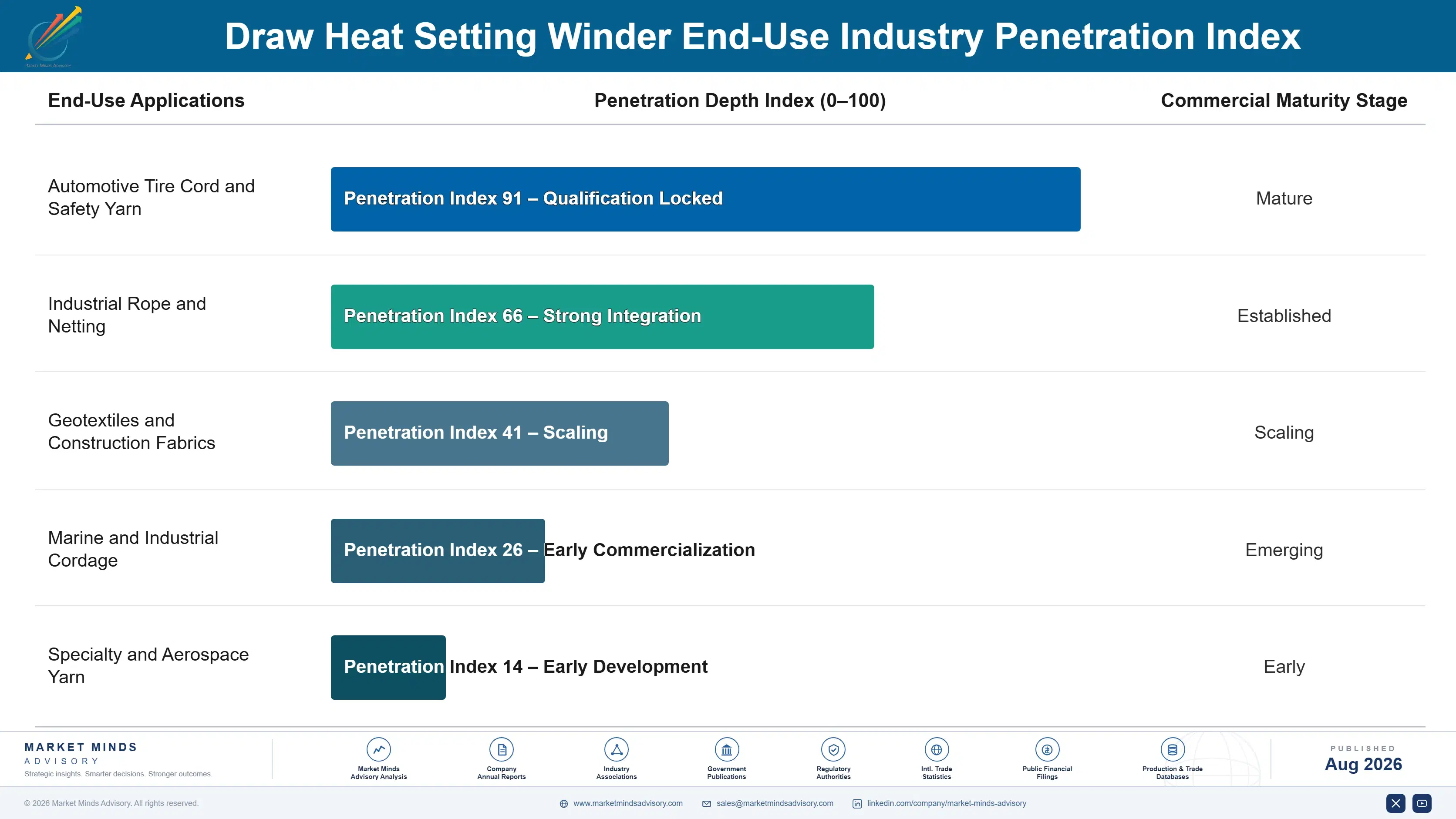
Certification Anchors Recurring Machine Revenue

Certified winders generate revenue well beyond the initial sale because automotive supplier qualification requires periodic recertification audits throughout a production line's operating life, typically every two to three years, creating a recurring certification support relationship that hardware-only competitors cannot easily capture on their own. Suppliers who build certification support relationships effectively position themselves for the eventual machine replacement decision that follows
Adoption depth varies meaningfully by producer type. Automotive-grade producers have moved into bundled certification and retrofit engineering relationships, where switching suppliers means re-qualifying an entire production line against a new vendor's equipment specifications and documentation standards. Standard industrial yarn producers remain firmly transactional, where price and delivery lead time matter more than supplier relationship depth or bundled service offerings for most individual buyers.

A generational shift in production floor management is reinforcing service adoption. Younger plant engineers trained on digital process monitoring increasingly expect machine performance data delivered as continuous telemetry rather than periodic manual inspection, pushing procurement decisions toward suppliers offering integrated monitoring over those selling machines alone, a preference reshaping vendor shortlists at facilities now hiring their next generation of engineers.
draw-heat-setting-winder-market-end-use-penetration-index-1787301715407

Where MMA Sees Durable Advantage

These are among the four positions where our research anticipates prominent divergence between winners and laggards over the coming forecast period. Each is grounded in the demand model, the regulatory perimeter, and the announced capacity pipeline.
01 / CERTIFICATION SUPPORT DEPTH

Owning the certification relationship matters more than machine speed

Machine builders offering bundled certification support capture a disproportionate share of automotive-grade equipment orders, since certification lead time and documented compliance track record frequently outweigh raw winding speed in purchasing decisions at automotive-grade producers. This capability is also difficult for challengers to build quickly, since certification expertise requires years of accumulated regulatory and engineering knowledge across multiple automaker qualification programs. MMA views certification support depth as the single most predictive metric of supplier durability in this market over the next decade.
02 / RETROFIT ENGINEERING BACKLOG

The retrofit backlog will outgrow new machine sales through the decade

A meaningful share of the global installed winder base remains manual or semi-automated, and rising labor costs are making automation retrofit increasingly attractive even where full machine replacement is not yet economically justified for producers operating on tighter capital budgets. Suppliers with proven retrofit engineering capability and standardized automation kits will capture a disproportionate share of this backlog as labor costs continue rising across major producing regions. MMA expects retrofit-focused suppliers to outgrow new-machine-only competitors meaningfully through the forecast period.
03 / CHINESE TECHNOLOGY CONVERGENCE

Chinese domestic manufacturers will close the precision engineering gap steadily

Chinese domestic machine builders are investing heavily in precision engineering capability that historically differentiated German and Japanese suppliers, and their improving quality is already visible in growing automotive-grade order wins at domestic Chinese technical yarn producers. Suppliers dependent on a pure precision-engineering price premium face a narrowing competitive window as Chinese equipment closes the quality gap while retaining a substantial cost advantage. MMA expects this convergence to intensify fastest in standard equipment segments before eventually reaching automotive-grade certified machinery as well.
04 / AUTOMOTIVE CERTIFICATION CYCLES

Tightening certification standards will keep replacement demand elevated for years

Automotive safety certification bodies show no sign of relaxing dimensional and tenacity tolerance requirements, and each successive certification cycle tends to be more demanding than the last as automakers pursue incremental safety improvements across their supply chains. Producers unable to demonstrate consistent compliance risk losing automotive supplier status entirely, a consequence severe enough that most producers prioritize certification-driven machine replacement over deferring capital spending during softer demand periods. MMA expects certification-driven replacement to remain the market's most reliable demand floor through the forecast period.

Engagement Snapshot From the Field

A live engagement with an industry participant carrying material or product regulatory and market exposure ahead of a defining policy shift, showing how our research translates into a defensible multi-year portfolio strategy.
MARKET MINDS ADVISORY · CLIENT ENGAGEMENT SUMMARY
Draw Heat Setting Winder Producer Strategic Portfolio Review and Transition Roadmap 2026·Investment Scenario on Draw Heat Setting Winder Exposure Evaluation 2025-26
CLIENT PROFILE
The client is a mid-sized Indian technical yarn producer operating four production lines supplying tire cord yarn to domestic and export automotive customers (client-reported, unverified by MMA), with roughly half its winder fleet older than fifteen years and lacking the integrated quality monitoring capability required for expanding automotive certification across additional new customer accounts and markets.
STRATEGIC CHALLENGE
Management wanted to pursue automotive supplier qualification with two additional international automakers, but the existing machine fleet could not consistently document the dimensional tolerance compliance required for certification audits, and the capital budget could not support replacing the entire fleet simultaneously across all four production lines within a single fiscal year.
MMA APPROACH
MMA benchmarked the client's machine fleet against retrofit sensor package compatibility across two vendors, modeled the certification timeline and revenue opportunity from the two target automaker contracts against retrofit versus full replacement cost, and evaluated vendor certification support capability to shorten the client's overall qualification timeline as much as possible.
KEY FINDINGS
  1. Roughly 60 percent of the client's older winders could accept a retrofit sensor package without structural modification (client-reported, unverified by MMA), cutting projected certification cost by nearly half versus full machine replacement.
  2. One vendor's retrofit sensor package offered certification-ready documentation output compatible with both target automakers' existing audit formats, avoiding a costly custom reporting integration project the other vendor would have required.
  3. The retrofit approach reduced projected time to certification readiness compared with a full fleet replacement timeline, primarily by avoiding new equipment procurement, installation, and commissioning delays across four separate production lines.
  4. Client engineering staff lacked experience interpreting automated sensor data output, creating a training need the selected vendor's certification support team was well positioned to address directly during implementation.
CLIENT PROFILE
The client is a mid-sized Indian technical yarn producer operating four production lines supplying tire cord yarn to domestic and export automotive customers (client-reported, unverified by MMA), with roughly half its winder fleet older than fifteen years and lacking the integrated quality monitoring capability required for expanding automotive certification across additional new customer accounts and markets.
STRATEGIC CHALLENGE
Management wanted to pursue automotive supplier qualification with two additional international automakers, but the existing machine fleet could not consistently document the dimensional tolerance compliance required for certification audits, and the capital budget could not support replacing the entire fleet simultaneously across all four production lines within a single fiscal year.
MMA APPROACH
MMA benchmarked the client's machine fleet against retrofit sensor package compatibility across two vendors, modeled the certification timeline and revenue opportunity from the two target automaker contracts against retrofit versus full replacement cost, and evaluated vendor certification support capability to shorten the client's overall qualification timeline as much as possible.
KEY FINDINGS
  1. Roughly 60 percent of the client's older winders could accept a retrofit sensor package without structural modification (client-reported, unverified by MMA), cutting projected certification cost by nearly half versus full machine replacement.
  2. One vendor's retrofit sensor package offered certification-ready documentation output compatible with both target automakers' existing audit formats, avoiding a costly custom reporting integration project the other vendor would have required.
  3. The retrofit approach reduced projected time to certification readiness compared with a full fleet replacement timeline, primarily by avoiding new equipment procurement, installation, and commissioning delays across four separate production lines.
  4. Client engineering staff lacked experience interpreting automated sensor data output, creating a training need the selected vendor's certification support team was well positioned to address directly during implementation.
RECOMMENDED STRATEGY
Phase 1: Phase 1 (Months 1-3): Finalize vendor selection for retrofit sensor packages and begin installation on the two production lines with the highest certification priority. Phase 2: Phase 2 (Months 4-8): Complete retrofit installation across remaining production lines and begin generating certification documentation for both target automaker audits. Phase 3: Phase 3 (Months 9-12): Submit certification packages to both target automakers and address any audit findings before final supplier qualification approval.
OUTCOME
Following the retrofit rollout, the client reported achieving certification readiness roughly five months faster than a full replacement timeline would have allowed and winning supplier qualification with one of the two target automakers within the engagement window (client-reported, unverified by MMA). The second qualification remains under review.

Frequently Asked Questions

Foundational context covering the market sizes, CAGR, scope, country, region and competition that inform every finding below. This section is provided to cover basics and most often pre-purchase conversations, answered from the MMA Primary Research Dataset.

What is the current size of the Draw Heat Setting Winder Market?

The global draw heat setting winder market was valued at approximately 0.45 billion dollars in 2025. Growth is anchored in automotive certification tightening and technical yarn capacity expansion across Asia.

How large will the Draw Heat Setting Winder Market be by 2036?

MMA projects the market will reach approximately 0.88 billion dollars by 2036 under the base case scenario. That represents nearly a doubling of the 2026 market value.

What is the CAGR for the Draw Heat Setting Winder Market 2026 to 2036?

The base case CAGR is 6.2 percent annually across the forecast period, reflecting certification-driven replacement demand. Bull and bear scenarios range between roughly 4.9 and 7.5 percent.

Which segment is growing fastest?

High-speed industrial yarn winders are the fastest-growing segment at a projected 8.5 percent CAGR through 2036. That is roughly 1.4 times the overall market growth rate.

Who are the major companies in the Draw Heat Setting Winder Market?

Leading suppliers include Oerlikon Barmag, Saurer, TMT Machinery, Murata Machinery, and Jingwei Textile Machinery. Together they hold an estimated 42 percent combined share on a unit shipment basis.

Which country is growing fastest?

China leads regional growth at an estimated 8.0 percent CAGR, driven by sustained technical yarn capacity expansion. Domestic machine manufacturing is scaling alongside this rising investment.

Report Segmentation Architecture

The full report scope spans multiple orthogonal segmentation dimensions, with cross-tabulated demand data provided for each dimension pair. Coverage extends further to regional breakdowns, trend trajectories, and the competitive detail needed to support segment-level decision-making.

By Automation Level

  • Manual Winders
  • Semi-Automated Winders
  • Fully Automated Winders
  • Automotive-Certified Winders
  • Retrofit Sensor Packages
  • Automated Doffing Systems

By End-Use Industry

  • Automotive Tire Cord and Safety Yarn
  • Industrial Rope and Netting
  • Geotextiles and Construction Fabrics
  • Marine and Industrial Cordage
  • Specialty and Aerospace Yarn

By Commercial Dimension

  • New Machine Sales
  • Retrofit and Upgrade Sales
  • Certification Support Services
  • Licensed Local Manufacturing

By Region

  • North America
  • Western Europe
  • East Asia
  • South Asia and Pacific
  • Latin America
  • Middle East and Africa
  • Eastern Europe

Scope, Methodology, and Coverage

Every figure in this report is reproducible from documented input assumptions. The scope below maps the historical period, the forecast horizon, the segmentation dimensions, and the countries covered, alongside the underlying primary and qualitative methodology.
Historical Period
2020 to 2025
Forecast Period
2026 to 2036
Base Year
2025 (USD billions; MMA Primary Research Dataset, August 2026)
Market Definition
The draw heat setting winder market covers integrated machinery that draws, heat-sets, and winds synthetic filament yarn, primarily nylon and polyester, into finished packages for industrial and technical yarn applications including tire cord, airbags, and safety belts. It excludes upstream spinning and extrusion equipment, and it excludes standalone texturing machinery sold without integrated heat-setting capability.
Quantitative Units
USD billions (current prices); installed unit base and machine shipment volume where applicable
Segmentation Dimensions
Automation Level; End-Use Industry; Commercial Dimension; By Region
Regions Covered
North America, Western Europe, East Asia, South Asia and Pacific, Latin America, Middle East and Africa, Eastern Europe
Countries Covered
USA, China, Germany, France, UK, Japan, South Korea, India, Australia, Canada, Brazil, Mexico, Indonesia, Vietnam, Thailand, Malaysia, UAE, Saudi Arabia, South Africa, Nigeria, Turkey, Poland, Netherlands, Italy, Spain, Sweden, Switzerland, Argentina, Colombia, Singapore, and additional markets relevant to this sector
Key Companies Profiled
Oerlikon Barmag, Saurer Technologies GmbH & Co. KG, TMT Machinery, Inc., Murata Machinery, Ltd., Jingwei Textile Machinery Company Limited, Rieter Holding AG, Savio Macchine Tessili S.p.A., SSM Scharer Schweiter Mettler AG, Himson Engineering Pvt. Ltd., Truetzschler Group SE, Toyota Industries Corporation, Karl Mayer Group, Lakshmi Machine Works Limited, Marzoli Machines Textile S.r.l., China Hi-Tech Group Corporation, Qingdao Hongda Textile Machinery Co., Ltd., ANDRITZ AG, Reifenhauser Group, Zhejiang Jinggong Science & Technology Co., Ltd., Jiangsu Hongyuan Textile Machinery Co., Ltd.
Quantitative Methodology
Primary survey, n=3,800 respondents, Q4 2025, six countries; demand-side model with trade association cross-validation
Qualitative Methodology
47 expert interviews, Q4 2025; applied to validate demand model assumptions, identify emerging dynamics, and assess competitive positioning
Report Format
PDF and XLSX data workbook (Word format preview document)
Publisher
Market Minds Advisory
Report Code
MMA-2026-CON-103
Published
August 2026
Contact
sales@marketmindsadvisory.com | www.marketmindsadvisory.com

Purchase the full Draw Heat Setting Winder Market Report (2026 to 2036).

The full report provides detailed sizing and ten-year forecasts for the draw heat setting winder market across all six automation segments and every major region. It includes company-level competitive profiles for the top twenty suppliers, benchmarked on unit shipment revenue, alongside detailed analysis of certification support capability and retrofit engineering positioning across major markets. Regional chapters cover automotive certification standards, technical yarn capacity expansion programs, and machine fleet age profiles shaping demand through 2036. A dedicated chapter models revenue lever adoption, including certification services and retrofit engineering pricing, against supplier margin trajectories. Buyers receive a downloadable data workbook alongside the full narrative report.
Ten-year market sizing across six automation level segments
Company profiles benchmarked on unit shipment revenue basis
Regional automotive certification and capacity expansion analysis
Certification support and retrofit engineering positioning benchmarking
Revenue lever modeling against supplier margin trajectories
Downloadable data workbook with full narrative report

Built For The People Who Decide

From boardroom strategy to bench-side execution, this report is read cover-to-cover by leaders shaping the next decade of their industry, turning demand scenarios, market dynamics and valuation benchmarks into decisions.
CXOs/ Presidents/ VPs/ Managers
M&A and Corporate Development
Strategy Teams and R&D Heads
Procurement and Product Directors
Regulatory and Compliance Leaders
Investor Relations and Equity Analysts