Market Minds Advisory
Drain Cleaning Chemicals Market

Drain Cleaning Chemicals Market: Drain Cleaning Chemicals. Enzymatic Formulations Challenge Legacy Caustic Chemistry

Aging municipal pipe networks and a wave of enzyme-based formulation reformulations are pushing legacy caustic drain cleaner makers to defend shelf space against greener challengers winning over environmentally cautious households and plumbers.

Lead Analyst

Published

September 2026

Make Smarter Decisions with Customized Research Insights

Request a free sample report and evaluate market opportunities, growth trends, and competitive dynamics relevant to your business needs.

2025 MARKET VALUE$3.8BMarket Size 2025
2036 FORECAST VALUE$6.2BBase Case , 2026 to 2036
CAGR 2026 TO 20364.6 %Bull 5.9% / Bear 3.3%
INCREMENTAL OPPORTUNITY$2.2BNet 10- year value creation
EXPANSION MULTIPLE1.57x2036 value over 2026 base
Strategic Levers
M&A Pipeline
Regional Outlook
Country Rankings
Competitive Intelligence
Segmental Deep-dive
Call-Us : 91 93563 13602

Executive Snapshot and Market Trajectory.

Enzymatic and bio-based formulations are reshaping a category long dominated by caustic soda, as retailers and professional plumbers alike push toward safer, pipe-friendly chemistry that reduces damage to aging residential plumbing systems and lowers wastewater treatment burden in municipal sewer networks.
Household demand remains the largest revenue base, but professional plumbing and facilities maintenance channels are growing faster as commercial property managers standardize on enzymatic maintenance programs over reactive caustic treatments applied only after a clog occurs. North America leads consumption given its aging single-family housing stock and extensive private plumbing infrastructure requiring frequent preventive maintenance across every major metropolitan region and suburban housing market, with older cast iron and clay pipe networks proving especially clog-prone.
Competition centers on a handful of established consumer brands defending shelf space against newer bio-based entrants and private label alternatives gaining traction at value retailers nationwide. Regulatory pressure on caustic and acidic formulations is accelerating reformulation timelines, while retailers increasingly favor suppliers who can document environmental safety data across their full drain cleaner portfolio rather than a single flagship product alone, particularly as wastewater treatment operators raise concerns about caustic discharge.
Market Definition
The drain cleaning chemicals market covers caustic, acidic, oxidizing, enzymatic, and foaming formulations sold for clearing and maintaining residential, commercial, and municipal drain and sewer lines. It excludes mechanical drain clearing tools, plumbing services labor, and industrial process pipe descaling chemicals used outside drain maintenance applications.
Base Year Value
$3.8B in 2025 (MMA Primary Research Dataset, September 2026)
Forecast Period
2026 to 2036, eleven discrete annual values
CAGR
4.6% base case. Bull 5.9%. Bear 3.3%.
Fastest Growth Segment
Enzymatic and Bio-Based Drain Cleaners: 8.5% CAGR
Fastest Growth Country
United States: 5.4% CAGR
Fastest Growth Region
South Asia and Pacific: 6.5% CAGR
Largest Region
North America: 30% of 2025 global value
Market Leaders
The Clorox Company, SC Johnson & Son, Summit Brands, Roebic Laboratories, and Scotch Corporation lead the market. Source: MMA Primary Research Dataset, July 2026.
Primary Survey
n=3,800 procurement and R&D decision-makers, Q4 2025, six countries
Methodology
Demand-side build-up, cross-validated against public data, 47 expert interviews

Drain Cleaning Chemicals Market Forecast Scenarios

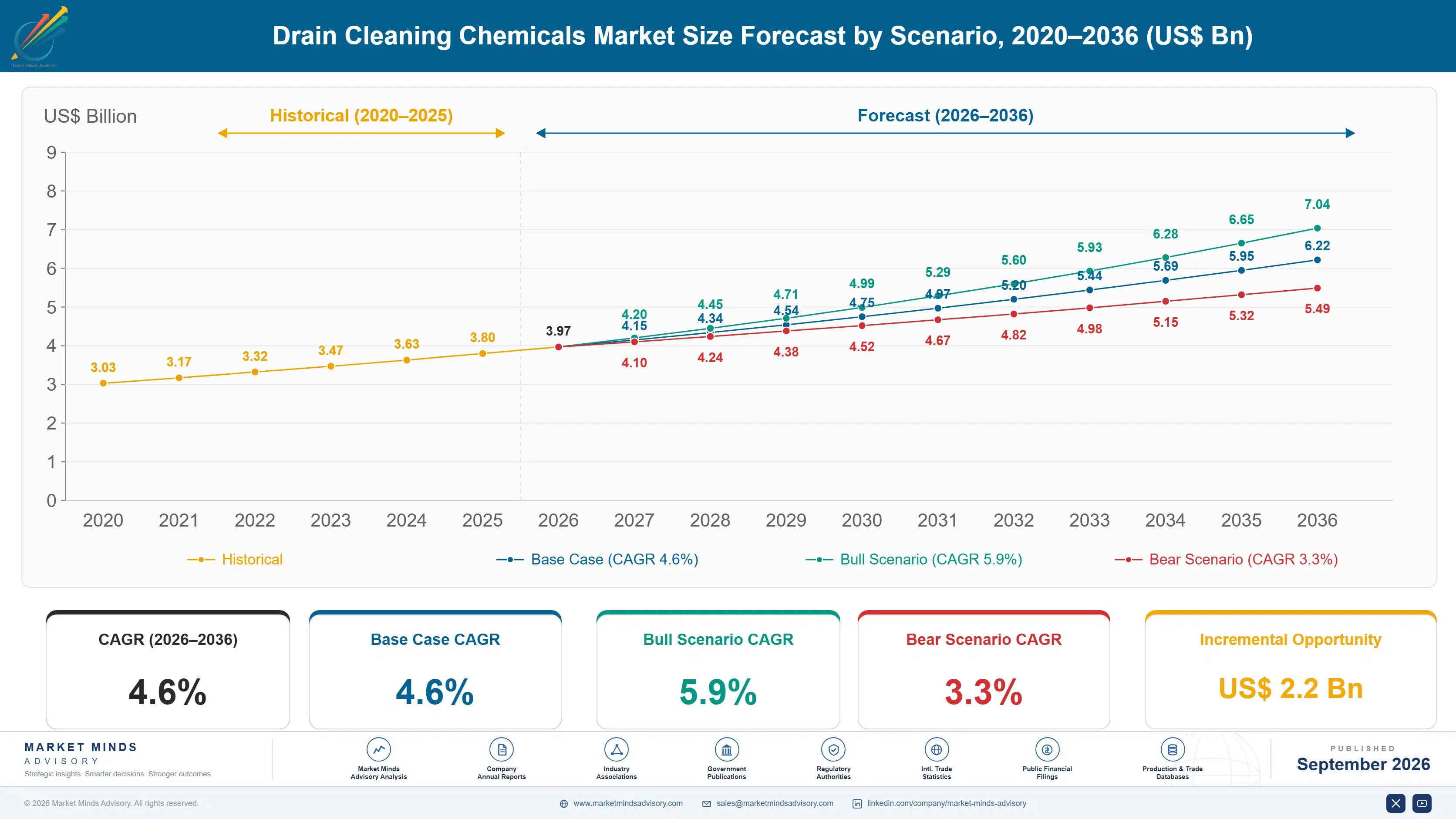
drain-cleaning-chemicals-market-size-forecast-scenario-1790013323198
The category grew steadily from 2020 to 2025, supported by stable household repair spending and consistent replenishment demand, with a historical CAGR near 3.8 percent reflecting a mature category more defined by reformulation than by unit volume expansion. Pandemic-era home improvement spending gave the category a temporary lift that has since normalized back toward its longer-run replacement-driven growth trajectory.
The base case assumes 4.6 percent annual growth through 2036, driven by three commercial mechanisms: continued enzymatic reformulation of legacy caustic product lines, expanding commercial facilities maintenance contracts standardizing on preventive drain treatment, and rising professional plumber recommendation of bio-based chemistry over corrosive alternatives. Aging pipe infrastructure across mature housing markets sustains steady replacement demand regardless of formulation shifts, and retailers continue expanding bio-based product shelf space at the expense of legacy caustic lines.
The bull case reaches 5.9 percent if municipal wastewater regulations accelerate caustic and acidic phase-outs faster than expected, pulling forward enzymatic adoption across both household and commercial channels nationwide. The bear case falls to 3.3 percent if private label caustic products retain share through aggressive discounting, slowing the shift toward higher-margin bio-based formulations across the industry as a whole.

From Caustic Soda to Enzymatic Pipe Chemistry

Drain cleaning chemicals remain a household staple, but the underlying chemistry is shifting fastest in decades. Caustic soda and sulfuric acid formulations, long the category default for guaranteed clog removal, are ceding shelf space to enzymatic and bio-based alternatives that pose lower risk to aging pipe materials and municipal wastewater systems, particularly in regions with older cast iron plumbing infrastructure.
MARKET CONCENTRATIONCR5 48%Top five brands hold roughly half of category sales
AVERAGE RETAIL PRICE$6.20 per unitReflects standard retail bottle sizing across most formulations
PROFESSIONAL CHANNEL SHARE34% of volumePlumbers and facilities managers account for meaningful category volume
REFORMULATION RATE22% of SKUs annuallyShare of products reformulated away from caustic chemistry yearly
PRIVATE LABEL PENETRATION19% of unit volumeRetailer-owned brands compete directly against national brand offerings
AVERAGE PRODUCT SHELF LIFE36 monthsTypical duration before formulation stability requires full retail reassessment
Professional plumbers increasingly recommend enzymatic maintenance products to homeowners and commercial property managers as a preventive alternative to reactive caustic treatment, a shift that is reshaping purchase patterns across both retail and professional distribution channels nationwide. Facilities management contracts increasingly specify bio-based chemistry outright, particularly in newer commercial developments with plastic and PVC piping less tolerant of aggressive caustic exposure over repeated treatment cycles.
Private label penetration remains meaningful in the caustic and acidic segments, where formulation complexity is lower and retailers can compete more directly on price with national brands. Enzymatic formulations carry higher production complexity and intellectual property protection, giving branded manufacturers more durable pricing power in that faster-growing segment of the category, and a stronger position with professional buyers seeking documented performance.
"The brands still betting on caustic soda as their flagship product are defending a shrinking part of the shelf. The real fight has already moved to who owns the enzymatic aisle."
Director, Household and Industrial Chemicals Practice · MMA Chemicals and Materials Practice · September 2026

Market Trends

Enzymatic Formulation Adoption Accelerates Across Retail

Enzymatic and bio-based drain cleaners are moving from a niche eco-conscious shelf position to mainstream retail placement as major chains expand facings for these products nationwide across every region and price tier. The shift reflects both consumer preference for lower-risk household chemicals and retailer response to state-level restrictions on certain caustic ingredients. Manufacturers report enzymatic product facings expanding by roughly 30 percent across major grocery and home improvement retailers over the past two years, with several national brands launching enzymatic line extensions alongside legacy caustic products rather than replacing them outright immediately.
Market Impact: Drives purchase frequency up 2x

Professional Channel Standardizes on Preventive Treatment

Facilities management companies and commercial property operators are shifting from reactive caustic treatment after a clog occurs to scheduled preventive enzymatic maintenance programs applied monthly or quarterly across their full property portfolios nationwide and internationally at growing scale each year. This shift reduces emergency plumbing service calls and pipe damage claims, giving facilities managers a measurable cost justification for the switch. Roughly 40 percent of large commercial property management firms surveyed now specify enzymatic maintenance products in standard operating contracts, up from a much smaller share only a few years earlier.
Market Impact: Cuts caustic SKU count 25 percent

Market Opportunities and Growth Drivers

Aging Housing Stock Sustains Replacement Demand

A large share of housing in mature markets was built before 1980 with cast iron, clay, or early plastic piping that clogs more frequently than modern PVC systems, sustaining steady drain cleaner replacement demand regardless of formulation trends across every region and climate zone. Homeowners in these older housing markets purchase drain cleaning chemicals roughly twice as often as those in newer construction, according to MMA primary survey data, giving the category a durable demand floor even as household formation growth slows in many mature economies overall and construction activity moderates.
Market Impact: Limits enzymatic penetration to 45 percent

Retailer Reformulation Mandates Push Bio-Based Growth

Major retail chains are increasingly setting internal chemical safety standards that go beyond regulatory minimums, requiring suppliers to disclose full ingredient safety data and phase out certain caustic and acidic compounds from shelf assortments nationwide and across international markets served by the same retail groups and buying alliances. This retailer-driven pressure is accelerating reformulation timelines faster than regulation alone would require, with several major chains committing to reduce caustic soda based SKU count by 25 percent within their private label assortments over the next three years across all store formats and regions.
Market Impact: Adds compliance cost across 15 jurisdictions

Market Restraints and Challenges

Enzymatic Products Underperform on Severe Clogs

Enzymatic and bio-based formulations work slower and less reliably against severe grease or hair clogs than caustic or acidic chemistry, a performance gap rooted in their reliance on biological digestion rather than immediate chemical dissolution of blockage material buildup. This limits their use to preventive maintenance rather than emergency clog removal, capping the pace at which they can fully displace caustic products in consumer purchase behavior. Manufacturers are addressing the gap by developing hybrid formulations, though these remain more expensive to produce and still trail caustic chemistry on severe blockages.
Market Impact: Expands shelf facings 30 percent

Fragmented Regulations Raise Compliance Costs Nationwide

Chemical safety regulations for household drain cleaners vary meaningfully across states and countries worldwide, forcing manufacturers to maintain multiple formulation variants and labeling schemes for what is otherwise a single product category sold nationwide and internationally across many different regulatory jurisdictions. This fragmentation raises compliance costs disproportionately for smaller manufacturers lacking dedicated regulatory affairs teams, with root causes tracing back to drain cleaners falling under several overlapping hazardous substance frameworks. Larger suppliers are consolidating formulations toward the strictest applicable standard to simplify compliance, accepting somewhat higher production costs in exchange.
Market Impact: Covers 40 percent of contracts
3 additional market trends, 2 additional growth drivers, and 4 additional restraints and challenges are covered in the full report. Contact sales@marketmindsadvisory.com to access the complete intelligence.

Segment CAGR and Growth Architecture

The drain cleaning chemicals market splits into six formulation-based segments defined by active chemistry: caustic, acidic, oxidizing, enzymatic, foaming, and solvent-based products used across residential, commercial, and municipal settings nationwide and abroad. Enzymatic and foaming formulations are gaining share fastest as retailers and professional buyers favor lower-risk chemistry over traditional caustic and acidic alternatives worldwide.
drain-cleaning-chemicals-market-market-share-analysis-1790013323805

Enzymatic and Bio-Based Drain Cleaners

Enzymatic and bio-based drain cleaners use bacterial cultures and enzymes to digest organic buildup such as hair, grease, and soap scum over repeated applications rather than dissolving blockages instantly through chemical reaction. This makes them best suited to preventive maintenance rather than emergency clog removal, but that positioning is exactly what is driving adoption among commercial facilities managers and increasingly among households seeking to avoid pipe damage from caustic exposure over repeated use. Manufacturers are investing heavily in faster-acting enzyme blends to close the performance gap with caustic chemistry on moderate clogs, a development that could meaningfully expand the segment's addressable use cases over the coming years and reshape purchase habits.
CAGR 8.5%

Foaming Gel Drain Cleaners

Foaming gel formulations combine surfactants with mild caustic or enzymatic active ingredients to coat pipe walls more thoroughly than thin liquid formulations, extending contact time with clog material and improving clearing performance on partial blockages across a wide range of pipe materials and diameters. Their gel consistency also reduces splash-back risk during application, an increasingly important selling point as households grow more safety-conscious about household chemical handling generally. Retailers report foaming gel formulations carrying a modest price premium over standard liquid products, and manufacturers are expanding foaming product lines faster than any other format as this combination of performance and safety appeal proves durable across both value and premium price tiers.
CAGR 6.0%
Full segment breakdown across 6 segments available in the complete report.

Regional Architecture and Country Demand Map

North America leads on aging single-family housing stock and extensive private plumbing infrastructure requiring frequent maintenance, followed by East Asia's dense urban housing base. South Asia and Pacific is expanding fastest as new housing construction and rising home ownership drive first-time purchase demand across the region.

North America

North America holds the largest regional share because its housing stock skews older than most other mature markets, with millions of single-family homes built before 1980 still relying on cast iron and clay pipe systems prone to frequent clogging and requiring regular chemical maintenance. High rates of homeownership mean plumbing maintenance falls directly on individual households rather than centralized building management, sustaining strong retail purchase volume for drain cleaning chemicals across every major grocery and home improvement retail channel nationwide. The United States accounts for the large majority of regional demand, with Canada following at meaningfully smaller scale given its smaller population and newer average housing stock across most provinces.
Share: 30% | CAGR: 5.6% (2026 to 2036)

Western Europe

Western Europe's growth trails North America and East Asia as EU chemical safety regulation increasingly restricts caustic and acidic formulations, pushing the region toward enzymatic alternatives faster than reformulation capacity in some smaller manufacturers can keep pace with across every national market and retail segment covered. Germany and the United Kingdom remain the largest national markets, reflecting their large housing stocks and established home improvement retail channels serving both professional and household buyers alike across every price tier. France's market follows a similar pattern, with growth increasingly concentrated in bio-based product lines rather than legacy caustic formulations as retailers reduce shelf space for older chemistries across the board and every store format.
Share: 20% | CAGR: 3.2% (2026 to 2036)
Regional intelligence for 5 additional markets available in the complete report: East Asia, South Asia and Pacific, Latin America, Middle East and Africa, Eastern Europe. Contact sales@marketmindsadvisory.com.
drain-cleaning-chemicals-market-country-cagr-analysis-1790013324334

Beyond the Bottle: Where Margin Concentrates

Selling a bottle of drain cleaner at retail is a low-margin, high-volume business dominated by scale and shelf placement across every major retail channel and geography. The larger margin opportunities sit in professional maintenance contracts, private label manufacturing partnerships, and formulation licensing that established manufacturers are increasingly pursuing alongside core retail sales and distribution nationwide.

Expanding Recurring Commercial Facilities Maintenance Contracts

Rather than selling individual bottles at retail, manufacturers are increasingly signing recurring supply contracts directly with facilities management companies and commercial property operators for scheduled preventive maintenance programs across entire property portfolios and multiple building types nationwide and abroad. These contracts generate more predictable revenue than retail sales and command pricing roughly 20 percent above equivalent retail volume once service and documentation are bundled in. Several manufacturers have built dedicated commercial sales teams specifically to pursue this channel as facilities managers increasingly standardize their maintenance vendor relationships across property portfolios nationwide.
Market Impact: Commands roughly 20 percent premium over comparable retail volume

Manufacturing Private Label Formulations for Retailers

Large retailers increasingly want private label drain cleaner lines to compete against national brands on price while capturing more margin themselves, and manufacturers with spare production capacity can win this contract manufacturing business at reasonably attractive volumes even at lower per-unit pricing than branded sales generate across the category and every price tier. Private label contracts now account for an estimated 19 percent of total category unit volume, and manufacturers who build strong retailer relationships in this channel gain valuable production scale that lowers their own branded product costs as well over time.
Market Impact: Adds volume from an estimated 19 percent private label share

Licensing Enzymatic Formulation Technology to Smaller Manufacturers

Manufacturers holding proprietary enzyme strain and formulation stability technology can license that intellectual property to smaller regional manufacturers who lack the research capability to develop competitive enzymatic products independently at comparable cost, speed, or scale on their own limited resources. This generates high-margin royalty revenue without requiring additional manufacturing capacity investment, and it lets technology leaders monetize their research spend across a wider base of production volume than their own manufacturing alone could support, adding an estimated 8 percent to overall segment revenue each year across licensed partners operating worldwide.
Market Impact: Adds an estimated 8 percent in royalty revenue

Offering Certified Safety Documentation as a Paid Service

Smaller manufacturers and private label producers increasingly need certified safety data sheets and regulatory compliance documentation to sell across multiple state and national jurisdictions, but few maintain dedicated regulatory affairs staff internally to manage this complex work efficiently and consistently over time and across formulations. Larger manufacturers with established regulatory teams can offer this documentation service to smaller competitors and private label partners for a fee, turning compliance overhead into a revenue stream that scales with the roughly 15 jurisdictions most manufacturers must satisfy simultaneously across their product lines and markets served.
Market Impact: Monetizes compliance work across roughly 15 jurisdictions served

Who Controls the Margin Pool

Ranked on global retail revenue from drain cleaning chemical sales, the market is moderately concentrated with a CR5 near 48 percent, reflecting decades of brand loyalty built through television advertising and retail shelf presence. The Clorox Company and SC Johnson lead through their Liquid-Plumr and Drano brands respectively, while Summit Brands and Roebic Laboratories hold strong positions in the professional and enzymatic segments. The gap between these leaders and smaller regional challengers is widening as national brands invest more heavily in bio-based reformulation.
Current competitive activity centers on enzymatic product line extensions, private label manufacturing partnerships, and marketing campaigns emphasizing pipe safety over raw chemical strength. Several manufacturers have launched foaming gel variants in the past year, targeting consumers seeking a middle ground between caustic potency and enzymatic gentleness.

Emerging pressure comes from private label products gaining share in the caustic and acidic segments, where formulation complexity is lower and retailers can compete more directly on price against national brands. Rankings are most likely to shift among mid-tier players as regulatory pressure accelerates reformulation costs that smaller manufacturers may struggle to absorb without scale advantages.
drain-cleaning-chemicals-market-company-positioning-matrix-1790013324860

Competitive Moat and Risk Dimensions

THE CLOROX COMPANY

Moat: Decades-Long Retail Brand Recognition

The Clorox Company's Liquid-Plumr brand benefits from decades of consistent television advertising and retail placement that newer entrants cannot easily replicate at comparable cost. This brand equity lets Clorox command premium retail pricing and secure prime shelf placement across nearly every major grocery and home improvement chain nationwide.
THE CLOROX COMPANY

Risk: Caustic Chemistry Regulatory Exposure

Liquid-Plumr's flagship products still rely heavily on caustic chemistry, leaving Clorox exposed as retailers and regulators push toward enzymatic alternatives faster than the brand's reformulation pipeline can fully match. Competitors with stronger enzymatic portfolios could erode Clorox's share if this transition accelerates faster than currently expected.
SC JOHNSON & SON

Moat: Category-Defining Product Recognition

SC Johnson's Drano brand has achieved near-generic status in the drain cleaner category, similar to how consumers refer to facial tissue by a leading brand name regardless of manufacturer. This recognition drives strong repeat purchase behavior and reduces the marketing spend needed to defend market share against newer challengers.
SC JOHNSON & SON

Risk: Slower Enzymatic Portfolio Expansion

SC Johnson has moved more slowly into enzymatic and bio-based formulations than some smaller competitors, relying instead on its established Drano brand equity to defend share in the caustic segment. This leaves an opening for challengers building dedicated enzymatic brand identities to capture share among environmentally conscious younger consumers first.

Players Tracked

Prominent Players

The Clorox Company
SC Johnson & Son
Summit Brands
Roebic Laboratories
Scotch Corporation

Other Key Players

Rooto Corporation
CLR Brands
Cleaning Solutions LLC
Zep Inc
Diversey Holdings
Ecolab
Comstar International
Earthworm Inc
Xion Corporation
J.R. Watkins
PDI Healthcare
Nyco Products Company
Amrep Inc
Spartan Chemical Company
Certol International

Recent Developments

FEBRUARY 2026

Clorox Launches Enzymatic Liquid-Plumr Line Extension

The Clorox Company launched an enzymatic line extension under its Liquid-Plumr brand, its first major bio-based product introduction in the category. The launch targets environmentally conscious consumers who have been shifting toward smaller enzymatic brands, aiming to defend Clorox's retail shelf position against these emerging challengers.
Signal: Signals legacy caustic brand leaders are finally committing meaningfully to enzymatic reformulation rather than defending share on chemistry alone
SEPTEMBER 2025

Summit Brands Expands Instant Power Production Capacity

Summit Brands expanded manufacturing capacity for its Instant Power enzymatic and foaming product lines to meet growing demand from both retail and professional facilities maintenance channels. The expansion reflects rising confidence that enzymatic demand growth will sustain over the medium term rather than proving a temporary consumer trend.
Signal: Signals enzymatic segment demand is durable enough to justify meaningful new capacity investment rather than incremental line extensions only
MAY 2026

Ecolab Signs Facilities Maintenance Supply Agreement

Ecolab signed a multi-year supply agreement with a major commercial property management firm to provide enzymatic drain maintenance products across its portfolio of office and retail properties. The agreement reflects growing demand for bundled professional maintenance programs over ad hoc reactive purchasing of individual drain cleaning products.
Signal: Signals commercial facilities contracts are becoming a distinct, growing revenue channel industry-wide rather than a niche side business

Caustic Soda and Enzyme Feedstock Costs

Caustic soda accounts for roughly 35 percent of cost of goods sold for traditional formulation manufacturers, sourced primarily from chlor-alkali producers in the United States, Germany, and China. Enzymatic formulations instead depend on specialty bacterial culture and enzyme feedstock inputs sourced from a smaller number of biotechnology suppliers concentrated in the United States and Denmark, carrying meaningfully higher per-unit input costs than commodity caustic chemistry.
Caustic soda prices spiked sharply in 2022 as chlor-alkali plant outages coincided with surging energy costs across European production, based on EIA commentary on industrial chemical feedstock markets. Several drain cleaner manufacturers reported input cost increases of 18 to 25 percent during that period before prices partially normalized through 2024, forcing temporary retail price increases across multiple national brands and private label suppliers alike nationwide.

Manufacturers reliant on a single caustic soda supply contract face greater margin exposure during price spikes than diversified competitors who can shift sourcing across multiple chlor-alkali producers or regions on short notice. Enzymatic formulation specialists face a different but comparable risk, since their smaller supplier base for specialty bacterial cultures offers fewer alternative sourcing options during a disruption.
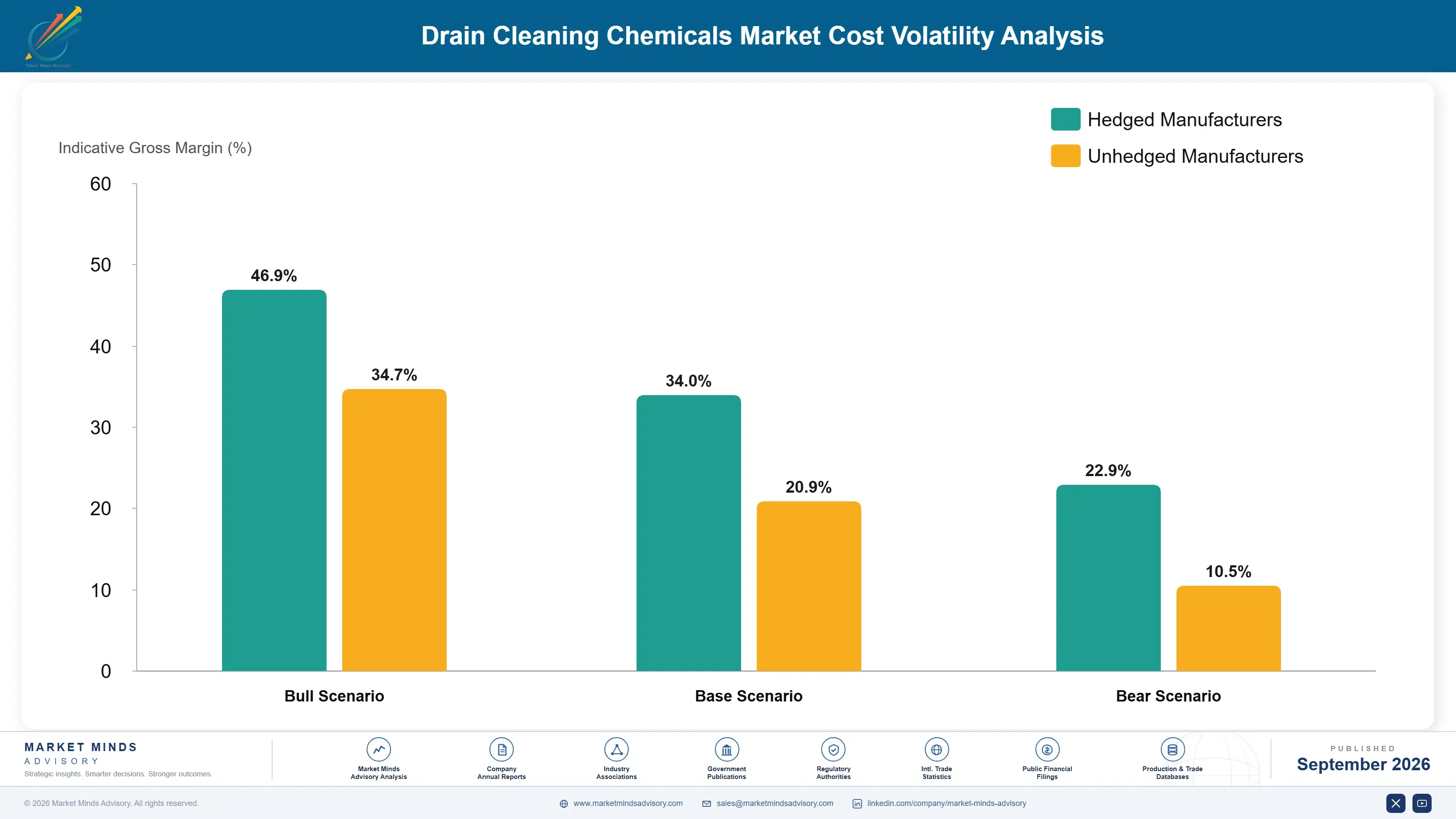
drain-cleaning-chemicals-market-cost-volatility-analysis-1790013325056

Diversifying Caustic Soda Supply Across Regions

Larger manufacturers are securing supply contracts with chlor-alkali producers across multiple regions rather than relying on a single domestic source, reducing exposure to regional plant outages or energy cost spikes affecting any one market. This diversification requires more complex logistics and inventory management but meaningfully reduces the risk of production disruption during a regional supply shock.

Building Long-Term Enzyme Supplier Partnerships

Enzymatic formulation manufacturers are increasingly locking in multi-year supply agreements with biotechnology partners rather than purchasing enzyme feedstock on the spot market, trading some pricing flexibility for greater supply certainty across production cycles. This approach also gives manufacturers earlier access to next-generation enzyme strains as suppliers prioritize committed long-term partners over spot market buyers.

Portfolio Architecture for Margin Defence

The category splits into three commercial tiers with distinct margin economics. Volume commodity-adjacent caustic and acidic products sold through mass retail carry the thinnest margins, competing almost entirely on shelf price and promotional discounting. Premium certified enzymatic and foaming formulations command substantially higher margins, and the sustainability-focused next-generation bio-based tier, while smallest in volume, is capturing a growing share of category gross profit.
Volume producers compete on price and reliable large-batch retail supply, leaving thin room to absorb rising caustic soda costs without losing shelf space to private label alternatives. Premium and next-generation suppliers instead compete on documented safety data, pipe-friendly positioning, and professional channel relationships, letting them pass through higher input costs while expanding margin as buyers prioritize safety over raw chemical strength.

High-value margin pools concentrate in enzymatic and foaming products sold through professional facilities maintenance contracts, where suppliers can charge premium pricing for guaranteed formulation consistency and bundled service support across large property portfolios. Mass retail caustic products remain the largest volume base but the thinnest margin pool in the category overall, and that gap is expected to widen further as enzymatic adoption continues expanding across both household and commercial channels.

Volume / Commodity-Adjacent Tier

Standard caustic and acidic drain cleaners sold in bulk through mass retail and grocery channels, competing primarily on shelf price and promotional discounting rather than formulation sophistication or safety documentation.
Gross Margin: 16-24%

Premium / Certified Tier

Enzymatic and foaming formulations with documented pipe-safety credentials, sold to safety-conscious households and professional facilities buyers seeking preventive maintenance rather than reactive clog removal alone, at a moderate price premium over commodity caustic products.
Gross Margin: 28-38%

Sustainability / Regulatory / Next-Generation Tier

Advanced bio-based and next-generation enzymatic formulations targeting the strictest retailer and municipal environmental standards, sold into premium retail assortments and specialized commercial maintenance programs commanding the category's highest per-unit pricing.
Gross Margin: 40-50%
drain-cleaning-chemicals-market-portfolio-architecture-1790013325581

High-value Sub-segments and Strategic Watch-out

Enzymatic and Bio-Based Drain Cleaners

Enzymatic and Bio-Based Drain Cleaners: the fastest-growing, highest-margin segment as professional buyers and safety-conscious households shift decisively away from caustic chemistry toward preventive, pipe-friendly formulations across both retail and commercial maintenance channels nationwide and increasingly abroad as well, led by North American and East Asian markets.
Gross Margin: 45-55%

Foaming Gel Drain Cleaners

Foaming Gel Drain Cleaners: strong growth and healthy margins as the format's extended pipe contact time and reduced splash-back risk win over households seeking a middle ground between caustic strength and enzymatic gentleness at a moderate price point across most major retail assortments and grocery store formats nationwide.
Gross Margin: 32-40%

Caustic Drain Cleaners

Caustic Drain Cleaners: the largest volume base today, generating steady but thinner margins as private label competition intensifies and retailers gradually reduce shelf space in favor of enzymatic alternatives across most major retail chains and geographic markets, particularly in mature Western economies with strict environmental rules.
Gross Margin: 16-24%

Regulatory-Driven Reformulation Risk

Regulatory-Driven Reformulation Risk: a segment to watch closely as state and EU restrictions on caustic ingredients tighten further, potentially forcing smaller manufacturers without reformulation capacity entirely out of key retail accounts within the next several years across multiple overlapping regulatory jurisdictions and consumer markets worldwide.
Gross Margin: 20-30%

Repeat Purchase Behavior in Drain Chemistry

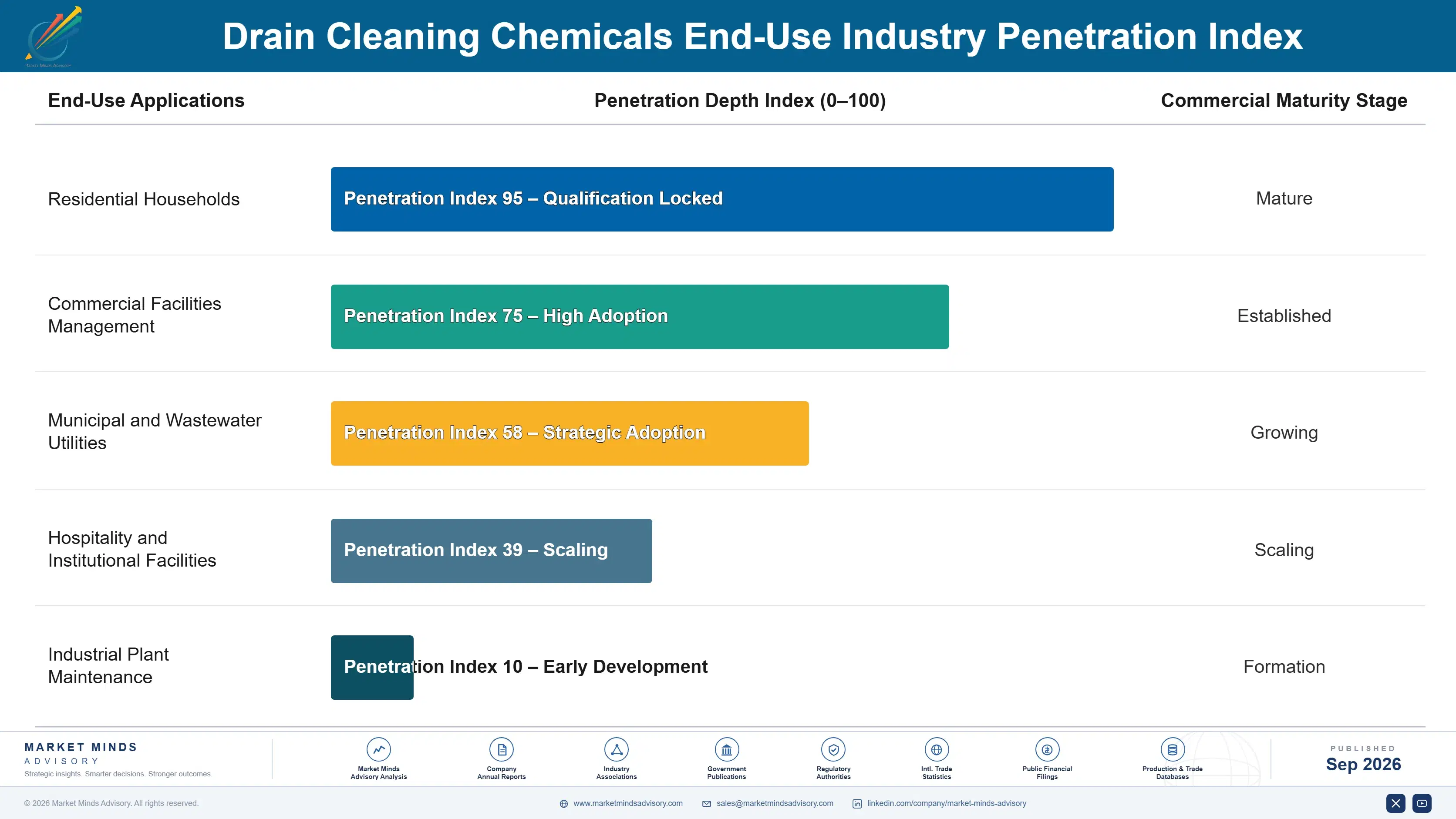
Drain cleaning chemicals behave as a low-consideration repeat purchase for most households, driven by periodic clog incidents rather than scheduled replacement cycles, which makes brand loyalty and shelf visibility at the moment of need more important than long-term supplier relationships. Professional and facilities maintenance contracts behave differently, functioning more like annuities once a preventive maintenance schedule is established and staff are trained on a given product line.
Adoption stickiness varies by end-use vertical. Commercial facilities contracts show the deepest lock-in, since switching suppliers mid-contract disrupts established maintenance schedules and requires re-training maintenance staff on new application procedures and safety protocols. Household purchasing shows far less stickiness, with consumers frequently switching brands based on price promotions, shelf availability, or word-of-mouth recommendations from friends and family rather than deliberate brand research.

Buyer profiles are shifting generationally as younger homeowners, more attuned to environmental and safety messaging than previous generations, increasingly seek out enzymatic and bio-based products by name rather than defaulting to whatever caustic product their parents used around the house. This generational shift is accelerating enzymatic adoption faster than pure product performance improvements alone would explain, and it shows little sign of reversing as this cohort ages into greater purchasing influence.
drain-cleaning-chemicals-market-end-use-penetration-index-1790013326072

Where the Category Is Actually Moving

These are among the four positions where our research anticipates prominent divergence between winners and laggards over the coming forecast period. Each is grounded in the demand model, the regulatory perimeter, and the announced capacity pipeline.
01 / ENZYMATIC PORTFOLIO INVESTMENT

Accelerate enzymatic reformulation ahead of retailer mandates

Manufacturers still treating enzymatic products as a niche shelf addition are underestimating how quickly retailer chemical safety standards are tightening beyond regulatory minimums across nearly every major national account. Brands that wait for formal mandates before reformulating will face compressed timelines and higher compliance costs than those investing proactively today, particularly given how long stability testing and retailer approval cycles typically take. The manufacturers gaining shelf space right now are the ones that started enzymatic reformulation years ahead of this current wave of retailer pressure.
02 / PROFESSIONAL CHANNEL EXPANSION

Build dedicated commercial facilities maintenance sales capability

Facilities management contracts offer more predictable, higher-margin revenue than retail sales, yet most manufacturers still organize their sales teams around retail buyers rather than commercial property operators and facilities directors. Building dedicated commercial sales capability requires upfront investment, but the recurring contract structure pays that investment back faster than retail promotional spending ever could, particularly once a supplier is embedded in a multi-year maintenance schedule. Manufacturers slow to build this capability will watch faster-moving competitors lock up the largest facilities accounts first.
03 / PRIVATE LABEL RISK MANAGEMENT

Diversify beyond flagship caustic products before share erodes further

Private label penetration is concentrated in the caustic and acidic segments precisely because those formulations are easiest to replicate at lower cost using widely available commodity chemistry and standard manufacturing processes. Brands whose flagship products remain purely caustic face the steepest exposure to private label substitution as retailers push their own lower-cost alternatives onto adjacent shelf space. Diversifying toward enzymatic and foaming formulations, where intellectual property and formulation complexity are harder to replicate, offers the more defensible long-term position against this pressure.
04 / SUPPLY CHAIN DIVERSIFICATION

Diversify caustic soda sourcing before the next price spike

Caustic soda price volatility has already forced temporary retail price increases once this decade, and chlor-alkali supply concentration in a handful of regions means another disruption remains entirely plausible over the coming decade. Manufacturers relying on a single regional supply contract carry meaningfully more margin risk than those who diversified sourcing after the last spike hit their production costs directly. The suppliers best positioned for the next shock are the ones treating diversification as standard practice rather than a one-time response.

Engagement Snapshot From the Field

A live engagement with an industry participant carrying material or product regulatory and market exposure ahead of a defining policy shift, showing how our research translates into a defensible multi-year portfolio strategy.
MARKET MINDS ADVISORY · CLIENT ENGAGEMENT SUMMARY
Drain Cleaning Chemicals Producer Strategic Portfolio Review and Transition Roadmap 2026·Investment Scenario on Drain Cleaning Chemicals Exposure Evaluation 2025-26
CLIENT PROFILE
The client is a mid-sized commercial facilities management firm operating office and retail properties across the northeastern United States, managing preventive maintenance contracts across a portfolio of roughly 120 buildings. The firm had historically sourced drain maintenance chemicals from multiple regional distributors on an ad hoc basis, without a standardized vendor relationship or documented safety compliance across its full property portfolio.
STRATEGIC CHALLENGE
Fragmented sourcing across multiple small distributors created inconsistent product quality and pricing, while the firm's growing institutional clients increasingly demanded documented environmental safety compliance across all vendor relationships nationwide. The client needed a consolidated sourcing strategy that reduced administrative overhead while meeting rising documentation standards within a single budget cycle.
MMA APPROACH
MMA benchmarked five drain cleaning chemical suppliers against the firm's volume requirements, evaluating enzymatic formulation depth, safety documentation completeness, and pricing structure for a consolidated annual supply contract. The engagement combined primary interviews with supplier account managers and comparative cost modeling across current fragmented spend versus a single consolidated vendor relationship.
KEY FINDINGS
  1. Consolidating to a single primary supplier reduced the firm's total annual drain maintenance chemical spend by roughly 14 percent (client-reported, unverified by MMA).
  2. Two of five evaluated suppliers could provide full enzymatic product lines with documented safety data sheets across the client's entire property portfolio.
  3. The firm's previous fragmented sourcing approach had left several properties without current safety compliance documentation, a gap unknown to management before the review.
  4. A phased twelve-month transition allowed the client to validate the new supplier's service reliability across multiple property types before fully retiring legacy distributor relationships entirely.
CLIENT PROFILE
The client is a mid-sized commercial facilities management firm operating office and retail properties across the northeastern United States, managing preventive maintenance contracts across a portfolio of roughly 120 buildings. The firm had historically sourced drain maintenance chemicals from multiple regional distributors on an ad hoc basis, without a standardized vendor relationship or documented safety compliance across its full property portfolio.
STRATEGIC CHALLENGE
Fragmented sourcing across multiple small distributors created inconsistent product quality and pricing, while the firm's growing institutional clients increasingly demanded documented environmental safety compliance across all vendor relationships nationwide. The client needed a consolidated sourcing strategy that reduced administrative overhead while meeting rising documentation standards within a single budget cycle.
MMA APPROACH
MMA benchmarked five drain cleaning chemical suppliers against the firm's volume requirements, evaluating enzymatic formulation depth, safety documentation completeness, and pricing structure for a consolidated annual supply contract. The engagement combined primary interviews with supplier account managers and comparative cost modeling across current fragmented spend versus a single consolidated vendor relationship.
KEY FINDINGS
  1. Consolidating to a single primary supplier reduced the firm's total annual drain maintenance chemical spend by roughly 14 percent (client-reported, unverified by MMA).
  2. Two of five evaluated suppliers could provide full enzymatic product lines with documented safety data sheets across the client's entire property portfolio.
  3. The firm's previous fragmented sourcing approach had left several properties without current safety compliance documentation, a gap unknown to management before the review.
  4. A phased twelve-month transition allowed the client to validate the new supplier's service reliability across multiple property types before fully retiring legacy distributor relationships entirely.
RECOMMENDED STRATEGY
Phase 1: Phase one: pilot the recommended supplier across twenty buildings, comparing service reliability and pricing against legacy distributors directly over one full quarter. Phase 2: Phase two: expand the consolidated contract to the full property portfolio once pilot performance was validated over two consecutive quarters of service. Phase 3: Phase three: formalize documented safety compliance reporting as a standard quarterly deliverable across all managed properties and institutional client accounts.
OUTCOME
The firm completed full vendor consolidation within the twelve-month transition window, achieving the targeted cost reduction while closing prior safety documentation gaps across its property portfolio (client-reported, unverified by MMA). Institutional clients confirmed the firm's updated compliance reporting met their vendor management requirements ahead of subsequent contract renewals.

Frequently Asked Questions

Foundational context covering the market sizes, CAGR, scope, country, region and competition that inform every finding below. This section is provided to cover basics and most often pre-purchase conversations, answered from the MMA Primary Research Dataset.

What is the current size of the Drain Cleaning Chemicals Market?

The market reached $3.8 billion globally in 2025. This covers caustic, acidic, oxidizing, enzymatic, and foaming formulations sold across residential, commercial, and municipal drain maintenance applications.

How large will the Drain Cleaning Chemicals Market be by 2036?

MMA projects the market will reach $6.22 billion by 2036 under the base case scenario. That represents roughly one and a half times the 2026 starting value over the ten-year forecast window.

What is the CAGR for the Drain Cleaning Chemicals Market 2026 to 2036?

The base case CAGR is 4.6 percent annually through 2036. Bull and bear scenarios range from 3.3 to 5.9 percent depending on the pace of enzymatic reformulation adoption.

Which segment is growing fastest?

Enzymatic and bio-based drain cleaners lead at an 8.5 percent CAGR, roughly 1.85 times the overall market rate. Foaming gel formulations follow as the second-fastest segment.

Who are the major companies in the Drain Cleaning Chemicals Market?

The Clorox Company, SC Johnson & Son, Summit Brands, Roebic Laboratories, and Scotch Corporation lead the market. Together they hold an estimated CR5 near 48 percent of category revenue.

Which country is growing fastest?

The United States leads at an estimated 5.4 percent CAGR, driven by aging housing stock and expanding professional facilities maintenance contracts. India and China follow as urban housing construction accelerates.

Report Segmentation Architecture

The full report scope spans multiple orthogonal segmentation dimensions, with cross-tabulated demand data provided for each dimension pair. Coverage extends further to regional breakdowns, trend trajectories, and the competitive detail needed to support segment-level decision-making.

By Primary Market Dimension

  • Caustic (Alkaline) Drain Cleaners
  • Acidic Drain Cleaners
  • Oxidizing Drain Cleaners
  • Enzymatic and Bio-Based Drain Cleaners
  • Foaming Gel Drain Cleaners
  • Solvent-Based Drain Cleaners

By End-Use Industry

  • Residential Households
  • Commercial Facilities Management
  • Municipal and Wastewater Utilities
  • Hospitality and Institutional Facilities
  • Industrial Plant Maintenance

By Commercial Dimension

  • Retail and Grocery Distribution
  • Professional Plumber and Contractor Channel
  • Facilities Maintenance Service Contracts
  • Private Label Manufacturing

By Region

  • North America
  • Western Europe
  • East Asia
  • South Asia and Pacific
  • Latin America
  • Middle East and Africa
  • Eastern Europe

Scope, Methodology, and Coverage

Every figure in this report is reproducible from documented input assumptions. The scope below maps the historical period, the forecast horizon, the segmentation dimensions, and the countries covered, alongside the underlying primary and qualitative methodology.
Historical Period
2020 to 2025
Forecast Period
2026 to 2036
Base Year
2025 (USD billions; MMA Primary Research Dataset, September 2026)
Market Definition
The drain cleaning chemicals market covers caustic, acidic, oxidizing, enzymatic, and foaming formulations sold for clearing and maintaining residential, commercial, and municipal drain and sewer lines. It excludes mechanical drain clearing tools, plumbing services labor, and industrial process pipe descaling chemicals used outside drain maintenance applications.
Quantitative Units
USD billions (current prices); metric tons of product volume where applicable
Segmentation Dimensions
By Primary Market Dimension; By End-Use Industry; By Commercial Dimension; By Region
Regions Covered
North America, Western Europe, East Asia, South Asia and Pacific, Latin America, Middle East and Africa, Eastern Europe
Countries Covered
USA, China, Germany, France, UK, Japan, South Korea, India, Australia, Canada, Brazil, Mexico, Indonesia, Vietnam, Thailand, Malaysia, UAE, Saudi Arabia, South Africa, Nigeria, Turkey, Poland, Netherlands, Italy, Spain, Sweden, Switzerland, Argentina, Colombia, Singapore, and additional markets relevant to this sector
Key Companies Profiled
The Clorox Company, SC Johnson & Son, Summit Brands, Roebic Laboratories, Scotch Corporation, Rooto Corporation, CLR Brands, Cleaning Solutions LLC, Zep Inc, Diversey Holdings, Ecolab, Comstar International, Earthworm Inc, Xion Corporation, J.R. Watkins, PDI Healthcare, Nyco Products Company, Amrep Inc, Spartan Chemical Company, Certol International
Quantitative Methodology
Primary survey, n=3,800 respondents, Q4 2025, six countries; demand-side model with trade association cross-validation
Qualitative Methodology
47 expert interviews, Q4 2025; applied to validate demand model assumptions, identify emerging dynamics, and assess competitive positioning
Report Format
PDF and XLSX data workbook (Word format preview document)
Publisher
Market Minds Advisory
Report Code
MMA-2026-CHM-712
Published
September 2026
Contact
sales@marketmindsadvisory.com | www.marketmindsadvisory.com

Purchase the full Drain Cleaning Chemicals Market Report (2026 to 2036).

This report delivers a comprehensive assessment of the drain cleaning chemicals market, covering market sizing, segmentation, and regional demand through 2036 across seven major world regions. It profiles the twenty leading manufacturers, benchmarking competitive positioning, moat durability, and emerging risk across the top two brand leaders in depth. The analysis includes detailed input cost exposure, portfolio margin architecture, and revenue diversification opportunities specific to drain maintenance chemistry manufacturers. A dedicated case study illustrates how a commercial facilities management firm navigated a live vendor consolidation engagement successfully.
Ten-year market sizing and forecast to 2036
Six-segment MECE segmentation framework with detailed subsegments
Seven-region demand, share, and growth rate analysis
Twenty-company competitive benchmarking with moat and risk assessment
Input cost exposure and mitigation pathways
Anonymized facilities management vendor consolidation case study

Built For The People Who Decide

From boardroom strategy to bench-side execution, this report is read cover-to-cover by leaders shaping the next decade of their industry, turning demand scenarios, market dynamics and valuation benchmarks into decisions.
CXOs/ Presidents/ VPs/ Managers
M&A and Corporate Development
Strategy Teams and R&D Heads
Procurement and Product Directors
Regulatory and Compliance Leaders
Investor Relations and Equity Analysts