Market Minds Advisory
Dog Collars Market

Dog Collars Market: Dog Collars Market: Ring Failure, The Migration To Harnesses and Subscription Economics

Collars fail at the ring and the buckle rather than the webbing, roughly seven in a hundred publish a tested breaking strength, and the failure happens while a dog is lunging.

Lead Analyst

Published

September 2026

Make Smarter Decisions with Customized Research Insights

Request a free sample report and evaluate market opportunities, growth trends, and competitive dynamics relevant to your business needs.

2025 MARKET VALUE$1.8BMarket Size 2025
2036 FORECAST VALUE$3.5BBase Case , 2026 to 2036
CAGR 2026 TO 20366.2 %Bull 7.4% / Bear 5.0%
INCREMENTAL OPPORTUNITY$1.6BNet 10- year value creation
EXPANSION MULTIPLE1.84x2036 value over 2026 base
Strategic Levers
M&A Pipeline
Regional Outlook
Country Rankings
Competitive Intelligence
Segmental Deep-dive
Call-Us : 91 93563 13602

Executive Snapshot and Market Trajectory.

Webbing almost never fails. What fails is the welded D-ring, the buckle, or the stitching where the ring attaches, and about 7% of collars publish a tested breaking strength at that point. The failure arrives at the worst possible moment, which is a dog lunging toward a road.
GPS and smart tracking collars grow at 9.3%, half again the market rate of 6.2%, and the hardware is close to a placement cost for a monthly connectivity subscription. Identification and tag collars follow at 7.6%. Training and correction collars grow slowest at 3.1%, as electronic collar prohibitions spread across the United Kingdom, Germany and several Australian states. Annual churn on connected collar subscriptions runs near 31%, which makes the business retention rather than manufacturing.
The collar is quietly becoming an identification device rather than a walking one. Veterinary and training guidance increasingly favours harnesses for walking, particularly for flat-faced breeds and dogs that pull, because of pressure on the trachea. That shifts growth toward the tag-carrying and tracking functions, which are smaller jobs and different products. Sizing is the other quiet problem, and a worn collar cannot be resold.
Market Definition
This market covers collars worn by dogs, spanning flat webbing, leather, martingale and limited-slip, GPS and smart tracking, training and correction, and identification and tag collars. Sizing is at wholesale shipment value and includes connected collar hardware. Harnesses, leads and long lines, head halters, muzzles, cat collars, standalone tags sold without a collar, and connectivity subscription revenue are excluded from this market.
Base Year Value
$1.8B in 2025 (MMA Primary Research Dataset, September 2026)
Forecast Period
2026 to 2036, eleven discrete annual values
CAGR
6.2% base case. Bull 7.4%. Bear 5.0%.
Fastest Growth Segment
GPS And Smart Tracking Collars: 9.3% CAGR
Fastest Growth Country
India: 9.4% CAGR
Fastest Growth Region
South Asia and Pacific: 8.2% CAGR
Largest Region
East Asia: 30% of 2025 global value
Market Leaders
Radio Systems Corporation, Mars, Tractive, Central Garden and Pet, Petmate. Source: MMA Primary Research Dataset, July 2026.
Primary Survey
n=3,800 procurement and R&D decision-makers, Q4 2025, six countries
Methodology
Demand-side build-up, cross-validated against public data, 47 expert interviews

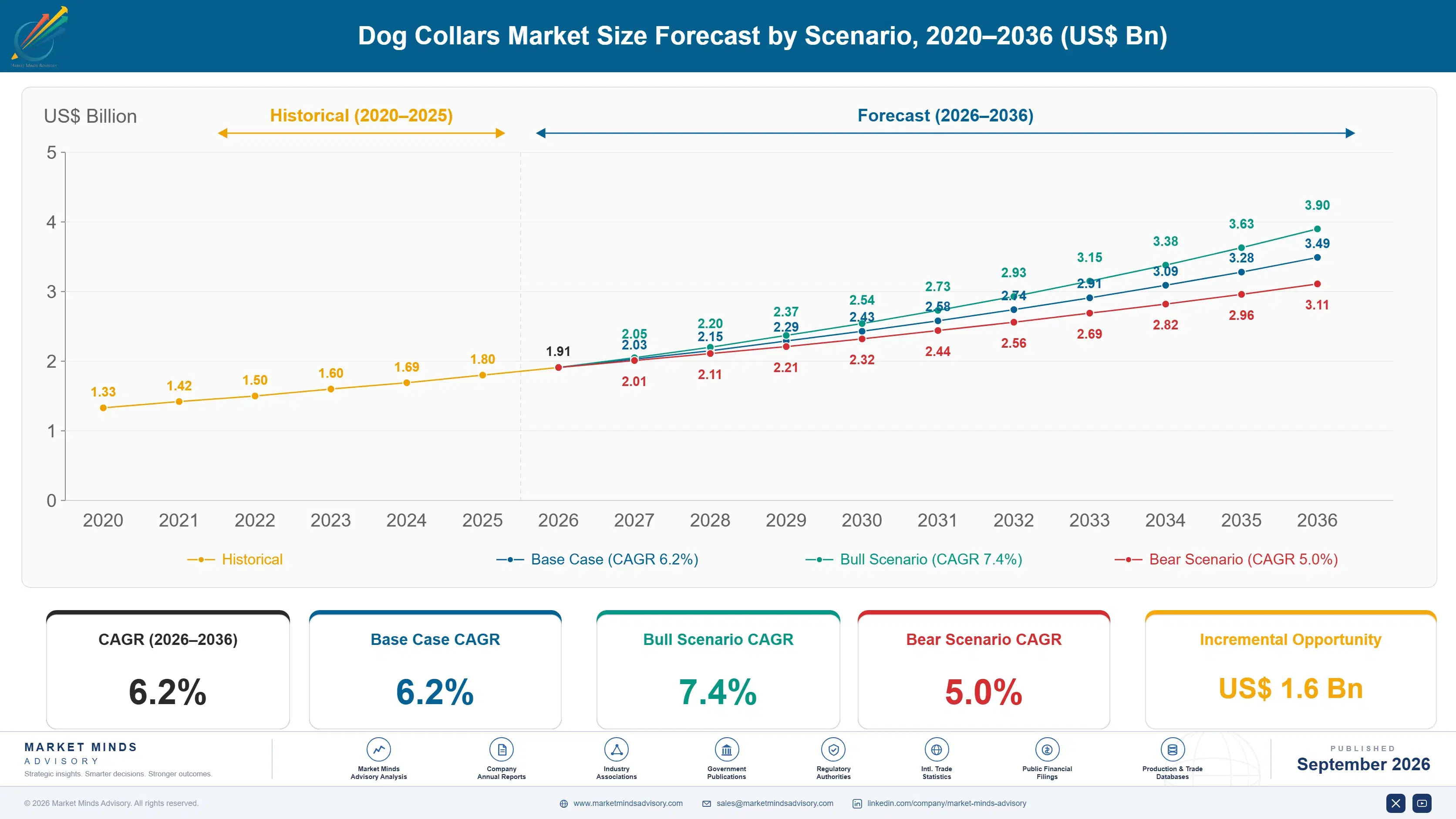
Dog Collars Market Forecast Scenarios

dog-collars-market-size-forecast-scenario-1790022741615
Growth of 5.1% between 2020 and 2025 came almost entirely from new dog ownership rather than from anything the category did. Household acquisition surged through 2020 and 2021 across North America and Western Europe, and each dog needed a collar within days. Replacement from that cohort arrived from 2023, since a webbing collar lasts two to three years.
Three mechanisms carry the base case. Connected collars grow at 9.3% because the hardware places a subscription rather than ending a transaction. Indian and Southeast Asian dog ownership expands from low bases as urban households change, with India at 9.4%, the fastest national market covered here. Identification collars grow at 7.6% as harness adoption pushes the walking function elsewhere and leaves the collar carrying tags, which is a job it keeps.
The bull case is breaking strength disclosure. If retailers require a published tested load at the ring, the collars that can support one separate immediately and the category gains a specification buyers can compare. The bear case is harness substitution. Continued guidance away from neck attachment would shrink the functional collar to a tag holder at a far lower price.

Where Collars Actually Break

Ask an owner what a collar is made of and they describe webbing. Ask a manufacturer what fails and the answer is always hardware: the welded D-ring opening under load, the side-release buckle cracking at the latch, or the bar-tack stitching pulling through where the ring is attached. Roughly 7% of collars on the market publish a tested breaking strength at that attachment point. Packaging discusses webbing and says nothing about the ring.
TOP FIVE CONCENTRATION21%Combined shipment value share held by the five largest participants
BREAKING STRENGTH STATED7%Collars publishing a tested load at the ring
AVERAGE SELLING PRICEUSD 19Weighted global wholesale price across all collar types
ONLINE RETURN RATE24%Units returned from online channels after delivery to buyers
SIZING RETURN SHARE63%Returns attributable to neck measurement rather than any defect
TRACKER SUBSCRIPTION CHURN31%Annual cancellation rate across connected collar subscription services
Sizing is the commercial problem nobody has solved. Online returns run at about 24% and roughly 63% of those are sizing rather than any defect, because most owners have never measured a dog's neck and adjustable ranges are stated inconsistently between brands. A returned collar that has been on an animal cannot be resold, so each one is close to a total write-off on a low value item.
Connected collars have brought subscription economics into a category that never had them. The hardware places a monthly connectivity fee and annual churn runs near 31%, which means the business is retention rather than manufacturing. Battery life between charges decides most of that churn. An owner charging every two days stops using it and cancels within a quarter.
"This industry describes webbing tensile strength on the packaging and stays silent about the welded ring that actually gives way. The one number an owner would want is the one nobody prints."
Director, Pet Products and Companion Animal Practice · MMA Consumer and Industrial Goods Practice · September 2026

Market Trends

Harness Guidance Moves The Walking Function Away

Veterinary and professional training guidance has shifted steadily toward harnesses for walking, driven by tracheal pressure concerns that are most acute in flat-faced breeds and in dogs that pull persistently. That does not remove the collar; it changes what the collar is for. Identification and tag collars grow at 7.6% while the category averages 6.2%, because the tag-carrying job survives the guidance and the restraint job does not. Participants whose ranges are built around walking collars are defending a function that clinical advice is steadily reassigning to a different product.
Market Impact: India grows 3.2 points faster
Electronic Collar Prohibitions Spread Across Major Markets

Wales and Scotland have prohibited electronic shock collars, England legislated a ban, and Germany and several Australian states restrict them, which has removed a category that was once a substantial part of training product revenue. Training and correction collars grow at 3.1%, the slowest segment covered here, and the decline is regulatory rather than commercial. Vibration and tone-only devices continue where shock is prohibited. Participants with training-heavy portfolios face a market shrinking by legislation in exactly the geographies where their pricing was strongest. No product improvement reverses a prohibition, and the affected markets are where pricing was strongest.
Market Impact: Connected collars grow at 9.3%

Market Opportunities and Growth Drivers

Indian Urban Dog Ownership Expands From A Low Base

Metropolitan Indian households have adopted dogs as companion animals at a pace that has surprised most participants, and pet retail has organised around it faster than in any comparable market. India grows at 9.4%, the fastest national market covered here, from ownership levels well below Western norms. Domestic manufacture serves the value tiers at prices imported product cannot approach, while premium and connected collars reach a smaller metropolitan segment through online channels. Growth here comes from new households rather than from replacement. Pet retail has organised around it faster than in any comparable market.
Market Impact: Only 7% publish a figure

Connected Hardware Converts A Purchase Into A Subscription

A tracking collar sells once and then bills monthly for cellular connectivity, which is an entirely different business from selling webbing and hardware. That architecture explains why connected collars grow at 9.3% and why manufacturers price the device close to cost. Annual churn near 31% means the economics turn on retention rather than on unit sales, and battery life between charges is the single largest churn driver. Participants treating the device as a product rather than an acquisition cost have generally mispriced it. Battery life between charges is the largest churn driver by far.
Market Impact: Sizing causes 63% of returns

Market Restraints and Challenges

Breaking Strength At The Ring Stays Unpublished

About 7% of collars publish a tested load at the attachment ring, and the root cause is liability rather than ignorance: stating a figure invites comparison against competitors who state nothing while creating a warranty exposure silence avoids. Commercially this leaves buyers choosing on colour and price for a product whose failure mode is a dog loose in traffic. Participants publishing tested figures alongside a stated dog weight range use it as a selling point, which works only while the rest of the category stays quiet about it. Buyers choose on colour instead.
Market Impact: Tag collars grow 1.4 points faster

Neck Sizing Drives Two Thirds Of Online Returns

Online returns run near 24% and about 63% of them are sizing rather than defect, because most owners have never measured a dog's neck and adjustable ranges are stated inconsistently across brands. The root cause is that sizing charts were written for a retail environment where the dog could be fitted in store. A worn collar cannot be resold, so each return is close to a total write-off. Participants are adding breed and weight guidance alongside measurement, and very few publish overlapping size ranges that remove the decision. Overlapping ranges would remove the decision rather than explain it.
Market Impact: Training collars grow at only 3.1%
3 additional market trends, 4 additional growth drivers, and 2 additional restraints and challenges are covered in the full report. Contact sales@marketmindsadvisory.com to access the complete intelligence.

Segment CAGR and Growth Architecture

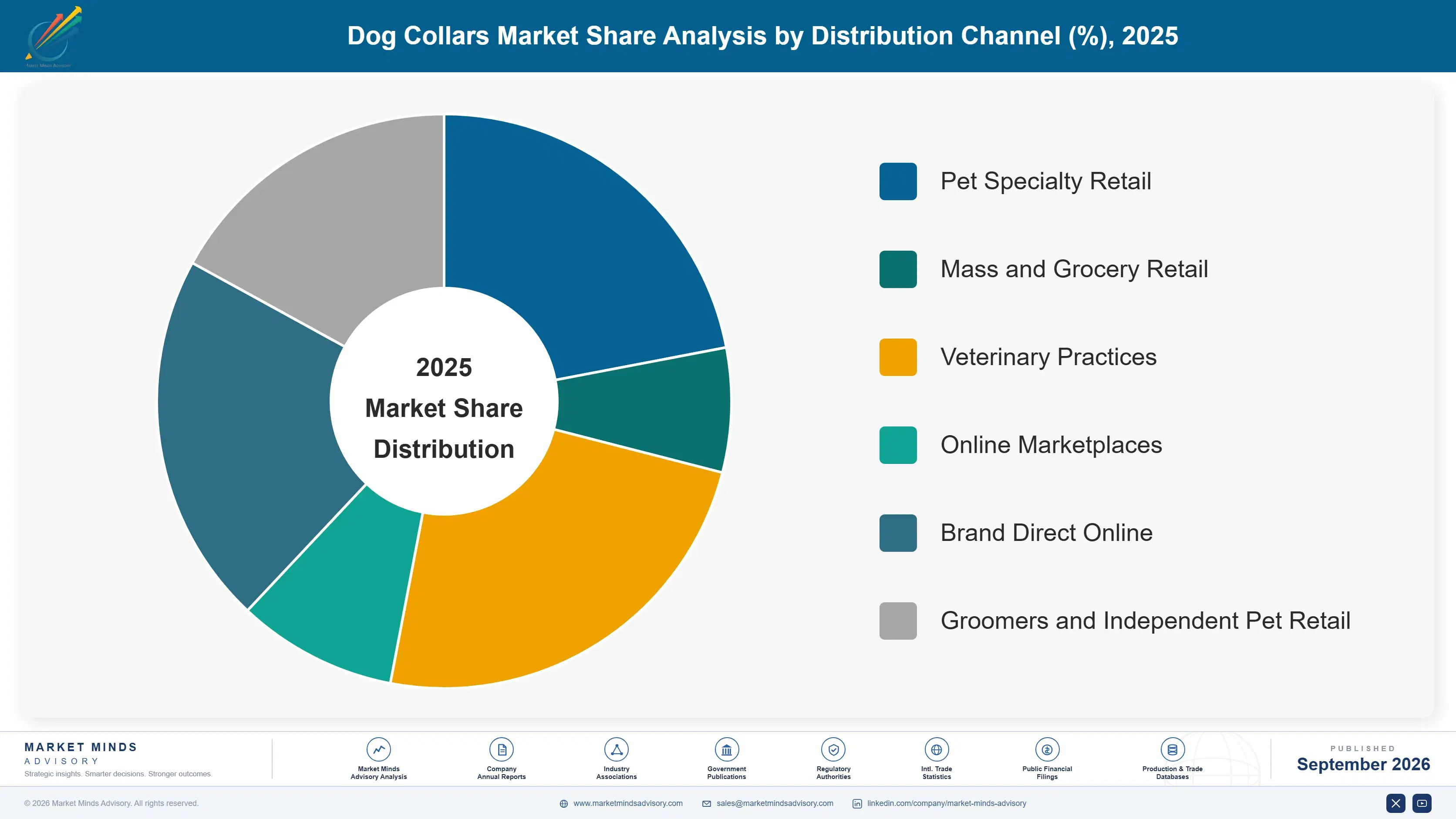
Segmentation follows collar type, the dimension on which construction, function, regulatory treatment and price all divide together in this market. Six types are assessed at wholesale shipment value. Harnesses, leads, head halters, muzzles, cat collars, standalone tags and connectivity subscription revenue sit outside the defined scope. Connected hardware is included but its subscription revenue is not.
dog-collars-market-market-share-analysis-1790022742178

GPS And Smart Tracking Collars

Connected tracking collars grow at 9.3%, half again the market rate of 6.2%, and the device is closer to an acquisition cost than a product. Hardware is priced near manufacturing cost because the revenue arrives monthly as a cellular connectivity fee, which makes this the only part of the category with subscription economics attached. Annual churn near 31% means retention rather than unit shipment determines whether any participant makes money. Battery life between charges is the largest churn driver by a wide margin, since an owner who has to charge a collar every two days stops using it and cancels within a quarter. Cellular module cost dominates the bill of materials.
CAGR 9.3%

Identification And Tag Collars

Identification and tag collars grow at 7.6% because the job they do survives a guidance shift that is taking the walking function elsewhere. Veterinary and training advice increasingly favours harnesses for restraint, particularly for flat-faced breeds and persistent pullers, but no harness carries identification as conveniently as a collar worn continuously. Construction requirements differ accordingly: comfort for all-day wear matters more than breaking strength, and lighter webbing with a flat buckle profile outperforms heavier walking construction. Engraved plate collars that avoid a dangling tag have taken share within the segment, since owners dislike the noise more than they admit. Continuous wear also shortens replacement intervals, since a collar never taken off wears faster than one used only for walks.
CAGR 7.6%
Full segment breakdown across 6 segments available in the complete report.

Regional Architecture and Country Demand Map

Regional shares measure wholesale shipment value where collars are sold rather than where they are manufactured, which matters because Chinese production supplies most of the category. Middle East and Africa sits just below its standard band. Ownership levels rather than income shape most of this table.

East Asia

China supplies most of the world's collars and is now also the largest single market for them, which is an unusual combination that gives the region its 30% position. Urban Chinese dog ownership has expanded rapidly as household composition changed, and domestic brands including Dogness serve it at prices no importer can reach. Japanese demand is distinctive and premium, weighted toward small breeds, lightweight construction and identification rather than restraint. Korean demand follows the Japanese pattern at smaller scale. Growth of 7.1% comes from new ownership alongside a replacement cycle that is only now establishing itself. A replacement cycle is only now establishing itself in China, since most of the installed base is recent.
Share: 30% | CAGR: 7.1% (2026 to 2036)

North America

At 29% this is the highest-value region per unit and the one where connected collars have advanced furthest. Average selling prices sit well above the global figure, supported by a premium pet spending culture and by subscription tracking services that European regulation and network economics have made harder elsewhere. Radio Systems, Mars and Petmate hold the largest positions through mass, specialty and veterinary distribution. Online return rates run above the global figure because sizing decisions are made without the dog present. Growth of 5.4% reflects a mature market where replacement and format mix drive value. Sizing decisions made without the dog present are why online returns here run above the global figure, and the channel keeps growing regardless.
Share: 29% | CAGR: 5.4% (2026 to 2036)
Regional intelligence for 5 additional markets available in the complete report: Western Europe, South Asia and Pacific, Latin America, Eastern Europe, Middle East and Africa. Contact sales@marketmindsadvisory.com.
dog-collars-market-country-cagr-analysis-1790022742694

Four Moves Worth Making Now

These four address what this category refuses to disclose and what it keeps losing to returns, plus the subscription economics that connected collars introduced. Each has been executed by at least one participant with measurable results, and none requires new tooling or a change to existing manufacturing arrangements anywhere. Three of the four are disclosure or specification decisions.

Publish Tested Breaking Strength At The Ring

Roughly 7% of collars state a tested load at the attachment point, which leaves owners choosing on colour and price for a product whose failure mode is a loose dog near traffic. Publishing a tested figure alongside a recommended dog weight range costs a test protocol and a print change. Participants who have done it report price realisation around 1.5 times comparable unrated collars in the same channel. The position stays available only while competitors continue saying nothing, which will not last indefinitely. Retailers have begun asking for the figure.
Market Impact: Lifts price realisation to roughly 1.5 times higher

Publish Overlapping Size Ranges With Weight Guidance

Online returns run near 24% and about 63% of those are sizing rather than defect, because owners have not measured a dog's neck and adjustable ranges are stated inconsistently between brands. Publishing deliberately overlapping ranges with breed and weight guidance removes the decision rather than explaining it. Participants doing this report sizing returns falling by roughly 38%, which on a worn collar that cannot be resold flows straight to contribution. The change costs artwork and listing copy rather than any product alteration. Sizing charts were written for a store where the dog could be fitted.
Market Impact: Cuts sizing related returns by roughly 38% overall

Engineer Connected Collars Around Battery Life

Annual churn on connected collar subscriptions runs near 31%, and battery life between charges is the largest single driver because an owner charging every two days stops using the device and cancels within a quarter. Extending charge interval costs cell capacity and reporting frequency rather than new technology. Participants who doubled charge interval report churn falling by about 11 points, which on a subscription business is worth considerably more than any hardware margin the extra battery consumes. Subscription retention is worth far more than hardware margin here, and most participants have priced the trade the wrong way round entirely.
Market Impact: Cuts annual subscription churn by roughly 11 points

Build Identification Collars As A Separate Range

Veterinary guidance is moving walking to harnesses while the tag-carrying job stays with the collar, and identification collars grow at 7.6% as a result. Those products need comfort for continuous wear, lighter webbing and a flat buckle profile rather than the heavier construction walking collars require. Most ranges still sell one collar for both jobs. Participants building a dedicated identification line report retail sell-through rising by roughly 27%, because the product finally matches what the dog is actually wearing it for. The dog wears an identification collar continuously and a walking collar for an hour.
Market Impact: Lifts retail sell-through rates by roughly 27% overall

Who Controls the Margin Pool

Concentration is very low at 21% held by the top five, measured consistently on wholesale shipment value of collars and collar-form devices rather than on units. The leader to challenger gap is wide in veterinary and specialty distribution and in connected service infrastructure, both of which take years to build, and effectively absent in webbing construction, where hundreds of Chinese, Indian and Vietnamese manufacturers supply comparable product to anyone.
Competition runs on three dimensions currently. Retail and veterinary distribution decides most volume, since this is a low-consideration purchase made in front of a fixture. Connected service capability decides participation in the fastest-growing segment, and it requires cellular agreements and application development that a webbing manufacturer cannot assemble. Price decides the value tier, where domestic manufacturers in China, India and Brazil compete on cost structures international brands cannot approach.

Pressure is building on training-heavy portfolios and on participants without a connected offer, and both are where positions will move. Electronic collar prohibition is removing a segment by legislation in the markets where it priced best. Meanwhile the subscription economics of connected collars reward retention capability that traditional pet hardware companies were never organised to deliver.
dog-collars-market-company-positioning-matrix-1790022743219

Competitive Moat and Risk Dimensions

RADIO SYSTEMS CORPORATION

Moat: Distribution And Category Breadth

Positions across mass, specialty and veterinary distribution under PetSafe and related brands give the company shelf access that individual product merit alone would not secure, and breadth across containment, training and collars makes it a range partner rather than a single-line vendor for retail buyers managing a whole fixture.
RADIO SYSTEMS CORPORATION

Risk: Training Portfolio Under Prohibition

Substantial revenue sits in training and containment products that electronic collar prohibitions have removed from the United Kingdom and restricted in Germany and several Australian states. The decline is legislative rather than commercial, so no product improvement reverses it, and the affected geographies are those where the category priced strongest.
MARS

Moat: Veterinary Channel And Data

Ownership of veterinary practice networks alongside the Whistle connected collar business places the company inside the channel where health-related product recommendations are made, and gives it activity and behaviour data that pure hardware competitors have no route to collecting at comparable scale. Recommendations made in a consulting room carry weight no retail fixture can match.
MARS

Risk: Connected Churn Undermines Subscription

Annual churn near 31% across connected collar services means the subscription business must replace roughly a third of its base each year simply to stand still. Retention depends on battery life and application usefulness rather than on veterinary relationships, and those are engineering problems the wider group is not primarily built to solve.

Players Tracked

Prominent Players

Radio Systems Corporation
Mars
Tractive
Central Garden and Pet
Petmate

Other Key Players

Coastal Pet Products
Ruffwear
Kurgo
Company of Animals
Julius-K9
Hunter Heimtierbedarf
Trixie Heimtierbedarf
Ferplast
Rogz
EzyDog
Fi
Garmin
Dogness International
Ancol Pet Products
Beeztees

Recent Developments

OCTOBER 2024

Tractive restructures European subscription pricing tiers

The company revised its connected collar subscription tiers across European markets, separating basic location tracking from health and activity monitoring. This was an internal commercial decision on service pricing, involving no partnership, acquisition or external party of any kind. Hardware pricing was left unchanged across the range.
Signal: Subscription structure rather than hardware is where connected collar competition now happens. Hardware pricing is close to settled.
APRIL 2025

Petmate signs Vietnamese manufacturing supply agreement

The company entered a multi-year supply agreement with a Vietnamese manufacturer covering webbing collars and related pet hardware for North American distribution. The arrangement is a commercial supply contract involving no equity stake or joint venture structure at all. Existing Chinese supply relationships were retained in parallel.
Signal: Sourcing is diversifying away from concentrated Chinese manufacture even in low value categories. Freight route concentration is being reduced.
JUNE 2025

Garmin introduces extended battery tracking collar range

The company launched tracking collars with substantially longer charge intervals, targeting the retention problem that short battery life creates across connected services. This was internal product development involving no acquisition, licence or external technology partnership whatever. Subscription pricing and service tiers were unaffected by the launch.
Signal: Battery life is now being engineered as a retention lever rather than as a simple product specification.

What A Collar Costs To Build

Hardware dominates conventional collar cost at roughly 26%, covering the welded or cast D-ring, side-release buckle, slider and rivets, most of it zinc alloy or moulded acetal from Chinese suppliers. Nylon and polyester webbing accounts for about 22%, which is less than owners assume given how much packaging discusses it. Packaging, labelling and printing add around 17%, and stitching labour and finishing take most of the remainder.
Connected collars have an entirely different structure that pressured differently. The cellular module, battery and enclosure account for well over half the bill of materials, and the 2021 and 2022 semiconductor allocation period extended lead times past forty weeks for exactly the low-cost modules this category depends on. Central Garden and Pet and Garmin reporting for that period both identify component availability and freight inflation as material factors requiring pricing action.

Exposure varies sharply by construction and by sourcing footprint. Conventional collar makers carry zinc alloy and container freight exposure on a bulky low-value product. Connected collar makers carry semiconductor and battery exposure alongside ongoing cellular network cost that conventional participants never encounter. Domestic manufacturers in China, India and Brazil selling into their own markets avoid that freight layer entirely.
dog-collars-market-cost-volatility-analysis-1790022743418

Specify hardware to a tested load rather than to a price

D-rings and buckles are typically bought to a cost target and a nominal size rather than to a tested breaking load, which is why failures cluster there rather than in the webbing. Specifying hardware against a tested figure costs a few cents per unit and removes the failure mode. It also makes publishing a breaking strength possible.

Qualify webbing and hardware supply outside a single country

Concentrated Chinese sourcing exposes a whole range to one freight route and one policy environment simultaneously, on a product where freight is a meaningful share of landed cost. Qualifying Vietnamese or Indian capacity spreads that risk and shortens transit into several destination markets. Minimum order quantity rather than technical capability is the practical obstacle throughout.

Dual source cellular modules before allocation tightens again

Connected collars depend on low-cost cellular modules from a narrow supplier base, and requalification requires firmware work and network certification that takes months. Doing it ahead of shortage costs a development cycle and preserves the ability to ship. Most participants only begin once lead times have already passed the point where a season is lost.

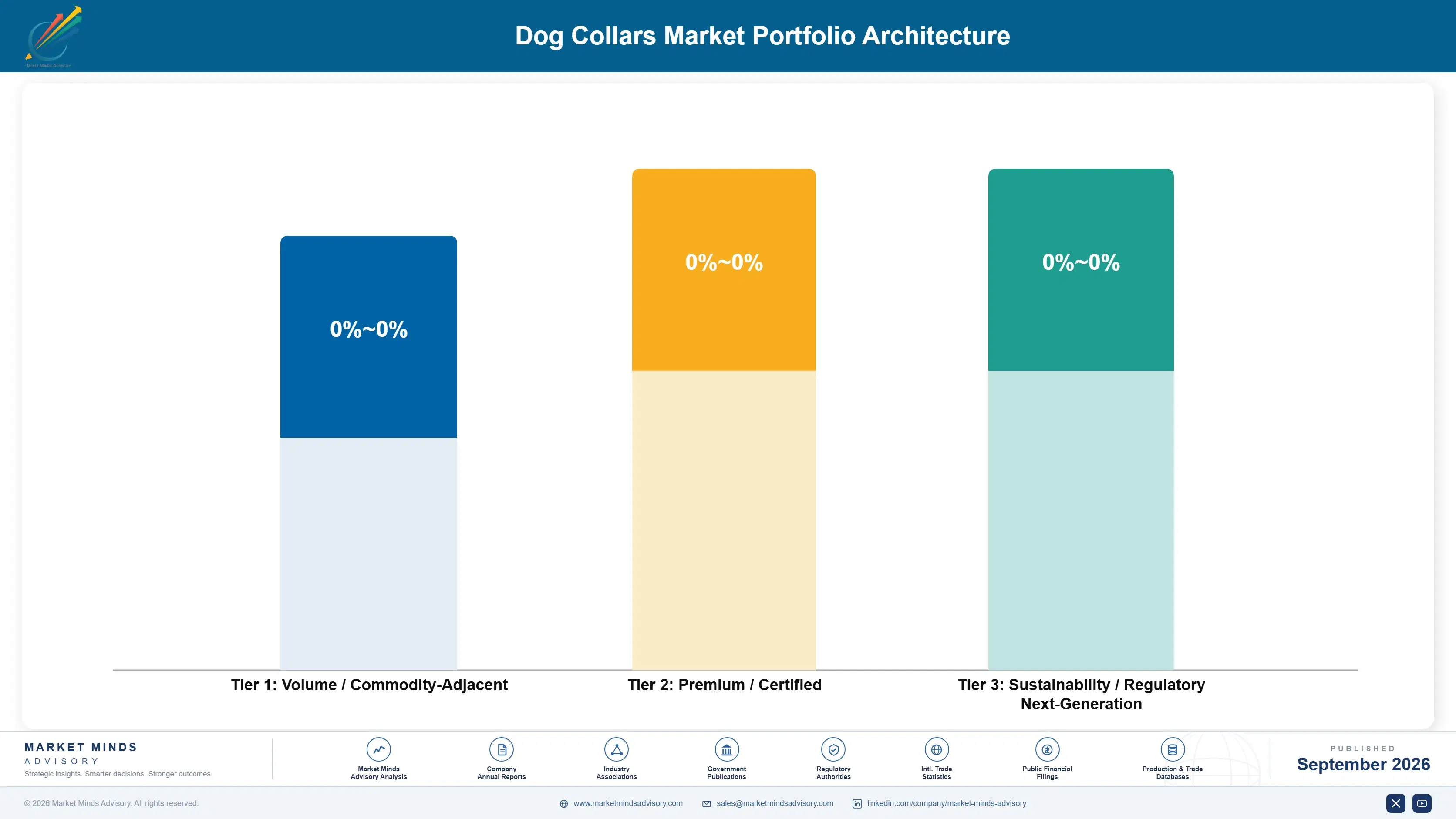
Portfolio Architecture for Margin Defence

Margin architecture divides by whether a product can support a specification claim and by whether a subscription sits behind it, rather than by construction cost. Entry webbing collars sold through mass retail and online marketplaces run at gross margins in the high twenties to mid thirties, competing against hundreds of visually similar products from manufacturers that supply anyone placing an order. Search position and colour decide which listing a buyer ever sees.
Premium construction collars in leather, technical webbing and specified hardware hold gross margins in the mid forties to low fifties. The spread reflects distribution and brand permission rather than materials, since a specified D-ring costs cents more than an unspecified one. Veterinary and specialty channels also avoid the direct price comparison an online search result enforces on a shopper.

The highest-value pool is the connected collar subscription rather than any physical product, at margins in the low to high sixties once network cost is netted. Hardware is priced near cost to place that subscription. Annual churn near 31% is what limits the pool, which makes battery engineering a margin decision rather than a specification one. Hardware exists to place the subscriber.

Volume / Commodity-Adjacent

Entry webbing collars sold through mass retail and online marketplaces. Hundreds of visually similar products compete on price and search position, and no participant holds a specification advantage a buyer can actually see.
Gross Margin: 28 to 36%

Premium / Certified

Leather and technical webbing collars with specified hardware sold through specialty and veterinary channels. The eight-point range reflects distribution and brand permission rather than materials cost, which barely differs. Specialty channels avoid direct search comparison entirely.
Gross Margin: 44 to 52%

Sustainability / Regulatory / Next-Generation

Connected collar subscription revenue, with hardware priced near cost to place it. Annual churn near 31% limits the pool, which makes battery engineering a margin decision rather than a product specification one.
Gross Margin: 62 to 70%
dog-collars-market-portfolio-architecture-1790022743927

High-value Sub-segments and Strategic Watch-out

Connected Collar Subscriptions

High value and high growth at 9.3%. Hardware is an acquisition cost and the revenue arrives monthly. Battery life between charges drives most of the 31% annual churn, since an owner charging every two days simply stops using it. Retention rather than shipment decides who earns anything.
Gross Margin: 64 to 70%

Specified Hardware Premium Collars

High value and moderate growth. A specified D-ring costs cents more than an unspecified one and allows a published breaking strength, which roughly 7% of the category currently offers. Participants publishing report 1.5 times price realisation. Retailers are beginning to ask for the figure directly.
Gross Margin: 46 to 52%

Entry Webbing Collars

Volume core, competing on search position and colour against visually identical products. It carries the return exposure from sizing while offering no attribute a buyer can compare before purchase anywhere. Hundreds of manufacturers supply visually identical product to anyone placing an order, which leaves no durable position at this tier.
Gross Margin: 28 to 35%

Training And Correction Collars

Strategic watch-out. Growing slowest at 3.1% as electronic collar prohibitions spread across the United Kingdom, Germany and Australian states. The sixteen-point range reflects how differently participants are exposed by geography. No product improvement reverses a prohibition, and vibration-only alternatives carry far weaker pricing than the devices they replace.
Gross Margin: 30 to 46%

What Drives The Next Purchase

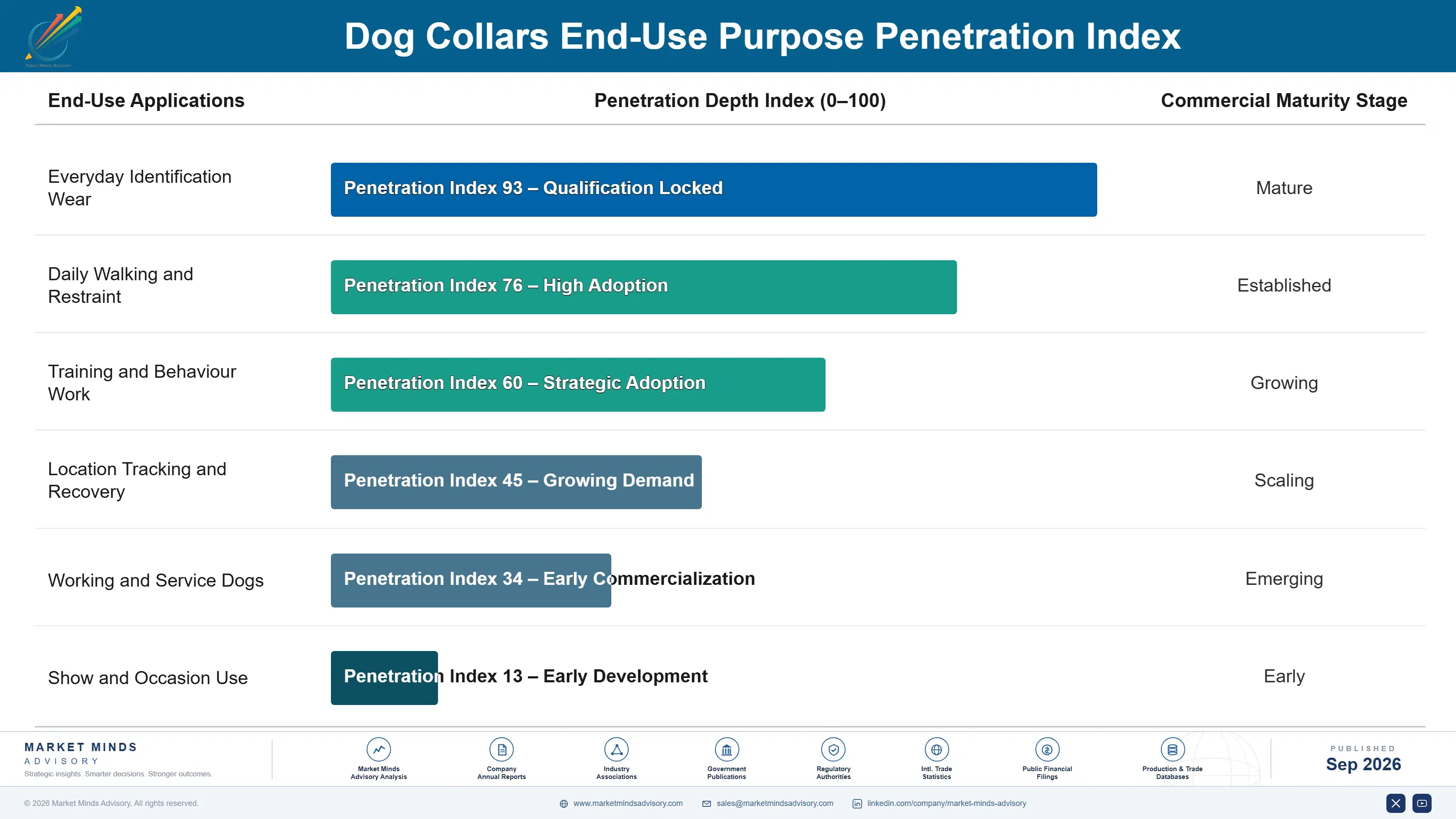
Replacement is wear-driven and the cycle is short enough to matter commercially. A webbing collar worn daily lasts roughly two to three years before the webbing frays, the buckle cracks or the printing wears off, and owners replace rather than repair because nothing about the product is serviceable. That makes the category more frequent than most pet hardware, and it means the 2020 and 2021 ownership cohort has now cycled through two collars.
Stickiness varies sharply by product type and by channel. Connected collar subscribers are locked in while they remain subscribed and gone entirely when they cancel, which happens to roughly a third each year. Veterinary channel buyers repurchase the recommended brand reliably, because the recommendation carries clinical weight. Marketplace buyers have no attachment at all and buy on price, colour and whichever listing appears first.

Owner behaviour shifted in one direction since 2020. The cohort that acquired dogs during that period has now been through a first collar failure, a sizing return or both, and it arrives at replacement asking different questions. That group asks about size ranges and holding strength, where earlier buyers chose on appearance.
dog-collars-market-end-use-penetration-index-1790022744417

Where This Category Earns

These are among the four positions where our research anticipates prominent divergence between winners and laggards over the coming forecast period. Each is grounded in the demand model, the regulatory perimeter, and the announced capacity pipeline.
01 / BREAKING STRENGTH DISCLOSURE

Print what the ring will actually hold

Roughly 7% of collars publish a tested load at the attachment ring, because stating a figure invites comparison against competitors who state nothing while creating warranty exposure that silence avoids. That leaves owners choosing on colour and price for a product whose failure mode is a loose dog near traffic. Participants publishing a tested figure alongside a recommended weight range report price realisation around 1.5 times comparable unrated collars, on a test protocol and a print change, and the position stays available only while competitors continue saying nothing at all.
02 / SIZING DECISION REMOVAL

Overlap the ranges instead of explaining measurement

Online returns run near 24% and about 63% of those are sizing rather than any defect, because most owners have never measured a dog's neck and adjustable ranges differ between brands. A worn collar cannot be resold, so every one of those returns is close to a total write-off on a low value item. Publishing deliberately overlapping ranges with breed and weight guidance removes the decision, and participants doing it report sizing returns falling by roughly 38%, on a change costing listing copy rather than any product alteration.
03 / BATTERY INTERVAL ENGINEERING

Charge intervals are a churn lever, not a specification

Annual churn on connected collar subscriptions runs near 31%, and battery life between charges drives most of it because an owner charging every two days stops using the device and cancels within a quarter. Extending the interval costs cell capacity and reporting frequency rather than any new technology. Participants who doubled charge interval report churn falling by about 11 points, which on a subscription business is worth far more than the hardware margin the larger cell consumes, which most participants have priced the wrong way round entirely.
04 / IDENTIFICATION RANGE SEPARATION

Build the collar the dog actually wears all day

Veterinary and training guidance is moving the walking function toward harnesses while the tag-carrying job stays with the collar, and identification collars grow at 7.6% as a direct result. Those products need comfort for continuous wear, lighter webbing and a flat buckle profile rather than heavier walking construction. Most ranges still sell one collar for both jobs, and participants building a dedicated identification line report retail sell-through rising by roughly 27%, because the product finally matches what the dog is actually wearing it for all day.

Engagement Snapshot From the Field

A live engagement with an industry participant carrying material or product regulatory and market exposure ahead of a defining policy shift, showing how our research translates into a defensible multi-year portfolio strategy.
MARKET MINDS ADVISORY · CLIENT ENGAGEMENT SUMMARY
Dog Collars Producer Strategic Portfolio Review and Transition Roadmap 2026·Investment Scenario on Dog Collars Exposure Evaluation 2025-26
CLIENT PROFILE
A pet products manufacturer supplying collars, leads and harnesses to European and North American retail with category revenue near USD 64 million (client-reported, unverified by MMA). Webbing collars accounted for 71% of collar volume and no product published a breaking strength or a tested hardware specification. Online channels had grown to 44% of sales, and returns were handled by destination market third parties whose costs sat outside category reporting.
STRATEGIC CHALLENGE
Contribution margin had fallen for two consecutive years while volume grew, and management attributed it to price competition from marketplace sellers. A cost reduction programme targeting hardware specification had been approved. Nobody had analysed return volumes by cause, and no failed unit returned from the field had ever been examined.
MMA APPROACH
MMA coded two years of return and complaint records by cause across four retail partners, then physically examined 80 field-failed collars to identify the failure sequence. Hardware specifications were benchmarked against six competitors and tested to destruction. Sizing charts were compared across the range and against competitors to identify gaps between adjacent sizes.
KEY FINDINGS
  1. Returns ran at 27% through online channels and 8% through physical retail, and sizing accounted for 66% of coded online return causes rather than any product defect.
  2. Physical examination showed D-ring deformation preceding failure in 71 of 80 units, with hardware testing below every benchmarked competitor at the same price point.
  3. Size charts left uncovered gaps between three adjacent sizes, so a dog measuring in those ranges had no correct option and the owner guessed.
  4. The proposed cost reduction programme targeted D-ring specification directly, which would have worsened the failure mode already generating warranty contacts. Nobody had examined a failed unit before approving it.
CLIENT PROFILE
A pet products manufacturer supplying collars, leads and harnesses to European and North American retail with category revenue near USD 64 million (client-reported, unverified by MMA). Webbing collars accounted for 71% of collar volume and no product published a breaking strength or a tested hardware specification. Online channels had grown to 44% of sales, and returns were handled by destination market third parties whose costs sat outside category reporting.
STRATEGIC CHALLENGE
Contribution margin had fallen for two consecutive years while volume grew, and management attributed it to price competition from marketplace sellers. A cost reduction programme targeting hardware specification had been approved. Nobody had analysed return volumes by cause, and no failed unit returned from the field had ever been examined.
MMA APPROACH
MMA coded two years of return and complaint records by cause across four retail partners, then physically examined 80 field-failed collars to identify the failure sequence. Hardware specifications were benchmarked against six competitors and tested to destruction. Sizing charts were compared across the range and against competitors to identify gaps between adjacent sizes.
KEY FINDINGS
  1. Returns ran at 27% through online channels and 8% through physical retail, and sizing accounted for 66% of coded online return causes rather than any product defect.
  2. Physical examination showed D-ring deformation preceding failure in 71 of 80 units, with hardware testing below every benchmarked competitor at the same price point.
  3. Size charts left uncovered gaps between three adjacent sizes, so a dog measuring in those ranges had no correct option and the owner guessed.
  4. The proposed cost reduction programme targeted D-ring specification directly, which would have worsened the failure mode already generating warranty contacts. Nobody had examined a failed unit before approving it.
RECOMMENDED STRATEGY
Phase 1: Phase one: halt the hardware cost reduction, upgrade D-ring specification to a tested load and publish the figure on pack. Phase 2: Phase two: republish size ranges with deliberate overlap and add breed and weight guidance to all listings. Gaps between adjacent sizes must close. Phase 3: Phase three: separate identification collars from walking collars as a distinct range with lighter construction. Continuous wear needs different construction entirely.
OUTCOME
Online returns fell from 27% to 17% across three quarters and warranty contacts fell by roughly two thirds after the hardware change reached the field (client-reported, unverified by MMA). The cost reduction programme was cancelled, and the published breaking strength drew retailer interest that the brand had not previously been able to secure.

Frequently Asked Questions

Foundational context covering the market sizes, CAGR, scope, country, region and competition that inform every finding below. This section is provided to cover basics and most often pre-purchase conversations, answered from the MMA Primary Research Dataset.

What is the current size of the Dog Collars Market?

The market was valued at USD 1.8 billion in 2025, rising to USD 1.9 billion in 2026. Sizing is at wholesale shipment value across six collar types including connected hardware.

How large will the Dog Collars Market be by 2036?

MMA forecasts USD 3.5 billion by 2036, an increase of USD 1.6 billion over the 2026 base. That represents expansion of 1.84 times across the forecast period.

What is the CAGR for the Dog Collars Market 2026 to 2036?

The base case CAGR is 6.2%, with a bull case of 7.4% and a bear case of 5.0%. Historical growth between 2020 and 2025 ran at 5.1%.

Which segment is growing fastest?

GPS and smart tracking collars grow at 9.3%, half again the market rate, because the hardware places a monthly connectivity subscription. Identification and tag collars follow at 7.6%.

Who are the major companies in the Dog Collars Market?

Radio Systems Corporation, Mars, Tractive, Central Garden and Pet and Petmate lead on shipment value, holding a combined 21%. The category is unusually fragmented across regional manufacturers.

Which country is growing fastest?

India grows fastest at 9.4%, as metropolitan household dog ownership expands from a base well below Western levels and pet retail organises around it. Domestic manufacture serves the value tiers at accessible prices.

Report Segmentation Architecture

The full report scope spans multiple orthogonal segmentation dimensions, with cross-tabulated demand data provided for each dimension pair. Coverage extends further to regional breakdowns, trend trajectories, and the competitive detail needed to support segment-level decision-making.

By Collar Type

  • Flat Webbing Collars
  • Leather Collars
  • Martingale and Limited-Slip Collars
  • GPS and Smart Tracking Collars
  • Training and Correction Collars
  • Identification and Tag Collars

By End-Use Purpose

  • Everyday Identification Wear
  • Daily Walking and Restraint
  • Training and Behaviour Work
  • Location Tracking and Recovery
  • Working and Service Dogs
  • Show and Occasion Use

By Distribution Channel

  • Pet Specialty Retail
  • Mass and Grocery Retail
  • Veterinary Practices
  • Online Marketplaces
  • Brand Direct Online
  • Groomers and Independent Pet Retail

By Region

  • East Asia
  • North America
  • Western Europe
  • South Asia and Pacific
  • Latin America
  • Eastern Europe
  • Middle East and Africa

Scope, Methodology, and Coverage

Every figure in this report is reproducible from documented input assumptions. The scope below maps the historical period, the forecast horizon, the segmentation dimensions, and the countries covered, alongside the underlying primary and qualitative methodology.
Historical Period
2020 to 2025
Forecast Period
2026 to 2036
Base Year
2025 (USD billions; MMA Primary Research Dataset, September 2026)
Market Definition
This market covers collars worn by dogs, spanning flat webbing, leather, martingale and limited-slip, GPS and smart tracking, training and correction, and identification and tag collars. Sizing is at wholesale shipment value across pet specialty, mass, veterinary, marketplace, direct and independent channels, and includes connected collar hardware. Harnesses, leads and long lines, head halters, muzzles, cat collars, standalone identification tags sold without a collar, and recurring connectivity subscription revenue are excluded throughout.
Quantitative Units
USD billions at wholesale shipment value; volume in millions of units; breaking strength in kilograms of tested load.
Segmentation Dimensions
Collar type, end-use purpose, distribution channel, and geographic region.
Regions Covered
East Asia, North America, Western Europe, South Asia and Pacific, Latin America, Eastern Europe, Middle East and Africa
Countries Covered
China, United States, Germany, India, Brazil, Japan
Key Companies Profiled
Radio Systems Corporation, Mars, Tractive, Central Garden and Pet, Petmate, Coastal Pet Products, Ruffwear, Kurgo, Company of Animals, Julius-K9, Hunter Heimtierbedarf, Trixie Heimtierbedarf, Ferplast, Rogz, EzyDog, Fi, Garmin, Dogness International, Ancol Pet Products, Beeztees
Quantitative Methodology
Primary survey, n=3,800 respondents, Q4 2025, six countries; demand-side model with trade association cross-validation
Qualitative Methodology
47 expert interviews, Q4 2025; applied to validate demand model assumptions, identify emerging dynamics, and assess competitive positioning
Report Format
PDF and XLSX data workbook (Word format preview document)
Publisher
Market Minds Advisory
Report Code
MMA-2026-CON-781
Published
September 2026
Contact
sales@marketmindsadvisory.com | www.marketmindsadvisory.com

Purchase the full Dog Collars Market Report (2026 to 2036).

The full report sizes the dog collar market across six collar types, six end-use purposes and six distribution channels for all seven global regions. It includes return and complaint records coded by cause, separating sizing from defect across retail and online channels. Field-failed collars are examined physically to establish the failure sequence, and hardware is tested to destruction against competitor specifications. Connected collar subscription churn is modelled against battery charge interval, and electronic collar regulation is mapped by jurisdiction. Competitive assessment covers 20 participants on a consistent wholesale shipment value basis.
Returns coded by cause across retail and online
Field failed collars examined to establish failure sequence
Hardware tested to destruction against competitor specifications
Subscription churn modelled against battery charge interval
Six collar types sized through 2036
Twenty participants assessed on wholesale shipment value

Built For The People Who Decide

From boardroom strategy to bench-side execution, this report is read cover-to-cover by leaders shaping the next decade of their industry, turning demand scenarios, market dynamics and valuation benchmarks into decisions.
CXOs/ Presidents/ VPs/ Managers
M&A and Corporate Development
Strategy Teams and R&D Heads
Procurement and Product Directors
Regulatory and Compliance Leaders
Investor Relations and Equity Analysts