Market Minds Advisory
Dodecanol Market

Dodecanol Market: Surfactant Dependence, Palm Traceability Cost, and the Natural Premium Under Review

Three quarters of this molecule becomes shampoo and detergent surfactant, and the natural feedstock that carried a marketing premium for decades now carries a traceability compliance cost as well. Brands are reconsidering.

Lead Analyst

Bilal Shaikh

Published

September 2026

Make Smarter Decisions with Customized Research Insights

Request a free sample report and evaluate market opportunities, growth trends, and competitive dynamics relevant to your business needs.

2025 MARKET VALUE$1.7BMarket Size 2025
2036 FORECAST VALUE$2.8BBase Case , 2026 to 2036
CAGR 2026 TO 20364.6 %Bull 5.8% / Bear 3.4%
INCREMENTAL OPPORTUNITY$1.0BNet 10- year value creation
EXPANSION MULTIPLE1.57x2036 value over 2026 base
Strategic Levers
M&A Pipeline
Regional Outlook
Country Rankings
Competitive Intelligence
Segmental Deep-dive
Call-Us : 91 93563 13602

Executive Snapshot and Market Trajectory

Seventy-four percent of this molecule is converted into sulphates and ethoxylates for shampoo, detergent, and toothpaste. Everything else is a rounding error, which means household and personal care demand rather than any industrial cycle determines what happens here. Feedstock politics does the rest. Nothing about this market is technology-led.
Commercial power sits with producers holding integrated oleochemical feedstock or ethylene positions rather than with anyone able to distil a fatty alcohol cut. Microbial fermentation grows fastest at 14.2%, roughly 3.09 times the market, from a base small enough that the rate flatters it considerably. East Asia holds 30% of global value, driven by Chinese surfactant conversion capacity rather than by feedstock production.
Concentration is high at roughly 57% for the top five, and feedstock integration explains most of it. Deforestation regulation now requires geolocation evidence for palm-derived material entering Europe, and only 44% of natural route supply currently carries it. The premium natural material has always held is being reconsidered as a result. Producers who mapped their supply chains early now sell into a market their competitors legally cannot enter. Only 44% of natural supply qualifies today.
Market Definition
The market comprises dodecanol, also traded as lauryl alcohol or C12 fatty alcohol, supplied as a surfactant and chemical intermediate, covering the palm kernel oil route, the coconut oil route, the Ziegler ethylene route, the oxo process route, and the microbial fermentation route. Value is measured at producer level across surfactant, lubricant additive, emollient, and intermediate applications. Other fatty alcohol chain lengths sold separately, finished surfactants including sodium lauryl ether sulphate, palm kernel oil as a commodity, methyl esters, and glycerine co-product fall outside scope.
Base Year Value
$1.7B in 2025 (MMA Primary Research Dataset, August 2026)
Forecast Period
2026 to 2036, eleven discrete annual values
CAGR
4.6% base case. Bull 5.8%. Bear 3.4%.
Fastest Growth Segment
Microbial Fermentation Route: 14.2% CAGR
Fastest Growth Country
India: 7.6% CAGR
Fastest Growth Region
South Asia and Pacific: 6.7% CAGR
Largest Region
East Asia: 30% of 2025 global value
Market Leaders
KLK Oleo, Wilmar International, Musim Mas, Sasol, and BASF lead on dodecanol production capacity. Source: company annual reports and MMA Analysis, July 2026.
Primary Survey
n=3,800 procurement and R&D decision-makers, Q4 2025, six countries
Methodology
Demand-side build-up, cross-validated against public data, 47 expert interviews

Dodecanol Market Forecast Scenarios

dodecanol-market-trends-size-forecast-scenario-1787549248488
Between 2020 and 2025 feedstock politics mattered more than demand. Palm kernel oil pricing swung violently on Indonesian export restrictions, biodiesel mandate changes, and weather, while surfactant demand itself grew steadily and unremarkably. European deforestation rules arrived late and imposed traceability requirements producers had not previously needed. The 3.7% historical growth describes stable consumption obscured by extraordinary feedstock volatility throughout.
The 4.6% base case rests on three mechanisms. Household and personal care consumption keeps growing with population and income across Asia, Africa, and Latin America, which is dull and reliable demand. Traceability compliance cost is shifting marginal volume toward synthetic routes that carry no deforestation exposure at all. And brand commitments to palm-free formulation are creating a small premium market that fermentation routes are being built to serve. Only the third of those three depends on anything other than demography.
The 5.8% bull case assumes personal care consumption growth holds across emerging markets and palm-free premiums broaden beyond niche brands. The 3.4% bear case reflects detergent reformulation toward lower surfactant loading, palm feedstock costs rising further under biodiesel competition, and private label pressure compressing surfactant pricing back through the chain. Feedstock policy decides more of this than consumer behaviour does.

One Application, Two Feedstocks, and a Compliance Problem

Three things set the commercial shape of this market. Feedstock position comes first, because inputs are 61% of production cost and a producer either owns palm kernel access or ethylene access, with everything else following from that choice. Surfactant demand comes second, since 74% of volume goes one way and household consumption governs it. Traceability comes third and is genuinely new. Nothing else comes close on the cost sheet.
TOP-FIVE CONCENTRATION57%Share of global dodecanol supply held by leading producers
AVERAGE SELLING PRICEUSD 1,780 per tonneBlended pricing across natural and synthetic route material
SURFACTANT DEMAND SHARE74%Portion of volume converted into sulphates and ethoxylates
FEEDSTOCK COST SHARE61%Palm kernel or ethylene input within total production cost
CERTIFIED TRACEABLE SHARE44%Portion of natural route supply carrying verified origin documentation
NATURAL SYNTHETIC PRICE GAP18%Typical premium natural route material holds over synthetic
The natural and synthetic split has defined this industry for decades and is now being reconsidered. Natural material commands roughly an 18% premium built on marketing claims about renewable origin, and that premium survived long after any technical difference disappeared. Deforestation regulation added a compliance cost the premium was never designed to cover. The burden falls on one side of a previously free choice.
Feedstock volatility differs completely between the two routes. Palm kernel oil moves on Indonesian and Malaysian export policy, biodiesel mandates, and weather. Ethylene moves with petrochemical cycles that are volatile in different ways and at different times. Producers holding both routes have a natural hedge that single-route competitors simply cannot construct. Single-route producers cannot construct that hedge.
"For thirty years the natural premium was free money, because customers paid extra for a story and the molecules were identical. Deforestation rules put a price on telling that story properly, and several brands are now quietly working out whether they ever actually needed it."
Practice Director, Oleochemicals and Surfactant Intermediates · MMA Chemicals and Materials Practice · August 2026

Market Trends

Deforestation Rules Put a Compliance Price on Natural Origin

European regulation now requires geolocation evidence tracing palm-derived material back to the plot it was grown on, and non-compliant supply cannot legally be placed on that market at all. Only 44% of natural route supply currently carries documentation to that standard, and building it means auditing smallholder supply chains involving thousands of growers. The compliance cost lands entirely on the natural route while synthetic material carries none of it. Producers who invested in traceability early are selling into a market their competitors cannot serve, which is an unusual position in a commodity intermediate.
Market Impact: Surfactants take 74% of volume
Palm-Free Formulation Claims Create a Fermentation Opportunity

Personal care brands responding to consumer concern about deforestation have begun specifying palm-free formulations, and that requirement cannot be met by certified sustainable palm because the objection is to the crop rather than to the sourcing. Microbial fermentation routes producing C12 alcohol from sugar address it directly and grow at 14.2% from a very small base. Cost per tonne remains far above both conventional routes and volumes are negligible against surfactant demand. What makes it commercially interesting is that brands paying for the claim are not comparing against commodity pricing at all.
Market Impact: Feedstock is 61% of cost

Market Opportunities and Growth Drivers

Household and Personal Care Consumption Grows With Emerging Incomes

Sulphates and ethoxylates made from this molecule reach the market as shampoo, shower gel, dishwashing liquid, laundry detergent, and toothpaste, and consumption per person rises steadily with income across Asia, Africa, and Latin America. That demand takes 74% of volume and grows without any technology change, marketing campaign, or regulatory driver behind it. Frequency of washing, product formats, and sachet penetration in lower income markets all contribute. It is unglamorous and among the most reliable demand any chemical intermediate enjoys, which is why capacity investment tracks it closely. Capacity investment tracks it closely.
Market Impact: Loadings down above 15%

Biodiesel Mandates Compete Directly for Palm Feedstock

Indonesian and Malaysian biodiesel blending requirements divert palm oil into fuel, and although kernel oil is a distinct co-product the economics of the whole fruit shift when fuel demand rises. Kernel oil availability and pricing have tightened accordingly, and mandate increases have moved oleochemical feedstock costs more sharply than any demand-side development. Producers on natural routes carry that exposure directly since feedstock is 61% of cost. The effect is to narrow the cost gap that natural routes historically enjoyed, quite independently of any traceability compliance burden. Fuel policy sets oleochemical feedstock cost now.
Market Impact: Audits cover over 5,000 growers

Market Restraints and Challenges

Surfactant Concentration Reduces Volume Per Consumer Product

Detergent and personal care manufacturers keep reformulating toward concentrated products, smaller pack sizes, and lower surfactant loading for cost, transport, and environmental reasons together. The root cause is straightforward economics: shipping water is expensive and consumers have accepted smaller doses. Each reformulation reduces the volume of this molecule required per unit of finished product sold. Producers cannot influence it and mitigate only by following demand into growing consumer markets, supplying the concentration technology themselves, and moving toward specialty applications where loading is set by function rather than cost. Concentration trends are one-directional.
Market Impact: Only 44% carries verified traceability

Traceability Auditing Reaches Thousands of Smallholder Growers

Verifying palm origin to plot level means documenting supply chains that include enormous numbers of independent smallholders selling through collectors and mills. The root cause is agricultural structure rather than any unwillingness to comply, since a mill may receive fruit from hundreds of sources with no existing record of origin. Building that documentation is slow, expensive, and never fully complete. Producers mitigate through mill-level segregation, direct smallholder programmes, and mass balance approaches where regulation permits, and each covers part of the requirement rather than all of it. Full coverage is never quite achieved.
Market Impact: Fermentation grows at 14.2% annually
4 additional market trends, 3 additional growth drivers, and 2 additional restraints and challenges are covered in the full report. Contact sales@marketmindsadvisory.com to access the complete intelligence.

Segment CAGR and Growth Architecture

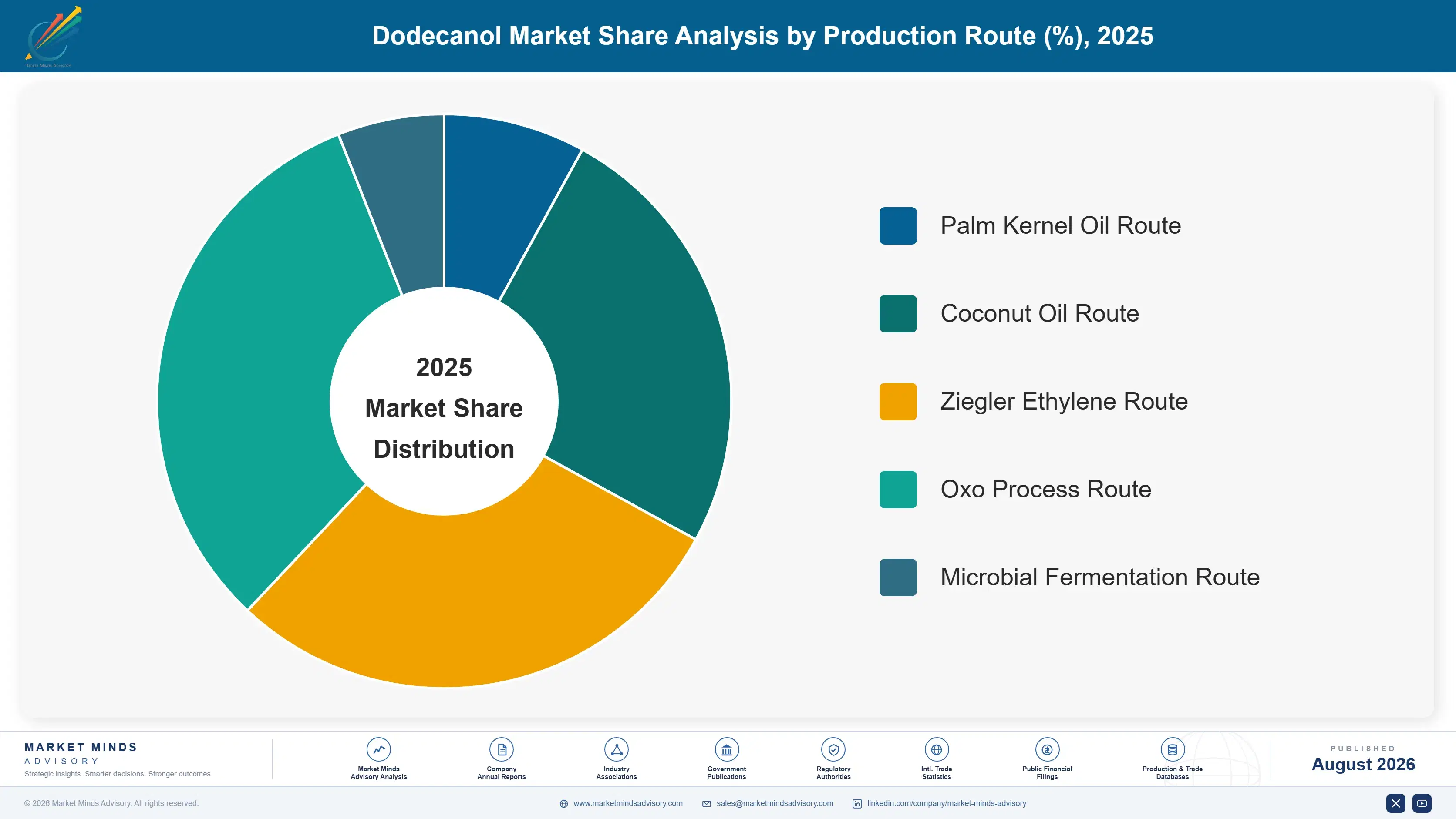
Segmentation follows production route, because the route determines feedstock exposure, cost volatility, regulatory burden, marketing claims available, and which customers a producer can serve at all. Five routes cover commercial supply, and they produce a chemically identical molecule, which means competition happens entirely on cost, origin documentation, and the story a brand wants to tell.
dodecanol-market-trends-market-share-analysis-1787549249019

Microbial Fermentation Route

The fastest-growing route at 14.2%, roughly 3.09 times the market, and by far the smallest. Engineered microorganisms converting sugar into C12 alcohol produce material that is neither palm-derived nor petrochemical, which is precisely the claim personal care brands responding to deforestation concern have started asking for. Certified sustainable palm cannot satisfy that requirement because the objection is to the crop itself rather than to how it was sourced. Cost per tonne runs several times conventional routes and capacity is negligible against surfactant demand. Brands buying the claim are not comparing against commodity pricing, which is what makes the economics work at this stage. Capacity investment remains modest and largely venture funded rather than industrial.
CAGR 14.2%

Ziegler Ethylene Route

Second fastest at 6.2%, and gaining share for reasons that have nothing to do with the chemistry. Synthetic material made by ethylene oligomerisation is molecularly identical to the natural product and carries no deforestation exposure, no smallholder traceability burden, and no palm feedstock volatility. As compliance costs mount on the natural side, formulators without a marketing commitment to renewable origin are quietly reassessing whether the 18% natural premium is worth paying. Ethylene pricing brings its own petrochemical volatility, which is uncomfortable but at least familiar and hedgeable. Sasol and a small group of integrated petrochemical producers hold most of this capacity globally. Route independence has quietly become a commercial advantage rather than the marketing liability it was for decades.
CAGR 6.2%
Full segment breakdown across 5 segments available in the complete report.

Regional Architecture and Country Demand Map

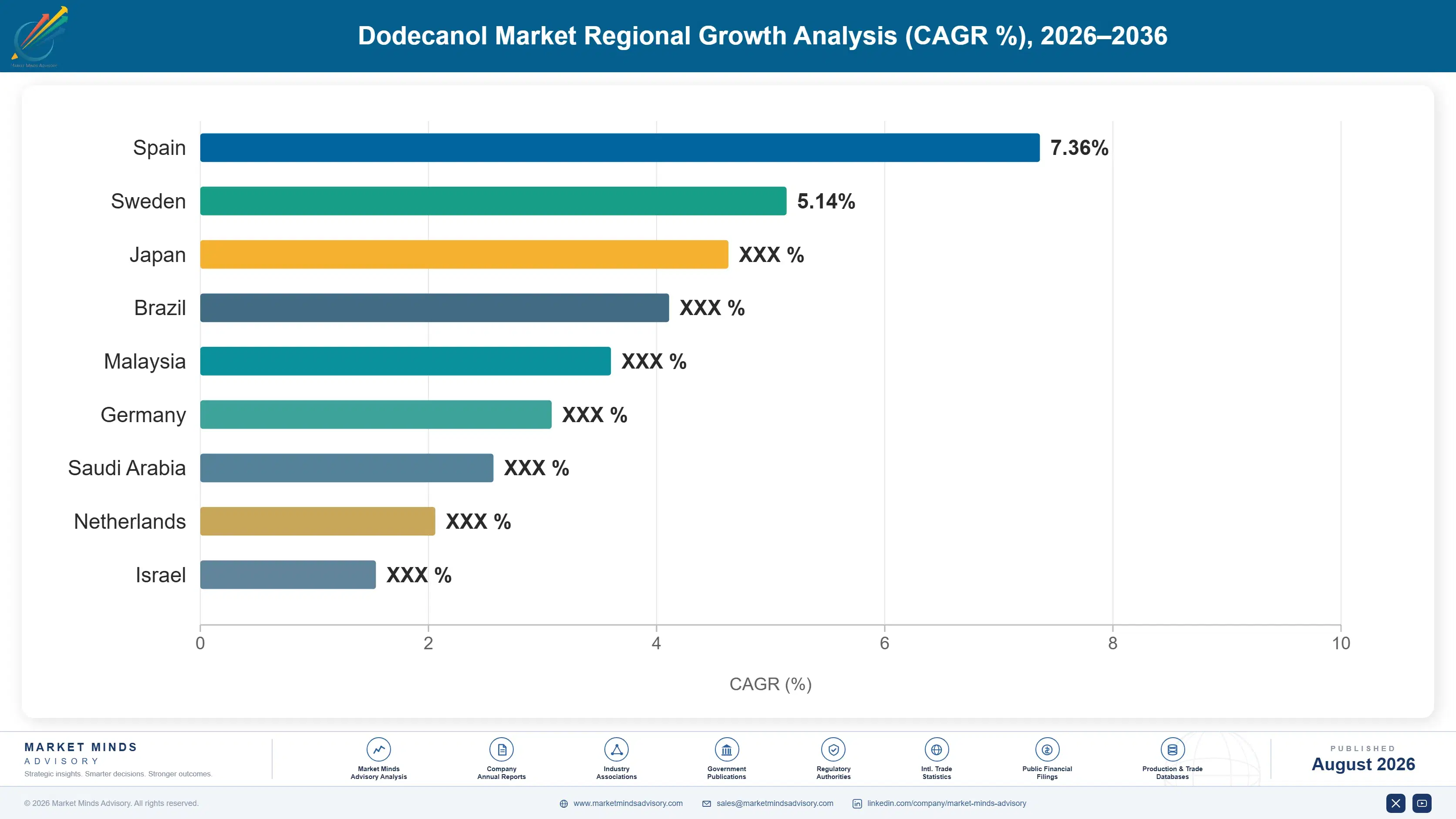
Regional shares reflect surfactant conversion capacity rather than feedstock production, which sit in quite different places. Southeast Asian countries produce far more natural route material than they consume and export the balance, while Chinese conversion capacity dominates consumption. Regulatory exposure differs sharply between consuming regions too.

North America

Synthetic route production anchors this region, with integrated petrochemical producers converting ethylene into fatty alcohols at scale and competing against imported natural material. Detergent and personal care manufacturing is substantial and consolidated, which makes the customer base concentrated and the negotiations correspondingly tough. Consumer preference for natural origin claims is weaker here than in Europe, and no equivalent deforestation regulation applies, so the synthetic route faces less marketing resistance. Sasol and BASF hold significant regional capacity. Concentrated detergent formats are more advanced here than almost anywhere, which reduces volume per unit sold. Growth of 4.3% reflects a mature consumer market with steady rather than expanding consumption. Deforestation rules impose no equivalent burden here.
Share: 24% | CAGR: 4.3% (2026 to 2036)

Western Europe

Deforestation regulation makes this the most demanding market anywhere for natural route material, requiring plot-level geolocation evidence that a substantial share of supply cannot yet provide. That has created a genuine two-tier market where compliant natural material commands a premium over both non-compliant natural and synthetic alternatives. Personal care brands headquartered here drive palm-free formulation demand more than anywhere else globally. Detergent concentration is well advanced and consumer volumes are flat. Regional production is modest and mostly synthetic, so the market imports heavily and the compliance burden falls on importers as much as producers. Growth of 3.2% is the slowest in the report and reflects flat consumption with mix shifting upward.
Share: 20% | CAGR: 3.2% (2026 to 2036)
Regional intelligence for 5 additional markets available in the complete report: East Asia, South Asia and Pacific, Latin America, Middle East and Africa, Eastern Europe. Contact sales@marketmindsadvisory.com.
dodecanol-market-trends-country-cagr-analysis-1787549249525

Four Moves That Change the Economics

Advantage here comes from feedstock position, origin documentation, and route flexibility rather than from process technology, which is mature and produces an identical molecule whichever way it is run. Four moves are worth capital and management attention across the forecast period, and two of them concern paperwork rather than plant. That is unusual and worth exploiting while it lasts.

Build plot-level traceability ahead of enforcement

Only 44% of natural route supply carries the geolocation evidence European rules require, and non-compliant material simply cannot be placed on that market. Producers who completed smallholder mapping and mill segregation are selling into a market competitors cannot access, which commands premiums of 12 to 22% over undocumented natural material. Building it costs field auditing and supply chain systems rather than plant investment. The work is slow enough that starting after enforcement tightens means missing at least two selling seasons while competitors hold the compliant positions. Competitors starting now will miss two selling seasons entirely.
Market Impact: Commands a 12 to 22% documented origin premium

Hold both natural and synthetic route capacity

Palm kernel oil moves on Indonesian export policy, biodiesel mandates, and weather while ethylene moves on petrochemical cycles, and the two rarely peak together. Producers holding both routes switch output toward whichever feedstock is favourable and hedge a cost line representing 61% of production cost. Single-route producers carry the full swing and have repeatedly been caught by it. The capital requirement is substantial and only justifies itself at genuine scale, which is a large part of why concentration in this market sits at 57%. Concentration at 57% follows directly from that capital requirement.
Market Impact: Hedges 61% of the total production cost base

Serve palm-free claims through fermentation partnership

Brands specifying palm-free formulation cannot be satisfied by certified sustainable palm, because the objection is to the crop rather than to the sourcing, and fermentation material is the only answer currently available. Volumes are tiny and pricing runs 3 to 5 times commodity levels, which means the customers are not comparing against bulk quotations at all. Partnering with a fermentation producer gives an established supplier the claim without funding capacity for a market that may stay small. It costs a commercial agreement rather than several hundred million dollars. Partnership costs an agreement rather than capacity.
Market Impact: Serves a niche now growing at 14.2% annually

Move downstream into surfactant conversion capacity

Seventy-four percent of output becomes sulphates and ethoxylates, and the conversion step captures margin that alcohol producers currently hand to their customers. Integrating forward earns 6 to 11 percentage points above merchant alcohol supply while securing outlet volume for the plant regardless of merchant market conditions. The obstacle is that it means competing with the customers who buy the alcohol today, which several producers have judged too disruptive. Those who moved anyway have proved considerably more resilient through the feedstock cycles that periodically flatten merchant sellers. Merchant sellers have repeatedly been flattened by cycles integrated producers rode out.
Market Impact: Earns 6 to 11 points above merchant supply

Who Controls the Margin Pool

Concentration is high: the top five hold roughly 57% of global dodecanol capacity, and feedstock integration rather than process capability explains it. KLK Oleo, Wilmar, and Musim Mas dominate the natural route from integrated Southeast Asian palm positions covering plantation, mill, and oleochemical conversion. Sasol and BASF anchor the synthetic side through ethylene integration, and the two groups compete on cost from entirely different starting points.
Competitive activity runs on three fronts. Feedstock cost position is the first and has always been decisive in a market where inputs are 61% of cost. Origin documentation is the second and is genuinely new, since compliant material now reaches markets that non-compliant material cannot. Downstream integration is the third, and it determines whether a producer captures conversion margin or hands it to a customer.

Pressure is building from two directions. Traceability compliance is raising the effective cost of natural material and narrowing a premium that survived for decades on marketing alone. And fermentation entrants, though tiny, are taking the palm-free claims that certified sustainable palm cannot address at any price. Neither has yet changed the ranking, and both are shifting the long-run comparison between the two production philosophies that have defined this industry.
dodecanol-market-trends-company-positioning-matrix-1787549250043

Competitive Moat and Risk Dimensions

KLK OLEO

Moat: Plantation to oleochemical integration

Owning plantation, mill, and oleochemical conversion in one chain gives KLK both a feedstock cost position competitors buying kernel oil cannot match and the plot-level origin records that deforestation regulation now demands. Traceability that others must construct through auditing thousands of independent growers already exists inside an integrated operation.
KLK OLEO

Risk: Concentration in palm feedstock

A business built entirely on palm carries full exposure to biodiesel mandate competition, producing country export policy, weather across two countries, and consumer sentiment about deforestation that no amount of certification fully addresses. Synthetic competitors face none of those, and brands specifying palm-free cannot be served at all whatever the certification standard achieved.
SASOL

Moat: Ethylene integration and route independence

Producing fatty alcohols from integrated ethylene rather than from agricultural feedstock removes deforestation exposure, traceability obligations, and palm price volatility in a single stroke. As compliance cost mounts on the natural side, that position converts from a marketing disadvantage into a genuine commercial one without the company changing anything.
SASOL

Risk: Petrochemical cost and sentiment exposure

Ethylene pricing carries its own volatility and the synthetic route faces persistent consumer preference for renewable origin that no technical argument dislodges. Personal care brands with sustainability positioning frequently specify natural origin regardless of comparative footprint evidence, which closes part of the premium market permanently.

Players Tracked

Prominent Players

KLK Oleo
Wilmar International
Musim Mas
Sasol
BASF

Other Key Players

Kao Corporation
P&G Chemicals
Emery Oleochemicals
Godrej Industries
VVF Limited
Ecogreen Oleochemicals
Shell Chemicals
Ineos Oligomers
Sinopec
PTT Global Chemical
Oleon
Cargill
Croda International
Stepan Company
Arkema

Recent Developments

FEBRUARY 2025

Producer completes smallholder traceability programme

Plot-level geolocation mapping was completed across a supplying mill network including several thousand independent smallholders, enabling compliant supply into European markets. The programme took several years and required direct field verification rather than relying on existing certification schemes alone. Costs ran into several million dollars across the programme.
Signal: Traceability is being built through direct field auditing, and certification alone no longer satisfies the requirement
JUNE 2025

Personal care brand specifies palm-free surfactant chain

A European personal care company committed to palm-free formulation across a product range, requiring surfactant intermediates from non-palm sources. Certified sustainable palm was explicitly excluded, since the stated objection concerned the crop rather than the sourcing standard applied to it. Fermentation material was named the only qualifying alternative.
Signal: Palm-free and sustainable palm are now separate requirements, and no certification scheme currently bridges the gap
SEPTEMBER 2025

Biodiesel mandate increase tightens kernel oil economics

A producing country raised its biodiesel blending requirement, diverting additional palm oil into fuel and shifting the economics of the whole fruit including kernel oil availability. Oleochemical producers reported feedstock cost pressure that demand-side developments had not caused. Oleochemical margins narrowed across the region. Buyers absorbed part of it.
Signal: Fuel policy rather than surfactant demand now sets natural route feedstock cost right across the industry

What Sets the Cost Base

Feedstock dominates completely at roughly 61% of production cost, whether that is palm kernel oil, coconut oil, or ethylene depending on route. Process energy for hydrogenation and fractionation contributes 14%, and hydrogen supply is a meaningful line within that for natural route producers. Traceability auditing, certification, and supply chain documentation now add 4% on natural routes and nothing on synthetic. Logistics, storage, and working capital absorb the remainder.
Palm kernel oil pricing moved violently through 2021 and 2022 on Indonesian export restrictions, labour shortages affecting harvest, and biodiesel mandate changes, at one point doubling within months. Wilmar and KLK both referenced feedstock cost volatility and margin compression across their reporting for those years. Ethylene followed a different path driven by European energy costs and North American plant outages, which is why producers holding both routes fared considerably better.

Exposure divides on route and integration rather than on scale. Plantation-integrated natural producers convert their own feedstock while merchant natural producers buy kernel oil at whatever the market asks. Synthetic producers integrated into ethylene hold the equivalent advantage on their side. Traceability cost falls entirely on the natural route and is permanent rather than cyclical, which shifts the long-run comparison permanently.
dodecanol-market-trends-cost-volatility-analysis-1787549250240

Contract kernel oil against published benchmarks with volume commitment

Palm kernel oil pricing swings on producing country policy that no buyer influences, and spot purchasing into that market has repeatedly destroyed a year of margin. Multi-year contracts indexed to published benchmarks with committed volume secure availability and remove negotiation risk without removing price exposure. Suppliers concede indexation more readily than fixed pricing, and availability matters more when markets tighten.

Integrate traceability systems rather than buying certificates

Deforestation rules require geolocation evidence rather than a certification scheme membership, and several producers discovered that distinction expensively. Building direct mill and smallholder mapping into procurement systems creates a permanent asset rather than an annually renewed cost. Field verification is slow and the resulting documentation opens markets that competitors relying on certification alone cannot currently enter.

Recover and reuse hydrogenation process hydrogen

Hydrogen is a meaningful cost within the 14% energy line for natural route producers converting methyl esters to alcohols. Recovery and purification of process hydrogen reduces both purchased volume and exposure to hydrogen pricing that tracks natural gas. Capital cost is moderate and payback depends heavily on regional gas pricing, which makes the case stronger in Europe than in Asia.

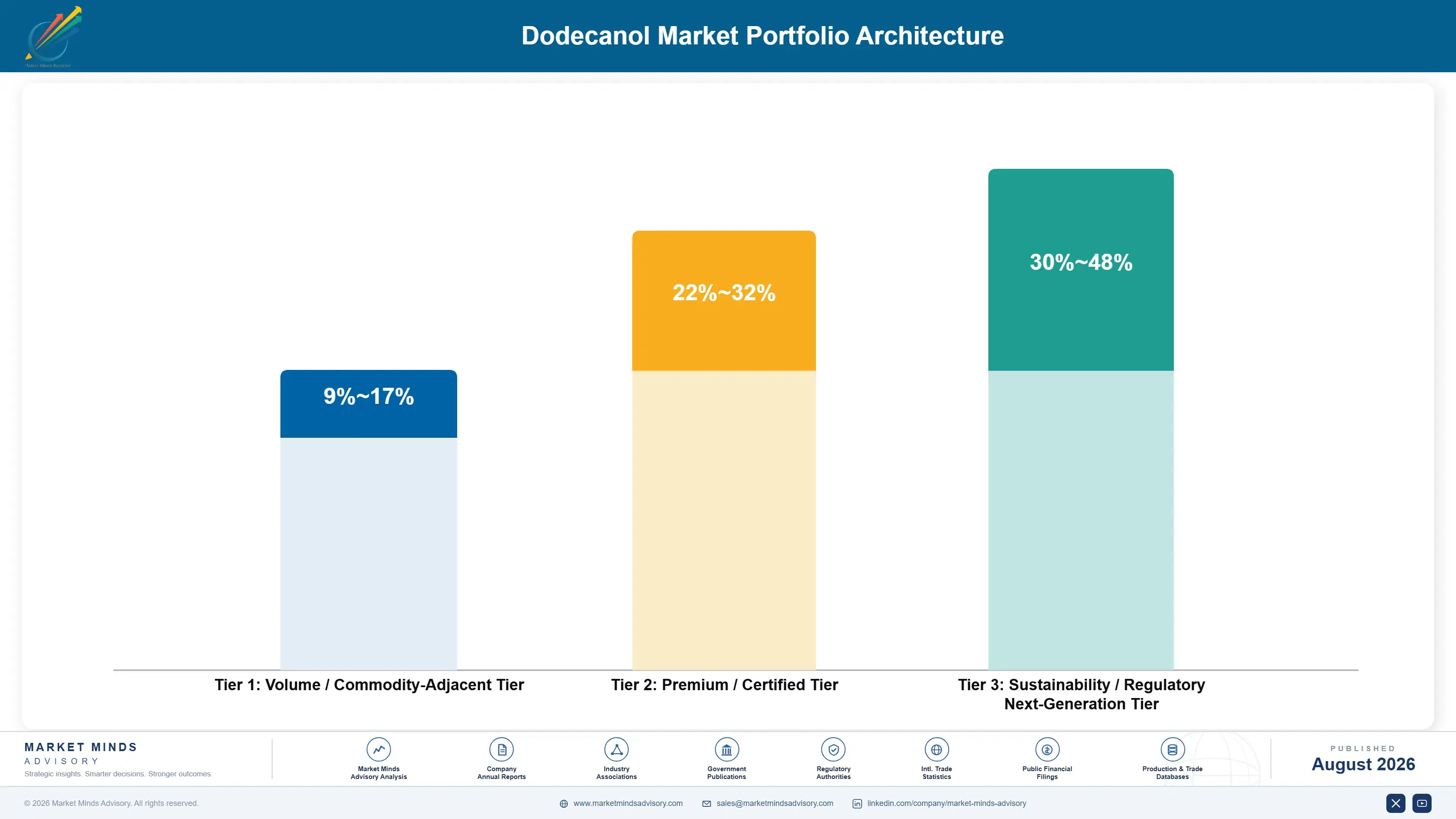
Portfolio Architecture for Margin Defence

Margin follows documentation and integration rather than volume, which is unusual for a commodity intermediate. Undocumented natural and merchant synthetic material sold into bulk surfactant conversion earns thin returns, because the molecule is identical whichever route produced it and buyers compare delivered price alone. Traceable certified material and palm-free fermentation product earn considerably more, since the buyer is purchasing market access or a marketing claim rather than a chemical.
The volume and premium tension sits in feedstock allocation rather than in plant loading. A producer with partial traceability coverage must decide which customers receive documented material, and the compliant volume is worth far more in Europe than anywhere else. Allocating it to a long-standing Asian customer at commodity pricing wastes the compliance investment entirely. Getting that allocation wrong wastes a compliance investment that took years to build and cannot be redirected afterwards.

High-value pools concentrate in three places: fully traceable natural material for European supply, fermentation-derived product serving palm-free claims, and integrated downstream surfactant conversion. Each is defended by documentation, technology access, or asset position rather than by price. Price competition arrives only when a competitor completes the auditing, secures the technology, or builds the conversion asset.

Volume / Commodity-Adjacent Tier

Undocumented natural and merchant synthetic material sold into bulk surfactant conversion on delivered price. Competes purely on feedstock cost position. The range reflects large differences between integrated and merchant feedstock access.
Gross Margin: 9%-17%

Premium / Certified Tier

Plot-level traceable natural material qualified for European supply under deforestation rules. The buyer purchases legal market access rather than the molecule, and non-compliant alternatives cannot be substituted at any price.
Gross Margin: 22%-32%

Sustainability / Regulatory / Next-Generation Tier

Fermentation-derived palm-free material and mass balance certified renewable routes serving brand formulation commitments. Marketing claims rather than performance drive the premium. The range is wide because fermentation pricing has not settled.
Gross Margin: 30%-48%
dodecanol-market-trends-portfolio-architecture-1787549250739

High-value Sub-segments and Strategic Watch-out

Traceable Natural Route Material

Compliant material reaches European markets that non-compliant supply legally cannot, which is the clearest access advantage in this market. Only 44% of natural supply qualifies today. Field auditing rather than certification membership is what actually builds the position. Start the auditing programme immediately. Begin now.
Gross Margin: 24%-34%

Fermentation Palm-Free Product

Brands specifying palm-free cannot be served by certified sustainable palm, because the objection concerns the crop rather than the sourcing. Volumes are tiny and buyers are not comparing against commodity quotations. Partnership beats funding capacity here. Partner rather than build the capacity. Do not build.
Gross Margin: 32%-48%

Integrated Downstream Conversion

Seventy-four percent of output becomes surfactant, and conversion captures margin that merchant sellers hand to customers. It also secures outlet volume through the feedstock cycles that periodically flatten merchant positions. Channel conflict is the real obstacle. Weigh channel conflict against cycle resilience. Decide deliberately. Move once.
Gross Margin: 26%-38%

Merchant Commodity Alcohol Supply

The strategic watch-out. An identical molecule from five routes competing on delivered price alone, with feedstock cost position the only differentiator available. It loads plants and funds fixed costs, and should be priced for exactly that. Load the plant and expect nothing more. Nothing further.
Gross Margin: 9%-16%

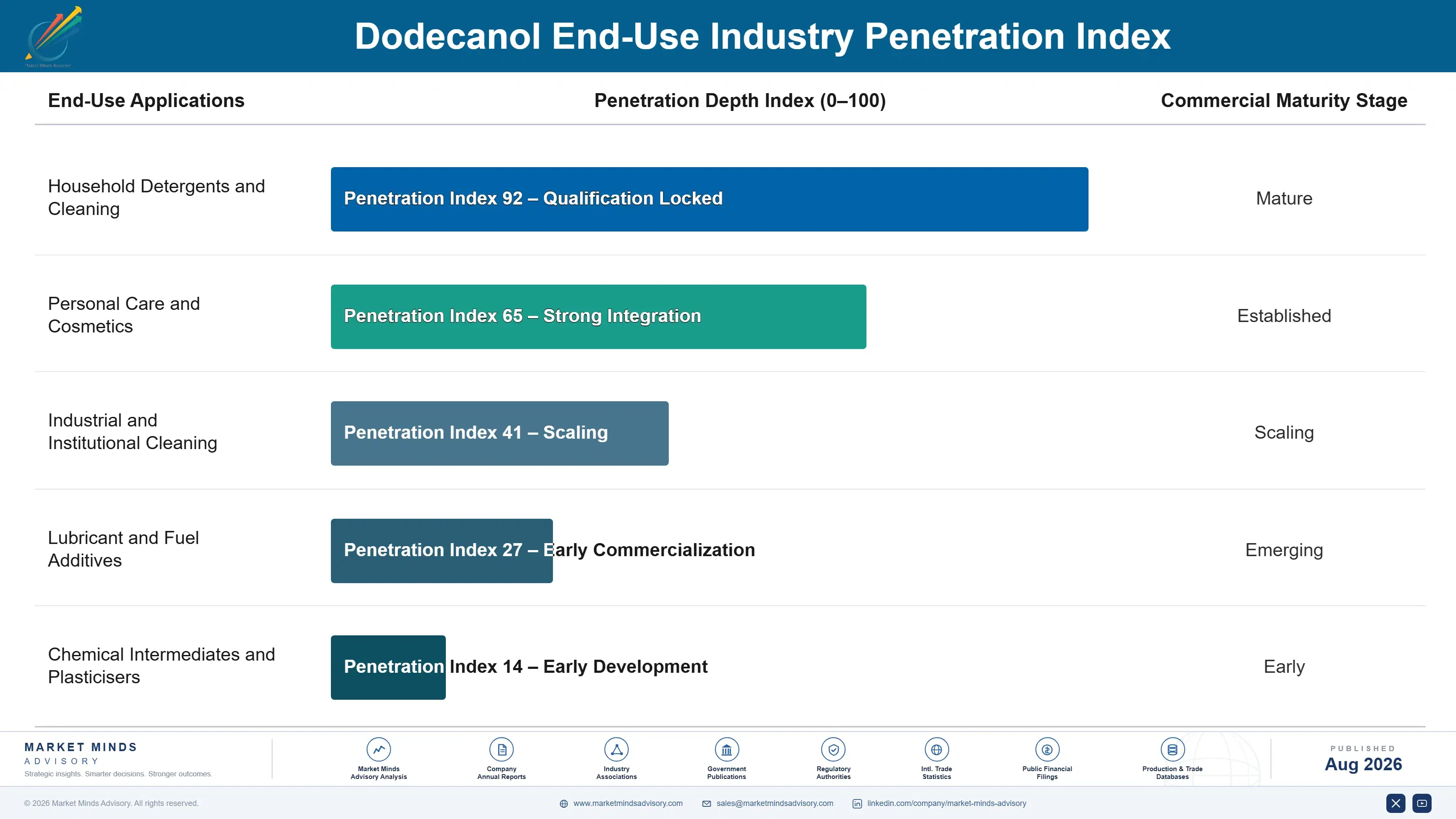
How Demand Actually Reaches Producers

The annuity here is consumption rather than contract. Surfactants take 74% of output and reach consumers as products bought weekly, which makes underlying demand about as steady as any chemical intermediate enjoys, tied to population, income, and washing frequency rather than to industrial cycles. What moves violently is not demand but feedstock cost, which is why producer earnings swing far more than volumes ever do. Buyers contract annually and switch routes readily when the price relationship shifts.
Adoption depth varies sharply by customer type. Multinational personal care brands run the deepest specifications, increasingly demanding origin documentation and in some cases palm-free sourcing, and they contract multi-year. Detergent manufacturers buy on price against a specification and switch between natural and synthetic freely. Contract surfactant converters buy to their customers' requirements. Industrial and lubricant additive users take small volumes on technical specification.

The buyer has shifted toward sustainability and procurement compliance functions at brand level. Those teams evaluate origin evidence before anyone examines a price. A supplier who cannot produce plot-level records will not reach the pricing conversation at all in European accounts, whatever the quotation says, and that filter did not exist three years ago anywhere in this industry.
dodecanol-market-trends-end-use-penetration-index-1787549251228

Where the Money Sits

These are among the four positions where our research anticipates prominent divergence between winners and laggards over the coming forecast period. Each is grounded in the demand model, the regulatory perimeter, and the announced capacity pipeline.
01 / ORIGIN DOCUMENTATION BUILD

Map the plots, because certificates no longer satisfy the rules

European deforestation regulation requires geolocation evidence tracing material to the plot it grew on, and only 44% of natural route supply currently carries anything meeting that standard. Producers who completed smallholder mapping and mill segregation now sell into a market their competitors legally cannot enter, at premiums of 12 to 22% over undocumented material. The work is field auditing rather than capital investment, and it is slow enough that starting after enforcement tightens means forfeiting at least two full selling seasons to better prepared competitors.
02 / DUAL ROUTE CAPABILITY

Hold both feedstocks, because they never peak together

Palm kernel oil moves on producing country export policy, biodiesel mandates, and weather while ethylene moves on entirely separate petrochemical cycles, and inputs represent fully 61% of production cost whichever route a producer happens to run. Producers holding both routes shift output toward whichever feedstock is favourable and hedge the largest line on the cost sheet. Single-route producers carry the full swing and have been caught repeatedly, though the capital required means the move only justifies itself at genuinely large operating scale.
03 / PALM-FREE CLAIM ACCESS

Partner for fermentation rather than funding the capacity

Brands specifying palm-free formulation cannot be satisfied by certified sustainable palm at all, because their stated objection concerns the crop rather than the sourcing standard applied to it. Fermentation material is currently the only available answer, growing at 14.2% from a base small enough that funding capacity would be speculative. A commercial partnership gives an established producer the claim and the customer access without having to commit several hundred million dollars to a market that may well stay permanently small.
04 / DOWNSTREAM CONVERSION MOVE

Take the surfactant step, because customers keep that margin

Seventy-four percent of output is converted into sulphates and ethoxylates by customers who capture the conversion margin that alcohol producers currently forgo entirely. Integrating forward earns a further 6 to 11 percentage points above merchant supply and it secures outlet volume regardless of what the merchant market happens to do in any given year. The obstacle is competing with existing customers, which several producers judge too disruptive, and the producers who moved anyway proved considerably more resilient through the last feedstock cycle.

Engagement Snapshot From the Field

A live engagement with an industry participant carrying material or product regulatory and market exposure ahead of a defining policy shift, showing how our research translates into a defensible multi-year portfolio strategy.
MARKET MINDS ADVISORY · CLIENT ENGAGEMENT SUMMARY
Dodecanol Producer Strategic Portfolio Review and Transition Roadmap 2026·Investment Scenario on Dodecanol Exposure Evaluation 2025-26
CLIENT PROFILE
A Southeast Asian oleochemical producer manufacturing fatty alcohols from purchased palm kernel oil, supplying surfactant converters across Asia and Europe with revenue near USD 240 million (client-reported, unverified by MMA). The business held no plantation position, relied on certification scheme membership for sustainability claims, and sold entirely as merchant alcohol. European exposure was substantial and growing.
STRATEGIC CHALLENGE
European customers had begun requesting plot-level origin evidence the client could not provide, and two contracts had moved to an integrated competitor as a result. Kernel oil purchasing had also proved brutally volatile through recent biodiesel mandate changes. Management needed to know whether traceability was achievable without plantation ownership and what else to change.
MMA APPROACH
MMA mapped the client's mill supply base and assessed traceability feasibility by source, sized European compliant demand against regional supply capability, and modelled feedstock cost exposure under alternative contracting approaches. Forty-seven expert interviews with surfactant converters, brand sourcing leads, and mill operators established what documentation buyers actually required. Buyer requirements had shifted quickly.
KEY FINDINGS
  1. Certification scheme membership satisfied no European customer under the new rules, and the client had assumed for two years that it would, which explained both contract losses directly.
  2. Traceability to plot level was achievable across 61% of the client's mill supply without plantation ownership, since several supplying mills already held partial records that had never been consolidated.
  3. Compliant material was commanding premiums approaching a fifth over undocumented supply in European contracts, comfortably justifying the field auditing programme required to secure it.
  4. Spot kernel oil purchasing had cost the business more across three years than its entire European margin, and no competitor of similar scale was still buying that way.
CLIENT PROFILE
A Southeast Asian oleochemical producer manufacturing fatty alcohols from purchased palm kernel oil, supplying surfactant converters across Asia and Europe with revenue near USD 240 million (client-reported, unverified by MMA). The business held no plantation position, relied on certification scheme membership for sustainability claims, and sold entirely as merchant alcohol. European exposure was substantial and growing.
STRATEGIC CHALLENGE
European customers had begun requesting plot-level origin evidence the client could not provide, and two contracts had moved to an integrated competitor as a result. Kernel oil purchasing had also proved brutally volatile through recent biodiesel mandate changes. Management needed to know whether traceability was achievable without plantation ownership and what else to change.
MMA APPROACH
MMA mapped the client's mill supply base and assessed traceability feasibility by source, sized European compliant demand against regional supply capability, and modelled feedstock cost exposure under alternative contracting approaches. Forty-seven expert interviews with surfactant converters, brand sourcing leads, and mill operators established what documentation buyers actually required. Buyer requirements had shifted quickly.
KEY FINDINGS
  1. Certification scheme membership satisfied no European customer under the new rules, and the client had assumed for two years that it would, which explained both contract losses directly.
  2. Traceability to plot level was achievable across 61% of the client's mill supply without plantation ownership, since several supplying mills already held partial records that had never been consolidated.
  3. Compliant material was commanding premiums approaching a fifth over undocumented supply in European contracts, comfortably justifying the field auditing programme required to secure it.
  4. Spot kernel oil purchasing had cost the business more across three years than its entire European margin, and no competitor of similar scale was still buying that way.
RECOMMENDED STRATEGY
Phase 1: Phase one: consolidate existing mill records and commission field verification across the supply base that can realistically reach plot-level documentation within a single season. Phase 2: Phase two: move kernel oil procurement to multi-year indexed contracts with committed volume, accepting price exposure while removing availability and negotiation risk entirely. Phase 3: Phase three: allocate compliant material deliberately to European contracts rather than by customer seniority, since the premium only exists in that market.
OUTCOME
The client achieved plot-level traceability across 58% of supply within fourteen months and recovered both lost European contracts. Documented material reached 34% of volume at premium pricing, feedstock cost volatility narrowed materially under indexed contracting, and blended gross margin improved 4.6 percentage points (client-reported, unverified by MMA).

Frequently Asked Questions

Foundational context covering the market sizes, CAGR, scope, country, region and competition that inform every finding below. This section is provided to cover basics and most often pre-purchase conversations, answered from the MMA Primary Research Dataset.

What is the current size of the Dodecanol Market?

The market was valued at USD 1.7 billion in 2025, rising to an estimated USD 1.78 billion in 2026. East Asia holds the largest regional share at 30% of global value.

How large will the Dodecanol Market be by 2036?

MMA forecasts USD 2.79 billion by 2036 under the base case, an expansion multiple of 1.57 times the 2026 value. That represents USD 1.01 billion of incremental value across the forecast period.

What is the CAGR for the Dodecanol Market 2026 to 2036?

The base case CAGR is 4.6%, with a bull case of 5.8% and a bear case of 3.4%. The spread reflects uncertainty over palm feedstock economics and detergent concentration trends.

Which segment is growing fastest?

The microbial fermentation route grows fastest at 14.2%, roughly 3.09 times the market rate, from a very small base. The Ziegler ethylene route follows at 6.2% on traceability avoidance.

Who are the major companies in the Dodecanol Market?

KLK Oleo, Wilmar International, Musim Mas, Sasol, and BASF lead on production capacity. The top five hold roughly 57% of global supply, split between palm and ethylene integration.

Which country is growing fastest?

India grows fastest at 7.6%, driven by rising detergent and personal care consumption per person from a low base. Southeast Asian countries produce far more than they consume.

Report Segmentation Architecture

The full report scope spans multiple orthogonal segmentation dimensions, with cross-tabulated demand data provided for each dimension pair. Coverage extends further to regional breakdowns, trend trajectories, and the competitive detail needed to support segment-level decision-making.

By Production Route

  • Palm Kernel Oil Route
  • Coconut Oil Route
  • Ziegler Ethylene Route
  • Oxo Process Route
  • Microbial Fermentation Route

By End-Use Industry

  • Household Detergents and Cleaning
  • Personal Care and Cosmetics
  • Industrial and Institutional Cleaning
  • Lubricant and Fuel Additives
  • Chemical Intermediates and Plasticisers

By Sales Model

  • Merchant Bulk Alcohol Supply
  • Traceability Documented Contract Supply
  • Integrated Internal Conversion
  • Distributor and Trader Channel
  • Brand-Specified Palm-Free Supply

By Region

  • North America
  • Western Europe
  • East Asia
  • South Asia and Pacific
  • Latin America
  • Middle East and Africa
  • Eastern Europe

Scope, Methodology, and Coverage

Every figure in this report is reproducible from documented input assumptions. The scope below maps the historical period, the forecast horizon, the segmentation dimensions, and the countries covered, alongside the underlying primary and qualitative methodology.
Historical Period
2020 to 2025
Forecast Period
2026 to 2036
Base Year
2025 (USD billions; MMA Primary Research Dataset, August 2026)
Market Definition
The market comprises dodecanol, traded as lauryl alcohol or C12 fatty alcohol, supplied as a surfactant precursor and chemical intermediate, covering the palm kernel oil route, the coconut oil route, the Ziegler ethylene route, the oxo process route, and the microbial fermentation route. Value is measured at producer level across household detergent, personal care, industrial cleaning, lubricant additive, and intermediate applications. Other fatty alcohol chain lengths sold separately, finished surfactants including sodium lauryl and laureth sulphate, palm and palm kernel oil as commodities, fatty acid methyl esters, and glycerine co-product fall outside scope.
Quantitative Units
USD billions (current prices); thousand tonnes supplied annually; USD per tonne by production route and documentation status
Segmentation Dimensions
By Production Route; By End-Use Industry; By Sales Model; By Region
Regions Covered
North America, Western Europe, East Asia, South Asia and Pacific, Latin America, Middle East and Africa, Eastern Europe
Countries Covered
United States, Canada, Mexico, Germany, France, United Kingdom, Netherlands, Italy, Spain, Belgium, Poland, Czechia, Romania, China, Japan, South Korea, India, Indonesia, Malaysia, Thailand, Philippines, Australia, Brazil, Colombia, Argentina, Saudi Arabia, United Arab Emirates, Egypt, Nigeria, Kenya, South Africa
Key Companies Profiled
KLK Oleo, Wilmar International, Musim Mas, Sasol, BASF, Kao Corporation, P&G Chemicals, Emery Oleochemicals, Godrej Industries, VVF Limited, Ecogreen Oleochemicals, Shell Chemicals, Ineos Oligomers, Sinopec, PTT Global Chemical, Oleon, Cargill, Croda International, Stepan Company, Arkema
Quantitative Methodology
Primary survey, n=3,800 respondents, Q4 2025, six countries; demand-side model with trade association cross-validation
Qualitative Methodology
47 expert interviews, Q4 2025; applied to validate demand model assumptions, identify emerging dynamics, and assess competitive positioning
Report Format
PDF and XLSX data workbook (Word format preview document)
Publisher
Market Minds Advisory
Report Code
MMA-2026-CHM-204
Published
August 2026
Contact
sales@marketmindsadvisory.com | www.marketmindsadvisory.com

Purchase the full Dodecanol Market Report (2026 to 2036).

The full report sizes dodecanol demand across five production routes, five end-use categories, and seven regions with 2026 to 2036 forecasts under base, bull, and bear cases. It separates documented traceable supply from undocumented material, which now reach different markets under deforestation rules. Competitive profiles cover twenty producers assessed consistently on dodecanol capacity, feedstock integration, and traceability position. Cost analysis traces palm kernel oil and ethylene exposure alongside the compliance cost that falls only on natural routes. Commercial guidance addresses origin documentation, dual route capability, palm-free claim access, and downstream conversion.
Five production routes sized separately by region
Traceable supply separated from undocumented natural material
Palm kernel and ethylene cost exposure modelled comparatively
Biodiesel mandate effects traced through feedstock economics
Palm-free claim demand quantified against certified sustainable supply
Twenty producers assessed on feedstock integration and documentation

Built For The People Who Decide

From boardroom strategy to bench-side execution, this report is read cover-to-cover by leaders shaping the next decade of their industry, turning demand scenarios, market dynamics and valuation benchmarks into decisions.
CXOs/ Presidents/ VPs/ Managers
M&A and Corporate Development
Strategy Teams and R&D Heads
Procurement and Product Directors
Regulatory and Compliance Leaders
Investor Relations and Equity Analysts