Market Minds Advisory
DNS DHCP And IPAM Market

DNS DHCP And IPAM Market: DNS DHCP And IPAM Market. Cloud-Native Platforms and Zero Trust Security Reset Core Network Infrastructure Demand

Cloud-native DDI platforms and zero trust DNS security integration are pushing core network infrastructure software well past legacy on-premises appliances across enterprise, hyperscale, and government networks everywhere worldwide right now

Lead Analyst

Published

September 2026

Make Smarter Decisions with Customized Research Insights

Request a free sample report and evaluate market opportunities, growth trends, and competitive dynamics relevant to your business needs.

2025 MARKET VALUE$1.4BMarket Size 2025
2036 FORECAST VALUE$3.8BBase Case , 2026 to 2036
CAGR 2026 TO 20369.4 %Bull 10.7% / Bear 8.1%
INCREMENTAL OPPORTUNITY$2.2BNet 10- year value creation
EXPANSION MULTIPLE2.46x2036 value over 2026 base
Strategic Levers
M&A Pipeline
Regional Outlook
Country Rankings
Competitive Intelligence
Segmental Deep-dive
Call-Us : 91 93563 13602

Executive Snapshot and Market Trajectory.

Cloud-native DDI platforms are reshaping the DNS DHCP and IPAM market right now, as enterprises retire legacy on-premises appliances in favor of software-defined infrastructure that scales elastically across hybrid and multi-cloud environments spanning most industries and network architectures worldwide today. and format. and type. and scale.
Zero trust security frameworks are pulling demand toward DDI platforms with integrated threat intelligence and DNS-layer security enforcement, since security teams increasingly treat DNS as a critical control point rather than pure infrastructure plumbing that can be managed passively, a shift concentrated most heavily across North American and East Asian enterprise networks with the deepest cloud migration investment already committed and further expansion planned across coming procurement cycles and modernization rounds still well ahead.
Competitive character is splitting between infrastructure incumbents defending legacy on-premises appliance franchises and newer entrants building cloud-native, API-first DDI platforms for hybrid enterprise customers at meaningful scale across regions. Integration depth with cloud provider platforms and security tooling is increasingly determining which vendors win procurement contracts across network modernization programs launching over the coming several years, favoring vendors with genuine platform breadth and reliability today.
Market Definition
The DNS DHCP And IPAM Market covers software and appliances that manage domain name resolution, dynamic host configuration, and IP address allocation across enterprise, service provider, and hyperscale networks. It excludes general network monitoring tools, firewall and general-purpose security appliances, and downstream application delivery infrastructure unrelated to core DDI functions.
Base Year Value
$1.4B in 2025 (MMA Primary Research Dataset, September 2026)
Forecast Period
2026 to 2036, eleven discrete annual values
CAGR
9.4% base case. Bull 10.7%. Bear 8.1%.
Fastest Growth Segment
Cloud-Native and SaaS DDI Platforms: 16.8% CAGR
Fastest Growth Country
India: 12.8% CAGR
Fastest Growth Region
South Asia and Pacific: 11.3% CAGR
Largest Region
North America: 32% of 2025 global value
Market Leaders
Infoblox, BlueCat Networks, EfficientIP, Cisco Systems, and Microsoft lead the competitive landscape.
Primary Survey
n=3,800 procurement and R&D decision-makers, Q4 2025, six countries
Methodology
Demand-side build-up, cross-validated against public data, 47 expert interviews

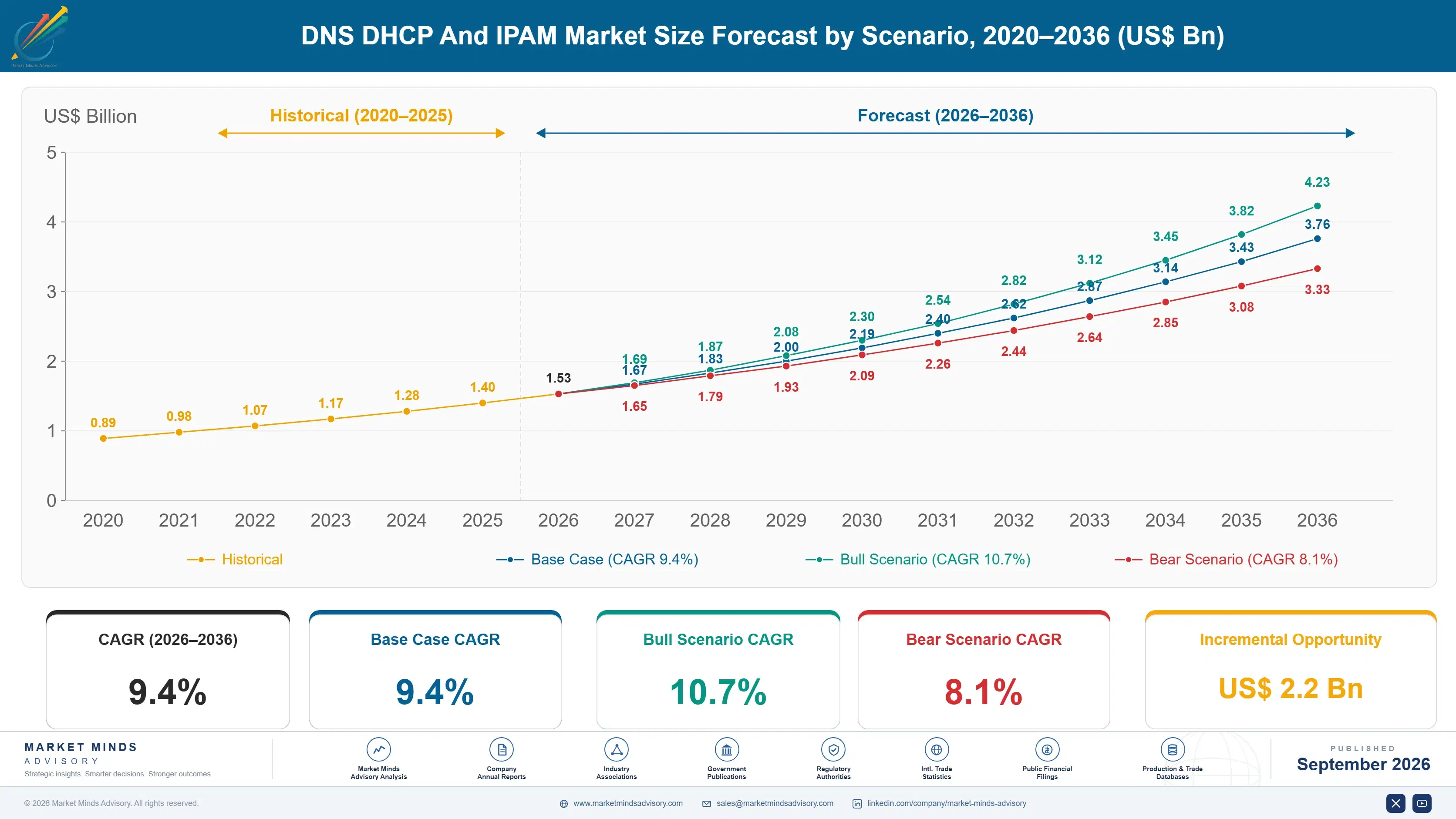
DNS DHCP And IPAM Market Forecast Scenarios

dns-dhcp-and-ipam-market-size-forecast-scenario-1790011645901
The 2020 to 2025 period grew a steady 8.4 percent annually as hybrid cloud adoption accelerated and enterprises modernized network infrastructure to support distributed workforces across most industries, though legacy appliance replacement cycles moved cautiously given lengthy procurement processes and cautious IT capital spending across most enterprise networks and government agencies during that stretch, tempering broader growth considerably.
The base case rests on three named commercial mechanisms: cloud-native DDI platforms reaching mainstream enterprise adoption across hybrid network architectures, zero trust security frameworks expanding DNS-layer security integration meaningfully across every major deployment, and IoT device proliferation sustaining steady IP address management demand across consumer and industrial categories. Together these push compounded annual growth to 9.4 percent through 2036, with platform vendors capturing rising share of total network infrastructure spending tracked.
The bull case hinges on faster-than-expected cloud migration and zero trust adoption across large enterprise networks, pushing growth toward 10.7 percent as security teams prioritize DNS-layer control. The bear case reflects prolonged IT capital spending caution amid economic uncertainty that slows infrastructure modernization and depresses growth to roughly 8.1 percent, favoring incumbent vendors with existing installed base relationships.

Cloud-Native Platforms Reset Infrastructure Economics

DDI platform demand is splitting between legacy on-premises appliance replacement and new cloud-native, API-first platforms built for hybrid and multi-cloud network architectures across nearly every enterprise segment tracked in this report. Appliance replacement remains steady across smaller enterprises that have not yet migrated core infrastructure, while cloud-native platforms are expanding meaningfully faster as larger enterprises complete broader cloud migration programs and retire legacy on-premises appliances.
MARKET CONCENTRATIONCR5 44%Top five vendors hold a substantial combined market share currently
AVERAGE CONTRACT VALUE$185,000Blended annual contract value per enterprise customer deployment
TOP PRODUCING COUNTRY SHAREUnited States 29%Share of global platform revenue concentrated in one country
CLOUD DEPLOYMENT SHARE48%Share of new deployments running on cloud-native architecture today
TRADE INTENSITY39%Share of platform revenue generated from cross-border customers annually
CLOUD INFRASTRUCTURE COST SHARE26% of COGSCloud hosting and compute cost share of total delivery cost
Pricing power is shifting toward vendors who embed DNS-layer security and threat intelligence directly into core DDI functionality, since security teams increasingly refuse to treat DNS management and DNS security as separate procurement decisions across their infrastructure stack. That integration premium is compressing margins for vendors still selling pure infrastructure management lacking any embedded security capability, a shrinking category as security integration adoption keeps accelerating across most enterprise segments.
Cloud infrastructure and hosting costs occasionally tighten vendor margins during periods of broader cloud compute demand growth, particularly for vendors operating multi-region, high-availability DNS resolution infrastructure at global scale and reliability standards. Vendors with diversified cloud provider relationships are proving meaningfully more resilient through these periodic cost pressures than smaller competitors dependent on single-provider hosting arrangements and spot-market pricing.
"DNS used to be the thing nobody thought about until it broke. Now it's the control point every security team wants to own outright."
Senior Analyst, Network Infrastructure and Security Practice · MMA Technology Practice · September 2026

Market Trends

Cloud-Native Platforms Displace Legacy On-Premises Appliances

Enterprises are replacing legacy on-premises DDI appliances with cloud-native, API-first platforms that scale elastically across hybrid and multi-cloud environments without requiring dedicated hardware refresh cycles every few years and budget approvals. Major enterprises in North America and East Asia have adopted cloud-native DDI as the default choice for new network deployments, and mid-market organizations are following as platform cost declines with production scale. This shift is reshaping which vendors win design slots, favoring companies with proven cloud-native architecture depth over those still defending legacy appliance franchises built over previous decades.
Market Impact: Adds 1.4 billion in platform demand
DNS-Layer Security Integration Becomes Standard Procurement Requirement

Security teams are increasingly specifying DNS-layer threat intelligence and malware blocking as baseline procurement requirements rather than optional add-ons, since DNS resolution represents a critical control point for detecting and blocking malicious traffic before it reaches endpoint devices across the network. This convergence is pulling DDI platform design toward integrated security architectures rather than separate infrastructure and security tooling that requires manual correlation. Enterprise security teams increasingly refuse to deploy DDI platforms lacking native security integration, accelerating vendor investment in threat intelligence capability across every major platform tier tracked in this report.
Market Impact: Adds 24 percent to demand

Market Opportunities and Growth Drivers

Hybrid Cloud Migration Expands Core Infrastructure Complexity

Enterprises operating hybrid and multi-cloud network architectures are driving substantial demand for unified DDI platforms capable of managing DNS, DHCP, and IP address allocation consistently across on-premises data centers and multiple public cloud environments simultaneously and reliably. Fragmented, cloud-specific infrastructure tools create operational complexity and security gaps that unified platforms directly address, making DDI consolidation an increasingly urgent IT priority. This shift is turning cloud migration into a direct multiplier for DDI platform demand, since every additional cloud environment adds complexity that unified platforms are specifically designed to manage centrally.
Market Impact: Adds 6 to 12 months

IoT Device Proliferation Sustains IP Address Management Demand

Rapidly expanding IoT device deployment across enterprise and industrial networks is sustaining steady demand for IP address management capability, since every connected device requires address allocation and tracking regardless of overall network complexity or device type deployed. Network administrators increasingly rely on automated IPAM tools to manage address space that has grown far beyond what manual tracking spreadsheets could reliably handle at enterprise scale. This shift is proving particularly valuable for organizations deploying dense sensor networks, where address management directly determines network reliability and troubleshooting speed across every connected facility.
Market Impact: Adds 12 to 18 months

Market Restraints and Challenges

Legacy Migration Complexity Slows Cloud Transition Pace

Migrating core network infrastructure from legacy on-premises DDI appliances to cloud-native platforms requires extensive planning and testing given the operational risk of any DNS or DHCP disruption to production networks. The root cause is that DDI infrastructure sits at the foundation of network operations, making any migration inherently high-stakes regardless of how incremental the underlying platform change may be. Some vendors are mitigating exposure by offering hybrid deployment models that let enterprises migrate incrementally, running cloud-native and legacy infrastructure in parallel during a gradual transition period rather than a disruptive full cutover.
Market Impact: Cuts infrastructure cost 35 percent

Security Certification Requirements Raise Development Cost

DDI platforms handling government and regulated industry traffic require extensive security certification and compliance documentation that adds substantial cost and development time beyond standard commercial platform development. The root cause is the rigorous compliance regime governing critical network infrastructure in regulated sectors, which applies uniformly regardless of how incremental the underlying platform feature change may be. Vendors are mitigating exposure by designing modular compliance architectures that share a common certified core across multiple regulatory frameworks, letting them amortize certification cost across a broader customer base rather than certifying separately for each framework.
Market Impact: Adds 22 percent to contract value
3 additional market trends, 4 additional growth drivers, and 2 additional restraints and challenges are covered in the full report. Contact sales@marketmindsadvisory.com to access the complete intelligence.

Segment CAGR and Growth Architecture

The market splits across six distinct product segments spanning DNS, DHCP, IPAM, cloud-native platforms, security add-ons, and managed services sold to enterprise and service provider customers worldwide today. Cloud-native platforms and DNS security add-ons are pulling ahead of legacy appliance categories as hybrid cloud adoption and zero trust security expand rapidly. Adoption is accelerating fastest across enterprise and hyperscale customers.
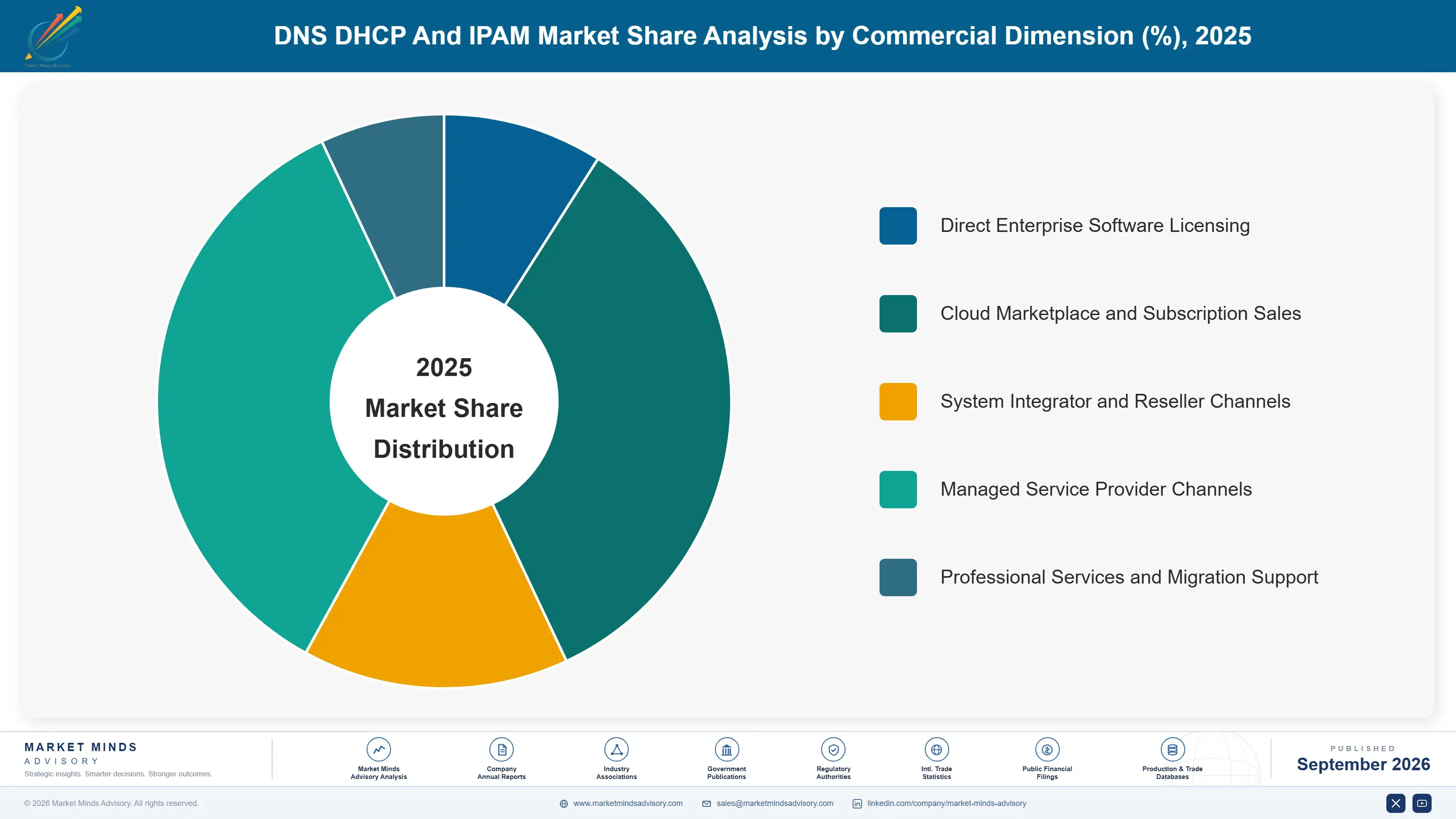
dns-dhcp-and-ipam-market-market-share-analysis-1790011646449

Cloud-Native and SaaS DDI Platforms

Cloud-native DDI platforms deliver DNS, DHCP, and IP address management as elastically scalable software rather than fixed-capacity hardware appliances, letting enterprises manage core network infrastructure consistently across hybrid and multi-cloud environments without hardware refresh cycles. Demand is concentrated among enterprises pursuing broad cloud migration programs, with North America and East Asia leading adoption given deeper cloud infrastructure investment and modernization budgets. Vendors are racing to bring platform migration cost down as enterprise adoption accelerates, since deployment flexibility increasingly determines which vendors win large-scale infrastructure contracts ahead of smaller, less-mature competitors still refining their cloud-native architecture and reliability track record. Adoption momentum keeps building each fiscal quarter across sectors. today. now.
CAGR 16.8%

DDI Security and Threat Intelligence Add-Ons

DDI security add-ons embed threat intelligence, malware blocking, and DNS-layer filtering directly into core infrastructure management, letting security teams treat DNS resolution as an active control point rather than passive plumbing that goes unmonitored. Demand is accelerating as zero trust security frameworks expand across enterprise networks, pulling platform vendors toward integrated security architectures rather than separate infrastructure and security tooling that requires manual correlation. Security teams increasingly specify DNS-layer threat intelligence as a baseline requirement for new infrastructure procurement, and the segment is expanding fastest among enterprises pursuing comprehensive zero trust security programs at scale. Enterprise procurement teams increasingly evaluate threat coverage alongside price. Pricing has held steady even as adoption volumes expand rapidly.
CAGR 14.2%
Full segment breakdown across 6 segments available in the complete report.

Regional Architecture and Country Demand Map

North America leads on dense enterprise IT and hyperscale cloud infrastructure spending concentration, with East Asia close behind on rapid cloud migration and platform investment activity across the region. South Asia and Pacific posts the fastest regional growth rate as India's enterprise cloud adoption accelerates.

North America

The United States hosts the world's largest concentration of hyperscale cloud providers and enterprise data center infrastructure, anchoring North America's leadership in DDI platform demand across both cloud-native and legacy appliance categories. Major enterprises across financial services, technology, and healthcare sectors continue funding network modernization programs that prioritize cloud-native DDI adoption alongside zero trust security integration. Federal government agencies contribute substantial demand tied to network modernization mandates and security certification requirements. Canada adds a smaller but steady contribution through enterprise cloud migration tied to cross-border corporate infrastructure and shared regulatory frameworks with the United States. Vendor headquarters concentration reinforces the region's platform development leadership. Vendor relationships here span multiple decades of continuous supply.
Share: 32% | CAGR: 10.4% (2026 to 2036)

East Asia

China's rapidly expanding enterprise cloud adoption and domestic hyperscale infrastructure buildout anchor East Asia's position as a major DDI platform market, with domestic technology companies increasingly demanding unified infrastructure management across sprawling multi-region deployments. Japan and South Korea contribute steady enterprise modernization demand tied to established corporate IT infrastructure upgrade cycles. Regional cloud infrastructure investment continues expanding as domestic hyperscale providers compete with global platforms for enterprise customers. Growth here outpaces North America modestly, reflecting a still-maturing enterprise cloud adoption curve with substantial remaining headroom for cloud-native DDI platform penetration across the region's largest economies and technology sectors. Domestic vendors are gaining share steadily each procurement cycle here. today. now.
Share: 24% | CAGR: 10.2% (2026 to 2036)
Regional intelligence for 5 additional markets available in the complete report: Western Europe, South Asia and Pacific, Latin America, Middle East and Africa, Eastern Europe. Contact sales@marketmindsadvisory.com.
dns-dhcp-and-ipam-market-country-cagr-analysis-1790011647050

Where DDI Platform Margin Actually Concentrates

Margin in the DDI market increasingly concentrates around cloud-native architecture and embedded security rather than raw infrastructure management volume alone across most segments. Vendors capturing design wins across enterprise cloud migration and zero trust security programs hold pricing power that pure-play, legacy appliance suppliers have steadily lost over recent years and continue losing today.

Cloud-Native Architecture Commands Enterprise Design Wins

Vendors offering elastically scalable, cloud-native DDI platforms are winning enterprise migration contracts that legacy appliance competitors cannot bid on at all, since IT teams increasingly refuse to commit to fixed-capacity hardware that cannot scale with dynamic cloud workloads. This cloud-native capability commands roughly 40 percent higher average contract value than legacy appliance platforms of comparable functional scope, since enterprises value deployment flexibility highly. Enterprises increasingly favor vendors who can support gradual hybrid migration paths, letting a single platform serve both legacy and cloud infrastructure simultaneously without full replacement. Few competitors can match this breadth today.
Market Impact: Commands a 40 percent higher average contract value

Embedded Security Integration Locks In Multi-Year Contracts

Vendors bundling DNS-layer security and threat intelligence alongside core infrastructure management capture recurring subscription revenue tied to ongoing security relationships rather than one-time infrastructure sales, generating far more predictable, durable revenue streams. These security relationships typically span 3 or more years once a vendor's threat intelligence platform becomes embedded in an enterprise security operations workflow, since switching costs and threat data continuity requirements discourage vendor changes. This mechanism is increasingly favored by vendors seeking revenue stability, since it insulates them from the more cyclical nature of pure infrastructure procurement cycles and capital budget timing.
Market Impact: Secures 3-plus year recurring security contract terms now

Zero Trust Early Adoption Advantage Pays Off

Vendors that moved early to integrate zero trust security frameworks into core DDI functionality are winning enterprise security contracts from organizations eager to skip an intermediate separate-tooling evaluation phase entirely. This early-mover positioning is generating a persistent design-in advantage worth an estimated 26 percent of new enterprise security contracts annually as organizations standardize on integrated zero trust platforms across their networks. Vendors slower to adopt are increasingly relegated to smaller, budget-constrained accounts still specifying separate infrastructure and security tooling, a shrinking category as integrated adoption keeps accelerating across nearly every enterprise segment tracked.
Market Impact: Wins 26 percent of all new security contracts

Managed Service Offerings Add Recurring Revenue Streams

Vendors offering fully managed DDI operations tuned specifically for enterprises lacking dedicated network infrastructure staff, combined with proactive monitoring services, are capturing premium pricing from organizations facing persistent staffing and expertise challenges. This managed service positioning adds roughly 20 percent to per-account revenue for vendors able to demonstrate reliable uptime and rapid incident response directly to procurement teams evaluating competing platform providers. Enterprises increasingly specify managed service capability explicitly in vendor selection criteria, giving established vendors a durable, defensible advantage over less-equipped competitors bidding for the same large-scale contracts today.
Market Impact: Adds roughly 20 percent to total per-account revenue

Who Controls the Margin Pool

The DDI market holds meaningful concentration, with the top five players controlling 44 percent of revenue on a combined software licensing and cloud subscription basis measured consistently across product categories. Infoblox and BlueCat Networks lead comfortably given decades of enterprise DDI deployment depth, while the gap to mid-tier challengers like EfficientIP has widened as cloud-native platform development demands capital smaller vendors struggle to match.
Current competitive activity centers on cloud-native architecture migration, DNS-layer security integration, and managed service expansion rather than pure feature-count claims that dominated pricing conversations a decade ago. Vendors are racing to embed threat intelligence directly into core infrastructure management, and several have pursued acquisitions to close security and cloud-native capability gaps rather than build technology internally.

Emerging pressure is coming from hyperscale cloud providers building native DDI capability directly into their own cloud platforms, threatening to disintermediate standalone vendors for cloud-only deployments specifically. Rankings could shift meaningfully over the next few years if hyperscale providers succeed in capturing more of the hybrid infrastructure market, pushing traditional DDI vendors toward deeper multi-cloud and security differentiation as their primary competitive response and growth avenue.
dns-dhcp-and-ipam-market-company-positioning-matrix-1790011647595

Competitive Moat and Risk Dimensions

INFOBLOX INC.

Moat: Enterprise Deployment Base Scale

Infoblox holds decades of accumulated enterprise deployment depth and integration relationships across large-scale network infrastructure customers, giving it default incumbency in major modernization programs that newer entrants struggle to displace quickly. This installed base generates recurring subscription and support revenue that provides a stable revenue floor even as growth concentrates in newer cloud-native applications.
INFOBLOX INC.

Risk: Cloud-Native Transition Pace

Infoblox's legacy appliance-centric portfolio has moved more cautiously into fully cloud-native platform architectures than newer competitors built specifically for cloud deployment from the outset. That slower pace risks ceding design wins in fast-growing cloud migration segments to vendors with more agile, cloud-native product roadmaps and faster iteration cycles.
BLUECAT NETWORKS INC.

Moat: Hybrid Deployment Flexibility Depth

BlueCat's hybrid deployment heritage gives it deep, proven expertise in bridging legacy on-premises and cloud infrastructure that translates directly into competitive migration pathways customers value during gradual cloud transitions. That platform depth lets BlueCat capture wallet share across entire modernization programs rather than point-product sales alone.
BLUECAT NETWORKS INC.

Risk: Hyperscale Competition Exposure

BlueCat faces intensifying competition from hyperscale cloud providers offering native DDI capability bundled with broader cloud infrastructure services, a category increasingly attractive to cloud-first enterprises. That competitive pressure risks ceding growth in the fastest-expanding cloud-native segment to providers with deeper cloud platform integration and bundled pricing advantages.

Players Tracked

Prominent Players

Infoblox Inc.
BlueCat Networks Inc.
EfficientIP SAS
Cisco Systems Inc.
Microsoft Corporation

Other Key Players

Men and Mice ehf
NS1 Inc
Amazon Web Services Inc
Google LLC
Akamai Technologies Inc
F5 Inc
Nokia Corporation
SolarWinds Corporation
ManageEngine (Zoho Corporation)
6connect Inc
DNSimple Inc
Constellix Inc
Neustar Inc
VeriSign Inc
Oracle Corporation

Recent Developments

JANUARY 2025

Infoblox Launches Integrated Zero Trust DNS Platform

Infoblox announced a new cloud-native platform integrating zero trust DNS security directly into core infrastructure management, targeting enterprises pursuing comprehensive security modernization without deploying separate infrastructure and security tooling across their networks. The platform is expected to enter general availability within two fiscal quarters. today.
Signal: Signals accelerating vendor investment in integrated zero trust security across the industry and beyond current product cycles
MAY 2025

BlueCat Expands Hyperscale Cloud Integration Partnership

BlueCat expanded its integration partnership with a major hyperscale cloud provider, embedding unified DDI management directly into next-generation multi-cloud reference architectures for enterprise customers migrating diverse workloads across providers, regions, and business units worldwide today. The partnership extends an existing multi-year strategic infrastructure relationship. today.
Signal: Reinforces multi-cloud demand as a primary growth vector for incumbents today between two long-standing infrastructure partners
SEPTEMBER 2025

EfficientIP Acquires Threat Intelligence Software Startup

EfficientIP acquired a smaller threat intelligence software startup to strengthen its DNS security roadmap, adding machine learning-based threat detection capability that complements its existing DDI platform product portfolio for enterprise customers across every major deployment tier and region. Integration is expected within two fiscal quarters.
Signal: Confirms acquisition remains a viable path to security capability for infrastructure vendors as consolidation activity keeps accelerating

Cloud Compute Cost and Security Data Exposure

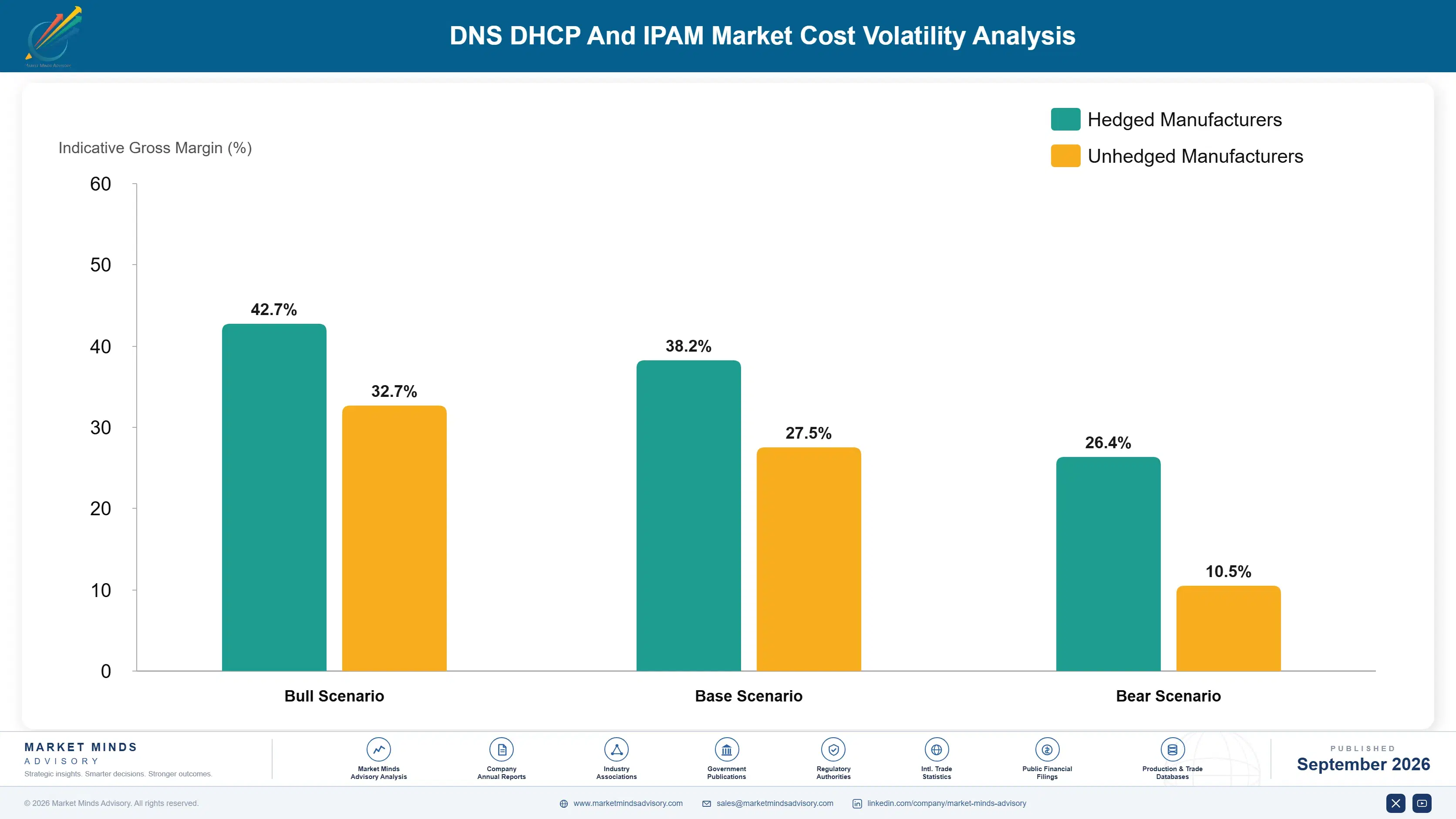
Cloud infrastructure hosting and compute represent the largest cost input for cloud-native DDI platforms, typically 26 to 32 percent of total cost of goods sold, sourced predominantly from major cloud infrastructure providers concentrated in the United States and increasingly distributed across regional data centers globally. Threat intelligence data licensing adds a second meaningful cost layer, particularly for vendors pursuing comprehensive DNS-layer security coverage across multiple threat categories simultaneously today.
Microsoft's 2024 annual report noted global data center capacity remaining broadly available but periodically tight during peak enterprise cloud migration cycles, with DDI platform customers competing for the same regional compute capacity as other enterprise SaaS workloads across the industry. That competition occasionally forced smaller vendors to extend deployment timelines during peak demand periods when larger customers received capacity priority across nearly every major regional market tracked in this report.

Vendors dependent on a single cloud infrastructure provider or lacking scale to negotiate priority allocation face genuine competitive disadvantage relative to larger rivals with diversified hosting relationships and greater purchasing leverage in negotiations. This exposure varies meaningfully by player type: smaller specialized vendors absorb the brunt of allocation squeezes, while Infoblox and Cisco secure preferential terms through decade-long cloud infrastructure partnerships.
dns-dhcp-and-ipam-market-cost-volatility-analysis-1790011647791

Diversified Multi-Cloud Infrastructure Sourcing Strategy

Larger vendors are distributing platform workloads across multiple cloud infrastructure providers simultaneously, trading some optimization for reduced dependence on any single provider relationship during allocation squeezes and demand spikes across product cycles and markets. This flexibility comes at meaningfully higher infrastructure cost but protects delivery schedules during periods of industry-wide compute tightness and constrained supply.

Proprietary Threat Intelligence Development Reduces Licensing Exposure

Vendors are increasingly developing proprietary threat intelligence capability to reduce dependence on third-party data licensing fees that scale directly with detection coverage and query volume across every deployment tier and customer segment. This shift reduces long-term cost exposure meaningfully for vendors with sufficient scale to justify the upfront research investment required across their product roadmap.

Long-Term Cloud Capacity Reservation Agreements

Larger vendors are signing multi-year cloud compute reservation agreements with priority allocation guarantees, securing predictable access to regional data center capacity even during industry-wide demand spikes affecting smaller competitors more severely and persistently over time and across cycles. Smaller vendors generally lack the volume commitments required to access comparable terms from major cloud providers today.

Portfolio Architecture for Margin Defence

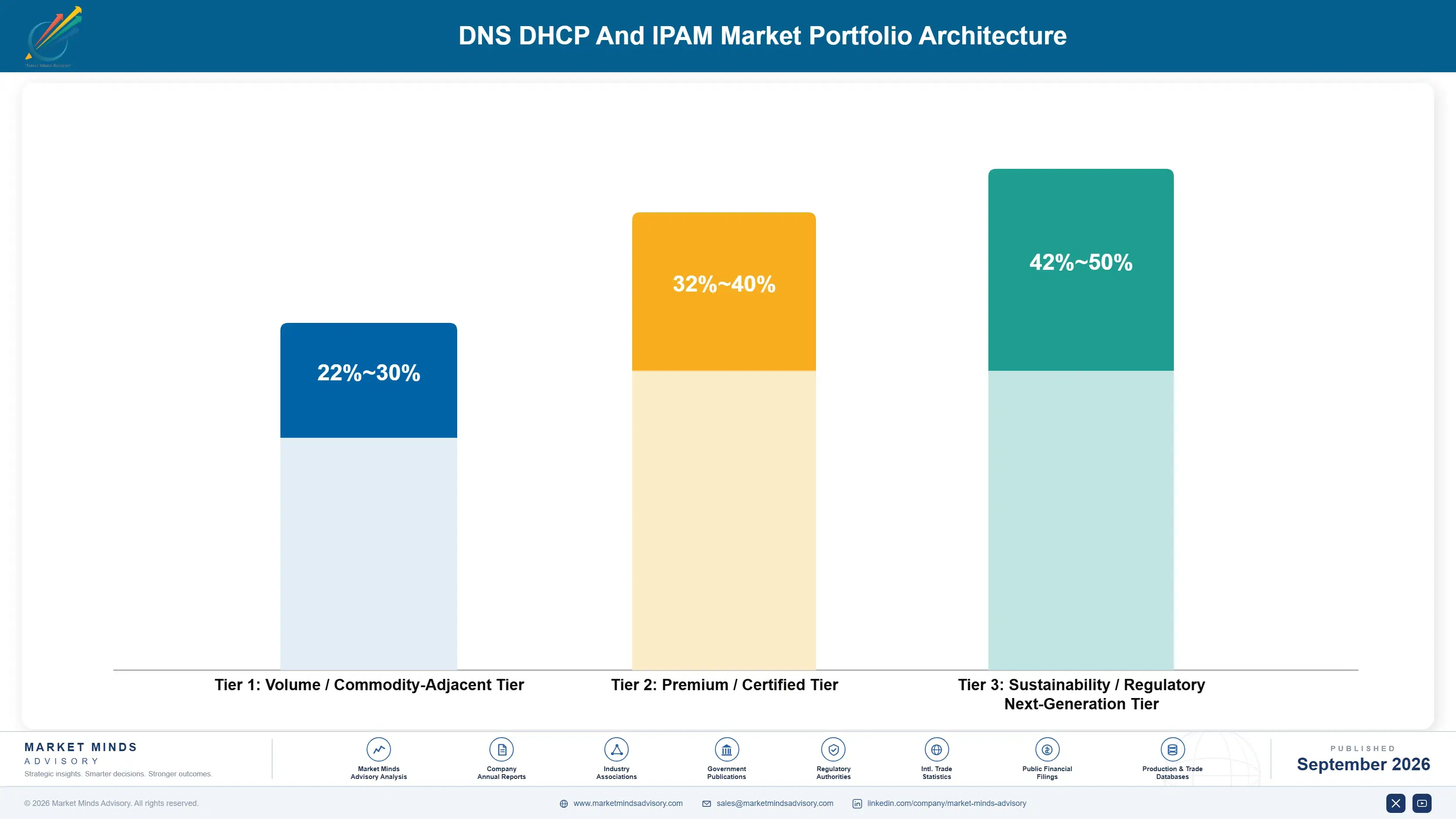
Platform margin structure runs on three distinct tiers separating on cloud-native architecture and embedded security rather than raw infrastructure management volume alone across segments. Commodity legacy appliances compete almost entirely on unit price, while cloud-native and security-integrated platforms command genuine premiums buyers pay for reduced deployment complexity and proven, validated zero trust performance across enterprise networks.
The volume tier still serves the most deployments by count but claims a shrinking share of industry profit pools, increasingly squeezed between rising cloud infrastructure cost and price-sensitive smaller enterprises treating basic DDI as commoditized infrastructure. Premium and next-generation tiers absorb heavier engineering and security investment upfront but return it through longer contract relationships and materially stronger renewal pricing power across multi-year enterprise agreements. Buyers increasingly reward proven integration track records.

High-value pools concentrate heavily in cloud-native platforms and DNS security integration, where technical depth and genuine switching cost together create durable competitive advantage that legacy producers cannot easily replicate. That concentration is steadily reshaping where vendors deploy research spending, favoring cloud-native architecture and security investment over legacy appliance development entirely, a shift accelerating industry-wide. Vendors slow to adapt risk permanent margin erosion.

Volume / Commodity-Adjacent Tier

Standard legacy appliances and basic on-premises DDI software sold primarily on price and delivery reliability, with thin margins and intense competition from low-cost regional producers chasing volume contracts each cycle.
Gross Margin: 22-30%

Premium / Certified Tier

Enterprise-grade hybrid platforms carrying security certification for defined regulatory frameworks, validated for performance requirements with long design-in relationships and multi-year contract commitments already firmly in place across most organizations. across most organizations and network types.
Gross Margin: 32-40%

Sustainability / Regulatory / Next-Generation Tier

Cloud-native, security-integrated platforms engineered for emerging zero trust mandates and AI-native network monitoring architectures that command sustained pricing power over legacy alternatives across most enterprise segments and jurisdictions. and jurisdictions worldwide today.
Gross Margin: 42-50%
dns-dhcp-and-ipam-market-portfolio-architecture-1790011648309

High-value Sub-segments and Strategic Watch-out

Cloud-Native and SaaS DDI Platforms

Fastest-growing and highest-margin segment today, driven by hybrid cloud migration that pushes infrastructure management well beyond fixed-capacity appliances into premium, design-in-locked product commanding sustained pricing power throughout the renewal cycle across every major enterprise network worldwide today. Vendors here set the pace industry-wide today. now.
Gross Margin: 44-52%

DDI Security and Threat Intelligence Add-Ons

Large, high-value pool growing steadily on zero trust adoption, where threat intelligence depth and switching costs sustain durable premium pricing over standard infrastructure management across most customer segments and regions served by major enterprise security programs today. Contract renewal rates stay consistently high. and abroad.
Gross Margin: 36-44%

IP Address Management Software

Volume core of the market, supplying baseline address allocation capability at steady but thinner margins, dependent on large customer bases and reliable delivery windows across multi-year procurement cycles and repeat purchasing patterns from established enterprise customers worldwide. Vendors here compete mostly on price and reliability.
Gross Margin: 24-30%

DNS Management Software and Appliances

Strategic watch-out segment facing commoditization as cloud-native platforms absorb standalone DNS management functionality, shrinking legacy standalone appliance revenue steadily year over year across most major enterprise markets and pressuring vendors reliant on that revenue base. Few vendors are reinvesting in this category. today. and abroad.
Gross Margin: 18-24%

Recurring Demand Beneath DDI Platforms

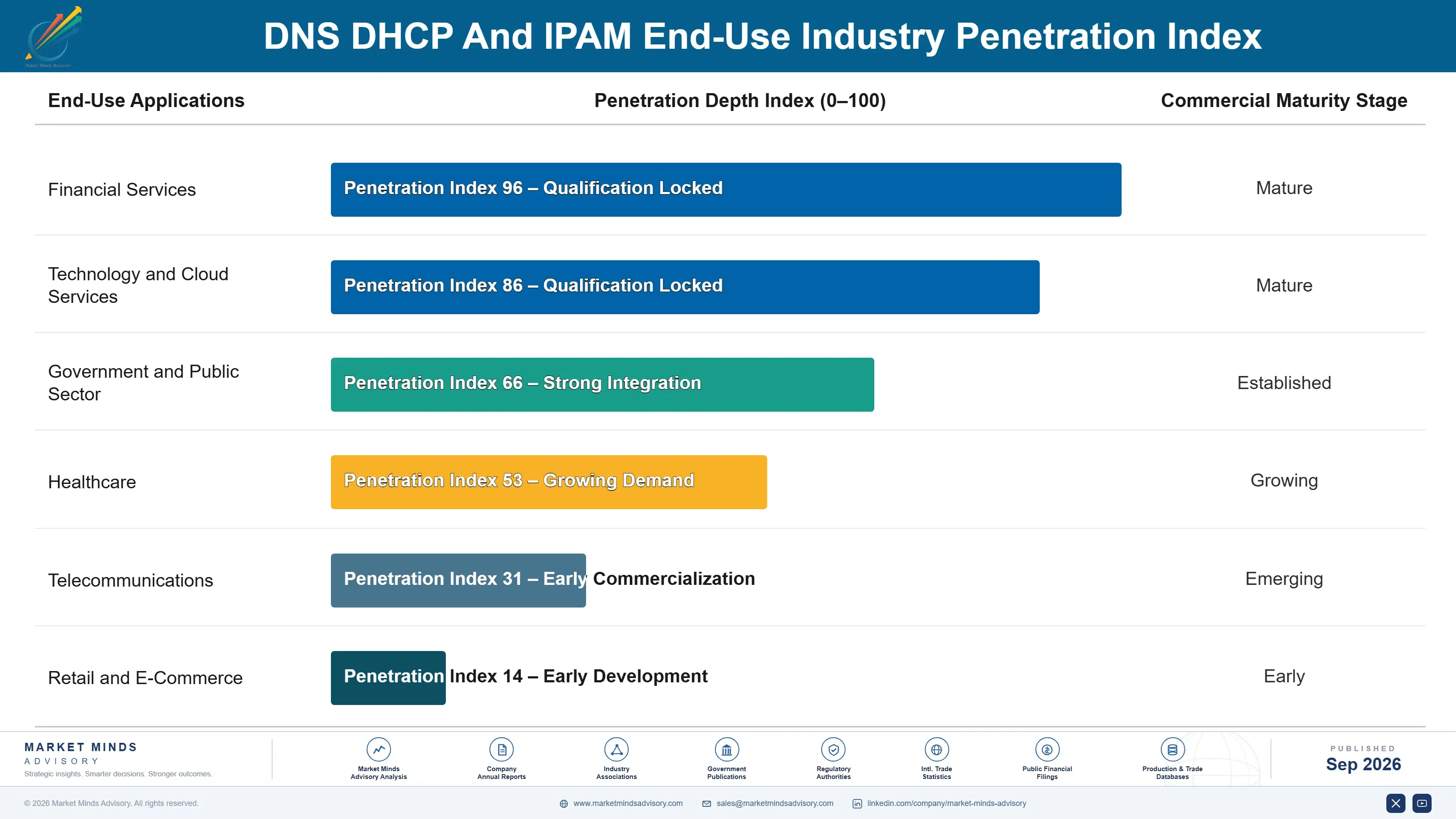
DDI platform demand runs closer to an infrastructure annuity than a one-time software purchase for most enterprise customers. Once a platform wins deployment across an enterprise's core network, expanded licensing, security add-on purchases, and managed service upgrades flow for years without a fresh competitive procurement process, giving incumbent vendors a durable, multi-cycle revenue stream that new entrants find genuinely hard to interrupt quickly once embedded.
Stickiness varies sharply by end-use vertical, though. Financial services and government relationships run deepest, anchored by regulatory compliance requirements and extensive security certification that discourages switching mid-deployment entirely. Technology sector relationships show comparable depth once a platform becomes standardized across an organization's cloud infrastructure, though the relationship is more exposed to competitive re-bidding at major modernization cycles than regulated-industry accounts tend to be. Retail and mid-market relationships sit in between, growing steadily but more price-sensitive than either regulated or large enterprise accounts.

Buyer profiles are shifting generationally as IT and security leadership turns over across most enterprise organizations. Younger technical buyers increasingly favor vendors offering cloud-native architecture and integrated security over pure incumbency, a change legacy appliance suppliers with strong historical relationships are still adjusting to across multiple regions and customer categories simultaneously.
dns-dhcp-and-ipam-market-end-use-penetration-index-1790011648804

Where DDI Strategy Should Focus Next

These are among the four positions where our research anticipates prominent divergence between winners and laggards over the coming forecast period. Each is grounded in the demand model, the regulatory perimeter, and the announced capacity pipeline.
01 / CLOUD-NATIVE PLATFORM INVESTMENT

Build cloud-native architecture into every new platform line

Cloud-native DDI platforms are capturing meaningfully higher contract value and design wins than legacy appliances, and that gap is widening as enterprises standardize on hybrid and multi-cloud network architectures across their operations, budget cycles, and IT modernization roadmaps. Vendors still shipping fixed-capacity appliances risk losing enterprise contracts to competitors offering elastic scalability at comparable manufacturing cost and validated reliability across most segments. Building cloud-native capability now, even at higher upfront engineering cost, protects design-in share before enterprises fully standardize on cloud-native infrastructure entirely.
02 / SECURITY INTEGRATION EXPANSION

Embed DNS-layer security into every core platform offering

Zero trust security adoption is expanding rapidly across enterprise networks, and vendors without integrated DNS-layer security risk losing accounts to competitors who bundle threat intelligence directly into their infrastructure platforms, dashboards, and reporting tools across every deployment. Vendors that build this capability now position themselves to capture recurring subscription revenue tied to ongoing security relationships rather than one-time infrastructure sales alone. Vendors that delay risk permanent exclusion from the security-integrated segment defining this market's fastest revenue growth trajectory going forward.
03 / CLOUD CAPACITY SECURITY

Lock in cloud infrastructure capacity ahead of demand spikes

Cloud infrastructure capacity remains periodically tight amid broader enterprise SaaS demand growth, leaving vendors without long-term hosting agreements vulnerable to extended deployment timelines during peak enterprise migration periods that recur unpredictably across the calendar year, budget cycle, and fiscal planning window. Larger competitors already secure preferential allocation through decade-long cloud infrastructure relationships that smaller rivals cannot easily replicate on short notice. Establishing multi-year capacity reservations now protects delivery reliability through the next inevitable industry-wide capacity crunch and preserves customer trust.
04 / REGIONAL ENTERPRISE POSITIONING

Expand presence across North American and Indian markets

North America anchors both hyperscale infrastructure and the deepest enterprise IT budgets for this market, while India posts the fastest country-level growth rate on rapid enterprise cloud adoption outpacing most other emerging markets tracked in this report today and well into the future. Vendors under-invested in either region face longer sales cycles or missed design-in opportunities relative to competitors already embedded in local enterprise relationships and procurement channels. Building deeper regional presence now secures proximity to both anchor markets available anywhere.

Engagement Snapshot From the Field

A live engagement with an industry participant carrying material or product regulatory and market exposure ahead of a defining policy shift, showing how our research translates into a defensible multi-year portfolio strategy.
MARKET MINDS ADVISORY · CLIENT ENGAGEMENT SUMMARY
DNS DHCP And IPAM Producer Strategic Portfolio Review and Transition Roadmap 2026·Investment Scenario on DNS DHCP And IPAM Exposure Evaluation 2025-26
CLIENT PROFILE
The client is a global financial services firm operating data centers across three continents, historically relying on legacy on-premises DDI appliances managed by regional IT teams with limited centralized visibility. Annual network infrastructure spend is approximately one hundred twenty million dollars (client-reported, unverified by MMA), with a growing share allocated to cloud migration and zero trust security initiatives.
STRATEGIC CHALLENGE
Regulatory examiners had flagged the client's fragmented, region-specific DDI infrastructure as a security and compliance risk, and leadership faced pressure to consolidate onto a unified platform before the next examination cycle began. Leadership needed an independent assessment of migration approach and vendor selection before committing to a multi-year infrastructure overhaul and budget commitment.
MMA APPROACH
MMA conducted structured interviews with the client's network engineering and compliance leadership, benchmarked competitor migration timelines against primary survey data, and modeled compliance and cost outcomes under different platform consolidation scenarios for leadership review. The engagement combined qualitative expert interviews with MMA's proprietary segment growth forecasts to prioritize which platform capability mattered most.
KEY FINDINGS
  1. Regional DDI fragmentation was creating documented visibility gaps that regulatory examiners specifically flagged in the client's most recent compliance review cycle findings.
  2. Competitors with unified cloud-native DDI platforms were reportedly passing regulatory examinations with substantially less remediation effort required during subsequent annual follow-up reviews.
  3. Legacy appliance replacement across all three continents was projected to take 20 months if pursued sequentially rather than in parallel across regions.
  4. A phased consolidation approach targeting the highest-risk region first could address the most urgent regulatory exposure within the examination timeline available to leadership.
CLIENT PROFILE
The client is a global financial services firm operating data centers across three continents, historically relying on legacy on-premises DDI appliances managed by regional IT teams with limited centralized visibility. Annual network infrastructure spend is approximately one hundred twenty million dollars (client-reported, unverified by MMA), with a growing share allocated to cloud migration and zero trust security initiatives.
STRATEGIC CHALLENGE
Regulatory examiners had flagged the client's fragmented, region-specific DDI infrastructure as a security and compliance risk, and leadership faced pressure to consolidate onto a unified platform before the next examination cycle began. Leadership needed an independent assessment of migration approach and vendor selection before committing to a multi-year infrastructure overhaul and budget commitment.
MMA APPROACH
MMA conducted structured interviews with the client's network engineering and compliance leadership, benchmarked competitor migration timelines against primary survey data, and modeled compliance and cost outcomes under different platform consolidation scenarios for leadership review. The engagement combined qualitative expert interviews with MMA's proprietary segment growth forecasts to prioritize which platform capability mattered most.
KEY FINDINGS
  1. Regional DDI fragmentation was creating documented visibility gaps that regulatory examiners specifically flagged in the client's most recent compliance review cycle findings.
  2. Competitors with unified cloud-native DDI platforms were reportedly passing regulatory examinations with substantially less remediation effort required during subsequent annual follow-up reviews.
  3. Legacy appliance replacement across all three continents was projected to take 20 months if pursued sequentially rather than in parallel across regions.
  4. A phased consolidation approach targeting the highest-risk region first could address the most urgent regulatory exposure within the examination timeline available to leadership.
RECOMMENDED STRATEGY
Phase 1: Phase one: consolidate DDI infrastructure in the highest-risk region onto a unified cloud-native platform within five months of engagement start. Phase 2: Phase two: extend the unified platform to remaining regions in parallel, targeting full consolidation within twelve months of the pilot. Phase 3: Phase three: integrate DNS-layer security and threat intelligence across the unified platform to address broader zero trust security objectives fully.
OUTCOME
Within fourteen months the client completed full DDI consolidation across all three continents and reported (client-reported, unverified by MMA) passing its subsequent regulatory examination with no infrastructure-related findings whatsoever, a marked improvement over the previous examination cycle's extensive remediation requirements and multiple time-consuming follow-up inspections.

Frequently Asked Questions

Foundational context covering the market sizes, CAGR, scope, country, region and competition that inform every finding below. This section is provided to cover basics and most often pre-purchase conversations, answered from the MMA Primary Research Dataset.

What is the current size of the DNS DHCP And IPAM Market?

The DNS DHCP And IPAM Market reached an estimated 1.4 billion dollars globally in 2025. Cloud-native platforms and zero trust security integration are the primary growth drivers today.

How large will the DNS DHCP And IPAM Market be by 2036?

MMA forecasts the market will reach approximately 3.76 billion dollars by 2036 under the base case scenario. That represents roughly a 2.46 times expansion from 2026 levels.

What is the CAGR for the DNS DHCP And IPAM Market 2026 to 2036?

The base case CAGR is 9.4 percent annually across the forecast period. Bull and bear scenarios range from 10.7 percent down to 8.1 percent respectively.

Which segment is growing fastest?

Cloud-Native and SaaS DDI Platforms is growing fastest at 16.8 percent CAGR, roughly 1.79 times the overall market rate. Hybrid cloud migration demand drives that pace.

Who are the major companies in the DNS DHCP And IPAM Market?

Leading players include Infoblox, BlueCat Networks, EfficientIP, Cisco Systems, and Microsoft. Together the top five hold an estimated 44 percent combined share of the market.

Which country is growing fastest?

India leads country-level growth at 12.8 percent CAGR, well ahead of the regional and global averages. Rapid enterprise cloud adoption and technology sector expansion are the main contributing factors.

Report Segmentation Architecture

The full report scope spans multiple orthogonal segmentation dimensions, with cross-tabulated demand data provided for each dimension pair. Coverage extends further to regional breakdowns, trend trajectories, and the competitive detail needed to support segment-level decision-making.

By Primary Market Dimension

  • DNS Management Software and Appliances
  • DHCP Management Software and Appliances
  • IP Address Management Software
  • Cloud-Native and SaaS DDI Platforms
  • DDI Security and Threat Intelligence Add-Ons
  • Managed DDI Services

By End-Use Industry

  • Financial Services
  • Technology and Cloud Services
  • Government and Public Sector
  • Healthcare
  • Telecommunications
  • Retail and E-Commerce

By Commercial Dimension

  • Direct Enterprise Software Licensing
  • Cloud Marketplace and Subscription Sales
  • System Integrator and Reseller Channels
  • Managed Service Provider Channels
  • Professional Services and Migration Support

By Region

  • North America
  • Western Europe
  • East Asia
  • South Asia and Pacific
  • Latin America
  • Middle East and Africa
  • Eastern Europe

Scope, Methodology, and Coverage

Every figure in this report is reproducible from documented input assumptions. The scope below maps the historical period, the forecast horizon, the segmentation dimensions, and the countries covered, alongside the underlying primary and qualitative methodology.
Historical Period
2020 to 2025
Forecast Period
2026 to 2036
Base Year
2025 (USD billions; MMA Primary Research Dataset, September 2026)
Market Definition
The DNS DHCP And IPAM Market covers software and appliances that manage domain name resolution, dynamic host configuration, and IP address allocation across enterprise, service provider, and hyperscale networks. It excludes general network monitoring tools, firewall and general-purpose security appliances, and downstream application delivery infrastructure unrelated to core DDI functions.
Quantitative Units
USD Billion
Segmentation Dimensions
Product and technology type, end-use industry, and commercial distribution channel
Regions Covered
North America, Western Europe, East Asia, South Asia and Pacific, Latin America, Middle East and Africa, Eastern Europe
Countries Covered
United States, China, Germany, United Kingdom, Japan, India, Brazil, and 14 additional countries
Key Companies Profiled
Infoblox Inc., BlueCat Networks Inc., EfficientIP SAS, Cisco Systems Inc., Microsoft Corporation, Men and Mice ehf, NS1 Inc, Amazon Web Services Inc, Google LLC, Akamai Technologies Inc, F5 Inc, Nokia Corporation, SolarWinds Corporation, ManageEngine (Zoho Corporation), 6connect Inc, DNSimple Inc, Constellix Inc, Neustar Inc, VeriSign Inc, Oracle Corporation
Quantitative Methodology
Primary survey, n=3,800 respondents, Q4 2025, six countries; demand-side model with trade association cross-validation
Qualitative Methodology
47 expert interviews, Q4 2025; applied to validate demand model assumptions, identify emerging dynamics, and assess competitive positioning
Report Format
PDF and XLSX data workbook (Word format preview document)
Publisher
Market Minds Advisory
Report Code
MMA-2026-TEC-903
Published
September 2026
Contact
sales@marketmindsadvisory.com | www.marketmindsadvisory.com

Purchase the full DNS DHCP And IPAM Market Report (2026 to 2036).

This report provides a comprehensive assessment of the global DNS DHCP And IPAM Market across all major product categories, end-use industries, and geographic regions through 2036. It combines MMA's primary survey dataset of 3,800 respondents with 47 expert interviews to quantify segment-level growth, competitive positioning, and regional demand mechanisms. Coverage spans market sizing, segmentation, regional dynamics, competitive benchmarking, input cost exposure, and portfolio economics. The analysis is designed to support product roadmap planning, procurement strategy, and investment decisions for platform vendors, enterprise IT teams, and security buyers evaluating this space.
Ten-year quantitative forecast by product segment
Seven-region demand and pricing breakdown analysis
Competitive benchmarking of top twenty players
Cloud infrastructure cost exposure and mitigation analysis
Margin tier and portfolio economics mapping
Primary survey and expert interview data

Built For The People Who Decide

From boardroom strategy to bench-side execution, this report is read cover-to-cover by leaders shaping the next decade of their industry, turning demand scenarios, market dynamics and valuation benchmarks into decisions.
CXOs/ Presidents/ VPs/ Managers
M&A and Corporate Development
Strategy Teams and R&D Heads
Procurement and Product Directors
Regulatory and Compliance Leaders
Investor Relations and Equity Analysts