

Market Minds Advisory
DNA Synthesis Market

DNA Synthesis Market: Enzymatic Platforms Meet Six Decades of Chemical Synthesis

Enzymatic synthesis platforms are challenging six decades of phosphoramidite chemistry as gene therapy manufacturers and DNA data storage pilots push demand for longer, cleaner synthetic DNA past what chemical routes can economically deliver.

Lead Analyst

Alice Ballenger

Published

September 2026

Make Smarter Decisions with Customized Research Insights

Request a free sample report and evaluate market opportunities, growth trends, and competitive dynamics relevant to your business needs.

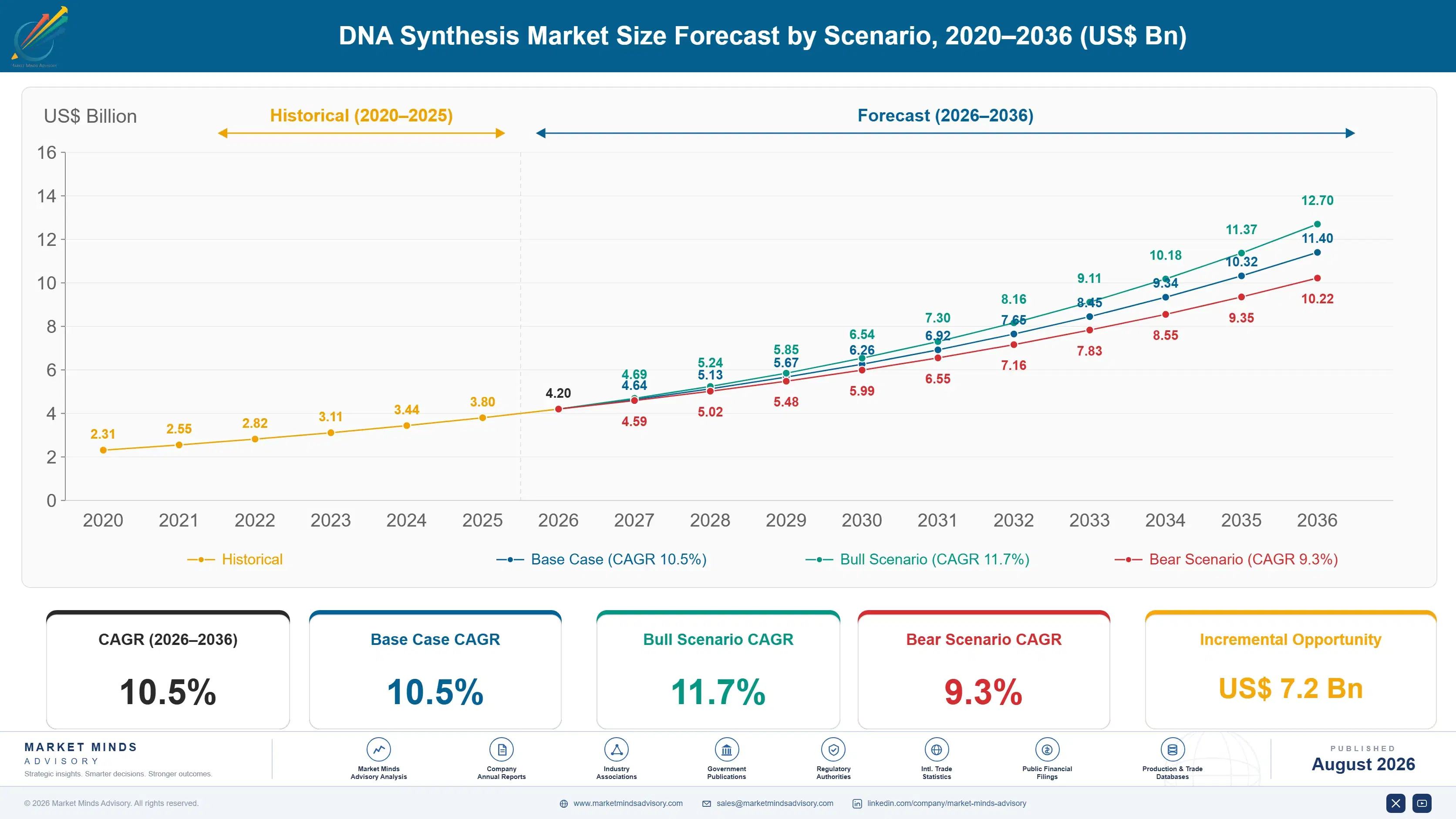
2025 MARKET VALUE$3.8BMarket Size 2025
2036 FORECAST VALUE$11.4BBase Case , 2026 to 2036
CAGR 2026 TO 203610.5 %Bull 11.7% / Bear 9.3%
INCREMENTAL OPPORTUNITY$7.2BNet 10- year value creation
EXPANSION MULTIPLE2.71x2036 value over 2026 base
Strategic Levers
M&A Pipeline
Regional Outlook
Country Rankings
Competitive Intelligence
Segmental Deep-dive
Call-Us : 91 93563 13602

Executive Snapshot and Market Trajectory

Enzymatic DNA synthesis is moving from pilot benches to production floors, giving gene therapy and synthetic biology developers a faster, cleaner alternative to sixty-year-old phosphoramidite chemistry, while chip-based array platforms simultaneously compress the cost of ordering short oligonucleotides and mid-length synthetic genes for regulated manufacturers.
Demand concentrates around three commercial forces: mRNA and cell therapy pipelines that need custom synthetic genes on shorter timelines, agricultural biotech programs synthesizing trait libraries at scale, and academic and CRO customers ordering primers and probes as consumables. Enzymatic synthesis, still under fifteen percent of volume, is growing fastest as it eliminates toxic reagents and extends oligo length beyond two hundred bases. East Asia is closing the capacity and price gap with United States suppliers.
Competitive intensity sits in a narrow tier of scaled suppliers, Integrated DNA Technologies, Twist Bioscience, and GenScript among them, that can guarantee turnaround and purity, while dozens of regional producers compete on price for standard oligonucleotides. Regulatory pressure from biosecurity screening requirements, following the 2023 White House executive order on synthetic nucleic acid procurement, is reshaping supplier selection as customers demand documented sequence screening before an order ships.
Market Definition
The DNA synthesis market covers the commercial production and sale of synthetic oligonucleotides, synthetic genes, and related synthesis instruments and reagents, produced through chemical, enzymatic, or hybrid methods. It includes custom synthesis services, catalog consumables, and synthesis platform hardware sold to pharmaceutical, biotechnology, agricultural, academic, and diagnostic customers. Downstream sequencing, PCR amplification services, and gene editing reagents are excluded unless bundled directly with a synthesis order.
Base Year Value
$3.8B in 2025 (MMA Primary Research Dataset, August 2026)
Forecast Period
2026 to 2036, eleven discrete annual values
CAGR
10.5% base case. Bull 11.7%. Bear 9.3%.
Fastest Growth Segment
Enzymatic DNA Synthesis: 19.5% CAGR
Fastest Growth Country
China: 17.0% CAGR
Fastest Growth Region
South Asia and Pacific: 12.6% CAGR
Largest Region
North America: 30% of 2025 global value
Market Leaders
Integrated DNA Technologies, Twist Bioscience, GenScript Biotech, Thermo Fisher Scientific, Eurofins Genomics. Source: MMA Analysis based on company annual reports.
Primary Survey
n=3,800 procurement and R&D decision-makers, Q4 2025, six countries
Methodology
Demand-side build-up, cross-validated against public data, 47 expert interviews

DNA Synthesis Market Forecast Scenarios

dna-synthesis-market-size-forecast-scenario-1787305471002
Between 2020 and 2025 the market grew at roughly 9.5% a year, driven by pandemic-era diagnostic primer demand in the first two years and a steadier build in gene therapy and synthetic biology ordering afterward. Chemical synthesis capacity expanded broadly across incumbent suppliers, while enzymatic platforms remained confined to early-access programs and university partnerships. That expansion set the base the decade builds from.
The base case carries the market to a 10.5% CAGR on three mechanisms. First, gene and cell therapy developers keep ordering longer, higher-fidelity synthetic genes as more programs reach clinical and commercial manufacturing. Second, agricultural biotechnology firms scale trait-library synthesis for gene-edited crop programs. Third, enzymatic platforms mature past early access, cutting turnaround time enough to pull volume away from chemical routes without materially undercutting supplier revenue per base. Institutional customers increasingly expect algorithmic sequence design bundled in.
The bull case reaches 11.7% if enzymatic synthesis reaches cost parity with phosphoramidite chemistry before 2029, pulling volume from legacy suppliers faster than modeled. The bear case falls to 9.3% if biosecurity screening mandates slow order fulfillment enough that customers consolidate purchasing with fewer, larger suppliers and overall order volume growth softens through the middle forecast years.

Chemical Synthesis Still Anchors a Market Enzymatic Platforms Are Reshaping

Three forces converge on this market at once. Falling per-base pricing keeps drawing new academic and biotech customers into routine ordering, gene and cell therapy manufacturing keeps lengthening the average synthetic construct, and biosecurity screening rules keep raising the compliance bar every supplier must clear before shipping an order. That combination is pulling capital toward suppliers who can move fastest on all three fronts at once, not just the ones defending cost.
MARKET CONCENTRATION (CR5)42%Top five suppliers hold well under half share
AVERAGE OLIGO PRICE$0.06/baseStandard-scale synthesis pricing continues falling on automation gains
TOP PRODUCING COUNTRY SHARE38%United States still leads installed synthesis capacity globally
CAPACITY UTILISATION76%Scaled facilities run near full continuous production capacity
TRADE INTENSITY31%Nearly a third of orders cross international borders routinely
FEEDSTOCK COST SHARE22% of COGSReagent and enzyme inputs weigh heavily on margins
Commercially, the market splits sharply between catalog consumables, priced near commodity levels and shipped within days, and custom gene synthesis, priced on complexity and length and often carrying multi-week lead times for constructs that fail assembly on the first attempt. Instrument sales sit alongside both as a smaller, higher-margin category tied to enzymatic platform adoption. That margin gap is widening as custom orders grow more technically demanding across the industry.
Over the next decade the defining question is whether enzymatic synthesis becomes the default production method or remains a premium tier for applications chemical synthesis genuinely cannot serve, particularly long, GC-rich constructs used in gene therapy vector design. Suppliers betting on the wrong answer risk stranding real capital.
"Every enzymatic synthesis pitch promises to replace phosphoramidite chemistry outright, but the more interesting shift is quieter: chemical synthesis is getting good enough at length and speed that enzymatic platforms may end up owning a narrower, higher-value niche than their backers expected."
Director, Genomics and Synthetic Biology Practice · MMA Healthcare / Life Scienc

Market Trends

Enzymatic Synthesis Platforms Reach Commercial Deployment

DNA Script's SYNTAX system and Ansa Biotechnologies' enzymatic platform have both moved from early-access programs into paid commercial deployment since 2023, offering same-day turnaround for short oligonucleotides without the toxic solvents phosphoramidite chemistry requires. Evonetix and Molecular Assemblies are pursuing parallel approaches aimed at longer constructs. Adoption remains concentrated among well-funded biotech and pharmaceutical customers willing to pay a premium for speed and reduced hazardous waste handling, but per-unit cost is falling roughly fifteen percent a year as platforms scale, narrowing the gap with chemical synthesis pricing faster than most suppliers projected two years ago.
Market Impact: Adds over 2,000 active clinical pro

Biosecurity Screening Requirements Reshape Supplier Selection

Following the October 2023 White House executive order on synthetic nucleic acid procurement, federally funded United States research now requires suppliers to screen orders against sequences of concern before shipment. The International Gene Synthesis Consortium's member screening protocol has become a de facto purchasing requirement among pharmaceutical and government-adjacent customers, even outside strict regulatory mandates. Smaller regional suppliers without automated screening infrastructure are losing institutional accounts to scaled suppliers that can document compliance instantly, consolidating purchasing among fewer vendors capable of proving order-level biosecurity screening on demand. That consolidation is reshaping which suppliers institutional buyers consider eligible at all.
Market Impact: Trait libraries exceed 5,000 varian

Market Opportunities and Growth Drivers

Gene and Cell Therapy Pipelines Lengthen Average Construct Orders

The FDA approved eight cell and gene therapies in 2024 alone, and the clinical pipeline behind them now exceeds two thousand active programs by industry association counts, each requiring custom synthetic genes for vector design, plasmid backbones, and guide RNA constructs. Average order length for therapy-linked synthesis has grown from roughly one thousand base pairs to several thousand as developers move from proof-of-concept vectors to full manufacturing constructs. This shifts revenue toward higher-value custom gene synthesis and away from short catalog oligonucleotides, rewarding suppliers who can guarantee assembly success on long, GC-rich sequences without repeated resynthesis.
Market Impact: Adds 2 to 3 weeks delay

Agricultural Biotechnology Scales Trait-Library Synthesis Volume

Gene-edited crop programs at Corteva, Bayer, and a growing set of agricultural biotech start-ups now synthesize trait libraries numbering in the thousands of variants per breeding cycle, replacing older cloning-based methods that took months per construct. USDA's 2020 biotechnology rule simplified regulatory review for many gene-edited traits, accelerating the number of programs moving from lab to field trial. Each program places recurring bulk orders for short synthetic DNA fragments used in guide RNA design and marker-assisted selection, a volume driver distinct from and additive to therapeutic demand. That steady bulk ordering gives suppliers predictable baseline volume regardless of therapy demand.
Market Impact: Delays roughly 6% of orders

Market Restraints and Challenges

Long, GC-Rich Constructs Still Fail Assembly Repeatedly

Sequences with extreme GC content, repetitive elements, or secondary structure remain difficult to synthesize reliably regardless of method, and the root cause is physical: both chemical coupling efficiency and enzymatic extension fidelity degrade as strand length and complexity increase. Suppliers routinely need two or three synthesis attempts to deliver a correct long construct, adding weeks to gene therapy vector timelines and raising effective cost per successful base. Several suppliers are mitigating the problem with computational sequence redesign tools that substitute synonymous codons to reduce problematic motifs before synthesis begins, cutting failure rates on affected orders substantially.
Market Impact: Adds 4 new commercial platforms

Biosecurity Screening Adds Cost and Delay to Every Order

Sequence screening against controlled pathogen and toxin databases now adds processing time to a share of orders, and the root cause is that screening software still generates false positives on benign sequences sharing short homologous regions with flagged ones, requiring manual biosecurity review before release. That review can add several days to turnaround on flagged orders and requires suppliers to staff dedicated compliance teams, a fixed cost smaller producers struggle to absorb. Industry consortium members are mitigating the friction by pooling screening infrastructure and sharing a common flagged-sequence database to cut duplicate manual review across suppliers.
Market Impact: Covers 80% of institutional volume
3 additional market trends, 4 additional growth drivers, and 3 additional restraints and challenges are covered in the full report. Contact sales@marketmindsadvisory.com to access the complete intelligence.

Segment CAGR and Growth Architecture

Segmentation follows synthesis technology, a single method-based logic distinguishing how DNA is actually built. Each technology carries its own cost curve, achievable length, and turnaround profile, so commercial position tracks the synthesis method rather than the end application the DNA is ordered for. Upstream reagent chemistry and downstream cloning services are treated as separate commercial dimensions, not parallel segments here.
dna-synthesis-market-market-share-analysis-1787305471574

Enzymatic DNA Synthesis

Enzymatic synthesis, using template-independent enzymes such as terminal deoxynucleotidyl transferase to build strands one base at a time, grows fastest at 19.5%, about 1.86 times the overall rate, from a small installed base concentrated among well-funded biotech customers. The method eliminates the toxic solvents and coupling reagents phosphoramidite chemistry requires, produces less hazardous waste, and increasingly matches chemical synthesis on turnaround for short constructs. Commercial platforms from DNA Script and Ansa Biotechnologies remain priced at a premium over chemical synthesis, but per-unit cost has fallen fifteen percent annually since 2023 as reagent consumption efficiency improves. Achievable strand length still trails chemical synthesis for the longest constructs, which keeps enzymatic adoption concentrated in applications valuing speed and reduced hazardous handling.
CAGR 19.5%

Microarray and Chip-Based Parallel Synthesis

Chip-based synthesis, which builds tens of thousands of short DNA sequences in parallel on a single silicon or glass substrate, grows at 14.0%, the second-fastest technology, as suppliers such as Twist Bioscience use the approach to drive catalog oligonucleotide and gene fragment pricing down sharply. Parallelization spreads fixed synthesis cost across enormous batch sizes, making chip-based platforms the lowest-cost route for short, high-volume orders including trait libraries and combinatorial screening panels. The tradeoff is per-sequence yield, which runs far lower than single-column chemical synthesis, confining chip-based output to applications needing many distinct short sequences rather than large quantities of any single one. Continued yield improvement is the main lever suppliers are pulling to expand the segment's addressable order size.
CAGR 14.0%
Full segment breakdown across 6 segments available in the complete report.

Regional Architecture and Country Demand Map

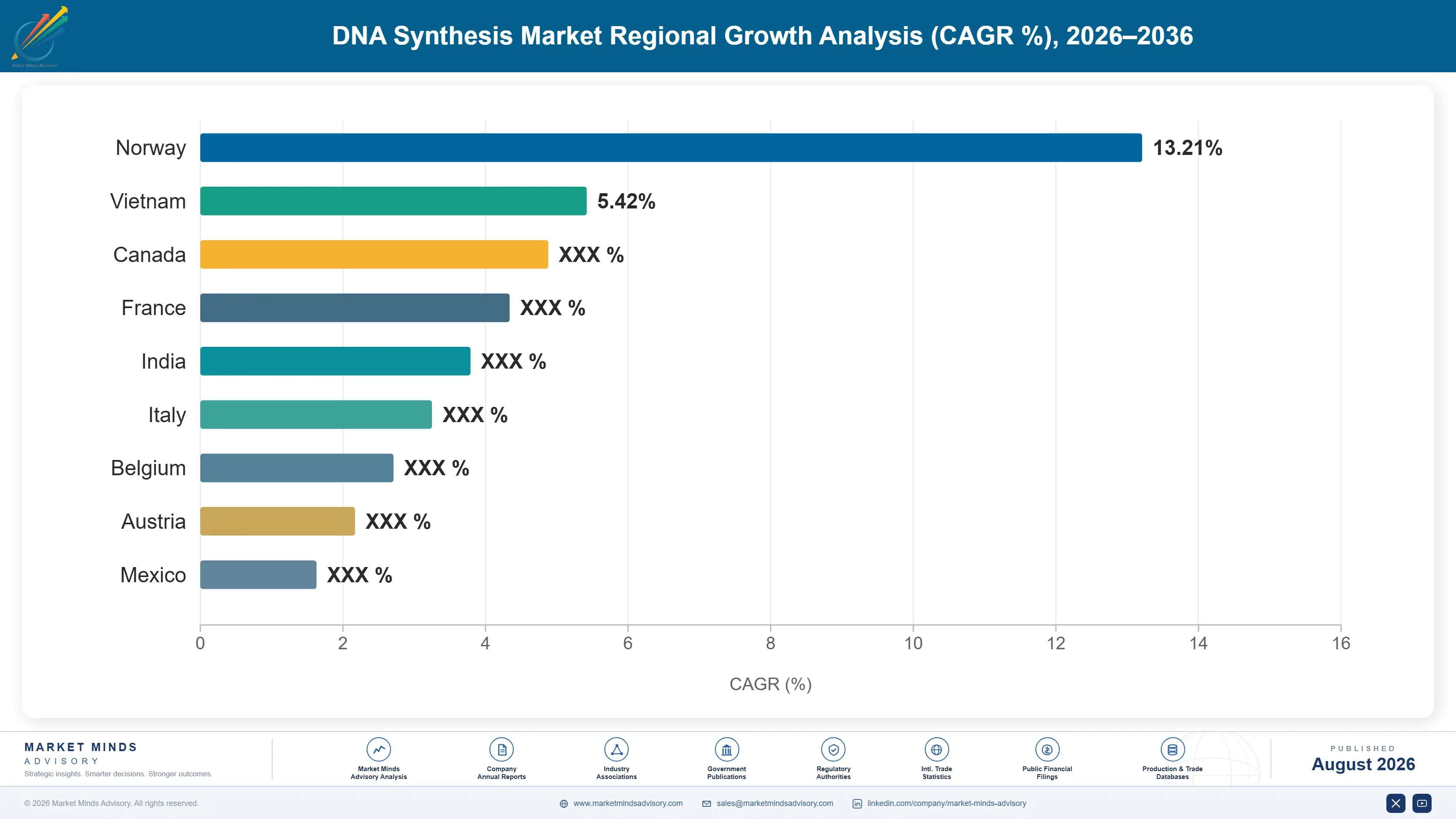
North America retains the largest share on concentrated domestic supplier capacity, while East Asia closes the gap fastest on Chinese synthesis investment and South Asia and Pacific compounds off a smaller genomics research base. Western Europe holds a steady middle position while smaller regions grow off lower bases.

North America

United States suppliers still anchor global capacity, with Integrated DNA Technologies' Iowa production campus and Twist Bioscience's South San Francisco and Portland facilities handling a large share of custom gene and oligonucleotide orders shipped worldwide. NIH-funded gene therapy and synthetic biology research keeps institutional ordering steady, and the region's concentration of cell and gene therapy manufacturers, many clustered around Boston and the Bay Area, drives disproportionate demand for long, GC-rich custom constructs. The October 2023 biosecurity executive order originated here and now shapes supplier screening practices adopted well beyond United States borders. Growth trails East Asia and South Asia and Pacific because the region's supplier base is already scaled, leaving less room for the expansion smaller markets are still capturing.
Share: 30% | CAGR: 9.8% (2026 to 2036)

Western Europe

Germany and the United Kingdom host the region's deepest academic genomics infrastructure, with Cambridge, Munich, and the Oxford biotech cluster generating steady custom synthesis demand tied to publicly funded life sciences research. Eurofins Genomics, headquartered in Germany, runs one of the region's largest oligonucleotide production networks and exports across the continent from centralized facilities. European Medicines Agency approvals for cell and gene therapies have lagged United States FDA approvals by roughly a year on average, slowing the therapy-linked demand growth that lifts North American and East Asian volumes faster. Regional biosecurity screening rules under discussion at the European Commission remain less prescriptive than the American executive order, leaving supplier compliance practices more fragmented across member states.
Share: 20% | CAGR: 9.0% (2026 to 2036)
Regional intelligence for 5 additional markets available in the complete report: East Asia, South Asia and Pacific, Latin America, Middle East and Africa, Eastern Europe. Contact sales@marketmindsadvisory.com.
dna-synthesis-market-country-cagr-analysis-1787305472097

Where Synthesis Suppliers Can Defend Margin

Four commercial moves separate suppliers gaining share from those losing it to price competition: guaranteed long-construct assembly, enzymatic platform licensing, compliance-as-a-service screening, and bundled downstream assembly and cloning services that keep customers from re-shopping each order. Each move trades near-term margin investment for a defensible position competitors without matching infrastructure cannot easily replicate within a single budget cycle.

Guarantee First-Attempt Assembly on Long Constructs

Gene therapy customers pay a premium for suppliers who can guarantee correct assembly of long, GC-rich constructs on the first attempt, since repeated resynthesis adds weeks to manufacturing timelines that carry real clinical trial costs. Suppliers investing in computational sequence redesign and proprietary coupling chemistry improvements can charge 20% to 30% above standard custom gene pricing for a documented first-pass success guarantee. This converts a chronic reliability problem into a premium service tier rather than a cost center, and it builds switching costs once a customer's construct library is validated against one supplier's synthesis platform.
Market Impact: Commands 20% to 30% pricing premium

License Enzymatic Platforms Rather Than Compete Head-On

Incumbent chemical synthesis suppliers facing enzymatic disruption have an alternative to competing directly: licensing or partnering with enzymatic technology developers to offer both methods under one account relationship, capturing the customer regardless of which technology ultimately wins a given order. Thermo Fisher's 2024 distribution partnerships with emerging enzymatic platform developers illustrate the model, adding a new revenue line without the capital cost of building enzymatic manufacturing from scratch. This defends the existing customer relationship, which is worth more over a multi-year ordering relationship than the margin on any single technology choice.
Market Impact: Preserves accounts worth 3 to 5 yea

Sell Biosecurity Screening as a Standalone Compliance Service

Automated sequence screening infrastructure, built to satisfy the 2023 executive order and International Gene Synthesis Consortium protocols, has value beyond a single supplier's own order flow. Suppliers with scaled screening capability can license or resell compliance verification to smaller producers and even to customers synthesizing DNA in-house on benchtop enzymatic devices, converting a regulatory cost center into a fee-generating service. Early movers offering this as a distinct line item report it recovering a meaningful share of their total compliance infrastructure spend within two years of launch. Two suppliers have already signed multi-year licensing deals with regional competitors under this model.
Market Impact: Recovers up to 40% of compliance in

Bundle Gene Synthesis With Downstream Cloning and Assembly

Customers ordering a synthetic gene almost always need it cloned into a vector and verified before use, and suppliers that bundle synthesis with cloning, sequence verification, and plasmid preparation capture revenue that otherwise flows to a separate contract research organization. GenScript's integrated synthesis-to-clone service lines demonstrate the model, and bundled orders typically carry 8 to 12 points higher blended margin than standalone synthesis because the incremental cloning step reuses existing laboratory infrastructure. This also raises switching costs meaningfully, since a customer moving suppliers must requalify an entire workflow rather than a single product.
Market Impact: Lifts blended order margin by 8 to

Who Controls the Margin Pool

Concentration sits at a moderate CR5 of 42%, with a gap separating the top tier from mid-sized challengers. Integrated DNA Technologies and Twist Bioscience compete on scale and turnaround guarantees, while GenScript and Eurofins Genomics anchor strong regional positions in Asia and Europe. Dozens of smaller producers compete almost entirely on price for standard catalog oligonucleotides, a segment with thin differentiation and thin margins.
Current competitive activity runs along three lines: enzymatic platform commercialization, where DNA Script and Ansa Biotechnologies are racing incumbents to prove cost parity; biosecurity screening, now a purchasing criterion; and vertical bundling into cloning and assembly services, which GenScript and Twist Bioscience have both pushed to raise switching costs. All participants here are assessed on one consistent basis, annual revenue from DNA synthesis products and services.

Pressure is building from two directions. Enzymatic platform developers threaten to erode chemical synthesis pricing power on short, high-volume orders even before reaching full cost parity. Chinese suppliers are pushing into export markets with meaningfully lower pricing, backed by domestic capacity investment Western suppliers cannot match. Rankings over the next five years shift toward incumbents that adopt enzymatic methods or bundle services enough that price alone stops deciding the order.
dna-synthesis-market-company-positioning-matrix-1787305472616

Competitive Moat and Risk Dimensions

TWIST BIOSCIENCE

Moat: Silicon-based parallel synthesis cost curve

Twist's proprietary silicon chip synthesis platform parallelizes short-sequence production at a scale chemical column synthesis cannot match, driving catalog oligonucleotide and gene fragment pricing below competitors. That cost edge has let Twist win trait-library and combinatorial screening contracts requiring wide sequence diversity at low per-unit cost, holding a durable advantage in that segment.
TWIST BIOSCIENCE

Risk: Persistent operating losses continue

Twist has not reached sustained profitability despite years of revenue growth, and continued capital spending on capacity expansion keeps pressuring margins. Should enzymatic platforms reach cost parity on the short-sequence orders where Twist's chip-based approach currently wins on price, the company's core cost advantage narrows just as it needs profitability to satisfy public market investors increasingly impatient with the timeline.
INTEGRATED DNA TECHNOLOGIES

Moat: Deepest institutional customer relationships

IDT's decades-long presence in academic and diagnostic markets has built the broadest installed customer base in the industry, reinforced by catalog breadth spanning primers, probes, and custom genes under one account relationship. That relationship depth, combined with Danaher's balance sheet backing continued capacity investment, gives IDT pricing and service flexibility that smaller independent competitors cannot easily replicate.
INTEGRATED DNA TECHNOLOGIES

Risk: Parent company capital allocation discipline

As a Danaher subsidiary, IDT's capital spending competes internally against Danaher's broader life sciences portfolio for investment priority, which can slow IDT's response to fast-moving enzymatic competitors relative to independently funded rivals racing to commercialize new synthesis technology on their own capital timeline and appetite for risk.

Players Tracked

Prominent Players

Integrated DNA Technologies
Twist Bioscience
GenScript Biotech
Thermo Fisher Scientific
Eurofins Genomics

Other Key Players

Azenta Life Sciences
DNA Script
Ansa Biotechnologies
Agilent Technologies
LGC Biosearch Technologies
Bio-Rad Laboratories
MilliporeSigma
Takara Bio
Synbio Technologies
ATDBio
Biolegio
TriLink BioTechnologies
Kilobaser
GeneCopoeia
Evonetix

Recent Developments

MAY 2025

DNA Script and Thermo Fisher Scientific sign commercial supply agreement

The companies signed a multi-year supply and distribution agreement placing DNA Script's enzymatic synthesis instruments through Thermo Fisher's global life sciences distribution network. This was a commercial supply agreement, not a joint venture or acquisition. The deal gives DNA Script access to institutional accounts it could not reach alone.
Signal: A distribution deal, not equity consolidat
SEPTEMBER 2024

Twist Bioscience completes South San Francisco capacity expansion

Twist completed an organic expansion of its silicon-based synthesis production line, adding meaningful annual capacity for oligonucleotide pool and gene fragment orders. The expansion was funded from existing capital rather than any acquisition or partnership, and management cited sustained demand growth from combinatorial screening customers.
Signal: Organic capacity investment, not consolida
FEBRUARY 2025

GenScript Biotech takes minority equity stake in enzymatic synthesis start-up

GenScript acquired a minority equity position in an early-stage enzymatic DNA synthesis developer, gaining a board observer seat but no operational control. The transaction was structured as a minority investment rather than an acquisition or joint venture, giving GenScript visibility into enzymatic technology without committing to a full platform buildout.
Signal: A minority stake, not a takeover, shows in

Reagents and Enzymes Drive Synthesis Cost

Phosphoramidite monomers, solvents, and coupling reagents together account for roughly twenty-two percent of chemical synthesis COGS, sourced primarily from specialty chemical manufacturers in the United States, Germany, and increasingly China, where several monomer producers have scaled since 2022. Enzymatic platforms carry a different cost structure, weighted toward proprietary engineered enzymes and modified nucleotides that remain expensive relative to bulk chemical reagents.
The clearest recent volatility event traces to acetonitrile, a solvent essential to phosphoramidite synthesis that saw global shortages in 2021 and 2022 after a major Chinese production facility explosion disrupted supply, according to American Chemical Society reporting on the incident. Prices spiked several-fold within months, and several smaller synthesis suppliers reported multi-week order delays as they rationed remaining inventory, a disruption large suppliers with diversified sourcing weathered far more easily.

Exposure varies sharply by supplier scale. Large suppliers with diversified, multi-region reagent sourcing and forward-purchasing agreements absorb input volatility with minimal customer-facing price impact, while smaller regional producers dependent on single-source distributors pass cost spikes directly to customers or absorb painful margin compression. Chinese producers face the least direct exposure to Western solvent supply disruptions given proximity to expanding domestic monomer and solvent manufacturing capacity.
dna-synthesis-market-cost-volatility-analysis-1787305472810

Diversify Reagent Sourcing Across Multiple Regions

Suppliers are qualifying second and third sourcing regions for critical solvents and monomers rather than relying on single-region supply chains, reducing exposure to any one facility disruption or export restriction event affecting a concentrated production base. This mirrors practices already standard in semiconductor and pharmaceutical reagent procurement, where single-source dependency has caused costly production halts in past years.

Forward-Purchase Key Reagents Against Demand Forecasts

Larger suppliers now lock multi-quarter reagent volumes at fixed pricing through forward purchase agreements, insulating production cost from spot market volatility even when it means holding larger working capital inventory positions than in past years. Smaller producers are beginning to pool purchasing through industry consortia to negotiate similar fixed-price terms collectively, narrowing the scale gap somewhat.

Shift Volume Toward Lower-Reagent-Intensity Enzymatic Methods

Some suppliers are directing price-sensitive short-order volume toward enzymatic platforms where feasible, since engineered enzyme cost, while currently high per unit, does not carry the same solvent supply chain volatility as chemical synthesis reagents. This shift also reduces hazardous waste disposal cost, a secondary benefit suppliers are increasingly citing when justifying the capital investment enzymatic platforms require.

Portfolio Architecture for Margin Defence

The portfolio splits into three tiers with real margin separation. Volume catalog oligonucleotides compete almost entirely on price and turnaround, earning thin margins defended mainly through automation scale. Certified premium custom gene synthesis, backed by guaranteed assembly and documented quality systems, earns substantially more because gene therapy customers pay for reliability over price. That gap widens whenever a program's timeline value exceeds the tier price difference.
The tension between volume and premium shapes how suppliers allocate capacity: catalog orders keep production lines full and cash flowing between large custom projects, but chasing volume too aggressively starves the specialized capacity long, complex constructs require. Suppliers that let custom gene synthesis crowd out catalog capacity risk losing the steady institutional relationships that anchor recurring revenue. Suppliers that manage this balance well retain both customer bases longer.

High-value pools concentrate in gene therapy vector construct synthesis and enzymatic platform licensing, where technical difficulty and regulatory stakes justify premium pricing few competitors can match. The emerging next-generation tier, enzymatic and hybrid synthesis platforms, currently earns unevenly as suppliers absorb technology investment costs against still-developing commercial volume. That unevenness should narrow as enzymatic platforms reach broader commercial scale.

Volume / Commodity-Adjacent Tier

Standard catalog oligonucleotides, primers, and probes sold on price and fast turnaround to academic and diagnostic customers., where automation scale and order-processing efficiency determine which suppliers can sustain margin at commodity-level pricing.
Gross Margin: 20-35%

Premium / Certified Tier

Custom gene synthesis with guaranteed first-pass assembly and documented quality systems for pharmaceutical and gene therapy manufacturing customers., who pay a sustained premium for reliability over price given the clinical and manufacturing timelines a failed synthesis attempt puts at risk.
Gross Margin: 45-60%

Sustainability / Regulatory / Next-Generation Tier

Enzymatic and hybrid synthesis platforms and licensed compliance screening services, still absorbing technology investment against developing volume., where suppliers are betting capital today on technology and screening infrastructure they expect institutional customers to demand as standard within a few years.
Gross Margin: 25-50%
dna-synthesis-market-portfolio-architecture-1787305473306

How Synthesis Demand Actually Recurs

Demand here runs on repeat ordering rather than one-time purchase. A gene therapy program orders synthetic constructs continuously across years of development and eventual manufacturing, while academic labs place standing catalog orders for primers and probes as routine consumables tied to ongoing research budgets rather than discrete projects. That recurring pattern gives suppliers unusually predictable revenue visibility years ahead of any single order shipping.
Adoption depth varies sharply by vertical. Pharmaceutical and gene therapy customers integrate synthesis suppliers deeply into validated manufacturing workflows, making supplier switching costly and rare once a construct is qualified. Academic and diagnostic customers, by contrast, shop more freely on price for standard catalog items, switching suppliers with little friction when a competitor undercuts on turnaround or cost. That difference forces suppliers to split strategy between retention and price.

Buyer profiles are shifting generationally as synthetic biology moves from specialist technique to standard laboratory practice. Younger researchers trained on cloud-based design tools expect instant online ordering and algorithmic sequence optimization as standard service, pushing suppliers to invest in digital ordering platforms well beyond the phone-and-email workflows that defined the industry a decade ago. Suppliers slow to modernize ordering risk losing tomorrow's customers.
dna-synthesis-market-end-use-penetration-index-1787305473795

Where DNA Synthesis Value Concentrates Next

These are among the four positions where our research anticipates prominent divergence between winners and laggards over the coming forecast period. Each is grounded in the demand model, the regulatory perimeter, and the announced capacity pipeline.
01 / ENZYMATIC PLATFORM BETS

Back enzymatic synthesis for speed-critical orders, not blanket replacement

Enzymatic synthesis will not replace chemical synthesis broadly within the forecast period, since achievable length and per-base cost still trail phosphoramidite chemistry for long, complex constructs. Its genuine advantage is turnaround speed and reduced hazardous waste on short, time-sensitive orders where customers will pay a premium regardless of underlying cost parity. Suppliers should position enzymatic capacity as a premium speed tier rather than a wholesale replacement strategy., reserving heaviest platform investment for the specific order types where speed alone justifies the price gap over the next several years.
02 / BIOSECURITY COMPLIANCE INVESTMENT

Treat screening infrastructure as a revenue line, not only a cost

Biosecurity screening requirements are consolidating institutional purchasing toward suppliers who can document compliance instantly, and that consolidation will only deepen as more customers adopt International Gene Synthesis Consortium protocols voluntarily. Suppliers who built screening infrastructure early now hold a genuine competitive advantage over smaller producers still catching up, a gap that widens further each time a new institutional customer adopts consortium screening as a default procurement requirement. The smartest operators are already reselling that infrastructure as a standalone compliance service to smaller competitors and in-house synthesizers.
03 / GENE THERAPY CONSTRUCT FOCUS

Prioritize guaranteed long-construct assembly over catalog volume growth

Gene and cell therapy manufacturing will keep lengthening average order complexity faster than any other demand segment through the forecast period, and customers in this vertical pay reliably for guaranteed first-pass assembly on difficult sequences. Suppliers chasing catalog volume growth risk under-investing in the specialized capability this higher-margin, faster-growing segment actually requires. Capacity allocation decisions made now will determine which suppliers capture this premium pool over the next decade., since specialized long-construct capacity cannot be built quickly once demand has already shifted toward competitors who invested earlier.
04 / CHINESE CAPACITY EXPANSION

Expect Chinese suppliers to keep taking export share on cost

Chinese synthesis capacity, backed by coordinated government investment under the fourteenth five-year plan, is expanding faster than any other national market and increasingly targets export customers with pricing Western suppliers cannot easily match. Export screening friction from some Western institutional buyers offers only partial protection against this pressure, though that protection is narrowing as Chinese suppliers build their own certification. Western suppliers should expect continued share erosion in price-sensitive catalog segments and should concentrate defensible value in the guaranteed-assembly and compliance-service tiers Chinese suppliers have not yet matched.

Engagement Snapshot From the Field

A live engagement with an industry participant carrying material or product regulatory and market exposure ahead of a defining policy shift, showing how our research translates into a defensible multi-year portfolio strategy.
MARKET MINDS ADVISORY · CLIENT ENGAGEMENT SUMMARY
DNA Synthesis Producer Strategic Portfolio Review and Transition Roadmap 2026·Investment Scenario on DNA Synthesis Exposure Evaluation 2025-26
CLIENT PROFILE
A clinical-stage gene therapy developer preparing to move a lead AAV vector program from preclinical into IND-enabling manufacturing approached MMA to evaluate synthesis supplier options. The client reported roughly USD 180 million in total funding raised across prior venture rounds, with no synthetic DNA supplier yet locked in for GMP-adjacent manufacturing scale-up (client-reported, unverified by MMA).
STRATEGIC CHALLENGE
The client's vector construct was long and GC-rich, and two prior synthesis attempts with a lower-cost regional supplier had failed assembly, delaying the preclinical timeline by several months. Management needed to select a supplier that could guarantee assembly reliability at manufacturing scale while staying within a constrained program budget ahead of a critical funding milestone.
MMA APPROACH
MMA benchmarked assembly success rates and guaranteed-delivery terms across five scaled suppliers using confidential program-level data shared under NDA, modeled total program cost including resynthesis risk rather than list price alone, and assessed each supplier's biosecurity screening documentation against the client's eventual FDA submission requirements. We also interviewed each supplier's technical account team to gauge realistic turnaround commitments under manufacturing-scale order volume.
KEY FINDINGS
  1. The lowest list-price supplier carried a documented first-pass failure rate on comparable GC-rich constructs nearly triple the client's prior experience, making it the highest true-cost option once resynthesis delay was priced in.
  2. One supplier's guaranteed-assembly premium pricing, roughly twenty-five percent above standard rates, would have paid for itself within a single avoided resynthesis cycle given the client's development timeline value.
  3. Only two of five evaluated suppliers could produce full biosecurity screening documentation formatted for direct inclusion in an eventual FDA submission package without additional client-side preparation work.
  4. Switching suppliers mid-program after the two prior failures would still net positive against staying with the original low-cost vendor, once program delay cost was included in the comparison (client-reported, unverified by MMA).
CLIENT PROFILE
A clinical-stage gene therapy developer preparing to move a lead AAV vector program from preclinical into IND-enabling manufacturing approached MMA to evaluate synthesis supplier options. The client reported roughly USD 180 million in total funding raised across prior venture rounds, with no synthetic DNA supplier yet locked in for GMP-adjacent manufacturing scale-up (client-reported, unverified by MMA).
STRATEGIC CHALLENGE
The client's vector construct was long and GC-rich, and two prior synthesis attempts with a lower-cost regional supplier had failed assembly, delaying the preclinical timeline by several months. Management needed to select a supplier that could guarantee assembly reliability at manufacturing scale while staying within a constrained program budget ahead of a critical funding milestone.
MMA APPROACH
MMA benchmarked assembly success rates and guaranteed-delivery terms across five scaled suppliers using confidential program-level data shared under NDA, modeled total program cost including resynthesis risk rather than list price alone, and assessed each supplier's biosecurity screening documentation against the client's eventual FDA submission requirements. We also interviewed each supplier's technical account team to gauge realistic turnaround commitments under manufacturing-scale order volume.
KEY FINDINGS
  1. The lowest list-price supplier carried a documented first-pass failure rate on comparable GC-rich constructs nearly triple the client's prior experience, making it the highest true-cost option once resynthesis delay was priced in.
  2. One supplier's guaranteed-assembly premium pricing, roughly twenty-five percent above standard rates, would have paid for itself within a single avoided resynthesis cycle given the client's development timeline value.
  3. Only two of five evaluated suppliers could produce full biosecurity screening documentation formatted for direct inclusion in an eventual FDA submission package without additional client-side preparation work.
  4. Switching suppliers mid-program after the two prior failures would still net positive against staying with the original low-cost vendor, once program delay cost was included in the comparison (client-reported, unverified by MMA).
RECOMMENDED STRATEGY
Phase 1: Phase 1 (0 to 2 months): Select the guaranteed-assembly supplier for the immediate lead construct, accepting the pricing premium against a documented total-cost model. Phase 2: Phase 2 (2 to 8 months): Requalify remaining pipeline constructs under the new supplier relationship to standardize screening documentation ahead of IND filing. Phase 3: Phase 3 (8 to 18 months): Negotiate a multi-year volume agreement locking pricing ahead of anticipated capacity-driven cost increases across the supplier's institutional customer base.
OUTCOME
The client's lead construct assembled correctly on the first attempt under the new supplier relationship, recovering roughly ten weeks against the prior timeline. The client subsequently closed a Series C round citing manufacturing readiness as a factor, reporting the round at USD 95 million (client-reported, unverified by MMA).

Frequently Asked Questions

Foundational context covering the market sizes, CAGR, scope, country, region and competition that inform every finding below. This section is provided to cover basics and most often pre-purchase conversations, answered from the MMA Primary Research Dataset.

What is the current size of the DNA Synthesis Market?

The DNA synthesis market was valued at USD 3.8 billion in 2025. Growth is driven by gene therapy manufacturing, agricultural biotechnology, and expanding enzymatic synthesis adoption.

How large will the DNA Synthesis Market be by 2036?

The market is projected to reach USD 11.4 billion by 2036 under the base case scenario. That reflects an expansion multiple of roughly 2.71 times the 2026 value.

What is the CAGR for the DNA Synthesis Market 2026 to 2036?

The base case CAGR is 10.5%, with a bull case of 11.7% and a bear case of 9.3%. Enzymatic platform adoption speed is the main swing factor between scenarios.

Which segment is growing fastest?

Enzymatic DNA synthesis grows fastest at 19.5% CAGR, roughly 1.86 times the overall market rate. Chip-based parallel synthesis follows as the second-fastest segment at 14.0%.

Who are the major companies in the DNA Synthesis Market?

Leading suppliers include Integrated DNA Technologies, Twist Bioscience, GenScript Biotech, Thermo Fisher Scientific, and Eurofins Genomics. The top five hold a combined 42% of the market.

Which country is growing fastest?

China is the fastest-growing country at 17.0% CAGR, driven by government-backed synthetic biology investment and expanding domestic production capacity. GenScript and Synbio Technologies anchor that buildout.

Report Segmentation Architecture

The full report scope spans multiple orthogonal segmentation dimensions, with cross-tabulated demand data provided for each dimension pair. Coverage extends further to regional breakdowns, trend trajectories, and the competitive detail needed to support segment-level decision-making.

By Synthesis Technology

  • Phosphoramidite Chemical Synthesis
  • Enzymatic DNA Synthesis
  • Microarray and Chip-Based Synthesis
  • PCR-Based Gene Assembly
  • Cell-Free Synthetic Biology Platforms
  • Hybrid Enzymatic-Chemical Synthesis

By End-Use Industry

  • Pharmaceutical and Biotechnology
  • Agricultural Biotechnology
  • Academic and Government Research
  • Diagnostics
  • Industrial Biotechnology

By Commercial Dimension

  • Custom Gene Synthesis
  • Catalog Oligonucleotides
  • Synthesis Instruments and Platforms
  • Compliance and Screening Services

By Region

  • North America
  • Western Europe
  • East Asia
  • South Asia and Pacific
  • Latin America
  • Middle East and Africa
  • Eastern Europe

Scope, Methodology, and Coverage

Every figure in this report is reproducible from documented input assumptions. The scope below maps the historical period, the forecast horizon, the segmentation dimensions, and the countries covered, alongside the underlying primary and qualitative methodology.
Historical Period
2020 to 2025
Forecast Period
2026 to 2036
Base Year
2025 (USD billions; MMA Primary Research Dataset, August 2026)
Market Definition
The DNA synthesis market comprises the commercial production and sale of synthetic oligonucleotides, synthetic genes, and related synthesis instruments and reagents, produced through chemical, enzymatic, or hybrid methods, sold to pharmaceutical, biotechnology, agricultural, academic, and diagnostic customers. Downstream sequencing services, PCR amplification, and standalone gene editing reagents are excluded unless bundled directly with a synthesis order.
Quantitative Units
USD billions (current prices); base-pairs synthesized and installed synthesis platform units where applicable
Segmentation Dimensions
By Synthesis Technology; By End-Use Industry; By Commercial Dimension; By Region
Regions Covered
North America, Western Europe, East Asia, South Asia and Pacific, Latin America, Middle East and Africa, Eastern Europe
Countries Covered
USA, China, Germany, France, UK, Japan, South Korea, India, Australia, Canada, Brazil, Mexico, Indonesia, Vietnam, Thailand, Malaysia, UAE, Saudi Arabia, South Africa, Nigeria, Turkey, Poland, Netherlands, Italy, Spain, Sweden, Switzerland, Argentina, Colombia, Singapore, and additional markets relevant to this sector
Key Companies Profiled
Integrated DNA Technologies, Twist Bioscience, GenScript Biotech, Thermo Fisher Scientific, Eurofins Genomics, Azenta Life Sciences, DNA Script, Ansa Biotechnologies, Agilent Technologies, LGC Biosearch Technologies, Bio-Rad Laboratories, MilliporeSigma, Takara Bio, Synbio Technologies, ATDBio, Biolegio, TriLink BioTechnologies, Kilobaser, GeneCopoeia, Evonetix
Quantitative Methodology
Primary survey, n=3,800 respondents, Q4 2025, six countries; demand-side model with trade association cross-validation
Qualitative Methodology
47 expert interviews, Q4 2025; applied to validate demand model assumptions, identify emerging dynamics, and assess competitive positioning
Report Format
PDF and XLSX data workbook (Word format preview document)
Publisher
Market Minds Advisory
Report Code
MMA-2026-HLT-101
Published
August 2026
Contact
sales@marketmindsadvisory.com | www.marketmindsadvisory.com

Purchase the full DNA Synthesis Market Report (2026 to 2036).

The full MMA DNA Synthesis Market report sizes demand across six synthesis technologies, five end-use industries, four commercial dimensions, and seven regions through 2036. It profiles twenty participants on a consistent revenue basis, scoring each on assembly reliability, enzymatic technology readiness, and biosecurity compliance infrastructure. Scenario models quantify how enzymatic cost-parity timing and screening mandate expansion move both demand and realizable pricing. The report includes delivered-cost modeling by synthesis technology and a supplier compliance-readiness screen built for procurement and R&D strategy teams. Regional capacity investment tracking rounds out the coverage for supply chain planning teams.
Synthesis technology cost-curve modeling across all major methods
Biosecurity compliance readiness scoring for every profiled supplier
Gene therapy construct demand forecasts by application and geography
Supplier assembly reliability benchmarks across guaranteed and standard orders
Regional capacity investment tracking across all seven covered regions
Enzymatic platform adoption timelines under bull and bear cases

Built For The People Who Decide

From boardroom strategy to bench-side execution, this report is read cover-to-cover by leaders shaping the next decade of their industry, turning demand scenarios, market dynamics and valuation benchmarks into decisions.
CXOs/ Presidents/ VPs/ Managers
M&A and Corporate Development
Strategy Teams and R&D Heads
Procurement and Product Directors
Regulatory and Compliance Leaders
Investor Relations and Equity Analysts