Market Minds Advisory
DNA-RNA Extraction Market

DNA-RNA Extraction Market: Protocol Lock, Instrument Overhang, and the Extraction-Free Threat

Extraction is the step every molecular result depends on and the one nobody talks about, which is why a laboratory that has validated one kit will almost never change it.

Lead Analyst

Alice Ballenger

Published

September 2026

Make Smarter Decisions with Customized Research Insights

Request a free sample report and evaluate market opportunities, growth trends, and competitive dynamics relevant to your business needs.

2025 MARKET VALUE$3.9BMarket Size 2025
2036 FORECAST VALUE$8.2BBase Case , 2026 to 2036
CAGR 2026 TO 20367.0 %Bull 8.2% / Bear 5.8%
INCREMENTAL OPPORTUNITY$4.0BNet 10- year value creation
EXPANSION MULTIPLE1.97x2036 value over 2026 base
Strategic Levers
M&A Pipeline
Regional Outlook
Country Rankings
Competitive Intelligence
Segmental Deep-dive
Call-Us : 91 93563 13602

Executive Snapshot and Market Trajectory

Laboratories change extraction kit at a rate of roughly 9% a year, because switching means revalidating every assay downstream of it. That single fact makes this the strongest lock-in position in life science tools, and one that almost nobody prices accordingly. Nothing else here locks a customer this hard.
Automation-dedicated consumables compound at 10.5%, a full 1.50x the market rate, because the pandemic left an enormous instrument installed base and those instruments consume cartridges with every run. East Asia holds the largest share at 30%, since Chinese capacity built during the testing surge did not disappear afterwards and now supplies domestic demand alongside exports at prices Western suppliers cannot approach. Positions are won at validation and held for the test's working life.
Concentration is moderate at 56%, and instrument sales face a real overhang, with pandemic-era platforms at roughly 38% utilisation. Extraction costs about USD 3.20 per sample and determines the quality of everything measured afterwards. Chemistry differences of roughly 22% in recovered material flow straight into whatever assay follows. Purchasing nonetheless sits with people comparing catalogue prices rather than anybody assessing what those differences do to a reported result.
Market Definition
This market covers products used to isolate and purify nucleic acids from biological samples, spanning magnetic bead extraction kits, spin column extraction kits, automated extraction instruments, automation-dedicated consumables and cartridges, extraction-free and direct lysis reagents, and bulk or custom extraction reagents, measured at supplier revenue. Downstream amplification, sequencing and detection reagents, sample collection devices and transport media, laboratory information systems, and complete integrated diagnostic systems where extraction cannot be separately identified are excluded.
Base Year Value
$3.9B in 2025 (MMA Primary Research Dataset, August 2026)
Forecast Period
2026 to 2036, eleven discrete annual values
CAGR
7.0% base case. Bull 8.2%. Bear 5.8%.
Fastest Growth Segment
Automation-Dedicated Consumables and Cartridges: 10.5% CAGR
Fastest Growth Country
China: 11.6% CAGR
Fastest Growth Region
South Asia and Pacific: 9.0% CAGR
Largest Region
East Asia: 30% of 2025 global value
Market Leaders
Qiagen, Thermo Fisher Scientific, Roche, Promega, and Bio-Rad Laboratories. Source: MMA Primary Research Dataset, July 2026.
Primary Survey
n=3,800 procurement and R&D decision-makers, Q4 2025, six countries
Methodology
Demand-side build-up, cross-validated against public data, 47 expert interviews

DNA-RNA Extraction Market Forecast Scenarios

dna-rna-extraction-market-size-forecast-scenario-1787305687969
Growth averaged near 6.2% from 2020 to 2025, and that number conceals the most violent cycle this category has ever experienced. Testing demand pulled extraction volumes to unprecedented levels through 2020 and 2021, suppliers allocated product and expanded capacity aggressively, and then volumes collapsed as testing normalised. The installed instrument base built during the surge remained in laboratories afterwards, largely underused.
Base case growth of 7.0% rests on three mechanisms. Sequencing and molecular diagnostic volumes keep rising across clinical and research settings, and every one of those workflows begins with extraction. Automated platforms already placed consume dedicated cartridges with each run regardless of how underused they are. And Chinese domestic suppliers keep expanding both volume and export reach, adding units at prices that broaden access rather than lifting value. None of the three depends on the others.
The bull case at 8.2% assumes liquid biopsy and cell-free nucleic acid applications scale clinically, since those demand specialised low-input chemistry commanding several times ordinary extraction pricing. The bear case at 5.8% is extraction-free displacement: direct amplification from crude sample proves reliable across enough sample types that a meaningful share of workflows stop extracting altogether, removing the step this whole market depends upon.

Nucleic Acid Extraction: Lock-In and Overhang

Every molecular result in medicine and biology begins with getting nucleic acid out of a sample, and almost nobody discusses it. Extraction determines yield, purity and fragment integrity, and differences of roughly 22% in recovered material between chemistries propagate straight into whatever assay follows. A laboratory validating a diagnostic or sequencing workflow on one chemistry has effectively validated that chemistry too, which is why switching runs near 9% annually.
TOP FIVE CONCENTRATION56%Concentrated across broad catalogue suppliers and specialist sample preparation houses
COST PER EXTRACTIONUSD 3.20Blended consumable cost across manual and automated sample preparation formats
AUTOMATED SAMPLE SHARE47%Samples processed on automated platforms rather than by manual handling
INSTRUMENT UTILISATION RATE38%Average capacity use across platforms placed during the surge
ANNUAL PROTOCOL SWITCHING9%Laboratories changing established extraction chemistry within a given year
YIELD VARIANCE BETWEEN METHODS22%Typical difference in recovered nucleic acid across competing extraction chemistries
That produces the strongest customer lock in life science tools, and suppliers price it remarkably modestly. Extraction costs around USD 3.20 a sample against downstream sequencing or diagnostic reagents costing many multiples of that, and against clinical decisions worth more still. The relationship between what this step costs and what it determines is poorly calibrated, and it survives because purchasing sits with people comparing consumable prices.
The pandemic left an awkward inheritance. Laboratories worldwide bought extraction platforms in enormous numbers during the testing surge, and those instruments now run at roughly 38% utilisation. That suppresses new instrument demand for years while guaranteeing consumable pull, since a placed platform consumes dedicated cartridges whenever it runs at all. The razors are distributed; the blades are what remains to be sold.
"This is the most under-priced step in the entire molecular workflow. It determines whether your sequencing run means anything, it costs about three dollars, and the person choosing it is comparing catalogue prices rather than result quality. That gap will not stay open forever."
Principal Analyst, Life Science Tools and Sample Preparation Practice · MMA Heal

Market Trends

Placed instruments pull dedicated consumables regardless of utilisation

The testing surge distributed extraction platforms into laboratories that would never otherwise have bought them, and those instruments consume closed cartridges with every run even at roughly 38% utilisation. Consumables therefore compound at 10.5% while instrument sales face years of overhang from the same event. Architecture decided at platform design determines whether a placement generates recurring revenue or none, and open systems accepting third-party consumables surrendered that permanently. Recovering an attach position from an installed base after laboratories have qualified cheaper alternatives has proved effectively impossible, which makes this a product design question rather than a commercial one.
Market Impact: Automation reaching 47% of samples

Chinese suppliers export extraction reagents at converged quality

Domestic Chinese reagent capacity expanded enormously during the testing surge and did not contract afterwards, leaving producers with scale, improved chemistry and every incentive to export. China compounds at 11.6% and its suppliers now compete credibly in research and routine clinical testing across Asia, Latin America and increasingly Europe. Quality differences have narrowed sufficiently that price rather than performance decides most purchases outside regulated diagnostic workflows. Regulated diagnostic work resists that pressure considerably better, because documentation requirements and validated protocol positions both exclude entrants competing purely on delivered price. The gap between the two is widening steadily.
Market Impact: Premium exceeding USD 3.20 per samp

Market Opportunities and Growth Drivers

Every sequencing and molecular diagnostic workflow begins here

Extraction sits upstream of amplification, sequencing, genotyping and every molecular diagnostic in routine use, so demand tracks the total volume of molecular work performed rather than any single application. Roughly 47% of samples now run on automated platforms, and that proportion keeps climbing as laboratories consolidate testing. Growth in oncology profiling, infectious disease panels, transplant monitoring and agricultural genomics all pull the same step, which makes the demand base unusually diversified. That diversification means no single application collapse can remove the demand base, which distinguishes this category from most life science tools markets sharply.
Market Impact: Platforms running at 38% utilisatio

Cell-free applications demand chemistry ordinary kits cannot deliver

Liquid biopsy, non-invasive prenatal testing and transplant rejection monitoring all require recovering tiny quantities of fragmented nucleic acid from plasma without damaging fragment size distribution, which ordinary extraction chemistry handles poorly. Specialised low-input kits command several times standard pricing at roughly USD 3.20 per sample, and their performance is genuinely difficult to replicate. Clinical adoption of these applications converts a research niche into recurring high-value diagnostic consumption. Fragment size preservation and recovery from very low input volumes are genuinely difficult problems, and generic bead chemistry handles neither well, which is why specialists retain positions against far larger competitors here.
Market Impact: Removes 100% of extraction spend

Market Restraints and Challenges

Instrument overhang from the testing surge suppresses placements

Laboratories acquired extraction platforms in extraordinary numbers through 2020 and 2021, and those instruments now run at roughly 38% utilisation with many years of service life remaining. The root cause is that pandemic procurement responded to peak demand rather than steady-state need. Commercial impact falls on instrument revenue, which faces a replacement cycle that has already been pulled forward. Suppliers are responding by pursuing consumable attach, reagent rental models and applications that need different platforms entirely. Reagent rental arrangements shift revenue toward consumption rather than placement. Applications needing different platforms entirely are the other route.
Market Impact: Compounding at 10.5% each year

Extraction-free methods threaten to remove the step entirely

Direct amplification from crude or minimally processed sample eliminates extraction altogether, and it works reliably for several sample types including some swabs and cultured material. The root cause is that inhibitor-tolerant polymerases and improved lysis chemistry have advanced faster than extraction itself. Commercial impact is existential for parts of the category rather than merely competitive. Suppliers are responding by offering extraction-free reagents themselves and by concentrating on sample types where the approach fails. Blood, fixed tissue and environmental samples resist it more stubbornly than swabs. Offering extraction-free reagents directly is the pragmatic hedge.
Market Impact: China compounding at 11.6% annually
3 additional market trends, 4 additional growth drivers, and 2 additional restraints and challenges are covered in the full report. Contact sales@marketmindsadvisory.com to access the complete intelligence.

Segment CAGR and Growth Architecture

Segmentation follows product class, because class determines the chemistry involved, whether the purchase is capital or recurring, the degree of automation possible and how the revenue behaves over time. Six product classes cover nucleic acid extraction supply without overlap between them. Sample type and downstream application cut across every class and are treated as use attributes.
dna-rna-extraction-market-market-share-analysis-1787305688501

Automation-Dedicated Consumables and Cartridges

Growing at 10.5%, a full 1.50x the market rate, dedicated cartridges and consumable packs are consumed by every run on a closed automated platform, generating revenue tied to laboratory activity rather than to any purchasing decision made afterwards. The pandemic distributed an enormous instrument base that continues consuming even at roughly 38% utilisation, which makes this the most reliable revenue in the category. Whether a placement becomes an annuity is settled entirely at platform design stage, and open architectures accepting third-party consumables surrendered that position irreversibly. Reagent rental models tie revenue to consumption rather than to any further placement, which suits an installed base that will not be replaced soon.
CAGR 10.5%

Magnetic Bead Extraction Kits

Magnetic bead chemistry grows at 8.8% and has displaced spin columns across most higher-throughput work, because beads suit automation naturally while columns require centrifugation that robots handle badly. Yield and purity are comparable for most sample types, and bead protocols scale from single samples to full plates without changing chemistry. The segment is where Chinese suppliers compete most effectively, since bead chemistry is well understood and manufacturing scale rather than proprietary formulation determines cost. Specialists retain positions in difficult sample types where generic beads underperform noticeably. Cell-free plasma, formalin-fixed tissue, stool and soil each defeat generic beads in different ways, and that is precisely where premium chemistry retains defensible pricing against otherwise converged competition.
CAGR 8.8%
Full segment breakdown across 6 segments available in the complete report.

Regional Architecture and Country Demand Map

Regional value tracks molecular testing and sequencing volume rather than research funding alone, and the capacity distribution left behind by the testing surge continues shaping where extraction demand actually sits today. Research funding alone would place this market somewhere quite different from where the samples are actually processed.

East Asia

East Asia holds the largest share at 30%, and the reason is capacity rather than research funding. Chinese extraction reagent manufacturing expanded enormously during the testing surge and did not contract afterwards, leaving producers including Sansure, Vazyme and MGI with scale, improved chemistry and export ambition. China compounds at 11.6%. Domestic sequencing volume is very large and growing, and provincial hospital molecular laboratories continue expanding. Japanese and South Korean demand is mature and considerably more loyal to established international suppliers. Regulated clinical work remains more loyal to established suppliers than research purchasing. Export reach now extends well beyond Asia into Latin America and increasingly European research markets, which was not the case before the testing surge built that capacity.
Share: 30% | CAGR: 8.2% (2026 to 2036)

North America

Twenty-six per cent of value, growing at 6.2%. Clinical molecular diagnostics, oncology profiling and academic sequencing together generate the highest value per sample anywhere, and premium extraction chemistry for cell-free and low-input applications concentrates here. The instrument overhang from pandemic procurement is most pronounced in this region, with platforms placed at peak demand now running well below capacity. Protocol lock is unusually strong in regulated clinical laboratories, where changing extraction chemistry would trigger revalidation of every validated assay downstream of it. Assay developers rather than procurement determine which chemistry enters a validated workflow, and very few suppliers run any commercial programme addressing that audience specifically at all. Reagent rental arrangements have emerged in response.
Share: 26% | CAGR: 6.2% (2026 to 2036)
Regional intelligence for 5 additional markets available in the complete report: Western Europe, South Asia and Pacific, Latin America, Middle East and Africa, Eastern Europe. Contact sales@marketmindsadvisory.com.
dna-rna-extraction-market-country-cagr-analysis-1787305689024

Where Extraction Suppliers Hold Position

Laboratories change extraction chemistry roughly 9% of the time because switching triggers revalidation of everything downstream, and the pandemic already placed the instruments. Value therefore accrues to whoever is inside a validated protocol, and to consumables that recur whether or not anybody buys another platform. Catalogue price competition addresses the wrong decision entirely. Validation decides everything.

Win the protocol at validation, because nothing moves afterwards

Annual switching runs near 9%, since changing extraction chemistry means revalidating every assay downstream and, in regulated laboratories, refiling documentation for each one. That makes the moment of assay development worth far more than any subsequent commercial effort, and technical support at that stage returns more than discounting ever will. Suppliers competing on catalogue price against an incumbent already inside a validated workflow are contesting a position that price does not actually decide. Assay developers rather than procurement make that choice, and almost nobody addresses them. Technical support at that stage returns more than discounting.
Market Impact: Switching occurs in only 9% of labo

Close consumable architecture on every platform placed

Dedicated cartridges compound at 10.5% and are consumed by every run even where instruments sit at roughly 38% utilisation, which makes consumable attach the only reliable revenue while instrument sales work through their overhang. That outcome is settled at platform design rather than commercially afterwards, and open systems accepting third-party consumables gave the position away permanently. Recovering it from an installed base has proved effectively impossible once laboratories have qualified cheaper alternatives. Reagent rental arrangements tie revenue to consumption rather than to placements that are not coming. Placements are not coming back soon.
Market Impact: Consumables are growing at 10.5% ev

Price the step against what it actually determines

Extraction costs roughly USD 3.20 a sample and governs yield, purity and fragment integrity for everything measured afterwards, with chemistry differences of around 22% in recovered material flowing straight into downstream results. Purchasing sits with laboratory managers comparing consumable catalogues rather than anyone assessing result quality. Suppliers who can demonstrate downstream performance impact to the assay owner rather than the buyer reach a conversation where price is not the operative variable at all. Downstream performance evidence rather than catalogue comparison is what moves that conversation. The assay owner is rarely anybody's designated customer.
Market Impact: Yield varies 22% between the compet

Concentrate on sample types generic chemistry handles badly

Cell-free plasma, formalin-fixed tissue, stool, soil and plant material each defeat generic bead chemistry in different ways, and specialists retain positions against far larger competitors precisely there. Low-input cell-free applications command several times the roughly USD 3.20 standard price because fragment size preservation is genuinely hard. Competing on ordinary blood and cultured sample extraction against Chinese suppliers with converged quality and better cost structures is a contest Western manufacturers cannot durably win. Manufacturing scale rather than formulation now sets the cost in generic bead chemistry. Specialists hold these positions against far larger competitors.
Market Impact: Premium runs several times the USD

Who Controls the Margin Pool

Concentration is moderate at 56% across the top five, measured on annual revenue from nucleic acid extraction kits, instruments and dedicated consumables, the single basis applied throughout this analysis. Qiagen and Thermo Fisher Scientific lead through different routes, the first as the sample preparation specialist whose protocols became the field's reference standard, the second on catalogue breadth and a very large automated platform installed base.
Competition runs on three dimensions that resolve at different moments. Protocol competition happens once, at assay validation, and effectively never reopens. Instrument competition has largely paused while the pandemic overhang works through, with consumable attach determining the value of placements already made. Price competition is fiercest in research and routine testing, where Chinese suppliers with converged quality compete directly and regulatory documentation matters far less.

Pressure builds from two directions. Chinese manufacturers hold scale and cost structures that Western suppliers cannot match outside regulated diagnostics, and their reach now extends well beyond Asia. Separately, extraction-free amplification threatens to remove the step entirely for some sample types. Rankings shift most where a supplier is written into a newly validated clinical assay, since that position then holds for the working life of the test.
dna-rna-extraction-market-company-positioning-matrix-1787305689548

Competitive Moat and Risk Dimensions

QIAGEN

Moat: Protocol reference standard position

Extraction chemistries embedded in published methods and validated clinical assays worldwide give Qiagen a position that revalidation cost protects far more effectively than any patent, since a laboratory changing kit risks results that no longer compare with the literature or with its own historical data. Breadth across difficult sample types supports the specialist work that generic chemistry handles poorly.
QIAGEN

Risk: Chinese price competition exposure

Bead chemistry is well understood and manufacturing scale rather than proprietary formulation now determines cost, which favours Chinese suppliers whose quality has converged in research and routine testing. Instrument revenue faces the pandemic overhang alongside everyone else. Extraction-free approaches would remove the step in sample types where the company holds volume.
THERMO FISHER SCIENTIFIC

Moat: Automated platform installed base

A very large installed base of automated extraction platforms, much of it placed during the testing surge, generates dedicated consumable revenue with every run irrespective of whether laboratories buy another instrument for years. Catalogue breadth across the whole molecular workflow lets Thermo Fisher supply extraction alongside everything downstream from one validated and documented source.
THERMO FISHER SCIENTIFIC

Risk: Instrument replacement cycle pulled forward

Platforms placed at peak testing demand now run at roughly 38% utilisation with years of service life remaining, which removes instrument revenue that would ordinarily recur across the forecast period. Specialist competitors hold stronger positions in difficult sample types. Consumable pricing faces pressure wherever laboratories qualify third-party alternatives successfully.

Players Tracked

Prominent Players

Qiagen
Thermo Fisher Scientific
Roche
Promega
Bio-Rad Laboratories

Other Key Players

Merck KGaA
Takara Bio
Zymo Research
Norgen Biotek
Beckman Coulter
Agilent Technologies
Analytik Jena
Tecan
Hamilton Company
MGI Tech
Sansure Biotech
Vazyme Biotech
Bioneer
Macherey-Nagel
Revvity

Recent Developments

FEBRUARY 2025

Pandemic-era extraction platforms remain widely underused across laboratories

Extraction instruments acquired during the testing surge continued running well below capacity across clinical and research laboratories, an organic consequence of procurement responding to peak demand, which suppressed new placements while sustaining dedicated consumable consumption. Reagent rental arrangements emerged in response across several suppliers. Replacement demand was pulled forward considerably.
Signal: The razors are already widely distributed,
AUGUST 2025

Chinese reagent suppliers extend export reach beyond Asian markets

Chinese nucleic acid extraction reagent manufacturers widened distribution across Latin American and European research markets through organic commercial expansion, offering bead chemistries with converged performance at prices established suppliers could not profitably match. Regulated diagnostic work resisted the same pressure considerably better throughout. Documentation requirements excluded most low-cost entrants.
Signal: Manufacturing scale rather than any propri
JANUARY 2026

Extraction-free amplification advances across additional sample types

Inhibitor-tolerant polymerases and improved lysis chemistry extended direct amplification from crude sample into further sample types, an organic technical development removing the extraction step altogether from a growing subset of molecular workflows. Blood, fixed tissue and environmental samples continued resisting the approach. Several suppliers began offering such reagents themselves.
Signal: For some workflows the strategic question

Magnetic Particle, Enzyme and Plastic Costs

Consumable economics dominate this category completely. Functionalised magnetic particles, chaotropic salts and buffer components account for roughly 34% of kit cost of goods, with proteinase and other enzymes adding a further 19% from a concentrated group of specialist producers. Injection moulded plastics for columns, plates and cartridges make up most of the remainder, and cartridge tooling carries substantial upfront cost amortised across long runs.
Enzyme and specialist consumable supply tightened severely through 2021 and 2022 as testing demand absorbed capacity that research applications normally rely upon, and extraction suppliers found themselves competing for the same fermentation and purification slots as diagnostic manufacturers. Supplier annual reports across that period documented allocation constraints and subsequent capacity investment. Plastic consumable and pipette tip availability proved as limiting as any reagent for several manufacturers.

Exposure varies most by manufacturing integration rather than by scale. Suppliers producing their own magnetic particles and enzymes carry process cost directly, while those buying finished components carry supplier margin and allocation risk together. Geography compounds it: Chinese producers with domestic particle, enzyme and plastic supply operate at cost structures Western manufacturers cannot approach, which is why price competition has intensified fastest in unregulated research and routine testing work.
dna-rna-extraction-market-cost-volatility-analysis-1787305689744

Secure dedicated enzyme production capacity ahead of demand spikes

Research and routine extraction applications sat behind diagnostic manufacturing in every allocation decision during the testing surge, and suppliers without dedicated capacity simply could not ship. Contracted or owned fermentation capacity removes that competition entirely. The capital requirement is modest relative to the revenue an allocation shortfall puts at risk during exactly the periods when demand peaks.

Integrate magnetic particle manufacture rather than buying finished beads

Functionalised particles represent the largest single input in bead chemistry and buying them finished carries both supplier margin and allocation exposure into every kit produced. Internal particle production converts that into process cost the manufacturer controls, and it enables surface chemistry variation that purchased beads simply do not permit. Several leading suppliers integrated for exactly these reasons.

Design cartridge tooling for volume across multiple product lines

Cartridge and column tooling carries high upfront cost that only long production runs amortise sensibly, and single-product tooling leaves manufacturers exposed if a platform underperforms commercially. Common cartridge geometry across several kit lines spreads that cost considerably further. The design constraint is modest against the flexibility it preserves when demand shifts between applications unexpectedly.

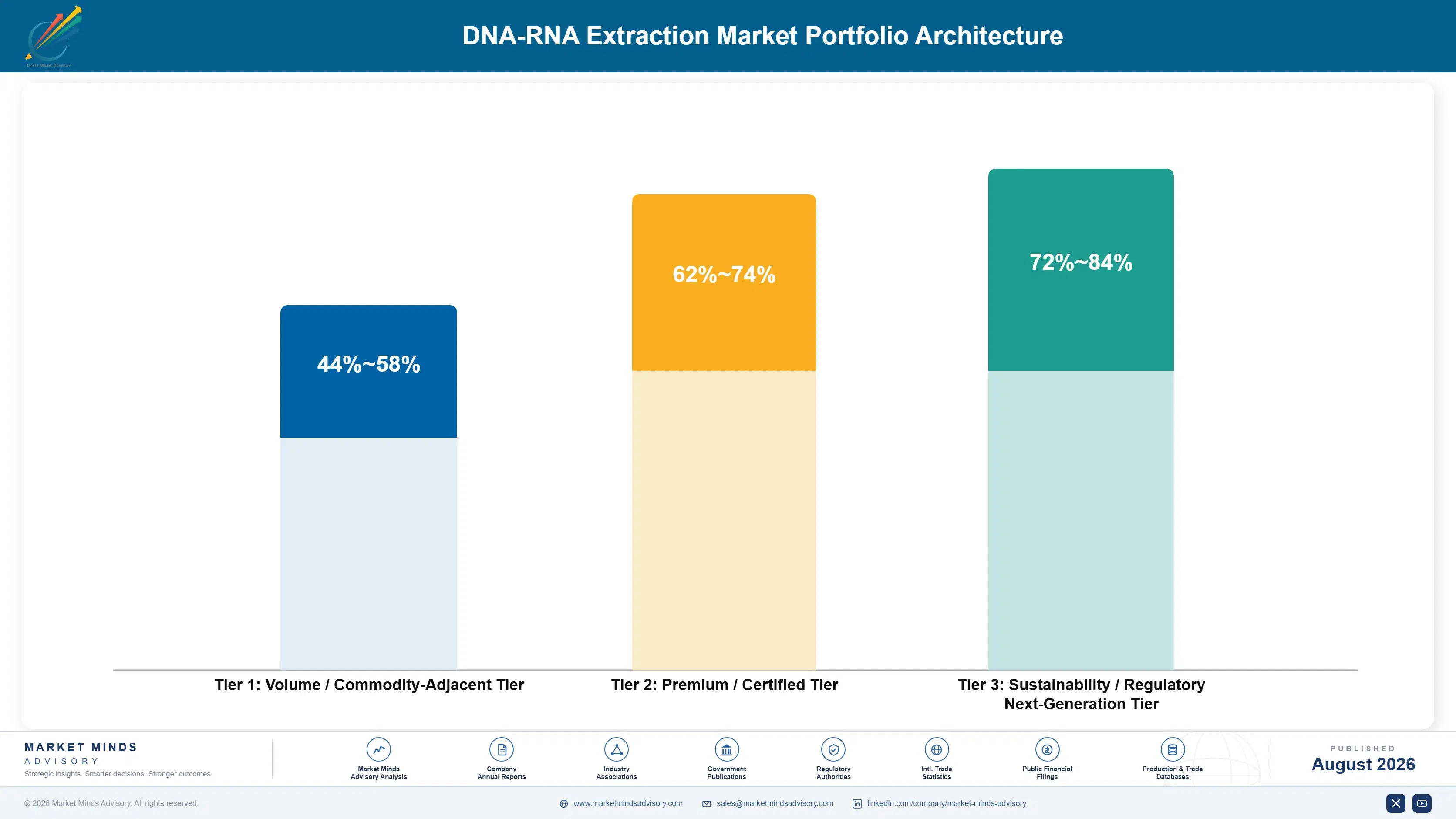
Portfolio Architecture for Margin Defence

Margin architecture separates on protocol position rather than on chemistry. Generic bead and column kits sold through catalogues and distributors compete against Chinese suppliers on price wherever no validated protocol has formed around a specific product. Chemistries written into validated clinical assays earn considerably better, protected by revalidation cost rather than by anything proprietary. Dedicated cartridges and specialist sample type kits earn best of all.
The volume against premium tension runs between research and regulated clinical work. Academic and routine testing generates enormous sample volume at prices that Chinese suppliers increasingly set, and it seeds the protocol positions that later become valuable in clinical settings. Regulated diagnostics generates far higher value per sample from fewer laboratories, with documentation requirements that exclude most low-cost entrants entirely. Neither alone builds a durable position.

High-value pools concentrate around lock-in and difficulty. Cell-free and low-input chemistry, formalin-fixed tissue and other awkward sample types, dedicated closed cartridges and validated clinical protocol positions all command pricing that generic extraction does not. Standard blood and cultured sample kits, whatever their quality, compete against manufacturers with cost structures Western suppliers have no realistic route to matching.

Volume / Commodity-Adjacent Tier

Generic bead and spin column kits for routine blood and cultured samples, sold through catalogues and distributors where Chinese suppliers with converged quality now compete directly on price alone. Performance differences have genuinely narrowed here.
Gross Margin: 44-58%

Premium / Certified Tier

Chemistries embedded in validated clinical assays with full regulatory documentation, protected by revalidation cost and refiling burden that laboratories will not undertake to save consumable spend. Positions hold for the working life of the assay.
Gross Margin: 62-74%

Sustainability / Regulatory / Next-Generation Tier

Dedicated closed cartridges and specialist chemistry for cell-free plasma, fixed tissue and other difficult sample types, commanding premium because generic bead chemistry fails on them noticeably. Architecture and chemistry difficulty both protect this tier.
Gross Margin: 72-84%
dna-rna-extraction-market-portfolio-architecture-1787305690243

Sample-Linked Consumption and Validation Inertia

Demand behaves as a true consumable annuity once a protocol is set. Every sample processed consumes a kit or cartridge, consumption tracks laboratory testing and sequencing activity directly rather than any purchasing cycle, and orders arrive continuously. Roughly 47% of samples now run on automated platforms, and those platforms consume dedicated consumables with each run regardless of how far below capacity they happen to be operating.
Stickiness depends almost entirely on what validation the customer performed. Chemistries inside regulated clinical assays hold for the working life of the test, because changing them means revalidating and in many cases refiling the assay itself. Research protocols hold nearly as well through comparability with published data. Generic extraction for exploratory work requalifies immediately and is bought on catalogue price with no meaningful loyalty at all.

Buyer profiles have shifted as laboratories consolidated. Individual investigators once selected kits from catalogues on their own budgets, and core facility managers and laboratory directors now standardise chemistry across many groups or across a whole clinical service at once. Procurement functions negotiate consumable agreements against platform placements. The assay developer, who actually determines which chemistry gets validated, is frequently nobody's designated customer at all.
dna-rna-extraction-market-end-use-penetration-index-1787305690737

Where Extraction Strategy Must Land

These are among the four positions where our research anticipates prominent divergence between winners and laggards over the coming forecast period. Each is grounded in the demand model, the regulatory perimeter, and the announced capacity pipeline.
01 / VALIDATION MOMENT PRIORITY

The purchase decision happens years before the order

Annual protocol switching runs at only roughly 9%, because changing extraction chemistry obliges a laboratory to revalidate every single assay downstream of it and, in regulated settings, to refile documentation for each one separately. That makes the moment of assay development worth considerably more commercially than every single subsequent selling effort combined afterwards. Suppliers competing on catalogue price against an incumbent already sitting inside a validated clinical workflow are contesting a position that price alone simply does not decide at all.
02 / CONSUMABLE ARCHITECTURE DECISION

The overhang makes attach rate the only reliable revenue

Extraction platforms acquired during the testing surge now run at roughly 38% utilisation with years of service life still remaining, which removes instrument revenue that would ordinarily recur across the whole forecast period. Dedicated cartridges nonetheless compound at 10.5%, because a placed instrument consumes them whenever it runs at all, however far below capacity it happens to be operating. That outcome was settled entirely at platform design stage, and open architectures accepting third-party consumables gave the position away permanently and irreversibly.
03 / PRICE TO CONSEQUENCE

Three dollars decides what a sequencing run means

Extraction costs roughly USD 3.20 per sample and determines yield, purity and fragment integrity for everything measured afterwards, with recovery differences of near 22% between competing chemistries propagating straight into every downstream result. Purchasing nonetheless sits with laboratory managers comparing consumable catalogues rather than with anybody at all assessing what those differences actually do to a reported result. Suppliers who reach the assay owner rather than the nominal buyer enter a conversation in which price is not the operative variable at all.
04 / DIFFICULT SAMPLE FOCUS

Generic chemistry is a contest Western suppliers lose

Bead chemistry is now thoroughly understood, and manufacturing scale rather than any proprietary formulation determines its cost today, which effectively hands routine blood and cultured sample extraction to Chinese producers whose quality has genuinely converged. Cell-free plasma, formalin-fixed tissue, stool, soil and plant material each defeat generic chemistry in different ways, and specialists hold positions against far larger competitors precisely there. Low-input cell-free work commands several times the standard price precisely because fragment size preservation remains a genuinely difficult problem.

Engagement Snapshot From the Field

A live engagement with an industry participant carrying material or product regulatory and market exposure ahead of a defining policy shift, showing how our research translates into a defensible multi-year portfolio strategy.
MARKET MINDS ADVISORY · CLIENT ENGAGEMENT SUMMARY
DNA-RNA Extraction Producer Strategic Portfolio Review and Transition Roadmap 2026·Investment Scenario on DNA-RNA Extraction Exposure Evaluation 2025-26
CLIENT PROFILE
A sample preparation supplier with an established bead chemistry catalogue, a modest automated platform installed base and limited presence in regulated clinical diagnostics. Annual revenue was approximately USD 210 million (client-reported, unverified by MMA), weighted toward research and routine testing customers purchasing through distributors across North America, Europe and Southeast Asia. Consumable attach on placed platforms was well below category average.
STRATEGIC CHALLENGE
Catalogue pricing had eroded steadily against Chinese suppliers whose bead chemistry performance had converged, while instrument placements had stalled entirely behind the pandemic overhang and consumable attach was weak because the platform accepted third-party consumables. The board needed to decide whether to compete on manufacturing cost, close the platform architecture, or reposition toward difficult sample types and clinical validation.
MMA APPROACH
MMA conducted 47 expert interviews spanning assay developers, core facility managers, clinical laboratory directors, regulatory affairs specialists, procurement leads and distributor principals across six countries. A quantitative survey of 3,800 respondents established chemistry switching behaviour, validation practice, platform utilisation and purchasing authority. We then modelled revenue and margin outcomes under cost competition, architecture closure and repositioning strategies against observed protocol lock data.
KEY FINDINGS
  1. Laboratories in five of six markets reported they would not change a validated extraction chemistry at any realistic price difference, citing downstream revalidation cost above everything else.
  2. Assay developers rather than procurement determined which chemistry entered a validated workflow, and no supplier surveyed had a commercial programme addressing them specifically.
  3. Platform utilisation among pandemic-era placements ran far below capacity, and none of the surveyed laboratories planned instrument replacement within the forecast period.
  4. Specialist chemistry for cell-free plasma and formalin-fixed tissue commanded several times generic pricing, and Chinese suppliers competed in neither of those categories effectively.
CLIENT PROFILE
A sample preparation supplier with an established bead chemistry catalogue, a modest automated platform installed base and limited presence in regulated clinical diagnostics. Annual revenue was approximately USD 210 million (client-reported, unverified by MMA), weighted toward research and routine testing customers purchasing through distributors across North America, Europe and Southeast Asia. Consumable attach on placed platforms was well below category average.
STRATEGIC CHALLENGE
Catalogue pricing had eroded steadily against Chinese suppliers whose bead chemistry performance had converged, while instrument placements had stalled entirely behind the pandemic overhang and consumable attach was weak because the platform accepted third-party consumables. The board needed to decide whether to compete on manufacturing cost, close the platform architecture, or reposition toward difficult sample types and clinical validation.
MMA APPROACH
MMA conducted 47 expert interviews spanning assay developers, core facility managers, clinical laboratory directors, regulatory affairs specialists, procurement leads and distributor principals across six countries. A quantitative survey of 3,800 respondents established chemistry switching behaviour, validation practice, platform utilisation and purchasing authority. We then modelled revenue and margin outcomes under cost competition, architecture closure and repositioning strategies against observed protocol lock data.
KEY FINDINGS
  1. Laboratories in five of six markets reported they would not change a validated extraction chemistry at any realistic price difference, citing downstream revalidation cost above everything else.
  2. Assay developers rather than procurement determined which chemistry entered a validated workflow, and no supplier surveyed had a commercial programme addressing them specifically.
  3. Platform utilisation among pandemic-era placements ran far below capacity, and none of the surveyed laboratories planned instrument replacement within the forecast period.
  4. Specialist chemistry for cell-free plasma and formalin-fixed tissue commanded several times generic pricing, and Chinese suppliers competed in neither of those categories effectively.
RECOMMENDED STRATEGY
Phase 1: Phase one: close consumable architecture on all new platform placements, since attach rate is decided at design stage and cannot be recovered from an installed base. Phase 2: Phase two: build a technical programme addressing assay developers directly at validation stage, where chemistry positions are won for the working life of a test. Phase 3: Phase three: reposition catalogue investment toward difficult sample types and clinical documentation rather than defending generic bead chemistry on price.
OUTCOME
The client closed consumable architecture on new placements, established an assay development support programme and redirected roughly USD 34 million from generic catalogue expansion into cell-free and fixed tissue chemistry (client-reported, unverified by MMA). Consumable attach on new placements improved substantially within a year, and two clinical laboratories validated the specialist chemistry into new assays.

Frequently Asked Questions

Foundational context covering the market sizes, CAGR, scope, country, region and competition that inform every finding below. This section is provided to cover basics and most often pre-purchase conversations, answered from the MMA Primary Research Dataset.

What is the current size of the DNA-RNA Extraction Market?

The global nucleic acid extraction market was valued at USD 3.9 billion in 2025, spanning bead and column kits, automated instruments, dedicated cartridges and extraction-free reagents. Roughly 47% of samples now run on automated platforms.

How large will the DNA-RNA Extraction Market be by 2036?

MMA forecasts the market at USD 8.21 billion by 2036, expanding 1.97 times from the 2026 base of USD 4.17 billion. That represents roughly USD 4.04 billion of incremental value across the forecast decade.

What is the CAGR for the DNA-RNA Extraction Market 2026 to 2036?

The base case compound annual growth rate is 7.0%, with a bull case of 8.2% and a bear case of 5.8%. The bear case assumes extraction-free amplification displaces the step across enough sample types to matter.

Which segment is growing fastest?

Automation-dedicated consumables and cartridges grow at 10.5%, a full 1.50x the overall market rate. Placed instruments consume them with every run even at roughly 38% average utilisation.

Who are the major companies in the DNA-RNA Extraction Market?

Qiagen, Thermo Fisher Scientific, Roche, Promega and Bio-Rad Laboratories together hold 56% of revenue. Qiagen leads on protocol standard position while Thermo Fisher leads on automated platform installed base.

Which country is growing fastest?

China grows fastest at 11.6%, as reagent capacity built during the testing surge was retained and redirected toward domestic demand and exports. East Asia is the largest region at 30% of value.

Report Segmentation Architecture

The full report scope spans multiple orthogonal segmentation dimensions, with cross-tabulated demand data provided for each dimension pair. Coverage extends further to regional breakdowns, trend trajectories, and the competitive detail needed to support segment-level decision-making.

By Product Class

  • Magnetic Bead Extraction Kits
  • Spin Column Extraction Kits
  • Automated Extraction Instruments
  • Automation-Dedicated Consumables and Cartridges
  • Extraction-Free and Direct Lysis Reagents
  • Bulk and Custom Extraction Reagents

By End-Use Industry

  • Clinical Diagnostic Laboratories
  • Academic and Government Research Institutions
  • Pharmaceutical and Biotechnology Discovery
  • Sequencing Service Providers
  • Agricultural and Veterinary Testing
  • Forensic and Public Health Laboratories

By Commercial Dimension

  • Catalogue and Distributor Sales
  • Instrument Placement and Consumable Programmes
  • Clinical Assay Component Supply Agreements
  • Bulk and Custom Manufacturing Contracts
  • Public Tender and Institutional Procurement
  • Original Equipment Manufacturer Supply

By Region

  • East Asia
  • North America
  • Western Europe
  • South Asia and Pacific
  • Latin America
  • Middle East and Africa
  • Eastern Europe

Scope, Methodology, and Coverage

Every figure in this report is reproducible from documented input assumptions. The scope below maps the historical period, the forecast horizon, the segmentation dimensions, and the countries covered, alongside the underlying primary and qualitative methodology.
Historical Period
2020 to 2025
Forecast Period
2026 to 2036
Base Year
2025 (USD billions; MMA Primary Research Dataset, August 2026)
Market Definition
This market comprises products used to isolate and purify deoxyribonucleic and ribonucleic acids from biological, environmental and agricultural samples, measured at supplier revenue across catalogue and distributor sales, instrument placement and consumable programmes, clinical assay component supply agreements, bulk and custom manufacturing contracts, public tender procurement and original equipment manufacturer supply. Coverage spans magnetic bead extraction kits, silica membrane spin column kits, automated extraction instruments and workstations, dedicated cartridges and consumable packs supplied for those platforms, extraction-free and direct lysis reagents, and bulk or custom formulated extraction reagents including specialist chemistries for cell-free plasma, formalin-fixed tissue and other difficult sample types. Downstream amplification, sequencing library preparation and detection reagents, sample collection devices, swabs and transport media, laboratory information and data analysis systems, general laboratory plasticware not dedicated to extraction, and integrated diagnostic systems where extraction consumables cannot be separately identified fall outside scope.
Quantitative Units
USD millions (current prices); samples processed by product class; kits and cartridges consumed; cost per extraction; instrument installed base and utilisation; protocol switching rate
Segmentation Dimensions
By Product Class; By End-Use Industry; By Commercial Dimension; By Region
Regions Covered
East Asia, North America, Western Europe, South Asia and Pacific, Latin America, Middle East and Africa, Eastern Europe
Countries Covered
China, Japan, South Korea, Taiwan, United States, Canada, Mexico, Germany, United Kingdom, France, Netherlands, Switzerland, Sweden, Italy, Spain, India, Australia, Singapore, Thailand, Indonesia, Brazil, Argentina, Chile, Colombia, Saudi Arabia, United Arab Emirates, Israel, South Africa, Poland, Czechia, Hungary, and additional markets relevant to molecular workflow analysis
Key Companies Profiled
Qiagen, Thermo Fisher Scientific, Roche, Promega, Bio-Rad Laboratories, Merck KGaA, Takara Bio, Zymo Research, Norgen Biotek, Beckman Coulter, Agilent Technologies, Analytik Jena, Tecan, Hamilton Company, MGI Tech, Sansure Biotech, Vazyme Biotech, Bioneer, Macherey-Nagel, Revvity
Quantitative Methodology
Primary survey, n=3,800 respondents, Q4 2025, six countries; demand-side model with trade association cross-validation
Qualitative Methodology
47 expert interviews, Q4 2025; applied to validate demand model assumptions, identify emerging dynamics, and assess competitive positioning
Report Format
PDF and XLSX data workbook (Word format preview document)
Publisher
Market Minds Advisory
Report Code
MMA-2026-HLT-346
Published
August 2026
Contact
sales@marketmindsadvisory.com | www.marketmindsadvisory.com

Purchase the full DNA-RNA Extraction Market Report (2026 to 2036).

The full MMA report treats protocol lock-in as the commercial fact that governs this category, quantifying why positions are won at assay validation and almost never afterwards. It sizes six product classes and seven regions to 2036, modelling samples processed, consumable consumption, extraction cost per sample, instrument installed base and utilisation separately so that the pandemic overhang can be assessed on its own terms. Competitive assessment covers twenty suppliers on one consistent revenue basis. Cost exposure is traced through magnetic particle, enzyme and plastic inputs. Four commercial levers and a strategic verdict close the report, grounded in 47 expert interviews and a 3,800-respondent survey.
Six product classes sized separately through 2036
Protocol switching behaviour modelled against validated assay populations
Instrument overhang and utilisation quantified by region
Twenty suppliers assessed on one consistent revenue basis
Extraction-free displacement risk mapped by sample type
Anonymised client engagement with tested strategic recommendations

Built For The People Who Decide

From boardroom strategy to bench-side execution, this report is read cover-to-cover by leaders shaping the next decade of their industry, turning demand scenarios, market dynamics and valuation benchmarks into decisions.
CXOs/ Presidents/ VPs/ Managers
M&A and Corporate Development
Strategy Teams and R&D Heads
Procurement and Product Directors
Regulatory and Compliance Leaders
Investor Relations and Equity Analysts