Market Minds Advisory
District Cooling Market

District Cooling Market: When A Utility Category Becomes A Master-Plan Default

A commercial reading of district cooling, where Gulf megaproject buildout and thermal energy storage economics are reshaping a utility category most of the world still treats as a minor niche service.

Lead Analyst

David Horsley

Published

September 2026

Make Smarter Decisions with Customized Research Insights

Request a free sample report and evaluate market opportunities, growth trends, and competitive dynamics relevant to your business needs.

2025 MARKET VALUE$8.6BMarket Size 2025
2036 FORECAST VALUE$21.1BBase Case , 2026 to 2036
CAGR 2026 TO 20368.5 %Bull 9.8% / Bear 7.3%
INCREMENTAL OPPORTUNITY$11.8BNet 10- year value creation
EXPANSION MULTIPLE2.26x2036 value over 2026 base
Strategic Levers
M&A Pipeline
Regional Outlook
Country Rankings
Competitive Intelligence
Segmental Deep-dive
Call-Us : 91 93563 13602

Executive Snapshot and Market Trajectory

District cooling stopped being a Gulf curiosity and quickly became the default cooling infrastructure for entire new cities, replacing building-by-building air conditioning at a pace developers now plan around carefully from the very earliest master plan stage of any major urban development project undertaken today.
The market stands at USD 8.6 billion in 2025 and reaches USD 21.1 billion by 2036 at an 8.5% CAGR. Thermal energy storage-integrated systems grow fastest at 13.8%, roughly 1.62 times the overall rate, since peak-shaving economics increasingly determine plant profitability more than raw cooling capacity alone across most large-scale developments today. Middle East and Africa holds 36% of value on Gulf megaproject buildout, while India posts the quickest national growth at 13.2%.
Concentration sits near 45%, dominated by regional utility operators holding long-term concession contracts across entire master-planned developments simultaneously across most major Gulf metropolitan areas and beyond. Two forces dominate ahead. Gulf state megaprojects keep committing new district cooling capacity years ahead of building completion, and thermal storage economics are turning what was once a construction-phase decision into an ongoing operational optimization discipline that shapes plant profitability directly.
Market Definition
The district cooling market covers centralized chilled water production and distribution infrastructure serving multiple buildings across a defined development, including plant equipment, distribution networks, and thermal storage. Individual building-level HVAC systems are excluded.
Base Year Value
$8.6B in 2025 (MMA Primary Research Dataset, August 2026)
Forecast Period
2026 to 2036, eleven discrete annual values
CAGR
8.5% base case. Bull 9.8%. Bear 7.3%.
Fastest Growth Segment
Thermal Energy Storage-Integrated Systems: 13.8% CAGR
Fastest Growth Country
India: 13.2% CAGR
Fastest Growth Region
South Asia and Pacific: 10.5% CAGR
Largest Region
Middle East and Africa: 36% of 2025 global value
Market Leaders
Tabreed, Empower, Engie, Veolia, Qatar Cool. Source: MMA Analysis based on company annual reports.
Primary Survey
n=3,800 procurement and R&D decision-makers, Q4 2025, six countries
Methodology
Demand-side build-up, cross-validated against public data, 47 expert interviews

District Cooling Market Forecast Scenarios

district-cooling-market-size-forecast-scenario-1787332717930
Growth from 2020 to 2025 compounded near 7.2%, propelled by Gulf megaproject buildout that committed district cooling capacity years ahead of building completion across major master-planned developments in the UAE, Saudi Arabia, and Qatar. Thermal storage adoption accelerated toward the end of the period, as operators discovered peak-shaving economics that improved plant profitability considerably beyond raw capacity utilization alone.
Three mechanisms carry the base case to 8.5%. First, Gulf state megaprojects continuing to commit new district cooling capacity as master-planned developments break ground across the region year after year. Second, thermal energy storage economics improving plant profitability enough that operators retrofit storage into existing networks rather than building new capacity alone. Third, sustainability retrofits in mature Western markets replacing aging building-level chillers with centralized district networks offering better carbon accounting and lower lifecycle cost.
The bull case at 9.8% assumes Gulf megaproject commitments accelerate further and thermal storage retrofit economics improve faster than currently modeled across most major developments. The bear case at 7.3% assumes megaproject construction timelines slip considerably, electricity price volatility undermines thermal storage payback periods, and mature-market sustainability retrofits proceed more slowly than committed decarbonization targets suggest they should.

Why Thermal Storage Economics, Not Chiller Capacity, Now Drive Margin

Three forces set demand here. Gulf megaproject buildout drives the largest new-capacity volume, as master-planned developments commit district cooling infrastructure years before building completion. Thermal storage economics drive a second stream, since peak-shaving retrofits improve profitability on existing networks without new chiller investment. Sustainability retrofit drives a third stream, as mature Western markets replace aging building-level systems with centralized networks.
MARKET CONCENTRATIONCR5: 45%Concentrated among regional utility operators holding long-term concession contracts
CONNECTION LOAD GROWTHAbout 12% annuallyShare of new building connections added to existing networks yearly
AVERAGE CONCESSION LENGTH25 to 35 yearsTypical duration of a district cooling operator concession agreement
PEAK LOAD REDUCTIONUp to 30% via storageReduction in peak electricity demand achieved through thermal storage
COOLING DEGREE DAY CORRELATIONAbove 0.85 for Gulf marketsStatistical correlation between climate intensity and network expansion pace
ELECTRICITY COST SHAREAbout 55% of opexShare of plant operating cost attributable to electricity consumption
The commercial character is defined by a widening split between new-build megaprojects and retrofit economics in mature markets. A Gulf developer commits district cooling infrastructure at the master-plan stage, locking in decades of concession revenue before a single building opens. A Western operator instead competes building by building, retrofitting existing HVAC with centralized alternatives that must prove payback against systems already sunk into place.
The decade turns on whether thermal storage economics keep improving fast enough to make retrofit projects competitive against doing nothing to an existing building-level system. Storage payback periods and electricity price volatility remain the primary constraints separating operators building durable concession relationships from those struggling to justify retrofit capital. That shift determines whether district cooling becomes a genuine decarbonization default or stays concentrated in new-build megaprojects alone.
"Nobody builds a district cooling plant to sell cold water. They build it to sell a concession contract that runs for thirty years, and the chiller is almost incidental."
Director, Urban Infrastructure and District Energy Practice · MMA Energy / Urban

Market Trends

Gulf Megaprojects Are Locking In Decades Of Concession Revenue

Master-planned developments across the UAE, Saudi Arabia, and Qatar are committing district cooling infrastructure at the earliest planning stage, locking operators into concession agreements spanning 25 to 35 years before a single building opens for occupancy across the entire development footprint. That early commitment is converting district cooling from a construction-phase equipment purchase into a decades-long annuity revenue stream operators now underwrite years ahead of actual cooling demand materializing on site. Operators with proven megaproject delivery track records are capturing the resulting wave of concession awards most directly and durably.
Market Impact: Locks in 30-year concessions now
Thermal Storage Is Converting Plants Into Grid Assets

District cooling operators are increasingly retrofitting thermal energy storage into existing plants, shifting chiller operation toward off-peak electricity hours and discharging stored cooling capacity during peak demand periods when electricity pricing is at its highest across most deregulated grid markets today. That storage capability is converting cooling plants from pure service providers into genuine grid flexibility assets that utilities and regulators increasingly value for demand response participation and capacity planning. Operators with storage-integrated plants are capturing both peak-shaving cost savings and emerging grid services revenue that storage-free competitors cannot access.
Market Impact: Cuts peak demand by 30%

Market Opportunities and Growth Drivers

Megaproject Commitments Are Locking In Concession Revenue

Master-planned developments across Gulf states are committing district cooling infrastructure at the earliest planning stage, locking operators into decades-long concession agreements that generate predictable annuity revenue regardless of how quickly individual buildings within the development actually reach full occupancy. That commitment structure creates demand independent of near-term construction cycles, since concession contracts are signed years before cooling load materializes and continue generating connection fee revenue as each new building comes online within the development footprint. Each new megaproject announcement adds directly to the addressable long-term concession pipeline operators can bid for.
Market Impact: Retrofit paybacks stretch beyond 8

Thermal Storage Retrofits Are Improving Plant Profitability

Operators retrofitting thermal energy storage into existing district cooling plants are capturing peak-shaving cost savings that directly improve plant profitability without requiring new chiller capacity investment or additional concession agreements to justify the retrofit capital spent across the entire network. That profitability improvement creates demand for storage retrofit projects independent of new-build megaproject cycles, since existing plant operators can justify storage investment purely on operating cost savings against current electricity tariff structures. Each new storage retrofit strengthens the case for the next operator considering a comparable investment across the wider industry.
Market Impact: Peak spreads narrowed by 25%

Market Restraints and Challenges

Retrofit Payback Periods Deter Mature Market Adoption

Retrofitting district cooling into mature Western cities with existing building-level HVAC systems already sunk into place requires payback periods many building owners find difficult to justify against simply maintaining equipment already installed and depreciated. The root cause is that district cooling retrofit economics depend heavily on aggregating enough nearby buildings to justify distribution network capital cost, which existing urban density and ownership fragmentation make genuinely difficult to coordinate. The commercial impact is that retrofit projects in mature markets proceed far more slowly than new-build capacity. Mitigation runs through anchor-tenant financing models and municipal decarbonization mandates several cities are now piloting.
Market Impact: Locks in 30-year concessions now

Electricity Price Volatility Undermines Storage Payback Models

Thermal storage retrofit economics depend on a meaningful spread between peak and off-peak electricity pricing, and that spread has narrowed in several deregulated markets as renewable generation flattens intraday price curves in ways storage payback models did not originally anticipate. The root cause is that electricity market structures are evolving faster than storage investment cycles, leaving operators exposed to pricing assumptions made years before a storage project reaches completion. The commercial impact is that some storage retrofits underperform their original payback projections considerably. Mitigation runs through flexible storage dispatch algorithms and demand response revenue several operators are now pursuing.
Market Impact: Cuts peak demand by 30%
3 additional market trends, 4 additional growth drivers, and 2 additional restraints and challenges are covered in the full report. Contact sales@marketmindsadvisory.com to access the complete intelligence.

Segment CAGR and Growth Architecture

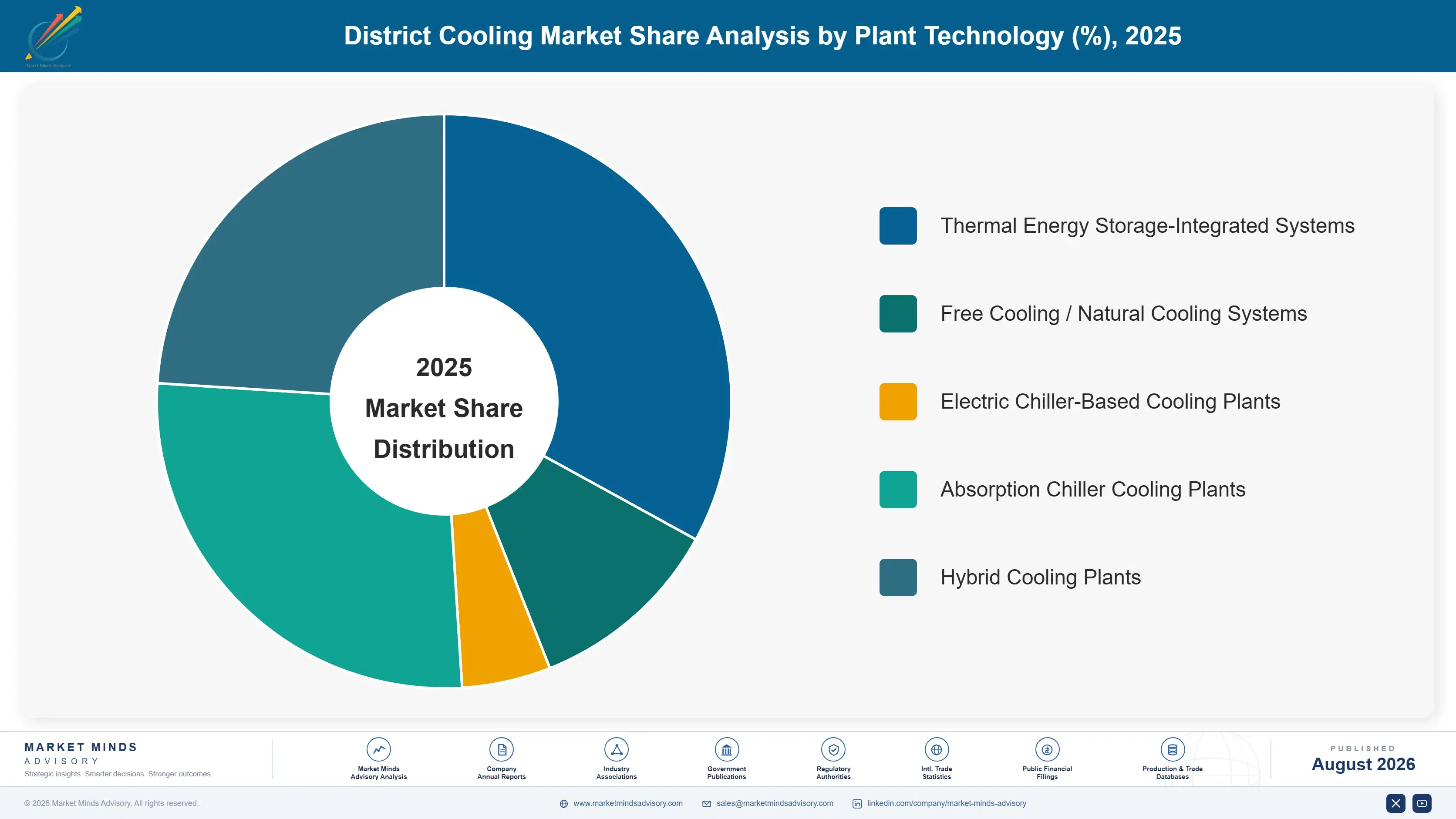
Segmentation follows plant technology, a single functional logic describing how the cooling itself is actually generated and delivered to connected buildings, rather than which type of building or development ultimately consumes it or where that development physically sits. Each technology carries its own capital intensity, operating cost structure, and decarbonization profile distinctly across the entire market.
district-cooling-market-market-share-analysis-1787332718489

Thermal Energy Storage-Integrated Systems

Thermal energy storage-integrated systems grow fastest at 13.8%, about 1.62 times the overall 8.5% rate, as peak-shaving economics increasingly determine plant profitability more directly than raw cooling capacity, particularly in markets with meaningful peak-to-off-peak electricity price spreads worth capturing consistently and reliably. Growth concentrates where operators retrofit storage into existing plants to capture cost savings without new chiller investment, since storage economics improve faster than new capacity construction can be justified alone. Tabreed and Engie both hold established positions in this segment through years of plant optimization and grid services development. Electricity market structure, not storage hardware cost, remains the primary constraint on how fast this segment keeps expanding nationally.
CAGR 13.8%

Free Cooling / Natural Cooling Systems

Free cooling and natural cooling systems grow at 11.5%, serving developments in climates cool enough for significant portions of the year that seawater, groundwater, or ambient air can displace mechanical chilling entirely for extended periods each calendar year quite reliably. Adoption concentrates among coastal and northern developments where natural cooling sources are physically available and sustainability-focused developers value the reduced electricity consumption these systems achieve compared to conventional chiller-only plants located nearby. Veolia and Qatar Cool both hold strong positions built on established engineering expertise spanning years of site-specific natural cooling assessment work. Site-specific resource availability, not technology cost, remains the primary constraint shaping how aggressively developers adopt this format.
CAGR 11.5%
Full segment breakdown across 5 segments available in the complete report.

Regional Architecture and Country Demand Map

Climate intensity and megaproject buildout, far more than population or general economic development, drive this seven-region value distribution across the entire market. Middle East and Africa dominates on Gulf state urban development, while South Asia and Pacific grows fastest on rapidly expanding urbanization and cooling demand.

North America

North America holds 10% of value at 8.0% growth, below the 22 to 32% band, because district cooling remains a niche infrastructure choice here, concentrated in a handful of downtown districts and university campuses rather than a default cooling model developers plan around from the outset. Lower cooling degree days across most of the country and dispersed suburban urban form limit the building density district cooling economics require to justify network capital cost. Engie and Veolia both maintain positions in select major cities, particularly downtown Toronto and a handful of dense US metros pursuing decarbonization goals. Growth reflects gradual sustainability-driven retrofit adoption rather than the megaproject-scale buildout seen in Gulf markets.
Share: 10% | CAGR: 8.0% (2026 to 2036)

Western Europe

Western Europe holds 11% of value at 7.2% growth, below the 18 to 26% band, because district cooling remains concentrated in specific Nordic and French cities rather than a widespread regional default across most of the continent's more temperate, lower-density urban areas and suburbs. Veolia and Engie both hold established positions in Paris, Stockholm, and Helsinki, where municipal utilities have operated district networks for decades alongside district heating infrastructure serving the same buildings. French and Nordic cities lead regional deployment, driven by combined heat and cooling network efficiency rather than cooling-only economics elsewhere on the continent. Growth reflects steady municipal expansion rather than the rapid megaproject buildout characterizing Gulf markets specifically and consistently.
Share: 11% | CAGR: 7.2% (2026 to 2036)
Regional intelligence for 5 additional markets available in the complete report: East Asia, South Asia and Pacific, Latin America, Middle East and Africa, Eastern Europe. Contact sales@marketmindsadvisory.com.
district-cooling-market-country-cagr-analysis-1787332719004

Where District Cooling Operators Actually Hold Margin

An operator selling raw cooling capacity into a market where a competitor already holds concession relationships and thermal storage economics is competing on the wrong axis entirely. The four moves below shift earnings toward what actually captures share: megaproject concession positioning, thermal storage retrofit capability, natural cooling site selection, and grid services participation pursued early.

Win Megaproject Concessions At The Master-Plan Stage

Operators that engage master-plan developers before ground is broken, rather than bidding for district cooling contracts after building design is already locked in, capture decades-long concession agreements that competitors entering later increasingly cannot win. That early positioning commands a premium of 20 to 35% in effective concession value over operators entering after site plans are finalized, since developers pay for infrastructure partners who can shape the cooling network around the master plan itself. Tabreed and Empower built this positioning over years, and it is not quickly replicated by newer entrants.
Market Impact: Commands a 20 to 35% concession pre

Retrofit Thermal Storage Into Existing Plant Assets

Operators that retrofit thermal energy storage into plants already generating cooling revenue, rather than treating storage as a new-build-only feature, capture peak-shaving cost savings that storage-free competitors cannot match, improving plant-level operating margin by roughly 15% without new chiller capacity investment across the existing network footprint and asset base. That retrofit capability reaches existing concession assets immediately, opening margin improvement that operators without storage retrofit expertise genuinely cannot access on comparable timelines or cost structures. Engie and Veolia are converting existing plant portfolios into storage-enabled assets successfully across multiple markets.
Market Impact: Improves plant operating margin by

Select Sites Where Natural Cooling Resources Exist

Operators that prioritize development sites with genuine natural cooling resource availability, seawater, groundwater, or favorable ambient conditions, rather than defaulting to mechanical chilling everywhere, cut electricity operating cost by roughly 25% compared to conventional chiller-only plants serving comparable cooling loads across similar climates and regions. That site selection discipline reaches sustainability-focused developers who specifically value the lower carbon intensity natural cooling delivers, opening contracts that mechanical-only competitors cannot match on lifecycle emissions or long-term operating cost. Veolia and Qatar Cool are converting site-specific resource advantages into durable competitive positioning successfully.
Market Impact: Cuts electricity operating cost by

Participate In Grid Services And Demand Response

Operators that position storage-integrated plants for grid services and demand response participation, rather than treating storage purely as an internal cost-saving tool, capture emerging revenue streams that storage-free competitors cannot access, adding roughly 10% to plant-level revenue through utility demand response payments negotiated directly with regional grid operators. That grid participation reaches utilities and regulators who specifically need flexible capacity as renewable generation share increases, opening contracts that operators without grid services capability genuinely cannot win. Operators investing in grid services early are converting infrastructure into a durable dual-revenue asset.
Market Impact: Adds roughly 10% to plant-level rev

Who Controls the Margin Pool

Concentration sits near 45% for the top five, dominated by regional utility operators holding long-term concession contracts across entire master-planned developments. The gap between leaders and challengers is megaproject relationship depth and thermal storage retrofit capability, broadly comparable across established players. All participants are assessed on one basis, connected cooling capacity revenue, excluding individual building-level HVAC equipment sales.
Competition runs along three lines. First, megaproject concession positioning, since that increasingly determines which operators capture decades-long revenue commitments before ground breaks. Second, thermal storage retrofit capability, which shapes plant profitability for years once an operator proves it can improve margin on existing assets. Third, grid services participation depth, since utilities increasingly value flexible capacity as renewable generation share rises.

Pressure is building from two directions. Large diversified utility groups are expanding into district cooling as a natural extension of existing energy infrastructure portfolios, bringing balance sheet strength smaller operators cannot match. Meanwhile specialized natural cooling engineering firms are winning niche coastal and northern development contracts directly through site-specific expertise larger incumbents have not prioritized. Rankings should favour operators combining megaproject relationships with genuine storage retrofit capability over those competing on chiller capacity alone.
district-cooling-market-company-positioning-matrix-1787332719523

Competitive Moat and Risk Dimensions

TABREED

Moat: Megaproject concession relationship depth

Tabreed built genuine megaproject concession relationships over years of Gulf state development delivery and government relationship investment across most major master-planned developments. Its established position with developers provides bidding advantages smaller specialists cannot easily replicate. Continued investment in thermal storage retrofit capability positions it ahead of operators relying purely on chiller capacity alone.
TABREED

Risk: Geographic concentration in Gulf markets

Its revenue remains heavily concentrated in Gulf megaproject markets, exposing the business to regional construction cycle timing and government infrastructure spending decisions outside its control. Diversified utility groups entering district cooling from adjacent energy infrastructure are targeting exactly the mature-market expansion Tabreed pursued more slowly. Expanding beyond core Gulf markets fast enough requires capital the business is still actively allocating.
ENGIE

Moat: Municipal utility distribution advantage

Engie built deep municipal utility distribution advantage through its combined heat and cooling network operations across major European cities spanning decades of infrastructure relationships. Its integrated energy portfolio provides cross-selling advantages standalone district cooling specialists cannot access. Continued investment in thermal storage and grid services extends that advantage into emerging flexible capacity revenue streams.
ENGIE

Risk: Slower growth in mature markets

Its mature Western European markets grow considerably slower than Gulf megaproject markets, limiting the pace at which Engie can expand district cooling revenue compared to operators concentrated in higher-growth regions. Gulf-focused specialists with deeper megaproject relationships are capturing the fastest-growing concession opportunities Engie's mature-market focus does not prioritize. Expanding into higher-growth regions requires relationship investment the business has not made.

Players Tracked

Prominent Players

Tabreed
Empower
Engie
Veolia
Qatar Cool

Other Key Players

Emicool
Saudi Tabreed
ENGIE Cofely
Keppel DHCS
SP Group
Vattenfall
Fortum
Stockholm Exergi
Marafeq Qatar
National Central Cooling Company
Trakya Cam
Doosan Enerbility
Thermax
Danfoss
Johnson Controls

Recent Developments

MAY 2023

Gulf operator wins major master-planned development concession

A leading Gulf district cooling operator announced a new long-term concession agreement to serve a major master-planned development spanning multiple phases across the following decade. This was a concession award rather than any acquisition or merger, and it committed decades of predictable connection fee and consumption revenue ahead of construction.
Signal: Winning master-plan-stage concessions befo
OCTOBER 2023

European utility acquires thermal storage retrofit specialist

A major European utility group completed acquisition of a thermal storage retrofit specialist, adding peak-shaving engineering capability directly into its existing district cooling and heating portfolio. This was a genuine acquisition rather than a joint venture or minority stake, and it closed a storage retrofit gap the utility previously lacked.
Signal: Acquiring storage retrofit expertise direc
MARCH 2024

Grid operator opens demand response programme to cooling storage

A national grid operator announced a new demand response programme explicitly welcoming district cooling thermal storage assets as qualifying flexible capacity for grid balancing services. This was regulatory and market design implementation rather than any corporate transaction, and it opened a new revenue channel for storage-integrated cooling plants.
Signal: New demand response eligibility for therma

Electricity And Refrigerant Cost Exposure

Electricity consumption dominates cost structure for district cooling plants, given the continuous chiller operation required to serve connected buildings around the clock. Electricity typically accounts for a substantial share of operating cost, sourced from national grids with pricing that varies considerably by market and time of day. Refrigerant procurement and maintenance complete the cost structure for most operating plants.
Electricity pricing moved considerably through 2021 and 2022 as global energy markets tightened following supply disruptions that affected natural gas and electricity generation costs across most major grid markets simultaneously and considerably. Several district cooling operators disclosed the resulting margin pressure across their annual reporting through that window, and industry data recorded meaningfully higher average electricity procurement costs that persisted well beyond the initial disruption period.

Exposure divides sharply by contract structure rather than by plant technology specifically across the industry. Operators with pass-through electricity pricing embedded in customer contracts held margin considerably better than those absorbing electricity cost increases directly under fixed-price concession agreements. The disadvantage compounds, because an operator locked into a fixed-price agreement during a price spike cannot recover cost the way pass-through operators can.
district-cooling-market-cost-volatility-analysis-1787332719720

Negotiate pass-through electricity pricing in contracts

Operators locked into fixed-price concession agreements absorb the full impact of periodic electricity price spikes directly, which the recent energy market disruption demonstrated quite expensively across the entire district cooling industry. Negotiating pass-through electricity pricing structures into new concession agreements reduces that exposure and improves margin stability during any future electricity pricing increase considerably.

Build renewable and off-peak electricity procurement contracts

Plants relying entirely on standard grid electricity tariffs absorb the full cost of peak-hour pricing regardless of when cooling demand actually requires chiller operation during the day. Shifting load toward off-peak hours through thermal storage and securing renewable power purchase agreements reduces average electricity cost and improves margin stability during any future pricing volatility.

Diversify refrigerant and chiller equipment sourcing

Plants entirely dependent on a single chiller equipment or refrigerant supplier cannot negotiate effectively when that supplier raises pricing or faces its own supply constraints, leaving no real alternative but to absorb the increase directly. Diversifying equipment and refrigerant sourcing across multiple qualified suppliers preserves negotiating leverage that single-supplier competitors simply cannot access as effectively.

Portfolio Architecture for Margin Defence

The portfolio splits into three tiers with genuinely different economics across the industry. Basic chiller-only plants form the volume tier, where equipment commoditization and construction-phase competition drive competition directly. Thermal storage-integrated and free cooling plants earn considerably more, because peak-shaving economics and site-specific engineering narrow the field. Next-generation grid services-enabled plants sit differently again, priced against the flexible capacity prob
The tension runs between basic chiller volume that fills construction pipeline and premium storage-enabled work that earns the return. Standard chiller plants generate the transaction volume that keeps engineering teams busy and maintains developer relationships through which higher-value storage retrofit conversations happen. Yet this segment competes on price against every qualified mechanical contractor. Operators managing this well treat basic volume as relationship capital.

High-value pools concentrate where thermal storage or grid services genuinely limits competition: megaproject concessions solving the decades-long revenue predictability problem, storage retrofits meeting peak-shaving economics, and natural cooling site selection resolving the lifecycle carbon constraint directly. All three resist the price competition defining basic chiller plants, since the customer is purchasing a solved infrastructure problem rather than comparing interchangeable equipment.

Volume / Commodity-Adjacent Tier

Basic chiller-only district cooling plants sold at commodity pricing against qualified mechanical contractors bidding on standard specifications. The range is wide because efficiency-optimized operators earn respectably while those competing purely on capital cost frequently do not.
Gross Margin: 15-28%

Premium / Certified Tier

Thermal storage-integrated and free cooling plants carrying peak-shaving economics and site-specific engineering expertise in the most demanding megaproject and sustainability-focused developments. The range is wide because storage retrofit maturity and site resource availability vary considerably by operator.
Gross Margin: 28-42%

Sustainability / Regulatory / Next-Generation Tier

Next-generation grid services-enabled plants participating in demand response programmes addressing the flexible capacity problem directly and durably across utilities requiring genuine renewable integration support. The range is wide because grid services monetization still varies enormously by market currently.
Gross Margin: 32-46%
district-cooling-market-portfolio-architecture-1787332720220

High-value Sub-segments and Strategic Watch-out

Thermal Energy Storage-Integrated Systems

High value and the fastest growth at 13.8%, from a small base as peak-shaving economics increasingly determine plant profitability more than raw cooling capacity across meaningful electricity spread markets. Electricity market structure increasingly determines which operators capture this volume, limiting near-term opportunity to those with proven retrofit engineering capability.
Gross Margin: 30-44%

Free Cooling / Natural Cooling Systems

High value with strong growth, protected by site-specific engineering expertise and natural resource availability that create a durable barrier newer specialist entrants find genuinely difficult to replicate quickly at scale. Sustainability-driven developer demand compounds steadily as carbon accounting requirements expand supporting broader decarbonization goals across most major markets.
Gross Margin: 28-42%

Electric Chiller-Based Cooling Plants

The volume core across basic chiller-only plants and hybrid systems worldwide, and the category with the longest commercial history of the five plant technologies listed here. Growth is steady but competition on capital cost is direct, holding margin below the storage and natural cooling tiers positioned above it.
Gross Margin: 15-28%

Absorption Chiller Cooling Plants

The strategic watch-out, growing slowest as absorption chiller plants increasingly lose ground to electric chiller and thermal storage alternatives offering better lifecycle economics across most demanding megaproject categories today and going forward. Declining technology preference limits addressable volume exactly where growth elsewhere is fastest, threatening this segment's long-term position.
Gross Margin: 14-26%

How District Cooling Revenue Locks In

Revenue commits differently depending on which mechanism drives the connection decision. Megaproject concession contracts lock in tightly once construction begins, since connection fees and consumption revenue accrue consistently as each building within the development comes online over years. Retrofit contracts in mature markets stay genuinely reversible if payback economics disappoint. Storage retrofit revenue persists on committed operating cost savings schedules regardless of demand.
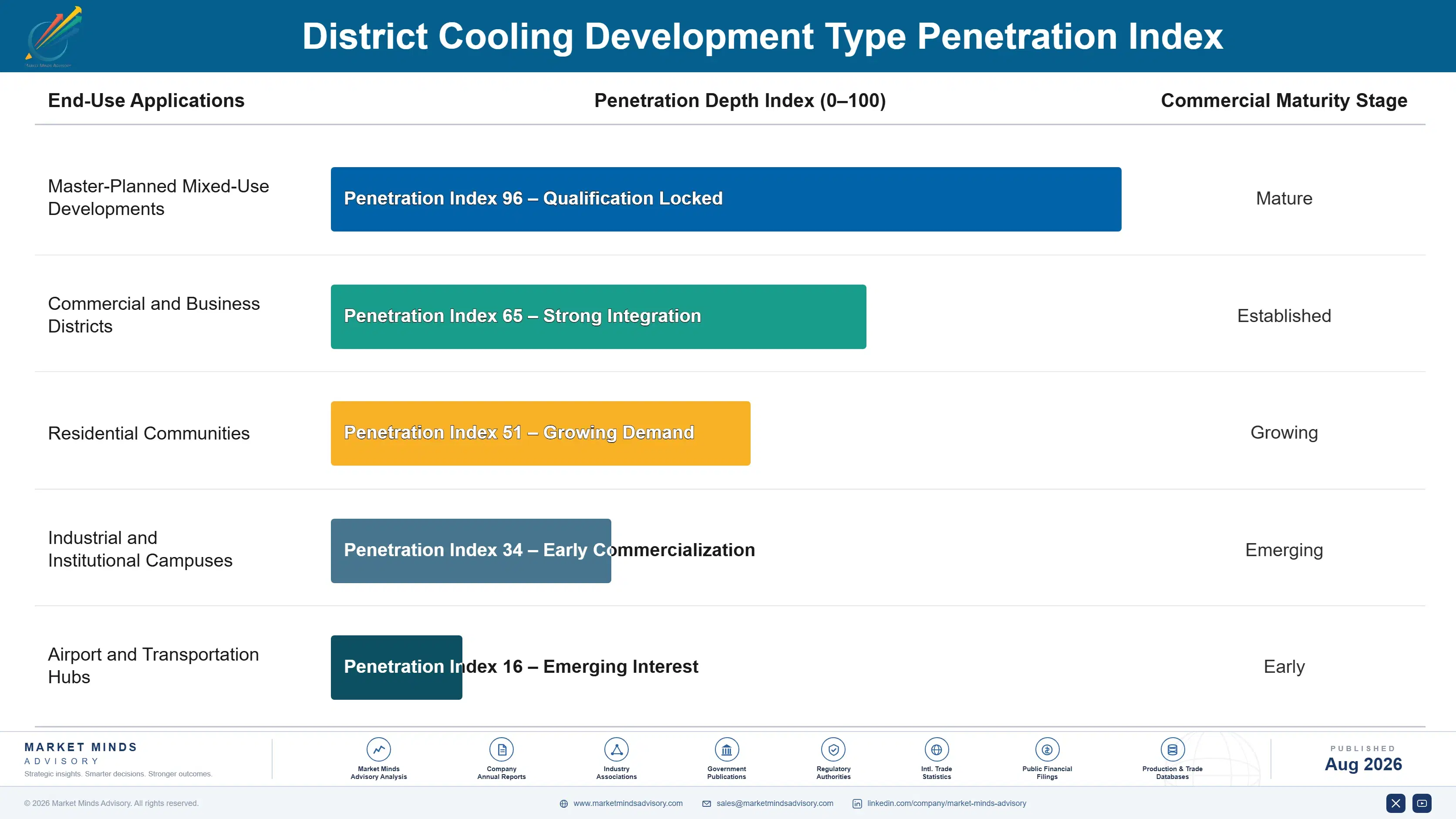
Adoption depth varies sharply by development type and ownership structure across most markets. Master-planned megaprojects go deepest, committing district cooling across the entire development footprint once the concession is signed at the planning stage. Mature-market retrofits adopt more selectively, often piloting district cooling for a single dense cluster before broader expansion. Fragmented-ownership districts weigh coordination cost most heavily, since aggregating buyer consent takes considerable time and effort.

Buyer profiles have shifted from facilities managers toward master-plan developers and sustainability directors with genuinely distinct priorities now. A facilities manager once compared equipment price and reliability directly; a master-plan developer now tracks concession revenue predictability, and a sustainability director drives specification against carbon accounting data a purely price-focused evaluation would never have prioritised at all.
district-cooling-market-end-use-penetration-index-1787332720707

Our Call On District Cooling

These are among the four positions where our research anticipates prominent divergence between winners and laggards over the coming forecast period. Each is grounded in the demand model, the regulatory perimeter, and the announced capacity pipeline.
01 / MEGAPROJECT CONCESSION STRATEGY

Win megaproject concessions at the master-plan stage

Operators that engage master-plan developers before ground is broken, rather than bidding for district cooling contracts after building design is already locked in, capture decades-long concession agreements that competitors entering later increasingly cannot win. That early positioning commands a premium of 20 to 35% in effective concession value over operators entering after site plans are finalized, since developers pay for infrastructure partners who can shape the cooling network around the master plan itself. Operators should prioritise this now, because it is not quickly replicated.
02 / THERMAL STORAGE RETROFIT STRATEGY

Retrofit thermal storage into existing plant assets

Operators that retrofit thermal energy storage into plants already generating cooling revenue, rather than treating storage as a new-build-only feature, capture peak-shaving cost savings that storage-free competitors cannot match, improving plant-level operating margin by roughly 15% without new chiller capacity investment across the existing network footprint and asset base entirely. That retrofit capability reaches existing concession assets immediately, opening margin improvement operators without storage retrofit expertise cannot access. Operators should invest here now, before storage-free competitors close the margin gap.
03 / NATURAL COOLING SITE STRATEGY

Select sites where natural cooling resources exist

Operators that prioritize development sites with genuine natural cooling resource availability, seawater, groundwater, or favorable ambient conditions, rather than defaulting to mechanical chilling everywhere, cut electricity operating cost by roughly 25% compared to conventional chiller-only plants serving comparable cooling loads across similar climates and regions worldwide. That site selection discipline reaches sustainability-focused developers who specifically value the lower carbon intensity natural cooling delivers across the entire project lifecycle. Operators should build this capability now, before rivals claim the best sites.
04 / GRID SERVICES PARTICIPATION

Participate in grid services and demand response

Operators that position storage-integrated plants for grid services and demand response participation, rather than treating storage purely as an internal cost-saving tool, capture emerging revenue streams that storage-free competitors cannot access, adding roughly 10% to plant-level revenue through utility demand response payments negotiated directly with regional grid operators across most deregulated markets. That grid participation reaches utilities and regulators who specifically need flexible capacity as renewable generation share increases. Operators should pursue this now, before rivals establish grid relationships first.

Engagement Snapshot From the Field

A live engagement with an industry participant carrying material or product regulatory and market exposure ahead of a defining policy shift, showing how our research translates into a defensible multi-year portfolio strategy.
MARKET MINDS ADVISORY · CLIENT ENGAGEMENT SUMMARY
District Cooling Producer Strategic Portfolio Review and Transition Roadmap 2026·Investment Scenario on District Cooling Exposure Evaluation 2025-26
CLIENT PROFILE
A master-planned mixed-use developer engaged MMA while evaluating district cooling concession bids for a new development spanning residential, retail, and commercial towers across multiple construction phases. The developer reported a projected cooling load exceeding 80,000 refrigeration tons at full build-out and faced pressure to lock in infrastructure partners before design finalization (client-reported, unverified by MMA).
STRATEGIC CHALLENGE
Selecting a concession partner too early risked locking in unfavorable long-term pricing terms, but waiting until design was finalized meant losing the chance to shape the cooling network around the master plan itself for maximum efficiency. Leadership needed a partner combining megaproject delivery credibility with thermal storage capability suited to the site's electricity market.
MMA APPROACH
MMA evaluated four candidate operators against documented megaproject delivery track records, thermal storage retrofit capability, and proposed concession pricing structure across a thirty-year contract horizon. We modelled lifecycle cost under each operator's actual plant efficiency data rather than accepting proposal-stage projections alone. We then assessed each operator's local market relationships and regulatory standing.
KEY FINDINGS
  1. Only two of the four candidate operators had thermal storage retrofit capability already proven across comparable megaproject-scale developments in the same climate region.
  2. The recommended operator's proposed pricing structure included pass-through electricity terms projected to reduce lifecycle cost by an estimated 18% (client-reported, unverified by MMA).
  3. Concession term length varied considerably across proposals, with the recommended operator offering the longest committed pricing stability period among all four candidates.
  4. Selecting a concession partner before finalizing building massing, without operator input on network layout, would have risked meaningfully higher long-term distribution cost.
CLIENT PROFILE
A master-planned mixed-use developer engaged MMA while evaluating district cooling concession bids for a new development spanning residential, retail, and commercial towers across multiple construction phases. The developer reported a projected cooling load exceeding 80,000 refrigeration tons at full build-out and faced pressure to lock in infrastructure partners before design finalization (client-reported, unverified by MMA).
STRATEGIC CHALLENGE
Selecting a concession partner too early risked locking in unfavorable long-term pricing terms, but waiting until design was finalized meant losing the chance to shape the cooling network around the master plan itself for maximum efficiency. Leadership needed a partner combining megaproject delivery credibility with thermal storage capability suited to the site's electricity market.
MMA APPROACH
MMA evaluated four candidate operators against documented megaproject delivery track records, thermal storage retrofit capability, and proposed concession pricing structure across a thirty-year contract horizon. We modelled lifecycle cost under each operator's actual plant efficiency data rather than accepting proposal-stage projections alone. We then assessed each operator's local market relationships and regulatory standing.
KEY FINDINGS
  1. Only two of the four candidate operators had thermal storage retrofit capability already proven across comparable megaproject-scale developments in the same climate region.
  2. The recommended operator's proposed pricing structure included pass-through electricity terms projected to reduce lifecycle cost by an estimated 18% (client-reported, unverified by MMA).
  3. Concession term length varied considerably across proposals, with the recommended operator offering the longest committed pricing stability period among all four candidates.
  4. Selecting a concession partner before finalizing building massing, without operator input on network layout, would have risked meaningfully higher long-term distribution cost.
RECOMMENDED STRATEGY
Phase 1: Phase 1 (0 to 6 months): Finalize concession terms and integrate operator input into master-plan network layout decisions before design lock. Phase 2: Phase 2 (6 to 24 months): Construct district cooling plant and distribution network alongside the first development phase towers as scheduled. Phase 3: Phase 3 (24 to 48 months): Bring subsequent phases online progressively, validating lifecycle cost against the original 18% savings target.
OUTCOME
The developer secured a thirty-year concession agreement with pass-through electricity pricing, achieving projected lifecycle cost savings while avoiding the network layout inefficiencies a late-stage operator selection would have risked. Construction proceeded on schedule, and the concession structure is now the developer's standard framework for future master-planned projects (client-reported, unverified by MMA).

Frequently Asked Questions

Foundational context covering the market sizes, CAGR, scope, country, region and competition that inform every finding below. This section is provided to cover basics and most often pre-purchase conversations, answered from the MMA Primary Research Dataset.

What is the current size of the District Cooling Market?

The global district cooling market is valued at USD 8.6 billion in 2025, covering centralized chilled water production and distribution infrastructure serving multiple buildings. Individual building-level HVAC systems are excluded.

How large will the District Cooling Market be by 2036?

The market is forecast to reach USD 21.1 billion by 2036 in the base case, about 2.26 times the 2026 level. That represents incremental value of roughly USD 11.77 billion across the forecast decade.

What is the CAGR for the District Cooling Market 2026 to 2036?

The market grows at an 8.5% CAGR in the base case, with bull and bear scenarios at 9.8% and 7.3%. The spread turns mainly on megaproject commitment pace and thermal storage retrofit economics.

Which segment is growing fastest?

Thermal energy storage-integrated systems grow fastest at 13.8%, about 1.62 times the overall rate, since peak-shaving economics increasingly determine plant profitability. Free cooling and natural cooling systems follow at 11.5%.

Who are the major companies in the District Cooling Market?

Leading operators include Tabreed, Empower, Engie, Veolia, and Qatar Cool, holding roughly 45% between them. Operators combining megaproject relationships with thermal storage capability are increasingly capturing premium growth.

Which country is growing fastest?

India grows fastest at a 13.2% CAGR, building on new smart city developments incorporating district cooling from the master-plan stage. Saudi Arabia follows closely on continued giga-project buildout.

Report Segmentation Architecture

The full report scope spans multiple orthogonal segmentation dimensions, with cross-tabulated demand data provided for each dimension pair. Coverage extends further to regional breakdowns, trend trajectories, and the competitive detail needed to support segment-level decision-making.

By Plant Technology

  • Thermal Energy Storage-Integrated Systems
  • Free Cooling / Natural Cooling Systems
  • Electric Chiller-Based Cooling Plants
  • Absorption Chiller Cooling Plants
  • Hybrid Cooling Plants

By Development Type

  • Master-Planned Mixed-Use Developments
  • Commercial and Business Districts
  • Residential Communities
  • Industrial and Institutional Campuses
  • Airport and Transportation Hubs

By Commercial Dimension

  • Direct Concession Agreements
  • Build-Operate-Transfer Contracts
  • Municipal Utility Ownership
  • Private Developer-Owned Networks

By Region

  • North America
  • Western Europe
  • East Asia
  • South Asia and Pacific
  • Latin America
  • Middle East and Africa
  • Eastern Europe

Scope, Methodology, and Coverage

Every figure in this report is reproducible from documented input assumptions. The scope below maps the historical period, the forecast horizon, the segmentation dimensions, and the countries covered, alongside the underlying primary and qualitative methodology.
Historical Period
2020 to 2025
Forecast Period
2026 to 2036
Base Year
2025 (USD billions; MMA Primary Research Dataset, August 2026)
Market Definition
The district cooling market comprises centralized chilled water production and distribution infrastructure serving multiple buildings across a defined development, valued at connected capacity and consumption revenue. It spans thermal energy storage-integrated systems, electric chiller-based plants, absorption chiller plants, free cooling systems, and hybrid plants serving residential, commercial, and mixed-use developments. Individual building-level HVAC systems and standalone equipment sales are excluded from this scope entirely.
Quantitative Units
USD billions (current prices); connected refrigeration ton capacity where applicable
Segmentation Dimensions
By Plant Technology; By Development Type; By Commercial Dimension; By Region
Regions Covered
North America, Western Europe, East Asia, South Asia and Pacific, Latin America, Middle East and Africa, Eastern Europe
Countries Covered
USA, Canada, Germany, France, UK, Sweden, Finland, Netherlands, China, Japan, South Korea, India, Australia, Singapore, Malaysia, Thailand, Brazil, Mexico, Chile, Argentina, UAE, Saudi Arabia, Qatar, South Africa, Poland, Czechia, Hungary, Romania, and additional markets relevant to this sector
Key Companies Profiled
Tabreed, Empower, Engie, Veolia, Qatar Cool, Emicool, Saudi Tabreed, ENGIE Cofely, Keppel DHCS, SP Group, Vattenfall, Fortum, Stockholm Exergi, Marafeq Qatar, National Central Cooling Company, Trakya Cam, Doosan Enerbility, Thermax, Danfoss, Johnson Controls
Quantitative Methodology
Primary survey, n=3,800 respondents, Q4 2025, six countries; demand-side model with trade association cross-validation
Qualitative Methodology
47 expert interviews, Q4 2025; applied to validate demand model assumptions, identify emerging dynamics, and assess competitive positioning
Report Format
PDF and XLSX data workbook (Word format preview document)
Publisher
Market Minds Advisory
Report Code
MMA-2026-ENE-158
Published
August 2026
Contact
sales@marketmindsadvisory.com | www.marketmindsadvisory.com

Purchase the full District Cooling Market Report (2026 to 2036).

The full MMA District Cooling report sizes the market across five plant technologies, seven regions, and multiple development types through 2036. It profiles 20 operators on a consistent basis of connected cooling capacity revenue, scoring each on megaproject concession positioning, thermal storage retrofit capability, natural cooling site selection, and grid services participation depth. Scenario models quantify how electricity pricing and thermal storage economics move both volume and achievable margin by plant technology across all seven regions. The report also includes concession pipeline tracking and thermal storage retrofit mapping.
Five-technology market sizing across seven regions through 2036
Twenty-operator benchmark on connected cooling capacity revenue
Gulf megaproject concession pipeline tracking by developer
Thermal storage retrofit economics benchmarking across operators
Electricity price volatility and grid services revenue tracking
Natural cooling site resource mapping by climate zone

Built For The People Who Decide

From boardroom strategy to bench-side execution, this report is read cover-to-cover by leaders shaping the next decade of their industry, turning demand scenarios, market dynamics and valuation benchmarks into decisions.
CXOs/ Presidents/ VPs/ Managers
M&A and Corporate Development
Strategy Teams and R&D Heads
Procurement and Product Directors
Regulatory and Compliance Leaders
Investor Relations and Equity Analysts