Market Minds Advisory
Distance Measurement Sensor Market

Distance Measurement Sensor Market: Distance Measurement Sensor Market. Trends and Forecast 2026 to 2036

Autonomous vehicle programmes, warehouse robotics, and smartphone depth cameras are pulling distance measurement sensors from single-purpose industrial tools into a mainstream perception component, rewarding suppliers who can shrink solid-state LiDAR cost while holding range accuracy.

Lead Analyst

Published

September 2026

Make Smarter Decisions with Customized Research Insights

Request a free sample report and evaluate market opportunities, growth trends, and competitive dynamics relevant to your business needs.

2025 MARKET VALUE$4.6BMarket Size 2025
2036 FORECAST VALUE$15.2BBase Case , 2026 to 2036
CAGR 2026 TO 203611.5 %Bull 12.8% / Bear 10.2%
INCREMENTAL OPPORTUNITY$10.1BNet 10- year value creation
EXPANSION MULTIPLE2.97x2036 value over 2026 base
Strategic Levers
M&A Pipeline
Regional Outlook
Country Rankings
Competitive Intelligence
Segmental Deep-dive
Call-Us : 91 93563 13602

Executive Snapshot and Market Trajectory.

Distance measurement sensors have moved from a specialized industrial automation tool into a mainstream perception component embedded across autonomous vehicles, warehouse robots, and consumer electronics, as solid-state LiDAR costs fall enough to reach mass-market vehicle platforms rather than remaining confined entirely to premium and luxury trims as before.
Autonomous vehicle programmes, warehouse and last-mile delivery robotics, and smartphone depth-sensing cameras are converging on solid-state LiDAR and time-of-flight sensor designs that balance range accuracy against unit cost, while Chinese LiDAR manufacturers and East Asian component suppliers concentrate production scale and vertical integration within a handful of manufacturing clusters serving global vehicle and electronics assemblers directly, shortening the path from initial prototype to mass-market shipment significantly.
Competitive intensity centers on a fragmented group of sensor specialists competing on range, resolution, and cost per unit rather than brand recognition, even as automotive safety regulation mandating advanced driver assistance features and rising industrial robotics adoption threaten to reshape which sensing technology, LiDAR, radar, or ultrasonic, ultimately wins the largest share of future vehicle and robotics platforms over the entire coming decade of rapid technology transition, consolidation, and pricing pressure.
Market Definition
The distance measurement sensor market covers LiDAR, time-of-flight, ultrasonic, infrared, and radar-based sensors that measure range between an object and a fixed or moving reference point for vehicles, robotics, industrial automation, and consumer electronics. It excludes complete perception software stacks and cameras used solely for two-dimensional imaging without range output.
Base Year Value
$4.6B in 2025 (MMA Primary Research Dataset, September 2026)
Forecast Period
2026 to 2036, eleven discrete annual values
CAGR
11.5% base case. Bull 12.8%. Bear 10.2%.
Fastest Growth Segment
Solid-State LiDAR Sensors for Autonomous Vehicles and Robotics: 18.0% CAGR
Fastest Growth Country
China: 14.5% CAGR
Fastest Growth Region
South Asia and Pacific: 13.5% CAGR
Largest Region
East Asia: 44% of 2025 global value
Market Leaders
Leading suppliers: Hesai Group, RoboSense, Velodyne Lidar, Sick AG, Keyence Corporation. Source: MMA Primary Research Dataset, July 2026.
Primary Survey
n=3,800 procurement and R&D decision-makers, Q4 2025, six countries
Methodology
Demand-side build-up, cross-validated against public data, 47 expert interviews

Distance Measurement Sensor Market Forecast Scenarios

distance-measurement-sensor-market-size-forecast-scenario-1789998768715
Between 2020 and 2025, distance measurement sensor demand grew steadily as early autonomous vehicle pilot programmes and warehouse robotics deployment proved that solid-state LiDAR and time-of-flight sensors could operate reliably outside laboratory conditions, lifting volume well ahead of broader industrial sensor market growth across automotive and logistics segments alike throughout the entire five-year period of steady adoption.
The base case assumes continued automotive and robotics adoption and rests on three commercial mechanisms: expanding advanced driver assistance system mandates requiring LiDAR or radar sensing across mid-tier vehicle trims worldwide, accelerating warehouse and last-mile delivery robotics deployment under e-commerce fulfillment pressure, and smartphone makers standardizing time-of-flight depth cameras across broader device price bands, each reinforcing capacity investment in solid-state sensor fabrication through the back half of the forecast window ahead.
A bull case built on faster-than-expected robotaxi commercialization and accelerating humanoid robotics development could push volumes meaningfully above trend, while a bear scenario tied to autonomous vehicle regulatory delays and slower industrial robotics capital spending would compress order backlogs and slow new sensor fabrication capacity qualification decisions across the industry's entire global supplier base broadly and consistently.

Distance Sensing Economics: Range Precision Versus Unit Cost

Distance measurement sensor economics divide sharply along underlying technology type rather than end application, since LiDAR, radar, ultrasonic, and time-of-flight sensors each carry distinct cost structures, range limits, and manufacturing scale characteristics that determine which vertical adopts which technology first and at what price point the resulting finished product becomes genuinely commercially viable for mass deployment across an entire vehicle fleet.
MARKET CONCENTRATIONCR5 46%fragmented field with no clear single dominant supplier
AVERAGE SELLING PRICE$85 per unitpricing varies sharply with range and resolution class
TOP PRODUCING COUNTRY SHAREChina 34%leads volume ahead of Japan and United States
CAPACITY UTILISATION79%assembly lines run high amid automotive order growth
TRADE INTENSITY61% exportedfinished sensors ship onward to global vehicle assemblers
FEEDSTOCK COST SHARE29%laser diodes and optical components dominate input cost
Pricing rewards suppliers who can shrink solid-state LiDAR module cost while holding detection range above 200 meters in adverse weather conditions, so vertically integrated Chinese manufacturers command a durable cost advantage over foreign rivals still dependent on discrete optical component suppliers for critical laser diode and receiver parts across their entire supply chain and assembly process from start to finish.
Laser diode and optical lens costs move independently of broader semiconductor demand cycles, tied instead to specialty optics manufacturing capacity concentrated in a small number of countries, which means margin pressure in this industry often originates several supply tiers upstream of the vehicle or robotics integrator that ultimately purchases the finished sensor module years after the underlying components were first sourced and qualified for full production deployment.
"Distance sensors are where the autonomous vehicle industry's real cost war is being fought, not in the software. Whoever gets LiDAR under a hundred dollars first changes the entire competitive map."
Director, Sensing and Perception Technology Practice · MMA Technology Practice · September 2026

Market Trends

China's Robotaxi Expansion Drives Automotive-Grade LiDAR Volume Sharply

Chinese robotaxi operators expanded active fleet size past 10,000 vehicles in 2025, and each vehicle integrates between four and six LiDAR units for full-coverage perception, creating sustained volume demand that domestic manufacturers have scaled production capacity to match. This fleet expansion has pushed unit costs down through manufacturing scale effects unavailable to smaller Western competitors still operating at prototype or low-volume production levels. Domestic Chinese LiDAR makers now supply both local robotaxi fleets and export orders to international automakers seeking comparable cost structures for their own advanced driver assistance programmes.
Market Impact: Mandates cover vehicles under 25,000 dollars

Warehouse Automation Investment Accelerates Time-of-Flight Sensor Deployment

Global warehouse automation investment reached roughly 28 billion dollars in 2025, and mobile robots navigating fulfillment centers increasingly rely on time-of-flight sensors for obstacle detection and precise positioning rather than older ultrasonic-only designs common in earlier automation generations built years ago. E-commerce fulfillment pressure has compressed the payback period for automation investment to under two years at large distribution centers, accelerating adoption well beyond earlier automation cycles focused primarily on cost reduction rather than throughput capacity. Robotics integrators increasingly specify time-of-flight sensing as a standard component rather than an optional upgrade.
Market Impact: Humanoid robotics funding surpassed 6 billion

Market Opportunities and Growth Drivers

Advanced Driver Assistance Mandates Require Mid-Tier Vehicle Sensing

Regulatory mandates requiring automatic emergency braking and forward collision warning have expanded the required distance sensor bill of materials for new vehicles sold in the European Union and United States starting in 2026, pushing radar and LiDAR sensing down from premium trims into mid-tier and entry-level vehicle platforms carrying price tags under 25,000 dollars. Automakers who previously reserved advanced sensing for flagship models now specify at least one radar unit across their entire lineup to meet mandatory safety ratings. This regulatory push has expanded the addressable vehicle population for distance sensors by tens of millions of units annually.
Market Impact: Range falls up to 40 percent

Humanoid Robotics Development Creates New Multi-Sensor Demand Category

Venture and corporate investment in humanoid robotics surpassed 6 billion dollars in 2025, and each prototype platform integrates multiple distance sensing modalities, typically combining LiDAR, time-of-flight, and ultrasonic sensors for redundant obstacle detection and precise manipulation tasks. This emerging category did not exist commercially five years ago and now represents a meaningful design-in opportunity for sensor makers willing to accept lower initial volume in exchange for design partnership positioning ahead of eventual mass production. Suppliers who secure early humanoid robotics design wins are positioning themselves for outsized volume once commercial deployment scales.
Market Impact: Prices fell more than 50 percent

Market Restraints and Challenges

Adverse Weather Performance Degradation Limits LiDAR Reliability Sharply

LiDAR detection range falls by as much as 40 percent in heavy rain or fog, and this performance gap remains the leading technical obstacle to fully removing human oversight from autonomous vehicle operation in regions with unpredictable weather patterns. The root cause is fundamental physics: laser light scatters off airborne water droplets in ways that camera and radar sensors handle more gracefully. Suppliers are exploring sensor fusion architectures that combine LiDAR with radar and thermal imaging to compensate for individual sensor weaknesses, though this approach adds cost and system complexity that pure LiDAR proponents have resisted.
Market Impact: Robotaxi fleets passed 10,000 vehicles

Component Price Compression Squeezes Sensor Manufacturer Margins

Aggressive Chinese pricing has pushed average LiDAR unit prices down more than 50 percent since 2022, compressing gross margins for Western manufacturers who cannot match domestic Chinese vertical integration and component cost structures built at massive scale. The root cause is overcapacity relative to near-term demand combined with state-supported manufacturing scale that non-Chinese competitors cannot replicate quickly or affordably. Some Western suppliers are shifting toward higher-margin software and calibration services layered on top of hardware sales to offset compressed component margins, though this transition requires capabilities many hardware-focused firms currently lack.
Market Impact: Warehouse automation spending reached 28 billion
4 additional market trends, 3 additional growth drivers, and 3 additional restraints and challenges are covered in the full report. Contact sales@marketmindsadvisory.com to access the complete intelligence.

Segment CAGR and Growth Architecture

Distance measurement sensors are segmented in this analysis by underlying sensing technology rather than by end application, since fabrication process, cost structure, and achievable detection range differ sharply across LiDAR, radar, ultrasonic, time-of-flight, and infrared designs despite serving overlapping automotive, robotics, and consumer electronics customers across virtually every geography and price tier worldwide today.
distance-measurement-sensor-market-market-share-analysis-1789998769326

Solid-State LiDAR Sensors for Autonomous Vehicles and Robotics

Solid-state LiDAR sensors are the fastest-growing segment, expanding at 18.0 percent annually as automakers and robotics integrators move away from mechanically rotating LiDAR designs toward chip-based sensing that eliminates moving parts and dramatically reduces manufacturing cost at production scale across the industry today. Chinese manufacturers have driven this transition fastest, achieving unit costs low enough to reach mid-tier vehicle platforms years ahead of Western competitor timelines and export markets worldwide. Warehouse and delivery robotics integrators have adopted the same underlying technology for obstacle detection, benefiting from cost declines originally driven by automotive volume rather than robotics-specific demand, which has accelerated adoption across both verticals simultaneously and reinforced supplier scale advantages.
CAGR 18.0%

Time-of-Flight Sensors for Consumer Electronics and Robotics

Time-of-flight sensors are the second-fastest segment, growing at 15.0 percent as smartphone makers standardize depth-sensing cameras across broader device price tiers and robotics integrators specify the technology for precise short-range obstacle detection and manipulation tasks across warehouse and industrial settings worldwide today. Unlike LiDAR, time-of-flight sensors achieve useful range and resolution at a fraction of the manufacturing cost, making them the default choice for applications requiring under ten meters of detection range in most current deployments globally today. Consumer electronics volume has pulled component costs down further still, creating spillover benefits for industrial and robotics customers who now access automotive-grade reliability at consumer electronics pricing levels across every major market.
CAGR 15.0%
Full segment breakdown across 6 segments available in the complete report.

Regional Architecture and Country Demand Map

Distance measurement sensor demand concentrates wherever autonomous vehicle fleets, robotics manufacturing, and consumer electronics assembly all converge together at genuine production scale, pulling a disproportionate share of global sensor volume into East Asia well ahead of every other region on the entire planet today by far.

North America

North America's demand rests primarily on autonomous vehicle development programmes and industrial robotics deployment rather than sensor manufacturing capacity, since most solid-state LiDAR fabrication happens outside the region entirely today. United States robotaxi operators and advanced driver assistance programmes at major automakers drive substantial design and integration activity, even though component fabrication increasingly happens at Asian contract manufacturers under long-term supply agreements spanning several years at a time. Warehouse automation investment across e-commerce fulfillment networks adds a steady secondary demand channel concentrated in major logistics hubs nationwide. Canadian robotics research institutions contribute a smaller but growing share tied to agricultural and mining automation applications spreading steadily across the entire continent.
Share: 22% | CAGR: 12.5% (2026 to 2036)

Western Europe

Western Europe's share sits below the standard regional band because the region hosts significant automotive engineering talent but limited sensor fabrication capacity, leaving demand concentrated in vehicle integration and industrial automation design work rather than component production itself entirely today. German automakers specify advanced driver assistance sensor suites for premium vehicle exports, while French and Swedish industrial automation firms integrate distance sensors into manufacturing robotics sold globally to customers worldwide each year. Sick AG and other German industrial sensor makers maintain meaningful domestic production, providing a rare regional manufacturing counterweight to Asian dominance. Nordic robotics startups contribute smaller-scale but technically sophisticated design activity in warehouse and agricultural automation across the region.
Share: 15% | CAGR: 9.8% (2026 to 2036)
Regional intelligence for 5 additional markets available in the complete report: East Asia, South Asia and Pacific, Latin America, Middle East and Africa, Eastern Europe. Contact sales@marketmindsadvisory.com.
distance-measurement-sensor-market-country-cagr-analysis-1789998769857

Sensor Fusion Precision and Recurring Calibration Revenue

Distance sensor suppliers can expand revenue well beyond per-unit hardware sales by moving into sensor fusion software licensing, recurring field calibration service contracts, beam steering process licensing to smaller regional manufacturers abroad, and bundled automotive qualification testing packages that smaller lower-cost competitors without full-stack capability cannot easily replicate or match on price alone today.

Sensor Fusion Software Licensing for Hardware Customers

Suppliers who develop proprietary sensor fusion algorithms combining LiDAR, radar, and camera data can license this software separately from hardware sales, capturing recurring revenue per vehicle or robot unit shipped rather than a single upfront component fee paid once. This software layer typically carries margins above 60 percent, far exceeding standard hardware margins, because it draws on scarce algorithm expertise most hardware-only competitors lack entirely today. Customers who adopt the bundled software also tend to standardize on the same supplier's hardware for future platform generations across their entire product line.
Market Impact: Software licensing work carries margins above 60 percent

Recurring Field Calibration and Recalibration Service Contracts

Distance sensors mounted on vehicles and industrial robots require periodic recalibration every 12 to 18 months to maintain accuracy after mechanical vibration and thermal cycling degrade factory alignment over time and usage. Suppliers who win the original design contract can capture a recurring service revenue stream covering field recalibration and diagnostic checks throughout the equipment's entire operational life span. This annuity-like revenue pattern is far more valuable than a single hardware sale, since service margins often exceed original equipment margins once initial tooling investment is fully recovered by the supplier.
Market Impact: Recalibration is needed every 12 to 18 months

Licensing Proprietary Solid-State Beam Steering Process Technology

A small number of suppliers have developed proprietary solid-state beam steering designs that eliminate mechanical moving parts entirely from the sensor assembly and housing, and some now license this process technology to smaller regional manufacturers for an upfront fee plus a running royalty near 5 percent of licensee production revenue each year. This converts research investment into a second income stream without requiring additional capital expenditure on new physical fabrication capacity. Licensing also extends the technology's reach into markets where the original developer lacks direct manufacturing presence or brand recognition.
Market Impact: Royalty fees run near 5 percent of revenue

Bundled Reliability Testing and Automotive Qualification Packages

Beyond the sensor itself, suppliers can bundle automotive-grade environmental testing, vibration cycling, and functional safety certification as a paid add-on package rather than folding these steps quietly into base hardware pricing structures used elsewhere in the industry. Customers requiring formal qualification certificates for automotive programme approval pay a premium of roughly 20 percent over standard sensor fees for this bundled service, and the resulting test data often becomes reusable across multiple customer programmes at no incremental cost. This add-on has become a meaningful profit center for suppliers serving safety-critical automotive customers.
Market Impact: Adds a 20 percent premium over standard fees

Who Controls the Margin Pool

Distance measurement sensor supply is more fragmented than most technology hardware categories, with a CR5 near 46 percent that reflects the coexistence of LiDAR specialists, radar suppliers, and industrial sensor makers who rarely compete head-to-head across every technology type. The gap between the leading supplier and mid-tier challengers is narrower here than in more consolidated hardware markets, since no single technology has fully displaced its rivals yet.
Current competitive activity centers on aggressive price competition in solid-state LiDAR alongside software and sensor fusion differentiation in time-of-flight and radar segments, since manufacturing capacity for basic sensor hardware has become increasingly commoditized. Firms are differentiating through proprietary beam steering architectures and through bundled software and calibration services that raw hardware suppliers struggle to match.

Emerging pressure comes from humanoid robotics and warehouse automation customers who reward multi-sensor integration and reliability over raw price, opening space for suppliers who can bundle complementary sensing modalities rather than selling single-technology components. Rankings could shift meaningfully if a mid-tier supplier secures a major humanoid robotics platform relationship or if a Western competitor develops a cost structure competitive with Chinese vertical integration.
distance-measurement-sensor-market-company-positioning-matrix-1789998770380

Competitive Moat and Risk Dimensions

HESAI GROUP

Moat: Vertically Integrated Manufacturing Scale

Hesai operates its own automated production lines rather than relying on contract manufacturers, achieving unit costs well below Western competitors still dependent on manual assembly or third-party fabrication. This vertical integration lets Hesai underprice rivals on comparable specification LiDAR units while maintaining healthier margins than its cost structure alone would suggest.
HESAI GROUP

Risk: Export Restriction Exposure Risk

A meaningful share of Hesai's growth depends on continued export access to Western automotive customers, leaving revenue exposed to trade policy shifts targeting Chinese sensor technology on national security grounds. Diversifying customer concentration away from any single geographic market would reduce this exposure but requires years of relationship building.
SICK AG

Moat: Industrial Safety Certification Depth

Sick AG holds deep functional safety certification experience across industrial automation applications that newer LiDAR entrants have not yet accumulated, giving it a durable position in factory and warehouse robotics where certification failure carries severe liability consequences. This certification depth compounds over decades and cannot be replicated quickly by well-funded but younger competitors.
SICK AG

Risk: Slower Automotive Segment Penetration

Sick AG's strength in industrial automation has not translated into comparable automotive design wins, leaving it exposed to being overtaken in the fastest-growing vehicle sensing segment by dedicated automotive LiDAR specialists. Expanding into automotive requires cost structures and volume economics quite different from its industrial heritage.

Players Tracked

Prominent Players

Hesai Group
RoboSense
Velodyne Lidar
Sick AG
Keyence Corporation

Other Key Players

Luminar Technologies
Innoviz Technologies
Ouster
Cepton
Continental AG
Denso Corporation
Bosch
Valeo
Aptiv
Texas Instruments
STMicroelectronics
Infineon Technologies
Omron Corporation
Panasonic Corporation
Leishen Intelligent System

Recent Developments

JANUARY 2026

Hesai Expands Automotive LiDAR Production Capacity

Hesai announced organic capacity expansion at its Shanghai facility, adding new automated production lines dedicated to automotive-grade solid-state LiDAR assembly. Funded through internal capital, the expansion should lift annual output roughly 40 percent once commissioned in mid-2026, addressing sustained robotaxi and export order demand growth.
Signal: Signals sustained capital commitment to manufacturing scale leadership rather than pursuing new market diversification bets now.
JUNE 2025

Keyence Signs Warehouse Robotics Supply Agreement

Keyence entered a multi-year supply agreement with a global warehouse robotics integrator to provide time-of-flight distance sensors for mobile robot obstacle detection across multiple continents. The agreement is a commercial supply contract rather than an acquisition or joint venture, marking Keyence's deepest push yet into mobile robotics.
Signal: Marks a deliberate diversification move by Keyence well beyond its historical, long-standing factory automation customer base.
OCTOBER 2025

RoboSense Acquires Solid-State Beam Steering Specialist

RoboSense completed the acquisition of a smaller Chinese solid-state beam steering specialist focused on next-generation LiDAR architecture, adding proprietary chip-based scanning technology to its product portfolio. The acquired firm's roughly 120 employees and existing patents transferred fully, giving RoboSense immediate access to next-generation design capability.
Signal: Confirms acquisition, rather than organic internal capacity development, remains RoboSense's preferred route into new adjacent segments.

Laser and Optics Price Exposure in Fabrication

Laser diodes and precision optical lenses together account for roughly 29 percent of distance sensor cost of goods sold, with automotive-grade laser diodes sourced primarily from Japanese and Chinese semiconductor makers while precision optics manufacturing concentrates among a handful of German and Japanese specialists holding genuinely limited spare capacity for sudden demand surges across the industry.
Rare earth element export restrictions from China tightened significantly in 2024, and prices for the specialty glass and coating materials used in precision optics climbed more than 25 percent within a year according to United States Geological Survey commodity tracking data. The restriction disproportionately affected smaller sensor makers without long-term supply contracts already in place, forcing several to delay new product launches while renegotiating supplier terms and searching for alternative material sources.

Vertically integrated manufacturers who produce their own laser diodes and optics internally are insulated from these price swings in ways that assembly-only competitors dependent on external suppliers simply are not. This gap widens further for smaller Western sensor makers who lack the production volume to justify backward integration into component manufacturing, leaving them permanently reliant on the same external suppliers as their competitors.
distance-measurement-sensor-market-cost-volatility-analysis-1789998770578

Backward Integration Into Laser Diode Fabrication

Larger sensor makers are investing in their own laser diode fabrication lines rather than purchasing externally, insulating themselves from rare earth material price swings that hit assembly-only competitors hardest during periods of extended market volatility. This vertical integration requires substantial upfront capital but pays back through pricing stability over the equipment's entire operational life span.

Diversifying Optics Sourcing Beyond Traditional Suppliers

Several manufacturers are qualifying alternative optics suppliers in Taiwan and South Korea to reduce dependence on traditional German and Japanese sources, even though these newer suppliers currently carry slightly higher defect rates during initial production ramp phases. This diversification smooths supply continuity risk during future material price spikes or export restrictions affecting the industry.

Portfolio Architecture for Margin Defence

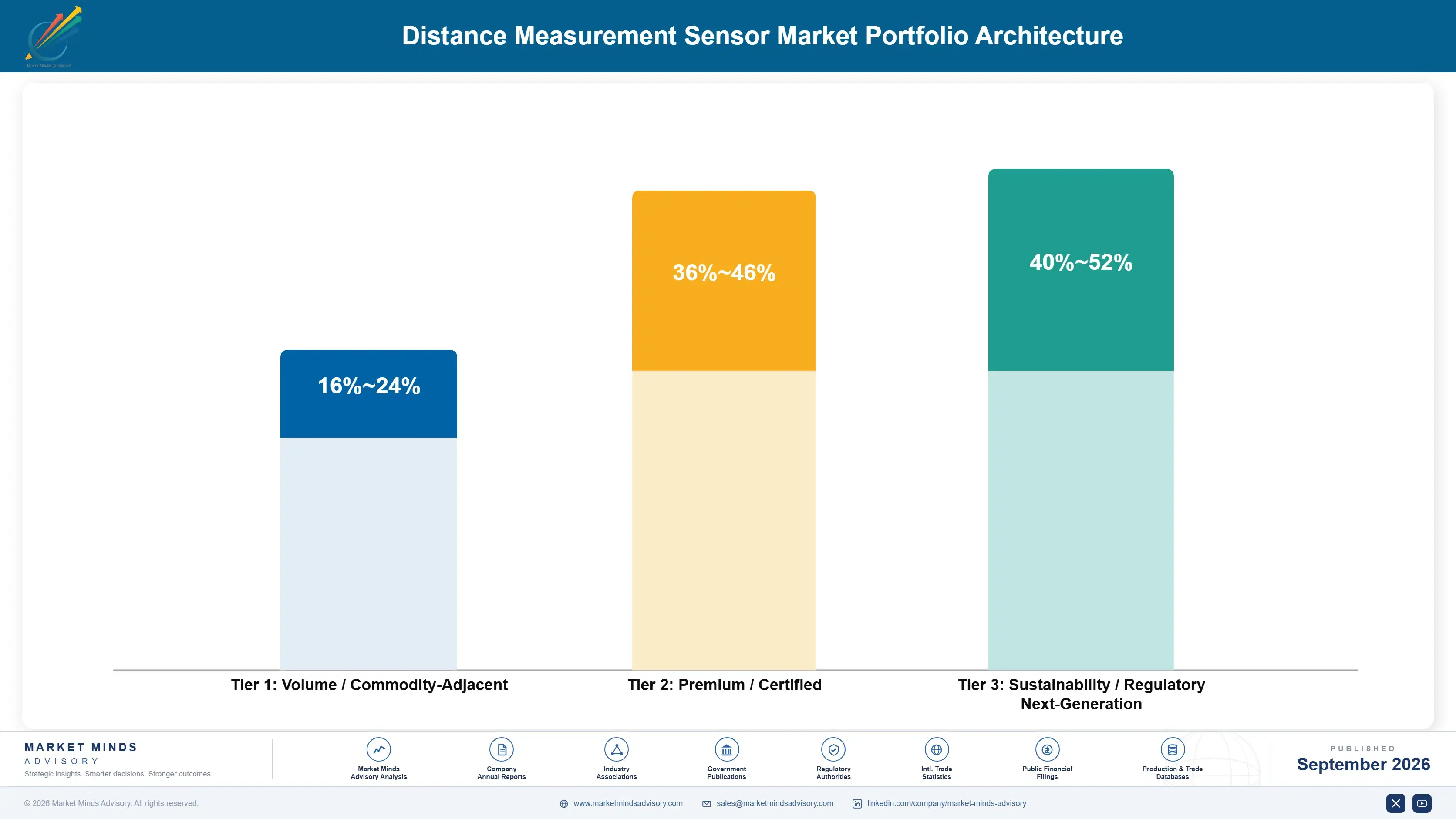
Distance sensor margin economics separate cleanly along sensing technology and application criticality rather than end market alone, with the widest gross margins concentrated in automotive-grade and safety-certified LiDAR work regardless of whether the customer is a robotaxi operator or an industrial automation integrator purchasing at scale. Commodity ultrasonic sensors run on considerably thinner margins sustained by high throughput volume rather than design differentiation.
The tension between volume and premium tiers plays out most clearly in capital allocation decisions: every dollar spent developing next-generation solid-state LiDAR pulls engineering resources away from mature radar and ultrasonic production that still serves existing automotive and industrial customers under long-standing supply contracts. Most established suppliers maintain both tiers simultaneously rather than fully committing capital to one over the other.

High-value margin pools concentrate overwhelmingly in automotive-grade and safety-critical work, where certification barriers and reliability testing requirements keep new entrants out far more effectively than pricing power alone ever could achieve on its own. Sustainability and next-generation segments, including chip-based beam steering, remain small today but are positioned to absorb a growing share of new capital investment as cost curves continue falling steadily.

Volume / Commodity-Adjacent

Commodity ultrasonic and basic infrared distance sensors for parking assistance and consumer devices, running on high volume and thin unit margins sustained by throughput rather than design differentiation or certification barriers.
Gross Margin: 16-24%

Premium / Certified

Automotive-grade radar and solid-state LiDAR sensors for driver assistance and autonomous vehicle platforms, where safety certification, reliability testing, and range precision command a durable price premium over commodity sensor sales.
Gross Margin: 36-46%

Sustainability / Regulatory / Next-Generation

Chip-based beam steering LiDAR and multi-modal sensor fusion platforms tied to autonomous mobility and humanoid robotics standards, still small in volume today but drawing rising capital allocation from established suppliers positioning early.
Gross Margin: 40-52%
distance-measurement-sensor-market-portfolio-architecture-1789998771080

High-value Sub-segments and Strategic Watch-out

Solid-State LiDAR for Vehicles and Robotics

The fastest-growing, highest-margin segment, driven by robotaxi fleet expansion and mid-tier vehicle advanced driver assistance mandates across major automotive markets. Chip-based beam steering and manufacturing scale advantages protect incumbent margins, and the segment is expected to absorb the largest share of new capital investment through the forecast window.
Gross Margin: 38-46%

Time-of-Flight Sensors for Consumer and Robotics

High-value and growing steadily as smartphone makers standardize depth-sensing cameras and robotics integrators specify short-range obstacle detection across warehouse and manufacturing settings worldwide today, with consumer electronics volume pulling component costs down further still and creating meaningful spillover benefits for industrial customers seeking comparable reliability.
Gross Margin: 32-40%

Automotive Radar Sensors for Driver Assistance

The volume core of the market, sustained by ongoing advanced driver assistance mandate expansion and steady vehicle replacement demand across major global markets today, though margins stay moderate because established radar fabrication processes face steady competition from a wider pool of qualified regional suppliers worldwide.
Gross Margin: 24-32%

Mechanical LiDAR for Legacy Autonomous Platforms

A strategic watch-out segment where accelerating replacement of mechanically rotating LiDAR designs with newer solid-state chip-based alternatives could leave committed manufacturing capacity substantially underutilized well before existing long-term supply contracts naturally expire across the entire affected legacy supplier base over the next several years ahead.
Gross Margin: 18-26%

Recurring Revenue Beneath Sensor Design Wins

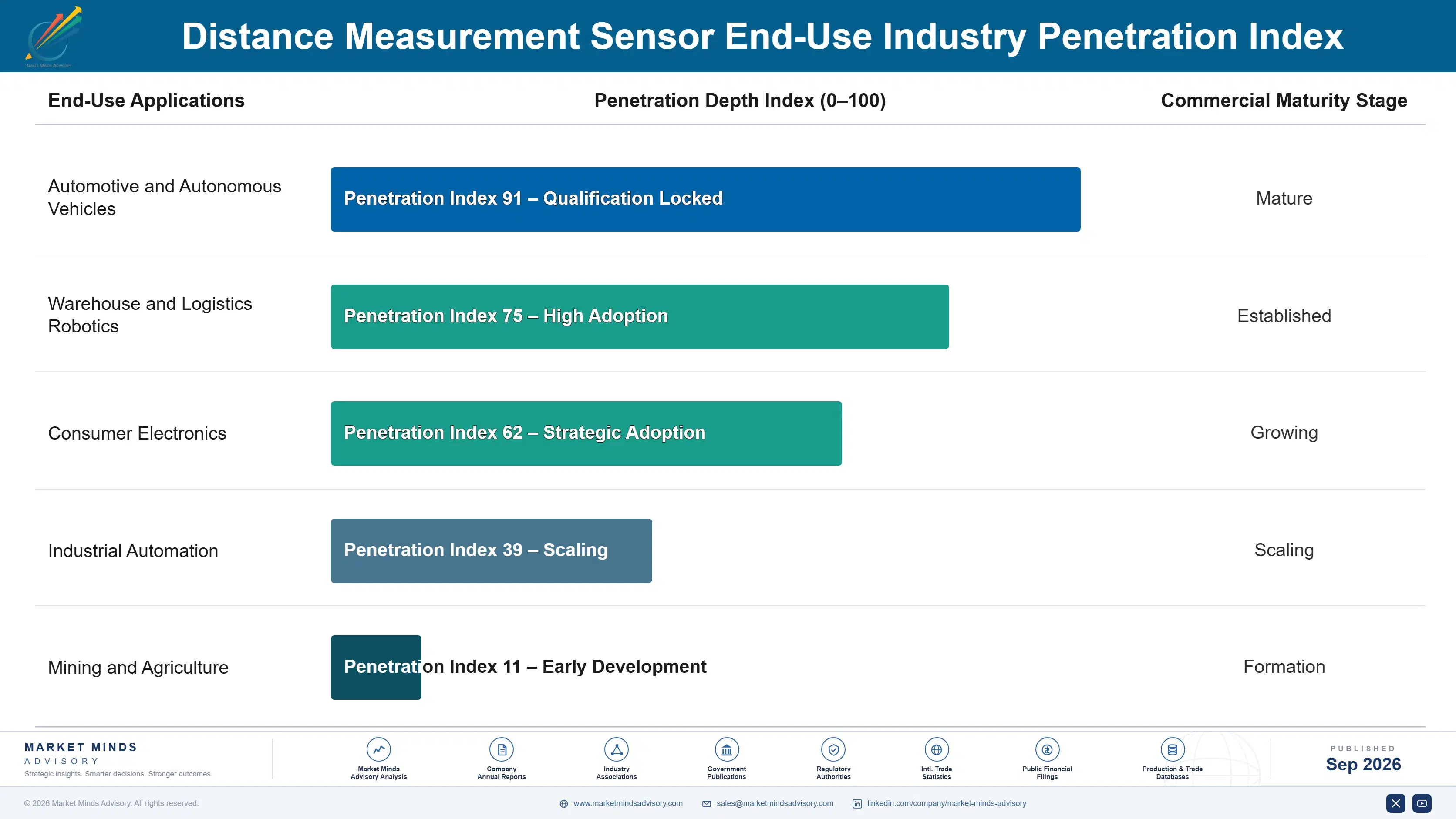
Distance sensor revenue behaves less like a one-time hardware sale and more like an annuity once a vehicle or robotics platform design win is secured, since periodic recalibration needs and multi-year vehicle production runs lock in repeat orders that persist well beyond the original design contract across the entire relationship.
Stickiness varies sharply by end-use vertical: automotive design wins carry the deepest lock-in because requalifying a new sensor supplier mid-production run can take years and risks disrupting an entire vehicle safety certification process, while consumer electronics customers are far more contestable since smartphone makers routinely dual-source across two or three qualified suppliers each product cycle. Industrial robotics relationships sit closer to automotive stickiness, anchored by shared integration engineering work developed over years.

Buyer profiles are shifting generationally as procurement authority moves from pure component cost engineers toward systems reliability and software integration teams who weigh sensor fusion compatibility and long-term support far more heavily than unit price alone. This generational change favors incumbents with documented automotive qualification track records over new entrants offering only lower cost, reshaping how future design contracts get awarded across the industry through the remainder of the forecast decade.
distance-measurement-sensor-market-end-use-penetration-index-1789998771573

Where Manufacturing Scale Decides Sensor Wins

These are among the four positions where our research anticipates prominent divergence between winners and laggards over the coming forecast period. Each is grounded in the demand model, the regulatory perimeter, and the announced capacity pipeline.
01 / SOLID-STATE CAPACITY TIMING

Invest in Solid-State LiDAR Before Volume Consolidates

Suppliers still running mechanical LiDAR-only production should commit decisively to solid-state capacity now, before robotaxi and mid-tier vehicle programmes finish allocating their remaining design slots for this product generation across major markets. Waiting even one product cycle risks permanent exclusion from the highest-volume segment of this entire market, a mistake that is genuinely difficult to reverse afterward. Early movers who invested ahead of the 2024 cost decline are already locking in automotive contracts that latecomers cannot easily displace at this stage of the cycle.
02 / SOFTWARE LAYER DEVELOPMENT

Build Sensor Fusion Software to Capture Recurring Revenue

Hardware-only suppliers should invest in sensor fusion software capability deliberately and soon, since bundled software licensing generates recurring revenue that dwarfs the value of any single hardware sale considered on its own. Developing credible algorithm expertise takes years and demands sustained capital investment that most smaller competitors will simply not commit to voluntarily given the uncertain near-term payback timeline involved. Firms that clear this bar first should expect to hold meaningful pricing power over customer platform generations for years afterward.
03 / AUTOMOTIVE CERTIFICATION ENTRY

Pursue Automotive Qualification Before Mandates Fully Take Effect

Suppliers without automotive-grade certification should pursue it immediately and without delay, since the 2026 advanced driver assistance mandates are expanding the addressable vehicle population faster than certification capacity across the entire supplier base can currently absorb comfortably at present. This is no longer a discretionary product decision given how quickly mandated sensing requirements are spreading across mid-tier vehicle platforms worldwide today. Competitors with certification already in place will simply capture design wins that unqualified rivals cannot even bid for at all.
04 / COMPONENT SOURCING DIVERSIFICATION

Diversify Laser Diode and Optics Sourcing Proactively

Firms weighing supply chain resilience should evaluate select alternative laser diode and optics sourcing carefully and methodically over an extended timeline, particularly where Taiwanese and South Korean suppliers could offset exposure to rare earth export restrictions meaningfully over time. This diversification carries real quality risk during initial qualification and should not be treated as a near-term cost reduction measure alone. It functions best as an option on future supply security rather than a present-day cost optimization strategy for most firms.

Engagement Snapshot From the Field

A live engagement with an industry participant carrying material or product regulatory and market exposure ahead of a defining policy shift, showing how our research translates into a defensible multi-year portfolio strategy.
MARKET MINDS ADVISORY · CLIENT ENGAGEMENT SUMMARY
Distance Measurement Sensor Producer Strategic Portfolio Review and Transition Roadmap 2026·Investment Scenario on Distance Measurement Sensor Exposure Evaluation 2025-26
CLIENT PROFILE
The client is a mid-tier warehouse robotics integrator preparing to launch a new autonomous mobile robot platform requiring reliable obstacle detection across variable warehouse lighting conditions. The company had previously relied on basic ultrasonic sensors for its earlier generation platform and had no prior sourcing relationship with time-of-flight or LiDAR suppliers. Its engineering team understood system-level navigation requirements but lacked hands-on sensor selection experience.
STRATEGIC CHALLENGE
The client needed to identify and qualify a distance sensor supplier capable of reliable obstacle detection performance within an aggressive eight-month product launch window tied to a major customer commitment. Existing supplier relationships in basic ultrasonic sensing offered no relevant qualification pathway, and the client's engineering team had never evaluated time-of-flight or LiDAR performance tradeoffs before this specific programme.
MMA APPROACH
MMA conducted a structured supplier assessment across ten qualified distance sensor manufacturers, screening for warehouse-specific reliability track record, cost per unit at target production volume, and integration support capability specific to the client's robotics platform architecture. The assessment combined primary interviews with supplier engineering leadership and a review of each candidate's documented field performance data over the prior three years.
KEY FINDINGS
  1. Only three of ten assessed suppliers held documented warehouse-specific reliability data relevant to the client's variable lighting and heavy dust exposure conditions.
  2. The client's initial preferred supplier lacked integration engineering support capacity, a gap that would have delayed the product launch by several months.
  3. Recurring calibration service revenue, once modeled properly across the robot fleet's projected service life, represented roughly four times the value of the initial hardware order.
  4. Two of the ten candidate suppliers offered bundled sensor fusion software that reduced the client's internal development burden significantly ahead of launch.
CLIENT PROFILE
The client is a mid-tier warehouse robotics integrator preparing to launch a new autonomous mobile robot platform requiring reliable obstacle detection across variable warehouse lighting conditions. The company had previously relied on basic ultrasonic sensors for its earlier generation platform and had no prior sourcing relationship with time-of-flight or LiDAR suppliers. Its engineering team understood system-level navigation requirements but lacked hands-on sensor selection experience.
STRATEGIC CHALLENGE
The client needed to identify and qualify a distance sensor supplier capable of reliable obstacle detection performance within an aggressive eight-month product launch window tied to a major customer commitment. Existing supplier relationships in basic ultrasonic sensing offered no relevant qualification pathway, and the client's engineering team had never evaluated time-of-flight or LiDAR performance tradeoffs before this specific programme.
MMA APPROACH
MMA conducted a structured supplier assessment across ten qualified distance sensor manufacturers, screening for warehouse-specific reliability track record, cost per unit at target production volume, and integration support capability specific to the client's robotics platform architecture. The assessment combined primary interviews with supplier engineering leadership and a review of each candidate's documented field performance data over the prior three years.
KEY FINDINGS
  1. Only three of ten assessed suppliers held documented warehouse-specific reliability data relevant to the client's variable lighting and heavy dust exposure conditions.
  2. The client's initial preferred supplier lacked integration engineering support capacity, a gap that would have delayed the product launch by several months.
  3. Recurring calibration service revenue, once modeled properly across the robot fleet's projected service life, represented roughly four times the value of the initial hardware order.
  4. Two of the ten candidate suppliers offered bundled sensor fusion software that reduced the client's internal development burden significantly ahead of launch.
RECOMMENDED STRATEGY
Phase 1: Phase 1 (Supplier Screening): Narrow the ten candidate suppliers down to three finalists based on reliability data and cost structure. Phase 2: Phase 2 (Field Validation): Commission independent field testing on finalist samples under actual real-world warehouse operating conditions before product launch. Phase 3: Phase 3 (Contract Structuring): Negotiate a calibration-inclusive supply agreement with pricing tiers tied directly to fleet expansion milestones and delivery volume.
OUTCOME
The client selected a supplier with documented warehouse reliability data and completed field validation three weeks ahead of the product launch deadline, strengthening its position with the anchor customer. Reported robot uptime improvement exceeded internal targets according to client assessment, though exact figures remain (client-reported, unverified by MMA).

Frequently Asked Questions

Foundational context covering the market sizes, CAGR, scope, country, region and competition that inform every finding below. This section is provided to cover basics and most often pre-purchase conversations, answered from the MMA Primary Research Dataset.

What is the current size of the Distance Measurement Sensor Market?

The global distance measurement sensor market reached an estimated $4.6 billion in 2025, driven by autonomous vehicle and robotics adoption. This base-year figure reflects MMA Primary Research Dataset estimates as of July 2026.

How large will the Distance Measurement Sensor Market be by 2036?

The distance measurement sensor market is forecast to reach $15.24 billion by 2036, up from $5.13 billion in 2026. Growth is led by solid-state LiDAR, automotive radar, and warehouse robotics demand.

What is the CAGR for the Distance Measurement Sensor Market 2026 to 2036?

The distance measurement sensor market is projected to grow at a 11.5 percent compound annual growth rate between 2026 and 2036. This reflects sustained autonomous vehicle and robotics adoption across the forecast period.

Which segment is growing fastest?

Solid-state LiDAR sensors for autonomous vehicles and robotics are the fastest-growing segment, expanding at 18.0 percent annually. That is roughly 1.57 times the overall market's 11.5 percent growth rate.

Who are the major companies in the Distance Measurement Sensor Market?

Major companies include Hesai Group, RoboSense, Velodyne Lidar, Sick AG, and Keyence Corporation. These five firms hold a combined CR5 near 46 percent of global shipment volume.

Which country is growing fastest?

China is growing fastest among individual countries, expanding at roughly 14.5 percent annually. Its robotaxi fleet expansion and LiDAR manufacturing scale are pulling demand upward each year.

Report Segmentation Architecture

The full report scope spans multiple orthogonal segmentation dimensions, with cross-tabulated demand data provided for each dimension pair. Coverage extends further to regional breakdowns, trend trajectories, and the competitive detail needed to support segment-level decision-making.

By Primary Market Dimension

  • Solid-State LiDAR Sensors for Autonomous Vehicles and Robotics
  • Automotive Radar Sensors for Driver Assistance Systems
  • Time-of-Flight Sensors for Consumer Electronics and Robotics
  • Ultrasonic Distance Sensors for Parking and Industrial Automation
  • Mechanical and Hybrid LiDAR Sensors for Legacy Autonomous Platforms
  • Infrared Distance Sensors for Consumer and Industrial Devices

By End-Use Industry

  • Automotive and Autonomous Vehicles
  • Warehouse and Logistics Robotics
  • Consumer Electronics
  • Industrial Automation
  • Mining and Agriculture

By Commercial Dimension

  • Original Equipment Manufacturer Direct Sourcing
  • Tier One Automotive Supplier Integration
  • Design and Calibration Support Services
  • Aftermarket Replacement and Recalibration Supply

By Region

  • North America
  • Western Europe
  • East Asia
  • South Asia and Pacific
  • Latin America
  • Middle East and Africa
  • Eastern Europe

Scope, Methodology, and Coverage

Every figure in this report is reproducible from documented input assumptions. The scope below maps the historical period, the forecast horizon, the segmentation dimensions, and the countries covered, alongside the underlying primary and qualitative methodology.
Historical Period
2020 to 2025
Forecast Period
2026 to 2036
Base Year
2025 (USD billions; MMA Primary Research Dataset, September 2026)
Market Definition
The distance measurement sensor market covers LiDAR, time-of-flight, ultrasonic, infrared, and radar-based sensors that measure range between an object and a fixed or moving reference point for vehicles, robotics, industrial automation, and consumer electronics. It excludes complete perception software stacks and cameras used solely for two-dimensional imaging without range output.
Quantitative Units
USD billions (current prices); unit shipment volume where applicable
Segmentation Dimensions
By Primary Market Dimension; By End-Use Industry; By Commercial Dimension; By Region
Regions Covered
North America, Western Europe, East Asia, South Asia and Pacific, Latin America, Middle East and Africa, Eastern Europe
Countries Covered
USA, China, Germany, France, UK, Japan, South Korea, India, Australia, Canada, Brazil, Mexico, Indonesia, Vietnam, Thailand, Malaysia, UAE, Saudi Arabia, South Africa, Nigeria, Turkey, Poland, Netherlands, Italy, Spain, Sweden, Switzerland, Argentina, Colombia, Singapore, and additional markets relevant to this sector
Key Companies Profiled
Hesai Group, RoboSense, Velodyne Lidar, Sick AG, Keyence Corporation, Luminar Technologies, Innoviz Technologies, Ouster, Cepton, Continental AG, Denso Corporation, Bosch, Valeo, Aptiv, Texas Instruments, STMicroelectronics, Infineon Technologies, Omron Corporation, Panasonic Corporation, Leishen Intelligent System
Quantitative Methodology
Primary survey, n=3,800 respondents, Q4 2025, six countries; demand-side model with trade association cross-validation
Qualitative Methodology
47 expert interviews, Q4 2025; applied to validate demand model assumptions, identify emerging dynamics, and assess competitive positioning
Report Format
PDF and XLSX data workbook (Word format preview document)
Publisher
Market Minds Advisory
Report Code
MMA-2026-TEC-962
Published
September 2026
Contact
sales@marketmindsadvisory.com | www.marketmindsadvisory.com

Purchase the full Distance Measurement Sensor Market Report (2026 to 2036).

The full report expands on every dimension summarized here, delivering complete segment-by-segment financial modeling, all seven regional profiles with country-level detail, and an extended competitive landscape covering all twenty profiled companies. It includes the complete methodology behind MMA's primary survey of 3,800 respondents and 47 expert interviews conducted across six countries in the fourth quarter of 2025. Buyers also receive downloadable data tables supporting every chart and figure referenced throughout the analysis. A dedicated appendix walks through the underlying assumptions behind every forecast scenario, and purchasers gain access to a live analyst briefing session to discuss findings directly.
Complete six-segment financial model, 2020 to 2036
All seven regional profiles with country detail
Twenty-company competitive benchmarking and profiling dataset
Primary survey and expert interview data tables
Live analyst briefing session included with purchase
Editable data appendix in spreadsheet format

Built For The People Who Decide

From boardroom strategy to bench-side execution, this report is read cover-to-cover by leaders shaping the next decade of their industry, turning demand scenarios, market dynamics and valuation benchmarks into decisions.
CXOs/ Presidents/ VPs/ Managers
M&A and Corporate Development
Strategy Teams and R&D Heads
Procurement and Product Directors
Regulatory and Compliance Leaders
Investor Relations and Equity Analysts