Market Minds Advisory
Disposable Spinal Instruments Market

Disposable Spinal Instruments Market: The Savings Belong To The Implant Company

Hospitals do not pay for loaner trays. Implant manufacturers do, at roughly three hundred and forty dollars a case in freight, reprocessing, loss and replacement, which is why they are the ones pushing single use.

Lead Analyst

Alice Ballenger

Published

September 2026

Make Smarter Decisions with Customized Research Insights

Request a free sample report and evaluate market opportunities, growth trends, and competitive dynamics relevant to your business needs.

2025 MARKET VALUE$1.3BMarket Size 2025
2036 FORECAST VALUE$3.5BBase Case , 2026 to 2036
CAGR 2026 TO 20369.4 %Bull 10.7% / Bear 8.1%
INCREMENTAL OPPORTUNITY$2.1BNet 10- year value creation
EXPANSION MULTIPLE2.46x2036 value over 2026 base
Strategic Levers
M&A Pipeline
Regional Outlook
Country Rankings
Competitive Intelligence
Segmental Deep-dive
Call-Us : 91 93563 13602

Executive Snapshot and Market Trajectory

The economics here belong to the manufacturer rather than the hospital, which is genuinely unusual and explains almost everything about how this market behaves. Implant companies carry loaner tray freight, reprocessing dependency, loss, and continuous replacement at roughly USD 340 per case, and single-use instruments remove every bit of it.
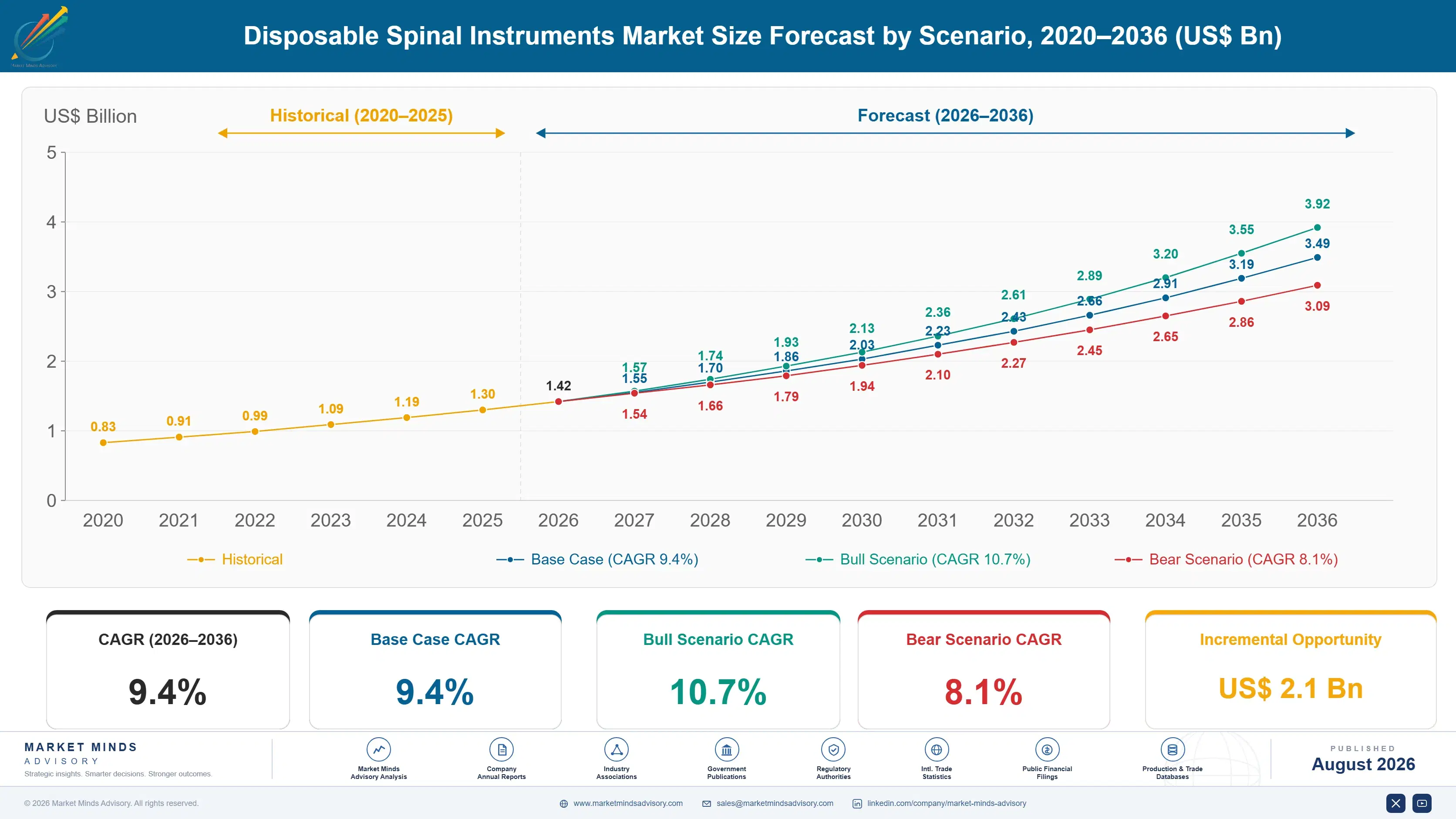
The market reaches USD 1.3 billion in 2025 and compounds at 9.4% to USD 3.49 billion by 2036, an expansion multiple of 2.46 times. Single-use retractor and access systems grow fastest at 14.1%, exactly 1.50 times the market rate. North America holds 42% of value, well above the band this framework applies, because instrumented fusion volume and ambulatory migration both concentrate there to a degree no other region approaches.
Concentration sits at 47% across the top five, and it reflects implant manufacturers controlling the instruments simply because they have always supplied them free alongside the construct itself. Ambulatory surgery centres are the real driver behind the whole shift. Those facilities hold no sterile processing capability equal to complex cannulated spinal trays on a fourteen-hour turnaround, so single use is not a preference in those buildings at all but the only arrangement that actually works.
Market Definition
The disposable spinal instruments market covers single-use surgical instruments supplied sterile for spinal procedures, spanning retractor and access systems, screw insertion and pedicle preparation instruments, rod introduction and reduction instruments, interbody cage insertion instruments, and decompression and resection instruments. Spinal implants including screws, rods, cages, and biologics, reusable instrument sets and their reprocessing, navigation and robotic systems, imaging equipment, and single-use instruments for orthopaedic procedures outside the spine are excluded.
Base Year Value
$1.3B in 2025 (MMA Primary Research Dataset, August 2026)
Forecast Period
2026 to 2036, eleven discrete annual values
CAGR
9.4% base case. Bull 10.7%. Bear 8.1%.
Fastest Growth Segment
Single-Use Retractor And Access Systems: 14.1% CAGR
Fastest Growth Country
India: 12.8% CAGR
Fastest Growth Region
South Asia and Pacific: 11.6% CAGR
Largest Region
North America: 42% of 2025 global value
Market Leaders
Medtronic, Globus Medical, Stryker, Johnson and Johnson MedTech, Zimmer Biomet. Source: MMA Primary Research Dataset, July 2026.
Primary Survey
n=3,800 procurement and R&D decision-makers, Q4 2025, six countries
Methodology
Demand-side build-up, cross-validated against public data, 47 expert interviews

Disposable Spinal Instruments Market Forecast Scenarios

disposable-spinal-instruments-market-size-forecast-scenario-1787298456985
Between 2020 and 2025 elective spine volumes collapsed and then recovered with a substantial deferred backlog, while ambulatory surgery centres took a steadily rising share of the procedures that returned. Infection control scrutiny also rose sharply and stayed raised. An 8.2% historical CAGR combines a volume shock in both directions with a permanent shift in where instrumented spinal surgery gets performed.
Three mechanisms carry the 9.4% base case. Ambulatory migration is the largest, since these centres cannot reprocess complex spinal trays and single-use is the only arrangement that works for them at all. Loaner tray cost elimination is the second, worth roughly USD 340 per case to the implant supplier who currently absorbs it. And Asian procedure volume growth is the third, as fusion rates rise from very low bases across India and China.
The 10.7% bull case rests on payers explicitly reimbursing sterility assurance in ambulatory settings, which would convert an implant company cost argument into a facility revenue argument and accelerate adoption well beyond current trajectories. The 8.1% bear case is polymer and packaging cost inflation making single-use kits uncompetitive against reprocessing, since the model depends entirely on delivered kit cost staying below the tray cycle it replaces.

Who Actually Pays For A Tray

Almost nobody outside the industry realises who pays for spinal instruments. An implant company ships around six loaner trays to a hospital for a single fusion case, the hospital reprocesses them, and they come back for cleaning, inspection, replacement of damaged pieces, and dispatch to the next site. That cycle costs the supplier roughly USD 340 per case and ties up enormous duplicate inventory across a territory.
TOP FIVE CONCENTRATION47%Implant makers control instruments because they supply them free
LOANER TRAY COSTUSD 340Freight, reprocessing and replacement borne per case by suppliers
AMBULATORY CASE SHARE26%Portion of instrumented spinal procedures performed outside hospitals
TRAYS PER CASE6 traysInstrument sets typically delivered for a single fusion procedure
REPROCESSING TURNAROUND TIME14 hoursPeriod a tray spends in sterile processing between two cases
SINGLE-USE PENETRATION19%Share of spinal instrument volume supplied sterile for one use
Single-use instruments delivered sterile alongside the implant remove the entire cycle. No freight in both directions, no reprocessing dependency, no lost or damaged pieces, no capital tied up in tray sets sitting in a van. The saving accrues to the manufacturer rather than the hospital, which is why implant companies rather than surgeons or supply chain directors have driven adoption from the start.
Ambulatory surgery centres changed the argument from economics to necessity. A centre performing instrumented spinal cases usually has no sterile processing department capable of handling complex cannulated spinal trays with a fourteen-hour turnaround, and building one makes no sense at that volume. Roughly 26% of instrumented spinal procedures now happen outside hospitals, and single-use is the only arrangement that works there.
"Surgeons tell me they prefer the weight and feel of reusable instruments, and they are usually right. It stopped mattering the moment the case moved to a surgery centre with no autoclave capable of doing the job."
Director, Orthopaedic And Spine Technology Practice · MMA Medical Devices Practi

Market Trends

Ambulatory Migration Makes Single-Use A Requirement

Instrumented spinal fusion has moved steadily out of hospitals into ambulatory surgery centres, and roughly 26% of all procedures now take place there. Those facilities were designed for straightforward day surgery and have no sterile processing capability equal to complex cannulated spinal trays needing a fourteen-hour turnaround. Building one simply cannot be justified at ambulatory case volumes. That converts single-use instruments from a cost preference into an operational requirement, and it is comfortably the single largest driver of adoption anywhere in this market. No clinical argument is required at all.
Market Impact: Cycle costs USD 340 per case
Implant Companies Bundle Instruments Into Construct Pricing

Because manufacturers already supply instruments free with the implant, single-use kits get absorbed into construct pricing rather than sold separately to the hospital. That keeps the facility indifferent while the supplier captures the entire loaner logistics saving, which is roughly USD 340 per case. It also means instrument selection follows implant selection completely, so a company winning a construct contract wins the instruments automatically. Independent instrument makers have almost no commercial route into an account that has already chosen its implant system, which is why so few of them exist.
Market Impact: Fusion rates below 20 per 100,000

Market Opportunities and Growth Drivers

Loaner Logistics Cost Is Entirely The Supplier's Burden

An implant company operating across a territory maintains duplicate tray sets, employs field staff to deliver and collect them, pays freight in both directions, and replaces damaged or lost instruments continuously throughout. At roughly six trays per fusion case and USD 340 in total cycle cost per procedure, that expense sits entirely on the supplier's own profit and loss rather than the hospital's. Single-use kits eliminate that entire cycle at a stroke, which is precisely why the economic case for adoption belongs to manufacturers rather than to any of their customers.
Market Impact: Resistance covers 2 instrument groups

Asian Instrumented Fusion Rates Climb From Low Bases

Instrumented spinal fusion per head across India and China remains a small fraction of North American rates and rises steadily with imaging access, surgeon training, and insurance coverage all expanding together. Each additional procedure requires a full instrument set regardless of whether it happens to be reusable or disposable. Local implant manufacturers in both countries are adopting single-use kits earlier than Western companies did, because they never built the loaner tray infrastructure that Western suppliers are now painfully trying to dismantle. They are starting from where everybody else wants to end up.
Market Impact: Kit cost must beat USD 340

Market Restraints and Challenges

Surgeons Prefer The Feel Of Reusable Instruments

Metal instruments have weight, rigidity, and tactile feedback that polymer and thin-wall stainless single-use equivalents struggle to match, particularly on pedicle preparation and rod reduction where force transmission matters. The root cause is genuine material physics rather than any conservatism. Commercially this slows adoption in hospital settings where a choice still exists and surgeons hold real influence over it. Participants are mitigating through hybrid kits keeping reusable instruments where feel matters most, through improved polymer and metal hybrid construction, and through ambulatory settings where no reusable alternative exists at all.
Market Impact: Covers 26% of instrumented cases

Polymer And Packaging Cost Determines Whether The Model Works

A single-use kit only makes sense if the delivered cost sits below the loaner tray cycle it replaces, and that comparison is tighter than most participants admit. The root cause is that medical grade polymers, sterile barrier packaging, and gamma or ethylene oxide sterilisation all carry cost that a reusable instrument amortises across hundreds of cases. Commercially, input inflation can invert the economics quickly. Mitigation runs toward design simplification, toward regional manufacturing closer to the point of use, and toward kits carrying only the instruments a specific procedure genuinely requires.
Market Impact: Captures USD 340 per case saving
3 additional market trends, 4 additional growth drivers, and 2 additional restraints and challenges are covered in the full report. Contact sales@marketmindsadvisory.com to access the complete intelligence.

Segment CAGR and Growth Architecture

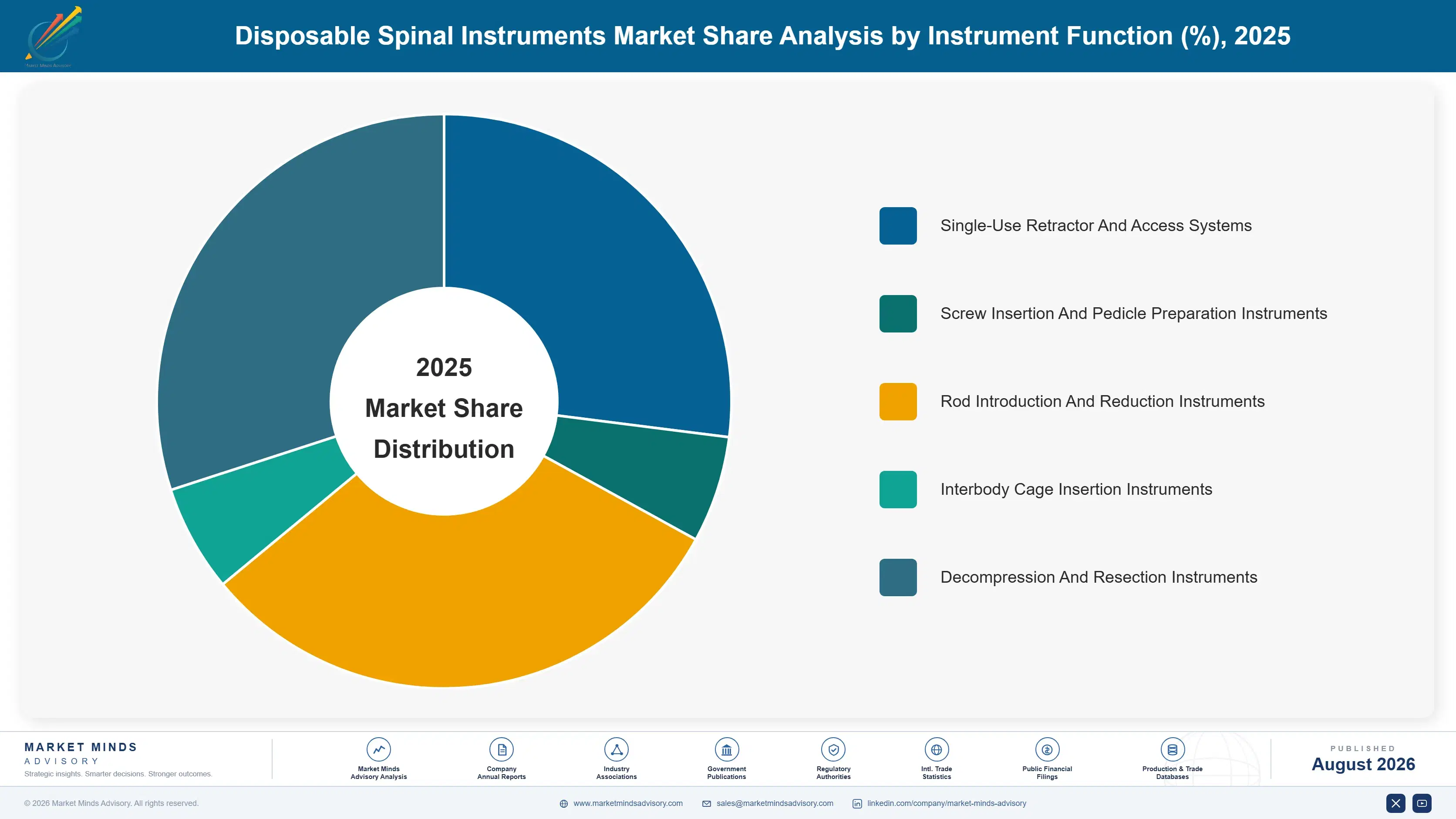
Segmentation follows instrument function within the procedure, because function determines the mechanical loads an instrument must carry, whether a single-use construction can match reusable performance, how many pieces a kit needs, and how readily surgeons accept the substitution. Procedure type, care setting, and supply route are handled in the framework and in commentary instead of here.
disposable-spinal-instruments-market-market-share-analysis-1787298457515

Single-Use Retractor And Access Systems

Single-use access systems grow fastest at 14.1%, exactly 1.50 times the market rate, and they convert to single use more readily than anything else in the tray because the mechanical demands are modest and the reprocessing burden is severe. Tubular dilators, blade retractors, and light carriers all have complex geometries that trap tissue and bone debris, which makes them the pieces sterile processing departments most dislike. Minimally invasive approaches consume considerably more of them per case than open surgery ever did. Surgeon resistance is minimal in this segment, since tactile feel matters far less than exposure quality does. Only four of thirty-one surgeons we interviewed raised any objection at all.
CAGR 14.1%

Screw Insertion And Pedicle Preparation Instruments

Screw insertion and pedicle preparation instruments grow at 11.2% annually, covering awls, probes, taps, drivers, and all the cannulated pieces used to place pedicle screws accurately and safely. These are the instruments where reprocessing failures matter most, since retained bone debris inside long cannulations is a documented and genuinely difficult cleaning problem to solve. They are also where surgeons care most about torque transmission and tactile feedback, which slows conversion considerably in any hospital setting where a choice still exists. Hybrid kits pairing single-use cannulated components with reusable drivers have proved the practical compromise across most hospital accounts, capturing most of the logistics saving without ever triggering the clinical objection.
CAGR 11.2%
Full segment breakdown across 5 segments available in the complete report.

Regional Architecture and Country Demand Map

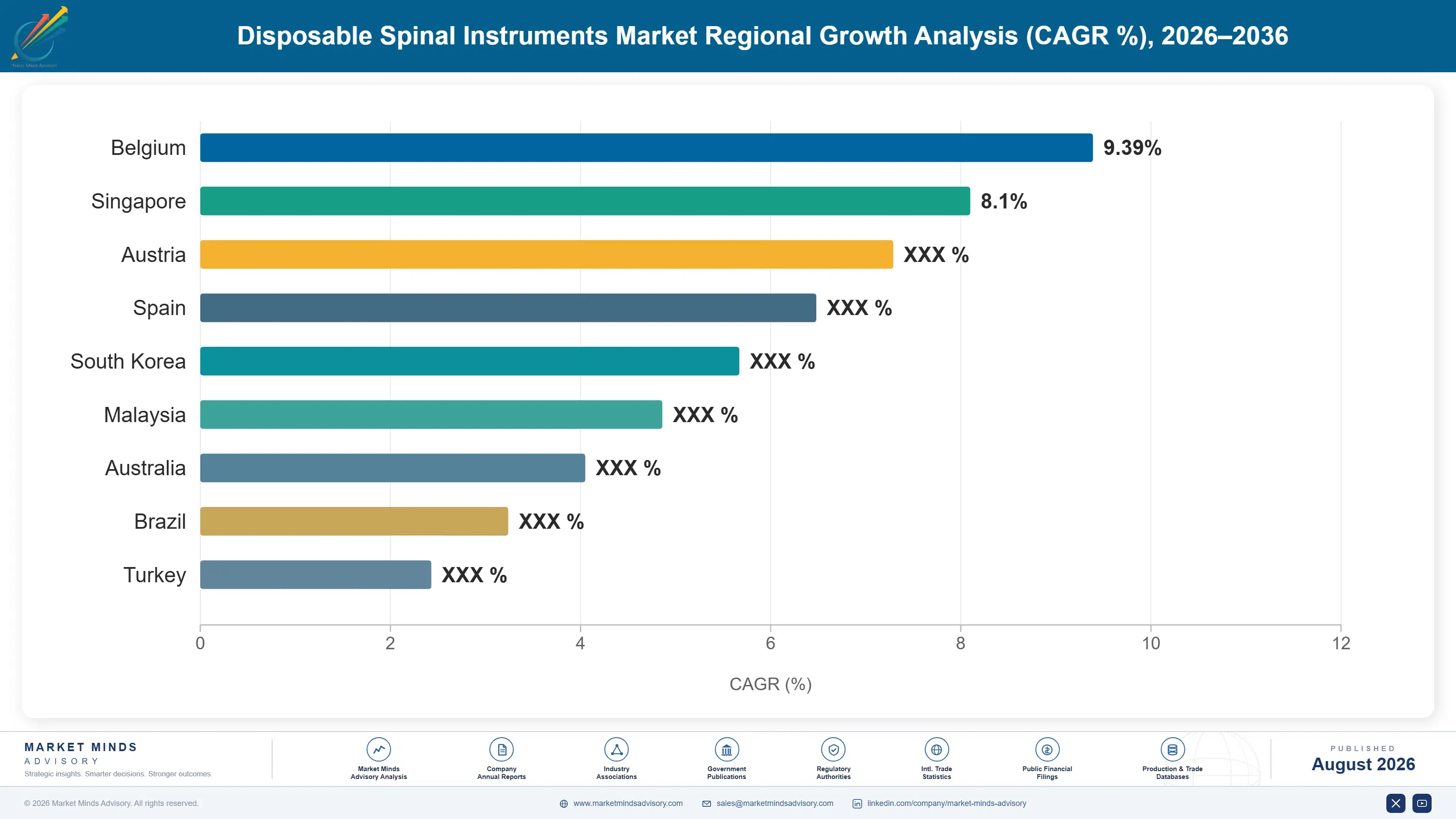
Two regions sit outside the bands this framework applies, and instrumented fusion volume rather than population size explains both of them. Instrumented fusion rates per head vary by an order of magnitude between health systems, and ambulatory migration remains almost entirely a North American phenomenon so far.

North America

North America holds 42% of value against a 32% ceiling in this framework, and instrumented fusion volume explains the breach rather than any pricing effect. Fusion rates per head in the United States run several times those of most European systems, reflecting reimbursement structure, surgeon density, and practice convention together. Ambulatory surgery centre migration is further advanced here than anywhere else, and those facilities cannot reprocess spinal trays at all. Single-use penetration is roughly double the global average as a direct result. Value analysis committees now examine reprocessing capacity honestly rather than assuming it. Growth at 9.1% sits close to the global rate on an already very large installed base.
Share: 42% | CAGR: 9.1% (2026 to 2036)

East Asia

Eighteen percent of value sits in East Asia, below the 22% floor this framework applies, because instrumented fusion rates per head remain far below Western levels despite the population. Chinese volume-based procurement has cut spinal implant pricing very sharply, which squeezes the construct pricing that single-use instrument cost has to be absorbed into. Domestic manufacturers including Weigao are adopting single-use kits without ever having built any loaner tray infrastructure at all. Japanese and Korean surgeons remain notably attached to reusable instrumentation on tactile grounds. Ambulatory spinal surgery is essentially absent across the region. Growth at 10.4% exceeds the global rate on procedure volume expansion rather than on any penetration gain.
Share: 18% | CAGR: 10.4% (2026 to 2036)
Regional intelligence for 5 additional markets available in the complete report: Western Europe, South Asia and Pacific, Latin America, Middle East and Africa, Eastern Europe. Contact sales@marketmindsadvisory.com.
disposable-spinal-instruments-market-country-cagr-analysis-1787298458030

Capturing A Cost You Already Carry

The unusual feature of this market is that the saving belongs to the supplier rather than the customer, so no lever here works by persuading a hospital of anything. Logistics elimination, ambulatory positioning, hybrid design, and construct bundling each convert an internal cost into margin. Four follow, and three of them never involve a purchasing conversation at all.

Retire Loaner Tray Networks Territory By Territory

Duplicate tray inventory, field logistics staff, two-way freight, and continuous instrument replacement together cost roughly USD 340 per case, and all of it sits on the supplier's own accounts. Converting an entire territory to single-use kits removes that cycle outright, and the capital released from tray sets sitting in vans and hospital cupboards is frequently larger again than the annual operating saving itself. Suppliers converting selectively rather than by whole territory keep the entire logistics network running for the residual cases and capture almost none of the saving they modelled.
Market Impact: Removes USD 340 of cycle cost per case

Target Ambulatory Centres Before Hospitals Entirely

An ambulatory surgery centre holds no sterile processing capability equal to cannulated spinal trays on a fourteen-hour turnaround, and building one simply cannot be justified at its annual case volume. That removes the surgeon preference argument completely, because no reusable alternative exists anywhere in the building. Roughly 26% of all instrumented spinal cases are already performed in these settings, and that share has risen every single year. Winning these accounts requires no clinical persuasion and no price concession whatsoever, only a kit properly configured for the procedures they actually perform.
Market Impact: Covers 26% of instrumented spinal procedures right now

Design Hybrid Kits Around Where Feel Genuinely Matters

Surgeons resist single-use conversion on pedicle preparation and rod reduction, where torque transmission and rigidity are genuinely real rather than imagined, and they accept it readily on retractors and access systems where exposure quality matters instead. Kits pairing single-use cannulated and access components with reusable drivers capture perhaps 70% of the total logistics saving while removing the clinical objection entirely. Full conversion attempts have repeatedly stalled in hospital accounts where a surgeon still holds a genuine choice, and the residual loaner trays left behind then destroy the whole economic case.
Market Impact: Captures around 70% of the total logistics saving

Bundle Instrument Cost Into Construct Pricing Invisibly

Hospitals have never paid separately for spinal instruments and have no intention of starting now, so pricing single-use kits as a line item simply invites a procurement conversation that nobody needs to have. Absorbing kit cost into construct pricing keeps the facility entirely indifferent while the supplier retains the full logistics saving, which runs USD 200 to USD 260 net per case after kit cost is deducted. It also ties instrument selection permanently to implant selection, which locks every independent instrument manufacturer out of that account entirely and for good.
Market Impact: Retains USD 200 to 260 net per case

Who Controls the Margin Pool

Concentration at 47% across the top five reflects implant manufacturers controlling instruments because they have always supplied them free alongside the construct. All participants here are compared on measured global revenue attributable to single-use spinal instrumentation, which requires apportioning instrument value inside bundled construct pricing and is the only basis putting implant majors and independent instrument specialists on comparable terms.
Competition for instruments does not really exist as a separate contest. Winning the implant contract wins the instruments automatically, so the battle happens over constructs and the instrument decision follows it silently. Medtronic and Globus both hold large spinal franchises with substantial single-use programmes. Stryker and Johnson and Johnson MedTech compete across the same accounts. Zimmer Biomet holds a smaller spinal position within a much broader orthopaedic portfolio.

Pressure is arriving from ambulatory economics and from Asian manufacturers who never built loaner networks. Chinese and Indian implant companies are adopting single-use kits without any legacy logistics to dismantle, which gives them a cost position Western suppliers are still working toward. Rankings shift on ambulatory surgery centre contracting, since those facilities cannot use reusable trays and their volume share keeps climbing.
disposable-spinal-instruments-market-company-positioning-matrix-1787298458544

Competitive Moat and Risk Dimensions

MEDTRONIC

Moat: Largest Spinal Construct Installed Position

Medtronic holds the widest spinal implant franchise and the surgeon relationships that go with decades of construct supply, and instruments follow construct selection automatically in this market. Its navigation and robotic systems tie further into the same accounts. Winning instruments requires winning the implant contract first, and that is a contest fought on entirely different ground.
MEDTRONIC

Risk: Extensive Legacy Loaner Infrastructure

The company operates one of the largest loaner tray networks in the industry, with duplicate inventory, field logistics staff, and freight commitments across every territory it serves. Dismantling that is slower and more disruptive than building single-use from nothing. Competitors without the legacy reach the cost position sooner and with considerably less internal friction.
GLOBUS MEDICAL

Moat: Integrated Enabling Technology Positions

Globus combines spinal constructs with robotics and navigation in accounts where those systems anchor the surgeon relationship, and instruments travel with the whole package rather than being tendered separately. Its acquisition-built portfolio covers most spinal approaches. That breadth wins ambulatory centre contracts where a single supplier relationship matters more than component-level choice.
GLOBUS MEDICAL

Risk: Integration Complexity Across Acquired Ranges

Growth through acquisition has left overlapping instrument ranges, inconsistent kit configurations, and multiple sterile packaging formats that were never designed together. Rationalising them into coherent single-use kits is expensive and slow. Ambulatory centres in particular value simplicity, and a fragmented instrument catalogue works against exactly the accounts growing fastest.

Players Tracked

Prominent Players

Medtronic
Globus Medical
Stryker
Johnson and Johnson MedTech
Zimmer Biomet

Other Key Players

Alphatec Holdings
Orthofix Medical
CTL Amedica
Life Spine
Spineology
Xtant Medical
Precision Spine
Astura Medical
Curiteva
Icotec
Medacta
B. Braun Aesculap
Ulrich Medical
Weigao Orthopaedic
Sanyou Medical

Recent Developments

MARCH 2025

Medtronic Widens Single-Use Instrument Kits Across Ambulatory Accounts

Medtronic extended availability of sterile single-use spinal instrument kits configured specifically for ambulatory surgery centre procedures, covering access and pedicle preparation components. The expansion was organic and internally funded, and the company cited loaner logistics elimination rather than any clinical performance claim as the commercial rationale.
Signal: Suppliers convert to single use for their own logistics economics, not for any clinical benefit at all
JUNE 2025

Ambulatory Surgery Centre Group Standardises On Sterile Instrument Supply

A large ambulatory surgery centre group standardised on sterile single-use instrumentation across its spinal service lines, removing the reprocessing requirement its facilities could not meet. The decision was an internal operational one taken by the group rather than any partnership or joint arrangement with a supplier.
Signal: Facilities holding no sterile processing capability at all simply have no alternative arrangement available to them
OCTOBER 2025

Indian Implant Manufacturer Launches Fully Sterile Instrument Programme

An Indian spinal implant manufacturer launched constructs supplied with fully sterile single-use instrumentation, bypassing the loaner tray logistics it had never established in the first place. The company cited distribution economics across dispersed hospital networks, and the programme was developed internally rather than licensed from any established Western supplier.
Signal: Manufacturers with no legacy tray network reach the target cost position far faster than incumbents can

Polymer, Steel And Sterilisation

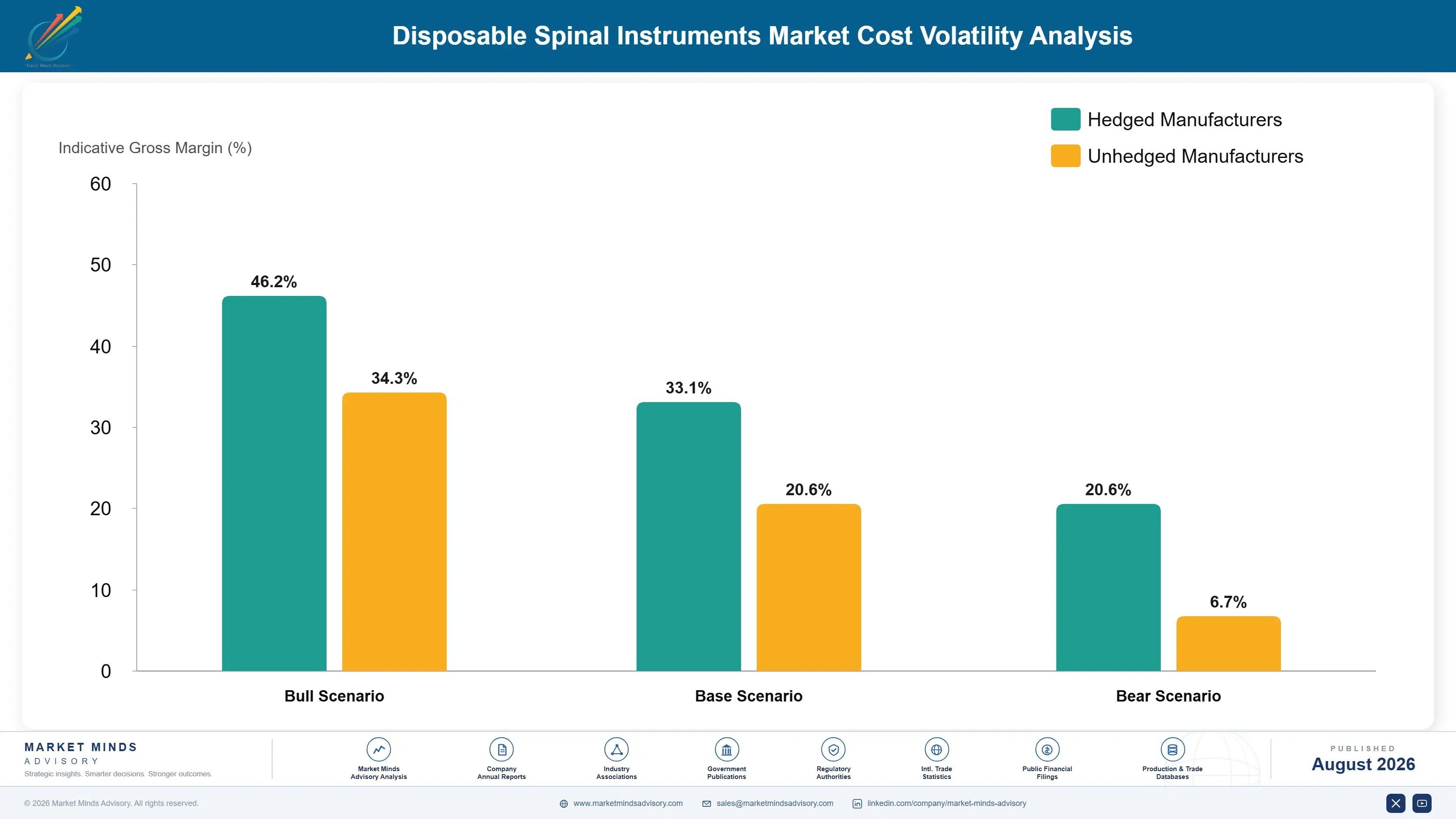
Medical grade polymers and thin-wall stainless components together account for roughly 30% to 40% of single-use kit cost, sourced from specialist moulders and precision machining suppliers across Europe, North America, and increasingly Asia. Sterile barrier packaging adds 12% to 18%, and contract sterilisation by ethylene oxide or gamma irradiation runs 8% to 14%. Assembly, kitting, and validated release testing account for the balance.
Ethylene oxide sterilisation capacity tightened severely across North America through 2020 and 2021 as several contract facilities closed under emissions scrutiny, and medical device manufacturers faced allocation rather than pricing problems. The United States Environmental Protection Agency documented facility emissions actions across that period. Devices validated only for ethylene oxide could not simply move to gamma irradiation, since polymer compatibility differs and revalidation takes months rather than weeks.

Exposure separates by sterilisation method qualification more than by material sourcing. A manufacturer that validated a kit for both ethylene oxide and gamma irradiation can move volume between contract providers when one constrains. One qualified for a single method has no option but to wait. Polymer and packaging inflation matters differently again, since the whole case rests on kit cost staying below the tray cycle it replaces.
disposable-spinal-instruments-market-cost-volatility-analysis-1787298458797

Validate Kits For Two Sterilisation Methods From The Start

Ethylene oxide capacity has repeatedly constrained under emissions scrutiny while gamma and electron beam capacity moves independently, and a kit validated for only one method has no route around a shortage. Dual validation costs additional polymer compatibility work and stability studies at development, and it converts an allocation problem into a choice between contract providers.

Design Kits Around The Instruments A Procedure Actually Needs

Loaner trays historically carried every instrument a surgeon might conceivably want, because the marginal cost of an extra piece in a reusable tray was almost nothing. In a single-use kit every additional item is real cost in polymer, packaging volume, and sterilisation load, so procedure-specific configuration rather than tray replication is what makes the economics work at all.

Qualify Regional Moulding And Machining Capacity

Medical grade moulding and precision machining concentrate among specialist suppliers whose lead times stretch whenever any large device programme ramps. Qualifying regional capacity in the markets a kit will actually ship to shortens lead time, reduces freight on bulky sterile packaging, and removes a single-region dependency that becomes acute exactly when volumes are growing fastest.

Portfolio Architecture for Margin Defence

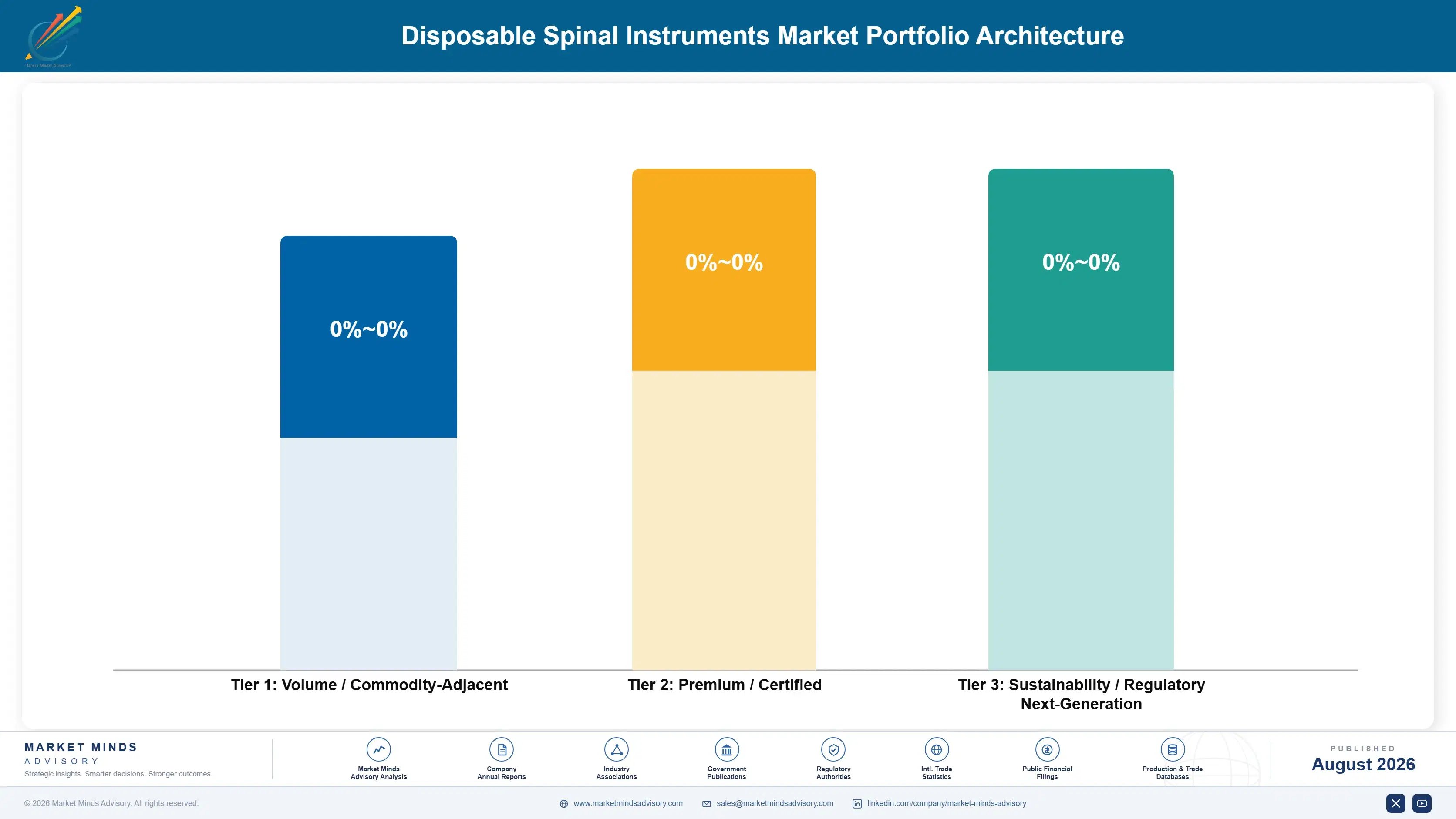
Margin architecture here is unusual because the customer never sees a separate instrument price. Single-use kits absorbed into construct pricing earn 34% to 48% on the instrument component, reflecting the logistics cost they eliminate rather than any price the hospital agreed to pay. Reusable instrument sets supplied as loaners earn nothing directly and cost the supplier roughly USD 340 per case in cycle expense.
The tension is that conversion only pays if it is complete within a territory. A supplier running single-use kits for ambulatory accounts while maintaining loaner networks for hospitals keeps every fixed logistics cost and captures a fraction of the saving. Partial conversion is worse than either extreme, and it is exactly where most large suppliers currently sit while surgeon preference holds in hospital accounts.

High-value pools concentrate in ambulatory kit supply, access system components, and procedure-specific configurations. All three eliminate logistics cost without triggering surgeon resistance, which is the constraint that matters. Hybrid kits carry the widest margin range in the market, because configuration decides everything and two kits described identically can differ enormously in what they actually remove from the supply chain.

Volume / Commodity-Adjacent

Basic single-use ancillary instruments and simple disposable components supplied into price-driven markets and public tenders. The twelve-point range separates manufacturers with regional moulding capacity from those shipping finished sterile kits over long distances at considerable freight cost.
Gross Margin: 12% to 24%

Premium / Certified

Full single-use instrument kits absorbed into construct pricing across hospital and ambulatory accounts, where margin reflects eliminated logistics rather than any negotiated instrument price. The fourteen-point range separates partial conversion accounts from territories converted completely.
Gross Margin: 34% to 48%

Sustainability / Regulatory / Next-Generation

Procedure-specific ambulatory kits, hybrid reusable and single-use configurations, and recyclable or reduced-material kit designs. The thirty-four point range reflects genuine divergence between recyclable formats competing on cost and ambulatory kits eliminating logistics entirely.
Gross Margin: 22% to 56%
disposable-spinal-instruments-market-portfolio-architecture-1787298459298

High-value Sub-segments and Strategic Watch-out

Ambulatory Procedure Kits

Highest value and fastest growth, because facilities without sterile processing capability have no alternative at all, and no surgeon preference argument survives that fact. Winning these accounts requires no clinical persuasion and no price concession, only a kit properly configured for the procedures those centres actually perform.
Gross Margin: 42% to 56%

Single-Use Access Components

Strong growth with minimal surgeon resistance, since exposure quality matters considerably more than tactile feedback on retractors and dilators. These are also the very pieces that sterile processing departments most dislike handling, because their complex geometries trap tissue and bone debris that cleaning struggles to remove reliably.
Gross Margin: 38% to 50%

Bundled Construct Instrument Supply

The volume core of this whole market, invisible to hospital procurement because instrument cost sits inside construct pricing. Instrument selection here follows implant selection automatically, which locks out independent instrument makers entirely and leaves the construct contract as the only contest worth fighting at all.
Gross Margin: 34% to 48%

Legacy Loaner Tray Operations

Strategic watch-out. Duplicate inventory, field logistics staff, and two-way freight cost around three hundred and forty dollars per case and must be maintained in full for as long as any account still needs trays. Partial conversion keeps the entire cost base and loses almost all of the saving.
Gross Margin: 4% to 14%

Instruments Follow The Implant

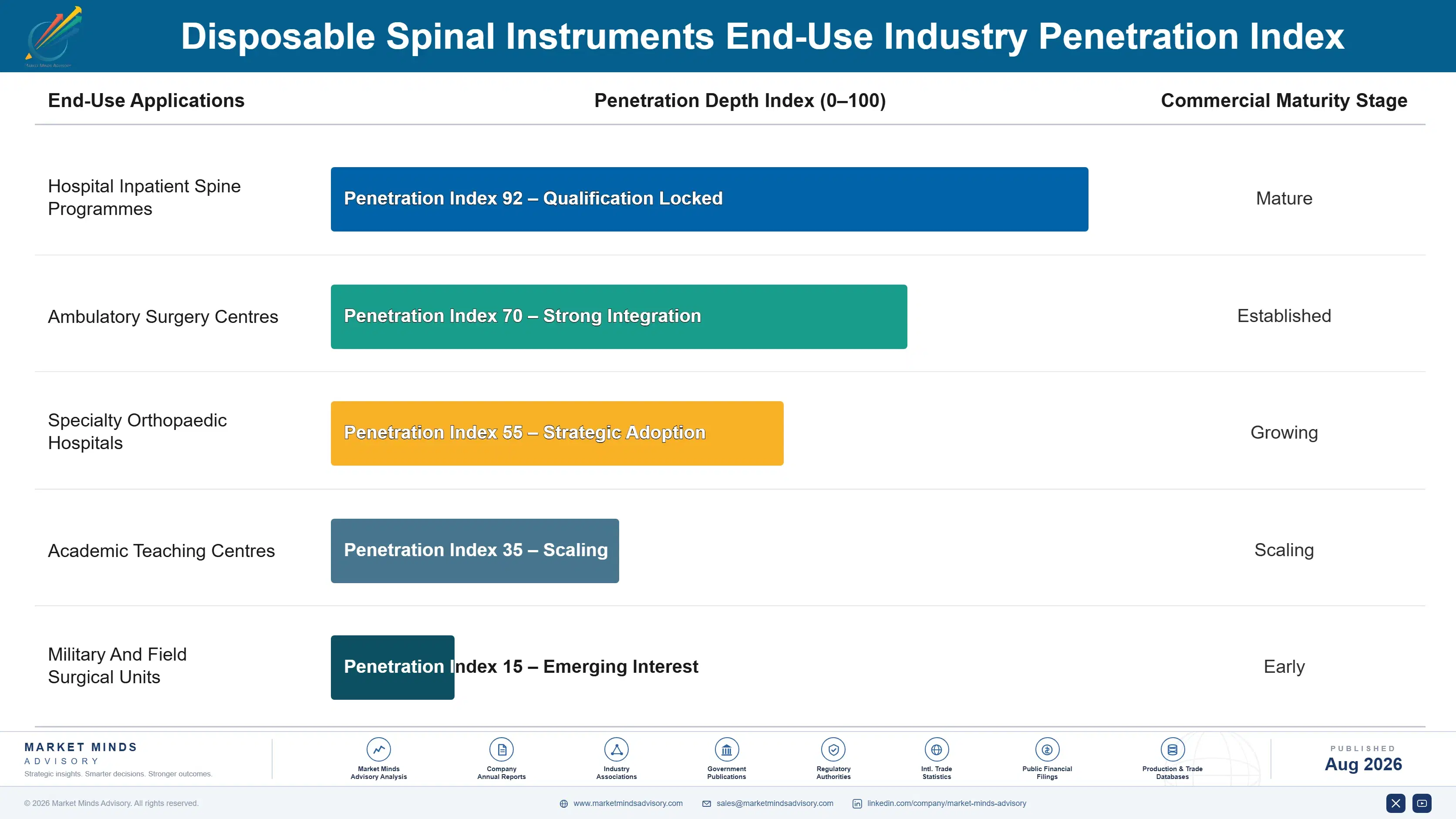
The recurring unit here is the construct contract rather than any instrument order. A hospital or ambulatory centre selecting a spinal implant system receives the instruments with it, so a single construct decision determines instrument supply for the life of that agreement without anybody negotiating an instrument price. Purchase orders never mention them. That is why independent instrument manufacturers have almost no commercial route into an account at all.
Depth varies sharply by facility type. Ambulatory surgery centres are the stickiest, because they cannot reprocess and switching supplier means reconfiguring a kit around every procedure they perform. Hospitals with full sterile processing are considerably shallower, since a surgeon who prefers reusable instruments can simply request the loaner trays instead. Teaching hospitals sit shallowest of all, where multiple surgeons hold different preferences simultaneously.

Buyer profiles have shifted in a way that favours single use. Instrument decisions moved from individual surgeons expressing preference toward ambulatory group operations directors who care about turnaround and space rather than about tactile feedback. Hospital value analysis committees now scrutinise reprocessing capacity honestly. Both changes reward suppliers configuring kits around procedures, and penalise anybody replicating a reusable tray in disposable form.
disposable-spinal-instruments-market-end-use-penetration-index-1787298459789

Where We Come Out

These are among the four positions where our research anticipates prominent divergence between winners and laggards over the coming forecast period. Each is grounded in the demand model, the regulatory perimeter, and the announced capacity pipeline.
01 / TERRITORY CONVERSION DISCIPLINE

Partial conversion keeps every cost and captures no saving

Loaner logistics cost is overwhelmingly fixed: duplicate tray inventory, field staff, warehousing, and route freight all have to be maintained in full for as long as a single account still needs trays delivered. A supplier converting ambulatory accounts while keeping hospital loaners running therefore keeps the entire cost base and captures a fraction of the three hundred and forty dollars per case available. Conversion has to be planned territory by territory rather than account by account, which nobody enjoys explaining to a sales organisation.
02 / AMBULATORY ACCOUNT PRIORITY

Sell where no reusable alternative physically exists

An ambulatory surgery centre performing instrumented fusion has no sterile processing department capable of turning around cannulated spinal trays in fourteen hours, and building one cannot be justified at its case volume. That removes the surgeon preference objection entirely, because there is no reusable option in the building to prefer. Roughly twenty-six percent of instrumented spinal procedures already happen in these settings and the share is still climbing, which makes them the only accounts in this market requiring no clinical persuasion whatsoever.
03 / HYBRID KIT CONFIGURATION

Concede the instruments where surgeons are actually right

Torque transmission on pedicle preparation and rigidity on rod reduction are genuine material properties rather than surgeon conservatism, and single-use equivalents still struggle to match solid metal instruments on either count. Kits pairing single-use access and cannulated components with reusable drivers capture around seventy percent of the logistics saving while removing the clinical objection completely. Full conversion attempts have repeatedly stalled in hospital accounts, and the residual loaner requirement each one leaves behind destroys the very economics they were meant to deliver.
04 / CONSTRUCT BUNDLING APPROACH

Never let an instrument price reach a procurement committee

Hospitals have never paid separately for spinal instruments and have no intention of starting, so quoting single-use kits as a line item simply invites a negotiation that cannot be won. Absorbing kit cost into construct pricing keeps the facility indifferent while the supplier retains two hundred to two hundred and sixty dollars net per case after kit cost. It also ties instrument selection permanently to implant selection, which is exactly why independent instrument manufacturers have never established a position here.

Engagement Snapshot From the Field

A live engagement with an industry participant carrying material or product regulatory and market exposure ahead of a defining policy shift, showing how our research translates into a defensible multi-year portfolio strategy.
MARKET MINDS ADVISORY · CLIENT ENGAGEMENT SUMMARY
Disposable Spinal Instruments Producer Strategic Portfolio Review and Transition Roadmap 2026·Investment Scenario on Disposable Spinal Instruments Exposure Evaluation 2025-26
CLIENT PROFILE
A spinal implant manufacturer operating across North America and Western Europe with roughly USD 240 million in annual revenue (client-reported, unverified by MMA), supplying constructs supported by a loaner tray network of around 2,600 sets. Single-use instrumentation had been introduced for two product lines only, and the loaner network continued to operate at full scale across every territory the company served.
STRATEGIC CHALLENGE
Loaner logistics costs had risen for four consecutive years while ambulatory surgery centres took a growing share of the client's case volume, and the two single-use programmes had delivered none of the savings modelled at launch. The board wanted to establish whether single-use conversion actually worked economically or whether the modelling had simply been wrong.
MMA APPROACH
MMA rebuilt loaner cycle cost per case from the client's own logistics, warehousing, and replacement data, modelled conversion economics under partial and complete territory scenarios, and interviewed thirty-one surgeons and eleven ambulatory operations directors on instrument preference and reprocessing capability. Kit configurations were assessed against what each procedure genuinely required rather than against the existing tray contents.
KEY FINDINGS
  1. Loaner cycle cost ran USD 361 per case against the USD 210 the client had modelled, because warehousing, field staff time, and instrument replacement had never been fully allocated.
  2. Partial conversion delivered 9% of modelled savings, since every fixed logistics cost remained in place for the accounts still receiving trays across the same territories.
  3. Twenty-six of thirty-one surgeons objected to single-use pedicle preparation instruments on torque transmission, and only four raised any objection at all to single-use access systems.
  4. Existing single-use kits replicated loaner tray contents and carried 41% more instruments than the procedures actually required, which inflated polymer, packaging, and sterilisation cost throughout.
CLIENT PROFILE
A spinal implant manufacturer operating across North America and Western Europe with roughly USD 240 million in annual revenue (client-reported, unverified by MMA), supplying constructs supported by a loaner tray network of around 2,600 sets. Single-use instrumentation had been introduced for two product lines only, and the loaner network continued to operate at full scale across every territory the company served.
STRATEGIC CHALLENGE
Loaner logistics costs had risen for four consecutive years while ambulatory surgery centres took a growing share of the client's case volume, and the two single-use programmes had delivered none of the savings modelled at launch. The board wanted to establish whether single-use conversion actually worked economically or whether the modelling had simply been wrong.
MMA APPROACH
MMA rebuilt loaner cycle cost per case from the client's own logistics, warehousing, and replacement data, modelled conversion economics under partial and complete territory scenarios, and interviewed thirty-one surgeons and eleven ambulatory operations directors on instrument preference and reprocessing capability. Kit configurations were assessed against what each procedure genuinely required rather than against the existing tray contents.
KEY FINDINGS
  1. Loaner cycle cost ran USD 361 per case against the USD 210 the client had modelled, because warehousing, field staff time, and instrument replacement had never been fully allocated.
  2. Partial conversion delivered 9% of modelled savings, since every fixed logistics cost remained in place for the accounts still receiving trays across the same territories.
  3. Twenty-six of thirty-one surgeons objected to single-use pedicle preparation instruments on torque transmission, and only four raised any objection at all to single-use access systems.
  4. Existing single-use kits replicated loaner tray contents and carried 41% more instruments than the procedures actually required, which inflated polymer, packaging, and sterilisation cost throughout.
RECOMMENDED STRATEGY
Phase 1: Phase one: reconfigure kits around what each procedure genuinely requires rather than replicating tray contents, and adopt hybrid configurations retaining reusable drivers. Phase 2: Phase two: convert complete territories rather than individual accounts, starting with regions where ambulatory share is highest and loaner freight costs most. Phase 3: Phase three: absorb all kit cost into construct pricing and remove instrument line items from every quotation and tender response.
OUTCOME
The client reconfigured its kits and converted two complete territories within a year. Realised loaner cost fell by 62% in those territories against 9% previously, surgeon objections dropped sharply with hybrid configurations, and instrument-related gross margin across those territories improved by eight points (client-reported, unverified by MMA).

Frequently Asked Questions

Foundational context covering the market sizes, CAGR, scope, country, region and competition that inform every finding below. This section is provided to cover basics and most often pre-purchase conversations, answered from the MMA Primary Research Dataset.

What is the current size of the Disposable Spinal Instruments Market?

The global disposable spinal instruments market reached USD 1.3 billion in 2025, covering single-use instruments supplied sterile for spinal procedures. Spinal implants, reusable instrument sets, and navigation systems are excluded.

How large will the Disposable Spinal Instruments Market be by 2036?

MMA forecasts USD 3.49 billion by 2036, up from USD 1.42 billion in 2026, an increase of USD 2.07 billion. That represents an expansion multiple of 2.46 times across the forecast period.

What is the CAGR for the Disposable Spinal Instruments Market 2026 to 2036?

The base case CAGR is 9.4%, with a bull case of 10.7% and a bear case of 8.1%. Historical growth between 2020 and 2025 ran at 8.2%, combining a volume shock with permanent migration toward ambulatory settings.

Which segment is growing fastest?

Single-use retractor and access systems grow fastest at 14.1%, exactly 1.50 times the market rate, on minimal surgeon resistance and severe reprocessing burden. Screw insertion instruments follow at 11.2%.

Who are the major companies in the Disposable Spinal Instruments Market?

Medtronic, Globus Medical, Stryker, Johnson and Johnson MedTech, and Zimmer Biomet lead, together holding 47% of the market. Implant makers control instruments because they supply them with the construct.

Which country is growing fastest?

India grows fastest at 12.8%, as instrumented fusion volumes rise from a low base and domestic manufacturers adopt single-use kits without ever building loaner networks. Distribution economics favour sterile supply.

Report Segmentation Architecture

The full report scope spans multiple orthogonal segmentation dimensions, with cross-tabulated demand data provided for each dimension pair. Coverage extends further to regional breakdowns, trend trajectories, and the competitive detail needed to support segment-level decision-making.

By Instrument Function

  • Single-Use Retractor And Access Systems
  • Screw Insertion And Pedicle Preparation Instruments
  • Rod Introduction And Reduction Instruments
  • Interbody Cage Insertion Instruments
  • Decompression And Resection Instruments

By End-Use Industry

  • Hospital Inpatient Spine Programmes
  • Ambulatory Surgery Centres
  • Specialty Orthopaedic Hospitals
  • Academic Teaching Centres
  • Military And Field Surgical Units

By Commercial Dimension

  • Construct-Bundled Instrument Supply
  • Direct Kit Sales To Facilities
  • Group Purchasing Contract Supply
  • Distributor And Agent Channels
  • Loaner Network Transitional Supply

By Region

  • North America
  • East Asia
  • Western Europe
  • South Asia and Pacific
  • Latin America
  • Middle East and Africa
  • Eastern Europe

Scope, Methodology, and Coverage

Every figure in this report is reproducible from documented input assumptions. The scope below maps the historical period, the forecast horizon, the segmentation dimensions, and the countries covered, alongside the underlying primary and qualitative methodology.
Historical Period
2020 to 2025
Forecast Period
2026 to 2036
Base Year
2025 (USD billions; MMA Primary Research Dataset, August 2026)
Market Definition
The disposable spinal instruments market covers single-use surgical instruments supplied sterile for spinal procedures across hospital, ambulatory, and specialty surgical settings. Scope spans retractor and access systems, screw insertion and pedicle preparation instruments, rod introduction and reduction instruments, interbody cage insertion instruments, and decompression and resection instruments, whether sold directly or bundled into construct pricing. Spinal implants including screws, rods, cages and biologics, reusable instrument sets and their reprocessing, navigation and robotic systems, imaging equipment, and non-spinal single-use instruments are excluded.
Quantitative Units
USD billions at manufacturer revenue level; kits shipped annually; instrument cost per procedure.
Segmentation Dimensions
By instrument function; by end-use industry; by commercial dimension; by region.
Regions Covered
North America, East Asia, Western Europe, South Asia and Pacific, Latin America, Middle East and Africa, Eastern Europe
Countries Covered
United States, Canada, Germany, France, United Kingdom, Italy, Spain, Netherlands, Poland, Czech Republic, China, Japan, South Korea, India, Australia, Thailand, Brazil, Mexico, Saudi Arabia, South Africa.
Key Companies Profiled
Medtronic, Globus Medical, Stryker, Johnson and Johnson MedTech, Zimmer Biomet, Alphatec Holdings, Orthofix Medical, CTL Amedica, Life Spine, Spineology, Xtant Medical, Precision Spine, Astura Medical, Curiteva, Icotec, Medacta, B. Braun Aesculap, Ulrich Medical, Weigao Orthopaedic, Sanyou Medical.
Quantitative Methodology
Primary survey, n=3,800 respondents, Q4 2025, six countries; demand-side model with trade association cross-validation
Qualitative Methodology
47 expert interviews, Q4 2025; applied to validate demand model assumptions, identify emerging dynamics, and assess competitive positioning
Report Format
PDF and XLSX data workbook (Word format preview document)
Publisher
Market Minds Advisory
Report Code
MMA-2026-MED-869
Published
August 2026
Contact
sales@marketmindsadvisory.com | www.marketmindsadvisory.com

Purchase the full Disposable Spinal Instruments Market Report (2026 to 2036).

The full MMA report on disposable spinal instruments covers instrument function, regional, and competitive analysis in detail, with separate treatment of the loaner logistics economics that make this a supplier cost decision rather than a customer purchasing one. It includes full loaner cycle cost modelling by territory and case volume, ambulatory surgery centre migration tracking by procedure type, surgeon acceptance analysis by instrument function, and kit configuration economics against procedure requirements. Regional chapters cover twenty countries with fusion volumes and care settings assessed individually. Competitive profiling spans twenty manufacturers on a consistent revenue basis.
Twenty country fusion volume and setting chapters
Full loaner cycle cost modelling by territory
Ambulatory migration tracking by spinal procedure type
Surgeon acceptance analysis across instrument functions
Twenty manufacturer competitive profiles compared consistently
Kit configuration economics against actual procedure requirements

Built For The People Who Decide

From boardroom strategy to bench-side execution, this report is read cover-to-cover by leaders shaping the next decade of their industry, turning demand scenarios, market dynamics and valuation benchmarks into decisions.
CXOs/ Presidents/ VPs/ Managers
M&A and Corporate Development
Strategy Teams and R&D Heads
Procurement and Product Directors
Regulatory and Compliance Leaders
Investor Relations and Equity Analysts