Market Minds Advisory
Disposable Protective Apparel Market

Disposable Protective Apparel Market: Barrier Performance for Two Different Buyers

Hospital systems and semiconductor fabs are both tightening single-use apparel specifications simultaneously, forcing nonwoven manufacturers to qualify barrier performance for two different customers at once while sustainability pressure pushes reusable alternatives into procurement conversations.

Lead Analyst

David Horsley

Published

August 2026

Make Smarter Decisions with Customized Research Insights

Request a free sample report and evaluate market opportunities, growth trends, and competitive dynamics relevant to your business needs.

2025 MARKET VALUE$14.2BMarket Size 2025
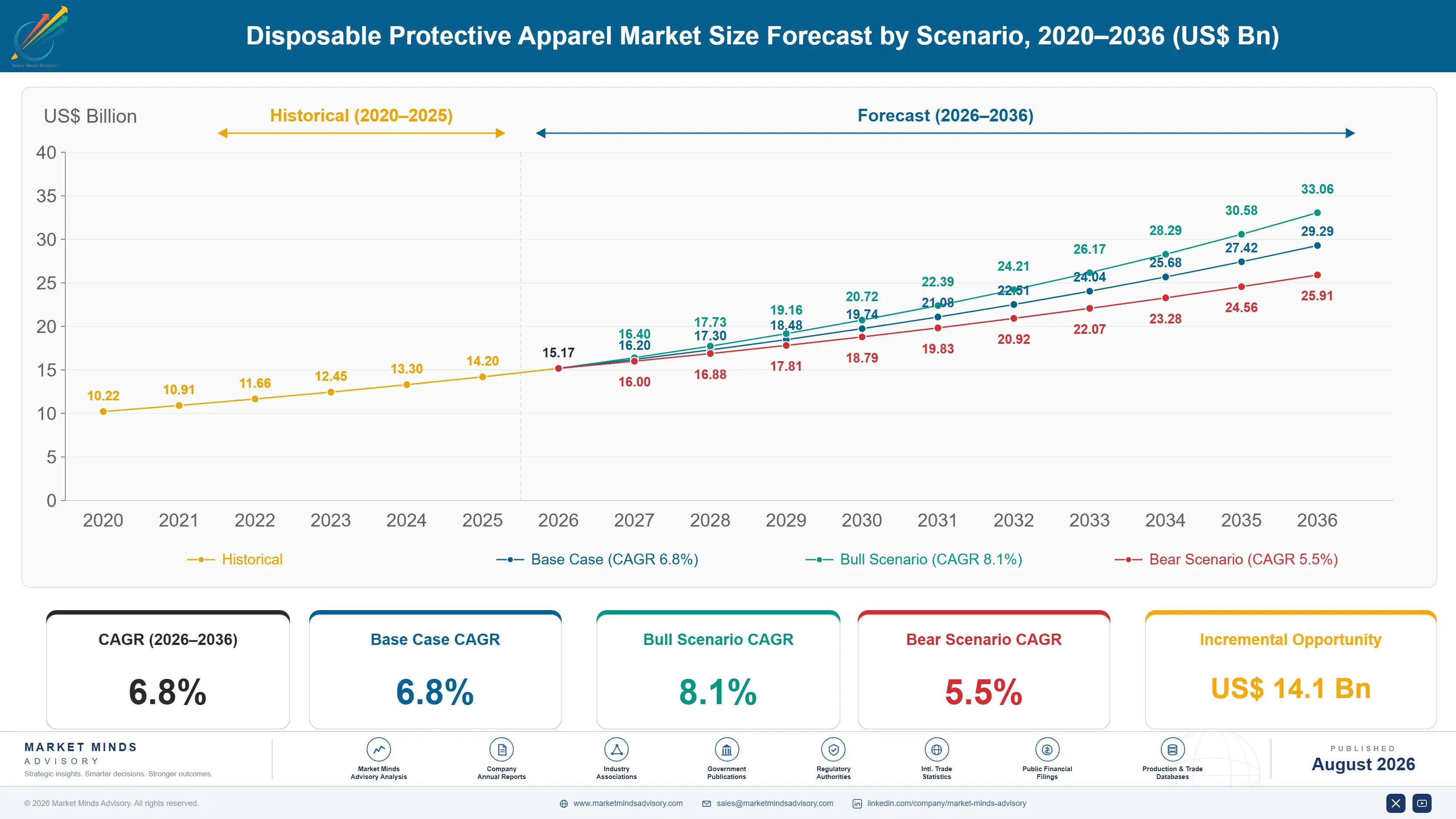
2036 FORECAST VALUE$29.3BBase Case , 2026 to 2036
CAGR 2026 TO 20366.8 %Bull 8.1% / Bear 5.5%
INCREMENTAL OPPORTUNITY$14.1BNet 10- year value creation
EXPANSION MULTIPLE1.93x2036 value over 2026 base
Strategic Levers
M&A Pipeline
Regional Outlook
Country Rankings
Competitive Intelligence
Segmental Deep-dive
Call-Us : 91 93563 13602

Executive Snapshot and Market Trajectory

Hospital infection control protocols and semiconductor cleanroom contamination standards are converging on the same underlying question: which barrier fabric performs reliably at the lowest cost per use, and that procurement math, not headline sustainability commitments, is what actually determines apparel specification decisions across most large institutional buyers today.
Cleanroom apparel is growing fastest at roughly 1.32 times the market average as semiconductor and biopharmaceutical manufacturing capacity expands globally, while coveralls and full-body suits follow closely on industrial chemical handling and battery manufacturing demand. East Asia holds the largest share of global spending because China combines the world's largest nonwoven apparel manufacturing base with rapidly expanding domestic semiconductor and hospital construction, and its converters increasingly export finished garments rather than raw nonwoven material.
Five suppliers, Kimberly-Clark, 3M, Cardinal Health, DuPont, and Ansell, hold under half of global revenue in a market fragmented enough for regional converters to compete on price and delivery speed. Sterility assurance requirements in pharmaceutical manufacturing and increasingly strict semiconductor particle contamination standards are reshaping which barrier fabrics buyers specify, favoring suppliers with proven high-performance nonwoven technology over legacy commodity spunbond lines that cannot meet the tightest contamination thresholds.
Market Definition
The disposable protective apparel market covers isolation gowns, coveralls and full-body suits, surgical gowns, cleanroom apparel, shoe and boot covers, and aprons and sleeve protectors made from nonwoven or film-laminate materials for single-use protection. It excludes gloves, masks and respirators, reusable textile protective apparel, and general workwear.
Base Year Value
$14.2B in 2025 (MMA Primary Research Dataset, August 2026)
Forecast Period
2026 to 2036, eleven discrete annual values
CAGR
6.8% base case. Bull 8.1%. Bear 5.5%.
Fastest Growth Segment
Cleanroom Apparel: 9.0% CAGR
Fastest Growth Country
Malaysia: 10.2% CAGR
Fastest Growth Region
South Asia and Pacific: 8.8% CAGR
Largest Region
East Asia: 30% of 2025 global value
Market Leaders
Kimberly-Clark, 3M, Cardinal Health, DuPont, Ansell. Source: MMA Analysis based on company annual reports.
Primary Survey
n=3,800 procurement and R&D decision-makers, Q4 2025, six countries
Methodology
Demand-side build-up, cross-validated against public data, 47 expert interviews

Disposable Protective Apparel Market Forecast Scenarios

disposable-protective-apparel-market-size-forecast-scenario-1787300264638
The market spiked in 2020 and 2021 as pandemic-driven demand pulled forward years of ordinary growth, then corrected through 2022 as hospital and institutional inventories normalized. Semiconductor and biopharmaceutical manufacturing capacity expansion began offsetting that correction from 2023 onward. The result was a 5.8 percent historical CAGR, distorted by the pandemic cycle rather than representative of underlying demand.
The base case rests on three mechanisms. First, semiconductor fabrication capacity expansion under CHIPS Act and Asian and European incentive programs is driving cleanroom apparel demand beyond historical hospital-driven baselines. Second, biopharmaceutical and cell and gene therapy manufacturing facilities require sterile gowning at a scale barely present a decade ago, creating a new demand category. Third, battery and electric vehicle manufacturing is adopting industrial coverall protocols historically limited to chemical processing, extending disposable apparel into new manufacturing verticals.
The bull case turns on accelerating semiconductor and biopharmaceutical capital investment if fabrication and manufacturing capacity expansion continues at pace through the decade, pulling premium cleanroom apparel demand above current forecasts. The bear case centers on a manufacturing capex slowdown that delays fab and biopharma facility construction, extending replacement cycles for apparel inventories and pushing buyers toward cheaper, lower-specification alternatives.

Barrier Performance Becomes the Cross-Industry Standard

Disposable protective apparel sits at the intersection of two very different but converging buyer requirements: hospital infection control protocols that prioritize barrier consistency and cost per use, and semiconductor and biopharmaceutical cleanroom standards that prioritize particle and fiber shedding performance above almost everything else. Both buyer types are pushing suppliers toward higher-specification nonwoven technology, even though their underlying reasons for doing so differ substa
CR5 CONCENTRATION44%Top five suppliers hold nearly half of global revenue
AVERAGE SELLING PRICE$3.40 per gownPremium barrier gowns command steep price over basics
TOP PRODUCING COUNTRY SHARE28%China leads global nonwoven protective apparel manufacturing output
CLEANROOM APPAREL PENETRATION24% of category revenueSemiconductor and biopharma demand keeps expanding at pace
TRADE INTENSITY33% of output exportedCross-border nonwoven apparel shipments rise with new capacity
INPUT COST SHARE52% of COGSPolypropylene nonwoven and film laminate dominate production costs
Commercially, the market splits cleanly between commodity and specialized buyers. Hospital systems and group purchasing organizations negotiate primarily on price and delivery reliability across enormous standardized volumes, while semiconductor and biopharmaceutical manufacturers qualify specific fabric constructions through lengthy validation processes that create durable switching costs once a supplier is approved. Kimberly-Clark and DuPont both increasingly segment their commercial teams around this buyer distinction rather than treating protective apparel as a single undifferentiated category.
Over the next decade, cleanroom and industrial coverall demand will keep growing faster than traditional hospital-driven categories, and suppliers without proven high-specification nonwoven technology will increasingly lose share in the fastest-growing, most defensible parts of this market to those that have already qualified it with major manufacturing customers.
"A gown is a gown until you ask what it is actually protecting against. Hospital buyers and fab engineers are asking completely different questions, and that gap is where the real margin sits."
Director, Healthcare and Industrial Materials Practice · MMA Healthcare | Person

Market Trends

Semiconductor Cleanroom Expansion Drives Apparel Demand

Semiconductor fabrication capacity is expanding rapidly across the United States, Taiwan, South Korea, and increasingly India and Japan, driven by CHIPS Act incentives and equivalent programs designed to reshore and diversify chip manufacturing. Each new fabrication facility requires thousands of cleanroom garments meeting strict particle and fiber shedding specifications, a fundamentally different qualification standard than hospital gowning requirements ever demanded. TSMC's Arizona expansion and Samsung's Taylor, Texas facility have both driven substantial new cleanroom apparel demand as construction moves toward operational status, and suppliers report cleanroom-specific order backlogs extending well beyond typical hospital supply contract timelines.
Market Impact: Adds battery coverall demand 15 percent
Cell and Gene Therapy Manufacturing Creates New Gowning Category

Cell and gene therapy manufacturing requires sterile gowning protocols closer to semiconductor cleanroom standards than traditional pharmaceutical manufacturing, since living cell processing tolerates essentially zero contamination risk across an entire production run. Facilities operated by companies including Lonza and Catalent have expanded sterile gowning programs as cell and gene therapy manufacturing capacity scales beyond clinical trial volumes into commercial production. This category barely existed five years ago and now represents a meaningfully growing share of premium sterile apparel demand, with suppliers that qualified early capturing a disproportionate share of new facility contracts as the category continues expanding.
Market Impact: Lifts sterile gowning specification 18 percent

Market Opportunities and Growth Drivers

Battery and EV Manufacturing Adopts Industrial Coverall Protocols

Battery gigafactories and electric vehicle manufacturing facilities are adopting chemical-resistant coverall protocols historically limited to traditional chemical processing plants, since lithium-ion battery manufacturing involves handling materials that pose meaningful chemical exposure risk to workers. Panasonic, LG Energy Solution, and other major battery manufacturers have all implemented disposable coverall requirements across new gigafactory construction in the United States and Europe, a category that barely existed in this specific manufacturing context five years ago. That shift is extending disposable protective apparel into a manufacturing vertical that previously relied primarily on reusable industrial workwear rather than single-use garments.
Market Impact: Resin costs rose 28 percent

Pharmaceutical Sterility Requirements Tighten Across Manufacturing

Regulatory agencies including the United States Food and Drug Administration and European Medicines Agency have tightened sterile manufacturing facility requirements following several high-profile contamination-related recalls, pushing pharmaceutical manufacturers toward higher-specification gowning protocols across both new and existing facilities. Biopharmaceutical manufacturing specifically, given its biological rather than chemical synthesis processes, requires sterility assurance standards that conventional pharmaceutical gowning historically did not always meet at the same rigor. Contract manufacturing organizations serving biopharmaceutical clients are upgrading gowning protocols proactively to remain competitive for new manufacturing contracts, since failing a client's own quality audit can mean losing the business entirely.
Market Impact: Reusable alternatives gain 8 percent share

Market Restraints and Challenges

Polypropylene Nonwoven Feedstock Price Volatility Squeezes Margins

Polypropylene resin used to manufacture spunbond and meltblown nonwoven fabric accounts for a large share of disposable apparel production cost, and pricing tracks crude oil and propylene feedstock markets that manufacturers do not control directly. When resin prices spiked during 2022's energy crisis, nonwoven manufacturers absorbed much of the increase to remain price-competitive against reusable alternatives, compressing margins across commodity gown and coverall lines specifically. Mid-tier manufacturers without long-term resin supply contracts felt this hardest, while Kimberly-Clark and DuPont leaned on scale purchasing agreements and began qualifying recycled polypropylene content to reduce future virgin feedstock exposure.
Market Impact: Lifts cleanroom apparel demand 22 percent

Sustainability Pressure Favors Reusable Apparel Alternatives

Hospital systems and semiconductor manufacturers face growing internal sustainability pressure to reduce single-use waste, and reusable protective apparel is re-entering procurement conversations after years of disposable products dominating largely on convenience and infection control grounds. The root cause is that single-use nonwoven apparel generates substantial medical and industrial waste volume that sustainability officers increasingly track and report publicly, creating internal pressure disposable apparel suppliers cannot ignore. Some manufacturers are addressing this by developing recyclable or compostable nonwoven formulations, though these alternatives still cost more than conventional disposable products and have not yet proven equivalent barrier performance at scale.
Market Impact: Adds 12 percent premium sterile demand
3 additional market trends, 3 additional growth drivers, and 3 additional restraints and challenges are covered in the full report. Contact sales@marketmindsadvisory.com to access the complete intelligence.

Segment CAGR and Growth Architecture

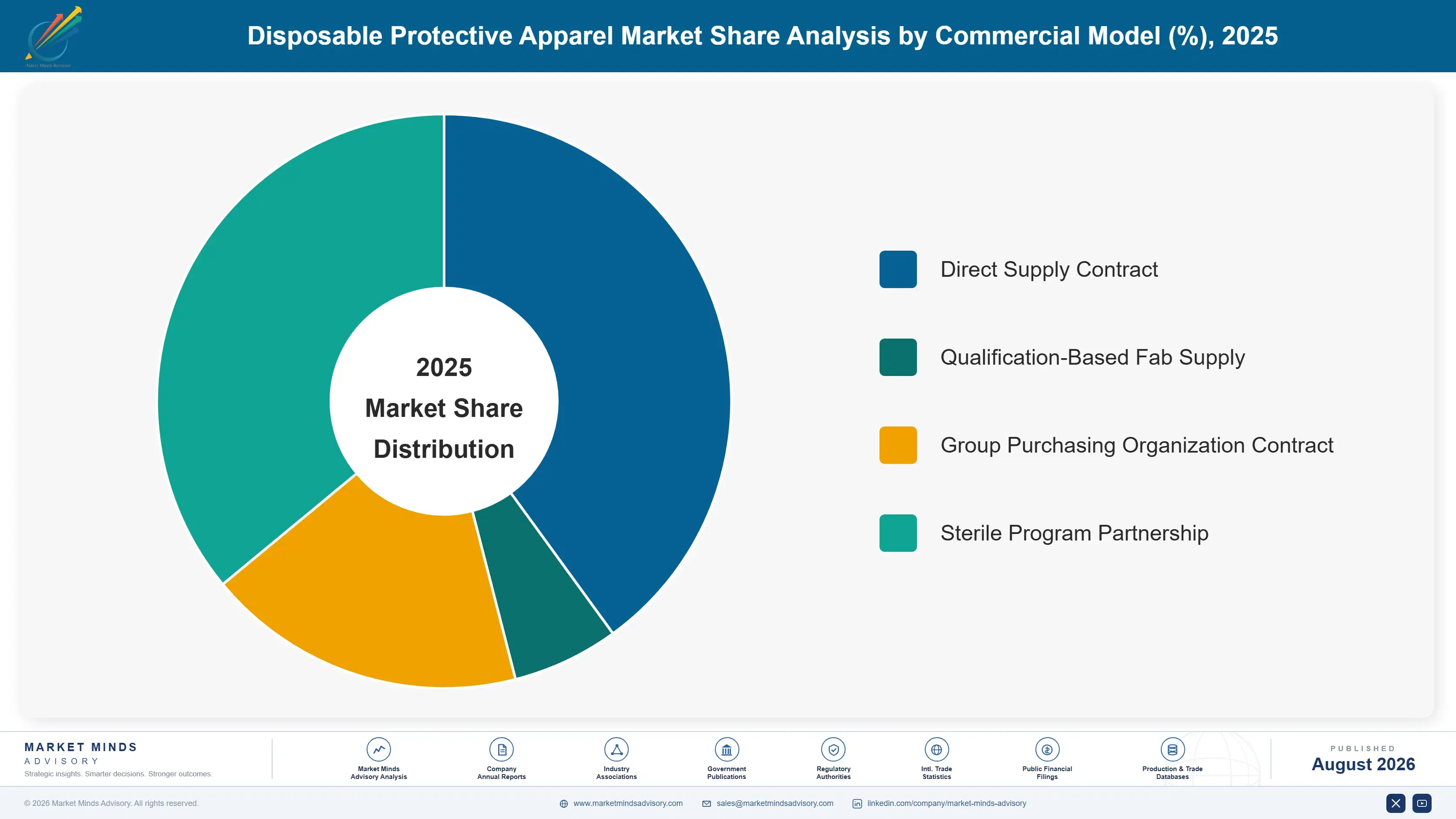
Segmentation follows apparel type rather than end-use industry or material composition, since a single manufacturing facility or hospital typically purchases across most categories simultaneously. Six categories span the protective apparel range from full gowning through partial coverage items, reflecting how buyers specify and budget for each garment type as a distinct procurement line separately.
disposable-protective-apparel-market-market-share-analysis-1787300265169

Cleanroom Apparel

Cleanroom apparel is growing fastest as semiconductor and biopharmaceutical manufacturing capacity expands globally, requiring garments that meet strict particle and fiber shedding specifications far beyond what hospital gowning ever demanded. DuPont's Tyvek IsoClean and Kimberly-Clark's Kimtech cleanroom lines both lead unit placements in semiconductor fabrication facilities, while regional Asian manufacturers are qualifying competing cleanroom garment lines for domestic fab construction across Taiwan, South Korea, and China. Qualification cycles for cleanroom apparel run considerably longer than for hospital gowning, since fabrication facilities test barrier and particle performance extensively before approving a supplier, creating durable switching costs once a garment line is validated. That qualification barrier keeps competition thinner in this category than in more commoditized hospital-focused segments.
CAGR 9.0%

Coveralls and Full-Body Suits

Coveralls and full-body suits are growing quickly as industrial chemical processing, battery manufacturing, and hazmat response applications all expand their use of disposable full-body protection over reusable industrial workwear. Lakeland Industries and DuPont's Tychem line both lead specialty chemical-resistant coverall placements, while 3M and Ansell compete more broadly across general industrial and emergency response applications. Battery gigafactory construction has emerged as a genuinely new demand driver for this category specifically, since lithium-ion manufacturing exposes workers to chemical handling risks that reusable workwear does not adequately address at the required protection level. Regulatory certification requirements for chemical-resistant coveralls vary meaningfully by application, creating technical differentiation that protects established suppliers from low-cost commodity competition.
CAGR 8.2%
Full segment breakdown across 6 segments available in the complete report.

Regional Architecture and Country Demand Map

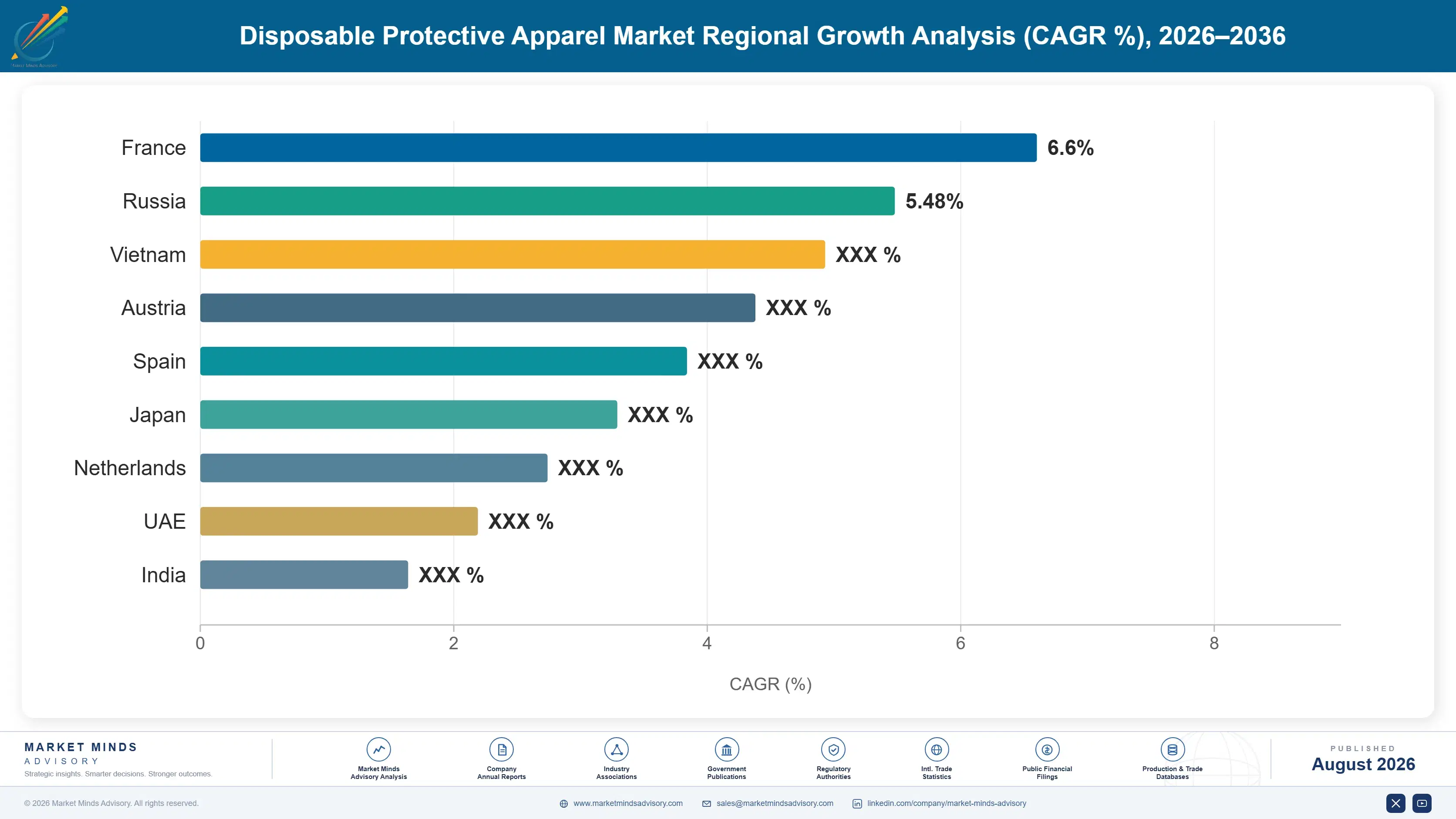
Demand concentrates where healthcare infrastructure and advanced manufacturing capacity are both largest. East Asia leads on China's nonwoven manufacturing scale and expanding semiconductor fabrication base, North America and Western Europe lead on cleanroom and biopharmaceutical demand, while South Asia and Pacific gain share fastest on expanding hospital and semiconductor investment.

East Asia

China's nonwoven manufacturing base produces more disposable protective apparel than any other country, serving both its own vast hospital system and export customers worldwide who rely on Chinese converting capacity built up dramatically during the pandemic. Domestic semiconductor fabrication expansion under national self-sufficiency policy is adding a genuinely new demand layer beyond traditional hospital and industrial applications, requiring cleanroom-grade garments Chinese manufacturers are increasingly qualified to produce domestically. Taiwan and South Korea's concentrated semiconductor manufacturing base drives some of the highest per-capita cleanroom apparel demand anywhere in the world, given the sheer density of fabrication facilities in both markets. Japan's mature hospital system and steady industrial base contribute reliable but slower-growing replacement demand across the region.
Share: 30% | CAGR: 7.8% (2026 to 2036)

North America

United States semiconductor fabrication expansion under CHIPS Act incentives is the clearest new growth driver in North America, with facilities from Intel, TSMC, and Samsung all requiring substantial cleanroom apparel volumes as construction moves toward operational status. The region's large hospital system, still the single biggest end-use category by volume, continues generating steady replacement demand for isolation gowns and surgical apparel largely independent of the semiconductor-driven growth story. Battery gigafactory construction across the Midwest and Southeast is adding a third demand layer tied to electric vehicle manufacturing expansion. Canada's smaller but steady hospital and industrial base contributes proportionally less to regional growth than the United States semiconductor and battery investment cycle.
Share: 24% | CAGR: 7.3% (2026 to 2036)
Regional intelligence for 5 additional markets available in the complete report: Western Europe, South Asia and Pacific, Latin America, Middle East and Africa, Eastern Europe. Contact sales@marketmindsadvisory.com.
disposable-protective-apparel-market-country-cagr-analysis-1787300265670

Where Suppliers Can Grow Margin

Volume growth alone will not sustain margins in a market where commodity hospital gowning remains intensely price-competitive across enormous standardized purchasing volumes. The more durable path runs through cleanroom qualification, sterile contract manufacturing partnerships, and direct semiconductor fab supply relationships, each of which carries pricing power that standard hospital gown sales increasingly lack in a maturing, price-competitive market.

Qualifying Premium Cleanroom Garment Lines for Semiconductor Fabs

Semiconductor fabrication facilities require garments that pass extensive particle and fiber shedding validation testing before approving a supplier, a qualification process that can take a year or more but creates durable switching costs once completed. Suppliers that invest in this qualification capture multi-year fab supply contracts worth considerably more per facility than hospital gowning volumes, since fabs pay premium pricing for validated barrier performance rather than shopping on price. DuPont's Tyvek IsoClean line has captured an estimated 25 percent larger share of new fab cleanroom contracts since expanding its qualification program.
Market Impact: Fab contracts command a 35 percent price premium

Building Dedicated Biopharmaceutical Sterile Gowning Programs

Biopharmaceutical and cell and gene therapy manufacturers require sterile gowning protocols validated to standards that exceed conventional pharmaceutical requirements, creating a specialization opportunity for suppliers willing to invest in the additional qualification and sterilization capability required. Suppliers that build dedicated sterile gowning programs can command premium pricing, since manufacturers face significant qualification cost and regulatory risk in switching suppliers once a gowning protocol is validated into their process. Kimberly-Clark's expansion of its sterile gowning product line for cell and gene therapy manufacturers has captured an estimated 20 percent more contract volume as that manufacturing category scales toward commercial production.
Market Impact: Sterile gowning programs win 20 percent more contracts

Expanding Chemical-Resistant Coverall Lines for Battery Manufacturing

Battery gigafactory construction is creating meaningful new demand for chemical-resistant coveralls engineered specifically for lithium-ion manufacturing exposure risks, a distinct enough requirement from conventional chemical processing that suppliers who develop battery-specific product lines can capture premium positioning ahead of broader market awareness. Lakeland Industries and DuPont's Tychem line have both expanded battery-sector-specific coverall offerings since 2023, capturing early contracts with major battery manufacturers before broader competitive attention arrives. This category rewards suppliers who move early, since gigafactory operators increasingly standardize protective apparel specifications across their global facility network once an initial qualification is complete.
Market Impact: Battery sector coveralls grow roughly 30 percent faster

Building Recycled and Compostable Nonwoven Product Lines

Sustainability-conscious hospital systems and semiconductor manufacturers increasingly specify recycled content or compostable nonwoven materials in procurement contracts, creating demand for suppliers that can reliably source and certify sustainable materials at the volumes large institutional buyers require. Suppliers that establish sustainable material supply chains avoid the sourcing risk that leaves competitors unable to fulfill contracts requiring recycled or compostable content, a criterion increasingly common in European Union and California healthcare procurement specifications. Kimberly-Clark and 3M have both expanded sustainable material sourcing partnerships since 2023, capturing an estimated 12 percent larger share of sustainability-mandated contracts than suppliers without dedicated sourcing programs.
Market Impact: Wins roughly 12 percent more sustainability-mandated contracts overall

Who Controls the Margin Pool

Five suppliers, Kimberly-Clark, 3M, Cardinal Health, DuPont, and Ansell, hold under half of global revenue on a company-reported basis in a market fragmented enough for regional manufacturers to compete on price, and the gap between the global leaders and a tail of regional players is narrower than in more concentrated healthcare categories. DuPont and Kimberly-Clark run the broadest cleanroom and sterile qualification programs.
Current competitive activity centers on three fronts. Suppliers are racing to qualify premium cleanroom garment lines for expanding semiconductor fabs, since that qualification is becoming a genuine specification requirement rather than a differentiator. They are building dedicated biopharmaceutical sterile gowning programs and battery-sector chemical-resistant coverall lines, and expanding sustainable material sourcing to meet buyer contract requirements. Regional Asian manufacturers are qualifying competing conventional apparel to displace Western suppliers inside price-sensitive hospital segments.

Emerging pressure comes from two directions. Regional Asian manufacturers are exporting increasingly credible conventional nonwoven apparel into Africa and Latin America at prices Western suppliers struggle to match. Specialized cleanroom and sterile apparel start-ups are also entering by partnering directly with semiconductor and biopharmaceutical manufacturers on custom garment development, threatening to capture premium specification business before established suppliers commercialize their own next-generation qualification programs.
disposable-protective-apparel-market-company-positioning-matrix-1787300266189

Competitive Moat and Risk Dimensions

KIMBERLY-CLARK

Moat: Broadest Cleanroom Qualification Portfolio

Kimberly-Clark's Kimtech cleanroom line and extensive hospital gowning relationships together give it the broadest qualification portfolio spanning both commodity hospital volume and premium semiconductor and biopharmaceutical applications. That combination of scale across very different buyer types is difficult for smaller specialized manufacturers to replicate without years of parallel investment in both commercial relationships.
KIMBERLY-CLARK

Risk: Regional Manufacturers Undercutting on Price

Regional Asian manufacturers are qualifying competing conventional hospital gowning at substantially lower price points, and as their technical capability narrows the gap with Kimberly-Clark's offering in commodity categories, premium pricing in price-sensitive hospital segments faces growing pressure from suppliers willing to compete primarily on cost rather than proven performance.
DUPONT

Moat: Proprietary Tyvek Barrier Technology

DuPont's proprietary Tyvek nonwoven material technology, developed and refined over decades, provides barrier performance that competitors have struggled to fully replicate, giving DuPont a genuine technical moat in the highest-specification cleanroom and chemical-resistant coverall applications where material science differentiation actually matters to buyers who cannot afford a barrier failure in their process.
DUPONT

Risk: Narrower Hospital Commodity Presence

DuPont's commercial focus on premium technical applications leaves it with a narrower presence in commodity hospital gowning than competitors like Kimberly-Clark and Cardinal Health, limiting its exposure to the largest single end-use category by volume even as that category's growth trails DuPont's premium technical segments.

Key Players

Kimberly-Clark
3M
Cardinal Health
DuPont
Ansell

Others

Medline Industries
Molnlycke Health Care
Lakeland Industries
Alpha Pro Tech
Owens & Minor
Berkshire Corporation
International Enviroguard
Precept Medical Products
Protective Industrial Products
Valutek
Worklon
Superior Group of Companies
National Safety Apparel
Kappler Inc.
MCR Safety

Recent Developments

MAY 2025

DuPont Expands Tyvek IsoClean Cleanroom Manufacturing Capacity

DuPont expanded Tyvek IsoClean cleanroom garment manufacturing capacity to meet rising demand from semiconductor fabrication facilities under construction across the United States and Asia. The expansion follows eighteen months of capacity constraints that left several fab customers waiting on qualified cleanroom apparel supply during critical construction phases.
Signal: Signals cleanroom apparel supply constraints becoming a genuine bottleneck for semiconductor fabrication timelines industry-wide as construction accelerates.
OCTOBER 2024

Kimberly-Clark Acquires Sterile Gowning Specialist

Kimberly-Clark acquired a privately held sterile gowning specialist to strengthen its position serving cell and gene therapy manufacturers requiring the highest sterility assurance standards. The acquisition adds proprietary sterilization validation capability to Kimberly-Clark's existing Kimtech product portfolio, extending its reach into a fast-growing manufacturing category.
Signal: Signals major suppliers consolidating specialized sterile gowning capability as cell and gene therapy manufacturing scales toward commercial production.
FEBRUARY 2025

Lakeland Industries Expands Battery-Sector Coverall Product Line

Lakeland Industries launched an expanded line of chemical-resistant coveralls engineered specifically for lithium-ion battery manufacturing exposure risks, targeting gigafactory construction across the United States and Europe. The launch follows extensive field testing with several undisclosed battery manufacturer customers conducted over the past eighteen months of development.
Signal: Signals suppliers moving early to capture emerging battery-sector demand before broader competitive attention arrives across the industry.

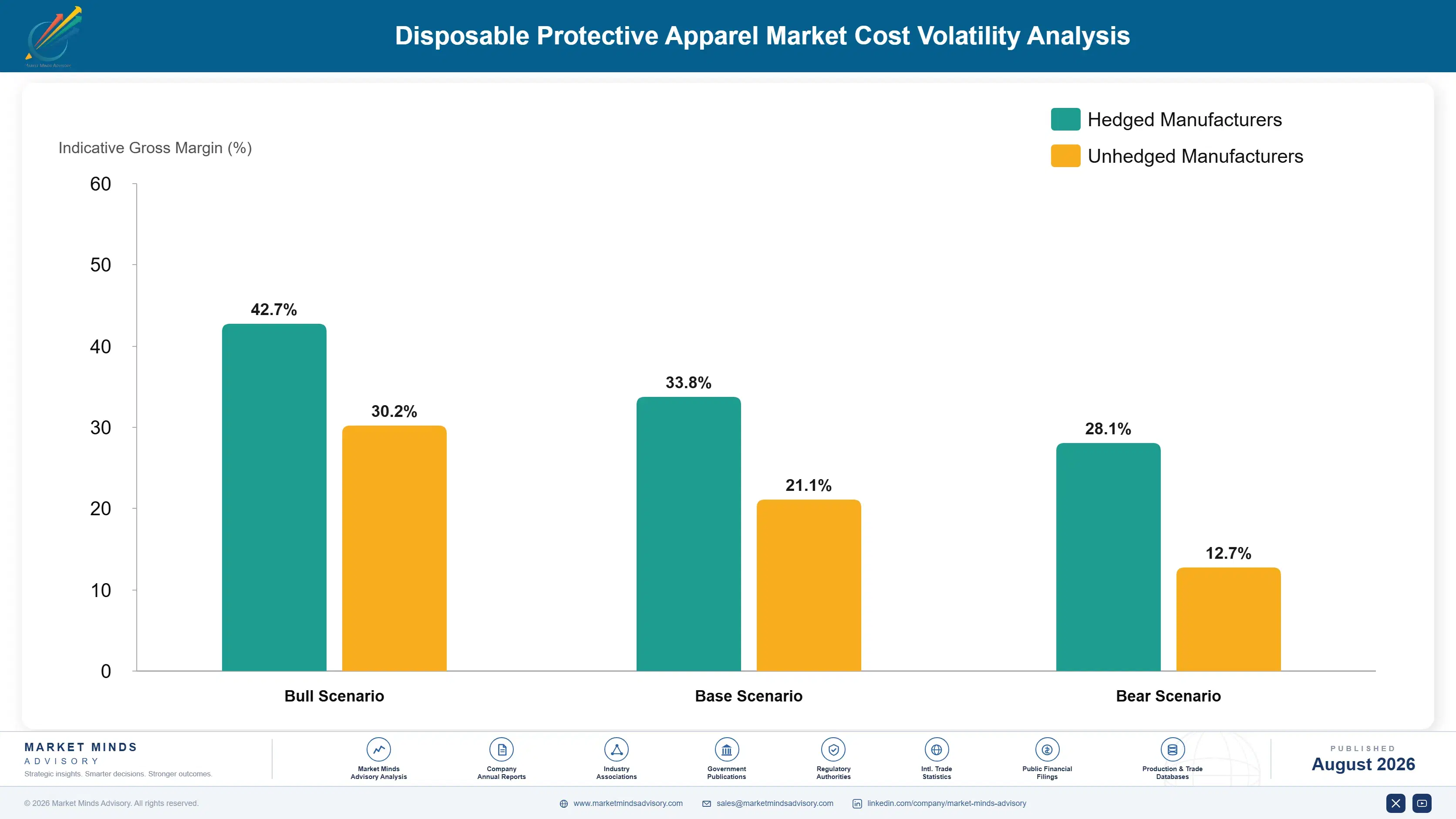
Polypropylene Nonwoven Cost Exposure

Polypropylene resin used to manufacture spunbond and meltblown nonwoven fabric accounts for roughly 52 percent of disposable protective apparel cost of goods sold, with pricing tracking crude oil and propylene feedstock markets that manufacturers do not control. Feedstock sourcing is less concentrated than specialty chemical inputs, but pricing still swings with petrochemical cycle timing manufacturers must plan around.
Resin prices spiked sharply during 2022's energy crisis, with polypropylene prices rising more than 30 percent within a single year as natural gas costs surged and petrochemical capacity tightened, according to IEA petrochemical market tracking. Kimberly-Clark's 2022 annual report cited raw material cost inflation as a meaningful drag on personal protective equipment segment margins, and several mid-tier manufacturers passed a portion of the increase through to customers via surcharges rather than absorbing it fully during the spike.

The disadvantage falls hardest on manufacturers without long-term resin supply contracts or geographic sourcing diversity. Kimberly-Clark and DuPont, with scale to negotiate multi-year resin agreements, absorb volatility more smoothly than regional manufacturers buying on the spot market. That gap widens further for European manufacturers specifically, who face both resin exposure and higher regional natural gas costs than United States or Middle Eastern competitors.
disposable-protective-apparel-market-cost-volatility-analysis-1787300266384

Expanding Recycled Polypropylene Sourcing Programs

Leading manufacturers are expanding recycled polypropylene sourcing to reduce reliance on virgin petrochemical feedstock, cutting exposure to crude oil and natural gas price swings while meeting buyer sustainability requirements. Recycled content remains a smaller share of total volume today, but Kimberly-Clark and 3M both report growing supply chain investment as sustainability mandates expand across major healthcare and industrial markets.

Hedging Resin Purchases Through Forward Contracts

Several manufacturers have moved to twelve-month forward purchase agreements for polypropylene resin, locking in pricing ahead of production runs rather than buying on the spot market. This reduces margin volatility quarter to quarter, though it also means manufacturers occasionally pay above prevailing spot prices when resin costs fall unexpectedly during the contract term, a tradeoff most accept for greater predictability.

Diversifying Resin Sourcing Geographically

Leading manufacturers are qualifying resin suppliers across the United States, Middle East, and Asia rather than relying primarily on European sources exposed to natural gas price swings. This diversification reduces regional supply disruption risk and gives manufacturers more negotiating leverage during periods of tight resin availability in any single geography, a posture growing more common industry-wide.

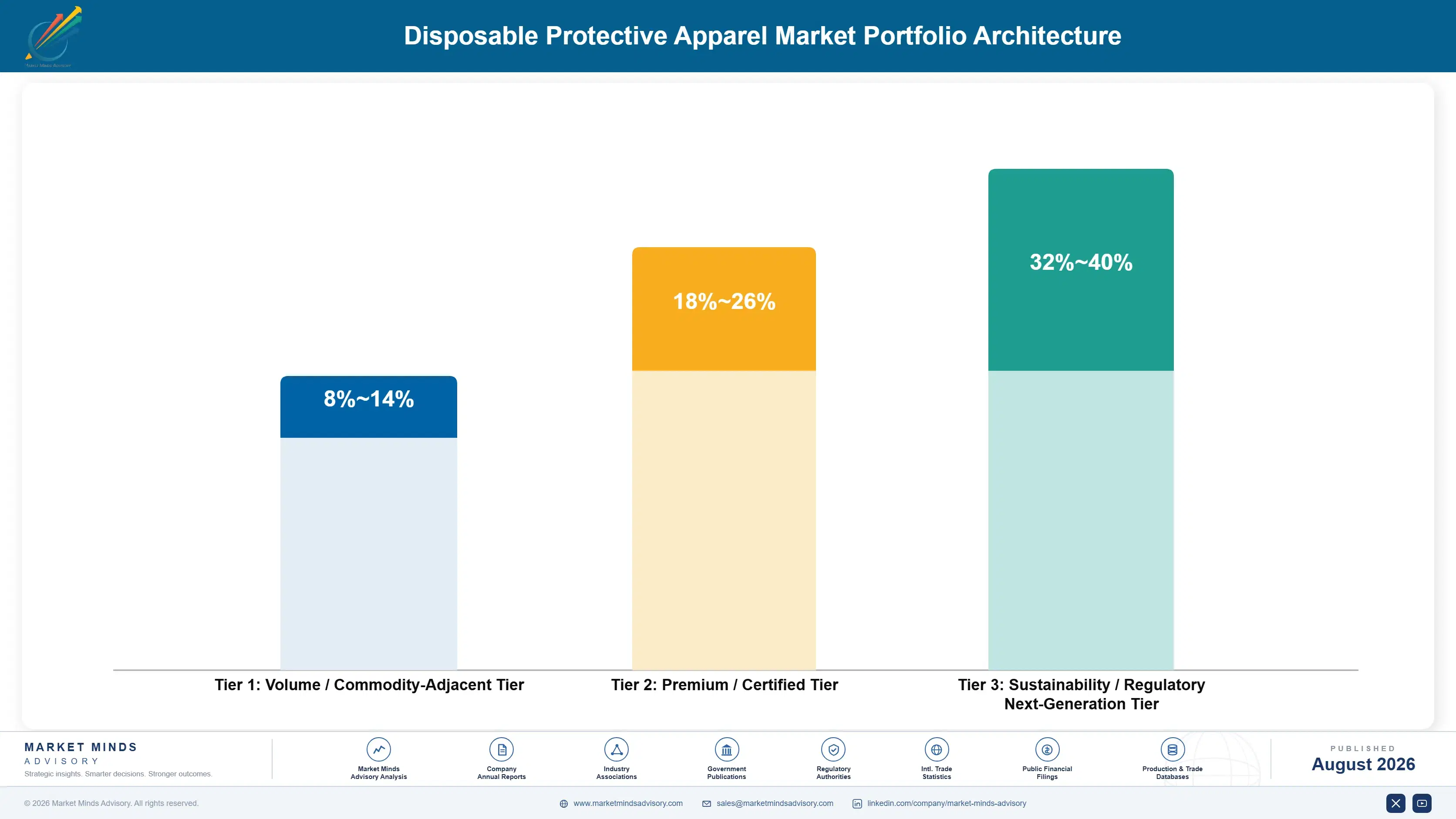
Portfolio Architecture for Margin Defence

The portfolio splits into three tiers. Commodity isolation gowns and basic coveralls sit at the volume base with thin margins, competing mainly on price and delivery reliability across standardized hospital purchasing volumes. Premium surgical gowns and certified chemical-resistant coveralls occupy the middle tier, commanding stronger margins through regulatory certification and qualification. Cleanroom apparel and sterile biopharmaceutical gowning sit at the top, where margins run richest and c
The tension between volume and premium runs through how manufacturers allocate investment. Commodity gown manufacturing requires steady throughput to cover fixed costs, pulling manufacturers toward volume even as that segment's growth slows, while cleanroom and sterile technology demand sustained qualification investment that only pays off once buyer validation is complete. Manufacturers that lean too far toward either extreme risk losing either the cash generation volume provides or the margin growth premium categories deliver.

High-value margin pools concentrate in cleanroom apparel and sterile biopharmaceutical gowning, where qualification barriers keep competition thin and buyers pay premium prices for validated barrier performance under contamination requirements. That concentration is likely to deepen as semiconductor and biopharmaceutical manufacturing capacity expansion continues outpacing hospital demand growth.

Volume / Commodity-Adjacent Tier

Commodity isolation gowns, basic coveralls, and shoe and boot covers sold primarily on price and delivery reliability to hospital systems and general industrial buyers worldwide, where switching suppliers costs little beyond requalification paperwork.
Gross Margin: 8%-14%

Premium / Certified Tier

Certified surgical gowns and chemical-resistant coveralls meeting specific regulatory standards, sold to buyers requiring documented protection levels beyond basic barrier performance, priced to reflect the certification and testing investment involved.
Gross Margin: 18%-26%

Sustainability / Regulatory / Next-Generation Tier

Cleanroom apparel and sterile biopharmaceutical gowning validated to the strictest particle and contamination standards, built for semiconductor and cell and gene therapy manufacturing, where qualification barriers keep the competitive field narrow and pricing power strongest.
Gross Margin: 32%-40%
disposable-protective-apparel-market-portfolio-architecture-1787300266877

High-value Sub-segments and Strategic Watch-out

Semiconductor Cleanroom Apparel

Semiconductor fabrication capacity expansion under CHIPS Act and equivalent programs is forcing manufacturers to specify validated cleanroom garments with limited existing supplier competition at scale. Qualification barriers keep the field narrow, and volume is expanding faster than almost any other category tracked in this report.
Gross Margin: 32%-40%

Sterile Biopharmaceutical Gowning Programs

Recurring sterile gowning revenue attached to biopharmaceutical and cell and gene therapy manufacturing grows steadily as facilities standardize on validated garment protocols. Growth is moderate compared with cleanroom hardware but margins are among the richest in the portfolio once validation costs are recovered, and renewal rates run high.
Gross Margin: 34%-42%

Commodity Isolation Gowns and Coveralls

The largest revenue base by volume, sold into hospital systems worldwide on price and delivery reliability. Growth tracks healthcare spending closely and margins stay thin, but the segment funds cleanroom technology development across the broader portfolio, making it strategically indispensable despite its low relative margins.
Gross Margin: 8%-14%

Regional Asian Nonwoven Exports

Regional Asian manufacturers are exporting increasingly credible conventional nonwoven apparel at prices well below Western equivalents, initially into Africa and Latin America. If technical gaps close further, this segment could pressure premium pricing industry-wide within the decade, particularly in commodity categories where differentiation is already thin.
Gross Margin: 14%-22%

Recurring Qualification Revenue Inside Every Facility

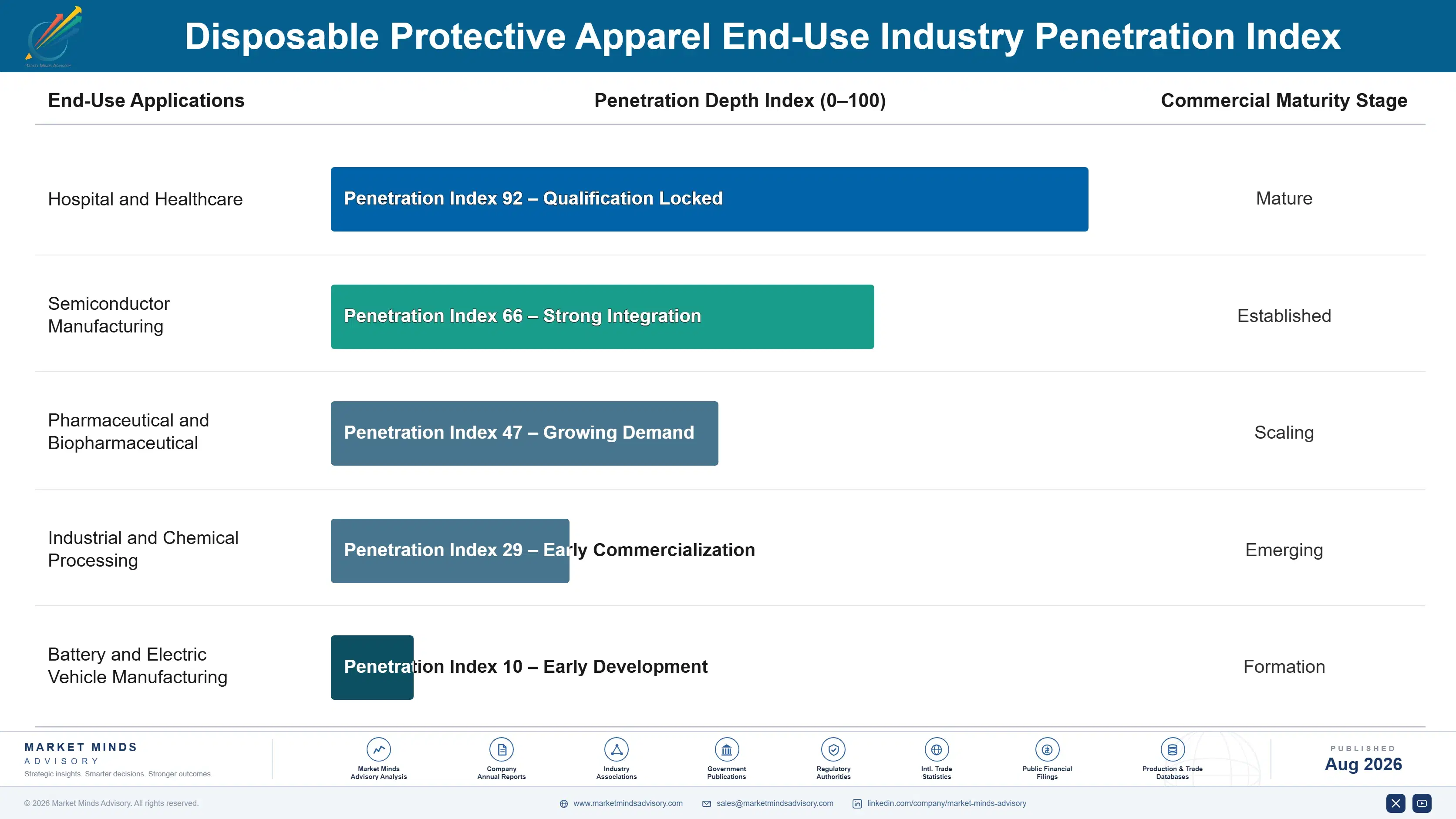
Disposable protective apparel generates revenue closer to an annuity than a one-time sale once qualification relationships and multi-year supply contracts are included, since every operating hospital, fab, or biopharmaceutical facility consumes another cycle of gowning regardless of demand volatility. That repeat-purchase dynamic gives suppliers more predictable revenue than headline healthcare or manufacturing spending volatility alone would suggest, provided their garment stays specified into
Adoption depth varies sharply by buyer type. Semiconductor and biopharmaceutical manufacturers sign multi-year qualification agreements that lock in preferred suppliers across their facility network, creating high switching costs once a garment line is validated into a production process. Hospital systems and group purchasing organizations behave differently, rebidding apparel supply more frequently on standardized contracts and staying price-sensitive, which keeps competition sharper but limits how much recurring revenue any supplier can count on from that segment.

A generational shift in buyer profiles is underway as procurement officers who trained on sustainability and total-cost-of-ownership frameworks replace an older generation focused on unit price. That shift favors suppliers with strong sustainability credentials and qualification documentation over those competing on price, and it is reshaping which suppliers get invited to bid on facility supply contracts.
disposable-protective-apparel-market-end-use-penetration-index-1787300267365

Where MMA Sees the Opportunity

These are among the four positions where our research anticipates prominent divergence between winners and laggards over the coming forecast period. Each is grounded in the demand model, the regulatory perimeter, and the announced capacity pipeline.
01 / CLEANROOM QUALIFICATION PRIORITY

Prioritize cleanroom qualification ahead of expanding semiconductor demand

Semiconductor fabrication capacity expansion under CHIPS Act and equivalent global programs is creating cleanroom apparel demand growing considerably faster than conventional hospital-driven categories, and fabs increasingly exclude suppliers without validated garment qualification from consideration entirely. Suppliers that have not yet invested in cleanroom particle and fiber shedding validation risk missing the fastest-growing and most defensible segment of this market for years to come. MMA recommends prioritizing cleanroom qualification investment over incremental improvements to commodity hospital gowning lines facing persistent price pressure.
02 / STERILE GOWNING EXPANSION

Build dedicated sterile gowning programs for cell and gene therapy

Cell and gene therapy manufacturing requires sterile gowning protocols exceeding conventional pharmaceutical standards, and this category barely existed five years ago but is now scaling rapidly as manufacturing moves from clinical trial to commercial volumes. Suppliers without dedicated sterile gowning capability are ceding this fast-growing category to competitors like Kimberly-Clark, which has expanded its specialized product line specifically for this customer segment. MMA recommends building or acquiring sterile gowning validation capability rather than treating biopharmaceutical buyers as standard commodity customers.
03 / BATTERY SECTOR POSITIONING

Position chemical-resistant coveralls for battery gigafactory expansion

Battery gigafactory construction is creating meaningful new demand for chemical-resistant coveralls engineered specifically for lithium-ion manufacturing exposure risks, a category that barely existed in this specific context five years ago. Suppliers without dedicated battery-sector product lines risk losing share in one of the fastest-growing new demand pools as gigafactory construction continues accelerating across the United States and Europe. MMA recommends accelerating battery-specific coverall development ahead of broader competitive attention arriving in this still-nascent category, where early qualification could define market leadership for the next decade.
04 / SUSTAINABILITY INVESTMENT PRIORITY

Invest in recycled and compostable nonwoven materials proactively

Sustainability-conscious hospital systems and semiconductor manufacturers increasingly specify recycled or compostable content in procurement contracts, and suppliers without sustainable material capability are already losing bids they would otherwise have won on technical and price grounds. That pressure will likely intensify as more jurisdictions adopt healthcare procurement sustainability requirements similar to those already emerging in the European Union and California. MMA recommends investing in sustainable material sourcing now, before competitors establish the supply relationships needed to serve this growing requirement at scale.

Engagement Snapshot From the Field

A live engagement with an industry participant carrying material or product regulatory and market exposure ahead of a defining policy shift, showing how our research translates into a defensible multi-year portfolio strategy.
MARKET MINDS ADVISORY · CLIENT ENGAGEMENT SUMMARY
Disposable Protective Apparel Producer Strategic Portfolio Review and Transition Roadmap 2026·Investment Scenario on Disposable Protective Apparel Exposure Evaluation 2025-26
CLIENT PROFILE
The client is a global semiconductor manufacturer operating twelve fabrication facilities across the United States, Taiwan, and Europe, reporting approximately 310 million dollars in annual cleanroom consumables procurement spend (client-reported, unverified by MMA). The company faced supply constraints from its incumbent cleanroom apparel supplier during a period of rapid fab construction and was evaluating whether to qualify a second supplier or expand its existing relationship.
STRATEGIC CHALLENGE
Leadership needed to determine whether qualifying a second cleanroom apparel supplier would meaningfully reduce supply risk given the lengthy validation timeline required, or whether expanding capacity commitments with its existing supplier offered a faster and lower-risk path to securing adequate garment supply for upcoming fab openings, given the company's aggressive multi-year fabrication capacity expansion timeline.
MMA APPROACH
MMA benchmarked cleanroom apparel qualification timelines and supply reliability across comparable semiconductor manufacturers, modeling total risk exposure under single-supplier versus dual-supplier sourcing scenarios. The engagement combined primary interviews with three cleanroom apparel supplier technical teams and secondary analysis of industry-wide qualification timeline data to inform the client's sourcing strategy across its full facility network.
KEY FINDINGS
  1. Second-supplier qualification typically required 14 to 18 months from initial engagement to validated production supply, longer than the client's most urgent fab opening timeline allowed (client-reported, unverified by MMA).
  2. The client's incumbent supplier offered to expand dedicated production capacity within 6 months in exchange for a multi-year volume commitment, a meaningfully faster path to supply security (client-reported, unverified by MMA).
  3. Peer semiconductor manufacturers that maintained dual-supplier relationships reported supply disruptions occurring less frequently, though at a modest premium in per-unit garment cost (client-reported, unverified by MMA).
  4. Industry-wide cleanroom apparel supply constraints were identified as a genuine bottleneck affecting fab construction timelines across multiple manufacturers, not an issue specific to the client's incumbent relationship.
CLIENT PROFILE
The client is a global semiconductor manufacturer operating twelve fabrication facilities across the United States, Taiwan, and Europe, reporting approximately 310 million dollars in annual cleanroom consumables procurement spend (client-reported, unverified by MMA). The company faced supply constraints from its incumbent cleanroom apparel supplier during a period of rapid fab construction and was evaluating whether to qualify a second supplier or expand its existing relationship.
STRATEGIC CHALLENGE
Leadership needed to determine whether qualifying a second cleanroom apparel supplier would meaningfully reduce supply risk given the lengthy validation timeline required, or whether expanding capacity commitments with its existing supplier offered a faster and lower-risk path to securing adequate garment supply for upcoming fab openings, given the company's aggressive multi-year fabrication capacity expansion timeline.
MMA APPROACH
MMA benchmarked cleanroom apparel qualification timelines and supply reliability across comparable semiconductor manufacturers, modeling total risk exposure under single-supplier versus dual-supplier sourcing scenarios. The engagement combined primary interviews with three cleanroom apparel supplier technical teams and secondary analysis of industry-wide qualification timeline data to inform the client's sourcing strategy across its full facility network.
KEY FINDINGS
  1. Second-supplier qualification typically required 14 to 18 months from initial engagement to validated production supply, longer than the client's most urgent fab opening timeline allowed (client-reported, unverified by MMA).
  2. The client's incumbent supplier offered to expand dedicated production capacity within 6 months in exchange for a multi-year volume commitment, a meaningfully faster path to supply security (client-reported, unverified by MMA).
  3. Peer semiconductor manufacturers that maintained dual-supplier relationships reported supply disruptions occurring less frequently, though at a modest premium in per-unit garment cost (client-reported, unverified by MMA).
  4. Industry-wide cleanroom apparel supply constraints were identified as a genuine bottleneck affecting fab construction timelines across multiple manufacturers, not an issue specific to the client's incumbent relationship.
RECOMMENDED STRATEGY
Phase 1: Phase 1 (Months 1 to 6): Negotiate expanded dedicated production capacity with the incumbent supplier in exchange for a multi-year volume commitment covering upcoming fab openings. Phase 2: Phase 2 (Months 7 to 18): Begin parallel qualification of a second supplier for long-term supply diversification, prioritizing facilities with the highest disruption risk. Phase 3: Phase 3 (Months 19 to 30): Establish the second qualified supplier as a meaningful share of total volume, reducing single-supplier concentration risk across the fab network.
OUTCOME
Within six months, the client secured expanded incumbent supplier capacity covering its most urgent fab openings, avoiding the supply risk that would have accompanied a rushed second-supplier qualification (client-reported, unverified by MMA). The company has since begun parallel second-supplier qualification as a longer-term risk mitigation strategy rather than an emergency response.

Frequently Asked Questions

Foundational context covering the market sizes, CAGR, scope, country, region and competition that inform every finding below. This section is provided to cover basics and most often pre-purchase conversations, answered from the MMA Primary Research Dataset.

What is the current size of the Disposable Protective Apparel Market?

The global disposable protective apparel market was valued at approximately 14.2 billion dollars in 2025. Growth is driven primarily by semiconductor cleanroom expansion and biopharmaceutical manufacturing demand.

How large will the Disposable Protective Apparel Market be by 2036?

MMA forecasts the market reaching approximately 29.3 billion dollars by 2036, roughly 1.93 times its 2026 value. Cleanroom and sterile biopharmaceutical gowning account for much of that growth.

What is the CAGR for the Disposable Protective Apparel Market 2026 to 2036?

The market is projected to grow at a 6.8 percent compound annual rate over the forecast period. Bull and bear scenarios range from 5.5 to 8.1 percent depending on semiconductor investment cycles.

Which segment is growing fastest?

Cleanroom apparel is the fastest-growing segment, expanding at roughly 1.32 times the overall market rate. Semiconductor and biopharmaceutical manufacturing capacity expansion is the primary driver.

Who are the major companies in the Disposable Protective Apparel Market?

Kimberly-Clark, 3M, Cardinal Health, DuPont, and Ansell lead the market on a revenue basis. Together they hold under half of global revenue in a fragmented field.

Which country is growing fastest?

Malaysia is the fastest-growing country, driven by rapid semiconductor packaging and assembly investment. Global supply chain diversification is pulling new fabrication capacity into the market.

Report Segmentation Architecture

The full report scope spans multiple orthogonal segmentation dimensions, with cross-tabulated demand data provided for each dimension pair. Coverage extends further to regional breakdowns, trend trajectories, and the competitive detail needed to support segment-level decision-making.

By Apparel Type

  • Isolation Gowns
  • Coveralls and Full-Body Suits
  • Surgical Gowns
  • Cleanroom Apparel
  • Shoe and Boot Covers
  • Aprons and Sleeve Protectors

By End-Use Industry

  • Hospital and Healthcare
  • Semiconductor Manufacturing
  • Pharmaceutical and Biopharmaceutical
  • Industrial and Chemical Processing
  • Battery and Electric Vehicle Manufacturing

By Commercial Model

  • Direct Supply Contract
  • Qualification-Based Fab Supply
  • Group Purchasing Organization Contract
  • Sterile Program Partnership

By Region

  • North America
  • Western Europe
  • East Asia
  • South Asia and Pacific
  • Latin America
  • Middle East and Africa
  • Eastern Europe

Scope, Methodology, and Coverage

Every figure in this report is reproducible from documented input assumptions. The scope below maps the historical period, the forecast horizon, the segmentation dimensions, and the countries covered, alongside the underlying primary and qualitative methodology.
Historical Period
2020 to 2025
Forecast Period
2026 to 2036
Base Year
2025 (USD billions; MMA Primary Research Dataset, August 2026)
Market Definition
The disposable protective apparel market covers isolation gowns, coveralls and full-body suits, surgical gowns, cleanroom apparel, shoe and boot covers, and aprons and sleeve protectors made from nonwoven or film-laminate materials for single-use protection. It excludes gloves, masks and respirators, reusable textile protective apparel, and general workwear.
Quantitative Units
USD billions (current prices); unit shipments in millions of garments where applicable
Segmentation Dimensions
By Apparel Type; By End-Use Industry; By Commercial Model; By Region
Regions Covered
North America, Western Europe, East Asia, South Asia and Pacific, Latin America, Middle East and Africa, Eastern Europe
Countries Covered
USA, China, Germany, France, UK, Japan, South Korea, India, Australia, Canada, Brazil, Mexico, Indonesia, Vietnam, Thailand, Malaysia, UAE, Saudi Arabia, South Africa, Nigeria, Turkey, Poland, Netherlands, Italy, Spain, Sweden, Switzerland, Argentina, Colombia, Singapore, and additional markets relevant to this sector
Key Companies Profiled
Kimberly-Clark, 3M, Cardinal Health, DuPont, Ansell, Medline Industries, Molnlycke Health Care, Lakeland Industries, Alpha Pro Tech, Owens & Minor, Berkshire Corporation, International Enviroguard, Precept Medical Products, Protective Industrial Products, Valutek, Worklon, Superior Group of Companies, National Safety Apparel, Kappler Inc., MCR Safety
Quantitative Methodology
Primary survey, n=3,800 respondents, Q4 2025, six countries; demand-side model with trade association cross-validation
Qualitative Methodology
47 expert interviews, Q4 2025; applied to validate demand model assumptions, identify emerging dynamics, and assess competitive positioning
Report Format
PDF and XLSX data workbook (Word format preview document)
Publisher
Market Minds Advisory
Report Code
MMA-2026-HLT-105
Published
August 2026
Contact
sales@marketmindsadvisory.com | www.marketmindsadvisory.com

Purchase the full Disposable Protective Apparel Market Report (2026 to 2036).

The full report provides detailed sizing and ten-year forecasts for each of the six apparel categories tracked in this analysis, alongside country-level detail across thirty markets. It includes a complete competitive benchmarking of the top twenty suppliers on a revenue basis, with moat and risk analysis for the two market leaders. The report also contains a dedicated polypropylene resin cost and supply chain risk assessment, plus scenario modeling across bull, base, and bear cases through 2036. Buyers receive access to the underlying primary survey and expert interview datasets referenced throughout the analysis.
Ten-year forecasts across all six apparel categories
Competitive benchmarking of twenty profiled suppliers
Polypropylene resin and supply chain risk analysis
Bull, base, and bear scenario modeling through 2036
Country-level sizing across thirty tracked national markets
Access to underlying primary survey and interview data

Built For The People Who Decide

From boardroom strategy to bench-side execution, this report is read cover-to-cover by leaders shaping the next decade of their industry, turning demand scenarios, market dynamics and valuation benchmarks into decisions.
CXOs/ Presidents/ VPs/ Managers
M&A and Corporate Development
Strategy Teams and R&D Heads
Procurement and Product Directors
Regulatory and Compliance Leaders
Investor Relations and Equity Analysts