Market Minds Advisory
Disposable Plastic Pallet Market

Disposable Plastic Pallet Market: Hygiene Certification as the New Purchase Driver

Disposable plastic pallets are replacing wood and pooled rental pallets across pharmaceutical, food export, and e-commerce logistics, where hygiene certification and one-way shipping economics matter more than the reuse savings that built the pooling industry.

Lead Analyst

Bilal Shaikh

Published

September 2026

Make Smarter Decisions with Customized Research Insights

Request a free sample report and evaluate market opportunities, growth trends, and competitive dynamics relevant to your business needs.

2025 MARKET VALUE$3.6BMarket Size 2025
2036 FORECAST VALUE$7.1BBase Case , 2026 to 2036
CAGR 2026 TO 20366.4 %Bull 7.6% / Bear 5.2%
INCREMENTAL OPPORTUNITY$3.3BNet 10- year value creation
EXPANSION MULTIPLE1.87x2036 value over 2026 base
Strategic Levers
M&A Pipeline
Regional Outlook
Country Rankings
Competitive Intelligence
Segmental Deep-dive
Call-Us : 91 93563 13602

Executive Snapshot and Market Trajectory

Shippers are done assuming reusable pooled pallets are always cheaper. Pharmaceutical exporters, food processors, and e-commerce fulfillment centers increasingly specify one-way plastic pallets instead, since avoiding a returned, cross-contaminated, or damaged pooled asset now outweighs the per-trip rental savings that built the pooling industry over three decades.
Recycled resin pallets are pulling the market forward fastest, as brand owners under sustainability mandates favor reprocessed material over virgin plastic wherever load specifications allow it. East Asia now holds the largest share of global demand, driven by China's massive export packaging volume and domestic e-commerce fulfillment growth, while South Asia grows fastest as India's pharmaceutical export sector adopts hygienic, single-use pallets to meet destination-market certification requirements that pooled wood pallets cannot satisfy.
Consolidation is proceeding through capacity expansion and regional acquisitions rather than mega-mergers, as manufacturers build closer to export ports to cut freight cost on an inherently bulky product. Competitive pressure is intensifying too, since recycled-resin entrants undercut virgin-material incumbents on price while brand owners simultaneously demand third-party sustainability certification, forcing manufacturers to prove recycled content rather than simply claim it, a documentation burden that favors larger, better-resourced producers.
Market Definition
The disposable plastic pallet market covers single-use, one-way plastic pallets sold for a single outbound shipment rather than returned and reused across multiple trips. It includes pallets molded from virgin and recycled thermoplastic resins, corrugated plastic sheet pallets, and expanded polypropylene foam pallets sold to shippers as a consumable logistics input. Pooled, rental, and multi-trip reusable pallet programs, along with wood and metal pallets, are excluded.
Base Year Value
$3.6B in 2025 (MMA Primary Research Dataset, August 2026)
Forecast Period
2026 to 2036, eleven discrete annual values
CAGR
6.4% base case. Bull 7.6%. Bear 5.2%.
Fastest Growth Segment
Recycled/Reprocessed Resin Pallets: 9.5% CAGR
Fastest Growth Country
India: 10.8% CAGR
Fastest Growth Region
South Asia and Pacific: 8.5% CAGR
Largest Region
East Asia: 28% of 2025 global value
Market Leaders
ORBIS Corporation, Schoeller Allibert Group, Cabka Group, Rehrig Pacific Company, Buckhorn Inc. Source: MMA Analysis based on company annual reports.
Primary Survey
n=3,800 procurement and R&D decision-makers, Q4 2025, six countries
Methodology
Demand-side build-up, cross-validated against public data, 47 expert interviews

Disposable Plastic Pallet Market Forecast Scenarios

disposable-plastic-pallet-market-size-forecast-scenario-1787300345118
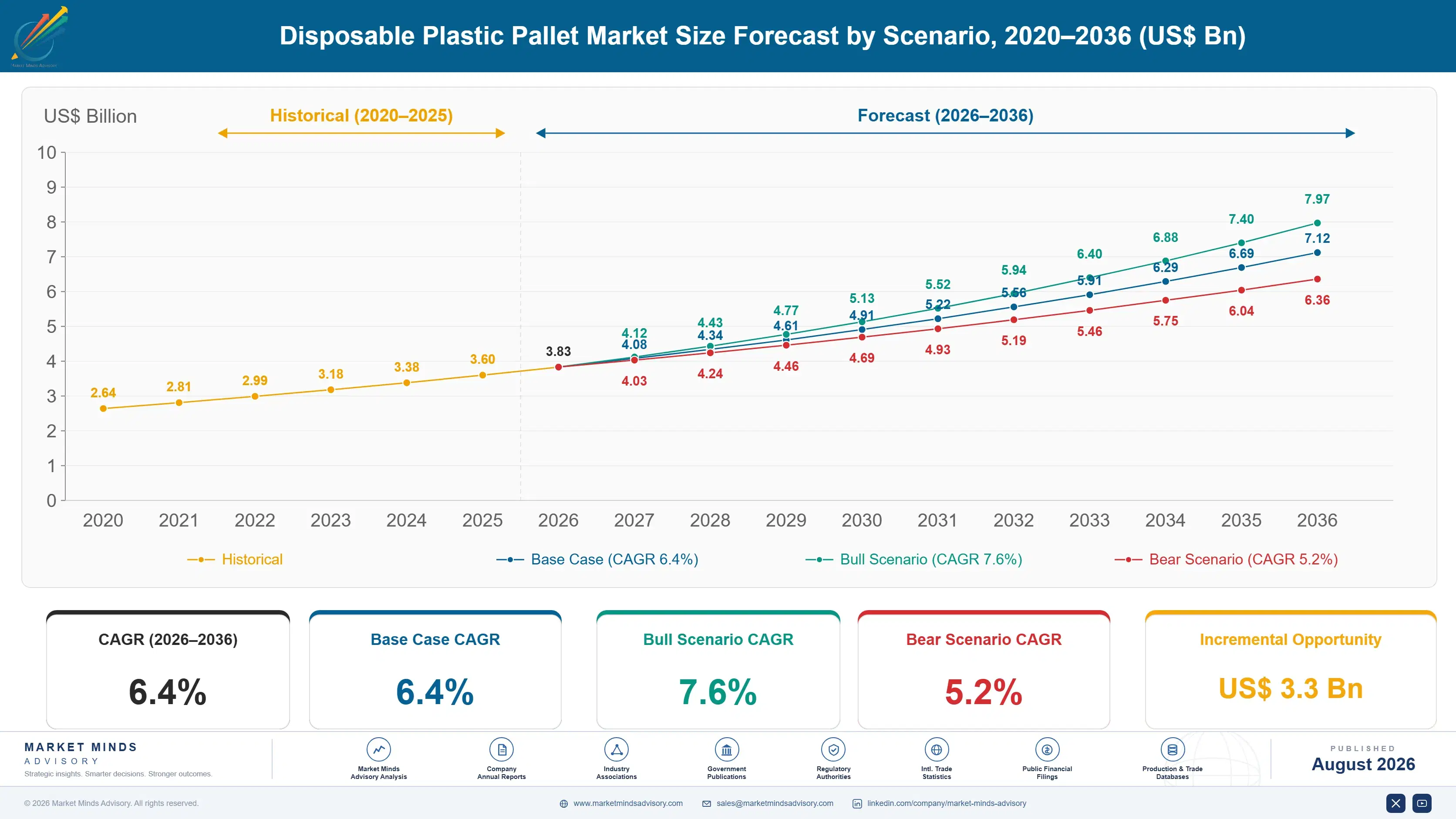
Between 2020 and 2025 the market grew at roughly 5.6% a year, a period shaped more by pandemic-driven e-commerce fulfillment volume than by any lasting shift away from wood. Pharmaceutical cold-chain shipments accelerated adoption of hygienic single-use pallets specifically, since contamination risk from a shared pooled asset became a genuine regulatory concern during vaccine distribution. Freight cost inflation slowed adoption in weight-sensitive long-haul lanes during the same period.
The base case carries the market to 7.1 billion dollars by 2036 on three mechanisms. First, pharmaceutical and food exporters increasingly specify single-use hygienic pallets to meet destination-market certification requirements that pooled wood pallets cannot satisfy consistently. Second, e-commerce fulfillment centers favor lightweight, nestable plastic pallets that cut empty-return freight cost across sprawling distribution networks. Third, brand owner sustainability mandates are pulling volume toward recycled-resin pallets now priced competitively against virgin material for the first time.
The bull case reaches roughly 7.6% annual growth if recycled resin supply scales fast enough to meet brand owner sustainability mandates without a price premium over virgin material. The bear case falls near 5.2% if freight cost inflation keeps favoring lighter wood alternatives on long-haul lanes where plastic's weight disadvantage outweighs its hygiene and durability benefits.

Where Hygiene Certification Beats Reuse Economics

Disposable plastic pallets used to be a niche substitute for wood; now they are a compliance requirement written into pharmaceutical export contracts and brand owner packaging specifications. Every molded HDPE deck and corrugated plastic sheet installed in a shipment exists to guarantee a clean, traceable, single-use asset that a pooled wood pallet simply cannot certify. That certainty, not raw material cost, is increasingly what shippers are paying for.
MARKET CONCENTRATION (CR5)26%Top five producers hold roughly one quarter of volume
AVERAGE SELLING PRICEUSD 11.40 per palletBlended price across HDPE, PP, and recycled resin grades
TOP PRODUCING COUNTRY SHAREChina, 22% of global outputLargest single national source of disposable pallet volume
RECYCLED CONTENT SHARE34% average across shipped volumeShare of resin sourced from post-industrial or post-consumer material
TRADE INTENSITY38% cross-borderOver a third of pallet volume crosses a border
REPLACEMENT CYCLE LENGTHSingle trip, no reuseEach unit ships once before disposal or recycling occurs
Commercially the market behaves like a consumable packaging business wearing a logistics equipment label. Unlike pooled pallet programs that generate recurring rental revenue from the same physical asset, disposable pallet manufacturers must win a new sale on every shipment, which keeps volume growth tightly linked to underlying freight and export activity rather than to any installed base. Manufacturers rarely lock in long-term contracts without volume commitments, since shippers can switch suppliers between orders without any asset-return logistics.
The next decade turns on three forces: tightening hygiene and traceability requirements in pharmaceutical and food export logistics, e-commerce fulfillment networks demanding lightweight nestable designs, and brand owner sustainability mandates pulling volume toward recycled resin. Manufacturers positioned across all three will set the pace industry-wide.
"Buyers aren't choosing plastic because it's cheaper than wood anymore, freight cost erased that argument years ago. They're choosing it because a pooled pallet can't prove where it's been."
Director, Packaging and Logistics Materials Practice · MMA Packaging Practice

Market Trends

Pharma Export Rules Mandate Single-Use Pallets

Pharmaceutical regulators and destination-market customs authorities increasingly require traceable, contamination-free packaging for temperature-sensitive shipments, and a pooled wood or plastic pallet that has carried unknown prior cargo cannot satisfy that documentation requirement on a consistent basis. Single-use plastic pallets solve the problem directly, since each unit ships with a known, single-shipment history that customs and quality assurance teams can verify without ambiguity. Major pharmaceutical logistics providers have begun specifying disposable plastic pallets by name in shipping contracts, converting what was once a packaging preference into a documented compliance requirement across cold-chain and controlled-substance export lanes specifically.
Market Impact: Cuts shipment rejection risk 25%
E-Commerce Fulfillment Favors Lightweight Nestable Pallets

E-commerce fulfillment centers move pallets through automated sortation and cross-dock systems built around consistent weight and stacking geometry, and lightweight nestable plastic pallets fit that automated handling far better than variable-quality wood alternatives. Empty-return logistics matter too: a nestable plastic pallet collapses to a fraction of its loaded height for the return leg, cutting the empty-trailer freight cost that erodes pooled pallet economics on long fulfillment network routes. Major logistics providers serving large e-commerce platforms have standardized on nestable plastic designs specifically to capture that empty-return freight saving across their entire distribution network rather than case by case.
Market Impact: Hits recycled content targets of 50%

Market Opportunities and Growth Drivers

Food Export Hygiene Standards Favor Plastic

Food safety authorities in major import markets increasingly require packaging materials that can be cleaned, sanitized, or traced to a specific production batch, standards that pooled wood pallets, with porous surfaces and unknown prior cargo history, struggle to meet consistently. Molded plastic pallets offer a smooth, non-porous surface that sanitizes reliably and carries no risk of splinters, nails, or pest contamination that wood inherently carries into a food supply chain. Major food exporters shipping into the European Union and United States have shifted meaningful volume toward single-use plastic pallets to simplify customs inspection and reduce shipment rejection risk.
Market Impact: Adds 8 to 15% freight cost

Recycled Resin Pricing Reaches Virgin Material Parity

Recycled HDPE and polypropylene resin prices have fallen close enough to virgin material pricing in several major markets that brand owner sustainability mandates no longer carry the cost penalty that limited recycled-content adoption a decade ago. That price convergence lets packaging teams meet corporate sustainability targets without the internal budget fight that a meaningful cost premium would otherwise trigger with procurement leadership. Several major consumer goods companies have published specific recycled-content targets for their disposable pallet packaging, and manufacturers able to certify recycled content are winning volume directly from virgin-material competitors on comparable pricing terms.
Market Impact: Leaves 40% of volume unrecycled

Market Restraints and Challenges

Freight Weight Penalty Erodes Cost Advantage

Plastic pallets typically weigh more than comparable wood pallets of the same load rating, and on weight-based long-haul freight lanes that difference adds real per-shipment cost that erodes plastic's hygiene and durability advantages in pure economic terms. The root cause is that thermoplastic resin, even in optimized rib and lattice designs, cannot yet match wood's strength-to-weight ratio at comparable cost. That weight penalty keeps plastic pallets concentrated in shorter-haul and air freight lanes where weight cost matters less than in long-haul truck and ocean freight. Some manufacturers are responding with thinner-wall, higher-strength resin formulations engineered to close that gap.
Market Impact: Covers over 40 pharma export lanes

Recycling Infrastructure Gaps Limit Circularity Claims

Brand owners increasingly want disposable pallets that are genuinely recyclable at destination, not merely recyclable in theory, but many export destination markets lack the plastic recycling infrastructure to process a single-use pallet at end of life. The root cause is that pallet-grade plastic recycling requires collection and reprocessing infrastructure that many developing export destinations have not built, leaving disposal to landfill regardless of the resin's technical recyclability. That gap undermines brand owner sustainability claims and creates real reputational risk when circularity marketing outpaces actual outcomes. Some manufacturers are building take-back programs at major destination ports to close that loop directly.
Market Impact: Cuts empty-return freight cost 30%
3 additional market trends, 3 additional growth drivers, and 4 additional restraints and challenges are covered in the full report. Contact sales@marketmindsadvisory.com to access the complete intelligence.

Segment CAGR and Growth Architecture

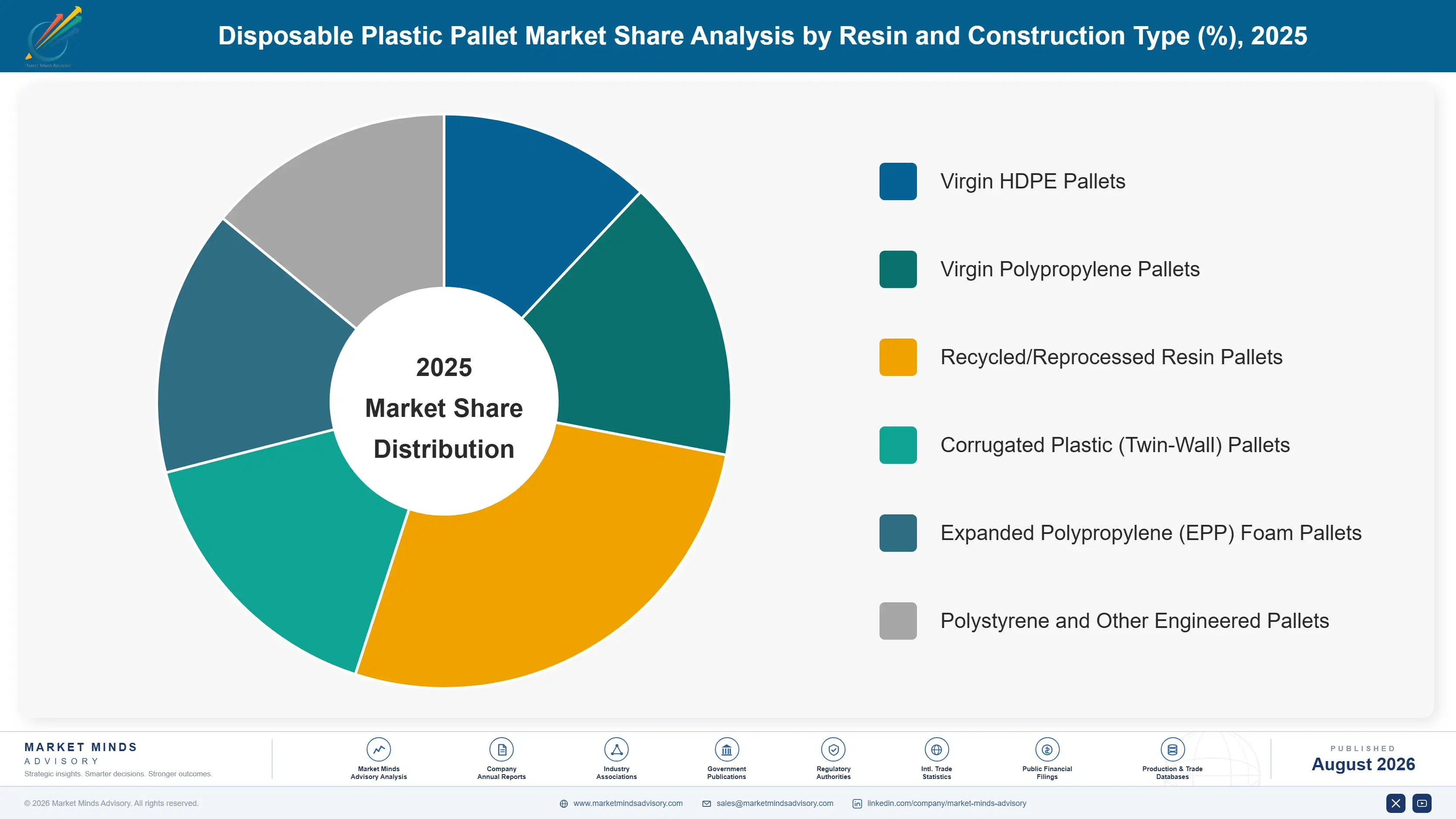
Segmentation follows resin and construction type, a single materials-science logic that groups disposable pallets by the plastic composition and molding process used rather than by end industry served. Each construction type carries its own cost structure, load rating, and recyclability profile, so commercial position tracks the material choice rather than the shipment it eventually carries.
disposable-plastic-pallet-market-market-share-analysis-1787300345695

Recycled/Reprocessed Resin Pallets

Recycled and reprocessed resin pallets grow fastest at 9.5%, about 1.48 times the overall market rate, as brand owner sustainability mandates pull volume toward reprocessed HDPE and polypropylene now priced close enough to virgin material to remove the cost penalty that limited adoption a decade ago. Post-industrial regrind sourced from manufacturing scrap dominates current recycled volume, since its consistent quality is easier to certify than post-consumer waste streams that vary lot to lot. Major consumer goods companies have published specific recycled-content targets for their packaging supply chains, and manufacturers able to document verified recycled content are winning volume directly from virgin-material competitors on comparable pricing. Supply constraints on high-quality post-consumer regrind remain the segment's binding growth limit for now.
CAGR 9.5%

Corrugated Plastic (Twin-Wall) Pallets

Corrugated plastic twin-wall pallets grow second-fastest at 8.2%, driven by their exceptionally light weight relative to molded resin alternatives, which matters directly on air freight and weight-sensitive export lanes where every kilogram carries real cost. Built from fluted polypropylene sheet folded and fastened into a pallet structure, twin-wall construction trades some compressive load rating for a substantial weight saving over solid molded decks. Pharmaceutical and electronics exporters favor the format specifically for lighter, higher-value shipments where load weight rating matters less than total shipment weight and customs documentation simplicity. The segment sits at the lighter end of the disposable pallet category, competing directly against corrugated cardboard alternatives as much as against other plastic formats in practice.
CAGR 8.2%
Full segment breakdown across 6 segments available in the complete report.

Regional Architecture and Country Demand Map

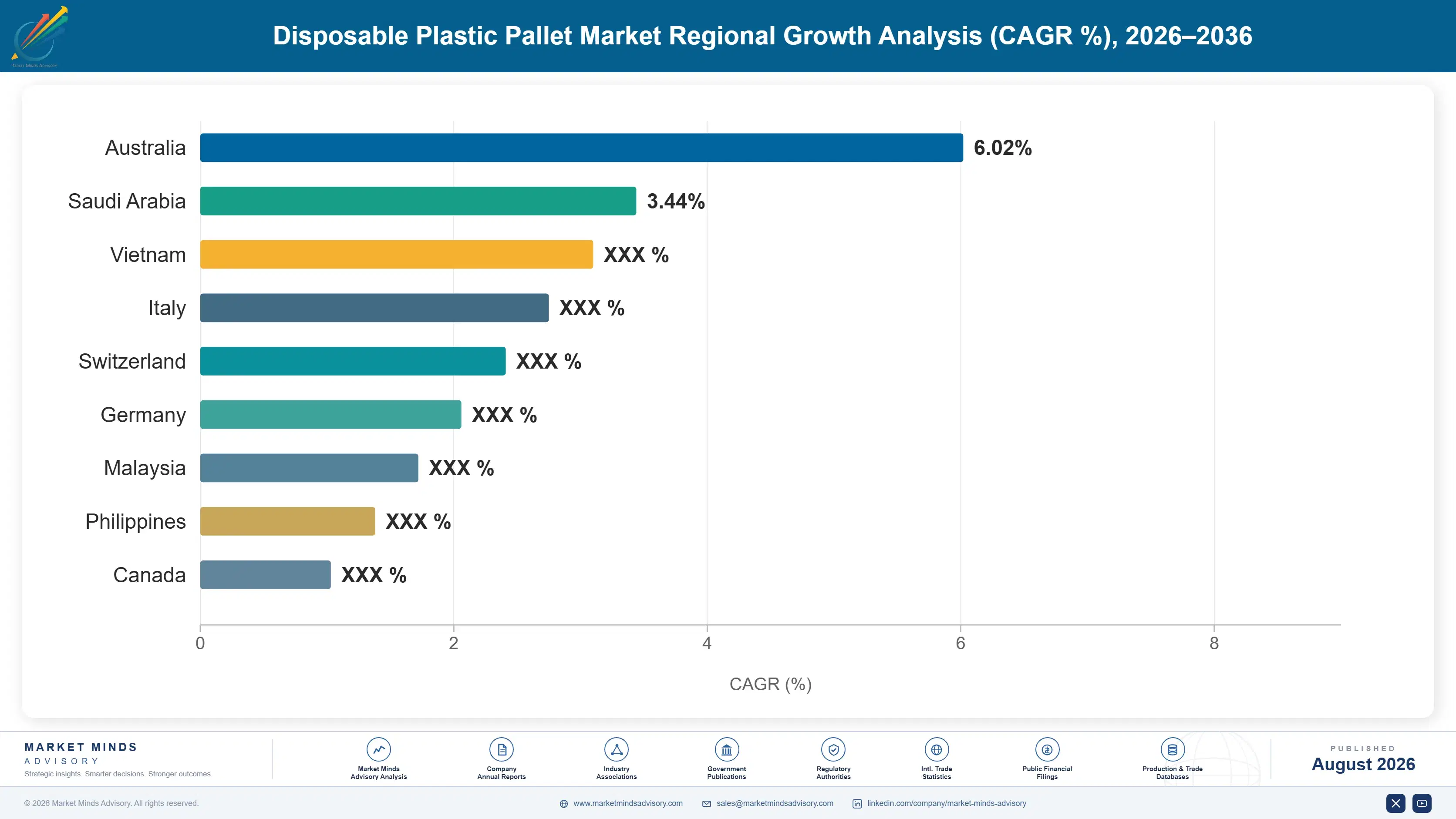
Demand concentrates where export volume and hygiene regulation intersect with manufacturing capacity, which increasingly means East Asia rather than the historically dominant North American base. China's export packaging volume and domestic e-commerce fulfillment growth are pulling deployment east even as North America retains the deepest hygiene-driven per-shipment spend.

North America

North America holds 24% of global value, still commanding the deepest per-shipment hygiene and pharmaceutical compliance spend anywhere even as East Asia has overtaken it on total export volume overall. FDA and USDA food safety requirements have pushed pharmaceutical and food exporters toward single-use plastic pallets specifically to simplify customs inspection and reduce shipment rejection risk at the border. ORBIS, Buckhorn, and Rehrig Pacific all run core manufacturing from domestic operations, giving American shippers direct access to custom pallet design and rapid replenishment scheduling. Growth of 6.9% tracks steady e-commerce fulfillment network expansion and continuing hygiene-driven substitution away from pooled wood pallets in pharmaceutical and food-grade shipping lanes specifically across the country.
Share: 24% | CAGR: 6.9% (2026 to 2036)

Western Europe

Western Europe accounts for 19% of value, a mature base shaped by some of the world's strictest packaging waste regulation, which cuts both ways for disposable plastic pallets specifically. The EU's Packaging and Packaging Waste Regulation increasingly favors reusable pooled systems over single-use formats on environmental grounds, creating real regulatory headwind that other regions do not face to the same degree. Schoeller Allibert and Cabka both run substantial manufacturing and recycling operations domestically, positioning recycled-content pallets as the compliant path forward under tightening circularity rules. Growth of 4.9% trails the global rate directly because of that regulatory pressure, though certified recycled-content pallets are capturing a growing share of the region's remaining single-use volume.
Share: 19% | CAGR: 4.9% (2026 to 2036)
Regional intelligence for 5 additional markets available in the complete report: East Asia, South Asia and Pacific, Latin America, Middle East and Africa, Eastern Europe. Contact sales@marketmindsadvisory.com.
disposable-plastic-pallet-market-country-cagr-analysis-1787300346218

How Producers Can Defend Margin Position

Selling a pallet once at commodity price leaves the highest-margin part of this market on the table. The four moves below shift revenue toward positions that command a premium over commodity plastic: certified recycled content, hygiene documentation services, lightweight design premiums, and take-back programs that close the sustainability loop brand owners increasingly demand across every export lane.

Certify Recycled Content For Sustainability Mandates

Manufacturers that invest in third-party verified recycled-content certification, rather than making unverified sustainability claims, capture a documented price premium of roughly 8% to 12% from brand owners who need auditable data to report against their own corporate sustainability targets. That certification cost runs into real money upfront, typically requiring dedicated testing and chain-of-custody documentation infrastructure, but it converts a commodity resin purchase into a compliance-driven relationship that unverified competitors cannot match regardless of their underlying recycled content percentage. Cabka and Schoeller Allibert have both built certification programs specifically to capture this premium ahead of competitors still relying on self-reported claims.
Market Impact: Captures an 8% to 12% verified price premium

Sell Hygiene Documentation As A Service

Bundling batch-level traceability and hygiene documentation as a paid service, rather than treating certification paperwork as a free add-on, captures real margin from pharmaceutical and food exporters who need that documentation for customs and quality assurance regardless of the underlying pallet cost. Vendors offering this service typically charge a premium of 10% to 15% over an equivalent undocumented pallet, since the customer would otherwise build that traceability capability internally at a far higher cost than the premium itself represents. In practice the approach has become standard among manufacturers serving pharmaceutical export lanes, where documentation matters as much as the pallet.
Market Impact: Charges a 10% to 15% traceability documentation premium

Engineer Lightweight Designs For Freight Savings

Manufacturers that invest in thinner-wall, rib-optimized pallet designs capture a meaningful price premium from shippers on weight-sensitive air freight and long-haul lanes, since every kilogram saved on pallet weight directly reduces per-shipment freight cost across the customer's entire shipping volume. That engineering investment requires real upfront design and testing cost to maintain load rating while cutting material weight, but it lets manufacturers charge 12% to 18% more than a standard-weight equivalent while still delivering a net cost saving to the shipper once freight is included. Corrugated twin-wall specialists have built their entire commercial position around this weight-saving value proposition specifically.
Market Impact: Charges a 12% to 18% lightweight design premium

Offer Destination Port Take-Back Recycling Programs

Rather than leaving disposal entirely to the shipper's destination market, manufacturers are building take-back programs at major destination ports that collect used pallets for reprocessing, closing the recycling loop that sustainability claims otherwise cannot fully support in markets lacking local infrastructure. Early adopters of this approach report capturing 5% to 10% more total contract value from brand owners willing to pay for a genuinely closed-loop program rather than a single-use pallet with no end-of-life plan. The structure also deepens customer relationships, since a shipper enrolled in a take-back program has real incentive to keep sourcing from that manufacturer.
Market Impact: Captures 5% to 10% more total contract value

Who Controls the Margin Pool

Concentration sits at a low CR5 of 26%, reflecting a market fragmented across regional manufacturers serving local export corridors rather than global scale. The gap between the top five and the next tier is real but moderate: leaders combine multi-region manufacturing footprint with certified recycled-content programs, while challengers operate from a single region. All participants here are assessed on one basis: disclosed disposable pallet segment revenue.
Competition today runs across three dimensions. First, recycled-content certification depth, since brand owners demand auditable data rather than self-reported claims. Second, regional manufacturing footprint, as exporters favor suppliers with production capacity near major port and fulfillment hubs to cut freight cost and lead time. Third, hygiene documentation capability, since pharmaceutical and food exporters treat traceability paperwork as part of the product rather than a separate service.

Pressure is building from lower-cost regional manufacturers in Southeast Asia and Eastern Europe who compete on price against established Western and Chinese incumbents without matching their certification infrastructure yet. Corrugated plastic specialists are pushing into molded pallet territory from the lightweight side, blurring category lines that used to separate formats cleanly. Rankings will shift toward manufacturers who pair certified recycled content with genuine regional manufacturing presence, since neither alone is enough.
disposable-plastic-pallet-market-company-positioning-matrix-1787300346733

Competitive Moat and Risk Dimensions

ORBIS CORPORATION

Moat: Deep North American Manufacturing Footprint

ORBIS operates an extensive network of North American manufacturing facilities positioned near major food, pharmaceutical, and e-commerce fulfillment hubs, letting it offer delivery lead times competitors serving the region from overseas cannot match. That regional density, combined with decades of custom pallet design experience, makes it the default supplier evaluation for large American shippers specifying new packaging programs.
ORBIS CORPORATION

Risk: Exposure To Domestic Freight Cost

ORBIS's manufacturing footprint is concentrated domestically, which protects lead times but leaves it more exposed to North American resin and freight cost inflation than competitors with globally diversified production. As Asian manufacturers expand export capacity into the American market, ORBIS's regional cost structure becomes a harder argument to defend on price-sensitive commodity pallet grades specifically.
SCHOELLER ALLIBERT GROUP

Moat: European Recycled Content Leadership

Schoeller Allibert has built extensive recycling and reprocessing capability directly into its European manufacturing operations, positioning it as the compliant supplier of choice under the EU's tightening packaging waste and circularity regulations. That regulatory alignment gives it a genuine durable advantage as European brand owners face mounting pressure to document verified recycled content across their packaging supply chains.
SCHOELLER ALLIBERT GROUP

Risk: Regulatory Headwind Limits European Growth

The EU's Packaging and Packaging Waste Regulation increasingly favors reusable pooled systems over single-use formats on environmental grounds, creating genuine headwind for a manufacturer whose core business remains disposable pallets in its largest home market. Schoeller Allibert is responding by expanding recycled-content and take-back programs, but underlying regulatory pressure on single-use formats is unlikely to ease meaningfully.

Key Players

ORBIS Corporation
Schoeller Allibert Group
Cabka Group
Rehrig Pacific Company
Buckhorn Inc.

Others

Nefab Group
Craemer GmbH
Polymer Solutions International Inc.
DS Smith Plastics
Loscam Limited
Litco International Inc.
Menasha Corporation
Perstorp Group
Georg Utz Holding AG
TranPak Inc.
Falkenhahn AG
IFCO Systems N.V.
Greystone Logistics Inc.
Jifram Extrusions Inc.
PGS International B.V.

Recent Developments

FEBRUARY 2025

ORBIS Expands Recycled Resin Processing Capacity in Ohio

ORBIS opened an expanded recycled resin reprocessing facility in Ohio, adding capacity dedicated to converting post-industrial plastic scrap into certified recycled content for its pallet manufacturing lines. The organic expansion, not a joint venture or acquisition, followed two years of rising brand owner demand for documented recycled-content packaging.
Signal: Signals manufacturers are building recycling capacity directly rather than relying entirely on third-party reprocessed resin suppliers.
OCTOBER 2024

Cabka Acquires Regional Pallet Manufacturer in Southeast Asia

Cabka completed the acquisition of a regional plastic pallet manufacturer in Southeast Asia for an undisclosed sum, adding manufacturing capacity positioned near major export ports serving pharmaceutical and food shipment lanes. The deal gives Cabka direct regional production it previously lacked in one of the fastest-growing export corridors.
Signal: Signals that European manufacturers are increasingly buying regional production capacity rather than exporting from home markets alone.
MAY 2025

Rehrig Pacific and a Pharma Logistics Firm Form Traceability Partnership

Rehrig Pacific and a pharmaceutical logistics technology firm formed a partnership to embed batch-level traceability tagging directly into disposable pallet manufacturing for cold-chain pharmaceutical shipments. The partnership targets deployment across major pharmaceutical export lanes within two years, combining Rehrig's manufacturing scale with its partner's tracking software.
Signal: Signals that pallet manufacturers increasingly partner with logistics technology firms rather than build tracking capability entirely internally.

Resin and Freight Cost Exposure

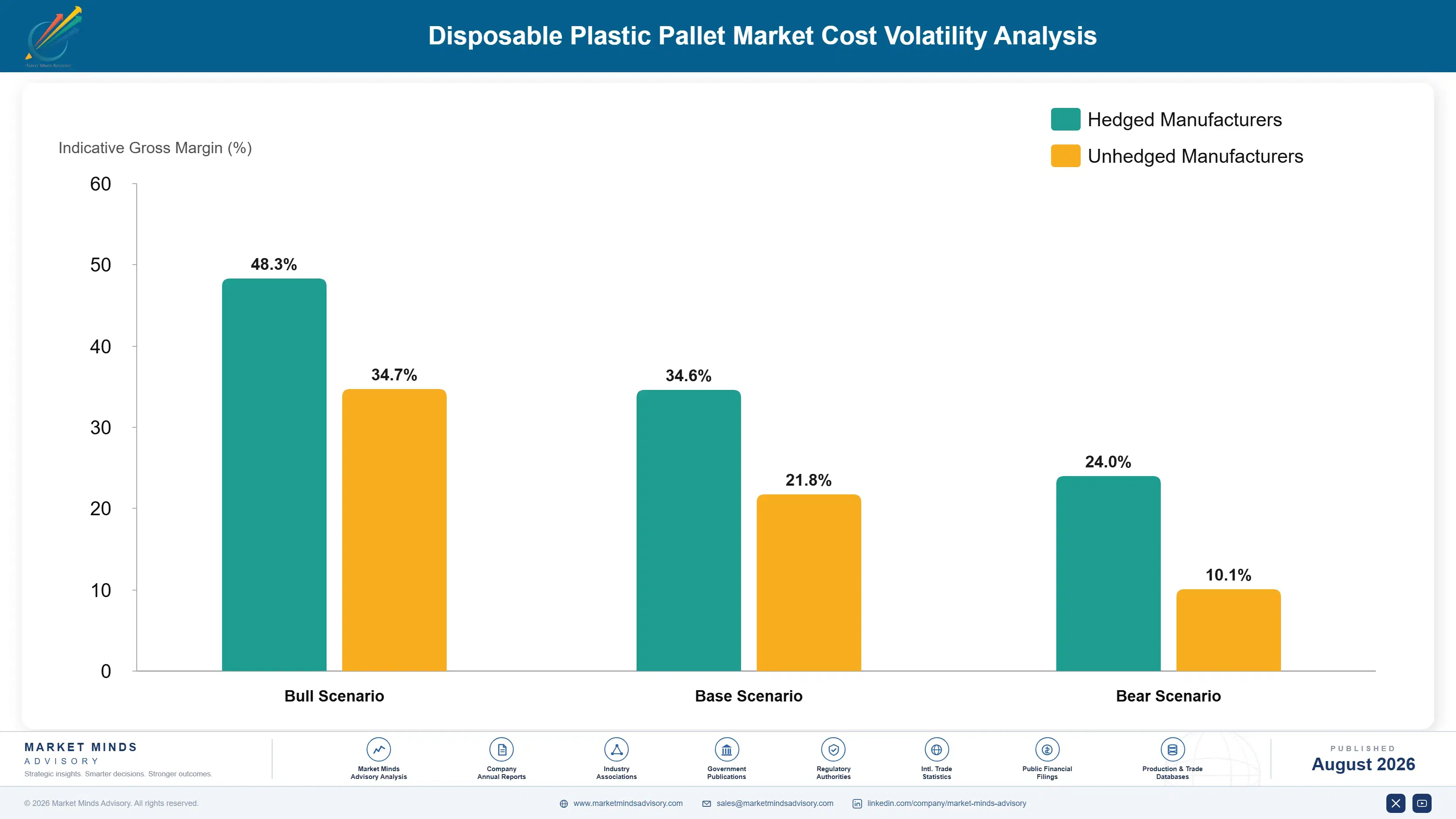
Virgin and recycled thermoplastic resin, primarily HDPE and polypropylene, makes up roughly 55% to 65% of cost of goods sold across disposable plastic pallets, well above most molded plastic products, since the pallet is a single large resin part with minimal secondary cost. Resin traces to petrochemical feedstock pricing, with virgin resin tracking crude oil and naphtha prices while recycled resin pricing follows a separate, increasingly independent demand curve.
The 2021 to 2022 polyethylene price spike illustrated the exposure directly. EIA and industry data recorded polyethylene contract prices reaching multi-year highs through 2021 as petrochemical feedstock costs surged and Gulf Coast production capacity was disrupted by extreme weather. Multiple pallet manufacturers disclosed pass-through price increases in customer communications, citing resin cost as the primary driver rather than demand weakness, and several noted the increase pressured margins on fixed-price contracts signed before the spike.

Smaller pallet manufacturers without long-term resin supply agreements absorbed the price spike hardest, since their purchase volumes were too small to secure the multi-year fixed pricing that larger producers like ORBIS negotiate directly with resin suppliers. That gap compounds over time: large manufacturers pre-purchase resin months ahead using balance sheet capacity smaller competitors do not have, leaving regional specialists exposed every price cycle.
disposable-plastic-pallet-market-cost-volatility-analysis-1787300346929

Secure Multi-Year Resin Supply Agreements Directly

Negotiating multi-year fixed or indexed pricing agreements directly with resin producers, rather than buying on the spot market, secures allocation priority during shortage cycles and smooths input cost volatility. The approach requires committing to volume forecasts years in advance, a real forecasting risk, but it has protected larger manufacturers' margins through two separate resin price spikes since 2020.

Diversify Between Virgin and Recycled Resin Sourcing

Qualifying pallet designs to accept a blended ratio of virgin and recycled resin, rather than committing entirely to one feedstock stream, reduces exposure to any single resin market's price cycle. Requalification takes real engineering and load-testing time, so manufacturers are prioritizing it for their highest-volume product lines first before extending blended sourcing across their full catalog over time.

Pass Through Cost Via Indexed Customer Pricing

Structuring customer supply agreements with pricing indexed to published resin cost benchmarks, rather than fixed annual pricing, shifts some volatility risk back to shippers who have more flexibility to absorb short-term cost swings. Large shippers have increasingly accepted indexed terms in exchange for guaranteed allocation during tight resin markets, a trade manufacturers use to protect margin without losing volume.

Portfolio Architecture for Margin Defence

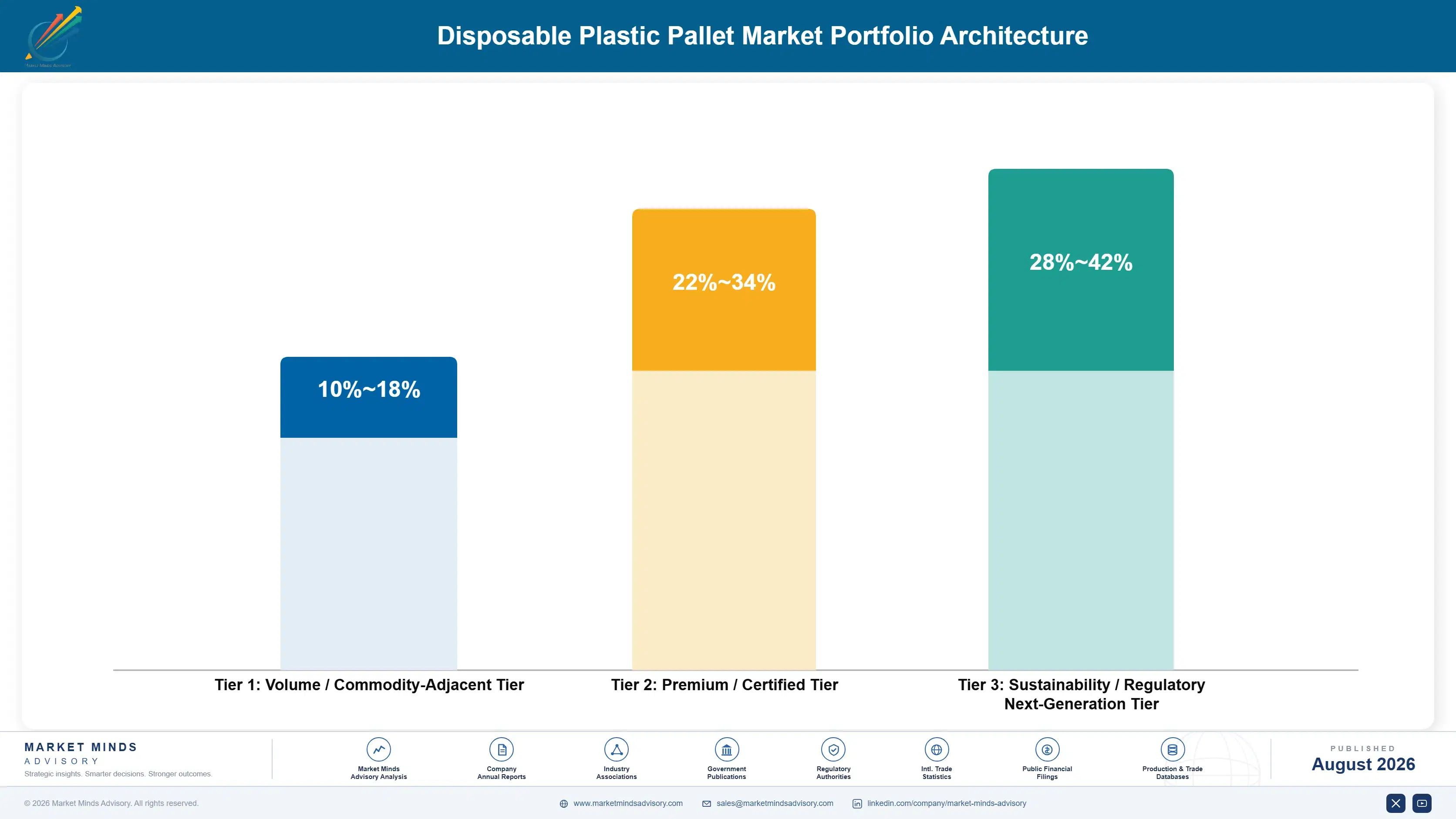
The portfolio splits into three tiers with wide margin separation tied to certification and design complexity rather than raw material cost alone. Commodity molded pallets sold on price and delivery reliability carry thin margins. Certified recycled-content and hygiene-documented pallets for pharmaceutical and food export carry the strongest margins. A third tier of next-generation take-back and closed-loop recycling programs is still scaling toward proven, repeatable commercial economics across
The tension between commodity volume and certified premium shapes how manufacturers allocate capital: commodity pallets fund the plant utilization and cash flow that keep production lines running, while certified programs fund the testing, documentation, and recycling infrastructure that create genuine competitive protection. Manufacturers that lean too far toward commodity volume risk losing the certification depth that differentiates them; those that lean too far toward certification risk under-utilized commodity capacity.

High-value pools concentrate specifically in pharmaceutical hygiene-documented pallets and certified recycled-content programs, where regulatory barriers and brand owner sustainability mandates both run highest. Commodity molded pallets used in general logistics generate volume but thin, price-competitive margins, since multiple regional manufacturers can supply functionally similar pallets against the same specification.

Volume / Commodity-Adjacent Tier

Standard molded HDPE and polypropylene pallets sold against several regional manufacturers competing primarily on unit price, load rating, and delivery reliability across large commodity logistics orders placed routinely by shippers.
Gross Margin: 10-18%

Premium / Certified Tier

Certified recycled-content and pharmaceutical hygiene-documented pallets carrying auditable sustainability data and traceability documentation that brand owners increasingly require before awarding new packaging contracts each fiscal cycle.
Gross Margin: 22-34%

Sustainability / Regulatory / Next-Generation Tier

Take-back and closed-loop recycling programs still scaling toward proven, repeatable commercial economics across a broad and varied shipper customer base of very different sizes and needs.
Gross Margin: 28-42%
disposable-plastic-pallet-market-portfolio-architecture-1787300347427

High-value Sub-segments and Strategic Watch-out

Recycled/Reprocessed Resin Pallets

The fastest-growing and highest-margin segment, converting sustainability mandates into a genuine commercial requirement that manufacturers increasingly cannot avoid, commanding price parity with virgin material while carrying real certification and documentation value shippers pay for directly and consistently across every order.
Gross Margin: 22-34%

Corrugated Plastic (Twin-Wall) Pallets

High value with steadier growth than recycled resin, directly serving weight-sensitive air freight and pharmaceutical export lanes where every kilogram of pallet weight adds real, measurable per-shipment freight cost each trip taken.
Gross Margin: 20-30%

Virgin HDPE and Polypropylene Pallets

The volume core of the market, supplying commodity molded pallets against several regional manufacturers competing primarily on price, load rating, and delivery reliability across routine logistics orders placed every single quarter.
Gross Margin: 10-18%

Polystyrene and Other Engineered Pallets

The strategic watch-out, a smaller niche category facing substitution pressure from both established HDPE designs and newer recycled-resin alternatives that increasingly match its cost and performance profile at real scale.
Gross Margin: 8-16%

Why Every Shipment Restarts the Sale

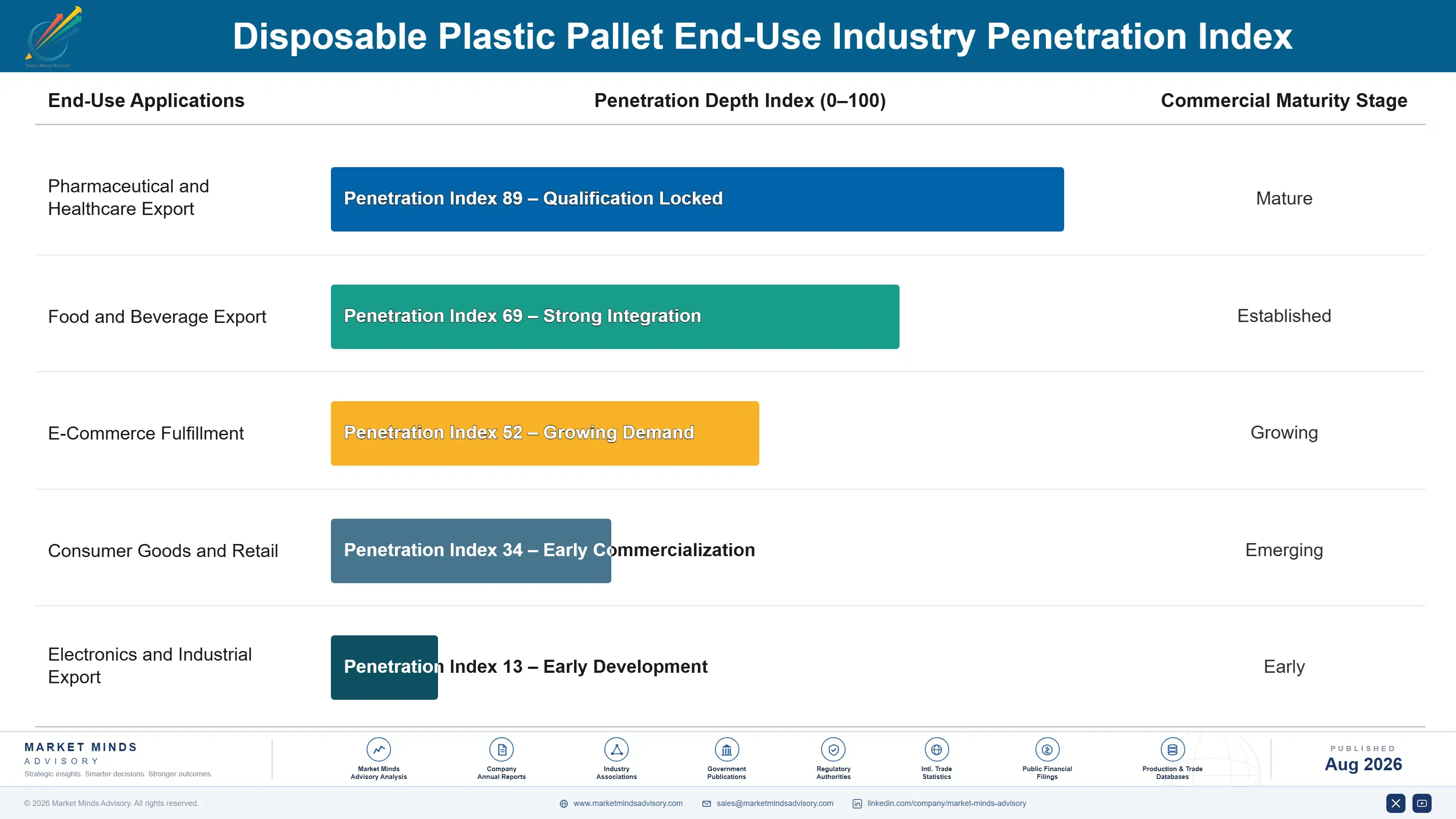
Demand here behaves nothing like an annuity, since a disposable pallet is consumed on a single shipment and generates no recurring relationship the way a pooled rental program does. A manufacturer must win a fresh purchasing decision on every order cycle, which keeps volume growth tightly linked to underlying freight, export, and e-commerce activity rather than to any installed base or contract renewal, unlike most industrial equipment categories this report otherwise covers.
Adoption depth varies sharply by end-use vertical. Pharmaceutical and food exporters requalify suppliers rarely once a hygiene documentation relationship is established, since switching means re-certifying an entire traceability chain with customs and quality authorities. E-commerce fulfillment operators, by contrast, treat pallets as a pure commodity purchase and switch suppliers readily based on price and availability, giving them real negotiating leverage manufacturers cannot easily counter with product differentiation alone.

Buyer profiles are shifting generationally too. A newer cohort of packaging and sustainability leaders, trained under mounting brand owner recycled-content mandates, now weighs a supplier's certification depth and documentation capability as heavily as unit price, a shift that favors manufacturers with genuine recycling infrastructure over commodity producers competing purely on cost.
disposable-plastic-pallet-market-end-use-penetration-index-1787300347917

What Shippers Will Pay For Next

These are among the four positions where our research anticipates prominent divergence between winners and laggards over the coming forecast period. Each is grounded in the demand model, the regulatory perimeter, and the announced capacity pipeline.
01 / CERTIFICATION DATA PREMIUM

Verified recycled content will separate winners from commodity producers

Manufacturers with third-party verified recycled-content certification will keep winning brand owner contracts regardless of price, because sustainability teams increasingly need auditable data to report against their own corporate targets rather than accept self-reported claims. Manufacturers without that certification depth will increasingly compete only on commoditized price against lower-cost regional producers who lack the same documentation infrastructure. Expect continued investment in reprocessing and testing capacity as commodity producers race to close the certification gap before it becomes a permanent competitive disadvantage.
02 / ASIAN EXPORT SCALE

East Asia's share keeps growing as China scales export packaging

East Asia already holds the largest regional share at 28% and grows near the top of its band as China's export packaging volume and domestic e-commerce fulfillment growth pull deployment east at real, sustained scale year after year. Regional manufacturers are closing the certification gap with Western incumbents faster than most industry observers expected just a few years ago. Multinationals that fail to build direct regional manufacturing presence risk losing the single largest volume opportunity in the entire global market.
03 / HYGIENE DOCUMENTATION CAPTURE

Traceability services will command real premium in pharma lanes

Pharmaceutical and food export lanes increasingly treat batch-level hygiene documentation as part of the product rather than a separate service, and manufacturers who bundle traceability capability will capture premium pricing that commodity competitors simply cannot match without building the same infrastructure themselves from scratch first. The approach commands genuine margin precisely because it removes compliance risk exporters would otherwise bear internally with dedicated staff. Expect documentation-as-a-service to become a standard offering across the top manufacturer tier within the forecast window.
04 / WEIGHT ENGINEERING PRESSURE

Lightweight design will keep eroding the wood pallet cost gap

Freight cost, not raw material price, remains the binding constraint on plastic pallet adoption over wood on long-haul lanes, and manufacturers who close that weight gap through engineering investment will keep capturing share that price alone cannot win over time. That pressure will keep building as freight costs continue rising faster than resin costs across most major shipping lanes. Expect manufacturers who resist weight-engineering investment to lose ground steadily to competitors who treat it as core to their commercial position.

Engagement Snapshot From the Field

A live engagement with an industry participant carrying material or product regulatory and market exposure ahead of a defining policy shift, showing how our research translates into a defensible multi-year portfolio strategy.
MARKET MINDS ADVISORY · CLIENT ENGAGEMENT SUMMARY
Disposable Plastic Pallet Producer Strategic Portfolio Review and Transition Roadmap 2026·Investment Scenario on Disposable Plastic Pallet Exposure Evaluation 2025-26
CLIENT PROFILE
A generic pharmaceutical manufacturer exporting temperature-sensitive products from India to the United States and European Union approached MMA while evaluating a shift from pooled wood pallets to single-use plastic pallets across its cold-chain shipping network. The client reported annual export revenue near USD 340 million, with several recent shipments facing customs delays tied to pallet documentation gaps (client-reported, unverified by MMA).
STRATEGIC CHALLENGE
Management knew hygiene documentation gaps were causing real customs delays but faced uncertainty over whether converting the entire pallet fleet was necessary or whether targeted conversion on the highest-risk lanes would suffice. The logistics team wanted full conversion immediately; the finance team worried about the capital cost; and the compliance officer needed a plan that would satisfy both American and European customs authorities.
MMA APPROACH
MMA benchmarked customs delay incidents against pallet type across the client's shipping lanes, modeled the cost of full-fleet conversion against a phased approach targeting only the highest-risk pharmaceutical export lanes first, and quantified the customs delay cost the client was already absorbing under the current pooled wood pallet system. We also assessed three vendor options on documentation capability and total delivered cost.
KEY FINDINGS
  1. Customs delays tied specifically to pallet documentation gaps cost the client an estimated USD 1.8 million in expedited freight and spoilage over the prior twelve months (client-reported, unverified by MMA).
  2. A phased conversion covering only the three highest-volume export lanes would address roughly 70% of documented customs delay incidents without the cost of full-fleet conversion.
  3. Only one of three vendors evaluated offered integrated batch-level traceability tagging mature enough to satisfy both American and European customs documentation requirements simultaneously.
  4. Full-fleet conversion would have cost meaningfully more than the phased approach while addressing incidents that phased conversion already resolved for the highest-risk lanes.
CLIENT PROFILE
A generic pharmaceutical manufacturer exporting temperature-sensitive products from India to the United States and European Union approached MMA while evaluating a shift from pooled wood pallets to single-use plastic pallets across its cold-chain shipping network. The client reported annual export revenue near USD 340 million, with several recent shipments facing customs delays tied to pallet documentation gaps (client-reported, unverified by MMA).
STRATEGIC CHALLENGE
Management knew hygiene documentation gaps were causing real customs delays but faced uncertainty over whether converting the entire pallet fleet was necessary or whether targeted conversion on the highest-risk lanes would suffice. The logistics team wanted full conversion immediately; the finance team worried about the capital cost; and the compliance officer needed a plan that would satisfy both American and European customs authorities.
MMA APPROACH
MMA benchmarked customs delay incidents against pallet type across the client's shipping lanes, modeled the cost of full-fleet conversion against a phased approach targeting only the highest-risk pharmaceutical export lanes first, and quantified the customs delay cost the client was already absorbing under the current pooled wood pallet system. We also assessed three vendor options on documentation capability and total delivered cost.
KEY FINDINGS
  1. Customs delays tied specifically to pallet documentation gaps cost the client an estimated USD 1.8 million in expedited freight and spoilage over the prior twelve months (client-reported, unverified by MMA).
  2. A phased conversion covering only the three highest-volume export lanes would address roughly 70% of documented customs delay incidents without the cost of full-fleet conversion.
  3. Only one of three vendors evaluated offered integrated batch-level traceability tagging mature enough to satisfy both American and European customs documentation requirements simultaneously.
  4. Full-fleet conversion would have cost meaningfully more than the phased approach while addressing incidents that phased conversion already resolved for the highest-risk lanes.
RECOMMENDED STRATEGY
Phase 1: Phase 1 (0 to 4 months): Convert the three highest-volume export lanes to certified hygienic single-use plastic pallets with integrated traceability tagging. Phase 2: Phase 2 (4 to 10 months): Monitor customs clearance times and documentation acceptance rates against the phased conversion before expanding further. Phase 3: Phase 3 (10 to 18 months): Extend conversion to remaining export lanes only if phased results confirm the customs delay reduction holds at scale.
OUTCOME
The client converted its three highest-volume lanes within five months and saw customs delay incidents fall by a reported 68% within the first two quarters, ahead of the modeled target. The client approved conversion of remaining export lanes, a program reported to be worth roughly USD 2.4 million in avoided customs and spoilage cost annually (client-reported, unverified by MMA).

Frequently Asked Questions

Foundational context covering the market sizes, CAGR, scope, country, region and competition that inform every finding below. This section is provided to cover basics and most often pre-purchase conversations, answered from the MMA Primary Research Dataset.

What is the current size of the Disposable Plastic Pallet Market?

The market stood at USD 3.6 billion in 2025, spanning HDPE, polypropylene, corrugated, and recycled resin formats. Recycled and reprocessed resin pallets are the fastest-growing segment within that base.

How large will the Disposable Plastic Pallet Market be by 2036?

The market is projected to reach USD 7.1 billion by 2036 under the base case scenario. That represents roughly 1.87 times the 2026 value of USD 3.8 billion.

What is the CAGR for the Disposable Plastic Pallet Market 2026 to 2036?

The base case CAGR is 6.4% annually through 2036. The bull case reaches 7.6% on faster recycled resin scaling, while the bear case falls to 5.2%.

Which segment is growing fastest?

Recycled and reprocessed resin pallets grow fastest at 9.5% annually, well ahead of virgin material formats. That is roughly 1.48 times the overall market growth rate.

Who are the major companies in the Disposable Plastic Pallet Market?

ORBIS Corporation, Schoeller Allibert Group, Cabka Group, Rehrig Pacific Company, and Buckhorn Inc. lead the market on a consistent basis of disclosed disposable pallet segment revenue across regions.

Which country is growing fastest?

India grows fastest among all countries at 10.8% annually, ahead of China and other major export economies. Growth is driven by pharmaceutical export hygiene certification requirements.

Report Segmentation Architecture

The full report scope spans multiple orthogonal segmentation dimensions, with cross-tabulated demand data provided for each dimension pair. Coverage extends further to regional breakdowns, trend trajectories, and the competitive detail needed to support segment-level decision-making.

By Resin and Construction Type

  • Virgin HDPE Pallets
  • Virgin Polypropylene Pallets
  • Recycled/Reprocessed Resin Pallets
  • Corrugated Plastic (Twin-Wall) Pallets
  • Expanded Polypropylene (EPP) Foam Pallets
  • Polystyrene and Other Engineered Pallets

By End-Use Industry

  • Pharmaceutical and Healthcare Export
  • Food and Beverage Export
  • E-Commerce Fulfillment
  • Consumer Goods and Retail
  • Electronics and Industrial Export

By Commercial Dimension

  • Direct Shipper Procurement
  • Distributor and Reseller Channel
  • Contract Packaging Integration
  • Take-Back and Closed-Loop Programs

By Region

  • North America
  • Western Europe
  • East Asia
  • South Asia and Pacific
  • Latin America
  • Middle East and Africa
  • Eastern Europe

Scope, Methodology, and Coverage

Every figure in this report is reproducible from documented input assumptions. The scope below maps the historical period, the forecast horizon, the segmentation dimensions, and the countries covered, alongside the underlying primary and qualitative methodology.
Historical Period
2020 to 2025
Forecast Period
2026 to 2036
Base Year
2025 (USD billions; MMA Primary Research Dataset, August 2026)
Market Definition
The disposable plastic pallet market covers single-use, one-way plastic pallets sold for a single outbound shipment rather than returned and reused across multiple trips. It includes pallets molded from virgin and recycled thermoplastic resins, corrugated plastic sheet pallets, and expanded polypropylene foam pallets sold to shippers as a consumable logistics input. Pooled, rental, and multi-trip reusable pallet programs, along with wood and metal pallets, are excluded.
Quantitative Units
USD billions (current prices); million pallet units shipped where applicable
Segmentation Dimensions
By Resin and Construction Type; By End-Use Industry; By Commercial Dimension; By Region
Regions Covered
North America, Western Europe, East Asia, South Asia and Pacific, Latin America, Middle East and Africa, Eastern Europe
Countries Covered
USA, China, Germany, France, UK, Japan, South Korea, India, Australia, Canada, Brazil, Mexico, Indonesia, Vietnam, Thailand, Malaysia, UAE, Saudi Arabia, South Africa, Nigeria, Turkey, Poland, Netherlands, Italy, Spain, Sweden, Switzerland, Argentina, Colombia, Singapore, and additional markets relevant to this sector
Key Companies Profiled
ORBIS Corporation, Schoeller Allibert Group, Cabka Group, Rehrig Pacific Company, Buckhorn Inc., Nefab Group, Craemer GmbH, Polymer Solutions International Inc., DS Smith Plastics, Loscam Limited, Litco International Inc., Menasha Corporation, Perstorp Group, Georg Utz Holding AG, TranPak Inc., Falkenhahn AG, IFCO Systems N.V., Greystone Logistics Inc., Jifram Extrusions Inc., PGS International B.V.
Quantitative Methodology
Primary survey, n=3,800 respondents, Q4 2025, six countries; demand-side model with trade association cross-validation
Qualitative Methodology
47 expert interviews, Q4 2025; applied to validate demand model assumptions, identify emerging dynamics, and assess competitive positioning
Report Format
PDF and XLSX data workbook (Word format preview document)
Publisher
Market Minds Advisory
Report Code
MMA-2026-PAC-119
Published
August 2026
Contact
sales@marketmindsadvisory.com | www.marketmindsadvisory.com

Purchase the full Disposable Plastic Pallet Market Report (2026 to 2036).

The full MMA Disposable Plastic Pallet report sizes the market across six resin and construction types, five end-use industries, four commercial models, and seven regions through 2036. It profiles 20 manufacturers on a consistent basis of disclosed disposable pallet segment revenue, scoring each on certification depth, regional manufacturing footprint, and recycled-content capability. Scenario models quantify how brand owner sustainability mandates, pharmaceutical export hygiene regulation, and resin price volatility move both demand and realizable pricing. The report also includes delivered-cost modeling by construction type, a certification and traceability comparison across major export markets, and a take-back program feasibility framework built for packaging strategy, procurement, and export compliance teams.
Six-format segmentation with cross-tabulated regional demand data
Twenty-company competitive benchmarking on consistent revenue basis
Certification and traceability comparison across major export markets
Resin cost and volatility exposure modeling by construction type
Scenario forecasts through 2036 under bull and bear cases
Case study on hygienic packaging conversion and traceability

Built For The People Who Decide

From boardroom strategy to bench-side execution, this report is read cover-to-cover by leaders shaping the next decade of their industry, turning demand scenarios, market dynamics and valuation benchmarks into decisions.
CXOs/ Presidents/ VPs/ Managers
M&A and Corporate Development
Strategy Teams and R&D Heads
Procurement and Product Directors
Regulatory and Compliance Leaders
Investor Relations and Equity Analysts