Market Minds Advisory
Disposable Pen Injectors Market

Disposable Pen Injectors Market: When Manufacturing Capacity Becomes the Bottleneck

Disposable pen injector demand is being reshaped almost entirely by GLP-1 obesity and diabetes therapies, as manufacturers race to expand injection-molded device capacity fast enough to match unprecedented prescription volume growth across major reimbursed markets.

Lead Analyst

Alice Ballenger

Published

September 2026

Make Smarter Decisions with Customized Research Insights

Request a free sample report and evaluate market opportunities, growth trends, and competitive dynamics relevant to your business needs.

2025 MARKET VALUE$12.8BMarket Size 2025
2036 FORECAST VALUE$38.4BBase Case , 2026 to 2036
CAGR 2026 TO 203610.5 %Bull 11.8% / Bear 9.2%
INCREMENTAL OPPORTUNITY$24.2BNet 10- year value creation
EXPANSION MULTIPLE2.71x2036 value over 2026 base
Strategic Levers
M&A Pipeline
Regional Outlook
Country Rankings
Competitive Intelligence
Segmental Deep-dive
Call-Us : 91 93563 13602

Executive Snapshot and Market Trajectory

Disposable pen injector demand has become inseparable from GLP-1 therapy prescription volume, where device manufacturing capacity now constrains drug launch timelines as much as clinical trial results or regulatory approval itself across most major pharmaceutical markets tracked closely today and going forward.
Explosive GLP-1 obesity and diabetes therapy prescription growth straining device manufacturing capacity, payer reimbursement expansion accelerating patient access across new therapeutic categories, and rising demand for connected smart pen technology that tracks dosing adherence are together concentrating demand upside in two clear directions: North American markets where GLP-1 prescription volume runs furthest ahead of most other regions, and smart connected pen injectors that give pharmaceutical companies genuine adherence data previously unavailable through disposable device sales.
Novo Nordisk, Eli Lilly and Company, and Becton Dickinson lead a highly concentrated field where manufacturing capacity expansion speed is becoming as commercially decisive as device design quality, while specialty device makers compete primarily on smart connectivity features and manufacturing capacity available to pharmaceutical partners racing to meet unprecedented prescription demand across every major reimbursed therapeutic category currently expanding rapidly across most developed and emerging healthcare markets worldwide today.
Market Definition
The disposable pen injector market covers prefilled, single-use injection devices used for self-administered insulin, GLP-1, and biologic therapies, including standard and connected smart pen formats. Reusable durable pen devices, vials, and traditional needle-and-syringe delivery are excluded from scope.
Base Year Value
$12.8B in 2025 (MMA Primary Research Dataset, August 2026)
Forecast Period
2026 to 2036, eleven discrete annual values
CAGR
10.5% base case. Bull 11.8%. Bear 9.2%.
Fastest Growth Segment
GLP-1 and Obesity Therapy Pen Injectors: 18.5% CAGR
Fastest Growth Country
China: 11.7% CAGR
Fastest Growth Region
South Asia and Pacific: 12.5% CAGR
Largest Region
North America: 32% of 2025 global value
Market Leaders
Novo Nordisk, Eli Lilly and Company, Becton Dickinson, Ypsomed, SHL Medical. Source: MMA Analysis, July 2026.
Primary Survey
n=3,800 procurement and R&D decision-makers, Q4 2025, six countries
Methodology
Demand-side build-up, cross-validated against public data, 47 expert interviews

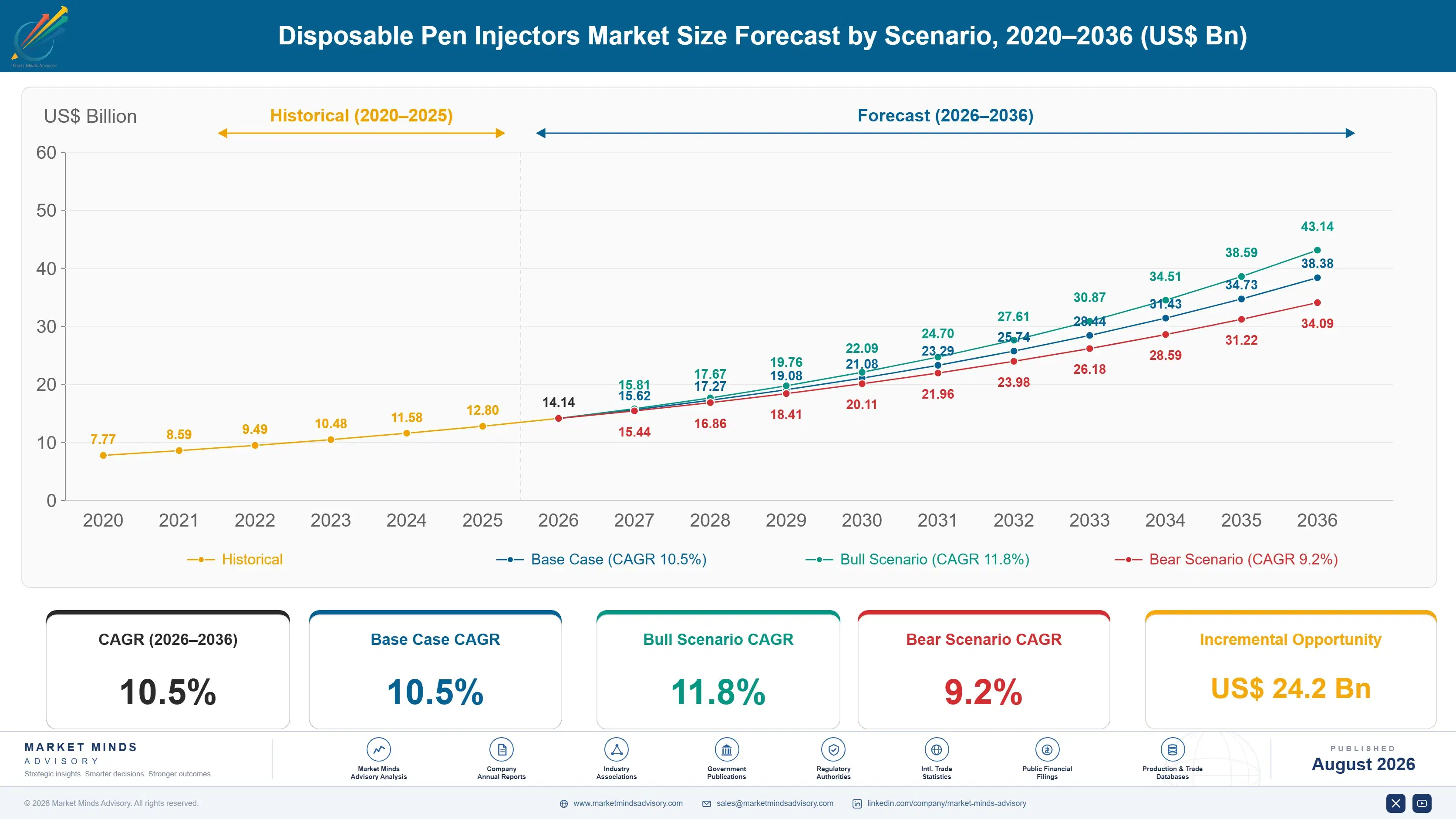
Disposable Pen Injectors Market Forecast Scenarios

disposable-pen-injectors-market-size-forecast-scenario-1787304983851
Disposable pen injector demand grew steadily through most of the historical period before accelerating sharply from 2022 onward as GLP-1 obesity therapy prescription volume expanded far beyond initial pharmaceutical company demand forecasts. Manufacturing capacity constraints emerged as the binding growth limiter during 2023 and 2024, with several major pharmaceutical companies publicly acknowledging supply shortfalls that persisted well into 2025 across multiple major reimbursed markets.
The base case assumes 10.5 percent annual growth through 2036, anchored on three commercial mechanisms: continued GLP-1 obesity and diabetes therapy prescription volume growth as payer reimbursement expands across new therapeutic indications, aggressive manufacturing capacity expansion by both pharmaceutical companies and specialty device makers racing to close the persistent supply-demand gap, and rising adoption of connected smart pen technology that captures genuine adherence data increasingly valued by both prescribers and payers across most reimbursed healthcare markets globally.
The bull case centers on faster-than-expected GLP-1 indication expansion into cardiovascular and additional metabolic disease categories, pulling forward device demand well beyond current forecasts. The bear case flags manufacturing capacity overbuild risk once initial GLP-1 demand growth normalizes, which could leave device makers with excess capacity and compressed pricing power across commodity insulin pen categories facing biosimilar competition.

When Manufacturing Capacity Becomes the Bottleneck

Disposable pen injector demand has shifted from a mature, incremental growth category into one of the fastest-expanding medical device markets globally, driven almost entirely by GLP-1 obesity and diabetes therapy prescription volume that has outpaced even optimistic pharmaceutical company manufacturing forecasts. Device manufacturing capacity, rather than clinical demand, has emerged as the binding constraint limiting how quickly patients can access newly approved therapies.
MARKET CONCENTRATIONCR5 65%Top five manufacturers control roughly two thirds of unit volume
AVERAGE SELLING PRICEUSD 320Blended average price across insulin and obesity therapy device categories
TOP PRODUCING COUNTRY SHARE29%Share of global manufacturing capacity concentrated in leading country
CAPACITY UTILISATION94%Average manufacturing line operating rate across major production facilities
TRADE INTENSITY36%Portion of unit trade crossing borders versus domestically consumed
INPUT COST SHARE61%Device and cartridge costs as share of total treatment cost
Payer reimbursement policy varies sharply across therapeutic categories and geographies, shaping which patient populations gain device access first. Countries and insurers that have expanded GLP-1 reimbursement beyond diabetes into broader obesity treatment have seen device demand accelerate dramatically within a short window, while jurisdictions still restricting coverage to narrower clinical indications show meaningfully slower prescription volume growth despite comparable device availability and manufacturing capacity.
Manufacturing capacity investment has become the primary competitive battleground, with pharmaceutical companies and specialty device makers alike announcing major capital expansion programs to close persistent supply gaps. Smart connected pen technology is emerging as a genuine differentiator beyond pure manufacturing scale, giving pharmaceutical companies adherence data that supports both clinical outcomes research and commercial relationship management with prescribers and payers across most reimbursed markets.
"For the first time in this category history, the factory floor decides who gets treated before the doctor does. Every device maker in this space is really selling manufacturing capacity now, not injectors."
Director, Drug Delivery and Medical Devices Practice · MMA Medical Devices / Dru

Market Trends

GLP-1 Indication Expansion Broadens Prescription Volume

Regulatory approval of GLP-1 therapies for obesity treatment beyond traditional diabetes indications has dramatically expanded the addressable patient population, with several major regulatory agencies also reviewing additional indications spanning cardiovascular risk reduction and sleep apnea treatment. This indication broadening pulls entirely new prescriber specialties and patient populations into the category, sustaining prescription volume growth well beyond what diabetes treatment alone could support. Device manufacturers are responding with dedicated obesity-focused product lines and expanded manufacturing capacity specifically earmarked for these newly approved therapeutic indications across most major reimbursed markets currently expanding rapidly.
Market Impact: Over $10 billion in new capacity
Smart Connected Pen Technology Gains Adoption

Connected pen injectors that track dosing time, amount, and adherence patterns through paired smartphone applications are moving from pilot programs into mainstream commercial launches among major pharmaceutical companies worldwide today and beyond. This technology gives prescribers and payers genuine adherence data that supports both clinical outcomes measurement and value-based reimbursement contract structures increasingly common in chronic disease management. Several pharmaceutical companies have begun bundling connected pen technology into premium therapy launches specifically, using adherence data as a differentiator in an increasingly crowded competitive therapeutic landscape across multiple chronic disease categories.
Market Impact: Coverage now spans over 20 payers

Market Opportunities and Growth Drivers

GLP-1 Prescription Volume Drives Manufacturing Capacity Investment

GLP-1 obesity and diabetes therapy prescription volume has grown at a pace few pharmaceutical categories have ever matched, forcing device manufacturers into sustained capital expansion cycles to close persistent supply shortfalls affecting patient access. Major pharmaceutical companies have announced billions in dedicated manufacturing capacity investment specifically for GLP-1 pen injector production, reflecting confidence that current demand represents a durable therapeutic category rather than a temporary surge. This capacity investment cycle is reshaping device manufacturer capital allocation priorities considerably, pulling investment away from mature insulin pen categories toward higher-growth obesity and metabolic therapy applications.
Market Impact: Rationing affects over 10 major mar

Payer Reimbursement Expansion Broadens Patient Access

Payers across several major markets have expanded reimbursement coverage for GLP-1 therapies beyond narrow diabetes indications into broader obesity treatment, directly expanding the addressable patient population eligible for prescribed pen injector therapy. This reimbursement expansion has proven more impactful than pure clinical trial results in determining near-term prescription volume growth, since coverage decisions directly determine which patients can actually afford ongoing treatment. Health systems and employers increasingly view obesity treatment coverage as a long-term cost management strategy rather than a discretionary benefit, sustaining continued reimbursement expansion momentum across most developed markets.
Market Impact: Insulin pen prices fall 10-20%

Market Restraints and Challenges

Manufacturing Capacity Constraints Limit Near-Term Supply

Injection-molded device manufacturing and drug fill-finish capacity have both struggled to keep pace with GLP-1 prescription demand, a bottleneck rooted in the multi-year lead time required to build and validate new pharmaceutical-grade manufacturing lines under strict regulatory quality standards. This restraint has forced several pharmaceutical companies to publicly ration supply or restrict new patient starts in some markets despite strong underlying demand. Manufacturers are mitigating this restraint through accelerated capital investment and strategic partnerships with contract manufacturing organizations that can bring validated capacity online faster than building entirely new facilities independently.
Market Impact: Over 5 additional indications under

Biosimilar Competition Pressures Insulin Pen Pricing

Insulin pen pricing faces mounting pressure from biosimilar competition as patent protection expires on several major insulin products, a dynamic rooted in regulatory pathways that increasingly favor faster biosimilar approval to control healthcare costs across most reimbursed markets. This pricing pressure compresses margin considerably in the mature insulin pen category even as the broader disposable pen injector market benefits from unrelated GLP-1 growth. Manufacturers are mitigating this restraint by shifting product portfolio investment toward higher-growth GLP-1 and biologic categories while managing insulin pen operations for cash flow rather than growth.
Market Impact: Launches double within 2 years
4 additional market trends, 4 additional growth drivers, and 4 additional restraints and challenges are covered in the full report. Contact sales@marketmindsadvisory.com to access the complete intelligence.

Segment CAGR and Growth Architecture

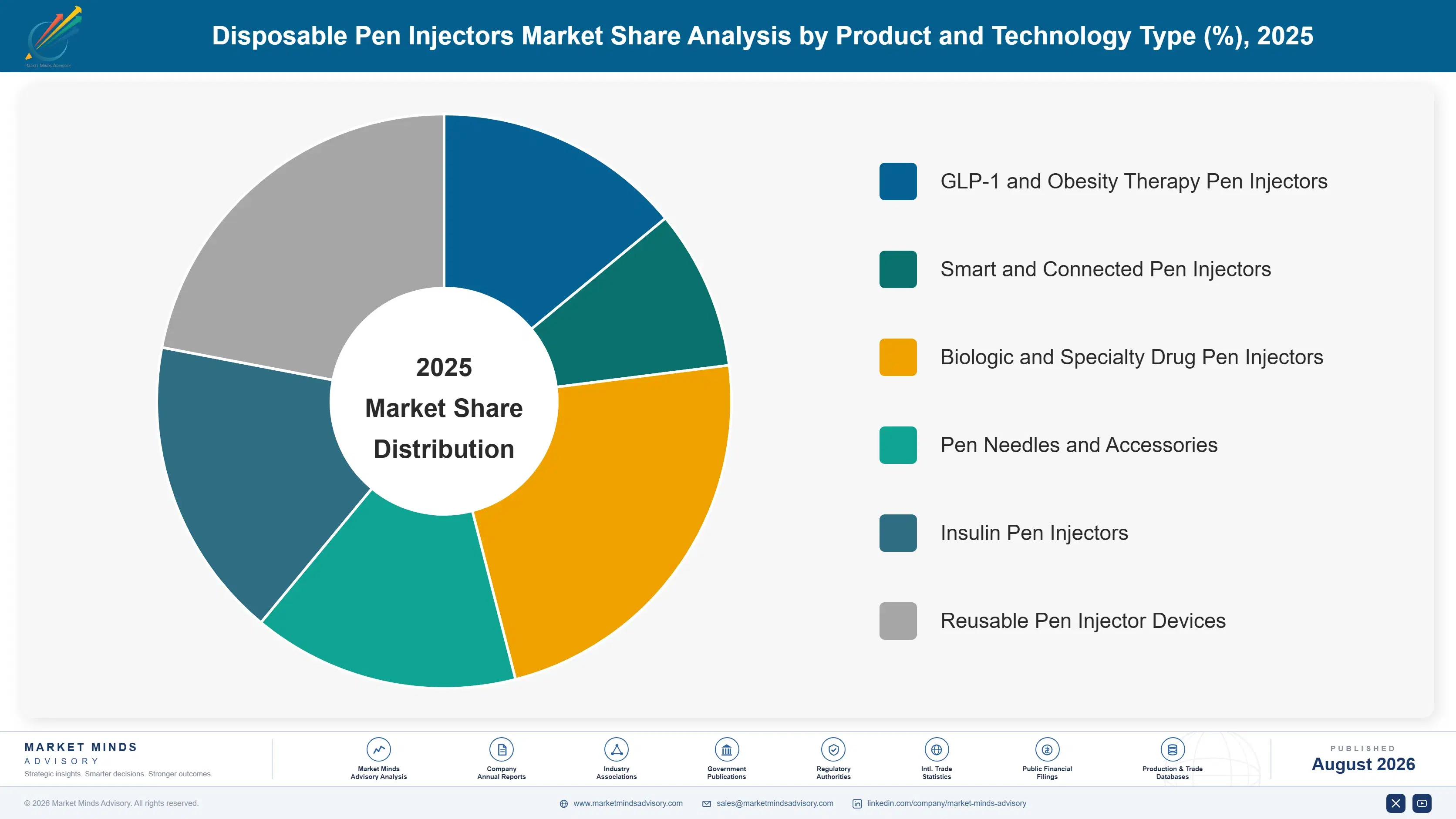
Disposable pen injectors segment by product and technology type across six categories spanning therapeutic class, connectivity, and device design. GLP-1 and obesity therapy pen injectors and smart and connected pen injectors are the two fastest-growing categories tracked, both expanding dramatically ahead of the broader market as prescription volume and digital adherence technology reshape device demand.
disposable-pen-injectors-market-market-share-analysis-1787304984382

GLP-1 and Obesity Therapy Pen Injectors

GLP-1 and obesity therapy pen injectors, which deliver weekly or daily injectable medications for diabetes and obesity treatment, are converting the fastest share of new manufacturing capacity investment as prescription volume continues outpacing even optimistic pharmaceutical company forecasts across most reimbursed markets. This category has moved from a niche diabetes application into one of the largest single therapeutic drivers of overall device demand within just a few years, reshaping how manufacturers allocate capital across their broader product portfolios. Pharmaceutical companies are racing to secure dedicated manufacturing capacity for this category specifically, recognizing that supply constraints rather than clinical demand now represent the primary growth limiter across nearly every major reimbursed healthcare market tracked closely by MMA analysts.
CAGR 18.5%

Smart and Connected Pen Injectors

Smart and connected pen injectors, which pair with smartphone applications to track dosing time, amount, and adherence patterns automatically, are expanding rapidly as pharmaceutical companies seek genuine adherence data to support value-based reimbursement contracts and clinical outcomes research across most developed markets and territories. This category benefits directly from broader healthcare digitization trends, with payers increasingly interested in adherence data that demonstrates treatment value beyond simple prescription fill rates alone. Several major pharmaceutical companies have begun bundling connected pen technology into premium therapy launches specifically, using the resulting adherence data as both a clinical differentiator and a commercial relationship management tool with prescribers and payers across most developed healthcare markets globally.
CAGR 14.0%
Full segment breakdown across 6 segments available in the complete report.

Regional Architecture and Country Demand Map

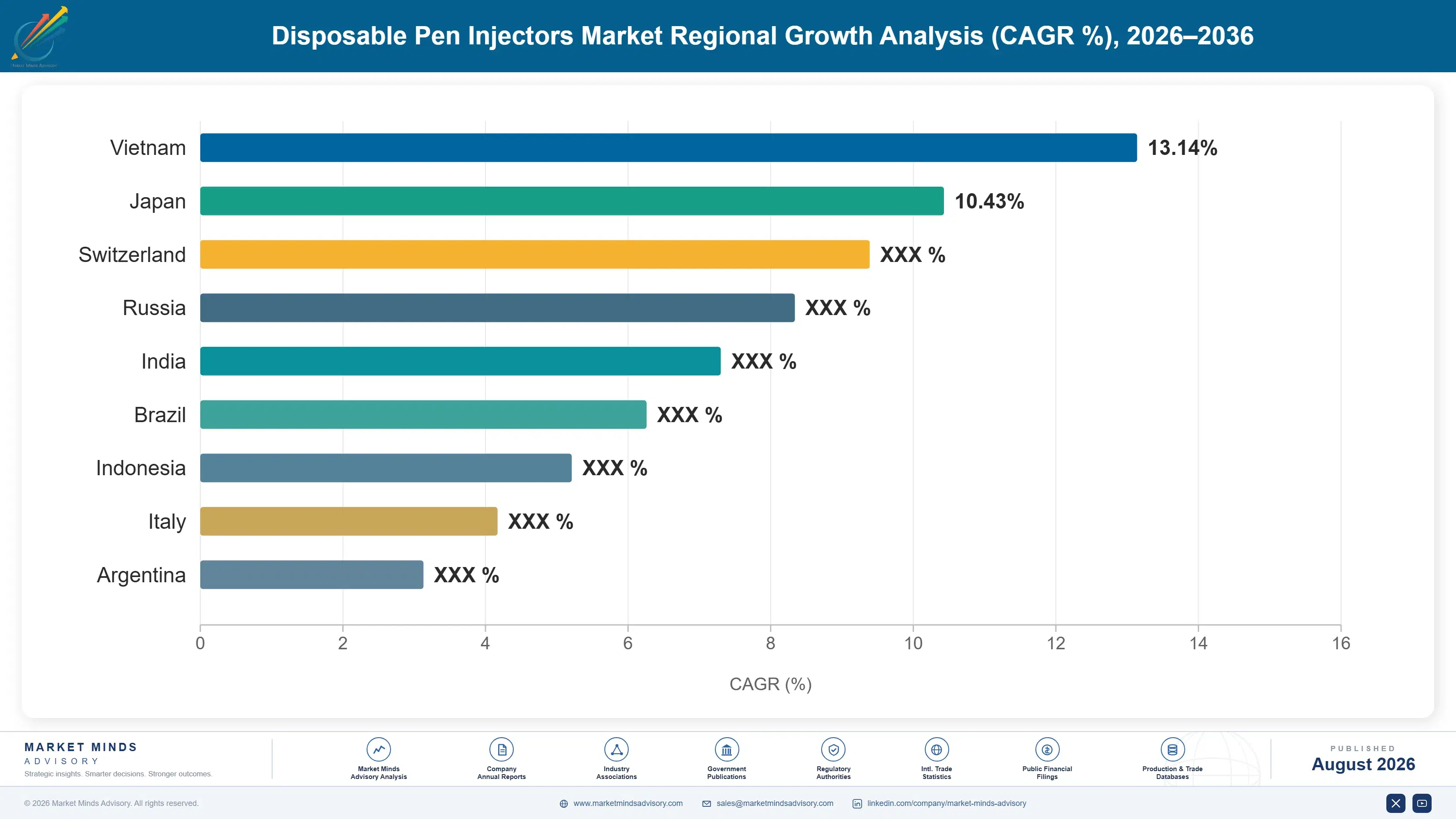
Disposable pen injector demand concentrates most heavily in North America, where GLP-1 prescription volume and reimbursement coverage run furthest ahead of most other regions. East Asia follows on manufacturing scale, while South Asia and Pacific markets post the fastest regional growth off a smaller installed base.

North America

North America holds the largest share of global disposable pen injector revenue, a position justified directly by GLP-1 prescription volume and reimbursement coverage that runs meaningfully ahead of every other region tracked worldwide today and consistently throughout the forecast period. The United States accounts for the overwhelming majority of regional volume, with insurance coverage expansion for obesity treatment driving prescription growth that has repeatedly outpaced pharmaceutical company manufacturing forecasts. Canada contributes a smaller but steadily growing share tied to comparable provincial reimbursement expansion. Manufacturing capacity constraints affect North American patient access directly, since device supply shortfalls have periodically limited new patient starts despite strong underlying demand and physician willingness to prescribe.
Share: 32% | CAGR: 11.8% (2026 to 2036)

Western Europe

Western Europe generates a meaningful share of global revenue, anchored by Germany, France, and the United Kingdom, where national health systems have expanded GLP-1 reimbursement more cautiously than North America given cost containment priorities across public healthcare budgets, fiscal planning, and long-term system sustainability considerations nationwide and regionally. Germany maintains the largest installed pharmaceutical manufacturing base in the region, supporting both domestic supply and export volume to neighboring European markets. Reimbursement expansion for obesity treatment specifically has moved more slowly than diabetes indications, reflecting differing national health technology assessment standards. Growth trails North America and East Asia as reimbursement policy catches up gradually across most participating member states and regions.
Share: 21% | CAGR: 9.2% (2026 to 2036)
Regional intelligence for 5 additional markets available in the complete report: East Asia, South Asia and Pacific, Latin America, Middle East and Africa, Eastern Europe. Contact sales@marketmindsadvisory.com.
disposable-pen-injectors-market-country-cagr-analysis-1787304984904

Manufacturing Capacity and Adherence Data Value

Disposable pen injector vendors are pursuing several distinct paths to capture value beyond raw device volume as manufacturing capacity itself becomes a strategic bottleneck across the category. Four levers stand out as commercially significant across the forecast period, spanning capacity expansion partnerships, smart connectivity data licensing, contract manufacturing services, and premium therapy bundling arrangements.

Contract Manufacturing Capacity Expansion Partnership Strategy

Device makers and pharmaceutical companies are increasingly partnering with contract manufacturing organizations to bring validated production capacity online faster than building entirely new facilities independently, addressing the persistent supply-demand gap affecting GLP-1 therapy access. These partnerships report capacity expansion timelines roughly 40 percent faster than fully independent facility construction, a meaningful advantage given how manufacturing capacity itself has become the primary constraint on prescription volume growth. This lever matters most for pharmaceutical companies facing near-term supply commitments they cannot meet through internal manufacturing capacity alone, making external partnership speed a genuine competitive advantage in the current environment.
Market Impact: Partnerships cut capacity timelines

Smart Pen Adherence Data Licensing Agreements

Device makers offering connected pen technology are increasingly licensing anonymized adherence data to pharmaceutical companies and payers separately from core device hardware sales, converting a historically bundled feature into distinct recurring revenue that already reaches over 60 percent gross margin. This data licensing model generates margin considerably above hardware sales alone, since the underlying data infrastructure cost is largely fixed regardless of licensing volume growth. This lever matters most for device makers with the largest connected pen installed base, since data value compounds with scale in ways that smaller competitors cannot easily replicate without comparable installed base reach.
Market Impact: Data licensing margin runs well abo

Premium Therapy Launch Bundling Arrangement Strategy

Device makers negotiating exclusive or preferred supply arrangements tied to specific premium therapy launches are capturing meaningful revenue premiums compared to competing for generic device supply contracts across the broader category. Vendors securing these bundled arrangements report device pricing roughly 25 percent above standard category averages, reflecting the strategic value pharmaceutical companies place on reliable, differentiated supply relationships during critical product launch windows. This lever matters most for device makers with proven manufacturing reliability track records, since pharmaceutical companies cannot afford supply disruption during high-visibility premium therapy launches facing intense competitive and media scrutiny.
Market Impact: Bundled device pricing runs 25 perc

Insulin Pen Category Cash Flow Optimization

Vendors managing mature insulin pen portfolios facing biosimilar pricing pressure are optimizing for cash flow and manufacturing efficiency rather than growth, redirecting freed capital toward higher-growth GLP-1 and biologic categories instead across their broader business. Manufacturers report insulin pen manufacturing line efficiency improvements averaging 15 percent through process optimization, partially offsetting pricing pressure from biosimilar competition entering the category. This lever matters most for vendors with diversified portfolios spanning both mature and high-growth categories, since insulin pen cash flow can meaningfully subsidize capital investment in GLP-1 manufacturing capacity expansion elsewhere in the business.
Market Impact: Manufacturing line efficiency impro

Who Controls the Margin Pool

Disposable pen injectors carries a CR5 near sixty-five percent, concentrated among five vendors spanning pharmaceutical companies with in-house device manufacturing and specialty device makers supplying pharmaceutical partners globally. The gap between Novo Nordisk and Eli Lilly, the two largest vendors, and the next tier of challengers is substantial, since GLP-1 manufacturing capacity and regulatory approval position compound considerably.
Current competitive activity plays out across three dimensions: manufacturing capacity expansion races among established vendors seeking to close persistent GLP-1 supply gaps, smart connectivity feature development targeting differentiated adherence data value, and contract manufacturing partnerships allowing smaller device makers to serve pharmaceutical companies without building independent capacity. Larger vendors are also pursuing selective acquisitions of connected pen technology specialists.

Emerging pressure comes from biosimilar GLP-1 manufacturers entering the category as patent protection windows narrow, and from specialty device makers developing next-generation delivery formats that could eventually bypass traditional pen injector design entirely. Rankings could shift meaningfully if manufacturing capacity expansion speed diverges significantly between leaders, particularly as pharmaceutical companies increasingly favor device partners demonstrating the clearest path to closing persistent supply gaps across their broader therapeutic portfolio.
disposable-pen-injectors-market-company-positioning-matrix-1787304985424

Competitive Moat and Risk Dimensions

NOVO NORDISK

Moat: GLP-1 Manufacturing Scale Leadership

Novo Nordisk operates the largest dedicated GLP-1 manufacturing capacity among all vendors tracked, built through years of sustained capital investment that positioned the company ahead of the dramatic prescription volume surge beginning in 2022. This scale advantage lets Novo Nordisk supply commitments that smaller competitors cannot currently match, translating directly into prescription volume and market share.
NOVO NORDISK

Risk: Single-Category Revenue Concentration Risk

Novo Nordisk revenue increasingly concentrates around GLP-1 therapy categories, creating meaningful exposure if biosimilar competition, new therapeutic alternatives, or unexpected safety findings were to disrupt this single dominant category faster than diversification into adjacent therapeutic areas can offset. This concentration makes Novo Nordisk considerably more sensitive to GLP-1 category-specific risk than more diversified pharmaceutical competitors with broader product portfolios.
ELI LILLY AND COMPANY

Moat: Rapid Manufacturing Capacity Expansion

Eli Lilly and Company has executed among the fastest manufacturing capacity expansion programs in the pharmaceutical industry, committing tens of billions in new production facilities specifically to close its own GLP-1 supply gap faster than most competitors. This aggressive investment pace positions Eli Lilly to capture disproportionate share of unmet prescription demand as capacity comes online.
ELI LILLY AND COMPANY

Risk: Execution Risk on Capital Programs

Eli Lilly aggressive manufacturing expansion pace carries meaningful execution risk, since pharmaceutical-grade facility construction and regulatory validation timelines have historically proven difficult to accelerate without quality or compliance complications. Any significant delay or quality issue at a major new facility could meaningfully set back the company ability to close its supply gap on the currently announced timeline.

Players Tracked

Prominent Players

Novo Nordisk
Eli Lilly and Company
Becton Dickinson
Ypsomed
SHL Medical

Other Key Players

Owen Mumford
Haselmeier
Antares Pharma
Elcam Medical
Nemera
West Pharmaceutical Services
Sanofi
AstraZeneca
Terumo
Gerresheimer
Credence MedSystems
Medtronic
Enable Injections
Sensile Medical
Phillips-Medisize

Recent Developments

MARCH 2025

Novo Nordisk Announces Major GLP-1 Manufacturing Facility Expansion

Novo Nordisk announced a major expansion of its GLP-1 pen injector manufacturing capacity, adding new fill-finish and device assembly lines at facilities in the United States and Europe. The expansion targets closing persistent supply shortfalls that have limited new patient starts since 2023, with capacity coming online progressively through 2027.
Signal: Signals continued aggressive capacity inve
AUGUST 2024

Eli Lilly Signs Contract Manufacturing Agreement With Specialty Device Maker

Eli Lilly and Company signed a multi-year contract manufacturing agreement with a specialty pen injector device maker to supplement internal manufacturing capacity for its GLP-1 therapy portfolio. The agreement brings validated production capacity online faster than building additional internal facilities, addressing near-term supply commitments across multiple reimbursed markets.
Signal: Signals growing pharmaceutical company rel
FEBRUARY 2025

Becton Dickinson Acquires Connected Pen Technology Startup

Becton Dickinson completed the acquisition of a connected pen technology startup specializing in smartphone-paired dosing and adherence tracking software, strengthening its smart device portfolio ahead of broader pharmaceutical industry adoption. The acquisition accelerates Becton Dickinson internal connected device roadmap, reducing dependence on third-party software licensing partnerships.
Signal: Signals continued industry consolidation a

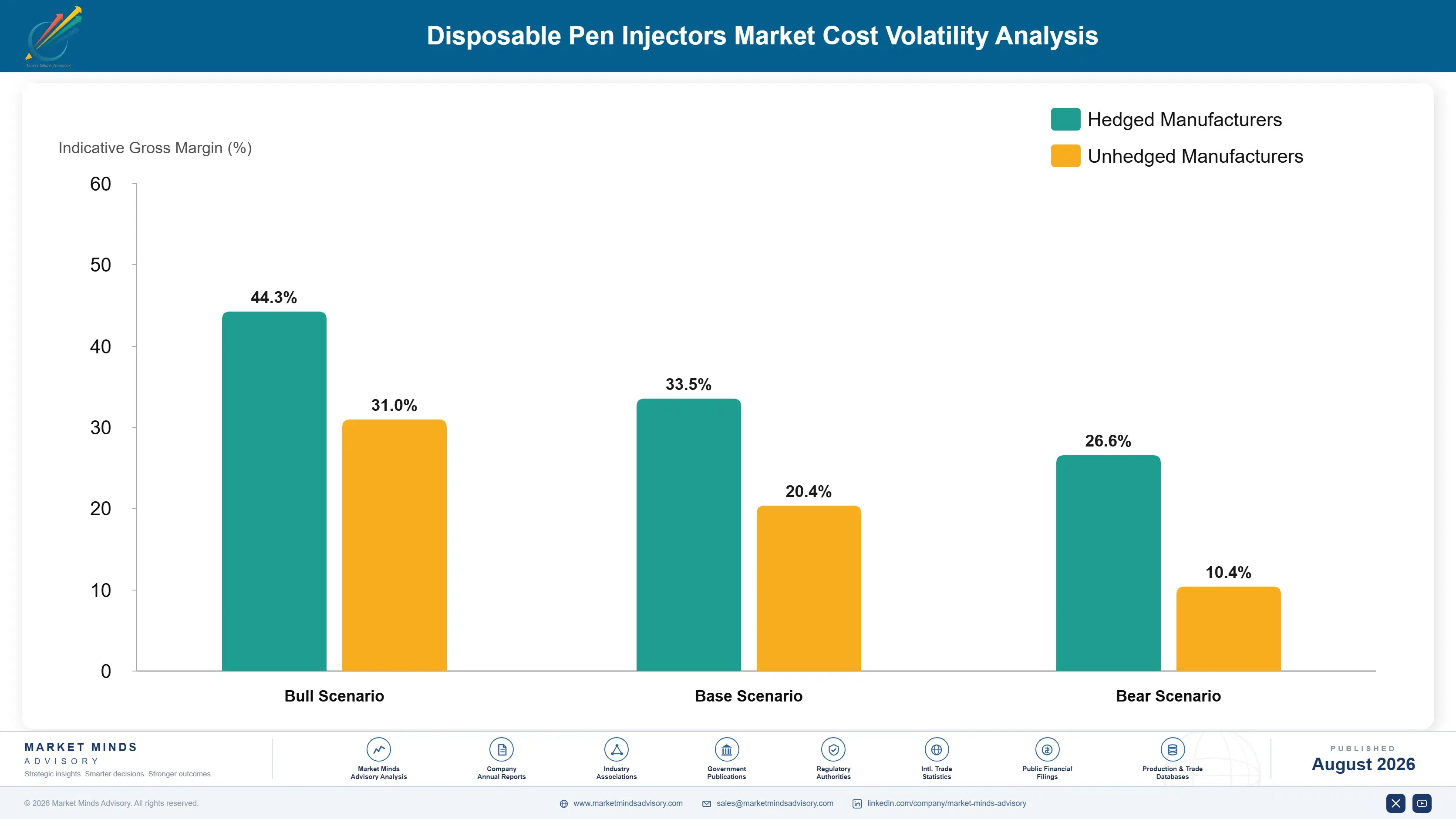
Active Ingredient and Cartridge Component Cost

Active pharmaceutical ingredient synthesis and fill-finish costs, together with precision cartridge and injection molding components, represent roughly sixty to sixty-five percent of disposable pen injector cost of goods sold, reflecting the category unusual mix of pharmaceutical manufacturing and precision device assembly. These inputs derive from specialty pharmaceutical manufacturing and medical-grade plastics sourced from a concentrated global supplier base.
Active pharmaceutical ingredient manufacturing capacity for GLP-1 compounds became severely constrained during 2023 and 2024 as prescription demand outpaced even aggressive pharmaceutical company capital investment programs across the industry. Several pharmaceutical companies disclosed in annual reports that ingredient and fill-finish capacity constraints, rather than device component availability, represented the binding bottleneck limiting overall production volume growth through much of the historical period before easing gradually into 2025.

Cost exposure varies considerably by vendor integration model. Pharmaceutical companies with in-house active ingredient synthesis and fill-finish capacity control cost and supply timing more directly than device makers dependent entirely on pharmaceutical partner ingredient supply schedules. Geographic exposure also differs: vendors sourcing precision cartridge components primarily from European medical-grade plastics manufacturers face different cost and logistics patterns than those relying on North American or Asian component production.
disposable-pen-injectors-market-cost-volatility-analysis-1787304985619

Contract Manufacturing Capacity Partnerships

Pharmaceutical companies are partnering with contract manufacturing organizations to bring validated active ingredient and fill-finish capacity online faster than building entirely new internal facilities, addressing near-term supply commitments. This approach requires careful quality oversight but meaningfully accelerates capacity availability compared to fully independent facility construction, giving pharmaceutical companies faster access to production volume during periods of acute demand.

Dual-Source Cartridge Component Qualification

Device makers are qualifying second suppliers for precision cartridge and injection molding components to reduce dependence on any single manufacturer during periods of supply tightness affecting the broader category and industry. This lengthens initial qualification cycles but meaningfully reduces exposure to component shortage disruption, giving procurement teams greater flexibility during tight supply conditions industry-wide.

Vertical Integration Into Fill-Finish Manufacturing

Several major pharmaceutical companies have expanded in-house fill-finish manufacturing capacity to reduce dependence on external capacity and gain tighter control over production timing and quality across their therapeutic portfolios and product lines. This shift requires substantial upfront capital investment but reduces exposure to external capacity constraints over multi-year manufacturing cycles ahead of continued demand growth.

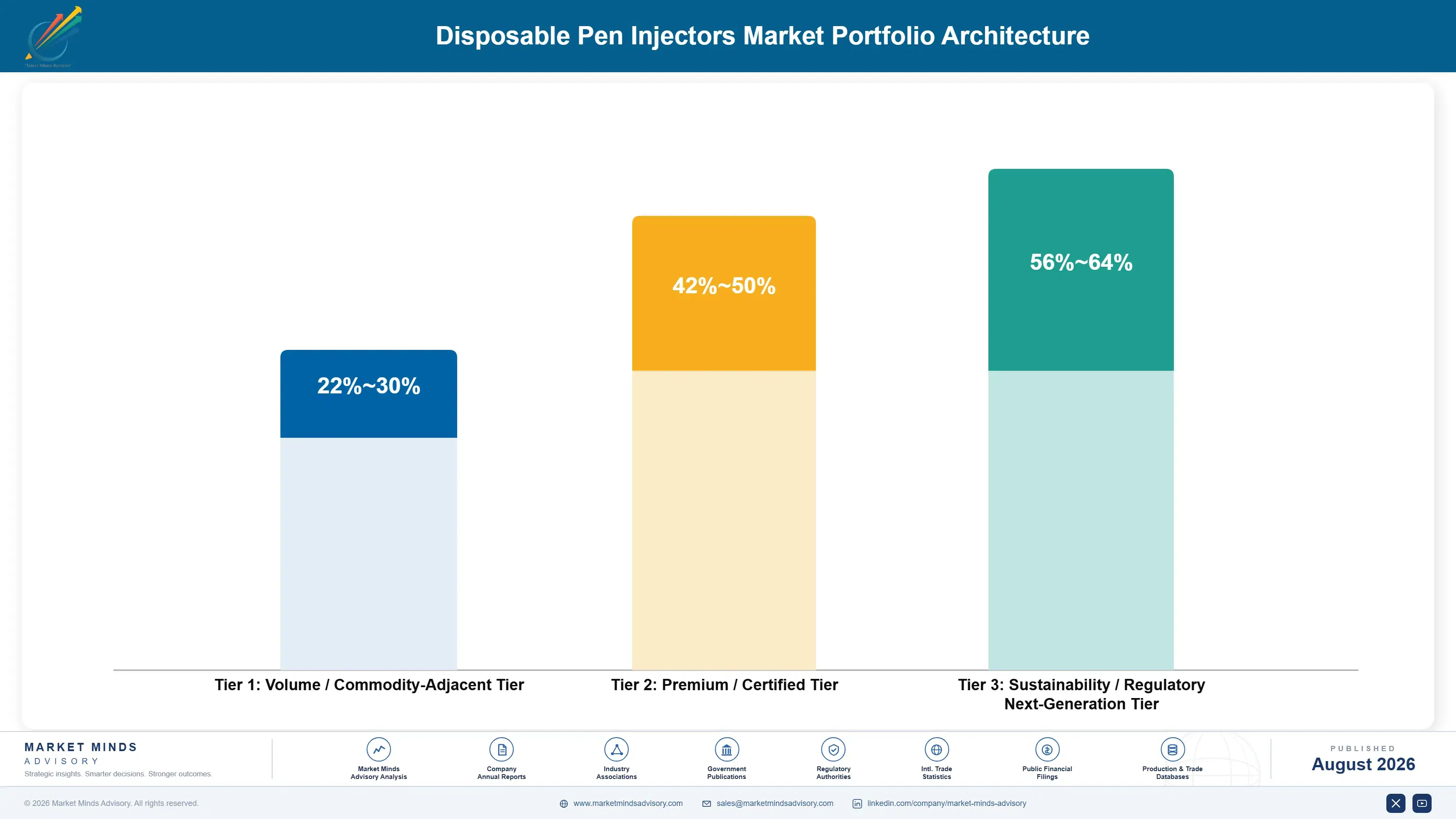
Portfolio Architecture for Margin Defence

Disposable pen injector portfolios span three margin tiers running from commodity-adjacent mature insulin pen categories through certified GLP-1 and biologic therapy devices to sustainability-linked next-generation smart connected platforms. Gross margin widens considerably moving up the tier structure, driven primarily by therapeutic category growth rate and adherence data value rather than device manufacturing complexity alone across most vendor product lines and portfolios.
Volume tier competition centers on price and manufacturing efficiency for mature insulin pen categories facing biosimilar pricing pressure, where cost management matters more than technology differentiation or premium positioning. Premium tier competition instead centers on manufacturing capacity reliability, smart connectivity features, and preferred pharmaceutical partnership relationships, an entirely different buying calculus that rewards vendors with proven supply reliability built over many years of sustained investment.

High-value margin pools concentrate overwhelmingly in the premium and next-generation tiers, where GLP-1 device supply and adherence data licensing generate revenue considerably above any mature insulin pen transaction alone across the full therapeutic category lifecycle. Vendors increasingly steer manufacturing capital investment and sales incentive structures toward this upper tier as volume-tier margin continues compressing under sustained biosimilar competition and intensifying price pressure from lower-cost manufacturers.

Volume / Commodity-Adjacent Tier

Mature insulin pen devices facing biosimilar pricing pressure, targeting cost-constrained healthcare systems and payers where manufacturing efficiency and reliable supply matter more than smart connectivity features or premium therapeutic positioning across most established markets.
Gross Margin: 22%-30%

Premium / Certified Tier

GLP-1 and biologic therapy pen injectors with reliable manufacturing supply commitments, typically sold through preferred pharmaceutical partnership arrangements to companies racing to close persistent supply gaps affecting high-growth obesity and diabetes therapy categories.
Gross Margin: 42%-50%

Sustainability / Regulatory / Next-Generation Tier

Smart connected pen platforms bundling adherence tracking, dosing verification, and data licensing capability, targeting leading pharmaceutical companies piloting value-based reimbursement contracts ahead of broader industry-wide adoption of connected device technology standards.
Gross Margin: 56%-64%
disposable-pen-injectors-market-portfolio-architecture-1787304986119

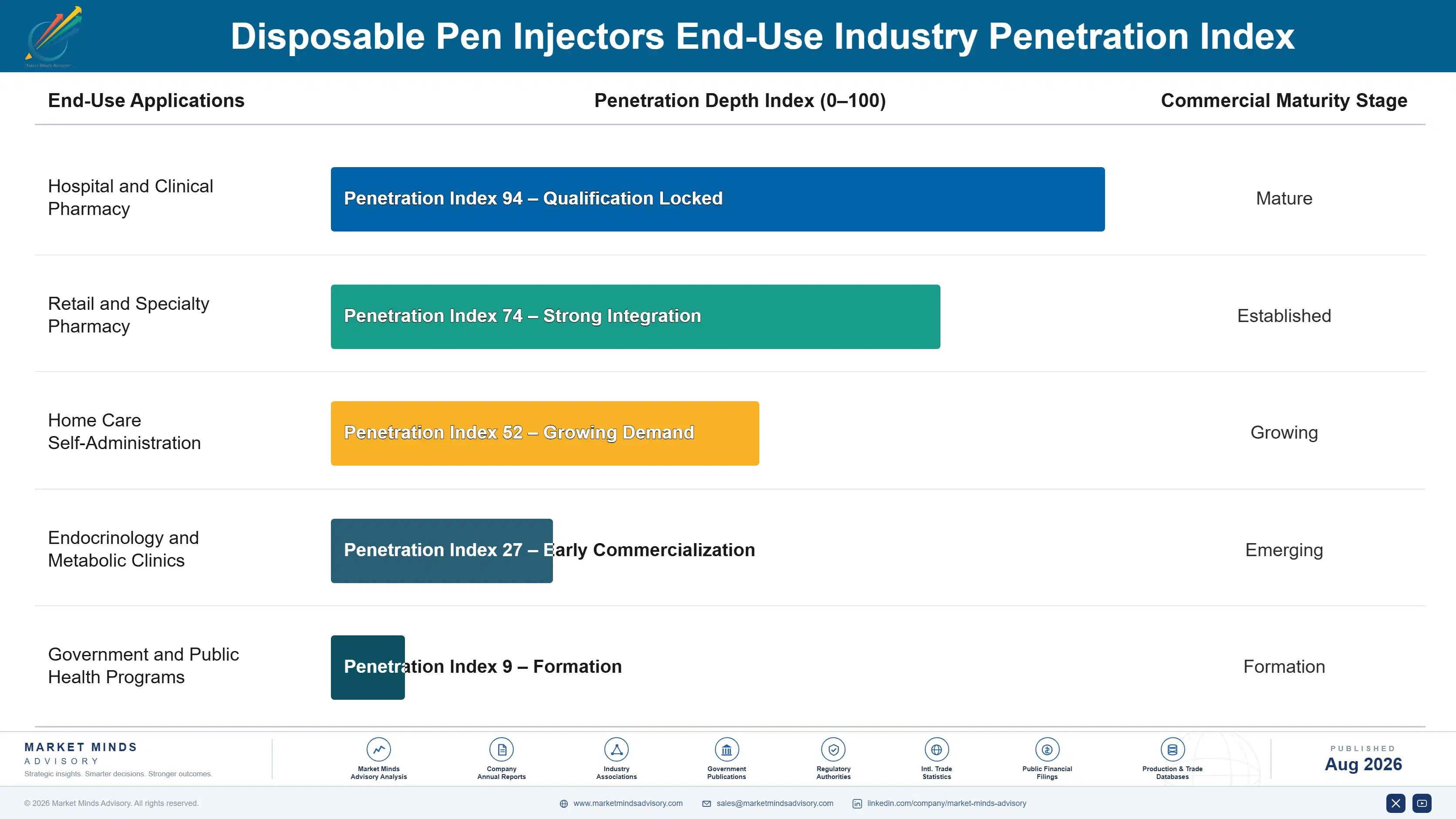
Chronic Therapy Loyalty and Supply Trust

Disposable pen injector demand carries genuine annuity characteristics through chronic therapy prescriptions that continue for years or decades once patients begin treatment, meaning vendors capture far more value from sustained prescription relationships than from any single device transaction alone. Pharmaceutical companies increasingly value manufacturing reliability and long-term supply commitment over pure device cost, since supply disruption directly threatens patient treatment continuity
Adoption depth varies sharply by therapeutic category. GLP-1 obesity and diabetes therapy shows the deepest and most rapidly expanding patient engagement, layering across an increasingly broad prescriber base beyond traditional endocrinology into primary care and cardiology. Mature insulin pen categories show more stable, established adoption patterns, with growth tracking population-level diabetes prevalence rather than any dramatic new demand catalyst.

A generational shift in prescriber and patient behavior is underway as younger physicians increasingly view obesity as a chronic disease warranting pharmacological treatment rather than a lifestyle issue managed through diet and exercise alone. This cohort expects GLP-1 therapy as a standard treatment pathway option, reshaping prescribing patterns and device demand away from the narrower diabetes-only framing that dominated the category for decades before recent indication expansion.
disposable-pen-injectors-market-end-use-penetration-index-1787304986607

Where Pen Injector Value Concentrates

These are among the four positions where our research anticipates prominent divergence between winners and laggards over the coming forecast period. Each is grounded in the demand model, the regulatory perimeter, and the announced capacity pipeline.
01 / MANUFACTURING CAPACITY INVESTMENT

Prioritize Capacity Reliability Over Pure Device Cost Competition

Vendors that invest aggressively in manufacturing capacity expansion are capturing disproportionate share of pharmaceutical company partnership decisions across most GLP-1 supply relationships currently active in the market and beyond current commitments, forecasts, and public guidance. Pharmaceutical companies increasingly weigh capacity reliability alongside device cost, a shift that rewards sustained manufacturing investment over incremental cost optimization alone. Vendors slow to build genuine capacity depth risk losing preferred partnership status within three to five years as this becomes the clear industry evaluation standard.
02 / SMART CONNECTIVITY DATA INVESTMENT

Build Connected Device Capability Ahead of Value-Based Contracts

Pharmaceutical companies are moving toward value-based reimbursement contracts faster than most device makers currently have connected technology capability to support profitably at meaningful scale across most therapeutic categories and payer relationships today and well beyond current levels. Establishing smart connectivity and adherence data infrastructure ahead of broader industry adoption requires patient multi-year investment with limited near-term payback for most vendors entering this space. Vendors that build this presence early are positioned to capture disproportionate share as value-based contracting continues expanding steadily.
03 / INSULIN PEN PORTFOLIO MANAGEMENT

Manage Insulin Pen Assets for Cash Flow Not Growth

Biosimilar competition threatens to compress insulin pen margin faster than established vendors can offset through pure manufacturing efficiency alone across most standard pricing negotiations and procurement cycles worldwide and internationally each year and beyond current expectations. Vendors need genuine capital discipline that redirects insulin pen cash flow toward higher-growth categories rather than defending market share in a category facing sustained multi-year margin erosion. Vendors clinging to insulin pen growth ambitions risk misallocating capital away from the GLP-1 opportunity that matters far more.
04 / MANUFACTURING OVERCAPACITY PREPARATION

Prepare Flexible Capacity for Eventual Demand Normalization

Current GLP-1 manufacturing capacity investment assumes sustained demand growth, but vendors need contingency planning for eventual demand normalization once the current unprecedented prescription surge moderates toward more typical chronic therapy growth rates across most reimbursed markets and territories. Building flexible manufacturing capacity that can pivot between therapeutic categories reduces the risk of costly overcapacity when growth eventually slows from current exceptional levels. Vendors that plan for this transition now will navigate the eventual moderation considerably more smoothly than competitors caught unprepared.

Engagement Snapshot From the Field

A live engagement with an industry participant carrying material or product regulatory and market exposure ahead of a defining policy shift, showing how our research translates into a defensible multi-year portfolio strategy.
MARKET MINDS ADVISORY · CLIENT ENGAGEMENT SUMMARY
Disposable Pen Injectors Producer Strategic Portfolio Review and Transition Roadmap 2026·Investment Scenario on Disposable Pen Injectors Exposure Evaluation 2025-26
CLIENT PROFILE
The client is a specialty pharmacy chain operating forty distribution centers across the United States, serving as a critical intermediary supplying pen injector therapies to patients and provider networks across multiple states. The chain faced repeated GLP-1 supply disruptions throughout 2023 and 2024 as manufacturer allocation constraints left several distribution centers unable to fill patient prescriptions on schedule, damaging patient relationships and provider trust.
STRATEGIC CHALLENGE
Leadership needed to evaluate whether diversifying manufacturer relationships and building more sophisticated allocation forecasting could reduce future supply disruption risk without requiring the chain to hold excessive, costly inventory across its distribution network. The chain also needed a framework for communicating realistic availability expectations to prescribers and patients during periods of continued manufacturer supply constraint.
MMA APPROACH
MMA conducted an independent supply chain assessment across the chain manufacturer relationships, benchmarking allocation reliability history, contract terms, and inventory positioning strategies against comparable specialty pharmacy operators facing similar supply constraints. The engagement combined primary interviews with procurement and clinical leadership, manufacturer relationship mapping across therapeutic categories, and a phased inventory and forecasting model redesign sequenced by therapeutic category risk level.
KEY FINDINGS
  1. Supply disruption incidents concentrated disproportionately among distribution centers relying on a single manufacturer relationship for GLP-1 therapy fulfillment, based on eighteen months of internal fulfillment data.
  2. Diversifying to two manufacturer relationships per major therapeutic category reduced projected stockout risk by an estimated thirty-five percent (client-reported, unverified by MMA), based on scenario modeling.
  3. Improved allocation forecasting accuracy reduced emergency inventory transfers between distribution centers by approximately twenty percent within six months of implementation, based on operational tracking data.
  4. Proactive patient and provider communication about realistic availability timelines improved satisfaction scores meaningfully despite continued underlying supply constraints (client-reported, unverified by MMA).
CLIENT PROFILE
The client is a specialty pharmacy chain operating forty distribution centers across the United States, serving as a critical intermediary supplying pen injector therapies to patients and provider networks across multiple states. The chain faced repeated GLP-1 supply disruptions throughout 2023 and 2024 as manufacturer allocation constraints left several distribution centers unable to fill patient prescriptions on schedule, damaging patient relationships and provider trust.
STRATEGIC CHALLENGE
Leadership needed to evaluate whether diversifying manufacturer relationships and building more sophisticated allocation forecasting could reduce future supply disruption risk without requiring the chain to hold excessive, costly inventory across its distribution network. The chain also needed a framework for communicating realistic availability expectations to prescribers and patients during periods of continued manufacturer supply constraint.
MMA APPROACH
MMA conducted an independent supply chain assessment across the chain manufacturer relationships, benchmarking allocation reliability history, contract terms, and inventory positioning strategies against comparable specialty pharmacy operators facing similar supply constraints. The engagement combined primary interviews with procurement and clinical leadership, manufacturer relationship mapping across therapeutic categories, and a phased inventory and forecasting model redesign sequenced by therapeutic category risk level.
KEY FINDINGS
  1. Supply disruption incidents concentrated disproportionately among distribution centers relying on a single manufacturer relationship for GLP-1 therapy fulfillment, based on eighteen months of internal fulfillment data.
  2. Diversifying to two manufacturer relationships per major therapeutic category reduced projected stockout risk by an estimated thirty-five percent (client-reported, unverified by MMA), based on scenario modeling.
  3. Improved allocation forecasting accuracy reduced emergency inventory transfers between distribution centers by approximately twenty percent within six months of implementation, based on operational tracking data.
  4. Proactive patient and provider communication about realistic availability timelines improved satisfaction scores meaningfully despite continued underlying supply constraints (client-reported, unverified by MMA).
RECOMMENDED STRATEGY
Phase 1: Phase 1 (Months 1 to 2): Complete supply chain assessment and manufacturer relationship mapping across all forty distribution centers and therapeutic categories. Phase 2: Phase 2 (Months 3 to 5): Negotiate diversified manufacturer relationships and redesign allocation forecasting models for highest-risk therapeutic categories first. Phase 3: Phase 3 (Months 6 to 10): Roll out revised inventory and communication protocols across remaining distribution centers, monitoring stockout incidents closely.
OUTCOME
Within ten months, the specialty pharmacy chain reduced GLP-1 supply disruption incidents meaningfully across its distribution network, improved patient and provider satisfaction scores despite continued industry-wide supply constraints, and avoided costly emergency inventory transfers between centers (client-reported, unverified by MMA). The revised forecasting framework has since been extended to additional high-demand therapeutic categories.

Frequently Asked Questions

Foundational context covering the market sizes, CAGR, scope, country, region and competition that inform every finding below. This section is provided to cover basics and most often pre-purchase conversations, answered from the MMA Primary Research Dataset.

What is the current size of the Disposable Pen Injectors Market?

The global disposable pen injector market was valued at 12.8 billion dollars in 2025. This figure covers prefilled, single-use devices for insulin, GLP-1, and biologic therapies.

How large will the Disposable Pen Injectors Market be by 2036?

MMA forecasts the market will reach 38.38 billion dollars by 2036, nearly tripling in value. This growth is driven primarily by GLP-1 obesity and diabetes therapy prescription volume.

What is the CAGR for the Disposable Pen Injectors Market 2026 to 2036?

The base case CAGR is 10.5 percent annually across the forecast period. Bull and bear scenarios range from 11.8 percent to 9.2 percent depending on indication expansion and capacity growth.

Which segment is growing fastest?

GLP-1 and obesity therapy pen injectors are the fastest-growing segment, expanding at approximately 18.5 percent annually. This is roughly 1.8 times the overall market growth rate, driven by prescription demand.

Who are the major companies in the Disposable Pen Injectors Market?

Leading companies include Novo Nordisk, Eli Lilly and Company, Becton Dickinson, Ypsomed, and SHL Medical. These five vendors hold a combined CR5 near sixty-five percent of the global market.

Which country is growing fastest?

China is the fastest-growing national market, expanding at approximately 11.7 percent annually. This reflects expanding domestic pharmaceutical manufacturing capacity and rising GLP-1 biosimilar development across the country.

Report Segmentation Architecture

The full report scope spans multiple orthogonal segmentation dimensions, with cross-tabulated demand data provided for each dimension pair. Coverage extends further to regional breakdowns, trend trajectories, and the competitive detail needed to support segment-level decision-making.

By Product and Technology Type

  • GLP-1 and Obesity Therapy Pen Injectors
  • Smart and Connected Pen Injectors
  • Biologic and Specialty Drug Pen Injectors
  • Pen Needles and Accessories
  • Insulin Pen Injectors
  • Reusable Pen Injector Devices

By End-Use Industry

  • Hospital and Clinical Pharmacy
  • Retail and Specialty Pharmacy
  • Home Care Self-Administration
  • Endocrinology and Metabolic Clinics
  • Government and Public Health Programs

By Commercial Dimension

  • Direct Pharmaceutical Company Sales
  • Pharmacy Benefit Manager Contracts
  • Distributor and Wholesale Channels
  • Contract Manufacturing Agreements

By Region

  • North America
  • Western Europe
  • East Asia
  • South Asia and Pacific
  • Latin America
  • Middle East and Africa
  • Eastern Europe

Scope, Methodology, and Coverage

Every figure in this report is reproducible from documented input assumptions. The scope below maps the historical period, the forecast horizon, the segmentation dimensions, and the countries covered, alongside the underlying primary and qualitative methodology.
Historical Period
2020 to 2025
Forecast Period
2026 to 2036
Base Year
2025 (USD billions; MMA Primary Research Dataset, August 2026)
Market Definition
The disposable pen injector market covers prefilled, single-use injection devices used for self-administered insulin, GLP-1, and biologic therapies, including standard and connected smart pen formats. Reusable durable pen devices, vials, and traditional needle-and-syringe delivery are excluded from scope.
Quantitative Units
USD billions (current prices); unit shipment volume where applicable
Segmentation Dimensions
By Product and Technology Type; By End-Use Industry; By Commercial Dimension; By Region
Regions Covered
North America, Western Europe, East Asia, South Asia and Pacific, Latin America, Middle East and Africa, Eastern Europe
Countries Covered
USA, China, Germany, France, UK, Japan, South Korea, India, Australia, Canada, Brazil, Mexico, Indonesia, Vietnam, Thailand, Malaysia, UAE, Saudi Arabia, South Africa, Nigeria, Turkey, Poland, Netherlands, Italy, Spain, Sweden, Switzerland, Argentina, Colombia, Singapore, and additional markets relevant to this sector
Key Companies Profiled
Novo Nordisk, Eli Lilly and Company, Becton Dickinson, Ypsomed, SHL Medical, Owen Mumford, Haselmeier, Antares Pharma, Elcam Medical, Nemera, West Pharmaceutical Services, Sanofi, AstraZeneca, Terumo, Gerresheimer, Credence MedSystems, Medtronic, Enable Injections, Sensile Medical, Phillips-Medisize
Quantitative Methodology
Primary survey, n=3,800 respondents, Q4 2025, six countries; demand-side model with trade association cross-validation
Qualitative Methodology
47 expert interviews, Q4 2025; applied to validate demand model assumptions, identify emerging dynamics, and assess competitive positioning
Report Format
PDF and XLSX data workbook (Word format preview document)
Publisher
Market Minds Advisory
Report Code
MMA-2026-MED-524
Published
August 2026
Contact
sales@marketmindsadvisory.com | www.marketmindsadvisory.com

Purchase the full Disposable Pen Injectors Market Report (2026 to 2036).

The full report delivers detailed segment-level revenue forecasts across all six product categories through 2036. It includes country-level breakdowns for the fourteen markets carrying the deepest primary research coverage, alongside a complete competitive benchmarking module covering all twenty profiled companies. Proprietary MMA survey data drawn from 3,800 respondents across six countries supports the demand analysis, complemented by expert interview findings from 47 industry specialists gathered during the fourth quarter of 2025. Buyers also receive editable data tables and a quarterly market monitor update subscription for twelve months following purchase.
Segment-level revenue forecasts across six product categories
Country-level breakdowns for fourteen deeply researched markets
Competitive benchmarking module covering twenty profiled companies
Proprietary survey data from 3,800 respondents worldwide
Expert interview findings from 47 industry specialists
Twelve months of quarterly market monitor updates

Built For The People Who Decide

From boardroom strategy to bench-side execution, this report is read cover-to-cover by leaders shaping the next decade of their industry, turning demand scenarios, market dynamics and valuation benchmarks into decisions.
CXOs/ Presidents/ VPs/ Managers
M&A and Corporate Development
Strategy Teams and R&D Heads
Procurement and Product Directors
Regulatory and Compliance Leaders
Investor Relations and Equity Analysts