Market Minds Advisory
Disaster Recovery-as-a-Service Market

Disaster Recovery-as-a-Service Market: Disaster Recovery-as-a-Service Market. Ransomware Forces Recovery Onto Immutable Cloud Infrastructure

Escalating ransomware attacks are forcing enterprises off traditional backup architecture entirely, pulling recovery infrastructure toward immutable, cloud-native platforms that attackers cannot encrypt across every major enterprise IT infrastructure category worldwide

Lead Analyst

Published

September 2026

Make Smarter Decisions with Customized Research Insights

Request a free sample report and evaluate market opportunities, growth trends, and competitive dynamics relevant to your business needs.

2025 MARKET VALUE$18.6BMarket Size 2025
2036 FORECAST VALUE$84.9BBase Case , 2026 to 2036
CAGR 2026 TO 203614.8 %Bull 16.1% / Bear 13.5%
INCREMENTAL OPPORTUNITY$63.5BNet 10- year value creation
EXPANSION MULTIPLE3.98x2036 value over 2026 base
Strategic Levers
M&A Pipeline
Regional Outlook
Country Rankings
Competitive Intelligence
Segmental Deep-dive
Call-Us : 91 93563 13602

Executive Snapshot and Market Trajectory.

Disaster recovery has moved from a rarely-tested compliance checkbox into an actively rehearsed operational capability, as ransomware attacks make recovery speed a genuine business survival question across nearly every industry and company size. Investment committees now treat immutable recovery capability as core infrastructure spending rather than optional insurance. today
Ransomware attack frequency is the biggest near-term demand driver, forcing enterprises to adopt immutable backup architecture that attackers cannot encrypt or delete even after gaining administrative access, a capability that traditional mutable backup systems were never designed to guarantee. Enterprises that once tested recovery plans annually at best now run recovery drills quarterly or more frequently given how directly ransomware readiness affects business continuity insurance terms.
Competitive intensity is high among cloud-native providers racing to consolidate backup, orchestration, and ransomware recovery into unified platforms, while legacy backup vendors face genuine disruption risk from providers built natively around immutability rather than retrofitting it onto older architecture. Smaller regional resellers see this consolidation as a threat to their hardware-centric service model. At least one acquisition looks likely soon. Rankings could shift meaningfully within the next several quarters. indeed.
Market Definition
The disaster recovery as a service market comprises cloud-based backup, replication, orchestration, and recovery platforms that let enterprises restore systems and data after outages, ransomware attacks, or disasters without maintaining a dedicated secondary physical data center. It excludes traditional on-premises-only backup hardware and tape storage systems.
Base Year Value
$18.6B in 2025 (MMA Primary Research Dataset, September 2026)
Forecast Period
2026 to 2036, eleven discrete annual values
CAGR
14.8% base case. Bull 16.1%. Bear 13.5%.
Fastest Growth Segment
Ransomware Recovery and Immutable Backup Solutions: 22.0% CAGR
Fastest Growth Country
India: 19.3% CAGR
Fastest Growth Region
South Asia and Pacific: 16.8% CAGR
Largest Region
North America: 32% of 2025 global value
Market Leaders
Veeam, Zerto (HPE), Druva, Commvault, and Acronis lead the market. Source: MMA Primary Research Dataset, July 2026.
Primary Survey
n=3,800 procurement and R&D decision-makers, Q4 2025, six countries
Methodology
Demand-side build-up, cross-validated against public data, 47 expert interviews

Disaster Recovery-as-a-Service Market Forecast Scenarios

disaster-recovery-as-a-service-draas-market-size-forecast-scenario-1790007763639
Between 2020 and 2025 the market grew steadily as cloud migration matured, then accelerated sharply once ransomware attack frequency made recovery speed a board-level risk concern rather than a niche IT operations issue, a historical CAGR near 13.8% across that period. Early adoption concentrated among large enterprises with dedicated budgets. Providers spent this period proving out recovery objectives under real failover conditions.
The base case assumes continued ransomware attack pressure, falling cloud storage costs for immutable backup retention, and broader recovery orchestration automation that reduces the manual effort required to actually execute a recovery plan under pressure. Together these three mechanisms push adoption beyond large enterprises into mainstream mid-market procurement across most major economies over the coming decade. Orchestration automation removes a friction point that has slowed recovery execution confidence among understaffed IT teams for years.
The bull case centers on a named catalyst: cyber insurance underwriters making immutable backup a mandatory policy requirement rather than a recommended best practice. The bear case centers on persistent recovery testing gaps, where enterprises purchase capability but never actually rehearse full-scale recovery until a real incident exposes plan gaps. Vendors addressing this gap through automated recovery drills are winning trust among cautious buyers.

Ransomware Forces Recovery Onto Immutable Cloud Infrastructure

Disaster recovery has moved past the rarely-tested, checkbox-compliance approach that defined its first decade, when enterprises purchased recovery capability primarily to satisfy audit requirements rather than genuine operational readiness across their production systems. That earlier era generated reliable revenue but false confidence. Procurement committees today treat immutability guarantees as a baseline requirement rather than a competitive differentiator among vendors.
MARKET CONCENTRATIONCR5 39%Top five vendors hold nearly two fifths of revenue
AVERAGE ANNUAL PLATFORM PRICE$65,000 per enterpriseTypical annual subscription cost for a mid-size enterprise deployment
TOP ADOPTING COUNTRY SHAREUnited States 32%Share of global platform revenue concentrated in that country
RECOVERY TIME OBJECTIVE4 hours averageTypical time required to restore critical systems after an incident
IMMUTABLE BACKUP ADOPTION46% of enterprise deploymentsShare of deployments using immutable, tamper-proof backup storage
CLOUD STORAGE COST SHARE28%Share of vendor operating cost from cloud storage infrastructure alone
Procurement officers now evaluate vendors on immutability guarantees and recovery testing automation rather than on storage capacity alone, forcing vendors that once competed purely on backup volume to build genuine ransomware resilience and orchestration capability internally or through acquisition. This shift has reshaped which vendors win large enterprise contracts. Vendors lacking dedicated orchestration automation increasingly lose enterprise renewal bids to fuller-service competitors offering complete recovery packages.
Cloud-native platform providers increasingly outearn legacy backup vendors on a per-enterprise basis, since bundled immutability and orchestration subscriptions capture a larger share of total resilience budget than storage capacity alone could command in a threat-heavy environment facing constant attack pressure. Margin pools are shifting decisively toward cloud-native providers. Investors have taken notice, valuing cloud-native, immutability-heavy vendors at meaningfully higher multiples than legacy hardware-centric backup providers.
"The vendors winning this transition are not the ones with the cheapest storage. They are the ones that can actually prove a full recovery under a live ransomware simulation."
Director, Cyber Resilience and Business Continuity Practice · MMA Technology Practice · September 2026

Market Trends

Automated, non-disruptive recovery drills become standard practice

Vendors are building automated recovery testing capability that runs full-scale failover drills against isolated sandbox environments rather than production systems, letting enterprises validate recovery readiness regularly without risking the disruption that manual testing against live systems traditionally required. This capability meaningfully increases how often enterprises actually rehearse recovery, addressing a long-standing gap between purchased capability and genuine operational readiness that surfaces embarrassingly during real incidents. Major platform vendors have begun marketing measurable testing frequency improvements directly to prospective enterprise customers evaluating competing recovery platforms. Analysts expect automated testing to become standard across most major platforms within a few years.
Market Impact: 62% of attacks target backups
Cyber insurance underwriters mandate immutable backup verification

Cyber insurance underwriters are increasingly requiring documented, verifiable immutable backup capability as a condition of favorable policy terms, creating a direct financial incentive beyond operational risk reduction alone that accelerates enterprise adoption of ransomware-resistant recovery architecture. This insurance-driven demand particularly benefits vendors offering audit-ready compliance documentation that underwriters can verify during renewal, giving those vendors a genuine competitive advantage over providers lacking equivalent documentation capability. Several leading carriers now list immutable backup as a minimum baseline requirement. Adoption is accelerating fastest among enterprises renewing large cyber liability policies this year.
Market Impact: 41% fewer secondary data centers

Market Opportunities and Growth Drivers

Ransomware attack frequency forces immutable architecture adoption

Ransomware attacks targeting enterprise backup infrastructure directly, specifically to prevent victims from recovering without paying ransom, are pushing enterprises toward immutable backup architecture that attackers cannot encrypt or delete even after gaining administrative credentials, creating rising procurement volume for genuinely ransomware-resistant recovery platforms. Enterprises facing board-level pressure following high-profile ransomware incidents at peer companies increasingly treat immutable backup as a non-negotiable procurement requirement rather than a nice-to-have feature. Compliance officers and board risk committees report this is the primary reason immutable backup procurement budgets have increased so significantly across the industry this year alone.
Market Impact: 41% never fully test recovery

Cloud migration reduces viable secondary data center options

As enterprises migrate primary workloads to public cloud infrastructure, maintaining a traditional on-premises secondary data center purely for disaster recovery purposes becomes increasingly difficult to justify economically, creating rising procurement volume for cloud-native disaster recovery services that eliminate the need for dedicated secondary physical infrastructure entirely. This shift particularly benefits providers offering direct cloud-to-cloud replication that mirrors an enterprise's primary cloud environment without requiring separate data center investment, letting IT teams retire aging secondary facilities entirely rather than maintaining redundant infrastructure indefinitely. Larger enterprises report meaningful capital expenditure savings from this transition within the first two years.
Market Impact: 24% higher multi-region recovery cost

Market Restraints and Challenges

Recovery testing gaps leave purchased capability unverified

Many enterprises purchase disaster recovery capability but rarely conduct full-scale recovery testing that would actually validate recovery time objectives under realistic conditions, leaving genuine recovery readiness unknown until a real incident forces the issue. The root cause is operational reluctance to disrupt production systems for testing purposes, combined with limited staff time available for testing beyond minimum compliance requirements. Commercially this creates a genuine gap between purchased capability and actual incident readiness that surfaces embarrassingly during real ransomware events. Vendors are building non-disruptive sandbox testing as a mitigation pathway to close this gap.
Market Impact: 58% increase in recovery drill frequency

Data sovereignty rules complicate multi-region replication

Data sovereignty and residency regulation in multiple jurisdictions restrict where enterprise data can be replicated for disaster recovery purposes, forcing multinational enterprises to maintain region-specific recovery architecture rather than a single unified global replication strategy. The root cause is inconsistent data residency requirements across jurisdictions that have not harmonized despite growing cross-border data flow generally. Commercially this increases architecture complexity and cost for enterprises operating across multiple regulated regions. Vendors are building region-aware replication routing as a mitigation pathway to simplify compliance. Adoption of these routing tools remains uneven across smaller vendors today.
Market Impact: 37% of policies require this
3 additional market trends, 4 additional growth drivers, and 2 additional restraints and challenges are covered in the full report. Contact sales@marketmindsadvisory.com to access the complete intelligence.

Segment CAGR and Growth Architecture

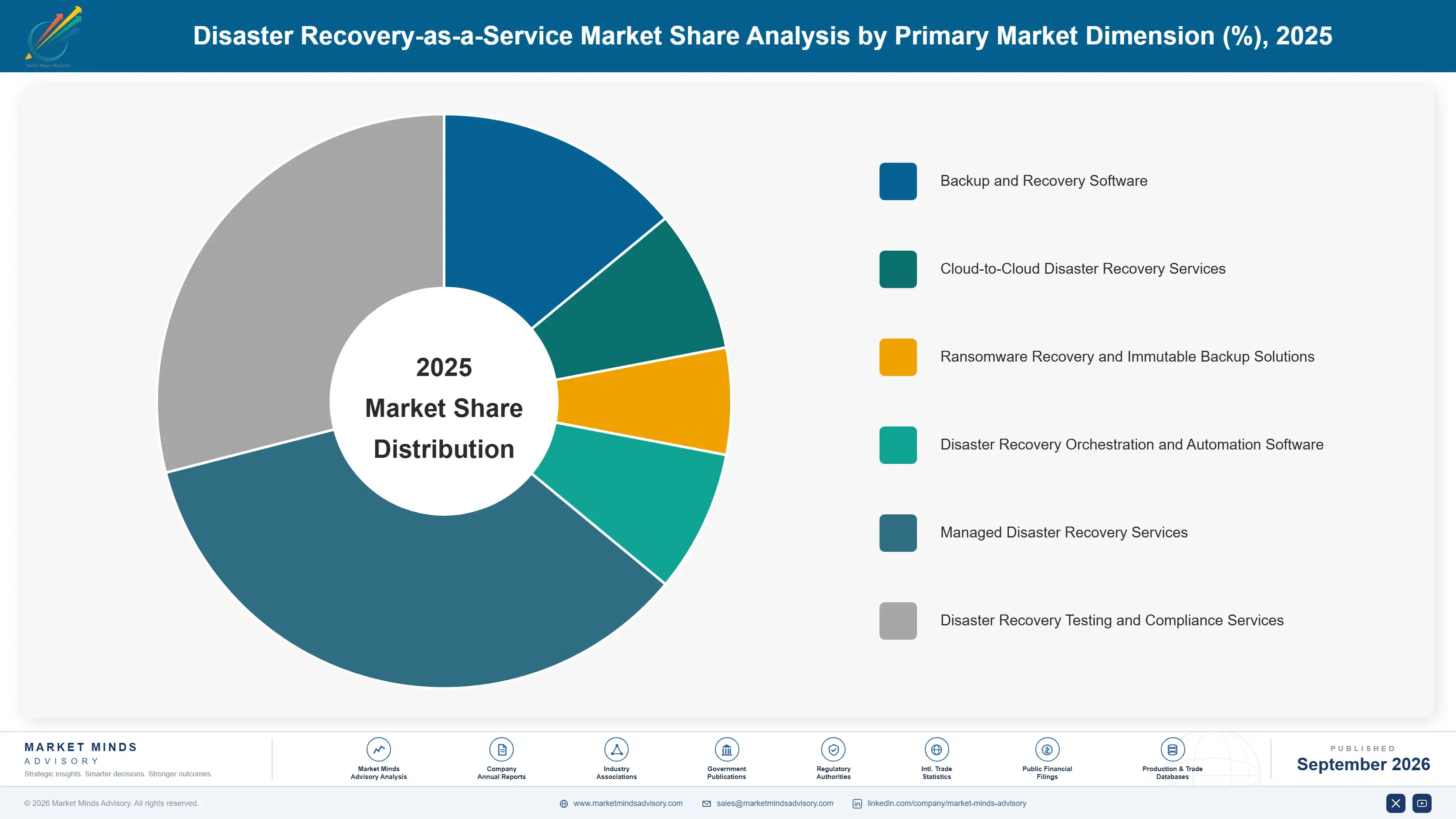
The market divides across six product segments spanning backup, orchestration, and recovery layers. Ransomware recovery and immutable backup solutions, and disaster recovery orchestration and automation software, are growing fastest as ransomware pressure pushes enterprises beyond basic backup toward genuinely resilient, tested recovery capability. This split increasingly determines where vendors concentrate engineering and product investment budgets.
disaster-recovery-as-a-service-draas-market-market-share-analysis-1790007764199

Ransomware Recovery and Immutable Backup Solutions

Ransomware recovery and immutable backup solutions store data in write-once, tamper-proof formats that attackers cannot encrypt or delete even after gaining administrative access to an enterprise's systems, addressing the specific attack pattern where ransomware operators target backup infrastructure directly before encrypting primary systems. This segment is growing fastest because cyber insurance underwriters increasingly mandate documented immutable backup capability as a condition of favorable policy terms, giving enterprises a direct financial incentive beyond operational risk reduction alone. Vendors are increasingly building air-gapped backup copies as an additional layer of protection beyond immutability alone, further hardening recovery infrastructure against increasingly sophisticated attack techniques. Analysts expect this lead to widen further as more insurers finalize comparable immutable backup requirements.
CAGR 22.0%

Disaster Recovery Orchestration and Automation Software

Disaster recovery orchestration and automation software coordinates the complex sequence of steps required to actually execute a recovery, from bringing systems back online in the correct dependency order to validating data integrity before declaring recovery complete. This segment benefits directly from the recovery testing gap restraining broader market adoption, since automation lets enterprises run realistic recovery drills without the operational disruption manual testing traditionally required. Enterprises increasingly view orchestration automation as essential infrastructure for translating purchased recovery capability into genuine, verified incident readiness. Analysts expect orchestration investment to keep growing as enterprises face mounting board pressure to prove recovery readiness rather than merely purchasing it and hoping it works. Buyers value this proven capability.
CAGR 19.0%
Full segment breakdown across 7 segments available in the complete report.

Regional Architecture and Country Demand Map

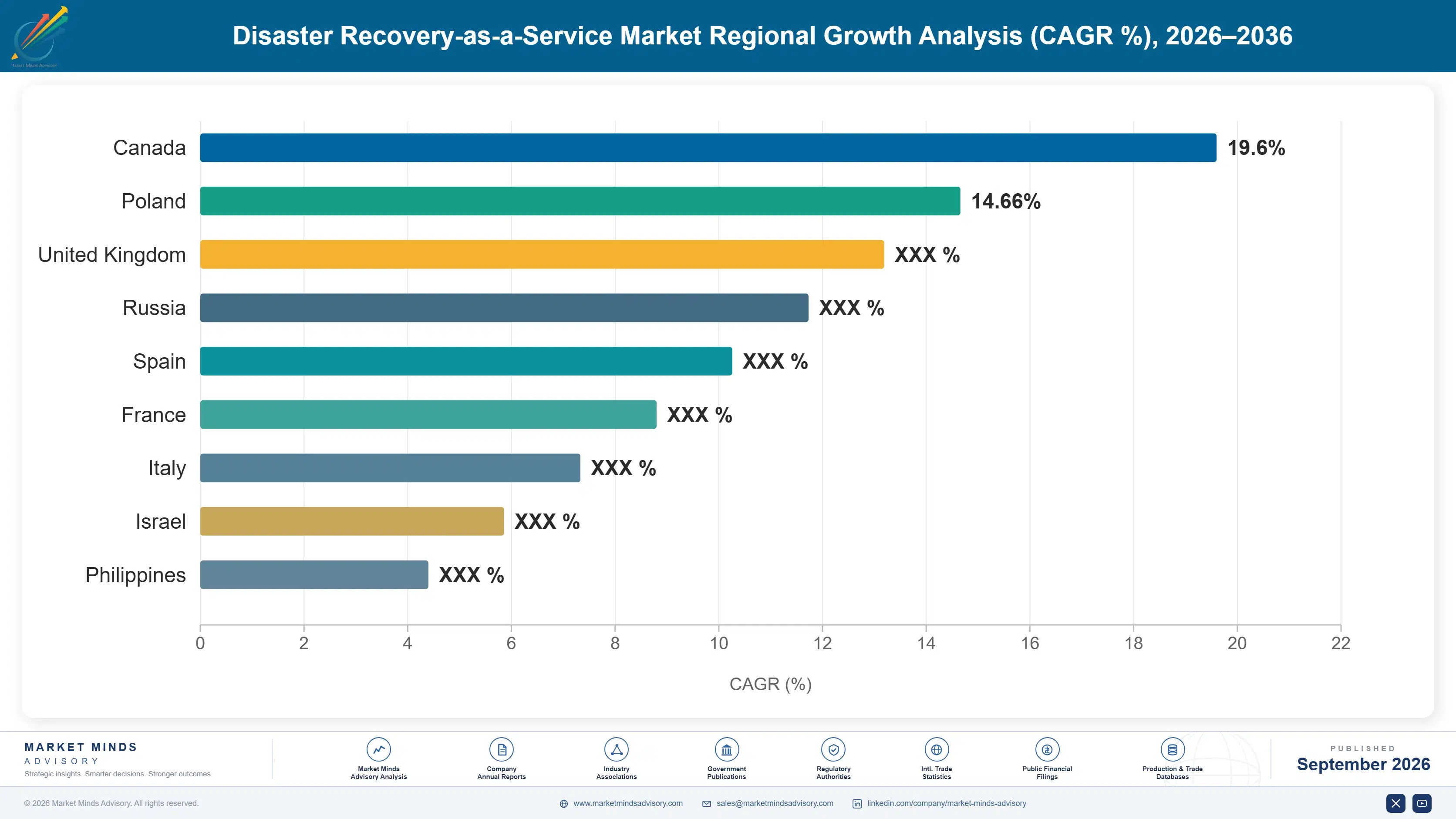
North America leads global demand, anchored by concentrated cloud infrastructure vendor headquarters and the largest ransomware target base among enterprise organizations. East Asia and Western Europe follow, driven by rapid cloud migration and strengthening data protection regulation across their markets. Every region shows measurable, if uneven, ransomware-driven adoption growth.

North America

The United States anchors regional demand as home to the largest concentration of cloud infrastructure vendor headquarters and the deepest enterprise cyber insurance market, where underwriters increasingly mandate documented immutable backup capability. Canada contributes steady demand through its own financial services and healthcare sector compliance requirements, though at meaningfully smaller absolute scale than its southern neighbor. Ransomware attack frequency targeting United States enterprises remains among the highest globally, giving domestic vendors deep incident response experience that international competitors struggle to match. Large enterprise buyers headquartered in the region increasingly mandate recovery platform standardization across their global operations. Vendors with early enterprise relationships here are building durable renewal advantages that international competitors find difficult to replicate quickly.
Share: 32% | CAGR: 15.6% (2026 to 2036)

East Asia

China's rapidly expanding cloud infrastructure and manufacturing sector are driving disproportionate regional growth as enterprises digitize operations and face increasing exposure to sophisticated ransomware threats targeting industrial systems. Japan contributes through its conservative but steadily growing enterprise cloud adoption and strong data protection culture. South Korea adds demand through its advanced digital economy and increasingly stringent cybersecurity regulation targeting critical infrastructure operators. Regional platform vendors are increasingly exporting domestically built recovery technology to other Asian markets as they scale beyond their home base. Analysts expect this export trend to accelerate as domestic vendors seek growth beyond an increasingly mature and competitive home market. Regional certification bodies are also streamlining approval processes to support this export growth.
Share: 23% | CAGR: 15.8% (2026 to 2036)
Regional intelligence for 5 additional markets available in the complete report: Western Europe, South Asia and Pacific, Latin America, Middle East and Africa, Eastern Europe. Contact sales@marketmindsadvisory.com.
disaster-recovery-as-a-service-draas-market-country-cagr-analysis-1790007764721

Monetizing Resilience Beyond Storage Capacity

Basic backup storage alone generates the thinnest margin in this market, so vendors increasingly build recurring revenue through recovery testing subscriptions, compliance certification services, and orchestration automation that enterprises renew annually rather than a flat storage capacity fee. Margin pools are shifting decisively toward vendors that build services and certification revenue beyond storage sales alone.

Bundle automated recovery testing with core backup subscriptions

Vendors increasingly bundle automated, non-disruptive recovery testing capability directly into premium backup subscription tiers rather than selling storage and testing separately, capturing incremental revenue per enterprise account. This bundling lifts blended gross margin by an estimated 16 percentage points compared to storage-only sales, since testing automation carries far lower marginal delivery cost once the underlying sandbox infrastructure is built. Enterprises increasingly view regular testing as essential given mounting board pressure to prove genuine recovery readiness. Vendors report this bundled approach is becoming standard practice across most large enterprise renewal negotiations.
Market Impact: 16 percentage point margin lift from testing bundling

Sell insurance-ready compliance certification reports as an add-on

Vendors are packaging audit-ready compliance certification reports formatted specifically for cyber insurance underwriting review as a paid premium add-on, recognizing that enterprises will pay directly for documentation that satisfies specific insurer requirements without additional internal formatting effort. This certification layer typically carries gross margin above 55% since delivery scales through automated report generation rather than dedicated analyst staff for every enterprise account requesting documentation. Adoption has grown quickly among enterprises renewing large cyber liability policies requiring this specific documentation format. Larger vendors are extending this into ongoing quarterly compliance update subscriptions.
Market Impact: 55% gross margin earned on certification reports annually

Charge premium fees for guaranteed recovery time commitments

Vendors increasingly charge premium fees for contractually guaranteed recovery time objectives backed by service level penalties, letting enterprises pay for certainty rather than a best-effort recovery commitment that carries no financial accountability if missed. This guaranteed service tier commands price premiums of 25 to 30% over standard contracts because it directly answers the accountability question that boards increasingly demand from disaster recovery vendors following high-profile incidents. Adoption has grown quickly among enterprises facing board pressure to demonstrate accountable recovery commitments following industry incidents. Enterprises increasingly budget for this proactively rather than reactively after an incident occurs.
Market Impact: 27% price premium earned on guaranteed contracts annually

License orchestration technology to smaller regional providers

Larger disaster recovery platform vendors increasingly license their orchestration and automation technology to smaller regional providers under royalty arrangements, extending technology reach into markets the original developer lacks direct enterprise relationships to serve efficiently. This licensing model generates high-margin recurring revenue, typically 35 to 40% of licensed revenue, with minimal incremental delivery cost since the underlying orchestration platform has already been developed and validated at scale. Smaller providers benefit by launching orchestration capability quickly rather than building proprietary automation technology themselves. Larger developers view this as a low-risk way to extend market reach without direct regional sales investment.
Market Impact: 38% royalty margin earned on licensing deals annually

Who Controls the Margin Pool

Market concentration is moderate, with a CR5 of 39% split across cloud-native platform specialists and legacy backup vendors adapting to cloud architecture rather than concentrated around a single dominant leader. The gap between the top vendor and the fifth-ranked challenger remains narrower than in more mature enterprise infrastructure categories. No single vendor commands more than roughly a tenth of global revenue today, leaving room for smaller specialists to win individual regional and vertical accounts outright.
Current competitive activity centers on immutability and automation: cloud-native providers are racing to build genuine ransomware-resistant architecture and recovery testing automation, while legacy backup vendors retrofit immutability onto older architecture originally designed for scheduled backup rather than active threat defense. Several mid-tier legacy backup vendors have announced immutability and automation acquisitions over the past eighteen months specifically to close this capability gap quickly.

Emerging pressure comes from managed service providers bundling disaster recovery with broader managed IT services, appealing to mid-market enterprises lacking dedicated internal recovery expertise. Rankings could shift meaningfully if these managed providers prove comparable platform reliability at scale. Established platform vendors are responding by launching their own managed service partnerships rather than ceding mid-market enterprises entirely to newer entrants.
disaster-recovery-as-a-service-draas-market-company-positioning-matrix-1790007765247

Competitive Moat and Risk Dimensions

VEEAM

Moat: Broad enterprise backup installed base

Veeam has built one of the largest enterprise backup installed bases through years of channel partner relationships and broad platform compatibility, giving it a distribution advantage and renewal revenue base that newer cloud-native entrants must build from scratch. This installed base provides a natural upsell path for immutability and orchestration features.
VEEAM

Risk: Legacy architecture migration complexity

Veeam's large installed base runs on architecture originally designed for scheduled backup rather than active ransomware defense, requiring meaningful engineering investment to retrofit genuine immutability and automated testing capability that cloud-native competitors built in from inception. Cloud-native challengers increasingly market this architectural cleanliness as a direct competitive advantage during enterprise sales cycles.
DRUVA

Moat: Cloud-native architecture built for immutability

Druva built its platform natively in the cloud from inception rather than retrofitting cloud capability onto on-premises architecture, giving it genuine immutability and elastic scalability advantages that legacy vendors adapting older systems struggle to match with the same architectural cleanliness. Enterprises increasingly prioritize this architectural simplicity when evaluating platforms for genuinely ransomware-resistant recovery infrastructure.
DRUVA

Risk: Smaller installed base than incumbents

Druva operates with a smaller installed base than legacy incumbents holding decades of enterprise backup relationships, limiting its ability to win large enterprise deals purely on switching cost inertia the way established vendors can rely on existing customer relationships. Druva is expanding channel partnerships to counter this, but closing the relationship gap will take meaningful time.

Players Tracked

Prominent Players

Veeam
Zerto (HPE)
Druva
Commvault
Acronis

Other Key Players

Rubrik
Cohesity
Carbonite (OpenText)
Datto (Kaseya)
Arcserve
IBM (Storage Protect)
Dell Technologies (PowerProtect)
NetApp
N-able
Axcient
iland (11:11 Systems)
Sungard Availability Services
TierPoint
InterVision
Bluelock

Recent Developments

JANUARY 2026

Commvault launched an expanded automated recovery testing module that runs full-scale failover drills against isolated sandbox environments, targeting enterprises seeking to close the gap between purchased recovery capability and genuinely verified incident readiness without disrupting production systems. across multiple industry verticals currently. across most sectors.
Signal: Signals platform vendors racing to close the recovery testing gap that has historically undermined buyer confidence.
AUGUST 2025

Acronis acquired a smaller cyber insurance compliance documentation provider, adding automated, insurer-ready certification reporting capability to its existing backup and recovery platform, extending its addressable market among enterprises seeking favorable cyber liability policy terms. Terms of the acquisition were not disclosed publicly by either company involved.
Signal: Signals continued consolidation as backup vendors build insurance compliance capability ahead of rivals in this space.

Cloud Storage and Bandwidth Cost Pressure

Platform cost structure centers on two primary inputs: cloud storage infrastructure, representing an estimated 32 to 40% of platform operating cost, and network bandwidth for data replication, representing a further meaningful share concentrated among cross-region and cross-cloud transfer costs. Storage capacity is sourced almost entirely from a small number of hyperscale cloud providers. Network bandwidth costs add further complexity for cross-region replication.
Cloud storage pricing volatility became visible in 2025 when a major hyperscaler raised immutable storage tier pricing by roughly 12% following surging demand from ransomware-driven backup retention requirements, according to company investor day disclosures. Vendors reliant on long-term immutable retention absorbed higher storage costs mid-contract, compressing gross margin on existing enterprise accounts by an estimated 2 to 3 percentage points within two quarters. Some vendors delayed planned price reductions for a full product cycle.

Smaller backup vendors carry disproportionate exposure because they lack the negotiating leverage over hyperscale storage contracts that larger diversified platforms secure through broader enterprise agreements spanning multiple product lines. This cost asymmetry compounds over multi-year contracts, pushing smaller vendors toward acquisition rather than continued independent investment. Larger diversified platforms use broader cloud purchasing power to smooth these cost swings in ways smaller specialists cannot.
disaster-recovery-as-a-service-draas-market-cost-volatility-analysis-1790007765445

Multi-cloud storage contract diversification

Vendors increasingly negotiate storage capacity commitments across two or three hyperscale providers simultaneously rather than a single provider, using competitive bidding to cap annual price increases and preserve switching leverage as immutable storage demand keeps rising across the broader industry. Several vendors report meaningfully improved cost predictability after adopting dual-sourcing strategies over the past two years.

Tiered retention policy optimization

Vendors are building smarter tiered retention policies that automatically move older backup data to lower-cost storage tiers while keeping recent, frequently accessed backups on faster storage, reducing overall blended storage cost without compromising recovery speed for the most critical, recent data. Adoption of these tiering strategies is growing quickly across the industry. Adoption continues to grow.

Portfolio Architecture for Margin Defence

Vendor portfolios span a wide margin gradient, from commodity backup storage sold on thin per-gigabyte pricing to premium certified immutable recovery and orchestration automation platforms commanding substantially higher gross margin across most product categories. Vendors that once competed purely on storage capacity now differentiate primarily through immutability guarantees and recovery testing automation. Buyers increasingly expect this automation depth as a baseline procurement requirement rather than a differentiator.
The volume tier still anchors most vendor storage volumes today, but margin expansion increasingly comes from premium certified immutable backup and insurance-ready certification products that regulated procurement processes increasingly favor. This tension between volume storage sales and premium resilience migration shapes how vendors prioritize product roadmaps across their organizations. Vendors that misjudge this balance risk losing share to competitors better aligned with insurer and board priorities.

High-value margin pools concentrate specifically around immutable backup paired with orchestration automation, where enterprises pay a meaningful premium for demonstrated ransomware resilience and reduced recovery labor. Vendors slow to build genuine immutability and automation capability risk ceding this expanding premium pool to newer, more focused competitors within a few product cycles. This premium pool is expected to expand faster than the overall market over the coming decade.

Standard mutable backup storage sold primarily on per-gigabyte pricing to budget-constrained smaller enterprises with minimal immutability or testing automation requirements across most standard use cases. Margins here remain the thinnest across the entire vendor product portfolio.
Gross Margin

Certified immutable backup and recovery orchestration bundled with automated testing sold to enterprises requiring documented compliance and ongoing vendor support across multi-year resilience contracts. Renewal rates in this tier run notably higher than in the volume tier below it.
Gross Margin

Insurance-integrated immutable backup and guaranteed recovery time platforms positioned for enterprises seeking measurable ransomware resilience and formal compliance with tightening cyber insurance requirements. Vendors here typically enjoy the strongest pricing power in the entire market.
Gross Margin
disaster-recovery-as-a-service-draas-market-portfolio-architecture-1790007765946

High-value Sub-segments and Strategic Watch-out

Insurance-Integrated Immutable Backup

The fastest-growing, highest-margin pool in the market, generating the documented compliance records that insurers increasingly require for favorable policy terms. Enterprises increasingly view this as essential rather than optional, pulling budget away from basic backup quickly. This trend should continue through the forecast period. Vendors here command strong pricing power.

Recovery Orchestration and Automation

A high-value, moderate-growth pool where established vendors defend share through deep automation engineering expertise and proven reliability at scale. Growth remains healthy but slower than immutable backup as the underlying automation trend matures further. This trend should continue through the forecast period. Buyers value this reliability.

Standard Mutable Backup Storage

The volume core of the market, still generating the largest storage volume base despite slowing margin growth. Vendors defend this base through bundled pricing and multi-year enterprise contracts even as buyers gradually shift new spending toward premium alternatives instead. This trend should continue through the forecast period.

Standalone Non-Immutable Backup Tools

A strategic watch-out segment facing mounting pressure as immutable, insurance-integrated platforms increasingly become standard specification rather than an optional upgrade. Vendors without a credible immutability roadmap risk losing renewal share to integrated competitors. This trend should continue through the forecast period. Investment here is slowing noticeably.

Why Recovery Contracts Compound Over Time

Disaster recovery contracts increasingly resemble annuity revenue rather than one-time backup purchases, since enterprises rarely abandon a working recovery platform once IT teams have built operational runbooks and cyber insurance documentation around it. Renewal rates on bundled backup-plus-orchestration contracts run meaningfully higher than storage-only sales, and expansion revenue from added system coverage compounds steadily across multi-year enterprise relationships.
Adoption stickiness varies meaningfully by end-use vertical: financial services and healthcare enterprises embed recovery platforms deeply into regulatory compliance and business continuity workflows, making displacement costly and rare, while smaller professional services firms adopt more selectively around specific compliance requirements, keeping switching costs comparatively lower and renewal cycles shorter across those less regulated accounts. Vendors track this closely when planning development budget.

Buyer profiles are shifting generationally as chief information security officers, rather than traditional backup administrators, increasingly own the platform purchasing decision, prioritizing ransomware resilience and verified recovery readiness over raw storage capacity. This generational handoff favors vendors that can demonstrate measurable recovery outcomes over incumbents selling primarily on storage cost alone. Vendors that misjudge this generational shift risk losing the champion inside the enterprise buying committee entirely.
disaster-recovery-as-a-service-draas-market-end-use-penetration-index-1790007766433

Where MMA Sees Durable Advantage

These are among the four positions where our research anticipates prominent divergence between winners and laggards over the coming forecast period. Each is grounded in the demand model, the regulatory perimeter, and the announced capacity pipeline.
01 / VENDOR SELECTION DISCIPLINE

Prioritize verified immutability over storage capacity alone

Enterprises evaluating disaster recovery vendors should weight genuine, independently verified immutability well above raw storage capacity or price when comparing shortlisted vendors for multi-year resilience commitments across their infrastructure. Vendors offering retrofitted immutability without genuine architectural guarantees routinely underperform cloud-native competitors on actual ransomware resistance within eighteen months of deployment, according to feedback gathered across the primary survey. Enterprises that select correctly the first time avoid a costly, disruptive platform migration a few years later, since upfront diligence costs far less than a forced mid-contract switch.
02 / RECOVERY TESTING INVESTMENT

Fund automated testing before an incident forces the question

Enterprises routinely underestimate the operational risk of purchasing recovery capability without ever validating it through realistic testing, treating annual compliance-driven testing as sufficient rather than the frequent validation genuine readiness requires. This underinvestment directly explains the recovery failures that surface embarrassingly during real incidents at otherwise well-funded enterprises. MMA recommends enterprises fund automated, non-disruptive testing capability before a real ransomware incident forces the question under far worse conditions, since vendors that publish testing frequency data proactively win enterprise trust considerably faster.
03 / INSURANCE ALIGNMENT TIMING

Align recovery architecture with insurer requirements proactively

Enterprises routinely underestimate how quickly cyber insurance underwriting requirements are tightening around documented immutable backup capability, leaving those without proactive alignment facing unfavorable renewal terms or coverage denial at the worst possible moment. This risk compounds for enterprises that delay recovery architecture investment until insurers explicitly demand it during renewal review. MMA recommends enterprises align recovery architecture with anticipated insurer requirements now rather than reacting to a renewal ultimatum later, since early alignment costs meaningfully less than a rushed retrofit.
04 / TALENT AND AUTOMATION INVESTMENT

Invest in automation ahead of persistent recovery talent scarcity

Enterprises routinely underestimate how scarce specialized disaster recovery and cyber resilience talent will remain as demand accelerates faster than training programs can produce qualified engineers, leaving organizations without early automation investment increasingly unable to staff growing resilience teams adequately. This risk compounds for organizations that delay automation investment until competitors have already secured the strongest available talent. MMA recommends organizations invest in recovery automation now rather than competing reactively for an increasingly scarce talent pool, since early investment builds durable staffing advantages over slower competitors.

Engagement Snapshot From the Field

A live engagement with an industry participant carrying material or product regulatory and market exposure ahead of a defining policy shift, showing how our research translates into a defensible multi-year portfolio strategy.
MARKET MINDS ADVISORY · CLIENT ENGAGEMENT SUMMARY
Disaster Recovery-as-a-Service Producer Strategic Portfolio Review and Transition Roadmap 2026·Investment Scenario on Disaster Recovery-as-a-Service Exposure Evaluation 2025-26
CLIENT PROFILE
The client is a regional healthcare system operating 18 hospitals and over 200 outpatient facilities with approximately $4 billion in annual revenue (client-reported, unverified by MMA). The system had survived a near-miss ransomware attempt the previous year that exposed significant gaps in its recovery infrastructure and testing discipline. Individual facility IT teams had previously handled recovery planning independently without system-wide coordination or shared testing standards.
STRATEGIC CHALLENGE
Leadership needed to rebuild disaster recovery infrastructure around genuine immutability and verified recovery readiness but lacked internal expertise to evaluate competing platform vendors and testing methodologies objectively. The board demanded independent validation before approving a significant new capital investment following the near-miss incident. The board explicitly requested independent, vendor-neutral evaluation before approving any system-wide infrastructure commitment.
MMA APPROACH
MMA conducted a structured vendor evaluation spanning six disaster recovery platforms, combining infrastructure assessment with clinical and IT staff interviews across the system's highest-risk facilities. The engagement produced a phased eighteen-month modernization plan sequencing critical clinical systems ahead of the remaining infrastructure. Recommendations were validated against each facility's existing clinical system dependencies before finalizing the sequence.
KEY FINDINGS
  1. Two of six evaluated vendors could not demonstrate genuine immutability sufficient for board approval without additional independent verification (client-reported, unverified by MMA).
  2. Facilities completing recovery testing automation reported 45% faster recovery drill execution compared to manual testing previously used (client-reported, unverified by MMA). across the recovery testing program.
  3. Bundled backup-plus-orchestration pricing reduced total infrastructure cost by an estimated 19% compared to separate procurement across the full program (client-reported, unverified by MMA).
  4. Cyber insurance premium negotiations improved measurably once the system could document verified immutable backup capability with its underwriter (client-reported, unverified by MMA).
CLIENT PROFILE
The client is a regional healthcare system operating 18 hospitals and over 200 outpatient facilities with approximately $4 billion in annual revenue (client-reported, unverified by MMA). The system had survived a near-miss ransomware attempt the previous year that exposed significant gaps in its recovery infrastructure and testing discipline. Individual facility IT teams had previously handled recovery planning independently without system-wide coordination or shared testing standards.
STRATEGIC CHALLENGE
Leadership needed to rebuild disaster recovery infrastructure around genuine immutability and verified recovery readiness but lacked internal expertise to evaluate competing platform vendors and testing methodologies objectively. The board demanded independent validation before approving a significant new capital investment following the near-miss incident. The board explicitly requested independent, vendor-neutral evaluation before approving any system-wide infrastructure commitment.
MMA APPROACH
MMA conducted a structured vendor evaluation spanning six disaster recovery platforms, combining infrastructure assessment with clinical and IT staff interviews across the system's highest-risk facilities. The engagement produced a phased eighteen-month modernization plan sequencing critical clinical systems ahead of the remaining infrastructure. Recommendations were validated against each facility's existing clinical system dependencies before finalizing the sequence.
KEY FINDINGS
  1. Two of six evaluated vendors could not demonstrate genuine immutability sufficient for board approval without additional independent verification (client-reported, unverified by MMA).
  2. Facilities completing recovery testing automation reported 45% faster recovery drill execution compared to manual testing previously used (client-reported, unverified by MMA). across the recovery testing program.
  3. Bundled backup-plus-orchestration pricing reduced total infrastructure cost by an estimated 19% compared to separate procurement across the full program (client-reported, unverified by MMA).
  4. Cyber insurance premium negotiations improved measurably once the system could document verified immutable backup capability with its underwriter (client-reported, unverified by MMA).
RECOMMENDED STRATEGY
Phase 1: Phase one prioritized the five highest-risk clinical systems before any additional system-wide capital commitment was made. establishing a proven modernization playbook first. Phase 2: Phase two expanded modernization to eight additional facilities over nine months, sequenced by existing infrastructure readiness. limiting operational disruption throughout the rollout. Phase 3: Phase three completed the remaining five facilities over six months, prioritized by equipment refresh cycle timing. completing the modernization program smoothly.
OUTCOME
Eighteen months post-engagement, the system reports full immutable backup coverage across critical clinical systems, improved cyber insurance renewal terms, and validated recovery readiness through regular automated testing (client-reported, unverified by MMA). The system has since made immutable backup a mandatory standard for all future facility acquisitions.

Frequently Asked Questions

Foundational context covering the market sizes, CAGR, scope, country, region and competition that inform every finding below. This section is provided to cover basics and most often pre-purchase conversations, answered from the MMA Primary Research Dataset.

What is the current size of the Disaster Recovery-as-a-Service Market?

The global market reached an estimated $18.6 billion in 2025. This figure covers backup, replication, orchestration, and immutable recovery platforms sold to enterprises worldwide today.

How large will the Disaster Recovery-as-a-Service Market be by 2036?

MMA projects the market will reach approximately $84.9 billion by 2036. Growth is driven primarily by ransomware attack pressure and expanding cyber insurance requirements globally.

What is the CAGR for the Disaster Recovery-as-a-Service Market 2026 to 2036?

The market is projected to grow at a 14.8% compound annual growth rate across the forecast period. This reflects accelerating immutable backup adoption and recovery testing automation.

Which segment is growing fastest?

Ransomware Recovery and Immutable Backup Solutions lead growth at a 22.0% CAGR, roughly 1.49 times the overall market rate. Cyber insurers increasingly mandate this documented capability.

Who are the major companies in the Disaster Recovery-as-a-Service Market?

Veeam, Zerto, Druva, Commvault, and Acronis lead the market today. These vendors combine backup infrastructure, immutability guarantees, and increasingly recovery orchestration capability at global scale.

Which country is growing fastest?

India leads country-level growth at a 19.3% CAGR. Rapid enterprise cloud adoption combined with rising ransomware exposure is accelerating disaster recovery platform investment across the country.

Report Segmentation Architecture

The full report scope spans multiple orthogonal segmentation dimensions, with cross-tabulated demand data provided for each dimension pair. Coverage extends further to regional breakdowns, trend trajectories, and the competitive detail needed to support segment-level decision-making.

By Primary Market Dimension

  • Backup and Recovery Software
  • Cloud-to-Cloud Disaster Recovery Services
  • Ransomware Recovery and Immutable Backup Solutions
  • Disaster Recovery Orchestration and Automation Software
  • Managed Disaster Recovery Services
  • Disaster Recovery Testing and Compliance Services

By End-Use Industry

  • Banking and Financial Services
  • Healthcare and Life Sciences
  • Retail and Ecommerce
  • Manufacturing
  • Government and Public Sector
  • Technology and Telecommunications

By Commercial Dimension

  • Large Enterprise Direct Licensing
  • Mid-Market Subscription
  • Managed Service Provider Channel
  • Cyber Insurance-Linked Bundling

By Region

  • North America
  • East Asia
  • Western Europe
  • South Asia and Pacific
  • Latin America
  • Middle East and Africa
  • Eastern Europe

Scope, Methodology, and Coverage

Every figure in this report is reproducible from documented input assumptions. The scope below maps the historical period, the forecast horizon, the segmentation dimensions, and the countries covered, alongside the underlying primary and qualitative methodology.
Historical Period
2020 to 2025
Forecast Period
2026 to 2036
Base Year
2025 (USD billions; MMA Primary Research Dataset, September 2026)
Market Definition
The disaster recovery as a service market comprises cloud-based backup, replication, orchestration, and recovery platforms that let enterprises restore systems and data after outages, ransomware attacks, or disasters without maintaining a dedicated secondary physical data center. It excludes traditional on-premises-only backup hardware and tape storage systems.
Quantitative Units
USD billions (current prices); enterprise seat counts where applicable
Segmentation Dimensions
By Primary Market Dimension; By End-Use Industry; By Commercial Dimension; By Region
Regions Covered
North America, East Asia, Western Europe, South Asia and Pacific, Latin America, Middle East and Africa, Eastern Europe
Countries Covered
USA, China, Germany, France, UK, Japan, South Korea, India, Australia, Canada, Brazil, Mexico, Indonesia, Vietnam, Thailand, Malaysia, UAE, Saudi Arabia, South Africa, Nigeria, Turkey, Poland, Netherlands, Italy, Spain, Sweden, Switzerland, Argentina, Colombia, Singapore, and additional markets relevant to this sector
Key Companies Profiled
Veeam, Zerto (HPE), Druva, Commvault, Acronis, Rubrik, Cohesity, Carbonite (OpenText), Datto (Kaseya), Arcserve, IBM (Storage Protect), Dell Technologies (PowerProtect), NetApp, N-able, Axcient, iland (11:11 Systems), Sungard Availability Services, TierPoint, InterVision, Bluelock
Quantitative Methodology
Primary survey, n=3,800 respondents, Q4 2025, six countries; demand-side model with trade association cross-validation
Qualitative Methodology
47 expert interviews, Q4 2025; applied to validate demand model assumptions, identify emerging dynamics, and assess competitive positioning
Report Format
PDF and XLSX data workbook (Word format preview document)
Publisher
Market Minds Advisory
Report Code
MMA-2026-TEC-512
Published
September 2026
Contact
sales@marketmindsadvisory.com | www.marketmindsadvisory.com

Purchase the full Disaster Recovery-as-a-Service Market Report (2026 to 2036).

The full report delivers a comprehensive assessment of the global disaster recovery as a service market across all seven regions, six segmentation categories, and twenty profiled vendors spanning cloud-native platform specialists and legacy backup vendors. It includes detailed forecast modeling through 2036, competitive positioning analysis, input cost exposure, and cyber insurance tracking across major jurisdictions. Buyers receive access to the underlying primary survey dataset and expert interview transcripts referenced throughout the analysis. Custom consulting engagements building on this research are available on request. The analysis draws on both quantitative survey and qualitative expert interview methodology, referenced separately throughout the document.
Ten-year quantitative market sizing and forecast model
Vendor competitive benchmarking and positioning matrix
Detailed regional commentary across seven regions
Primary survey dataset access, n equals 3800
Expert interview transcript summaries and analysis
Quarterly market update subscription option available

Built For The People Who Decide

From boardroom strategy to bench-side execution, this report is read cover-to-cover by leaders shaping the next decade of their industry, turning demand scenarios, market dynamics and valuation benchmarks into decisions.
CXOs/ Presidents/ VPs/ Managers
M&A and Corporate Development
Strategy Teams and R&D Heads
Procurement and Product Directors
Regulatory and Compliance Leaders
Investor Relations and Equity Analysts