Market Minds Advisory
Directional Luminaire Market

Directional Luminaire Market: Directional Luminaire Market: Glare Nobody Specifies, The Driver That Fails First and Where Colour Consistency Actually Comes From

The LED chip in a track spotlight will outlast the building, and the driver behind it fails in about six years, which is why almost nothing in this category reaches its rated life.

Lead Analyst

Published

September 2026

Make Smarter Decisions with Customized Research Insights

Request a free sample report and evaluate market opportunities, growth trends, and competitive dynamics relevant to your business needs.

2025 MARKET VALUE$18.4BMarket Size 2025
2036 FORECAST VALUE$36.4BBase Case , 2026 to 2036
CAGR 2026 TO 20366.4 %Bull 7.6% / Bear 5.2%
INCREMENTAL OPPORTUNITY$16.8BNet 10- year value creation
EXPANSION MULTIPLE1.86x2036 value over 2026 base
Strategic Levers
M&A Pipeline
Regional Outlook
Country Rankings
Competitive Intelligence
Segmental Deep-dive
Call-Us : 91 93563 13602

Executive Snapshot and Market Trajectory.

Rated lamp life in this category describes the part that does not fail. LED chips are specified at 50,000 hours or more while the driver behind them typically gives out around six years, and the fixture is discarded whole because nothing in the design anticipates replacing one without the other.
Tunable white and spectrally adjustable luminaires grow at 9.6%, half again the market rate of 6.4%, as retail and hospitality buyers discover that colour temperature changes how merchandise and food actually look. Adjustable track spotlights follow at 8.1%. Fixed downlights grow slowest at 3.2%, the volume product that almost nobody specifies deliberately at all. Beam control and glare rather than efficiency separate the products that get specified.
Glare decides whether a lit space works and appears on very few specifications. A unified glare rating exists, tools to calculate it exist, and around 23% of commercial tenders name it. Concentration is low at 34% held by the top five participants, and India grows fastest of any country covered here at 11.2%. Lux and colour temperature appear in nearly every tender, which is why lit spaces meet every stated number and remain unpleasant.
Market Definition
This market covers luminaires that direct light toward a defined target rather than distributing it broadly, spanning adjustable track spotlights, fixed and adjustable downlights, tunable white and spectrally adjustable luminaires, wall washers and linear grazers, exterior floodlights and accent luminaires, and display case and shelf luminaires. Sizing is at manufacturer net revenue. Lamps and retrofit bulbs sold separately, general diffuse ambient lighting, emergency lighting, and lighting control systems sold independently are excluded.
Base Year Value
$18.4B in 2025 (MMA Primary Research Dataset, September 2026)
Forecast Period
2026 to 2036, eleven discrete annual values
CAGR
6.4% base case. Bull 7.6%. Bear 5.2%.
Fastest Growth Segment
Tunable White And Spectrally Adjustable Luminaires: 9.6% CAGR
Fastest Growth Country
India: 11.2% CAGR
Fastest Growth Region
South Asia and Pacific: 8.6% CAGR
Largest Region
East Asia: 30% of 2025 global value
Market Leaders
Signify, Acuity Brands, ERCO, Zumtobel Group, Fagerhult Group. Source: MMA Primary Research Dataset, July 2026.
Primary Survey
n=3,800 procurement and R&D decision-makers, Q4 2025, six countries
Methodology
Demand-side build-up, cross-validated against public data, 47 expert interviews

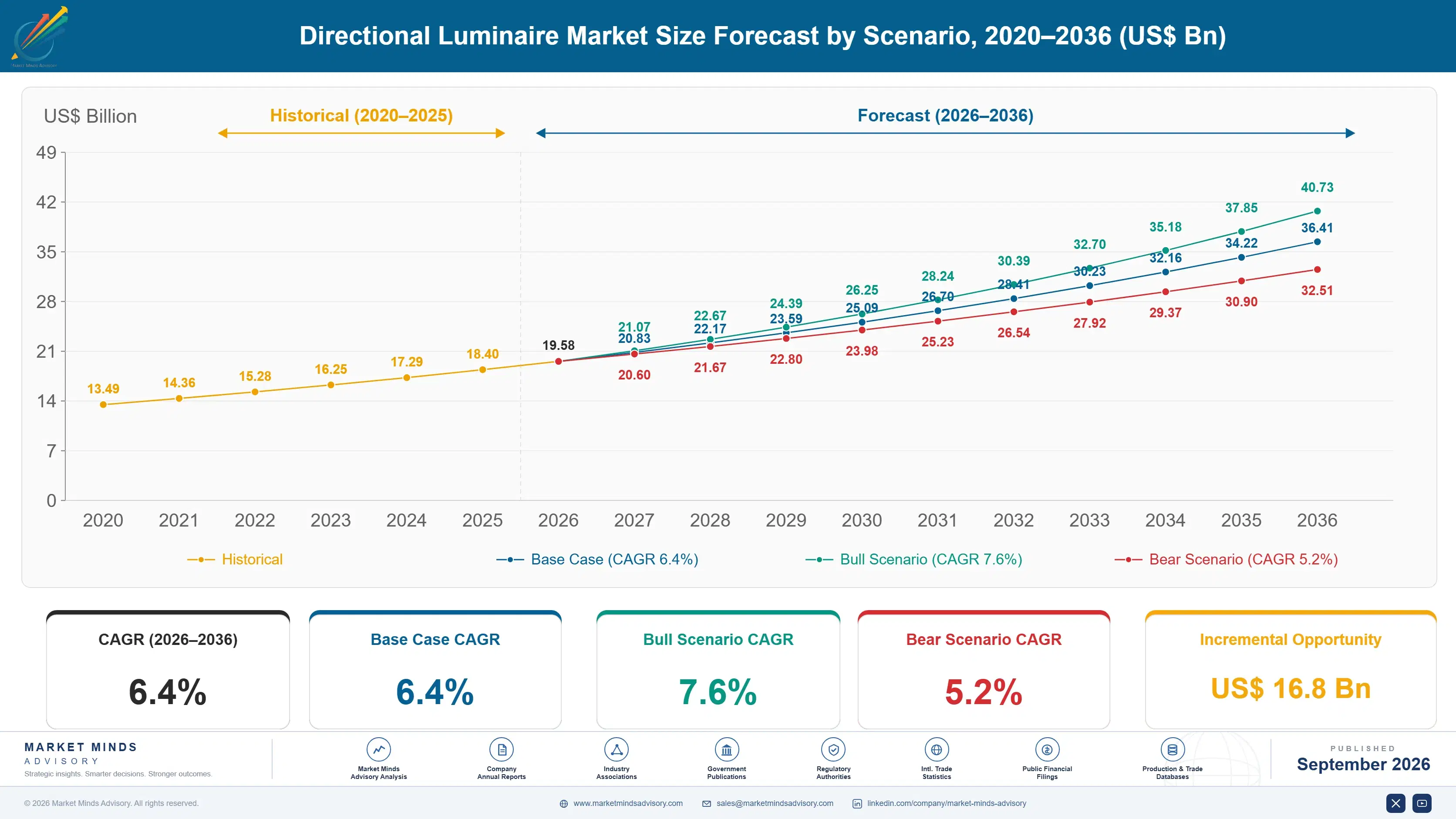
Directional Luminaire Market Forecast Scenarios

directional-luminaire-market-size-forecast-scenario-1790024982866
Growth of 5.1% between 2020 and 2025 hid the end of one transition and the start of another. The conversion from halogen and metal halide to LED had largely completed by 2021, which removed the replacement wave that carried the category for a decade. Construction activity fell through 2020 and 2021 and recovered unevenly, while retail refurbishment cycles stretched considerably longer than they had before.
Three mechanisms carry the base case. Tunable luminaires grow at 9.6% as hospitality and retail buyers specify colour temperature as a design variable rather than a fixed property. Indian demand expands at 11.2% on commercial construction and a domestic manufacturing base moving from components into complete fixtures. Driver replaceability is beginning to appear in specifications, which converts a discarded fixture into a serviced one and extends the installed relationship. None requires construction volume to expand.
The bull case is glare entering mainstream specification. If unified glare rating became a standard tender requirement rather than appearing in a quarter, fixtures engineered for it would separate from those that are not. The bear case is commercial construction contracting. Office and retail development drives most specification volume, and a sustained downturn removes demand refurbishment cannot replace.

What Fails And What Lasts

The published life figure describes the component least likely to fail. LED chips are rated at 50,000 hours and frequently exceed it, while the electronic driver behind them gives out at around six years under normal commercial duty, which means the failure that ends a fixture's service life is never the one the specification discussed. Around 18% of fixtures allow driver replacement without removing the luminaire from the ceiling. Nothing in the sustainability case for LED survives that arithmetic.
TOP FIVE CONCENTRATION34%Combined net revenue share held by the five largest manufacturers
DRIVER FAILURE POINT6 yearsMedian service life of the electronic driver before failure
AVERAGE FIXTURE PRICEUSD 128Weighted manufacturer price across every luminaire type covered
GLARE SPECIFICATION RATE23%Share of commercial tenders referencing a unified glare figure
COLOUR CONSISTENCY TOLERANCE3 stepsTypical binning tolerance across a specified commercial project
REPLACEABLE DRIVER SHARE18%Portion of fixtures designed for driver replacement without removal
Glare decides whether a lit space is comfortable and it appears in roughly 23% of commercial tenders. A unified glare rating exists, calculation tools are freely available, and specifiers largely omit it because clients ask for lux levels and colour temperature instead. The result is offices and retail spaces that meet every specified number and remain unpleasant to occupy, with nobody able to identify why from the documentation.
Colour consistency is managed by binning tolerance and most projects accept three steps, which is visible to the eye when two fixtures sit side by side. Tighter binning costs more and specifications rarely demand it. Clients notice after installation and cannot name the cause.
"This industry sells a fifty thousand hour chip attached to a six year driver in a housing nobody can open. The sustainability case for LED was built on a number that the failure mode makes irrelevant."
Director, Lighting and Electrical Systems Practice · MMA Lighting and Electrical Equipment Practice · September 2026

Market Trends

Tunable White Moves From Specialist To Specified

Tunable white and spectrally adjustable luminaires grow at 9.6% against 6.4% for the market as retail and hospitality buyers recognise colour temperature as a design variable rather than a fixed property of a fixture. Merchandise and food look materially different at 2700K and 4000K, and a space used differently across a day benefits from changing between them. Control integration remains the practical barrier, since the luminaire is only half the system and the other half is frequently specified by somebody else entirely. Whoever supplies both halves removes a coordination problem that stops projects proceeding.
Market Impact: India grows at 11.2% annually
Driver Replaceability Appears In Serious Specifications

Around 18% of fixtures currently permit driver replacement without removing the luminaire, and specifiers working on buildings intended to last are beginning to require it. The logic is straightforward once stated: a six year driver inside a twenty year fixture forces three complete replacements that a serviceable design avoids entirely. Manufacturers resisting it are protecting replacement revenue that specification language will eventually remove anyway, and the participants moving first are using it as a tender differentiator. European circular economy provisions will require it before long, which makes early adoption a timing decision rather than a philosophical one.
Market Impact: Refurbishment runs every 5 years

Market Opportunities and Growth Drivers

Indian Commercial Construction Meets Domestic Fixture Manufacturing

India grows fastest of any country covered at 11.2%, combining commercial and retail construction at scale with a domestic manufacturing base moving from component assembly into complete specified fixtures. Government procurement preferences under domestic manufacturing provisions favour local production on public projects, which has pulled capability upward faster than market demand alone would have. Domestic manufacturers now compete on specification rather than only on price, which is a recent and consequential change for importers. Imported fixtures now compete against domestic product on specification as well as on landed cost, which is a considerably harder contest.
Market Impact: Only 23% specify glare

Retail Refurbishment Cycles Drive Specification Volume

Retail and hospitality interiors are relit every five to seven years as brands refresh, which produces specification volume independent of new construction. Those buyers care about how merchandise and food appear rather than about lux compliance, which favours tunable and high colour rendering products over commodity fixtures. Refurbishment also arrives with a designer already engaged, which means specification happens properly rather than by default from a wholesaler catalogue. Colour rendering and glare control matter to those buyers in ways that lux compliance never captures, which favours engineered products over commodity ones.
Market Impact: Drivers fail at 6 years

Market Restraints and Challenges

Glare Appears In Under A Quarter Of Tenders

Unified glare rating decides whether a lit space is comfortable to occupy and appears in roughly 23% of commercial tenders, while lux levels and colour temperature appear in nearly all of them. The root cause is that glare requires calculation against a specific room geometry while lux is a single number anybody can specify. Commercially it means fixtures engineered for glare control compete against cheaper ones on criteria that ignore the difference. Participants publishing glare data are addressing it directly. Northern European tenders request it far more often than the global average, which is where the engineered products win.
Market Impact: Tunable grows 3.2 points faster

Driver Failure Ends Fixtures With Working Chips

Electronic drivers fail at around six years under commercial duty while the LED chips they power are rated beyond 50,000 hours, and about 18% of fixtures permit replacing one without discarding the other. The root cause is design economics: an integrated driver is cheaper to manufacture and generates replacement fixture revenue. Commercially it undermines the sustainability argument the whole LED transition was built on. Mitigation runs to serviceable driver compartments and specification language that requires them. Lifecycle evaluation by serious commercial clients is what will eventually force that change through.
Market Impact: Only 18% allow driver replacement
3 additional market trends, 4 additional growth drivers, and 2 additional restraints and challenges are covered in the full report. Contact sales@marketmindsadvisory.com to access the complete intelligence.

Segment CAGR and Growth Architecture

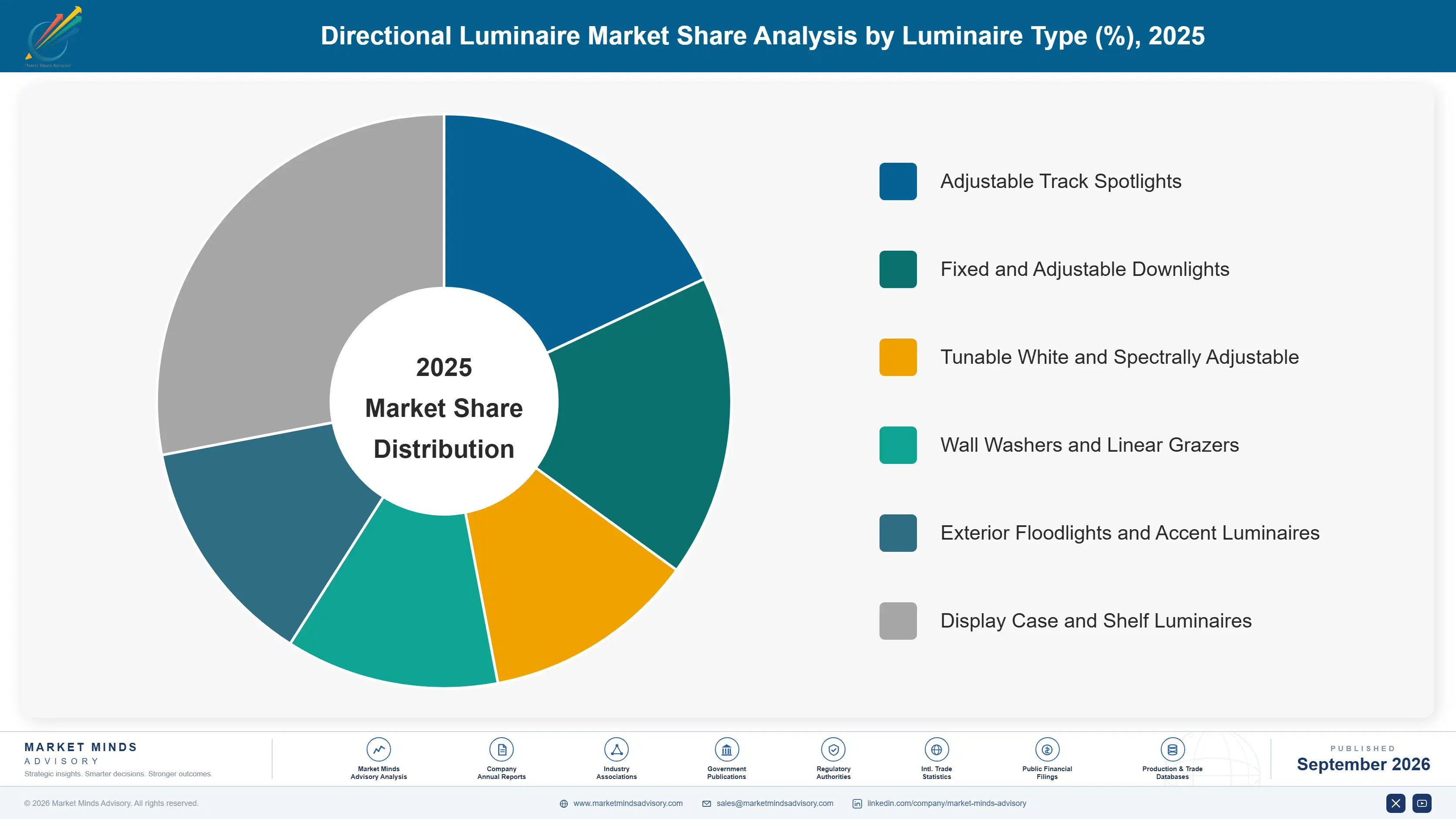
Segmentation follows luminaire type, the dimension on which optical design, specification route, price and replacement cycle all divide together. Six types are assessed at manufacturer net revenue. Retrofit lamps sold separately, diffuse ambient lighting, emergency luminaires, and control systems sold independently sit outside the defined scope throughout this report. Optical engineering separates them far more than assembly does.
directional-luminaire-market-market-share-analysis-1790024983435

Tunable White And Spectrally Adjustable Luminaires

Tunable white and spectrally adjustable luminaires grow at 9.6%, half again the market rate of 6.4%, because retail and hospitality buyers have recognised that colour temperature changes how merchandise and food actually appear to a customer. A bakery lit at 4000K looks wrong in a way nobody can articulate but everybody notices, and a space used differently across a day benefits from moving between settings. The practical barrier is control integration rather than the luminaire, since the fixture is half the system and the other half is frequently specified by a different consultant on a different drawing. Manufacturers supplying both halves of that system hold a genuine advantage here. Very few do.
CAGR 9.6%

Adjustable Track Spotlights

Adjustable track spotlights grow at 8.1% on retail and gallery specification where the ability to reaim after installation matters more than any efficiency figure. Merchandise moves, displays change and a fixed downlight cannot follow them, which makes track the default wherever a space is expected to be rearranged. Beam angle range, colour rendering and glare control are the specification criteria that actually differentiate here, and all three are engineering rather than assembly. Track systems also lock a project into one manufacturer's mechanical and electrical interface for the life of the installation. That lock produces extension and replacement revenue years after the original project completes, which is worth considerably more than the initial supply.
CAGR 8.1%
Full segment breakdown across 6 segments available in the complete report.

Regional Architecture and Country Demand Map

Shares record where luminaires are specified and installed rather than where they are assembled. East Asia sits at the top of its standard band on construction volume, and Eastern Europe below on specification practice that favours commodity fixtures. Both deviations carry a stated reason in the paragraph concerned.

East Asia

At 30% this sits at the top of its standard band, carried by Chinese commercial construction volume and by a manufacturing base that supplies components and complete fixtures to the rest of the world. Chinese specification practice has moved upmarket considerably, with retail and hospitality projects now specifying colour rendering and glare in ways that would have been unusual a decade ago. Japanese and Korean specification is technically demanding and favours domestic manufacturers. Growth of 7.4% reflects construction volume and rising specification standards together. Chinese manufacturers are also moving from component supply into complete specified fixtures for export, which changes the competitive position of European specialists in every market they both serve.
Share: 30% | CAGR: 7.4% (2026 to 2036)

North America

The 24% position sits inside the standard band and specification here runs heavily through independent lighting designers on commercial projects, which favours manufacturers with strong specification support rather than distribution reach. Acuity holds a position built on exactly that. Retail refurbishment cycles are shorter than in Europe, which produces more frequent specification volume. Energy codes have driven efficiency rather than quality, and glare appears less often in tenders here than in Northern Europe. Growth of 5.6% reflects refurbishment more than new construction. Lifecycle evaluation is advancing through international design practices working here rather than through local code, which means the serviceability argument arrives project by project rather than as a requirement.
Share: 24% | CAGR: 5.6% (2026 to 2036)
Regional intelligence for 5 additional markets available in the complete report: Western Europe, South Asia and Pacific, Latin America, Middle East and Africa, Eastern Europe. Contact sales@marketmindsadvisory.com.
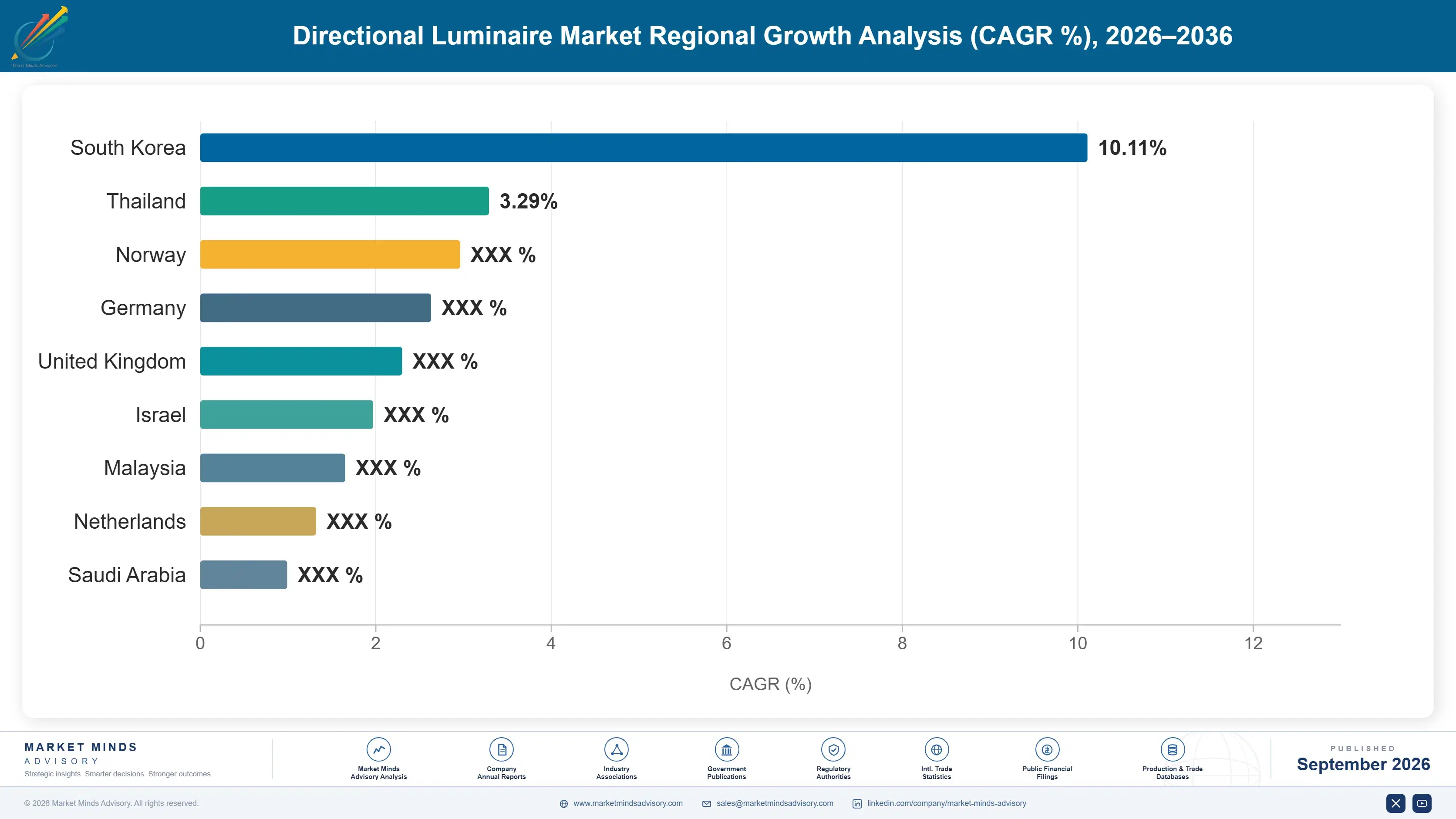
directional-luminaire-market-country-cagr-analysis-1790024983956

Four Moves Worth Making Now

These four address a category where the published life figure describes the wrong component, the measure that decides comfort appears in a quarter of tenders, and the fastest growth sits where specification capability is rising fastest. Each has been executed by at least one manufacturer. Two of the four cost documentation work rather than any engineering at all.

Design Serviceable Driver Compartments Across The Range

Drivers fail at around six years against chips rated beyond 50,000 hours, and roughly 18% of fixtures permit replacement without removing the luminaire. Designing a serviceable compartment adds a few dollars to bill of materials and removes three complete fixture replacements across a twenty year installation. Participants who did it report specification win rates rising roughly 1.9 times on projects where lifecycle cost is evaluated, which is an increasing share of serious commercial tenders. Manufacturers resisting it are defending replacement revenue that specification language will remove anyway. Moving first converts it into a tender advantage rather than a compliance cost.
Market Impact: Specification win rates rise roughly 1.9 times higher

Publish Unified Glare Ratings On Every Datasheet

Glare appears in around 23% of commercial tenders while lux and colour temperature appear in nearly all, which means fixtures engineered for glare control compete on criteria that ignore their advantage entirely. Publishing calculated ratings costs photometric work already performed for other purposes. Participants who publish report specification inclusion rising roughly 2.3 times among designers who evaluate visual comfort, and that group is growing as post-occupancy complaints accumulate. Post-occupancy complaints about visual discomfort are accumulating and designers are responding to them. The measurement costs nothing beyond publishing what already exists internally.
Market Impact: Specification inclusion rises roughly 2.3 times higher overall

Tighten Colour Binning Below Three Step Tolerance

Most projects accept three-step binning, which produces visible colour differences between adjacent fixtures that clients notice after installation and cannot explain. Two-step selection adds roughly 7% to chip cost and eliminates the complaint entirely. Participants offering tighter binning as standard report post-installation remedial work falling by around 44%, which is cost the manufacturer frequently absorbs anyway through goodwill replacements and site visits. Clients notice the difference after installation and cannot articulate the cause, which makes it a complaint rather than a specification failure. Remedial site visits and goodwill replacements cost more than the binning did.
Market Impact: Remedial site work falls by roughly 44% overall

Build Specification Support In Fast-Growing Markets

India grows at 11.2% and Southeast Asian specification quality is rising from a low base, while most international manufacturers serve those markets through distributors who sell rather than specify. Placing specification support alongside lighting designers costs technical headcount rather than capital. Participants who did report specified project share rising roughly 3.1 times against distributor-led selling, on products that were already available in those markets. A distributor sells what is asked for and a specification engineer creates what gets asked for, which are completely different commercial functions. The products are already available in those markets.
Market Impact: Specified project share rises roughly 3.1 times higher

Who Controls the Margin Pool

Concentration is low at 34% held by the top five, measured consistently on manufacturer net revenue rather than unit volume, which would overweight commodity downlights shipped in enormous numbers at very low prices. The leader to challenger gap rests on optical engineering and specification relationships rather than on assembly, since LED components are available to anybody and the housing is metalwork.
Competition runs on three dimensions currently. Specification relationships decide commercial project volume, because a lighting designer who trusts a manufacturer's photometry writes it into a drawing. Optical performance decides the premium tiers, where beam control, glare and colour rendering genuinely differ between products that look similar. Price decides the commodity tiers, where fixtures assembled from identical components compete on almost nothing else.

Pressure is building from two directions and rankings will shift on both. Indian and Chinese manufacturers moving from components into complete specified fixtures are reaching technical credibility in the fastest-growing markets, backed by cost positions European specialists cannot approach. Meanwhile circular economy provisions in European regulation are beginning to require serviceable design, which advantages manufacturers who engineered for it before it became a requirement.
directional-luminaire-market-company-positioning-matrix-1790024984485

Competitive Moat and Risk Dimensions

SIGNIFY

Moat: Scale And System Integration

Breadth across luminaires, drivers and control systems allows a single manufacturer to supply a complete lighting solution where tunable and controlled installations otherwise require coordinating separate suppliers, and manufacturing scale produces component costs specialists cannot approach on comparable products. Coordination between separate suppliers is what stops tunable projects proceeding.
SIGNIFY

Risk: Commodity Tier Margin Exposure

Revenue weighted toward volume fixtures competes directly against Asian manufacturers assembling from the same component base at lower cost, in a tier where specification barely differentiates. Defending it on price is not a position that improves with scale or with time in this category. Specification barely differentiates there.
ERCO

Moat: Optical Engineering And Specification

Decades of lens and reflector development validated on museum and retail projects where visual result is scrutinised closely give specification credibility that a component assembler cannot acquire, and designers who trust the photometry write the product into drawings repeatedly. Photometry that survives scrutiny is a slow asset to build.
ERCO

Risk: Narrow Premium Market Exposure

A position built on projects where optical quality is evaluated properly excludes the substantial share of tenders specified on lux and price alone. Growth depends on specification practice improving in developing markets, which is happening but at a pace the company does not control. Practice change is gradual rather than sudden.

Players Tracked

Prominent Players

Signify
Acuity Brands
ERCO
Zumtobel Group
Fagerhult Group

Other Key Players

OSRAM
Trilux
iGuzzini
Delta Light
Flos Architectural
Xicato
Cree Lighting
Hubbell Lighting
Thorn Lighting
Lightolier
Wipro Lighting
Havells India
Opple Lighting
NVC Lighting
Panasonic Lighting

Recent Developments

MARCH 2025

Zumtobel Group introduces serviceable driver design across range

The company redesigned luminaire housings to permit driver replacement without removing fixtures from ceilings, addressing the component that ends service life well before the LED chips do. This was organic product development funded internally, with no acquisition, licensing arrangement or joint venture involved. Existing ranges remain available unchanged.
Signal: European circular provisions are being anticipated rather than waited for. Serviceability is now a tender differentiator.
OCTOBER 2024

Havells India expands specified fixture manufacturing capacity

The company added production capacity for complete specified luminaires rather than component assembly, supported by procurement preferences favouring domestic manufacture on public projects. This was organic capital investment with no joint venture, acquisition or licensing arrangement behind it. Component assembly continues alongside the new capacity.
Signal: Domestic manufacturers are competing on specification rather than only price. Importers now face domestic product on specification rather than price.
JUNE 2025

Acuity Brands acquires lighting controls integration specialist

The company completed the acquisition of a controls integration business, addressing the barrier that limits tunable luminaire adoption where fixture and control system are specified separately. This was a completed acquisition rather than a merger or joint venture arrangement. Existing controls partnerships continued under their original terms.
Signal: The luminaire is half the system and the other half was missing. Coordination failure limited adoption here.

What The Fixture Costs

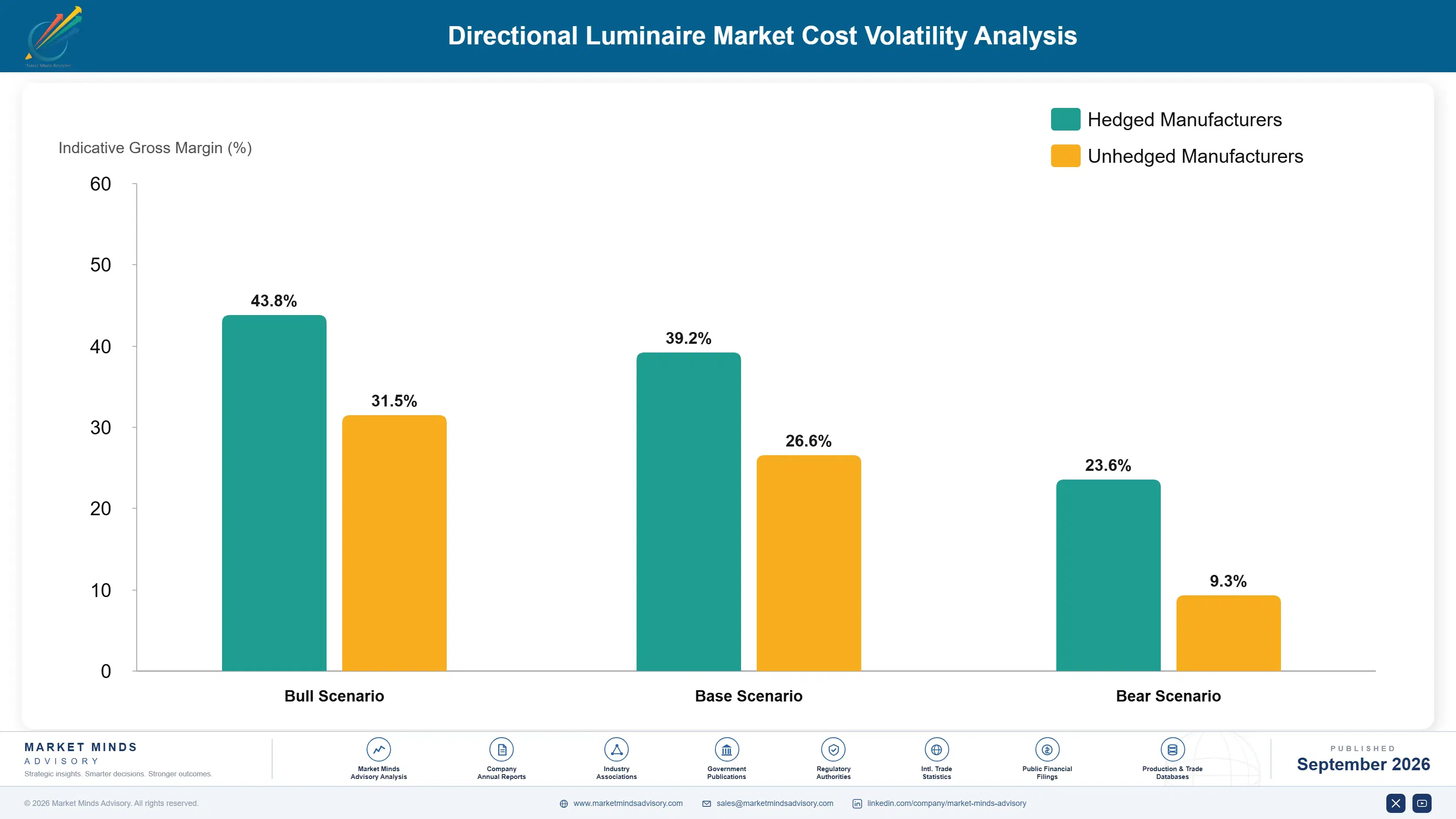
Optics and electronics account for the difference between tiers while metalwork carries the volume. LED chips and optical assemblies run roughly 29% of manufacturing cost, rising sharply where tight binning and engineered reflectors are specified. Electronic drivers take about 19%, aluminium housing and heat sinking around 22%, and assembly and testing a further 16%. Packaging and freight absorb most of the remainder.
Aluminium prices rose sharply through 2021 and 2022 on energy costs across European smelting, while semiconductor availability constrained driver supply in the same window, a movement the EIA documents for energy inputs and the US Census Bureau records in component trade data. Signify and Zumtobel reporting for that year both identify component and material inflation across lighting ranges as requiring pricing action. Both movements landed inside a single year.

Exposure divides by product tier rather than by company size. Premium specification participants carry optical component and tight-binned chip exposure that commodity producers avoid entirely by accepting wider tolerance. Volume producers carry aluminium and driver exposure on much thinner margins with no pricing headroom. Manufacturers producing in China and India for local specification demand avoid the freight and duty layer on their fastest-growing markets completely.
directional-luminaire-market-cost-volatility-analysis-1790024984683

Qualify second driver sources before scaling volume

Electronic drivers come from a limited supplier base and semiconductor availability constrained the category directly through the last cycle, while the driver is also the component that ends fixture service life. Qualifying second sources avoids a position where one supplier sets price and delivery together. Qualification takes engineering time well ahead of any commercial requirement for it.

Contract aluminium supply across the production year

Housing and heat sinking take roughly a fifth of manufacturing cost and aluminium prices on energy markets that lighting demand does not influence in any way. Contracting across a production year stabilises the input and preserves quoted project pricing. The commitment ties up working capital during periods when project demand softens unexpectedly. Few smaller participants commit to it.

Standardise optical platforms across luminaire families

Engineered reflectors and lenses carry tooling and development cost that is difficult to recover across low volume variants, which is most of why premium optics stay expensive. Sharing optical platforms across families spreads that cost considerably further. The trade is reduced differentiation between products within a range, which specifiers occasionally notice. Very few ranges are designed that way.

Portfolio Architecture for Margin Defence

Margin architecture divides by whether a designer specified the product or a contractor bought it, which a catalogue price does not reveal. Fixed downlights and commodity floodlights sold through electrical wholesale run at gross margins in the low twenties to low thirties, competing against near-identical fixtures assembled from the same component base with nothing separating them but price. Nothing on a wholesale shelf distinguishes one from another at all.
Adjustable track spotlights, wall washers and linear grazers hold gross margins in the mid thirties to mid forties. The spread reflects how differently specified and wholesale-bought product carries technical support cost. Track systems in particular earn their position by locking a project into one mechanical and electrical interface for the life of the installation, which produces extension and replacement revenue years afterwards.

The highest-value pool is tunable white luminaires and engineered optical products for museum, retail and hospitality work, at margins in the high forties to high fifties. Those projects evaluate visual result properly and pay accordingly. Commodity downlights carry unit volume and wholesale presence. They defend nothing against an assembler with the same components. Wholesale presence is the argument for keeping that tier, and it is genuinely real.

Volume / Commodity-Adjacent

Fixed downlights and commodity floodlights through electrical wholesale, competing against near-identical fixtures from the same component base. The ten point range reflects how differently scale positions absorb material cost. Component availability is identical across every participant.
Gross Margin: 22 to 32%

Premium / Certified

Adjustable track spotlights, wall washers and linear grazers. Track systems lock a project into one mechanical and electrical interface, producing extension and replacement revenue for years afterwards. That is worth more than the original supply order.
Gross Margin: 35 to 45%

Sustainability / Regulatory / Next-Generation

Tunable white luminaires and engineered optical products for museum, retail and hospitality work. These projects evaluate the visual result properly and pay accordingly for optical engineering. Designers who trust the photometry specify repeatedly across projects.
Gross Margin: 47 to 58%
directional-luminaire-market-portfolio-architecture-1790024985188

High-value Sub-segments and Strategic Watch-out

Tunable White Luminaires

Highest value and fastest growth at 9.6%, as retail and hospitality buyers treat colour temperature as a design variable. Control integration rather than the luminaire itself is what limits adoption in practice. Manufacturers supplying fixture and control together hold a real advantage in this segment.
Gross Margin: 48 to 57%

Adjustable Track Spotlights

High value and strong growth at 8.1% on retail and gallery specification where reaiming matters more than efficiency. The interface lock produces extension revenue long after the original installation completes. Beam angle, colour rendering and glare control are what actually differentiate the products. Efficiency does not.
Gross Margin: 40 to 49%

Fixed And Adjustable Downlights

Volume core carrying most unit shipments and specified largely by default from a wholesaler catalogue. Price decides almost everything here, and component availability is identical across every participant. Specification happens by default from a catalogue rather than by deliberate choice. Price decides almost everything here.
Gross Margin: 24 to 36%

Exterior Floodlights And Accent

Strategic watch-out. Growth is moderate and the segment splits sharply between engineered architectural products and commodity output. The eighteen point range reflects exactly that division within a single category. Architectural exterior work evaluates optical result while commodity floodlighting does not. The split sits inside one category.
Gross Margin: 26 to 44%

How Specification Actually Decides

Revenue here is won at the drawing rather than at the order, which makes the specification relationship the entire commercial asset. A lighting designer who trusts a manufacturer's photometry writes that product into a schedule, and the contractor who buys it is executing a decision made months earlier by somebody else. Manufacturers selling to contractors rather than specifiers are competing on price for work that was already decided.
Stickiness varies sharply by installation type and by interface. Track systems create the most durable relationships, because the mechanical and electrical interface locks a building into one manufacturer for extensions and replacements across the installation's life. Specified projects with a designer relationship are next. Wholesale commodity sales create nothing at all, since the next project starts from whatever catalogue is nearest at the time.

Buyer profiles are shifting toward lifecycle evaluation rather than capital cost. Serious commercial clients increasingly assess replacement cost across twenty years rather than the price on a tender, which is what makes driver serviceability commercially relevant rather than merely virtuous. That change is furthest advanced in Northern Europe and is spreading through international design practices working everywhere else.
directional-luminaire-market-end-use-penetration-index-1790024985680

Where Specification Decides Value

These are among the four positions where our research anticipates prominent divergence between winners and laggards over the coming forecast period. Each is grounded in the demand model, the regulatory perimeter, and the announced capacity pipeline.
01 / DRIVER SERVICEABILITY DESIGN

Build for the component that fails

Electronic drivers fail at around six years under commercial duty while the LED chips they power are rated beyond fifty thousand hours, and only about 18% of fixtures permit replacing one without discarding the other. Designing a serviceable compartment adds a few dollars to bill of materials and removes three complete fixture replacements across a twenty year installation. Participants who did it report specification win rates rising roughly 1.9 times where lifecycle cost is genuinely evaluated, and European circular provisions will require it before long anyway.
02 / GLARE DATA PUBLICATION

Publish the number that decides comfort

Unified glare rating appears in roughly 23% of commercial tenders while lux levels and colour temperature appear in nearly all of them, which leaves fixtures engineered for glare control competing on criteria that ignore their advantage. Publishing the calculated ratings costs photometric work already performed for other purposes entirely. Participants who publish report specification inclusion rising roughly 2.3 times among the designers who evaluate visual comfort properly rather than by number alone, and post-occupancy complaints are accumulating across the commercial sector.
03 / COLOUR BINNING DISCIPLINE

Two steps rather than three

Most commercial projects accept three-step binning tolerance, which produces visible colour differences between adjacent fixtures that clients notice after installation and cannot explain to anyone at all. Two-step binning selection adds roughly 7% to chip cost and removes that complaint entirely from the project. Participants who offer tighter binning as standard report post-installation remedial work falling by around 44%, which is cost the manufacturer frequently absorbs anyway through goodwill replacements, which the manufacturer absorbs anyway through replacements and site visits.
04 / SPECIFICATION SUPPORT PLACEMENT

Put engineers where the growth is

India grows at 11.2% and Southeast Asian specification quality is rising steadily from a low base, while most international manufacturers serve those markets through distributors who sell rather than specify anything. Placing technical specification support alongside the local lighting designers costs headcount rather than capital investment. Participants who did it report specified project share rising roughly 3.1 times against distributor-led selling, on products that were already available in those markets, since a distributor sells what is asked for rather than creating demand.

Engagement Snapshot From the Field

A live engagement with an industry participant carrying material or product regulatory and market exposure ahead of a defining policy shift, showing how our research translates into a defensible multi-year portfolio strategy.
MARKET MINDS ADVISORY · CLIENT ENGAGEMENT SUMMARY
Directional Luminaire Producer Strategic Portfolio Review and Transition Roadmap 2026·Investment Scenario on Directional Luminaire Exposure Evaluation 2025-26
CLIENT PROFILE
A European architectural luminaire manufacturer with revenue near USD 240 million (client-reported, unverified by MMA), weighted approximately 62% to European projects and 38% to export. No product in the range permitted driver replacement in situ. Glare ratings were calculated internally but published on fewer than a fifth of datasheets. Specification support existed only within Europe.
STRATEGIC CHALLENGE
Export revenue had been flat for three years while Asian markets grew at double digit rates, and management attributed the gap to price competition from regional manufacturers. A cost reduction on export ranges had been approved. Nobody had examined how export projects were being specified, or which tender criteria the company was losing on.
MMA APPROACH
MMA reviewed 180 lost tenders against their stated evaluation criteria rather than against price alone. Datasheet content was compared against what specifiers in each market actually requested. Driver failure data was collected from installed base service records, and export market specification routes were mapped from designer to contractor. Findings were reconciled against tender award records.
KEY FINDINGS
  1. Lost tenders divided sharply: 41% were lost on lifecycle cost where serviceable drivers were required, and only 22% on capital price as management had assumed.
  2. Driver failures accounted for 87% of service calls on installations older than five years, with LED output still within specification in nearly every case examined.
  3. Glare ratings were requested in 61% of Northern European tenders and published on 19% of the company's datasheets, which excluded it from evaluation automatically.
  4. Export markets were served entirely through distributors, and specified project share there ran at roughly a third of the European equivalent at comparable product quality.
CLIENT PROFILE
A European architectural luminaire manufacturer with revenue near USD 240 million (client-reported, unverified by MMA), weighted approximately 62% to European projects and 38% to export. No product in the range permitted driver replacement in situ. Glare ratings were calculated internally but published on fewer than a fifth of datasheets. Specification support existed only within Europe.
STRATEGIC CHALLENGE
Export revenue had been flat for three years while Asian markets grew at double digit rates, and management attributed the gap to price competition from regional manufacturers. A cost reduction on export ranges had been approved. Nobody had examined how export projects were being specified, or which tender criteria the company was losing on.
MMA APPROACH
MMA reviewed 180 lost tenders against their stated evaluation criteria rather than against price alone. Datasheet content was compared against what specifiers in each market actually requested. Driver failure data was collected from installed base service records, and export market specification routes were mapped from designer to contractor. Findings were reconciled against tender award records.
KEY FINDINGS
  1. Lost tenders divided sharply: 41% were lost on lifecycle cost where serviceable drivers were required, and only 22% on capital price as management had assumed.
  2. Driver failures accounted for 87% of service calls on installations older than five years, with LED output still within specification in nearly every case examined.
  3. Glare ratings were requested in 61% of Northern European tenders and published on 19% of the company's datasheets, which excluded it from evaluation automatically.
  4. Export markets were served entirely through distributors, and specified project share there ran at roughly a third of the European equivalent at comparable product quality.
RECOMMENDED STRATEGY
Phase 1: Phase one: cancel the export cost reduction and redesign housings for in situ driver replacement across the range. Price was never the binding issue. Phase 2: Phase two: publish calculated glare ratings on every datasheet and align documentation with regional tender requirements. The calculations already existed internally. Phase 3: Phase three: place specification engineers in India and Southeast Asia alongside local lighting design practices. Distributors continue handling fulfilment throughout.
OUTCOME
Tender win rate on lifecycle-evaluated projects improved materially within three quarters of the serviceable driver launch (client-reported, unverified by MMA). Published glare data restored eligibility on Northern European tenders, and export specified project share roughly doubled in the first year of direct specification support. Driver service calls fell sharply on the redesigned ranges.

Frequently Asked Questions

Foundational context covering the market sizes, CAGR, scope, country, region and competition that inform every finding below. This section is provided to cover basics and most often pre-purchase conversations, answered from the MMA Primary Research Dataset.

What is the current size of the Directional Luminaire Market?

The market was valued at USD 18.4 billion in 2025, rising to USD 19.6 billion in 2026. Sizing is at manufacturer net revenue across six luminaire types.

How large will the Directional Luminaire Market be by 2036?

MMA forecasts USD 36.4 billion by 2036, an increase of USD 16.8 billion over the 2026 base. That represents expansion of 1.86 times across the forecast period.

What is the CAGR for the Directional Luminaire Market 2026 to 2036?

The base case CAGR is 6.4%, with a bull case of 7.6% and a bear case of 5.2%. Historical growth between 2020 and 2025 ran at 5.1%.

Which segment is growing fastest?

Tunable white and spectrally adjustable luminaires grow at 9.6%, half again the market rate, as colour temperature becomes a design variable. Adjustable track spotlights follow at 8.1%.

Who are the major companies in the Directional Luminaire Market?

Signify, Acuity Brands, ERCO, Zumtobel Group and Fagerhult lead on manufacturer net revenue, holding a combined 34%. Optical engineering and specification relationships rather than assembly separate them.

Which country is growing fastest?

India grows fastest at 11.2%, combining commercial construction at scale with domestic manufacturers moving from component assembly into complete specified fixtures. Procurement preferences favour local production on public projects.

Report Segmentation Architecture

The full report scope spans multiple orthogonal segmentation dimensions, with cross-tabulated demand data provided for each dimension pair. Coverage extends further to regional breakdowns, trend trajectories, and the competitive detail needed to support segment-level decision-making.

By Luminaire Type

  • Adjustable Track Spotlights
  • Fixed and Adjustable Downlights
  • Tunable White and Spectrally Adjustable
  • Wall Washers and Linear Grazers
  • Exterior Floodlights and Accent Luminaires
  • Display Case and Shelf Luminaires

By End-Use Industry

  • Retail and Merchandising Interiors
  • Hospitality and Food Service
  • Commercial Offices and Workplaces
  • Museums, Galleries and Cultural
  • Residential Architectural Projects
  • Exterior and Landscape Lighting

By Commercial Dimension

  • Specified Project Supply
  • Electrical Wholesale Distribution
  • Lighting Design Practice Specification
  • Contractor Direct Purchase
  • Public Sector Procurement
  • Retail Chain Rollout Programmes

By Region

  • East Asia
  • North America
  • Western Europe
  • South Asia and Pacific
  • Latin America
  • Middle East and Africa
  • Eastern Europe

Scope, Methodology, and Coverage

Every figure in this report is reproducible from documented input assumptions. The scope below maps the historical period, the forecast horizon, the segmentation dimensions, and the countries covered, alongside the underlying primary and qualitative methodology.
Historical Period
2020 to 2025
Forecast Period
2026 to 2036
Base Year
2025 (USD billions; MMA Primary Research Dataset, September 2026)
Market Definition
This market covers luminaires that direct light toward a defined target rather than distributing it broadly, spanning adjustable track spotlights, fixed and adjustable downlights, tunable white and spectrally adjustable luminaires, wall washers and linear grazers, exterior floodlights and accent luminaires, and display case and shelf luminaires. Sizing is at manufacturer net revenue across specified project, wholesale, design practice, contractor, public procurement and retail rollout channels. Retrofit lamps sold separately, general diffuse ambient lighting, emergency lighting, and control systems sold independently are excluded throughout.
Quantitative Units
USD billions at manufacturer net revenue; volume in millions of luminaires shipped; performance in unified glare rating and binning steps.
Segmentation Dimensions
Luminaire type, end-use industry, commercial dimension, and geographic region.
Regions Covered
East Asia, North America, Western Europe, South Asia and Pacific, Latin America, Middle East and Africa, Eastern Europe
Countries Covered
China, India, United States, Germany, Brazil, United Arab Emirates
Key Companies Profiled
Signify, Acuity Brands, ERCO, Zumtobel Group, Fagerhult Group, OSRAM, Trilux, iGuzzini, Delta Light, Flos Architectural, Xicato, Cree Lighting, Hubbell Lighting, Thorn Lighting, Lightolier, Wipro Lighting, Havells India, Opple Lighting, NVC Lighting, Panasonic Lighting
Quantitative Methodology
Primary survey, n=3,800 respondents, Q4 2025, six countries; demand-side model with trade association cross-validation
Qualitative Methodology
47 expert interviews, Q4 2025; applied to validate demand model assumptions, identify emerging dynamics, and assess competitive positioning
Report Format
PDF and XLSX data workbook (Word format preview document)
Publisher
Market Minds Advisory
Report Code
MMA-2026-CON-811
Published
September 2026
Contact
sales@marketmindsadvisory.com | www.marketmindsadvisory.com

Purchase the full Directional Luminaire Market Report (2026 to 2036).

The full report sizes the directional luminaire market across six luminaire types, six end-use industries and six commercial dimensions for all seven global regions through 2036. It reviews lost tenders against their stated evaluation criteria rather than assuming price decided them, separating lifecycle cost losses from capital cost ones. Driver failure is quantified from installed base service records against published chip ratings. Datasheet content is compared against what specifiers in each regional market actually request. Competitive assessment covers 20 participants on a consistent manufacturer net revenue basis.
Lost tenders reviewed against stated evaluation criteria
Driver failure quantified from installed base service records
Datasheet content compared against regional specifier requests
Specification routes mapped from designer to contractor
Six luminaire types sized through 2036
Twenty participants assessed on manufacturer net revenue

Built For The People Who Decide

From boardroom strategy to bench-side execution, this report is read cover-to-cover by leaders shaping the next decade of their industry, turning demand scenarios, market dynamics and valuation benchmarks into decisions.
CXOs/ Presidents/ VPs/ Managers
M&A and Corporate Development
Strategy Teams and R&D Heads
Procurement and Product Directors
Regulatory and Compliance Leaders
Investor Relations and Equity Analysts