Market Minds Advisory
Dimethylolpropionic Acid Market

Dimethylolpropionic Acid Market: Waterborne Coatings Transition and VOC Regulation Compliance Through 2036

Tightening volatile organic compound regulations are pushing coatings manufacturers toward waterborne polyurethane dispersions faster than legacy solvent-based formulations can be phased out across major industrial markets, reshaping capacity investment across the specialty chemical supply chain.

Lead Analyst

Bilal Shaikh

Published

September 2026

Make Smarter Decisions with Customized Research Insights

Request a free sample report and evaluate market opportunities, growth trends, and competitive dynamics relevant to your business needs.

2025 MARKET VALUE$0.3BMarket Size 2025
2036 FORECAST VALUE$0.6BBase Case , 2026 to 2036
CAGR 2026 TO 20366.8 %Bull 8.0% / Bear 5.6%
INCREMENTAL OPPORTUNITY$0.3BNet 10- year value creation
EXPANSION MULTIPLE1.93x2036 value over 2026 base
Strategic Levers
M&A Pipeline
Regional Outlook
Country Rankings
Competitive Intelligence
Segmental Deep-dive
Call-Us : 91 93563 13602

Executive Snapshot and Market Trajectory

Dimethylolpropionic acid remains a fundamentally niche building block chemical, but its role as the key ionomer monomer in waterborne polyurethane dispersions is pulling demand growth well ahead of the broader specialty chemical sector, and this application-specific concentration is quietly reshaping which producers hold the strongest long-term position.
Perstorp Group and Zhejiang NHU Company continue supplying established adhesive and printing ink formulation applications, since that demand base remains steady even as growth concentrates elsewhere in the category. Waterborne polyurethane dispersion grade is capturing disproportionate investment attention as coatings manufacturers across multiple regions comply with tightening volatile organic compound emission limits, Suppliers without documented waterborne formulation expertise increasingly struggle to win these newer high-volume contracts, particularly for producers relying on legacy commodity-only revenue.
Shandong Baifu New Materials and Ningbo Nengzhiguang Chemical are investing in powder coating resin grade production as industrial finishing applications demand different purity specifications than commodity adhesive uses ever required. Suppliers without flexible production capable of serving both commodity and higher-purity applications increasingly find themselves confined to lower-margin bulk contracts, particularly as industrial finishing customers formalize documented purity requirements across their supplier qualification programs, over time.
Market Definition
The dimethylolpropionic acid market covers waterborne polyurethane dispersion grade, powder coating resin grade, adhesive formulation grade, textile coating application grade, printing ink formulation grade, and other specialty polymer synthesis uses sold to coatings, adhesive, and polymer manufacturers. It excludes finished polyurethane dispersions and coatings sold as separate downstream products.
Base Year Value
$0.3B in 2025 (MMA Primary Research Dataset, August 2026)
Forecast Period
2026 to 2036, eleven discrete annual values
CAGR
6.8% base case. Bull 8.0%. Bear 5.6%.
Fastest Growth Segment
Waterborne Polyurethane Dispersion Grade: 9.5% CAGR
Fastest Growth Country
China: 8.0% CAGR
Fastest Growth Region
South Asia and Pacific: 8.8% CAGR
Largest Region
East Asia: 30% of 2025 global value
Market Leaders
Perstorp Group, Zhejiang NHU Company, Shandong Baifu New Materials, Ningbo Nengzhiguang Chemical, Wuxi Baichuan Chemical. Source: MMA Analysis based on company annual reports.
Primary Survey
n=3,800 procurement and R&D decision-makers, Q4 2025, six countries
Methodology
Demand-side build-up, cross-validated against public data, 47 expert interviews

Dimethylolpropionic Acid Market Forecast Scenarios

dimethylolpropionic-acid-market-trends-size-forecast-scenario-1787548387939
Between 2020 and 2025 the market grew at roughly 5.9 percent a year, with pandemic-era chemical supply chain disruptions briefly slowing shipments before waterborne coatings adoption and regulatory compliance deadlines accelerated production through the back half of the period, and waterborne dispersion intermediate orders climbed steadily as more coatings manufacturers finalized compliance timelines indeed too.
The base case assumes 6.8 percent annual growth to 2036, built on three mechanisms: waterborne polyurethane dispersion demand expanding as volatile organic compound regulations tighten across major coatings markets, powder coating resin applications growing as industrial finishing shifts away from solvent-based systems, and steady adhesive and printing ink demand sustaining baseline production regardless of which specific application is growing fastest. Together these three mechanisms sustain growth above simple industrial production trends.
A bull case near 8.0 percent depends on volatile organic compound regulations tightening faster than currently planned across additional emerging markets. The bear case near 5.6 percent assumes global industrial production growth slows enough that dimethylolpropionic acid demand growth tracks closer to simple solvent replacement levels, and chemical processors postpone finalizing capacity expansion decisions where demand signals stay uncertain.

Regulatory Compliance Reshapes Application Mix

Dimethylolpropionic acid economics run on feedstock cost and application grade above almost everything else, since the same base chemistry serves applications ranging from bulk adhesive to premium waterborne dispersion purely based on how tightly a producer can control purity and consistency, and that single variable has shaped supplier investment strategy across the entire industry for decades, and that dependency has shaped supplier strategy across the entire industry for years.
PRODUCER CONCENTRATIONCR5 44%top five producers hold roughly two-fifths of global capacity
AVERAGE SELLING PRICE$2,600/tonneblended price across commodity and specialty polymer grade material
EAST ASIA PRODUCTION SHARE36%share of global production capacity located within this region
WATERBORNE APPLICATION SHARE34%share of total volume consumed by dispersion coating production today
TRADE INTENSITY38%share of tonnage crossing a border before reaching final customers
FEEDSTOCK COST SHARE40% of COGSformaldehyde and propionaldehyde precursor cost burden within production
Commercially, the market splits between mature adhesive and printing ink grade priced close to commodity levels and a faster-growing waterborne dispersion tier commanding a premium as coatings manufacturers demand documented regulatory compliance. Margins concentrate in purity control and certification history, where regulatory approval matters more than simple production scale, as buyers increasingly weigh documented purity consistency before committing to a supplier relationship.
Over the next decade, purity control and waterborne formulation certification capability will matter more to competitive position than basic adhesive-grade manufacturing scale, since commodity dimethylolpropionic acid production technology itself is now widely accessible across multiple regional suppliers, particularly as buyers weigh certification depth alongside simple unit cost carefully too indeed, particularly as buyers finalize their certification roadmaps ahead.
"The same molecule sells for meaningfully more once you can document consistent purity for a waterborne dispersion customer. That gap is the entire business case for upgrading a commodity adhesive plant."
Director, Chemicals and Materials Practice · MMA Chemicals and Materials Practice · August 2026

Market Trends

VOC Regulations Pull Capacity Toward Waterborne Systems

Coatings manufacturers across multiple regions are expanding waterborne polyurethane dispersion production capacity to comply with tightening volatile organic compound emission limits, and dimethylolpropionic acid, the key ionomer monomer enabling water dispersibility, is capturing a growing share of that demand as environmental standards tighten globally. Perstorp Group and Zhejiang NHU Company have both expanded waterborne dispersion grade production capacity specifically to serve this demand rather than relying on legacy adhesive-grade capacity alone. This trend is spreading from established coatings hubs into emerging manufacturing centers across Southeast Asia, reflecting how quickly environmental regulation is reshaping supplier investment priorities across the industry.
Market Impact: Waterborne coatings output grows 5-6%
Powder Coating Applications Expand Purity Standards

Industrial finishing manufacturers are specifying higher-purity dimethylolpropionic acid for powder coating resin applications as production volume increases across the automotive and appliance manufacturing sectors. Shandong Baifu New Materials and Ningbo Nengzhiguang Chemical have both expanded powder coating grade production capacity specifically to serve this purity-driven demand wave rather than relying on standard industrial grade material. This trend is spreading from established industrial hubs into contract manufacturing organizations building comparable purity certification capability, reinforcing how quickly purity standards are reshaping supplier qualification requirements across the supply base, as purity standards keep tightening steadily.
Market Impact: Industrial finishing output grows 6-7% annually

Market Opportunities and Growth Drivers

Waterborne Coatings Adoption Sustains Demand Growth

Global waterborne coatings manufacturing continues expanding as regulatory pressure and consumer preference for lower-emission products grow across most major markets, and that growth directly increases demand for dimethylolpropionic acid, the key monomer enabling water dispersibility, regardless of which specific application category is growing fastest at any given time. This volume relationship gives dimethylolpropionic acid suppliers a demand floor tied directly to broader waterborne coatings consumption growth rather than depending on any single coatings manufacturer's individual sourcing decisions within the competitive specialty chemical landscape shaping the industry worldwide indeed today now.
Market Impact: Feedstock swings cut margins 20%

Industrial Finishing Expansion Sustains Powder Coating Demand

Industrial finishing manufacturing volume continues expanding as automotive and appliance production scales across most major markets, and that demand provides dimethylolpropionic acid suppliers a stable growth category independent of adhesive industry cycles. Shandong Baifu New Materials and Wuxi Baichuan Chemical have both maintained steady powder coating grade production capacity specifically to serve this demand, capturing revenue that smooths overall category volatility across economic cycles, a trend expected to continue as automotive production keeps expanding further across major markets, even as adhesive-specific demand cycles introduce meaningfully more volatility elsewhere in the category.
Market Impact: Certification adds 12-18 months to entry

Market Restraints and Challenges

Feedstock Price Volatility Compresses Producer Margins

Dimethylolpropionic acid margins remain exposed to formaldehyde and propionaldehyde precursor price volatility, and the underlying cause is that feedstock costs represent a substantial share of total production cost that even modest price swings translate directly into meaningful margin pressure regardless of operational efficiency elsewhere. The commercial impact has forced some producers to renegotiate contract terms mid-cycle during periods of high feedstock prices. Producers are mitigating this through long-term feedstock supply agreements and index-linked pricing contracts, particularly for smaller regional producers lacking the purchasing scale to negotiate favorable long-term terms today.
Market Impact: Waterborne application share reached 34%

Waterborne Certification Costs Limit New Entrants

Qualifying dimethylolpropionic acid for waterborne dispersion applications requires extensive testing and certification with individual coatings manufacturers, and the underlying cause is that even minor purity variation can affect dispersion stability, making manufacturers extremely cautious about qualifying new suppliers. The commercial impact limits new entrant access to the highest-margin waterborne segment regardless of underlying production capability. Suppliers are mitigating this through partnerships with established waterborne-grade producers seeking additional capacity, particularly across smaller producers lacking the capital to fund extended qualification programs, and this barrier persists despite years of process improvement effort across the industry.
Market Impact: Powder coating demand grew 13%
3 additional market trends, 4 additional growth drivers, and 3 additional restraints and challenges are covered in the full report. Contact sales@marketmindsadvisory.com to access the complete intelligence.

Segment CAGR and Growth Architecture

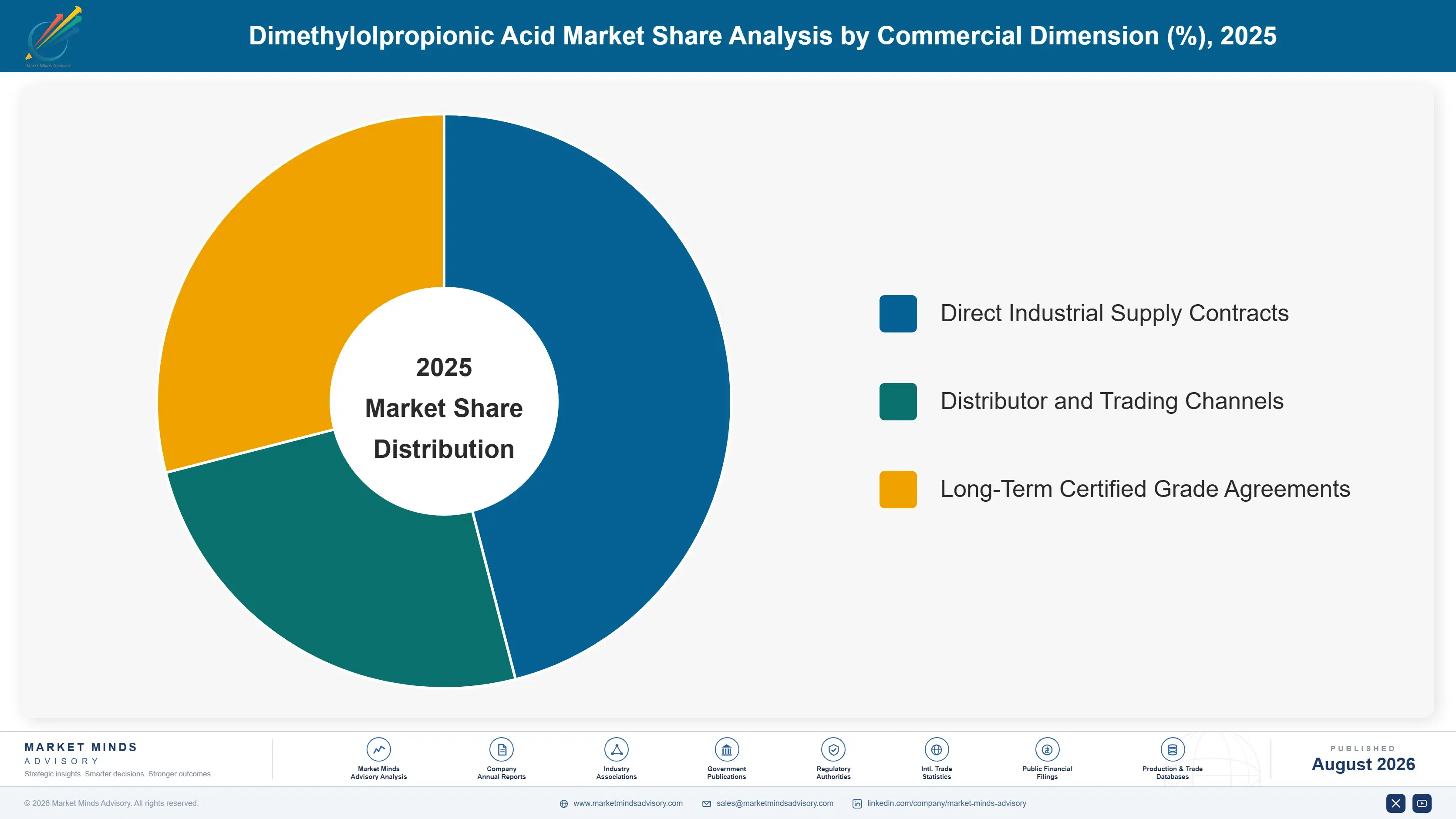
The market splits into six categories by end-use application, from waterborne dispersion through specialty synthesis. Waterborne polyurethane dispersion grade is growing fastest as VOC regulation tightens across coatings markets, while powder coating resin grade follows closely given industrial finishing purity requirements, as purity specifications tighten across every major end-use industry served today indeed too.
dimethylolpropionic-acid-market-trends-market-share-analysis-1787548388475

Waterborne Polyurethane Dispersion Grade

Waterborne polyurethane dispersion grade is growing faster than any other category because coatings manufacturers across multiple regions are expanding capacity to comply with tightening volatile organic compound emission limits, and dimethylolpropionic acid remains the industry standard ionomer monomer enabling water dispersibility for these systems. Perstorp Group and Zhejiang NHU Company have both expanded waterborne dispersion grade production capacity specifically to serve this demand rather than relying on legacy adhesive-grade capacity alone. Wuxi Baichuan Chemical has pursued a similar strategy, and the category's technical complexity, spanning both purity control and regulatory certification, gives established suppliers a meaningful advantage over new entrants lacking comparable qualification history, particularly for suppliers lacking comparable qualification track records with major coatings manufacturers.
CAGR 9.5%

Powder Coating Resin Grade

Powder coating resin grade is growing quickly as industrial finishing manufacturers specify higher-purity dimethylolpropionic acid for applications where production volume continues expanding across automotive and appliance manufacturing sectors. Shandong Baifu New Materials and Ningbo Nengzhiguang Chemical compete most directly in this category, where documented purity consistency increasingly differentiates suppliers from those serving less demanding industrial applications. This combination of tightening purity requirements and expanding industrial manufacturing investment gives this category a growth rate meaningfully above the broader dimethylolpropionic acid market average across most major producing regions, BASF has similarly expanded powder coating grade production to serve this growing purity-driven demand across multiple regions, regardless of broader macroeconomic swings affecting the specialty chemical industry more generally.
CAGR 7.5%
Full segment breakdown across 7 segments available in the complete report.

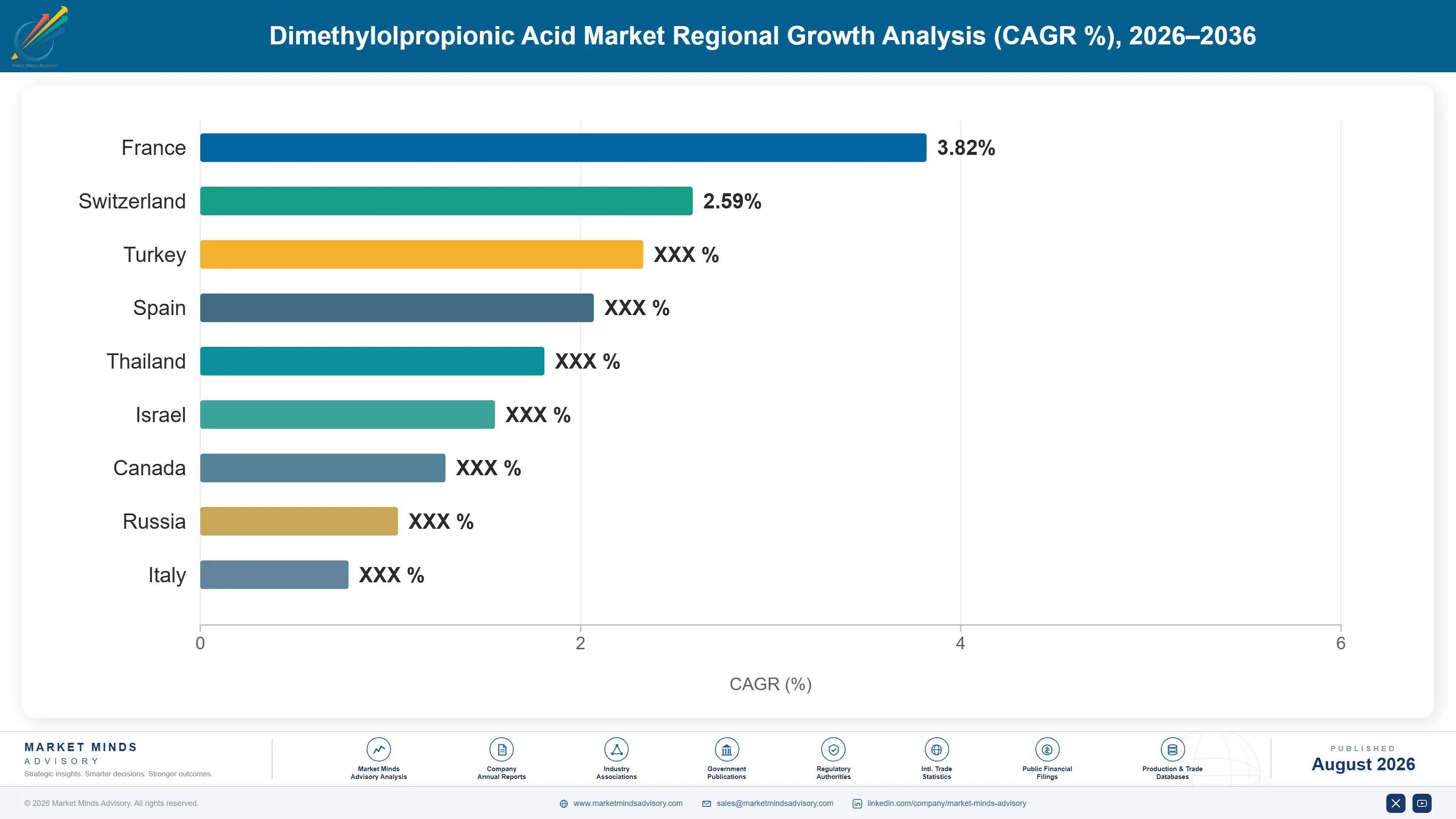
Regional Architecture and Country Demand Map

East Asia leads global dimethylolpropionic acid demand, anchored by China's coatings manufacturing scale and deep chemical production base. South Asia and Pacific posts the fastest growth as industrial finishing capacity expands rapidly across the region, as domestic environmental regulation continues tightening across several countries too.

North America

US coatings manufacturers maintain steady adhesive and printing ink intermediate demand tied to established industrial manufacturing, generating consistent baseline volume regardless of waterborne dispersion demand cycles elsewhere. Perstorp Group maintains significant domestic manufacturing capacity serving both commodity and specialty polymer customers across the region. Canada's smaller chemical manufacturing base follows similar demand patterns tied to cross-border supply chain integration. Powder coating resin demand from the region's substantial automotive manufacturing sector adds further steady volume beyond commodity adhesive applications, and reinforcing established supplier relationships built over years of continuous industrial development, across every major manufacturing hub in the region, and their tier-one partners, sustaining stable long-term revenue, each production cycle too.
Share: 22% | CAGR: 7.1% (2026 to 2036)

Western Europe

Germany hosts substantial specialty chemical manufacturing capacity serving both domestic coatings producers and export markets, with Covestro and Allnex anchoring significant regional research investment in waterborne formulation purity control. The region's coatings manufacturing base consumes meaningful dispersion grade volume, though growth here trails faster-growing Asian markets because industrial finishing manufacturing capacity itself has expanded more slowly. Local production increasingly focuses on higher-purity waterborne grade material rather than commodity adhesive applications, and helping domestic suppliers maintain technical relevance as global purity standards keep tightening further, and export markets alike across the continent, for years to come as well, sustaining stable long-term revenue further, each production cycle too, and beyond, too, now.
Share: 21% | CAGR: 5.5% (2026 to 2036)
Regional intelligence for 5 additional markets available in the complete report: East Asia, South Asia and Pacific, Latin America, Middle East and Africa, Eastern Europe. Contact sales@marketmindsadvisory.com.
dimethylolpropionic-acid-market-trends-country-cagr-analysis-1787548388988

Capturing Value as Regulation Tightens

Producers capture the largest margin gains not from selling more dimethylolpropionic acid but from shifting what they sell: waterborne dispersion grade purity, powder coating certification, and long-term feedstock agreements that stabilize margins. Each lever depends on capability incumbents already have and challengers must still build, and it favors producers who move on it early.

Expand Waterborne Dispersion Grade Purity Certification

Producers with mature waterborne dispersion grade purity certification can capture a price premium of roughly 25 to 35 percent over standard adhesive-grade pricing, capturing value from coatings manufacturers racing to secure documented regulatory compliance across their processing operations. Perstorp Group and Zhejiang NHU Company have both prioritized this expansion with existing customers rather than competing purely for new qualification contracts, since incumbent producers already hold the certification history and testing data needed to win the upgrade without a fully competitive tender process, and this advantage is widening as more coatings manufacturers finalize their compliance roadmaps.
Market Impact: Waterborne grade helps command a 25-35% price premium

Build Powder Coating Certification Programs Further

Producers that build documented powder coating certification capture recurring industrial finishing contracts worth an estimated 18 to 22 percent margin above conventional commodity-grade material, generating income that basic adhesive sales alone cannot match. Shandong Baifu New Materials has expanded this certification capability specifically to serve automotive and appliance manufacturers seeking documented purity consistency for demanding finishing applications across their production operations, across every major regional manufacturing hub currently expanding operations, and this certification approach is increasingly viewed as essential across the broader industry as purity standards tighten further today indeed.
Market Impact: Powder coating certification adds an 18-22% margin gain

Secure Long-Term Formaldehyde Feedstock Agreements Further

Producers that secure long-term formaldehyde precursor supply agreements avoid the margin compression that periodically strikes competitors during feedstock price spikes by an estimated 20 percent, giving them a meaningful cost stability advantage over producers exposed to spot market pricing. Wuxi Baichuan Chemical has pursued this strategy through direct long-term supplier arrangements, while several smaller producers are now pursuing comparable agreements to defend margin stability, and this stability advantage compounds meaningfully across each multi-year supply contract cycle, across every major regional market currently served by the supply chain today too indeed.
Market Impact: Feedstock agreements help avoid a 20% margin drop

Who Controls the Margin Pool

Concentration sits moderate at a CR5 near 44 percent, reflecting an industry where waterborne and powder coating qualification history creates genuine barriers against new entrants. Perstorp Group holds the clearest leadership position given its broad grade range and deep feedstock integration. The gap between Perstorp Group and challengers like Zhejiang NHU Company is narrower in commodity adhesive categories than in specialized waterborne and powder coating grade purity control.
Current competitive activity centers on waterborne dispersion grade capacity expansion and powder coating certification, as producers race to serve customers demanding progressively higher purity and documented consistency. Shandong Baifu New Materials and Ningbo Nengzhiguang Chemical have both expanded powder coating grade capability, while Wuxi Baichuan Chemical continues developing distribution partnerships to differentiate from pure production-focused competitors.

Emerging pressure comes from Chinese specialty chemical makers scaling technical capability rapidly within their large domestic coatings and automotive manufacturing market, a trajectory that could eventually support competition beyond basic adhesive-grade material into precision waterborne applications. Rankings could shift meaningfully over the next decade if domestic producers close the remaining purity control gap that currently protects established multinational suppliers reshaping the industry's cost structure meaningfully over time.
dimethylolpropionic-acid-market-trends-company-positioning-matrix-1787548389509

Competitive Moat and Risk Dimensions

PERSTORP GROUP

Moat: Broad Grade Portfolio Range

Perstorp Group's presence across adhesive, waterborne, and powder coating grades lets customers standardize on one supplier across multiple application categories, reducing the qualification burden buyers face when managing separate suppliers for each purity tier across their operations, and reinforcing its position as the preferred choice for multi-grade global customer programs.
PERSTORP GROUP

Risk: Scale Disadvantage in Asia

Perstorp Group's manufacturing footprint concentrates more heavily in Europe than diversified Asian competitors like Zhejiang NHU Company, potentially limiting its ability to serve faster-growing demand emerging in East Asia without further capacity investment there, particularly as Asian producers accelerate their capacity expansion faster than currently projected.
ZHEJIANG NHU COMPANY

Moat: Waterborne Technical Depth

Zhejiang NHU Company has invested early in waterborne dispersion grade certification and testing capability, positioning it favorably with coatings manufacturers who increasingly require proven regulatory compliance data rather than adapted industrial-grade formulations, as more coatings manufacturers formalize documented compliance sourcing requirements into their supplier scorecards.
ZHEJIANG NHU COMPANY

Risk: Regional Concentration Exposure

Zhejiang NHU Company's manufacturing footprint concentrates more heavily in East Asia than diversified competitors, potentially limiting its ability to capture growth in faster-expanding South Asian markets without further capital investment in regional capacity there, as those competitors extend their manufacturing footprint across faster-growing regional markets.

Players Tracked

Prominent Players

Perstorp Group
Zhejiang NHU Company
Shandong Baifu New Materials
Ningbo Nengzhiguang Chemical
Wuxi Baichuan Chemical

Other Key Players

Trimethylolpropane USA
Hubei Xingfa Chemicals
Jiangsu Baichuan High-Tech
Sichuan Emei Shan Chemical
Beijing Eastern Rising Technology
Zhejiang Yangfan New Materials
Shanghai Kaiyuan Chemical
Anhui Guangxin Agrochemical
Hebei Chengxin Chemical
Nantong Xingchen Synthetic Material
Alberdingk Boley
Covestro
BASF
Allnex
DIC Corporation

Recent Developments

MARCH 2025

Perstorp Group announced an expansion of its waterborne dispersion grade production capacity at its European facility, adding capacity specifically to serve coatings manufacturers scaling regulatory compliance ahead of continued production volume growth across several major markets, and reinforcing its position as a preferred supplier for premium waterborne manufacturing programs.
Signal: Signals producer confidence that waterborne demand will sustain long-term capacity utilization broadly across the industr too.
SEPTEMBER 2025

Shandong Baifu New Materials entered a supply agreement with a major automotive finishing customer to provide powder coating grade dimethylolpropionic acid across several manufacturing facilities over a multi-year period, reinforcing its position in a category valued for purity consistency, extending its reach into the broader automotive finishing landscape.
Signal: Confirms automotive finishing customers increasingly commit to multi-year supply contracts over spot purchasing across the sector
JANUARY 2026

Wuxi Baichuan Chemical launched an expanded quality testing laboratory aimed at accelerating coatings manufacturer qualification timelines for next-generation waterborne formulations entering development across multiple product categories, reinforcing its regional leadership position in qualification testing, across every major coatings customer segment currently expanding too indeed now.
Signal: Signals competitive shift toward faster qualification capability rather than production scale alone across the industr too.

Formaldehyde Feedstock and Catalyst Exposure

Formaldehyde and propionaldehyde precursor materials together represent roughly 40 percent of cost of goods sold for dimethylolpropionic acid producers, sourced from a concentrated group of petrochemical suppliers whose own pricing cycles directly influence contract pricing across the broader specialty chemical supply chain each production year, particularly during periods of tight global petrochemical capacity utilization now.
Formaldehyde prices rose meaningfully during a 2021 to 2022 petrochemical supply disruption tied to pandemic-era manufacturing bottlenecks, according to industry commodity pricing reports, and that shortage passed through to dimethylolpropionic acid contract pricing within roughly two to three quarters as producers renegotiated terms with downstream customers already committed to production schedules. Producers without long-term feedstock supply agreements absorbed the sharpest cost increases during that period across the industry.

Smaller regional producers without diversified formaldehyde sourcing or long-term supply contracts absorb price volatility directly in margin, while larger diversified producers with broader procurement relationships smooth pricing for their downstream customers instead. That gap in resilience increasingly determines which producers can offer multi-year fixed-price contracts that large coatings and adhesive customers now require, given the scale of their customer contract footprint too.
dimethylolpropionic-acid-market-trends-cost-volatility-analysis-1787548389707

Long-Term Formaldehyde Supply Agreements

Producers are securing formaldehyde precursor through multi-year contracts with petrochemical suppliers rather than relying on spot-market purchases, smoothing cost volatility during years when supply disruptions or competing industrial demand push feedstock prices higher than budgeted across the industry each production cycle today, helping preserve stable margins even when broader petrochemical demand elsewhere tightens overall capacity.

Diversified Catalyst Sourcing Relationships

Producers are securing catalyst materials through multiple suppliers rather than relying on a single source, smoothing cost volatility during regional supply disruptions that periodically affect specific chemical manufacturing facilities and their surrounding markets globally each cycle indeed, and helping producers maintain delivery schedules even when a single supplier faces unexpected capacity constraints too indeed.

Vertical Integration Into Feedstock Production

Some larger producers are integrating vertically into formaldehyde production operations, reducing exposure to third-party petrochemical pricing while gaining tighter control over feedstock quality specifications that dimethylolpropionic acid purity ultimately depends on meaningfully today, an approach increasingly valued by producers seeking to avoid dependence on any single external supplier and this approach spreads across every major regional facility.

Portfolio Architecture for Margin Defence

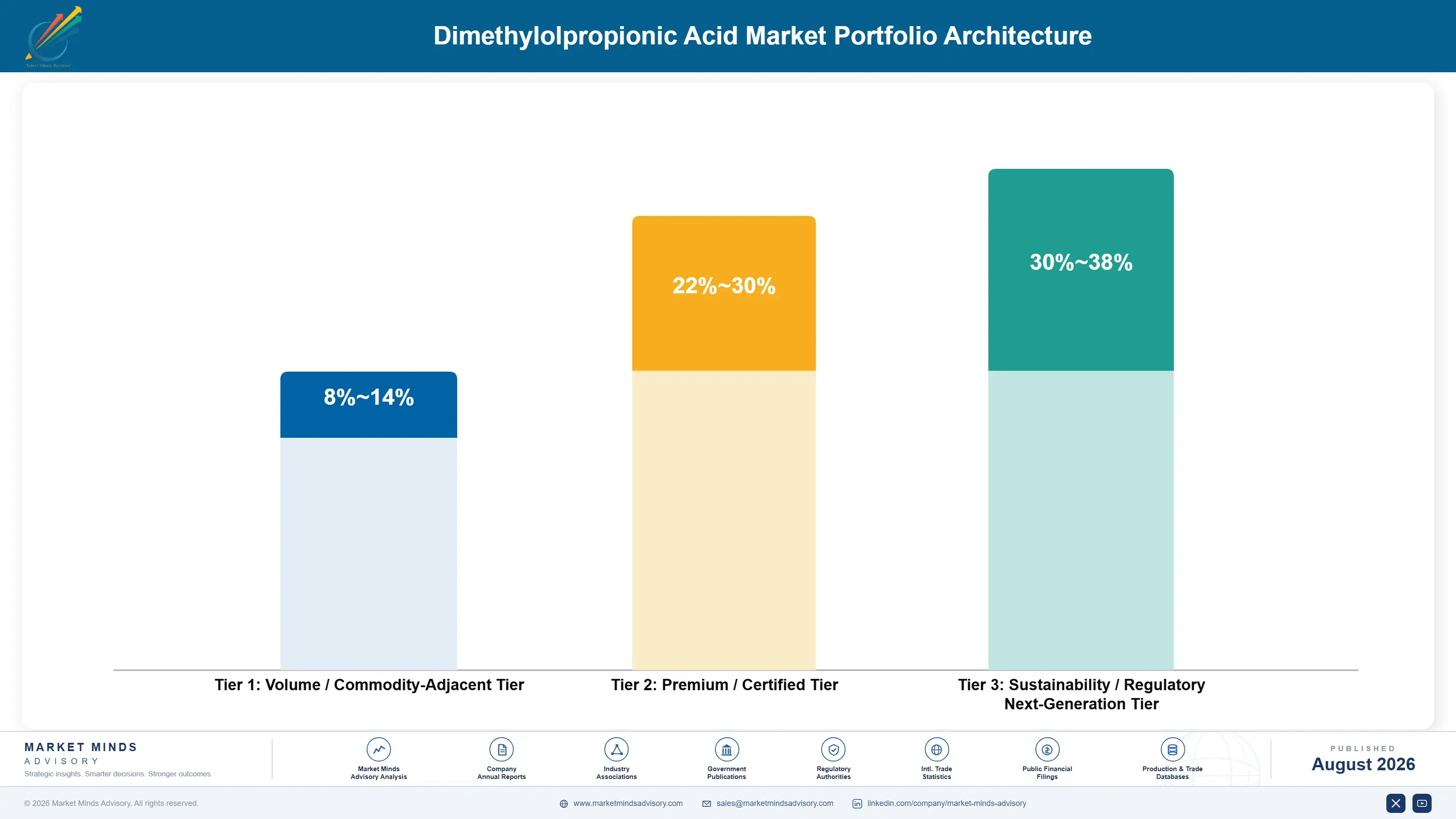
The market splits across three tiers: commodity adhesive and printing ink grade sold on thin margins against industrial volume contracts, waterborne dispersion grade sold with regulatory certification at a premium, and an emerging tier of powder coating grade commanding the highest margins as automotive manufacturers demand documented purity, reflecting how quickly the underlying purity mix within the industry keeps shifting.
Volume sits overwhelmingly in the commodity adhesive tier, where bulk contracts with industrial customers generate revenue scale but comparatively thin margins given intense price competition among established and regional producers. Premium tension is sharpest in powder coating grade, where documented purity consistency earns meaningfully better margins than commoditized adhesive-grade material, pulling producer investment toward capacity serving both tiers, as more customers finalize their documented purity requirements.

High-value margin pools concentrate in waterborne and powder coating intermediate grades sold to coatings and automotive manufacturers pursuing both regulatory documentation and finishing purity simultaneously, a category still smaller in absolute volume than commodity adhesive but growing faster and attracting disproportionate research investment each year, a pattern likely to continue strengthening as more producers finalize their own certification roadmaps.

Volume / Commodity-Adjacent Tier

Standardized adhesive and printing ink intermediate grade sold on multi-year volume contracts to industrial customers, competing primarily on manufacturing cost and delivery reliability, reflecting the intense price sensitivity these budget-constrained buyers bring to every large-volume procurement decision.
Gross Margin: 8%-14%

Premium / Certified Tier

Waterborne polyurethane dispersion grade sold with regulatory certification and documented purity, commanding a premium over standardized adhesive-grade equivalents across most contracts, as environmental regulation continues tightening steadily across an expanding set of regional markets.
Gross Margin: 22%-30%

Sustainability / Regulatory / Next-Generation Tier

Powder coating resin grade tied to automotive finishing purity requirements, sold into the industry's highest-margin certification arrangements currently available across major markets, as more automotive manufacturers seek documented finishing purity over separately sourced commodity components.
Gross Margin: 30%-38%
dimethylolpropionic-acid-market-trends-portfolio-architecture-1787548390202

High-value Sub-segments and Strategic Watch-out

Powder Coating Resin Grade

Powder coating resin grade commands the category's highest margins and is growing fastest as automotive manufacturers increasingly demand documented purity over standardized adhesive-grade material each production cycle currently underway here, and suppliers with established certification capability are capturing the bulk of this expanding demand too.

Waterborne Polyurethane Dispersion Grade

Waterborne polyurethane dispersion grade sold into coatings manufacturing contracts commands steady premium pricing on certification value, growing reliably as VOC regulation continues tightening across additional regional markets worldwide too, and this trend is likely to continue as regulation keeps expanding and beyond current regulatory frameworks.

Standardized Adhesive and Printing Ink Grade

The largest volume pool by far, standardized adhesive grade generates scale revenue for top producers but offers little margin expansion room given intense multi-region price competition among established manufacturers here too, leaving room for little meaningful margin growth ahead and beyond current pricing structures too.

Domestic Chinese Specialty Chemical Producers

Domestic Chinese specialty chemical producers scaling technical capability could challenge multinational suppliers on cost within their home market over the next decade, a shift worth monitoring closely indeed, particularly if domestic certification capability matures faster than currently anticipated over the coming years ahead indeed too.

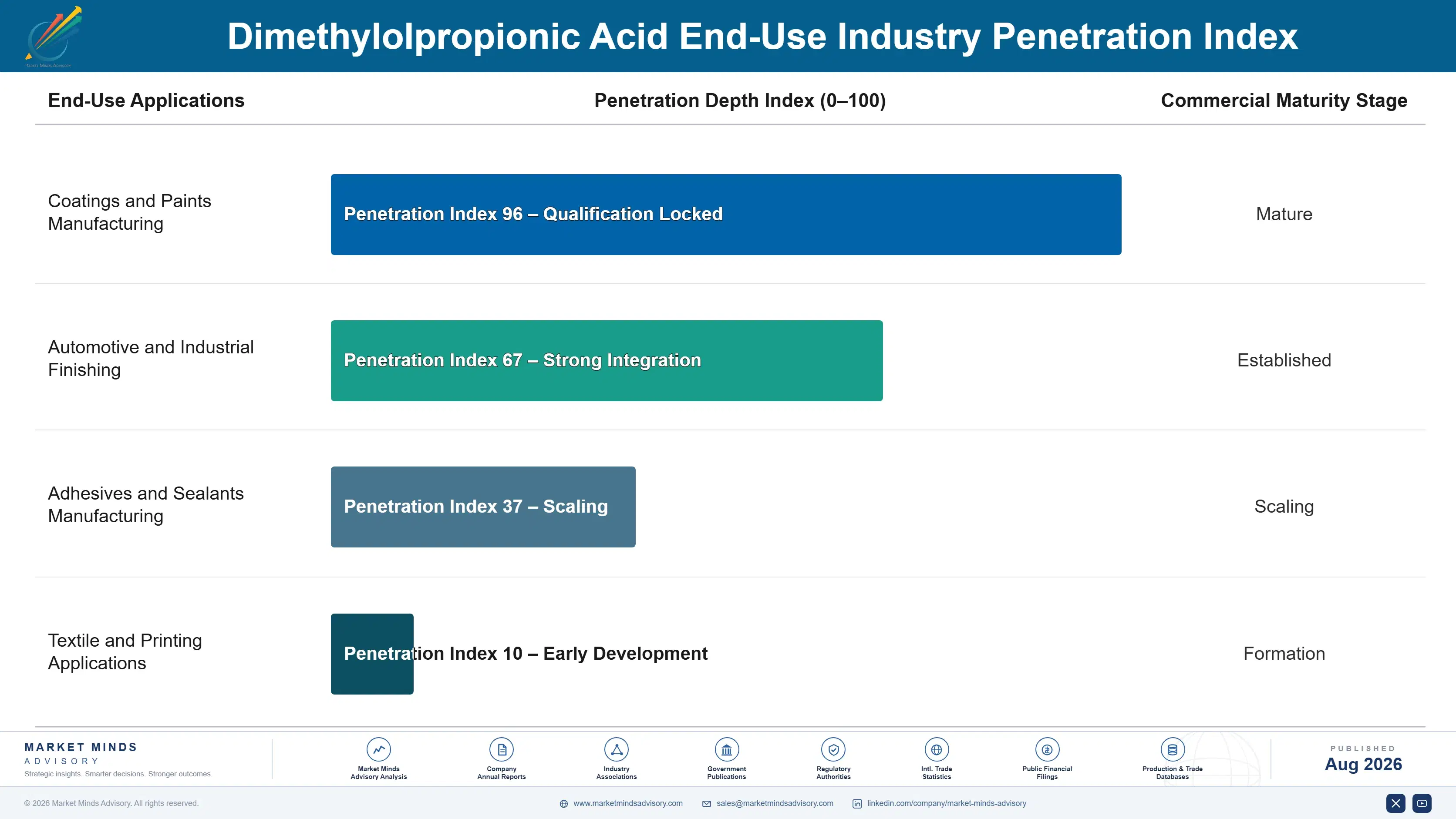
Contract Cycles and Customer Loyalty

Original equipment demand behaves like an annuity once a coatings or automotive customer qualifies a specific producer's dimethylolpropionic acid against its own purity and regulatory specifications, since switching suppliers requires repeating extensive qualification testing that most customers avoid unless supply is disrupted, giving incumbent producers durable multi-year volume once they win the initial contract and pass the first renewal cycle successfully.
Adoption depth varies by segment: large coatings and automotive manufacturers show the deepest supplier stickiness given the scale of qualification testing required for regulatory-critical applications, while smaller industrial adhesive customers switch suppliers more readily since their specifications are less stringent and requalification costs correspondingly lower relative to total procurement spend involved, particularly where product specifications rotate more frequently across shorter industrial procurement cycles.

A generational shift among younger procurement officers toward treating documented purity traceability as a core sourcing criterion rather than a secondary consideration is pulling supplier selection earlier into buyer decision processes, giving certification-capable producers a seat at the table that commodity-focused suppliers historically never had, reshaping how procurement teams weigh certification capability against simple component price, reshaping how procurement teams weigh certification depth over time.
dimethylolpropionic-acid-market-trends-end-use-penetration-index-1787548390700

Positioning as Regulation Reshapes Demand

These are among the four positions where our research anticipates prominent divergence between winners and laggards over the coming forecast period. Each is grounded in the demand model, the regulatory perimeter, and the announced capacity pipeline.
01 / WATERBORNE GRADE INVESTMENT

Expand waterborne purity certification ahead of demand growth

Waterborne grade already commands a 25 to 35 percent premium, and producers without proven certification history cannot access the contracts Perstorp Group and Zhejiang NHU Company increasingly dominate as VOC regulation tightens. Building this capability now, even at substantial engineering investment, positions a producer to capture the highest-margin category before more coatings manufacturers finalize their compliance roadmaps. Producers who wait risk permanent exclusion from contracts requiring years of certification history to win too across every regional market too indeed now.
02 / POWDER COATING CERTIFICATION BUILDOUT

Build powder coating certification to capture automotive demand

Powder coating certification adds an estimated 18 to 22 percent margin gain, and Shandong Baifu New Materials already demonstrates this advantage through documented purity consistency that automotive manufacturers increasingly require. Producers without comparable certification depth struggle to win finishing contracts against established specialists. Building this capability now secures long-term customer relationships before competitors close the remaining certification gap further across the industry across the broader manufacturing base and beyond across every plant program in the network overall too indeed now.
03 / FEEDSTOCK SUPPLY STABILITY

Lock in feedstock agreements to defend margin stability

Feedstock price swings periodically compress margins by 20 percent, and producers with long-term formaldehyde supply agreements avoid this exposure entirely, unlike competitors dependent on spot market pricing. Wuxi Baichuan Chemical already demonstrates this advantage through direct long-term supplier arrangements that smaller competitors increasingly seek to replicate. Producers securing comparable feedstock agreements now will maintain steadier profitability across future commodity price volatility cycles across the industry as adoption spreads further across the sector too overall too indeed today now here too.
04 / CHINESE MARKET LOCALIZATION

Localize production in China before domestic producers mature

China's dimethylolpropionic acid market is growing at roughly 8.0 percent annually, and domestic producers Zhejiang NHU Company and Shandong Baifu New Materials are scaling capacity rapidly to serve this expanding coatings and automotive manufacturing base. Producers who build local manufacturing capacity now can secure long-term supply relationships before domestic champions capture the bulk of new demand growth entirely. Early localization secures market position before this fast-growing market matures and consolidates further around domestic leaders and pricing dynamics continue evolving further ahead.

Engagement Snapshot From the Field

A live engagement with an industry participant carrying material or product regulatory and market exposure ahead of a defining policy shift, showing how our research translates into a defensible multi-year portfolio strategy.
MARKET MINDS ADVISORY · CLIENT ENGAGEMENT SUMMARY
Dimethylolpropionic Acid Producer Strategic Portfolio Review and Transition Roadmap 2026·Investment Scenario on Dimethylolpropionic Acid Exposure Evaluation 2025-26
CLIENT PROFILE
A regional coatings manufacturer operating several processing facilities across Western Europe engaged MMA to guide a waterborne intermediate supplier consolidation strategy after managing separate vendor relationships across multiple facilities became increasingly inefficient. The manufacturer's annual dimethylolpropionic acid procurement spend exceeded 22 million dollars (client-reported, unverified by MMA), making supplier selection a material decision for its senior operations leadership.
STRATEGIC CHALLENGE
The manufacturer managed separate suppliers for waterborne intermediate across its various processing facilities, creating coordination overhead and inconsistent quality documentation that complicated regulatory compliance audits across its network as environmental scrutiny intensified further and every affiliated production line and every quality assurance officer involved in the process and every regional distribution partner.
MMA APPROACH
MMA benchmarked cross-facility suppliers against documented purity consistency and regulatory certification depth, modeled the coordination savings of consolidating vendors, and structured a phased consolidation plan prioritizing the facilities facing the nearest compliance audit deadlines overall too and beyond too and every affected production line too indeed across every affected department.
KEY FINDINGS
  1. Consolidating to a single certified supplier reduced coordination overhead meaningfully within the first two facilities, freeing engineering resources for other priority operational improvements.
  2. The consolidated supplier's documentation exceeded what separate vendors previously provided across the network, strengthening the manufacturer's regulatory compliance readiness meaningfully across the network.
  3. A phased consolidation across three facility groups avoided the supply disruption a full switch would have created, keeping production schedules on track throughout the transition period.
  4. Supplier quality documentation support during the transition proved as valuable as the cost savings themselves, giving operations leadership confidence to expand the relationship further.
CLIENT PROFILE
A regional coatings manufacturer operating several processing facilities across Western Europe engaged MMA to guide a waterborne intermediate supplier consolidation strategy after managing separate vendor relationships across multiple facilities became increasingly inefficient. The manufacturer's annual dimethylolpropionic acid procurement spend exceeded 22 million dollars (client-reported, unverified by MMA), making supplier selection a material decision for its senior operations leadership.
STRATEGIC CHALLENGE
The manufacturer managed separate suppliers for waterborne intermediate across its various processing facilities, creating coordination overhead and inconsistent quality documentation that complicated regulatory compliance audits across its network as environmental scrutiny intensified further and every affiliated production line and every quality assurance officer involved in the process and every regional distribution partner.
MMA APPROACH
MMA benchmarked cross-facility suppliers against documented purity consistency and regulatory certification depth, modeled the coordination savings of consolidating vendors, and structured a phased consolidation plan prioritizing the facilities facing the nearest compliance audit deadlines overall too and beyond too and every affected production line too indeed across every affected department.
KEY FINDINGS
  1. Consolidating to a single certified supplier reduced coordination overhead meaningfully within the first two facilities, freeing engineering resources for other priority operational improvements.
  2. The consolidated supplier's documentation exceeded what separate vendors previously provided across the network, strengthening the manufacturer's regulatory compliance readiness meaningfully across the network.
  3. A phased consolidation across three facility groups avoided the supply disruption a full switch would have created, keeping production schedules on track throughout the transition period.
  4. Supplier quality documentation support during the transition proved as valuable as the cost savings themselves, giving operations leadership confidence to expand the relationship further.
RECOMMENDED STRATEGY
Phase 1: Phase 1 (Months 1-4): Consolidate suppliers for the highest-priority processing facility first, the facility facing the nearest compliance audit deadline. Phase 2: Phase 2 (Months 5-9): Extend the consolidated relationship across two additional facility groups, validating documentation quality before completing the full transition. Phase 3: Phase 3 (Months 10-13): Complete consolidation and finalize joint quality documentation together, closing out the consolidation on schedule and within budget.
OUTCOME
The manufacturer completed its phased supplier consolidation within the recommended thirteen-month window and reported meaningfully reduced coordination overhead across its facility network (client-reported, unverified by MMA), while consolidated documentation strengthened its regulatory compliance audit readiness significantly each renewal cycle too each renewal cycle too indeed.

Frequently Asked Questions

Foundational context covering the market sizes, CAGR, scope, country, region and competition that inform every finding below. This section is provided to cover basics and most often pre-purchase conversations, answered from the MMA Primary Research Dataset.

What is the current size of the Dimethylolpropionic Acid Market?

The global dimethylolpropionic acid market was valued at approximately $0.28 billion in 2025. Waterborne polyurethane dispersion grade already accounts for a meaningful share of category value.

How large will the Dimethylolpropionic Acid Market be by 2036?

MMA projects the market will reach approximately $0.58 billion by 2036, roughly 1.93 times its 2026 value. Waterborne demand growth drives much of this expansion.

What is the CAGR for the Dimethylolpropionic Acid Market 2026 to 2036?

The market is projected to grow at a 6.8 percent compound annual rate between 2026 and 2036. Bull and bear scenarios range from 5.6 to 8.0 percent.

Which segment is growing fastest?

Waterborne polyurethane dispersion grade is the fastest-growing segment at a 9.5 percent CAGR, well above the overall market rate. Tightening VOC regulation drives this expansion.

Who are the major companies in the Dimethylolpropionic Acid Market?

Leading producers include Perstorp Group, Zhejiang NHU Company, Shandong Baifu New Materials, Ningbo Nengzhiguang Chemical, and Wuxi Baichuan Chemical. Together they hold a CR5 near 44 percent of global capacity.

Which country is growing fastest?

China posts the fastest national growth at roughly 8.0 percent, driven by its large coatings manufacturing base and expanding automotive production sector. Domestic capacity continues expanding to meet this rising demand.

Report Segmentation Architecture

The full report scope spans multiple orthogonal segmentation dimensions, with cross-tabulated demand data provided for each dimension pair. Coverage extends further to regional breakdowns, trend trajectories, and the competitive detail needed to support segment-level decision-making.

By End-Use Application

  • Waterborne Polyurethane Dispersion Grade
  • Powder Coating Resin Grade
  • Adhesive Formulation Grade
  • Textile Coating Application Grade
  • Printing Ink Formulation Grade
  • Other Specialty Polymer Synthesis

By End-Use Industry

  • Coatings and Paints Manufacturing
  • Automotive and Industrial Finishing
  • Adhesives and Sealants Manufacturing
  • Textile and Printing Applications

By Commercial Dimension

  • Direct Industrial Supply Contracts
  • Distributor and Trading Channels
  • Long-Term Certified Grade Agreements

By Region

  • North America
  • Western Europe
  • East Asia
  • South Asia and Pacific
  • Latin America
  • Middle East and Africa
  • Eastern Europe

Scope, Methodology, and Coverage

Every figure in this report is reproducible from documented input assumptions. The scope below maps the historical period, the forecast horizon, the segmentation dimensions, and the countries covered, alongside the underlying primary and qualitative methodology.
Historical Period
2020 to 2025
Forecast Period
2026 to 2036
Base Year
2025 (USD billions; MMA Primary Research Dataset, August 2026)
Market Definition
The dimethylolpropionic acid market covers waterborne polyurethane dispersion grade, powder coating resin grade, adhesive formulation grade, textile coating application grade, printing ink formulation grade, and other specialty polymer synthesis uses sold to coatings, adhesive, and polymer manufacturers. It excludes finished polyurethane dispersions and coatings sold as separate downstream products.
Quantitative Units
USD millions (current prices); metric tonnes for volume detail
Segmentation Dimensions
By End-Use Application; By End-Use Industry; By Commercial Dimension; By Region
Regions Covered
North America, Western Europe, East Asia, South Asia and Pacific, Latin America, Middle East and Africa, Eastern Europe
Countries Covered
China, Japan, South Korea, USA, Germany, India, France, UK, Brazil, Mexico, UAE, Saudi Arabia, South Africa, Poland, Czech Republic, Hungary, Slovakia, Turkey, Indonesia, Thailand, Vietnam, Australia, Italy, Spain, Netherlands, Sweden, Canada, Argentina, Colombia, and additional markets relevant to this sector
Key Companies Profiled
Perstorp Group, Zhejiang NHU Company, Shandong Baifu New Materials, Ningbo Nengzhiguang Chemical, Wuxi Baichuan Chemical, Trimethylolpropane USA, Hubei Xingfa Chemicals, Jiangsu Baichuan High-Tech, Sichuan Emei Shan Chemical, Beijing Eastern Rising Technology, Zhejiang Yangfan New Materials, Shanghai Kaiyuan Chemical, Anhui Guangxin Agrochemical, Hebei Chengxin Chemical, Nantong Xingchen Synthetic Material, Alberdingk Boley, Covestro, BASF, Allnex, DIC Corporation
Quantitative Methodology
Primary survey, n=3,800 respondents, Q4 2025, six countries; demand-side model with trade association cross-validation
Qualitative Methodology
47 expert interviews, Q4 2025; applied to validate demand model assumptions, identify emerging dynamics, and assess competitive positioning
Report Format
PDF and XLSX data workbook (Word format preview document)
Publisher
Market Minds Advisory
Report Code
MMA-2026-CHM-106
Published
August 2026
Contact
sales@marketmindsadvisory.com | www.marketmindsadvisory.com

Purchase the full Dimethylolpropionic Acid Market Report (2026 to 2036).

The full Dimethylolpropionic Acid Market report delivers a comprehensive 2026 to 2036 forecast across six end-use application categories, seven regions, and twenty profiled companies active in this sector. It includes detailed segmentation by end-use industry, feedstock and catalyst cost modeling, and competitive benchmarking measured against a single consistent production capacity basis throughout. Analysts document the waterborne compliance and powder coating certification trends reshaping supplier positioning across the industry. Buyers receive full access to the underlying data tables, regional breakouts, and a customizable Excel model built for scenario planning.
2026-2036 volume and value forecasts by segment
Six-category application type breakdown and detailed analysis
Seven-region market sizing and share detail
Twenty-company competitive profiles and full benchmarking
Feedstock and catalyst cost sensitivity modeling
Editable Excel forecast workbook with scenario toggles

Built For The People Who Decide

From boardroom strategy to bench-side execution, this report is read cover-to-cover by leaders shaping the next decade of their industry, turning demand scenarios, market dynamics and valuation benchmarks into decisions.
CXOs/ Presidents/ VPs/ Managers
M&A and Corporate Development
Strategy Teams and R&D Heads
Procurement and Product Directors
Regulatory and Compliance Leaders
Investor Relations and Equity Analysts