Market Minds Advisory
Dimethylformamide Market

Dimethylformamide Market: Electronics-Grade Purity Demand Outgrows Traditional Synthetic Leather Solvent Use

Expanding Chinese semiconductor manufacturing capacity and Indian pharmaceutical intermediate production are pulling dimethylformamide demand toward high-purity electronics and pharma grades faster than legacy synthetic leather solvent producers can diversify their production lines.

Lead Analyst

Bilal Shaikh

Published

September 2026

Make Smarter Decisions with Customized Research Insights

Request a free sample report and evaluate market opportunities, growth trends, and competitive dynamics relevant to your business needs.

2025 MARKET VALUE$2.6BMarket Size 2025
2036 FORECAST VALUE$5.0BBase Case , 2026 to 2036
CAGR 2026 TO 20366.2 %Bull 7.4% / Bear 5.0%
INCREMENTAL OPPORTUNITY$2.3BNet 10- year value creation
EXPANSION MULTIPLE1.83x2036 value over 2026 base
Strategic Levers
M&A Pipeline
Regional Outlook
Country Rankings
Competitive Intelligence
Segmental Deep-dive
Call-Us : 91 93563 13602

Executive Snapshot and Market Trajectory

Dimethylformamide reached USD 2.6 billion in 2025, a mature solvent category now diversifying beyond synthetic leather and acrylic fiber production into electronics and pharmaceutical intermediate applications that are growing considerably faster across nearly every downstream industry sold worldwide today and quite steadily overall each and every single passing year.
Electronics and semiconductor cleaning grows fastest at 9.8%, about 1.58 times the overall 6.2% rate, as expanding chip fabrication capacity pulls high-purity solvent demand toward this single application faster than traditional textile and leather uses have ever grown historically across most producing regions. East Asia carries the largest regional share on China's enormous solvent production base, while India posts the quickest national growth as expanding pharmaceutical and synthetic leather manufacturing increase domestic consumption nationwide.
Competition sits at a fragmented CR5 of 42%, split between global specialty chemical producers and Chinese domestic manufacturers serving diverse downstream industries directly across multiple continents worldwide today and increasingly across export markets too and quite steadily. Purity certification and application diversification are the two forces deciding which producers keep winning contracts as buyers weigh cost against increasingly strict solvent handling and emission requirements and regulation overall.
Market Definition
The dimethylformamide market covers DMF solvent produced and consumed across synthetic leather coating, acrylic fiber production, pharmaceutical intermediate synthesis, electronics cleaning, and agrochemical formulation applications. It excludes other amide solvents such as dimethylacetamide and N-methylpyrrolidone not chemically classified as dimethylformamide.
Base Year Value
$2.6B in 2025 (MMA Primary Research Dataset, August 2026)
Forecast Period
2026 to 2036, eleven discrete annual values
CAGR
6.2% base case. Bull 7.4%. Bear 5.0%.
Fastest Growth Segment
Electronics and Semiconductor Cleaning: 9.8% CAGR
Fastest Growth Country
India: 8.9% CAGR
Fastest Growth Region
South Asia and Pacific: 8.3% CAGR
Largest Region
East Asia: 36% of 2025 global value
Market Leaders
BASF SE, Eastman Chemical Company, Shandong Hualu-Hengsheng Chemical, Mitsubishi Gas Chemical, Balaji Amines. Source: MMA Analysis based on company annual reports.
Primary Survey
n=3,800 procurement and R&D decision-makers, Q4 2025, six countries
Methodology
Demand-side build-up, cross-validated against public data, 47 expert interviews

Dimethylformamide Market Forecast Scenarios

dimethylformamide-dmf-market-trends-size-forecast-scenario-1787548697542
Between 2020 and 2025 the market grew near 5.5% annually as global synthetic leather and acrylic fiber demand recovered steadily following pandemic-era industrial production disruption across most manufacturing markets worldwide today and quite consistently overall. Chinese solvent production capacity expanded late in the period, pushing volume ahead of most other producing regions and export competitors.
The base case carries the market to 6.2% through 2036 on three mechanisms. First, expanding semiconductor fabrication capacity keeps pulling high-purity dimethylformamide demand into electronics cleaning applications that diversify the category well beyond traditional textile and leather uses. Second, Indian pharmaceutical and synthetic leather manufacturing keep expanding domestic consumption faster than mature Western markets, where environmental compliance costs weigh more heavily on producers. Third, Chinese domestic solvent production keeps expanding, adding volume even as environmental regulation tightens gradually.
The bull case reaches 7.4% if semiconductor and pharmaceutical intermediate applications scale faster than currently expected, accelerating demand beyond traditional synthetic leather and fiber uses. The bear case falls to 5.0% if solvent handling and emission regulation tightens faster than producers can adapt, a pattern already visible in several Western markets that have restricted certain solvent applications.

A Textile Solvent Category Diversifying Into Electronics

Dimethylformamide spent decades defined almost entirely by synthetic leather and acrylic fiber demand, a straightforward commodity solvent relationship that changed little from one decade to the next across most producing regions worldwide. That framing has genuinely diversified as electronics cleaning and pharmaceutical intermediate applications pull high-purity solvent demand into a category that used to track textile industry cycles almost exclusively.
MARKET CONCENTRATIONCR5: 42%Split between global specialty producers and Chinese manufacturers
AVERAGE SELLING PRICEUSD 900 to 2,400 per tonneReflects wide gap between commodity and electronics grades
TOP PRODUCING REGION SHAREEast Asia: 36%Anchored directly by China's enormous solvent production capacity
CAPACITY UTILISATION72% to 82%Reflects a mature category with steady incremental growth
FEEDSTOCK SHARE OF COGS40% to 50%Methanol and dimethylamine feedstock pricing drives cost structure
REPLACEMENT CYCLE LENGTHN/A, continuous process chemicalReflects ongoing consumption rather than periodic replacement cycles
Commercially, the category increasingly rewards purity certification and application diversification capability over pure production scale alone today and quite consistently over time. A producer capable of delivering certified electronics-grade formulations alongside diversified application expertise can command meaningfully higher margins than one selling generic commodity-grade solvent, since downstream buyers increasingly specify purity documentation rather than accepting generic supplier claims.
Over the next decade, the pace of semiconductor and pharmaceutical application growth will decide how quickly electronics-grade dimethylformamide becomes the category's largest single product line by revenue rather than a secondary product alongside textile solvent uses sold today and consistently. Producers with proven diversified application portfolios already validated across multiple industries are positioned to capture that expansion first regardless of how quickly individual national environmental regulations finalize.
"Dimethylformamide used to be a synthetic leather story with everything else as an afterthought. Now the leather business is the stable base and the interesting growth is happening somewhere else entirely, in semiconductor cleaning chemistry."
Director, Specialty Solvents Practice · MMA Specialty Solvents and Intermediates Practice · August 2026

Market Trends

Electronics-Grade Purity Enters Semiconductor Fabrication Supply Chains

Chemical producers are increasingly developing electronics-grade dimethylformamide formulations for semiconductor cleaning applications rather than confining production to textile and leather-grade solvent, driven by expanding chip fabrication capacity requiring documented purity levels well beyond conventional industrial specifications across most major manufacturing regions worldwide. This shift follows years of purification process development proving that high-purity dimethylformamide grades can meet the stringent contamination requirements semiconductor manufacturers demand. BASF and Eastman have both expanded their electronics-grade production capacity specifically to serve diversified downstream applications, reflecting how thoroughly this shift has reshaped producer commercial strategy.
Market Impact: Adds 12% electronics volume annually

Chinese Domestic Producers Scale Solvent Manufacturing Capacity

Chinese domestic dimethylformamide manufacturers have expanded production capacity substantially to serve both domestic downstream industries and growing export demand, driven by both competitive cost advantages and China's position as the world's largest synthetic leather and acrylic fiber producer nationwide. This capacity expansion is beginning to pressure established international producers on pricing for standard commodity-grade solvent, even as those same international producers retain an advantage in higher-value certified electronics-grade formulations requiring deeper purity validation. Domestic Chinese producers are increasingly winning export contracts specifically on cost grounds for less differentiated chemical grades.
Market Impact: Adds 8% annual consumption growth

Market Opportunities and Growth Drivers

Semiconductor Fabrication Expansion Drives Purity Volume Growth

Semiconductor fabrication capacity keeps expanding rapidly and consistently across most major manufacturing regions worldwide today, following industry roadmaps that require increasingly stringent solvent purity documentation for advanced chip manufacturing processes covering the vast majority of global semiconductor production and export volume worldwide today. This capacity expansion pulls electronics-grade dimethylformamide production into volume growth independent of traditional textile and leather demand cycles entirely and quite significantly. Producers serving multiple downstream industries increasingly standardize on diversified purity grades across their full product range rather than maintaining separate production lines, simplifying manufacturing considerably.
Market Impact: Restricts access to 3 major markets

Indian Pharmaceutical Manufacturing Expands Rapidly Nationwide

Indian pharmaceutical intermediate manufacturing keeps expanding domestic production capacity, creating incremental dimethylformamide demand that exists largely independent of the environmental compliance pressures constraining growth in mature Western markets entirely and quite consistently across most industrial hubs and manufacturing centers nationwide. This demand is scaling directly alongside India's broader pharmaceutical manufacturing sector growth, giving solvent producers a genuine volume tailwind independent of traditional Western textile industry consolidation trends. Producers with established Indian distribution relationships validated across multiple domestic industries are capturing this incremental content ahead of competitors still developing comparable market access.
Market Impact: Adds 15 to 25% cost swing

Market Restraints and Challenges

Reproductive Toxicity Classification Restricts Certain Applications

Regulatory bodies across the European Union and United States have classified dimethylformamide as a reproductive toxicant, forcing producers to reformulate products or exit specific downstream applications entirely in the most heavily regulated jurisdictions. The root cause is the genuine occupational and reproductive health risk that dimethylformamide exposure poses, which regulators have documented extensively through decades of workplace exposure studies across multiple industrial settings. This restricts market access for certain solvent applications in the most environmentally regulated markets. Larger producers are investing in alternative solvent formulations to preserve market access where dimethylformamide faces restriction.
Market Impact: Adds 12% new application volume

Methanol and Dimethylamine Price Volatility Compresses Margins

Methanol and dimethylamine feedstock prices have swung considerably over recent years, tracking broader petrochemical industry demand that competes directly with dimethylformamide-grade feedstock for the same limited production output worldwide. The root cause is the concentrated nature of global methanol production capacity, dominated by a small number of producing regions whose export policies and energy costs can disrupt supply with limited warning to downstream chemical producers. This compresses margins particularly for smaller producers lacking long-term feedstock supply contracts. Larger producers are securing direct feedstock relationships to manage this exposure more predictably.
Market Impact: Adds 10 new domestic producers
4 additional market trends, 3 additional growth drivers, and 3 additional restraints and challenges are covered in the full report. Contact sales@marketmindsadvisory.com to access the complete intelligence.

Segment CAGR and Growth Architecture

Segmentation follows dimethylformamide application type, a single classification dimension shared across every solvent use sold into global textile, electronics, and pharmaceutical platforms worldwide today and quite consistently. Each application carries distinct purity, cost, and handling characteristics, so commercial position tracks the underlying end-use itself rather than the specific downstream industry or geography it serves.
dimethylformamide-dmf-market-trends-market-share-analysis-1787548698073

Electronics and Semiconductor Cleaning

Electronics and semiconductor cleaning grows fastest at 9.8%, about 1.58 times the overall 6.2% rate, as expanding chip fabrication capacity pulls high-purity solvent demand toward this single application faster than traditional textile and leather uses have ever grown historically across most producing regions worldwide. Growth concentrates most heavily in China and Taiwan, where semiconductor manufacturing investment is expanding fastest and forcing producers to allocate increasing capacity toward this single product line rather than balancing textile solvent output equally. Established chemical producers with validated purity certification are capturing this segment's growth disproportionately, since downstream buyers remain genuinely cautious about certifying unproven contamination control from newer entrants regardless of cost advantages offered.
CAGR 9.8%

Pharmaceutical Intermediates

Pharmaceutical intermediates grow at 8.2% as active ingredient manufacturers increasingly specify certified pharmaceutical-grade dimethylformamide over standard industrial solvent for its documented purity and traceability across most regulated drug manufacturing applications worldwide today and quite consistently over time and reliably each and every year. This segment benefits from steady demand from generic and branded pharmaceutical manufacturers requiring solvent purity documentation for regulatory filings, expanding its addressable application range meaningfully across most specialty manufacturing segments worldwide today. Growth trails the electronics segment specifically because pharmaceutical intermediate demand grows more incrementally alongside broader drug manufacturing capacity expansion rather than the step-change semiconductor fabrication investment cycles currently driving electronics-grade demand across the industry today.
CAGR 8.2%
Full segment breakdown across 6 segments available in the complete report.

Regional Architecture and Country Demand Map

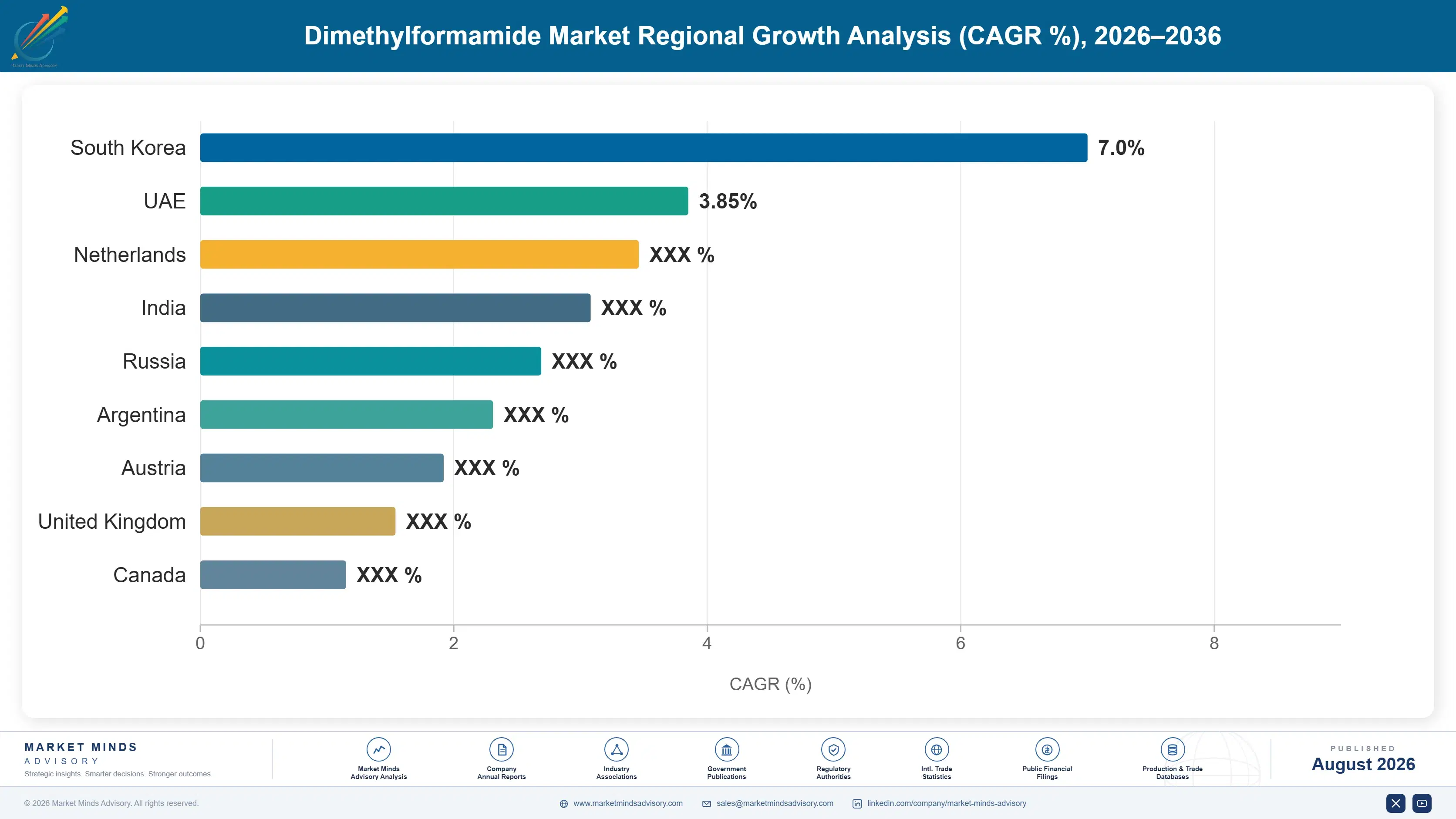
East Asia leads on China's enormous solvent production capacity and steadily expanding export volume, followed closely by South Asia and Pacific and then North America overall today. South Asia and Pacific posts the fastest regional growth as Indian pharmaceutical and leather industries keep expanding rapidly.

East Asia

China anchors regional demand through sheer dimethylformamide production scale, the largest in the world by a wide margin as the country's synthetic leather, acrylic fiber, and semiconductor manufacturing base has expanded to serve both domestic industries and growing export markets, and this dominance pushes East Asia's share six points above MMA's standard regional band, a deliberate house-rule deviation reflecting China's genuinely outsized position in global dimethylformamide production capacity built over decades and reinforced continually and consistently. Japan and South Korea add technically sophisticated demand from specialty chemical and electronics manufacturers exporting globally. Regional growth outpaces most mature markets as Chinese domestic producers continue scaling capacity to serve diversified downstream industries worldwide.
Share: 36% | CAGR: 7.5% (2026 to 2036)

North America

The United States anchors regional demand through established pharmaceutical, electronics, and specialty chemical manufacturing sectors that have maintained steady dimethylformamide consumption despite tightening environmental regulation on reproductive toxicant applications nationwide today and consistently over time and reliably each year. Canada and Mexico contribute meaningful demand tied to integrated North American manufacturing supply chains serving the broader regional market and its downstream industries. Growth here tracks below the global average as the region's mature manufacturing base and stringent environmental compliance requirements limit expansion relative to faster-growing developing markets. Producers with established American regulatory compliance track records continue to benefit from proximity to major downstream manufacturing hubs and facilities across the region.
Share: 22% | CAGR: 5.2% (2026 to 2036)
Regional intelligence for 5 additional markets available in the complete report: Western Europe, South Asia and Pacific, Latin America, Middle East and Africa, Eastern Europe. Contact sales@marketmindsadvisory.com.
dimethylformamide-dmf-market-trends-country-cagr-analysis-1787548698591

Capturing Margin as Applications Diversify

Application diversification, not commodity production scale, is the clearest margin opportunity this category has seen in years, rewarding producers who can deliver certified specialty grades across every downstream industry and price segment worldwide today and consistently over time. The four moves below target where participants across the value chain can build lasting competitive advantage.

Develop Electronics-Grade Purity Formulations Immediately Now

Semiconductor manufacturers require documented purity levels that standard industrial-grade dimethylformamide cannot meet, and producers securing validated electronics-grade formulations ahead of competitors are capturing pricing 25% to 40% above standard commodity sales across most fabrication segments and applications. This diversification converts a mature textile solvent business into a semiconductor materials relationship with genuine long-term volume potential independent of traditional leather and fiber demand cycles entirely. This investment requires sustained purity validation work but compounds across successive chip fabrication qualification programs that reuse validated formulations rather than restarting testing from scratch each time.
Market Impact: Lifts platform pricing by 25% to 40% overall

Develop Certified Pharmaceutical-Grade Formulations Immediately Now

Pharmaceutical manufacturers keep expanding demand for certified pharmaceutical-grade dimethylformamide, and producers offering validated purity documentation ahead of competitors are capturing content worth 20% additional regulatory-compliant revenue that rivals confined to standard industrial grades cannot easily match in these regulated jurisdictions. This certification capability increasingly functions as a genuine market access requirement rather than a discretionary product line extension, since several downstream pharmaceutical buyers now specify certified-only sourcing to avoid regulatory exposure entirely. Larger producers with meaningful research budgets are best positioned to develop these formulations ahead of smaller competitors lacking comparable capability.
Market Impact: Preserves access to 20% of regulated revenue overall

Secure Direct Methanol Feedstock Mining Relationships

Methanol and dimethylamine feedstock price volatility keeps compressing producer margins across the category, and producers securing direct feedstock relationships ahead of competitors are capturing content worth 15% cost stability advantage that rivals relying only on spot market purchasing cannot easily match during supply disruptions. This direct sourcing increasingly functions as a genuine competitive differentiator during periods of petrochemical supply disruption, converting a procurement function into a customer-facing supply reliability advantage. Larger producers with meaningful purchasing scale are best positioned to negotiate these direct relationships ahead of smaller competitors lacking comparable volume commitments.
Market Impact: Cuts cost volatility by roughly 15% annually overall

Expand Indian Distribution for Pharmaceutical Manufacturers

Indian pharmaceutical intermediate manufacturing keeps expanding domestic production rapidly, and producers establishing direct distribution relationships ahead of competitors are capturing content worth 18% additional Indian market share that rivals serving the market only through intermediary distributors cannot easily match at comparable margin or overall timeline. This localization increasingly functions as a genuine market access requirement rather than a discretionary expansion, since several large Indian manufacturers now prefer direct supplier relationships over intermediary distribution arrangements entirely. Producers without a credible direct Indian distribution strategy risk losing meaningful volume to better-positioned competitors.
Market Impact: Captures 18% additional Indian market share overall today

Who Controls the Margin Pool

Concentration sits at a fragmented CR5 of 42%, reflecting a category split between global specialty chemical producers with decades of downstream application qualification history and Chinese domestic manufacturers serving diverse industries directly. The gap between BASF, the broadest dimethylformamide portfolio holder, and Chinese domestic manufacturers is meaningful given the environmental compliance investment required to compete on certified specialty grades. All participants are assessed on one basis: revenue attributable to dimethylformamide product lines.
Current competitive activity runs along three lines. Application diversification increasingly differentiates producers competing for electronics and pharmaceutical contracts from those confined to standard textile solvent sales only. Reproductive toxicant reformulation is emerging as a genuine advantage in environmentally regulated markets. Chinese domestic producer expansion is reshaping the competitive base for commodity grades, pressuring international producers on price.

Emerging pressure comes from Chinese domestic chemical companies building diversified application capability close to the world's largest solvent production base, challenging the advantage international specialists held through decades of application expertise. Rankings over the next five years will likely shift toward whichever companies combine proven application diversification with regulatory compliance depth and credible feedstock supply security, since that addresses the category's core challenges simultaneously.
dimethylformamide-dmf-market-trends-company-positioning-matrix-1787548699111

Competitive Moat and Risk Dimensions

BASF SE

Moat: Broadest dimethylformamide portfolio

BASF's position as one of the largest global specialty chemical producers gives it application expertise and regulatory compliance depth across textile, pharmaceutical, and electronics grades that smaller regional competitors cannot easily replicate, supporting cost leadership across both standard and certified specialty platform packages sold worldwide.
BASF SE

Risk: Chinese domestic price competition exposure

BASF faces mounting price pressure from Chinese domestic manufacturers on standard commodity-grade dimethylformamide sold into cost-sensitive export markets, and sustained share loss on textile solvent volume could genuinely erode the scale advantages supporting its broader specialty application development investment over the coming several years and beyond.
EASTMAN CHEMICAL COMPANY

Moat: Deep electronics-grade purity expertise

Eastman has invested heavily in electronics-grade purity formulations validated across major semiconductor manufacturer qualification programs, giving it credibility that suppliers without comparable long-term contamination control and testing cannot easily match on newly launched fabrication facilities entering additional developing markets worldwide today and quite consistently overall.
EASTMAN CHEMICAL COMPANY

Risk: Higher production cost structure exposure

Eastman carries a higher production cost structure than Chinese domestic manufacturers operating with lower labor and environmental compliance costs, and sustained price pressure on commodity-grade products could genuinely erode the margin base supporting its broader electronics-grade research investment over the coming several years and beyond overall.

Players Tracked

Prominent Players

BASF SE
Eastman Chemical Company
Shandong Hualu-Hengsheng Chemical
Mitsubishi Gas Chemical
Balaji Amines

Other Key Players

American Elements
Jiangsu Lianhai Biological Technology
Ningxia Xiaocheng Chemical
Nippon Chemical Industrial
Alfa Aesar (Thermo Fisher)
Camex Limited
Shandong Baofeng
SNF Group
Jiangsu Sanmu Group
Anhui Jinhe Industrial
Shanxi Sanwei Group
Hebei Chengxin Chemical
Yankuang Guohong Chemical
Zhejiang Xinhua Chemical
Punjab Chemicals and Crop Protection

Recent Developments

MARCH 2025

BASF Expands Electronics-Grade Dimethylformamide Production Capacity in Louisiana

BASF commissioned additional electronics-grade dimethylformamide production capacity at its existing facility in Louisiana to meet growing demand for semiconductor cleaning grades across North American and export platforms. The expansion was funded from BASF's own capital budget as an organic capacity addition. Full production ramp is expected within ten months.
Signal: Confirms electronics-grade demand now justifies dedicated new capacity investment, not simply routine expansion at all today.
JULY 2025

Eastman and a Chinese Chemical Firm Form Joint Venture

Eastman entered a joint venture with a Chinese chemical manufacturer to produce pharmaceutical-grade dimethylformamide specifically for the domestic Chinese pharmaceutical market. The venture combines Eastman's purity technology with the partner's local manufacturing scale and customer relationships. Initial production is targeted for early 2026 across facilities.
Signal: Signals that joint ventures, not direct competition alone, are now the preferred strategy for accessing China.
NOVEMBER 2025

Balaji Amines Acquires Electronics-Grade Solvent Specialist

Balaji Amines acquired a smaller specialty electronics-grade solvent manufacturer with established semiconductor qualification capability to expand its diversified application portfolio beyond its existing textile solvent operations. The acquired company brought proprietary high-purity processing technology that Balaji previously lacked internally. Integration is expected to complete within eight months of close.
Signal: Confirms textile-focused producers now see electronics purity research as a genuine and direct acquisition target overall.

Methanol and Dimethylamine Feedstock Exposure

Methanol and dimethylamine together account for 40% to 50% of cost of goods sold across dimethylformamide manufacturers, sourced primarily from petrochemical producers concentrated in China, the United States, and the Middle East, three regions controlling the majority of global supply. This concentration leaves the category exposed to petrochemical feedstock cycles and natural gas price swings.
The 2022 European natural gas price spike, documented in International Energy Agency reports, forced several European chemical manufacturers to curtail methanol-derived feedstock production sharply within a single year as European producers faced elevated feedstock costs relative to American and Middle Eastern competitors. Manufacturers with diversified feedstock sourcing across multiple regions absorbed that disruption more smoothly than those dependent on a single European supplier contract. Conditions gradually normalized over the following eighteen months as gas prices eased.

Exposure varies by manufacturer scale and feedstock sourcing depth. Larger manufacturers with long-term methanol supply agreements absorb price volatility more smoothly than smaller regional producers buying primarily through distributors, who face sharper cost swings during tight supply periods. Geography matters too: manufacturers with direct American or Middle Eastern feedstock relationships face different exposure than those dependent on European petrochemical supply specifically.
dimethylformamide-dmf-market-trends-cost-volatility-analysis-1787548699305

Diversify Feedstock Sourcing Across Multiple Regions

Manufacturers qualifying methanol and dimethylamine supply from multiple petrochemical producers across different geographic regions simultaneously reduce dependence on any single facility's feedstock allocation decisions in a given calendar period each and every year. This adds supplier qualification complexity but meaningfully smooths aggregate input cost volatility across a full multi-year sourcing horizon and planning cycle.

Secure Long-Term Methanol Supply Agreements

Larger manufacturers are negotiating dedicated long-term methanol supply agreements directly with petrochemical producers, locking allocation priority ahead of the broader chemical market's cyclical demand swings across multiple end-use categories and applications each and every passing year. This requires meaningful upfront commitment but delivers substantially more predictable feedstock supply during future disruption periods and planning cycles.

Develop Alternative Amine Synthesis Pathways

Some manufacturers are developing dimethylformamide synthesis pathways capable of using a wider range of amine feedstock sources, reducing dependence on any single specialized dimethylamine supply chain and its associated allocation risk across the broader industry today. This requires genuine engineering investment but expands sourcing flexibility meaningfully over time and across multiple future production generations.

Portfolio Architecture for Margin Defence

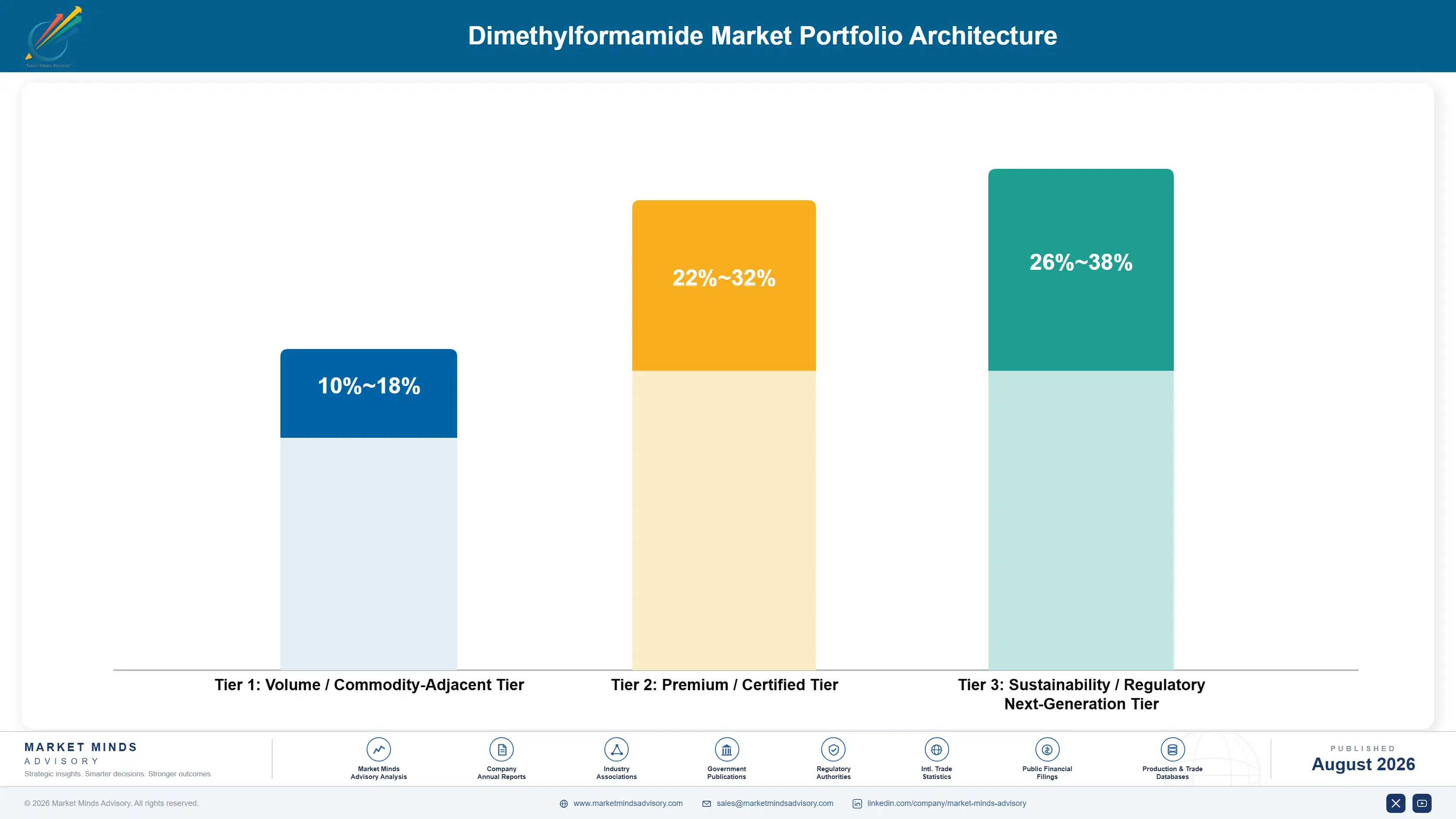
The portfolio splits into three tiers with meaningful margin separation tied to application diversification rather than raw commodity chemical cost alone. Standard textile-grade dimethylformamide competes mainly on price and delivery reliability, while diversified electronics and pharmaceutical grades command durable premiums tied to certified purity and complete downstream application responsibility.
The tension between commodity volume and specialty premium is sharpening as electronics and pharmaceutical applications expand purity-grade demand faster than textile solvent demand grows, pulling producer investment toward the higher-margin segment even though textile-grade solvent remains the larger unit volume base globally today, particularly in developing leather and fiber markets. Producers that maintain a foothold in both segments preserve optionality, while those chasing only specialty applications risk losing the stable cash flow that textile solvent sales still reliably provide.

High-value margin pools concentrate specifically in certified electronics-grade dimethylformamide for semiconductor cleaning and pharmaceutical-grade formulations for regulated markets, both requiring genuine research investment that commodity-only producers must build or acquire rather than simply extend from existing manufacturing capability. Standard textile-grade solvent, by contrast, remains a large but slower-growing volume base offering thinner, more commoditized margins for most participants going forward.

Volume / Commodity-Adjacent Tier

Standard textile-grade dimethylformamide sold primarily on price and delivery reliability into leather and fiber markets without specialty purity or diversified application requirements yet, particularly across cost-sensitive emerging markets worldwide today.
Gross Margin: 10-18%

Premium / Certified Tier

Certified pharmaceutical and metal finishing grades integrated into downstream-certified specialty platforms commanding durable premiums tied to purity validation depth and a proven multi-year track record with regulators and buyers worldwide.
Gross Margin: 22-32%

Sustainability / Regulatory / Next-Generation Tier

Electronics-grade and next-generation ultra-high-purity dimethylformamide grades representing the newest and most technically demanding corner of the entire product portfolio, built specifically for semiconductor platforms sold globally today and quite consistently.
Gross Margin: 26-38%
dimethylformamide-dmf-market-trends-portfolio-architecture-1787548699796

High-value Sub-segments and Strategic Watch-out

Electronics-Grade Semiconductor Cleaning Formulations

High value and high growth, driven by chip fabrication expanding dimethylformamide demand across broader electronics applications worldwide and every price point today. Producers with proven purity grades are capturing this segment's fastest-growing design wins globally right now, across nearly every major market and region worldwide.
Gross Margin: 26-38%

Certified Pharmaceutical-Grade Formulations

High value with strong growth, tied directly to expanding pharmaceutical manufacturing scaling independent of broader textile solvent cycles worldwide and across most segments today. Validated pharmaceutical formulations increasingly decide which producer wins long-term regulated-market contracts across most major buyers and regions worldwide today and consistently.
Gross Margin: 22-32%

Standard Textile-Grade Dimethylformamide

The volume core, serving leather and fiber markets across most global regions regardless of application diversification pace or regulatory timeline currently in place today. Steady growth tracks textile production volume rather than any specific technology trend emerging currently across the wider category and industry overall today.
Gross Margin: 10-18%

Unvalidated Chinese Domestic Commodity Hardware

The strategic watch-out, facing accelerating price competition as domestic suppliers scale production for cost-sensitive downstream segments worldwide and across every single price tier today and quite consistently overall. Remaining international producer volume concentrates in accounts still requiring proven validation history and long-established track records built over time.
Gross Margin: 8-16%

Qualification Cycles Meet Regulatory Timelines

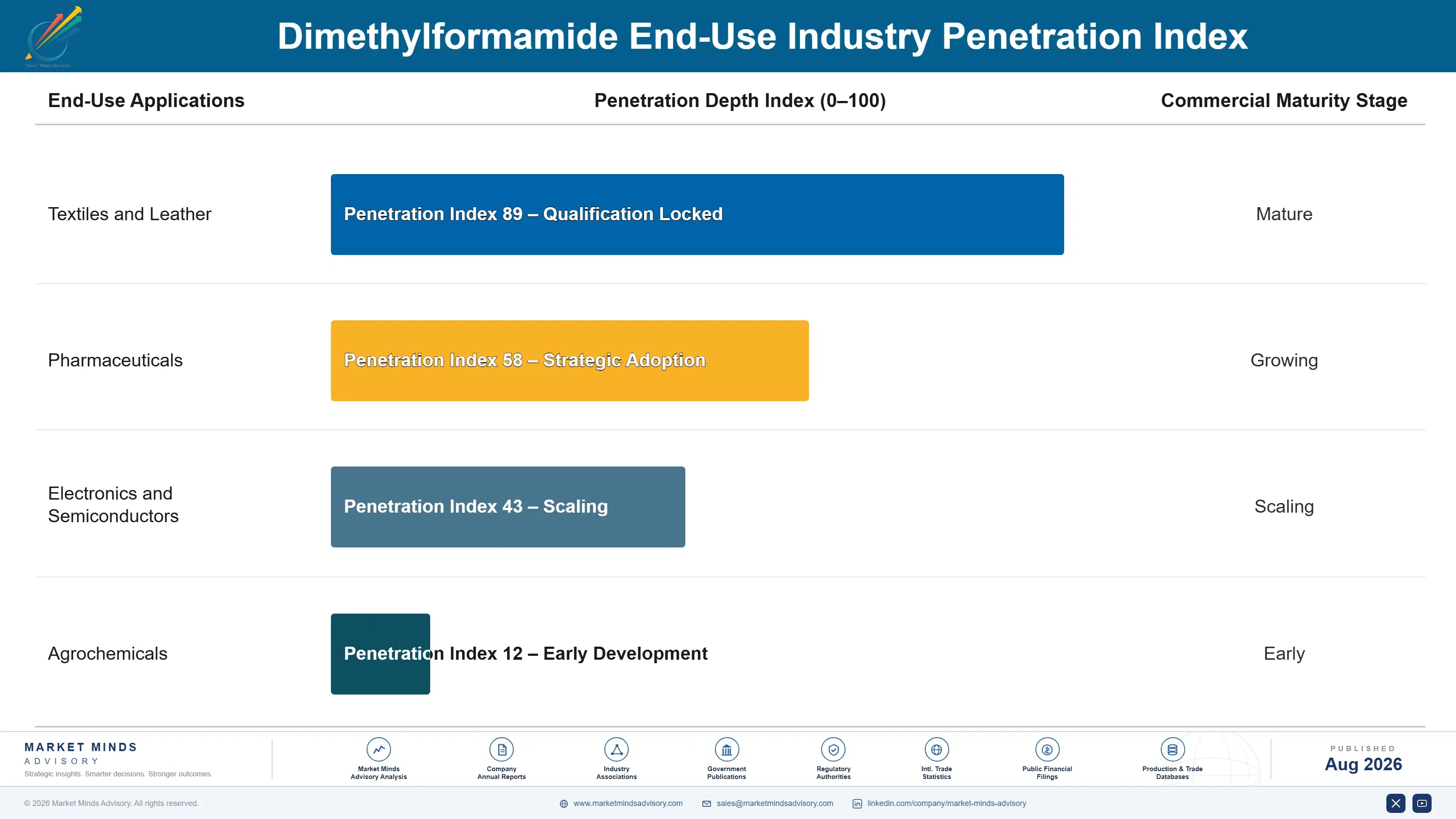
Demand compounds through downstream application qualification cycles rather than simple repeat commodity purchasing patterns. Once a buyer validates a producer's purity grade and environmental compliance documentation against a specific application requirement, switching suppliers means repeating qualification that typically runs 6 to 12 months, creating genuine lock-in once a contract is secured. That lock-in makes won contracts closer to an annuity than a spot sale.
Adoption depth varies sharply by application and buyer scale. Large semiconductor and pharmaceutical manufacturers show the deepest qualification lock-in, having validated complete purity specifications years before smaller competitors began comparable programs. Mid-sized leather and fiber producers show more price-driven switching behavior as they source commodity-grade solvent under competitive bidding. Agrochemical formulators sit between the two, with loyalty varying by certification requirements.

Generational buyer shifts are reshaping who makes these sourcing decisions across the industry today and consistently. Younger procurement managers increasingly prioritize validated environmental compliance data and application performance over established supplier relationships that shaped earlier generations of chemical purchasing professionals. This shift favors producers investing in transparent compliance documentation over those relying primarily on legacy relationship depth built over decades of prior supplier engagement.
dimethylformamide-dmf-market-trends-end-use-penetration-index-1787548700281

Where Producers Should Focus

These are among the four positions where our research anticipates prominent divergence between winners and laggards over the coming forecast period. Each is grounded in the demand model, the regulatory perimeter, and the announced capacity pipeline.
01 / ELECTRONICS PURITY INVESTMENT

Develop Semiconductor Formulations Before Chemistry Consolidates

Semiconductor fabrication capacity keeps expanding across most major manufacturing regions, and producers without validated electronics-grade purity formulations are losing early qualification wins to competitors that invested in this capability years ahead of the current fabrication investment wave sweeping the industry. This gap will only widen as chip manufacturers standardize purity specifications across broader portions of their supply chains to simplify multi-year qualification cycles across regions. Producers relying only on standard textile sales should treat this formulation investment as an urgent strategic priority rather than a discretionary expansion.
02 / PHARMACEUTICAL CERTIFICATION STRATEGY

Secure Regulated-Market Grades Ahead of Compliance Expansion

Pharmaceutical intermediate manufacturing keeps expanding across major markets, and producers without validated pharmaceutical-grade formulations are losing regulated-market business to competitors that secured certification years before compliance requirements tightened significantly across these environmentally sensitive jurisdictions and export destinations worldwide today and consistently. This gap keeps widening as more governments finalize purity documentation requirements, pushing certified-mandated demand into applications that previously accepted standard industrial grades exclusively and reliably. Producers without a credible pharmaceutical certification pipeline risk permanently losing regulated-market volume to better-prepared competitors.
03 / FEEDSTOCK SUPPLY SECURITY STRATEGY

Secure Direct Methanol Supply Relationships Now

Methanol and dimethylamine price volatility keeps compressing margins across the category, and producers relying purely on spot market purchasing against direct-sourcing competitors face a genuinely difficult position given the cost advantages secured feedstock relationships provide during periods of supply disruption and volatility. Direct feedstock partnerships combining guaranteed volume commitments with negotiated pricing address both the cost stability and supply security challenges simultaneously and directly across producing regions. Producers without a credible direct sourcing strategy risk losing meaningful margin advantage permanently to better-positioned competitors.
04 / INDIAN DISTRIBUTION EXPANSION

Build Direct Distribution Ahead of Pharmaceutical Growth

Indian pharmaceutical intermediate manufacturing keeps expanding domestic production capacity, and producers without direct distribution relationships are losing volume to competitors that established local sales presence years before this domestic growth wave accelerated across major Indian industrial hubs and manufacturing centers. This gap keeps widening as more Indian manufacturers prefer direct supplier relationships over intermediary distribution arrangements that added cost and reduced responsiveness. This positions early movers to own a growing Indian content category before broader industry investment catches up fully.

Engagement Snapshot From the Field

A live engagement with an industry participant carrying material or product regulatory and market exposure ahead of a defining policy shift, showing how our research translates into a defensible multi-year portfolio strategy.
MARKET MINDS ADVISORY · CLIENT ENGAGEMENT SUMMARY
Dimethylformamide Producer Strategic Portfolio Review and Transition Roadmap 2026·Investment Scenario on Dimethylformamide Exposure Evaluation 2025-26
CLIENT PROFILE
A mid-sized Indian pharmaceutical intermediate manufacturer approached MMA while planning a solvent sourcing overhaul ahead of expanding export certification requirements into European markets nationwide and across every product line. The client reported annual production volume near 3,800 tonnes of active pharmaceutical intermediates and had previously sourced commodity-grade dimethylformamide through regional distributors without direct producer relationships (client-reported, unverified by MMA).
STRATEGIC CHALLENGE
Management needed to identify a dimethylformamide supplier capable of meeting new European export certification requirements within a compressed compliance timeline while keeping incremental chemical cost within the client's competitive intermediate pricing constraints and margin targets. The client's procurement team had limited prior experience validating pharmaceutical-grade compliance documentation at this export scale.
MMA APPROACH
MMA benchmarked certified dimethylformamide pricing and compliance documentation across four candidate suppliers under the client's specific export deadline and cost targets. We modeled total sourcing cost including certification and assessed each supplier's methanol feedstock supply security given recent petrochemical disruption history. We also evaluated each candidate's experience supporting comparable export certification for other South Asian pharmaceutical manufacturers.
KEY FINDINGS
  1. Two of the four candidate suppliers had already supported comparable European export certification for other South Asian pharmaceutical manufacturers, meaningfully reducing expected timeline risk (client-reported, unverified by MMA).
  2. The client's incumbent regional distributor could not provide the environmental compliance documentation required for European export within the certification deadline at all.
  3. Per-unit chemical cost increased meaningfully under the recommended direct producer relationship but remained within the client's stated competitive pricing tolerance for the segment.
  4. Methanol feedstock supply security varied significantly among candidates, with only two suppliers offering diversified sourcing protecting future delivery timelines fully and reliably.
CLIENT PROFILE
A mid-sized Indian pharmaceutical intermediate manufacturer approached MMA while planning a solvent sourcing overhaul ahead of expanding export certification requirements into European markets nationwide and across every product line. The client reported annual production volume near 3,800 tonnes of active pharmaceutical intermediates and had previously sourced commodity-grade dimethylformamide through regional distributors without direct producer relationships (client-reported, unverified by MMA).
STRATEGIC CHALLENGE
Management needed to identify a dimethylformamide supplier capable of meeting new European export certification requirements within a compressed compliance timeline while keeping incremental chemical cost within the client's competitive intermediate pricing constraints and margin targets. The client's procurement team had limited prior experience validating pharmaceutical-grade compliance documentation at this export scale.
MMA APPROACH
MMA benchmarked certified dimethylformamide pricing and compliance documentation across four candidate suppliers under the client's specific export deadline and cost targets. We modeled total sourcing cost including certification and assessed each supplier's methanol feedstock supply security given recent petrochemical disruption history. We also evaluated each candidate's experience supporting comparable export certification for other South Asian pharmaceutical manufacturers.
KEY FINDINGS
  1. Two of the four candidate suppliers had already supported comparable European export certification for other South Asian pharmaceutical manufacturers, meaningfully reducing expected timeline risk (client-reported, unverified by MMA).
  2. The client's incumbent regional distributor could not provide the environmental compliance documentation required for European export within the certification deadline at all.
  3. Per-unit chemical cost increased meaningfully under the recommended direct producer relationship but remained within the client's stated competitive pricing tolerance for the segment.
  4. Methanol feedstock supply security varied significantly among candidates, with only two suppliers offering diversified sourcing protecting future delivery timelines fully and reliably.
RECOMMENDED STRATEGY
Phase 1: Phase 1 (0 to 3 months): Select the certified dimethylformamide supplier and finalize direct sourcing terms fully and quite promptly. Phase 2: Phase 2 (3 to 7 months): Complete full compliance and quality documentation thoroughly against European export certification requirements and standards. Phase 3: Phase 3 (7 to 10 months): Launch full export shipments under the newly certified dimethylformamide sourcing arrangement now in place.
OUTCOME
The client completed certification within the ten-month timeline, meeting the export deadline without any production disruption whatsoever across the entire facility. The certified sourcing also qualified the client's intermediates for premium European buyers, supporting a reported margin improvement on export shipments (client-reported, unverified by MMA).

Frequently Asked Questions

Foundational context covering the market sizes, CAGR, scope, country, region and competition that inform every finding below. This section is provided to cover basics and most often pre-purchase conversations, answered from the MMA Primary Research Dataset.

What is the current size of the Dimethylformamide Market?

The market stood at approximately USD 2.6 billion in 2025, according to MMA's primary research dataset. This reflects global demand across textile, electronics, and pharmaceutical dimethylformamide grades.

How large will the Dimethylformamide Market be by 2036?

MMA projects the market will reach approximately USD 5.04 billion by 2036 under the base case scenario. This represents roughly 1.83 times the 2026 market entry value.

What is the CAGR for the Dimethylformamide Market 2026 to 2036?

The base case CAGR is 6.2%, with a bull case of 7.4% and a bear case of 5.0%. The range reflects uncertainty around solvent handling and emission regulation.

Which segment is growing fastest?

Electronics and semiconductor cleaning grows fastest at 9.8%, about 1.58 times the overall market rate. Expanding chip fabrication capacity is the primary driver of this growth.

Who are the major companies in the Dimethylformamide Market?

Leading companies include BASF SE, Eastman Chemical Company, Shandong Hualu-Hengsheng Chemical, Mitsubishi Gas Chemical, and Balaji Amines. These five hold an estimated 42% of the market.

Which country is growing fastest?

India posts the fastest national growth at 8.9% CAGR, driven by expanding pharmaceutical and synthetic leather manufacturing. This outpaces the broader South Asia and Pacific regional average.

Report Segmentation Architecture

The full report scope spans multiple orthogonal segmentation dimensions, with cross-tabulated demand data provided for each dimension pair. Coverage extends further to regional breakdowns, trend trajectories, and the competitive detail needed to support segment-level decision-making.

By Application Type

  • Synthetic Leather and PU Coatings
  • Pharmaceutical Intermediates
  • Acrylic Fiber Production
  • Agrochemical Formulation
  • Electronics and Semiconductor Cleaning
  • Pesticide and Herbicide Solvent

By End-Use Industry

  • Textiles and Leather
  • Pharmaceuticals
  • Electronics and Semiconductors
  • Agrochemicals

By Commercial Dimension

  • Direct Producer Supply
  • Distributor and Trader Supply
  • Long-Term Contract Supply
  • Spot Market Supply

By Region

  • East Asia
  • North America
  • Western Europe
  • South Asia and Pacific
  • Latin America
  • Middle East and Africa
  • Eastern Europe

Scope, Methodology, and Coverage

Every figure in this report is reproducible from documented input assumptions. The scope below maps the historical period, the forecast horizon, the segmentation dimensions, and the countries covered, alongside the underlying primary and qualitative methodology.
Historical Period
2020 to 2025
Forecast Period
2026 to 2036
Base Year
2025 (USD billions; MMA Primary Research Dataset, August 2026)
Market Definition
The dimethylformamide market covers DMF solvent produced and consumed across synthetic leather coating, acrylic fiber production, pharmaceutical intermediate synthesis, electronics cleaning, and agrochemical formulation applications. It excludes other amide solvents such as dimethylacetamide and N-methylpyrrolidone not chemically classified as dimethylformamide.
Quantitative Units
USD billions (current prices); metric tonnes shipment volume where applicable
Segmentation Dimensions
By Application Type; By End-Use Industry; By Commercial Dimension; By Region
Regions Covered
East Asia, North America, Western Europe, South Asia and Pacific, Latin America, Middle East and Africa, Eastern Europe
Countries Covered
China, India, USA, Germany, France, UK, Japan, South Korea, Australia, Canada, Brazil, Mexico, Indonesia, Vietnam, Thailand, Ethiopia, UAE, Saudi Arabia, South Africa, Nigeria, Turkey, Poland, Russia, Netherlands, Italy, Spain, Sweden, Argentina, Colombia, Taiwan, and additional markets relevant to this sector
Key Companies Profiled
BASF SE, Eastman Chemical Company, Shandong Hualu-Hengsheng Chemical, Mitsubishi Gas Chemical, Balaji Amines, American Elements, Jiangsu Lianhai Biological Technology, Ningxia Xiaocheng Chemical, Nippon Chemical Industrial, Alfa Aesar (Thermo Fisher), Camex Limited, Shandong Baofeng, SNF Group, Jiangsu Sanmu Group, Anhui Jinhe Industrial, Shanxi Sanwei Group, Hebei Chengxin Chemical, Yankuang Guohong Chemical, Zhejiang Xinhua Chemical, Punjab Chemicals and Crop Protection
Quantitative Methodology
Primary survey, n=3,800 respondents, Q4 2025, six countries; demand-side model with trade association cross-validation
Qualitative Methodology
47 expert interviews, Q4 2025; applied to validate demand model assumptions, identify emerging dynamics, and assess competitive positioning
Report Format
PDF and XLSX data workbook (Word format preview document)
Publisher
Market Minds Advisory
Report Code
MMA-2026-CHM-204
Published
August 2026
Contact
sales@marketmindsadvisory.com | www.marketmindsadvisory.com

Purchase the full Dimethylformamide Market Report (2026 to 2036).

The full MMA Dimethylformamide report sizes the market across six application types, four end-use industries, and seven regions through 2036. It profiles 20 participants on a consistent revenue basis, scoring each on application diversification, environmental compliance depth, and methanol feedstock supply security. Scenario models quantify how electronics and pharmaceutical demand and reproductive toxicant regulation move pricing across textile and specialty segments. The report also includes delivered methanol cost modeling, a regulatory tracker, and an Indian pharmaceutical demand mapping screen built for procurement and category strategy teams.
Six-application segmentation with detailed growth forecasts
Methanol and dimethylamine supply risk assessment
Reproductive toxicant regulation tracking dashboard tool
Textile versus specialty grade margin model
Indian pharmaceutical demand mapping tool overall
Twenty-company competitive benchmarking scorecard overall today

Built For The People Who Decide

From boardroom strategy to bench-side execution, this report is read cover-to-cover by leaders shaping the next decade of their industry, turning demand scenarios, market dynamics and valuation benchmarks into decisions.
CXOs/ Presidents/ VPs/ Managers
M&A and Corporate Development
Strategy Teams and R&D Heads
Procurement and Product Directors
Regulatory and Compliance Leaders
Investor Relations and Equity Analysts