Market Minds Advisory
Dimethyl Terephthalate Market

Dimethyl Terephthalate Market: Methanolysis Revival, Certified Recycled Content, and the Waste Bale Everyone Now Wants

A molecule displaced from commodity polyester decades ago has become the natural output of chemical recycling, which turned a declining intermediate into the entry point for certified recycled content. Feedstock, not chemistry, now decides.

Lead Analyst

Bilal Shaikh

Published

September 2026

Make Smarter Decisions with Customized Research Insights

Request a free sample report and evaluate market opportunities, growth trends, and competitive dynamics relevant to your business needs.

2025 MARKET VALUE$1.3BMarket Size 2025
2036 FORECAST VALUE$2.6BBase Case , 2026 to 2036
CAGR 2026 TO 20366.4 %Bull 7.6% / Bear 5.2%
INCREMENTAL OPPORTUNITY$1.2BNet 10- year value creation
EXPANSION MULTIPLE1.86x2036 value over 2026 base
Strategic Levers
M&A Pipeline
Regional Outlook
Country Rankings
Competitive Intelligence
Segmental Deep-dive
Call-Us : 91 93563 13602

Executive Snapshot and Market Trajectory

Purified terephthalic acid took the commodity polyester business away from this molecule decades ago, and everyone assumed the story ended there. Chemical recycling reopened it, because depolymerising polyester waste with methanol produces dimethyl terephthalate directly rather than as a detour. Nobody expected the revival to come from waste.
Commercial power sits with producers holding depolymerisation capacity and certified feedstock supply rather than with conventional oxidation plants. The methanolysis route grows fastest at 14.8%, roughly 2.31 times the market, from a base that barely existed five years ago. East Asia holds 30% of global value, carried by Korean, Japanese, and Chinese engineering resin and specialty polyester production together. Textile and coloured streams remain largely untapped.
Concentration is high at roughly 63% for the top five, and depolymerisation capital requirements are widening rather than narrowing that gap. Certified recycled material commands a 26% premium over identical virgin molecules. Competition for waste polyester bales now sets the economics more than methanol pricing does. Depolymerisation plants now compete for bales against mechanical recyclers, bottle-to-bottle operations, and each other, and collection has not expanded to match. Bale prices have risen accordingly.
Market Definition
The market comprises dimethyl terephthalate supplied as a polyester and engineering resin intermediate, covering the p-xylene oxidation and esterification route, the terephthalic acid esterification route, the PET methanolysis depolymerisation route, the glycolysis-methanolysis hybrid route, and the polyester waste solvolysis route. Value is measured at producer level across virgin and recycled-origin supply. Purified terephthalic acid, monoethylene glycol, finished polyester resins and fibres, mechanically recycled polyester flake, and polymerisation equipment fall outside scope.
Base Year Value
$1.3B in 2025 (MMA Primary Research Dataset, August 2026)
Forecast Period
2026 to 2036, eleven discrete annual values
CAGR
6.4% base case. Bull 7.6%. Bear 5.2%.
Fastest Growth Segment
PET Methanolysis Depolymerisation Route: 14.8% CAGR
Fastest Growth Country
India: 9.6% CAGR
Fastest Growth Region
South Asia and Pacific: 8.6% CAGR
Largest Region
East Asia: 30% of 2025 global value
Market Leaders
Eastman Chemical, SK Chemicals, Oxxynova, Mitsubishi Gas Chemical, and Indorama Ventures lead on dimethyl terephthalate supply. Source: company annual reports and MMA Analysis, July 2026.
Primary Survey
n=3,800 procurement and R&D decision-makers, Q4 2025, six countries
Methodology
Demand-side build-up, cross-validated against public data, 47 expert interviews

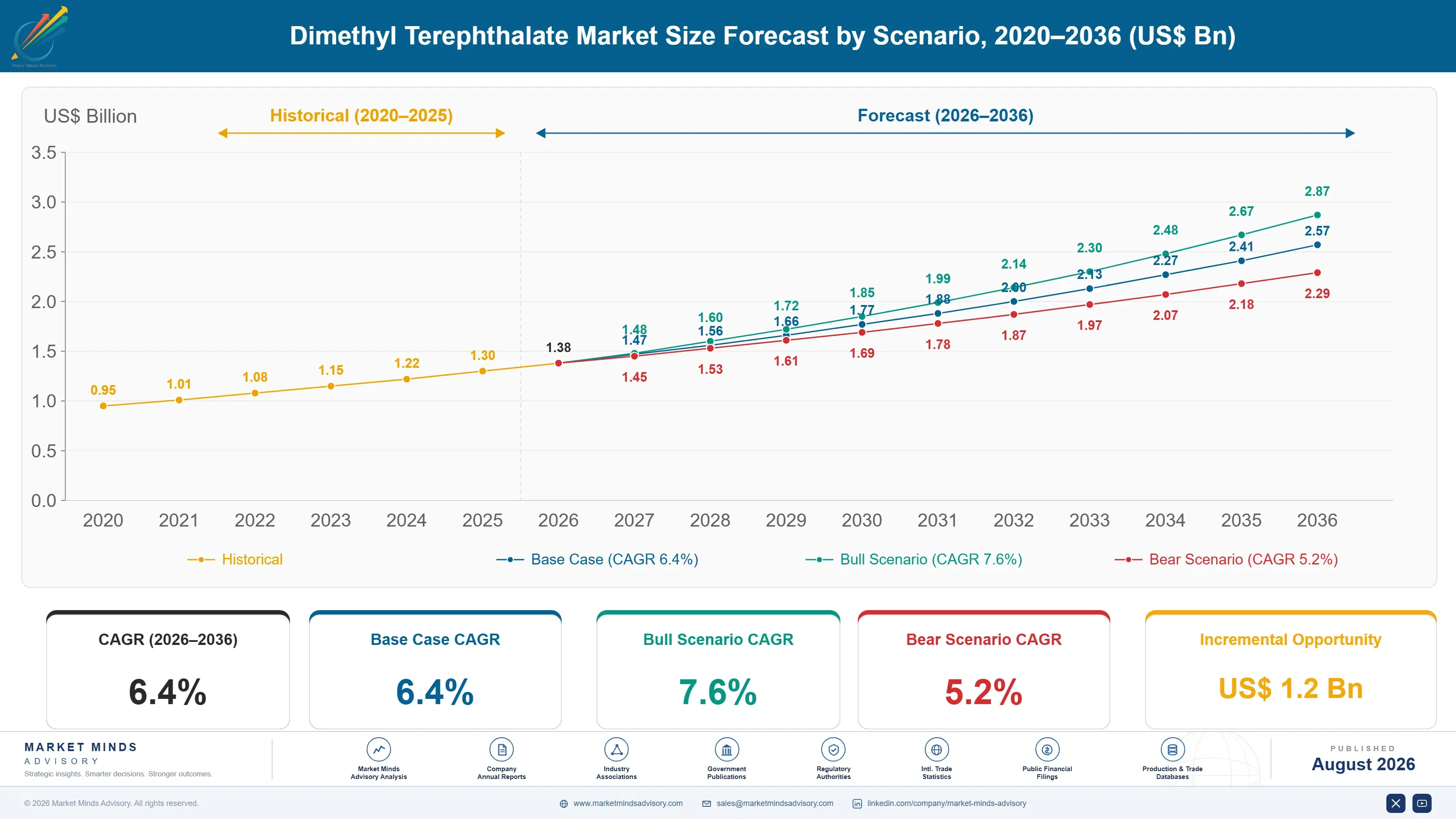
Dimethyl Terephthalate Market Forecast Scenarios

dimethyl-terephthalate-dmt-market-trends-size-forecast-scenario-1787549210071
Between 2020 and 2025 a declining intermediate became a growth story for reasons unconnected to its traditional applications. Brand commitments and European packaging rules created demand for chemically recycled polyester, and methanolysis produces this molecule directly. Conventional demand in engineering resins held steady while commodity polyester continued using terephthalic acid. The 5.1% historical growth mixes a flat legacy business with one expanding from nothing.
The 6.4% base case rests on three mechanisms. Recycled content mandates and voluntary brand commitments require material that mechanical recycling cannot supply for coloured, mixed, and textile polyester waste, and depolymerisation is the only route that handles those streams at specification. Engineering resin demand grows with electrical connectors and vehicle electrification content. And certified recycled material commands a 26% premium that makes depolymerisation capacity investable. Policy timetables rather than market forces set the pace of all three.
The 7.6% bull case assumes recycled content mandates are enforced on schedule and depolymerisation capacity reaches announced levels. The 5.2% bear case reflects mandate deferral, waste polyester feedstock costs rising as recyclers compete for the same bales, and brand commitments softening once the cost of meeting them reaches retail pricing. Feedstock economics decide more than technology in either case.

The Molecule That Chemical Recycling Brought Back

Three things set the commercial shape of this market. Recycled content policy comes first, because mandates and brand commitments are what created demand for a molecule that commodity polyester had abandoned. Feedstock access comes second, since depolymerisation plants compete for waste polyester bales against mechanical recyclers, bottle-to-bottle operations, and each other. Engineering resin demand comes third, the steady legacy business underneath.
TOP-FIVE CONCENTRATION63%Share of global supply held by the leading producers
AVERAGE SELLING PRICEUSD 1,320 per tonneBlended pricing across virgin and recycled origin material
RECYCLED ORIGIN SHARE18%Portion of supply produced from depolymerised polyester waste
ENGINEERING RESIN SHARE34%Portion of demand consumed by engineering thermoplastic production
METHANOL COST SHARE23%Methanol input within total conventional route production cost
CERTIFIED CONTENT PREMIUM26%Price uplift commanded by verified recycled origin material
The chemistry matters commercially in one specific way. Depolymerisation with methanol produces this molecule directly and it purifies by distillation, which removes colour, contaminants, and additives that mechanical recycling carries through. That is why coloured bottles, mixed trays, and textile polyester all become feasible feedstock, and those streams are precisely what mechanical recyclers cannot use. That capability gap is the whole basis of the premium.
Certification is the commercial instrument rather than the chemistry. A brand paying a 26% premium is buying a mass balance certificate proving recycled origin, since the molecule itself is identical to virgin material by every analytical test available. That makes chain of custody documentation a product feature, and producers without credible certification cannot access the premium regardless of what their process actually consumes. Documentation capability is a genuine commercial asset.
"The strange thing about this market is that the premium product and the commodity product are chemically indistinguishable. What a brand pays extra for is a certificate and an audit trail, which means the commercial competence that matters most is documentation rather than chemistry. Plenty of good chemists have lost that argument expensively."
Practice Director, Polymers and Circular Materials · MMA Chemicals and Materials Practice · August 2026

Market Trends

Methanolysis Turns Waste Polyester Into Specification Monomer

Depolymerising polyester with methanol produces this molecule directly, and distillation then removes colour, dyes, additives, and contaminants that mechanical recycling carries into the finished product. That opens coloured bottles, multilayer trays, and textile polyester as feedstock, none of which mechanical recyclers can use at food or fibre specification. Recycled origin material already supplies 18% of the market from a base that barely existed five years ago. Capital cost per tonne of capacity remains high and feedstock logistics are unfamiliar to chemical companies, which is why announced capacity has consistently arrived later than planned.
Market Impact: Mandates specify above 25% content
Certification Rather Than Chemistry Captures the Premium

Recycled and virgin material are chemically indistinguishable, so the 26% premium a brand pays rests entirely on mass balance certification and a documented chain of custody back to the waste stream. Certification schemes audit input records, allocation methodology, and site controls rather than testing the product, which makes documentation capability a genuine commercial asset. Producers who invested in certification early access the premium while equally capable competitors cannot. Brands under recycled content commitments will not accept uncertified material at any price, because their own reporting depends on the audit trail rather than on the molecule.
Market Impact: Engineering resins take 34% of demand

Market Opportunities and Growth Drivers

Recycled Content Mandates Create Demand Policy Rather Than Markets Set

European packaging rules and comparable national requirements set minimum recycled content in polyester packaging on published timetables, and brands have made voluntary commitments beyond them. Mechanical recycling cannot supply the volumes required at the necessary specification, particularly for coloured and multilayer material, which leaves chemical routes as the only compliance path for a meaningful share. That converts a policy deadline into a purchase order with a date attached. Producers with certified capacity in place before each deadline capture demand that arrives suddenly rather than gradually across the market. Capacity in place beats capacity announced.
Market Impact: Bale costs up above 30%

Engineering Resin Demand Grows With Vehicle Electrification Content

Polybutylene terephthalate takes 34% of demand and serves electrical connectors, housings, and sensor components where dimensional stability and electrical properties matter more than cost. A battery electric vehicle carries substantially more connector and high-voltage component content than a combustion equivalent, and each adds engineering resin volume. This demand is technically specified and slow to change, which makes it the steady base underneath a recycling business that policy could disrupt in either direction. Automotive qualification also locks material sources for platform lifetimes measured in years rather than quarters. That stability matters in a policy-driven market.
Market Impact: Projects exceed $300 million each

Market Restraints and Challenges

Waste Polyester Feedstock Competition Raises the Cost Floor

Depolymerisation plants compete for the same waste bales as mechanical recyclers, bottle-to-bottle operations, and other chemical recyclers, and collection infrastructure has not expanded to match the announced capacity. The root cause is that waste supply grows with collection systems rather than with demand from processors. Bale prices have risen sharply wherever chemical recycling capacity has been commissioned. Producers mitigate through long-term collection contracts, investment in sorting infrastructure, and deliberately targeting streams mechanical recyclers cannot use, which is the only genuinely defensible position available. Collection expands far more slowly than processing capacity does, and nothing in current policy changes that.
Market Impact: Recycled origin reaches 18% of supply

Depolymerisation Capital Intensity Delays Announced Capacity Repeatedly

Building a methanolysis plant costs several hundred million dollars for meaningful scale and requires feedstock logistics that chemical companies have rarely handled before. The root cause is a genuine mismatch of competence: sorting, baling, and contaminated feedstock handling belong to the waste industry rather than to petrochemicals. Announced projects have slipped repeatedly and several have been cancelled. Producers mitigate by partnering with waste management companies, staging capacity in modules, and securing offtake before committing capital rather than building speculatively into a policy expectation. Speculative building into policy expectation has proved expensive.
Market Impact: Certified material earns 26% more
4 additional market trends, 3 additional growth drivers, and 2 additional restraints and challenges are covered in the full report. Contact sales@marketmindsadvisory.com to access the complete intelligence.

Segment CAGR and Growth Architecture

Segmentation follows production route, because the route determines feedstock, capital intensity, achievable purity, certification eligibility, and cost position. Five routes cover commercial supply, and they compete for the same customers with quite different economics, since a conventional oxidation plant and a depolymerisation unit share an output specification and almost nothing else. Feedstock rather than chemistry separates them commercially.
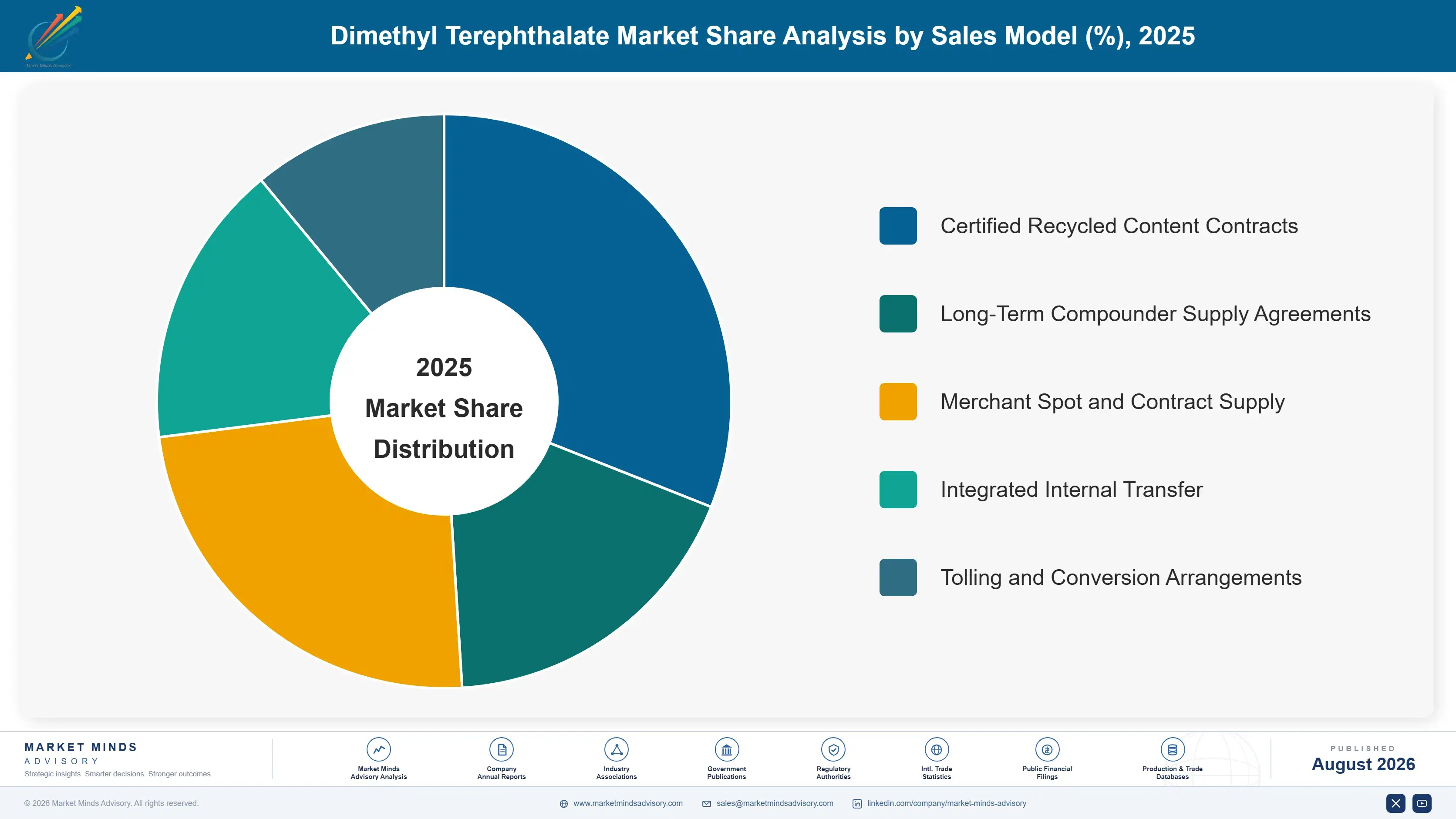
dimethyl-terephthalate-dmt-market-trends-market-share-analysis-1787549210609

PET Methanolysis Depolymerisation Route

The fastest-growing route at 14.8%, roughly 2.31 times the market, and the reason this molecule has a growth story at all. Methanol depolymerises polyester directly into the monomer, which then purifies by distillation to a specification that removes colour, dyes, and additives entirely. That opens coloured bottles, multilayer trays, and textile waste as feedstock, none of which mechanical recycling can process to food or fibre grade. Capital cost runs several hundred million dollars for meaningful scale, and feedstock logistics demand competence chemical companies have rarely needed. Announced capacity has consistently arrived later than planned, which is why the premium has held rather than eroding. Feedstock access rather than process technology now determines whether a project proceeds at all.
CAGR 14.8%

Glycolysis-Methanolysis Hybrid Route

Second fastest at 11.4%, combining partial glycolysis with subsequent methanolysis to handle feedstock streams that direct methanolysis manages poorly. The hybrid approach tolerates higher contamination and mixed polymer content, which matters for textile waste and post-consumer streams that arrive far dirtier than bottle bales. Yields sit below direct methanolysis and the process carries additional steps, so cost per tonne runs higher. What justifies it commercially is feedstock access, since the streams it handles are cheaper and less contested than clear bottle bales. Producers running both routes can direct each waste stream to whichever process handles it economically. Running both routes lets a producer direct each incoming stream to whichever process handles it economically rather than rejecting the material outright.
CAGR 11.4%
Full segment breakdown across 5 segments available in the complete report.

Regional Architecture and Country Demand Map

Regional shares follow engineering resin and specialty polyester production alongside recycled content policy. Where mandates exist, depolymerisation capacity follows; where they do not, demand rests on the legacy engineering resin business almost entirely. Collection infrastructure quality determines whether depolymerisation is viable at all. Policy sets demand; logistics sets supply.

North America

Eastman's methanolysis investment at Kingsport made this region the proving ground for commercial-scale chemical recycling into this molecule, and brand commitments from consumer goods companies headquartered here created the offtake that justified it. State-level recycled content requirements in California and elsewhere add regulatory demand alongside the voluntary commitments. Engineering resin production for automotive connectors and electrical components supplies the legacy base. Waste polyester collection infrastructure is less developed than European systems, which makes feedstock sourcing genuinely difficult and has pushed producers into direct collection partnerships. Growth of 7.2% depends on depolymerisation capacity arriving closer to announced schedules than the recent record suggests. Direct collection partnerships have become standard practice here.
Share: 25% | CAGR: 7.2% (2026 to 2036)

Western Europe

Packaging regulation defines this market and sets recycled content requirements on timetables that brands must meet regardless of cost or supply availability. Collection and sorting infrastructure is the best developed anywhere, which should favour depolymerisation, and instead intense competition for bales from mechanical recyclers has driven feedstock costs up sharply. Oxxynova in Germany anchors conventional regional production. Announced chemical recycling projects have slipped or been cancelled at a higher rate here than elsewhere, largely on feedstock economics rather than technology. Engineering resin demand from German automotive electrical component production is substantial. Growth of 4.8% is the slowest in the report despite the strongest policy driver anywhere. Feedstock economics rather than technology killed those projects.
Share: 19% | CAGR: 4.8% (2026 to 2036)
Regional intelligence for 5 additional markets available in the complete report: East Asia, South Asia and Pacific, Latin America, Middle East and Africa, Eastern Europe. Contact sales@marketmindsadvisory.com.
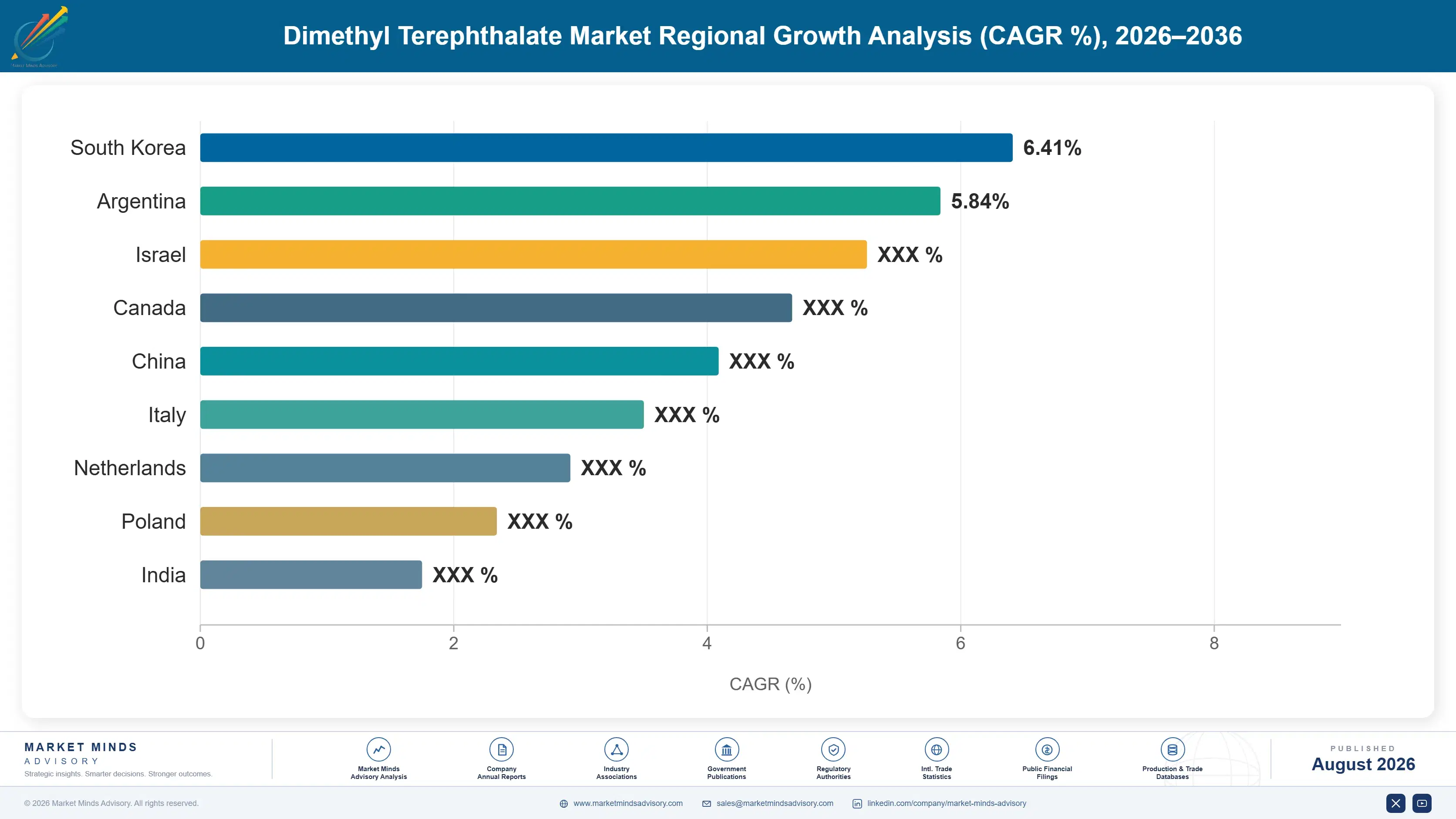
dimethyl-terephthalate-dmt-market-trends-country-cagr-analysis-1787549211125

Four Moves That Change the Economics

Advantage here comes from feedstock access, certification capability, and route flexibility rather than from process chemistry, which is well published and unpatentable in its essentials. Four moves are worth capital and management attention across the forecast period, and two of them concern waste supply rather than anything a chemical engineer would recognise. Both require competence outside conventional chemical operations.

Contract waste feedstock before building any capacity

Bale prices have risen above 30% wherever depolymerisation capacity has been commissioned, because collection has not expanded to match processing demand. Long-term supply agreements with waste management companies, municipalities, and textile collectors secure both volume and price before a plant commits capital. Producers who built first and sourced afterwards have run below nameplate capacity while paying spot prices that destroy the project economics. The commercial competence required belongs to the waste industry rather than to petrochemicals, which is precisely why partnership beats attempting it internally. Partnership beats attempting to build waste competence internally.
Market Impact: Bale costs have already risen above 30% overall

Build certification and chain of custody capability first

Recycled and virgin material are chemically identical, so the entire 26% premium rests on mass balance certification and auditable input records rather than on anything analytical. Brands under recycled content commitments refuse uncertified material at any price because their own reporting depends on the audit trail. Certification costs perhaps $300,000 to $700,000 to establish and maintain annually, which is negligible against the premium it earns across every tonne sold. Producers treating it as a compliance overhead rather than as the revenue mechanism consistently underinvest and then cannot explain their pricing.
Market Impact: Secures a 26% certified recycled content price premium

Target waste streams mechanical recycling cannot process

Clear bottle bales are contested by every recycler and priced accordingly, while coloured bottles, multilayer trays, and textile polyester go largely unrecovered because mechanical routes cannot bring them to specification. Depolymerisation handles all of them, and those streams cost 25 to 45% less than clear bale feedstock. Building sorting and preprocessing capability for contaminated material is the barrier, and it is also the defence, since competitors buying the same clear bales as everybody else have no cost advantage available to them at all. Competitors buying identical clear bales hold no cost advantage at all.
Market Impact: Cuts feedstock cost by 25 to 45% overall

Run both depolymerisation routes to match feedstock quality

Direct methanolysis handles clean bottle-grade feedstock efficiently while the glycolysis-methanolysis hybrid tolerates the contamination and mixed polymer content that textile and post-consumer streams carry. Operating both lets a producer direct each incoming stream to whichever process handles it economically rather than rejecting material or paying to clean it excessively. Route flexibility typically improves feedstock utilisation 15 to 25% against a single-process plant. The additional capital is modest relative to the primary depolymerisation investment already committed. Each stream goes to whichever process handles it economically rather than being rejected. Additional capital is modest beside the primary investment already committed.
Market Impact: Improves overall feedstock utilisation by 15 to 25%

Who Controls the Margin Pool

Concentration is high: the top five hold roughly 63% of global supply, and depolymerisation capital requirements are widening that gap rather than narrowing it. Eastman leads through commercial-scale methanolysis capacity and the brand offtake relationships that justified building it. SK Chemicals and Mitsubishi Gas Chemical hold substantial conventional positions serving engineering resin and specialty polyester chains, while Oxxynova anchors European supply and Indorama brings polyester integration across several continents.
Competitive activity runs on three fronts. Feedstock access is the first, and it now determines project viability more than process technology does. Certification capability is the second, because the premium rests on documentation rather than on the molecule. Route flexibility is the third, and producers able to process dirtier streams reach feedstock nobody else is competing for. Process technology itself is well published and confers little advantage.

Pressure is building from two directions. Waste management companies are integrating forward into depolymerisation, arriving with the feedstock position chemical producers lack. And announced capacity from multiple entrants could oversupply the certified market if mandates are deferred while plants complete. The first pressure is the more serious, because a waste operator entering depolymerisation arrives holding the position that chemical producers find hardest to build.
dimethyl-terephthalate-dmt-market-trends-company-positioning-matrix-1787549211643

Competitive Moat and Risk Dimensions

EASTMAN CHEMICAL

Moat: Commercial scale methanolysis capability

Operating depolymerisation at genuine commercial scale rather than demonstration scale gives Eastman an operating record and brand offtake relationships that competitors announcing projects cannot match. Consumer goods companies under recycled content commitments contract years ahead with producers who have actually delivered certified material, which compounds the early advantage considerably.
EASTMAN CHEMICAL

Risk: Feedstock cost and availability exposure

Depolymerisation economics depend on waste polyester bales whose prices have risen above 30% wherever capacity has been commissioned, and collection infrastructure expands far more slowly than processing capacity. Competing for feedstock against mechanical recyclers with lower capital intensity and lower processing cost is an uncomfortable position that scale alone does not resolve.
SK CHEMICALS

Moat: Engineering resin chain integration

Supplying the monomer into its own specialty polyester and copolyester production gives SK Chemicals demand certainty that merchant producers lack, and it captures margin across two stages rather than one. Regional engineering resin customers value a supplier who understands the downstream polymer requirements rather than shipping to a specification.
SK CHEMICALS

Risk: Limited depolymerisation capacity position

Growth in this market comes almost entirely from recycled origin material, and a position built on conventional production participates in the flat legacy business rather than the expanding one. Building depolymerisation capacity requires several hundred million dollars and feedstock competence that sits outside the company's established operating experience entirely.

Players Tracked

Prominent Players

Eastman Chemical
SK Chemicals
Oxxynova
Mitsubishi Gas Chemical
Indorama Ventures

Other Key Players

Loop Industries
Alpek Polyester
Reliance Industries
JBF Industries
Hunan Yuncheng Chemical
Shandong Yuandong
Toray Industries
Teijin
LG Chem
Lotte Chemical
DuPont
BASF
Covestro
Jiangsu Sanfangxiang
Far Eastern New Century

Recent Developments

MARCH 2025

Producer signs long-term textile waste supply agreement

A multi-year feedstock agreement covering post-consumer textile polyester was concluded with a collection and sorting operator, securing a stream that mechanical recyclers cannot process to specification. Sorting and preprocessing investment formed part of the arrangement rather than being left to the supplier alone. Volumes were multi-year and substantial.
Signal: Feedstock contracting now clearly precedes any capacity decision, reversing the sequence that this industry originally attempted
JULY 2025

Brand commits to certified recycled content volumes

A consumer goods company contracted multi-year volumes of mass balance certified recycled material at a premium to virgin pricing, covering packaging portfolios subject to recycled content requirements. Chain of custody documentation rather than any analytical specification formed the contractual basis for the premium paid. Pricing referenced virgin benchmarks.
Signal: Brands are contracting certificates and audit trails, which makes documentation capability into the actual revenue mechanism
OCTOBER 2025

Announced depolymerisation project cancelled on feedstock economics

A planned chemical recycling facility was cancelled before construction after bale price increases undermined the project economics, despite technology validation having been completed. Collection infrastructure had not expanded at the rate the original investment case had assumed it would. Technology validation had been completed before the decision.
Signal: Feedstock rather than technology is now killing these projects, which most investment cases still underweight badly

What Sets the Cost Base

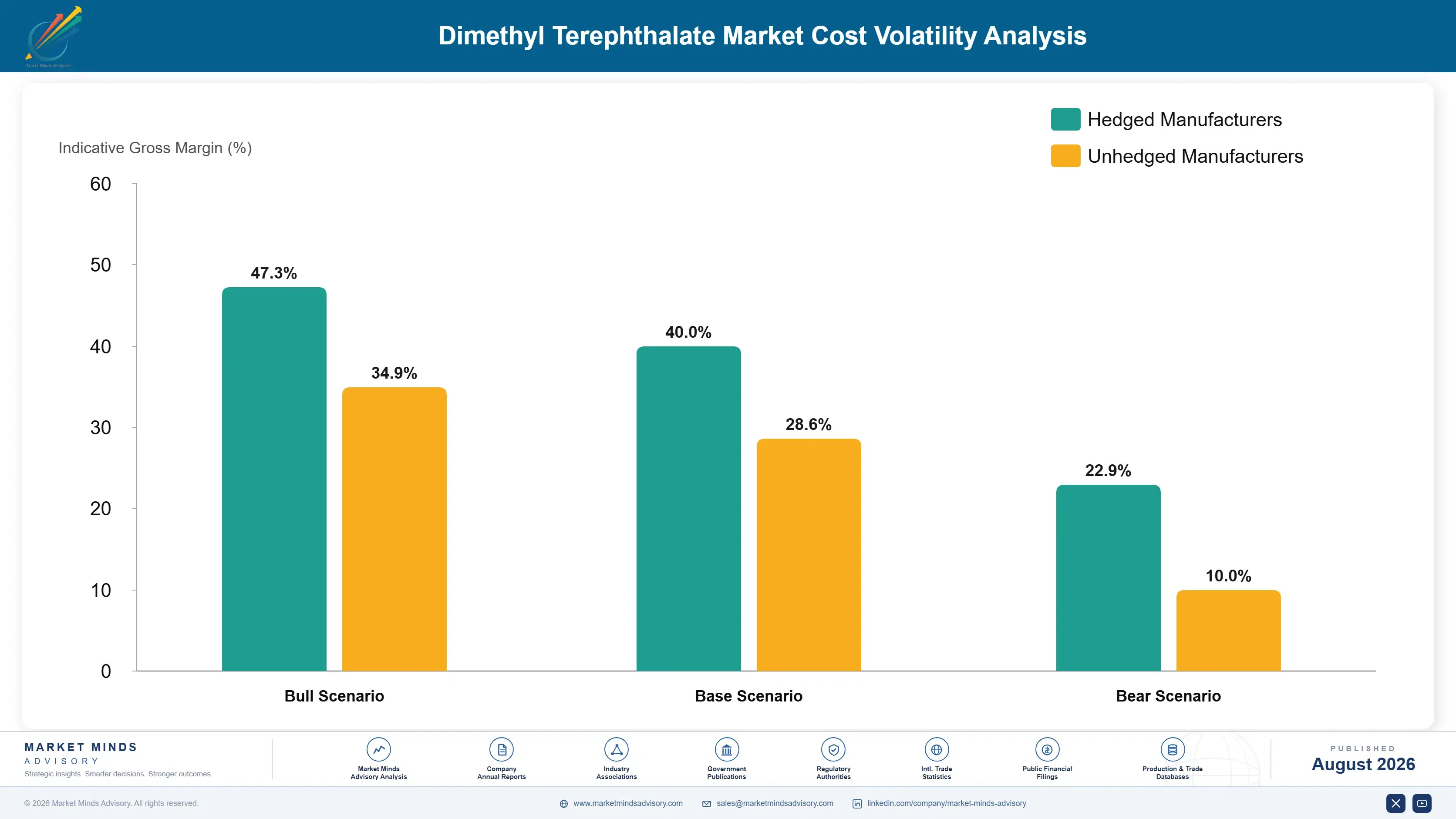
Cost structures differ completely between routes. Conventional production runs on p-xylene and methanol, with methanol alone at 23% of cost and p-xylene the larger share, both tracking petrochemical markets. Depolymerisation replaces that entirely with waste polyester bales at 41% of cost plus methanol recovered and recycled within the process. Energy is significant in both at 14%, reflecting distillation duty. Certification, logistics, and sorting absorb the balance in recycled routes specifically.
Waste bale pricing rose sharply through 2023 and 2024 wherever chemical recycling capacity was commissioned, because processing demand grew faster than collection systems expanded. Eastman and Indorama both referenced feedstock cost and availability across their reporting for those years. Conventional producers faced a different problem, with methanol and p-xylene both moving on energy and petrochemical cycles. Neither route escaped input inflation, and the recycled route faced the sharper move by some margin.

Exposure divides on feedstock contracting rather than on scale. Producers holding long-term bale agreements and targeting streams mechanical recyclers cannot use have insulated themselves considerably, while those buying clear bottle bales on spot compete directly against recyclers with lower capital intensity. Conventional producers carry petrochemical exposure instead, which is more volatile and far better understood in this industry.
dimethyl-terephthalate-dmt-market-trends-cost-volatility-analysis-1787549211840

Secure multi-year bale supply with collection partners

Waste polyester supply grows with collection infrastructure rather than with processing demand, and that mismatch has driven bale prices up sharply. Long-term agreements with municipalities, waste managers, and textile collectors secure volume and cap price exposure before capacity commits. The cost is committed offtake through periods when spot material is cheaper, which is smaller than running below nameplate.

Develop sorting capability for contaminated waste streams

Coloured, multilayer, and textile polyester costs 25 to 45% less than clear bottle bales precisely because mechanical recyclers cannot use it. Building sorting and preprocessing capability to handle those streams converts a cost disadvantage into an advantage. Capital and operating complexity are real, and the resulting feedstock position is not contested by anyone else in the recycling chain.

Recover and recycle methanol within the depolymerisation loop

Methanol is consumed and regenerated across the depolymerisation and downstream esterification steps, and recovery efficiency determines how much fresh methanol the process actually requires. Improving recovery reduces exposure to methanol pricing that swings with natural gas markets. Distillation energy is the trade-off, which matters most wherever industrial power costs are high. Recovery efficiency is worth engineering attention early.

Portfolio Architecture for Margin Defence

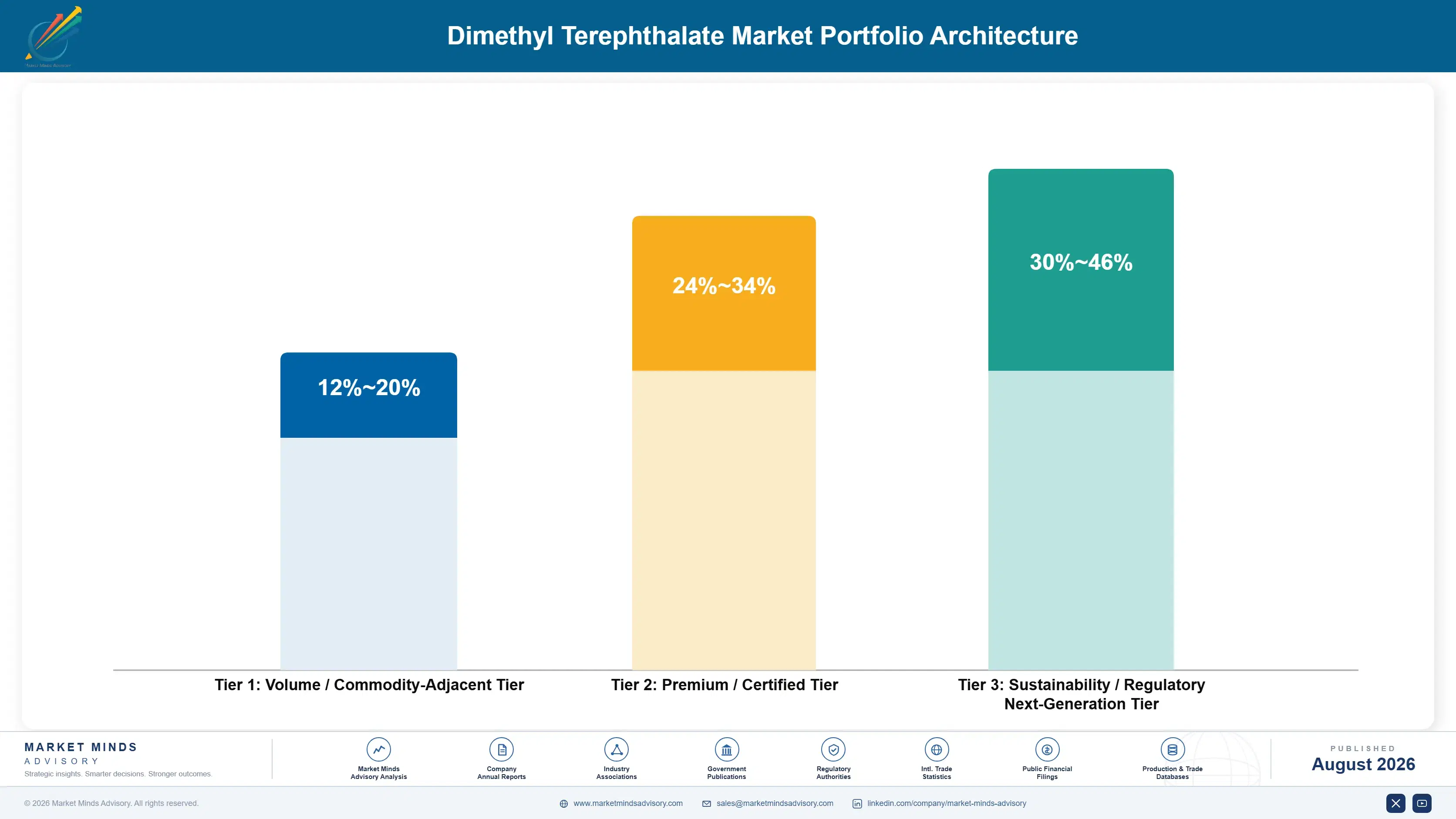
Margin follows certification and feedstock position rather than volume. Conventional material sold into engineering resin and specialty polyester chains earns modest returns, because the product is a commodity intermediate and buyers compare delivered price directly against alternatives. Certified recycled material earns a 26% premium on an identical molecule, which is the clearest demonstration available that this market prices documentation rather than chemistry.
The volume and premium tension sits in feedstock allocation rather than in plant loading. A producer running both conventional and depolymerisation capacity must decide which customers receive certified material when demand exceeds what feedstock supports, and mass balance rules govern how much can be allocated. Getting that allocation wrong disappoints premium customers while conventional buyers pay nothing extra for the same molecules.

High-value pools concentrate in three places: certified recycled material for brand commitments, difficult-stream depolymerisation feedstock, and engineering resin grades for qualified automotive applications. Each is defended by documentation, sorting capability, or qualification rather than by price. Price competition arrives in each only when a competitor secures certification, builds sorting capability, or completes automotive qualification, and none of those is a quick purchase.

Volume / Commodity-Adjacent Tier

Conventional route material supplied into specialty polyester and film production against terephthalic acid alternatives. Competes on delivered cost. The range reflects large differences in feedstock integration and regional energy position.
Gross Margin: 12%-20%

Premium / Certified Tier

Engineering resin grades qualified into automotive electrical and connector applications with platform lifetime supply commitments. The compounder purchases consistency and qualification history rather than the molecule specification alone. Requalification is rarely worth the effort.
Gross Margin: 24%-34%

Sustainability / Regulatory / Next-Generation Tier

Mass balance certified recycled origin material serving brand commitments and regulatory content requirements. Documentation rather than chemistry commands the premium. The range is wide because certified pricing varies enormously by region and mandate status.
Gross Margin: 30%-46%
dimethyl-terephthalate-dmt-market-trends-portfolio-architecture-1787549212342

High-value Sub-segments and Strategic Watch-out

Certified Recycled Origin Material

Commands a 26% premium on a molecule analytically identical to virgin material, which makes chain of custody documentation the entire product. Brands under content commitments refuse uncertified supply at any price. Certification capability is the revenue mechanism here. Establish it well before capacity decisions. Do it early.
Gross Margin: 32%-46%

Difficult Stream Depolymerisation Feedstock

Coloured, multilayer, and textile polyester costs 25 to 45% below contested clear bale material because mechanical recyclers cannot process it. Sorting capability is both the barrier and the defence. Nobody else competes for these streams currently. Sorting investment is what secures the position. Invest first.
Gross Margin: 30%-44%

Qualified Engineering Resin Grades

Automotive electrical and connector applications qualify material for platform lifetimes, which makes each position durable once won. Electrification raises connector content per vehicle steadily. This is the stable base beneath a recycling business that policy could disrupt. Qualification holds for the platform lifetime. Defend it hard.
Gross Margin: 26%-36%

Conventional Route Merchant Supply

The strategic watch-out. Competes against terephthalic acid on delivered cost in applications where the purification advantage no longer justifies a premium. It holds customer relationships and plant loading, and should be priced for that. Price it for relationships and plant loading. Nothing beyond that. Hold it.
Gross Margin: 12%-19%

How Demand Actually Reaches Producers

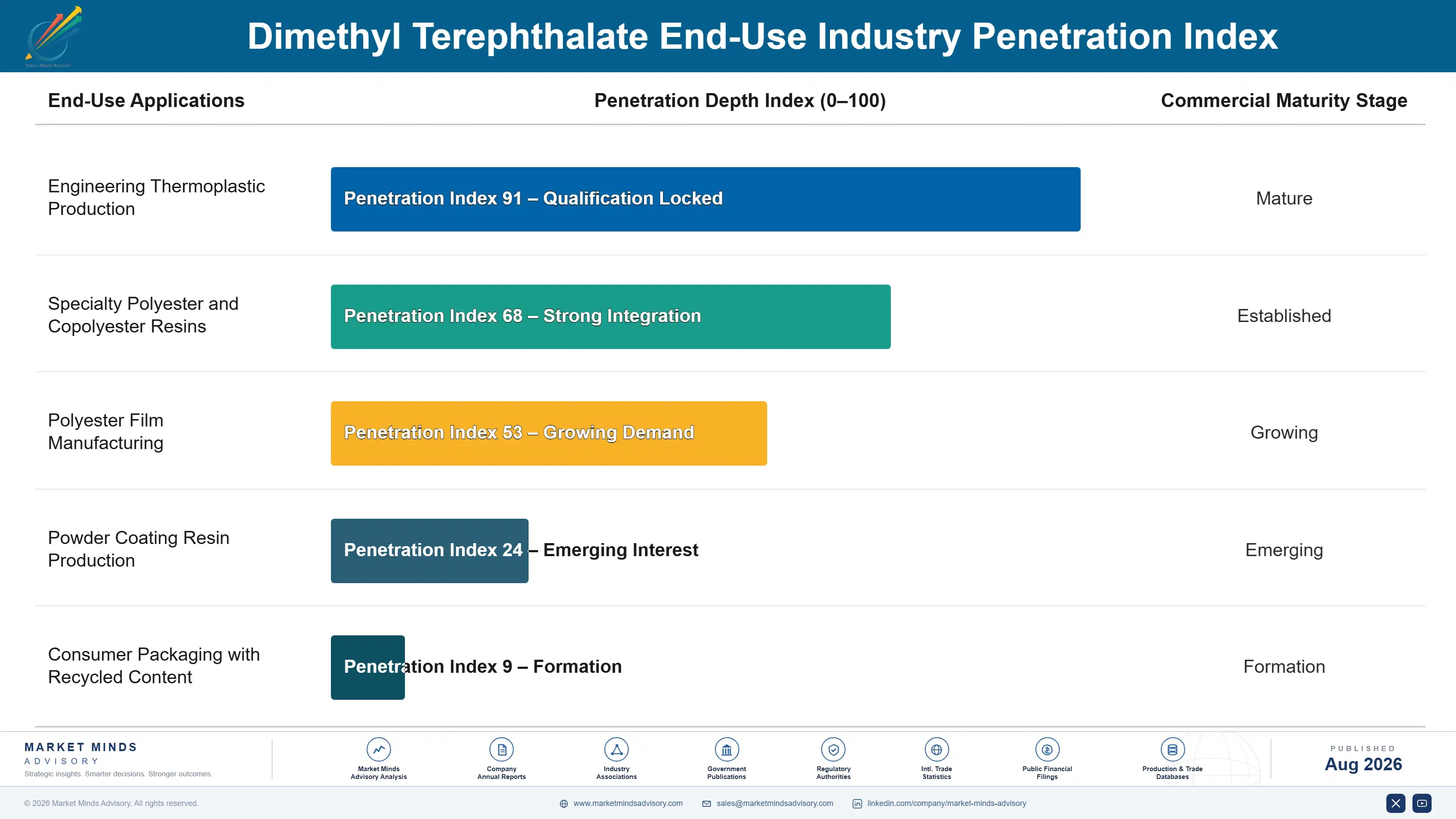
The annuity here comes from qualification and from policy rather than from any replacement cycle. Engineering resin customers qualify a material source into automotive and electrical components and then buy it for the platform lifetime, which runs years and rarely reopens. Certified recycled demand behaves differently, arriving in commitments contracted years ahead against mandate deadlines that give producers unusual forward visibility. Both are contracted rather than transactional, which is why merchant spot volume is a small and shrinking part of this market.
Adoption depth varies sharply by customer type. Consumer brands under recycled content commitments are the deepest buyers, contracting multi-year volumes and refusing uncertified material outright. Engineering resin compounders qualify slowly and then stay. Film and specialty polyester producers buy on specification and switch when terephthalic acid economics favour it. Commodity polyester producers left this molecule decades ago and are not coming back.

The buyer has shifted toward sustainability and packaging compliance functions at brand level. Those teams evaluate certification schemes and audit reports rather than technical data sheets. A producer whose certification scheme a brand's own auditor does not recognise will not be considered at all, however good the material or however competitive the price quoted alongside it.
dimethyl-terephthalate-dmt-market-trends-end-use-penetration-index-1787549212832

Where the Money Sits

These are among the four positions where our research anticipates prominent divergence between winners and laggards over the coming forecast period. Each is grounded in the demand model, the regulatory perimeter, and the announced capacity pipeline.
01 / FEEDSTOCK CONTRACTING DISCIPLINE

Secure the bales before committing any plant capital

Waste polyester bale prices have risen above 30% wherever depolymerisation capacity has actually been commissioned, because collection infrastructure expands far more slowly than new processing capacity does. Producers who built first and sourced afterwards have run well below nameplate while paying spot prices that destroy the project economics entirely. The competence required belongs to the waste industry rather than to petrochemicals, which makes partnership with collectors and municipalities a considerably better answer than attempting to build that capability internally from nothing.
02 / CERTIFICATION CAPABILITY BUILD

Invest in documentation, because that is what the premium buys

Recycled and virgin material are chemically indistinguishable by every analytical test available, so the entire 26% premium rests instead on mass balance certification and a fully auditable chain of custody. Brands operating under content commitments refuse uncertified material at any price at all, because their own regulatory reporting depends on the audit trail rather than the molecule. Establishing and maintaining certification costs $300,000 to $700,000 annually, which is negligible measured against a premium that applies across every single tonne the plant produces.
03 / DIFFICULT STREAM TARGETING

Chase the waste nobody else can actually process

Clear bottle bales are contested by every recycler in the chain and priced accordingly, while coloured bottles, multilayer trays, and textile polyester all go largely unrecovered today because mechanical routes cannot bring them to specification. Depolymerisation handles all of those streams at feedstock costs 25 to 45% below contested clear bale material. Building sorting capability for contaminated streams is the barrier and simultaneously the defence, since any producer buying exactly the same bales as everyone else holds no cost advantage whatsoever.
04 / ROUTE FLEXIBILITY INVESTMENT

Run both processes so no feedstock gets rejected

Direct methanolysis handles clean bottle-grade material efficiently while the glycolysis-methanolysis hybrid tolerates the contamination and mixed polymer content that textile and post-consumer streams carry into a plant. Operating both lets every incoming stream go to whichever process handles it most economically, rather than being rejected outright or over-cleaned. Route flexibility improves overall feedstock utilisation by 15 to 25% against any single-process plant, and it does so at additional capital cost that is genuinely modest beside the primary depolymerisation investment already committed.

Engagement Snapshot From the Field

A live engagement with an industry participant carrying material or product regulatory and market exposure ahead of a defining policy shift, showing how our research translates into a defensible multi-year portfolio strategy.
MARKET MINDS ADVISORY · CLIENT ENGAGEMENT SUMMARY
Dimethyl Terephthalate Producer Strategic Portfolio Review and Transition Roadmap 2026·Investment Scenario on Dimethyl Terephthalate Exposure Evaluation 2025-26
CLIENT PROFILE
A European producer of conventional route dimethyl terephthalate supplying specialty polyester and engineering resin compounders across the region, with revenue near EUR 118 million (client-reported, unverified by MMA). The business held no depolymerisation capacity, no recycled content certification, and no relationships with waste collection or sorting operators anywhere. Conventional volumes had been flat for years.
STRATEGIC CHALLENGE
Conventional volumes had been flat for five years while competitors announced depolymerisation projects and signed brand offtake agreements at premium pricing. Two engineering resin customers had asked whether certified recycled material would be available before regulatory deadlines, and the client had no answer. Management needed an entry route that did not require several hundred million euros.
MMA APPROACH
MMA sized certified recycled demand against announced regional capacity, analysed bale pricing and availability by waste stream type, and modelled entry economics for full depolymerisation against tolling and partnership alternatives. Forty-seven expert interviews with brand sustainability leads, waste operators, and compounders established what buyers actually required contractually. Contract requirements proved revealing.
KEY FINDINGS
  1. Announced regional depolymerisation capacity substantially exceeded certified demand under current mandates, meaning the premium would likely compress before the client's own plant could ever be commissioned.
  2. Textile and coloured polyester streams were available at 38% below clear bale pricing and were being bought by nobody in the region, since no operator had sorting capability for them.
  3. Brand customers required mass balance certification and audit documentation rather than any particular process route, which meant certified tolled material would satisfy their contracts entirely.
  4. Establishing certification and chain of custody capability cost under a million euros and could be completed well ahead of any physical capacity investment decision being made.
CLIENT PROFILE
A European producer of conventional route dimethyl terephthalate supplying specialty polyester and engineering resin compounders across the region, with revenue near EUR 118 million (client-reported, unverified by MMA). The business held no depolymerisation capacity, no recycled content certification, and no relationships with waste collection or sorting operators anywhere. Conventional volumes had been flat for years.
STRATEGIC CHALLENGE
Conventional volumes had been flat for five years while competitors announced depolymerisation projects and signed brand offtake agreements at premium pricing. Two engineering resin customers had asked whether certified recycled material would be available before regulatory deadlines, and the client had no answer. Management needed an entry route that did not require several hundred million euros.
MMA APPROACH
MMA sized certified recycled demand against announced regional capacity, analysed bale pricing and availability by waste stream type, and modelled entry economics for full depolymerisation against tolling and partnership alternatives. Forty-seven expert interviews with brand sustainability leads, waste operators, and compounders established what buyers actually required contractually. Contract requirements proved revealing.
KEY FINDINGS
  1. Announced regional depolymerisation capacity substantially exceeded certified demand under current mandates, meaning the premium would likely compress before the client's own plant could ever be commissioned.
  2. Textile and coloured polyester streams were available at 38% below clear bale pricing and were being bought by nobody in the region, since no operator had sorting capability for them.
  3. Brand customers required mass balance certification and audit documentation rather than any particular process route, which meant certified tolled material would satisfy their contracts entirely.
  4. Establishing certification and chain of custody capability cost under a million euros and could be completed well ahead of any physical capacity investment decision being made.
RECOMMENDED STRATEGY
Phase 1: Phase one: establish mass balance certification and chain of custody systems immediately, since they gate the premium and cost a fraction of any capacity investment. Phase 2: Phase two: contract certified recycled material through tolling arrangements with existing depolymerisation operators, serving customer commitments without committing plant capital. Phase 3: Phase three: secure textile and coloured stream feedstock positions with sorting partners, building the feedstock advantage before deciding whether to invest in owned capacity.
OUTCOME
The client completed certification within seven months and began supplying certified recycled material through tolling in the same year. Certified volumes reached 16% of revenue at premium pricing, textile stream feedstock positions were secured with two sorting operators, and blended gross margin improved 4.2 percentage points without any plant investment (client-reported, unverified by MMA).

Frequently Asked Questions

Foundational context covering the market sizes, CAGR, scope, country, region and competition that inform every finding below. This section is provided to cover basics and most often pre-purchase conversations, answered from the MMA Primary Research Dataset.

What is the current size of the Dimethyl Terephthalate Market?

The market was valued at USD 1.3 billion in 2025, rising to an estimated USD 1.38 billion in 2026. East Asia holds the largest regional share at 30% of global value.

How large will the Dimethyl Terephthalate Market be by 2036?

MMA forecasts USD 2.57 billion by 2036 under the base case, an expansion multiple of 1.86 times the 2026 value. That represents USD 1.19 billion of incremental value across the forecast period.

What is the CAGR for the Dimethyl Terephthalate Market 2026 to 2036?

The base case CAGR is 6.4%, with a bull case of 7.6% and a bear case of 5.2%. The spread reflects uncertainty over recycled content mandate enforcement and waste feedstock costs.

Which segment is growing fastest?

The PET methanolysis depolymerisation route grows fastest at 14.8%, roughly 2.31 times the market rate. The glycolysis-methanolysis hybrid route follows at 11.4% on contaminated feedstock tolerance.

Who are the major companies in the Dimethyl Terephthalate Market?

Eastman Chemical, SK Chemicals, Oxxynova, Mitsubishi Gas Chemical, and Indorama Ventures lead on supply. The top five hold roughly 63% of global value, and depolymerisation capital is widening that gap.

Which country is growing fastest?

India grows fastest at 9.6%, driven by extended producer responsibility rules requiring recycled content alongside localised engineering resin manufacturing. Textile polyester waste availability there is exceptional and largely unexploited.

Report Segmentation Architecture

The full report scope spans multiple orthogonal segmentation dimensions, with cross-tabulated demand data provided for each dimension pair. Coverage extends further to regional breakdowns, trend trajectories, and the competitive detail needed to support segment-level decision-making.

By Production Route

  • p-Xylene Oxidation and Esterification Route
  • Terephthalic Acid Esterification Route
  • PET Methanolysis Depolymerisation Route
  • Glycolysis-Methanolysis Hybrid Route
  • Polyester Waste Solvolysis Route

By End-Use Industry

  • Engineering Thermoplastic Production
  • Specialty Polyester and Copolyester Resins
  • Polyester Film Manufacturing
  • Powder Coating Resin Production
  • Consumer Packaging with Recycled Content

By Sales Model

  • Certified Recycled Content Contracts
  • Long-Term Compounder Supply Agreements
  • Merchant Spot and Contract Supply
  • Integrated Internal Transfer
  • Tolling and Conversion Arrangements

By Region

  • North America
  • Western Europe
  • East Asia
  • South Asia and Pacific
  • Latin America
  • Middle East and Africa
  • Eastern Europe

Scope, Methodology, and Coverage

Every figure in this report is reproducible from documented input assumptions. The scope below maps the historical period, the forecast horizon, the segmentation dimensions, and the countries covered, alongside the underlying primary and qualitative methodology.
Historical Period
2020 to 2025
Forecast Period
2026 to 2036
Base Year
2025 (USD billions; MMA Primary Research Dataset, August 2026)
Market Definition
The market comprises dimethyl terephthalate supplied as an intermediate for polyester, copolyester, and engineering thermoplastic production, covering the p-xylene oxidation and esterification route, the terephthalic acid esterification route, the PET methanolysis depolymerisation route, the glycolysis-methanolysis hybrid route, and the polyester waste solvolysis route. Value is measured at producer level across virgin and certified recycled origin supply. Purified terephthalic acid, monoethylene glycol and other diols, finished polyester resins fibres and films, mechanically recycled polyester flake and pellet, and polymerisation or depolymerisation equipment fall outside scope.
Quantitative Units
USD billions (current prices); thousand tonnes supplied annually; USD per tonne by production route and certification status
Segmentation Dimensions
By Production Route; By End-Use Industry; By Sales Model; By Region
Regions Covered
North America, Western Europe, East Asia, South Asia and Pacific, Latin America, Middle East and Africa, Eastern Europe
Countries Covered
United States, Canada, Mexico, Germany, Netherlands, Belgium, Italy, Spain, France, United Kingdom, Poland, Czechia, Turkey, China, Japan, South Korea, Taiwan, India, Thailand, Indonesia, Vietnam, Australia, Brazil, Argentina, Chile, Saudi Arabia, United Arab Emirates, Egypt, South Africa
Key Companies Profiled
Eastman Chemical, SK Chemicals, Oxxynova, Mitsubishi Gas Chemical, Indorama Ventures, Loop Industries, Alpek Polyester, Reliance Industries, JBF Industries, Hunan Yuncheng Chemical, Shandong Yuandong, Toray Industries, Teijin, LG Chem, Lotte Chemical, DuPont, BASF, Covestro, Jiangsu Sanfangxiang, Far Eastern New Century
Quantitative Methodology
Primary survey, n=3,800 respondents, Q4 2025, six countries; demand-side model with trade association cross-validation
Qualitative Methodology
47 expert interviews, Q4 2025; applied to validate demand model assumptions, identify emerging dynamics, and assess competitive positioning
Report Format
PDF and XLSX data workbook (Word format preview document)
Publisher
Market Minds Advisory
Report Code
MMA-2026-CHM-183
Published
August 2026
Contact
sales@marketmindsadvisory.com | www.marketmindsadvisory.com

Purchase the full Dimethyl Terephthalate Market Report (2026 to 2036).

The full report sizes dimethyl terephthalate demand across five production routes, five end-use categories, and seven regions with 2026 to 2036 forecasts under base, bull, and bear cases. It separates certified recycled origin supply from conventional material, which command different prices for an identical molecule. Competitive profiles cover twenty producers assessed consistently on dimethyl terephthalate supply, depolymerisation capability, and certification position. Cost analysis traces waste bale pricing against petrochemical feedstock exposure by route. Commercial guidance addresses feedstock contracting, certification capability, difficult stream targeting, and route flexibility investment.
Five production routes sized separately by region
Certified recycled supply separated from conventional material
Waste bale pricing tracked by stream type and region
Recycled content mandate timetables mapped by jurisdiction
Depolymerisation capacity announcements assessed against realistic delivery
Engineering resin qualification positions examined across twenty producers

Built For The People Who Decide

From boardroom strategy to bench-side execution, this report is read cover-to-cover by leaders shaping the next decade of their industry, turning demand scenarios, market dynamics and valuation benchmarks into decisions.
CXOs/ Presidents/ VPs/ Managers
M&A and Corporate Development
Strategy Teams and R&D Heads
Procurement and Product Directors
Regulatory and Compliance Leaders
Investor Relations and Equity Analysts