Market Minds Advisory
Dimethyl Disulphide Market

Dimethyl Disulphide Market: Turnaround Cycles, Renewable Diesel Sulphiding, and the Odour Problem That Shapes Every Shipment

One producer supplies most of the world, demand arrives in bursts tied to refinery turnaround schedules, and the odour is severe enough to dictate how every drum is transported and stored.

Lead Analyst

Bilal Shaikh

Published

September 2026

Make Smarter Decisions with Customized Research Insights

Request a free sample report and evaluate market opportunities, growth trends, and competitive dynamics relevant to your business needs.

2025 MARKET VALUE$0.3BMarket Size 2025
2036 FORECAST VALUE$0.5BBase Case , 2026 to 2036
CAGR 2026 TO 20365.4 %Bull 6.6% / Bear 4.2%
INCREMENTAL OPPORTUNITY$0.2BNet 10- year value creation
EXPANSION MULTIPLE1.69x2036 value over 2026 base
Strategic Levers
M&A Pipeline
Regional Outlook
Country Rankings
Competitive Intelligence
Segmental Deep-dive
Call-Us : 91 93563 13602

Executive Snapshot and Market Trajectory

Demand for this molecule arrives in bursts rather than in a stream. Refinery catalyst sulphiding takes 46% of volume and happens at turnarounds roughly every four years, so a producer's order book depends on maintenance schedules published years ahead. Order books follow maintenance calendars, and utilisation follows suit.
Commercial power sits with the handful of producers holding integrated methyl mercaptan capacity rather than with anyone able to buy the molecule and resell it. Formulated soil fumigant grades grow fastest at 8.2%, roughly 1.52 times the market, wherever registration permits their use. East Asia holds 30% of total global value, carried by Chinese refining capacity and by domestic production that has expanded considerably.
Concentration is extreme at roughly 71% for the top five, among the highest in any chemical market this size, because backward integration into methyl mercaptan is what makes production economic. Renewable diesel units have created genuine new sulphiding demand nobody forecast. Odour dictates every logistics decision. Odour detection thresholds in the parts per billion range mean that containment engineering rather than price decides which supplier a site is prepared to accept at all.
Market Definition
The market comprises dimethyl disulphide supplied for industrial and agricultural use, covering catalyst sulphiding grade, formulated soil fumigant grade, anti-coking additive grade, chemical intermediate grade, and odourised and stabilised blends. Value is measured at producer level across refining, petrochemical, agricultural, and chemical synthesis applications. Dimethyl sulphide, methyl mercaptan sold as such, other organosulphur sulphiding agents including polysulphides, methionine and its intermediates, and application equipment fall outside scope.
Base Year Value
$0.3B in 2025 (MMA Primary Research Dataset, August 2026)
Forecast Period
2026 to 2036, eleven discrete annual values
CAGR
5.4% base case. Bull 6.6%. Bear 4.2%.
Fastest Growth Segment
Soil Fumigant Formulated DMDS: 8.2% CAGR
Fastest Growth Country
India: 8.4% CAGR
Fastest Growth Region
South Asia and Pacific: 7.5% CAGR
Largest Region
East Asia: 30% of 2025 global value
Market Leaders
Arkema, Chevron Phillips Chemical, Merck KGaA, Toray Fine Chemicals, and Sichuan Lutianhua lead on dimethyl disulphide supply. Source: company annual reports and MMA Analysis, July 2026.
Primary Survey
n=3,800 procurement and R&D decision-makers, Q4 2025, six countries
Methodology
Demand-side build-up, cross-validated against public data, 47 expert interviews

Dimethyl Disulphide Market Forecast Scenarios

dimethyl-disulphide-dmds-market-trends-size-forecast-scenario-1787549189266
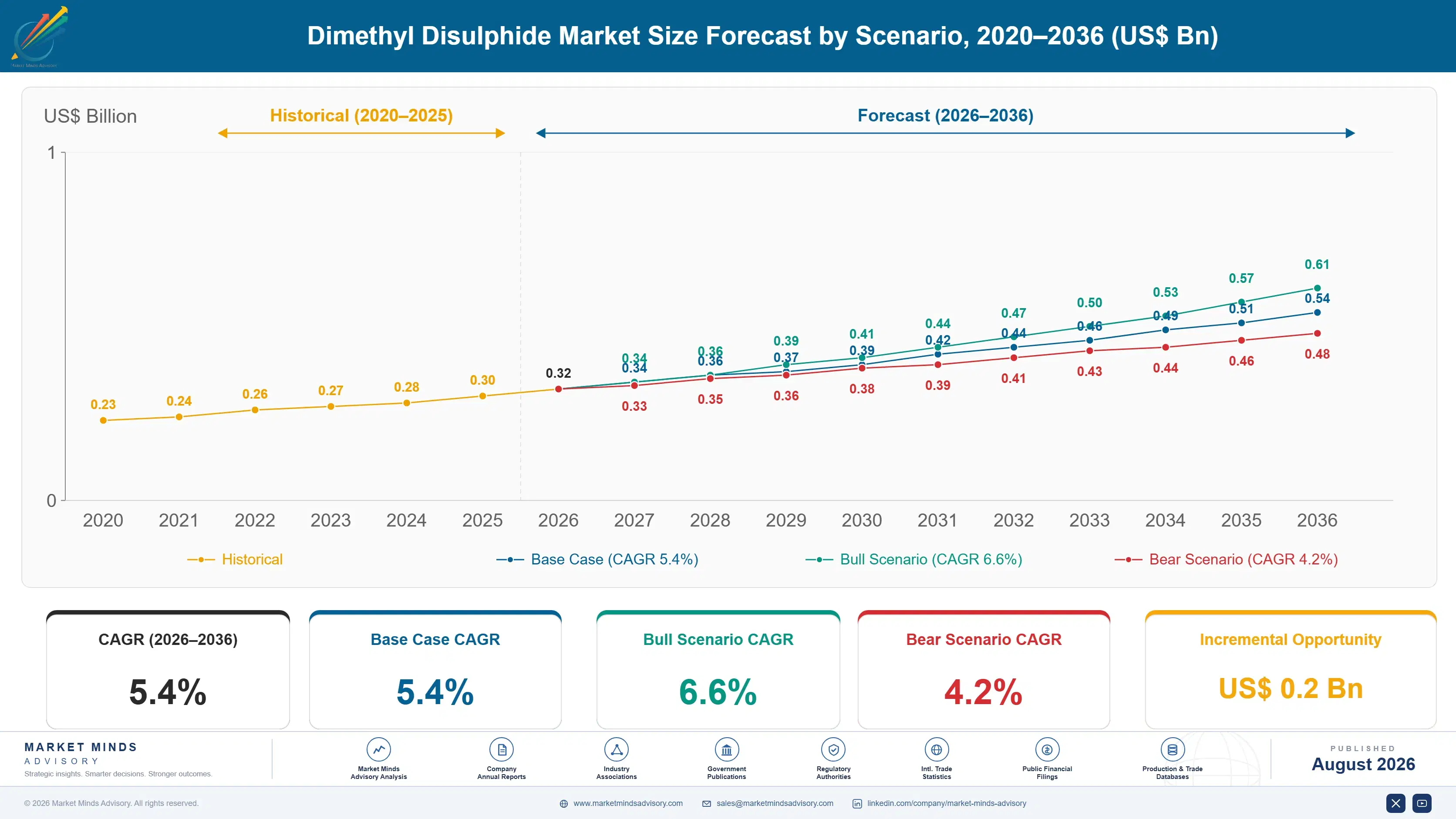
Between 2020 and 2025 refinery turnaround schedules dominated the pattern. Maintenance deferred through 2020 and 2021 arrived together in 2022 and 2023, producing a surge unrelated to underlying consumption. Renewable diesel conversions added a demand pool that had not existed. Methanol and sulphur costs moved sharply. The 4.3% historical growth averages a deferral and a catch-up rather than a trend.
The 5.4% base case rests on three mechanisms. Renewable diesel and sustainable aviation fuel units require sulphided hydrotreating catalyst while running feedstocks containing almost no sulphur, which makes external sulphiding agent a continuous requirement rather than a start-up one. Refining capacity continues expanding across Asia and the Middle East, adding turnaround cycles that will recur for decades. And soil fumigant registration is broadening in markets seeking methyl bromide alternatives. Each behaves differently from the turnaround cycle this industry was built around.
The 6.6% bull case assumes renewable fuel capacity scales as announced and fumigant registrations advance in major producing countries. The 4.2% bear case reflects refinery closures across Europe and North America, renewable fuel project cancellations, and fumigant registration setbacks where review has already proved slow. Policy rather than chemistry decides most of the difference between them.

A Burst Demand Molecule With a Severe Odour Problem

Three things set the commercial shape of this market. Turnaround scheduling comes first, because 46% of volume is consumed at refinery maintenance events planned years in advance, which makes demand forecastable in aggregate and violently lumpy individually. Feedstock integration comes second, since methanol and sulphur are 38% of cost and producers without methyl mercaptan capacity buy from competitors. Odour comes third and shapes everything physical.
TOP-FIVE CONCENTRATION71%Share of global supply held by the leading producers
AVERAGE SELLING PRICEUSD 2,150 per tonneBlended pricing across catalyst and fumigant grade material
CATALYST SULPHIDING SHARE46%Portion of volume consumed by refinery catalyst activation
FEEDSTOCK COST SHARE38%Methanol and sulphur input within total production cost
TURNAROUND CYCLE LENGTH4 yearsTypical interval between refinery catalyst change and resulphiding
ODOURANT CONTENT REQUIREMENT0.4%Masking agent added for handling and transport safety
The odour point is not a footnote. Dimethyl disulphide is detectable at extremely low concentrations and smells strongly unpleasant, which dictates tank design, loading procedures, transport routing, and community relations at every site that handles it. Odour-masked and stabilised formulations command real premiums for exactly this reason, and handling capability rather than price frequently decides who supplies a site. A site that has dealt with a community complaint does not repeat the experience.
Renewable diesel created a demand pool nobody modelled. Hydrotreating catalysts must be sulphided to work, and renewable feedstocks contain almost no sulphur to maintain that state, so operators must inject sulphiding agent continuously rather than only at start-up. That converts an intermittent purchase into a running item at every renewable unit commissioned.
"This is a molecule with one dominant producer, demand that arrives in four-year waves, and a smell that decides where you can build a terminal. It should be a dull market and it is not, because renewable diesel accidentally turned an occasional purchase into a continuous one and nobody in the industry saw that coming."
Practice Director, Refining Chemicals and Catalyst Services · MMA Chemicals and Materials Practice · August 2026

Market Trends

Renewable Fuel Units Convert Intermittent Demand Into Continuous Consumption

Hydrotreating catalysts require sulphided metal sites to function, and conventional feedstocks supply enough sulphur to maintain that state during operation. Renewable feedstocks including used cooking oil, tallow, and vegetable oils contain almost none, so operators inject sulphiding agent continuously to keep catalysts active. Every renewable diesel and sustainable aviation fuel unit commissioned therefore adds running consumption rather than a single start-up charge. Producers had modelled this market on turnaround cycles for decades, and the new demand behaves entirely differently, arriving steadily and growing with capacity rather than with maintenance schedules.
Market Impact: Cycles recur every 4 years
Odour Management Capability Decides Who Can Supply a Site

Detection thresholds for this molecule sit in the parts per billion range, which means a minor release generates complaints across a wide radius and can halt operations at a terminal. Sites therefore select suppliers on containment engineering, closed transfer systems, and odour incident history at least as much as on price. Odourised and stabilised blends that reduce release risk grow at 7.4%, well above the market, and command premiums that pure chemistry cannot explain. Producers with poor handling records lose accounts permanently, since a site that has dealt with a community complaint does not repeat the experience.
Market Impact: Fumigant grades grow at 8.2%

Market Opportunities and Growth Drivers

Asian and Middle Eastern Refining Capacity Adds Permanent Turnaround Cycles

Hydrotreating and hydrocracking capacity commissioned across China, India, and the Gulf over the past fifteen years will require catalyst change and resulphiding roughly every four years for the operating life of those units. Each new unit therefore adds a recurring demand stream rather than a one-off charge, and the installed base of hydroprocessing capacity has grown faster in these regions than anywhere. European and North American closures offset part of it. The net effect keeps volume growing steadily even as refining consolidates geographically, and it moves demand toward regions where local production has expanded.
Market Impact: Peaks exceed 4 times baseline

Methyl Bromide Replacement Sustains Soil Fumigant Registration Demand

Methyl bromide phase-out under international agreement left growers of strawberries, tomatoes, peppers, and nursery crops without an equivalent broad-spectrum soil treatment, and formulated dimethyl disulphide addresses part of that gap. Registration is granted country by country and remains the limiting factor rather than agronomic performance, which is well established. Where approval exists, adoption follows quickly because the alternatives are either less effective or facing their own regulatory pressure. Formulated fumigant grades grow at 8.2% against a market at 5.4%, and each new national registration adds a step change rather than gradual growth.
Market Impact: Reviews exceed 36 months typically

Market Restraints and Challenges

Turnaround Timing Makes Individual Supplier Demand Violently Lumpy

A single large refinery turnaround can consume more material in a fortnight than a producer ships to that region in a normal quarter, and the schedule shifts when maintenance is deferred. The root cause is operational rather than commercial: catalyst change happens when the unit comes down, and units come down when operators decide. Producers must hold inventory and logistics capability for peaks that may move by a year. Mitigation runs through multi-year supply agreements covering scheduled turnarounds, regional inventory positions, and the steadier renewable fuel consumption now emerging. Renewable fuel demand helps considerably.
Market Impact: Adds continuous demand above 15%

Fumigant Registration Progresses Slowly and Unpredictably

Soil fumigant approval requires country-by-country registration with substantial toxicology and environmental data packages, and several major agricultural markets have kept applications under review for years. The root cause is regulatory caution around soil fumigants generally following the problems that led to methyl bromide phase-out. That leaves the fastest-growing application dependent on decisions no producer controls or can reliably schedule. Mitigation involves sequencing applications by likelihood rather than by market size, building buffer zone and application protocols that address regulator concerns directly, and funding independent efficacy work. Independent efficacy evidence strengthens each subsequent submission.
Market Impact: Blends grow at 7.4% annually
4 additional market trends, 3 additional growth drivers, and 2 additional restraints and challenges are covered in the full report. Contact sales@marketmindsadvisory.com to access the complete intelligence.

Segment CAGR and Growth Architecture

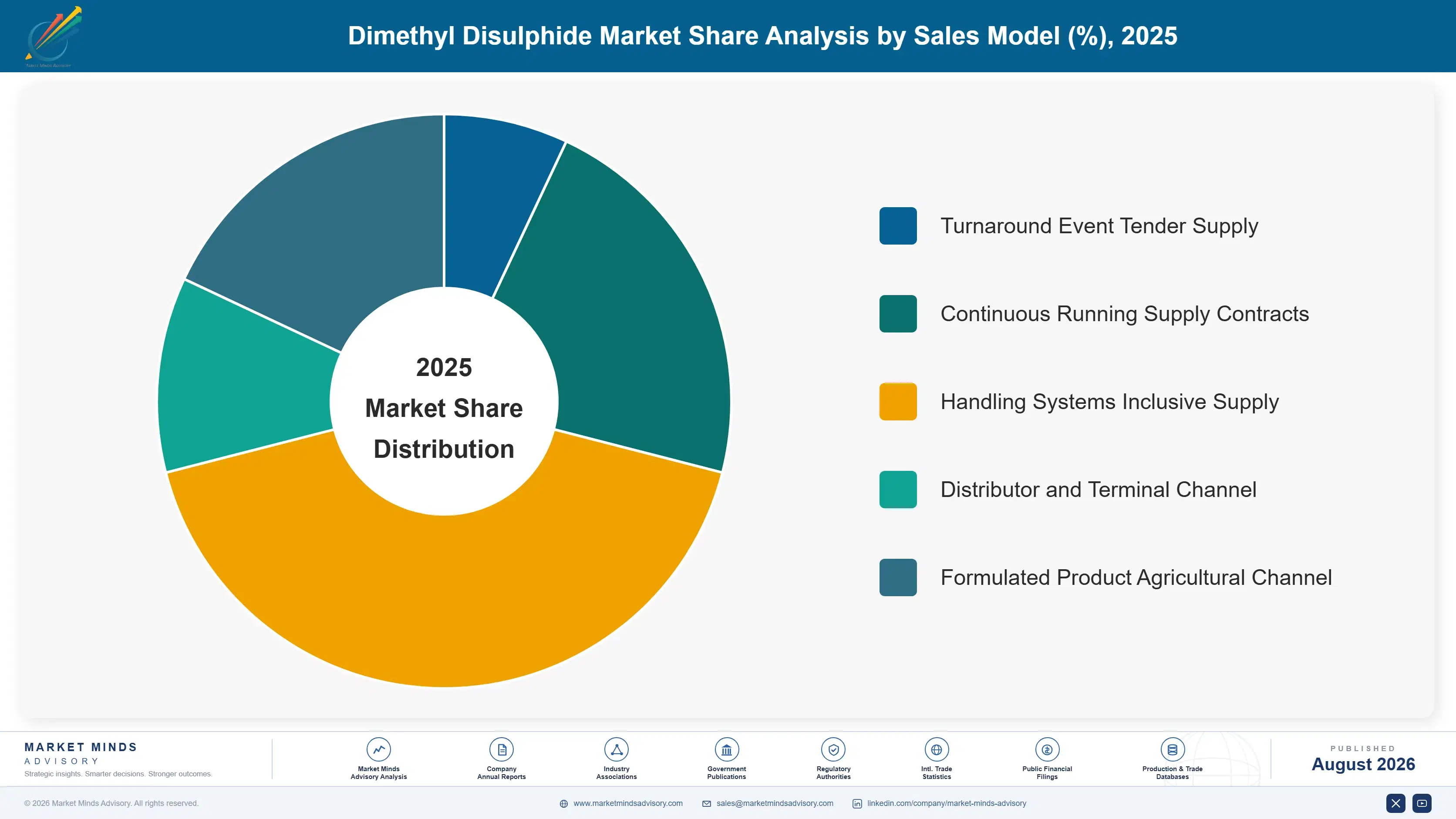
Segmentation follows product grade, because purity, odourant content, stabilisation, and formulation determine which application a material can serve, what handling it requires, and what it commands per tonne. Five grades cover commercial supply, and they are not interchangeable, since a formulated fumigant and a catalyst sulphiding charge differ in specification and regulatory status entirely.
dimethyl-disulphide-dmds-market-trends-market-share-analysis-1787549189795

Soil Fumigant Formulated DMDS

The fastest-growing grade at 8.2%, roughly 1.52 times the market, and the one whose trajectory depends least on chemistry. Formulated products combining dimethyl disulphide with chloropicrin or emulsifiers address the soil pest and pathogen control gap left by methyl bromide phase-out, and agronomic performance in strawberries, tomatoes, peppers, and nursery production is well established. Registration rather than efficacy is the binding constraint, granted country by country over timelines measured in years. Each approval produces a step change in regional volume rather than gradual growth. Application protocols including buffer zones and tarpaulin sealing are part of the product, since regulators approve the practice rather than only the molecule. Regulators approve the practice rather than simply the molecule.
CAGR 8.2%

Odourised and Stabilised DMDS Blends

Second fastest at 7.4%, and growing on handling risk rather than on any performance improvement. Detection thresholds in the parts per billion range mean a minor release generates complaints across a wide area and can stop operations, so sites increasingly specify formulations incorporating masking agents and stabilisers that reduce release consequence. The premium these blends command has no basis in the chemistry delivered to the catalyst and every basis in what a community complaint costs an operator. Producers supplying them alongside closed transfer equipment and handling training hold positions that pure material suppliers cannot approach on price alone. Producers supplying containment equipment and handling training alongside the material hold positions that no competitor reaches on price alone.
CAGR 7.4%
Full segment breakdown across 5 segments available in the complete report.

Regional Architecture and Country Demand Map

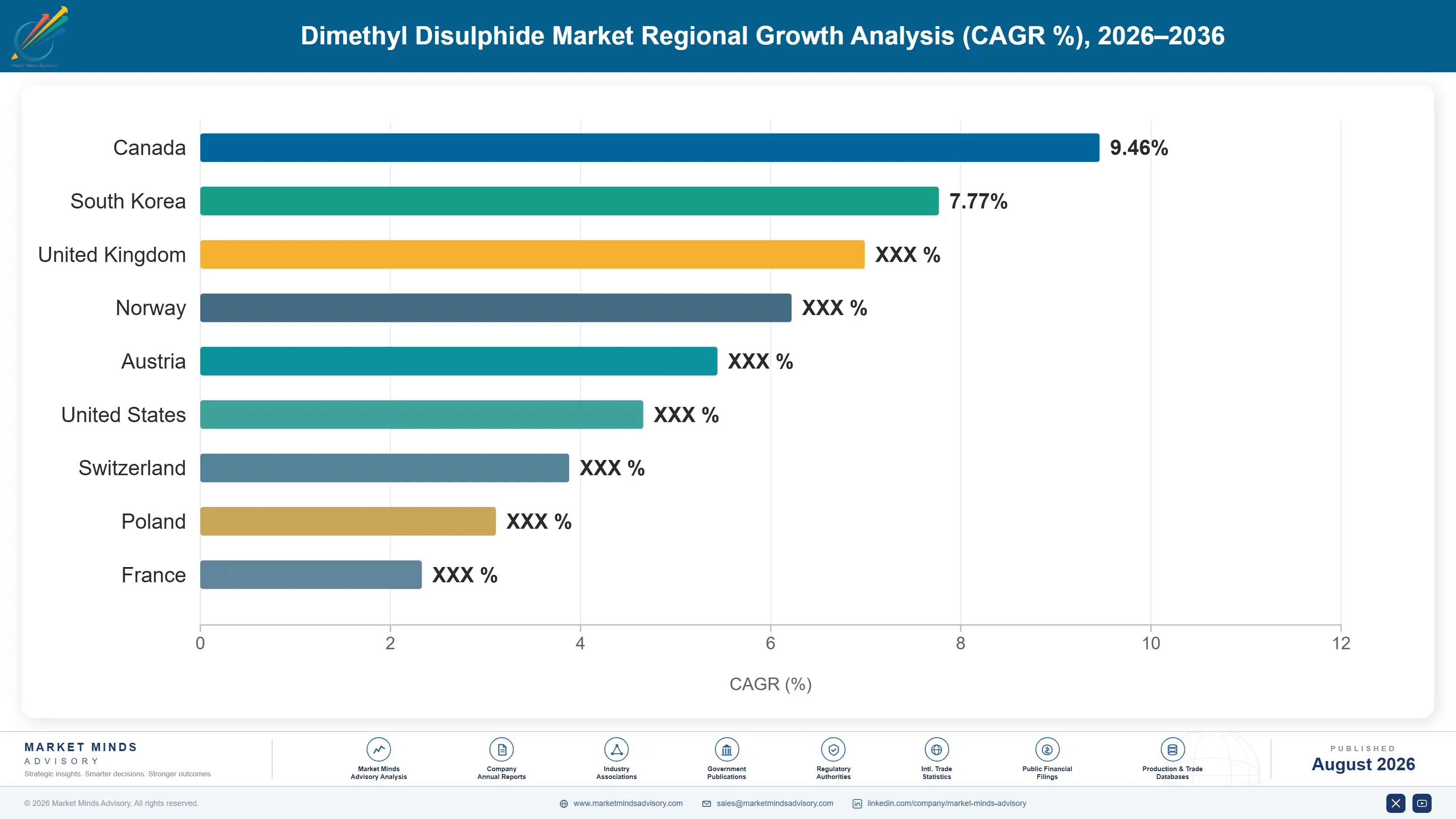
Regional shares follow hydroprocessing capacity and agricultural fumigant registration rather than economic size. Refining installed base determines the recurring turnaround demand, while fumigant volume appears only where national registration has actually been granted to a formulated product. Local production capability differs sharply between them as well.

North America

Renewable diesel conversion has been the defining development here, with numerous units across the Gulf Coast and Midwest converted or built to process vegetable oils and animal fats. Those units consume sulphiding agent continuously rather than at turnarounds, which has changed the demand pattern in this region more than anywhere else. Conventional refining turnaround cycles continue alongside, though closures have removed some capacity. Soil fumigant registration exists and supports meaningful volume in Californian and Floridian specialty crop production. Arkema and Chevron Phillips both operate production here. Growth of 5.9% blends renewable fuel consumption with a conventional refining base that is slowly contracting rather than expanding. Handling infrastructure is well established across the region.
Share: 25% | CAGR: 5.9% (2026 to 2036)

Western Europe

Refining capacity has been closing steadily and the units that remain face uncertain futures, which caps the turnaround demand that historically anchored this region. Arkema's production at Lacq remains globally significant and supplies well beyond Europe. Renewable fuel conversion has proceeded at several sites and adds continuous consumption that partly offsets the conventional decline. Soil fumigant registration under European rules has been difficult and volumes are limited compared with agronomic potential in Spanish and Italian specialty crop production. Handling and odour regulation is applied strictly across the region. Growth of 3.9% is the slowest in the report and reflects genuine refining contraction rather than any competitive weakness. Export supply from the region remains globally significant.
Share: 19% | CAGR: 3.9% (2026 to 2036)
Regional intelligence for 5 additional markets available in the complete report: East Asia, South Asia and Pacific, Latin America, Middle East and Africa, Eastern Europe. Contact sales@marketmindsadvisory.com.
dimethyl-disulphide-dmds-market-trends-country-cagr-analysis-1787549190313

Four Moves That Change the Economics

Advantage here comes from feedstock integration, handling capability, and registration position rather than from product quality, which across qualified suppliers is essentially identical. Four moves are worth capital and management attention across the forecast period, and two of them address demand pools that behave nothing like the traditional turnaround business. The other two address weaknesses producers most often carry.

Contract renewable fuel units on continuous supply terms

Renewable feedstocks contain almost no sulphur, so hydrotreating catalysts require continuous sulphiding agent injection rather than a single turnaround charge, and this demand already adds above 15% to consumption. Contracting those units on running supply terms rather than event-based purchasing converts lumpy revenue into predictable volume and locks the account before competitors recognise the pattern. Operators value supply certainty highly because catalyst deactivation costs throughput immediately. The commercial work is understanding a demand behaviour the industry modelled on turnarounds for forty years. The industry has not adjusted its models to this demand behaviour yet.
Market Impact: Adds above 15% in continuous running volume demand

Sell handling systems alongside the material

Odour detection in the parts per billion range means a release generates complaints across a wide radius and can halt site operations entirely, and buyers select on containment capability accordingly. Supplying closed transfer equipment, storage engineering, and handling training alongside the product carries margins 12 to 20 percentage points above material-only supply and makes the relationship extremely difficult to displace. A site that has managed one community complaint will not change suppliers for a small price advantage. The investment is engineering and training capability rather than manufacturing capacity. A single complaint changes purchasing behaviour permanently.
Market Impact: Adds 12 to 20 points of gross margin

Sequence fumigant registrations by approval likelihood

Formulated fumigant grades grow at 8.2% and every national approval produces a step change in regional volume, but reviews routinely exceed thirty-six months and several major markets have stalled applications indefinitely. Sequencing submissions by regulatory receptiveness rather than by market size gets revenue moving years earlier, and each successful approval strengthens the dossier for the next. Registration costs run into millions per country. Producers who pursued the largest markets first have frequently waited longest and earned nothing while smaller approvals would have paid. Every approval also strengthens the dossier supporting the next one.
Market Impact: Reviews exceed 36 months in nearly every country

Integrate backward into methyl mercaptan capacity

Methanol and sulphur represent 38% of production cost, and producers without methyl mercaptan capability buy the intermediate from competitors who also sell finished product into the same accounts. That dependence sets a floor under their cost position that no operational improvement crosses. Integration costs substantial capital and only makes sense above real volume thresholds, which is precisely why concentration in this market sits at 71%. For anyone with sufficient scale, it converts a competitor-controlled input into a manufacturing cost. Concentration at 71% follows directly from this arithmetic. Below those thresholds, conceding the bulk segment is the honest answer.
Market Impact: Secures 38% of the total production cost base

Who Controls the Margin Pool

Concentration is extreme: the top five hold roughly 71% of global supply, which is among the highest figures in any chemical market of comparable size. Arkema leads by a wide margin through integrated methyl mercaptan capacity, production on two continents, and the formulated fumigant position built around methyl bromide replacement. Chevron Phillips competes through sulphur chemistry breadth, while Toray, Merck, and Chinese producers including Sichuan Lutianhua hold regional or application-specific positions.
Competitive activity runs on three fronts. Feedstock integration is the first, because producers buying methyl mercaptan from competitors carry a cost disadvantage they cannot engineer away. Handling and odour management capability is the second, and it decides which supplier a site will accept regardless of price. Registration position in fumigant markets is the third, and it takes years to build.

Pressure is building from two directions. Chinese producers have expanded capacity substantially and compete on price across Asia and increasingly beyond. And catalyst service companies bundling sulphiding into turnaround packages are inserting themselves between producers and refinery customers. Both pressures reach the bulk commodity end first, while formulated and handling-inclusive positions remain considerably more defensible against either of them.
dimethyl-disulphide-dmds-market-trends-company-positioning-matrix-1787549190839

Competitive Moat and Risk Dimensions

ARKEMA

Moat: Integrated feedstock and global production

Methyl mercaptan integration built around a substantial methionine business gives Arkema a cost position competitors buying the intermediate cannot approach, and production on two continents lets it serve turnaround peaks anywhere without prohibitive freight. The formulated fumigant registrations add a second business on the same molecule that took over a decade to establish.
ARKEMA

Risk: European refining base contraction

A significant share of traditional demand sits in European refining capacity that is closing steadily, and renewable fuel conversion offsets only part of it. Growth is concentrated in Asia and the Middle East, where Chinese producers hold cost and proximity advantages that make defending share there considerably harder than holding established European accounts.
CHEVRON PHILLIPS CHEMICAL

Moat: Sulphur chemistry portfolio breadth

Supplying mercaptans, sulphides, and related specialty sulphur chemicals from an integrated position lets Chevron Phillips serve refinery and petrochemical customers across several product needs from one relationship. That breadth spreads the fixed cost of handling infrastructure across more volume than a single-product supplier could support economically.
CHEVRON PHILLIPS CHEMICAL

Risk: Absence from fumigant applications

The fastest-growing application in this market is formulated soil fumigant, and building a registration position from nothing would take a decade and substantial expenditure against an incumbent already approved in the receptive jurisdictions. That leaves the business dependent on industrial demand tied to refining capacity whose long-term direction is uncertain in its core region.

Players Tracked

Prominent Players

Arkema
Chevron Phillips Chemical
Merck KGaA
Toray Fine Chemicals
Sichuan Lutianhua

Other Key Players

Eastman Chemical
Nouryon
Evonik Industries
Lanxess
Tokyo Chemical Industry
Thermo Fisher Scientific
Ataman Kimya
Shandong Novista Chemicals
Hebei Yanuo Bioscience
Jiangsu Yida Chemical
Sumitomo Seika Chemicals
Zhejiang Jiahua Energy
Hubei Xinjing New Material
Shandong Baovi Energy Technology
Adisseo

Recent Developments

APRIL 2025

Producer extends continuous supply contracts to renewable units

Multi-year running supply agreements were concluded with several renewable diesel operators requiring continuous catalyst sulphiding rather than turnaround charges. The contracts price differently from conventional turnaround supply and give the producer volume visibility that event-driven purchasing had never provided at all. Volumes were not disclosed publicly.
Signal: Renewable fuel demand is now being contracted as running supply, which changes revenue predictability quite fundamentally
AUGUST 2025

Soil fumigant registration granted in additional market

National approval for a formulated dimethyl disulphide soil fumigant was granted in a further specialty crop producing country, following a review process that ran well beyond three years. Application protocols including buffer zones and sealing requirements formed part of the approved use conditions. Adoption began immediately.
Signal: Registration rather than agronomy governs this application, and each approval delivers a step change in volume
NOVEMBER 2025

Chinese capacity expansion targets regional export markets

Additional production capacity entered service in China aimed at regional export demand across Asia, adding to output that already supplies most domestic requirement. Handling and transport infrastructure was built alongside the plant, addressing the odour containment issues that constrain distribution of this material. Export volumes rose quickly.
Signal: Chinese producers are now building handling capability alongside new capacity, removing their main historical competitive disadvantage

What Sets the Cost Base

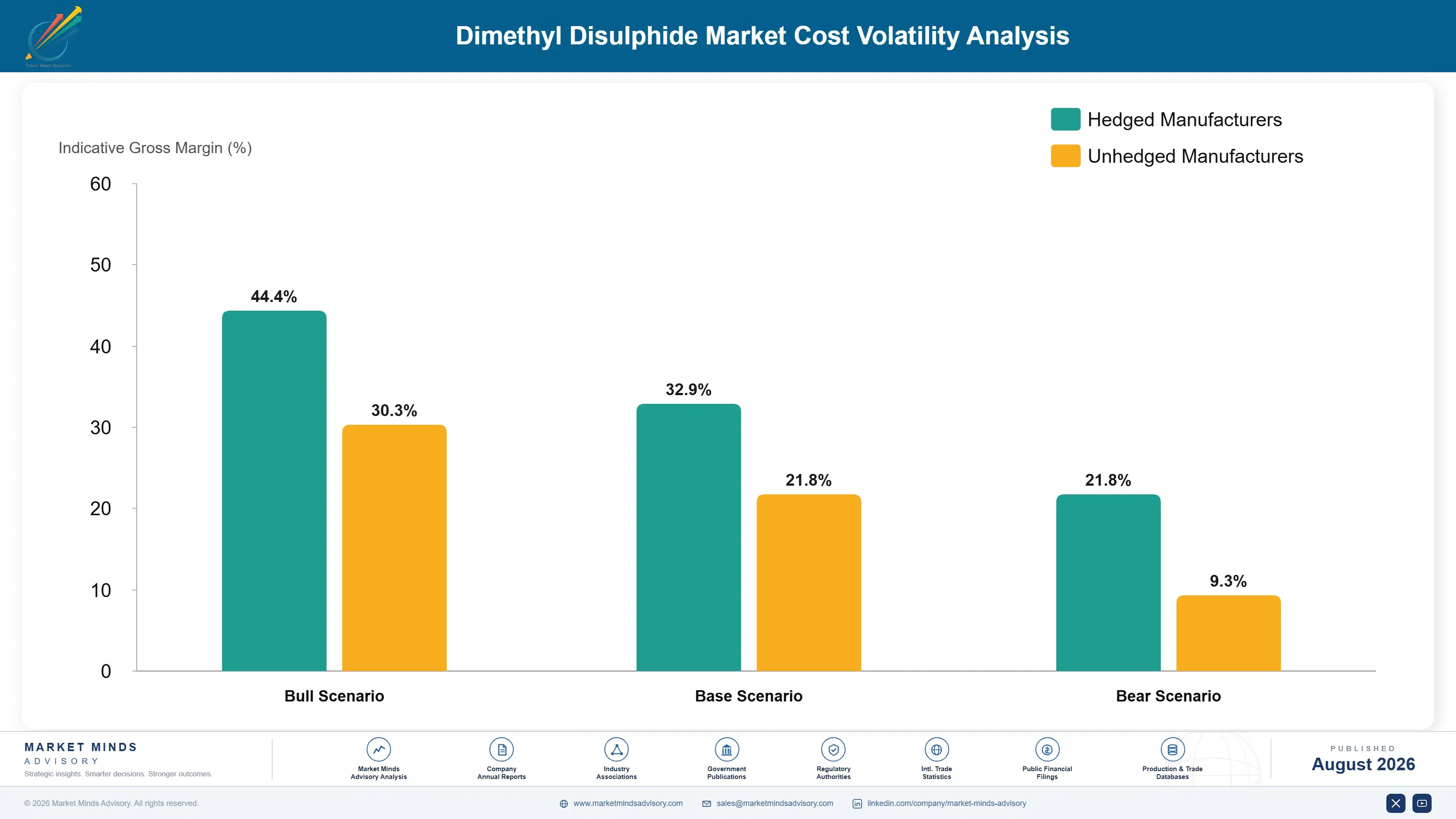
Methanol and sulphur together account for roughly 38% of production cost, routed through methyl mercaptan which producers either make internally or purchase from competitors. Process energy contributes 16%, reflecting the reaction and distillation duty involved. Odourants, stabilisers, and formulation additives take 7%, small in cost terms and disproportionately important commercially. Specialised handling, containment, and transport infrastructure absorb the balance, an unusually high share driven entirely by the odour characteristics.
Methanol pricing moved sharply through 2021 and 2022 as natural gas costs rose across Europe and Asia, and sulphur followed refinery run rates that were themselves disrupted. Arkema referenced raw material and energy cost pressure across its reporting for those years. Producers without integrated mercaptan capacity faced the compounded effect of both feedstock increases and their suppliers' margin decisions, which widened the cost gap between integrated and non-integrated positions considerably.

Exposure divides on backward integration rather than on scale or geography. Integrated producers convert methanol and sulphur at their own cost while non-integrated ones buy an intermediate priced by a competitor selling into the same end markets. Regional energy cost adds a second divide, with European production carrying gas and power costs Chinese and North American plants avoid.
dimethyl-disulphide-dmds-market-trends-cost-volatility-analysis-1787549191036

Contract methanol supply against published regional benchmarks

Methanol pricing swings with natural gas and regional supply balances that no downstream producer influences. Indexed multi-year contracts referencing published benchmarks remove the negotiation risk without removing the price exposure, and they secure volume during periods when methanol allocation tightens. The alternative is spot purchasing into a market that has proved capable of doubling inside a year more than once.

Invest in closed transfer and containment infrastructure

Handling infrastructure is an unusually large cost share and it is also the principal commercial differentiator, which makes the spending dual-purpose rather than purely defensive. Closed transfer systems, vapour recovery, and containment engineering reduce both odour incident risk and product loss. Sites that have experienced a community complaint weight this capability above price when they next select a supplier.

Recover and reuse process vent streams

Vent streams carrying odorous sulphur compounds must be treated regardless, and treating them as a recovery opportunity rather than solely an emissions obligation reduces both raw material loss and abatement cost. Thermal oxidation destroys value that scrubbing and recycling can partly retain. Capital cost is meaningful and the payback improves considerably wherever energy or methanol pricing is high.

Portfolio Architecture for Margin Defence

Margin follows formulation and service rather than volume. Bulk catalyst sulphiding grade sold against turnaround tenders earns modest returns, because the specification is straightforward, qualified suppliers are interchangeable on chemistry, and refiners buy competitively when a turnaround is scheduled. Formulated fumigant and odourised blends supplied with handling systems earn considerably more, since registration status and containment capability limit the field to very few suppliers.
The volume and premium tension shows in logistics rather than in production. Handling and containment infrastructure is expensive and must exist before any material moves, so producers take bulk turnaround volume to justify terminals and transport assets that the premium business depends on. Losing bulk volume weakens the network supporting the profitable formulated business, which is why nobody exits the commodity end voluntarily.

High-value pools concentrate in three places: registered soil fumigant formulations, continuous supply to renewable fuel units, and odourised blends sold with handling systems. Each is defended by registration, contract position, or engineering capability rather than by price. Price competition arrives in each only when a competitor secures a registration, wins a running supply contract, or builds equivalent containment capability, and none of those happens quickly.

Volume / Commodity-Adjacent Tier

Bulk catalyst sulphiding and chemical intermediate grade supplied against turnaround tenders and industrial contracts. Competes on delivered cost from the nearest terminal. The range reflects large differences in feedstock integration and freight position.
Gross Margin: 16%-24%

Premium / Certified Tier

Odourised and stabilised blends supplied with closed transfer equipment, containment engineering, and handling training. The site purchases odour incident avoidance rather than chemistry, and switching supplier risks a community complaint.
Gross Margin: 32%-44%

Sustainability / Regulatory / Next-Generation Tier

Registered soil fumigant formulations and continuous supply contracts serving renewable fuel units. Registration status and contract position drive returns. The range is wide because fumigant pricing varies enormously between approved markets.
Gross Margin: 34%-52%
dimethyl-disulphide-dmds-market-trends-portfolio-architecture-1787549191532

High-value Sub-segments and Strategic Watch-out

Registered Soil Fumigant Formulations

The fastest-growing application at 8.2% and the one with the highest barrier, since registration takes years and competitors cannot shortcut it. Each national approval delivers a step change in volume. Application protocol forms part of what regulators actually approve. Sequence submissions by receptiveness, not market size.
Gross Margin: 36%-52%

Renewable Fuel Continuous Supply

A demand pool nobody modelled, converting turnaround purchasing into running consumption at every unit commissioned. Contracting it on supply terms locks accounts before competitors recognise the pattern. Operators value certainty because catalyst deactivation costs throughput immediately. Contract it before competitors recognise the pattern. Move early.
Gross Margin: 30%-42%

Odourised Blends With Handling Systems

Premiums here have no basis in the chemistry delivered and every basis in what a community odour complaint costs an operator. Supplying containment engineering alongside material makes the relationship almost impossible to displace on price alone. Engineering capability rather than chemistry defends it. Invest here.
Gross Margin: 33%-45%

Bulk Catalyst Sulphiding Supply

The strategic watch-out. Interchangeable on specification, tendered competitively at each turnaround, and increasingly contested by Chinese producers with new capacity. It funds the terminals and transport assets everything else depends on entirely. Keep it for the terminals and nothing else. Price for loading only. Nothing else.
Gross Margin: 16%-23%

How Demand Actually Reaches Producers

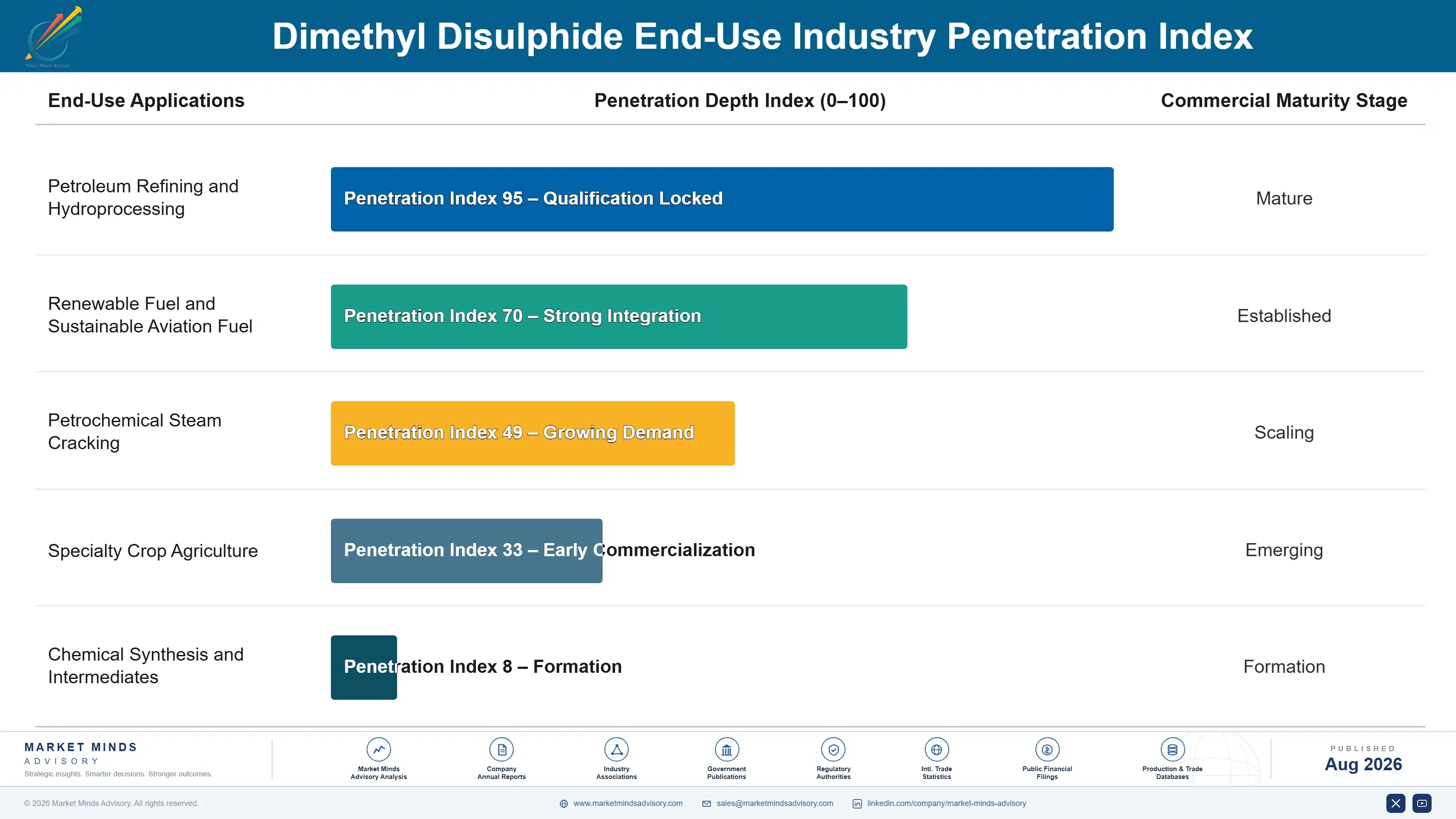
Two demand patterns coexist here and behave nothing alike. Turnaround consumption is event-driven, arriving in bursts that can exceed four times baseline for a fortnight and then vanishing for years, which makes it forecastable in aggregate and impossible to smooth for any individual supplier. Renewable fuel consumption is continuous, growing with commissioned capacity rather than with maintenance schedules, and it is the first genuinely steady demand this molecule has ever had. Producers weighted toward turnarounds carry volatility the newer pool would reduce.
Adoption depth varies sharply by customer type. Refiners running hydroprocessing units have no alternative and treat the purchase as a scheduled operational necessity. Renewable fuel operators are the same but continuously. Petrochemical crackers using anti-coking additive buy small volumes on established specifications. Growers buying formulated fumigant make an annual agronomic decision weighed against alternatives and crop economics.

The buyer has shifted toward turnaround planners and reliability engineers rather than procurement. Those people schedule years ahead and value supply certainty over unit price. A supplier who missed a turnaround window once will not be invited to quote for the next one, whatever the price, because an unavailable sulphiding charge costs days of refinery throughput.
dimethyl-disulphide-dmds-market-trends-end-use-penetration-index-1787549192021

Where the Money Sits

These are among the four positions where our research anticipates prominent divergence between winners and laggards over the coming forecast period. Each is grounded in the demand model, the regulatory perimeter, and the announced capacity pipeline.
01 / RENEWABLE UNIT CONTRACTING

Contract the running demand before competitors notice it exists

Renewable feedstocks contain almost no sulphur, so hydrotreating catalysts at these units need continuous injection rather than a single turnaround charge, and that already adds above 15% to total consumption. Contracting on running supply terms converts the lumpiest revenue in specialty chemicals into predictable volume while locking accounts early. Operators pay for certainty because catalyst deactivation costs throughput immediately, and most of the industry is still modelling this new demand using the turnaround assumptions it relied on for forty years.
02 / HANDLING CAPABILITY SELLING

Sell containment engineering, because odour decides supplier choice

Detection thresholds in the parts per billion range mean a small release generates complaints across a wide radius and can halt operations at a site entirely. Supplying closed transfer systems, storage engineering, and handling training alongside material earns 12 to 20 percentage points above material-only supply and makes displacement genuinely difficult. A site that has already managed one community complaint will not switch suppliers for a modest price advantage, which makes this the most durable relationship available in the market.
03 / FUMIGANT REGISTRATION SEQUENCING

Pursue receptive regulators first, not the biggest markets

Formulated fumigant grades grow at 8.2% and each national registration produces a step change in regional volume, but reviews routinely exceed thirty-six months and several major markets have left applications pending indefinitely. Sequencing submissions by regulatory receptiveness rather than by market size starts revenue years earlier and strengthens the dossier for subsequent applications. Producers who chased the largest markets first have generally waited longest and earned nothing at all, while smaller approvals would already have paid for themselves several times over.
04 / FEEDSTOCK INTEGRATION DECISION

Make the mercaptan, or accept a permanent cost floor

Methanol and sulphur are 38% of production cost and reach the process through methyl mercaptan, which non-integrated producers buy from competitors selling finished product into exactly the same accounts. That dependence sets a cost floor no operational programme crosses, and it explains why concentration in this market sits at 71% rather than anywhere near a normal chemical industry figure. Integration demands substantial capital and only justifies itself above genuinely large volume thresholds, which is the honest constraint most producers in this market cannot escape.

Engagement Snapshot From the Field

A live engagement with an industry participant carrying material or product regulatory and market exposure ahead of a defining policy shift, showing how our research translates into a defensible multi-year portfolio strategy.
MARKET MINDS ADVISORY · CLIENT ENGAGEMENT SUMMARY
Dimethyl Disulphide Producer Strategic Portfolio Review and Transition Roadmap 2026·Investment Scenario on Dimethyl Disulphide Exposure Evaluation 2025-26
CLIENT PROFILE
An Asian producer of specialty sulphur chemicals including dimethyl disulphide, supplying refinery and petrochemical customers regionally with revenue near USD 74 million (client-reported, unverified by MMA). The business purchased methyl mercaptan from a larger competitor, sold bulk material against turnaround tenders, and held no formulated fumigant or handling systems offer. Revenue swung heavily with maintenance schedules.
STRATEGIC CHALLENGE
Revenue swung violently with regional turnaround schedules, and a deferred maintenance season had left the business carrying inventory and idle logistics capacity for most of a year. Meanwhile two renewable diesel units in the region had commissioned and were buying continuously from a competitor the client had never considered a rival in that application.
MMA APPROACH
MMA mapped regional turnaround schedules against renewable fuel commissioning timetables, sized the continuous supply and handling systems opportunities, and modelled revenue volatility under alternative portfolio mixes. Forty-seven expert interviews with refinery turnaround planners, reliability engineers, and renewable fuel operators established how each buyer type actually purchases. Purchasing behaviour differed sharply by type.
KEY FINDINGS
  1. Renewable fuel units in the region were consuming continuously at volumes comparable to a mid-size turnaround every year, and none of that demand appeared in the client's forecasting model at all.
  2. Two customers had experienced odour complaints in the preceding three years, and both said containment capability would outweigh a meaningful price difference at their next supplier review.
  3. Purchased methyl mercaptan set a cost floor roughly nine percentage points above the integrated competitor, which no operational improvement the client identified could realistically close.
  4. Turnaround revenue concentration meant a single deferred maintenance season removed more than a third of annual volume, an exposure the business had accepted as unavoidable rather than addressed.
CLIENT PROFILE
An Asian producer of specialty sulphur chemicals including dimethyl disulphide, supplying refinery and petrochemical customers regionally with revenue near USD 74 million (client-reported, unverified by MMA). The business purchased methyl mercaptan from a larger competitor, sold bulk material against turnaround tenders, and held no formulated fumigant or handling systems offer. Revenue swung heavily with maintenance schedules.
STRATEGIC CHALLENGE
Revenue swung violently with regional turnaround schedules, and a deferred maintenance season had left the business carrying inventory and idle logistics capacity for most of a year. Meanwhile two renewable diesel units in the region had commissioned and were buying continuously from a competitor the client had never considered a rival in that application.
MMA APPROACH
MMA mapped regional turnaround schedules against renewable fuel commissioning timetables, sized the continuous supply and handling systems opportunities, and modelled revenue volatility under alternative portfolio mixes. Forty-seven expert interviews with refinery turnaround planners, reliability engineers, and renewable fuel operators established how each buyer type actually purchases. Purchasing behaviour differed sharply by type.
KEY FINDINGS
  1. Renewable fuel units in the region were consuming continuously at volumes comparable to a mid-size turnaround every year, and none of that demand appeared in the client's forecasting model at all.
  2. Two customers had experienced odour complaints in the preceding three years, and both said containment capability would outweigh a meaningful price difference at their next supplier review.
  3. Purchased methyl mercaptan set a cost floor roughly nine percentage points above the integrated competitor, which no operational improvement the client identified could realistically close.
  4. Turnaround revenue concentration meant a single deferred maintenance season removed more than a third of annual volume, an exposure the business had accepted as unavoidable rather than addressed.
RECOMMENDED STRATEGY
Phase 1: Phase one: pursue continuous supply contracts with regional renewable fuel operators immediately, pricing for volume predictability rather than matching turnaround tender economics. Phase 2: Phase two: build closed transfer and containment capability as a sold offer, targeting first the two customers who had already experienced odour complaints on site. Phase 3: Phase three: assess mercaptan integration honestly against volume thresholds, and if it fails the test, concede the bulk commodity segment rather than defending it unprofitably.
OUTCOME
The client won continuous supply at both regional renewable units within a year and converted three customers to handling-inclusive contracts. Revenue volatility across the turnaround cycle fell materially, formulated and service revenue reached 22% of the total, and blended gross margin improved 5.7 percentage points (client-reported, unverified by MMA).

Frequently Asked Questions

Foundational context covering the market sizes, CAGR, scope, country, region and competition that inform every finding below. This section is provided to cover basics and most often pre-purchase conversations, answered from the MMA Primary Research Dataset.

What is the current size of the Dimethyl Disulphide Market?

The market was valued at USD 0.3 billion in 2025, rising to an estimated USD 0.32 billion in 2026. East Asia holds the largest regional share at 30% of global value.

How large will the Dimethyl Disulphide Market be by 2036?

MMA forecasts USD 0.54 billion by 2036 under the base case, an expansion multiple of 1.69 times the 2026 value. That represents USD 0.22 billion of incremental value across the forecast period.

What is the CAGR for the Dimethyl Disulphide Market 2026 to 2036?

The base case CAGR is 5.4%, with a bull case of 6.6% and a bear case of 4.2%. The spread reflects uncertainty over renewable fuel capacity and fumigant registration progress.

Which segment is growing fastest?

Formulated soil fumigant grades grow fastest at 8.2%, roughly 1.52 times the market rate. Odourised and stabilised blends follow at 7.4% on handling risk rather than performance.

Who are the major companies in the Dimethyl Disulphide Market?

Arkema, Chevron Phillips Chemical, Merck KGaA, Toray Fine Chemicals, and Sichuan Lutianhua lead on supply. The top five hold roughly 71% of global value, among the highest concentrations anywhere.

Which country is growing fastest?

India grows fastest at 8.4%, driven by refining capacity expansion with rising hydroprocessing content as fuel specifications tighten. Announced renewable fuel projects will add continuous consumption when commissioned.

Report Segmentation Architecture

The full report scope spans multiple orthogonal segmentation dimensions, with cross-tabulated demand data provided for each dimension pair. Coverage extends further to regional breakdowns, trend trajectories, and the competitive detail needed to support segment-level decision-making.

By Product Grade

  • Catalyst Sulphiding Grade
  • Soil Fumigant Formulated Grade
  • Anti-Coking Additive Grade
  • Chemical Intermediate Grade
  • Odourised and Stabilised Blends

By End-Use Industry

  • Petroleum Refining and Hydroprocessing
  • Renewable Fuel and Sustainable Aviation Fuel
  • Petrochemical Steam Cracking
  • Specialty Crop Agriculture
  • Chemical Synthesis and Intermediates

By Sales Model

  • Turnaround Event Tender Supply
  • Continuous Running Supply Contracts
  • Handling Systems Inclusive Supply
  • Distributor and Terminal Channel
  • Formulated Product Agricultural Channel

By Region

  • North America
  • Western Europe
  • East Asia
  • South Asia and Pacific
  • Latin America
  • Middle East and Africa
  • Eastern Europe

Scope, Methodology, and Coverage

Every figure in this report is reproducible from documented input assumptions. The scope below maps the historical period, the forecast horizon, the segmentation dimensions, and the countries covered, alongside the underlying primary and qualitative methodology.
Historical Period
2020 to 2025
Forecast Period
2026 to 2036
Base Year
2025 (USD billions; MMA Primary Research Dataset, August 2026)
Market Definition
The market comprises dimethyl disulphide supplied for industrial and agricultural applications, covering catalyst sulphiding grade, formulated soil fumigant grade, anti-coking additive grade, chemical intermediate grade, and odourised and stabilised blends. Value is measured at producer level across refining, renewable fuel, petrochemical, agricultural, and chemical synthesis end uses. Dimethyl sulphide, methyl mercaptan sold as an intermediate, alternative organosulphur sulphiding agents including polysulphides and tertiary nonyl polysulphide, methionine and its intermediates, and injection or application equipment fall outside scope.
Quantitative Units
USD billions (current prices); thousand tonnes supplied annually; USD per tonne by grade and application
Segmentation Dimensions
By Product Grade; By End-Use Industry; By Sales Model; By Region
Regions Covered
North America, Western Europe, East Asia, South Asia and Pacific, Latin America, Middle East and Africa, Eastern Europe
Countries Covered
United States, Canada, Mexico, France, Germany, Netherlands, Italy, Spain, Belgium, Poland, Romania, Hungary, China, Japan, South Korea, India, Singapore, Malaysia, Indonesia, Australia, Brazil, Argentina, Chile, Peru, Saudi Arabia, United Arab Emirates, Kuwait, Egypt, South Africa
Key Companies Profiled
Arkema, Chevron Phillips Chemical, Merck KGaA, Toray Fine Chemicals, Sichuan Lutianhua, Eastman Chemical, Nouryon, Evonik Industries, Lanxess, Tokyo Chemical Industry, Thermo Fisher Scientific, Ataman Kimya, Shandong Novista Chemicals, Hebei Yanuo Bioscience, Jiangsu Yida Chemical, Sumitomo Seika Chemicals, Zhejiang Jiahua Energy, Hubei Xinjing New Material, Shandong Baovi Energy Technology, Adisseo
Quantitative Methodology
Primary survey, n=3,800 respondents, Q4 2025, six countries; demand-side model with trade association cross-validation
Qualitative Methodology
47 expert interviews, Q4 2025; applied to validate demand model assumptions, identify emerging dynamics, and assess competitive positioning
Report Format
PDF and XLSX data workbook (Word format preview document)
Publisher
Market Minds Advisory
Report Code
MMA-2026-CHM-171
Published
August 2026
Contact
sales@marketmindsadvisory.com | www.marketmindsadvisory.com

Purchase the full Dimethyl Disulphide Market Report (2026 to 2036).

The full report sizes dimethyl disulphide demand across five product grades, five end-use categories, and seven regions with 2026 to 2036 forecasts under base, bull, and bear cases. It separates event-driven turnaround consumption from the continuous renewable fuel demand that behaves entirely differently. Competitive profiles cover twenty suppliers assessed consistently on dimethyl disulphide supply, feedstock integration, and handling capability. Cost analysis traces methanol, sulphur, and energy exposure against integrated and non-integrated positions. Commercial guidance addresses renewable unit contracting, handling capability selling, registration sequencing, and feedstock integration.
Five product grades sized separately by region
Turnaround demand separated from continuous renewable consumption
Fumigant registration status mapped by country and timetable
Feedstock integration assessed across twenty producers
Odour handling capability compared as a commercial differentiator
Refinery hydroprocessing installed base modelled by turnaround cycle

Built For The People Who Decide

From boardroom strategy to bench-side execution, this report is read cover-to-cover by leaders shaping the next decade of their industry, turning demand scenarios, market dynamics and valuation benchmarks into decisions.
CXOs/ Presidents/ VPs/ Managers
M&A and Corporate Development
Strategy Teams and R&D Heads
Procurement and Product Directors
Regulatory and Compliance Leaders
Investor Relations and Equity Analysts