Market Minds Advisory
Digital Trust Market

Digital Trust Market: Digital Trust Market. Identity Verification And Authentication Platforms Securing Digital Transactions

AI-generated deepfakes and synthetic identity fraud are forcing enterprises to replace static document checks with continuous identity verification, turning digital trust infrastructure into a board-level line item rather than a compliance afterthought.

Lead Analyst

Published

September 2026

Make Smarter Decisions with Customized Research Insights

Request a free sample report and evaluate market opportunities, growth trends, and competitive dynamics relevant to your business needs.

2025 MARKET VALUE$14.2BMarket Size 2025
2036 FORECAST VALUE$44.8BBase Case , 2026 to 2036
CAGR 2026 TO 203611.0 %Bull 12.3% / Bear 9.7%
INCREMENTAL OPPORTUNITY$29.0BNet 10- year value creation
EXPANSION MULTIPLE2.84x2036 value over 2026 base
Strategic Levers
M&A Pipeline
Regional Outlook
Country Rankings
Competitive Intelligence
Segmental Deep-dive
Call-Us : 91 93563 13602

Executive Snapshot and Market Trajectory.

Digital identity verification is shifting from a one-time onboarding check to continuous transaction-level trust scoring as synthetic identity fraud and deepfake-generated documents overwhelm static verification methods that enterprises relied on for years, forcing a rapid overhaul of onboarding and transaction monitoring systems across nearly every regulated sector.
Financial services and government agencies adopt continuous verification fastest, driven respectively by fraud losses and mandated digital identity programs, and North America leads deployment given its concentration of specialized vendor headquarters, with enterprise buyers increasingly consolidating identity verification, authentication, and e-signature workflows into single trust platforms rather than managing separate point tools across each transaction stage independently as they historically did for years across separate procurement cycles and separate vendor support contracts entirely.
Competitive intensity now centers on verification accuracy against AI-generated fraud rather than raw document check speed, as DocuSign and Okta defend leading platform positions while Thales and Entrust push consolidated identity suite offerings, and evolving digital identity regulation across the European Union increasingly shapes which vendors clear enterprise procurement review at large multinational accounts spanning several regulatory jurisdictions at once, particularly across finance and healthcare.
Market Definition
The Digital Trust market covers software platforms that verify identity, authenticate users, secure digital signatures, and establish cryptographic trust for online transactions, including identity verification, public key infrastructure, and multi-factor authentication. It excludes broader identity governance and administration platforms, physical access control hardware, and generic cybersecurity monitoring tools not focused specifically on transaction or identity trust.
Base Year Value
$14.2B in 2025 (MMA Primary Research Dataset, September 2026)
Forecast Period
2026 to 2036, eleven discrete annual values
CAGR
11.0% base case. Bull 12.3%. Bear 9.7%.
Fastest Growth Segment
Digital Identity Verification Platforms: 17.0% CAGR
Fastest Growth Country
India: 13.2% CAGR
Fastest Growth Region
South Asia and Pacific: 13.2% CAGR
Largest Region
North America: 31% of 2025 global value
Market Leaders
DocuSign, Okta, Entrust, DigiCert, Thales. Source: MMA Analysis based on company annual reports.
Primary Survey
n=3,800 procurement and R&D decision-makers, Q4 2025, six countries
Methodology
Demand-side build-up, cross-validated against public data, 47 expert interviews

Digital Trust Market Forecast Scenarios

digital-trust-market-size-forecast-scenario-1789989641788
Between 2020 and 2025 digital trust adoption moved from basic document-based identity checks to AI-assisted continuous verification, accelerated by rising synthetic fraud losses and a historical CAGR near ten percent that reset how enterprises budget for identity and transaction security spending overall, moving it from a compliance line item to a strategic budget priority owned directly by the chief risk officer.
The base case assumes continued displacement of static document verification as fraud losses climb, expanding government-mandated digital identity programs requiring compliant verification infrastructure, and rising enterprise willingness to pay premium pricing for continuous rather than point-in-time trust scoring, three mechanisms that together sustain double-digit expansion through 2036 without requiring a fundamentally new fraud category to emerge beyond the synthetic identity fraud already driving most of the current budget growth across nearly every regulated industry tracked.
A bull scenario hinges on accelerated deepfake-driven fraud losses pushing enterprises toward premium verification tiers faster than currently expected across every industry. The bear case centers on economic slowdown delaying discretionary identity platform upgrades, as buyers extend legacy verification contracts beyond planned retirement dates, stretching refresh cycles by a year or more in cost-constrained sectors.

Continuous Verification Redefining Transaction Security

Digital trust sits at the intersection of fraud prevention, regulatory compliance, and user experience, and vendors that can verify identity accurately without introducing friction into the transaction now win deals that used to require stitching together separate fraud, identity, and signature products from three or four different vendors entirely, each with its own integration timeline and support contract to manage separately.
MARKET CONCENTRATIONCR5 30%top five vendors hold roughly one third of spend
AVERAGE CONTRACT VALUE$78Ktypical enterprise annual per-seat licensing commitment size overall
VENDOR HQ CONCENTRATION65%leading platform vendors headquartered in a single region
SYNTHETIC FRAUD GROWTH RATE34%year over year increase in reported synthetic identity fraud
CLOUD-DELIVERED DEPLOYMENT SHARE74%identity platforms now hosted on cloud rather than on-premises
VERIFICATION PASS RATE91%average legitimate user verification success rate across platforms tested
Commercially the market behaves like enterprise infrastructure software rather than a periodic compliance purchase: per-verification or per-seat subscription pricing, multi-year contracts, and expansion revenue from add-on modules such as biometric verification and continuous authentication. Renewal economics dominate growth once a platform becomes embedded into core transaction workflows across onboarding, payments, and account recovery alike, and switching providers mid-cycle risks introducing new friction that customers notice immediately.
Over the next decade, AI-driven deepfake detection, tightening digital identity regulation, and continued platform consolidation into unified trust suites will separate vendors capable of operating at hyperscale verification volume from smaller players confined to narrow document-checking niches unable to keep pace with AI-generated fraud techniques or defend pricing against a determined, better-funded challenger entering the same competitive evaluation.
"A verification platform that still relies mainly on checking whether a photo ID looks real is already fighting last year's fraud, not this year's."
Director, Digital Identity and Fraud Prevention Practice · MMA Digital Identity Verification And Transaction Security Platforms Practice · September 2026

Market Trends

AI-Generated Deepfakes Force Liveness Detection Upgrades

Fraudsters are increasingly using AI-generated deepfake video and synthetic voice to defeat traditional selfie-based identity verification, prompting vendors to embed advanced liveness detection that analyzes micro-movements and depth data no static or generated image can replicate convincingly. This has pushed identity verification vendors to invest heavily in proprietary anti-spoofing models trained on the latest generative AI outputs rather than relying on generic face-matching algorithms that deepfake technology has already learned to defeat. Vendors slow to make this transition are increasingly losing enterprise evaluations against liveness-first challengers with demonstrably higher detection rates.
Market Impact: Adds 27 EU states to mandate

Passwordless Authentication Adoption Accelerates Across Enterprise

Enterprises are rapidly adopting passwordless authentication standards built on FIDO2 and passkey technology, eliminating the credential theft risk that phishing and password reuse have long exploited across corporate and consumer accounts alike. This shift has accelerated as major platform vendors including Apple, Google, and Microsoft standardize passkey support across their operating systems, removing the user experience friction that previously slowed enterprise passwordless rollouts considerably. Vendors offering smooth passkey integration alongside existing identity infrastructure increasingly win enterprise renewal negotiations over legacy password-based competitors lacking comparable ease of adoption across their existing customer base.
Market Impact: Cuts synthetic fraud losses 32 percent

Market Opportunities and Growth Drivers

Government Digital Identity Mandates Expand Compliant Infrastructure

The European Union's Digital Identity Wallet regulation requires member states to offer citizens a compliant digital identity credential by 2026, creating a multi-year infrastructure buildout across dozens of national governments and the private vendors supporting them. Financial institutions and telecommunications providers operating across the European Union must integrate with these national wallet systems to remain compliant, and similar government-backed digital identity programs are now spreading into India's Aadhaar-linked verification network and several Gulf state national identity initiatives, widening the addressable infrastructure opportunity considerably beyond the original European regulatory scope defined in the founding 2024 framework.
Market Impact: Loses 8 percent of legitimate applicants

Synthetic Identity Fraud Losses Sustain Premium Budget Growth

Synthetic identity fraud, where criminals combine real and fabricated personal data to create credible fake identities, has grown considerably faster than traditional identity theft according to company annual fraud reports, sustaining verification budget growth even during periods when broader enterprise IT spending faced scrutiny elsewhere. Banks and fintech lenders face particularly acute exposure given the difficulty of detecting synthetic identities through traditional credit bureau checks alone, pushing these buyers toward premium continuous verification tiers rather than basic onboarding checks that leave critical gaps against this fraud category specifically as it continues evolving each year.
Market Impact: Adds 4 to 6 months delay

Market Restraints and Challenges

Verification Friction Increases Legitimate User Abandonment

Adding more rigorous identity checks to reduce fraud inevitably increases the time and steps legitimate customers must complete during onboarding, and a meaningful share of otherwise genuine users abandon the process entirely when verification feels invasive or repeatedly fails due to poor lighting or device camera quality. The root cause is an inherent tension between fraud prevention and conversion optimization that no verification technology fully eliminates. Vendors are mitigating this through adaptive verification that applies stricter checks only to higher-risk transactions rather than uniform friction for every single user regardless of risk profile.
Market Impact: Cuts deepfake fraud success 45%

Cross-Border Data Residency Rules Complicate Global Rollout

Enterprises deploying identity verification across multiple countries must navigate a patchwork of data residency and biometric data handling regulations that differ meaningfully by jurisdiction, forcing costly region-specific infrastructure rather than a single global deployment. The root cause is that privacy regulators worldwide have moved faster and less uniformly than the identity verification industry's own technical standards bodies. Vendors are mitigating this by building regional data processing infrastructure and modular compliance configurations that adapt to local requirements without requiring separate underlying platforms entirely for each and every jurisdiction the vendor currently serves globally.
Market Impact: Cuts credential-based breach attempts by 60%
3 additional market trends, 3 additional growth drivers, and 4 additional restraints and challenges are covered in the full report. Contact sales@marketmindsadvisory.com to access the complete intelligence.

Segment CAGR and Growth Architecture

Digital Trust is segmented by verification technology, the framework enterprise security and compliance teams use to evaluate platform capability, since a biometric identity engine requires fundamentally different infrastructure than certificate-based signing regardless of buyer industry, and this technical lens maps directly onto how competing platforms are marketed and priced across nearly every competing vendor in the field today.
digital-trust-market-market-share-analysis-1789989642361

Digital Identity Verification Platforms

Digital identity verification platforms confirm that a user is who they claim to be through document scanning, biometric matching, and liveness detection, catching synthetic and deepfake identities that simpler document checks miss entirely. This segment is compounding fastest because it directly addresses the fraud category driving most current security budget growth, and financial regulators increasingly name continuous verification explicitly as a compliance expectation rather than a best practice suggestion. Vendors increasingly differentiate on anti-spoofing accuracy against the latest generative AI techniques rather than basic document authenticity checks alone, and integration with fraud scoring engines has become a baseline expectation among serious enterprise buyers evaluating competing vendors during any procurement cycle.
CAGR 17.0%

Multi-Factor and Passwordless Authentication Software

Multi-factor and passwordless authentication software verifies an already-known user's identity at each login or transaction using hardware tokens, biometrics, or cryptographic passkeys rather than vulnerable static passwords. Growth is accelerating as major platform vendors standardize passkey support across operating systems, removing the user experience friction that historically slowed enterprise passwordless rollouts considerably. Financial services and healthcare buyers lead adoption given elevated exposure to credential-based account takeover fraud, and vendors increasingly bundle passwordless authentication as a default-included capability rather than a separately priced premium module, pushing legacy password-only vendors out of serious enterprise consideration entirely as buyers standardize on modern authentication approaches across every application in their technology stack over the coming several years.
CAGR 14.5%
Full segment breakdown across 6 segments available in the complete report.

Regional Architecture and Country Demand Map

North America leads given its concentration of specialized vendor headquarters and deep fraud losses, while South Asia and Pacific posts the fastest regional growth as national digital identity programs scale rapidly across newly formalizing financial systems, with Western Europe trailing mainly on slower cloud adoption budgets.

North America

North America holds the largest share of digital trust spend because it combines the highest reported synthetic identity fraud losses with the headquarters of nearly every leading verification vendor, giving buyers deeper reference customers and faster support than anywhere else. Financial regulators here increasingly mandate continuous verification for high-risk account opening, compounding demand across thousands of banks and fintech lenders simultaneously. Enterprise security budgets run larger per customer relationship than any other region, supporting premium continuous verification tiers rather than basic onboarding checks, and this concentration of both vendor supply and fraud exposure reinforces the region's lead year after year, even as challengers abroad build comparable verification depth. Vendor investment in local fraud research keeps expanding to match this demand.
Share: 31% | CAGR: 11.8% (2026 to 2036)

Western Europe

Germany, France, and the United Kingdom account for the bulk of Western European digital trust spend, led by financial institutions preparing for the European Union's Digital Identity Wallet regulation taking effect across member states. Data residency requirements under the General Data Protection Regulation push enterprises toward vendors offering in-region biometric data processing rather than routing sensitive identity data through American cloud infrastructure. Growth trails North America and East Asia because European procurement cycles favor longer evaluation periods before committing to full platform migration, a caution that slows expansion even as underlying regulatory pressure toward digital identity keeps building steadily across every major industry vertical tracked in this analysis over the coming decade.
Share: 22% | CAGR: 9.5% (2026 to 2036)
Regional intelligence for 5 additional markets available in the complete report: East Asia, South Asia and Pacific, Latin America, Middle East and Africa, Eastern Europe. Contact sales@marketmindsadvisory.com.
digital-trust-market-country-cagr-analysis-1789989642902

How Trust Vendors Convert Accuracy Into Margin

Beyond core per-verification pricing, four commercial mechanisms determine which digital trust vendors convert fraud growth into durable margin expansion rather than competing purely on verification accuracy benchmarks against every other vendor in the field, since accuracy claims have converged closely enough that they rarely decide a deal alone across a crowded and increasingly commoditized field.

Bundling Biometric Liveness Detection Into Core Licenses

Vendors now fold advanced biometric liveness detection directly into standard verification licenses rather than selling anti-spoofing capability as a costly separate add-on, a shift that raises average contract value substantially once buyers see measurably lower deepfake fraud rates. Attach rates on liveness modules have climbed past 50 percent among large enterprise renewals, and because the underlying models are shared across the customer base, incremental delivery cost stays low, converting most of the incremental revenue directly into margin for the vendor rather than into additional support cost for the vendor to absorb over time.
Market Impact: Raises average contract value by 28 percent overall

Expanding Into Continuous Transaction Monitoring Coverage

Early identity verification deployments checked identity once at onboarding, leaving the rest of the customer relationship outside continuous trust monitoring entirely. Vendors that extend coverage to ongoing transaction-level authentication capture licensing revenue previously stuck with separate fraud monitoring vendors, and roughly 45 percent of enterprise accounts have not yet completed this expansion, leaving substantial unclaimed contract value on the table for account teams to pursue during upcoming renewal negotiations across the existing installed customer base still running onboarding-only checks without any continuous monitoring layered on top of the initial onboarding check.
Market Impact: Raises average contract value by roughly 35 percent

Monetizing Compliance Certification As A Premium Tier

Vendors increasingly package advanced regulatory compliance certification and audit-ready reporting as a premium tier priced above the standard verification platform, targeting regulated buyers in financial services and government who face the steepest audit burden. Early pricing data suggests these premium compliance tiers carry list prices roughly 25 percent above base platform seats, and adoption concentrates among the largest enterprise accounts facing the most complex multi-jurisdiction regulatory exposure across their entire customer base and multiple overlapping regulatory frameworks that grow noticeably more complex with each passing regulatory cycle across every jurisdiction served.
Market Impact: Prices compliance tiers 25 percent above base overall

Capturing Fraud Investigation Services Revenue Upfront

Enterprises increasingly purchase dedicated fraud investigation services alongside their core verification license, ensuring rapid vendor support during a suspected fraud ring incident rather than negotiating emergency terms under pressure when losses are actively accumulating. These service engagements carry materially higher margins than standalone licensing once investigation teams reach sufficient scale, and roughly 28 percent of large enterprise renewals now include a services component, up sharply from a smaller base only a few years earlier across the industry as fraud ring sophistication continues climbing year over year across nearly every industry vertical tracked.
Market Impact: Adds a 28 percent services attach rate overall

Who Controls the Margin Pool

Market concentration sits moderate at a CR5 of 30 percent, evaluated on trailing twelve-month platform revenue, leaving meaningful room between established leaders DocuSign and Okta and a wide field of challengers still building comparable verification accuracy and platform breadth to match the two established category leaders directly on brand trust, verification accuracy, and global points-of-presence coverage alike.
Current competitive activity plays out across three fronts: aggressive acquisition of specialized biometric and AI detection startups by established platform vendors, expansion into continuous verification by e-signature and authentication incumbents seeking adjacent revenue, and price-per-verification compression as challenger vendors undercut incumbents to win displaced legacy document-checking contracts that have not kept pace with deepfake detection standards demanded by financial regulators and cyber insurance underwriters alike today.

Emerging pressure comes from AI-native startups building verification engines trained from scratch on the latest deepfake and synthetic identity patterns rather than retrofitting legacy document-scanning architecture, a dynamic that could reshuffle rankings among mid-tier vendors lacking either deep regulatory credibility or comparable AI development budgets to compete on equal footing against entrenched incumbents currently dominating enterprise procurement decisions across most regulated industry verticals.
digital-trust-market-company-positioning-matrix-1789989643439

Competitive Moat and Risk Dimensions

DOCUSIGN

Moat: Dominant e-signature brand recognition

DocuSign built overwhelming brand recognition as the default e-signature platform over nearly two decades, embedding itself into enterprise contract workflows so deeply that switching carries meaningful legal validation and integration risk most enterprises are unwilling to accept without strong justification for the disruption to an already-working contract execution process.
DOCUSIGN

Risk: E-signature commoditization from bundling

As Microsoft and Adobe bundle competing e-signature features directly into existing productivity suites customers already pay for, DocuSign faces continued pricing pressure at the low end of its business, forcing expansion into adjacent identity verification and contract intelligence to sustain its historical growth rate as the core e-signature market matures further.
OKTA

Moat: Vendor-neutral identity independence

Okta's independence from any single cloud provider or hardware vendor makes it the trusted neutral identity layer for enterprises running mixed technology stacks across AWS, Microsoft, and Google Cloud simultaneously, a positioning that platform-tied competitors embedded inside a single cloud platform cannot credibly replicate without abandoning their own cloud platform incentives.
OKTA

Risk: High-profile breach reputational damage

Okta suffered widely reported security breaches in recent years affecting customer support systems and downstream client environments, and while the company strengthened its security posture considerably afterward, competitors continue citing the incidents in competitive evaluations against security-conscious enterprise buyers evaluating identity vendors for mission-critical infrastructure deployments.

Players Tracked

Prominent Players

DocuSign
Okta
Entrust
DigiCert
Thales

Other Key Players

Ping Identity
OneSpan
Jumio
Onfido
Sectigo
GlobalSign
IdenTrust
Trulioo
Socure
Persona
Yubico
RSA Security
IDEMIA
Mitek Systems
IDnow

Recent Developments

FEBRUARY 2025

Okta Expands Identity Platform With New Continuous Authentication Module

Okta added a new continuous authentication module to its identity platform, extending coverage beyond login-time verification into ongoing session risk scoring, directly targeting the continuous trust trend already underway across the competitive digital identity field earlier in the year across its largest enterprise customer accounts.
Signal: Confirms continuous authentication has become a required baseline across every serious platform vendor competing in the market today.
JUNE 2025

Jumio Completes Acquisition Of An AI Deepfake Detection Startup

Jumio acquired a smaller AI deepfake detection vendor to accelerate liveness verification inside its identity platform, folding the acquired engineering team directly into its core product organization rather than operating the technology as a standalone product sold separately to existing customers under a prior standalone pricing arrangement.
Signal: Shows identity verification vendors racing to close deepfake detection gaps against newer AI-native entrants moving fast.
OCTOBER 2025

Entrust Deepens Certificate Management Integration With Identity Verification

Entrust tied its certificate management platform more closely to its identity verification offering, giving enterprise customers a single console spanning digital certificates and identity trust, a bundling move aimed squarely at accounts consolidating vendor relationships across their technology stack under one unified vendor relationship rather than two separate contracts.
Signal: Shows established PKI vendors using platform breadth to defend against narrower point-solution challengers lacking comparable suite breadth.

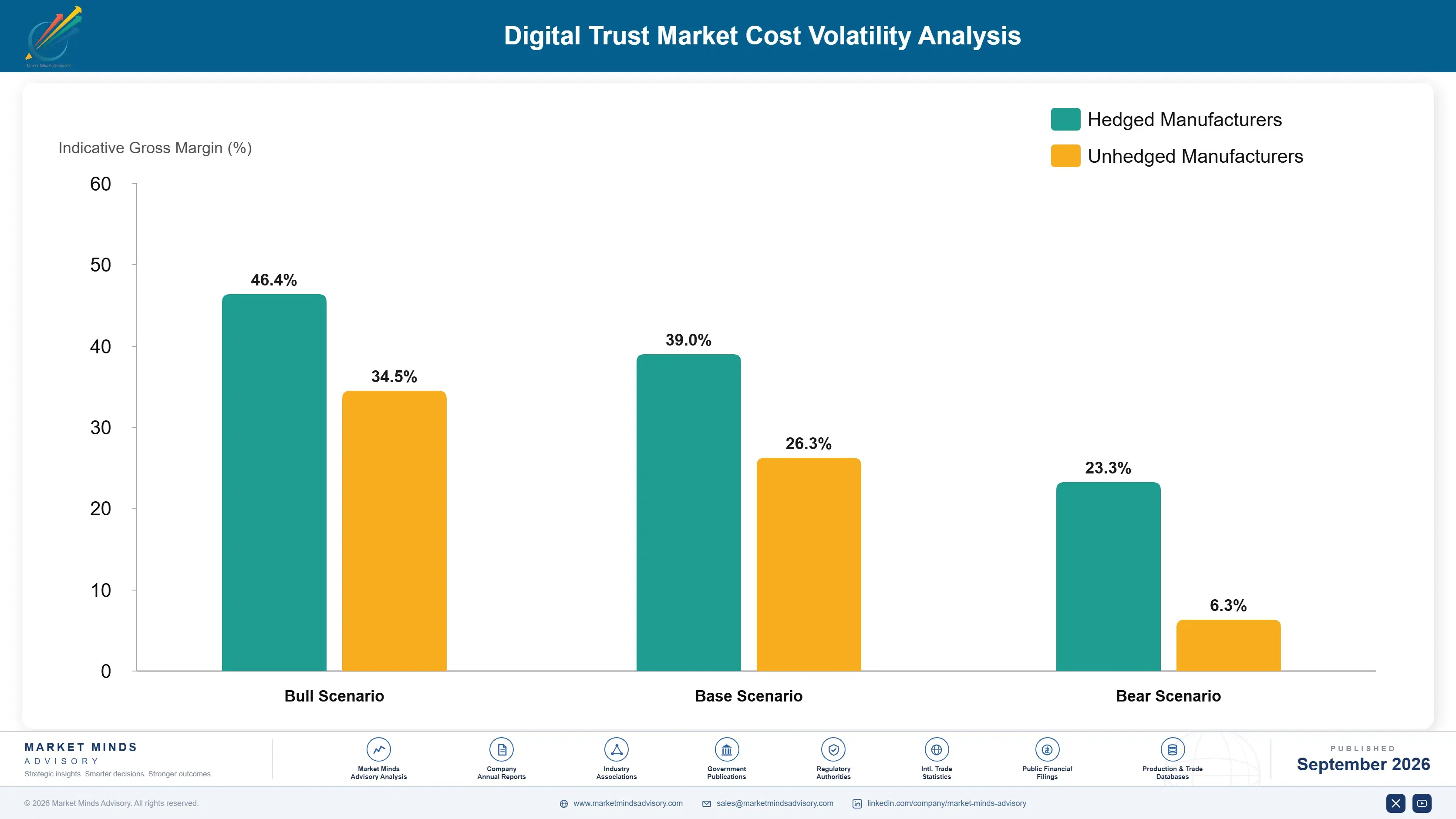
Biometric Research And Cloud Processing Costs

The dominant cost inputs for digital trust vendors are biometric research talent and cloud infrastructure for processing verification requests at scale, together running roughly 48 to 55 percent of cost of goods sold, sourced from a global machine learning research workforce combined with hyperscale cloud providers hosting verification engines that must run continuously across millions of daily identity checks worldwide.
Cloud compute pricing volatility became visible in 2024 when several hyperscale providers raised list prices on premium GPU processing tiers used for biometric matching, a shift documented in company annual report infrastructure cost disclosures, forcing vendors to renegotiate committed-use agreements or absorb thinner gross margins during the transition period, a squeeze that hit smaller vendors lacking scale to negotiate favorable terms hardest across the most GPU-intensive parts of their verification pipeline.

Vendors that built proprietary biometric processing infrastructure carry lower long-run cost exposure than those renting equivalent GPU capacity entirely from third-party cloud providers, creating a durable cost gap between well-capitalized incumbents and smaller challengers dependent on rented infrastructure for every verification request they process without the balance sheet room to build owned capacity at comparable scale.
digital-trust-market-cost-volatility-analysis-1789989643636

Diversifying Across Multiple Cloud GPU Providers

Leading vendors now split biometric processing workloads across two or more hyperscale providers rather than relying on a single cloud partner, reducing renegotiation leverage risk and limiting exposure to any single provider's GPU pricing decisions during periods of tight capacity. This diversification typically adds modest coordination overhead but pays off during future capacity or pricing disruptions.

Building Dedicated Biometric Research Hubs Regionally

Vendors are establishing dedicated biometric research centers in regions with strong technical talent pools and lower relative labor costs, expanding research capacity without proportionally increasing total compensation expense across the organization. These hubs typically pair local researchers with senior staff at headquarters through structured mentorship programs designed to accelerate ramp-up time for new researchers.

Locking In Multi-Year Committed-Use GPU Agreements

Vendors increasingly commit to multi-year minimum GPU spend agreements with cloud infrastructure providers in exchange for locked-in discount pricing, trading flexibility for cost predictability that helps protect gross margin forecasts against sudden mid-contract increases. These agreements typically span three to five years and are negotiated well ahead of expected verification volume growth across the largest enterprise deployments.

Portfolio Architecture for Margin Defence

Vendor portfolios split across three margin tiers: commodity-adjacent basic document-checking subscriptions priced to win volume among smaller buyers, certified full-platform bundles carrying premium pricing for enterprises demanding continuous verification and compliance reporting, and next-generation AI-augmented tiers commanding the steepest margins as differentiated capability rather than a simple onboarding checkbox, and vendors increasingly design roadmaps around moving customers upward through this hierarchy over time rather than leaving them parked on entry-level licensing indefinitely.
Volume-tier deals win on price and speed of integration, while premium-tier deals win on verification accuracy and breadth of continuous monitoring coverage, and the tension between the two shows up directly in how sales teams structure land-and-expand strategies across multi-year enterprise renewal cycles within regulated industries, reshaping how account teams prioritize expansion conversations each renewal cycle.

High-value margin pools concentrate in the next-generation tier, where biometric liveness detection and compliance certification modules command list prices well above the base platform, and vendors capable of selling into that tier consistently outperform peers stuck competing on basic document verification alone, a gap that widens as buyers grow comfortable paying for automated outcomes rather than raw document scanning alone.

Volume / Commodity-Adjacent Tier

Basic document verification subscriptions sold to smaller buyers through self-service onboarding rather than direct enterprise sales relationships, priced for volume and minimal support overhead. Margins here trail the rest of the portfolio considerably.
Gross Margin: 38-48%

Premium / Certified Tier

Full-platform bundles combining continuous verification, biometric matching, and compliance reporting required by regulated financial services buyers, typically sold through direct sales with multi-year contract terms. Renewal rates in this tier run consistently high across the customer base.
Gross Margin: 60-68%

Sustainability / Regulatory / Next-Generation Tier

AI-driven deepfake detection, continuous authentication, and proprietary fraud intelligence tiers sold to the largest global enterprise accounts, where vendor account teams work closely with customer compliance leadership. These accounts anchor the vendor most durable long-term revenue base.
Gross Margin: 70-78%
digital-trust-market-portfolio-architecture-1789989644150

High-value Sub-segments and Strategic Watch-out

Biometric Liveness Detection Add-On Suites

Highest-value, highest-growth pool as vendors price advanced anti-spoofing and deepfake detection as standalone premium tiers above the core licensed platform, capturing disproportionate margin relative to incremental delivery cost involved. This makes it the single most important segment for margin-focused investors to track closely each quarter.
Gross Margin: 70-78%

Compliance Certification Premium Modules

High-value, moderate-growth pool serving regulated buyers who need audit-ready reporting capability beyond what the standard verification license already includes, a gap that widens as regulation grows more complex each year. Vendors with mature compliance teams are best positioned to capture this expanding demand across new accounts.
Gross Margin: 58-66%

Core Document Verification Licensing

Volume core of the market, generating the bulk of recurring revenue at moderate margin as the primary first-purchase most smaller buyers make before expanding into continuous verification over subsequent renewal cycles. Pricing here stays under steady competitive pressure from aggressive challenger discounting each renewal cycle.
Gross Margin: 40-48%

Platform-Bundled Basic Identity Checks

Strategic watch-out as major cloud and software platforms bundle basic identity verification into broader subscriptions, threatening to commoditize the entry tier vendors rely on for new-logo growth among smaller and mid-market buyers. Vendors are responding by pushing differentiation higher up the value chain as quickly as possible.
Gross Margin: 25-35%

Annuity Economics Of Trust Infrastructure

Digital trust revenue behaves like an annuity once deployed: verification workflows become embedded into daily onboarding and transaction processes, switching costs rise with every fraud model tuned to a specific vendor's data, and renewal rates comfortably exceed those of most enterprise software categories once a platform clears its first full year without a major fraud incident forcing a costly re-evaluation of the entire vendor relationship, which happens far less often than in the document-only era.
Adoption depth varies sharply by vertical. Financial services and government push deep multi-module deployments covering identity verification, authentication, and continuous monitoring within the first contract year, while smaller retail or gig-economy buyers often start with basic onboarding checks and expand gradually as budget and fraud losses justify further investment, a gap vendors actively work to close through account expansion programs.

Buyer profiles are shifting generationally too: compliance officers who came up managing paper-based document checks are giving way to a cohort raised on API-driven fraud dashboards, and this newer generation evaluates vendors on integration speed and model accuracy rather than certification checklist length alone, and they expect self-service configuration tools earlier buyer generations rarely demanded.
digital-trust-market-end-use-penetration-index-1789989644643

Where To Place Digital Trust Bets

These are among the four positions where our research anticipates prominent divergence between winners and laggards over the coming forecast period. Each is grounded in the demand model, the regulatory perimeter, and the announced capacity pipeline.
01 / VENDOR SELECTION DISCIPLINE

Prioritize deepfake detection accuracy over document check speed

Buyers evaluating digital trust platforms should weight independently verified deepfake and liveness detection accuracy well above raw document check speed, since the two vendors leading the market, DocuSign and Okta, both compete primarily on trust depth rather than transaction throughput alone. Basic verification speed parity across serious platform vendors has become the norm rather than the exception. A platform relying mainly on static document checks will lose enterprise support regardless of how fast its onboarding flow looks on paper during a procurement evaluation.
02 / CONTRACT STRUCTURING APPROACH

Negotiate continuous monitoring bundles at initial signature, not later

Enterprises consistently pay a premium to add continuous transaction monitoring after initial contract signature rather than negotiating the full bundle upfront. Vendors price incremental monitoring assuming reduced switching risk once the core verification platform is already embedded into daily onboarding operations. Procurement teams that anticipate future monitoring needs during the first negotiation window capture meaningfully better pricing than those who return to the table each time fraud losses expose a coverage gap months or years into the contract, once budget finally becomes available.
03 / REGIONAL EXPANSION TIMING

Weight India and Gulf state deployments earlier than budget cycles suggest

South Asia and Pacific and Middle East regional demand is compounding faster than mature Western markets, driven respectively by national digital identity programs and government-backed verification infrastructure funding. Vendors and enterprise buyers alike who treat these regions as an afterthought behind North American rollout plans risk ceding ground to competitors building local implementation capacity now. Early regional investment compounds through reference customers that later anchor broader account expansion across neighboring markets well ahead of slower-moving competitors entering these markets only after demand becomes obvious to everyone.
04 / COMPETITIVE POSITIONING WATCH

Monitor platform-bundled identity checks as the entry-tier threat

Major cloud and software platforms bundling basic identity verification into broader subscriptions represent the clearest long-run threat to entry-tier standalone verification pricing power across the industry. Standalone vendors should expect continued margin pressure at the commodity end of the market as bundled capability keeps narrowing the gap with paid alternatives each year. The strategic response is pushing differentiation toward continuous monitoring and deepfake detection where bundled tools currently offer comparatively little depth across regulated enterprise accounts, a gap that will take years to close credibly.

Engagement Snapshot From the Field

A live engagement with an industry participant carrying material or product regulatory and market exposure ahead of a defining policy shift, showing how our research translates into a defensible multi-year portfolio strategy.
MARKET MINDS ADVISORY · CLIENT ENGAGEMENT SUMMARY
Digital Trust Producer Strategic Portfolio Review and Transition Roadmap 2026·Investment Scenario on Digital Trust Exposure Evaluation 2025-26
CLIENT PROFILE
The client is a digital-only regional bank operating across three states with roughly 900 employees and 1.4 million retail customer accounts, running an identity verification process built around basic document scanning that had not been meaningfully upgraded since the bank's launch nearly five years earlier despite rapid growth in synthetic identity fraud targeting newly opened digital-only accounts specifically.
STRATEGIC CHALLENGE
Synthetic identity fraud losses had climbed sharply over the prior year, and the bank's primary regulator flagged its onboarding controls as a supervisory concern during a routine examination. Leadership needed a continuous verification platform selected and deployed within seven months, ahead of the next scheduled examination cycle placing the charter at further risk.
MMA APPROACH
MMA conducted a structured vendor evaluation benchmarking three leading identity verification platforms against the bank's specific fraud loss patterns, existing core banking integration requirements, and regulatory examination priorities. The engagement combined interviews with fraud and compliance staff, a total cost of ownership model spanning five contract years, and a phased rollout plan minimizing disruption during peak account opening season.
KEY FINDINGS
  1. Migrating to continuous verification was projected to cut synthetic identity fraud losses by roughly 40 percent within the first year of full deployment (client-reported, unverified by MMA).
  2. Existing core banking integration required custom connector development that added an estimated eight weeks to the original seven-month implementation timeline agreed at project kickoff.
  3. Two of the three evaluated vendors could not fully support the bank's specific state-level regulatory reporting formats without costly customization work spanning several additional months.
  4. Fraud analysts identified biometric liveness detection as the single highest-priority capability gap in the legacy system currently in daily use across every branch and digital channel.
CLIENT PROFILE
The client is a digital-only regional bank operating across three states with roughly 900 employees and 1.4 million retail customer accounts, running an identity verification process built around basic document scanning that had not been meaningfully upgraded since the bank's launch nearly five years earlier despite rapid growth in synthetic identity fraud targeting newly opened digital-only accounts specifically.
STRATEGIC CHALLENGE
Synthetic identity fraud losses had climbed sharply over the prior year, and the bank's primary regulator flagged its onboarding controls as a supervisory concern during a routine examination. Leadership needed a continuous verification platform selected and deployed within seven months, ahead of the next scheduled examination cycle placing the charter at further risk.
MMA APPROACH
MMA conducted a structured vendor evaluation benchmarking three leading identity verification platforms against the bank's specific fraud loss patterns, existing core banking integration requirements, and regulatory examination priorities. The engagement combined interviews with fraud and compliance staff, a total cost of ownership model spanning five contract years, and a phased rollout plan minimizing disruption during peak account opening season.
KEY FINDINGS
  1. Migrating to continuous verification was projected to cut synthetic identity fraud losses by roughly 40 percent within the first year of full deployment (client-reported, unverified by MMA).
  2. Existing core banking integration required custom connector development that added an estimated eight weeks to the original seven-month implementation timeline agreed at project kickoff.
  3. Two of the three evaluated vendors could not fully support the bank's specific state-level regulatory reporting formats without costly customization work spanning several additional months.
  4. Fraud analysts identified biometric liveness detection as the single highest-priority capability gap in the legacy system currently in daily use across every branch and digital channel.
RECOMMENDED STRATEGY
Phase 1: Phase 1 (Months 1 to 2): Complete vendor selection and negotiate contract terms including dedicated regulatory reporting configuration support upfront. Phase 2: Phase 2 (Months 3 to 6): Migrate new account onboarding and liveness detection first, validating fraud model accuracy before full cutover. Phase 3: Phase 3 (Month 7): Complete core banking integration and retire the legacy document-scanning verification system entirely once cutover validation was fully complete.
OUTCOME
The bank selected a continuous verification platform and completed migration within the seven-month window, reporting a 37 percent reduction in synthetic identity fraud losses against the legacy baseline (client-reported, unverified by MMA). The subsequent regulatory examination closed the supervisory concern without further findings, closing out the supervisory concern entirely.

Frequently Asked Questions

Foundational context covering the market sizes, CAGR, scope, country, region and competition that inform every finding below. This section is provided to cover basics and most often pre-purchase conversations, answered from the MMA Primary Research Dataset.

What is the current size of the Digital Trust Market?

The Digital Trust market was valued at $14.2 billion in 2025. It is projected to reach $15.76 billion in 2026 as synthetic identity fraud continues driving budget growth.

How large will the Digital Trust Market be by 2036?

MMA projects the market will reach $44.75 billion by 2036, a 2.84-times expansion from 2026 levels. Growth is driven by deepfake detection adoption and continuous verification expansion.

What is the CAGR for the Digital Trust Market 2026 to 2036?

The market is forecast to grow at an 11.0 percent CAGR between 2026 and 2036. Bull and bear scenarios range from 9.7 percent to 12.3 percent depending on fraud trends.

Which segment is growing fastest?

Digital Identity Verification platforms lead at a 17.0 percent CAGR, roughly 1.5 times the overall market rate. Demand is compounding as regulators mandate continuous verification over static checks.

Who are the major companies in the Digital Trust Market?

DocuSign, Okta, Entrust, DigiCert, and Thales lead the competitive field. Together these five vendors hold roughly 30 percent of the market on a platform revenue basis.

Which country is growing fastest?

India leads country-level growth at a 13.2 percent CAGR, driven by its Aadhaar-linked digital identity program. Australia follows closely on financial compliance verification and anti-money laundering requirements.

Report Segmentation Architecture

The full report scope spans multiple orthogonal segmentation dimensions, with cross-tabulated demand data provided for each dimension pair. Coverage extends further to regional breakdowns, trend trajectories, and the competitive detail needed to support segment-level decision-making.

By Primary Market Dimension

  • Digital Identity Verification Platforms
  • Multi-Factor and Passwordless Authentication Software
  • Public Key Infrastructure and Certificate Management
  • Fraud Detection and Transaction Trust Platforms
  • Digital Signature and E-Signature Platforms
  • Trust Seals and Website Security Certificates

By End-Use Industry

  • Banking, Financial Services and Insurance
  • Government and Public Sector
  • Healthcare and Life Sciences
  • Retail and E-Commerce
  • Telecommunications

By Commercial Dimension

  • Large Enterprise
  • Small and Mid-Sized Business
  • Direct Sales Channel
  • Reseller and Integration Partner Channel

By Region

  • North America
  • Western Europe
  • East Asia
  • South Asia and Pacific
  • Latin America
  • Middle East and Africa
  • Eastern Europe

Scope, Methodology, and Coverage

Every figure in this report is reproducible from documented input assumptions. The scope below maps the historical period, the forecast horizon, the segmentation dimensions, and the countries covered, alongside the underlying primary and qualitative methodology.
Historical Period
2020 to 2025
Forecast Period
2026 to 2036
Base Year
2025 (USD billions; MMA Primary Research Dataset, September 2026)
Market Definition
This report defines the Digital Trust market as software platforms that verify identity, authenticate users, secure digital signatures, and establish cryptographic trust for online transactions, including identity verification, public key infrastructure, and multi-factor authentication. It excludes broader identity governance and administration platforms, physical access control hardware, and generic cybersecurity monitoring tools not focused specifically on transaction or identity trust.
Quantitative Units
USD billions (current prices); year-over-year percentage growth; CAGR percentages
Segmentation Dimensions
By Verification Technology; By End-Use Industry; By Commercial Dimension; By Region
Regions Covered
North America, Western Europe, East Asia, South Asia and Pacific, Latin America, Middle East and Africa, Eastern Europe
Countries Covered
USA, China, Germany, France, UK, Japan, South Korea, India, Australia, Canada, Brazil, Mexico, Indonesia, Vietnam, Thailand, Malaysia, UAE, Saudi Arabia, South Africa, Nigeria, Turkey, Poland, Netherlands, Italy, Spain, Sweden, Switzerland, Argentina, Colombia, Singapore, and additional markets relevant to this sector
Key Companies Profiled
DocuSign, Okta, Entrust, DigiCert, Thales, Ping Identity, OneSpan, Jumio, Onfido, Sectigo, GlobalSign, IdenTrust, Trulioo, Socure, Persona, Yubico, RSA Security, IDEMIA, Mitek Systems, IDnow
Quantitative Methodology
Primary survey, n=3,800 respondents, Q4 2025, six countries; demand-side model with trade association cross-validation
Qualitative Methodology
47 expert interviews, Q4 2025; applied to validate demand model assumptions, identify emerging dynamics, and assess competitive positioning
Report Format
PDF and XLSX data workbook (Word format preview document)
Publisher
Market Minds Advisory
Report Code
MMA-2026-TEC-328
Published
September 2026
Contact
sales@marketmindsadvisory.com | www.marketmindsadvisory.com

Purchase the full Digital Trust Market Report (2026 to 2036).

The full Digital Trust Market report delivers comprehensive segment-level forecasts, competitive benchmarking across twenty profiled vendors, and detailed regional demand analysis spanning all seven world regions through 2036. It includes proprietary MMA primary survey data covering 3,800 enterprise respondents alongside 47 expert interviews conducted in the fourth quarter of 2025. The report also provides input cost analysis, revenue lever benchmarking, and a strategic verdict section designed to support vendor selection and investment decisions. Buyers gain access to portfolio tier margin economics and a detailed case study illustrating a real identity platform selection process.
Ten-year quantitative market forecasts by segment
Competitive benchmarking across twenty profiled vendors
Regional demand analysis across seven world regions
Primary survey data from 3,800 enterprise respondents
Expert interview insights from 47 qualitative interviews
Strategic verdict and revenue lever recommendations

Built For The People Who Decide

From boardroom strategy to bench-side execution, this report is read cover-to-cover by leaders shaping the next decade of their industry, turning demand scenarios, market dynamics and valuation benchmarks into decisions.
CXOs/ Presidents/ VPs/ Managers
M&A and Corporate Development
Strategy Teams and R&D Heads
Procurement and Product Directors
Regulatory and Compliance Leaders
Investor Relations and Equity Analysts