Market Minds Advisory
Digital Textile Printing Market

Digital Textile Printing Market: Ink Annuities, Effluent Rules, and Ninety-Three Percent Still To Convert

Seven percent of printed textile metres are made digitally. The argument that finally moves the other ninety-three is not print quality or run length, it is what leaves the mill in the wastewater.

Lead Analyst

Bilal Shaikh

Published

September 2026

Make Smarter Decisions with Customized Research Insights

Request a free sample report and evaluate market opportunities, growth trends, and competitive dynamics relevant to your business needs.

2025 MARKET VALUE$3.4BMarket Size 2025
2036 FORECAST VALUE$9.9BBase Case , 2026 to 2036
CAGR 2026 TO 203610.2 %Bull 11.4% / Bear 8.9%
INCREMENTAL OPPORTUNITY$6.2BNet 10- year value creation
EXPANSION MULTIPLE2.64x2036 value over 2026 base
Strategic Levers
M&A Pipeline
Regional Outlook
Country Rankings
Competitive Intelligence
Segmental Deep-dive
Call-Us : 91 93563 13602

Executive Snapshot and Market Trajectory

Only about seven percent of the world's printed textile metres come off a digital machine. The rest still run through rotary screen, which needs engraved cylinders, long runs, and a great deal of water. That gap is the whole commercial opportunity, and it has been slow to close.
Growth is being pulled by chemistry rather than by hardware. Pigment direct-to-fabric systems grow fastest at 15.3%, exactly 1.50 times the market rate, because pigment printing skips the steaming and washing steps entirely and saves around 14 litres of water per metre. Direct-to-garment and direct-to-film follow at 12.8%. East Asia holds the largest share, and South Asia and Pacific sits well above its framework band on Indian and Pakistani mill conversion.
Concentration reaches 43% across the top five measured on annual installed system value, with Japanese and Italian builders holding most production-class placements. Ink contributes 61% of supplier revenue, which makes the printer a razor and the consumable the actual business. Effluent regulation across Asian textile districts is the force most likely to accelerate conversion, and it is tightening steadily. Nothing about the hardware decides this any more.
Market Definition
This market covers inkjet printing systems and consumable inks used to print designs onto textile substrates and garments, spanning pigment, reactive, acid, disperse, and sublimation chemistries across scanning and single-pass architectures. Scope includes hardware, printheads sold as spares, inks, and pretreatment chemistry supplied by system vendors. Rotary and flat screen printing equipment, dyeing and finishing machinery, textile manufacture, contract printing services, and printing onto non-textile substrates are excluded.
Base Year Value
$3.4B in 2025 (MMA Primary Research Dataset, August 2026)
Forecast Period
2026 to 2036, eleven discrete annual values
CAGR
10.2% base case. Bull 11.4%. Bear 8.9%.
Fastest Growth Segment
Pigment Direct-To-Fabric Systems: 15.3% CAGR
Fastest Growth Country
India: 14.6% CAGR
Fastest Growth Region
South Asia and Pacific: 12.4% CAGR
Largest Region
East Asia: 30% of 2025 global value
Market Leaders
Epson. Kornit Digital. EFI Reggiani. Konica Minolta. Dover. Source: MMA Analysis based on company annual reports.
Primary Survey
n=3,800 procurement and R&D decision-makers, Q4 2025, six countries
Methodology
Demand-side build-up, cross-validated against public data, 47 expert interviews

Digital Textile Printing Market Forecast Scenarios

digital-textile-printing-market-size-forecast-scenario-1787298950769
The 2020 to 2025 period delivered two very different halves. Apparel demand collapsed and then rebounded hard, while fast fashion design cycles shortened in a way that suited digital economics far better than screen engraving ever could. Single-pass machine capability improved substantially during the same window. An 8.9% historical rate averages a frozen capital market against a genuine acceleration in mill-scale adoption from 2023 onward.
Three mechanisms carry the 10.2% base case. Effluent regulation across Asian textile districts is the largest, since pigment digital printing removes the wash and steam stages that generate most of the discharge load. Short-run economics is the second, because digital breaks even around 500 metres where screen needs several thousand to amortise cylinder engraving. And single-pass throughput is the third, now fast enough to sit inside a mill rather than beside it.
The 11.4% bull case rests on pigment ink hand-feel and wash fastness reaching parity with reactive printing on cellulosics, which would open the largest remaining substrate category to a chemistry that needs no washing at all. The 8.9% bear case is capital availability across Asian mills tightening, since a production-class installation costs well over a million dollars and payback runs about 31 months.

The Razor, the Blade, and the Wastewater

The machine is not the business. Ink contributes 61% of supplier revenue and considerably more of supplier profit, which makes a production-class printer a placement decision dressed up as a capital sale. Vendors protect that annuity through printhead warranty conditions and authentication on ink cartridges, and the third-party ink fight is fiercer here than most buyers realise when they sign. Third-party ink houses attack that annuity constantly.
TOP FIVE CONCENTRATION43%Concentrated among Japanese and Italian system builders today
DIGITAL PENETRATION7%Share of printed textile metres produced digitally worldwide
INK REVENUE SHARE61%Consumable ink as a proportion of supplier revenue
SINGLE-PASS LINE SPEED1,400 sq m hourlyOutput of current production class machines running polyester
WATER SAVED PER METRE14 litresAgainst conventional reactive printing including washing and steaming
SYSTEM PAYBACK PERIOD31 monthsTypical for production class installation at reasonable utilisation
What has changed the adoption argument is not quality. Digital print quality passed screen for most applications years ago and mills kept buying screen anyway, because screen was cheaper per metre on long runs and mills ran long runs. The argument that actually moves them is discharge. Pigment digital printing skips steaming and washing altogether, saving roughly 14 litres of water per metre and removing most of the effluent load with it.
Two forces shape the next decade. Effluent enforcement across Chinese. Indian, and Bangladeshi textile districts keeps tightening, and each tightening makes the pigment route look better. And single-pass machines at 1,400 square metres an hour have finally reached mill-scale throughput. Neither force has much to do with what the machine prints, which vendors keep failing to notice.
"Vendors have spent twenty years selling colour gamut and design flexibility to mill owners who did not care about either. The mills that converted did it because an inspector turned up, or because a brand customer demanded a water figure. Sell the effluent number and the machine sells itself."
Director. Industrial Printing and Textile Technology Practice · MMA Technology a

Market Trends

Pigment Chemistry Removes The Wash And Steam Stages

Reactive and acid printing both require steaming to fix the dye and washing to remove what did not fix, which is where most of the water and nearly all of the effluent load originates. Pigment inks cure with heat alone and need neither step. That removes roughly 14 litres of water per printed metre along with the associated discharge, and it removes two pieces of downstream equipment from the mill. Pigment systems grow at 15.3% against a market rate of 10.2%. The remaining obstacles are hand-feel, which pigment binders stiffen, and wash fastness on heavily laundered garments.
Market Impact: Cuts discharge load by 80%

Single-Pass Architecture Reaches Genuine Mill-Scale Throughput

Scanning printers move a carriage back and forth and top out at a few hundred square metres an hour, which is fine for sampling and useless for production. Single-pass machines fix the heads in a fixed array and run the fabric underneath continuously, reaching around 1,400 square metres an hour on polyester. That is the throughput at which digital stops being a sampling department and becomes a production line. Capital is substantially higher and printhead redundancy becomes critical, since a single blocked nozzle in a fixed array leaves a visible stripe down every metre printed.
Market Impact: Breaks even at 500 metres

Market Opportunities and Growth Drivers

Asian Effluent Enforcement Makes Conventional Printing Progressively Harder

Textile districts across China. India. Bangladesh, and Pakistan have tightened discharge limits and enforcement over the past decade, and printing is among the most water-intensive stages in the whole chain. Common effluent treatment plants in Indian clusters operate at capacity, and new connections are difficult to obtain in several regions. A pigment digital line generates a fraction of the discharge and in some configurations essentially none. That turns an environmental argument into a permitting argument, which mill owners treat with considerably more urgency than they treat sustainability messaging. Brand customers apply the same pressure independently of regulators.
Market Impact: Blocks 40% of cellulosic volume

Short-Run Economics Suit How Apparel Is Now Bought

Rotary screen requires an engraved cylinder per colour, which costs money and time and must be amortised across several thousand metres before the economics work. Digital has no setup at all, so it breaks even around 500 metres and wins outright below that. Fast fashion, direct-to-consumer brands, and made-to-order platforms all buy in exactly that range, and design change frequency has risen steadily across the whole apparel sector. Mills serving those customers cannot economically quote screen work, which pushes conversion regardless of any environmental consideration. Design change frequency has risen across the whole apparel sector.
Market Impact: Replacement exceeds 100,000 dollars

Market Restraints and Challenges

Pigment Hand-Feel Still Fails On Premium Cellulosic Fabrics

Pigment inks sit on the fibre surface held by a binder rather than bonding chemically the way reactive dyes do, and that binder stiffens the fabric. On heavy cotton the difference is tolerable; on fine cotton, viscose, and lyocell intended for premium apparel it is immediately obvious to a buyer's hand. The root cause is binder chemistry rather than the pigment itself. Commercial impact keeps the largest substrate category partly closed to the fastest-growing chemistry. Ink houses are working on softer binders, lower binder loadings, and pretreatment systems that reduce the quantity needed.
Market Impact: Saves 14 litres per printed metre

Printhead Replacement Cost Dominates Machine Operating Economics

Industrial printheads are consumable and expensive, and a single-pass machine carries dozens of them. Replacement across a full array runs into six figures, and heads degrade faster on pigment inks because pigment particles are abrasive relative to dissolved dyes. The root cause is that piezo printheads were engineered for graphics inks and adapted afterwards to textiles. Commercial impact falls hardest on high-utilisation mills, exactly the customers vendors most want. Mitigation runs through improved ink filtration, recirculating head designs, nozzle redundancy in the array, and warranty structures that share the replacement risk.
Market Impact: Reaches 1,400 square metres hourly
4 additional market trends, 3 additional growth drivers, and 2 additional restraints and challenges are covered in the full report. Contact sales@marketmindsadvisory.com to access the complete intelligence.

Segment CAGR and Growth Architecture

Segmentation follows the print system, defined by ink chemistry and the substrate route it serves, because that combination determines the downstream process required, the water and effluent profile, and the fabric types a mill can actually sell. Application and run length both cut across every system, so neither works as a primary dimension here.
digital-textile-printing-market-market-share-analysis-1787298951299

Pigment Direct-To-Fabric Systems

The fastest system at 15.3%, exactly 1.50 times the market rate, and the only one that removes downstream process rather than merely replacing an upstream one. Pigment cures with heat, so the steamer and the washer both disappear, taking roughly 14 litres of water per metre and most of the effluent load with them. In Asian textile districts where discharge permits are genuinely hard to obtain, that converts an environmental benefit into a licence to operate. Pigment also prints across mixed fibre blends that dye chemistries cannot handle in a single pass. The constraint is hand-feel, since binders stiffen fine cellulosics, and this is where the ink houses are concentrating their development spend.
CAGR 15.3%

Direct-To-Garment And Direct-To-Film Systems

Second fastest at 12.8%, and commercially a different business from mill printing despite sharing the underlying inkjet technology. These systems print finished garments or a transfer film rather than roll fabric, which suits print-on-demand platforms, customisation services, and small decorators rather than textile mills. Unit economics are entirely different: low capital, very short runs, and a price per piece rather than per metre. Direct-to-film in particular has expanded rapidly because it prints onto a carrier and transfers to almost any garment, removing the substrate limitations that constrained direct-to-garment. Volume growth is genuine but value per installation is small, so the segment matters more for ink consumption than for hardware revenue.
CAGR 12.8%
Full segment breakdown across 6 segments available in the complete report.

Regional Architecture and Country Demand Map

Demand follows where textiles are actually printed rather than where they are designed or worn, and the equipment is built where very little printing happens. South Asia and Pacific sits well above its framework band because Indian, Pakistani, and Bangladeshi mills are converting fastest under effluent pressure.

East Asia

Thirty percent, the largest pool, and China prints more textile metres than the rest of the world put together across its Zhejiang. Guangdong, and Jiangsu clusters. Discharge enforcement in those provinces has been tightened repeatedly and is the single clearest reason mills there have converted. Domestic equipment builders now supply competent production-class machines at prices Japanese and Italian vendors cannot match, and they have taken most of the mid-tier installations. Japanese and Korean demand is smaller, higher specification, and skewed toward technical textiles. Growth at 11.2% runs above the global rate on continuing effluent pressure and on domestic machine availability at accessible price points. Provincial enforcement has been tightened repeatedly over a decade.
Share: 30% | CAGR: 11.2% (2026 to 2036)

South Asia and Pacific

Fifteen percent against a framework band of seven to twelve, and the breach reflects genuine conversion activity rather than any estimation choice. Indian printing clusters at Surat. Tiruppur, and Erode face common effluent treatment plants running at capacity and new discharge connections that are difficult to obtain at all, which makes pigment digital a permitting solution rather than a sustainability gesture. India contributes the fastest national growth rate in this forecast at 14.6%. Pakistani and Bangladeshi mills serving European apparel brands face the same pressure from their customers directly. Growth at 12.4% is the highest of any region by a clear margin. Brand customers impose equivalent water requirements independently, Capital availability is the only real brake now.
Share: 15% | CAGR: 12.4% (2026 to 2036)
Regional intelligence for 5 additional markets available in the complete report: North America, Western Europe, Latin America, Middle East and Africa, Eastern Europe. Contact sales@marketmindsadvisory.com.
digital-textile-printing-market-country-cagr-analysis-1787298951811

Where the Money Is in Digital Textile

Hardware margin erodes every year as Chinese builders close the capability gap, and no vendor wins on print quality any more. Value comes from securing the ink annuity, from selling discharge compliance rather than colour, from fixing pigment hand-feel, and from financing machines against consumable offtake. Four levers follow, and three of them concern the consumable.

Secure The Ink Annuity Through Warranty And Authentication

Ink contributes 61% of supplier revenue across a machine life, so the placement matters far more than the hardware margin does. Printhead warranty conditioned on approved ink, cartridge authentication, and ink filtration specifications tied to head guarantees all protect that stream legitimately, since pigment particle size genuinely does destroy heads. Vendors who left ink open to third parties have watched consumable revenue fall by 30 to 40% on installed machines within three years. This is the single most consequential commercial design decision in the entire product architecture. Buyers rarely examine the ink architecture before signing.
Market Impact: Protects 30 to 40% of consumable revenue stream

Sell Discharge Compliance Instead Of Colour Gamut

Mill owners in Asian textile districts are not buying print quality, they are buying the ability to keep operating where effluent connections are capacity-constrained and permits are hard to obtain. A pigment line removes roughly 14 litres of water per metre and most of the discharge load, which is a permitting argument rather than an environmental one. Vendors who rebuilt their proposals around discharge figures and local permit conditions report far shorter sales cycles. Those still presenting colour gamut comparisons are answering a question no mill owner has asked in a decade.
Market Impact: Removes 14 litres of discharge per printed metre

Fix Pigment Hand-Feel To Open Premium Cellulosic Volume

Cotton, viscose, and lyocell together represent the largest printed substrate category and pigment binders stiffen all of them enough that premium apparel buyers reject the result. Solving that binder problem opens roughly 40% of cellulosic volume currently closed to the fastest-growing chemistry. Development spend across ink houses is concentrated here for good reason, and the first to reach genuine parity on hand-feel and wash fastness takes a market position that hardware improvements cannot replicate. This is the highest-value technical problem anywhere in the category. Ink houses are all working on it simultaneously.
Market Impact: Opens roughly 40% of currently blocked cellulosic volume

Finance The Machine Against Contracted Ink Offtake

A production-class installation costs well over a million dollars against a payback of about 31 months, and Asian mill capital availability is the practical brake on conversion far more often than conviction is. Financing the hardware at low or zero margin against a contracted multi-year ink volume converts a capital decision the mill cannot make into an operating one it can. Vendor economics improve rather than worsen, since ink is where the profit sits anyway. Competitors still requiring full capital payment are losing installations to nothing more than a balance sheet constraint.
Market Impact: Converts a 1 million dollar capital decision entirely

Who Controls the Margin Pool

Concentration reaches 43% across the top five measured on annual installed system value, with Japanese printhead and system builders and Italian production-machine specialists holding most of the mill-scale placements. The composition differs by tier: garment and film printing is far more fragmented than mill equipment. The gap to challengers has narrowed sharply as Chinese builders reached production-class capability at substantially lower prices.
Competition runs on three fronts. Ink lock-in architecture is the first and it decides lifetime account value more than any hardware feature. Printhead supply and reliability is the second, and vendors without their own head technology depend on competitors for a critical component. Discharge and compliance positioning is the third, and it is where the sales conversation has moved. Vendors without head technology depend on a competitor for it.

Pressure builds from two directions. Chinese system builders now supply competent single-pass machines at prices that make the Japanese and Italian premium hard to defend on specification alone. And third-party ink houses continue attacking the consumable annuity that most vendor business models depend upon entirely. Both pressures attack the consumable annuity rather than the hardware, which is where the profit actually sits.
digital-textile-printing-market-company-positioning-matrix-1787298952330

Competitive Moat and Risk Dimensions

EPSON

Moat: Owns the printhead technology

Designing and manufacturing its own piezo printheads means the company controls the component every competitor must buy, and it can tune head design against its own ink chemistry rather than working around somebody else's specification. Vendors sourcing heads externally depend on a supplier who is also a competitor. That vertical position protects margin where it is hardest to attack.
EPSON

Risk: Weak at mill production scale

The strongest positions sit in scanning printers, sampling, and garment printing rather than the single-pass production machines mills need to convert at scale. Italian specialists and Chinese builders dominate that tier. A portfolio weighted toward smaller machines captures ink volume without capturing the largest consumable streams.
KORNIT DIGITAL

Moat: Integrated pigment and pretreatment system

Selling printer, pigment ink, and pretreatment chemistry as one qualified system removes the integration risk that stops mills adopting pigment, since the three interact and getting them wrong produces poor hand-feel and failed wash tests. Competitors selling hardware alone leave the customer to solve that themselves.
KORNIT DIGITAL

Risk: Concentrated in one chemistry

The business is built substantially around pigment, which is the fastest-growing chemistry and also the one with an unsolved hand-feel problem on premium cellulosics. If binder development stalls, the addressable substrate base stays capped. Heavy exposure to print-on-demand platforms adds a second concentration, since that channel's volume depends on a small number of large e-commerce customers.

Players Tracked

Prominent Players

Epson
Kornit Digital
EFI Reggiani
Konica Minolta
Dover

Other Key Players

Durst Group
Mimaki Engineering
Roland DG
Hangzhou Honghua Digital Technology
Zimmer Austria
SPGPrints
Aleph
Mutoh Industries
Brother Industries
Ricoh
HP
Sensient Technologies
Huntsman Textile Effects
DyStar
Bordeaux Digital PrintInk

Recent Developments

FEBRUARY 2025

Italian builder launches wider single-pass pigment production line

An Italian production machine specialist introduced a wider single-pass platform configured for pigment inks, targeting mill installations where steaming and washing capacity is the constraint. The launch was organic product development rather than any acquisition, and it pairs the machine with a qualified pretreatment and ink specification.
Signal: Machine builders are finally selling process removal rather than print quality, which is what mill owners were buying anyway
MAY 2025

Indian cluster tightens common effluent treatment plant connections

Authorities governing a major Indian textile printing cluster restricted new connections to the common effluent treatment plant and tightened discharge parameters for existing users. The action was a regulatory and capacity decision by the treatment authority rather than any national legislation, and it applies to conventional printing operations most directly.
Signal: Permitting capacity rather than environmental preference is what now decides whether an Indian mill can print conventionally at all
SEPTEMBER 2025

Chinese builder ships production single-pass systems into Southeast Asia

A Chinese digital textile equipment manufacturer began shipping single-pass production systems to mills across Vietnam. Indonesia, and Bangladesh at pricing well below Japanese and Italian equivalents. The expansion was organic commercial activity through existing distributor relationships rather than any partnership with an established vendor. Volumes shipped were not disclosed publicly.
Signal: Production-class capability at Chinese pricing removes the last reason mid-tier Asian mills deferred conversion on capital grounds

What Sits Behind an Ink Litre

Ink cost is dominated by chemistry rather than by pigment. Dispersions, binders, humectants, and surfactants together run about 46% of ink cost of goods, sourced from specialty chemical suppliers concentrated in Germany. Switzerland. Japan, and increasingly China. Pigment and dye actives add roughly 21%. On the hardware side, printheads are the dominant input at close to 30% of machine cost and come from a very small group of suppliers.
Printhead supply was the exposure that mattered. Availability tightened severely during the recent semiconductor and precision component disruption, and system builders without their own head manufacturing found themselves rationed by suppliers who were also competitors. Company annual reports across the industrial printing sector describe the constraint in consistent terms, and several builders extended lead times by two quarters rather than commit to dates they could not meet.

The competitive disadvantage mechanism is vertical rather than geographic. A builder manufacturing its own printheads controls cost, supply, and the tuning between head and ink, while a builder buying heads pays a competitor's margin and accepts a competitor's roadmap. Ink houses without dispersion capability face a similar dependency one level down, and small integrators assembling third-party heads and inks carry both exposures at once.
digital-textile-printing-market-cost-volatility-analysis-1787298952526

Qualify a second printhead platform before supply tightens again

Head qualification takes many months of ink compatibility work, waveform tuning, and reliability testing, which means it simply cannot begin once supplier allocation has already been cut back. Running a second qualified platform costs engineering effort and inventory complexity, but it removes dependence on a single supplier who also competes in the same market.

Bring pigment dispersion capability in-house at sufficient scale

Dispersion quality determines both print performance and printhead life, and buying finished dispersions means paying someone else's formulation margin while accepting their particle size distribution as given. In-house dispersion above a certain volume improves cost and gives direct control over the single variable that most affects printhead longevity, which matters enormously to warranty exposure.

Design ink filtration around head protection rather than cost

Pigment particles are abrasive and inadequate filtration destroys printheads worth six figures across an array, which converts a small saving on filter specification into a very large warranty cost. Specifying filtration against head life rather than against consumable cost is straightforward engineering that vendors routinely get wrong. The warranty exposure alone justifies the better specification several times over.

Portfolio Architecture for Margin Defence

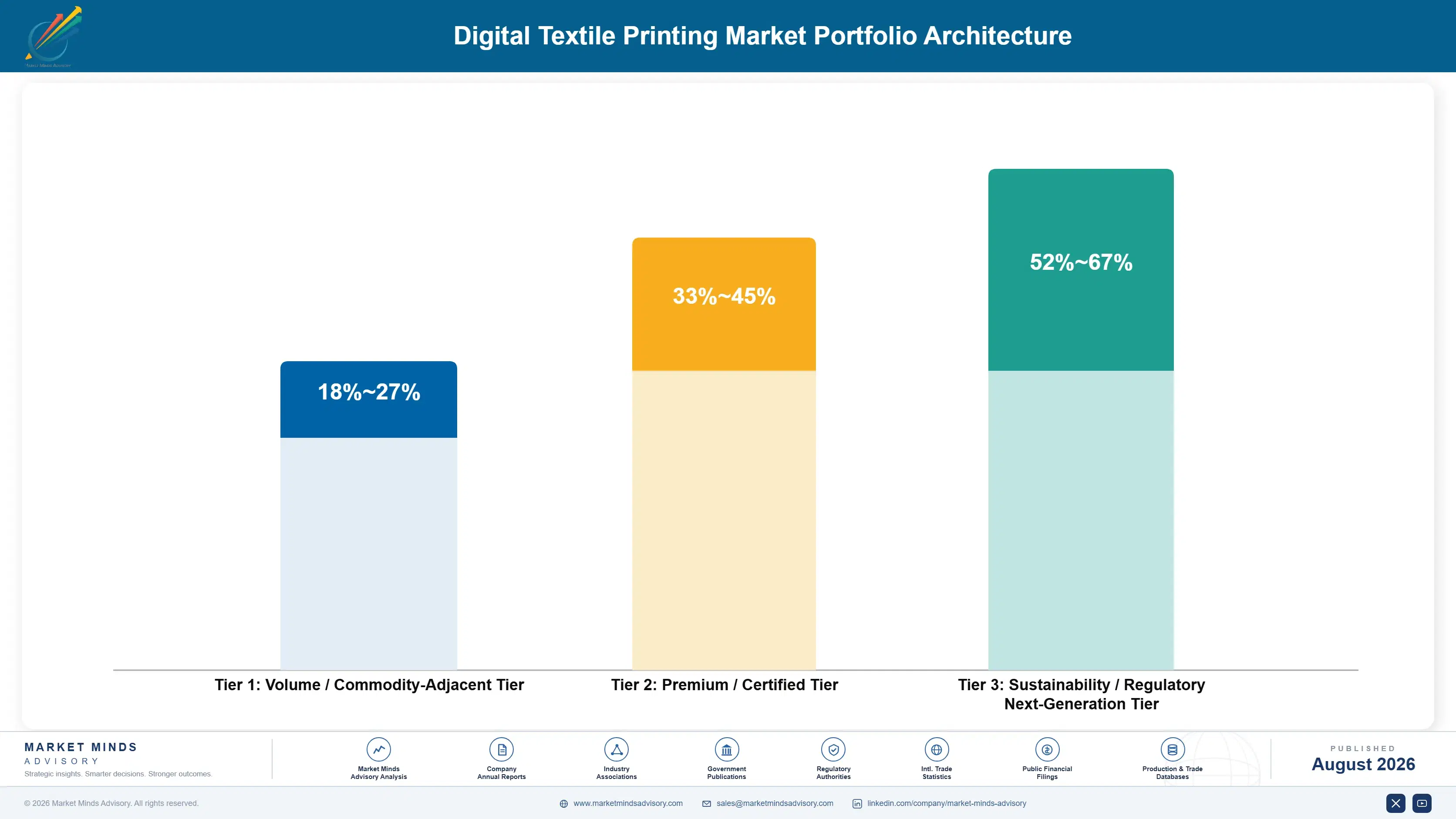
Three tiers describe this business and the margin spread is unusually wide because consumables and hardware behave so differently. Entry scanning printers and garment machines sold into a fragmented buyer base sit at the bottom, where Chinese builders set the price and differentiation is thin. Production-class single-pass systems with qualified process integration sit considerably higher. And inks, pretreatment chemistry, and printhead spares occupy a third tier at the best margin of all.
The tension is that hardware placements create the consumable stream and cannot be sacrificed to protect reported hardware margin. A vendor that stops winning installations watches ink revenue decline across the following machine generation, and ink is 61% of the business. Several builders ceded the mid-tier to Chinese competitors and discovered the consequence in consumables two or three years later. The lag between cause and effect is what makes it dangerous.

High-value pools concentrate where the vendor controls a qualified system rather than a component. Integrated pigment ink, pretreatment, and printhead packages hold pricing that any of the three sold separately would not. Qualification is the barrier, and it is commercial rather than technical, which makes it defensible for longer.

Volume / Commodity-Adjacent Tier

Entry scanning printers, direct-to-garment machines, and direct-to-film systems sold into a fragmented buyer base. Thin hardware margin under Chinese price competition, but each placement seeds consumable demand across the machine's working life.
Gross Margin: 18-27%

Premium / Certified Tier

Production-class single-pass systems with qualified ink and process integration, sold to mills converting at scale. Margin reflects throughput engineering, printhead array reliability, and the process qualification work that lower-cost builders do not supply.
Gross Margin: 33-45%

Sustainability / Regulatory / Next-Generation Tier

Pigment inks, pretreatment chemistry, printhead spares, and qualified low-discharge process packages. Best margin in the business, contributing 61% of supplier revenue and defended by warranty architecture rather than by any technical barrier.
Gross Margin: 52-67%
digital-textile-printing-market-portfolio-architecture-1787298953028

High-value Sub-segments and Strategic Watch-out

Pigment Ink And Pretreatment Systems

Best margin and fastest growth at 15.3%, defended by printhead warranty architecture rather than by patents. Third-party ink houses attack this constantly, and vendors who left the architecture open lost 30 to 40% of consumable revenue within three years. Warranty terms rather than patents hold this position.
Gross Margin: 52-67%

Production Single-Pass Systems

Strong margin earned on throughput engineering and on process qualification work, growing steadily as mills convert under discharge pressure across the major Asian textile districts. Chinese builders reaching production-class capability at considerably lower prices are now compressing this tier faster than most vendors ever modelled.
Gross Margin: 33-45%

Garment And Film Printing Systems

The volume core in unit terms though small in value per installation, serving print-on-demand platforms and decorators rather than mills. Ceding it to protect hardware margin costs consumable revenue two or three years later, which several builders learned expensively. Ink consumption per installation is high despite small hardware value.
Gross Margin: 18-27%

Reactive Ink Systems For Cellulosics

The strategic watch-out, holding the largest substrate category today and directly exposed if pigment binders reach hand-feel parity on cotton and viscose. Reactive also carries the wash and steam stages that discharge regulation is progressively making harder to permit. Discharge permitting is making those stages progressively harder.
Gross Margin: 44-56%

How the Consumable Stream Behaves

The machine sells once and the ink sells for a decade, which makes installed base the only metric that predicts anything about future revenue. A production line consumes ink continuously in proportion to its utilisation, and consumption is measurable, forecastable, and protected by warranty architecture rather than by contract. What breaks the annuity is not a competitor's machine but a third-party ink house qualifying against the installed head. Vendors track that far more anxiously than they t
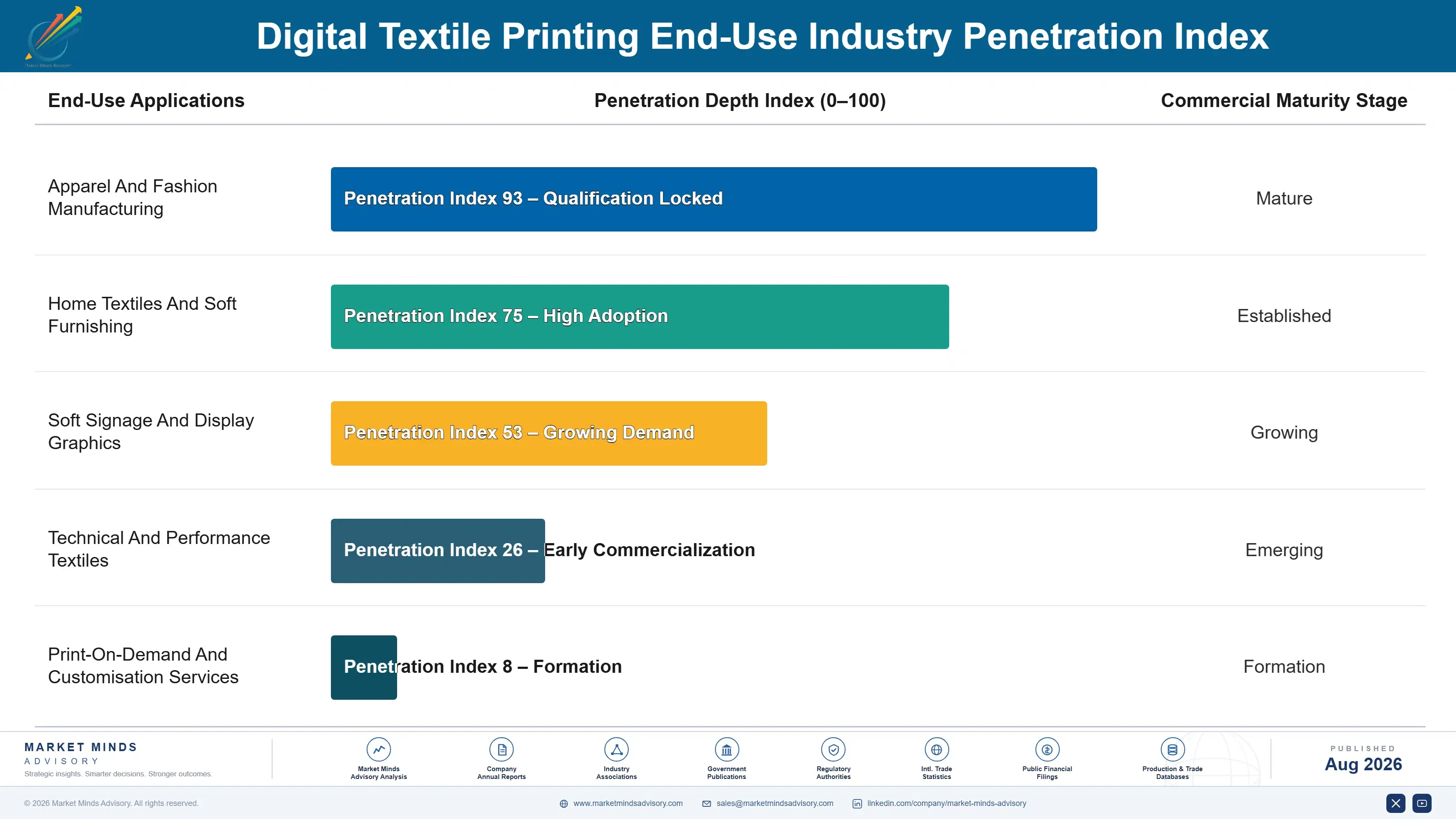
Depth of adoption varies enormously by customer type. Large integrated mills converting under discharge pressure buy production systems and consume ink at high volume with predictable utilisation. Commission printers serving multiple brands need chemistry flexibility across substrates and run lower utilisation. Print-on-demand platforms consume very high ink volume across many small machines. Sampling departments in vertically integrated apparel groups buy scanning printers and barely consume anything at all.

Buyer profiles are shifting as environmental compliance functions gain influence over equipment specification. The person approving a printer increasingly reports into sustainability or regulatory affairs rather than into production engineering. Equipment specifications now arrive with water figures attached routinely, and production engineering signs them off afterwards.
digital-textile-printing-market-end-use-penetration-index-1787298953519

What We Would Tell a Board

These are among the four positions where our research anticipates prominent divergence between winners and laggards over the coming forecast period. Each is grounded in the demand model, the regulatory perimeter, and the announced capacity pipeline.
01 / CONSUMABLE ARCHITECTURE DESIGN

Ink lock-in is the product decision that matters most

Ink contributes 61% of supplier revenue across a machine life, so the architecture governing which ink a machine will accept is worth far more than any hardware specification on the datasheet. Printhead warranty conditioned on approved ink and filtration is defensible on genuine technical grounds, because pigment particle size really does destroy heads. Vendors who left that architecture open have watched consumable revenue on their installed machines fall by 30 to 40% within three years of placement, with third-party ink qualified against their own heads.
02 / COMPLIANCE SALES POSITIONING

Mills buy discharge permits, not colour gamut

Digital print quality passed rotary screen years ago and mills kept buying screen regardless, because quality was never the constraint they were managing. What moves an Asian mill owner is a common effluent treatment plant at capacity and a discharge permit that cannot be obtained, against a pigment line that removes 14 litres of water per metre. Vendors who rebuilt their proposals around local permit conditions and discharge figures report far shorter sales cycles than those still presenting colour gamut comparisons.
03 / BINDER DEVELOPMENT PRIORITY

Hand-feel on cotton is the largest prize available

Cellulosics are the biggest printed substrate category anywhere, and pigment binders stiffen fine cotton, viscose, and lyocell enough that premium apparel buyers simply reject the finished fabric. Solving that binder problem opens roughly 40% of cellulosic volume to the fastest-growing chemistry in this market, which no conceivable hardware improvement comes close to matching in value. Whichever ink house reaches genuine parity on both hand-feel and wash fastness first will define the chemistry mix across this industry for the following decade.
04 / CAPITAL BARRIER REMOVAL

Finance the hardware; the ink pays for it anyway

A production installation costs well over a million dollars against payback of about 31 months, and Asian mill balance sheets rather than mill conviction are what most often stop conversion happening. Financing hardware at minimal margin against contracted multi-year ink volume turns a capital decision the mill cannot make into an operating one it can, and vendor economics improve because ink is where the profit sits. Competitors demanding full capital payment upfront are losing installations to nothing more substantial than a financing gap.

Engagement Snapshot From the Field

A live engagement with an industry participant carrying material or product regulatory and market exposure ahead of a defining policy shift, showing how our research translates into a defensible multi-year portfolio strategy.
MARKET MINDS ADVISORY · CLIENT ENGAGEMENT SUMMARY
Digital Textile Printing Producer Strategic Portfolio Review and Transition Roadmap 2026·Investment Scenario on Digital Textile Printing Exposure Evaluation 2025-26
CLIENT PROFILE
A European digital textile printing system builder with approximately 280 million dollars in annual revenue (client-reported, unverified by MMA), supplying scanning and single-pass machines to mills and commission printers across Asia and Europe. The company sourced printheads externally, sold machines outright at full capital price, permitted third-party inks without restriction, and led every proposal with colour gamut and registration accuracy comparisons.
STRATEGIC CHALLENGE
Hardware placements had grown steadily while consumable revenue per installed machine declined for four consecutive years, and management could not explain the divergence. Sales cycles in India and Bangladesh were running far longer than competitors reported. The board wanted an independent view before approving a further hardware development programme. Nobody had connected the two observations.
MMA APPROACH
We reconstructed consumable revenue per installation by cohort against ink policy, benchmarked sales cycle length and win rates against vendors leading with discharge positioning, and modelled financed placement economics across contracted ink offtake scenarios. Mill owner interviews across four countries tested what actually drove their conversion decisions and in what order.
KEY FINDINGS
  1. Consumable revenue on machines older than three years ran roughly 38% below vendors operating warranty-linked ink architecture, with third-party ink qualified on most installations.
  2. Not one of the fourteen mill owners interviewed cited print quality as a factor in their conversion decision, while eleven cited discharge permitting or brand customer water requirements first.
  3. Sales cycles in India averaged nearly twice those of a competitor selling financed placements, and capital approval rather than technical evaluation accounted for the entire difference.
  4. External printhead supply had constrained two separate product launches, and the supplier concerned competes directly with the client in single-pass production systems.
CLIENT PROFILE
A European digital textile printing system builder with approximately 280 million dollars in annual revenue (client-reported, unverified by MMA), supplying scanning and single-pass machines to mills and commission printers across Asia and Europe. The company sourced printheads externally, sold machines outright at full capital price, permitted third-party inks without restriction, and led every proposal with colour gamut and registration accuracy comparisons.
STRATEGIC CHALLENGE
Hardware placements had grown steadily while consumable revenue per installed machine declined for four consecutive years, and management could not explain the divergence. Sales cycles in India and Bangladesh were running far longer than competitors reported. The board wanted an independent view before approving a further hardware development programme. Nobody had connected the two observations.
MMA APPROACH
We reconstructed consumable revenue per installation by cohort against ink policy, benchmarked sales cycle length and win rates against vendors leading with discharge positioning, and modelled financed placement economics across contracted ink offtake scenarios. Mill owner interviews across four countries tested what actually drove their conversion decisions and in what order.
KEY FINDINGS
  1. Consumable revenue on machines older than three years ran roughly 38% below vendors operating warranty-linked ink architecture, with third-party ink qualified on most installations.
  2. Not one of the fourteen mill owners interviewed cited print quality as a factor in their conversion decision, while eleven cited discharge permitting or brand customer water requirements first.
  3. Sales cycles in India averaged nearly twice those of a competitor selling financed placements, and capital approval rather than technical evaluation accounted for the entire difference.
  4. External printhead supply had constrained two separate product launches, and the supplier concerned competes directly with the client in single-pass production systems.
RECOMMENDED STRATEGY
Phase 1: Phase 1 (months one to six): introduce warranty-linked ink and filtration architecture on new machines, and rebuild proposals around discharge and permit economics. Phase 2: Phase 2 (months six to eighteen): launch financed placement offering in India and Bangladesh against contracted multi-year ink offtake commitments. Phase 3: Phase 3 (months eighteen to thirty-six): qualify a second printhead platform and evaluate in-house pigment dispersion capability at commercial scale.
OUTCOME
The client implemented warranty-linked ink architecture and rebuilt its Asian sales approach around discharge economics. Sales cycle length in India shortened materially within three quarters and consumable revenue per new installation rose well above the prior cohort average (client-reported, unverified by MMA), with second printhead qualification now underway.

Frequently Asked Questions

Foundational context covering the market sizes, CAGR, scope, country, region and competition that inform every finding below. This section is provided to cover basics and most often pre-purchase conversations, answered from the MMA Primary Research Dataset.

What is the current size of the Digital Textile Printing Market?

The market is valued at USD 3.4 billion in 2025, rising to USD 3.75 billion in 2026. Only about seven percent of printed textile metres worldwide are produced digitally.

How large will the Digital Textile Printing Market be by 2036?

MMA forecasts USD 9.90 billion by 2036, an increase of USD 6.15 billion over the 2026 base. That represents an expansion multiple of 2.64 times.

What is the CAGR for the Digital Textile Printing Market 2026 to 2036?

The base case CAGR is 10.2%, with a bull case of 11.4% and a bear case of 8.9%. The historical rate from 2020 to 2025 was also 8.9%.

Which segment is growing fastest?

Pigment direct-to-fabric systems at 15.3%, exactly 1.50 times the market rate. Pigment cures with heat and removes the steaming and washing stages entirely, saving roughly 14 litres per metre.

Who are the major companies in the Digital Textile Printing Market?

Epson, Kornit Digital, EFI Reggiani, Konica Minolta, and Dover lead on annual installed system value, together holding 43% of the market. Japanese and Italian builders dominate mill-scale placements.

Which country is growing fastest?

India at 14.6%, driven by common effluent treatment plants running at capacity across printing clusters and new discharge connections being difficult to obtain. Conversion is a permitting decision there.

Report Segmentation Architecture

The full report scope spans multiple orthogonal segmentation dimensions, with cross-tabulated demand data provided for each dimension pair. Coverage extends further to regional breakdowns, trend trajectories, and the competitive detail needed to support segment-level decision-making.

By Print System

  • Pigment Direct-To-Fabric Systems
  • Direct-To-Garment And Direct-To-Film Systems
  • Disperse Direct-To-Polyester Systems
  • Acid Ink Systems For Protein Fibres
  • Dye-Sublimation Transfer Systems
  • Reactive Ink Systems For Cellulosics

By End-Use Industry

  • Apparel And Fashion Manufacturing
  • Home Textiles And Soft Furnishing
  • Soft Signage And Display Graphics
  • Technical And Performance Textiles
  • Print-On-Demand And Customisation Services

By Commercial Model

  • Outright System Sale With Open Consumables
  • Placement Against Contracted Ink Offtake
  • Financed And Leased Equipment Supply
  • Consumables And Spares Supply Only

By Region

  • East Asia
  • South Asia and Pacific
  • North America
  • Western Europe
  • Latin America
  • Middle East and Africa
  • Eastern Europe

Scope, Methodology, and Coverage

Every figure in this report is reproducible from documented input assumptions. The scope below maps the historical period, the forecast horizon, the segmentation dimensions, and the countries covered, alongside the underlying primary and qualitative methodology.
Historical Period
2020 to 2025
Forecast Period
2026 to 2036
Base Year
2025 (USD billions; MMA Primary Research Dataset, August 2026)
Market Definition
This market comprises inkjet printing systems and the consumable inks used to apply designs onto textile substrates and finished garments, measured at vendor realised prices across hardware, inks, pretreatment chemistry, and printheads sold as spares. System coverage spans pigment, reactive, acid, disperse, and sublimation chemistries across scanning and single-pass architectures, including direct-to-garment and direct-to-film equipment. Rotary and flat screen printing equipment, dyeing and finishing machinery, textile manufacture itself, contract printing service revenue, and inkjet printing onto paper, plastic, or other non-textile substrates fall outside scope.
Quantitative Units
USD billions (current prices); systems installed annually; ink litres consumed per installed system
Segmentation Dimensions
By Print System; By End-Use Industry; By Commercial Model; By Region
Regions Covered
East Asia, South Asia and Pacific, North America, Western Europe, Latin America, Middle East and Africa, Eastern Europe
Countries Covered
China, Japan, South Korea, Taiwan, India, Pakistan, Bangladesh, Vietnam, Indonesia, Thailand, Italy, Spain, Germany, Portugal, Netherlands, UK, Turkey, Poland, USA, Canada, Mexico, Brazil, Colombia, Peru, Egypt, Morocco, South Africa, Ethiopia, UAE, and additional markets relevant to this sector
Key Companies Profiled
Epson, Kornit Digital, EFI Reggiani, Konica Minolta, Dover, Durst Group, Mimaki Engineering, Roland DG, Hangzhou Honghua Digital Technology, Zimmer Austria, SPGPrints, Aleph, Mutoh Industries, Brother Industries, Ricoh, HP, Sensient Technologies, Huntsman Textile Effects, DyStar, Bordeaux Digital PrintInk
Quantitative Methodology
Primary survey, n=3,800 respondents, Q4 2025, six countries; demand-side model with trade association cross-validation
Qualitative Methodology
47 expert interviews, Q4 2025; applied to validate demand model assumptions, identify emerging dynamics, and assess competitive positioning
Report Format
PDF and XLSX data workbook (Word format preview document)
Publisher
Market Minds Advisory
Report Code
MMA-2026-TEC-245
Published
August 2026
Contact
sales@marketmindsadvisory.com | www.marketmindsadvisory.com

Purchase the full Digital Textile Printing Market Report (2026 to 2036).

The full report sizes digital textile printing across six print systems, five end-use industries, four commercial models, and seven regions, with country detail for the twenty largest national markets. Hardware and consumable revenue are sized separately throughout, since ink contributes the majority of value and behaves nothing like machine sales. Installed base is tracked by system class, region, and ink policy, with consumable revenue per installation modelled by cohort age. Competitive profiling covers twenty companies on annual installed system value. Effluent regulation and permitting conditions are documented cluster by cluster across the major Asian printing districts.
Hardware and consumable revenue sized separately throughout
Installed base tracked by system class and ink policy
Consumable revenue per installation modelled by cohort age
Effluent permitting conditions documented by Asian printing cluster
Pigment hand-feel and wash fastness benchmarked across binder systems
Financed placement economics against contracted ink offtake scenarios

Built For The People Who Decide

From boardroom strategy to bench-side execution, this report is read cover-to-cover by leaders shaping the next decade of their industry, turning demand scenarios, market dynamics and valuation benchmarks into decisions.
CXOs/ Presidents/ VPs/ Managers
M&A and Corporate Development
Strategy Teams and R&D Heads
Procurement and Product Directors
Regulatory and Compliance Leaders
Investor Relations and Equity Analysts