Market Minds Advisory
Digital Substation Market

Digital Substation Market: Copper Wiring Gives Way to a Software Layer

A commercial reading of digital substations, where process bus adoption strips out copper wiring utilities relied on for a century, renewable integration demands faster protection response, and cybersecurity mandates now shape procurement decisions.

Lead Analyst

David Horsley

Published

September 2026

Make Smarter Decisions with Customized Research Insights

Request a free sample report and evaluate market opportunities, growth trends, and competitive dynamics relevant to your business needs.

2025 MARKET VALUE$4.6BMarket Size 2025
2036 FORECAST VALUE$13.8BBase Case , 2026 to 2036
CAGR 2026 TO 203610.5 %Bull 11.8% / Bear 9.2%
INCREMENTAL OPPORTUNITY$8.7BNet 10- year value creation
EXPANSION MULTIPLE2.71x2036 value over 2026 base
Strategic Levers
M&A Pipeline
Regional Outlook
Country Rankings
Competitive Intelligence
Segmental Deep-dive
Call-Us : 91 93563 13602

Executive Snapshot and Market Trajectory

Utilities are finally replacing the copper wiring that has connected substation equipment for a century, and cybersecurity requirements now shape procurement decisions as much as automation performance does across nearly every major tender evaluated by utility planning committees anywhere today, regardless of vendor reputation.
The market stands at USD 4.6 billion in 2025 and reaches USD 13.8 billion by 2036 at a 10.5% CAGR. Process bus and merging units grow fastest at 14.0%, about 1.33 times the overall rate, as IEC 61850 digital communication standards mature enough for utilities to trust at scale. East Asia holds 26% of value on grid investment intensity, while South Korea posts the quickest national growth at 12.8% on state utility digitalisation programmes.
Concentration is moderate, with the top five holding roughly 55% of digital substation systems revenue against established electrical equipment manufacturers extending into automation. Two distinct forces reshape the field right now. Renewable integration is forcing faster protection and control response times that only digital systems can deliver reliably, and cybersecurity mandates are adding network security requirements that increasingly determine which vendors even qualify for utility tenders at all.
Market Definition
The digital substation market covers protection, control, automation, and communication systems built around IEC 61850 digital standards, including merging units, process bus networking, non-conventional instrument transformers, substation automation software, and substation cybersecurity systems. Conventional electromechanical substation equipment, primary power transformers and switchgear hardware, and transmission line construction are excluded.
Base Year Value
$4.6B in 2025 (MMA Primary Research Dataset, August 2026)
Forecast Period
2026 to 2036, eleven discrete annual values
CAGR
10.5% base case. Bull 11.8%. Bear 9.2%.
Fastest Growth Segment
Process Bus and Merging Units: 14.0% CAGR
Fastest Growth Country
South Korea: 12.8% CAGR
Fastest Growth Region
South Asia and Pacific: 12.6% CAGR
Largest Region
East Asia: 26% of 2025 global value
Market Leaders
Siemens Energy, Hitachi Energy, Schneider Electric, GE Vernova, Eaton. Source: MMA Analysis based on company annual reports.
Primary Survey
n=3,800 procurement and R&D decision-makers, Q4 2025, six countries
Methodology
Demand-side build-up, cross-validated against public data, 47 expert interviews

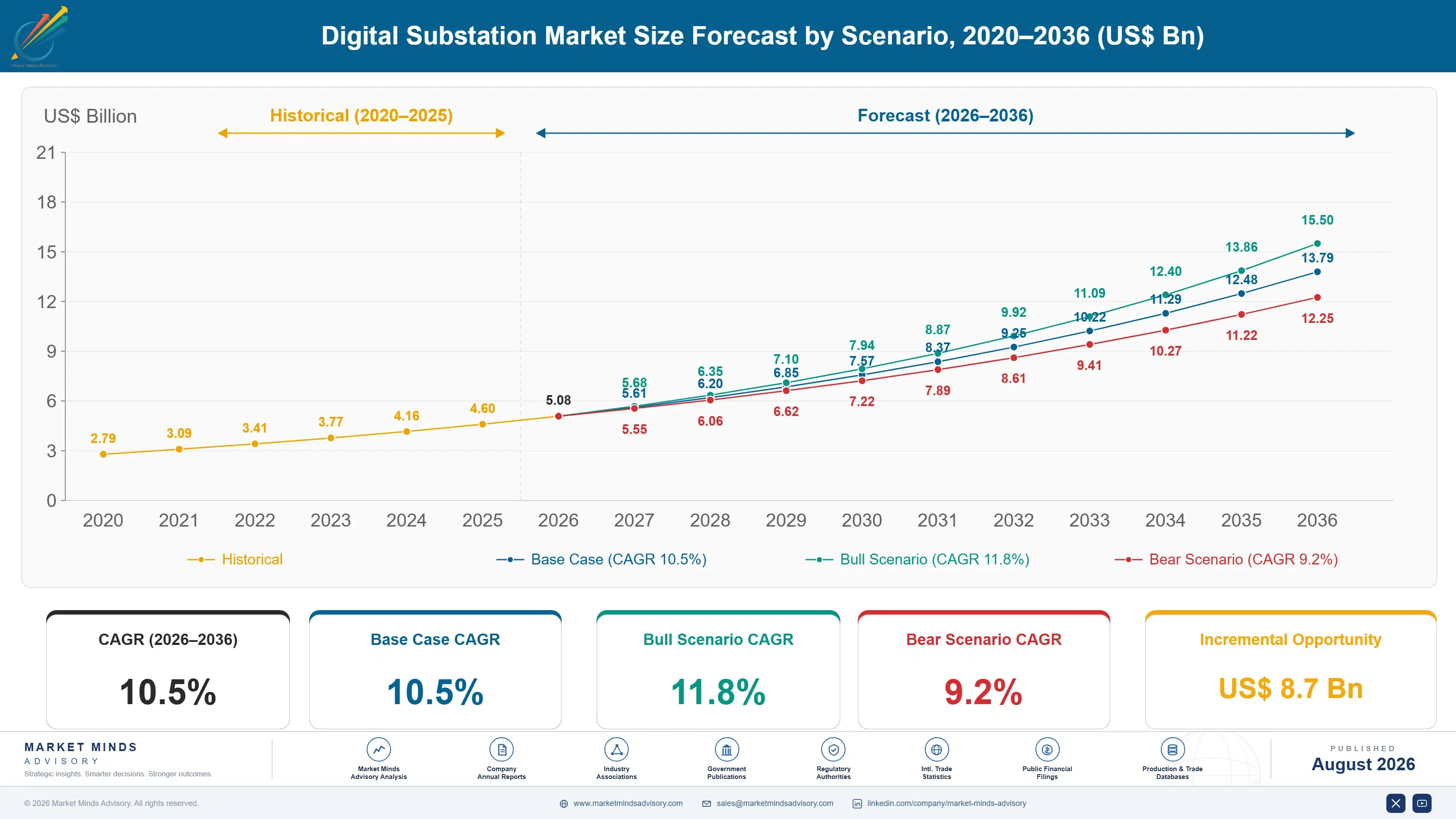
Digital Substation Market Forecast Scenarios

digital-substation-market-size-forecast-scenario-1787324172959
Growth from 2020 to 2025 compounded near 9.5%, held back early by utility caution around a still-maturing IEC 61850 standard before accelerating from 2023 onward as process bus deployments proved reliable at scale across several major reference utilities globally, building confidence utilities had previously withheld given the technology's relative novelty and the regulatory scrutiny surrounding early adoption decisions.
Three mechanisms carry the base case to 10.5%. First, grid modernisation programmes funding digital substation retrofits across ageing transmission and distribution infrastructure in developed markets specifically. Second, renewable integration, which requires protection and control response times only digital systems can reliably deliver at the speed variable generation demands today. Third, cybersecurity mandates, which increasingly require network security capability that conventional electromechanical substations were never designed to support at all previously.
The bull case at 11.8% assumes IEC 61850 process bus adoption accelerates faster than current utility procurement cycles suggest and renewable integration targets tighten further across major grids worldwide. The bear case at 9.2% assumes utility capital budgets tighten under rate case pressure and interoperability gaps between vendor implementations continue slowing multi-vendor deployment across mixed-equipment substations considerably.

Why the Substation Is Becoming a Software Product

Three forces set demand. Grid modernisation provides the steadiest layer, as ageing transmission and distribution infrastructure in developed markets reaches the age where digital replacement competes directly against like-for-like electromechanical renewal. Renewable integration adds a second layer, since variable generation requires protection response times conventional systems cannot reliably deliver at the speed modern grids increasingly demand. Cybersecurity regulation adds a third layer e
MARKET CONCENTRATIONCR5: 55%Moderately consolidated among established global electrical equipment manufacturers today
TYPICAL RETROFIT COSTUSD 2 million to 15 millionVaries considerably by substation voltage class and scope
TOP DEPLOYING REGIONEast Asia: 26% of global valueReflects sustained state utility grid investment programmes underway
COPPER WIRING REDUCTION60 to 80% less cablingProcess bus architecture replaces hardwired copper connections entirely
PROTECTION RESPONSE TIMEUnder 4 milliseconds typicalMeaningfully faster than conventional electromechanical protection systems allow
CYBERSECURITY BUDGET SHARE12 to 20% of project costRising steadily as regulatory security mandates tighten further
The commercial character rewards standards compliance and interoperability credibility over raw feature count. A vendor whose IEC 61850 implementation interoperates cleanly with a utility's existing multi-vendor equipment wins tenders that a technically superior but poorly interoperable competitor loses regardless of price. Utilities also increasingly evaluate cybersecurity architecture as carefully as automation functionality, since a compromised substation carries consequences well beyond the cost of the equipment itself.
The next decade turns on two things. Whether interoperability between vendor IEC 61850 implementations improves enough that utilities can mix equipment freely across a single substation without integration risk. And whether cybersecurity requirements standardise across jurisdictions or continue fragmenting into region-specific mandates that raise compliance cost for vendors selling internationally.
"Everyone talks about digital substations as an automation story, and the utilities buying them increasingly talk about them as a cybersecurity story. The protection relay used to be the product. Now the product is whether that relay can be trusted on a network a nation-state actor might probe."
Director, Grid Infrastructure and Energy Technology Practice · MMA Energy / Grid

Market Trends

IEC 61850 Process Bus Adoption Eliminates Copper Wiring

Process bus architecture replaces the hardwired copper connections between field equipment and control systems that utilities have relied on for a century, cutting cabling requirements by sixty to eighty percent while enabling faster protection and control configurations. This matters commercially because copper wiring installation represents a substantial share of traditional substation construction cost, and eliminating it changes project economics meaningfully in favour of digital architecture. Siemens Energy and Hitachi Energy have both reported accelerating process bus order volume across recent periods. Utilities increasingly specify process bus by default on new construction, reserving conventional wiring for retrofits.
Market Impact: Grid programmes fund 30% share
Cybersecurity Mandates Add Network Security as Standard Specification

Regulatory cybersecurity requirements, including North American reliability standards and European network security directives, now require substation automation systems to meet security specifications that add twelve to twenty percent to typical project cost, a requirement that barely existed as a formal specification category a decade ago. This shift has turned cybersecurity architecture into a genuine competitive differentiator rather than an afterthought bolted onto automation systems after the fact. Vendors without credible security certification increasingly fail utility tender qualification regardless of automation feature quality otherwise offered. Cybersecurity capability now determines vendor shortlisting as much as protection performance ever did.
Market Impact: Response times fall under 4 millise

Market Opportunities and Growth Drivers

Grid Modernisation Programmes Fund Digital Substation Retrofits

National grid modernisation programmes, including infrastructure legislation in the United States and coordinated grid investment plans across the European Union, are funding substation replacement at a pace that pulls forward digital adoption well ahead of what organic asset ageing alone would generate. Utilities increasingly specify digital architecture by default when replacement capital is available, rather than defaulting to like-for-like electromechanical renewal as earlier cycles typically did. This funding also de-risks the capital premium digital systems carry over conventional equipment, since budgets specifically anticipate that cost. Siemens Energy and Schneider Electric have both disclosed substantial order backlogs tied to these programmes.
Market Impact: Retrofits cost USD 2 to 15M

Renewable Integration Requires Faster Protection Response

Variable renewable generation introduces power quality and fault current characteristics that conventional electromechanical protection systems struggle to manage reliably, since response times measured in tens of milliseconds are no longer fast enough for grids carrying substantial wind and solar penetration. Digital protection systems respond in under four milliseconds typically, fast enough to isolate faults before they cascade across increasingly interconnected renewable-heavy grid segments. Grid operators in regions with high renewable penetration, including parts of Europe and Australia, have moved fastest on this driver. This is a necessity rather than a discretionary upgrade wherever renewable penetration crosses a meaningful threshold.
Market Impact: Integration adds 15% to project cos

Market Restraints and Challenges

High Retrofit Cost and Budget Cycles Slow Adoption

Digital substation retrofits cost USD 2 million to 15 million depending on voltage class and scope, a capital commitment that competes against every other grid investment priority within constrained utility rate case budgets. The root cause is that utility capital allocation runs through regulatory approval cycles that can take years, and digital upgrades must justify themselves against reliability metrics regulators recognise rather than against superior but harder-to-quantify capability. Commercially this slows adoption regardless of demonstrated performance advantages in reference installations. Vendors respond with phased upgrade paths and financing structures reducing upfront burden.
Market Impact: Cabling requirements fall 60% to 80

Interoperability Gaps Between Vendor Implementations Persist

Different vendors interpret IEC 61850 standard specifications with enough variation that mixed-vendor substations frequently require additional integration engineering utilities did not originally budget for during planning. The root cause is that the standard permits implementation flexibility vendors have used to differentiate products, which works against the interoperability the standard was designed to guarantee across the industry. Commercially this raises integration cost and project risk on multi-vendor deployments, discouraging some utilities from mixing suppliers even where doing so would reduce cost. Working groups are developing stricter conformance testing requirements ahead of major tenders.
Market Impact: Security adds 12% to 20%
3 additional market trends, 4 additional growth drivers, and 3 additional restraints and challenges are covered in the full report. Contact sales@marketmindsadvisory.com to access the complete intelligence.

Segment CAGR and Growth Architecture

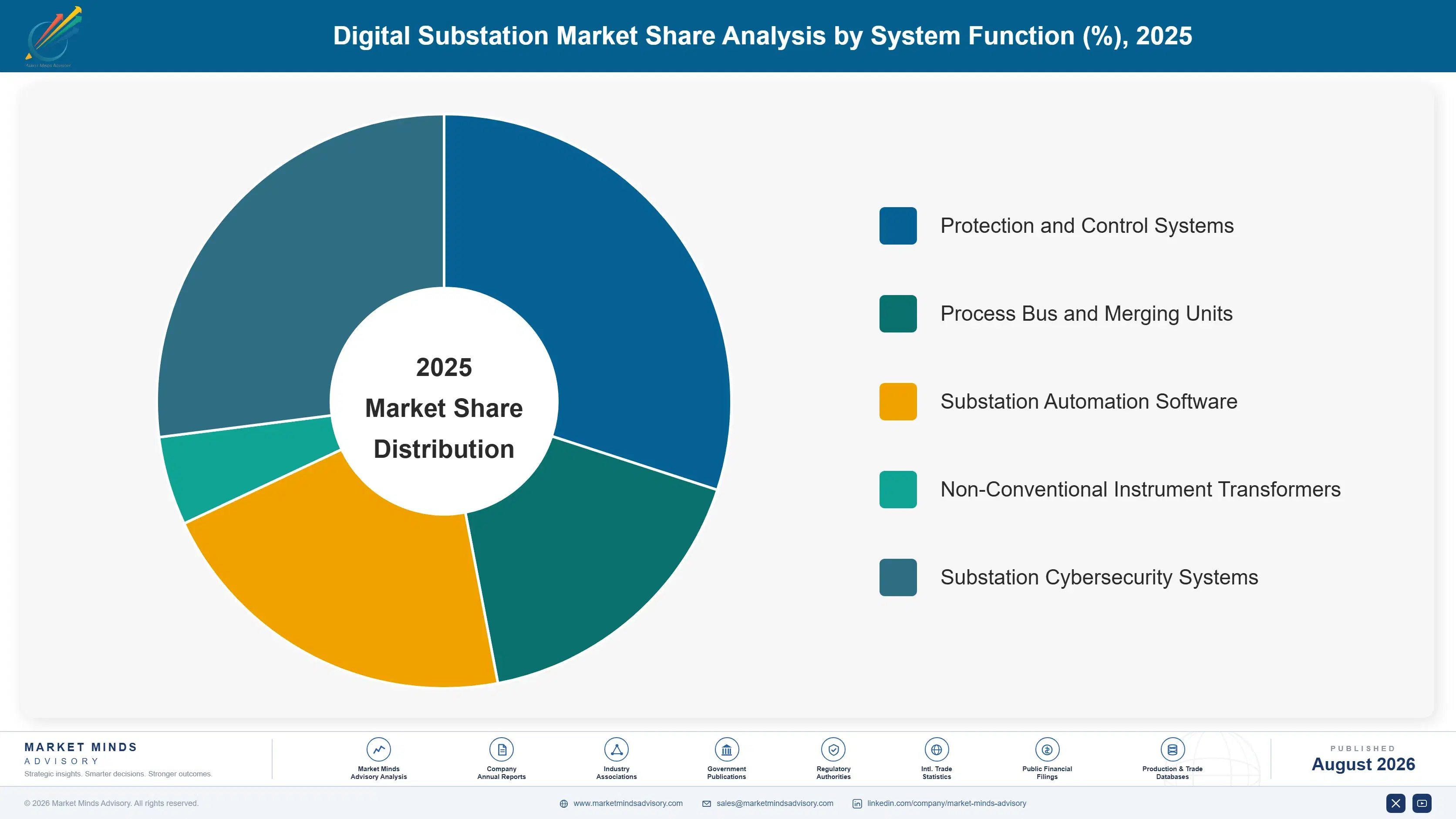
Segmentation follows system function, a single technical logic describing the specific role each component plays within a digital substation architecture rather than the voltage class it ultimately serves. Each function carries distinct technical requirements and adoption timelines, so commercial position tracks function rather than end-use voltage class, which appears separately within the framework below.
digital-substation-market-market-share-analysis-1787324173489

Process Bus and Merging Units

Process bus and merging units grow fastest at 14.0%, about 1.33 times the overall 10.5% rate, as IEC 61850-9-2 digital communication standards mature enough for utilities to trust them at scale after years of cautious pilot deployment. This is the newest widely adopted technology category within digital substations, converting analogue signals from field instrument transformers into digital data streams that eliminate the hardwired copper connections conventional substations required for a century. Siemens Energy and Hitachi Energy have both reported accelerating order volume in this category across recent periods. Adoption concentrates initially in new construction, where architects design around process bus topology from the outset, rather than in retrofits where legacy wiring complicates conversion. Reference installations have accelerated industry confidence.
CAGR 14.0%

Substation Cybersecurity Systems

Substation cybersecurity systems grow at 13.0%, the second-fastest category, as regulatory requirements including North American reliability standards and European network security directives mandate protection that conventional electromechanical substations were never designed to support at all. This category barely existed as a distinct procurement line item a decade ago and now represents twelve to twenty percent of typical project cost across new digital substation deployments specifically. Vendors without credible security certification increasingly fail utility tender qualification regardless of automation feature quality otherwise offered. Schneider Electric and Eaton have both expanded dedicated substation cybersecurity product lines considerably in response to this sustained regulatory pressure. Compliance requirements continue to fragment somewhat across different national jurisdictions, complicating vendor strategy for global equipment suppliers specifically.
CAGR 13.0%
Full segment breakdown across 5 segments available in the complete report.

Regional Architecture and Country Demand Map

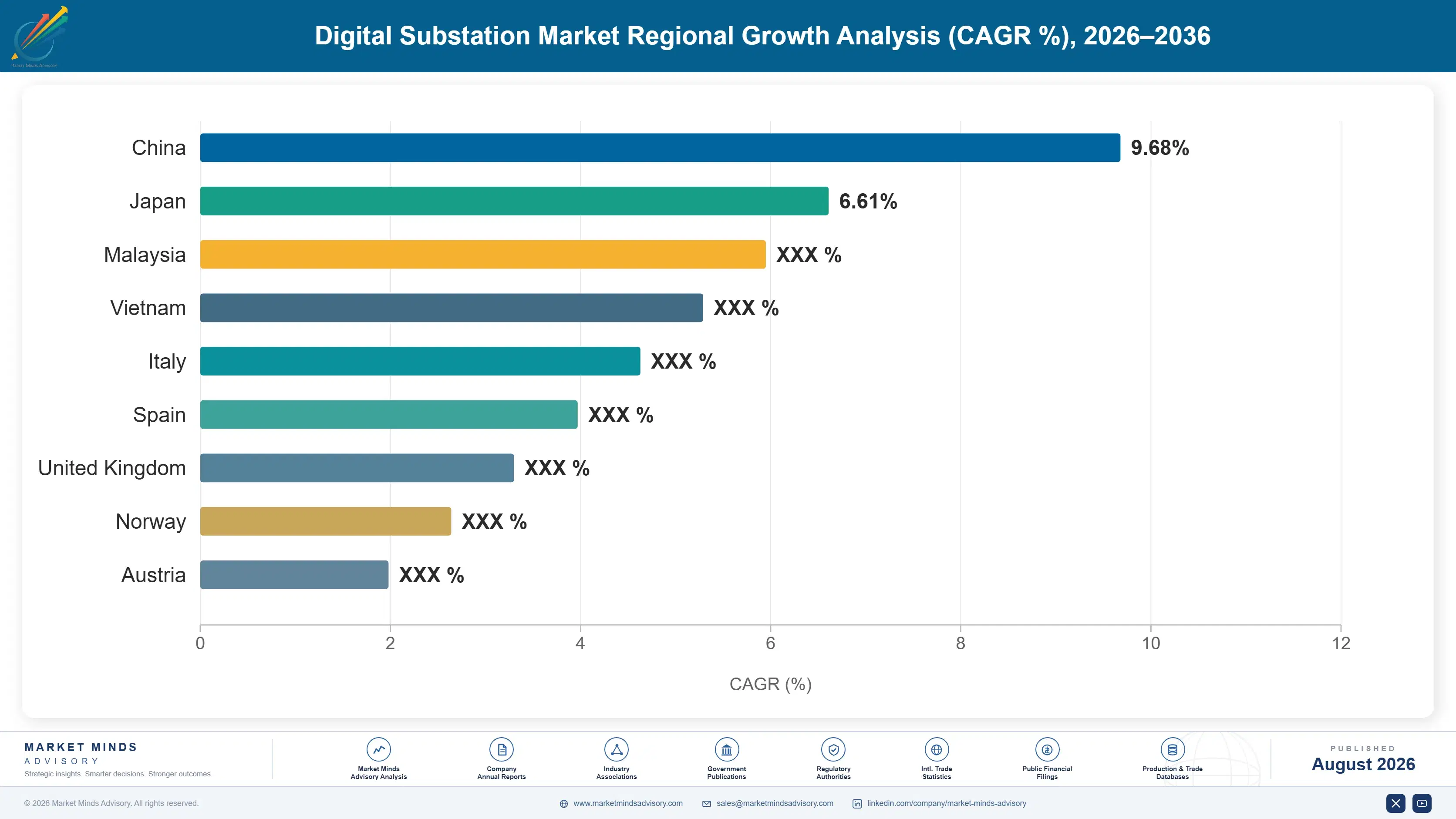
Grid investment intensity and renewable integration pace together set this distribution, since digital substation adoption tracks where utilities fund modernisation most aggressively. East Asia leads on sustained state utility investment, while South Asia and Pacific posts the fastest growth as grid modernisation programmes expand rapidly.

North America

Federal infrastructure funding anchors North American demand more directly than any other single factor. North America holds 24% of value, with grid modernisation legislation funding substation replacement at a pace that pulls forward digital adoption well ahead of organic asset ageing alone. GE Vernova and Eaton both maintain deep utility relationships supporting these funded modernisation programmes across multiple regional grid operators. Cybersecurity mandates under North American reliability standards have become a defining procurement requirement specifically shaping vendor qualification decisions. Growth of 10.2% reflects steady funded replacement alongside renewable integration driving additional protection upgrade demand. Utility rate case approval cycles remain the practical pacing constraint on deployment speed across most jurisdictions and states.
Share: 24% | CAGR: 10.2% (2026 to 2036)

Western Europe

Renewable integration intensity defines this market above any other single factor. Western Europe holds 22% of value, with German, Nordic, and British grid operators managing among the highest wind and solar penetration levels anywhere, which forces faster protection response than conventional electromechanical systems can reliably deliver. Siemens Energy and Schneider Electric both maintain particularly strong domestic positions built over decades of regional utility relationships and standards leadership. European network security directive compliance has become a defining procurement requirement shaping vendor qualification considerably. Growth of 9.0%, the slowest of the seven, reflects mature grid infrastructure and measured replacement cycles rather than weakening demand fundamentals. Cross-border grid interconnection projects continue to support steady incremental digital substation demand.
Share: 22% | CAGR: 9.0% (2026 to 2036)
Regional intelligence for 5 additional markets available in the complete report: East Asia, South Asia and Pacific, Latin America, Middle East and Africa, Eastern Europe. Contact sales@marketmindsadvisory.com.
digital-substation-market-country-cagr-analysis-1787324174004

Where Digital Substation Vendor Margin Concentrates

Competing purely on protection relay hardware price concentrates margin in exactly the segment established electrical equipment manufacturers price most aggressively worldwide across nearly every utility tender evaluated. The four moves below shift value toward positions standards leadership and security depth genuinely protect: process bus expertise, cybersecurity certification, interoperability credibility, and grid modernisation programme relationships.

Build Process Bus Expertise Ahead of Standardisation

Process bus and merging units grow at 14.0% against a 10.5% overall market as IEC 61850-9-2 standards mature enough for utilities to trust them at scale after years of cautious pilot deployment across reference installations worldwide. Vendors with proven process bus reference installations win new construction tenders that architects increasingly design around from the outset rather than retrofit afterward. Building this expertise requires sustained investment in reference project execution, favouring vendors willing to accept early-stage project risk over those waiting for the technology to fully mature before committing engineering resources at scale.
Market Impact: Process bus segment grows at 14.0%

Achieve Cybersecurity Certification Before It Becomes Mandatory

Cybersecurity requirements now add 12% to 20% to typical project cost and increasingly determine vendor tender qualification regardless of automation feature quality otherwise offered by competing suppliers in the same bid entirely and completely today already. Vendors achieving credible security certification ahead of regulatory deadlines capture tender shortlisting that competitors scrambling to comply later miss entirely during that transition window specifically. This requires sustained security engineering investment that smaller vendors sometimes cannot justify economically, which favours larger, better-resourced manufacturers with dedicated security development teams already firmly established in place today.
Market Impact: Security spend reaches 20% of total

Invest in Interoperability and Conformance Testing

Interoperability gaps between vendor IEC 61850 implementations raise integration cost by roughly 15 percent on multi-vendor deployments, discouraging some utilities from mixing suppliers even where doing so would otherwise reduce total project cost meaningfully across the entire programme. Vendors investing in rigorous conformance testing and genuine multi-vendor interoperability capture utility trust that poorly interoperable competitors cannot match regardless of individual product performance claims made during evaluation. This investment compounds over time as interoperability reputation becomes a genuine differentiator utilities specifically reference during vendor evaluation processes and renewal decisions made later.
Market Impact: Integration cost falls by roughly 1

Deepen Grid Modernisation Programme Ties Now

National grid modernisation programmes fund roughly 30 percent of new digital substation builds, pulling forward adoption well ahead of what organic asset ageing alone would generate across most developed grid markets specifically and consistently over time and cycles. Vendors building direct relationships with programme administrators and utility planning departments capture more predictable order pipeline than those relying on individual project bidding without that broader context or visibility at all. This relationship depth increasingly determines which vendors receive early visibility into upcoming programme-funded tenders before they reach open competitive bidding rounds.
Market Impact: Grid programmes fund 30% of all new

Who Controls the Margin Pool

Concentration is moderate: the top five hold roughly 55% of digital substation systems revenue, with established electrical equipment manufacturers extending automation capability alongside specialised protection relay competitors. The gap between leaders and challengers is standards leadership and cybersecurity certification depth rather than raw hardware capability, which is fairly widely available across credible competitors. All participants here are assessed on global digital substation sys
Competition runs along four lines. First, IEC 61850 process bus reference installation depth, increasingly the strongest signal utilities evaluate. Second, cybersecurity certification and network security architecture credibility. Third, interoperability and conformance testing rigor across multi-vendor deployments specifically. Fourth, grid modernisation programme relationships that provide early visibility into funded tender pipelines.

Pressure is building from two directions. Chinese manufacturers including NARI Technology and Beijing Sifang Automation have built genuine technical capability and increasingly compete internationally beyond their domestic state grid relationships. Meanwhile specialised protection relay competitors including SEL are capturing share in cybersecurity-sensitive segments where deep technical credibility matters more than broad automation portfolio breadth. Rankings should favour vendors combining process bus depth with credible cybersecurity certification over those competing on legacy hardware reputation alone.
digital-substation-market-company-positioning-matrix-1787324174524

Competitive Moat and Risk Dimensions

SIEMENS ENERGY

Moat: Standards leadership and reference base

Siemens Energy holds deep involvement in IEC 61850 standards development itself, giving it credibility and technical foresight that vendors merely implementing the standard cannot easily replicate. Its extensive process bus reference installation base across major utilities globally provides proof points competitors without comparable deployment history lack entirely. Broad automation and grid technology portfolio supports cross-selling into related transmission infrastructure projects.
SIEMENS ENERGY

Risk: Broad portfolio complexity and cost

Siemens Energy's broad technology portfolio spanning far beyond digital substations means capital and management attention compete across many priorities simultaneously, not all tied to grid automation specifically. Chinese manufacturers are closing the technical capability gap while offering meaningfully lower pricing on comparable functionality. Cybersecurity certification requirements vary considerably across jurisdictions, adding compliance complexity a more geographically focused competitor might avoid.
HITACHI ENERGY

Moat: Grid technology depth and heritage

Hitachi Energy inherited deep grid automation technology and utility relationships from the former ABB Power Grids business, providing decades of protection engineering credibility few competitors can match. Its parent's broader digital and industrial technology capability supports genuine cross-technology innovation in data analytics and predictive maintenance. Strong presence across developed and emerging grid markets provides diversified revenue exposure.
HITACHI ENERGY

Risk: Integration and brand transition risk

The relatively recent transition from ABB Power Grids branding has required sustained investment in market communication that competitors with stable branding avoid entirely. Cybersecurity certification investment must scale across an unusually broad geographic footprint given its global customer base. Chinese competitors are pricing aggressively in emerging markets where Hitachi Energy has historically held strong relationships.

Players Tracked

Prominent Players

Siemens Energy
Hitachi Energy
Schneider Electric
GE Vernova
Eaton

Other Key Players

Toshiba Energy Systems
Mitsubishi Electric
NR Electric
Efacec
ABB Electrification
SEL Inc
NARI Technology
Beijing Sifang Automation
Larsen and Toubro
Bharat Heavy Electricals
Doble Engineering
OMICRON electronics
Kalkitech
Advanced Electronics Company
TBEA Co

Recent Developments

FEBRUARY 2025

Siemens Energy completes major process bus reference installation in Germany

Siemens Energy completed a large-scale process bus digital substation installation for a German transmission operator, its largest fully digital reference project to date in the region. This was a project completion and reference installation milestone rather than any acquisition, strengthening Siemens Energy's process bus credibility considerably going forward.
Signal: Large-scale reference installations increa
SEPTEMBER 2024

Hitachi Energy signs cybersecurity technology partnership agreement

Hitachi Energy signed a technology partnership agreement with a cybersecurity software specialist to strengthen network security capability across its substation automation product line. This was a technology partnership rather than an acquisition or joint venture, extending Hitachi Energy's security capability without direct in-house development investment.
Signal: Partnering for cybersecurity capability is
MAY 2025

NARI Technology expands international sales presence beyond China

NARI Technology announced expanded international sales and support presence targeting grid modernisation tenders outside its traditional Chinese state grid customer base specifically and quite deliberately. This was a sales and market expansion initiative rather than any acquisition, extending NARI's international competitive reach directly and considerably.
Signal: Chinese digital substation manufacturers a

Semiconductors, Precision Electronics, and Software

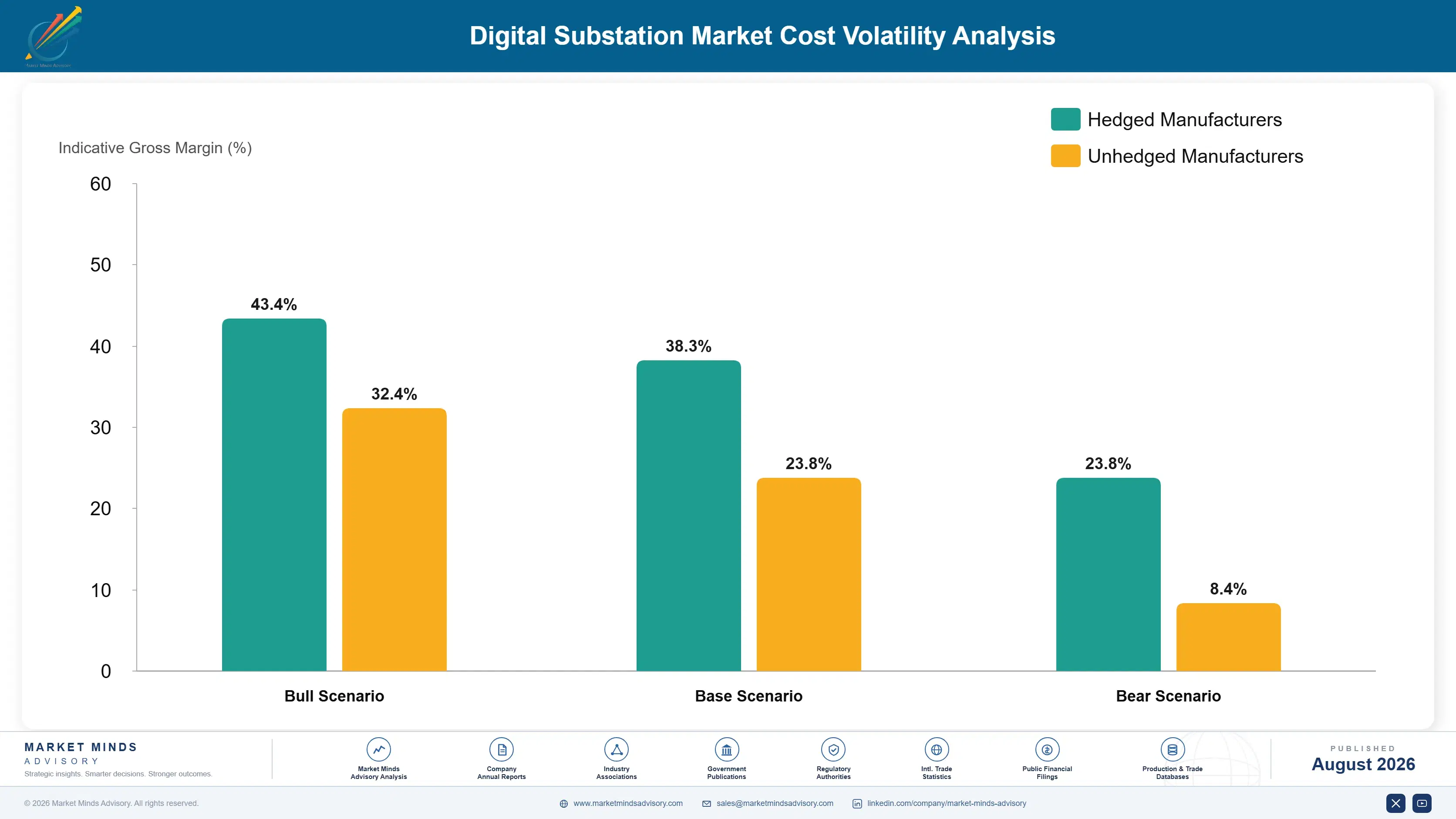
Semiconductor components and precision electronics, including processors, sensors, and communication modules, account for 45% to 58% of cost of goods sold across digital substation equipment. Software development amortised across product lines adds a further 18% to 26%, while enclosure hardware and final assembly make up the remainder. This cost structure differs meaningfully from conventional electromechanical substation equipment, where mechanical components rather than electronics dominate co
Semiconductor supply tightened considerably through 2021 and 2022 amid the broader global chip shortage, with several digital substation equipment manufacturers disclosing extended lead times on processors and communication modules specifically, according to industry component supplier disclosures covering that period. Several vendors delayed product shipments as a direct result of that component scarcity, straining utility project timelines already constrained by regulatory approval schedules. Supply has since eased, though lead times remain longer than pre-2021 norms for certain specialist components.

Exposure separates clearly by component sourcing strategy and manufacturing scale. Vendors with diversified semiconductor supplier relationships absorbed less disruption than smaller competitors dependent on single-source components during the tightest shortage periods. Larger manufacturers with broader industrial electronics businesses beyond grid automation specifically achieved better supplier allocation priority than pure-play protection relay specialists lacking comparable purchasing scale.
digital-substation-market-cost-volatility-analysis-1787324174720

Diversify semiconductor supplier relationships broadly

Single-source component dependence exposed several manufacturers to extended lead times during the 2021 and 2022 chip shortage specifically and repeatedly. Qualifying multiple semiconductor suppliers for critical components reduces this concentration risk considerably across future disruption cycles. The trade-off is additional qualification and testing cost that smaller vendors sometimes cannot justify economically at current volume.

Use Broader Industrial Electronics Purchasing Scale

Manufacturers with broader industrial electronics businesses beyond grid automation achieved better supplier allocation priority during recent shortages than pure-play specialists lacking comparable purchasing volume overall. Building or acquiring adjacent electronics purchasing scale improves component security considerably over time and across cycles. This benefit compounds as manufacturing scale grows relative to narrowly focused competitors in the category.

Invest in software capability to offset hardware pressure

Semiconductor cost pressure compresses hardware margin regardless of vendor scale, while automation and cybersecurity software capability, once developed, carries meaningfully higher margin and genuine differentiation value over time and cycles. Software investment shifts vendor economics away from pure hardware competition entirely. Vendors treating software as secondary consistently underperform those building it as a core differentiator.

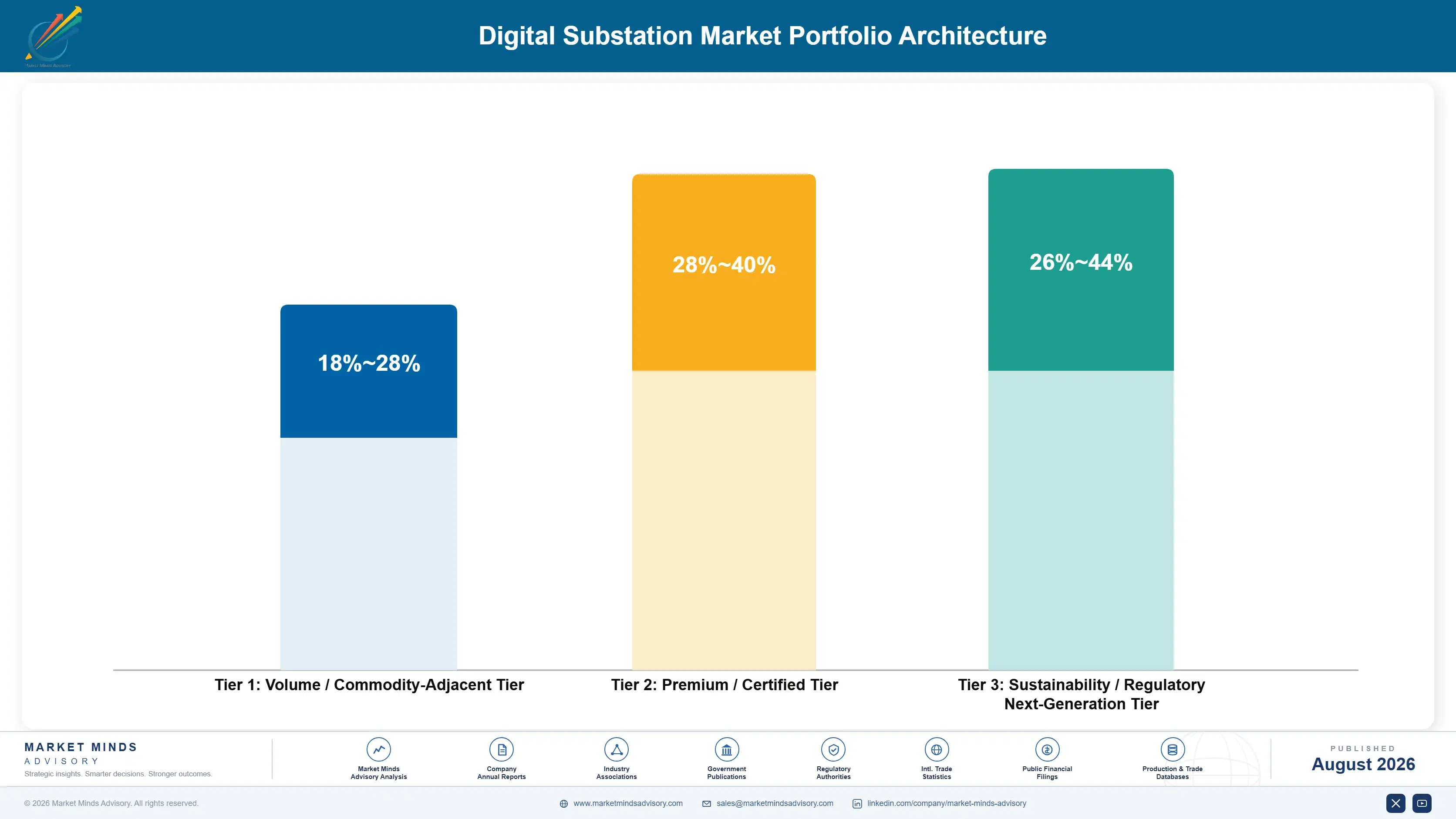
Portfolio Architecture for Margin Defence

The portfolio splits into three tiers with distinct economics. Conventional protection relays and basic automation hardware form the volume tier, competing mainly on price with margin set by component cost and manufacturing scale. Process bus systems and cybersecurity-certified automation earn considerably more since standards leadership and certification depth deter competitors lacking comparable technical investment. Grid modernisation programme-integrated solutions and interoperability-certif
The tension runs between conventional hardware revenue that funds the business today and process bus investment that positions it for the next decade. A vendor defending conventional protection relay volume too aggressively cedes the fastest-growing segments to competitors investing in process bus and security capability directly. Companies managing this well use conventional cash flow to fund standards leadership and certification investment rather than treating them as competing priorities.

High-value pools concentrate where standards leadership, certification depth, or programme relationships limit competition: process bus systems with proven reference installations, cybersecurity-certified automation meeting the strictest regulatory requirements, and grid modernisation programme-integrated solutions. Conventional protection relay hardware sold without differentiated capability sits at the other end, competing almost entirely on price against every credible global and regional manufacturer.

Volume / Commodity-Adjacent Tier

Conventional protection relays and basic substation automation hardware competing mainly on price, increasingly commoditised as manufacturing scale spreads across more global and regional competitors each year worldwide and consistently over time.
Gross Margin: 18-28%

Premium / Certified Tier

Process bus systems and cybersecurity-certified automation meeting strict regulatory requirements, supporting meaningfully stronger margin than conventional protection relay hardware production across most utility deployments and reference installations tracked currently worldwide.
Gross Margin: 28-40%

Sustainability / Regulatory / Next-Generation Tier

Grid modernisation programme-integrated solutions, interoperability-certified multi-vendor systems, and emerging artificial intelligence-based predictive maintenance and grid analytics platforms sold alongside core protection and automation hardware to utilities and grid operators worldwide.
Gross Margin: 26-44%
digital-substation-market-portfolio-architecture-1787324175222

High-value Sub-segments and Strategic Watch-out

Process Bus and Merging Units

High value and high growth at 14.0%, the fastest category in the market, driven by IEC 61850-9-2 standards maturing enough for utilities to trust at scale after years of cautious pilot deployment across reference sites worldwide. Reference credibility increasingly determines which vendors win new construction tenders outright.
Gross Margin: 28-40%

Substation Cybersecurity Systems

High value with strong growth at 13.0%, second-fastest category, driven by regulatory mandates that conventional substations were never designed to support at all previously. Vendors without credible certification increasingly fail tender qualification entirely regardless of automation feature quality otherwise offered by competing suppliers everywhere today.
Gross Margin: 28-40%

Protection and Control Systems

The volume core by revenue, growing near 9.0% as this remains the most established digital substation category across nearly every utility and grid operator deployment tracked currently worldwide today. Mature technology with well-proven reliability across most major grid operators and regulatory jurisdictions everywhere globally and consistently.
Gross Margin: 18-28%

Non-Conventional Instrument Transformers

The strategic watch-out, growing near 9.5% and constrained by utility caution around optical and digital sensing technology still viewed as less proven than conventional instrument transformers in many regulatory jurisdictions and markets currently, though confidence is gradually building steadily among grid operators worldwide each year.
Gross Margin: 18-28%

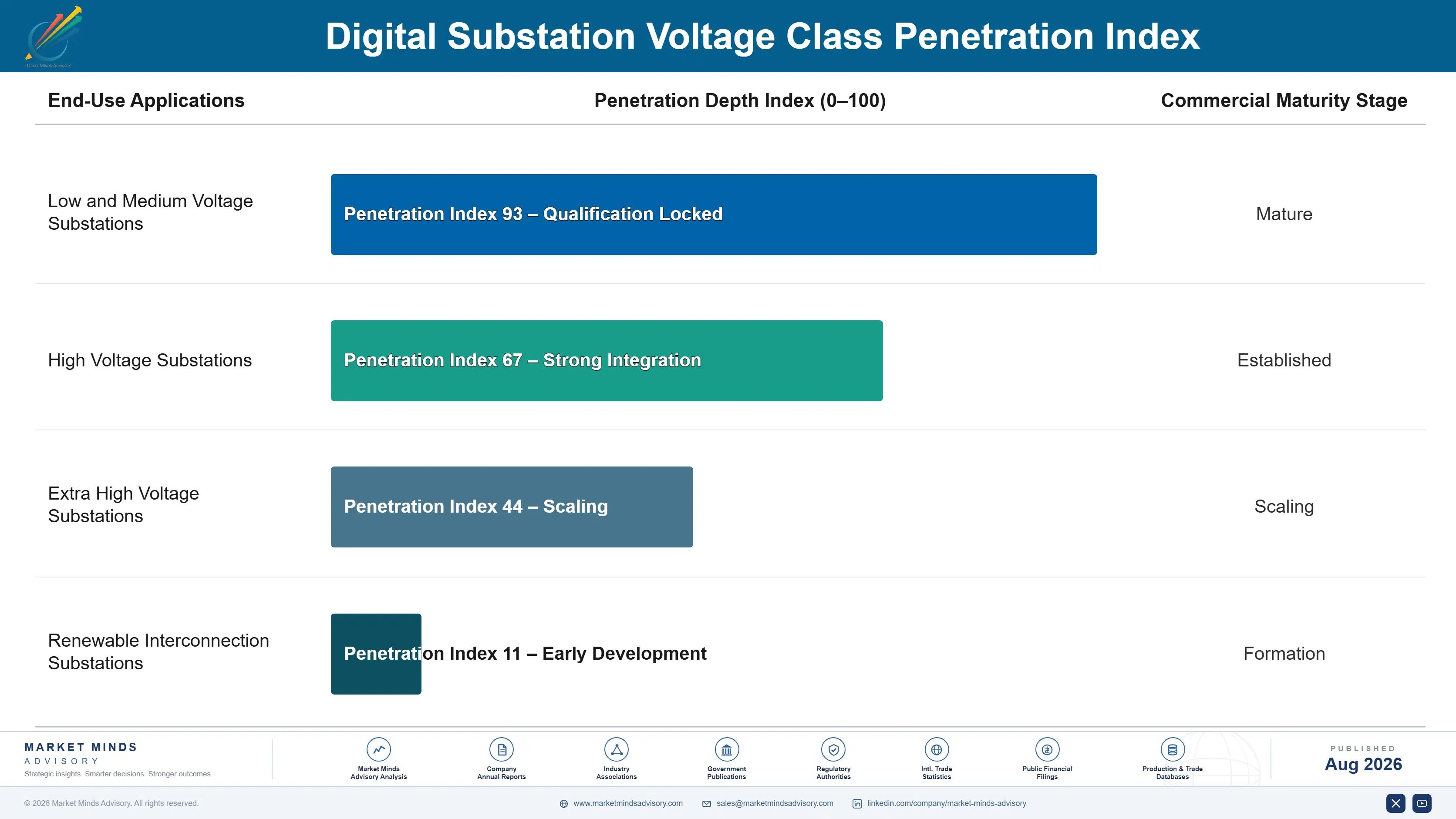
How Reference Sites Lock In Trust

Revenue depends on reference installation credibility rather than one-time equipment sales in most large utility procurement decisions, and a vendor's proven deployment at one major utility generates years of pipeline visibility beyond that project. Utilities evaluating unfamiliar vendors weigh reference depth as heavily as technical specification sheets, since a compromised substation carries consequences that dwarf the equipment cost itself. Losing a flagship reference relationship costs a ven
Adoption depth varies sharply by system function. Cybersecurity systems commit hardest, since regulatory certification and integration costs deter switching once a vendor proves reliable within a utility's existing security architecture. Process bus systems sit in the middle, with utilities increasingly loyal to whichever vendor delivered their first successful installation. Conventional protection relay buyers switch most readily, since price differentiation between qualified manufacturers remains genuinely minimal.

Buyer profiles have shifted from protection engineers evaluating relay specifications toward grid modernisation programme committees weighing cybersecurity, interoperability, and total lifecycle cost together. Regulatory compliance officers increasingly hold veto power over vendor selection that engineering teams once controlled entirely alone. Younger grid engineers also weigh software openness and data analytics integration more heavily than predecessors did, favouring vendors with genuinely open architecture.
digital-substation-market-end-use-penetration-index-1787324175719

Our Call on Digital Substations

These are among the four positions where our research anticipates prominent divergence between winners and laggards over the coming forecast period. Each is grounded in the demand model, the regulatory perimeter, and the announced capacity pipeline.
01 / CYBERSECURITY NOW GATES ACCESS

Security certification decides who even qualifies

Cybersecurity requirements now add twelve to twenty percent to typical project cost and increasingly determine vendor tender qualification regardless of automation feature quality otherwise offered by competing suppliers in the same bid entirely. Vendors achieving credible security certification ahead of regulatory deadlines capture tender shortlisting that competitors scrambling to comply later miss entirely and permanently. Companies should treat cybersecurity investment as a gating requirement rather than a differentiator to add later, since failing certification increasingly excludes vendors from consideration outright.
02 / PROCESS BUS REDEFINES CONSTRUCTION

New builds increasingly default to digital architecture

Process bus and merging units grow at 14.0% against a 10.5% overall market as IEC 61850-9-2 standards mature enough for utilities to trust them at scale after years of cautious pilot deployment across reference installations worldwide today. Vendors with proven reference installations win new construction tenders that architects increasingly design around from the outset rather than retrofitting later. Companies should prioritise reference project execution now, since early credibility compounds into pipeline advantage competitors entering later cannot easily replicate or match.
03 / INTEROPERABILITY REMAINS UNRESOLVED

Multi-vendor integration risk still shapes procurement

Interoperability gaps between vendor IEC 61850 implementations raise integration cost by roughly fifteen percent on multi-vendor deployments, discouraging some utilities from mixing suppliers even where doing so would otherwise reduce total project cost meaningfully across the programme. Vendors investing in rigorous conformance testing capture utility trust that poorly interoperable competitors cannot match regardless of individual product claims made during procurement. Companies should invest in genuine multi-vendor interoperability as a trust-building exercise, not merely a technical compliance checkbox to satisfy minimally and move on.
04 / GRID PROGRAMMES SET PACE

Funded modernisation determines deployment timing

National grid modernisation programmes fund roughly 30 percent of new digital substation builds, pulling forward adoption well ahead of what organic asset ageing alone would generate across most developed grid markets currently. This funding also de-risks the capital premium digital systems carry over conventional equipment, since programme budgets specifically anticipate that incremental cost upfront. Vendors should build direct relationships with programme administrators well before tenders open, since early visibility into funded pipelines increasingly separates winners from vendors relying on open bidding alone.

Engagement Snapshot From the Field

A live engagement with an industry participant carrying material or product regulatory and market exposure ahead of a defining policy shift, showing how our research translates into a defensible multi-year portfolio strategy.
MARKET MINDS ADVISORY · CLIENT ENGAGEMENT SUMMARY
Digital Substation Producer Strategic Portfolio Review and Transition Roadmap 2026·Investment Scenario on Digital Substation Exposure Evaluation 2025-26
CLIENT PROFILE
A regional transmission utility operating 45 substations across its service territory engaged MMA ahead of a planned multi-year digital substation upgrade programme spanning its entire service area and customer base. The client reported roughly 60% of its substation fleet exceeding 30 years of age, with rising maintenance cost across that ageing population (client-reported, unverified by MMA).
STRATEGIC CHALLENGE
Leadership faced a regulatory rate case deadline requiring a defined capital plan but lacked consensus on whether to pursue full digital conversion or continue like-for-like electromechanical replacement at lower upfront cost. The board worried a purely conventional plan would leave the utility poorly positioned for renewable interconnection requests already accumulating in its queue. Cybersecurity requirements added complexity.
MMA APPROACH
MMA benchmarked digital versus conventional replacement economics across the client's substation fleet, weighting renewable interconnection queue exposure by location specifically and consistently throughout. We assessed cybersecurity certification requirements against the client's regulatory jurisdiction directly. We then modelled a phased digital conversion plan sequenced against the rate case capital approval timeline.
KEY FINDINGS
  1. Roughly 35% of the ageing substation fleet sat in locations with active renewable interconnection requests, making digital protection capability a near-term operational necessity rather than optional.
  2. Digital conversion carried a capital premium of approximately 18% over like-for-like replacement, but qualified for grid modernisation programme funding covering a meaningful share of that premium (client-reported, unverified by MMA).
  3. Process bus architecture reduced projected cabling and installation labour cost enough to narrow the digital premium considerably once full project economics were modelled properly.
  4. Sequencing digital conversion first at renewable-interconnection-exposed substations, rather than spreading upgrades evenly, aligned capital spending with the utility's most pressing operational need directly.
CLIENT PROFILE
A regional transmission utility operating 45 substations across its service territory engaged MMA ahead of a planned multi-year digital substation upgrade programme spanning its entire service area and customer base. The client reported roughly 60% of its substation fleet exceeding 30 years of age, with rising maintenance cost across that ageing population (client-reported, unverified by MMA).
STRATEGIC CHALLENGE
Leadership faced a regulatory rate case deadline requiring a defined capital plan but lacked consensus on whether to pursue full digital conversion or continue like-for-like electromechanical replacement at lower upfront cost. The board worried a purely conventional plan would leave the utility poorly positioned for renewable interconnection requests already accumulating in its queue. Cybersecurity requirements added complexity.
MMA APPROACH
MMA benchmarked digital versus conventional replacement economics across the client's substation fleet, weighting renewable interconnection queue exposure by location specifically and consistently throughout. We assessed cybersecurity certification requirements against the client's regulatory jurisdiction directly. We then modelled a phased digital conversion plan sequenced against the rate case capital approval timeline.
KEY FINDINGS
  1. Roughly 35% of the ageing substation fleet sat in locations with active renewable interconnection requests, making digital protection capability a near-term operational necessity rather than optional.
  2. Digital conversion carried a capital premium of approximately 18% over like-for-like replacement, but qualified for grid modernisation programme funding covering a meaningful share of that premium (client-reported, unverified by MMA).
  3. Process bus architecture reduced projected cabling and installation labour cost enough to narrow the digital premium considerably once full project economics were modelled properly.
  4. Sequencing digital conversion first at renewable-interconnection-exposed substations, rather than spreading upgrades evenly, aligned capital spending with the utility's most pressing operational need directly.
RECOMMENDED STRATEGY
Phase 1: Phase 1 (0 to 12 months): Secure grid modernisation programme funding and prioritise substations with active renewable interconnection requests pending. Phase 2: Phase 2 (12 to 36 months): Deploy process bus architecture at priority substations, sequenced against rate case capital approval milestones. Phase 3: Phase 3 (36 to 60 months): Extend digital conversion across the remaining ageing fleet as capital allocation permits over time.
OUTCOME
The client secured grid modernisation programme funding and began phased digital conversion prioritised by renewable interconnection exposure, aligning capital spending with its most pressing operational need. The regulatory rate case filing incorporated the phased plan successfully, avoiding the all-or-nothing choice leadership had originally faced (client-reported, unverified by MMA).

Frequently Asked Questions

Foundational context covering the market sizes, CAGR, scope, country, region and competition that inform every finding below. This section is provided to cover basics and most often pre-purchase conversations, answered from the MMA Primary Research Dataset.

What is the current size of the Digital Substation Market?

The global digital substation market is valued at USD 4.6 billion in 2025, covering protection, control, and communication systems built around IEC 61850 standards. Conventional electromechanical equipment is excluded.

How large will the Digital Substation Market be by 2036?

The market is forecast to reach USD 13.8 billion by 2036 in the base case, about 2.71 times the 2026 level. That represents incremental value of roughly USD 8.71 billion across the decade.

What is the CAGR for the Digital Substation Market 2026 to 2036?

The market grows at a 10.5% CAGR in the base case, with bull and bear scenarios at 11.8% and 9.2%. The spread turns mainly on process bus adoption speed and utility capital budgets.

Which segment is growing fastest?

Process bus and merging units grow fastest at 14.0%, about 1.33 times the overall rate, as IEC 61850 standards mature. Substation cybersecurity systems follow at 13.0%.

Who are the major companies in the Digital Substation Market?

Leading companies include Siemens Energy, Hitachi Energy, Schneider Electric, GE Vernova, and Eaton. Concentration is moderate, with the top five holding roughly 55% of systems revenue.

Which country is growing fastest?

South Korea grows fastest at a 12.8% CAGR, driven by state utility digitalisation tied to renewable integration targets. India follows on national smart grid initiatives.

Report Segmentation Architecture

The full report scope spans multiple orthogonal segmentation dimensions, with cross-tabulated demand data provided for each dimension pair. Coverage extends further to regional breakdowns, trend trajectories, and the competitive detail needed to support segment-level decision-making.

By System Function

  • Protection and Control Systems
  • Process Bus and Merging Units
  • Substation Automation Software
  • Non-Conventional Instrument Transformers
  • Substation Cybersecurity Systems

By Voltage Class

  • Low and Medium Voltage Substations
  • High Voltage Substations
  • Extra High Voltage Substations
  • Renewable Interconnection Substations

By Commercial Dimension

  • Direct Utility Procurement
  • Grid Modernisation Programme Funding
  • Systems Integrator Channel
  • Retrofit and Upgrade Services

By Region

  • North America
  • Western Europe
  • East Asia
  • South Asia and Pacific
  • Latin America
  • Middle East and Africa
  • Eastern Europe

Scope, Methodology, and Coverage

Every figure in this report is reproducible from documented input assumptions. The scope below maps the historical period, the forecast horizon, the segmentation dimensions, and the countries covered, alongside the underlying primary and qualitative methodology.
Historical Period
2020 to 2025
Forecast Period
2026 to 2036
Base Year
2025 (USD billions; MMA Primary Research Dataset, August 2026)
Market Definition
The digital substation market comprises protection, control, automation, and communication systems built around IEC 61850 digital standards, valued at manufacturer revenue for hardware and software sold to utilities and grid operators. It spans merging units and process bus networking, non-conventional instrument transformers, substation automation software, protection and control systems, and substation cybersecurity systems. Conventional electromechanical substation equipment, primary power transformers and switchgear hardware, and transmission line construction or civil works are excluded.
Quantitative Units
USD billions (current prices); installed substation count where applicable
Segmentation Dimensions
By System Function; By Voltage Class; By Commercial Dimension; By Region
Regions Covered
North America, Western Europe, East Asia, South Asia and Pacific, Latin America, Middle East and Africa, Eastern Europe
Countries Covered
USA, China, Germany, France, UK, Japan, South Korea, India, Australia, Canada, Brazil, Mexico, Indonesia, Vietnam, Thailand, Malaysia, UAE, Saudi Arabia, South Africa, Nigeria, Turkey, Poland, Netherlands, Italy, Spain, Sweden, Switzerland, Argentina, Colombia, Singapore, and additional markets relevant to this sector
Key Companies Profiled
Siemens Energy, Hitachi Energy, Schneider Electric, GE Vernova, Eaton, Toshiba Energy Systems, Mitsubishi Electric, NR Electric, Efacec, ABB Electrification, SEL Inc, NARI Technology, Beijing Sifang Automation, Larsen and Toubro, Bharat Heavy Electricals, Doble Engineering, OMICRON electronics, Kalkitech, Advanced Electronics Company, TBEA Co
Quantitative Methodology
Primary survey, n=3,800 respondents, Q4 2025, six countries; demand-side model with trade association cross-validation
Qualitative Methodology
47 expert interviews, Q4 2025; applied to validate demand model assumptions, identify emerging dynamics, and assess competitive positioning
Report Format
PDF and XLSX data workbook (Word format preview document)
Publisher
Market Minds Advisory
Report Code
MMA-2026-ENE-107
Published
August 2026
Contact
sales@marketmindsadvisory.com | www.marketmindsadvisory.com

Purchase the full Digital Substation Market Report (2026 to 2036).

The full MMA Digital Substation report sizes the market across five system functions, four voltage classes, four commercial channels, and seven regions through 2036. It profiles 20 companies on a consistent systems revenue basis, scoring each on process bus reference depth, cybersecurity certification strength, interoperability credibility, and grid programme relationships. Scenario models quantify how grid modernisation funding, renewable integration requirements, and cybersecurity regulation move both deployment volume and achievable margin by system function. The report also includes reference installation competitive tracking, cybersecurity certification benchmarking, and interoperability conformance analysis for vendor and utility strategy teams.
Five-function and four-channel market sizing to 2036
Twenty-company benchmark on systems revenue basis
Process bus reference installation competitive tracking
Cybersecurity certification and compliance benchmarking across regions
Interoperability conformance testing analysis by vendor
Grid modernisation programme funding and pipeline tracking

Built For The People Who Decide

From boardroom strategy to bench-side execution, this report is read cover-to-cover by leaders shaping the next decade of their industry, turning demand scenarios, market dynamics and valuation benchmarks into decisions.
CXOs/ Presidents/ VPs/ Managers
M&A and Corporate Development
Strategy Teams and R&D Heads
Procurement and Product Directors
Regulatory and Compliance Leaders
Investor Relations and Equity Analysts