Market Minds Advisory
Digital Psychotherapeutics Market

Digital Psychotherapeutics Market: Clearance Without Payment, the German Exception, and the Activation Gap

A company holding three regulatory authorisations went into administration because nobody would pay for its products, which is the clearest statement anyone has ever made about this market's real problem.

Lead Analyst

Alice Ballenger

Published

September 2026

Make Smarter Decisions with Customized Research Insights

Request a free sample report and evaluate market opportunities, growth trends, and competitive dynamics relevant to your business needs.

2025 MARKET VALUE$1.9BMarket Size 2025
2036 FORECAST VALUE$7.7BBase Case , 2026 to 2036
CAGR 2026 TO 203613.6 %Bull 14.9% / Bear 12.3%
INCREMENTAL OPPORTUNITY$5.6BNet 10- year value creation
EXPANSION MULTIPLE3.58x2036 value over 2026 base
Strategic Levers
M&A Pipeline
Regional Outlook
Country Rankings
Competitive Intelligence
Segmental Deep-dive
Call-Us : 91 93563 13602

Executive Snapshot and Market Trajectory

Regulatory clearance turned out to be the easy part. A company holding three authorisations went into administration because no payer would fund its products, and that bankruptcy remains the most instructive event this category has produced. Clearance and commercial viability are entirely separate questions here.
Exposure and virtual reality therapeutics compound at 20.4%, a full 1.50x the market rate, as headset costs collapsed and effect sizes in phobia and post-traumatic stress proved the strongest anywhere in the field. Western Europe holds the largest share at 32%, above the standard band, because Germany operates the only national statutory reimbursement pathway for digital therapeutics that actually functions, and Germany alone compounds at 21.6%. Distribution rather than evidence is this category's deficit.
Concentration is very low at 26%, and the binding constraint is delivery rather than efficacy. Roughly 34% of prescribed programmes are ever activated by the patient and 41% of those started are completed, so the delivered dose falls far below the prescribed one in a way no tablet does. Prescriber adoption sits near 12%, because physicians have no workflow for prescribing software and no visibility into what happens afterwards.
Market Definition
This market covers clinically validated software-based therapeutic interventions for mental health and behavioural conditions, spanning digital cognitive behavioural therapy programmes, cognitive training and attention interventions, exposure and virtual reality therapeutics, digital contingency management programmes, and adjunct monitoring and symptom-guided interventions, measured at developer revenue across prescription, reimbursed and institutional channels. Teletherapy and human-delivered counselling services, general wellness and meditation applications without clinical validation, electronic health records and clinical documentation software, and psychiatric medication are excluded.
Base Year Value
$1.9B in 2025 (MMA Primary Research Dataset, August 2026)
Forecast Period
2026 to 2036, eleven discrete annual values
CAGR
13.6% base case. Bull 14.9%. Bear 12.3%.
Fastest Growth Segment
Exposure and Virtual Reality Therapeutics: 20.4% CAGR
Fastest Growth Country
Germany: 21.6% CAGR
Fastest Growth Region
South Asia and Pacific: 15.6% CAGR
Largest Region
Western Europe: 32% of 2025 global value
Market Leaders
Otsuka Pharmaceutical, Big Health, Click Therapeutics, GAIA, and Sidekick Health. Source: MMA Primary Research Dataset, July 2026.
Primary Survey
n=3,800 procurement and R&D decision-makers, Q4 2025, six countries
Methodology
Demand-side build-up, cross-validated against public data, 47 expert interviews

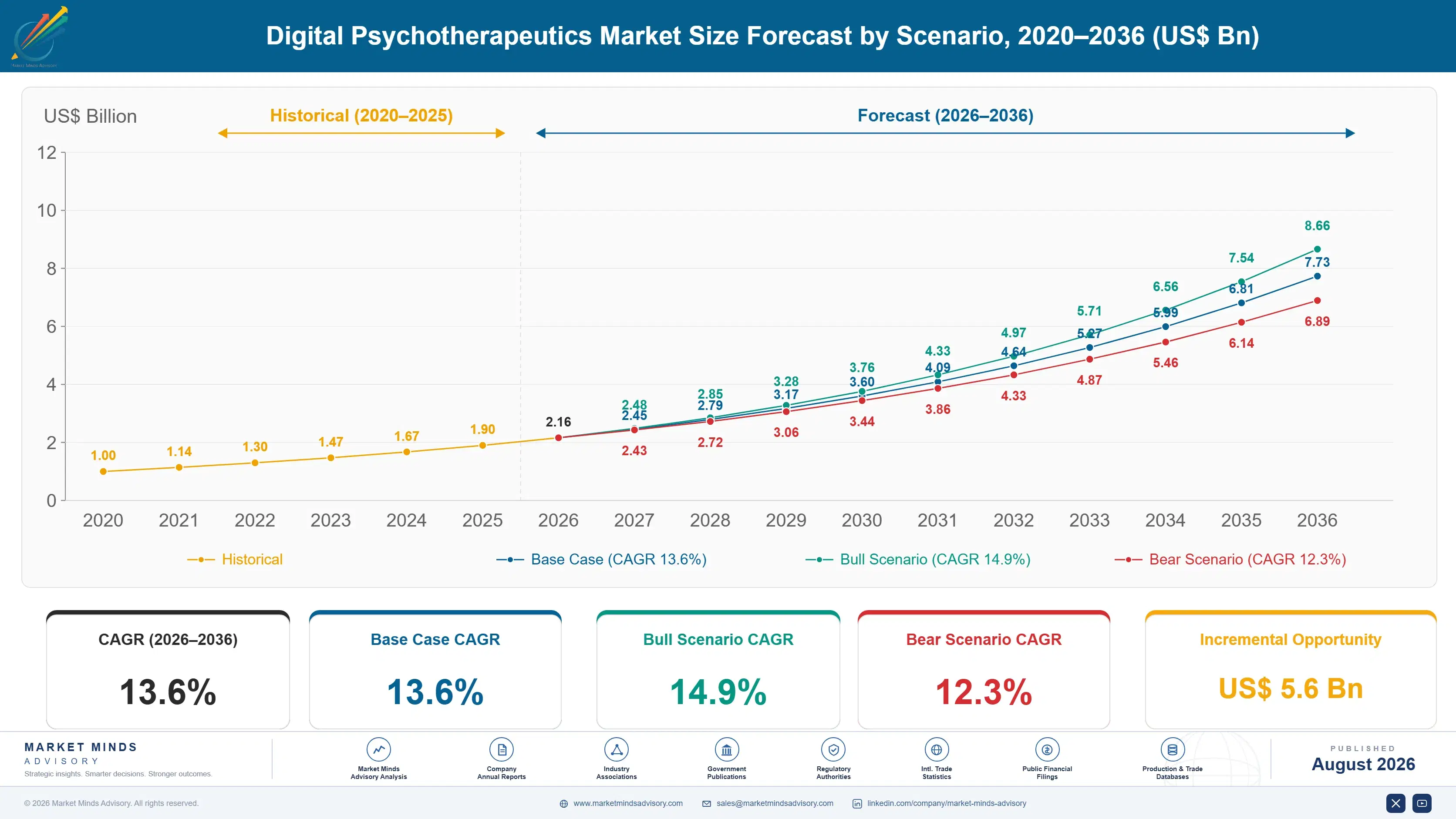
Digital Psychotherapeutics Market Forecast Scenarios

digital-psychotherapeutics-market-size-forecast-scenario-1787304909896
Growth ran near 12.2% from 2020 to 2025 through a period that humbled the field considerably. Remote care demand pulled enormous investment into digital mental health, valuations rose sharply, and then several prominent prescription developers failed outright despite holding authorisations, because reimbursement never arrived. Germany's statutory pathway meanwhile grew steadily and quietly into the largest single market anywhere.
Base case growth of 13.6% rests on three mechanisms. Germany's reimbursement framework continues expanding its listed catalogue while several European neighbours build comparable pathways. Employer and health system contracting replaces prescription as the dominant commercial route, paying per covered life rather than per activation. And virtual reality exposure becomes deliverable at consumer hardware cost across conditions where exposure was always the established treatment. None of the three requires the others to arrive first.
The bull case at 14.9% assumes two or more countries establish functioning statutory reimbursement pathways, converting a German exception into a European norm and giving developers a route clearance alone never provided. The bear case at 12.3% is a further confidence failure: activation rates stay near 34%, another prominent developer fails publicly, and payers conclude the delivered clinical benefit does not justify funding.

Digital Psychotherapeutics: Clearance, Payment and Activation

The most useful thing that has happened in this category is a failure. A developer holding three separate regulatory authorisations for prescription digital therapeutics entered administration in 2023, not because the products did not work but because almost nobody would pay for them. That single event demonstrated what a decade of enthusiasm had obscured: clearance and commercial viability are entirely separate questions here.
TOP FIVE CONCENTRATION26%Highly fragmented across specialist developers and pharmaceutical entrants alike
STATUTORY REIMBURSEMENT PATHWAYS1 countryFrameworks reliably funding prescribed digital therapeutics through statutory insurance
PRESCRIPTION ACTIVATION RATE34%Prescribed programmes that patients actually download and begin using
TWELVE WEEK COMPLETION RATE41%Activated programmes carried through to the intended course length
REIMBURSED PROGRAMME PRICEUSD 580Typical annual reimbursed price under an established statutory listing framework
PRESCRIBER ADOPTION RATE12%Physicians prescribing a digital therapeutic within the past year
Germany is the exception that proves it. Its statutory framework lists validated applications, obliges insurers to reimburse them, and grants provisional listing with a year to produce confirmatory evidence. Prices have been negotiated down since, and developers grumble, but they get paid. That one decision made Germany compound at 21.6% and pulled Western Europe to the largest regional share in a category otherwise dominated by American investment.
The unglamorous problem is that a prescribed programme is only therapeutic if somebody uses it. Roughly 34% of prescriptions are ever activated and about 41% of those reach the intended course length, so the delivered dose sits far below what any trial measured. No tablet has this problem at this magnitude. Physicians have no workflow, no sample and no visibility afterwards, which explains adoption near 12%.
"Everybody in this field spent a decade optimising for regulatory clearance and then discovered that nobody had built the thing that pays for cleared products. Germany built it. Nobody else has, and that is why a market with American technology has a European centre of gravity."
Principal Analyst, Digital Health and Behavioural Therapeutics Practice · MMA He

Market Trends

Virtual reality exposure becomes deliverable at consumer hardware cost

Exposure therapy is the established treatment for specific phobia and a core component in post-traumatic stress care, and delivering it has always been logistically awkward, requiring therapist time, controlled environments and stimuli that are hard to arrange. Headsets now cost a fraction of what dedicated systems did, and effect sizes in controlled comparison are the strongest in this whole field. The segment compounds at 20.4% as clinics adopt hardware they can justify without any specialist procurement process. Content libraries and clinical protocol integration rather than the hardware itself now determine competitive position, since every developer can access the same headsets.
Market Impact: Germany compounding at 21.6% annual
Employer contracting replaces prescription as the commercial route

Prescription developers who failed did so on reimbursement rather than on evidence, and several survivors pivoted decisively toward employer and health system contracts paying per covered life each month regardless of whether anybody uses the product. That is a considerably better business and a considerably weaker clinical proposition, since revenue detaches from delivered therapy entirely. Prescriber adoption near 12% made the pivot commercially rational, whatever it implies about the category's original promise. Payers examining delivered outcomes rather than covered lives will eventually make the same observation. Booked revenue grew while delivered therapy did not.
Market Impact: Segment compounding at 17.2% yearly

Market Opportunities and Growth Drivers

German statutory reimbursement demonstrates a functioning payment route

Germany lists validated digital applications, obliges statutory insurers to fund them and grants provisional listing with a year to generate confirmatory evidence, which is the only national framework anywhere that reliably pays developers. Germany compounds at 21.6% on that basis alone, and reimbursed programmes command roughly USD 580 annually. France, Belgium and several other systems are building comparable pathways, and each additional one removes the objection that clearance leads nowhere commercially. Provisional listing with a year to produce confirmatory evidence is demanding, and it is at least attached to a payment route rather than to a publication.
Market Impact: Only 1 country reliably reimburses

Contingency management finally becomes deliverable at scale

Contingency management is the most strongly evidenced behavioural intervention in stimulant use disorder and was effectively undeliverable for decades, blocked by rules limiting patient incentives and by the administrative burden of verifying abstinence repeatedly. Digital delivery with remote verification and regulatory clarification on incentive value together removed both obstacles. Adoption is expanding across addiction treatment programmes where nothing pharmacological exists for stimulant use at all. Clinicians treating stimulant use disorder have very little else to offer, which makes adoption a clinical necessity rather than a commercial preference. Programme funding remains the practical constraint on how far it spreads.
Market Impact: Activation reaching only 34%

Market Restraints and Challenges

Regulatory clearance does not produce a payment pathway

A developer holding three authorisations entered administration because reimbursement never materialised, and exactly 1 country operates a statutory framework that reliably funds prescribed digital therapeutics. The root cause is that payment systems are built around procedures, devices and molecules, and software fits none of those categories cleanly. Commercial impact has been outright failure for several prominent developers. Participants are responding by pursuing employer contracts, health system licensing and partnership with pharmaceutical companies who already hold payer relationships. Several of the field's most prominent names no longer trade at all. Clearance was never the obstacle.
Market Impact: Compounding at 20.4% each year

Delivered dose falls far below the prescribed course

Roughly 34% of prescribed programmes are ever activated and about 41% of activations reach the intended course length, so most patients receive a fraction of what the trials measured. The root cause is that software requires sustained self-directed engagement in conditions that specifically impair motivation and concentration. Commercial impact undermines the outcomes case with payers directly. Participants are pursuing human coaching layers, clinician dashboards, simplified activation and shorter course designs to close the gap. Trials measuring completers rather than intention to treat overstate what payers actually receive. Payers are beginning to ask about that gap.
Market Impact: Prescriber adoption stuck near 12%
3 additional market trends, 4 additional growth drivers, and 2 additional restraints and challenges are covered in the full report. Contact sales@marketmindsadvisory.com to access the complete intelligence.

Segment CAGR and Growth Architecture

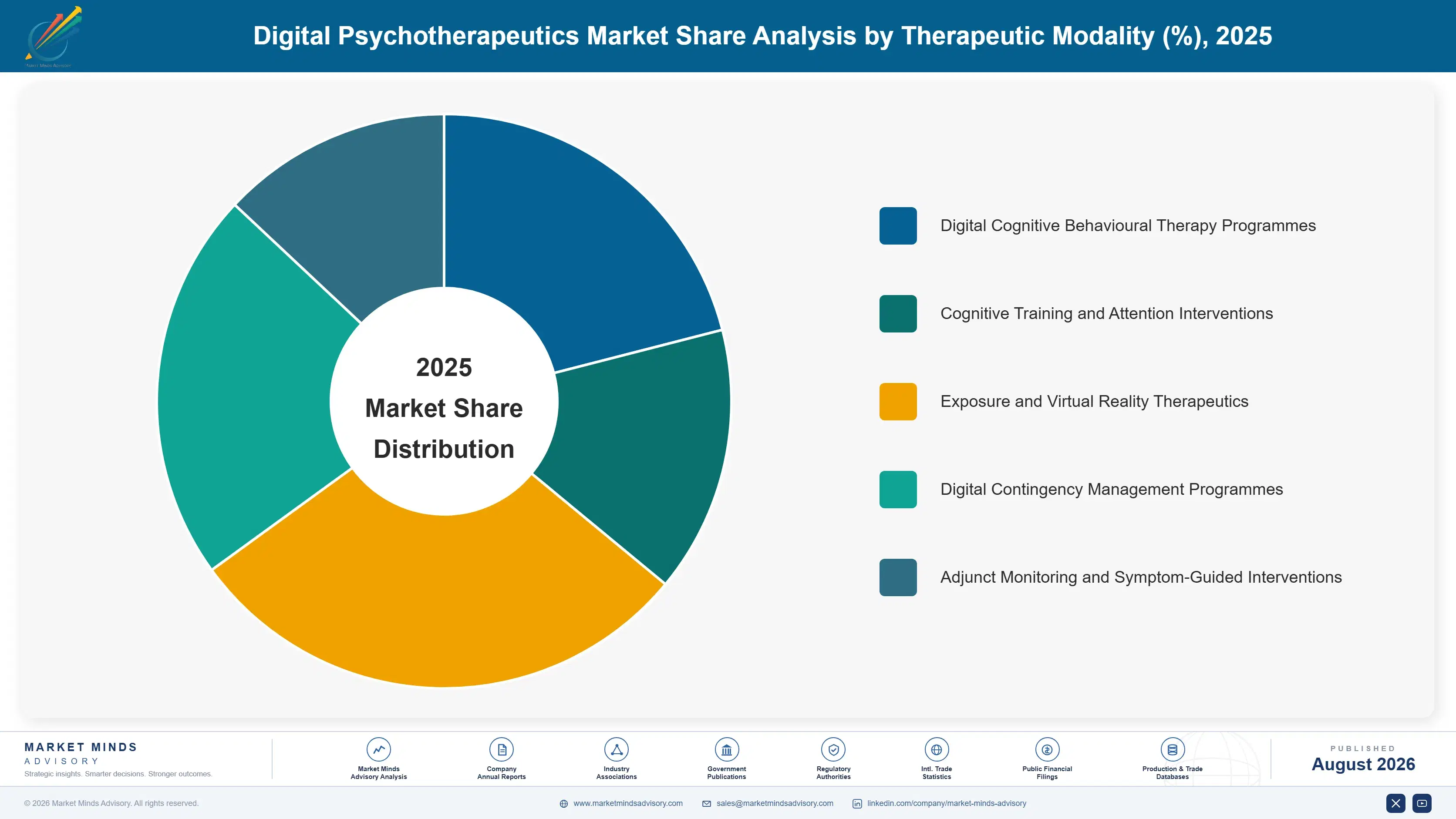
Segmentation follows therapeutic modality, because modality determines the evidence required, the regulatory pathway, the hardware involved and how much sustained patient engagement a programme actually demands. Five modalities cover digital psychotherapeutic supply without overlap between them. Clinical indication and delivery channel cut across every modality and are treated here as use attributes rather than segments.
digital-psychotherapeutics-market-market-share-analysis-1787304910425

Exposure and Virtual Reality Therapeutics

Growing at 20.4%, a full 1.50x the market rate, virtual reality exposure delivers the established treatment for specific phobia and a core component of post-traumatic stress care in a controlled, repeatable and therapist-supervised form. Effect sizes in controlled comparison are the strongest anywhere in this field, and unlike self-directed software the therapist remains present, which largely removes the engagement problem that undermines other modalities. Headset costs have fallen to consumer levels, so clinics can adopt without specialist procurement. Content libraries and clinical protocol integration rather than hardware now determine competitive position. Clinics buy this hardware from operating budgets rather than through payer negotiation, which sidesteps the reimbursement problem entirely. That is a genuine advantage.
CAGR 20.4%

Digital Contingency Management Programmes

Digital contingency management grows at 17.2%, delivering incentives contingent on verified abstinence, which is the most strongly evidenced behavioural intervention available in stimulant use disorder. It was effectively undeliverable for decades, blocked by rules restricting patient incentives and by the administrative burden of verifying abstinence frequently enough to matter clinically. Remote verification and regulatory clarification on incentive value together resolved both obstacles. Demand concentrates in addiction treatment programmes facing stimulant use disorder, where no pharmacological option exists at all and clinicians have very little else to offer. Programme funding rather than clinical acceptance now limits how widely it spreads, since addiction services operate under budget constraints that a demonstrably effective intervention does not automatically overcome.
CAGR 17.2%
Full segment breakdown across 5 segments available in the complete report.

Regional Architecture and Country Demand Map

Regional shares here follow reimbursement architecture rather than technology development or clinical need, and those things diverge more sharply in this category than in any comparable healthcare market. Development activity and clinical need both point somewhere quite different from where the revenue actually accumulates, which is unusual even for healthcare.

Western Europe

Western Europe holds the largest share at 32%. Note: this sits above the standard regional band entirely because Germany operates the only statutory reimbursement framework that reliably funds prescribed digital therapeutics, listing validated applications and obliging insurers to pay for them. Germany compounds at 21.6% while France, Italy, Spain and the United Kingdom lag considerably, which is why the regional growth rate sits below the global figure despite the leading share. France and Belgium are both building comparable pathways, and each one that functions removes an obstacle developers have faced everywhere. Regional growth sits below the global rate despite the leading share for exactly that reason. Belgian and French pathways are the ones worth watching.
Share: 32% | CAGR: 12.4% (2026 to 2036)

North America

Twenty-eight per cent of value, growing at 12.8%. The great majority of development capital, regulatory authorisations and clinical trial activity originates here, and so did the category's most public failures, since clearance never came with any payment mechanism attached. Survivors pivoted decisively toward employer and health system contracting, which pays per covered life monthly and detaches revenue from actual use. Prescriber adoption remains near 12% because physicians have no workflow, no sample and no visibility into whether a prescribed programme was ever opened. Pharmaceutical organisations have acquired several failed prescription assets for the clinical evidence behind them, applying payer infrastructure that the original developers never possessed at all. Investment appetite has cooled considerably.
Share: 28% | CAGR: 12.8% (2026 to 2036)
Regional intelligence for 5 additional markets available in the complete report: East Asia, South Asia and Pacific, Latin America, Middle East and Africa, Eastern Europe. Contact sales@marketmindsadvisory.com.
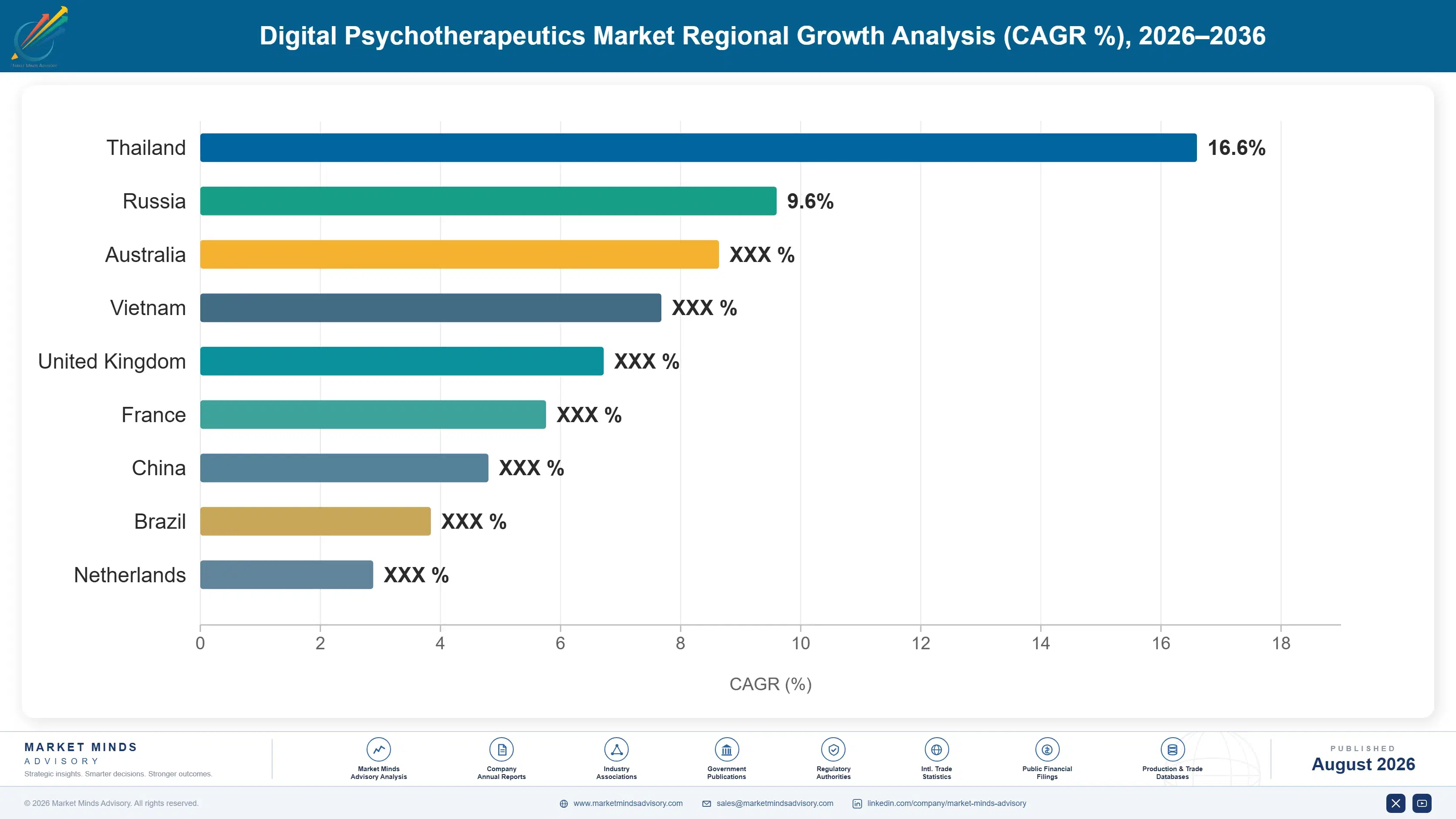
digital-psychotherapeutics-market-country-cagr-analysis-1787304910947

Where Digital Therapeutic Value Actually Sits

Clearance has been demonstrated to lead nowhere commercially on its own, only one country reliably pays, and most prescribed programmes are never opened. Value therefore accrues to whoever reaches a functioning payment route, and to modalities where a clinician stays in the room. Evidence alone has proved insufficient repeatedly. Distribution is the deficit. Evidence rarely decides.

Follow the reimbursement architecture rather than the regulator

Exactly 1 country operates a statutory framework that reliably funds prescribed digital therapeutics, and a developer holding three authorisations entered administration for want of exactly that. Germany compounds at 21.6% while comparable products elsewhere reach nobody. Sequencing market entry against reimbursement pathway availability rather than against regulatory ease reverses how most developers have planned, and the ones who planned the other way round are largely no longer trading at all. Evidence generated for a market that cannot pay is simply a very expensive publication. Most developers planned the other way round.
Market Impact: Exactly 1 country now reliably fund

Keep a clinician in the room where engagement matters

Roughly 34% of prescribed programmes are activated and 41% of those are completed, because self-directed software demands sustained engagement from patients whose conditions specifically impair it. Virtual reality exposure compounds at 20.4% partly because a therapist remains present throughout, which removes the engagement problem rather than attempting to design around it. Modalities requiring unsupervised persistence face a delivery gap that coaching layers and reminders have reduced but never closed. Shorter modular course designs address the same gap through design rather than through persuasion. Coaching layers reduce the gap at meaningfully higher cost.
Market Impact: Completion reaching just 41% of all

Contract per covered life rather than per prescription

Employer and health system agreements pay monthly for every covered person regardless of activation, which detaches revenue from a delivery problem the category has not solved. That is commercially far stronger and clinically far weaker, and the survivors of the prescription era adopted it deliberately. Programmes priced near USD 580 annually under reimbursement compete against contracts costing a fraction of that per employee, which reshapes what any developer can realistically charge. Developers should hold the distinction clearly rather than presenting covered lives as treated patients. The distinction will not stay invisible indefinitely.
Market Impact: Reimbursed pricing sitting near USD

Partner with organisations that already hold payer relationships

Pharmaceutical companies have reimbursement functions, prescriber relationships and field organisations that digital developers spent a decade failing to build from nothing, and several have acquired failed prescription assets precisely for the clinical evidence behind them. Prescriber adoption near 12% reflects a distribution problem rather than a product one. Partnership converts a distribution deficit into an existing channel, and it is the route most surviving prescription developers have now taken. Acquiring organisations have bought validated assets at a fraction of what generating that evidence originally cost. Building distribution alone has repeatedly failed.
Market Impact: Prescriber adoption is still stuck

Who Controls the Margin Pool

Concentration is very low at 26% across the top five, measured on annual developer revenue from clinically validated digital therapeutic programmes, the single basis applied throughout. Otsuka Pharmaceutical and Big Health lead through opposite strategies, the first a pharmaceutical company acquiring digital assets and applying existing payer infrastructure, the second a specialist that abandoned the prescription route for employer and health system contracting entirely.
Competition runs on three dimensions that barely intersect. German listed products compete on evidence quality and negotiated price within a defined statutory framework. Employer channel products compete on procurement relationships, breadth of covered conditions and per-employee pricing, where clinical evidence matters considerably less than it should. Virtual reality products compete on content libraries and clinical protocol integration, selling to clinics rather than to payers at all.

Pressure builds from a direction nobody in the category controls. Conversational artificial intelligence is being applied to mental health support at consumer scale without clinical validation, regulatory oversight or reimbursement, and it reaches more people daily than every validated product combined. Rankings shift most where a developer secures a functioning reimbursement listing, since that remains the only route through which clearance converts into sustained revenue.
digital-psychotherapeutics-market-company-positioning-matrix-1787304911479

Competitive Moat and Risk Dimensions

OTSUKA PHARMACEUTICAL

Moat: Payer and prescriber infrastructure

Existing reimbursement functions, established prescriber relationships and a field organisation built for psychiatric medicines give Otsuka the distribution capability that digital developers spent a decade failing to construct from nothing. Acquiring validated assets from failed prescription developers brought clinical evidence at a fraction of what generating it would have cost, into a channel that could actually use it.
OTSUKA PHARMACEUTICAL

Risk: Digital execution and engagement

Pharmaceutical commercial models assume a dispensed product is taken, and roughly 34% activation rates break that assumption entirely, requiring engagement capability that medicines organisations have never needed. Reimbursement for software remains absent across most markets regardless of prescriber reach. Product iteration cycles in software run far faster than pharmaceutical development governance comfortably accommodates.
BIG HEALTH

Moat: Evidence base with commercial pivot

A genuinely strong randomised evidence base in insomnia and anxiety, built over many years, combined with a decisive pivot away from prescription toward employer and health system contracting, gave Big Health revenue that does not depend on a reimbursement pathway that mostly does not exist. Contracts pay per covered life monthly rather than per activation.
BIG HEALTH

Risk: Detachment from delivered therapy

Per-covered-life contracting generates revenue whether or not anybody uses the product, which is commercially comfortable and steadily erodes the clinical argument that justified the evidence investment. Employer procurement compares digital programmes against far cheaper wellbeing applications on price. Consumer artificial intelligence tools reach comparable populations without any evidence requirement whatsoever.

Players Tracked

Prominent Players

Otsuka Pharmaceutical
Big Health
Click Therapeutics
GAIA
Sidekick Health

Other Key Players

Selfapy
HelloBetter
Orexo
XRHealth
BehaVR
DarioHealth
Kaia Health
Woebot Health
Freespira
Pelago
DynamiCare Health
Boehringer Ingelheim
Teva Pharmaceutical Industries
Novartis
Koa Health

Recent Developments

MARCH 2025

German listing framework expands catalogue while negotiating prices downward

Germany's statutory digital application framework added further validated mental health programmes to its reimbursed catalogue while continuing to negotiate listed prices downward, an organic policy process that sustained the only reliable payment route developers have anywhere. Listed developers accepted lower prices in exchange for reliable payment.
Signal: One national framework is effectively carr
AUGUST 2025

Prescription developers complete pivot toward employer contracting channels

Surviving prescription digital therapeutic developers completed commercial pivots toward employer and health system contracting paying per covered life, an organic strategic shift detaching revenue from activation rates the category has never managed to lift. Clinical evidence investment became harder to justify. Covered lives replaced activated courses as the reported measure.
Signal: Revenue and delivered therapy have now qui
DECEMBER 2025

Consumer conversational tools reach mental health populations without validation

General purpose conversational artificial intelligence applications reached very large populations seeking mental health support without clinical validation, regulatory oversight or reimbursement, an organic consumer adoption pattern occurring entirely outside the therapeutic framework. Regulators began examining how such tools should be classified. No reimbursement or oversight framework currently applies to them.
Signal: Unvalidated consumer tools now reach far m

Evidence Generation, Engineering and Compliance

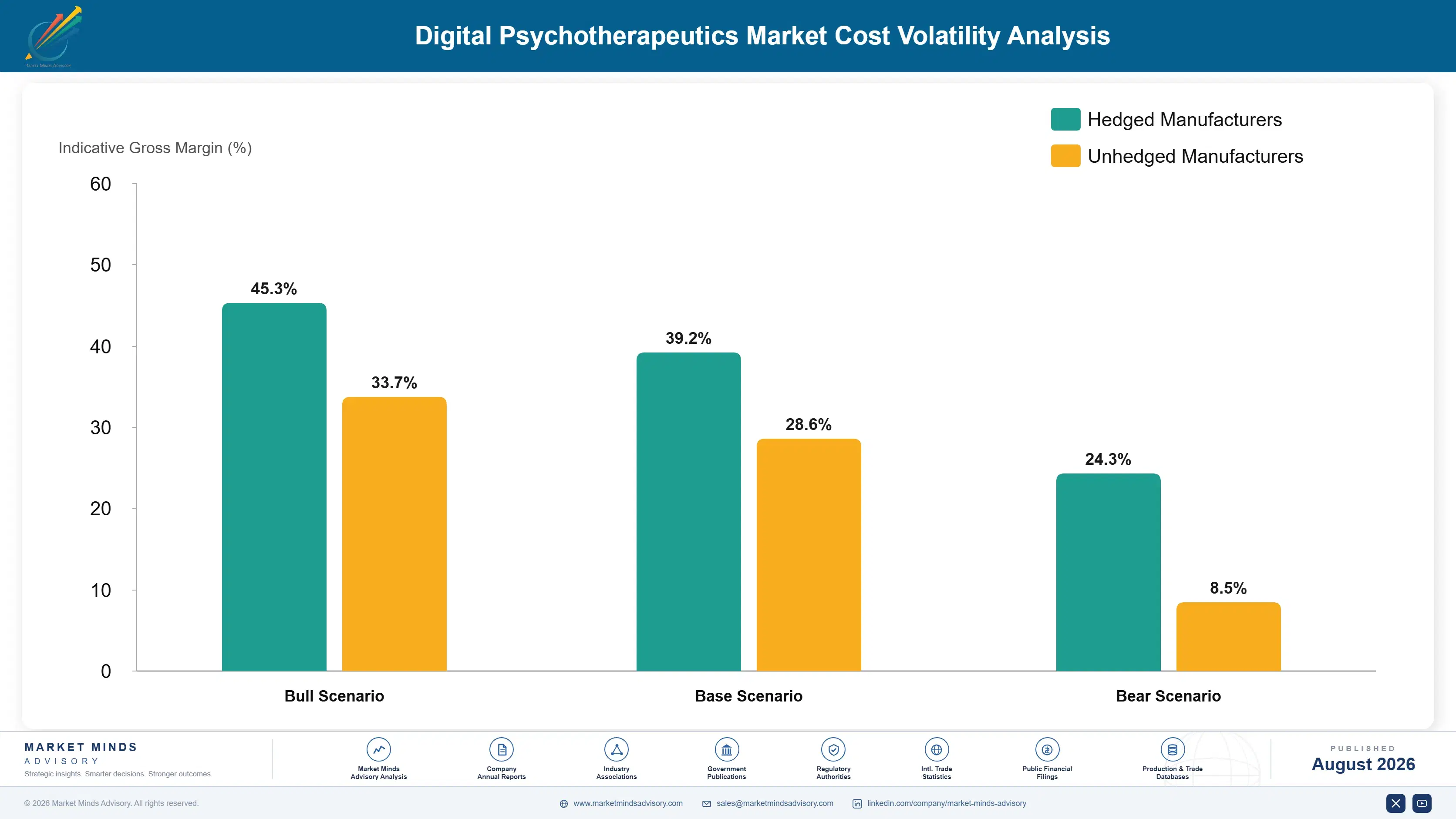
Cost structure here looks nothing like a device or a medicine. Software engineering, clinical content development and platform maintenance account for roughly 44% of operating cost, with regulatory affairs, quality management system maintenance and cybersecurity compliance adding a further 21%. Clinical evidence generation sits outside operating cost entirely and frequently dominates total capital consumed, since randomised trials in mental health require large samples and long follow-up.
Clinical trial costs in mental health rose materially across recent years as recruitment became harder and placebo response in depression and anxiety trials remained stubbornly high, requiring larger samples to demonstrate effect. Developer disclosures across the period documented trial spending exceeding all other investment combined. Cybersecurity and data protection compliance costs also rose sharply following regulatory attention to health application data handling in both Europe and North America.

Exposure varies most by commercial channel rather than by scale. Prescription and reimbursement-seeking developers carry full evidence and regulatory burden against uncertain payment, which is precisely the combination that bankrupted several of them. Employer channel developers carry far lighter obligations because procurement rarely demands trial evidence. Geography compounds it: German listing demands confirmatory evidence within a year, which is at least attached to a payment route.
digital-psychotherapeutics-market-cost-volatility-analysis-1787304911675

Sequence evidence generation against reimbursement pathway availability

Trial spending has exceeded all other investment for most prescription developers, and several generated it into markets with no payment mechanism waiting. Aligning trial design and timing with a listing framework that will actually reimburse converts the largest cost in the business into a genuine asset. Evidence built for a market that cannot pay is only an expensive publication.

Design courses shorter than the engagement curve permits

Roughly 41% of activated programmes reach the intended course length, so a twelve week design delivers a fraction of its measured effect across the treated population. Shorter courses with defined completion points, or modular designs allowing partial benefit, convert the engagement problem into a design parameter. Trials reporting completers overstate what a payer actually receives.

Build compliance capability once across the whole portfolio

Quality management systems, cybersecurity certification and data protection compliance together consume roughly a fifth of operating cost and scale poorly for single-product developers. Portfolio breadth amortises that overhead considerably, which is one genuine argument for consolidation in a fragmented category. Single-product organisations carry an obligation designed for companies with several times their revenue. Consolidation is the obvious answer nobody enjoys.

Portfolio Architecture for Margin Defence

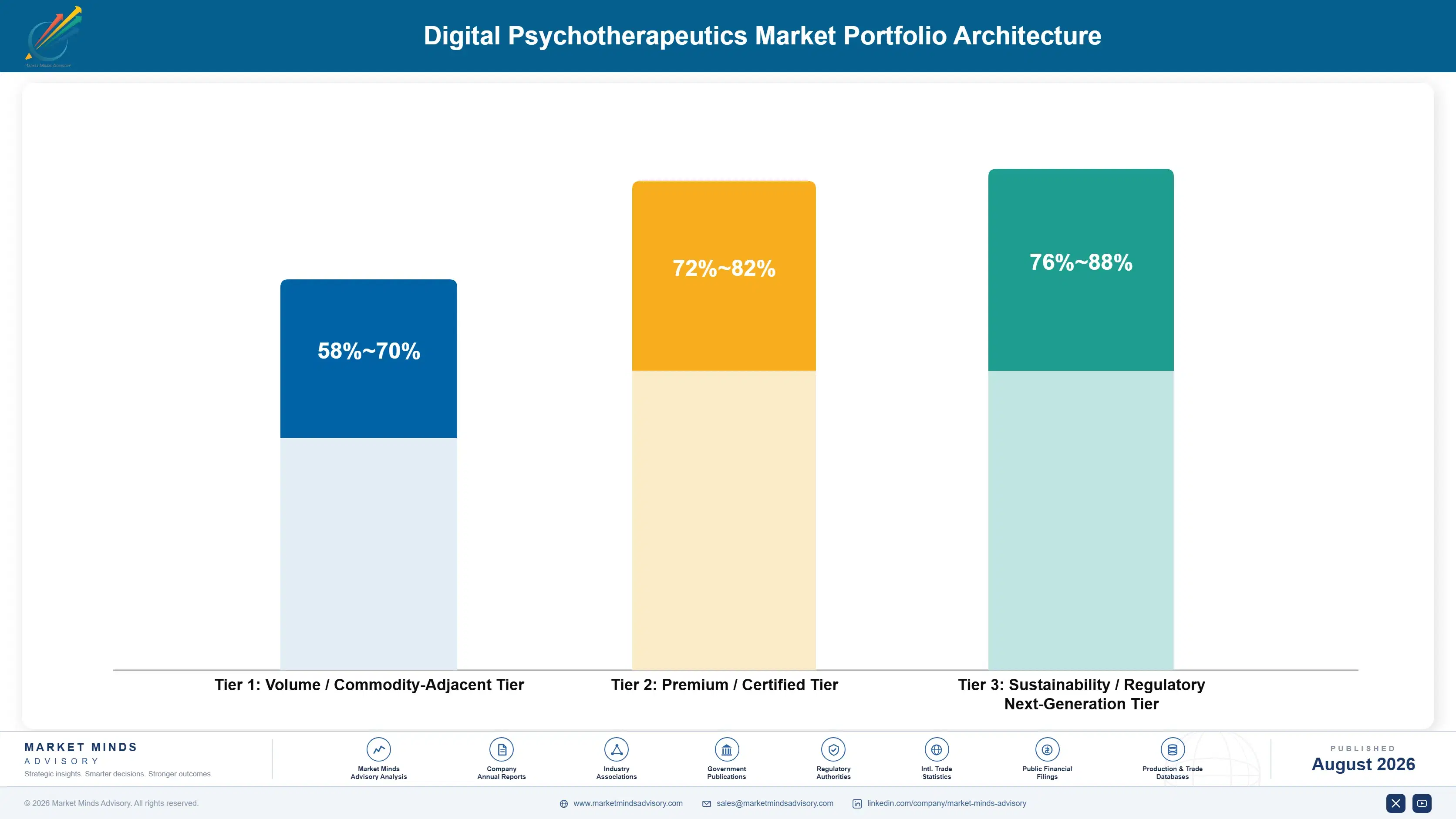
Margin architecture in this category separates on payment route rather than on clinical merit. Employer and wellbeing channel contracts earn steadily at modest per-employee prices, and procurement there compares validated programmes against far cheaper applications with no evidence at all. Statutory reimbursement listings earn considerably better at roughly USD 580 annually, protected by evidence requirements competitors must also meet. Clinic-sold virtual reality earns well because clinicians b
The volume against premium tension runs between reach and rigour. Employer contracting reaches enormous covered populations of whom very few engage, generating predictable revenue detached from delivered therapy entirely. Reimbursed prescription reaches far fewer people with considerably better clinical intent and a payment route available in essentially one country. The category has been drifting toward the first because the second nearly destroyed it.

High-value pools concentrate around functioning payment and around supervised delivery. Statutory listings, clinic-purchased virtual reality systems and contingency management programmes in addiction treatment all command pricing that self-directed employer applications do not. Prescription programmes without a reimbursement pathway, whatever their evidence, have repeatedly proved commercially unviable, and the field now has ample demonstration of that.

Volume / Commodity-Adjacent Tier

Employer and wellbeing channel programmes contracted per covered life monthly, competing directly against unvalidated applications on price where procurement rarely examines clinical evidence in any depth. Revenue accrues whether anyone uses the product.
Gross Margin: 58-70%

Premium / Certified Tier

Statutory reimbursement listings and health system licensing agreements, protected by confirmatory evidence requirements and regulatory quality obligations that competing developers must also satisfy fully. Exactly one such framework currently functions anywhere.
Gross Margin: 72-82%

Sustainability / Regulatory / Next-Generation Tier

Clinic-purchased virtual reality exposure systems and digital contingency management in addiction treatment, commanding premium because a clinician remains involved and the engagement problem largely disappears. Clinics purchase directly from operating budgets.
Gross Margin: 76-88%
digital-psychotherapeutics-market-portfolio-architecture-1787304912176

Covered Lives Against Activated Courses

Two revenue patterns operate here and they measure entirely different things. Employer and health system contracting pays monthly for every covered person whether or not a single one opens the application, producing predictable recurring revenue detached from clinical delivery. Prescription and reimbursement revenue arrives per activated course, which means roughly 34% activation converts directly into roughly a third of theoretical revenue and no developer can influence the difference easily.
Engagement depth varies enormously by how much supervision a modality involves. Clinic-delivered virtual reality exposure completes at rates approaching conventional therapy because a clinician conducts the session. Self-directed cognitive behavioural programmes complete at around 41% of activations, and considerably lower in depression than in insomnia, since the conditions treated specifically impair the persistence the format requires. Coached programmes sit between the two at meaningfully higher cost.

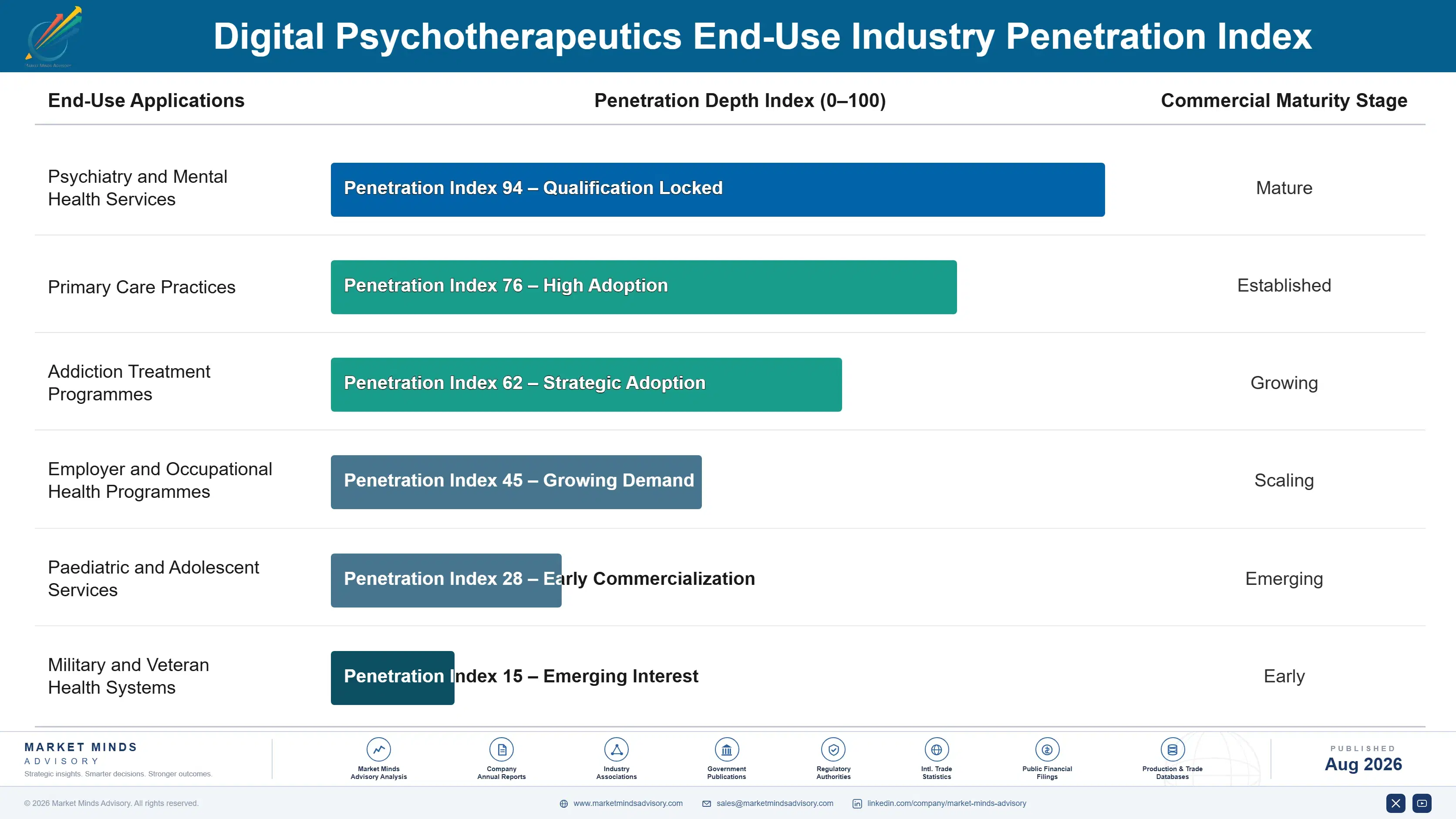
Purchasing profiles are unusually scattered for a therapeutic category. German statutory insurers reimburse against a national listing that physicians prescribe from. Employer benefits managers buy per covered life on procurement criteria where evidence rarely features prominently. Clinics buy virtual reality hardware directly from operating budgets. And patients increasingly obtain unvalidated conversational tools themselves, entirely outside every one of those routes.
digital-psychotherapeutics-market-end-use-penetration-index-1787304912664

Where Digital Therapeutic Strategy Lands

These are among the four positions where our research anticipates prominent divergence between winners and laggards over the coming forecast period. Each is grounded in the demand model, the regulatory perimeter, and the announced capacity pipeline.
01 / PAYMENT ROUTE PRIORITY

Clearance without reimbursement has already killed companies

A developer holding three separate regulatory authorisations entered administration because reimbursement never materialised at any workable scale, and exactly 1 country currently operates a statutory framework that reliably funds prescribed digital therapeutics. Germany compounds at 21.6% on that single institutional decision alone, while entirely comparable products elsewhere reach almost nobody at all. Sequencing market entry against payment pathway availability rather than against regulatory accessibility reverses how most developers actually planned, and most of those developers are no longer trading today.
02 / SUPERVISION DESIGN CHOICE

Engagement is a design problem, not a marketing one

Roughly 34% of prescribed programmes are ever activated and about 41% of those activations reach the intended course length, so the actual delivered dose sits far below whatever any published trial originally measured in its completers. Self-directed software demands sustained persistence from patients whose underlying conditions specifically impair exactly that capacity. Virtual reality exposure compounds at 20.4% substantially because a therapist stays present throughout the session, which removes the engagement problem outright rather than attempting to design around its edges.
03 / CHANNEL HONESTY DISCIPLINE

Per-covered-life revenue detaches from delivered therapy

Employer and health system contracts pay monthly for every covered person regardless of whether anybody opens the application, which is commercially far stronger and clinically far weaker than the prescription model the category originally promised its investors. Survivors adopted that route quite deliberately after reimbursement failed them, and booked revenue accordingly grew while delivered therapy did not. Developers should hold that distinction clearly in their own planning, because payers examining delivered outcomes will eventually make exactly the same observation themselves.
04 / DISTRIBUTION PARTNERSHIP LOGIC

Pharmaceutical channels already have what developers lack

Prescriber adoption sits near 12% because physicians have no workflow for prescribing software, no sample to hand over and no visibility at all into whether a programme was ever opened afterwards by the patient. Pharmaceutical organisations already hold reimbursement functions, prescriber relationships and field capability that digital developers spent an entire decade failing to build from nothing. Partnership or acquisition converts a distribution deficit into an existing working channel, which is precisely the route most surviving prescription developers have now taken.

Engagement Snapshot From the Field

A live engagement with an industry participant carrying material or product regulatory and market exposure ahead of a defining policy shift, showing how our research translates into a defensible multi-year portfolio strategy.
MARKET MINDS ADVISORY · CLIENT ENGAGEMENT SUMMARY
Digital Psychotherapeutics Producer Strategic Portfolio Review and Transition Roadmap 2026·Investment Scenario on Digital Psychotherapeutics Exposure Evaluation 2025-26
CLIENT PROFILE
A digital therapeutics developer holding one regulatory authorisation for a cognitive behavioural programme in anxiety, a second product in development and no reimbursement listing in any market. Annual revenue was approximately USD 22 million (client-reported, unverified by MMA), derived almost entirely from a small number of employer contracts rather than from any prescription or reimbursed channel.
STRATEGIC CHALLENGE
Trial spending had consumed most of the capital raised while producing an authorisation that generated essentially no revenue, and employer procurement was comparing the client's validated programme against unvalidated wellbeing applications costing a fraction as much. The board needed to decide whether to pursue German statutory listing, deepen employer contracting, or seek a pharmaceutical partner with existing payer infrastructure.
MMA APPROACH
MMA conducted 47 expert interviews spanning psychiatrists, primary care physicians, statutory insurer medical directors, employer benefits managers, health technology assessment advisers, addiction treatment programme leads and digital health investors across six countries. A quantitative survey of 3,800 respondents established activation behaviour, completion patterns and treatment preferences among patients. We then modelled revenue outcomes under listing, employer and partnership strategies against observed reimbursement timelines.
KEY FINDINGS
  1. Statutory insurer medical directors in the one reimbursing market confirmed a defined evidence pathway and price negotiation process, which no other surveyed system could offer developers at all.
  2. Employer benefits managers ranked breadth of covered conditions and per-employee price above clinical evidence, and most could not distinguish validated programmes from wellbeing applications.
  3. Physicians reported no workflow for prescribing software and no way to learn whether a patient had activated a programme, which most cited as their reason for not prescribing.
  4. Patients surveyed activated prescribed programmes at roughly a third and completed at well under half of activations, with depression performing considerably worse than insomnia.
CLIENT PROFILE
A digital therapeutics developer holding one regulatory authorisation for a cognitive behavioural programme in anxiety, a second product in development and no reimbursement listing in any market. Annual revenue was approximately USD 22 million (client-reported, unverified by MMA), derived almost entirely from a small number of employer contracts rather than from any prescription or reimbursed channel.
STRATEGIC CHALLENGE
Trial spending had consumed most of the capital raised while producing an authorisation that generated essentially no revenue, and employer procurement was comparing the client's validated programme against unvalidated wellbeing applications costing a fraction as much. The board needed to decide whether to pursue German statutory listing, deepen employer contracting, or seek a pharmaceutical partner with existing payer infrastructure.
MMA APPROACH
MMA conducted 47 expert interviews spanning psychiatrists, primary care physicians, statutory insurer medical directors, employer benefits managers, health technology assessment advisers, addiction treatment programme leads and digital health investors across six countries. A quantitative survey of 3,800 respondents established activation behaviour, completion patterns and treatment preferences among patients. We then modelled revenue outcomes under listing, employer and partnership strategies against observed reimbursement timelines.
KEY FINDINGS
  1. Statutory insurer medical directors in the one reimbursing market confirmed a defined evidence pathway and price negotiation process, which no other surveyed system could offer developers at all.
  2. Employer benefits managers ranked breadth of covered conditions and per-employee price above clinical evidence, and most could not distinguish validated programmes from wellbeing applications.
  3. Physicians reported no workflow for prescribing software and no way to learn whether a patient had activated a programme, which most cited as their reason for not prescribing.
  4. Patients surveyed activated prescribed programmes at roughly a third and completed at well under half of activations, with depression performing considerably worse than insomnia.
RECOMMENDED STRATEGY
Phase 1: Phase one: pursue German statutory listing immediately, since it is the only route where existing clinical evidence converts directly into a reliable payment mechanism. Phase 2: Phase two: redesign the programme around a shorter defined course with modular partial benefit, matching the completion curve rather than the trial protocol. Phase 3: Phase three: open partnership discussions with pharmaceutical organisations holding prescriber and reimbursement infrastructure rather than continuing to build distribution alone.
OUTCOME
The client secured provisional statutory listing within the year, redesigned its programme around a shorter modular course, and entered partnership discussions with two pharmaceutical organisations (client-reported, unverified by MMA). Reimbursed revenue exceeded employer channel revenue within eighteen months, completion rates improved measurably against the previous design, and one partnership discussion advanced to term sheet.

Frequently Asked Questions

Foundational context covering the market sizes, CAGR, scope, country, region and competition that inform every finding below. This section is provided to cover basics and most often pre-purchase conversations, answered from the MMA Primary Research Dataset.

What is the current size of the Digital Psychotherapeutics Market?

The global digital psychotherapeutics market was valued at USD 1.9 billion in 2025, spanning digital cognitive behavioural therapy, cognitive training, virtual reality exposure, contingency management and adjunct monitoring. Only one country reliably reimburses prescribed programmes.

How large will the Digital Psychotherapeutics Market be by 2036?

MMA forecasts the market at USD 7.73 billion by 2036, expanding 3.58 times from the 2026 base of USD 2.16 billion. That represents roughly USD 5.57 billion of incremental value across the forecast decade.

What is the CAGR for the Digital Psychotherapeutics Market 2026 to 2036?

The base case compound annual growth rate is 13.6%, with a bull case of 14.9% and a bear case of 12.3%. The bull case assumes two or more additional countries establish functioning statutory reimbursement pathways.

Which segment is growing fastest?

Exposure and virtual reality therapeutics grow at 20.4%, a full 1.50x the overall market rate. A therapist remains present throughout, which removes the engagement problem that undermines self-directed software.

Who are the major companies in the Digital Psychotherapeutics Market?

Otsuka Pharmaceutical, Big Health, Click Therapeutics, GAIA and Sidekick Health together hold just 26% of revenue. The leaders pursued opposite strategies, one through pharmaceutical payer infrastructure and one through employer contracting.

Which country is growing fastest?

Germany grows fastest at 21.6%, operating the only statutory framework that reliably funds prescribed digital therapeutics. Western Europe is the largest region at 32% of value almost entirely on that basis.

Report Segmentation Architecture

The full report scope spans multiple orthogonal segmentation dimensions, with cross-tabulated demand data provided for each dimension pair. Coverage extends further to regional breakdowns, trend trajectories, and the competitive detail needed to support segment-level decision-making.

By Therapeutic Modality

  • Digital Cognitive Behavioural Therapy Programmes
  • Cognitive Training and Attention Interventions
  • Exposure and Virtual Reality Therapeutics
  • Digital Contingency Management Programmes
  • Adjunct Monitoring and Symptom-Guided Interventions

By End-Use Industry

  • Psychiatry and Mental Health Services
  • Primary Care Practices
  • Addiction Treatment Programmes
  • Employer and Occupational Health Programmes
  • Paediatric and Adolescent Services
  • Military and Veteran Health Systems

By Commercial Dimension

  • Statutory Reimbursement Listing
  • Employer and Payer Contracting
  • Health System Enterprise Licensing
  • Clinic Direct Purchase
  • Pharmaceutical Partnership and Co-Promotion
  • Direct-to-Consumer Subscription

By Region

  • Western Europe
  • North America
  • East Asia
  • South Asia and Pacific
  • Latin America
  • Middle East and Africa
  • Eastern Europe

Scope, Methodology, and Coverage

Every figure in this report is reproducible from documented input assumptions. The scope below maps the historical period, the forecast horizon, the segmentation dimensions, and the countries covered, alongside the underlying primary and qualitative methodology.
Historical Period
2020 to 2025
Forecast Period
2026 to 2036
Base Year
2025 (USD billions; MMA Primary Research Dataset, August 2026)
Market Definition
This market comprises clinically validated software-based therapeutic interventions for mental health and behavioural conditions, measured at developer revenue across statutory reimbursement listing, employer and payer contracting, health system enterprise licensing, clinic direct purchase, pharmaceutical partnership arrangements and direct-to-consumer subscription. Coverage spans digital cognitive behavioural therapy programmes for depression, anxiety, insomnia and related conditions, cognitive training and attention interventions including those with regulatory authorisation, exposure therapeutics delivered through virtual reality hardware and software, digital contingency management programmes for substance use disorders, and adjunct monitoring and symptom-guided intervention products used alongside conventional treatment. Teletherapy and video counselling services delivered by human clinicians, general wellness, meditation and mindfulness applications without clinical validation, electronic health record and clinical documentation software, patient engagement and appointment platforms, psychiatric medication and neuromodulation devices, and unvalidated consumer conversational applications fall outside scope.
Quantitative Units
USD millions (current prices); programmes prescribed and activated; covered lives contracted; annual reimbursed price; activation and completion rates; prescriber adoption; listed products by market
Segmentation Dimensions
By Therapeutic Modality; By End-Use Industry; By Commercial Dimension; By Region
Regions Covered
Western Europe, North America, East Asia, South Asia and Pacific, Latin America, Middle East and Africa, Eastern Europe
Countries Covered
Germany, France, Belgium, Netherlands, United Kingdom, Italy, Spain, Sweden, Switzerland, United States, Canada, Japan, South Korea, China, Taiwan, Australia, India, Singapore, New Zealand, Brazil, Mexico, Argentina, Chile, United Arab Emirates, Saudi Arabia, Israel, South Africa, Poland, Czechia, Hungary, and additional markets relevant to digital therapeutic analysis
Key Companies Profiled
Otsuka Pharmaceutical, Big Health, Click Therapeutics, GAIA, Sidekick Health, Selfapy, HelloBetter, Orexo, XRHealth, BehaVR, DarioHealth, Kaia Health, Woebot Health, Freespira, Pelago, DynamiCare Health, Boehringer Ingelheim, Teva Pharmaceutical Industries, Novartis, Koa Health
Quantitative Methodology
Primary survey, n=3,800 respondents, Q4 2025, six countries; demand-side model with trade association cross-validation
Qualitative Methodology
47 expert interviews, Q4 2025; applied to validate demand model assumptions, identify emerging dynamics, and assess competitive positioning
Report Format
PDF and XLSX data workbook (Word format preview document)
Publisher
Market Minds Advisory
Report Code
MMA-2026-HLT-339
Published
August 2026
Contact
sales@marketmindsadvisory.com | www.marketmindsadvisory.com

Purchase the full Digital Psychotherapeutics Market Report (2026 to 2036).

The full MMA report treats reimbursement architecture rather than regulatory clearance as the fact that determines commercial outcomes in this category, quantifying why one country holds a disproportionate share. It sizes five therapeutic modalities and seven regions to 2036, modelling prescriptions, activations, completions, covered lives contracted and reimbursed pricing separately so that delivered therapy can be distinguished from booked revenue. Competitive assessment covers twenty developers on one consistent revenue basis. Cost exposure is traced through evidence generation, engineering and compliance. Four commercial levers and a strategic verdict close the report, grounded in 47 expert interviews and a 3,800-respondent survey.
Five therapeutic modalities sized separately through 2036
Reimbursement pathway availability mapped across every covered market
Activation and completion rates modelled against booked contract revenue
Twenty developers assessed on one consistent revenue basis
Employer channel economics separated from prescription and reimbursed supply
Anonymised client engagement with tested strategic recommendations

Built For The People Who Decide

From boardroom strategy to bench-side execution, this report is read cover-to-cover by leaders shaping the next decade of their industry, turning demand scenarios, market dynamics and valuation benchmarks into decisions.
CXOs/ Presidents/ VPs/ Managers
M&A and Corporate Development
Strategy Teams and R&D Heads
Procurement and Product Directors
Regulatory and Compliance Leaders
Investor Relations and Equity Analysts