Market Minds Advisory
Digital Printed Pouch Market

Digital Printed Pouch Market: Zero Origination Cost, SKU Proliferation and the Run Length Where Gravure Stops Winning

Engraved cylinders cost thousands per colour and take weeks to produce, which decides what a brand can afford to launch. Digital printing removes that cost entirely, and the consequences reach far beyond the pressroom.

Lead Analyst

Bilal Shaikh

Published

September 2026

Make Smarter Decisions with Customized Research Insights

Request a free sample report and evaluate market opportunities, growth trends, and competitive dynamics relevant to your business needs.

2025 MARKET VALUE$1.9BMarket Size 2025
2036 FORECAST VALUE$7.2BBase Case , 2026 to 2036
CAGR 2026 TO 203613.2 %Bull 14.4% / Bear 12.0%
INCREMENTAL OPPORTUNITY$5.1BNet 10- year value creation
EXPANSION MULTIPLE3.45x2036 value over 2026 base
Strategic Levers
M&A Pipeline
Regional Outlook
Country Rankings
Competitive Intelligence
Segmental Deep-dive
Call-Us : 91 93563 13602

Executive Snapshot and Market Trajectory

A gravure cylinder set costs thousands of dollars per colour and takes weeks to engrave. That single fact has decided which products brands could afford to launch for sixty years, and digital printing simply deletes it from the calculation entirely. Sixty years of packaging strategy rested on it.
Retort and sterilisable pouches compound at 19.8%, exactly 1.50 times the market, now that digital inks have been qualified to survive sterilisation at 121 degrees Celsius and clear food contact migration limits. That opened pet food, ready meals and infant nutrition to a technology previously confined to ambient dry goods. North America holds 31% of demand, well ahead of any other region. Ambient dry goods had been the ceiling.
Concentration is very low, with the top five converters holding 19% between them. Digital presses cost a fraction of a gravure line, so a regional converter can enter with one machine and serve short-run work profitably from day one. Press capital sets the entry threshold, and it is low. That entry economics explains why the supplier landscape looks nothing at all like conventional flexible packaging. Regional single-plant operators compete credibly against far larger names.
Market Definition
The market covers flexible pouches printed by digital processes, principally electrophotographic and inkjet, spanning stand-up, flat, spouted, retort, recloseable and shaped formats across food, beverage, pet care, personal care and household applications. Pouches printed by gravure, flexographic or offset processes are excluded, as are digitally printed labels, cartons, sacks and rollstock not converted into a pouch format.
Base Year Value
$1.9B in 2025 (MMA Primary Research Dataset, August 2026)
Forecast Period
2026 to 2036, eleven discrete annual values
CAGR
13.2% base case. Bull 14.4%. Bear 12.0%.
Fastest Growth Segment
Retort and Sterilisable Pouches: 19.8% CAGR
Fastest Growth Country
India: 16.2% CAGR
Fastest Growth Region
South Asia and Pacific: 15.4% CAGR
Largest Region
North America: 31% of 2025 global value
Market Leaders
Amcor, ePac Flexible Packaging, Constantia Flexibles, Mondi, Huhtamaki. Source: MMA Analysis based on company annual reports.
Primary Survey
n=3,800 procurement and R&D decision-makers, Q4 2025, six countries
Methodology
Demand-side build-up, cross-validated against public data, 47 expert interviews

Digital Printed Pouch Market Forecast Scenarios

digital-printed-pouch-market-size-forecast-scenario-1787307209029
Growth across 2020 to 2025 ran at an implied 11.8% and was driven by two separate forces. Direct-to-consumer brand launches accelerated sharply through 2020 and 2021, creating exactly the short-run, high-version work digital serves best, and press installations followed. Then from 2023 the conversation shifted from run length toward retort qualification and mono-material compatibility. Capability replaced economics as the question.
The base case at 13.2% rests on three mechanisms. Retort ink qualification opens pet food, ready meals and infant nutrition, categories that had been closed to digital printing entirely and which represent very large pouch volumes. SKU proliferation and multilingual versioning continue to multiply the number of distinct designs a brand needs. And the economic break-even run length keeps rising as press speeds and web widths improve each generation. None of the three has run its course.
The bull case at 14.4% assumes press manufacturers deliver another step change in speed and width, pushing the break-even run length far enough to threaten mid-length gravure work rather than only short runs. The bear case at 12.0% follows from digital ink and consumable pricing staying high, since the per-unit cost premium over gravure remains the constraint on longer runs.

What Happens When Origination Costs Nothing

Every constraint in conventional flexible packaging traces back to the cylinder. Engraving a set costs thousands per colour and takes weeks, so a brand amortises that spend across as long a run as it can justify. Short runs, regional variants, seasonal designs and multilingual versions all become expensive propositions, and marketing departments have spent decades quietly abandoning ideas that the pressroom made uneconomic.
TOP FIVE CONCENTRATION19%Combined share held by the five largest global converters
BREAK-EVEN RUN LENGTH8,400 linear metresPoint at which gravure economics overtake digital printing costs
ORIGINATION LEAD TIME SAVED26 daysTypical time removed by eliminating engraved cylinder production
SETUP WASTE REDUCTION94% less filmSubstrate saved against conventional gravure make-ready per job
DIGITAL PENETRATION OF FLEXIBLES5.8% of volumeShare of flexible packaging currently printed by digital processes
AVERAGE VERSIONS PER BRAND34 designsDistinct artwork versions carried by a typical multilingual portfolio
Digital printing removes origination entirely. There is no cylinder, no engraving lead time and almost no make-ready waste, which is 94% less film per job. Below roughly 8,400 linear metres digital wins outright on total cost, and above it gravure still wins on the per-metre running cost. That crossover point moves upward with every press generation, which is the whole competitive story. Every press generation moves the line upward.
The frontier has shifted from run length to capability. Digital inks now clear food contact migration limits and survive retort sterilisation at 121 degrees Celsius, opening pet food, ready meals and infant nutrition. Mono-material recyclable structures, with their narrower processing windows, also suit digital better than solvent gravure does. Capability has moved faster in three years than in the previous fifteen.
"I have sat in meetings where a perfectly good regional product idea died because nobody wanted to explain a twelve thousand dollar cylinder bill for a trial. Digital printing does not make those products succeed, but it does mean somebody gets to find out."
Director, Flexible Packaging and Print Technology Practice · MMA Flexible Packag

Market Trends

Retort Ink Qualification Opens Categories Digital Could Not Serve

Digital inks had to clear two separate hurdles for retort applications: surviving sterilisation at 121 degrees Celsius without delamination or colour shift, and satisfying food contact migration limits under European Commission and United States Food and Drug Administration frameworks. Both have now been met across several commercial ink sets. That opens pet food, ready meals, soups and infant nutrition, categories representing very large pouch volumes and previously closed to digital entirely. The segment compounds at 19.8% against a market at 13.2%, from a base small enough that the ceiling remains distant.
Market Impact: New customers at 28% of volume

SKU Proliferation Multiplies Designs Beyond Gravure Economics

A brand with a dozen flavours sold across six language markets in three pack sizes carries more distinct artwork versions than most gravure economics can support, and the typical multilingual portfolio now runs to 34 designs. Each version demands its own cylinder set under conventional printing, which forces brands to consolidate designs, delay regional variants or abandon them. Digital printing is indifferent to version count, since changing artwork means changing a file. Version count is now the variable that decides which process a brand can economically use at all. Retailer own-brand programmes have accelerated the same pressure.
Market Impact: Mono-material work at 23% of jobs

Market Opportunities and Growth Drivers

Direct-to-Consumer Brands Launch at Volumes Gravure Cannot Serve

A brand launching online with a single product and uncertain demand cannot justify cylinder origination, and conventional converters have historically declined the work as uneconomic. Digital converters quote it profitably at a few hundred kilograms, which brought an entire category of customer into flexible packaging for the first time. Those brands also iterate artwork constantly, testing claims and imagery in ways gravure economics forbid. Roughly 28% of digital pouch volume now comes from brands that would not have been served at all a decade ago. Conventional converters had declined it outright.
Market Impact: Break-even capped at 8,400 metres

Mono-Material Recyclable Structures Suit Digital Processing Windows

Recyclable mono-material polyethylene and polypropylene pouch structures have narrower heat and solvent tolerance than the multi-material laminates they replace, which complicates solvent-based gravure printing considerably. Digital processes apply less thermal and chemical load to the web, and shorter runs mean less accumulated stress. As European Packaging and Packaging Waste Regulation recyclability requirements push brands toward mono-material construction, that processing advantage converts into commercial preference rather than remaining a technical curiosity confined to trials. Barrier performance still trails established multi-material laminates in several demanding categories, which limits how quickly the substitution can proceed across a full portfolio.
Market Impact: Tolerance disputes affecting 17% of

Market Restraints and Challenges

Per-Metre Running Cost Caps the Addressable Run Length

Above roughly 8,400 linear metres, gravure beats digital on total cost because the per-metre running cost of digital ink and consumables remains substantially higher. The root cause is straightforward: digital ink sets are proprietary, sold by the press manufacturer, and priced to recover development across a modest installed base. That caps the addressable share of flexible packaging at 5.8% of volume today. Converters mitigate by mixing digital and conventional capacity under one roof and routing each job to whichever process the run length favours. Neither process wins across a whole portfolio.
Market Impact: Retort formats compounding at 19.8%

Colour Matching Against Gravure Reference Standards Remains Difficult

Brand owners hold colour standards established on gravure presses, and matching them digitally is genuinely hard on some spot colours, particularly extended-gamut reproductions of specified brand colours. The root cause is a different colourant chemistry and gamut rather than any calibration failure. A brand running both processes across its portfolio risks visible shelf inconsistency between pack sizes. Converters mitigate through extended gamut profiling, dedicated spot ink stations on newer presses, and by agreeing revised tolerance standards with brand owners upfront. Agreeing tolerances upfront avoids most disputes, though it requires a conversation brand owners are often reluctant to have.
Market Impact: Portfolios averaging 34 distinct de
4 additional market trends, 3 additional growth drivers, and 2 additional restraints and challenges are covered in the full report. Contact sales@marketmindsadvisory.com to access the complete intelligence.

Segment CAGR and Growth Architecture

Segmentation follows pouch format, because format determines the converting equipment required, the barrier structure the print must survive and the categories a converter can serve. A retort pouch and a flat sachet share a printing technology and essentially nothing else in specification, qualification burden or customer expectation. Format decides equipment, qualification burden and customer alike.
digital-printed-pouch-market-market-share-analysis-1787307209565

Retort and Sterilisable Pouches

Retort formats compound at 19.8%, exactly 1.50 times the market rate, because a technical barrier fell rather than because demand suddenly appeared. Digital inks had to survive sterilisation at 121 degrees Celsius without delaminating or shifting colour, and simultaneously satisfy food contact migration limits under both European and United States frameworks. Several commercial ink sets now clear both. Pet food, ready meals, soups and infant nutrition all become addressable, and those are very large pouch categories where short-run and regional versioning demand had been suppressed entirely by cylinder economics. The base remains small enough that growth at this rate can continue for years before capacity or category limits bind. Validation work keeps the field narrow.
CAGR 19.8%

Shaped and Contour-Cut Pouches

Shaped pouches grow at 17.2% on a combination that only works digitally. Laser and digital die-cutting produce contoured pouch outlines without cutting tooling, which removes the second origination cost that conventional converting imposes alongside the printing cylinder. A brand can therefore test a distinctive silhouette at trial volumes rather than committing to tooling amortised across years of production. Shelf differentiation is the commercial argument and it is a strong one in crowded categories. The constraint is filling line compatibility, since an unusual outline may not run on standard equipment, which keeps the format concentrated in premium positioning where a slower filling speed is acceptable. Tooling origination disappears alongside the cylinder.
CAGR 17.2%
Full segment breakdown across 6 segments available in the complete report.

Regional Architecture and Country Demand Map

Adoption follows brand portfolio complexity rather than converting capacity or packaging consumption. Markets with high SKU counts, frequent regional versioning and rapid product launch cycles adopt digital first, regardless of how much flexible packaging they consume overall. North America and Western Europe therefore lead here.

North America

North America takes 31% of demand, the largest regional share, and the reason is genuinely commercial rather than a default. Direct-to-consumer brand launches, private label programmes and a retail structure that rewards regional and seasonal variants together generate more short-run, high-version work than any other market. ePac built an entire network of regional digital plants on that demand pattern, operating close to customers with lead times measured in days. Pet food and snacking categories have been the earliest retort adopters. Growth of 12.6% is slower than the global rate simply because penetration started here and the easy conversions have already happened, leaving longer-run work that digital economics reach less readily.
Share: 31% | CAGR: 12.6% (2026 to 2036)

Western Europe

Western Europe holds 25% of demand and grows at 11.8%, the slowest of the seven regions, for the same reason North America does: early adoption means the readily convertible work has largely converted. Multilingual versioning is the distinguishing driver here, since a product sold across the single market may need artwork in a dozen languages, and gravure economics forced brands to consolidate designs onto multilingual packs that satisfied nobody. Packaging and Packaging Waste Regulation recyclability requirements are pushing brands toward mono-material structures whose narrower processing windows suit digital printing. German, Italian and British converters hold the largest installed digital capacity. Recyclability requirements are accelerating conversion further, since mono-material structures print more readily on digital presses than on solvent gravure lines.
Share: 25% | CAGR: 11.8% (2026 to 2036)
Regional intelligence for 5 additional markets available in the complete report: East Asia, South Asia and Pacific, Latin America, Middle East and Africa, Eastern Europe. Contact sales@marketmindsadvisory.com.
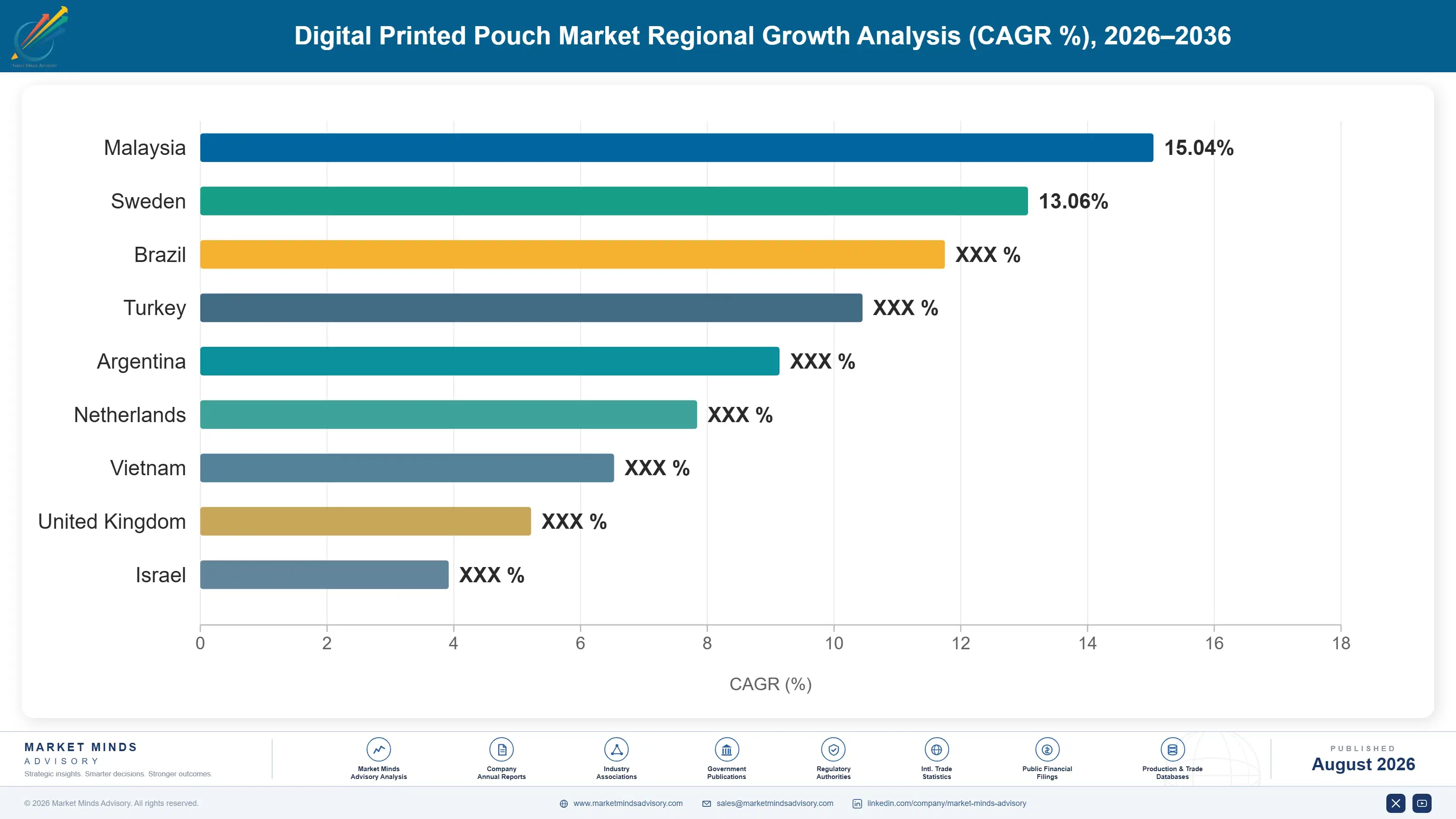
digital-printed-pouch-market-country-cagr-analysis-1787307210085

Where Digital Converting Earns Its Premium

Digital pouch converting charges more per metre than gravure and always will, so the commercial question is never price. It is which jobs carry a value the customer will pay for beyond the printed metre itself. Four positions do, and each rests on something gravure genuinely cannot supply. Cost per metre is the wrong argument entirely.

Qualify Retort Capability Before Competitors Attempt It

Retort formats compound at 19.8% now that digital inks survive sterilisation at 121 degrees Celsius and clear food contact migration limits under both major regulatory frameworks. Qualification is genuine work: ink set validation, structure testing and customer-specific migration documentation take months rather than weeks. Converters holding it quote pet food, ready meals and infant nutrition work that competitors cannot touch, at gross margins roughly 14 to 21 points above ambient dry goods pouches. The categories concerned carry very large volumes, and short-run versioning demand within them has been suppressed by cylinder economics for decades.
Market Impact: Retort work carrying 14 to 21 point

Sell Speed to Shelf Rather Than Cost Per Metre

Removing cylinder origination takes roughly 26 days out of a launch timeline, and for a brand chasing a seasonal window or responding to a competitor that time is worth considerably more than the print premium. Converters that quote lead time alongside price, and hold capacity to honour it, win work that never reaches a cost comparison at all. This requires scheduling discipline and deliberate capacity reservation rather than any technical capability. Brands paying for speed accept per-metre premiums of 20 to 35% without material resistance once the launch date is genuinely at risk.
Market Impact: Speed premiums running 20 to 35% ab

Run Mixed Digital and Conventional Capacity Under One Roof

The break-even at roughly 8,400 linear metres means every customer portfolio splits across both processes, and a converter holding only one of them loses half the relationship. Operating both allows job-by-job routing to whichever process the run length favours, and it keeps the account when a product succeeds and its run length grows past the digital threshold. Converters running mixed capacity retain roughly 40% more of a customer's total volume than digital-only competitors. The capital requirement is real, though gravure capacity can be secured through partnership rather than ownership. Partnership can substitute for ownership.
Market Impact: Mixed capacity retaining 40% more o

Build Regional Plants Close to Short-Run Customers

Digital presses cost a fraction of a gravure line, which makes a distributed network of small regional plants economically viable in a way conventional flexible packaging never permitted. Proximity cuts freight, shortens lead times further and lets a converter serve small local brands that a distant plant would never quote. That structure suits precisely the customer base digital serves best, and roughly 28% of volume now comes from brands too small to have been served at all a decade ago. Capital per site runs well below a single conventional converting line.
Market Impact: Regional model serving 28% of entir

Who Controls the Margin Pool

The five largest converters hold 19% of the market measured on digital pouch conversion revenue, the basis applied consistently through this section. That is extraordinarily fragmented, and press economics explain it: a digital press costs a fraction of a gravure line, so a single-machine regional converter can enter and compete profitably on short-run work immediately. Nothing about that structure resembles conventional flexible packaging.
Competition operates on three dimensions. Retort and food contact qualification decides which categories a converter can quote at all, and it takes months to establish. Lead time reliability decides who wins work where speed to shelf rather than cost drives the decision. And mixed digital and conventional capacity decides whether a converter keeps an account when a product succeeds and its run length outgrows the digital threshold. All three are earned rather than bought.

Two pressures are reshaping position. Press manufacturers including HP Indigo, Bobst and Screen keep raising speed and web width, which pushes the break-even run length upward and expands the addressable pool for everyone at once. Separately, large conventional converters are adding digital capacity defensively. Rankings will shift toward converters combining retort qualification with genuine regional proximity. Very few hold both today.
digital-printed-pouch-market-company-positioning-matrix-1787307210609

Competitive Moat and Risk Dimensions

AMCOR

Moat: Scale and structure development

Amcor combines global converting reach with genuine materials development capability, which matters where a digital pouch must also deliver barrier performance, retort survivability or mono-material recyclability. The company can serve a multinational brand's conventional long-run volume and its digital short-run versioning from within one relationship, which single-process competitors cannot offer at all.
AMCOR

Risk: Short-run responsiveness gap

Large converting organisations are built around long-run scheduling efficiency, and the customers digital serves best want a few hundred kilograms delivered in days. Matching a regional single-plant competitor on responsiveness requires operating practices that sit awkwardly inside a plant optimised for gravure throughput, and small brand customers frequently prefer suppliers built for them.
EPAC FLEXIBLE PACKAGING

Moat: Distributed regional plant network

ePac built a network of small digital plants sited close to customers rather than a few large centralised facilities, which is only economically possible because digital press capital is modest. That structure delivers lead times measured in days, serves small local brands larger converters decline, and creates a commercial position built entirely around the customer segment digital printing actually suits.
EPAC FLEXIBLE PACKAGING

Risk: No conventional capacity

Without gravure or flexographic capacity, the company loses volume whenever a customer's product succeeds and its run length passes the break-even threshold near 8,400 linear metres. Growing brands eventually outgrow a digital-only supplier, so the model requires constant new customer acquisition to replace the volume that graduates away from it.

Players Tracked

Prominent Players

Amcor
ePac Flexible Packaging
Constantia Flexibles
Mondi
Huhtamaki

Other Key Players

Sonoco Products Company
Berry Global
Sealed Air
ProAmpac
TC Transcontinental
Glenroy
American Packaging Corporation
Bryce Corporation
Clifton Packaging Group
Hood Packaging
Uflex
Coveris
Schur Flexibles
Wipak
Printpack

Recent Developments

MARCH 2025

Digital ink sets clear retort sterilisation and migration requirements

Several commercial digital ink sets completed validation for retort applications, surviving sterilisation at 121 degrees Celsius while satisfying food contact migration limits under European and United States frameworks. These were technical qualifications rather than corporate transactions, and they opened categories previously closed to digital printing.
Signal: A technical barrier falling rather than de
JULY 2025

Press manufacturers raise digital web width and running speed

Digital press manufacturers introduced wider web and faster running configurations for flexible packaging, moving the economic break-even run length further upward against gravure. These were product introductions rather than acquisitions, and they expand the addressable job pool for every converter simultaneously. Nobody gains share from it directly.
Signal: Every press generation shifts the crossove
NOVEMBER 2025

Conventional converters add digital capacity to defend accounts

Several large gravure and flexographic converters commissioned digital pouch capacity, responding to short-run and versioning work migrating toward digital-only specialists. These were organic capital investments rather than acquisitions or joint ventures, aimed at retaining whole customer portfolios rather than winning new ones. Retention rather than acquisition is the motive.
Signal: Incumbents are buying digital capacity to

Ink, Film and the Press Contract

Substrate film accounts for roughly 41% of cost of goods, sourced from regional flexible packaging film producers across Europe, North America and Asia. Digital ink and consumables run a further 24%, and unusually these are proprietary, purchased from the press manufacturer under click-charge or supply agreements rather than from a competitive market. Lamination adhesives, converting labour and finishing make up most of the remainder.
Polymer film pricing moved sharply through 2022 and 2023 as European energy disruption raised resin and conversion costs together, a movement International Energy Agency reporting documents across that period. Digital converters absorbed it less comfortably than conventional ones, because near-zero setup waste is a smaller advantage when the film itself costs more. Company annual reports covering flexible packaging segments disclose margin compression through those quarters.

The disadvantage falls on converters without scale in ink purchasing. Click-charge and consumable pricing is negotiated against installed press count, so an operator with one machine pays materially more per metre than one running twenty. That gap does not close with operating skill, and it is the principal reason single-plant entrants struggle to compete for anything except genuinely local, genuinely urgent work where proximity outweighs unit cost.
digital-printed-pouch-market-cost-volatility-analysis-1787307210806

Negotiate consumable pricing against multi-press installed commitments

Click-charge and ink pricing scale with installed press count rather than with volume printed, so committing to a multi-press programme secures rates a single machine never earns. Converters expanding regionally should negotiate the whole network at once rather than press by press. The commitment is real, but the gap it closes is the largest controllable cost difference in digital converting.

Route jobs by run length across mixed process capacity

Every customer portfolio splits around the 8,400 metre break-even, and a converter holding both processes routes each job to whichever is cheaper. This protects margin on longer runs that digital would print at a loss and retains the account when a product grows. Gravure capacity can be accessed through partnership where owning it is not justified.

Contract film supply regionally against forecast volume

Film at 41% of cost is bulky, priced regionally and moves with polymer markets. Annual contracting against forecast volume rather than spot purchasing removes a meaningful part of the exposure, and regional supply avoids freight on a low-value bulky input. Mono-material structures complicate this, since qualified sources for recyclable grades remain fewer. Qualification takes time.

Portfolio Architecture for Margin Defence

The portfolio separates on whether the customer is buying printed film or something else entirely. Ambient dry goods pouches on standard structures compete against gravure on cost per metre, and digital only wins below the break-even. Retort, mono-material and shaped formats sell on capability gravure cannot match economically. Speed-to-shelf work sells on lead time, where the print premium barely enters the discussion. What the customer is actually buying draws the ladder.
The tension is that standard short-run work fills the presses and builds the customer relationships from which everything else follows. A converter chasing only qualified retort and shaped work runs machines below capacity and loses the account when the customer needs something ordinary. Successful operators treat standard work as utilisation and relationship access rather than as the margin engine. Utilisation and margin have to be pursued as separate objectives.

High-value pools concentrate where a technical qualification, a launch deadline or a shelf differentiation objective sets the specification. Retort formats, contour-cut shapes and urgent launch work all qualify, and none of them is bought primarily on cost per printed metre. Cost per printed metre decides none of them.

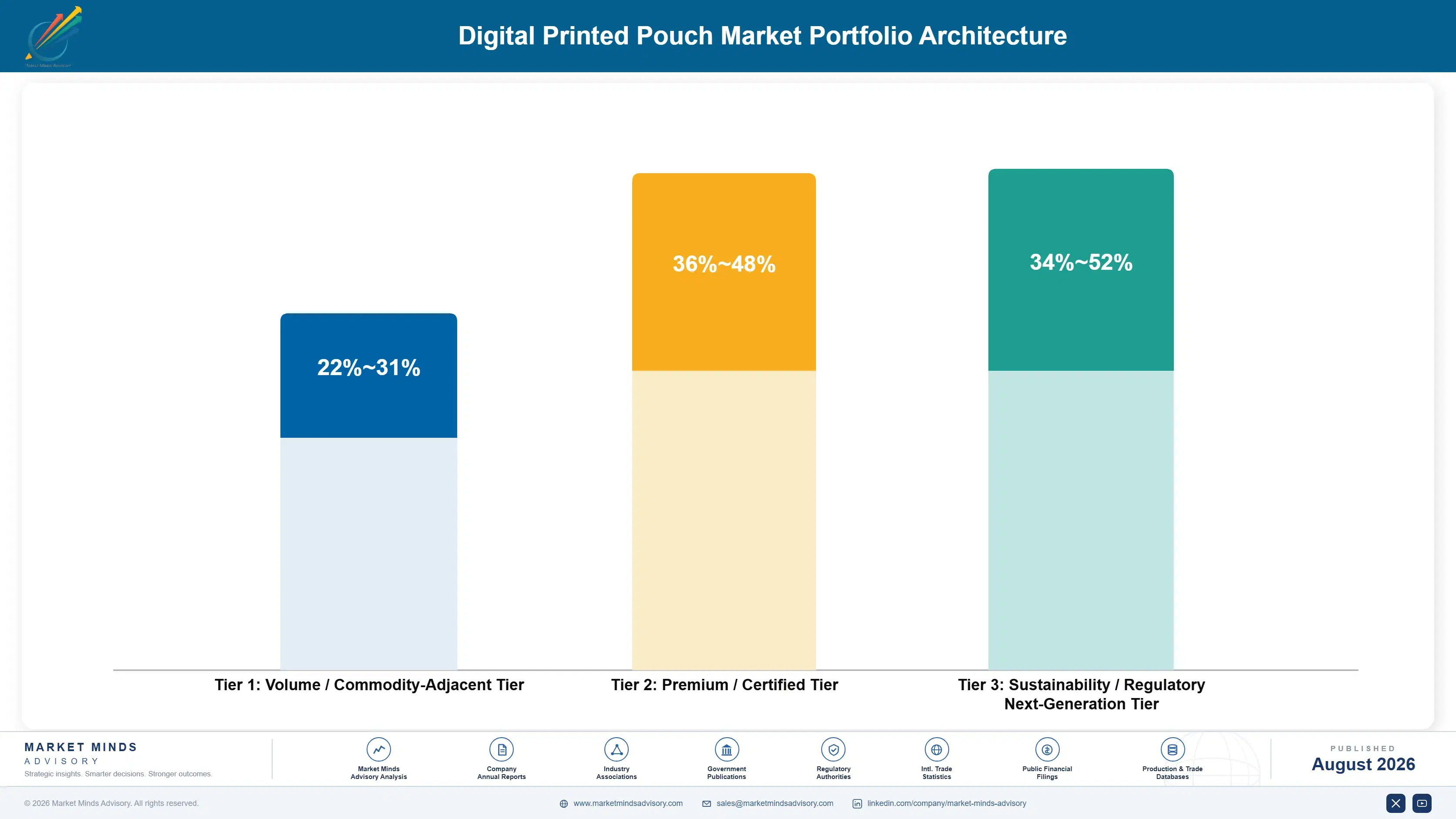
Volume / Commodity-Adjacent Tier

Standard stand-up, flat and pillow pouches on conventional laminate structures for ambient dry goods. Competes directly against gravure below the break-even run length and on cost per metre above it, which digital rarely wins on price alone.
Gross Margin: 22-31%

Premium / Certified Tier

Retort and sterilisable formats, spouted and fitment pouches, and shaped contour-cut constructions requiring qualified ink sets, validated structures or digital die-cutting. Capability rather than run length decides who is able to quote the work at all.
Gross Margin: 36-48%

Sustainability / Regulatory / Next-Generation Tier

Recyclable mono-material and paper-based pouch structures whose narrower processing windows suit digital printing. The wide margin range reflects sharply differing substrate availability and qualification burden between recyclable grades and established laminates.
Gross Margin: 34-52%
digital-printed-pouch-market-portfolio-architecture-1787307211321

High-value Sub-segments and Strategic Watch-out

Retort and Sterilisable Pouches

Compounding at 19.8% now that qualified ink sets survive sterilisation and clear migration limits under both major frameworks. Pet food, ready meals and infant nutrition become addressable, and months of validation work keeps the field of converters able to quote genuinely narrow. Early qualification is worth years of position.
Gross Margin: 40-48%

Shaped and Contour-Cut Formats

Growing at 17.2% because laser and digital die-cutting remove the tooling origination cost alongside the printing cylinder. Brands can test distinctive silhouettes at trial volumes, though filling line compatibility keeps the format concentrated in premium positioning where slower filling is acceptable. Trial volumes become genuinely viable.
Gross Margin: 38-50%

Standard Ambient Dry Goods Pouches

The volume core at 12.4%, competing directly against gravure and winning only below the 8,400 metre break-even run length. Run for press utilisation and customer relationship access rather than for margin, since neither survives a straight cost per metre comparison. Abandoning it costs the relationship.
Gross Margin: 22-31%

Recyclable Mono-Material Structures

The watch-out and the opportunity together. Narrower processing windows suit digital better than solvent gravure, but qualified recyclable substrate sources remain few and barrier performance still trails established laminates in several demanding categories. Converters qualified on those substrates first will hold the advantage. Regulatory pressure will resolve it eventually.
Gross Margin: 30-52%

Relationships Built on Response Time

The recurring economics here differ from conventional flexible packaging in a fundamental way. Gravure locks a customer in through cylinder ownership: the artwork lives on tooling the incumbent holds, and moving suppliers means paying for origination again. Digital has no such lock, so retention depends entirely on responsiveness and qualification. That makes the relationship less contractually secure and considerably more dependent on consistent performance. Performance is the only retention me
Depth varies sharply by customer type. Small direct-to-consumer brands buy deepest relative to their size, at 28% of volume, because no alternative supplier will quote their run lengths at all. Retort category customers buy deeply once qualified, since revalidating a new supplier is expensive. Large multinational brands buy digital only for versioning and promotional work, holding their core volume on gravure. Retailer own-brand programmes sit in between.

The buying population has broadened considerably. Flexible packaging used to be bought by packaging procurement optimising cost per thousand. Digital work is frequently specified by brand marketing chasing a launch window, and that participant weighs lead time and version flexibility far above the printed unit cost. That participant is far harder to reach through procurement channels.
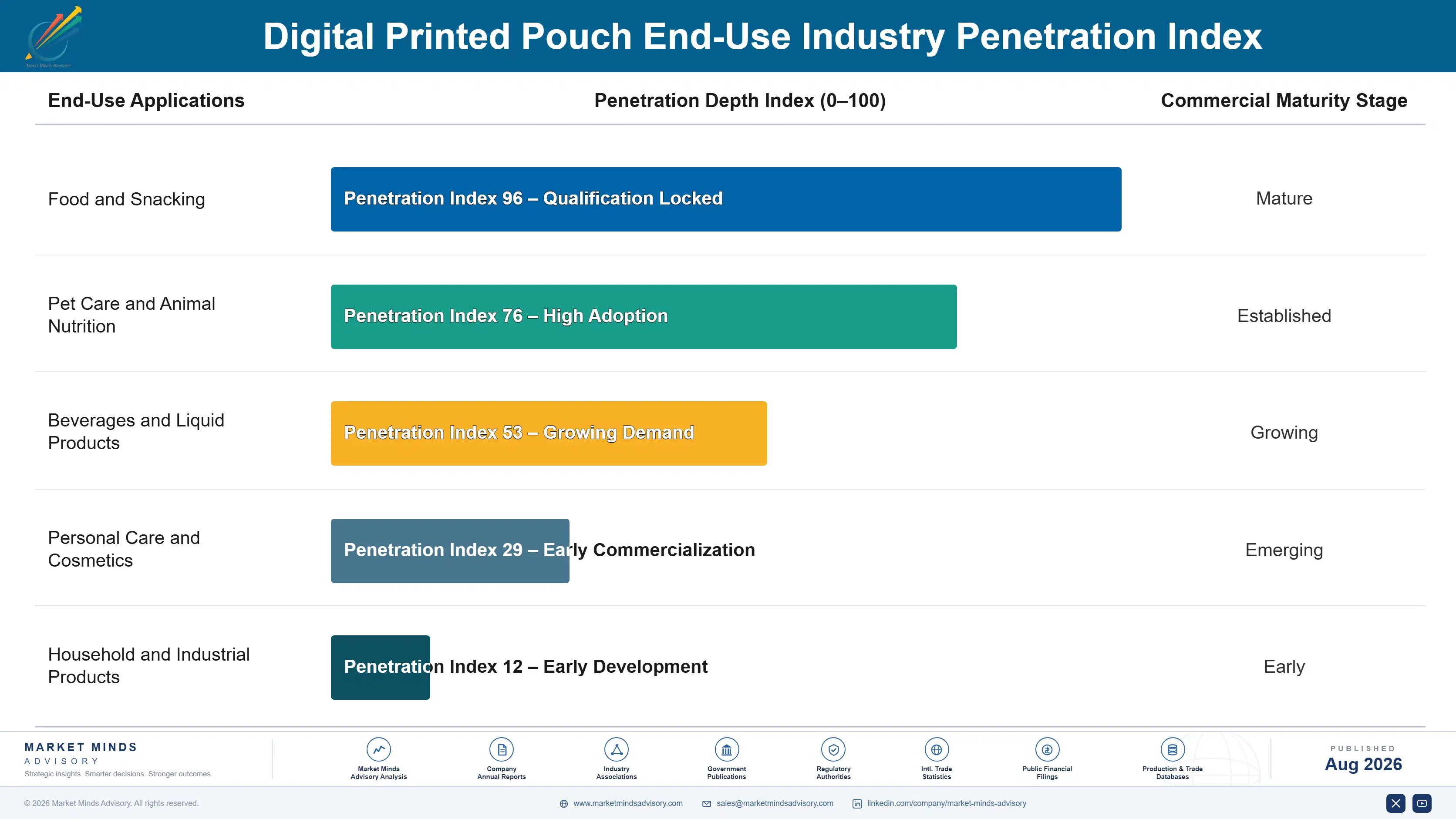
digital-printed-pouch-market-end-use-penetration-index-1787307211827

Where Digital Pouches Win

These are among the four positions where our research anticipates prominent divergence between winners and laggards over the coming forecast period. Each is grounded in the demand model, the regulatory perimeter, and the announced capacity pipeline.
01 / RETORT QUALIFICATION TIMING

The categories that just opened are the largest ones available

Digital inks now survive sterilisation at 121 degrees Celsius and clear food contact migration limits under both European and United States frameworks, which opens pet food, ready meals, soups and infant nutrition to digital conversion for the first time. Those are very large pouch categories where versioning demand has been suppressed by cylinder economics for decades. Qualification takes months of ink set validation and structure testing work, so converters that started early hold positions that competitors simply cannot reach quickly.
02 / LEAD TIME SELLING

Removing 26 days from a launch beats the print premium

Eliminating cylinder origination takes roughly 26 days out of a product launch timeline, and a brand chasing a seasonal window or answering a competitor values that far above any higher cost per printed metre. Converters that quote lead time alongside price, and deliberately reserve capacity to honour it, win work which never reaches a cost comparison at all. Brands with a launch date genuinely at risk will accept per-metre premiums of 20 to 35% without any material resistance or extended negotiation at all.
03 / MIXED PROCESS RETENTION

Digital-only converters lose every customer that succeeds

The break-even sits near 8,400 linear metres, above which gravure wins outright on total delivered cost, so any product that succeeds and keeps growing will eventually outgrow a digital-only supplier entirely. Converters that hold both processes route each job by run length and keep roughly 40% more of a given customer's total volume than digital-only competitors manage to. The digital-only model consequently requires constant new customer acquisition simply to replace the volume that graduates away from it every single year.
04 / CONSUMABLE COST SCALE

Click charges scale with press count, not with operating skill

Digital ink and consumables run 24% of cost of goods and are bought from the press manufacturer under agreements priced against installed press count rather than against volume actually printed. A single-machine converter therefore pays materially more per printed metre than an operator running twenty presses, and no amount of operational efficiency ever closes that gap. Negotiating a multi-press network commitment upfront, rather than machine by machine as each press is added, is the only lever that genuinely moves it.

Engagement Snapshot From the Field

A live engagement with an industry participant carrying material or product regulatory and market exposure ahead of a defining policy shift, showing how our research translates into a defensible multi-year portfolio strategy.
MARKET MINDS ADVISORY · CLIENT ENGAGEMENT SUMMARY
Digital Printed Pouch Producer Strategic Portfolio Review and Transition Roadmap 2026·Investment Scenario on Digital Printed Pouch Exposure Evaluation 2025-26
CLIENT PROFILE
A regional converter operating four gravure lines and two digital presses across two plants, with roughly USD 190 million in revenue (client-reported, unverified by MMA). Digital work represented about 14% of revenue (client-reported, unverified by MMA) and had been added three years earlier defensively, after two accounts moved short-run versioning work to a digital specialist competitor.
STRATEGIC CHALLENGE
Digital contribution margin sat well below the gravure lines and management was considering whether to keep the capacity at all. The commercial team argued that digital was retaining gravure accounts worth several times its own revenue, but nobody had measured that effect, and the internal reporting attributed no value to retention at all.
MMA APPROACH
MMA reconstructed customer portfolios by run length, establishing which volume sat either side of the break-even for each account, then tested what had happened at accounts where a competitor held digital capacity and the client did not. Retort qualification requirements were assessed against the client's ink set and structure portfolio.
KEY FINDINGS
  1. Accounts where the client supplied both processes retained 41% more total volume over three years than accounts served by gravure alone, and the difference concentrated among customers with growing product ranges.
  2. Digital contribution margin was understated because setup waste savings and cylinder origination costs avoided were both booked to the gravure cost centre rather than against the digital work that generated them.
  3. The client's ink set was one validation cycle away from retort qualification, and three existing pet food customers had short-run versioning requirements they were sending elsewhere.
  4. Click-charge pricing had been negotiated press by press rather than as a network commitment, leaving the client paying materially above the rate its total installed count should have earned.
CLIENT PROFILE
A regional converter operating four gravure lines and two digital presses across two plants, with roughly USD 190 million in revenue (client-reported, unverified by MMA). Digital work represented about 14% of revenue (client-reported, unverified by MMA) and had been added three years earlier defensively, after two accounts moved short-run versioning work to a digital specialist competitor.
STRATEGIC CHALLENGE
Digital contribution margin sat well below the gravure lines and management was considering whether to keep the capacity at all. The commercial team argued that digital was retaining gravure accounts worth several times its own revenue, but nobody had measured that effect, and the internal reporting attributed no value to retention at all.
MMA APPROACH
MMA reconstructed customer portfolios by run length, establishing which volume sat either side of the break-even for each account, then tested what had happened at accounts where a competitor held digital capacity and the client did not. Retort qualification requirements were assessed against the client's ink set and structure portfolio.
KEY FINDINGS
  1. Accounts where the client supplied both processes retained 41% more total volume over three years than accounts served by gravure alone, and the difference concentrated among customers with growing product ranges.
  2. Digital contribution margin was understated because setup waste savings and cylinder origination costs avoided were both booked to the gravure cost centre rather than against the digital work that generated them.
  3. The client's ink set was one validation cycle away from retort qualification, and three existing pet food customers had short-run versioning requirements they were sending elsewhere.
  4. Click-charge pricing had been negotiated press by press rather than as a network commitment, leaving the client paying materially above the rate its total installed count should have earned.
RECOMMENDED STRATEGY
Phase 1: Phase 1 (months 1 to 6): Renegotiate consumable pricing as a single network commitment and rebuild cost allocation to attribute origination savings correctly. Phase 2: Phase 2 (months 6 to 16): Complete retort ink qualification and approach the three pet food accounts already sending short-run work elsewhere. Phase 3: Phase 3 (months 16 to 28): Add a third digital press positioned to serve the region where account retention analysis showed the greatest exposure.
OUTCOME
Digital capacity was retained and expanded rather than withdrawn. Consumable pricing fell by roughly 9% on renegotiation (client-reported, unverified by MMA), and retort qualification completed within eleven months, bringing two of the three targeted pet food accounts across. Blended converting margin improved by approximately three points (client-reported, unverified by MMA).

Frequently Asked Questions

Foundational context covering the market sizes, CAGR, scope, country, region and competition that inform every finding below. This section is provided to cover basics and most often pre-purchase conversations, answered from the MMA Primary Research Dataset.

What is the current size of the Digital Printed Pouch Market?

The global market was worth USD 1.85 billion in 2025, reaching USD 2.09 billion in 2026. North America holds the largest regional share at 31% of demand.

How large will the Digital Printed Pouch Market be by 2036?

MMA forecasts USD 7.23 billion by 2036, an expansion multiple of 3.45 times the 2026 base. That represents roughly USD 5.14 billion of incremental value.

What is the CAGR for the Digital Printed Pouch Market 2026 to 2036?

The base case compounds at 13.2% annually, with a bull case of 14.4% and a bear case of 12.0%. Historical growth from 2020 to 2025 ran at 11.8%.

Which segment is growing fastest?

Retort and sterilisable pouches compound at 19.8%, exactly 1.50 times the market rate. Qualified digital inks now survive sterilisation and clear food contact migration limits.

Who are the major companies in the Digital Printed Pouch Market?

Amcor, ePac Flexible Packaging, Constantia Flexibles, Mondi and Huhtamaki hold a combined 19% of the market. Fragmentation is extreme because a single digital press supports a viable business.

Which country is growing fastest?

India compounds at 16.2%, ahead of every other national market. Regional language requirements across a dozen major languages create version counts that gravure origination cannot support.

Report Segmentation Architecture

The full report scope spans multiple orthogonal segmentation dimensions, with cross-tabulated demand data provided for each dimension pair. Coverage extends further to regional breakdowns, trend trajectories, and the competitive detail needed to support segment-level decision-making.

By Pouch Format

  • Stand-Up Pouches
  • Flat and Pillow Pouches
  • Spouted and Fitment Pouches
  • Retort and Sterilisable Pouches
  • Recloseable Zipper and Slider Pouches
  • Shaped and Contour-Cut Pouches

By End-Use Industry

  • Food and Snacking
  • Pet Care and Animal Nutrition
  • Beverages and Liquid Products
  • Personal Care and Cosmetics
  • Household and Industrial Products

By Commercial Dimension

  • Direct Brand Owner Supply
  • Retailer Own-Brand Programmes
  • Contract Packer and Co-Packer Supply
  • Trade and Broker Channel

By Region

  • North America
  • Western Europe
  • East Asia
  • South Asia and Pacific
  • Latin America
  • Middle East and Africa
  • Eastern Europe

Scope, Methodology, and Coverage

Every figure in this report is reproducible from documented input assumptions. The scope below maps the historical period, the forecast horizon, the segmentation dimensions, and the countries covered, alongside the underlying primary and qualitative methodology.
Historical Period
2020 to 2025
Forecast Period
2026 to 2036
Base Year
2025 (USD billions; MMA Primary Research Dataset, August 2026)
Market Definition
The market covers flexible pouches printed by digital processes, principally electrophotographic and inkjet technologies, across stand-up, flat and pillow, spouted, retort, recloseable and shaped contour-cut formats, serving food, beverage, pet care, personal care and household applications. Pouches printed by gravure, flexographic or offset processes are excluded, as are digitally printed labels, folding cartons, sacks, and printed rollstock not converted into a finished pouch. Sizing is measured at converter revenue in current prices.
Quantitative Units
USD billions (current prices); pouch units and linear metres of printed web where applicable
Segmentation Dimensions
By Pouch Format; By End-Use Industry; By Commercial Dimension; By Region
Regions Covered
North America, Western Europe, East Asia, South Asia and Pacific, Latin America, Middle East and Africa, Eastern Europe
Countries Covered
USA, China, Germany, France, UK, Japan, South Korea, India, Australia, Canada, Brazil, Mexico, Indonesia, Vietnam, Thailand, Malaysia, UAE, Saudi Arabia, South Africa, Nigeria, Turkey, Poland, Netherlands, Italy, Spain, Sweden, Switzerland, Argentina, Colombia, Singapore, and additional markets relevant to this sector
Key Companies Profiled
Amcor, ePac Flexible Packaging, Constantia Flexibles, Mondi, Huhtamaki, Sonoco Products Company, Berry Global, Sealed Air, ProAmpac, TC Transcontinental, Glenroy, American Packaging Corporation, Bryce Corporation, Clifton Packaging Group, Hood Packaging, Uflex, Coveris, Schur Flexibles, Wipak, Printpack
Quantitative Methodology
Primary survey, n=3,800 respondents, Q4 2025, six countries; demand-side model with trade association cross-validation
Qualitative Methodology
47 expert interviews, Q4 2025; applied to validate demand model assumptions, identify emerging dynamics, and assess competitive positioning
Report Format
PDF and XLSX data workbook (Word format preview document)
Publisher
Market Minds Advisory
Report Code
MMA-2026-PAC-654
Published
August 2026
Contact
sales@marketmindsadvisory.com | www.marketmindsadvisory.com

Purchase the full Digital Printed Pouch Market Report (2026 to 2036).

The full report sizes digitally printed pouches across six formats, three commercial dimensions and seven regions, with annual forecasts to 2036 under base, bull and bear scenarios. Break-even run length is modelled by format, substrate and press generation, showing where the crossover against gravure sits today and where successive press introductions are moving it. Retort ink qualification status is compared across commercial ink sets and converter portfolios. Account retention economics for mixed process capacity are quantified from primary interview evidence. Twenty converters are profiled on a consistent digital conversion revenue basis.
Break-even run length modelled by format and press generation
Retort ink qualification status compared across commercial ink sets
Account retention economics quantified for mixed process capacity
Click-charge and consumable pricing benchmarked by installed count
SKU and version count profiles by category and region
Mono-material substrate availability assessed for digital processes

Built For The People Who Decide

From boardroom strategy to bench-side execution, this report is read cover-to-cover by leaders shaping the next decade of their industry, turning demand scenarios, market dynamics and valuation benchmarks into decisions.
CXOs/ Presidents/ VPs/ Managers
M&A and Corporate Development
Strategy Teams and R&D Heads
Procurement and Product Directors
Regulatory and Compliance Leaders
Investor Relations and Equity Analysts